Visual overview
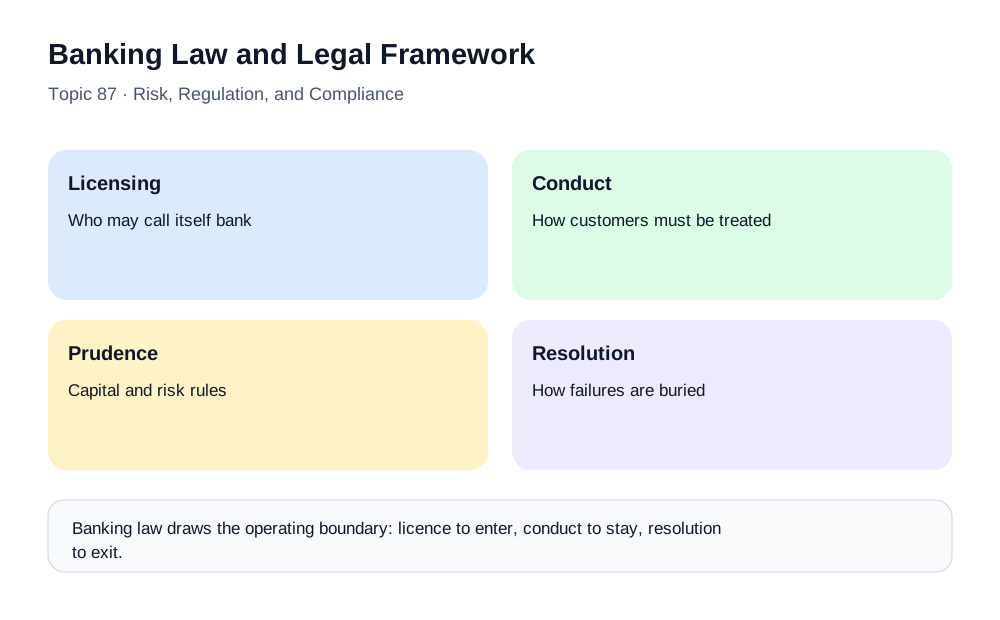
Banking Law and Legal Framework at a glance — Banking Regulation Act, Dodd-Frank, consumer laws.
Banking Regulation Act, Dodd-Frank, and the Laws That Govern Banks
Banks operate within one of the most extensively regulated legal environments of any industry. From the moment of their creation through licensing requirements, to their daily operations governed by prudential standards, to their potential resolution under special bankruptcy regimes, every aspect of banking is shaped by legislation and regulation. Understanding this legal framework is not merely an academic exercise for compliance officers but essential context for anyone seeking to comprehend why banks function as they do and why banking practices vary so substantially across jurisdictions.
The heavy regulation of banking reflects several characteristics that create distinctive public-interest and financial-stability concerns. Ordinary deposits generally create a debtor-creditor relationship rather than a universal fiduciary relationship, yet banks hold funds customers depend on for everyday payments and savings. Banking failures can transmit losses and liquidity stress through payment systems, markets and other institutions. Banks also engage in leveraged maturity and liquidity transformation, while depositors cannot realistically monitor the complete risk of a bank balance sheet. Deposit insurance and other safety-net arrangements can reduce run risk while creating moral-hazard concerns. These factors help explain the extensive legal and supervisory framework around deposit-taking institutions.
In India, the Banking Regulation Act of 1949 serves as the primary legislation governing banking companies. This comprehensive statute establishes the basic parameters within which Indian banks must operate and grants the Reserve Bank of India its supervisory powers. No entity may carry on banking business in India without a license from the Reserve Bank, ensuring that only qualified institutions with adequate capital and management enter the market. The Banking Regulation Act provides core powers and requirements relating to banking companies, including licensing, management, restrictions on certain activities, prudential oversight and other matters. Indian reserve and liquidity requirements arise through the wider statutory and regulatory framework, including the Reserve Bank of India Act, the Banking Regulation Act and RBI directions as applicable. Current CRR, SLR and related operational requirements should therefore be taken from current RBI rules rather than inferred from one historical statutory sentence. The Reserve Bank's inspection powers allow comprehensive examination of any bank's books and affairs, while its authority to issue binding directions enables rapid response to emerging problems. The Act also provides mechanisms for amalgamation of weak banks with stronger institutions, facilitating orderly resolution of troubled institutions.
The Reserve Bank of India Act of 1934 establishes the central bank itself and defines its functions. This legislation grants the Reserve Bank exclusive authority to issue currency notes in India, making it the monopoly supplier of base money. The Reserve Bank of India Act establishes the central bank and provides important monetary, banking and institutional powers, while other statutes and RBI directions complete the framework. Monetary-policy operations, reserve requirements, liquidity requirements, government banking, currency management and liquidity assistance each have their own legal and operational basis. A durable curriculum should avoid implying that every modern instrument, including the SLR or a specific standing facility, derives from one identical provision of the RBI Act. The broad regulatory powers enable supervision and oversight of the entire financial system, including banks, non-banking financial companies, and payment systems.
Beyond these foundational statutes, Indian banking operates under numerous specialized laws. The Securitisation and Reconstruction of Financial Assets and Enforcement of Security Interest Act, 2002 (SARFAESI) provides qualifying secured creditors with statutory mechanisms to enforce eligible security interests subject to the Act, rules, notices, exclusions, borrower rights and available tribunal or court processes. It should not be described as an unconditional power to seize any collateral immediately without legal procedure. The Prevention of Money Laundering Act of 2002 establishes the legal framework for anti-money laundering compliance including know your customer requirements and suspicious transaction reporting. The Negotiable Instruments Act of 1881 governs cheques, promissory notes, and other payment instruments, including the criminalization of cheque dishonor. The Insolvency and Bankruptcy Code of 2016 provides a comprehensive framework for corporate resolution, replacing a fragmented system with time-bound processes that have transformed the approach to distressed assets. The Deposit Insurance and Credit Guarantee Corporation Act of 1961 establishes the deposit insurance framework protecting bank depositors. The Foreign Exchange Management Act of 1999 regulates cross-border transactions and foreign currency operations. The Consumer Protection Act of 2019 extends consumer rights to banking services, providing additional avenues for customer grievances.
The United States banking legal framework has evolved through a series of landmark statutes responding to successive crises. The Glass-Steagall Act of 1933, enacted during the Great Depression, separated commercial banking from investment banking, preventing banks with government-insured deposits from engaging in securities underwriting and trading. This separation was repealed by the Gramm-Leach-Bliley Act of 1999, which authorized universal banking combining commercial, investment, and insurance activities. The Bank Secrecy Act of 1970 established anti-money laundering reporting requirements including currency transaction reports and suspicious activity reports. The Community Reinvestment Act of 1977 requires banks to serve their entire communities including low-income areas, addressing concerns about redlining and discriminatory lending.
The Dodd-Frank Wall Street Reform and Consumer Protection Act of 2010 substantially reshaped US financial regulation after the global financial crisis. Among other changes it established the Consumer Financial Protection Bureau, created or strengthened resolution-planning and systemic-risk arrangements, supported enhanced prudential standards, introduced the Volcker Rule framework and changed derivatives oversight. The scope, thresholds and detailed implementation of stress testing, resolution planning and enhanced requirements have been amended over time, so current Federal Reserve, FDIC, OCC, CFPB and other applicable rules should be used for live US obligations rather than treating the original 2010 framework as unchanged.
European banking regulation operates through a combination of EU-wide directives and regulations plus national implementation. The Capital Requirements Directive and Capital Requirements Regulation implement Basel standards across the European Union, establishing capital, liquidity, and leverage requirements for EU banks. The revised Payment Services Directive facilitates open banking by requiring banks to share customer data with authorized third parties through application programming interfaces. The Markets in Financial Instruments Directive provides investor protection standards for securities markets. The Bank Recovery and Resolution Directive establishes frameworks for resolving failing banks without taxpayer bailouts. The General Data Protection Regulation affects all banking data processing, imposing strict requirements on customer information handling.
The United Kingdom operates a distinctive twin peaks regulatory model following the 2008 crisis reforms. The Prudential Regulation Authority, part of the Bank of England, focuses on safety and soundness of banks and insurers. The Financial Conduct Authority focuses on conduct regulation, ensuring fair treatment of customers and proper functioning of markets. This separation allows specialized expertise in prudential versus conduct supervision while requiring coordination between the two bodies.
Regulatory architecture varies substantially across countries in ways that affect banking operations. India's regulatory architecture assigns the Reserve Bank of India central responsibility for banks and important categories of non-bank financial institutions and payment activity within its statutory remit, while other authorities regulate securities, insurance, pensions, competition, insolvency, consumer matters and other domains. It is therefore more accurate to view Indian banking as operating within a coordinated multi-authority legal framework than as one completely unified regulator for every financial activity. The United States maintains a complex patchwork of federal and state regulators, with the Federal Reserve overseeing bank holding companies, the Office of the Comptroller of the Currency regulating national banks, the Federal Deposit Insurance Corporation supervising state-chartered banks that are not Federal Reserve members, and the Consumer Financial Protection Bureau focusing on consumer protection across all institutions. This overlapping structure creates both redundancy and potential gaps that banks must navigate.
Understanding this legal framework is essential for banking professionals because every business decision occurs within its constraints. Capital requirements limit growth and determine dividend capacity. Activity restrictions define what businesses banks can enter. Consumer protection rules govern product design and marketing. Resolution frameworks shape how banks prepare for potential failure. The framework continues to evolve in response to crises and innovations, requiring continuous attention to remain compliant and competitive.
<!-- MBA-DEEP-DIVE-START -->Deep Dive: Banking Law as the Operating Boundary of a Bank
Banking law is not one universal statute and it is not merely a list of regulations remembered by compliance teams. It is the legal architecture that determines who may operate as a bank, what activities the institution may conduct, how customer money is treated, which prudential standards apply, what supervisors can demand, how payments and data must be handled, how creditors are ranked, and what happens when the bank can no longer remain viable.
The Basel Committee’s revised Core Principles for Effective Banking Supervision, effective from 25 April 2024, provide a useful international reference. They describe minimum standards for a sound supervisory system, including clear supervisory powers, licensing, consolidated supervision, corrective action, corporate governance, risk management, capital, liquidity, operational risk, financial reporting and disclosure. But Basel does not create national banking law. Each jurisdiction implements banking through its own constitution, statutes, regulations, court decisions, administrative rules, supervisory guidance, licences and contractual law.
For practitioners, the essential discipline is therefore to separate international standard, national law, supervisory rule, scheme rule, contract and internal policy. They can point in the same direction while creating different legal obligations.
A bank exists because law defines and licenses it
The word “bank” carries legal significance.
Most jurisdictions restrict deposit-taking or the use of banking titles to authorised institutions. Licensing protects the public because banks accept repayable funds, provide payment services, create credit, and connect directly to financial infrastructure.
A licensing authority normally assesses matters such as:
- ownership;
- capital;
- governance;
- management fitness and propriety;
- business model;
- risk management;
- financial projections;
- operational resilience;
- systems;
- internal controls;
- group structure;
- source of capital.
A licence is therefore not simply permission to launch an app. It is a legal status accompanied by continuing obligations.
Regulatory perimeter matters in modern finance
Not every financial company is a bank.
Payment institutions, e-money issuers, non-bank lenders, securities firms, asset managers, insurers, fintech platforms, credit unions, cooperative institutions and money-service businesses can perform activities that resemble banking while operating under different legal regimes.
The regulatory perimeter asks which activity triggers which licence or rule.
This becomes complex in embedded finance. A technology platform can present the customer experience while a licensed bank actually holds deposits or originates credit. The legal contract should make clear which entity provides which regulated service.
A customer-facing brand cannot erase the licensed entity behind the product.
Legal entity is fundamental to every banking obligation
Large banking groups contain multiple companies.
The group can include a parent holding company, licensed banks in different countries, broker-dealers, asset managers, service companies and finance subsidiaries.
Regulation can apply at several levels:
- individual legal entity;
- banking subgroup;
- consolidated banking group;
- wider financial conglomerate.
A group-wide risk dashboard does not mean cash, capital or licences can be transferred freely between entities.
Contracts, regulators, tax, capital rules, resolution requirements and local law can restrict movement.
Banking systems therefore need a reliable legal-entity dimension in accounts, trades, payments, capital, liquidity and reporting.
Supervisor powers need a clear legal basis
Effective supervision requires more than voluntary cooperation from banks.
The 2024 Basel Core Principles emphasise legal powers allowing supervisors to authorise banks, access information, conduct ongoing supervision, enforce prudential standards and take timely corrective action.
Depending on jurisdiction, supervisors may be able to:
- request records;
- inspect premises;
- require remediation;
- restrict distributions;
- impose additional capital or liquidity requirements;
- remove or challenge management;
- limit activities;
- impose penalties;
- revoke licences;
- trigger or support resolution processes.
The exact power comes from local law.
A bank should know not just what the rule requires but which authority can enforce it and how.
Prudential law and conduct law solve different problems
Prudential regulation focuses primarily on safety and soundness: capital, liquidity, risk management, governance, concentration, resilience and ability to survive loss.
Conduct regulation focuses on how the bank treats customers and markets: disclosure, suitability, sales practices, complaints, fair treatment, market integrity and other obligations.
The same product can create both.
A mortgage can be prudentially risky because of credit and interest-rate exposure. It can be a conduct problem if affordability was assessed poorly or fees were misleading.
Organisationally separating prudential and conduct teams does not separate the underlying customer event.
Consumer protection is encoded in product behaviour
A consumer-protection rule becomes real through system logic.
If law requires disclosure before contract formation, the channel must show the right information at the right time and preserve evidence.
If the customer has a cooling-off right, servicing must support it.
If fees need advance notice, pricing changes need effective dating and communication.
If vulnerable customers require additional support, staff and digital journeys need escalation paths.
Legal compliance is therefore not achieved by publishing terms and conditions that the operating system contradicts.
The contract, screen, ledger and customer-service process should describe the same product.
Contract law is the daily law of banking
Most bank-customer relationships are contractual.
Account terms define how the bank can debit or credit, calculate interest, charge fees, act on instructions, restrict service and close the relationship.
Loan agreements define principal, interest, repayment, covenants, security, events of default and remedies.
Treasury contracts define settlement, collateral, termination and netting.
Payment-service terms define authority, execution, error handling and liability.
A system change can therefore modify contractual behaviour even when no lawyer edits the contract document.
Product owners and analysts need to understand which system rules are legally promised.
Customer authority is a legal control
Before executing an instruction, the bank must know who is authorised to act.
For individuals, authority can come from the account holder, guardian, attorney, executor or other recognised representative.
For companies, authority can come through board resolutions, mandates, powers of attorney and digital entitlements.
A corporate customer may require two authorised users to approve a payment above a threshold.
If technology accidentally lets one user execute alone, the problem is not merely access control. The bank has failed to implement the customer’s legal mandate.
Identity, entitlement and mandate systems are therefore part of banking law in operation.
Confidentiality has legal and contractual dimensions
Banks hold sensitive data on balances, salary, debts, investments, beneficiaries and business activity.
Duties of confidentiality can arise from contract, common law, statute, professional obligations and data-protection law depending on jurisdiction.
Confidentiality is not absolute. Banks can be required to disclose information to regulators, courts, tax authorities, financial-intelligence units or law enforcement under lawful powers.
The control objective is authorised and proportionate disclosure.
An employee should not access an account merely out of curiosity, while the bank should also be capable of responding to a valid legal demand within the required time.
Data-protection law changes system design
Digital banking processes identity, transaction, behavioural, device and sometimes location data.
Data-protection frameworks can impose requirements around legal basis, transparency, purpose limitation, data minimisation, retention, security, rights of individuals, international transfer and breach notification.
The exact rights and obligations differ internationally.
A bank therefore needs a data inventory that answers:
- what data is collected;
- why it is used;
- where it is stored;
- who can access it;
- who receives it;
- how long it is retained;
- which legal entity is responsible.
Data architecture becomes legal architecture.
Bank secrecy and data privacy are not identical
Some jurisdictions have specific bank-secrecy rules governing disclosure of customer financial information. Data-protection law can impose broader obligations across personal information.
A disclosure permitted under one framework can still require analysis under another.
Banks should avoid simplifying every privacy question to “customer consent.”
Processing can be required by law, necessary for contract, based on legitimate interests where recognised, or rely on other legal bases depending on jurisdiction.
Using consent where the customer has no real choice can be legally inappropriate.
Banking law defines property and security rights
Lending depends heavily on enforceability.
A mortgage, pledge, charge, assignment or other security interest is useful only if it is validly created and, where required, perfected or registered.
Priority matters because several creditors can claim the same asset.
Operations should therefore know:
- what collateral exists;
- who owns it;
- which legal entity has security;
- whether registration is complete;
- priority;
- expiry or renewal requirements;
- valuation;
- insurance;
- release conditions.
A credit system showing “secured = yes” is not enough.
Collateral enforcement depends on law, not only contract wording
Even a strong security agreement operates inside local enforcement law.
Some assets can be enforced quickly. Others require notice, court action, administrator involvement or statutory procedure.
Consumer collateral can have additional protections.
Cross-border assets can create conflict-of-law and recognition issues.
Recovery estimates should therefore consider legal time, cost and certainty rather than assume market value equals cash recovery.
Legal enforceability influences credit LGD and pricing long before default.
Insolvency changes bilateral rights into collective rights
When a corporate customer becomes insolvent, the bank may no longer act independently as if it were the only creditor.
Insolvency law can impose stays, claim procedures, voting, creditor classes, priority waterfalls and rules on security enforcement.
A payment received shortly before insolvency can sometimes be challenged under preference or avoidance rules depending on jurisdiction.
The bank must understand the legal process before taking aggressive recovery action.
Insolvency teams need accurate claim, collateral, guarantee and transaction histories.
Bank insolvency is usually special
Ordinary corporate insolvency is often unsuitable for deposit-taking banks because banks provide critical payment and financial services and can transmit contagion.
Many jurisdictions therefore have special bank resolution frameworks.
Resolution tools can include:
- transfer to a purchaser;
- bridge institution;
- asset separation;
- bail-in where legally available;
- deposit transfer;
- liquidation under a special regime.
Resolution law determines which authority acts, creditor safeguards, hierarchy and funding mechanisms.
The objective is often to maintain critical functions while allocating losses according to law.
Recovery planning happens before non-viability
Recovery is a bank-management responsibility before formal resolution begins.
A recovery plan identifies actions the institution can take under severe stress, such as:
- raising capital;
- selling assets;
- reducing risk;
- changing funding;
- conserving liquidity;
- selling businesses;
- restricting distributions.
Each action needs legal and operational feasibility.
A plan that assumes an asset sale requiring six months of regulatory approval cannot count the full proceeds as an immediate liquidity action.
Legal teams therefore participate in recovery planning before a crisis.
Resolution planning requires legal structure clarity
Authorities need to know which entity owns assets, employs staff, holds licences, operates systems, owns intellectual property and signs service contracts.
Complex intra-group dependencies can block resolution.
For example, a critical payment platform might legally belong to a service company outside the bank being resolved. If the service agreement terminates automatically on insolvency, critical operations could fail.
Resolution planning therefore examines operational continuity, not merely capital structure.
Contracts may require resolution-resilient clauses or service arrangements under local rules.
Payment law defines execution responsibilities
Payment services are governed by national statutes, regulations and scheme rules.
Legal questions can include:
- who authorised the payment;
- when the instruction is received;
- when it becomes irrevocable;
- execution time;
- liability for unauthorised transactions;
- refund rights;
- information requirements;
- error resolution;
- finality.
The customer may see one “send” button, but the legal event can pass through several stages.
Payment-system design should therefore distinguish customer acceptance, bank execution, interbank settlement and beneficiary credit.
Settlement finality is a legal concept
Payment and securities infrastructures need certainty about when settlement becomes final and cannot be unwound simply because one participant later fails.
Settlement-finality laws and system rules reduce systemic risk by defining protected transfers and netting arrangements.
Without legal finality, insolvency law could create uncertainty about payments already processed through a system.
Technology status alone does not define finality.
A database saying SETTLED must correspond to the legal and scheme meaning of settlement in that infrastructure.
Netting depends on enforceability
Banks use netting in derivatives, securities financing, payments and other relationships.
If Bank A owes Bank B ₹100 and Bank B owes Bank A ₹90, enforceable netting can reduce exposure significantly.
But prudential recognition depends on legal certainty.
A master agreement needs to be enforceable in the relevant jurisdictions and circumstances, including insolvency.
Banks often obtain legal opinions to support netting treatment.
The risk system should know which agreements and counterparties qualify rather than net exposures merely because they share a customer identifier.
Financial collateral law affects market infrastructure
Repos, derivatives and clearing use collateral extensively.
Legal frameworks determine creation, perfection, reuse, enforcement and priority of collateral rights.
Central counterparties and clearing members also operate under detailed rulebooks and default-management frameworks.
Collateral systems therefore need legal agreement, account, asset and eligibility data.
A security that is economically valuable can be unusable as collateral if the bank lacks a perfected interest or the agreement does not permit the intended use.
Securities law creates another regulatory layer
Banks can act as issuers, brokers, dealers, custodians, advisers, underwriters and investors.
Those activities can trigger securities-market law in addition to banking law.
Rules can cover:
- market abuse;
- investor protection;
- suitability;
- disclosure;
- best execution;
- custody;
- conflicts;
- prospectuses;
- trading venues.
A universal bank therefore operates under multiple regulatory regimes simultaneously.
Product governance should map the complete legal perimeter rather than assume the banking licence covers everything.
Market abuse rules apply to bank employees too
Bank staff can receive confidential information about customers, financings, mergers or securities transactions.
Trading or tipping using inside information can breach market-abuse law.
Banks need information barriers, restricted lists, personal-account-dealing controls and surveillance where applicable.
A corporate relationship manager should not be able to use confidential acquisition information learned through lending discussions for personal trading.
Legal duties therefore shape internal access and employee conduct.
Competition law matters in banking markets
Banks compete on deposits, credit, payments, cards, securities and data services.
Competition law can prohibit collusion, market allocation, anti-competitive agreements or abuse of dominance.
Industry collaboration is still necessary for payment standards, fraud intelligence and financial stability, but it needs legal boundaries.
A meeting of banks discussing a new payment scheme can be legitimate; discussing coordinated customer pricing can create serious competition-law risk.
Governance should distinguish cooperative infrastructure from competitive commercial decisions.
Consumer credit law affects underwriting and collections
Retail lending can be subject to affordability, disclosure, interest, fee, collection, credit-reporting and fair-lending requirements.
Exact rules vary by jurisdiction and product.
A technically correct credit model can still create legal risk if it uses prohibited discrimination or fails to provide required notices.
Collections can create legal and conduct risk if agents harass customers, contact prohibited parties, disclose debts publicly or ignore hardship protections.
Credit lifecycle design therefore includes legal constraints from origination through recovery.
Fair lending and anti-discrimination law affect model inputs
Banks should know which protected characteristics and discrimination standards apply in the jurisdictions where they lend.
An automated model can create disparate or unlawful outcomes even when no developer intentionally encodes discrimination.
Proxy variables, data quality and historical bias matter.
Legal, risk, data science and model-validation teams should collaborate before deployment.
Explainability is also important where customers have rights to reasons or adverse-action information.
AML law creates mandatory gatekeeping duties
Banking law intersects with anti-money-laundering frameworks.
Banks can be required to conduct customer due diligence, identify beneficial owners, keep records, monitor activity, report suspicion, apply targeted financial sanctions and support competent authorities.
FATF provides the international standard, but national law creates the enforceable duty.
A global bank therefore needs a group framework plus jurisdiction-specific procedures.
One global KYC policy cannot simply overwrite stricter or different local requirements.
Sanctions law can have extraterritorial effects
Sanctions obligations depend on the legal nexus of the bank, currency, employees, branches, counterparties and transaction.
A global payment can therefore implicate more than one sanctions regime.
Banks should not treat sanctions as one universal list.
Legal analysis determines which regime applies and what action is required.
Operations then need to implement blocking, rejecting, freezing, reporting or licensing requirements correctly.
A false legal assumption can cause either prohibited dealing or unnecessary customer harm.
Foreign-exchange controls are jurisdiction-specific
Some countries allow broad currency convertibility; others restrict certain capital or current-account transactions.
Banking law can require purpose codes, documentary evidence, approvals, limits or reporting for cross-border activity.
A payment message containing valid beneficiary details does not itself prove that the underlying foreign-exchange transaction is legally permitted.
Banks therefore maintain exchange-control rules separately from payment formatting.
The customer's residency, transaction purpose and capital-account nature can affect eligibility.
Tax law enters routine banking operations
Banks deduct withholding tax, report customer information, support tax-authority orders, calculate tax on certain products and comply with international information-exchange frameworks.
Tax residence is not always the same as immigration or exchange-control residence.
A customer can therefore have multiple residency concepts in bank data.
Systems should distinguish them rather than use one generic country_of_residence field for every legal purpose.
Tax data can also be highly sensitive and subject to specific reporting rules.
FATCA and CRS illustrate cross-border legal implementation
International tax transparency can require banks to identify tax residence and report financial-account information under applicable frameworks.
The United States Foreign Account Tax Compliance Act and the OECD Common Reporting Standard operate differently but both affect customer onboarding and reporting internationally.
Banks need self-certifications, tax identifiers, entity classification, controlling-person data and change-of-circumstance procedures where applicable.
A KYC refresh can therefore trigger tax-reporting consequences even when AML risk remains unchanged.
Outsourcing does not outsource regulated responsibility
Banks use cloud providers, processors, call centres, software vendors and fintech partners.
Supervisors increasingly require banks to retain effective oversight, access to information, resilience and exit capability.
The 2024 Basel Core Principles explicitly reinforce attention to third-party dependencies and operational resilience.
Contracts should address:
- audit and access rights;
- data location;
- confidentiality;
- subcontracting;
- incident notification;
- business continuity;
- regulatory cooperation;
- termination;
- data return or deletion.
A vendor contract is therefore part of prudential control.
Cloud contracts need legal and technical alignment
Cloud services can support resilience and scalability, but responsibility remains with the regulated bank.
Legal teams should understand architecture sufficiently to negotiate meaningful controls.
A contractual right to retrieve data is weak if the bank cannot technically export it in a usable form.
A requirement for regulator access is weak if subcontractors fall outside the clause.
Technology and legal teams should therefore review material outsourcing together.
Cyber incidents can create legal notification duties
A cyber event can trigger banking-supervisory, data-protection, securities, consumer and law-enforcement obligations simultaneously.
Each framework can use different materiality thresholds and notification timelines.
Incident response should therefore include a legal-notification matrix.
The first technical diagnosis might change as more facts emerge, so the bank needs governance for preliminary and updated notifications.
Late legal escalation can turn a manageable cyber incident into a regulatory breach.
Record retention is more than storage
Banks retain customer, transaction, credit, communication and compliance records for legal and regulatory reasons.
Different record types can have different retention periods and legal holds.
A simple policy saying “keep everything forever” creates privacy, cost and discovery risk.
A system saying “delete after five years” can also be wrong if litigation or investigation requires a hold.
Retention needs classification, effective dates, legal hold, secure disposal and evidence of deletion.
Archives should remain searchable enough to support investigations and disputes.
Electronic signatures require legal validity and evidence
Digital onboarding increasingly replaces handwritten signatures with electronic consent, digital signatures, authentication, biometrics or other mechanisms.
The legal question is not whether the screen looked modern. It is whether the method creates enforceable evidence under applicable law.
The bank should preserve:
- identity;
- document version;
- timestamp;
- authentication method;
- consent event;
- relevant device or session evidence;
- delivery of terms where required.
A signed PDF stored without the surrounding audit trail can be weaker evidence than the bank expects.
Automated decisions can create legal accountability questions
Credit scoring, fraud controls, transaction monitoring and customer-service systems increasingly use automated models.
Applicable law can impose requirements around fairness, explainability, human review, data quality or customer rights.
Even where no AI-specific banking law applies, existing consumer, discrimination, privacy and prudential rules still apply to the outcome.
A bank should therefore avoid the argument that “the model decided” as if automation removed institutional responsibility.
Governance should identify the legal owner of automated decisions.
Complaints are legal and control evidence
Customer complaints can reveal systemic breaches.
Repeated complaints about a fee, account freeze, payment rejection or loan collection can show that system behaviour differs from contract or law.
Banks should classify complaints by root cause and feed material patterns into product, legal, compliance and operational-risk governance.
A complaint team that resolves every case individually without identifying the common system defect misses valuable evidence.
Regulators can also use complaint trends as supervisory signals.
Regulatory reporting has legal consequences
Banks submit prudential, statistical, financial-crime, tax, payment and other reports to authorities.
A report is not merely management information. It can be a formal legal submission signed or attested by responsible officers.
Data lineage, reconciliation and approval therefore matter.
Repeated manual adjustments with no root-cause remediation can create governance concerns even when the final number is correct.
The bank should know which source systems support each material regulatory field.
Supervisory findings need controlled remediation
When a regulator identifies a weakness, the bank needs more than an action-plan spreadsheet.
A credible remediation should define:
- issue;
- root cause;
- affected population;
- risk while remediation is underway;
- owner;
- target state;
- evidence;
- testing;
- sustainable closure.
Closing an audit or regulatory issue because a policy was rewritten is weak if the system behaviour remains unchanged.
Independent validation of closure can be appropriate for material findings.
Regulatory change should map rule to system behaviour
Banking law changes continuously.
A regulatory-change function should capture official changes, determine applicability, assign ownership, interpret requirements, identify affected products and systems, implement controls, test them, train staff and retain evidence.
A strong traceability chain looks like:
legal requirement → policy → business rule → system/process control → test → evidence.
This allows internal audit and supervisors to verify not only that the bank read the rule but that operations actually changed.
Cross-border branches create home-host questions
A bank operating internationally can be supervised by both home and host authorities.
Branches and subsidiaries have different legal characteristics.
A branch can be part of the same legal bank while a subsidiary is a separate legal entity.
This affects capital, liquidity, deposit insurance, resolution, governance and customer contracts.
Home-host cooperation is therefore central to global bank supervision, as reflected in the Basel Core Principles.
Systems should preserve booking entity and branch accurately for reporting and legal rights.
Consolidated supervision prevents risk hiding outside the bank
Risk can be transferred to affiliates through guarantees, service arrangements, derivatives or funding.
Supervisors therefore consider banking groups on a consolidated and group-wide basis where the framework requires.
A bank cannot safely evaluate itself while ignoring a parent, finance subsidiary or service entity whose failure could damage it.
Related-party transactions need particular governance because conflicts can weaken arm’s-length discipline.
Legal-entity mapping, ownership and intercompany exposure are core prudential data.
Related-party lending requires special controls
Loans to directors, owners, affiliates or connected parties can create conflicts of interest.
Many banking regimes restrict or require enhanced governance for such exposures.
The risk is that insiders obtain favourable credit terms or avoid normal underwriting.
Systems should identify related parties and connected groups before approval.
A relationship discovered only during annual reporting is too late for preventive control.
The exact legal definition and limits must come from local law.
Licensing conditions continue after authorisation
Regulators can impose conditions or expectations that affect growth, activities, capital, governance or systems.
A bank should therefore maintain a register of licence conditions and supervisory commitments.
A product team can unintentionally breach a condition if it launches a service the regulator has restricted.
Corporate actions such as acquisition, change of control, branch opening or outsourcing can also require notification or approval.
Regulatory affairs should be integrated into strategic planning.
Board duties sit above regulatory checklists
Directors owe duties under corporate and banking law applicable to their jurisdiction.
Bank boards also carry prudential expectations for governance, risk appetite, internal controls and oversight.
The board cannot delegate responsibility simply because a risk committee or management function exists.
It needs sufficient information and expertise to challenge management.
A board pack containing hundreds of pages without clear risk decisions can satisfy form while failing substance.
Senior manager accountability can be explicit
Some jurisdictions impose specific accountability regimes on senior banking managers.
These can require mapped responsibilities, fitness and propriety, conduct standards and personal accountability for reasonable steps.
Even where no named regime exists, banks benefit from clear ownership.
A material regulatory obligation should have a responsible executive rather than disappear between legal, compliance, operations and technology.
Responsibility maps also help during incidents when rapid decisions are required.
Enforcement risk includes remediation cost, not only fines
Regulatory breaches can produce:
- monetary penalties;
- licence restrictions;
- business limitations;
- customer remediation;
- restitution;
- capital add-ons;
- management changes;
- independent monitors;
- technology programmes;
- litigation;
- reputational damage.
The remediation programme can cost more than the headline fine.
Legal risk should therefore be considered in product and change decisions before launch rather than treated as a cost of enforcement afterward.
Legal opinions are controlled risk evidence
Banks obtain legal opinions for issues such as netting, collateral, enforceability, cross-border activity and regulatory interpretation.
An opinion has assumptions and scope.
A system should not continue relying on an old opinion after contract terms or law change materially.
Legal-opinion inventories can include jurisdiction, product, agreement type, date, assumptions, conclusion and review trigger.
This is especially important when prudential capital relies on legal enforceability.
Terms and conditions need version control
A bank can have millions of customers on different historical versions of product terms.
When terms change, the institution should know:
- which version applies to which customer;
- effective date;
- notice given;
- consent if required;
- grandfathered provisions;
- system behaviour.
Customer service should not quote today’s website terms to a customer whose contract follows an older version.
Document management and product configuration therefore need a common effective-date model.
Manual overrides can create legal exceptions
Staff can waive fees, release holds, change interest, override limits or adjust customer status.
Overrides can be legitimate but should not silently bypass legal or contractual rules.
The system should distinguish discretionary commercial authority from controls that cannot be overridden without specific approval.
Maker-checker, reason codes, evidence and monitoring are important for high-risk overrides.
Repeated overrides can reveal that the product or policy is badly designed.
A payment dispute example
A customer says a digital transfer was unauthorised.
The bank cannot decide the case by observing that the correct one-time password was entered.
It should reconstruct authentication, device history, login, beneficiary creation, fraud alerts, customer communication and the applicable legal liability framework.
Social engineering can cause customers to authenticate transactions they did not understand.
The legal outcome depends on local payment law and facts.
Technology evidence supports the decision; it does not replace legal analysis.
A secured-loan example
A bank approves a large property-backed corporate loan.
Credit assumes first-ranking security. Legal documentation is signed, but a required registration is missed.
Years later the borrower fails and another creditor has priority.
The original underwriting spreadsheet can show excellent collateral coverage while the bank’s actual legal recovery is weak.
This demonstrates why legal perfection is part of credit risk, not post-default administration.
A regulatory-change example
A regulator changes customer-disclosure requirements for a loan product.
The change affects more than the legal document.
The bank must update website content, mobile screens, branch scripts, sales training, pre-contract disclosures, archive evidence, complaints handling and testing.
If one channel continues using the old disclosure after the effective date, compliance is incomplete.
A mature bank therefore manages regulatory change across customer journeys rather than only policy libraries.
What excellent banking-law implementation looks like
A world-class bank knows the legal entity providing every regulated service, which licence supports it, which supervisor has authority, and which customer contract applies. Prudential rules are separated from conduct rules but connected in product governance. Security interests are legally perfected. Payment status aligns with settlement-finality law. Netting and collateral treatment are supported by current legal opinions. Data privacy, AML, sanctions, tax and consumer rules are implemented in systems rather than left in policy documents.
The bank also maintains legal traceability through change. New regulations map to business rules, controls and tests. Terms are versioned. Outsourcing contracts preserve regulatory access and resilience. Supervisory findings are remediated to sustainable closure. Recovery and resolution plans reflect actual legal entities and service dependencies.
The deepest lesson is that banking law is not a fence around the bank. It is part of the machinery inside the bank. Authority to debit an account, a mortgage registration, a sanctions hold, a liquidity requirement, a customer disclosure, a netting set, a payment-finality rule and a resolution transfer all become fields, states, approvals and evidence in operational systems. Banking becomes legally reliable only when those systems behave exactly as the law, contract and supervisory framework require.
Practical Continuation: Translating Banking Law into Everyday Controls
Banking law becomes operational when legal obligations are converted into account rules, approval limits, customer terms, system validations, evidence and escalation. A bank can understand a statute correctly in principle and still create risk if the requirement is not embedded consistently across products, channels and legal entities.
The first question is always which legal entity is acting
Large banking groups often contain multiple regulated entities. A customer may see one brand while the underlying service is provided by a bank, broker, payment institution, finance company or another group entity. The legal rights, licences, prudential rules and customer protections can therefore differ.
Contracts, disclosures and systems should identify the entity that provides the service and the jurisdiction whose law applies. Product teams should not assume that a process approved for one subsidiary automatically works for another. Cross-border booking models, branches and passporting or licensing arrangements require explicit legal analysis.
Regulation and contract work together
A banking relationship is shaped by both mandatory law and agreed terms. The contract can define fees, interest calculation, notice periods, security rights, mandates and service conditions, but it cannot lawfully remove protections that legislation makes mandatory.
Operational teams therefore need to know which rules are contractual choices and which are legal requirements. This matters when changing terms. A pricing change can require notice under the contract, consumer law or both. A system release should not assume that technical capability equals legal authority.
Authority to act must be represented accurately
Banks deal with natural persons, companies, partnerships, trusts, estates and public bodies. The person giving an instruction may be the customer, a director, trustee, authorised signatory, attorney or other representative. The legal capacity of that person matters.
Mandate data should therefore capture who can act, for which account or product, within which limits, and from which effective date. Changes should be evidenced and historically traceable. If two directors must sign jointly, a digital channel should not accidentally allow one user to approve alone merely because the entitlement model is too simple.
Security interests require disciplined documentation
Lending frequently depends on collateral, guarantees or other forms of credit support. The existence of an asset does not by itself mean the bank has an enforceable security interest. Documentation, perfection, registration, priority and local-law requirements can determine whether the bank's rights are effective against the borrower and third parties.
Credit operations should therefore maintain evidence that required legal steps were completed. Expiry dates, registration renewals, insurance, valuations and covenant conditions may need monitoring. A loan system that stores only “secured = yes” can give a false sense of protection if the legal security was never properly created or has become defective.
Customer money and bank money must not be confused
Different legal arrangements can determine whether funds are ordinary deposits, safeguarded client money, custodial assets, escrow balances or something else. Those distinctions affect insolvency treatment, customer rights, reporting and operational handling.
Product design must therefore identify the legal nature of the customer's claim before deciding how to book the balance. Ledger labels should reflect substance rather than marketing terminology. If a fintech interface calls something an “account,” the underlying legal arrangement still needs to be clear to the bank and customer.
Confidentiality has controlled exceptions
Banks are expected to protect customer information, but legal systems can also require disclosure to regulators, courts, law-enforcement bodies, tax authorities or other authorised recipients. Data-sharing rules can also permit or restrict transfers within a banking group or to service providers.
The practical control is not “never disclose.” It is to disclose only through an authorised legal basis and process. Requests should be authenticated, scoped, approved where required and recorded. Staff should not send customer data merely because a request looks official, nor should they refuse a lawful order because they misunderstand confidentiality as absolute.
Record retention needs a defensible rule set
Different laws can require different retention periods for contracts, transaction records, KYC evidence, complaints, tax information and regulatory submissions. Retaining everything forever can create privacy and storage risks, while deleting too early can destroy legally required evidence.
Banks should therefore maintain a retention schedule linked to legal categories and jurisdictions. Systems need legal holds so that records relevant to litigation, investigation or regulatory action are preserved even when the normal deletion date arrives. Disposal should be controlled and auditable.
Complaints can create legal and conduct obligations
A complaint is more than a customer-service inconvenience. Depending on the jurisdiction and product, it can trigger response deadlines, escalation, ombudsman rights, compensation analysis, root-cause review or regulatory reporting.
Banks should define what counts as a complaint and make sure front-line staff do not reclassify dissatisfaction merely to avoid service-level metrics. The case record should preserve the customer's issue, investigation, evidence, decision, remedy and communication. Repeated complaints can reveal a systemic legal or product problem that individual case closure would miss.
Outsourcing does not outsource legal responsibility
Banks use cloud providers, payment processors, call centres, data vendors and other third parties. A contract can allocate tasks and liability between firms, but the bank generally remains responsible for meeting the legal and regulatory obligations that apply to its regulated activity.
Legal review should therefore connect with operational resilience, information security, data protection, audit rights, subcontracting, exit planning and regulatory access. A beautifully drafted contract is insufficient if the bank cannot actually retrieve data, migrate the service or supervise the provider in practice.
Legal change requires implementation evidence
When a new law or regulation becomes effective, the bank needs to identify impacted products, entities, customers, processes, systems, documents and reports. Legal interpretation should become an implementation requirement with a clear owner and effective date.
Testing should prove that the rule works in operational scenarios. If a disclosure must be shown before a customer commits, testing should confirm the sequencing, not merely the wording. If a restriction applies only to a category of customer, customer classification and eligibility logic must be tested as well.
Front-line judgement needs escalation boundaries
Employees regularly face situations where policy does not give an obvious answer: a disputed mandate, unusual court document, deceased customer, conflicting ownership claim, sanctions-related restriction, vulnerable customer or cross-border instruction. Staff should know when they can decide and when Legal, Compliance or another specialist must be involved.
Good escalation is not weakness. It prevents informal legal interpretations from spreading through operations. Decisions on unusual cases should also be captured so that precedent, training and policy can improve.
A professional banking-law operating standard
A mature bank can trace important legal obligations from source rule to policy, contract, system control, procedure and evidence. It knows which entity is acting, who is authorised, what customer rights apply, what data may be used, which records must be retained, and how exceptions are governed.
That discipline is what makes banking law usable. The legal text establishes rights and duties; the bank's operating model determines whether those rights and duties are actually respected in millions of everyday transactions.
<!-- MBA-DEEP-DIVE-END -->