Visual overview
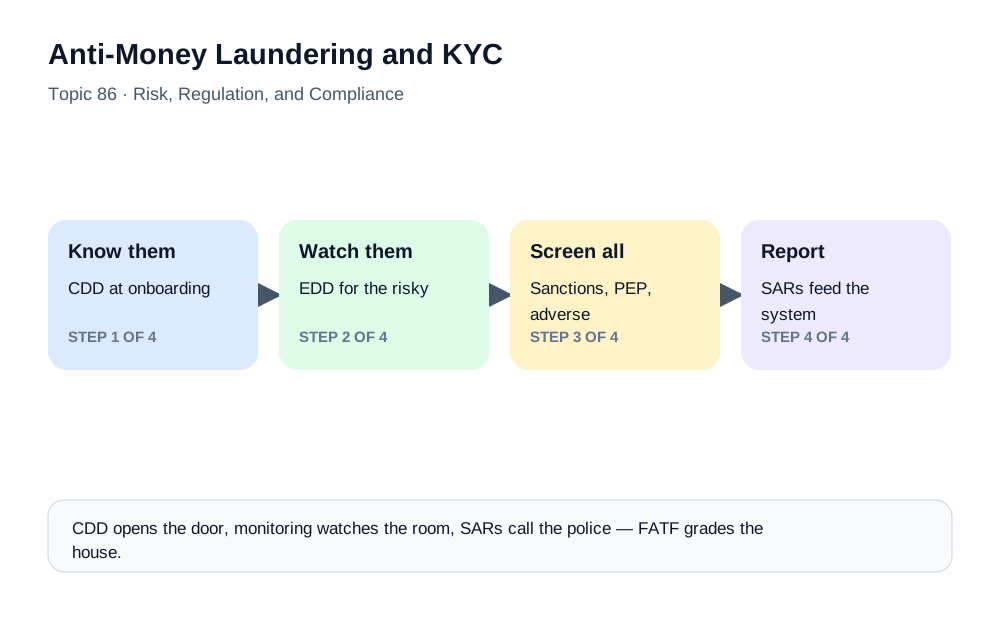
Anti-Money Laundering and KYC at a glance — CDD, EDD, SAR, sanctions screening, FATF.
CDD, EDD, SAR, Sanctions Screening, and FATF
Anti-money laundering and know your customer requirements constitute a fundamental responsibility of modern banking. Financial institutions serve as the primary gatekeepers between illicit funds and the legitimate economy, making them the first line of defense against money launderers, terrorist financiers, sanctions evaders, and other financial criminals. The cost of compliance is substantial, requiring massive investments in personnel, technology, and processes. The cost of failure is potentially existential, as evidenced by the billion-dollar fines and destroyed reputations that have followed major compliance breakdowns. Understanding the framework, processes, and stakes of AML compliance is essential for every banking professional.
Money laundering transforms the proceeds of criminal activity into apparently legitimate funds that can be used without attracting attention. This process typically occurs in three stages that financial institutions must detect and disrupt. Placement introduces cash into the financial system, often the most vulnerable stage for detection as criminals must explain the source of large cash deposits. Structuring deposits in amounts below reporting thresholds, using multiple accounts at different institutions, and purchasing monetary instruments such as money orders are common placement techniques. Layering creates complex webs of transactions designed to obscure the audit trail and sever the connection between funds and their criminal origins. Moving money through shell companies in multiple jurisdictions, converting between currencies and assets, and creating artificial transactions all serve to confuse investigators. Integration returns the laundered money to the criminal in a form that appears legitimate, such as business profits, investment returns, or loan proceeds, completing the cycle and making the funds available for use.
The scale of illicit finance is inherently difficult to measure because successful laundering is designed to remain hidden. Historic global estimates are often repeated as if they were precise current measurements, but they should be treated cautiously. For banks, the relevant conclusion does not depend on one global dollar estimate: money laundering, terrorist financing, proliferation financing, fraud proceeds, corruption and other predicate crimes create material risks that require effective risk-based controls and continuous adaptation to new typologies.
Know your customer forms the foundation of effective AML compliance. This process requires banks to establish and verify the identity of their customers, understand the nature of their business, and assess the risk they present for money laundering or terrorist financing. Effective KYC addresses fundamental questions about who the customer is, what the source of their funds may be, why they are opening the account, and what transaction patterns would be expected given their stated circumstances. This understanding provides the baseline against which unusual or suspicious activity can be identified.
Customer due diligence exists at multiple levels depending on assessed risk. Simplified due diligence applies to low-risk customers such as small accounts with limited functionality or customers from low-risk jurisdictions, requiring only basic identification information. Standard due diligence applies to normal retail and commercial relationships, requiring identity verification through government-issued documents, address confirmation, occupation details, and understanding of expected transaction types and volumes. Enhanced due diligence applies to high-risk customers and requires substantially deeper investigation including detailed source of wealth documentation, beneficial ownership identification for corporate customers, ongoing transaction monitoring with lower alert thresholds, and senior management approval for relationship establishment.
Enhanced measures apply when required by the applicable legal framework or when the bank's risk assessment identifies higher money-laundering or terrorist-financing risk. Politically exposed persons, higher-risk jurisdictions, correspondent banking, complex ownership structures, cash-intensive activity and other factors can require additional controls, but the exact treatment is jurisdiction-specific and should not be reduced to one universal list of customers that are automatically rejected or handled identically. Enhanced due diligence should address the actual risk—for example source of wealth for a PEP, ownership for a complex company, or downstream relationships for correspondent banking.
KYC is not a one-time exercise at account opening but a continuous obligation. Transaction monitoring systems apply automated rules and increasingly artificial intelligence to identify patterns that deviate from established baselines. Significant changes in transaction volume, type, or geography trigger alerts for investigation. Periodic refreshes of customer information ensure that files remain current with changes in address, employment, or business activities. Name screening against updated sanctions lists, adverse media databases, and politically exposed person registries identifies new risks that may have emerged since account opening. Unusual activity identified through any of these processes is escalated for review and potential reporting.
When suspicious activity is identified, banks must file reports with financial intelligence units without alerting the customer. In India, suspicious transaction reports are filed with the Financial Intelligence Unit of India. In the United States, suspicious activity reports go to the Financial Crimes Enforcement Network. The United Kingdom's National Crime Agency and similar bodies in other jurisdictions receive these reports. Many jurisdictions prohibit or restrict tipping off a customer that a suspicious report has been filed or that specified investigative activity is underway. The precise offence, exceptions and permitted communications depend on local law. Banks therefore need approved customer-communication and escalation procedures so staff protect investigative confidentiality without inventing explanations or disclosing information that the law requires them to keep confidential.
The Financial Action Task Force is the principal international standard-setter for anti-money laundering, counter-terrorist financing and counter-proliferation-financing measures. Its Recommendations are updated over time; the current consolidated Recommendations were amended in June 2026 for this course's review date. FATF mutual evaluations assess both technical compliance and effectiveness, and FATF publishes statements on jurisdictions under increased monitoring and high-risk jurisdictions subject to a call for action. Informal labels such as ‘grey list’ and ‘black list’ are widely used externally, but banks should rely on the current official FATF statements and their own jurisdiction's legal requirements when determining enhanced measures or countermeasures.
Sanctions screening represents a distinct but related compliance obligation. Banks must ensure they do not transact with individuals, entities, or countries subject to international sanctions. The United States Office of Foreign Assets Control maintains the Specially Designated Nationals list that includes terrorists, narcotics traffickers, and sanctions evaders. The European Union, United Kingdom, and United Nations maintain comparable lists. Screening must examine not only direct counterparties but also beneficiaries, intermediaries, and in trade finance contexts, vessels and aircraft involved in transactions. The high frequency of common names creates substantial false positive burdens, requiring sophisticated systems and manual review to clear alerts without missing genuine matches.
The penalties for AML failures have reached unprecedented levels, demonstrating regulatory determination to enforce compliance. HSBC paid one point nine billion dollars in 2012 for failures that allowed Mexican drug cartels to launder money through its systems. Danske Bank faced two billion dollars in penalties for two hundred billion euros of suspicious flows through its Estonian branch. Standard Chartered paid one point one billion dollars for sanctions violations involving Iran and Myanmar. Westpac's one point three billion Australian dollar penalty in 2020 addressed twenty-three million compliance violations. These amounts, while substantial, may understate the true cost when reputational damage, remediation expenses, and business restrictions are included.
Anti-money laundering and customer due diligence are core banking controls rather than peripheral compliance exercises. Criminal methods, payment technology, customer behaviour and regulation continue to evolve, so banks need evidence that their controls are effective rather than merely documented. The strongest programmes connect customer understanding, beneficial ownership, screening, transaction monitoring, investigations, suspicious reporting, governance, data quality and ongoing review into one risk-based operating model.
<!-- MBA-DEEP-DIVE-START -->Deep Dive: AML and KYC as a Customer-and-Transaction Control System
Anti-money laundering and customer due diligence are often taught as document collection: obtain identity evidence, screen a name, assign a risk rating, and refresh the file periodically. Real banking is much broader. An effective AML/CFT framework connects who the customer is, who ultimately owns or controls the relationship, what economic activity is expected, where money comes from, where it goes, which parties participate, which risks change over time, and what the bank does when observed behaviour no longer makes sense.
The Financial Action Task Force’s Recommendations, last amended in October 2025, remain the principal international standard for combating money laundering, terrorist financing and proliferation financing. FATF deliberately sets a risk-based global framework rather than one identical operating rule for every country. National law determines exact customer-identification requirements, reporting thresholds, record-retention periods, suspicious-reporting procedures, sanctions obligations, tipping-off offences, and supervisory expectations.
For a bank, the most important principle is therefore risk-based understanding supported by evidence. The objective is not to collect the largest possible number of documents. It is to know enough about the customer and activity to identify when the relationship is being used in a way that creates unacceptable financial-crime risk.
Money laundering is not one fixed three-step process
Placement, layering and integration are useful teaching concepts, but real laundering does not always move neatly through three visible stages.
Criminal proceeds can enter the financial system electronically rather than as cash. Fraud proceeds can originate inside a bank account already. Trade transactions can disguise value through invoices rather than obvious transfers. Digital assets, shell companies, professional intermediaries, gambling, securities, real estate, cash-intensive businesses, and money-service providers can all create different pathways.
The bank should therefore avoid building controls only around one historical laundering model.
The practical question is: what criminal or prohibited financial purpose could this product, customer, corridor, counterparty, or transaction structure enable?
That approach leads naturally to risk assessment.
Enterprise financial-crime risk assessment comes before customer scoring
A bank should understand its own inherent exposure before deciding whether one customer is high or low risk.
Relevant dimensions can include:
- customer segments;
- products;
- delivery channels;
- countries and corridors;
- legal entities;
- correspondent relationships;
- cash usage;
- trade finance;
- private banking;
- digital onboarding;
- payment speed;
- intermediaries;
- complex ownership structures;
- new technologies.
A domestic salary account and a global correspondent bank do not create the same risk. Neither should be controlled with the same depth merely for consistency.
The enterprise assessment helps determine control intensity, staffing, monitoring, onboarding rules, and risk appetite.
KYC begins with identifying the legal customer
The bank first needs to know who is entering the relationship.
For an individual, this typically means identity, date of birth, address or other contact information, and verification using reliable evidence according to local law.
For a company, the bank needs the legal entity, registration, business activity, ownership, control, authorised representatives, and other required information.
For trusts, partnerships, charities, funds, government bodies, and other structures, the relevant parties can differ.
A system that stores every relationship in the same flat “first name / last name” model cannot represent the legal reality needed for KYC.
Party modelling is therefore a financial-crime control.
Customer, beneficial owner, controller, and authorised user are different roles
The named account holder is not always the person who ultimately owns or controls the relationship.
A company is the legal customer, but natural persons may ultimately own or control it. An employee can be authorised to operate the account without owning the company. A trustee can control assets for beneficiaries. An intermediary can hold client funds.
Banks need to distinguish roles such as:
- customer;
- beneficial owner;
- controller;
- director;
- trustee;
- settlor;
- beneficiary;
- authorised signatory;
- power-of-attorney holder;
- related party.
Collapsing them into one “party” field can cause screening, ownership, reporting, and entitlement errors.
Beneficial ownership is about real control, not only percentages
Ownership thresholds can be part of local rules, but financial-crime analysis should not become a mechanical percentage exercise.
A person can exercise effective control through voting agreements, senior management authority, trusts, nominee arrangements, family relationships, or other structures even when direct share ownership appears small.
Complex chains across jurisdictions can make ownership difficult to establish.
The bank should understand the structure well enough to identify the natural persons who ultimately own or control the customer according to the applicable framework.
If ownership cannot be established credibly, that is itself a risk decision rather than a documentation inconvenience.
Purpose and intended nature of the relationship matter
Identity alone does not tell the bank what “normal” looks like.
A corporate customer might legitimately expect monthly payroll, supplier payments, tax transfers, foreign-exchange transactions, and customer receipts. Another company of similar size might operate only a domestic holding structure with little transactional activity.
The onboarding process should therefore capture business purpose and expected activity in enough detail to support later monitoring.
Useful information can include:
- business model;
- major markets;
- expected counterparties;
- transaction volumes;
- currencies;
- countries;
- sources of funding;
- anticipated cash activity;
- expected account purpose.
A risk model cannot identify unusual behaviour if the bank never established an expected baseline.
Source of funds and source of wealth answer different questions
Source of funds explains where the money used in a particular transaction or relationship comes from.
Source of wealth explains how a customer accumulated their overall wealth.
A private-banking customer can have legitimate wealth from a business sale while one specific incoming payment comes from a property transaction. The bank may need evidence for both depending on risk.
Evidence can include audited accounts, tax records, sale contracts, inheritance documentation, payroll, investment statements, or other reliable information.
The objective is not to demand every document from every customer. It is to obtain evidence proportionate to risk and resolve inconsistencies.
Customer risk rating should be explainable
Many banks combine risk factors into a customer risk rating.
Possible factors include:
- customer type;
- occupation or industry;
- ownership complexity;
- geography;
- products;
- delivery channel;
- expected transaction activity;
- PEP status;
- adverse information;
- cash intensity;
- correspondent or intermediary activity.
A numerical score can improve consistency, but it should not hide judgement.
The bank should be able to explain why the customer is rated high, medium, or low risk and what controls change as a result.
If a scoring model produces a low-risk result for a clearly unusual structure, human escalation should remain possible.
Simplified due diligence is not zero due diligence
Risk-based frameworks can permit simplified measures in genuinely lower-risk circumstances under applicable law.
That does not mean anonymous banking or absence of monitoring.
The bank still needs enough information to identify the customer, understand the relationship, and recognise material change.
Simplification usually changes the extent, timing, or intensity of measures rather than eliminating the obligation entirely.
The legal conditions must be checked locally because some situations do not permit simplified treatment even when transaction values are small.
Enhanced due diligence should target the actual risk
Enhanced due diligence, or EDD, is not simply “collect three more documents.”
The additional work should address why the relationship is risky.
For a politically exposed person, the focus can include role, source of wealth, source of funds, approval and ongoing monitoring.
For a complex corporate structure, the focus can be ownership and commercial purpose.
For a high-risk jurisdiction, the bank may need deeper understanding of counterparties, transaction rationale, and controls.
For a cash-intensive business, the bank may analyse cash volumes relative to business economics.
EDD is effective when it resolves the risk question rather than creating a larger file.
PEP status indicates risk, not guilt
Politically exposed persons can present elevated corruption and bribery risk because of prominent public functions and access to public resources or influence.
A PEP designation does not mean the person is corrupt.
The control framework should identify the relevant categories under local implementation, including treatment of family members and close associates where required, and apply proportionate enhanced measures.
PEP status can also change over time. Former officials may remain higher risk depending on circumstances and law.
Systems therefore need dated PEP status, relationship role, review evidence, and controlled decisions rather than a permanent unexplained red flag.
Adverse media is an investigative signal, not a conviction database
Banks use public information to identify allegations of fraud, corruption, sanctions evasion, organised crime, environmental offences, tax crimes, and other relevant conduct.
But adverse media is noisy.
Common names, low-quality sources, old allegations, resolved cases, and politically motivated reporting can create false positives.
Review should consider source credibility, recency, relevance, identity match, legal outcome, and relationship to the customer.
Automatically rejecting every person mentioned negatively online would be neither fair nor effective risk management.
Sanctions screening is related to AML but legally distinct
Sanctions regimes can prohibit or restrict dealings with designated persons, entities, sectors, territories, vessels, or activities depending on the authority and programme.
AML monitoring asks whether activity appears suspicious or related to financial crime. Sanctions compliance can require blocking, rejecting, freezing, licensing, or other action even without suspicion of laundering.
The exact obligation depends on jurisdiction and nexus.
Banks should therefore maintain separate but coordinated governance for:
- sanctions lists;
- ownership and control rules;
- payment screening;
- customer screening;
- trade screening;
- escalation;
- blocking or rejection;
- reporting;
- licence management.
A customer can be low AML risk yet still be prohibited under sanctions law.
Name screening is an entity-resolution problem
Screening compares customer and transaction parties with watchlists.
Exact matching is easy but insufficient because names can contain spelling variations, transliteration, abbreviations, aliases, reordered components, and missing data.
Fuzzy matching improves recall but produces false positives.
The control challenge is therefore to find a threshold that captures plausible matches without overwhelming investigators.
Good screening uses additional attributes such as date of birth, nationality, address, identifier, country, vessel details, or corporate registration when available.
The system should preserve why an alert was generated and how it was resolved.
Screening at onboarding is not enough
A customer can become sanctioned, politically exposed, or subject to adverse information after onboarding.
Banks therefore rescreen customers when lists or relevant data change and according to their control framework.
The event model matters.
If a sanctions list is updated at 10:00 AM, the bank should know how quickly customer and payment systems receive the update, what happens to transactions already in flight, and how pending alerts are controlled.
List ingestion, effective dating, version control, and deployment are operational-risk disciplines inside compliance.
Transaction monitoring should look for behaviour inconsistent with risk
Transaction monitoring uses rules, scenarios, analytics, models, or combinations to identify activity requiring review.
Examples of risk patterns include:
- rapid movement of funds through an account with little economic purpose;
- transaction volume inconsistent with stated business;
- sudden high-risk geographies;
- circular payments;
- unusual cash activity;
- funnel-account behaviour;
- structuring patterns;
- unexplained third-party payments;
- dormant account suddenly becoming active;
- trade values inconsistent with business profile.
An alert is not proof of money laundering. It is a prompt for investigation.
The quality of the investigation matters more than the number of alerts generated.
Rules can become ineffective when thresholds are poorly governed
A monitoring rule can generate thousands of false positives because its threshold is too low, or miss risk because it is too high.
Thresholds should therefore be calibrated using data, typologies, risk appetite, customer segmentation, and historical outcomes.
Changes need governance.
A business unit should not lower sensitivity merely because the alert queue is inconvenient. Equally, compliance should not keep an ineffective rule forever because changing it feels risky.
Back-testing, quality assurance, scenario performance, and documented change control are essential.
Machine learning can support detection but needs model governance
Machine learning can identify unusual patterns, cluster customers, prioritise alerts, or improve entity resolution.
It does not remove regulatory accountability.
The bank should understand:
- training data;
- target outcome;
- explainability;
- bias;
- drift;
- false negatives;
- validation;
- human override;
- change control.
A model trained on previous suspicious reports can reproduce historical investigator bias. A model trained during stable behaviour can degrade when products or criminal tactics change.
AI should improve evidence-based prioritisation, not become an unchallengeable “risk score.”
Alert disposition should be structured
Investigators need clear outcomes.
An alert might be closed because activity is consistent with known customer behaviour, escalated for additional information, linked to another case, referred for enhanced review, or contribute to a suspicious transaction or activity report according to local law.
The decision should retain:
- alert reason;
- transactions reviewed;
- customer context;
- evidence;
- analyst conclusion;
- reviewer approval where required;
- related cases;
- final reporting decision.
Copying the same generic closure text into every alert is not strong investigation.
Suspicion is a judgement, not a transaction amount
Suspicious reporting generally depends on reason to suspect financial crime under the applicable jurisdictional standard, not merely on whether a transaction exceeds one universal amount.
Some countries also require separate threshold-based reports for cash or other transactions. Those should not be confused with suspicious reports.
An unusual ₹10,000 transfer can be more suspicious than a well-documented ₹10 crore corporate payment.
Banks need training that distinguishes large, unusual, and suspicious.
The reporting threshold and legal test must come from current local law.
Tipping-off controls require careful customer communication
Many jurisdictions restrict disclosure that a suspicious report has been filed or that certain law-enforcement activity is underway.
Customer-service teams still need to communicate about delayed or restricted transactions.
This creates a difficult operational boundary.
Staff should use approved scripts and escalation rather than tell the customer “AML filed a report on you” or invent false explanations.
The exact tipping-off offence and permitted disclosures differ by jurisdiction, so legal and compliance teams should define the communication framework.
Ongoing due diligence connects static KYC to transaction behaviour
Customer information becomes stale.
A student becomes a business owner. A private company changes shareholders. A corporate expands into new countries. A charity changes trustees. A customer who expected domestic salary payments starts receiving international commercial flows.
Ongoing due diligence should identify material changes and update the risk assessment.
Reviews can be triggered by time, risk events, transaction behaviour, ownership changes, PEP changes, adverse information, or product changes.
A rigid three-year refresh cycle without event-driven updates can leave the bank blind between reviews.
Periodic review frequency should follow risk and law
Higher-risk relationships usually require more frequent review than lower-risk relationships under a risk-based framework.
But frequency is only one dimension.
A yearly review that simply confirms “no change” without checking ownership, activity, and risk evidence can be weaker than a well-designed event-driven control.
Banks should define what must be reviewed, who owns the action, what evidence is required, and what happens when the customer does not respond.
Backlogs should be measured by risk, not merely total case count.
KYC remediation is different from ordinary refresh
A remediation programme occurs when the bank discovers historical customer files do not meet current standards or contain material data gaps.
The bank should first identify the population and risk.
Possible approaches include:
- priority remediation for high-risk customers;
- transaction restrictions where legally and contractually appropriate;
- additional monitoring;
- targeted outreach;
- relationship exit where risk cannot be managed.
A remediation target such as “close 100,000 files this quarter” can create poor quality if teams optimise for volume.
Completion should mean the risk gap was resolved, not that a checkbox was clicked.
Correspondent banking needs an institutional view
Correspondent banking allows one financial institution to provide payment or other banking services to another.
The respondent bank’s customers can therefore create activity passing through the correspondent.
The correspondent needs to understand the respondent institution, ownership, management, regulatory environment, AML controls, customer base, services, geography, and nested relationships according to the applicable framework.
It cannot perform ordinary retail KYC on every underlying customer, but it must assess whether the respondent’s controls and activity are acceptable.
Correspondent-risk monitoring should also identify behaviour inconsistent with the expected relationship.
Nested relationships can obscure the true payment chain
A respondent bank may provide access to other financial institutions that indirectly use the correspondent account.
These nested relationships can be legitimate, but they increase opacity.
The correspondent should understand whether nesting is permitted, who the downstream institutions are where required, and whether the transaction activity matches the approved model.
Undisclosed nested use can be a serious control issue.
Payment data, relationship due diligence, and monitoring therefore need to connect.
Payment transparency is evolving
FATF revised Recommendation 16 on payment transparency in June 2025, with related assessment methodology published after the October 2025 Plenary. The revised standard clarifies responsibilities across the payment chain, standardises certain information requirements for qualifying cross-border person-to-person payments above the relevant threshold, and includes requirements aimed at reducing fraud and error. FATF states that the changes are to come into effect by the end of 2030.
Banks should therefore treat payment-transparency change as a future implementation programme rather than claim that every revised requirement is already local law everywhere.
The enduring operational principle is that originator and beneficiary information should remain accurate and traceable through the payment chain under the applicable rules.
ISO 20022 can improve data quality but does not create compliance automatically
Where payment infrastructures use ISO 20022, structured party, account, address, purpose, and agent data can improve screening and investigation.
But richer messages help only if source data are accurate.
A structured country field populated with a guessed value can be worse than honest unstructured text because downstream systems may trust it automatically.
Compliance teams should therefore participate in data-governance and mapping decisions where message fields affect screening or regulatory obligations.
The standard provides structure; the bank remains responsible for meaning.
Sanctions and AML screening can occur at several points
A payment can be screened at channel capture, payment-hub processing, network release, or other stages depending on architecture and legal requirements.
Screening too early can miss data added later. Screening too late can create operational difficulty if funds have already moved.
The bank should define:
- which data set is screened;
- which lists apply;
- when screening occurs;
- how updates affect in-flight transactions;
- who resolves alerts;
- whether the transaction is held, rejected, or blocked;
- how timeout and duplicate behaviour is managed.
Compliance requirements should be designed into the transaction state machine.
Real-time payments compress investigation time
Instant payments can execute in seconds, leaving little time for manual review before release.
Banks therefore rely more heavily on pre-transaction controls, customer risk, behavioural analytics, sanctions screening performance, and automated decisioning.
This does not mean every AML alert must be resolved before every instant payment. The control design depends on legal requirements and risk appetite.
But institutions need to understand which controls operate in real time and which operate retrospectively.
A rule that was acceptable for next-day batch payments may be useless in a ten-second payment environment.
Trade-based money laundering requires commercial context
Trade finance can be abused through over-invoicing, under-invoicing, multiple invoicing, phantom shipment, false goods descriptions, unusual routing, or collusion.
Banks usually see documents rather than the physical goods.
Controls therefore combine customer knowledge, trade documents, goods, values, counterparties, shipping routes, vessel information, sanctions, and transaction behaviour.
Price anomalies require context. Commodity prices vary by quality, contract, freight, and timing.
A red flag starts an investigation; it is not proof of laundering.
Cash-intensive businesses need economic plausibility
Cash is legitimate in many sectors, but it can make source-of-funds verification more difficult.
The bank should compare cash deposits with the business model.
A restaurant with daily cash receipts can be plausible. A consulting company depositing large amounts of cash every evening may require explanation.
Monitoring can compare location, seasonality, turnover, tax information where available, and peer behaviour.
The objective is not to ban cash businesses but to understand whether observed cash flows are economically credible.
Mule accounts connect fraud and AML
A money mule receives and transfers illicit funds, sometimes knowingly and sometimes after manipulation.
Mule detection sits between fraud and AML.
Fraud teams can identify account takeover, scam payments, unusual devices, and rapid movement. AML teams can identify broader layering or networks. Customer service can receive reports from victims.
Banks should share intelligence across these functions under appropriate controls.
Treating fraud loss and money laundering as completely separate can allow the same criminal network to pass through organisational gaps.
Source-of-funds checks should not become theatrical friction
Customers can become frustrated when banks request information that appears unrelated to the transaction.
Staff should understand the actual risk question so they can ask for proportionate evidence.
For a large property-sale receipt, a sale agreement and bank trail may answer the question better than ten generic documents. For a business cash deposit, invoices and turnover evidence may be more relevant.
Poorly targeted requests create cost without improving risk understanding.
Good compliance is precise.
Customer exit is a risk decision, not punishment
A bank may decide it cannot manage a relationship within risk appetite or legal requirements.
Exit decisions can arise from inability to complete CDD, unacceptable financial-crime risk, sanctions restrictions, repeated suspicious activity, or other factors under policy.
The process should consider legal obligations, contractual notice, vulnerable customers, outstanding loans, safe-custody items, payment commitments, and tipping-off risk.
Account closure should be controlled across products rather than leaving one forgotten account active after the relationship is supposedly exited.
De-risking can create unintended consequences
Banks sometimes respond to financial-crime risk by exiting whole customer categories or countries.
This can reduce the bank’s exposure but can also push legitimate customers toward less transparent channels and damage financial inclusion.
A risk-based approach should distinguish between customers within a category rather than treat every money-service business, charity, correspondent bank, or customer from a high-risk country identically unless law requires it.
Risk appetite remains legitimate, but decisions should be evidence-based and proportionate.
KYC data is sensitive data
AML programmes collect passports, addresses, ownership records, source-of-wealth evidence, financial statements, adverse-media research, and investigation notes.
Access should be tightly controlled.
A bank employee does not need visibility into a celebrity or colleague’s source-of-wealth file simply because they work in operations.
Privacy, confidentiality, legal privilege, and AML access rules must coexist.
Data should be retained for the required period and securely disposed of when lawful retention ends.
Third parties can perform tasks but not erase accountability
Banks can use vendors for identity verification, screening technology, adverse-media databases, transaction-monitoring platforms, or KYC operations.
The bank still needs governance over the outcome.
Vendor controls include:
- data quality;
- model or matching logic;
- list update frequency;
- subcontractors;
- security;
- service levels;
- regulatory access;
- resilience;
- exit capability.
If a screening provider fails to load a sanctions update, the bank cannot defend itself merely by saying “the vendor missed it.”
Management information should measure effectiveness, not activity
Weak AML dashboards celebrate the number of alerts closed or files refreshed.
Better management information asks:
- Are high-risk customers reviewed on time?
- Which scenarios generate meaningful cases?
- Where are false positives concentrated?
- How many alerts age beyond target?
- Which products create rising risk?
- Are customer risk ratings changing?
- Are quality-assurance failures recurring?
- Do suspicious reports contain useful information?
- Are screening lists loaded on time?
- Are investigators adequately trained?
Volume is useful for capacity planning, but effectiveness is the objective.
Quality assurance should challenge investigative reasoning
A closed alert can be technically complete and still be poorly investigated.
Quality assurance should sample work and test whether the analyst:
- reviewed relevant transactions;
- understood customer context;
- resolved the alert reason;
- considered linked activity;
- documented evidence;
- applied escalation criteria correctly;
- avoided unsupported conclusions.
Recurring defects should feed training, rule design, and process change.
The goal is not to catch individual analysts making mistakes forever; it is to improve the system that produces the mistakes.
Compliance testing and internal audit are different
First-line and second-line monitoring can test day-to-day compliance controls. Independent internal audit assesses whether the overall governance and control framework is designed and operating effectively.
A healthy model preserves independence while sharing evidence.
Audit should be able to trace a requirement from law or policy through systems, operations, alerts, cases, reporting, and management oversight.
An AML programme that produces extensive documentation but cannot demonstrate effectiveness under challenge remains weak.
Regulatory change needs traceability
FATF standards, sanctions programmes, national AML laws, beneficial-ownership rules, payment-transparency requirements, and supervisory guidance evolve.
Banks need a regulatory-change process that identifies:
- what changed;
- which legal entities are affected;
- which policies and controls must change;
- which systems and data are impacted;
- which training and customer communications are needed;
- when the change becomes effective;
- who approved implementation.
A regulation should not disappear into a PDF library without a mapped control owner.
A corporate onboarding example
A newly formed trading company applies for an account and expects large international payments.
The bank verifies incorporation, directors, authorised signers, beneficial ownership, business purpose, countries, counterparties, expected volumes, and source of initial capital. The ownership chain includes a holding company in another jurisdiction, so the team obtains evidence establishing the natural-person owners and commercial rationale.
Screening identifies no sanctions match. One beneficial owner is a former senior public official, triggering the applicable PEP process and enhanced review. Source of wealth is documented and senior approval is obtained.
After onboarding, monitoring compares actual flows with the expected profile. Six months later, the company begins receiving large third-party payments unrelated to its stated trade activity. The change generates alerts and a KYC event review.
The account is not automatically declared criminal. The bank asks what changed, evaluates evidence, and decides whether the activity is acceptable, requires enhanced controls, warrants suspicious reporting, or makes the relationship outside risk appetite.
That is risk-based KYC operating over time.
A sanctions payment example
A corporate customer sends an international payment. A beneficiary name resembles a designated party.
The payment is held according to the bank’s sanctions workflow. Screening has also captured date, address, country and other available attributes.
An analyst determines that the beneficiary is a different legal entity with distinct registration and ownership. The alert is cleared with evidence and the transaction continues.
If the attributes instead indicate a true match, the bank follows the applicable legal requirement, which can involve blocking, rejecting, freezing, reporting or seeking a licence depending on regime and facts.
The important control is that the matching engine does not make the legal decision alone.
A real-time fraud-and-AML example
A previously low-risk personal account suddenly receives dozens of small transfers from unrelated victims and sends the funds immediately to a cryptocurrency platform.
Fraud systems detect victim reports and unusual device activity. Transaction monitoring identifies rapid pass-through and a sharp change from the salary-account profile.
A joined case reveals likely mule activity.
The bank can restrict further risk as permitted, investigate connected accounts, consider suspicious reporting, support fraud-recovery processes, and update the customer risk assessment.
No single system saw the whole story. The control became effective when data and teams connected the events.
What excellent AML and KYC looks like
A world-class bank can explain who its customer is, who owns or controls the relationship, what the account is for, what normal activity looks like, and why the risk rating is appropriate. Enhanced due diligence responds to the actual risk. PEP and adverse-media decisions are evidence-based. Screening is timely, versioned, and explainable. Transaction monitoring is calibrated and tested. Alerts become well-reasoned cases rather than closure factories.
The bank also connects financial crime to the rest of banking. Payment data remains traceable. Fraud and mule intelligence can feed AML. Trade finance includes goods and routing context. Customer exits are controlled across products. Privacy protects sensitive investigation data. Third-party tools are governed. Regulatory changes are mapped into controls.
The deepest lesson is that AML is not a wall built around banking after the transaction happens. It is a continuous understanding layer running from customer onboarding to every material change in behaviour. The bank does not need to prove that every customer is innocent. It needs a disciplined, risk-based process that recognises when the economic story stops making sense and responds before the institution becomes a convenient machine for moving illicit value.
Practical Continuation: Building an AML/KYC Operating Model That Survives Real Banking Complexity
An AML/KYC framework becomes credible only when policy, customer data, transaction data, workflow, investigation and governance operate as one system. A bank can have a strong written policy and still fail operationally if customer records are fragmented, ownership information is stale, alerts cannot be linked across products, or investigators cannot see the payment context behind a case.
Customer master design is a financial-crime control
Large banks often hold the same customer in several systems. Retail banking, cards, wealth, trade finance, corporate banking and acquired businesses may each maintain different identifiers. If those records are not linked reliably, the bank can underestimate the customer's total activity and fail to connect risk signals.
A strong customer master therefore needs stable identifiers, relationship links, effective dates and lineage. It should distinguish the legal customer from accounts, products, beneficial owners, authorised users and related entities. Matching logic must be controlled because an incorrect merge can contaminate one customer's risk profile with another person's activity, while a missed match can fragment risk across multiple records.
This is not merely a data-warehouse concern. It determines whether due diligence, screening, monitoring and investigation operate on the correct population.
KYC data should have evidence, source and freshness
A field such as occupation, industry, expected turnover or source of funds should not exist as unexplained text. The bank should know where the information came from, when it was obtained, which evidence supports it, whether it has been verified, and when it should be reviewed.
Effective dating matters because historical investigations may need to reconstruct what the bank knew at a particular time. If a company changed ownership in March and an investigator reviews transactions from January, the current owner record alone is not enough. Systems should retain relevant history rather than overwrite everything with the newest value.
Data-quality rules should also distinguish missing information from information that is genuinely not applicable. Those are different conditions and should not collapse into the same blank field.
Event-driven KYC can be stronger than calendar-only refresh
Periodic review remains important, but major risk changes can occur between scheduled dates. Banks should identify events that require reassessment, such as a material ownership change, new high-risk geography, significant product expansion, adverse information, unusual transaction behaviour, new PEP status or a major change in expected activity.
The event should create a controlled workflow rather than an informal email. The case should show why the review was triggered, what information changed, which risk factors were reassessed, what decision was made, and whether enhanced monitoring or restrictions were applied.
A well-designed event model reduces the risk of a customer appearing current simply because the next periodic review date has not arrived.
Payment-time controls need clear ownership
Some financial-crime controls operate before a payment is released, while others operate after activity has occurred. Sanctions screening can create an immediate legal or policy decision on a transaction. Fraud controls can stop suspicious customer behaviour in real time. AML transaction monitoring often analyses patterns after posting or in near real time and may create an investigative alert rather than a direct payment block.
The bank should define which control can hold, reject, block, release or retrospectively investigate a transaction. Mixing these responsibilities creates operational confusion. A monitoring alert should not automatically become a payment rejection unless the bank's legal and control framework explicitly requires that action.
Payment systems should therefore carry reason codes, timestamps, screening outcomes and case references so that operations can distinguish a compliance hold from a technical failure or customer-fraud decision.
Alert queues should be managed by risk, not only age
An AML operations dashboard that reports only total open alerts can hide the cases that matter most. Queue management should consider customer risk, typology, transaction value, jurisdiction, correspondent exposure, age, prior alerts and links to active cases.
Service levels can help prevent backlogs, but they should not encourage superficial closure. A case that needs deeper investigation should not be closed merely to meet a productivity target. Management information should therefore combine throughput with quality measures such as escalation rates, quality-assurance findings, repeated alert behaviour and ageing of high-risk cases.
Case linkage can reveal patterns that individual alerts miss
A customer may trigger several modest alerts across accounts, products or legal entities. Each alert viewed in isolation can appear explainable, while the combined pattern may show rapid movement of funds, related counterparties or repeated unusual behaviour.
Case management should support linking customers, accounts, payments, counterparties, devices, beneficial owners and previous investigations. Investigators should be able to see why an alert fired and how the activity relates to prior events.
This does not mean every alert needs a giant network diagram. It means the bank should preserve enough structured relationships to recognise repeated or connected risk.
Requests for information need controlled handling
Investigators sometimes need additional information from customers, relationship managers or other banks. Those requests should be specific to the risk question. Generic requests for large document packs can delay decisions without improving understanding.
The workflow should record what was requested, from whom, by when, what was received, and whether the response resolved the concern. If the bank asks a customer to explain a transaction, the explanation should be assessed against independent evidence and known activity rather than accepted automatically.
For correspondent relationships, interbank requests can be particularly important. Responses should be handled through authorised channels and retained with the investigation where required.
Exit decisions require governance and execution planning
Where a relationship falls outside risk appetite or material concerns cannot be resolved, the bank may decide to restrict or exit it subject to law, contract and policy. That decision is not complete when Compliance says “offboard.”
Operations must identify accounts, cards, credit facilities, custody positions, standing instructions, pending payments, linked entities and legal constraints. Customer communication must avoid prohibited disclosure while still providing lawful notice. Treasury, Credit, Legal and business teams may need to coordinate the sequence.
Poorly executed exits can strand legitimate funds, create conduct issues or leave residual products open after the supposed termination date. Relationship exit is therefore an operational programme, not a single case status.
Quality assurance should test reasoning, not formatting
A quality-assurance review should ask whether the investigator understood the customer, analysed the relevant transactions, considered contradictory evidence, applied the correct policy and reached a defensible conclusion. Checking only whether mandatory fields were populated does not establish investigation quality.
Sampling should include difficult and high-risk cases, not only random easy closures. Findings should feed training, scenario tuning, policy clarification and system improvement. Repeated defects can indicate that the problem lies in the process design rather than individual staff performance.
Regulatory change must be translated into data and workflow impacts
Financial-crime rules evolve through legislation, regulation, supervisory guidance, sanctions measures and international standards. A bank needs more than a legal summary when something changes. The change process should identify which customers, products, jurisdictions, data fields, screening rules, monitoring scenarios, forms, procedures, training and reports are affected.
Implementation should have an effective date, owner, testing evidence and post-implementation review. Where national requirements differ, global policy should define the minimum framework while local procedures apply the legally binding details.
The most dangerous state is when a policy document is updated but operational systems still enforce the old rule.
Metrics should show control effectiveness
Useful AML/KYC metrics go beyond the number of alerts or completed reviews. Management may need to understand high-risk customer populations, overdue due-diligence actions, unresolved ownership gaps, screening false-positive rates, monitoring scenario performance, case ageing, quality findings, suspicious-reporting trends, remediation progress and material system defects.
Metrics should have clear definitions and consistent populations. If two committees receive different counts for “overdue KYC” because systems use different cut-off logic, management cannot assess risk reliably.
A professional AML/KYC operating standard
A mature bank can reconstruct the financial-crime story of a relationship from onboarding through ongoing activity. It knows who the customer is, who owns or controls it, what activity was expected, what actually happened, which controls fired, how alerts were investigated, what evidence supported the decision, and what changed afterward.
That traceability is the practical foundation of effective AML/KYC. Strong controls are not created by collecting more documents or generating more alerts. They are created by connecting reliable customer understanding with transaction behaviour, governed decisions and evidence that can withstand internal challenge, supervisory review and real operational pressure.
<!-- MBA-DEEP-DIVE-END -->