Visual overview
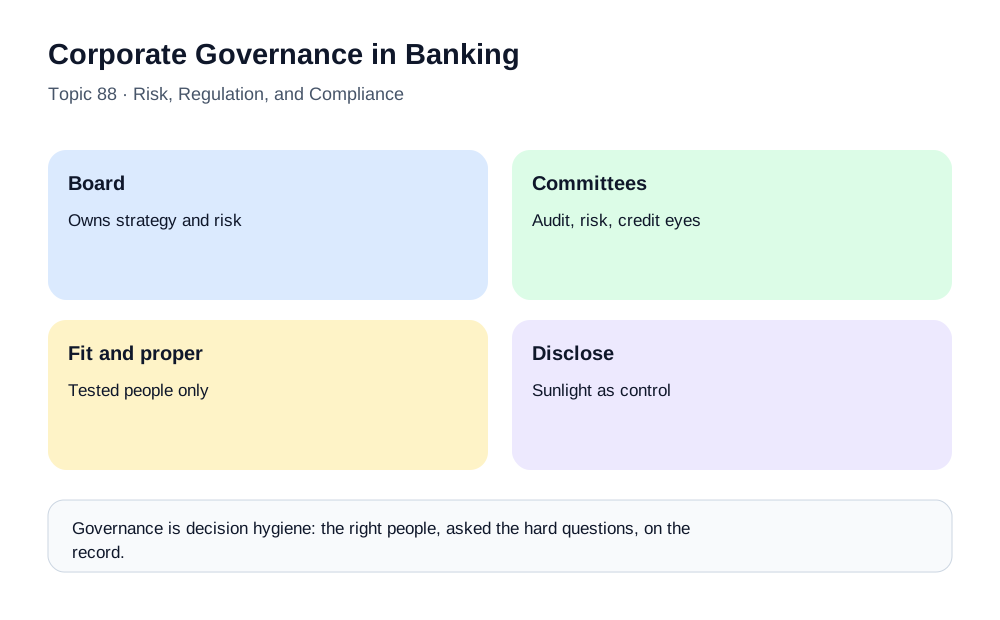
Corporate Governance in Banking at a glance — Board structure, committees, fit and proper.
Board Structure, Committees, and Fit & Proper Standards
Corporate governance in banking goes well beyond formal compliance. A bank can fail because of credit losses, liquidity stress, market shocks, fraud, operational disruption or a combination of causes, but governance determines how effectively the institution identifies, challenges and responds to those risks. Weak boards, poorly controlled incentives, conflicts of interest, inadequate risk oversight and ineffective challenge can amplify financial and operational problems. Strong governance therefore supports safety and soundness by clarifying responsibility, decision rights, risk appetite, oversight and accountability.
Bank governance receives intensive supervisory attention because banks are leveraged institutions that take deposits, extend credit, provide payments and perform functions whose disruption can affect customers and the wider financial system. Exact leverage varies materially by institution and accounting measure, and not every banking relationship creates a fiduciary duty in the legal sense. The broader point is that boards oversee complex balance sheets, liquidity, capital, conduct, technology and operational dependencies while the institution operates within a public regulatory and safety-net framework. This combination makes effective board oversight and competent senior management especially important.
The board bears ultimate responsibility for the bank's strategy, governance framework and oversight of senior management, but exact board-composition and tenure rules depend on the bank's legal form, jurisdiction and applicable company, securities and banking law. In India, requirements differ across private sector banks, public sector banks, co-operative banks and other regulated entities. RBI instructions for relevant bank categories address matters such as appointment of directors, committee structures, fit-and-proper assessment and separation of certain executive and board roles, while other statutory and listing requirements may also apply. Internationally, the Basel Committee emphasises a board with sufficient independence, skills, diversity of perspective and collective understanding of the bank's risk profile rather than one universal numerical template for every bank.
The functions of the board span the full range of governance responsibilities. Strategy development involves approving the bank's business plan and strategic direction, ensuring that growth ambitions align with risk capacity. Management oversight includes monitoring the performance of executive leadership, holding them accountable for achieving objectives while operating within risk appetite. Risk governance requires setting the risk appetite framework that defines acceptable levels and types of risk, establishing the boundaries within which management must operate. Compliance oversight ensures adherence to the extensive regulatory requirements governing banking operations. Accountability to shareholders and regulators demands transparent reporting and responsiveness to legitimate concerns. Perhaps most importantly, the board appoints, evaluates, and if necessary removes the chief executive, ensuring that the bank's most powerful position is subject to appropriate oversight.
Effective governance often uses board committees to provide focused oversight, but the committee architecture is not identical across all banks or jurisdictions. Audit, risk, nomination and remuneration committees are common in larger regulated banks, while technology, customer, credit, conduct or other committees may be required, recommended or created by the institution depending on its legal framework and risk profile. Delegation to a committee does not remove the full board's accountability. Committee mandates, membership, independence, information rights, reporting lines and escalation responsibilities should be explicit so that important issues do not disappear between committees.
Fit-and-proper assessment is intended to support competent and trustworthy bank leadership. The precise legal criteria vary, but relevant frameworks commonly consider qualifications and experience, track record, integrity, conflicts, regulatory history and financial soundness. RBI instructions require due-diligence processes for directors in the bank categories to which those instructions apply, while statutory disqualifications and nomination or approval processes can add further requirements. Fit-and-proper status is therefore a governed assessment under the applicable rules, not a single universal checklist that can be applied identically to every director of every bank.
The consequences of governance failures fill the history of banking with cautionary tales. Yes Bank's collapse in 2020 revealed a dominant chief executive who could not be challenged by a compliant board, resulting in hidden non-performing assets and ultimate regulatory rescue. IL&FS demonstrated how boards could fail to identify massive asset-liability mismatches that brought the infrastructure finance giant to the brink of systemic collapse. Wells Fargo's fake accounts scandal showed boards ignoring whistleblowers while a toxic sales culture created millions of unauthorized accounts, ultimately costing billions in fines and the chief executive's job. Wirecard's board failed to scrutinize accounting fraud that made one point nine billion euros disappear. Punjab National Bank's massive fraud occurred partly because internal control failures were not visible to the board. Each case illustrates the catastrophic potential when governance mechanisms fail.
Remuneration governance is an important mechanism for aligning incentives with the bank's long-term risk and conduct objectives. Regulatory requirements differ by jurisdiction and employee category. In India, RBI compensation guidelines apply to specified private sector and foreign-bank populations and include detailed requirements for fixed and variable remuneration, deferral, malus, clawback and risk alignment. Rather than memorising one percentage as a rule for every bank employee, practitioners should identify the current instruction that applies to the relevant institution and role. The governance principle is stable: compensation should not reward short-term revenue while ignoring the risks, conduct outcomes or losses that emerge later.
Corporate governance in banking is ultimately about creating the structures, processes, and culture that enable effective oversight of complex institutions. The board must possess the expertise to understand the business, the independence to challenge management, the processes to identify problems early, and the will to act decisively when necessary. Regulatory requirements establish minimum standards, but truly effective governance requires a commitment that goes beyond compliance to embrace genuine stewardship of institutions that serve vital economic functions.
<!-- MBA-DEEP-DIVE-START -->Deep Dive: How Corporate Governance Actually Works Inside a Bank
Corporate governance is the operating system for authority inside a bank. It determines who may take which decisions, what information the board receives, how management is challenged, how conflicts are controlled, and what happens when commercial ambition exceeds the institution's capacity to manage risk. A governance framework is therefore not a collection of committee names. It is the structure through which strategy, risk appetite, capital, liquidity, conduct, technology, culture and accountability are connected.
The Basel Committee's governance principles deliberately avoid prescribing one identical board structure for every bank. Legal systems differ, bank ownership differs, and the responsibilities of boards and senior management are not organised in the same way in every jurisdiction. What remains consistent is the expectation that the governing body understands the bank's business and risks, challenges management, sets clear responsibilities and maintains effective independent control functions. National law and supervisory rules then turn those principles into binding requirements for particular institutions.
1. Governance starts with a clear map of accountability
A bank should be able to answer a basic question for every material decision: who owns it? Strategy may require board approval. A product launch may be owned by a business executive but require independent risk, compliance, finance, legal, information-security and operations review. A large credit exposure may need approval under a delegated credit authority. A severe incident may require escalation to the chief executive, board risk committee or full board.
Confusion arises when responsibility is described collectively. If a paper says “management will monitor the risk” but does not name the accountable executive, action can disappear between functions. Good governance uses documented mandates, delegated authorities, committee terms of reference and management responsibilities so that ownership remains visible even when many teams contribute.
The same principle applies after an error. Governance should make it possible to distinguish who made the decision, who challenged it, who approved it and what information was available at the time.
2. The board governs; management manages
A board should not run daily bank operations. Its role is to approve direction, establish risk appetite, appoint and oversee senior management, challenge important decisions and make sure the institution remains safe, lawful and strategically coherent. Senior management converts that direction into operating plans and is responsible for execution.
This distinction protects both sides. If directors descend into routine operational approval, they can blur management accountability and lose sight of enterprise-level risk. If management treats the board as a ceremonial audience, major decisions can proceed without effective challenge.
A healthy relationship therefore combines delegation with escalation. Management should have enough authority to operate efficiently, but it should know which decisions exceed its mandate. The board should receive information early enough to influence important choices rather than merely ratify decisions that have already become irreversible.
3. Board competence is collective, not a checklist of titles
A bank board needs enough collective knowledge to understand the institution it governs. That usually includes experience relevant to banking, finance, risk, technology, accounting, customers, regulation, people and the markets in which the bank operates. No single director is expected to be expert in everything.
The practical test is whether the board as a group can ask intelligent questions and recognise when additional expertise is needed. A director does not need to write a cyber-security architecture, for example, but should understand the potential impact of a critical vulnerability, the bank's tolerance for disruption, and whether remediation is proceeding with appropriate urgency.
Skills matrices can help identify gaps, but they should not become decorative. Board evaluation should consider whether members actually contribute relevant challenge, prepare for meetings, understand the business and devote enough time to the role.
4. Independence is about the ability to challenge
Formal independence requirements are important, but independence of judgement is equally important. A director can satisfy a legal definition and still be reluctant to challenge a powerful founder or chief executive. Conversely, a non-independent director may possess deep institutional knowledge that contributes constructively when conflicts are managed.
The board should therefore pay attention to both legal independence and board dynamics. Are dissenting views heard? Do papers present alternatives and downside cases? Are directors given access to control functions without management filtering? Can the chair prevent one personality from dominating discussion?
These questions matter because governance failures often develop gradually. A board can become accustomed to optimistic assumptions, repeated exceptions or growing concentration long before a formal limit is breached. Independent challenge interrupts that normalisation.
5. The chair shapes the quality of challenge
The chair does more than run the meeting agenda. Effective chairing determines whether difficult issues receive enough time, whether management answers the question asked, whether minority views are explored and whether decisions are recorded clearly.
A weak meeting can have excellent papers and still produce poor governance. Directors may spend an hour on minor historical results and five minutes on a strategic acquisition. A strong chair redirects the discussion toward material uncertainty and ensures that unresolved issues are assigned for follow-up.
Where the legal framework separates chair and chief executive roles, that separation can reinforce oversight. The exact governance model depends on the jurisdiction and institution, but the functional objective is clear: executive power should be subject to credible board supervision.
6. Information quality determines board effectiveness
A board cannot govern what it cannot see. Management information should be accurate, timely, sufficiently granular and focused on decision-relevant risk. Hundreds of pages of data are not necessarily good governance if material deterioration is hidden in averages.
Board reporting should distinguish actual performance from limits, appetite and plan. It should show trends, concentrations, stress results, overdue remediation and material exceptions. Where a metric is based on assumptions, those assumptions should be visible. Where data quality is weak, the weakness should be stated rather than concealed behind a precise number.
For example, reporting that non-performing loans are within plan is incomplete if a rapidly growing sector concentration is showing early arrears. Governance requires the forward-looking signal as well as the current accounting outcome.
7. Risk appetite converts strategy into boundaries
Strategy describes what the bank wants to achieve. Risk appetite defines how much and what type of risk it is prepared to accept while doing so. The two should be designed together.
A bank that wants aggressive mortgage growth must consider capital, funding, interest-rate exposure, operational capacity, underwriting standards and concentration. A digital expansion strategy should consider fraud, cyber risk, third-party dependencies, customer support and resilience. Growth without those boundaries is not a complete strategy.
The board should approve the overall risk-appetite framework and understand how it cascades into limits and management actions. Business units should be able to see which measures constrain them and what escalation occurs when a threshold is approached or breached.
8. Limits are useful only when breaches change behaviour
A limit that can be exceeded repeatedly without consequence is not a control. Governance should define early-warning thresholds, hard limits, breach ownership, escalation timelines and the authority needed to approve temporary exceptions.
Temporary exceptions can be legitimate. Markets move, customers draw committed facilities, and operational events can create short-lived exposures. The important question is whether the exception is transparent and time-bound.
A recurring “temporary” waiver suggests that either the limit is poorly designed or management is operating outside the approved risk appetite. Boards and risk committees should examine repeated exceptions as a governance signal rather than review each one in isolation.
9. The risk committee needs an enterprise view
For banks where a board risk committee is required or appropriate, its role should extend across material financial and non-financial risks. Credit, market, liquidity and interest-rate risks remain important, but technology, cyber, operational resilience, model, climate, conduct and third-party risks can also become material.
The committee should not simply receive separate presentations from each risk function. It should understand interactions. A cyber incident can create liquidity consequences if customers lose confidence. A third-party outage can generate conduct issues when customers cannot make payments. A rapid credit expansion can create operational processing errors as well as future losses.
Enterprise risk governance is strongest when the committee sees these dependencies rather than treating each risk category as an isolated box.
10. The audit committee has a different purpose
Risk and audit committees overlap but should not become duplicates. A risk committee is generally concerned with the bank's risk profile, appetite and risk-management framework. An audit committee focuses more heavily on financial reporting, internal control, internal audit and external audit oversight.
Coordination matters where issues cross boundaries. A major model weakness might affect both capital reporting and risk decisions. A significant cyber-control failure might require internal audit assurance while also sitting within risk appetite.
Committee chairs should therefore have a mechanism to share important matters, and the full board should receive an integrated view. A problem should never fall between committees because each assumed the other owned it.
11. Control functions require stature and independence
Risk management, compliance and internal audit need enough authority, resources and access to challenge the businesses they oversee or audit. Independence is weakened if control-function leaders depend entirely on the business executives they may need to oppose.
Governance should address reporting lines, appointment and removal, remuneration, access to the board, and the ability to escalate unresolved concerns. Control functions also need competent staff and reliable data. Independence without capability is not enough.
The objective is constructive challenge, not organisational conflict. Business management remains responsible for running the bank safely; control functions help ensure that risk-taking remains within agreed boundaries and law.
12. The chief risk officer should be heard before risk is taken
A chief risk officer who only reports losses after they occur is not fulfilling the intended role. Risk leadership should participate early in material strategic, product, acquisition and balance-sheet decisions.
This does not mean Risk must approve every commercial choice. It means management and the board should hear an independent view of the risk before committing the institution. If the chief risk officer disagrees with a major proposal, the disagreement and resolution should be documented and escalated according to governance rules.
An effective CRO also needs direct access to the board or board risk committee so that material concerns cannot be filtered out by executive management.
13. Compliance governance is broader than regulatory reporting
Compliance should identify applicable legal and regulatory obligations, advise the business, monitor adherence and escalate material breaches. Its role is not limited to submitting returns or maintaining a policy library.
New products illustrate this clearly. A product can be technically feasible and profitable but still create consumer-protection, AML, privacy, market-conduct or licensing concerns. Compliance should therefore be involved before launch, not asked to approve wording after the commercial design is fixed.
Board reporting should focus on material compliance risk, recurring breaches, overdue remediation, regulatory interactions and themes that indicate weaknesses in culture or process.
14. Conflicts of interest need both disclosure and control
Banks contain many potential conflicts: lending to related parties, advising a client while financing another bidder, distributing products that generate higher fees, trading while holding confidential information, or remunerating staff for sales they also assess.
Disclosure alone is not always sufficient. Some conflicts require separation of duties, information barriers, independent approval, restricted lists, recusal or prohibition.
Governance should identify who owns the conflicts framework and how breaches are escalated. Board members themselves must also disclose interests and abstain from decisions where required. The credibility of governance deteriorates quickly if senior individuals are seen to operate under different rules from everyone else.
15. Related-party transactions deserve heightened scrutiny
Transactions with directors, executives, significant shareholders or connected entities can create a risk that the bank's resources are used on non-arm's-length terms. Legal restrictions vary by jurisdiction, but the governance principle is consistent: related-party exposures should be identified, controlled, approved at the appropriate independent level and reported transparently.
Systems need reliable party relationships to enforce this. A credit workflow cannot flag a connected borrower if ownership and relationship data are incomplete.
The board should also consider indirect relationships. A transaction routed through several entities can still create a conflict if the ultimate beneficiary is connected to decision-makers.
16. Remuneration can change risk behaviour
Compensation affects how employees and executives respond to targets. If a trader is rewarded only for current-year profit, a relationship manager only for loan volume, or a branch only for product sales, the incentive design can encourage risk that appears later.
Risk-aligned remuneration uses a broader set of measures and can defer portions of variable compensation so that later outcomes matter. Malus and clawback mechanisms can apply under relevant rules or policies when performance proves illusory or misconduct is discovered.
Control-function remuneration should also protect independence. A compliance officer's bonus should not depend primarily on the sales revenue of the business being challenged.
17. Succession planning is a risk control
Leadership changes can destabilise a bank if critical knowledge and authority are concentrated in one individual. Boards should understand succession plans for the chief executive and other key roles such as finance, risk, operations, technology and compliance.
Succession planning should distinguish emergency cover from long-term development. Who takes charge tomorrow if a key executive becomes unavailable? Who could credibly assume the role in two or three years? Which positions have no realistic internal successor?
The exercise also reveals organisational concentration. A bank that cannot operate without one long-serving executive may have a broader governance weakness.
18. Fit-and-proper assessment is ongoing
Suitability should not be checked only at appointment. Circumstances can change: a director may become involved in litigation, face regulatory action, develop a conflict or take on commitments that reduce the time available for the bank.
Applicable law determines the formal process, but banks should have a mechanism for periodic declarations, conflict updates and escalation of material changes. Nomination functions should also verify qualifications and experience rather than rely solely on self-description.
The objective is not to remove directors whenever an allegation appears. It is to assess relevant facts consistently and maintain evidence of the decision.
19. Board evaluation should test effectiveness, not politeness
An annual board evaluation can become meaningless if every question receives a high score and no difficult feedback is recorded. Effective evaluation asks whether the board receives the right information, spends time on the right issues, challenges management, uses committees well and follows through on actions.
It can also assess meeting dynamics. Are some members silent? Does management dominate? Are papers distributed too late? Are important topics repeatedly deferred?
Results should lead to practical changes such as training, agenda redesign, recruitment of new expertise or stronger committee coordination.
20. Culture is visible through repeated decisions
Boards often say they want a strong risk culture. Culture becomes visible when revenue conflicts with policy, when an employee raises a concern, when a control breach delays a launch or when a high-performing executive violates standards.
If the institution repeatedly rewards results while excusing the method used to obtain them, employees learn that stated values are optional. Conversely, consistent consequence management signals that conduct and control matter.
Boards can use employee surveys, whistleblowing themes, customer complaints, audit findings, limit breaches, incentive data and staff turnover to understand culture. None is definitive alone; patterns are informative.
21. Speak-up arrangements need board attention
Whistleblowing mechanisms should allow employees and other eligible parties to report suspected wrongdoing confidentially and, where permitted, anonymously. Reports should be triaged independently, investigated competently and protected from inappropriate retaliation.
Board or audit-committee oversight is important for serious allegations, especially those involving senior management. Management should not control an investigation into itself.
Metrics should distinguish volume from quality. A low number of reports does not automatically mean strong culture; it may indicate fear or lack of awareness. The board should look at substantiation rates, themes, investigation age, retaliation concerns and repeated issues.
22. Product governance is corporate governance in miniature
Every product launch brings together strategy, customers, financial risk, operations, technology, legal obligations and data. A well-governed product process therefore mirrors the bank's broader governance structure.
The business should state the target market and commercial rationale. Credit or market risk should assess financial exposure. Compliance and Legal should assess obligations. Operations should confirm process readiness. Technology and Security should assess resilience and access. Finance should confirm accounting and reporting. Customer teams should confirm servicing and complaints.
Approval should record material conditions. If a product is approved only for certain countries or customer types, systems should enforce those restrictions rather than rely on memory.
23. New technology needs governance before deployment
Artificial intelligence, cloud services, APIs and automation can improve banking, but they also redistribute decision-making and operational dependency. Governance should determine who owns the model or service, what data are used, how outputs are validated, how customers are affected, and what happens when the technology fails.
Boards do not need to approve every software release. They do need visibility over material technology strategy and risk, including large transformations and critical dependencies.
Technology governance is strongest when cyber security, operational resilience, data, model risk and third-party risk are considered together instead of through separate technical presentations.
24. Major change programmes need independent challenge
Core-banking migrations, mergers, payment-platform replacements and regulatory transformations can expose the bank to severe operational risk. Programme governance should define accountable sponsors, decision forums, independent assurance, risk acceptance and go-live criteria.
A project can be “green” against schedule while still carrying unresolved customer or control risk. Board reporting should therefore include readiness, defect severity, reconciliation, contingency arrangements and operational capacity rather than only cost and milestone completion.
Where a go-live decision accepts material residual risk, the decision-maker and rationale should be clear.
25. Mergers create governance complexity before legal completion
When banks merge or acquire businesses, governance must address duplicate systems, different risk appetites, overlapping authorities, cultural differences and transitional legal entities. The combined institution can inherit control weaknesses that were tolerable at smaller scale but become material after integration.
Boards should understand integration risk and not focus only on financial synergies. Customer migrations, data lineage, access rights, product rationalisation and regulatory commitments can take years to complete.
Temporary governance during transition should also be explicit. Employees need to know which policy and authority applies before the target operating model is fully implemented.
26. Group governance must respect legal entities
A banking group may set enterprise policies centrally, but each regulated subsidiary can have its own board duties and local obligations. Group management cannot simply override a subsidiary board where local law assigns responsibilities to that board.
Good group governance sets common minimum standards while preserving legal-entity accountability. Information should flow upward so the parent understands group risk and downward so subsidiaries receive relevant group requirements.
Conflicts can arise when group strategy is beneficial overall but creates unacceptable risk for one subsidiary. The governance framework should provide a way to resolve those tensions transparently.
27. Crisis governance should be designed before the crisis
During a liquidity event, cyber incident or major operational outage, normal committee cycles are too slow. Banks need crisis decision structures with clear authority, escalation and communication.
The board should know when it will be notified, which executives can invoke contingency plans, who communicates with regulators, and how decisions are recorded. Crisis governance should not bypass controls unnecessarily; it should make urgent control decisions possible with the right people involved.
Exercises are valuable because they expose ambiguity. If two executives both believe the other has authority to shut down a compromised service, the governance design needs correction before a real attack occurs.
28. Recovery planning turns governance into executable actions
Recovery plans identify actions the bank could take under severe stress, such as raising capital, reducing risk, selling assets or changing funding. Governance determines who monitors recovery indicators, who can activate options and when the board becomes involved.
A recovery option is not credible merely because it appears in a document. The bank should understand execution time, legal constraints, operational dependencies, market capacity and customer effects.
Boards should challenge whether actions remain realistic under the scenario in which they are expected to be used.
29. Minutes and decision records matter
Good minutes do not need to transcribe every sentence, but they should capture the substance of important challenge, decisions, conditions and dissent. This protects institutional memory and demonstrates how governance operated.
Action logs should identify owners and due dates. A recurring audit or regulatory issue should not disappear when personnel change.
Decision records are particularly important for exceptions. If management accepts risk outside normal parameters, future reviewers should be able to understand the evidence and authority behind that choice.
30. Governance failures often appear first as small exceptions
Large failures rarely begin with a board deciding to take an obviously catastrophic action. Warning signs can be smaller: repeated policy waivers, unexplained staff departures, overdue audit issues, aggressive growth, stale risk limits, optimistic model overrides or persistent customer complaints.
A strong governance system aggregates those signals. It asks whether several isolated exceptions point to one deeper problem.
This is why board effectiveness depends on curiosity as much as structure. Directors should look beyond the headline metric and ask what assumptions, concentrations and unresolved issues sit underneath it.
31. Governance must be proportionate without becoming weak
A small specialised bank does not need the same committee architecture as a global systemically important bank. Proportionality allows governance to reflect size, complexity and risk.
But proportionality does not mean important responsibilities disappear. The institution still needs effective oversight, independent control, risk management, audit and clear accountability. In a smaller bank, individuals may cover broader portfolios, which can make conflicts and key-person dependency more significant.
The design should therefore be simpler where appropriate but still capable of challenging the institution's actual risks.
32. Regulatory governance should use the applicable rule, not folklore
Bank governance is full of memorable numbers: committee sizes, director tenures, deferral percentages and meeting frequencies. Those numbers can be useful when they come from the current rule for the relevant institution. They become dangerous when repeated globally without scope.
A practitioner should always identify the regulator, bank category, legal entity, effective date and transitional provisions. In India, private sector banks, public sector banks, co-operative banks, small finance banks and other regulated entities can be subject to different statutory and RBI frameworks.
This discipline prevents a training simplification from becoming an implementation error.
33. Governance data should reconcile with operational reality
Boards increasingly receive risk dashboards generated from automated data pipelines. Governance therefore depends on data controls. A limit report that omits one legal entity or uses stale exposures can lead to a wrong decision.
Material board metrics should have defined owners, calculation rules, source systems, quality checks and change controls. If a key metric changes methodology, the board should understand the impact on trend comparisons.
This is especially important for aggregated group measures such as capital, liquidity, concentration and operational incidents.
34. A practical board scenario
Imagine a bank plans to launch instant cross-border payments for corporate customers. The commercial case is attractive, but the product changes settlement speed, fraud exposure, sanctions processing, liquidity, customer support and technology dependency.
Management should not ask the board to approve thousands of technical requirements. It should present the strategic rationale, material risks, risk-appetite impact, readiness of critical controls, unresolved issues and contingency arrangements. Relevant committees can examine detail within their mandates.
If sanctions screening cannot meet the required latency or liquidity limits are not ready for weekend operation, the governance process should force a conscious decision: fix the gap, constrain scope, delay launch or formally accept risk where authority permits.
35. What excellent bank governance looks like
Excellent governance is visible when the institution can make difficult decisions before external pressure forces them. The board understands the business model and challenges concentration. Management knows its authority and escalates material exceptions. Risk and Compliance can oppose revenue-generating proposals without fear. Internal Audit can report uncomfortable findings directly. Technology and data risks receive the same seriousness as traditional financial risks when they threaten customers or stability.
Most importantly, decisions leave an evidence trail. The bank can show what it knew, who challenged, what was approved, what conditions applied and whether follow-up occurred.
That is the practical standard. Corporate governance is not the architecture around banking; it is the mechanism that keeps the entire architecture accountable.
Governance Continuation: From Board Papers to Supervisory Credibility
Board calendars should reflect the bank's risk cycle
A board calendar should not be built only around statutory meeting dates. It should reflect the moments when the bank makes or reviews material decisions: strategy, budget, capital planning, liquidity planning, recovery planning, risk appetite, remuneration, succession, major technology investment and annual control-function assessments. Important topics need enough time for challenge rather than being crowded into one year-end meeting.
The calendar should also leave room for emerging issues. If every agenda is fixed months in advance, an unexpected market, cyber or conduct risk can struggle to receive proper attention. Governance works best when recurring obligations and current risk are balanced deliberately.
Board papers should distinguish decision, discussion and information
Every paper should make clear what the board is being asked to do. A decision paper needs options, recommendation, material risks, financial impact, unresolved issues and the authority being exercised. A discussion paper may seek direction before a proposal is final. An information paper should not quietly contain a major decision that management expects the board to notice.
This classification helps directors prepare and prevents passive approval. It also improves minutes because the governance record can show whether the board approved, challenged or simply noted the matter.
Executive summaries should not hide adverse evidence
A concise board paper is useful, but compression becomes dangerous when negative information is moved into appendices while positive results dominate the summary. Material downside, uncertainty and limit breaches should appear where directors are likely to see them.
Risk and control functions should have a route to comment on major business papers, particularly where their view differs from the sponsor. One practical approach is to include explicit Risk, Compliance, Finance or Legal commentary rather than allow the business case to represent all functions collectively.
Management committees need defined authority too
Much of banking governance happens below the board. Asset-liability committees, credit committees, new-product committees, operational-risk forums and technology committees make or recommend material decisions.
Their mandates should define membership, quorum, voting or decision method, escalation, delegated limits and recordkeeping. If a committee can approve exceptions, that authority should be traceable to a higher delegation framework.
A committee with no decision authority can still be useful, but its purpose should be clear. Otherwise issues can circulate through meetings without anyone becoming accountable for resolution.
Delegations should follow roles, not personalities
Banks sometimes build authority around experienced individuals: “ask Ravi because he always approves these.” That creates key-person dependency and weakens succession.
Delegations should attach to defined roles, limits and conditions. Temporary acting arrangements should be documented. System entitlements should match the approved delegation so that an employee cannot approve transactions beyond authority merely because access was never updated after a role change.
Periodic reconciliation between governance delegations and system permissions is a practical control that links corporate governance to technology access.
Committee overlap should be mapped
A major issue can legitimately appear in several forums. A cloud concentration risk might be discussed by technology, operational risk, resilience and board risk committees. The danger is not duplication itself; it is inconsistent conclusions or assumed ownership.
Banks can map which committee is the decision-maker, which provides specialist review and which receives reporting. Cross-references in minutes and action logs help preserve continuity.
For material issues, a single enterprise owner should coordinate remediation even when several committees oversee different aspects.
Risk acceptance should be distinguishable from risk ignorance
Management may consciously accept residual risk because remediation cost is disproportionate or because a strategic benefit justifies it within appetite. That is a governance decision. It should state the exposure, compensating controls, duration and approving authority.
Risk that is unknown because data are missing is different. A board should not be told that exposure is “within appetite” if the underlying measurement is incomplete. Data limitations should be visible so the decision reflects uncertainty.
Board appetite should cascade into operational triggers
A board may approve a statement such as “low appetite for material customer harm.” That principle must translate into measurable indicators and escalation in products and operations.
Complaint uphold rates, failed-payment volumes, vulnerable-customer outcomes or regulatory breaches may serve as indicators depending on the business. The exact metric matters less than the linkage: management should know when operational evidence indicates the bank is moving outside the board's intended tolerance.
Capital planning is a governance decision, not only Finance work
Capital affects growth, dividends, acquisitions and resilience. The board should understand how strategy changes capital consumption and how stress could erode headroom.
Finance may produce projections and Risk may challenge scenarios, but the board must own the balance between commercial ambition and capital capacity. A plan that depends on optimistic earnings or future capital raising should show those dependencies clearly.
Governance quality is visible when directors challenge whether planned management actions would still be available during stress.
Liquidity governance needs rapid escalation
Liquidity can deteriorate faster than many other risks. Governance should therefore define indicators, escalation thresholds and crisis authority before stress begins.
The board or its committee should understand major funding concentrations, contingent liquidity needs and the credibility of contingency sources. During normal periods, small changes in deposit mix can appear unimportant; during stress, the same trends can become decisive.
Clear escalation avoids wasting critical hours deciding who has authority to activate contingency plans.
Model governance reaches the board through materiality
Boards should not review every model. They should understand the institution's material model risk, major limitations, validation findings and where models drive significant decisions or regulatory outcomes.
Management should explain consequences in business terms. A credit model weakness matters because it can alter underwriting, pricing or capital; an AML model weakness matters because it can miss suspicious behaviour or create unmanageable alerts.
Board reporting is strongest when technical metrics are connected to decision impact.
Data governance has a corporate-governance dimension
Important decisions increasingly depend on enterprise data. The board should know whether major risk and finance metrics are reliable, whether critical data-quality issues remain unresolved and whether large transformations threaten reporting continuity.
Data ownership should sit with accountable business or functional leaders, supported by technology. Calling every data defect “an IT issue” can obscure the fact that definitions and business rules often originate outside Technology.
Regulatory relationships are governed relationships
Supervisors expect timely, accurate and candid communication. Management should coordinate regulatory interactions so material commitments are tracked and the board understands significant findings.
A bank should avoid fragmented responses in which different functions give inconsistent explanations to the same supervisor. Regulatory commitments need owners, due dates and evidence of closure just like major audit findings.
Board oversight becomes especially important when remediation programmes are repeatedly delayed or when a finding challenges the business model itself.
Customer outcomes belong in governance reporting
Financial results alone do not show whether a strategy is sustainable. A rapidly growing product may generate strong revenue while complaints, fraud losses or early arrears rise.
Boards should receive enough customer-outcome information to understand this trade-off. The objective is not to micromanage service cases but to identify whether commercial success is being achieved through processes likely to create future remediation or conduct risk.
Governance should include people capacity
A bank can approve growth that its operations cannot safely support. Staffing, specialist skills, training and change fatigue therefore have governance implications.
If a new product doubles investigation volumes but the relevant operations team has no capacity plan, the business case is incomplete. Similarly, repeated reliance on key contractors in critical control functions can create resilience and independence concerns.
People risk should be considered before it appears as an incident backlog.
Remuneration committees need risk information
Compensation decisions should not rely only on revenue and financial performance. Material risk, conduct, audit and compliance information can affect whether variable remuneration is appropriate under policy and applicable rules.
Control functions can provide independent input where governance requires it. The process should avoid both extremes: automatically cancelling reward for any minor issue or ignoring serious control failure because financial targets were exceeded.
Board succession should preserve institutional challenge
Refreshing the board is not just about replacing directors at tenure limits. The bank should preserve important knowledge while introducing new perspective and skills.
Succession plans should consider future strategy. A bank moving heavily into digital ecosystems may need stronger technology and operational-resilience understanding; a bank expanding internationally may need jurisdictional and cross-border experience.
Recruitment should respond to actual future risk, not copy the current board indefinitely.
Governance during remediation requires its own structure
Large regulatory or control-remediation programmes often span several years. They need clear executive accountability, independent challenge, milestones, evidence standards and board reporting.
A programme can report high percentage completion while the hardest root-cause fixes remain open. Governance should distinguish activity completion from risk reduction. Independent validation of closure is particularly valuable where the original issue was severe.
Decision quality improves when alternatives are explicit
Board papers often present one preferred solution as inevitable. Better governance shows credible alternatives and why they were rejected.
For a system replacement, options might include full migration, phased migration, temporary remediation of the existing platform or outsourcing. Each carries different cost, operational and control risk.
Directors can challenge more effectively when trade-offs are visible rather than receiving only the sponsor's chosen design.
The board should understand residual risk after action
Management actions rarely remove all risk. A new control can reduce likelihood while leaving customer impact unchanged if it fails. A hedge can reduce one exposure while creating basis risk. A cloud failover can improve resilience but still share a common identity dependency.
Good governance asks what remains after mitigation and whether that residual exposure fits appetite. This prevents the word “mitigated” from becoming shorthand for “closed.”
Governance maturity is revealed by bad news
The real test of governance is how quickly bad news travels upward. If employees delay reporting incidents until they have a solution, senior leaders receive a falsely calm picture. If executives soften messages before they reach the board, directors cannot intervene early.
Healthy governance rewards timely escalation even when the issue is embarrassing. Leaders can still hold people accountable for preventable failures while recognising that early transparency protects the institution.
Final perspective: governance is the quality of controlled choice
A bank cannot eliminate uncertainty. It chooses customers, products, markets, technology and risk every day. Corporate governance makes those choices visible, assigns authority, introduces independent challenge and records accountability.
The strongest institution is not the one with the most committees. It is the one in which the right decision reaches the right forum with reliable information, opposing views can be heard, risk is accepted consciously, and actions remain traceable after people and circumstances change.
Governance Top-Up: Strategic Challenge, Assurance and Accountability
Strategic concentration should reach the board before it becomes a limit problem
A bank can remain within formal limits while becoming strategically dependent on one sector, funding source, customer segment, geography or technology provider. Board challenge should therefore look beyond current compliance and ask how the business model would perform if the concentrated exposure were stressed. Management papers should show concentration trends, plausible downside scenarios and realistic actions rather than only current-limit utilisation.
This matters because concentration often builds gradually through individually reasonable decisions. Governance adds value when directors identify the cumulative pattern early enough to influence strategy rather than after the bank is already forced to reduce exposure in difficult market conditions.
External assurance does not remove board responsibility
Banks receive assurance from external auditors, regulators, consultants, certification providers and specialist reviewers. Those sources can strengthen governance, but the board should understand their scope and limitations. A clean external audit opinion does not mean every operational or conduct risk has been tested, just as a cyber certification does not prove every application configuration is secure.
Management should explain what assurance exists over material risks, where gaps remain and how Internal Audit fits into the overall assurance map. The board can then decide whether additional independent review is warranted.
Governance should distinguish unresolved risk from unresolved administration
Action trackers can contain hundreds of items. Some are documentation tasks; others represent continuing exposure to customer harm, financial loss or regulatory breach. Treating every overdue action as equally important can hide the issues that need executive attention.
Governance forums should therefore classify actions by residual risk, dependency and age. Where a high-risk item remains open, the responsible executive should explain interim controls and whether the risk is still within appetite. This keeps committee attention on the consequence of delay rather than the colour of the project-status box.
Regulatory source discipline improves governance quality
Governance decisions frequently depend on regulatory requirements concerning board composition, remuneration, outsourcing, capital, customer protection or control functions. The responsible team should identify the exact legal entity, applicable rule, effective date and scope before presenting a requirement as mandatory.
This discipline prevents an instruction written for one category of bank from being copied automatically into another entity. It also helps boards distinguish binding requirements from supervisory guidance, industry practice and internal policy choices.
Final board test: can the decision be explained later?
A strong governance decision should remain understandable after executives, directors and circumstances change. The record should show the issue, material evidence, challenge, alternatives, authority, decision, conditions and follow-up.
That standard protects institutional memory and strengthens supervisory credibility. It demonstrates that the bank did not merely reach an outcome; it used a controlled and accountable process to reach it.
<!-- MBA-DEEP-DIVE-END -->