Visual overview
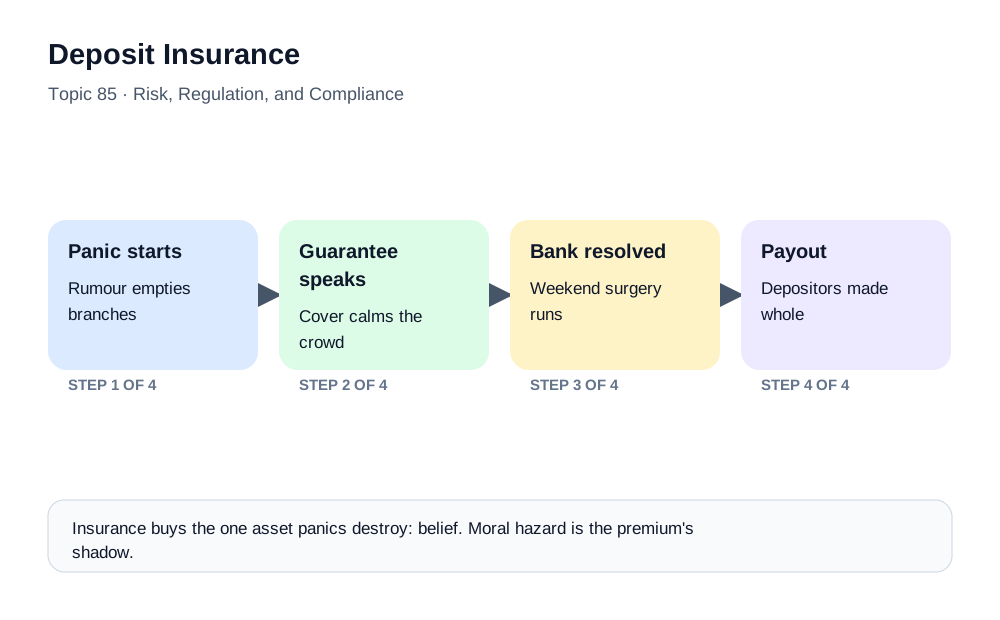
Deposit Insurance at a glance — Coverage limits, moral hazard, consumer protection.
Coverage Limits, Moral Hazard, and Protecting Depositors
Deposit insurance represents one of the most consequential innovations in banking history, transforming the relationship between banks and their customers while fundamentally altering the dynamics of financial stability. By promising that deposited funds remain safe even if a bank fails, deposit insurance eliminates the incentive for depositors to run, preventing the panic that converts solvent institutions into failed ones. Yet this same guarantee creates a paradox: the safety net that prevents crisis may encourage the risk-taking that makes crisis more likely. Understanding this tension, and the institutional frameworks designed to manage it, illuminates the complex trade-offs inherent in modern banking regulation.
Deposit insurance systems differ substantially in funding and failure-management design. Many collect industry premiums or assessments and maintain ex-ante funds, while some frameworks also provide ex-post assessments, borrowing arrangements or public backstops under defined legal conditions. When an insured institution fails, protected deposits may be reimbursed directly or maintained through transfer or resolution tools. Insurance reduces the incentive for protected depositors to run merely from fear of losing eligible balances, but it does not eliminate all depositor monitoring, guarantee every bank liability, or mean that every scheme has an unlimited government backstop.
India operates deposit insurance through the Deposit Insurance and Credit Guarantee Corporation under the applicable statutory framework. Coverage amount, premium rates, covered institutions, treatment of accounts and payout procedures are matters for the current DICGC and RBI rules and should be checked at the time of use rather than frozen into a global curriculum. The durable operational point is that Indian banks need accurate depositor and account data capable of applying the scheme's aggregation, eligibility and payment rules, including any special process that applies when a bank is under restriction or failure management.
The United States operates federal deposit insurance through the FDIC for eligible deposits at insured institutions, with coverage determined under current statutory limits and ownership-category rules. The number of insured institutions, Deposit Insurance Fund balance and other statistics change over time, so current FDIC sources should be used for live figures. Ownership category and legal capacity matter because a customer can hold several accounts that are aggregated or treated separately under the detailed rules; the bank and depositor therefore need to understand the legal account structure rather than simply count account numbers.
Most major banking systems maintain depositor-protection arrangements, but coverage limits and detailed rules are jurisdiction-specific and can change. The United Kingdom, European Union member states, Japan, Singapore and other jurisdictions use different legal definitions, limits, ownership treatment and failure-management processes. A durable comparison should therefore focus on design principles—clear scope, credible funding, prompt access, depositor data, public awareness and coordination with resolution—while using each official scheme's current publication for live coverage numbers.
The extraordinary events surrounding Silicon Valley Bank's failure in March 2023 illustrated both the importance and the limits of deposit insurance. At SVB, approximately eighty-eight percent of deposits exceeded the two hundred fifty thousand dollar insurance limit, reflecting the bank's concentration of large corporate and venture capital accounts. When the bank failed, the systemic risk exception was invoked to cover all deposits regardless of limit, preventing contagion to other institutions but generating controversy about whether this effectively raised insurance coverage without legislative process. The incident highlighted the challenge of setting coverage limits appropriate for different types of depositors and the potential for ad hoc extensions that undermine the discipline function of limits.
Deposit insurance can weaken one source of market discipline because protected depositors have less reason to analyse a bank's solvency continuously. That creates moral-hazard concerns, especially if weak institutions can attract insured funding by offering unusually high rates. But depositor behaviour does not become completely indifferent to risk: customers still care about service continuity, uninsured balances, access delays and reputation. Effective systems therefore combine depositor protection with prudential supervision, capital and liquidity requirements, risk-sensitive funding arrangements where used, early intervention and credible resolution so that shareholders, management and other stakeholders still face consequences for unsafe banking.
This moral hazard manifests in several observable ways. Banks may take more risk in their lending and investment activities knowing that depositors are protected from the consequences. Depositors, relieved of monitoring responsibilities, may deposit with the highest-paying banks regardless of underlying risk. Weaker institutions may offer above-market deposit rates to attract funding, using the proceeds to make risky loans or investments in a gamble for resurrection. The effective subsidy created by deposit insurance flows disproportionately to riskier banks, distorting competitive dynamics.
Regulators have developed several mechanisms to mitigate moral hazard while preserving the stability benefits of deposit insurance. Risk-based premium systems charge higher insurance rates to banks with riskier profiles, internalizing some of the cost of excessive risk-taking. Coverage limits ensure that large depositors remain exposed to potential loss, preserving their incentive to monitor bank health and providing a constituency for sound management. Co-insurance arrangements, rare in practice, would require depositors to bear some percentage of any loss even within insured limits. Strong supervision substitutes regulatory monitoring for market discipline, with regulators assuming responsibility for detecting and constraining excessive risk that depositors no longer police. Prompt corrective action frameworks mandate increasingly severe regulatory interventions as bank capital declines, intervening before insolvency while private market discipline might still be weak.
When banks fail despite these protections, resolution mechanisms determine how the insurance system responds. Direct payout involves the insurance fund paying depositors up to coverage limits and liquidating the failed bank, typically the most expensive approach. Purchase and assumption transactions, the preferred method, transfer deposits and selected assets to a healthy acquiring bank, maintaining continuity for customers and often reducing costs to the insurance fund. Bridge bank arrangements create temporary institutions to operate failed banks while permanent solutions are arranged. Open bank assistance, involving capital injections to keep troubled banks operating, is now rare and controversial following the crisis-era bailouts.
Deposit insurance is a central component of the modern financial safety net because credible protection can reduce destabilising incentives among eligible depositors. Its effectiveness depends on design and execution rather than on the existence of a guarantee alone. The 2025 revision of the IADI Core Principles reflects lessons from digitalisation, resolution practice and recent banking turmoil, reinforcing the need for clear mandates, dependable funding, high-quality depositor data, prompt access and strong coordination with other safety-net authorities.
36. Failure-Weekend Operations Must Be Pre-Designed
A deposit insurer and bank do not have the luxury of designing payout mechanics after a failure announcement. The operational sequence should already be understood: freeze the relevant balance at the legally defined point, produce the depositor data set, apply eligibility and aggregation rules, identify exceptions, reconcile totals, arrange funding, transfer or pay protected balances, and communicate the outcome.
Each step can fail in a different way. A customer identifier can be duplicated. Accrued interest can be missing. A joint account can be classified incorrectly. A sanctions hold can be ignored. A payout file can contain stale contact information. The operational design therefore needs exception handling as well as a happy path.
37. Payout Files Need Version and Cut-Off Control
Balances can continue changing during stress unless the legal and operational cut-off is clear. The bank should know which business date, value date and processing state determine the insured balance. Transactions submitted but not yet finally booked need defined treatment.
A payout file should carry a version, generation timestamp, source-system references and reconciliation totals. Re-running the file should not silently change protected amounts because an overnight batch or manual adjustment posted after the failure cut-off. This is financial-control logic, not merely data-export logic.
38. Exceptions Need Named Owners
Straightforward retail accounts may be processed automatically. Complex cases need case management. Examples include trusts, deceased customers, disputed ownership, legal holds, dormant accounts, pooled client money, incomplete KYC, suspected fraud and foreign-currency balances.
Each exception should have a reason code, owner, evidence requirement, status and escalation path. The depositor should not disappear from the process merely because automation cannot decide the case. Management should track the value and age of unresolved protected claims during a failure event.
39. The Receiving Bank Must Be Ready Too
When protected deposits are transferred to another bank, operational risk moves to the acquirer. Customer records, balances, mandates, standing orders, cards, direct debits, digital credentials and payment instructions may need to be migrated quickly.
The receiving bank should know which services become available immediately and which require later conversion. Duplicate customer records and AML/KYC differences must be controlled. The objective is continuity of access without creating duplicate money, lost instructions or unauthorised access. Resolution testing should therefore include the receiving institution where the framework allows it.
40. Public Awareness Is Part of the Safety Net
Insurance works best when customers understand it before a crisis. If ordinary depositors do not know whether their account is protected, rumours can still trigger unnecessary withdrawals.
Banks and insurers should communicate scheme membership and the legal deposit-taking entity clearly. Information should distinguish insured deposits from investment products and explain where customers can check current official limits. During stress, communication should be concise, consistent and authoritative.
A banner that says ‘your money is safe’ without explaining which legal scheme applies can create more confusion than confidence.
41. Digital Brands Can Obscure the Insured Institution
A mobile app can display a fintech or consumer brand while the actual deposit sits with a partner bank. Customers may not realise that several brands share the same underlying banking licence or that a wallet balance is legally different from a deposit.
Product design should therefore show the regulated deposit-taking entity and the nature of the customer claim. Where pass-through or custodial arrangements are used, underlying customer records must support the intended insurance treatment under the relevant scheme. Marketing convenience should never make legal ownership ambiguous.
42. Deposit Insurance Data Should Be Tested Like Critical Financial Data
Banks should run periodic quality checks and simulations rather than wait for a regulator to request a file. Testing can sample customers across ownership categories, reconstruct insured amounts manually, compare results with the automated calculation and reconcile totals to the general ledger.
Changes to core banking, customer master, product codes, legal entities or mergers should trigger regression testing. A seemingly harmless field rename can break aggregation logic. A new savings product can be omitted from the depositor file if regulatory reporting is not part of product approval.
43. Funding Stress Should Include Multiple Failures
An insurance fund can be adequate for ordinary isolated failures yet face greater pressure when several institutions fail in a common crisis. Funding arrangements should therefore consider correlated events rather than only one average bank.
The insurer needs liquid resources and credible backup arrangements consistent with its legal framework. Premium income collected over many years does not help immediately if the fund's investments cannot be monetised fast enough. Asset-liability management matters for the insurer as well as the insured banks.
44. Recoveries Need Their Own Ledger
After payout or resolution support, the insurer can have claims on the failed institution's estate according to law. Those recoveries can arrive over years and should be tracked separately from initial payout.
A disciplined recovery ledger records claim amount, legal priority, cash recovered, costs, expected remaining recovery and write-downs. This allows the insurer and stakeholders to distinguish gross assistance from ultimate net cost. It also feeds future premium and fund-adequacy analysis.
45. Banks Should Connect Insurance to Funding Strategy
Treasury should understand what portion of the deposit base is likely protected, uninsured, concentrated or operational. Coverage status is not a perfect predictor of behaviour, but it improves runoff modelling when combined with customer type and relationship characteristics.
A large operational corporate balance above the insurance limit can behave differently from a small payroll account. A rate-sensitive brokered or digitally sourced deposit can behave differently from a longstanding transactional balance. The same customer information needed for deposit insurance therefore supports liquidity risk and recovery planning.
46. Customer Service Needs Legal Accuracy Under Pressure
During a bank failure, customers will ask whether their exact accounts are covered. Front-line staff should not guess. They need approved scripts, access to official scheme information and escalation for complex ownership structures.
The safest response can be to explain the general rule and direct the customer to the official calculation where the situation depends on legal capacity. Overconfident but incorrect reassurance can become a conduct problem and damage trust at the worst possible time.
47. The Professional Standard
Excellent deposit-insurance readiness means the legal promise can be converted into operational access without improvisation. The bank can identify the depositor, aggregate the right accounts, apply eligibility, handle exceptions, reconcile the population and deliver a controlled data set quickly. The insurer has credible funding, tested payout or transfer processes, clear communication and coordination with supervision and resolution authorities.
That is why deposit insurance is more than a coverage limit. It is a pre-built failure-management capability. The customer experiences it as confidence that ordinary money remains usable even when a bank does not survive; the industry earns that confidence through years of data quality, legal design, funding and testing before the crisis begins.
<!-- MBA-DEEP-DIVE-START -->Deep Dive: Deposit Insurance as Part of the Financial Safety Net
Deposit insurance is often described in one sentence: if a bank fails, eligible depositors are protected up to a defined limit. That description is correct but incomplete. An effective deposit insurance system is a financial-stability institution that must know which deposits are protected, maintain or access credible funding, receive accurate depositor data, coordinate with supervisors and resolution authorities, reimburse or transfer protected balances quickly, communicate clearly during stress, and avoid creating incentives for banks or customers to ignore risk completely.
The International Association of Deposit Insurers revised its Core Principles for Effective Deposit Insurance Systems in 2025. The revised international standard reflects lessons from structural changes in banking, the growing role of deposit insurers in resolution, digitalisation, and the 2023 banking turmoil. The Core Principles are intentionally adaptable because deposit insurance systems differ by jurisdiction. Coverage limits, covered institutions, eligible products, funding models, resolution mandates, payout targets, and treatment of different ownership categories are not globally uniform.
The durable lesson is therefore not one country’s current coverage number. It is how a credible deposit insurance system is designed and how banks must support it operationally.
Why deposits require special protection
A bank deposit is a liability of the bank. The customer sees a balance that can usually be transferred, withdrawn, or used for payments, but the bank uses much of its funding to support loans, securities, and other assets.
This creates a maturity and liquidity transformation problem. Depositors expect immediate or near-immediate access while many bank assets mature later.
If every depositor becomes worried at the same time, the bank cannot simply demand immediate repayment from every mortgage borrower and corporate customer. It must use cash, liquid assets, secured borrowing, central-bank facilities where available, asset sales, and other funding sources.
Deposit insurance reduces the incentive for protected depositors to join a panic merely because they fear being last in line.
That confidence function can stabilise the institution and the system even before any insurer pays a claim.
Deposit insurance is not a guarantee of the bank
Deposit insurance protects eligible deposits according to the relevant scheme. It does not mean the bank itself cannot fail.
Shareholders can lose their investment. Capital instruments and creditors can absorb losses according to the legal hierarchy. Management can be replaced. The business can be sold, resolved, restructured, or liquidated.
The distinction matters because sound policy should protect depositors without making every bank economically immortal.
If insurance were interpreted as a guarantee of all bank liabilities, market discipline would disappear and public exposure could become unlimited.
Deposit insurance is therefore one component of an orderly failure framework, not a promise that failure never occurs.
The coverage limit is a policy design choice
Coverage must be high enough to protect the intended depositor population and support confidence, but not necessarily unlimited.
A very low limit can fail to reassure ordinary households and small businesses. A very high or unlimited guarantee can weaken incentives for larger depositors and banks to consider risk and can create a large contingent public or industry-funded liability.
Jurisdictions therefore choose limits based on their banking structure, income and wealth distribution, financial stability objectives, funding model, and legal framework.
Coverage should be reviewed periodically because inflation, digital banking, deposit concentration, and changes in payment behaviour can make an old limit less effective.
A global training programme should always direct learners to the current official scheme for live coverage amounts rather than present one historical number as timeless.
“Per depositor per bank” can be more complex than it sounds
Insurance is often calculated on an aggregated basis, but the exact aggregation rules differ.
Important questions include:
- Which legal entity is the insured bank?
- Do multiple brands operate under the same banking licence?
- Are deposits across branches aggregated?
- Are joint accounts treated separately?
- Are trust, retirement, estate, or client-money balances treated differently?
- Are accrued interest amounts included?
- Are foreign-currency deposits eligible?
- Are deposits booked in foreign branches covered?
- Are temporary high balances given special treatment?
The customer interface may show several accounts, but the insurer may aggregate them into one protected amount according to ownership and legal capacity.
Bank systems therefore need more than a product code to calculate coverage correctly.
Eligible deposits must be distinguished from investment products
A product sold by a bank is not automatically an insured deposit.
Banks can distribute mutual funds, bonds, insurance products, structured investments, securities, and other instruments whose value may fluctuate and which can fall outside deposit insurance.
Customer communications should make this boundary clear.
A customer who buys an investment through a bank branch may believe “my money is with the bank” even though the legal product is an investment claim rather than a deposit liability.
Misleading sales language can therefore create both conduct risk and confusion during a bank failure.
Product systems, disclosures, statements, and staff training should identify insured and non-insured products accurately.
Coverage depends on legal ownership and capacity
Deposit insurance systems often need to know who legally owns or is entitled to the funds.
An individual account is straightforward. More complex arrangements include:
- joint accounts;
- trusts;
- estates;
- client or fiduciary accounts;
- escrow accounts;
- nominee structures;
- partnerships;
- corporate groups;
- guardianship accounts.
If a bank stores only an account name without the legal relationship, the insurer may not be able to calculate protected balances quickly.
This is why customer-master and account-mandate data become part of financial-stability infrastructure.
Single customer view is an operational capability
Many deposit insurers and resolution authorities require banks to produce a single customer view or equivalent consolidated depositor data set.
The concept is simple: take all relevant accounts for a depositor, apply eligibility and aggregation rules, calculate the protected amount, and identify any balance above the insured limit.
Implementing that at scale is difficult.
A bank can have millions of accounts across old core systems, acquired banks, brands, branches, currencies, and products. Customer records may be duplicated or incomplete. Names can differ. One legal customer can have multiple internal identifiers.
A credible deposit-insurance capability therefore depends on customer identity resolution, legal ownership, account status, balance accuracy, and data lineage.
Depositor data must be accurate before failure
A failing bank has the least time and operational capacity to repair decades of customer data.
Authorities therefore expect banks to maintain depositor information in a state that can support payout or transfer under stress.
Data-quality controls can include:
- valid customer identifiers;
- date of birth or incorporation where required;
- current address and contact data;
- legal ownership category;
- joint-holder information;
- account balance and accrued interest;
- currency;
- eligibility status;
- pledged or restricted balances where relevant;
- dormant or deceased-customer indicators;
- sanctions or legal holds where legally relevant to payout.
A periodic regulatory file that is never reconciled to the core ledger creates false confidence.
Reimbursement speed is a financial-stability control
Deposit insurance is most credible when customers can regain access quickly.
A protected depositor who must wait months for reimbursement can still experience severe hardship and may withdraw from other banks pre-emptively during stress.
Modern deposit insurance standards therefore emphasise prompt and effective reimbursement or another method that maintains access, such as transferring protected deposits to an acquiring institution.
Speed depends on preparation before failure:
- accurate depositor files;
- tested calculation engines;
- payment channels;
- identity verification;
- funding availability;
- legal authority;
- communication plans;
- exception handling.
A payout target is meaningless if the bank cannot produce trustworthy depositor data.
Purchase-and-assumption can preserve continuity
One resolution approach transfers some or all deposits and selected assets to a healthy institution.
For depositors, this can be less disruptive than receiving a separate insurance payment. Accounts may continue under the acquiring bank with limited interruption.
The insurer or resolution authority must still determine which liabilities are transferred, what financial support is permitted, and how the transaction affects the insurance fund or wider resolution structure.
The economic decision compares feasible resolution options rather than assuming direct payout is always best.
Operationally, the receiving bank must be ready to ingest customer and account data, balances, mandates, payment instructions, cards, standing orders, and other services without creating duplicate or missing transactions.
Bridge institutions can buy time
A bridge bank or similar temporary institution can preserve critical operations while authorities arrange a permanent solution, where the legal framework provides such a tool.
This can be useful when immediate liquidation would disrupt payments, deposits, lending, or other critical functions.
The bridge needs operational capability: core banking, customer access, payment connectivity, treasury, risk controls, compliance, data, staff, and governance.
Resolution is therefore not merely a legal transfer of assets and liabilities. It is an operational continuity programme executed under extreme time pressure.
Deposit insurers that have a role in resolution need clear mandates and coordination with other authorities.
The mandate of the insurer differs across countries
Deposit insurers can have different institutional roles.
Some are primarily paybox institutions whose main function is reimbursing insured depositors after failure.
Others can have broader responsibilities involving risk minimisation, resolution support, bank monitoring, or participation in failure-management decisions.
The IADI Core Principles are designed to accommodate different mandates while requiring clarity about objectives, powers, governance, funding, and coordination.
A bank operating internationally should therefore not assume that the deposit insurer in every jurisdiction has the same authority or process.
Resolution playbooks need jurisdiction-specific mapping.
Funding must be credible before a crisis
A deposit insurance promise is credible only if the scheme can mobilise enough resources when needed.
Systems can be funded ex ante through premiums accumulated before failures, ex post through assessments after losses, through borrowing arrangements, public backstops, or combinations depending on the legal design.
The key policy questions include:
- target fund size;
- premium methodology;
- risk-based pricing;
- access to backup funding;
- investment of fund resources;
- liquidity of those investments;
- treatment of recoveries from failed-bank estates.
A fund invested in illiquid or highly correlated assets can itself face liquidity problems when bank failures occur.
Risk-based premiums can reduce moral hazard
If every bank pays exactly the same insurance price regardless of risk, a weak institution can attract insured funding without bearing the full cost of its risk profile.
Risk-based premiums attempt to align contributions more closely with the probability or potential cost of failure.
Inputs can include capital, asset quality, earnings, liquidity, governance, supervisory ratings, funding concentration, or other indicators depending on the scheme.
No premium formula perfectly prices failure risk. But risk sensitivity can reduce the subsidy from safer institutions to riskier ones and reinforce supervisory incentives.
Banks should understand how their risk profile affects insurance cost and incorporate that cost into product economics.
Moral hazard is real but should not be overstated
Deposit insurance reduces the need for protected retail customers to monitor the bank’s balance sheet actively. That can weaken one source of market discipline.
But ordinary households are not well positioned to analyse bank capital, liquidity, derivatives, or credit concentration in real time. Expecting every depositor to perform institutional credit analysis would make modern payments and deposit banking impractical.
The solution is not to remove depositor protection. It is to combine protection with:
- prudential capital;
- liquidity requirements;
- supervision;
- governance;
- risk-based insurance premiums;
- resolution planning;
- loss allocation to shareholders and eligible creditors.
Deposit insurance substitutes organised institutional safeguards for monitoring that small depositors cannot realistically perform.
Uninsured deposits still matter enormously
Balances above the insured limit can be more sensitive to bank risk, particularly when they are held by sophisticated corporate, institutional, or high-net-worth customers.
A bank with a large proportion of concentrated uninsured deposits can therefore experience much faster runoff than one funded mainly by diversified protected retail balances.
Treasury should know:
- insured amount;
- uninsured amount;
- top depositors;
- deposit purpose;
- customer segment;
- operational versus investment balances;
- digital transfer capability;
- maturity;
- rate sensitivity.
The 2023 banking turmoil reinforced that depositor concentration and speed can matter as much as the headline size of the deposit base.
Digital withdrawals changed failure-management timing
Mobile and online banking allow customers to transfer large balances quickly. Social and professional networks can spread concerns within minutes.
Deposit insurance systems therefore need to consider not only whether customers are ultimately protected but how quickly they know they are protected and how quickly access can be maintained.
Ambiguous communication can accelerate withdrawals even when most deposits are insured.
Authorities and banks should have pre-approved communication frameworks explaining:
- which institution is affected;
- whether services remain available;
- which deposits are protected;
- how customers will regain access;
- where official information is published.
Clarity is part of the control environment.
Communication should avoid promising more than the law
Bank staff should not improvise insurance advice.
A customer may ask whether a joint account, trust, foreign-currency deposit, brokered deposit, or temporary property-sale balance is fully covered. The answer can depend on detailed scheme rules.
Training should therefore distinguish between basic explanation and legal determination.
Useful customer guidance identifies the official insurer and current rules rather than giving a confident but inaccurate verbal guarantee.
During stress, inconsistent branch, call-centre, website, and app messages can damage confidence quickly.
Treatment of accrued interest matters
At failure, an account can contain principal plus accrued but not yet credited interest.
Whether and how accrued interest enters the insured calculation depends on the scheme’s rules and failure date.
Systems should be capable of calculating the relevant balance consistently across products.
A term-deposit engine that accrues interest outside the core ledger may need to provide data to the depositor-insurance file. If the insurance calculation uses only the displayed principal, protected amounts can be wrong.
This is another example of why payout data cannot be assembled from one table at the last minute.
Foreign-currency deposits create valuation questions
If foreign-currency deposits are eligible under a scheme, payout or coverage can require currency conversion according to specified rules.
The insurer must define which exchange rate and date apply.
Banks should preserve currency, balance, accrued interest, and legal ownership accurately so that the calculation can be reproduced.
A volatile FX market during bank failure can otherwise create disputes over how the protected amount was determined.
Again, exact treatment is jurisdiction-specific and should be taken from the live official rulebook.
Dormant and deceased customers still need protection
A depositor does not cease to have legal rights merely because an account is dormant.
Payout systems need controlled processes for customers who are deceased, incapacitated, uncontactable, or subject to estate administration.
The bank’s customer data should preserve nominees, representatives, joint holders, legal restrictions, and contact history as applicable.
Reimbursement might require additional evidence before funds can be released, but the protected claim should still be identified correctly.
Failure-management procedures need exception queues rather than dropping complex cases from the payout population.
Legal holds and sanctions can complicate access
A depositor can be within the insured limit but have an account subject to a court order, sanctions restriction, fraud freeze, or other legal hold.
Deposit insurance does not automatically override these restrictions.
The insurer and bank need rules that distinguish eligibility for insurance from ability to release funds immediately.
Systems should preserve hold type, legal authority, amount, dates, and case reference.
This prevents a payout engine from accidentally releasing legally restricted funds while also ensuring the customer’s underlying claim is not lost.
Deposit insurance and resolution need a least-cost or statutory decision framework
Where the law provides multiple failure-management options, authorities can compare payout, transfer, bridge, sale, or other resolution strategies under the applicable statutory objectives.
The lowest immediate cash outlay is not always the only consideration. Financial stability, continuity of critical functions, depositor access, and recoveries can matter.
The legal framework should define who makes the decision and how the insurer’s funds may be used.
Governance protects the insurance fund from being used as an unlimited source of assistance to keep weak shareholders or management in place.
Recovery from the failed bank reduces insurance loss
When an insurer pays protected depositors or supports a resolution, it may acquire a claim against the failed bank’s estate or otherwise participate in recoveries according to law.
The final cost to the insurance fund is therefore not necessarily equal to the initial amount paid.
Recoveries depend on asset quality, collateral, legal priority, resolution method, and time.
Finance teams should distinguish gross payout from net loss after recoveries.
Long recovery periods also create time-value and operational costs.
Premiums are part of bank product economics
Banks normally bear insurance assessments or premiums according to the scheme.
That cost ultimately becomes part of the economics of deposit products and the institution’s funding base.
A high-rate deposit strategy that attracts large insured balances can therefore have funding cost beyond the customer interest rate.
Funds transfer pricing and product profitability should include applicable insurance cost, reserve requirements, liquidity value, operational expense, and acquisition cost.
Deposits are valuable funding, but they are not free liabilities.
Insurance coverage data supports liquidity stress testing
Depositor-protection data should not live only in a regulatory reporting silo.
Treasury can use insured/uninsured segmentation when modelling runoff. Large uninsured operational balances may behave differently from small protected payroll deposits.
The relationship is not deterministic. An insured depositor can still withdraw for convenience or fear, and an uninsured corporate can remain because of a deep operational relationship. But coverage status is an important behavioural attribute.
A common customer and deposit data model allows deposit insurance, treasury, ALM, recovery planning, and customer service to use consistent classifications.
Reconciliation should prove the insured population is complete
A bank can produce a beautifully formatted depositor file that is missing one legacy system.
Control should therefore reconcile depositor-insurance data to authoritative totals.
Useful checks include:
- total deposit balance by legal entity;
- total eligible and ineligible balances;
- insured and uninsured amounts;
- account counts;
- customer counts;
- currency totals;
- product totals;
- exceptions and unresolved ownership records.
The file should reconcile to the general ledger and product sub-ledgers within defined tolerances.
An unexplained difference is a payout risk, not merely a reporting issue.
Duplicate customers can materially distort coverage
If the same person has three internal customer IDs, a naive system can grant the coverage limit three times.
If two different people are incorrectly merged, the opposite can occur and protected amounts can be understated.
Customer identity management therefore has direct prudential significance.
Banks need controlled matching rules using reliable identifiers and human review for ambiguous cases.
Acquisitions create particular risk because acquired institutions can bring their own customer numbering and data-quality history.
Customer-master integration should consider depositor-protection consequences explicitly.
Scheme membership and branding should be transparent
Customers need to know which legal institution holds their deposit and which scheme protects it.
Digital brands can make this less obvious. A fintech or bank brand can use a customer-facing name different from the licensed deposit-taking entity.
If multiple brands share one licence, balances can be aggregated for insurance depending on the scheme.
Clear disclosure reduces the risk that customers mistakenly believe they have separate coverage simply because two apps look different.
Banks should maintain consistent legal-entity disclosure across onboarding, statements, websites, apps, and marketing.
E-money and stored value create a policy boundary
Digital wallets and e-money products raise an important question: is the customer holding an insured bank deposit, a safeguarded claim against an e-money issuer, or another legal form of value?
The answer differs by jurisdiction and business model.
IADI has continued policy work on e-money and deposit insurance as digital financial products evolve.
For learners, the key principle is to identify the legal claim. A wallet balance should not be called “insured like a bank account” unless the actual structure and local law support that statement.
Digital interfaces can make legally different products look almost identical to customers.
Pass-through coverage requires reliable underlying records
Some structures hold funds in pooled accounts on behalf of underlying customers. Whether those customers receive pass-through deposit insurance treatment depends on the scheme’s rules and recordkeeping requirements.
The bank or intermediary may need to identify each beneficial owner and their share of the pooled balance.
If underlying records are incomplete, customers can face delays or reduced protection.
This creates a data dependency between banks and fintechs, payment firms, brokers, trustees, or other intermediaries.
Contractual arrangements should specify data quality, frequency, audit rights, and failure-time access.
Outsourcing does not remove insurer-data responsibility
A bank may outsource core processing, account administration, statement generation, or customer onboarding.
If the vendor holds information needed for depositor reimbursement, the bank and authorities still need timely access during failure.
Third-party contracts should therefore address:
- data ownership;
- data format;
- regulatory access;
- backup and resilience;
- extraction time;
- termination;
- insolvency of the provider;
- cybersecurity;
- testing.
A deposit-insurance file that can only be produced by one unavailable vendor is not a credible resolution capability.
Cybersecurity matters during payout
A bank failure attracts criminals. Customers are anxious and expect urgent messages, creating ideal conditions for phishing and social engineering.
Fraudsters can impersonate the insurer, acquiring bank, or failed institution and ask customers for credentials or fees.
Official communication should clearly state approved channels and warn that protected depositors should not provide passwords or one-time codes to receive insurance.
Payout systems also need strong identity verification without creating impossible friction for genuine customers.
Security and reimbursement speed must be designed together.
Scenario testing is better than a policy document
Authorities and banks can conduct simulation exercises covering bank failure, data extraction, coverage calculation, payout, transfer, customer communication, and exception handling.
Testing reveals practical weaknesses:
- file generation takes too long;
- customer identifiers do not match;
- joint-account rules are coded incorrectly;
- payout bank details are missing;
- dormant accounts are excluded;
- call-centre scripts conflict with legal rules;
- backup systems cannot produce data;
- contact information is stale.
A successful test is not one where everyone follows the script perfectly. It is one that exposes problems early enough to fix them before a real failure.
A bank merger can alter insurance understanding
Suppose a customer holds deposits at Bank A and Bank B, each separately insured under the applicable scheme. The two banks merge into one legal institution.
The treatment of pre-existing balances after merger depends on the scheme’s rules and any transition period.
The bank should communicate clearly rather than allow customers to assume permanent separate coverage after legal consolidation.
Mergers also require customer-master integration so aggregated coverage can eventually be calculated correctly.
Deposit-insurance implications therefore belong in merger planning alongside products, systems, branches, and branding.
A failure scenario from the customer’s perspective
Consider a household with salary, savings, and a fixed deposit at the same bank.
The bank is placed into resolution over a weekend. The customer hears the news on social media and opens the mobile app.
A well-designed safety net gives a clear message: which accounts remain usable, which balances have transferred, or how insured funds will be made available. The customer does not need to understand the bank’s capital structure to know how rent and food will be paid.
Behind that simple experience, the bank and authorities have aggregated accounts by depositor, applied eligibility and coverage rules, reconciled balances, transferred or reserved funding, handled legal holds, and prepared customer support.
The operational complexity is hidden because preparation happened before failure.
A corporate depositor scenario
A business holds operating cash far above the insurance limit because the account supports payroll and supplier payments.
The company is economically dependent on uninterrupted access even if only part of the balance is protected.
This illustrates why deposit insurance alone cannot eliminate bank-run risk. Large corporates still care about bank credit quality, diversification, operational resilience, and resolution arrangements.
The bank should understand concentration of such balances and treasury should model their potential runoff.
The customer, meanwhile, can manage its own risk through diversification and treasury policy rather than assuming the public safety net covers every operating balance.
Moral hazard should be addressed through the whole framework
The strongest deposit-insurance design does not try to make depositors afraid enough to monitor banks continuously.
It combines:
- clear limited coverage where appropriate;
- effective prudential supervision;
- credible capital and liquidity standards;
- risk-based funding or premiums;
- early intervention;
- recovery and resolution planning;
- loss allocation to investors and creditors according to law;
- strong governance at the insurer.
This preserves depositor confidence while maintaining consequences for unsafe banking.
What excellent deposit-insurance readiness looks like
A world-class bank can produce an accurate depositor view quickly, reconcile it to the ledger, explain which accounts are eligible, aggregate balances under the correct legal rules, and identify protected and unprotected amounts. Customer ownership and legal-capacity data are reliable. Joint, trust, pooled, foreign-currency, dormant, deceased, and restricted accounts have defined treatment. Vendors cannot block access to critical data.
The bank also connects depositor protection to treasury and resolution. It knows the concentration of uninsured balances, tests digital-run scenarios, trains customer-service staff, and participates in payout or transfer exercises where required. Product marketing distinguishes deposits from investments. Legal-entity branding is clear.
The deepest lesson is that deposit insurance works because customers do not have to become bank analysts every morning before using their money. But that simplicity is earned through an enormous institutional control system behind the scenes. The insurer, supervisor, resolution authority, central bank, government where relevant, and the bank itself must be ready to turn a legal promise of protection into usable money for real customers at the moment confidence is most fragile.
Practical Continuation: Deposit Insurance Readiness Inside the Bank
Deposit insurance is often described from the depositor's point of view: eligible balances are protected up to the applicable legal limit. Inside a bank, however, the difficult work happens much earlier. The institution must be able to identify the depositor correctly, aggregate balances under the right legal capacity, exclude ineligible items, apply the correct scheme rules, reconcile the result, and deliver reliable data quickly if the bank enters resolution or failure.
Legal entity mapping must be unambiguous
A banking group can operate several regulated entities, brands and product platforms. Customers may see one group name even though their deposits legally belong to different institutions. Deposit protection normally attaches to the relevant legal framework and insured institution, not simply to a marketing brand.
The bank therefore needs a controlled mapping from product and account to the legal deposit-taking entity and applicable scheme. Acquisitions, migrations and white-label arrangements make this harder. If that mapping is wrong, the customer may receive inaccurate information and the failure data set may aggregate balances incorrectly.
Customer identity quality directly affects payout accuracy
Insurance calculations depend on knowing when multiple accounts belong to the same depositor and when similarly named customers are actually different people or entities. Duplicate customer records, inconsistent identifiers, old names and incomplete legal-capacity data can all create problems.
A bank should therefore treat depositor identity data as critical financial data. Customer-master deduplication, legal-name control, tax or national identifiers where legally permitted, date-of-birth validation, entity-registration data and relationship roles all contribute to accurate aggregation. Data cleanup performed only during a crisis is too late.
Account ownership needs more than one field
Joint accounts, trusts, fiduciary accounts, client-money accounts, estates, minors and partnerships can require special treatment under local scheme rules. A simple field saying “account owner” may not represent who ultimately holds the legal claim.
Systems should distinguish relevant capacities and preserve supporting evidence. Where rules depend on beneficial entitlement or pass-through arrangements, the bank needs records that allow the insurer or resolution authority to apply the legal treatment. Product teams should involve legal, operations and deposit-insurance specialists before launching structures that the customer master cannot represent properly.
Accrued interest and pending transactions need a defined policy
The protected balance at failure may not equal the visible ledger balance if accrued interest, card settlements, direct debits, standing orders, cheques, reversals or other transactions are still pending. The applicable legal framework determines what is included, but the bank must translate that rule into system logic.
Operational design should specify the cut-off, the source balance, treatment of accrued amounts, foreign-currency conversion if relevant, and handling of transactions in intermediate states. Otherwise different systems can produce different answers for the same customer.
Reconciliation should prove population completeness
A deposit-insurance extract is not reliable merely because the file was generated successfully. The bank should reconcile account counts and monetary totals to authoritative books and records, explain exclusions, identify unsupported products and investigate breaks.
Controls should answer several questions: Did every eligible product feed the file? Were closed or dormant accounts handled correctly? Did all legal entities map to the intended scheme? Are totals consistent with finance data after defined adjustments? Are exceptions visible rather than silently dropped? These checks should be automated where possible and evidenced when they require manual judgement.
Product change governance should include insurance impact
A new savings product, account wrapper or fintech partnership can alter deposit-insurance treatment. The bank should not discover this after launch. Product governance should ask which entity holds the deposit, whether the balance is eligible, how customer disclosure works, whether ownership can be represented, and whether the product appears correctly in depositor-data reporting.
The same control applies when core systems are replaced or migrated. A data field that looks operationally minor can be essential to aggregation or eligibility. Deposit-insurance regression testing should therefore sit alongside financial and customer testing during major change.
Customer communications should match the legal position
Customers need clear information, especially when several brands share one licence or when a product resembles a deposit but legally is not one. Front-line staff and digital channels should use approved explanations and current official scheme information.
The bank should avoid vague claims such as “all your money is guaranteed.” Coverage can depend on depositor type, legal capacity, product, institution and current statutory rules. Precise communication protects customers and reduces conduct risk.
Deposit insurance and resolution planning should connect
Payout is only one possible response to bank failure. Transfer of deposits, purchase-and-assumption transactions and other resolution tools can preserve customer access without a traditional payout. The depositor data needed for insurance can therefore also support resolution execution.
Banks should test whether their records can be produced quickly under stress, whether critical staff know the process, whether systems remain accessible, and whether contingency arrangements exist if normal infrastructure is unavailable. A theoretically correct file that takes weeks to assemble is not operationally ready.
A professional readiness standard
Strong deposit-insurance readiness means the bank can convert a legal protection promise into a verified customer-level data set under severe time pressure. It knows which institution owes the deposit, who the depositor is, how accounts are aggregated, which exceptions require judgement, how totals reconcile, and how the result is communicated and transferred.
That capability protects more than individual balances. It supports confidence in the banking system by making the safety net executable rather than merely stated.
<!-- MBA-DEEP-DIVE-END -->