Visual overview
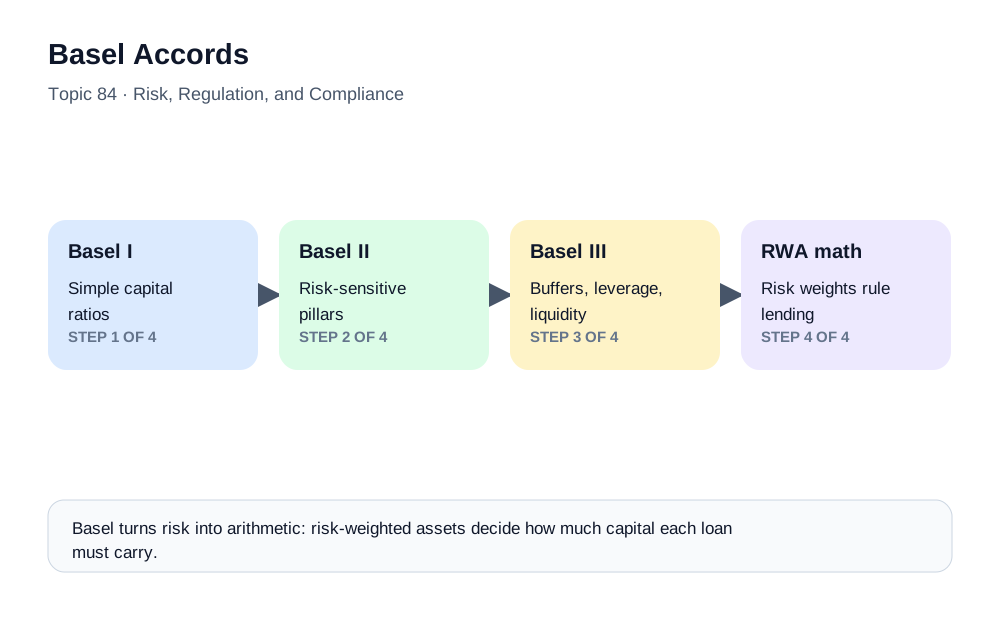
Basel Accords at a glance — Basel I, II, III, capital adequacy, RWA.
Basel I, II, III — The Rules That Shape Global Banking
The Basel Accords constitute the most influential regulatory framework in the history of banking. Developed by the Basel Committee on Banking Supervision, these international agreements establish the capital requirements, risk measurement standards, and supervisory expectations that govern virtually every significant bank in the world. From their origins in the late 1980s through the comprehensive reforms following the 2008 financial crisis and the ongoing refinements of Basel III, these standards have fundamentally shaped how banks manage risk, how regulators supervise institutions, and how financial crises are prevented or contained.
The evolution of Basel reflects a continuous learning process driven by financial crises and subsequent regulatory responses. Basel I emerged in 1988 following the Latin American debt crisis that exposed capital inadequacy at major international banks. Basel II, published in 2004, responded to criticism that the original framework was too crude and did not adequately differentiate risk across borrowers. Basel III, agreed in 2010 after the global financial crisis, fundamentally reformed capital quality and quantity, added liquidity requirements for the first time, and established leverage ratios as backstops. The final post-crisis Basel III reforms continue this evolution through revised standardised approaches, tighter constraints on internal-model use, the output floor and other changes. Labels such as ‘Basel 3.1’ or ‘Basel Endgame’ are used in some jurisdictions and market commentary, but they are not a universal name for one identical global implementation package.
Basel I established the foundational concepts that remain central to banking regulation today. The framework introduced the Capital Adequacy Ratio, requiring bank capital to equal at least eight percent of risk-weighted assets. This formula recognized that not all assets carry equal risk and that capital requirements should reflect these differences. Risk weights assigned zero percent to cash and government bonds, twenty percent to claims on banks, fifty percent to residential mortgages, and one hundred percent to corporate loans and other assets. The simplicity of this approach facilitated implementation but created obvious distortions. A loan to Apple and a loan to a struggling startup both received one hundred percent risk weights despite their vastly different credit quality. Nevertheless, Basel I succeeded in raising capital levels at international banks and establishing the principle that capital should be risk-sensitive.
Basel II represented a quantum leap in sophistication with its three-pillar architecture that remains the organizing framework for bank regulation. Pillar One addressed minimum capital requirements, expanding risk coverage and introducing multiple approaches of varying sophistication. For credit risk, banks could use the standardized approach based on external ratings, the foundation internal ratings-based approach using bank estimates of probability of default with regulatory inputs, or the advanced internal ratings-based approach using bank estimates for all parameters. Market risk capital could be calculated using either standardized methods or internal models based on Value at Risk. Operational risk, recognized explicitly for the first time, could be measured through basic indicator, standardized, or advanced measurement approaches. Pillar Two introduced the supervisory review process, requiring banks to assess their own capital adequacy through the Internal Capital Adequacy Assessment Process and empowering regulators to impose additional requirements for risks not fully captured in Pillar One. Pillar Three mandated market discipline through public disclosure, enabling investors and analysts to assess bank risk and exert market pressure for sound practices.
The 2008 global financial crisis exposed fatal flaws in the pre-crisis regulatory framework that Basel III was designed to address. Banks had held insufficient high-quality capital, with hybrid instruments that proved ineffective in absorbing losses during stress. No liquidity requirements existed, leaving banks vulnerable to funding runs. Risk-weighted capital ratios had been gamed through model manipulation and regulatory arbitrage. Excessive leverage had accumulated, hidden by accounting practices that did not reflect true economic exposure. No special rules applied to systemically important institutions despite their potential to bring down the entire system.
Basel III responded with comprehensive reforms across capital, liquidity, leverage, and systemic risk. Capital requirements increased dramatically in both quantity and quality. Basel III strengthened both the minimum quality and the buffer structure of capital. At the global standard level, the minimum CET1 requirement is 4.5% of risk-weighted assets and the capital conservation buffer is 2.5% above minimum requirements. Other buffers and supervisory requirements can apply, including countercyclical and systemic buffers. The amount a particular bank must maintain in practice therefore depends on the current Basel standard, national implementation, systemic designation, supervisory requirements and management buffers; one headline CET1 percentage should not be presented as a universal requirement for every bank.
The quality of capital matters as much as quantity. Common Equity Tier One consists of common shares and retained earnings, the only instruments that fully absorb losses while the bank remains a going concern. Additional Tier 1 and Tier 2 instruments must satisfy detailed Basel eligibility criteria covering permanence or maturity, subordination, distributions, loss absorbency and other terms. Instrument structures differ across jurisdictions, so AT1 should not be reduced to one universal conversion trigger and Tier 2 should not be treated as any subordinated debt with a sufficiently long contractual maturity. The regulatory classification depends on the actual instrument terms and applicable local implementation.
Basel III introduced liquidity requirements where none had existed before. The Liquidity Coverage Ratio requires banks to hold high-quality liquid assets sufficient to survive thirty days of severe stress without external funding. The Net Stable Funding Ratio requires that long-term assets be funded by stable long-term sources rather than short-term wholesale funding. Together these ratios address the maturity transformation risk that makes banks vulnerable to runs and funding disruptions.
The leverage ratio provides a simple backstop against the complexity and potential manipulation of risk-weighted approaches. Calculated as Tier One capital divided by total exposure without risk weighting, this ratio must equal at least three percent. While seemingly low, this translates to maximum leverage of thirty-three times capital, far below the levels reached by some institutions before the 2008 crisis. The leverage ratio catches risks that risk-weighted measures might miss and prevents excessive leverage accumulation even when risk weights suggest safety.
Global systemically important banks face additional loss-absorbency requirements reflecting the potential impact of their distress on the global financial system. The Basel methodology uses indicators including size, interconnectedness, substitutability or financial-institution infrastructure, complexity and cross-jurisdictional activity. Designated institutions and their bucket allocations are updated over time, so a durable curriculum should use the latest official annual G-SIB publication for current names and surcharges rather than freeze one year's bank list into the lesson.
The finalisation of the post-crisis Basel III reforms addresses, among other issues, excessive variability in risk-weighted asset calculations across banks. The output floor limits how much lower internal model calculations can go compared to standardized approaches, ensuring that model sophistication does not become model arbitrage. Revised standardized approaches for credit risk incorporate more risk sensitivity without requiring complex modeling. The fundamental review of the trading book revises market risk capital requirements based on expected shortfall rather than Value at Risk, better capturing tail risk. These refinements aim to restore credibility to risk-weighted capital ratios while maintaining the incentives for banks to develop sophisticated risk measurement capabilities.
The Basel standards have made capital, liquidity, leverage, risk governance and disclosure central constraints on modern banking strategy. Loan pricing, balance-sheet growth, dividend capacity, trading activity and funding choices can all be affected by prudential requirements. The framework cannot make bank failure impossible, and implementation differs across jurisdictions, but it creates a common architecture for measuring resilience and for requiring banks to operate with loss-absorbing and liquidity resources proportionate to the risks they take.
35. Basel Implementation Starts With Scope
Before a bank calculates one ratio, it must determine which legal entities and exposures fall inside the applicable prudential scope. Banking groups can contain holding companies, regulated banks, securities firms, insurance entities and service companies. Accounting consolidation and prudential consolidation are not always identical, and capital can be trapped in one entity even when the group appears well capitalised overall.
A strong implementation therefore begins with an entity map showing ownership, regulatory perimeter, consolidation treatment and material intra-group exposures. Changes in acquisitions, disposals or restructurings should trigger a prudential-scope review. Without this step, even a mathematically correct capital engine can calculate the wrong group.
36. The Capital Waterfall Should Be Operationally Reproducible
Regulatory capital is built through a sequence of adjustments. Finance starts with accounting information, then prudential filters and deductions are applied according to the relevant rules. Capital instruments are tested for eligibility, regulatory adjustments are applied, and CET1, AT1 and Tier 2 amounts are produced.
The bank should be able to reproduce that waterfall from source data to final ratio. Every deduction, adjustment and eligibility decision needs ownership and evidence. Manual top-side adjustments should be controlled, approved and reconciled. If a capital number changes materially, management should know whether the cause was profit, losses, instrument issuance, deductions, foreign-exchange movement, regulation, model change or data correction.
37. RWA Needs Reconciliation by Driver
A headline RWA number is not enough. Banks should attribute movement to business growth, rating migration, defaults, collateral changes, market moves, model updates, regulatory changes and portfolio disposals.
Suppose credit RWA rises by ₹5,000 crore in a month. If ₹3,000 crore comes from new lending, ₹1,000 crore from downgrades and ₹1,000 crore from collateral losing eligibility, each driver requires a different response. New lending may be planned. Downgrades may indicate portfolio deterioration. Collateral eligibility may expose a data or legal problem.
Driver attribution turns capital reporting into a management tool rather than an end-of-period compliance number.
38. Standardised and Internal-Model Views Should Be Compared
Where a bank uses approved internal models, management should still understand how the same portfolio looks under the standardised approach. The output floor makes that comparison formally important, but it is also useful as a risk diagnostic.
Large unexplained gaps between modelled and standardised RWA deserve challenge. The difference may be economically justified by better risk differentiation, or it may reveal optimistic model calibration, stale data or inconsistent classification.
The objective is not to force the two measures to match. It is to ensure the divergence is understood, governed and credible.
39. Basel Change Programmes Need Business Ownership
A prudential rule change can look like a finance or risk project while affecting the whole bank. Revised credit conversion factors can change the economics of undrawn facilities. New real-estate risk weights can influence mortgage pricing. Output-floor effects can alter the value of internal models. Operational-risk changes can affect business-line capital allocation.
Implementation programmes should therefore include business, risk, finance, treasury, data, legal, architecture, development, testing and reporting. Requirements should trace from regulatory text to policy, data fields, calculation rules, reports, controls and sign-off.
A successful programme is not one that produces the first regulatory return on time while product teams remain unaware that their economics have changed.
40. Capital and Liquidity Should Be Managed Together
A bank can be strongly capitalised and still fail to meet cash obligations. It can also hold abundant liquidity while suffering losses that erode capital. Basel deliberately contains separate capital and liquidity standards because neither solves the other.
Management should therefore examine combined stress. A deposit run can force asset sales that crystallise losses. Credit deterioration can weaken capital and trigger rating pressure that raises funding costs. Derivative market moves can generate margin calls while also changing trading-book capital.
The integrated question is not simply whether CET1, LCR and NSFR each pass independently. It is whether the bank remains viable when the same scenario affects all of them at once.
41. Management Buffers Are Strategic Choices
Operating exactly at a regulatory minimum is rarely a sensible target. Banks hold internal buffers to absorb ordinary volatility, stress, model uncertainty, regulatory change and planned growth.
The size of that buffer should connect to risk appetite and recovery planning. Too little margin leaves management with few options after a shock. Excessive unused capital can reduce returns and make the business uncompetitive.
Capital planning therefore balances resilience and economic efficiency. The board should understand why the chosen management buffer is adequate for the bank's risk profile rather than simply copy a peer's target.
42. Basel Metrics Need Independent Control
Regulatory calculations should be subject to maker-checker controls, reconciliations, data-quality thresholds and independent review. Material rule changes need testing. Model outputs need validation. Regulatory reports need sign-off.
Internal audit should be able to trace sample exposures from source systems through classification and calculation into published or supervisory figures. Where manual adjustments remain, the bank should track volume, value, reason and ageing so recurring workarounds do not become permanent hidden processes.
Strong control is especially important because prudential metrics influence dividend decisions, market disclosures and supervisory judgement.
43. The Board Should Understand Constraint, Not Every Formula
Directors do not need to reproduce the standardised credit-risk calculation by hand. They do need to understand which ratios constrain the bank, how much headroom exists, what risks consume capital, how stress changes the position and what management actions are credible.
Useful board questions include: Which portfolios drive RWA growth? What happens if credit quality weakens? Is leverage or risk-weighted capital the binding constraint? How much of the liquidity buffer is genuinely usable? What would the output floor do under the growth plan? Which regulatory transitions could change strategy?
If the answers cannot be explained in business language, prudential reporting has not yet become governance.
44. The Professional Standard
World-class Basel implementation is visible when prudential rules influence decisions before reports are filed. Risk-weighted assets are traceable, capital instruments are legally and operationally eligible, liquidity resources are usable, model risk is challenged, regulatory change is controlled and management buffers are deliberate. Product pricing reflects capital and liquidity consumption. Growth plans remain inside risk appetite. Stress testing connects capital, liquidity and earnings rather than treating them as separate spreadsheets.
That is the real purpose of the Basel framework. It is not to create more ratios for banks to publish. It is to create enough discipline that leverage, maturity transformation, market activity and operational complexity remain survivable when assumptions prove wrong.
<!-- MBA-DEEP-DIVE-START -->Deep Dive: The Basel Framework as the Global Architecture of Bank Resilience
The Basel standards are best understood not as one capital ratio but as a joined prudential architecture. Capital requirements absorb losses. Liquidity standards help banks survive cash outflows. The leverage ratio constrains balance-sheet expansion that might look deceptively safe under risk weights. The supervisory review process addresses material risks that are not captured adequately by minimum formulas. Disclosure requirements support market discipline. Standards for large exposures, operational risk, counterparty credit risk, market risk, interest rate risk in the banking book, resolution-related loss absorbency, and other areas fit around the same objective: a bank should be able to take risk without making ordinary shocks fatal to itself or the wider financial system.
The Basel Committee on Banking Supervision does not enact national law. It develops international standards and supervisory principles. Jurisdictions then implement those standards through their own legislation, regulation, supervisory rules, reporting frameworks, and transition arrangements. This distinction is critical for banking professionals. A statement can be correct as a Basel minimum yet still not describe the exact rule applied to a specific bank in India, the European Union, the United Kingdom, the United States, Singapore, or another jurisdiction at a particular date.
The consolidated Basel Framework is therefore the best conceptual reference point, but implementation analysis must always identify which jurisdiction, which bank population, which effective date, and which local rule apply.
Why Basel exists
Banking is inherently leveraged. Deposits and other liabilities fund assets many times larger than shareholder equity. This leverage makes banking economically useful because it transforms savings into credit, but it also means relatively modest losses can erase equity.
Suppose a bank has assets of ₹100 and liabilities of ₹94, leaving ₹6 of equity. A 2% asset loss reduces equity by one-third. A 6% loss can eliminate it entirely. The exact accounting and regulatory treatment is more complex, but the basic leverage logic explains why prudential capital exists.
Individual banks also interact through payments, markets, derivatives, securities financing, lending, and common asset holdings. A failure can therefore transmit stress through the system. Prudential regulation seeks not only to protect one institution but to reduce the probability that ordinary banking losses become systemic crises.
Basel standards create a common language for that task.
Basel I created a common capital floor
The 1988 Basel Capital Accord established an internationally agreed framework for measuring bank capital relative to risk-weighted assets for internationally active banks. Its simplicity was a strength at the time. Exposures were placed into broad risk-weight categories and banks were expected to maintain a minimum capital ratio.
The framework improved comparability across countries and helped counter concerns that international banks were competing with increasingly thin capital.
But broad buckets were economically crude. Two corporate borrowers with very different credit quality could attract the same regulatory treatment. Securitisation and other innovations exposed opportunities for regulatory arbitrage. The framework also focused predominantly on credit risk and later incorporated market risk through amendments.
The lesson is not that Basel I was a mistake. It solved a 1980s problem with tools appropriate to that period. Its limitations created the case for a more risk-sensitive framework.
Basel II introduced the three-pillar architecture
Basel II organised prudential regulation around three pillars.
Pillar 1 sets minimum capital requirements for defined risk categories using prescribed approaches.
Pillar 2 is the supervisory review process. It requires banks and supervisors to consider the adequacy of capital and risk management beyond mechanical Pillar 1 calculations.
Pillar 3 uses public disclosure to strengthen market discipline by allowing investors and other stakeholders to understand material risk and capital positions.
This architecture remains fundamental because no quantitative formula can capture every material risk. A bank can satisfy minimum capital ratios while carrying concentration risk, interest-rate risk, weak governance, poor liquidity, or model risk that deserves additional supervisory attention.
Basel II also made credit risk more sensitive through standardised and internal-ratings-based approaches and expanded the treatment of operational risk. Greater risk sensitivity improved economics but also increased model complexity and reliance on data, governance, and validation.
The global financial crisis exposed weaknesses beyond capital quantity
The 2007–09 global financial crisis demonstrated that apparently adequate capital ratios could coexist with severe fragility.
Some institutions held capital instruments that did not absorb losses effectively while the bank remained a going concern. Leverage was high. Trading and securitisation risks were underestimated. Off-balance-sheet commitments returned to bank balance sheets during stress. Funding models depended heavily on short-term wholesale markets. Liquidity could disappear rapidly. Counterparty exposures and interconnectedness amplified losses.
The post-crisis reforms therefore addressed both quality and quantity of capital, added a leverage-ratio backstop, introduced global liquidity standards, strengthened counterparty and market-risk treatment, added capital buffers, and imposed additional loss-absorbency requirements on systemically important banks.
The reforms collectively became known as Basel III.
Basel III is broader than one implementation date
Basel III was developed through multiple standards over many years. Some elements were implemented earlier; others were finalised later and phased in differently across jurisdictions.
The phrase “Basel III finalisation” is preferable to informal labels such as “Basel 3.1” when discussing the global standard, because local regulators can use different terminology for their own packages.
The final post-crisis reforms included revisions to the standardised approaches, constraints on internal-model use, the output floor, revised operational-risk measurement, revised credit valuation adjustment treatment, and the fundamental review of the trading book, among other changes.
Implementation dates have differed internationally. A banking analyst should therefore separate:
- what the Basel standard says;
- when the Basel Committee intended implementation;
- how a jurisdiction transposed the standard; and
- which transition applies to the specific bank.
Regulatory capital is not the same as accounting equity
A bank’s accounting balance sheet reports equity under the applicable accounting framework. Regulatory capital starts from accounting data but applies prudential definitions, eligibility criteria, deductions, adjustments, and limits.
This distinction exists because not every accounting equity item is equally capable of absorbing losses.
Regulatory capital is organised broadly into:
- Common Equity Tier 1, or CET1;
- Additional Tier 1, or AT1; and
- Tier 2.
CET1 is the highest-quality going-concern capital. It includes common shares and retained earnings subject to regulatory adjustments and eligibility requirements.
AT1 contains instruments designed to absorb losses while the bank remains a going concern, subject to detailed eligibility conditions.
Tier 2 provides additional loss-absorbing capacity, particularly in gone-concern situations, again subject to eligibility requirements.
A professional should avoid describing every subordinated bond as regulatory capital. Instrument terms determine eligibility.
CET1 is central because it absorbs loss first
Common equity provides the clearest buffer against unexpected losses. If a bank records a large credit provision or trading loss, retained earnings and equity fall.
That direct relationship is why prudential frameworks place strong emphasis on CET1.
Minimum ratios alone do not describe the full requirement. Buffers, supervisory add-ons, systemic surcharges, stress-test constraints, and jurisdiction-specific rules can raise the capital level a bank must maintain in practice.
The correct question is therefore not “What is the Basel CET1 number?” but “What minimum, buffers, supervisory requirements, and management margin apply to this bank?”
Capital conservation creates usable buffers above minima
The capital conservation buffer is designed to ensure banks build capital above minimum requirements in normal times.
When a bank enters the buffer range, restrictions on capital distributions can become progressively stronger under the applicable framework. This is intended to allow the bank to conserve resources rather than continue dividends, share buybacks, or discretionary payments while capital is weak.
The buffer is not supposed to be viewed as permanently untouchable. Its purpose is to absorb stress while creating incentives for restoration.
Management should nevertheless operate above regulatory thresholds with its own internal management buffer. Running exactly at a regulatory boundary leaves little room for ordinary earnings volatility, model changes, asset growth, or supervisory adjustments.
Countercyclical buffers address system-wide credit growth
The countercyclical capital buffer is a macroprudential tool. Authorities can increase it when excessive credit growth or other conditions suggest system-wide risk is building and release it during stress where appropriate.
Its logic differs from a bank-specific surcharge.
A bank can be individually well managed while the entire financial system is becoming more leveraged. If every lender expands aggressively at the same time, risk can be correlated. Countercyclical capital creates additional loss-absorbing capacity during the build-up phase and can support lending capacity when conditions reverse.
The applicable buffer varies by jurisdiction and exposure geography under the detailed rules, so a global bank needs data capable of applying different national settings.
Systemically important banks carry additional obligations
A systemically important bank can impose unusually large costs on the financial system if it fails. The Basel framework therefore includes additional loss-absorbency requirements for global systemically important banks, while domestic authorities can impose requirements for domestic systemically important institutions.
Systemic importance is not simply “being very large.” Methodologies consider indicators such as size, interconnectedness, cross-jurisdictional activity, substitutability, and complexity.
The list of designated institutions and their bucket assignments can change. Training material should therefore avoid hard-coding one year’s list as permanent fact.
The enduring principle is that institutions whose disorderly failure would create greater external damage are expected to maintain stronger resilience and resolution capability.
Risk-weighted assets convert exposure into prudential risk
Capital ratios use risk-weighted assets, or RWA, rather than total assets alone.
The denominator therefore depends on both exposure amount and regulatory risk measurement.
A ₹100 exposure with a 20% risk weight contributes ₹20 of RWA. A ₹100 exposure with a 100% risk weight contributes ₹100. The bank then applies the relevant capital ratio to the resulting RWA.
This structure encourages risk sensitivity, but it also creates model and classification risk. Wrong customer type, collateral recognition, external rating, default status, maturity, loan-to-value, or product classification can change RWA materially.
Regulatory capital reporting therefore depends on detailed data lineage and controlled rule implementation.
The standardised approach has become more risk-sensitive
The post-crisis revisions strengthened the standardised approach for credit risk. Rather than treating every exposure in a broad category identically, the framework uses more granular exposure classes and risk drivers.
The exact treatment depends on the counterparty and exposure type. Corporate, bank, sovereign, retail, real-estate, defaulted, subordinated, and other exposures can follow different rules.
Collateral, guarantees, and credit risk mitigation can alter the result when eligibility conditions are met.
A bank should not implement capital rules from a simple spreadsheet mapping “mortgage = one risk weight” or “corporate = one risk weight.” The current framework contains conditional logic and jurisdiction-specific implementation decisions.
Internal models require permission and governance
Basel frameworks historically allowed qualifying banks to use internal estimates for certain risk parameters under internal-ratings-based approaches.
Model use is subject to supervisory approval, minimum standards, validation, data history, governance, and ongoing performance expectations. The post-crisis reforms restricted the scope of internal models for some portfolios and parameters because excessive variability in modelled RWA weakened comparability.
Internal modelling is therefore not a regulatory reward for sophistication. It is a controlled permission that imposes demanding governance obligations.
If model outputs consistently produce unusually low RWA without economic explanation, supervisors and management should challenge calibration, data, overrides, and portfolio definitions.
The output floor limits divergence from standardised RWA
The output floor is a key part of the Basel III finalisation. It limits how far aggregate RWA calculated using approved internal approaches can fall below a percentage of RWA calculated using the standardised approaches, subject to the framework’s detailed scope and transition.
The principle is important because model sophistication should not permit a bank’s regulatory denominator to become disconnected from a common benchmark.
Implementation requires banks using internal models to calculate a credible standardised RWA measure in parallel. This creates major data and systems requirements.
A bank cannot treat the standardised approach as a simple fallback if the output floor depends on it every reporting period.
The leverage ratio is a non-risk-based backstop
Risk weights can be wrong. Models can underestimate risk. Assets considered low risk can still create large losses or liquidity pressure. The leverage ratio therefore compares Tier 1 capital with a broad exposure measure without using ordinary RWA weights.
Its purpose is not to replace risk-sensitive capital requirements but to constrain excessive leverage that may not be visible in the RWA ratio.
The exposure measure includes more than accounting assets and follows detailed treatment for derivatives, securities financing transactions, and off-balance-sheet exposures.
A bank can therefore be constrained either by risk-weighted capital or by leverage. Business planning should model both.
Liquidity Coverage Ratio adds a short-term survival test
The Liquidity Coverage Ratio, or LCR, requires a stock of high-quality liquid assets relative to prescribed net cash outflows over a 30-day stress period, subject to the detailed Basel framework and local implementation.
The LCR was a major post-crisis innovation because the global crisis showed that a bank can meet capital ratios yet fail when short-term funding disappears.
The ratio uses assumptions about runoff, drawdown, inflows, asset liquidity, and haircuts. It is not simply cash divided by deposits.
Banks also need internal liquidity stress testing because their actual depositor concentration, currencies, collateral, and operational constraints can differ from the regulatory scenario.
Net Stable Funding Ratio addresses structural funding
The Net Stable Funding Ratio, or NSFR, encourages banks to maintain stable funding relative to the liquidity and maturity characteristics of assets and off-balance-sheet activities over a longer horizon.
Its economic logic is that illiquid or long-dated assets should not rely excessively on funding likely to disappear quickly.
A long mortgage portfolio funded mainly through very short wholesale borrowing can look profitable in calm markets while containing a structural rollover problem.
LCR and NSFR therefore address different horizons. One should not be used as a substitute for the other.
Market risk capital moved beyond simple VaR
The fundamental review of the trading book revised the boundary and measurement of market risk.
A major conceptual change is the use of expected shortfall in the internal-models framework rather than relying only on Value at Risk. Expected shortfall focuses on the average loss beyond a tail threshold and is intended to capture severe outcomes more effectively.
The framework also strengthens the trading-book/banking-book boundary, model approval, liquidity horizons, default risk treatment, and desk-level tests.
For practitioners, the key point is that market-risk capital is linked closely to how positions are classified, priced, modelled, and governed. Moving a position between books is not a free capital-management choice.
Operational risk moved to a standardised framework
The Basel III finalisation replaced earlier operational-risk capital approaches with a standardised approach.
The framework links capital to a business indicator and, subject to implementation, internal loss experience through the prescribed methodology.
The reform responded to wide variation and difficulty validating highly model-driven operational-risk capital estimates.
Operational-risk management itself remains much broader than the capital formula. Cyber risk, fraud, process failure, legal risk, third-party dependency, resilience, data errors, and conduct events require operational controls even when the capital calculation is standardised.
Counterparty credit risk is dynamic exposure
Derivatives and securities-financing transactions create counterparty credit risk whose value changes with markets.
Unlike a fixed loan balance, derivative exposure can move rapidly as rates, FX, credit spreads, equities, or commodities change.
Basel standards therefore include methodologies for current and potential future exposure, collateral, netting, margin, central counterparties, and credit valuation adjustment risk.
A bank needs legally enforceable netting and high-quality collateral data to obtain the intended prudential recognition. A signed document sitting outside the exposure engine does not reduce RWA by itself.
Credit valuation adjustment capital covers mark-to-market credit deterioration
Counterparty default is not the only source of loss. A counterparty’s credit quality can deteriorate before default, widening spreads and reducing the market value of a derivative position.
Credit valuation adjustment, or CVA, reflects that effect in valuation. The prudential framework also includes capital requirements for CVA risk.
This is a useful example of Basel’s evolution. Risk regulation increasingly recognises that economic loss can occur through changing market perception before a legal default event occurs.
Risk, finance, valuation, and capital systems therefore need consistent counterparty data.
Large-exposure limits protect against concentration
Even a well-rated counterparty can fail.
A bank that lends an enormous amount to one borrower or connected group can therefore be endangered by a single event even if ordinary credit-risk weights looked acceptable.
The Basel large-exposures framework limits concentration relative to eligible capital and contains specific treatment for interconnected counterparties and certain exposures.
The control is conceptually different from RWA. Capital ratios measure aggregate risk. Large-exposure rules prevent excessive dependence on one source of loss.
Credit systems must identify connected counterparties correctly for this reason.
Pillar 2 addresses risks beyond the formulas
Pillar 2 is the supervisory review process.
Banks assess capital and liquidity adequacy relative to their full risk profile, while supervisors evaluate governance, risk management, stress testing, business models, and risks not adequately captured in Pillar 1.
Examples can include:
- interest rate risk in the banking book;
- concentration risk;
- model risk;
- strategic or business-model risk;
- pension risk;
- risks arising from weak governance;
- additional operational or liquidity vulnerabilities.
The exact local process can use names such as ICAAP, ILAAP, SREP, or other jurisdictional frameworks.
The enduring principle is that prudential safety cannot be outsourced to one formula.
Stress testing connects Basel requirements to forward-looking risk
Capital ratios are point-in-time measures. Stress testing asks what those ratios would become after severe but plausible losses and balance-sheet changes.
A stress can include credit defaults, market moves, deposit runoff, margin calls, weaker income, operational losses, and management actions.
If the bank starts with a strong CET1 ratio but falls below requirements quickly under plausible stress, current capital may not be adequate for its risk profile.
Stress testing therefore informs capital planning, risk appetite, dividend decisions, recovery planning, and supervisory assessment.
Pillar 3 makes risk visible to the market
Pillar 3 disclosure requirements aim to support market discipline by making key information on capital, RWA, leverage, liquidity, risk exposures, and other prudential measures publicly available in comparable formats.
Disclosure quality matters because investors cannot evaluate a bank from an accounting balance sheet alone.
However, disclosure is only useful if definitions are consistent and data reconcile with regulatory reporting.
A bank should be able to explain why a capital ratio in a public disclosure agrees with—or legitimately differs from—numbers in internal management information and supervisory returns.
Regulatory reporting is a controlled production process
Basel implementation creates thousands of data points across customer, account, collateral, instrument, legal entity, market, finance, and risk systems.
A regulatory capital number can fail because of a simple data problem:
- wrong counterparty class;
- missing default flag;
- stale external rating;
- incorrect property valuation;
- duplicate collateral;
- missing guarantee maturity;
- wrong netting set;
- incorrect legal entity;
- off-balance-sheet exposure omitted.
Regulatory reporting therefore requires lineage, reconciliations, ownership, controlled rules, data-quality thresholds, issue management, and audit evidence.
The calculation engine is only one part of compliance.
Capital affects product pricing
A loan that consumes more regulatory and economic capital should generally require a higher return, all else equal.
Banks therefore incorporate capital into risk-adjusted pricing and profitability.
A corporate facility can look attractive on interest spread but become weak after funding cost, expected credit loss, operating cost, liquidity cost, and capital charge are included.
This is why regulatory change reaches product teams. A change in risk weights, credit conversion factors, model eligibility, or output-floor impact can alter the economics of whole portfolios even when customer contracts remain unchanged.
Capital planning links growth to balance-sheet capacity
A bank cannot grow assets indefinitely without considering capital generation.
New lending increases exposure and potentially RWA. Retained earnings generate capital internally. Dividends and buybacks reduce capital. Acquisitions, model changes, regulatory changes, and credit deterioration can also affect capital ratios.
Capital planning therefore projects:
- business growth;
- earnings;
- losses;
- RWA movement;
- dividends;
- issuance or redemption of capital instruments;
- stress outcomes;
- regulatory transitions.
A strong plan maintains management buffers rather than targeting the regulatory minimum.
Basel is also a data-architecture programme
The post-crisis framework increased the amount of granular data banks need to calculate risk consistently.
Credit risk requires obligor, exposure, collateral, guarantee, default, maturity, and product attributes. Market risk requires positions, sensitivities, liquidity horizons, market data, and desk classification. Operational risk requires business and loss data. Counterparty risk requires netting and collateral. Liquidity requires depositor and funding characteristics.
The same customer or instrument can appear in several calculations.
A bank therefore benefits from common identifiers and governed reference data. Separate regulatory silos that each invent their own customer class eventually produce reconciliation problems.
Model risk is built into prudential measurement
Whenever regulatory results depend on internal models, parameter estimates, valuation models, or behavioural assumptions, model risk follows.
Governance should address:
- development standards;
- independent validation;
- data quality;
- performance monitoring;
- overrides;
- model change;
- limitations;
- use tests;
- supervisory approval where required.
A model can be statistically impressive and still be unsuitable for regulatory use if the data population, governance, or business implementation is weak.
Proportionality does not mean no discipline
The Basel Core Principles recognise proportionality because banking systems contain institutions of very different size, complexity, and systemic importance.
A small domestic bank should not necessarily operate the same infrastructure as a global dealer bank. But proportionality does not mean ignoring material risk.
The 2024 revised Basel Core Principles emphasise that supervisory intensity and requirements should be commensurate with risk profile and systemic importance while preserving robust standards.
The principle allows regulation to fit the institution without turning smaller size into an exemption from sound governance, capital, liquidity, or risk management.
Basel standards and accounting standards answer different questions
Accounting determines recognition, measurement, income, impairment, and financial-statement presentation under frameworks such as IFRS or US GAAP.
Basel prudential rules determine regulatory capital, RWA, leverage, liquidity, and supervisory requirements.
The two interact but are not identical.
For example, an accounting provision can reduce earnings and CET1, while prudential rules can apply additional treatment to expected losses or deductions. A fair-value movement can affect accounting equity differently depending on classification, while economic risk may still matter to supervision.
Finance and regulatory-capital teams should reconcile the two views rather than assume one number can be copied into the other.
Basel standards and resolution requirements also connect
Capital protects a going concern, but authorities also need credible mechanisms for handling failure.
Systemically important institutions can be subject to total loss-absorbing capacity or other resolution-related requirements under the applicable international and local framework.
These instruments are designed to absorb losses and support recapitalisation in resolution without relying solely on ordinary public support.
Capital planning should therefore distinguish going-concern capital, gone-concern resources, and liquidity needs in resolution.
Implementation requires change governance
A Basel rule change can affect far more than the regulatory reporting team.
A revised credit-risk rule can change data capture, collateral policy, loan pricing, product strategy, limit frameworks, system fields, model use, disclosures, and capital forecasts.
A strong implementation programme traces each regulatory requirement through:
- legal interpretation;
- policy;
- business rules;
- data sources;
- calculation engines;
- controls;
- reporting;
- disclosure;
- testing;
- sign-off.
This is why large prudential programmes require business analysts, risk specialists, finance, data teams, architects, developers, model teams, testers, operations, and senior governance.
A complete capital example
Imagine a bank plans rapid growth in commercial real-estate lending.
Credit risk assesses borrowers and collateral. The regulatory-capital team estimates RWA under the applicable approach. Finance forecasts expected credit losses and earnings. Treasury models funding and liquidity. Stress testing applies a property downturn. Capital planning estimates the effect on CET1 and leverage. Large-exposure controls test concentration to groups and sectors.
The business may discover that the portfolio is profitable in the base case but consumes too much capital under stress or becomes constrained by concentration rather than by the ordinary capital ratio.
Management can then change pricing, reduce growth, diversify collateral, syndicate exposures, or raise capital.
Basel works when these signals change business decisions before losses occur.
A complete regulatory-data example
Suppose a mortgage portfolio has strong credit performance but the bank’s property valuations are stale.
If the regulatory approach depends on loan-to-value bands, old valuations can place exposures in the wrong risk categories. A system migration that drops the valuation date can make the problem worse.
The bank needs rules for eligible valuation, refresh frequency, property type, collateral linkage, and audit history. Risk-weight calculations should reject or conservatively treat records that do not meet required data quality rather than silently assume the most favourable category.
This example shows why prudential compliance is inseparable from data governance.
What excellent Basel implementation looks like
A world-class bank knows which prudential framework applies to each legal entity and portfolio, which local implementation date governs it, and how transitional rules affect the result. Capital calculations reconcile to finance and exposure systems. RWA has traceable data lineage. Internal models are independently validated. Standardised calculations are credible. Leverage, liquidity, concentration, and stress limits are monitored alongside risk-weighted capital.
The bank also understands business impact. Product pricing reflects capital and liquidity consumption. Growth plans respect capital capacity. Management buffers sit above regulatory minima. Pillar 2 risks are not ignored because they lack a simple formula. Disclosures reconcile with supervisory returns. Rule changes are implemented through controlled end-to-end programmes.
The deepest lesson is that Basel is not an external reporting exercise imposed after banking happens. It changes which risks are affordable, which products are attractive, how much growth a bank can support, how much liquidity it must keep, and how much loss the institution can survive. Prudential regulation becomes real only when those constraints are visible in everyday business decisions.
Practical Continuation: Turning Basel Requirements into Bank-Level Decisions
The Basel framework matters most when broad prudential principles are translated into concrete balance-sheet, data, process and governance decisions. A bank does not experience Basel as a single ratio. It experiences it through capital planning, risk-weighted assets, leverage, liquidity, stress testing, model governance, disclosure, supervisory review and thousands of data points feeding those processes.
Capital ratios depend on both numerator and denominator
A capital ratio can improve because the bank raises or retains more qualifying capital, but it can also improve because risk-weighted assets fall. Those are economically different outcomes. Management should therefore separate changes caused by earnings, distributions, capital issuance and deductions from changes caused by credit migration, exposure reduction, collateral, model parameters or portfolio mix.
A ratio that improves because the bank exits risky assets may represent genuine de-risking. A ratio that improves because data are reclassified incorrectly is a control failure. Finance and Risk therefore need reconciled movement analysis rather than only the final percentage.
Risk-weighted assets are a business input, not merely a regulatory output
Risk-weighted assets influence return-on-equity decisions, pricing, portfolio limits and capital allocation. If two loans have the same nominal amount but very different risk characteristics, they can consume different amounts of regulatory capital. That affects the economics of the relationship.
Business teams should not manipulate customer decisions simply to minimise regulatory capital, but they should understand the capital consequences of product structure, collateral, maturity, counterparty quality and off-balance-sheet commitments. Sound pricing considers expected loss, funding, operating cost and capital consumption together.
The leverage ratio provides a different lens
Risk-based ratios depend on measures of risk. A leverage measure is designed to constrain excessive balance-sheet expansion even when risk weights are low. This matters because a bank can accumulate large nominal exposures that appear low risk individually but still create system-wide balance-sheet vulnerability.
Management should therefore avoid thinking of one measure as a substitute for another. A business can be comfortable on risk-weighted capital yet constrained by leverage, liquidity or concentration. Prudential management works across constraints simultaneously.
Capital buffers should be usable in stress, not treated as decorative headroom
Banks normally operate above hard minimum requirements because management buffers absorb volatility and protect strategic flexibility. The size of that headroom depends on risk appetite, business mix, stress results, expected growth, market access and supervisory expectations.
A useful capital plan does not merely say that the current ratio exceeds a threshold. It projects capital under credible adverse conditions, including weaker earnings, credit deterioration, market moves, operational losses and balance-sheet growth. It also defines management actions and asks whether those actions would still be realistic in stress.
Stress testing connects static ratios to future resilience
A point-in-time capital number cannot show how quickly losses may consume resources. Stress testing estimates how earnings, credit quality, market exposures, risk-weighted assets and capital might evolve under adverse scenarios.
The value of stress testing lies in decisions, not in producing a severe-looking chart. Management should understand which assumptions drive the result, which portfolios create the largest losses, whether mitigating actions are feasible, and where second-round effects could arise. A planned asset sale is not a credible mitigation if every bank would try to sell the same assets into an illiquid market.
Model risk sits inside prudential risk
Where internal models or advanced measurement approaches are permitted, their outputs can influence capital materially. That creates incentives and model risk. Validation should therefore challenge data quality, conceptual design, calibration, performance, limitations and use.
Even standardised approaches require control. Mapping an exposure to the wrong regulatory category can alter capital. Incorrect collateral recognition, maturity treatment or conversion factors can create systematic errors. Regulatory capital is therefore as much a data-governance problem as a mathematical one.
Regulatory reporting needs traceability to the ledger and source systems
A prudential return should be reproducible. The bank should be able to trace material figures from submitted templates through calculation layers to source records and, where appropriate, reconcile totals to accounting information.
This requires controlled data lineage, transformation logic, ownership and evidence. Manual adjustments should be visible, approved and explained. If a recurring adjustment is needed every reporting cycle, the bank should investigate the underlying system or mapping defect rather than normalise the workaround.
Disclosure creates an external discipline
Public prudential disclosures allow investors, counterparties and analysts to understand aspects of a bank's capital, risk and liquidity position. The disclosure process should therefore be consistent with internal management information and regulatory submissions.
Material unexplained differences between public, regulatory and management views can damage confidence even when each number has a technical explanation. Governance should ensure definitions, dates, consolidation scopes and adjustments are clearly understood.
Basel implementation is national, not self-executing
Basel Committee standards are international prudential standards, but banks are legally bound through the rules adopted by their relevant jurisdictions and supervisors. Exact implementation dates, transitional arrangements, discretions and reporting requirements can therefore differ.
Professionals should distinguish the international standard from local law. When implementing a change, the bank should identify which legal entity is affected, which jurisdiction applies, which version of the rule is effective, what transition exists and how group-level requirements interact with local subsidiary requirements.
A professional Basel operating standard
A mature bank can explain how regulatory capital and liquidity requirements shape its balance sheet without allowing compliance to become a disconnected reporting exercise. It knows where each important number comes from, how business decisions affect prudential resources, what assumptions and models matter, how stress can change the position, and what management actions remain credible.
The real objective is resilience. Ratios, buffers, reporting templates and disclosures are mechanisms for ensuring that a bank can absorb losses, continue critical services and remain governable under pressure. That is the practical meaning behind the Basel framework.
<!-- MBA-DEEP-DIVE-END -->