Visual overview
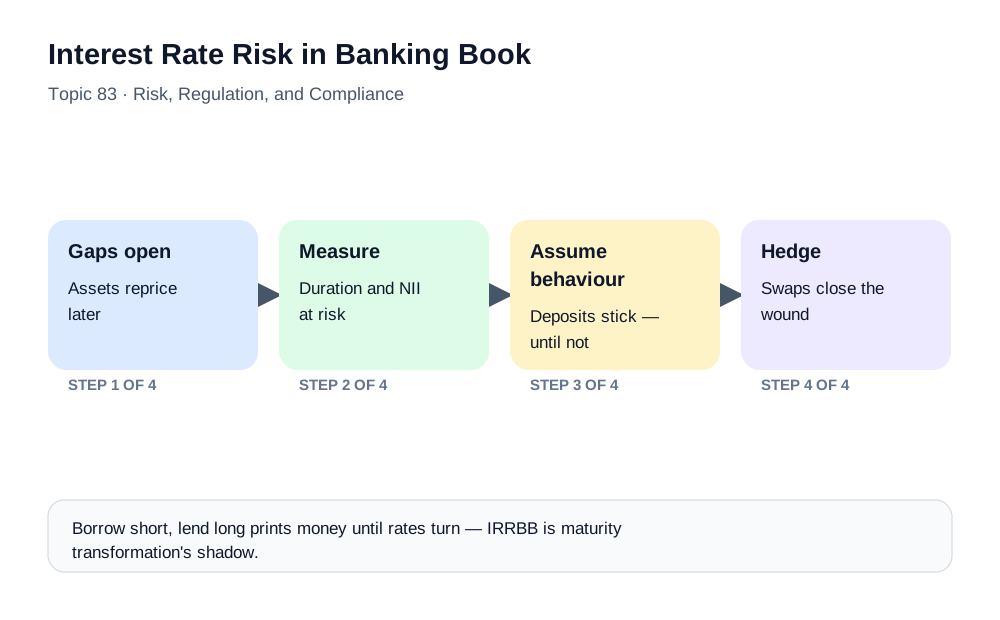
Interest Rate Risk in Banking Book at a glance — Gap analysis, duration, NII at risk.
Gap Analysis, Duration, and NII at Risk
Interest rate risk in the banking book can materially affect both bank earnings and economic value. The 2023 US banking turmoil reinforced the importance of managing rate sensitivity together with funding concentration, liquidity, hedging and governance: large market-value declines on long-duration fixed-rate assets can become especially consequential when deposit outflows force an institution to mobilize or sell assets quickly. Managing IRRBB therefore requires understanding how rate changes affect both short-term earnings and long-term economic value, then keeping those exposures within a clearly governed risk appetite.
Banks operate as maturity intermediaries, earning net interest income from the spread between what they pay on deposits and what they earn on loans and securities. Net Interest Margin, calculated as interest income minus interest expense divided by average earning assets, represents the fundamental profitability metric of traditional banking. When interest rates change, however, the two sides of this equation rarely move in parallel. Assets and liabilities reprice at different times, in different amounts, and with different sensitivities to market rate changes. These mismatches create interest rate risk that can compress margins, reduce earnings, and destroy economic value.
Four distinct types of interest rate risk affect banks. Repricing risk arises when assets and liabilities reprice at different times, creating exposure to rate changes in the interval. A bank that funds a five-year fixed-rate loan with overnight deposits faces repricing risk because deposit costs will change immediately when rates move, while loan yields remain fixed for years. Yield curve risk emerges when the shape of the yield curve changes, affecting banks differently depending on whether they borrow short and lend long or follow the opposite strategy. A flattening curve, where short-term rates rise toward long-term rates, typically compresses net interest margin for traditional banks. Basis risk occurs when different reference rates do not move in lockstep. A loan priced off the marginal cost of lending rate while funding is priced off the repo rate creates basis risk if these benchmarks diverge. Optionality risk reflects the embedded options in many banking products that customers may exercise when rates move. Borrowers prepay fixed-rate loans when rates fall, forcing reinvestment at lower yields, while depositors withdraw early when rates rise, forcing banks to pay higher rates to retain funds.
Gap analysis provides the fundamental framework for measuring repricing risk by comparing rate-sensitive assets and rate-sensitive liabilities across time buckets. The gap for each period equals rate-sensitive assets minus rate-sensitive liabilities, showing whether the bank is asset-sensitive or liability-sensitive for that horizon. A positive gap, where rate-sensitive assets exceed rate-sensitive liabilities, means the bank benefits from rising rates in that period because asset yields will increase more than funding costs. Conversely, a negative gap means the bank is hurt by rising rates because funding costs will rise faster than asset yields. Cumulative gaps across multiple periods reveal the overall interest rate risk position and guide management decisions about hedging and balance sheet restructuring.
Consider a hypothetical gap report showing rate-sensitive assets of five thousand crore rupees against rate-sensitive liabilities of eight thousand crore rupees in the zero to one month bucket. This negative gap of three thousand crore rupees indicates that an immediate rate increase would hurt the bank's net interest income, as funding costs would reprice faster than asset yields. In the one to three month bucket, four thousand crore in assets against three thousand crore in liabilities produces a positive gap of one thousand crore, partially offsetting the initial exposure. By summing these gaps cumulatively, management can see the net exposure over various horizons and understand whether the overall position favors rising or falling rates.
While gap analysis focuses on earnings impacts over relatively short horizons, duration analysis measures sensitivity of economic value to interest rate changes. Modified duration quantifies the percentage change in a bond's price or portfolio's value for a given change in interest rates. The formula states that the change in value approximately equals negative modified duration multiplied by the change in rate multiplied by current value. A bond portfolio with modified duration of five years will lose approximately five percent of its value for every one percentage point increase in rates. This sensitivity applies directly to the economic value of equity, the difference between the market value of assets and liabilities.
Silicon Valley Bank is a useful case study in the interaction between duration risk and funding risk, but the failure should not be reduced to one estimated duration or one headline unrealised-loss figure. SVB accumulated substantial fixed-rate securities during the low-rate period. Rapid monetary tightening subsequently reduced the market value of those assets, while the bank also had a highly concentrated depositor base that could move funds quickly. When confidence weakened, extraordinary deposit outflows and the need to raise liquidity brought the balance-sheet sensitivity into sharp focus. The durable lesson is that long-duration assets, hedging, deposit behaviour, liquidity capacity and governance must be analysed together.
Net Interest Income at Risk measures the earnings impact of interest rate changes over a twelve-month horizon, complementing the longer-term economic value perspective. Banks model multiple rate scenarios and calculate the resulting impact on projected net interest income. Scenario design should reflect the current applicable supervisory framework and the bank's own risk profile rather than relying indefinitely on one memorised parallel-shift assumption; the Basel IRRBB framework includes several prescribed shock shapes and was recalibrated for implementation from 1 January 2026. A base case might project net interest income of two thousand crore rupees. Under a plus two hundred basis point scenario, this might increase to two thousand one hundred fifty crore, while a minus two hundred basis point scenario might reduce it to one thousand eight hundred twenty crore. These projections help banks set internal limits on acceptable earnings volatility and guide hedging decisions.
Economic Value of Equity provides the alternative long-term view by measuring the change in the present value of all assets minus liabilities when rates change. While NII at Risk focuses on earnings over the coming year, EVE measures the impact on capital value over the full life of the balance sheet. A bank might tolerate modest NII volatility if EVE remains stable, or vice versa, but significant deterioration in either measure signals problematic risk exposure. Regulatory guidance typically requires banks to monitor both metrics and maintain them within specified limits relative to capital.
Managing interest rate risk requires a toolkit of strategies and instruments. Natural hedging matches the repricing characteristics of assets and liabilities by originating floating-rate loans funded by floating-rate deposits, or fixed-rate loans funded by fixed-rate deposits or long-term debt. Interest rate swaps allow synthetic transformation of cash flow characteristics, exchanging fixed for floating payments to achieve desired exposures. Duration management adjusts portfolio maturity and cash flow characteristics to reduce sensitivity when rates are expected to rise. Limit structures define acceptable ranges for NII impact and EVE change under standardized rate shocks. Pricing strategy can influence depositor and borrower behavior, adjusting rates to encourage or discourage particular products based on overall risk positioning. Asset-Liability Committees provide governance oversight, reviewing risk reports and making strategic decisions about the bank's interest rate risk profile.
Interest rate risk is not merely a technical matter for treasury departments. It is a balance-sheet risk that needs board oversight, credible modelling and integration with liquidity, capital, finance and product strategy. The 2023 banking turmoil is best used as evidence that rate sensitivity, funding concentration, liquidity mobilisation, hedging and confidence can interact rapidly rather than as proof that one duration formula alone explains failure.
37. IRRBB Needs a Daily Operating Model
A policy can define limits, but the bank still needs a repeatable operating process. Treasury or ALM teams should receive position data from core deposits, loans, securities, derivatives and off-balance-sheet products. The risk engine applies contractual terms and behavioural assumptions, calculates sensitivities, and produces limit and stress views. Independent risk challenges the assumptions and exposure. Finance reconciles balances and accounting outcomes. Product teams understand how pricing and new business change the profile.
A practical operating cycle includes data extraction, validation, position reconciliation, scenario calculation, limit monitoring, explanation of movement, management action and evidence of review. The bank should know which reports are daily, weekly, monthly or event-driven. Material market moves can require ad hoc recalculation before the next scheduled ALCO.
A key control is position completeness. If one mortgage platform, acquired deposit book or hedge portfolio is omitted, the model can look precise while measuring the wrong balance sheet. Reconciliation should therefore compare IRRBB exposure totals with finance and product-system balances and investigate unexplained differences.
38. Accounting Classification Does Not Remove Economic Rate Risk
Accounting standards determine where valuation changes appear and when they affect profit, equity or carrying value. IRRBB asks a different question: how have the economics of future cash flows changed?
A fixed-rate security can therefore create significant economic-value sensitivity even when current accounting presentation does not show the full market movement in earnings. Conversely, an accounting hedge can reduce reported volatility while residual economic basis risk remains.
Treasury, risk and finance should reconcile these views rather than argue that one is ‘the real number’. Accounting is required for financial reporting. IRRBB is required for risk management. Liquidity analysis asks whether the position can be monetised. Capital planning asks what losses or earnings changes mean for buffers. One instrument can be important in all four views.
39. Product Pricing Should React Before the Balance Sheet Becomes Distorted
IRRBB often grows because product pricing remains stale while market rates move. A bank can continue originating long fixed-rate loans using a customer rate designed for yesterday's funding curve. Volumes may look excellent precisely because the product is underpriced. The future risk is then locked into the balance sheet.
Pricing governance should therefore connect customer rates with FTP, option cost, liquidity, expected credit loss, operating expense, capital and competitive conditions. When market rates move sharply, product teams need controlled but rapid repricing authority.
The same is true for deposits. Raising a savings rate can protect liquidity but change NII sensitivity. Launching a high-rate term-deposit campaign can reduce immediate runoff while locking the bank into expensive funding if market rates fall. Product decisions should therefore be assessed as balance-sheet actions, not merely marketing decisions.
40. Behavioural Assumptions Need Conservatism During Structural Change
Historical data are useful only when the future resembles the past closely enough. Digital banking, open finance, comparison sites and faster transfers can change deposit mobility. Mortgage refinancing economics can change when fees or regulation change. Customer behaviour during a prolonged low-rate period may not predict behaviour during rapid tightening.
Model governance should identify where structural change makes history less reliable. The bank can use sensitivity ranges, alternative assumptions and management overlays while new evidence develops. An overlay should have a documented rationale, owner, amount or parameter effect, review frequency and exit criterion. It should not become a permanent unexplained adjustment.
The board does not need to approve every model coefficient, but it should understand which behavioural assumptions are capable of changing the risk conclusion materially.
41. Hedging Capacity Has Its Own Limits
A bank cannot assume every IRRBB exposure can be hedged instantly at no cost. Derivative markets have liquidity, collateral, counterparty and basis constraints. Large hedge programmes can consume credit limits and generate variation-margin needs. Hedge accounting can also influence reported earnings.
Treasury should therefore maintain approved instruments, counterparties, tenor limits, collateral arrangements, execution controls and contingency plans. A hedge strategy should work under stress, not only under normal market liquidity.
If the bank's only response to a large rate shock is ‘we will enter swaps tomorrow’, management should ask whether the necessary market capacity and collateral would actually be available under the scenario being modelled.
42. IRRBB Testing Should Cover Failure Modes, Not Only Formulas
Technology testing should prove more than mathematical accuracy on a clean sample. Boundary cases matter: negative or near-zero rates where relevant, rate floors, caps, missing reset dates, matured instruments, early withdrawals, partial prepayments, multi-currency positions, amortising loans, interest-only periods, and products moving between behavioural segments.
Integration tests should confirm that a change in the core banking system reaches the risk engine with the correct effective date. Reconciliation tests should identify duplicate or missing balances. Model-version tests should show which assumptions produced a historical report. Disaster-recovery tests should prove that risk positions can still be calculated after a major system outage.
A model is not operationally reliable merely because the equation in the methodology document is correct.
43. Change Attribution Builds Management Trust
When NII or EVE sensitivity changes materially, management should be able to explain the movement. A useful attribution separates market movement, new business, customer behaviour, model change, hedge activity and data correction.
Suppose EVE sensitivity worsens by ₹500 crore. If ₹350 crore comes from new fixed-rate mortgage growth, ₹100 crore from slower prepayment assumptions and ₹50 crore from hedge maturity, the actions are different. Product pricing can address new growth. Model governance can review the behavioural change. Treasury can replace or redesign the hedge.
Without attribution, a risk number becomes something management observes rather than manages.
44. What the Board Should Be Able to Ask
A governing body does not need to calculate duration manually, but it should be able to challenge the risk story. Useful questions include: Which rate scenarios hurt us most? Which deposit assumptions drive the result? What happens if customers reprice faster than history? Which portfolios create the largest economic-value loss? How much of the exposure is hedged? What collateral would those hedges require in stress? How does a rate shock interact with liquidity and capital? What management action is available before a limit is breached?
If the answers require weeks of analysis, the IRRBB framework is not providing decision-ready information.
45. The Professional Standard
Excellent IRRBB management is visible when product design, customer behaviour, treasury hedging, finance, liquidity and capital tell one coherent story. The bank understands not only today's gap but how the gap changes when customers exercise options, deposits migrate, yield curves move non-parallel, and management responds. Models are independently challenged, data reconcile, limits have early warnings, and material changes reach ALCO and the board with clear attribution.
That discipline turns interest-rate risk from a hidden consequence of maturity transformation into an explicit strategic choice. Banks cannot remove all IRRBB without also removing much of what makes banking economically useful. They can, however, know exactly where the risk sits, how much earnings and value are at stake, and what actions remain credible when rates move in the direction the business hoped they would not.
<!-- MBA-DEEP-DIVE-START -->Deep Dive: Interest Rate Risk in the Banking Book as a Balance-Sheet Risk
Interest rate risk in the banking book, usually shortened to IRRBB, is the risk that changes in interest rates damage a bank’s earnings or economic value through positions that are held in the banking book rather than managed as trading positions. The current Basel Framework defines IRRBB as the current or prospective risk to capital and earnings arising from adverse rate movements affecting banking-book positions. That definition is important because it makes two things explicit: the bank must protect both future earnings and underlying economic value, and the risk arises from the whole balance sheet rather than from one bond portfolio.
A bank can report healthy current profit while carrying large economic sensitivity to future rates. It can also protect long-run economic value while accepting some short-term net-interest-income volatility. IRRBB management is therefore not about predicting the next central-bank decision. It is about deciding how much rate sensitivity the institution is willing to carry, understanding which customer behaviours create that sensitivity, and proving that the resulting exposure remains within governance and capital capacity under multiple scenarios.
The Basel Framework treats IRRBB primarily through the supervisory review process rather than as a simple Pillar 1 formula. The current standard identifies gap risk, basis risk, and option risk as the three principal forms of IRRBB and expects banks to measure, monitor, control, disclose, and govern the exposure. Credit spread risk in the banking book is related but conceptually separate: a widening credit or liquidity spread can reduce the value of an asset even when the underlying risk-free yield curve is unchanged.
IRRBB begins with balance-sheet transformation
Traditional banking deliberately transforms maturities and repricing characteristics. Customers may keep money in transaction and savings accounts that can be withdrawn quickly. Banks use part of that funding to make mortgages, corporate loans, and investments whose cash flows extend for years. Even when the contractual maturities differ dramatically, customer behaviour can make some short-term liabilities economically stable and some long-term assets repay much earlier than scheduled.
This transformation creates value because customers do not all want the same maturity. Depositors value liquidity; borrowers value longer-term financing. The bank earns a spread for intermediating between them. But the spread is not guaranteed. When market rates change, the funding side and asset side can move at different speeds.
Suppose a bank originates a five-year fixed-rate business loan at 7% and funds it partly with savings deposits currently paying 3%. The 4% spread looks attractive. If deposit competition forces the bank to raise savings rates to 6% while the loan remains fixed at 7%, most of the margin disappears. The customer made no mistake and the borrower did not default. The loss came from a repricing mismatch created by the bank’s own balance-sheet structure.
IRRBB is therefore a price-of-money risk embedded in ordinary banking products.
Gap risk is about timing, not simply maturity
Gap risk arises because assets and liabilities reprice at different times. The relevant date is often the next contractual or behavioural repricing date rather than the final maturity date.
A ten-year floating-rate loan that resets every three months behaves differently from a ten-year fixed-rate loan. A one-year deposit that the bank can reprice next month because its rate is administered behaves differently from a one-year fixed deposit whose rate is locked until maturity.
A simple repricing-gap report places rate-sensitive assets and liabilities into time buckets such as overnight, one month, three months, six months, one year, and longer periods. The bank then compares the amount that can reprice in each bucket.
If more liabilities than assets reprice in the next month, the bank is liability-sensitive for that bucket. An increase in rates can increase funding cost faster than asset yield. If more assets reprice first, the bank is asset-sensitive and may initially benefit from rising rates.
The word “initially” matters. A gap report is a snapshot and cannot capture every behavioural response. Deposit rates can lag policy rates and later catch up. Customers can move from low-rate accounts to high-rate term deposits. Borrowers can prepay. New business can change the balance sheet. Gap analysis is therefore a foundation, not a complete risk model.
Yield-curve risk is more than a parallel shift
Interest rates across different maturities form a yield curve. The curve can shift upward or downward, but it can also steepen, flatten, invert, or move unevenly at different tenors.
A bank that funds short and lends long can be exposed to the relationship between short-term and long-term rates. Suppose overnight rates rise sharply while ten-year rates move only slightly. Short-term funding can become expensive without a corresponding increase in long-term asset yields. A parallel-shift scenario would not capture the full effect.
Modern IRRBB frameworks therefore include non-parallel scenarios. Supervisory shock frameworks consider different changes in the shape and level of yield curves rather than relying on one universal plus-or-minus rate movement.
The Basel Committee recalibrated its prescribed IRRBB shocks in 2024 for implementation from 1 January 2026. The important operational lesson is not to memorise one basis-point number forever. The bank should use the current applicable supervisory calibration and maintain the ability to update scenario parameters without rewriting its entire risk engine.
Basis risk appears when references move differently
Two instruments can have similar maturities but different reference rates. The imperfect relationship between those rates creates basis risk.
A loan might reprice using one benchmark while the funding supporting it reprices using another. Both may be three-month rates, but they need not move by the same amount. A bank can therefore be “matched” by tenor and still experience margin volatility.
Basis risk also appears when an administered deposit rate responds imperfectly to a market benchmark. A bank controls the posted savings rate contractually, but customer competition constrains how slowly it can reprice. The economic basis is therefore partly behavioural.
The transition away from legacy interbank offered rates reinforced this lesson. Banks moved contracts to alternative reference rates with different calculation conventions and economic properties. A hedge designed against one benchmark cannot be assumed to offset exposure to another simply because both are described as short-term rates.
IRRBB systems should therefore store the actual repricing index or administered-rate logic for each material position rather than one generic “floating” flag.
Option risk is embedded throughout banking products
Many customers have choices that become valuable when rates move. Those choices create option risk for the bank.
A mortgage borrower may prepay or refinance when rates fall, forcing the bank to receive principal earlier than expected and reinvest at lower yields. When rates rise, the same borrower may remain in the cheap fixed-rate mortgage longer than the bank expected. The asset shortens when reinvestment conditions are unattractive and extends when the locked-in yield is unattractive to the bank. This is a form of adverse convexity.
Depositors have options too. A savings customer can withdraw on demand. A term depositor may break the deposit if the contract allows early withdrawal and new market rates are sufficiently attractive. A customer can move money internally from a low-rate current account to a high-rate deposit without leaving the bank at all.
The option may be contractual, like a cap, floor, callable bond, or prepayment right, or behavioural, like the practical decision to move deposits between products. The Basel IRRBB framework explicitly distinguishes automatic and behavioural option risk.
A bank that models only contractual maturity can therefore materially misstate its exposure.
Non-maturity deposits are one of the hardest assumptions
Current accounts and many savings accounts have no contractual maturity. Customers can often withdraw immediately, yet a large portion of balances may remain for years because the account is used for salary, collections, payments, cash management, or other relationship purposes.
Treasury and ALM therefore estimate the behavioural life of non-maturity deposits. They may identify stable “core” balances and more volatile components. They also estimate how rapidly the rate paid on those deposits responds to market rates.
These two assumptions—balance decay and deposit beta—can dominate IRRBB results.
If the model assumes that a savings portfolio behaves like stable five-year funding but customers become much more mobile, economic-value sensitivity can be understated. If the model assumes the bank can keep deposit rates almost unchanged while competitors reprice aggressively, projected NII can be overstated.
The 2023 banking turmoil demonstrated how digital access, depositor concentration, and market communication can invalidate older behavioural assumptions. Historical stability should therefore be evidence, not certainty.
Deposit beta needs both rate and mix behaviour
Deposit beta is a simplified measure of how much a deposit rate changes relative to a market or policy-rate move over a defined period.
If a reference rate rises by 200 basis points and the average rate paid on a deposit portfolio rises by 80 basis points, the observed beta over that period is 40%. But beta does not capture every economic effect.
Customers can migrate from non-interest-bearing or low-rate balances into higher-rate products. The bank can retain the deposits but pay much more for them. This mix shift can compress margin even if the posted rate on the original product changes only modestly.
A robust model therefore considers:
- rate paid on each product;
- migration between products;
- customer segmentation;
- concentration;
- competitive pricing;
- lag in repricing;
- balance runoff;
- digital switching behaviour.
Retail payroll deposits can behave differently from institutional balances managed by professional treasury teams. Treating all deposits with one beta creates false precision.
Prepayment models change asset duration
Loan prepayment affects the timing of asset cash flows. The effect is especially important for mortgages and other fixed-rate consumer loans.
When market rates fall, refinancing becomes attractive. Prepayments can accelerate, returning principal to the bank earlier than forecast. When rates rise, borrowers may keep existing cheap loans for longer, slowing prepayments.
The bank’s effective asset duration therefore changes with the rate scenario.
A static cash-flow model that assumes the same prepayment rate in every scenario misses this non-linearity. Better frameworks estimate behavioural prepayment using rate incentive, seasoning, borrower characteristics, housing turnover, penalties, product structure, and historical performance.
The model should also be conservative where data are limited. A highly complex behavioural model is not automatically safer than a simple model if the calibration cannot be explained or validated.
Net interest income sensitivity measures the earnings lens
NII sensitivity asks how projected net interest income changes under defined rate scenarios over a management horizon.
The calculation generally requires a forecast balance sheet, contractual cash flows, repricing schedules, behavioural assumptions, deposit pricing, new-business assumptions, hedging, and scenario-specific customer behaviour.
The bank compares projected NII under a base path with NII under shock or stress paths.
This view is valuable because earnings support retained capital and business sustainability. A bank can have strong accounting capital today but face a severe earnings squeeze if funding cost reprices much faster than asset yield.
NII sensitivity is not one universal metric. Banks can use different horizons and modelling conventions depending on regulatory and internal frameworks. What matters is that governance understands the assumptions and that limits are connected to risk appetite.
Static and dynamic balance sheets tell different stories
A static-balance-sheet NII model assumes the existing balance sheet runs off or is replaced in a simplified manner. A dynamic model incorporates expected new business, product growth, customer migration, and management actions.
Dynamic modelling can be more realistic for business planning, but it introduces more assumptions. Management might assume that expensive deposits can be replaced with cheaper funding or that new loans will reprice quickly enough to protect margin. Those actions may not be achievable in stress.
Risk measurement therefore often uses a controlled set of assumptions rather than the most optimistic business plan.
A useful governance practice is to show both contractual exposure and management-action-adjusted exposure. That makes clear how much of the risk is already hedged and how much depends on future decisions.
Economic value measures the long-horizon lens
Economic value analysis discounts expected future cash flows of assets, liabilities, and relevant off-balance-sheet items under different interest-rate scenarios. The change in the net present value provides an estimate of how the bank’s underlying economic value responds to rate movements.
This is often expressed through economic value of equity, or EVE, sensitivity.
The intuition is straightforward. A fixed-rate asset loses present value when market discount rates rise. A fixed-rate liability can also lose value, which can offset part of the asset effect. Floating-rate positions generally reset more quickly, though floors, caps, and behavioural lags can change the result.
EVE and NII can move differently. A bank can enjoy higher short-term NII after rates rise because variable-rate assets reprice quickly while still suffer a significant economic-value decline on long fixed-rate assets. Both views are necessary.
Duration is useful but not sufficient
Duration approximates the sensitivity of present value to interest rates. It is a powerful intuition tool for bonds and portfolios, but a bank balance sheet contains instruments with embedded options, non-linear cash flows, administered rates, and behavioural maturities.
Modified duration works best for relatively simple cash flows and small rate moves. Larger shocks require convexity and full revaluation. Option-rich portfolios may require scenario-specific cash-flow generation before discounting.
A bank should therefore avoid reducing IRRBB to one average duration number.
Two portfolios can have similar reported duration but very different basis exposure, prepayment behaviour, deposit optionality, and curve-shape sensitivity.
Duration remains valuable as one diagnostic among a wider set of measures.
Funds transfer pricing should transfer structural rate risk
Business units should not be rewarded for creating unpriced interest-rate risk.
Suppose a mortgage business originates twenty-year fixed-rate loans. If the business is measured only on the customer rate minus an overnight deposit cost, it will appear extremely profitable and may originate too much duration risk.
A matched-maturity funds transfer pricing framework charges the business an internal funding rate aligned with the asset’s tenor, optionality, and liquidity profile. Treasury or the central ALM function then receives the structural interest-rate exposure and manages it at bank level.
Deposits receive the mirror treatment. A stable non-maturity deposit franchise can receive an internal funding credit that reflects its behavioural value.
FTP does not eliminate IRRBB. It clarifies who owns it and prevents product profitability from being distorted by free balance-sheet risk.
ALCO is a governance forum, not a substitute for measurement
The Asset-Liability Committee usually reviews structural balance-sheet risk, liquidity, funding, IRRBB, capital interaction, pricing, and related treasury issues.
A strong ALCO receives concise but decision-useful information:
- NII sensitivity;
- EVE sensitivity;
- gap and basis positions;
- deposit behaviour;
- prepayment assumptions;
- hedge positions;
- limit utilisation;
- stress-test results;
- funding and liquidity interaction;
- changes since the previous meeting;
- proposed management actions.
ALCO should understand what changed and why, not merely approve a large report pack.
The governing body remains responsible for oversight of the IRRBB framework and risk appetite under the Basel principles, even when detailed monitoring is delegated to ALCO or senior management.
Limits should protect both earnings and value
A bank can set IRRBB risk appetite using measures that capture different dimensions.
Possible internal limits include:
- maximum NII decline under specified scenarios;
- maximum EVE decline relative to capital;
- repricing-gap limits by time bucket;
- basis-risk limits;
- deposit beta assumptions and model ranges;
- duration limits for investment portfolios;
- hedge notional or sensitivity limits;
- concentration of fixed-rate assets;
- model-risk or assumption limits.
A limit framework should contain early-warning thresholds before hard breaches.
Waiting until a regulatory outlier threshold is reached is too late. Risk appetite exists to keep management well inside the institution’s capacity, not merely inside the legal maximum.
Stress tests should connect interest rates to customer behaviour
A rate shock is not only a mathematical yield-curve movement. Customers react.
Higher rates can cause deposit migration, early withdrawal, slower mortgage prepayment, reduced loan demand, increased borrower stress, and different competitive pricing. Lower rates can accelerate refinancing, reduce asset yields, and increase demand for some products.
A strong stress scenario therefore links market rates to behavioural responses.
The bank should also test combinations. A rapid rate increase can coincide with deposit outflows and securities losses. A recession can lower rates while increasing credit losses. Rate risk, liquidity risk, and credit risk interact even when separate teams measure them.
IRRBB and liquidity risk can reinforce each other
A long-duration bond can be high quality from a credit perspective and still create liquidity vulnerability if rates rise and the bank must sell it during deposit outflows.
The economic-value loss is an IRRBB issue. The forced sale is a liquidity issue. The realised accounting loss can become a capital issue. The same instrument therefore connects multiple risk frameworks.
This interaction is why management should not celebrate a strong liquidity buffer without considering the stressed sale value of the assets in that buffer.
Similarly, raising deposit rates can reduce liquidity runoff but worsen NII. A liquidity action can therefore change IRRBB in real time.
Hedging changes risk but creates new dependencies
Interest-rate swaps, futures, options, and other instruments can reduce structural rate exposure. A bank with fixed-rate assets can pay fixed and receive floating through a swap, synthetically reducing fixed-rate duration.
But hedging introduces counterparty, collateral, basis, accounting, operational, and model risks.
A hedge can be economically effective while creating variation-margin cash calls. It can fail hedge-accounting criteria and create P&L volatility even when economic exposure is reduced. A swap linked to one benchmark may not perfectly offset an asset linked to another.
Risk management should therefore measure residual exposure after hedging rather than assuming that a large hedge notional equals protection.
Hedge effectiveness should be monitored after inception
A hedge that matched the portfolio on day one can become misaligned as customers prepay, deposits move, new business is originated, or yield curves change.
Treasury should therefore rebalance structural hedges according to policy and risk limits.
Monitoring can include sensitivity comparison, cash-flow matching, basis exposure, hedge accounting results, collateral usage, counterparty limits, and stress performance.
Frequent rebalancing has cost, while infrequent rebalancing leaves residual risk. The policy should define tolerance rather than chase perfect neutrality.
New-product approval should include IRRBB
A new banking product can create structural interest-rate risk even if credit and operational risks appear straightforward.
Examples include:
- a ten-year fixed-rate mortgage with free prepayment;
- a savings product with a guaranteed promotional rate;
- a term deposit with an early-withdrawal option;
- a loan with a cap or floor;
- a structured deposit linked to market rates;
- a product allowing customers to convert between fixed and floating rates.
The new-product process should identify repricing, optionality, FTP, hedging, accounting, data, model, and customer-behaviour implications before launch.
A product should not reach production and only then be handed to treasury to “hedge somehow.”
Static data can create IRRBB errors
Interest-rate models depend on precise product and contract data.
Critical attributes can include:
- current rate;
- reference index;
- spread;
- next reset date;
- reset frequency;
- contractual maturity;
- floor or cap;
- prepayment terms;
- early-withdrawal terms;
- currency;
- customer segment;
- product behavioural category.
A wrong next-repricing date can put an exposure in the wrong bucket. A missing floor can overstate downside repricing. A wrong benchmark mapping can hide basis risk.
Data controls are therefore part of IRRBB control, not merely technology hygiene.
Model governance matters because behaviour is estimated
Behavioural models for deposits and prepayments influence both EVE and NII. They should be subject to governance comparable to other material models.
A sound framework includes:
- clear model purpose;
- documented data and assumptions;
- independent validation;
- back-testing;
- performance monitoring;
- sensitivity analysis;
- change approval;
- model limitations;
- management overlays where justified;
- periodic review.
Model outputs should also be understandable to ALCO and the board. Complexity that prevents effective challenge is itself a governance weakness.
Back-testing exposes false stability
Suppose a deposit model predicted that only 5% of a segment would migrate to higher-rate products after a policy-rate increase, but actual migration was 20%. The error should change future assumptions and possibly risk appetite.
Back-testing should compare projected and realised:
- balance runoff;
- deposit beta;
- migration between products;
- loan prepayment;
- repricing lag;
- NII outcomes.
The objective is not to prove the previous model was “right.” It is to learn where customer behaviour changed.
A model that is never challenged by actual outcomes becomes institutional mythology rather than risk measurement.
Capital assessment should consider material IRRBB
Because IRRBB is principally addressed under the supervisory review process, banks need to assess whether the risk requires internal capital under their capital-adequacy framework and local supervisory implementation.
The bank should connect scenario results, risk appetite, earnings capacity, capital buffers, and model uncertainty.
A severe EVE decline can weaken the economic value supporting shareholders even when accounting recognition differs. A severe NII decline can reduce retained earnings over time.
Capital planning should therefore understand structural rate risk rather than treat it as only a treasury earnings issue.
Reporting should explain the drivers, not just the number
Senior management receives more value from a risk explanation than from a percentage alone.
If EVE sensitivity worsens, the report should explain whether the driver was mortgage growth, slower expected prepayment, deposit outflow, longer behavioural deposit duration, a hedge maturity, or a yield-curve change.
If NII sensitivity improves, management should know whether the improvement comes from genuine risk reduction or from an assumption that deposit rates will remain low.
Good IRRBB reporting separates:
- market movement;
- balance-sheet change;
- model or assumption change;
- hedge change;
- management action.
That attribution makes the framework auditable and actionable.
A rising-rate scenario from end to end
Consider a bank funded heavily by savings deposits with a large fixed-rate mortgage book and a portfolio of long-duration securities.
Market rates rise rapidly.
At first, the bank keeps deposit rates low, so NII improves as some floating-rate assets reprice. Customers then become more rate-sensitive. Some move money into term deposits, others transfer to competitors, and the average funding cost rises. Mortgage prepayments slow because borrowers keep their cheaper existing loans. The effective duration of the asset book extends. Long-duration securities lose market value.
Treasury increases deposit pricing to stabilise runoff, which protects liquidity but compresses NII. It adds hedges, which reduce economic-value sensitivity but create collateral requirements. ALCO reviews the combined NII, EVE, liquidity, and capital effects and slows new long fixed-rate lending until pricing catches up.
This is IRRBB as it actually operates: market rates change, customers respond, treasury acts, and the risk profile changes again.
A falling-rate scenario can be painful too
Now consider the opposite shock.
Rates fall sharply. Floating-rate loans reset downward. Deposit rates cannot fall as quickly because some accounts are already near a practical or contractual floor. NII compresses.
At the same time, fixed-rate mortgage customers refinance. Principal returns earlier than expected and must be reinvested at lower yields. The bank’s hedges may gain or lose depending on structure, and some hedge positions may no longer match the shrinking asset exposure.
A bank that prepared only for rising rates can therefore suffer materially when rates fall.
IRRBB is about sensitivity in multiple directions, not a directional market forecast.
Lessons from 2023 should be framed carefully
The 2023 US banking turmoil demonstrated how interest-rate risk can interact with concentrated funding and rapid digital withdrawals. Long-duration fixed-rate securities lost significant market value as rates increased. When confidence weakened and deposits left rapidly at some institutions, liquidity needs forced attention onto losses that had previously been unrealised.
The correct lesson is not that owning government or agency securities is inherently unsafe. Credit quality, duration, accounting treatment, deposit behaviour, hedging, and liquidity needs must be considered together.
Nor is one headline unrealised-loss number sufficient to explain a bank failure. The failure mechanism depended on the relationship between asset sensitivity, funding concentration, liquidity mobilisation, governance, and market confidence.
What excellent IRRBB management looks like
A world-class bank can explain how every major product reprices, which benchmark or administered rate drives it, what customer options are embedded, how deposit balances and rates are expected to behave, and how those assumptions change under stress. It measures both NII and economic value. It understands gap, basis, and option risk. It validates behavioural models, monitors credit spread risk separately where appropriate, prices structural risk through FTP, and owns hedges centrally under clear governance.
It also recognises interaction. Deposit repricing affects both liquidity and NII. Slower mortgage prepayment changes duration. A hedge can reduce EVE while creating collateral cash needs. A securities portfolio can be credit-safe yet economically rate-sensitive. These are not separate stories.
The deepest insight is that IRRBB is the price paid for transforming customer preferences across time. Banks create value by accepting deposits with one pattern and creating assets with another. Excellence means doing that deliberately, transparently, and within a risk appetite that remains credible when the yield curve and customer behaviour both move against the bank.
Practical Continuation: Running IRRBB as a Daily Banking Discipline
Interest-rate risk in the banking book becomes real when contractual cash flows, behavioural assumptions, pricing decisions and hedge positions are brought together in one controlled view. It is easy to describe repricing gaps in a classroom. The harder task is to make sure the bank knows which balances are genuinely rate-sensitive, when they can reprice, how customers may behave when rates move, and whether the reported exposure can be reconciled back to source systems.
Behavioural assumptions can dominate the result
Many banking-book products do not behave exactly like their legal maturity suggests. A current account may be contractually payable on demand but can contain a stable core balance for years. A fixed-rate mortgage may have a long contractual maturity but can prepay early. A term deposit may be withdrawn before maturity if customers accept a penalty. These behaviours affect the effective duration of assets and liabilities.
Because of this, assumptions for non-maturity deposits, loan prepayments and early redemptions should not be treated as convenient model plugs. They need historical evidence, segmentation, governance, independent challenge and periodic back-testing. A model that assumes deposits remain indefinitely stable can make risk appear smaller than it really is. A model that assumes every customer leaves immediately can exaggerate risk and distort pricing or hedging decisions.
New business and runoff should not be mixed carelessly
A bank can measure the existing balance sheet on a runoff basis or include assumptions about replacement and new business. Those views answer different questions. A runoff view asks what happens to the current book if positions mature and are not replaced. A constant-balance or dynamic view can be useful for planning, but it introduces assumptions about future volumes, pricing and product mix.
Risk committees should therefore know which view they are reading. A number produced for regulatory or risk-appetite monitoring should not silently contain aggressive future-business assumptions. Management planning can use dynamic scenarios, but the assumptions should be visible and separately governed.
Product pricing should consume IRRBB information
Interest-rate risk management is not only a Treasury activity after products have been sold. Product pricing should reflect the funding and hedging consequences created by customer behaviour. If a business unit prices a long-dated fixed-rate loan without considering the cost of locking funding or hedging, the apparent customer margin can be misleading.
Transfer pricing frameworks can allocate the economic cost of interest-rate exposure to the originating business. This helps distinguish commercial margin from structural balance-sheet risk. The objective is not to make every product perfectly hedged. It is to ensure that the decision to retain or hedge risk is explicit and owned at the correct level.
Hedge accounting and economic hedging are not identical
A derivative can reduce economic interest-rate exposure even when accounting treatment does not perfectly offset reported profit volatility. Conversely, an accounting hedge relationship can satisfy documentation requirements yet still leave basis, behavioural or optionality risk.
Treasury, Finance and Risk therefore need a common view of the purpose of each hedge. The bank should know which exposure is being reduced, how effectiveness is measured, what happens if the underlying behavioural assumption changes, and what accounting consequences remain. The economic risk decision should not be driven solely by the desire to avoid short-term accounting volatility.
Basis risk deserves separate attention
Two instruments can reprice at similar times but against different reference rates. A loan may reset against one benchmark while funding or hedges reference another. The mismatch can widen even when the overall direction of market rates is correctly anticipated.
This is basis risk. It can become important when benchmark spreads move during stress, when product floors or administered rates behave differently, or when customers are repriced with a delay. Reporting only broad maturity buckets can hide this exposure. Banks should therefore identify material reference-rate mismatches and understand which businesses create them.
Daily data lineage is part of the control framework
An IRRBB report depends on account balances, contractual dates, interest-rate types, repricing dates, embedded options, customer segments, behavioural assumptions and hedge data. If any of those fields are wrong, the risk result can be wrong even when the model mathematics are perfect.
A strong control process reconciles the population to finance or ledger totals, validates key attributes, tracks excluded records and explains day-on-day movement. Large unexplained changes should be investigated before management relies on the report. Data-quality thresholds should have owners and escalation, especially when a missing field causes positions to fall into a default bucket.
Stress results should lead to management choices
The purpose of scenarios is not to produce colourful charts. A material exposure should lead to a decision: hedge, change product pricing, adjust funding mix, reduce concentration, change limits, modify assumptions after evidence, or consciously retain the risk within appetite.
Management should also understand second-order effects. Higher rates can improve income on some assets while increasing deposit competition, prepayments may slow, credit losses can rise, and customers may migrate from non-interest-bearing to interest-bearing products. IRRBB therefore connects Treasury, Finance, Credit, Product and customer behaviour rather than sitting in one isolated model.
A professional IRRBB operating standard
A mature bank can explain the exposure from source transaction to management decision. It can identify which products drive the position, which assumptions matter most, which hedges offset the risk, what happens under prescribed and internal scenarios, and how the result compares with approved limits. It can also reproduce the calculation, trace changes, challenge assumptions and show what action was taken when exposure moved materially.
That end-to-end discipline is what turns interest-rate risk from a mathematical concept into a controllable banking process.
<!-- MBA-DEEP-DIVE-END -->