Visual overview
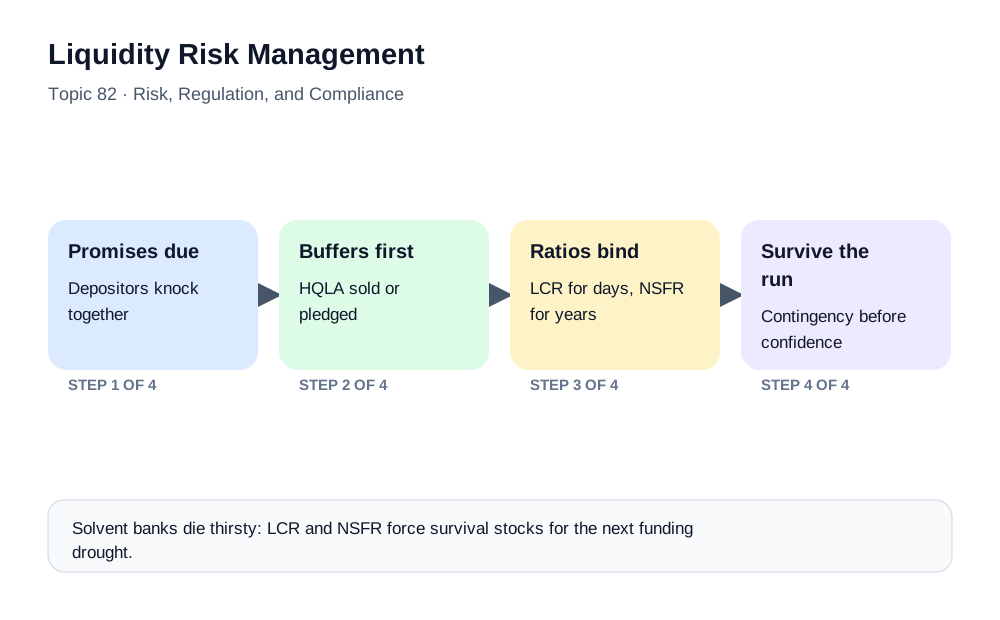
Liquidity Risk Management at a glance — LCR, NSFR, liquidity stress testing.
LCR, NSFR, and Surviving the Next Bank Run
Liquidity risk has destroyed more banks throughout history than any other single factor, including the credit losses that receive so much attention in normal times. A bank can remain technically solvent, with assets exceeding liabilities and capital above regulatory minimums, yet still fail catastrophically if it cannot convert those assets to cash quickly enough to meet withdrawal demands. This cruel reality, that solvency without liquidity means nothing in a crisis, has driven the development of sophisticated liquidity risk management frameworks under the Basel III accords. The Liquidity Coverage Ratio and Net Stable Funding Ratio now sit alongside capital requirements as the essential metrics defining bank safety.
Liquidity risk manifests in several distinct forms that banks must monitor and manage simultaneously. Funding liquidity risk addresses the bank's ability to meet cash outflows as they come due, whether from deposit withdrawals, loan disbursements, or contractual obligations. When depositors demand their money back en masse, when wholesale funding markets freeze, or when contingent commitments such as credit lines are drawn upon, funding liquidity risk crystallizes into crisis. Market liquidity risk concerns the bank's ability to sell assets at fair value when cash is needed. In normal markets, even illiquid assets can be sold at reasonable prices given sufficient time. In stressed markets, forced sellers must accept fire-sale prices, converting unrealized losses into realized ones and potentially triggering solvency concerns. Intraday liquidity risk, often overlooked until it becomes critical, involves the ability to meet payment system obligations throughout the business day. A bank that cannot fund its Fedwire or RTGS positions, even if it expects incoming funds later in the day, faces potential default on its payment obligations with severe reputational and systemic consequences.
The characteristics that make liquidity risk so deadly differentiate it sharply from other banking risks. Liquidity crises develop with extraordinary speed, unfolding over hours or days rather than the months or years credit losses typically require. This compression of timeline leaves little margin for error in detection and response. Liquidity problems are inherently self-reinforcing, as funding difficulties trigger credit rating downgrades and loss of confidence that make further funding even harder to obtain. Contagion spreads rapidly through the liquidity channel, as distress at one institution causes creditors to withdraw from others preemptively. Most insidiously, a bank can be fully solvent by accounting measures yet fail immediately from liquidity exhaustion, as the inability to meet today's payments makes tomorrow's solvency irrelevant.
The Liquidity Coverage Ratio emerged from the Basel III reforms as the primary metric ensuring banks can survive short-term liquidity stress. The formula divides High Quality Liquid Assets by total net cash outflows over a thirty-day stress period, requiring the result to exceed one hundred percent. This requirement mandates that banks hold sufficient liquid assets to survive a severe stress scenario lasting thirty days without recourse to external funding. The thirty-day horizon reflects regulatory judgment that this period provides sufficient time for management to implement recovery plans, for supervisors to organize official support if needed, and for market conditions to potentially stabilize.
High Quality Liquid Assets under the LCR framework are classified into three levels with differing haircuts reflecting their liquidity characteristics. Level One assets include cash, central bank reserves, and sovereign bonds that qualify for zero risk weight under Basel capital rules. These assets receive no haircut, meaning their full value counts toward the ratio. Level Two A assets include corporate bonds rated double-A minus or above and covered bonds, which receive a fifteen percent haircut acknowledging their slightly lower liquidity. Level Two B assets include corporate bonds rated between single-A plus and triple-B minus, certain equities, and residential mortgage-backed securities, receiving haircuts between twenty-five and fifty percent reflecting their more limited marketability. The framework caps Level Two assets at forty percent of total HQLA to ensure the buffer consists primarily of truly liquid assets rather than lower-quality substitutes.
Net cash outflows under the LCR are calculated by applying assumed run-off rates to various liability categories and expected drawdown rates to contingent commitments. Stable retail deposits, typically fully insured and held by customers with established relationships, are assumed to experience only five percent outflows even in severe stress. Less stable retail deposits, including those above insurance limits or from customers with less sticky relationships, carry ten percent run-off assumptions. Wholesale funding from operational relationships, such as clearing and custody balances that customers need to maintain, assumes twenty-five percent outflows. Unsecured wholesale funding from non-operational relationships assumes forty to one hundred percent outflows depending on the counterparty type. Committed credit facilities face assumed drawdown rates between five and one hundred percent depending on the borrower category, recognizing that customers are most likely to draw credit lines precisely when the bank least wants them to.
While the LCR addresses short-term survival, the Net Stable Funding Ratio ensures banks maintain stable funding for their assets over the longer term. The formula divides Available Stable Funding by Required Stable Funding, again requiring one hundred percent or greater. This metric addresses the fundamental maturity mismatch of banking by requiring that long-term assets be funded by long-term rather than short-term sources. The NSFR discourages reliance on hot money that can flee at the first sign of trouble and encourages structural balance sheet resilience.
Available Stable Funding under the NSFR applies different factors to various funding sources based on their expected stability over a one-year horizon. Regulatory capital instruments and other equity count fully as stable funding, reflecting their permanent nature. Stable retail deposits with maturities over one year receive ninety-five percent factors, while less stable retail deposits receive ninety percent. Wholesale funding with maturities exceeding one year counts fully, but shorter-term wholesale funding receives substantially lower factors, with funding under six months contributing little or nothing to stable funding. This structure creates powerful incentives for banks to extend their funding maturities and develop deep retail deposit franchises.
Required Stable Funding applies factors to assets reflecting how much long-term funding they require. Cash requires no stable funding, receiving a zero percent factor. Government bonds receive five percent factors, acknowledging their liquidity and use as collateral for short-term funding. Performing loans with maturities over one year require sixty-five to eighty-five percent stable funding depending on their characteristics, while mortgage loans require sixty-five percent. Other assets including fixed assets and non-performing loans require one hundred percent stable funding. The overall effect is to require that illiquid, long-term assets be matched with stable funding sources.
Beyond these regulatory ratios, banks conduct liquidity stress testing to evaluate resilience under various crisis scenarios. Idiosyncratic stress scenarios model bank-specific crises such as credit rating downgrades, loss of confidence, or operational problems, assuming markets remain otherwise normal. Market-wide stress scenarios model system-wide crises where all banks face funding pressure simultaneously, testing whether the bank can survive when neither wholesale markets nor asset sales provide relief. Combined scenarios apply both bank-specific and market-wide stress simultaneously, representing the most severe but realistic threats. Key metrics monitored in stress testing include the survival horizon, measuring how many days the bank can operate without external funding, and the cumulative cash gap, tracking the running total of cash inflows versus outflows.
Liquidity management requires active governance and operational capabilities. Cash flow forecasting predicts daily, weekly, and monthly inflows and outflows to anticipate needs before they become crises. Asset-Liability Committees make strategic decisions about funding mix, pricing, and balance sheet structure. Interbank markets provide short-term funding through instruments such as call money and repurchase agreements. Central bank facilities including marginal standing facilities and discount windows provide backstop liquidity in emergencies. Contingency funding plans document pre-planned actions for liquidity crises, ensuring rapid response when stress emerges. Buffer management ensures HQLA remain above regulatory minimums with appropriate cushions for uncertainty.
The evolution of liquidity risk management from afterthought to central pillar of bank regulation reflects hard-won lessons from countless crises. The LCR ensures banks can survive thirty days of severe stress, the NSFR ensures they fund long-term assets with stable sources, and stress testing examines resilience against scenarios beyond regulatory assumptions. Yet as Silicon Valley Bank demonstrated, even these requirements cannot prevent failures when management makes fundamental errors in interest rate risk management and deposit concentration. Liquidity risk management provides the tools for survival, but those tools must be used with wisdom and discipline.
<!-- MBA-DEEP-DIVE-START -->Deep Dive: Liquidity Risk as the Bank’s Ability to Keep Every Promise on Time
Liquidity risk is sometimes explained as the risk that a bank “runs out of cash.” That is directionally true but operationally too shallow. A bank can own valuable assets, report positive capital, and still be unable to meet a payment at 10:30 in the morning because the usable cash sits in the wrong currency, the wrong legal entity, the wrong settlement account, or in an asset that cannot be monetised quickly enough. Liquidity risk is therefore a problem of amount, timing, currency, location, transferability, collateral usability, and market confidence.
The Basel Committee’s current framework treats liquidity as a core prudential discipline alongside capital. The Liquidity Coverage Ratio and Net Stable Funding Ratio are important regulatory measures, but strong banks manage far beyond the minimum ratios. They forecast intraday cash, model behavioural deposit runoff, monitor concentration, pre-position collateral, stress contingent drawdowns, track encumbrance, maintain contingency funding plans, and prove that the operational machinery needed to obtain emergency liquidity will actually work under pressure.
The central principle is simple: a bank survives only if it can settle every due obligation when it becomes due. Accounting value matters, but timing decides whether the institution gets through the day.
Liquidity risk begins with the cash-flow clock
Every banking product creates cash flows. Deposits can leave. Loans can be drawn. Credit facilities can be utilised. Securities settle. Derivatives generate margin calls. Payment systems debit settlement accounts. Wholesale debt matures. Repos roll. Card networks settle net positions. Customers transfer salaries, taxes, securities proceeds, and corporate payments.
Liquidity management therefore starts with a time line rather than a balance-sheet total.
A bank may begin the day with ₹5,000 crore of central-bank or settlement liquidity. It expects ₹3,000 crore of outgoing customer payments and ₹2,500 crore of incoming receipts. On an end-of-day view, the position appears comfortable. But if most outflows occur at 9:30 AM and most inflows arrive after 3 PM, the institution can face a severe intraday funding gap even though the closing balance is positive.
This is why a daily treasury forecast must understand when cash arrives, not merely how much arrives over the whole day.
Funding liquidity and market liquidity reinforce each other
Funding liquidity risk is the risk that the bank cannot obtain cash or equivalent settlement resources when obligations fall due. Market liquidity risk is the risk that assets cannot be sold or financed quickly at reasonable prices.
The two risks interact.
A bank experiencing deposit outflows may decide to sell securities. If markets are deep and calm, this can produce cash with limited price impact. If many institutions are selling the same assets during stress, market prices fall and bid-ask spreads widen. The bank may then realise losses, which can damage capital or confidence, which can accelerate further deposit outflows.
This feedback loop explains why liquidity crises can become self-reinforcing. The problem is not only “cash is leaving.” The problem is that every action taken to generate cash can change the perception and economic strength of the institution.
Solvency and liquidity must be analysed together
A solvent institution has assets whose economic value exceeds liabilities, subject to the relevant measurement framework. A liquid institution can meet obligations when due. These are different concepts, but in a crisis they converge quickly.
Suppose a bank owns long-dated fixed-rate securities purchased when interest rates were low. If rates rise, their market value falls. If the bank can hold them and funding remains stable, the unrealised loss may not force immediate action. If deposits leave rapidly and the bank must sell, the market-value loss becomes realised and can reduce capital.
Liquidity pressure can therefore crystallise losses that were previously only economic or unrealised. This is one of the most important lessons from recent bank failures and from earlier crises: asset quality, interest-rate risk, funding structure, and liquidity cannot be managed in separate silos.
Liquidity is legal-entity specific
Large banking groups often operate through multiple banks, branches, broker-dealers, finance companies, holding companies, and subsidiaries. Group-level liquidity can create false comfort if funds are not freely transferable.
Imagine a banking group with excess dollar liquidity in a US subsidiary and a shortage of euros in a European bank subsidiary. The group cannot assume it can move funds immediately. Transfers may be restricted by local regulation, capital requirements, tax, ring-fencing, resolution planning, collateral arrangements, intercompany limits, or operational cut-offs.
A good liquidity dashboard therefore shows at least three views:
- consolidated group liquidity;
- liquidity by legal entity;
- liquidity by material currency.
Management should know which resources are genuinely available to the stressed entity, not merely owned somewhere within the group.
Currency liquidity is its own risk
A bank can have more than enough value in one currency and still fail to meet an obligation in another.
Suppose a bank has large rupee assets but must deliver USD 500 million today. It can obtain dollars through correspondent balances, deposits, interbank borrowing, secured funding, FX swaps, central-bank facilities where available, or asset sales. But every route has market, settlement, collateral, and timing dependencies.
During normal conditions, FX swaps may provide efficient short-term foreign-currency funding. During global stress, cross-currency basis can widen and counterparties can reduce limits. The assumption that “we can always swap into dollars” may fail precisely when the dollars are most needed.
Banks therefore maintain currency-specific liquidity limits, stress scenarios, funding plans, and correspondent or settlement arrangements for material currencies.
Intraday liquidity is a business-service risk
Intraday liquidity deserves separate attention because many obligations settle during the day before incoming funds arrive.
Real-time gross settlement systems, securities settlement systems, card settlements, central counterparties, and high-value payment infrastructures can require liquidity at specific times. A bank that waits for late incoming payments may cause queues, delayed customer transactions, or systemic gridlock.
Intraday management can include:
- opening settlement balances;
- expected and actual high-value payments;
- payment queues;
- collateral available for intraday credit;
- central-bank intraday facilities;
- securities settlement obligations;
- time-critical customer payments;
- expected incoming receipts;
- peak intraday liquidity usage.
The important measure is often maximum intraday liquidity need, not just the end-of-day balance.
Payments operations and treasury should share the same view. A treasury desk cannot manage intraday liquidity well if the payment system cannot tell it which large outgoing payments are queued and which incoming payments are delayed.
Payment prioritisation must be controlled
During stress, a bank may need to manage the timing of outgoing payments. This does not mean arbitrarily delaying customers. Payment prioritisation should follow legal obligations, scheme rules, customer commitments, systemic importance, and approved crisis procedures.
Examples of time-critical obligations can include central-bank settlement, clearing-house obligations, securities settlement, margin payments, tax or payroll files, and certain large corporate payments.
Systems should support controlled queue visibility and authorised intervention. A payment operator should not be able to hold or release a large payment merely to improve a local dashboard without governance.
The bank also needs to distinguish a genuine liquidity action from a technology incident. If payments are delayed because a message queue is broken, treasury should not misinterpret the reduced outflow as available liquidity.
High-quality liquid assets are useful only if they are usable
Regulatory liquidity buffers contain assets expected to remain liquid during stress. But owning an eligible asset is not enough.
A security can fail as an immediate liquidity resource if it is:
- already pledged to another counterparty;
- held in an inaccessible custody account;
- in a legal entity that cannot transfer the proceeds;
- denominated in the wrong currency;
- ineligible for the facility the bank plans to use;
- subject to settlement delay;
- operationally blocked by missing documentation or system access.
Strong banks therefore distinguish gross HQLA, encumbered HQLA, and operationally available HQLA.
Treasury should know how quickly each asset can become settlement cash through sale, repo, or central-bank mobilisation.
Asset encumbrance reduces future flexibility
An encumbered asset is pledged or otherwise restricted so it cannot be freely used for another funding need.
Secured funding creates liquidity today but consumes collateral capacity for tomorrow.
Suppose the bank owns ₹10,000 crore of eligible securities and pledges ₹7,000 crore to repo transactions. It still owns the securities economically, but much of the portfolio is no longer freely available. If stress worsens and the bank needs another ₹4,000 crore, only the unencumbered assets may be immediately available, subject to eligibility and haircuts.
A liquidity dashboard should therefore show:
- total collateral inventory;
- pledged collateral;
- unencumbered collateral;
- collateral by legal entity;
- collateral by currency;
- eligibility by central bank, clearing house, repo counterparty, or other facility;
- settlement location;
- monetisation time.
This turns collateral management into an extension of liquidity management rather than a separate back-office activity.
Haircuts can create a second liquidity shock
Secured lenders do not normally lend the full market value of collateral. They apply a haircut.
If a security worth ₹100 normally supports ₹95 of borrowing, the haircut is 5%. During stress, market value can fall to ₹90 and the haircut can widen to 15%. The same asset may then support only ₹76.50 of funding.
The bank can therefore suffer two simultaneous shocks:
- collateral value falls; and
- lenders demand a larger margin of safety.
Stress tests should combine market-value shocks and haircut shocks. Looking at either separately can materially underestimate funding need.
Margin calls can drain cash even when a hedge works
Derivatives and centrally cleared positions can generate variation-margin and initial-margin requirements.
Suppose a bank hedges the economic interest-rate risk of a fixed-rate asset portfolio with derivatives. The hedge may protect the institution’s economic value, but if the derivative moves against the bank before the asset value is realised, the bank may need to post cash collateral immediately.
This creates a crucial distinction: economic hedging does not guarantee liquidity neutrality.
Liquidity stress testing should therefore include margin calls under severe but plausible market moves, collateral eligibility, settlement timing, and the ability to substitute securities for cash where permitted.
Treasury, market risk, and collateral operations need a common stress view.
The Liquidity Coverage Ratio is a floor, not a forecast
The LCR is designed to promote short-term resilience by requiring a stock of high-quality liquid assets sufficient to meet prescribed net cash outflows over a 30-day stress scenario, subject to the Basel standard and local implementation.
The ratio is valuable because it imposes a common regulatory stress framework. But a bank should not interpret an LCR above 100% as proof that it can survive every crisis.
Real stress can differ from the regulatory assumptions. Deposit outflows can occur faster. Particular depositor groups can be more concentrated. Margin calls can be larger. Operational access to collateral can fail. Social-media rumours can accelerate withdrawals. Foreign-currency needs can concentrate in one legal entity.
Internal liquidity stress testing should therefore answer a different question from regulatory reporting:
What would actually cause this bank, with this funding structure and this operating model, to run out of usable liquidity?
LCR classifications require careful implementation
The Basel LCR framework differentiates assets by liquidity quality and liabilities by assumed runoff characteristics. The exact treatment depends on detailed eligibility conditions, caps, haircuts, counterparty categories, deposit characteristics, and local implementation.
A common implementation error is to code broad product labels rather than the actual regulatory attributes.
For example, “retail deposit” alone is not enough to determine a runoff assumption. The bank may need information about deposit insurance, relationship characteristics, transactional use, maturity, legal entity, currency, and other criteria.
Similarly, “government bond” alone does not prove full HQLA eligibility. The asset must satisfy the applicable standard and local rules.
Liquidity reporting therefore depends on granular reference data and regulatory classification logic, not only treasury balances.
Net cash outflow is not simply liabilities minus assets
LCR outflow calculation applies prescribed assumptions to liabilities and contingent commitments. Inflows are also subject to rules and limits because supervisors do not want banks to assume every contractual receivable will arrive during stress.
A bank cannot build a strong liquidity ratio simply by counting all expected loan repayments or unsecured interbank receivables as certain cash.
The framework deliberately recognises that inflows can fail, be delayed, or be needed to support continuing business.
This is a useful general principle beyond the ratio: liquidity planning should haircut optimism.
NSFR addresses the structural maturity problem
The Net Stable Funding Ratio encourages banks to maintain stable funding relative to the liquidity and maturity characteristics of assets and off-balance-sheet activities over a longer horizon.
Its economic purpose is straightforward. Long-term or difficult-to-liquidate assets should not be financed excessively with funding that can disappear quickly.
A bank that funds a long-duration mortgage portfolio primarily with overnight wholesale borrowing may appear fine while markets are open. The moment lenders refuse to roll the funding, the structural mismatch becomes a crisis.
NSFR therefore complements the LCR:
- LCR focuses on short-term stressed cash outflows;
- NSFR focuses on structural funding stability.
Neither replaces behavioural ALM or internal stress testing.
Behavioural maturity can differ from contractual maturity
Many deposits are contractually payable on demand but behave as if a portion is stable over long periods. Conversely, a term deposit can be contractually long but leave early if the product allows breakage and the customer is willing to pay a penalty.
Banks therefore model behavioural maturity.
This modelling supports:
- liquidity risk;
- interest-rate risk in the banking book;
- funds transfer pricing;
- hedge strategy;
- balance-sheet planning;
- stress testing.
The danger is overconfidence in historical behaviour. Deposit patterns observed during a decade of branch-based banking may not remain valid when customers can move money in seconds through mobile apps.
Models should therefore be validated, segmented, stressed, and updated when customer behaviour or technology changes.
Deposit concentration can matter more than total deposits
A bank with ₹1 lakh crore of deposits can appear strongly funded. But the risk depends on who controls those balances.
Consider two banks.
Bank A has millions of small retail customers, many using accounts for salary and daily payments.
Bank B has a few hundred large corporate, venture, fund, or institutional depositors with sophisticated treasury teams and high transfer limits.
The same total deposit amount can have radically different runoff speed.
Liquidity risk management should therefore examine:
- top depositors;
- top connected groups;
- sector concentration;
- geographic concentration;
- insured versus uninsured or uncovered balances;
- operational versus non-operational balances;
- rate sensitivity;
- digital transfer capability;
- maturity and notice period;
- historical and stressed runoff.
Diversification is about the number of independent funding decisions, not the number of account numbers.
Digital banking changed the velocity of a run
A classic bank run was physically constrained by branch hours, cash availability, cheques, and manual processes. Modern customers can transfer large balances electronically with little friction.
This changes liquidity modelling in two ways.
First, runoff can happen much faster than historical monthly or weekly data suggest.
Second, information spreads faster. A rumour, rating action, social-media post, or investor discussion can influence many customers at once.
The bank should therefore stress both volume and velocity.
A liquidity buffer that can cover 20% runoff over thirty days may still be operationally insufficient if 12% leaves in six hours and collateral mobilisation takes a full day.
Deposit pricing can buy time but destroy margin
When deposits leave, banks may raise rates to retain or attract funding. This can improve liquidity but create earnings pressure.
Suppose the bank pays 8% for new term deposits while much of its loan book yields 7%. The immediate cash position improves, but the economics deteriorate. If the strategy continues, the bank can turn a liquidity problem into a profitability and capital problem.
An unusually high deposit rate can also send a negative market signal if customers interpret it as desperation.
Liquidity actions should therefore be evaluated across:
- cash effect;
- net-interest-income effect;
- capital effect;
- customer behaviour;
- market perception;
- maturity profile.
Treasury cannot manage liquidity safely by focusing on cash alone.
Wholesale funding should be diversified by source and maturity
Banks use interbank deposits, certificates of deposit, commercial paper, repos, covered bonds, senior debt, securitisation, and other instruments depending on jurisdiction and business model.
A funding plan can look diversified by instrument while remaining concentrated by investor or market.
If the same money-market funds buy the bank’s commercial paper, certificates, and short-term senior debt, multiple instruments may fail together when those investors lose confidence.
Funding diversification should therefore consider:
- investor type;
- market;
- currency;
- secured versus unsecured;
- maturity;
- collateral dependency;
- geography;
- rating sensitivity;
- rollover concentration.
A maturity wall years in the future can become a liquidity issue well before the actual due date if markets doubt the bank’s ability to refinance it.
Rollover risk is invisible until markets say no
Short-term wholesale funding often relies on continuous renewal.
A bank may borrow ₹1,000 crore for one month and assume it can simply issue another one-month instrument at maturity. In normal conditions this can happen repeatedly for years. But the true liability is not economically one month; it is an ongoing dependence on market confidence.
Stress testing should therefore assume different degrees of rollover failure.
For example:
- unsecured funding does not roll;
- only part of secured funding rolls;
- maturities shorten;
- spreads widen;
- haircuts increase;
- investor concentration worsens.
This produces a more realistic picture than assuming every maturing liability can be refinanced at a higher rate.
Committed credit facilities are contingent liquidity claims
A bank may have a ₹10,000 crore portfolio of undrawn corporate revolving lines. No cash has left yet, but customers have contractual rights to draw subject to facility conditions.
During market stress, those customers may draw precisely because they fear future funding difficulty.
The bank therefore experiences a double shock:
- deposits or wholesale funding leave;
- committed assets become funded.
Liquidity stress testing must include drawdowns of committed facilities, not only expected customer withdrawals.
Credit, treasury, and liquidity risk teams should share the same commitment data. A credit system that knows a limit exists but does not expose it to treasury creates a serious blind spot.
Mortgage and loan prepayments can change under stress
Customer behaviour affects both sides of the balance sheet.
When interest rates rise, mortgage prepayments can slow, extending the effective maturity of assets. At the same time deposits may become more rate-sensitive and reprice or leave faster.
This is an adverse combination: assets remain locked for longer while liabilities become less stable.
Liquidity stress and interest-rate risk should therefore use internally consistent behavioural assumptions. It makes little sense for one model to assume deposits remain stable for five years while another assumes the same customers leave rapidly under the same scenario.
Model governance should reconcile assumptions across ALM, liquidity, FTP, IRRBB, and capital planning.
Survival horizon turns stress into a management clock
A useful internal measure is survival horizon: the time until cumulative stressed cash outflows exceed available liquidity under a defined scenario.
Suppose a combined stress assumes:
- large corporate deposits run quickly;
- some retail deposits leave;
- unsecured wholesale funding does not roll;
- committed credit lines are drawn;
- derivative margin calls increase;
- secured-funding haircuts rise;
- a rating downgrade triggers additional outflows;
- asset sales occur at stressed prices.
Treasury projects cash day by day, sometimes hour by hour for the first days.
If the institution exhausts available liquidity on day fourteen, management now has a concrete problem: what actions extend the horizon beyond fourteen days?
Possible actions include asset sales, additional repo, central-bank borrowing, deposit pricing, term issuance, reduced new lending, securitisation, intercompany transfers where permitted, or recovery-plan actions.
The survival horizon makes liquidity risk actionable.
Stress scenarios should include idiosyncratic and market-wide shocks
An idiosyncratic stress is specific to the bank: fraud, cyber incident, rating downgrade, governance scandal, large credit loss, operational outage, or rumour.
A market-wide stress affects the broader system: recession, sovereign stress, pandemic, market closure, currency shock, or widespread funding disruption.
A combined stress assumes both occur together.
Combined scenarios are especially important because a bank-specific problem is hardest to manage when markets are already weak.
The scenario design should consider not only outflow percentages but causal relationships. A rating downgrade can trigger collateral calls, reduce secured funding, increase wholesale spreads, and cause customers to withdraw. Modelling each event independently can understate the combined effect.
Reverse stress testing asks what would break the bank
Ordinary stress testing begins with a scenario and calculates the result. Reverse stress testing begins with failure and asks what scenario could produce it.
For liquidity, the failure condition might be inability to meet obligations without extraordinary support.
The bank then works backward:
- how much deposit runoff is required?
- which wholesale markets must close?
- how large would margin calls need to be?
- what collateral haircut would cause the buffer to fail?
- which operational constraint creates the bottleneck?
Reverse stress testing is valuable because management can become anchored to familiar scenarios. It forces the institution to imagine combinations that may not appear in historical data.
Contingency funding plans need real triggers
A contingency funding plan should not be a generic list saying “sell securities, borrow in market, use central bank.” It should define when management changes behaviour and who is authorised to act.
Possible triggers include:
- unusual deposit outflow;
- increase in top-depositor withdrawals;
- wholesale spread widening;
- reduction in funding tenor;
- falling internal liquidity buffer;
- deterioration in LCR or NSFR;
- collateral haircut increase;
- rating watch or downgrade;
- accelerated credit-line drawdown;
- unusual payment-queue behaviour;
- social-media or news concern;
- operational failure affecting cash mobilisation.
The plan should specify escalation levels, governance, communication, funding actions, collateral actions, customer measures, regulator engagement, and reporting frequency.
A crisis is the wrong time to debate who has authority to mobilise ₹5,000 crore of securities.
Central-bank facilities require operational readiness
Central banks can provide liquidity to eligible institutions under their frameworks, but access should not be assumed to work automatically.
The bank may need eligible collateral, completed legal documentation, operational accounts, authorised users, tested connectivity, settlement procedures, and internal approvals.
A facility that has never been tested can fail when credentials are expired, collateral is held in the wrong account, or staff do not know the operational sequence.
Good contingency planning therefore includes periodic operational tests where permitted.
The deeper principle is: potential liquidity is not usable liquidity until the bank can mobilise it.
Stigma can affect emergency-funding decisions
Banks may hesitate to use certain central-bank or emergency facilities because they fear markets will interpret usage as evidence of weakness. This creates a difficult trade-off.
Avoiding an available facility to protect reputation can worsen actual liquidity, while excessive reliance can signal structural funding problems.
Contingency plans should therefore consider communication and market perception in advance rather than leave the issue to improvised crisis judgement.
Supervisory frameworks generally expect institutions to manage liquidity prudently rather than depend on official support as a normal business model.
Liquidity recovery actions need sequencing
Not every action should be taken at once.
A recovery playbook can rank actions by speed, value, side effects, and market signal.
For example:
Immediate operational actions: increase monitoring frequency, mobilise internal cash, optimise payment queues within rules, transfer available collateral, secure intraday credit.
Near-term market actions: repo liquid assets, draw committed backup lines, issue term deposits, adjust wholesale funding.
Balance-sheet actions: slow new asset growth, sell securities, securitise assets, reduce discretionary lending.
Strategic recovery actions: asset disposals, capital actions, business sales, recovery-plan measures.
Each action should have an estimated liquidity benefit, execution time, prerequisites, and adverse consequences.
This prevents management from counting the same resource twice or assuming every action can be executed simultaneously.
Management information must be fast enough for the crisis
A monthly liquidity report is useless during a run.
Banks need data architecture capable of moving from ordinary reporting to high-frequency crisis reporting.
Key information can include:
- cash by settlement account;
- cash by legal entity and currency;
- deposit outflows by segment;
- top-depositor movements;
- wholesale maturities;
- collateral inventory and encumbrance;
- payment queues;
- committed facility drawdowns;
- derivative margin calls;
- central-bank borrowing capacity;
- LCR and internal buffer estimates;
- survival horizon.
The data should reconcile with authoritative source systems. A crisis dashboard that differs from the general ledger, payment system, or custody system creates dangerous debate when decisions must be made quickly.
Data lineage matters because liquidity is calculated from many systems
Liquidity metrics commonly combine data from deposits, loans, treasury, securities, derivatives, collateral, payments, customer master, legal entities, regulatory classifications, and the GL.
Each field needs lineage.
If a corporate deposit is classified as operational funding, the bank should know which business rule and source data support that classification. If a security appears as unencumbered HQLA, the bank should know which custody position proves availability.
Data quality issues can create both underestimation and overestimation of risk.
A duplicated collateral position can make the bank believe it has more liquidity than it actually has. A stale encumbrance flag can make usable collateral appear unavailable. Both are serious, but the first can be fatal in stress.
Reconciliation is a liquidity control
Treasury forecasts only become trustworthy when they reconcile to actual cash movement.
Suppose treasury predicted ₹20,000 crore of outgoing payments and ₹18,000 crore of incoming payments, but settlement statements show a ₹3,000 crore larger net debit than expected.
The bank should explain the difference by transaction or category: unexpected corporate drawdown, securities settlement, card settlement, margin call, deposit movement, or forecast error.
Forecast accuracy should be measured and improved over time.
A recurring unexplained variance means the bank does not understand its own cash flows well enough.
Liquidity transfer pricing changes business behaviour
Business units can create liquidity risk without seeing the cost.
A lending business may originate long-term assets because customer spreads look attractive. A corporate deposit business may accept highly rate-sensitive overnight balances and treat them as cheap funding. Treasury ultimately manages the mismatch.
Funds transfer pricing can assign liquidity costs and benefits to products.
A five-year loan should carry an internal funding and liquidity charge consistent with its tenor and optionality. A stable retail operating deposit may receive a stronger funding credit than a concentrated institutional deposit that can leave tomorrow.
Proper pricing aligns business incentives with the balance-sheet risk the bank is actually taking.
Liquidity limits should exist before the ratio limit
A strong risk appetite framework uses multiple limits rather than relying only on regulatory minima.
Examples can include:
- minimum internal liquidity buffer;
- survival horizon;
- top-depositor concentration;
- unsecured wholesale funding reliance;
- short-term maturity concentration;
- encumbrance ratio;
- foreign-currency funding gap;
- intraday liquidity usage;
- central-bank facility reliance;
- committed-line drawdown exposure.
Limits should have warning thresholds before hard breaches.
If management first reacts when the LCR falls below the regulatory minimum, the escalation framework has failed.
Early warning indicators should combine market and customer behaviour
Liquidity deterioration is often visible before formal ratios fail.
Possible early warning indicators include:
- accelerating deposit outflows;
- customers shortening deposit maturities;
- unusually high requests for large transfers;
- decline in renewal rates;
- widening bond or CDS spreads where relevant;
- shorter wholesale-funding tenor;
- increased collateral haircuts;
- counterparties reducing limits;
- rising usage of committed facilities;
- social-media concern;
- rating-agency action;
- falling equity price where relevant;
- payment delays or operational incidents.
No single indicator proves a crisis. The value comes from combining evidence and defining escalation rules.
Communication is part of liquidity risk
Banking is confidence-sensitive. Poor communication can accelerate withdrawals.
During stress, treasury, senior management, investor relations, communications, legal, compliance, operations, and regulators may need a coordinated message.
Statements should be factual and consistent with operational reality.
If management announces that liquidity is strong while customers experience delayed withdrawals or failed payments, credibility collapses.
The best communication strategy is therefore supported by actual execution: customers can access funds, payments settle, and operational service remains stable.
Operational resilience and liquidity resilience are connected
A cyberattack can become a liquidity event even if no money is stolen.
Imagine an outage prevents the bank from accessing its collateral-management platform. Securities that are economically available cannot be pledged. At the same time customers continue to withdraw through channels that remain online.
Or imagine a data centre failure blocks incoming payment processing while outgoing obligations continue. Expected inflows do not post when treasury forecast them.
Business continuity planning should therefore identify systems essential to liquidity mobilisation and settlement, not only customer-facing channels.
Critical systems can include:
- RTGS connectivity;
- treasury dealing;
- collateral management;
- custody;
- payment hubs;
- correspondent interfaces;
- core banking;
- liquidity reporting;
- market data;
- authentication and entitlement systems.
Recovery priorities should reflect their role in financial survival.
A payments-heavy bank needs a different liquidity model
Two banks with identical balance sheets can have different intraday liquidity needs.
A retail deposit bank with modest payment activity may require less intraday settlement liquidity than a transaction bank processing huge corporate payment flows, securities settlements, and correspondent transactions.
Transaction banking therefore creates an important paradox: customer operating deposits can be a valuable funding source, but the associated payment activity can create large intraday liquidity requirements.
Treasury should understand both sides of the relationship.
A corporate customer holding ₹500 crore in operating deposits may also send ₹2,000 crore of payments during the day using incoming collections and intraday credit. Balance alone does not describe the liquidity footprint.
Nostro balances are part of cross-border liquidity
Banks processing foreign-currency payments often maintain Nostro accounts with correspondent banks.
Too little Nostro liquidity can cause failed or delayed payments. Too much creates opportunity cost and counterparty exposure.
Treasury forecasts expected debits and credits by currency, correspondent, and cut-off.
FX settlement, trade finance, card settlement, securities activity, and customer transfers can all consume the same Nostro balance.
A strong system provides a consolidated view so different business lines do not independently assume the same cash is available.
Cut-off times create hidden liquidity deadlines
A bank may have enough cash by end of day but miss a correspondent or market cut-off.
Suppose USD funding arrives at 5 PM local time but the relevant correspondent cut-off for a critical payment was 4 PM. Economically the bank received the money “today,” but operationally it was too late.
Liquidity forecasting should therefore incorporate:
- payment-system cut-offs;
- correspondent cut-offs;
- securities settlement windows;
- collateral mobilisation deadlines;
- central-bank facility operating times;
- local holidays;
- time zones.
Time-zone awareness is essential for global banks because one currency can be closing while another market is opening.
Recovery and resolution planning should connect to liquidity
A bank’s recovery plan identifies actions management can take before failure. Resolution planning addresses how authorities could manage failure while preserving critical functions where required by the applicable framework.
Liquidity is central to both.
A bank may be recapitalised yet still need temporary liquidity to continue payments and withdrawals. A resolved entity may need access to settlement systems, collateral, central-bank facilities subject to applicable eligibility, and operational funding.
Resolution planning therefore asks not only “who absorbs losses?” but also “how does the institution keep functioning while legal and ownership changes occur?”
Liquidity in resolution is a distinct planning problem from ordinary going-concern liquidity.
A complete digital-run scenario
Consider a mid-sized bank with a concentrated deposit base from technology companies and investment funds. Many balances are above local insurance limits and customers can transfer funds instantly.
On Monday morning, market rumours question the bank’s unrealised losses on long-duration securities. Several large customers initiate withdrawals. By 10 AM, outflows exceed the normal daily forecast. Treasury escalates to the liquidity crisis level.
The bank has substantial securities, but part of the portfolio is already pledged. Some unencumbered assets are held in a custody location that requires transfer before central-bank eligibility. Corporate borrowers simultaneously draw committed revolving facilities because they fear the bank may restrict future lending.
At noon, the bank’s rating outlook is changed. Repo counterparties increase haircuts. Derivative counterparties call additional margin. Social-media discussion accelerates retail withdrawals.
A weak liquidity framework would discover these interactions one by one.
A strong framework already modelled them. Management sees deposit concentration, collateral availability, margin calls, drawdowns, and intraday payment obligations on one crisis dashboard. Pre-positioned collateral is mobilised. Payment obligations continue to settle. The bank activates approved term funding and balance-sheet actions. Senior management and supervisors receive consistent information.
Whether the bank ultimately survives depends on the size of the shock and its solvency, but the quality of liquidity management determines how much time management has to act.
A complete intraday payment scenario
A large transaction bank opens the day with sufficient total liquidity but expects a major securities receipt at 11 AM.
At 9:15 AM, corporate customers send unusually large tax and supplier payments. At 9:45 AM, a clearing system requires additional settlement funds. The expected securities receipt is delayed because the counterparty has a technical issue.
The bank’s payment queue begins to grow.
Treasury sees the intraday shortfall immediately. It pledges pre-positioned securities for intraday central-bank or secured liquidity under the applicable arrangements and releases priority payments according to policy. The delayed securities receipt arrives at 1 PM and temporary liquidity is repaid.
The bank ends the day with a normal closing balance.
A daily closing report would show nothing unusual. An intraday risk framework shows that the bank used a large amount of emergency liquidity for several hours.
That information matters for stress calibration and future buffer decisions.
What excellence looks like
A world-class liquidity framework knows not only how much liquidity the bank owns but where it is, in which currency, in which legal entity, under whose control, against which collateral, and how quickly it can become settlement cash.
It understands deposit concentration and behavioural runoff. It models committed drawdowns, derivative margin, collateral haircuts, and wholesale rollover. It monitors intraday payment queues and Nostro balances. It distinguishes regulatory HQLA from operationally available liquidity. It pre-positions collateral and tests emergency facilities. It reconciles forecasts with actual cash. It prices liquidity into products. It uses early-warning indicators before regulatory ratios approach minimums. It can produce high-frequency crisis information that senior management trusts.
Most importantly, it treats liquidity as an end-to-end banking capability rather than a treasury spreadsheet. Deposits, loans, payments, securities, derivatives, collateral, technology, customer behaviour, regulation, and market confidence all meet in the liquidity position.
That is why liquidity risk management is one of the clearest examples of banking as a joined system: a promise made in one part of the bank can become a cash obligation somewhere else, at a specific second, in a specific currency. The bank survives by being ready for that moment.
<!-- MBA-DEEP-DIVE-END -->