Solvency, Liquidity, Confidence, and the Mechanics of a Banking Crisis
Banks do not fail for one universal reason. Some fail because borrowers stop repaying and losses destroy capital. Some fail because interest-rate or market positions create large economic losses. Some remain asset-rich on paper but cannot generate cash quickly enough to meet withdrawals. Others are damaged by fraud, governance failures, operational incidents, concentrated funding, weak controls, or combinations of all these problems.
The most useful way to understand bank failure is to separate solvency, liquidity, funding confidence, and operational capability.
A bank is solvent when the economic value of its assets and other resources is sufficient to cover liabilities with an adequate capital cushion. A bank is liquid when it can meet cash obligations when they fall due. A bank can be solvent but temporarily illiquid. It can also appear liquid today while being fundamentally insolvent. A confidence shock can rapidly convert a manageable liquidity position into a crisis, particularly when deposits are concentrated and easily transferable.
The 2023 failures of several US regional banks demonstrated this interaction. FDIC assessments emphasized the combination of securities losses, asset-liability mismatches, concentrated and largely uninsured deposits, rapid deposit outflows, and loss of market confidence. The lesson is broader than one event: bank failure is usually a chain of weaknesses that becomes visible when funding providers stop waiting patiently.
Visual overview
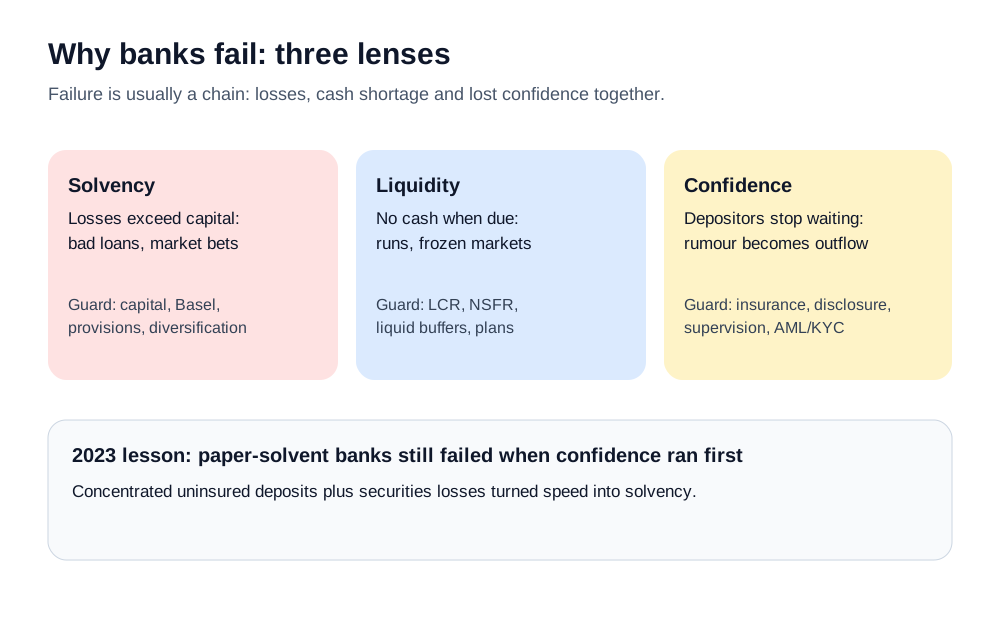
Phase 9 map: solvency, liquidity and confidence fail together. Capital, buffers and supervision guard each lens.
1. Banks Transform Maturity and Liquidity
Banks accept liabilities such as current accounts, savings deposits, term deposits, wholesale funding, and issued debt. They invest those funds in assets such as loans and securities.
Many assets mature later than the funding supporting them. A thirty-year mortgage can be funded partly by deposits that customers can withdraw tomorrow. This maturity and liquidity transformation is central to banking because households and businesses want liquid money while borrowers need longer-term financing.
The transformation creates risk.
The bank depends on deposit behavior, access to markets, liquid assets, central-bank facilities where available, and confidence that most funding will not leave simultaneously.
It is therefore inaccurate to describe a safe bank as one that simply keeps a fixed percentage of every deposit in cash. Modern liquidity management uses regulatory requirements, internal stress tests, behavioral models, high-quality liquid assets, funding diversification, collateral, and contingency plans.
2. Liquidity Failure Can Happen Fast
A bank can have valuable assets and still be unable to pay depositors quickly enough.
Suppose a bank has ₹100,000 crore of assets, including long-term mortgages and government securities. Depositors request ₹15,000 crore of withdrawals in one day. The bank may not be able to collect mortgages early. It must use cash, sell securities, borrow, pledge collateral, or obtain central-bank liquidity if eligible.
If the necessary cash cannot be raised before payment obligations fall due, the bank has a liquidity crisis.
The important concept is time to cash. A high-quality asset is not automatically immediately usable liquidity. It can be encumbered, held in the wrong legal entity, denominated in the wrong currency, or require operational steps before it can be sold or pledged.
3. Solvency Failure Is Different
A solvency problem arises when losses reduce the value of assets relative to liabilities and capital.
Suppose a bank has ₹100,000 crore of assets, ₹92,000 crore of liabilities, and ₹8,000 crore of equity. If credit and market losses reduce the economic value of assets by ₹10,000 crore, the bank no longer has enough asset value to cover liabilities.
Liquidity can temporarily conceal this. A bank can continue meeting withdrawals while receiving new funding, even though its economic capital position is weak.
That is why supervision focuses on both capital and liquidity. Cash availability today does not prove long-term solvency.
4. Credit Losses Can Destroy Capital Gradually
Traditional bank failures frequently begin with bad lending.
A bank grows quickly into commercial property, unsecured consumer credit, construction, agriculture, one corporate group, or another concentrated sector. During good economic conditions, defaults remain low and reported profits rise.
When the cycle turns, borrowers fail together because they share the same economic exposure. Provisions increase, collateral values fall, recoveries weaken, and capital is consumed.
Credit losses can be slow enough to create false confidence. Management may restructure weak loans, delay recognition, or continue lending to troubled borrowers. By the time the problem becomes obvious, the bank's options are limited.
5. Concentration Turns Ordinary Risk Into Existential Risk
A bank can make individually reasonable loans and still build a dangerous portfolio if too many exposures depend on the same factor.
Concentration can exist by:
- borrower or connected group;
- industry;
- geography;
- collateral type;
- funding source;
- currency;
- maturity;
- depositor type;
- technology provider;
- market instrument.
The same concept applies to liabilities. A bank funded by a small number of large corporate or venture-capital customers can face faster outflows than a bank with millions of diversified household depositors.
Diversification is therefore relevant on both sides of the balance sheet.
6. Interest-Rate Risk Can Create Economic Losses
When market interest rates rise, the value of existing long-duration fixed-rate assets generally falls.
Consider a bank that purchased long-term fixed-rate securities when yields were low. If market rates rise substantially, those securities may be worth less in the market even when the issuer remains creditworthy.
If the bank can hold the securities until maturity and receives contractual cash flows, the market-value decline may not produce the same outcome as a credit default. But if large deposit outflows force the bank to sell, unrealized economic losses can become realized losses.
This interaction between duration risk and liquidity risk was central to the 2023 regional bank stress in the United States.
Accounting classification does not eliminate the economic sensitivity of a fixed-rate asset.
7. Deposit Concentration Changes Run Speed
Two banks with the same total deposits can have very different liquidity risk.
Bank A has five million small retail accounts used for payroll and daily transactions.
Bank B has two thousand large business depositors who communicate with each other and can move funds electronically within minutes.
Bank B can lose a much larger share of deposits in a short period because fewer decision-makers control more money.
Risk teams therefore monitor:
- largest depositors;
- uninsured or uncovered balances;
- operational versus investment deposits;
- industry concentration;
- customer relationships;
- historical runoff behavior;
- digital transfer capability;
- maturity and pricing sensitivity.
The number of accounts is not the same as diversification.
8. Digital Banking Accelerated Bank Runs
Historic bank runs were constrained by branch opening hours, physical queues, cheques, and slower communications.
Modern depositors can coordinate through social media, messaging groups, and professional networks. Large corporate balances can be transferred digitally without visiting a branch.
This compresses the crisis-management clock.
A bank that once expected deposit runoff to occur over several days may now face extraordinary outflows within hours.
Liquidity stress testing must therefore consider both amount and velocity.
9. Confidence Is an Economic Variable
A bank relies on depositors, creditors, counterparties, and markets believing that it will meet obligations.
Confidence is not irrational sentiment detached from fundamentals. It can respond to real information: losses, governance scandals, funding concentration, delayed financial statements, regulatory action, failed capital raising, or weak risk management.
Once confidence weakens, funding can become more expensive or unavailable. Customers may withdraw. Counterparties may shorten terms. Rating agencies may downgrade. Collateral requirements can rise.
These reactions can weaken the bank further.
A confidence crisis is therefore both psychological and financial.
10. A Bank Run Is Not Always Pure Panic
Economic models show that runs can be self-reinforcing, but real-world runs often contain information about genuine weakness.
Depositors may withdraw because they believe others will leave, but they can also be reacting rationally to observed losses or funding vulnerabilities.
The distinction matters for policy.
Emergency liquidity can help a solvent bank experiencing temporary outflows. It cannot permanently solve a bank whose assets are worth less than its obligations.
Liquidity assistance buys time; it does not create economic capital.
11. Fire Sales Can Turn Liquidity Stress Into Solvency Stress
A bank under pressure may sell assets quickly.
If markets are deep, the sale can generate cash with limited loss. During stress, many institutions may sell similar assets simultaneously and market prices can fall.
The bank then realizes losses that reduce capital.
Other banks holding the same assets may experience mark-to-market losses or market concern, creating a contagion channel.
This is the fire-sale mechanism: a liquidity response can weaken solvency across institutions.
12. Wholesale Funding Can Disappear Before Deposits
Banks do not fund only through retail deposits. They can use interbank borrowing, repo, commercial paper, certificates of deposit, bonds, and other wholesale sources.
Market-based funding can be efficient but sensitive to confidence.
If investors refuse to roll over maturing debt, the bank must replace it with another source of liquidity. A maturity wall can therefore create stress even without retail depositor withdrawals.
Northern Rock's 2007 failure illustrated the danger of heavy dependence on wholesale funding when markets close.
13. Collateral Haircuts Can Worsen Stress
Secured borrowing depends on collateral value and lender haircuts.
Suppose a bank holds securities worth ₹100 crore and can normally borrow ₹95 crore against them. During stress, the market value falls to ₹90 crore and lenders increase the haircut.
The same assets now support much less funding.
The bank faces two simultaneous pressures: lower collateral value and lower advance rate.
Liquidity stress tests should therefore combine asset-price shocks with haircut shocks.
14. Margin Calls Can Create Sudden Cash Needs
Banks using derivatives and secured funding can face variation-margin calls when market values move.
A hedge can be economically sensible while still creating short-term cash outflow.
For example, an interest-rate hedge may offset the economic value decline of a bond portfolio but require cash collateral before the gain on another part of the balance sheet becomes available.
Treasury must therefore include margin and collateral flows in liquidity forecasts.
15. Foreign-Currency Liquidity Is Separate
A bank can have abundant local-currency liquidity and still fail to meet a foreign-currency obligation.
If the bank owes USD but holds mainly local-currency assets, it needs access to USD deposits, FX swaps, correspondent balances, secured funding, or another reliable source.
During global stress, foreign-currency funding can become expensive or scarce.
Liquidity should therefore be measured by material currency and legal entity rather than only at consolidated group level.
16. Legal-Entity Trapping Matters
A banking group can hold surplus cash in one subsidiary while another entity experiences stress.
Regulation, capital rules, local depositor protection, tax, currency controls, governance, or resolution requirements can prevent rapid transfer between entities.
Group management must know which liquidity is actually movable.
A consolidated balance-sheet number can create false comfort if funds are trapped in the wrong place.
17. Fraud and Governance Can Destroy a Bank
Not every failure begins with market conditions.
Internal fraud, unauthorized lending, hidden losses, related-party transactions, false reporting, weak board oversight, or aggressive sales incentives can undermine an institution from within.
Governance failures often delay recognition of other risks. A board that does not challenge rapid growth or concentration allows balance-sheet vulnerabilities to build.
Culture matters because risk limits and policies are useful only when people respect them.
18. Operational Failure Can Become Liquidity Failure
A severe cyberattack or system outage can block access to payments, customer accounts, or treasury systems.
Even if the bank is financially sound, customers may lose confidence if they cannot access funds.
An outage can also prevent the bank from mobilizing collateral, receiving market data, settling payments, or monitoring positions.
Operational resilience is therefore part of financial stability.
A bank must be able to recover critical services without duplicating or losing financial transactions.
19. Capital Is the Loss-Absorbing Buffer
Bank equity and regulatory capital absorb losses before ordinary depositors and senior creditors according to the applicable framework.
Higher capital provides more capacity to survive credit, market, and operational losses.
But capital is not the same as cash.
A highly capitalized bank can still experience a liquidity crisis. A highly liquid bank can still be undercapitalized.
Risk management needs both dimensions.
20. Liquidity Buffers Buy Time
Banks hold high-quality liquid assets and settlement balances to meet stressed outflows.
The liquidity buffer should be genuinely usable. Assets already pledged elsewhere, trapped in a subsidiary, operationally inaccessible, or denominated in the wrong currency may not help when needed.
Treasury therefore tracks:
- unencumbered liquid assets;
- central-bank eligibility;
- collateral location;
- time to monetize;
- currency;
- legal entity;
- haircut under stress.
A buffer that exists only in a regulatory calculation is not enough.
21. Deposit Insurance Reduces Run Incentives
Deposit insurance protects eligible depositors up to the limits and conditions of the relevant national scheme.
Its purpose includes supporting confidence so smaller depositors do not need to race other customers to the bank at the first rumor of trouble.
Coverage is not universal across all products or balances. Large uninsured deposits can remain more sensitive to bank risk.
Banks therefore need accurate depositor data for insurance reporting and resolution planning.
22. Lender of Last Resort
Central banks can provide emergency liquidity to eligible institutions under defined frameworks, usually against acceptable collateral and subject to policy conditions.
The function is designed to prevent temporary liquidity stress from forcing a solvent institution into destructive asset sales.
It does not mean every failing bank should be kept alive indefinitely.
Central-bank lending, government support, resolution, and closure are different policy tools with different objectives and legal standards.
23. Recovery Planning Begins Before Crisis
A bank should know how it would respond before liquidity falls dangerously.
A recovery plan can include actions such as:
- raising deposits;
- issuing funding;
- selling liquid assets;
- reducing new lending;
- drawing committed facilities;
- monetizing collateral;
- hedging or reducing risk;
- selling businesses;
- raising capital;
- reducing dividends or distributions;
- activating central-bank facilities where appropriate.
Each action has prerequisites and execution time.
A plan should not list “raise capital” as an instant solution when market confidence has already collapsed.
24. Contingency Funding Plans Need Triggers
A liquidity plan should define early-warning indicators and management actions.
Possible indicators include:
- unusual deposit outflow;
- top-depositor withdrawals;
- rising funding spreads;
- shorter wholesale funding tenor;
- collateral haircut increases;
- falling market value of securities;
- rating downgrade;
- large committed-line drawings;
- negative media or social sentiment;
- declining liquidity buffer.
Triggers create governance speed. Management should not spend the first hours of a crisis debating whether the crisis exists.
25. Resolution Is Different From Rescue
When a bank is no longer viable, authorities may place it into a resolution or insolvency process according to local law.
The objectives can include protecting insured depositors, maintaining critical functions, preserving financial stability, and allocating losses to shareholders and creditors according to the legal hierarchy.
Tools can include transfer of deposits and assets, sale to another institution, bridge bank, bail-in powers in some jurisdictions, or liquidation.
The exact framework varies by country.
The key lesson is that failure management should avoid chaotic closure where possible.
26. Contagion Can Spread Through Several Channels
Bank distress can affect other institutions through:
direct exposure — loans, deposits, derivatives, settlement positions;
funding markets — lenders become cautious toward similar banks;
asset markets — forced sales depress prices;
depositor behavior — customers withdraw from institutions with similar characteristics;
operational infrastructure — failure of a critical provider disrupts participants;
confidence — uncertainty raises funding costs across the sector.
Contagion does not mean every nearby bank is weak. It means the market may reassess shared vulnerabilities quickly.
27. Stress Testing Should Combine Risks
A useful bank-failure scenario does not shock one variable in isolation.
Imagine:
- interest rates rise sharply;
- fixed-rate securities lose market value;
- depositors become more rate-sensitive;
- large uninsured deposits leave;
- wholesale funding costs rise;
- collateral haircuts increase;
- borrowers draw unused credit lines;
- margin calls consume cash.
The bank should model capital and liquidity together.
Single-risk models can underestimate how real crises compound.
28. Reverse Stress Testing Asks What Would Break the Bank
Traditional stress testing starts with a scenario and calculates the result.
Reverse stress testing starts with failure or breach of risk appetite and asks what combination of events could cause it.
This can reveal vulnerabilities that ordinary forecasts miss.
For example, management may discover that the bank can survive a 20% retail deposit runoff but not a simultaneous withdrawal by five large corporate depositors plus a collateral call.
That insight can change concentration limits and contingency planning.
29. Early Warning Should Be Forward Looking
Bank failure rarely arrives without signals.
Useful indicators can include:
- rapid asset growth;
- concentration increases;
- declining deposit quality;
- rising funding cost;
- deposit mix shifts;
- growing unrealized losses;
- weakening credit vintages;
- repeated policy exceptions;
- management turnover;
- audit findings;
- delayed financial reporting;
- falling market valuation;
- increasing customer complaints.
No one metric predicts failure perfectly. The value comes from connecting them.
30. A Solvent-but-Illiquid Scenario
A bank holds a diversified, performing mortgage portfolio and adequate economic capital. A false rumor triggers an unusually large withdrawal wave.
The bank has enough high-quality collateral but not enough immediate cash in its settlement account.
Treasury pledges eligible securities under an established facility and raises liquidity. Payments continue. Depositor confidence stabilizes.
The bank survives because the underlying assets were sound and liquidity could be mobilized without destroying capital.
This is the type of situation emergency liquidity frameworks are designed to address.
31. An Insolvent Scenario
Another bank has grown aggressively in commercial property. Property values fall and borrowers default. Realistic loss estimates show that the loan book is worth much less than reported carrying values.
The bank can still borrow for a time, but new liquidity does not change the fact that asset losses exceed the available capital buffer.
Providing more short-term funding postpones the problem; it does not restore solvency.
The solution requires recapitalization, restructuring, sale, or resolution rather than liquidity alone.
32. A Digital Run Scenario
A bank has a concentrated base of large corporate depositors. News of a loss on securities spreads quickly through industry messaging groups. Customers submit billions in withdrawal instructions through online channels within hours.
The bank sells liquid securities, draws available funding, and pledges collateral. Outflows continue faster than new liquidity can be mobilized.
The crisis demonstrates that historical assumptions about branch-based withdrawal speed are obsolete for concentrated digital deposits.
The lesson is not “mobile banking causes bank failure.” The lesson is that technology changes behavioral speed and therefore stress assumptions.
33. What Excellent Bank-Failure Prevention Looks Like
A resilient bank understands its vulnerabilities before markets do. It knows which borrowers can fail together, which depositors can leave together, how much interest-rate risk sits in long assets, which securities can be monetized, which collateral is unencumbered, which currency and legal entity hold liquidity, how quickly committed credit lines can be drawn, and which operational systems are critical in a crisis.
It also has governance that acts early. Weaknesses are reported rather than hidden, recovery actions are realistic, contingency facilities are tested, and management does not assume that yesterday's stable funding behavior will continue forever.
The deepest lesson is that banks fail when losses, liquidity needs, and confidence overwhelm the institution's buffers and response capacity. The goal of regulation and risk management is not to make failure impossible. It is to make vulnerabilities visible early, absorb losses where possible, preserve critical services, and prevent one institution's problems from becoming a wider financial crisis.
34. Failure Prevention Depends on Decision Speed
A bank can possess the right policy documents and still fail if management reacts too slowly. Risk governance should therefore connect early-warning indicators to explicit decisions. A concentration limit breach should trigger a funding or portfolio response, not merely a dashboard colour change. A sharp increase in uninsured deposit runoff should move treasury into higher-frequency monitoring, collateral mobilisation, and contingency funding before ordinary liquidity ratios approach their minimums. A material valuation loss should be analysed for both capital impact and the possibility that depositors or counterparties will react to it.
Boards and senior management also need information in a form that reveals interaction between risks. Separate reports showing ‘credit acceptable’, ‘liquidity acceptable’, and ‘market risk within limit’ can still hide a dangerous combination if the same scenario weakens all three at once. Effective crisis governance asks what happens to capital, funding, collateral, customer behaviour, payment obligations, and recovery options under one joined scenario.
This is why prevention is ultimately an operating discipline. The institution survives not because one ratio looked healthy last quarter, but because it detected the changing pattern early enough to reduce risk, raise resources, communicate clearly, and execute recovery actions while genuine choices still existed.
<!-- MBA-DEEP-DIVE-START -->Deep Dive: How a Bank Moves From Stress to Recovery or Failure
A bank rarely moves from healthy to failed in one clean step. The more realistic path is a sequence: the balance sheet becomes vulnerable, management underestimates or tolerates the vulnerability, market or economic conditions change, losses or funding pressure emerge, confidence weakens, liquidity becomes harder to obtain, and management's available actions become progressively narrower. The quality of governance determines how early the institution recognizes that chain and how much room remains to respond.
A strong failure analysis therefore asks what happened first, what amplified it, and which control should have interrupted the sequence. Saying that a bank failed because of a run can be incomplete if the run was triggered by visible losses. Saying it failed because rates rose can be incomplete if a better-managed bank with the same rate environment would have hedged duration or diversified deposits. Banking crises are systems problems.
Balance-sheet vulnerability begins with business strategy
Every bank chooses a business model.
A mortgage bank deliberately holds long-duration household assets. A corporate bank can have large concentrated deposits and committed credit lines. A private bank can have wealthy customers whose balances move quickly. An investment-oriented bank can have large securities and derivatives books. A community bank can be concentrated in one local economy.
The business model itself is not a failure. The risk comes from whether capital, liquidity, funding, hedging, diversification, and operational capacity match that model.
A bank should be able to state its main failure modes explicitly. If management cannot describe what could realistically break the institution, risk appetite is too abstract.
Growth can hide deterioration
Rapid growth improves many headline ratios temporarily.
New loans have not had time to default. New deposits can mask runoff in older customers. Revenue grows before losses mature. Staff and controls may not scale as quickly as assets.
A bank growing 40% per year should therefore receive more scrutiny, not less.
Risk teams should ask:
- Are underwriting standards changing?
- Is customer acquisition moving into new segments?
- Are systems and operations keeping up?
- Is capital growing with risk-weighted assets?
- Is stable funding keeping pace with long-term lending?
- Are exceptions increasing?
- Are credit vintages weakening?
Growth consumes resilience when it outpaces capital and control maturity.
Profit can be a misleading safety signal
Banks can report strong profits shortly before serious stress.
Interest income can remain high while unrealized securities losses accumulate. Loan income can continue while credit quality deteriorates but has not yet reached default. Cheap deposits can support strong margin until customers reprice or leave.
Management should therefore separate current earnings from embedded risk.
Useful forward-looking measures include economic value sensitivity, stressed credit losses, deposit beta, liquidity runoff, concentration, and capital under adverse scenarios.
A profitable bank can still be fragile.
Accounting values and economic values can diverge
Accounting rules determine how assets and liabilities are reported, but treasury and risk management also need an economic view.
A fixed-rate security can continue producing contractual cash flow while its market value falls when rates rise. If the bank genuinely holds to maturity and has stable funding, that decline can have a different consequence from a forced sale.
If depositors withdraw and the bank must sell, the economic loss becomes immediate.
This is why liquidity planning should evaluate the sale value under the same stress scenario that creates the outflow.
The asset cannot be valued at a calm-market assumption while the liability side is stressed as a panic.
Duration mismatch can be intentional but must be bounded
Banks naturally perform maturity transformation. The objective is not to eliminate duration mismatch entirely.
The bank can manage it through:
- floating-rate assets;
- fixed-rate and term funding;
- interest-rate swaps and other hedges;
- securities portfolio design;
- deposit behavioral modelling;
- product pricing;
- transfer pricing;
- risk limits.
The danger arises when management treats non-maturity deposits as permanently stable and invests them into long fixed-rate assets without enough hedge or liquidity capacity.
Behavioral assumptions should be validated against changing technology and customer behavior.
Non-maturity deposits are model-dependent liabilities
A current account has no contractual maturity in the same way a five-year bond does. Treasury therefore estimates how long the balance will remain and how quickly its interest rate will respond to market changes.
Those assumptions influence hedging and investment strategy.
If the bank models deposits as stable for five years but customers behave as if they mature overnight, the asset-liability position is wrong.
Model validation should test different customer segments rather than one average decay curve. Corporate, retail, wealth, fintech, government, and brokered balances can behave very differently.
Deposit beta and runoff can move together
When market rates rise, depositors can demand higher rates or move money elsewhere.
The bank faces two possible pressures:
- repricing pressure — deposits remain but become more expensive;
- runoff pressure — deposits leave.
A strategy that refuses to reprice can protect margin briefly but increase outflow. A strategy that aggressively raises rates can preserve funding while damaging earnings.
Treasury and product teams should model both effects together.
Liquidity and profitability are connected.
Uninsured or uncovered deposits are not automatically unstable
Large uninsured deposits can be more run-sensitive, but not every large deposit behaves identically.
A corporate operating account deeply integrated into payroll, collections, and treasury services can be sticky despite its size. A rate-chasing institutional deposit can leave quickly even if the relationship is long-standing.
The bank should therefore segment by economic purpose and decision-maker behavior, not insurance status alone.
Insurance coverage remains important, but it is one variable among several.
Social networks can create correlated depositor behavior
Depositor concentration is not only a balance-size issue.
Customers can belong to the same industry, investment community, professional network, or social group. They can receive the same information and make similar decisions simultaneously.
A bank serving thousands of startup companies can appear numerically diversified while those companies are connected through the same venture-capital ecosystem.
Funding concentration analysis should therefore consider common influencers and information channels where relevant.
This is a modern form of correlation risk.
Treasury should know the first 24 hours of a run
A contingency plan becomes credible when it can answer operational questions hour by hour.
If ₹5,000 crore leaves by 10 AM:
- Which settlement account is depleted?
- Which assets can be sold immediately?
- Which can be repoed?
- Which central-bank collateral is pre-positioned?
- Who authorizes emergency borrowing?
- Which payment queues are affected?
- What is the intraday collateral need?
- When do wholesale markets close?
- What can be done after those markets close?
A policy that says “treasury will raise funding” is not enough.
Crisis liquidity is operational execution under severe time pressure.
Collateral inventory should be maintained continuously
A bank should know which assets are:
- unencumbered;
- already pledged;
- eligible at central bank;
- eligible in repo markets;
- held in the correct custody location;
- freely transferable;
- subject to legal restrictions;
- denominated in each material currency.
This is the collateral inventory.
If treasury begins searching legal files for proof of ownership during a run, it is already too late.
Pre-positioning and periodic test transactions can prove that theoretical liquidity is operationally accessible.
Funding diversification needs behavioral testing
A bank may believe it has diversified funding because it uses retail deposits, corporate deposits, covered bonds, senior debt, interbank borrowing, and repo.
During stress, several sources can close at once because they depend on the same market confidence or collateral pool.
The bank should stress funding by common driver.
If unsecured investors stop lending, corporate depositors withdraw, and secured lenders increase haircuts in response to the same credit concern, three listed sources are really one correlated funding risk.
Diversification should survive the same scenario, not just look different in a funding chart.
Liquidity transfer pricing can influence safer behavior
Businesses should pay internally for the liquidity they consume.
A long-term illiquid loan funded by unstable deposits should carry a higher internal liquidity cost than a short-dated liquid asset.
Funds transfer pricing can therefore discourage businesses from booking assets that look profitable only because the funding risk is ignored.
Similarly, a business that attracts stable operational deposits should receive recognition for the value it provides to treasury.
A poorly designed transfer-pricing system can incentivize excessive maturity transformation.
Credit lines can be drawn exactly when liquidity is scarce
Banks provide revolving facilities that customers can draw during stress.
When markets become uncertain, corporates often prefer to secure cash by drawing committed lines. The bank therefore experiences asset growth at the same time deposits or wholesale funding can be under pressure.
Liquidity stress tests should include drawdown of unused commitments.
A bank that models only deposit runoff can miss a major source of cash outflow.
Credit deterioration can weaken funding confidence before losses materialize
Depositors and markets do not need to wait for loans to default formally.
News of exposure to a troubled sector can raise concern. Falling collateral values, borrower downgrades, or rising non-performing loans can lead investors to question future capital adequacy.
Funding spreads widen. Large depositors reduce balances. The bank may then need to sell assets or shrink lending.
Credit risk and liquidity risk interact through confidence.
Capital raising becomes harder as urgency rises
A recovery plan can say the bank will issue new equity, but investors need to believe the institution is viable.
If management waits until losses are obvious and deposits are leaving, potential investors demand a lower price or refuse entirely.
Early recognition preserves strategic options.
This is one reason governance and honest valuation matter: admitting a manageable problem early can be less destructive than hiding it until it becomes a crisis.
Dividend policy can weaken resilience during good times
When profits are strong, shareholders may expect dividends or buybacks. Retaining more earnings builds capital for future stress.
A bank that distributes aggressively based on optimistic forecasts can enter a downturn with less capacity to absorb loss.
Capital planning should therefore use stress outcomes, not only current profitability.
Distribution decisions are part of risk appetite.
Supervisory findings can be leading indicators
Regulators can identify weaknesses in governance, liquidity, interest-rate risk, data, model assumptions, or credit practices before public markets see them.
Management should treat serious supervisory findings as business risks, not compliance paperwork.
Repeatedly overdue remediation can indicate weak execution or unwillingness to challenge the business model.
The board should understand material findings and track whether the underlying risk actually changes, not merely whether documentation is submitted.
Internal audit findings reveal control fatigue
A bank can accumulate hundreds of open audit issues without any one issue appearing existential.
The pattern matters.
Repeated access-control failures, reconciliation breaks, model-governance gaps, or unresolved system weaknesses can indicate that the institution's operating model is overstretched.
Risk aggregation should therefore include control-health trends as well as financial exposures.
A severe crisis often exploits operational weaknesses that were already visible in smaller incidents.
Management information can fail before the bank does
Senior management can make poor decisions because data is late, inconsistent, or aggregated incorrectly.
In a liquidity crisis, leaders need current views of:
- deposits by customer and segment;
- outflows by hour;
- liquidity by legal entity and currency;
- collateral availability;
- market funding;
- committed-line drawings;
- payment queues;
- capital effects of asset sales.
If reports arrive next morning, they are useless during a digital run.
Data architecture is therefore part of bank survival.
Intraday liquidity should be visible separately
A bank can meet end-of-day ratios and still fail a major payment during the day.
Large-value payment systems, securities settlement, card settlement, and margin calls can create intraday peaks.
Treasury should know its maximum intraday need and available sources.
Holding enough cash by close of business is not sufficient if the bank cannot fund a noon obligation.
Intraday monitoring becomes especially important during stress because incoming payments can arrive later than usual while outgoing customer instructions continue.
Payment throttling is not a normal liquidity tool
A bank under stress may be tempted to slow outgoing customer payments to conserve cash.
Deliberately delaying valid payments can create legal, regulatory, operational, and confidence consequences.
Payment operations and treasury should instead coordinate legitimate liquidity mechanisms and scheme queue management according to applicable rules.
If customer payments begin failing, market confidence can deteriorate even faster.
Operational continuity is part of crisis communication.
Communications can either stabilize or worsen confidence
A bank facing rumors needs coordinated communication among senior management, legal, treasury, investor relations, customer service, and regulators.
Statements should be accurate. Overly broad reassurance can backfire if customers see contradictory evidence.
At the same time, silence allows speculation to dominate.
The best communication cannot rescue an insolvent bank, but clear facts and continued service can reduce unnecessary panic in a sound institution.
Deposit-rate escalation can be a warning sign
A stressed bank can offer unusually high deposit rates to attract or retain funding.
This can buy liquidity but increase future interest expense and sometimes signal desperation to sophisticated customers.
Supervisors and management should ask whether growth in high-cost deposits is solving a temporary mismatch or funding a structurally unprofitable balance sheet.
Liquidity obtained at any price is not sustainable funding.
Asset sales should be planned by economic cost
Treasury should know the order in which assets can be monetized.
Selling the most liquid asset first is operationally easy but can leave the bank with an even more illiquid residual balance sheet.
A crisis plan can rank assets by:
- market liquidity;
- haircut;
- accounting impact;
- capital impact;
- future income loss;
- collateral value;
- strategic importance.
The objective is not just to raise cash but to preserve viability after the sale.
Hedging can create both protection and liquidity needs
Interest-rate swaps or other derivatives can protect economic value, but their collateral requirements need to be modeled.
A hedge that gains value can still require or receive cash at different times from losses elsewhere.
Netting agreements, collateral calls, settlement timing, and counterparty credit affect how much protection is operationally available during stress.
Risk teams should therefore test cash-flow behavior of hedges, not just P&L sensitivity.
Basis risk can undermine a hedge
A bank can hedge a loan portfolio using a market benchmark that does not move exactly like the customer rates or funding costs.
The difference is basis risk.
During calm periods, the basis can appear stable. During stress, deposit pricing, credit spreads, and benchmark rates can diverge.
A hedge can reduce headline duration while leaving significant earnings risk.
Failure analysis should look beyond whether management “had hedges” to whether the hedges matched the actual exposure.
Currency mismatch can magnify a crisis
A bank funded in foreign currency can face exchange-rate and liquidity stress simultaneously.
If local currency weakens, the cost of obtaining foreign currency can rise. Foreign creditors can also withdraw.
A bank with local-currency assets and foreign-currency liabilities needs reliable hedging and funding access.
Sovereign or market stress can make both difficult at once.
Currency risk should therefore be included in recovery and resolution planning.
Sovereign-bank feedback loops can amplify stress
Banks often hold domestic government securities, while governments can be expected to support banking stability.
If sovereign credit weakens, the value and liquidity of bank-held government securities can deteriorate. Banks become weaker. The government can then face higher potential support costs, which can weaken sovereign confidence further.
This is the sovereign-bank feedback loop.
It demonstrates that a security considered low risk in normal times can become correlated with the bank's own country risk during severe stress.
Commercial real-estate concentration illustrates slow-burn risk
Property lending can perform well for years while valuations rise.
If interest rates increase and occupancy falls, borrowers face lower property income and higher refinancing costs. Collateral values decline. Loans that were conservative at origination can become highly leveraged.
The losses may emerge gradually as loans mature and refinancing fails.
A bank concentrated in one property segment should stress both cash flow and collateral rather than rely on current delinquency rates.
Operational incidents can trigger depositor behavior
Imagine a bank experiences a prolonged online-banking outage during a period of market rumors.
Customers cannot see balances or move funds. Even if the outage is unrelated to financial health, uncertainty can increase fear.
Once service returns, customers may transfer funds rapidly.
Operational resilience and liquidity resilience can therefore interact.
Crisis simulation should include combined cyber and financial scenarios rather than treating them as separate disciplines.
Cyber extortion can affect liquidity directly
A ransomware or destructive attack can block payments, treasury operations, or access to securities collateral.
Attackers can also attempt fraud while systems are degraded.
The bank needs offline or alternate procedures for critical liquidity and settlement actions.
Business continuity should identify which systems treasury cannot operate without and how those systems are recovered securely.
Fraud can destroy capital before liquidity reacts
A large internal or external fraud can create an immediate loss.
If the amount is material relative to capital, market confidence can fall once disclosed.
The bank then faces a second-order liquidity problem even though the original event was operational.
Segregation of duties, transaction limits, reconciliations, independent confirmations, privileged-access controls, and whistleblowing can prevent or detect such events earlier.
Operational risk and financial risk converge in the balance sheet.
Related-party lending can hide concentration
A bank can appear diversified if loans are booked to many legal entities that are ultimately controlled by one economic group.
Beneficial ownership and connected-counterparty analysis are therefore important.
If one group fails, all related exposures can deteriorate together.
Weak governance can make this especially dangerous when insiders influence lending decisions.
Concentration limits should use economic connection, not only legal names.
Evergreening delays but does not eliminate loss
A troubled borrower can receive new credit used to repay old interest or principal, making the account appear current.
If the underlying business cannot generate sustainable cash flow, the bank has not solved the credit problem.
Evergreening delays recognition and can increase total exposure.
Accurate classification and independent credit review are therefore essential to prevent reported asset quality from becoming misleading.
Loss recognition affects confidence
Markets can tolerate losses better when they believe the bank understands and has reserved for them.
Unexpected large write-downs undermine confidence in management information and risk controls.
Transparent provisioning, realistic collateral valuation, and stress testing can therefore support confidence even when the economic environment is weak.
Hiding losses often creates a larger confidence shock later.
Capital ratios can improve by shrinking assets—but at a cost
A stressed bank can reduce risk-weighted assets by slowing lending or selling assets.
This can improve capital ratios, but rapid deleveraging can reduce revenue and credit availability to the economy.
If many banks do it simultaneously, asset prices and economic activity can weaken further.
Recovery planning should therefore consider the feasibility and systemic impact of balance-sheet reduction.
Resolution planning asks how critical services survive failure
A living will or resolution plan identifies critical functions, legal entities, financial resources, operational dependencies, and strategies for orderly resolution.
The objective is to make it possible for authorities to manage failure without unnecessary disruption.
Payments, deposits, custody, clearing, and other critical services may need continuity even when shareholders lose their investment.
Resolution planning therefore connects finance with technology and operations.
A bank cannot be resolvable if no one understands which system holds the authoritative depositor balance.
Depositor data is a resolution asset
In a failure, authorities need to know who the depositors are, which balances are insured, which accounts are joint or trust accounts, which legal entity holds them, and what restrictions apply.
Poor customer and account data can delay depositor access.
Banks should therefore treat deposit-insurance and single-customer-view data as critical, regularly tested information.
Data quality has direct financial-stability consequences.
Recovery and resolution are different phases
Recovery is management's attempt to restore the bank to a viable position while it remains under its control.
Resolution begins when authorities use statutory powers or formal insolvency mechanisms because ordinary recovery is no longer sufficient.
A recovery action such as capital raising may fail and lead to resolution.
The bank's plan should know the indicators that signal transition from ordinary recovery to supervisory or resolution intervention.
Crisis governance should narrow decision rights
Normal bank governance can involve many committees and approval layers. Crisis response needs speed without abandoning control.
A crisis-management framework can define:
- executive decision group;
- board escalation;
- regulator communication;
- treasury authority;
- legal review;
- customer communication;
- incident command;
- frequency of management information.
The authority should be agreed before the crisis.
A liquidity decision cannot wait for a committee that meets next Thursday.
Crisis exercises should simulate imperfect information
Real crises do not provide clean data.
A simulation can include:
- conflicting deposit reports;
- delayed collateral valuation;
- social-media rumors;
- a large customer withdrawal;
- a failed funding transaction;
- regulator questions;
- system outage;
- unexpected credit-line draw.
This tests whether governance can make decisions while uncertainty remains.
A tabletop exercise with perfect data can create false confidence.
Post-crisis review should change the risk model
If a bank survives a severe event, management should not simply return to normal.
The event provides evidence about deposit behavior, liquidity mobilization time, market access, system resilience, and communication.
Behavioral assumptions and contingency plans should be recalibrated.
A stress test is most valuable when real stress later improves the model.
What world-class bank resilience looks like
A resilient bank can identify the path from one weakness to another. It does not manage credit, liquidity, market, operational, and conduct risk as independent boxes. It understands that a credit loss can damage confidence, confidence can cause deposit outflow, outflow can force asset sales, asset sales can consume capital, and operational failures can accelerate every step.
Management information is fast enough for the crisis clock. Collateral is pre-positioned. Funding sources are tested. Depositor concentration is understood behaviorally. Hedging is evaluated for cash-flow as well as valuation effect. Recovery actions have realistic execution times. Resolution data is accurate.
The deepest lesson is that bank resilience is not one capital ratio or one liquidity ratio. It is the institution's ability to absorb losses and continue performing critical obligations while conditions change faster than expected.
<!-- MBA-DEEP-DIVE-END -->