Visual overview
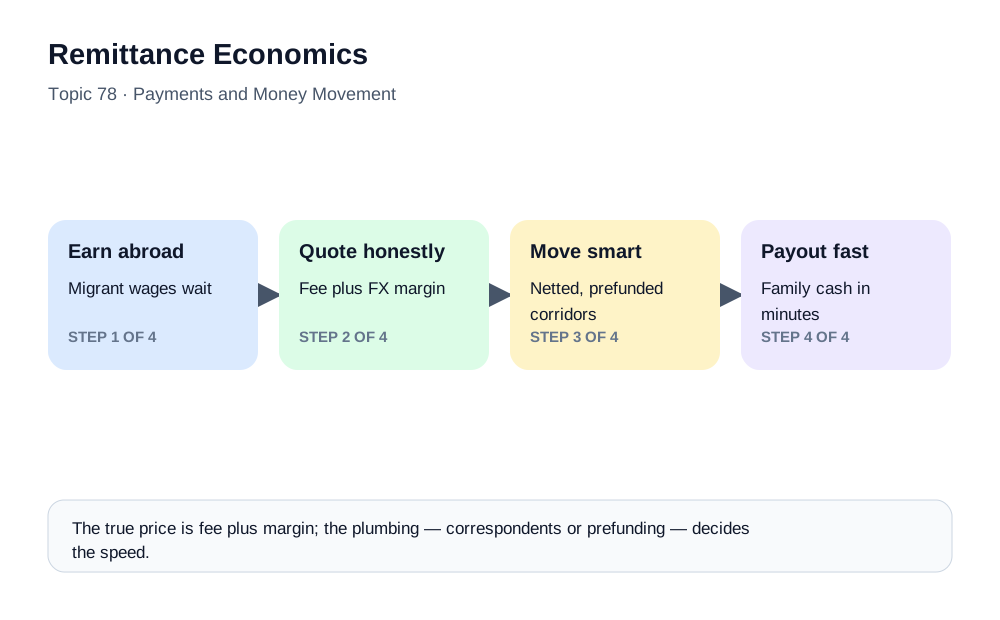
Remittance Economics at a glance — Global flows, migrant payments, digital disruption.
How Cross-Border Household Money Actually Moves
Remittances are personal cross-border transfers, most visibly the money migrant workers send to families, but the banking mechanics are broader than a simple international wire. The sender may fund the transfer from a bank account, card, mobile wallet, or cash. The provider may move value through correspondent banking, local payout partners, prefunded accounts, netting arrangements, linked instant-payment systems, or a combination of these methods. The beneficiary may receive money into a bank account, wallet, card, or cash pickup point.
The customer sees one promise: send this amount here, and the recipient will receive that amount there. Behind that promise sit foreign exchange, customer identification, sanctions and AML controls, payout liquidity, settlement between providers, fees, reconciliation, error handling, and customer support.
A good remittance service therefore has to solve four problems at the same time:
- identify legitimate senders and recipients;
- price and manage the currency conversion;
- deliver value reliably across jurisdictions;
- make the full cost and final amount understandable to the customer.
1. Why Remittances Matter
For many households, remittances are not discretionary investment flows. They pay for food, rent, education, medical treatment, housing, debt service, and family support. That makes reliability and cost especially important.
World Bank monitoring consistently shows that remittance costs remain material. Its Remittance Prices Worldwide database reported a global average cost of about 6.36% of the amount sent in its latest published monitoring, while the international policy objective remains a much lower cost. The practical lesson for banks is more important than the exact percentage: a few percentage points of fee or FX markup can materially reduce what a family receives.
Remittance customers therefore care about the amount delivered, not just the advertised transfer fee.
2. The Real Price Is Fee Plus FX Margin
Suppose a sender wants to transfer USD 500 and the mid-market exchange rate is 1 USD = 84 units of the destination currency.
The theoretical value before costs is 42,000.
Provider A advertises “zero fee” but uses an exchange rate of 81.50. The beneficiary receives 40,750.
Provider B charges an explicit USD 5 fee but uses 83.70. If USD 495 is converted, the beneficiary receives 41,431.50.
Provider B has the visible fee but delivers more money.
The true remittance price can therefore include:
- transfer fee;
- exchange-rate spread or markup;
- receiving fee;
- cash-pickup fee;
- intermediary-bank charges;
- card funding cost;
- taxes or regulatory levies where applicable.
Customer comparison should focus on total amount sent, total amount paid, exchange rate, amount received, and delivery time.
3. A Remittance Does Not Always Cross the Border as One Payment
One of the most important operating insights is that the customer's transfer and the provider's cross-border settlement are not always the same transaction.
Imagine a provider receives dollars from many customers in the United States who are sending money to India. The provider or its partner may already maintain rupee liquidity in India. Beneficiaries can be paid from that local pool immediately, while the provider later settles the net cross-border position through banking or treasury arrangements.
This is a local collection/local payout model.
The customer transfer is cross-border economically because value moves from one person in one country to another person in another. But the operational settlement can involve two domestic payment legs plus later wholesale settlement between providers.
This architecture can improve speed and lower cost because every individual retail payment does not need to travel through a chain of correspondent banks.
4. Correspondent Banking Model
Traditional bank remittances can use correspondent banking when the sending bank does not hold a direct settlement account with the beneficiary bank.
A sending bank may instruct its correspondent in the destination currency. That correspondent may route value to another bank, and the beneficiary bank ultimately credits the recipient.
Each institution needs accurate settlement instructions, currency liquidity, account balances, cut-off awareness, sanctions controls, and reconciliation.
The customer payment message and the actual movement of settlement assets are related but distinct. A message can be delivered while settlement fails. Settlement can occur while the beneficiary account posting remains unresolved.
That is why cross-border operations track message state, correspondent account movement, and beneficiary outcome separately.
5. Prefunding Can Make Payout Fast
Remittance providers frequently maintain prefunded balances with payout partners or banks in destination markets.
If a provider expects customers to send the equivalent of INR 20 crore into India during a weekend, it can ensure adequate rupee liquidity is available before transfers arrive.
When customers send, the payout partner credits beneficiaries from the prefunded position. Later, the remittance provider replenishes the balance.
Prefunding reduces customer waiting time but creates treasury costs:
- idle cash;
- foreign-exchange exposure;
- counterparty exposure;
- trapped liquidity by country;
- forecasting risk.
A provider can be globally solvent and still fail to pay beneficiaries if it lacks usable liquidity in the correct destination currency and legal entity.
6. Netting Reduces Wholesale Settlement
If two providers have flows in both directions, they may be able to settle only the net obligation under an approved arrangement rather than transfer the gross value of every customer remittance between them.
For example, Provider A owes Provider B USD 10 million equivalent for customers sending to Country B, while Provider B owes Provider A USD 7 million equivalent for flows in the opposite direction. The net settlement obligation is USD 3 million equivalent, subject to the contractual and regulatory arrangement.
Netting can reduce liquidity and settlement volume, but it creates counterparty exposure until settlement occurs. The providers need limits, collateral or prefunding rules where appropriate, settlement frequency, reconciliation, and default procedures.
7. Cash Pickup Remains Important
Digital account-to-account transfers are efficient only when recipients have usable accounts or wallets. Cash pickup remains important in many corridors because beneficiaries may live far from banks, prefer cash, or operate in cash-heavy local economies.
The remittance provider can send an instruction to a local money-transfer agent or partner. The beneficiary presents required identification and a transaction reference, and the agent pays cash.
This creates physical-liquidity and identity risks similar to mobile money:
- agent has insufficient cash;
- wrong person attempts pickup;
- fake identification;
- duplicate payout;
- agent fraud;
- customer reference stolen;
- payout recorded electronically but cash not handed over.
The provider needs authoritative payout confirmation and agent reconciliation, not just a message stating “ready for collection.”
8. Bank Account Payout
Account-credit remittances can be cheaper and easier to reconcile because the beneficiary bank provides the final account posting.
The provider needs correct bank and account identifiers, beneficiary name, currency, and routing data. Domestic payout can then use the destination country's local payment system.
A cross-border remittance may therefore finish as a domestic credit transfer.
If the account is closed or invalid, the payout can reject and funds must return to the remittance provider before the sender is refunded. This return path needs explicit status and reconciliation.
9. Wallet Payout
Where mobile money is widespread, a remittance can terminate in a wallet rather than a bank account.
The remittance provider needs a reliable link to the wallet provider, recipient identifier validation, local currency liquidity, fraud controls, and settlement between the institutions.
A mobile number alone should not be assumed to prove recipient identity. Number recycling and SIM changes create risk.
The provider should display the recipient name or other verification signal where the ecosystem supports it before the sender commits.
10. Sender Funding Methods Change Risk
A remittance funded from a bank account differs from one funded by card or cash.
Bank-account funding can be lower cost but may have timing or return risk depending on the payment method.
Card funding can provide rapid authorization but creates card fraud, chargeback, and processing cost.
Cash funding requires agent infrastructure and physical cash controls.
Wallet funding depends on wallet balance, authentication, and the wallet provider's operating model.
The remittance provider should understand when sender funds become sufficiently final before paying the beneficiary. Paying out before sender funding is secure creates credit risk on the sender or funding provider.
11. Foreign Exchange Is Central to Remittance Economics
Most cross-border household transfers involve two currencies.
The provider quotes the customer a retail exchange rate. Behind that quote, treasury manages wholesale FX positions arising from many customer transactions.
A provider can:
- hedge each transaction;
- aggregate flows and hedge net positions;
- use natural offsets from opposite-direction flows;
- prefund destination currency;
- manage risk within defined limits.
The customer rate includes more than the market price. It can include liquidity, volatility, hedging cost, operating cost, and commercial margin.
Transparent providers disclose both fee and exchange rate clearly so customers can compare the final delivered value.
12. Rate Lock Creates Market Risk for the Provider
Suppose the provider quotes a customer USD 1 = INR 84 for a transfer that will be funded in two hours.
If the provider guarantees the quote immediately, it has taken FX risk until the customer funding and hedge are complete.
If USD/INR moves sharply, the provider can lose money on the promised rate.
The service therefore needs rules for quote validity, funding deadline, cancellation, and rate refresh.
A rate shown on a screen should not remain open indefinitely unless the provider intends to take that market risk.
13. Customer Onboarding Must Understand Cross-Border Purpose
Remittance providers need to know the sender under the applicable KYC framework and understand enough about expected activity to identify suspicious behavior.
Useful information can include:
- identity;
- residence;
- source of funds where required;
- occupation;
- expected transfer frequency;
- expected corridors;
- relationship to beneficiaries;
- transfer purpose.
The required depth depends on jurisdiction, customer risk, product, and limits.
A customer sending a regular modest family-support payment has a different profile from a newly opened account sending unusually large transfers to many unrelated recipients.
14. Beneficiary Data Is Also Important
The sender is not the only relevant party. The provider needs sufficient beneficiary information for payout, compliance, fraud, and error prevention.
A recipient name, account or wallet identifier, country, and relationship can be relevant. High-risk transfers may require additional data according to law and policy.
Systems should not ask customers for data merely because a message schema allows it. Data collection should have a business, legal, compliance, or operational purpose.
15. Sanctions Screening Can Occur Across the Chain
Cross-border remittances can involve sender, beneficiary, banks, payout partners, countries, and other parties or locations relevant to sanctions controls.
A fast remittance service still needs to comply with applicable legal obligations.
Structured and accurate names, countries, dates of birth where relevant, and institutional identifiers improve screening quality.
False positives need controlled resolution. The provider should not silently drop or alter beneficiary data to reduce screening alerts.
16. AML Monitoring Looks for Patterns, Not Just Large Amounts
Money laundering can involve many small transfers rather than one large transaction.
Patterns can include:
- one sender paying many unrelated beneficiaries;
- many senders paying one recipient;
- rapid reversal or refund behavior;
- repeated transfers just below internal thresholds;
- activity inconsistent with occupation or profile;
- corridors unrelated to known customer circumstances;
- use of multiple funding instruments;
- coordinated agent activity.
No single pattern proves crime. Monitoring creates alerts for investigation.
Remittance providers should avoid rules that simply label every cash customer or migrant worker high risk. Risk assessment should be evidence-based and proportionate.
17. Fraud Can Target Sender, Recipient, or Provider
Remittance fraud includes:
- account takeover;
- stolen card funding;
- scam-induced transfers;
- fake recipients;
- beneficiary impersonation;
- agent fraud;
- refund abuse;
- identity theft;
- mule accounts;
- social engineering of customer support.
The service should connect device, funding, sender behavior, beneficiary history, transfer velocity, and corridor data where lawful.
A customer can authorize a transfer while being deceived, so authentication is not the same as scam prevention.
18. The Provider Needs an End-to-End State Model
A remittance is not simply pending or complete.
Useful states can include:
- quote created;
- sender funding pending;
- funding received;
- compliance review;
- FX completed;
- payout instruction sent;
- payout accepted;
- beneficiary credited;
- cash available;
- cash collected;
- rejected;
- returned;
- refund pending;
- refunded;
- under investigation.
The exact states depend on payout method.
Customer communication should match evidence. “Ready for pickup” is different from “collected.” “Sent to bank” is different from “credited to beneficiary.”
19. Unknown Outcomes Need Safe Resolution
Suppose the provider sends a payout instruction to a destination bank but receives no response.
If it sends a second instruction immediately, the beneficiary can be paid twice. If it assumes the first succeeded, the customer may wait indefinitely.
The provider needs an unknown state, status inquiry, unique transaction reference, duplicate controls, and reconciliation.
The same principle applies to sender funding. A card or bank debit timeout should not automatically create a second customer charge.
20. Reconciliation Spans Several Ledgers
A remittance provider may need to reconcile:
- sender funding;
- customer remittance ledger;
- FX trades;
- prefunding accounts;
- payout partner statements;
- beneficiary payment statuses;
- fees;
- refunds;
- bank accounts;
- general ledger.
A customer transfer can look successful while the provider's treasury settlement is wrong. Conversely, provider accounts can balance while one beneficiary remains unpaid.
Reconciliation therefore needs both financial totals and transaction-level matching.
21. Corridor Profitability Is More Than the Customer Fee
A corridor's economics depend on:
- customer fee;
- FX margin;
- funding cost;
- payout-partner fee;
- correspondent or bank cost;
- cash-agent cost;
- fraud loss;
- compliance cost;
- customer acquisition;
- liquidity cost;
- operational support.
A low-fee digital corridor can be very profitable if flows net efficiently and payout is automated. A higher-fee cash corridor can still have thin margins because agent and compliance costs are high.
Banks should analyze economics by corridor and payout method rather than one global average.
22. Speed and Cost Trade Off
Some customers value immediate payout. Others prefer lower cost and can wait.
Providers can offer different service levels, such as instant card-funded transfer at a higher price and slower bank-funded transfer at lower cost.
The customer should understand the difference before sending.
A “fast” product should also define what starts the clock: customer authorization, confirmed receipt of sender funds, completion of compliance review, or another event.
23. Cross-Border Instant-Payment Linkages
Countries and payment-system operators are increasingly exploring or implementing links between domestic instant-payment systems. These can reduce friction by reusing domestic addressing and payment experiences across borders.
The connection does not remove FX, compliance, liquidity, or settlement design. It changes how those functions are organized.
A cross-border instant-payment linkage still needs:
- participant rules;
- currency conversion;
- quote and rate transparency;
- sender and recipient information;
- routing;
- settlement or prefunding;
- error handling;
- reconciliation;
- consumer protection.
The customer may use a familiar domestic app, but the backend remains a cross-border financial service.
24. Stablecoin and Distributed-Ledger Experiments
Some providers explore stablecoins or distributed-ledger assets as a wholesale or retail transfer mechanism.
The technology can potentially reduce certain settlement frictions, but it introduces other questions: reserve quality, redemption, wallet custody, blockchain fees, sanctions compliance, operational security, legal classification, liquidity, and conversion into local currency.
A recipient who ultimately wants cash or a bank deposit still requires a reliable off-ramp.
The right comparison is not “blockchain versus slow banks.” It is total end-to-end cost, risk, liquidity, compliance, and customer outcome.
25. Informal Transfer Systems Persist for Practical Reasons
Informal value-transfer systems can remain attractive where formal services are expensive, slow, inaccessible, or documentation-heavy.
Their persistence is a signal that formal providers have not solved every customer problem.
Banks should not romanticize informal channels: lack of transparent records and regulatory oversight can create significant money-laundering, sanctions, fraud, and consumer-protection risks.
The policy challenge is to make regulated services accessible and affordable enough that legitimate users are not pushed toward opaque alternatives.
26. De-Risking Can Have Unintended Effects
Banks sometimes exit relationships with money-transfer businesses or institutions in higher-risk markets because compliance cost and perceived risk exceed commercial return.
This can reduce formal competition and push prices higher or activity into less transparent channels.
Risk management should therefore distinguish high risk from unmanageable risk. Strong due diligence, transaction monitoring, controls, and corridor understanding can sometimes support service safely without indiscriminate exit.
The decision remains institution-specific and subject to regulatory expectations.
27. Data Quality Drives Both Speed and Compliance
A beneficiary name misspelled at initiation can create a screening alert, bank rejection, or cash-pickup problem later.
Accurate structured data reduces manual repair.
Useful controls include:
- account format validation;
- bank identifier validation;
- country and currency compatibility;
- recipient-name confirmation where supported;
- purpose-code validation;
- phone-number format;
- duplicate detection;
- sender-beneficiary relationship capture where required.
A fast front end that accepts poor data merely moves the problem downstream.
28. Returns Are New Financial Events
If a beneficiary bank rejects a payment after the provider has completed FX, the sender may need a refund.
The refund amount can differ from the original amount if currency conversion must be reversed under the product terms and market rates changed.
The provider should disclose who bears FX movement when a transfer returns and distinguish provider-caused error from customer-provided invalid data where relevant.
The original remittance should remain in history, with a linked return and refund event.
29. Customer Service Needs Cross-Border Visibility
A sender asks one simple question: “Where is my money?”
The support agent needs visibility across funding, compliance, FX, payout, partner, and beneficiary status.
Without an integrated case view, support teams contact multiple operations groups and provide vague answers.
A strong platform presents the latest authoritative status, timestamps, reason codes, expected next action, and whether the customer needs to provide anything.
30. A Complete Digital Remittance Example
A worker in the UK wants to send GBP 500 to a family member's bank account in India.
The provider displays its fee, FX rate, and the exact INR amount the beneficiary will receive. The sender confirms.
The provider verifies the sender's funding and applies fraud and compliance controls. Treasury aggregates the resulting FX exposure with other customer flows and executes the required currency management.
The provider already holds or has access to INR payout liquidity through an Indian partner. It sends a domestic payout instruction using the partner arrangement. The beneficiary bank credits the account and returns a status.
The provider marks the customer remittance completed only when it has the evidence defined by its service. Later, treasury settles the net corridor position with the payout partner. Reconciliation matches sender funding, FX, payout, partner settlement, fees, and accounting.
The customer saw one cross-border transfer. The provider operated several linked financial processes.
31. A Failed Payout Example
A sender funds USD 1,000 for a beneficiary account in another country. FX is completed and the payout partner sends the local transfer. The beneficiary account is closed, so the receiving bank rejects it.
The payout partner returns the local funds to the remittance provider's settlement position. The provider links the return to the original transfer, determines the refund amount under the disclosed FX and fee rules, and sends the refund back to the sender's original funding method or approved account.
Operations reconciles every leg.
A weak provider simply changes status to “failed.” A strong provider can explain where value is currently held and what financial event happens next.
32. What Excellent Remittance Banking Looks Like
A world-class remittance provider can explain the full price before the customer sends, knows when sender funds become final enough for payout, manages currency and corridor liquidity, screens the relevant parties, detects fraud without excluding legitimate migrants, distinguishes customer status from wholesale settlement, handles cash and digital payout correctly, resolves unknown outcomes safely, and reconciles every transaction across partner and bank accounts.
The deepest lesson is that remittances are not just international messages. They are liquidity promises across currencies and legal systems. Trust comes from delivering the promised amount to the right person and being able to prove exactly how the value moved.
<!-- MBA-DEEP-DIVE-START -->Deep Dive: Remittance Operations, Corridor Liquidity, FX, Compliance, and Reconciliation
Remittance businesses look simple from the customer side because they sell one outcome: “send money home.” The operating model underneath is much closer to a miniature cross-border bank. The provider must obtain funds from the sender, know who is sending and receiving, manage currencies, choose a payout route, fund that route, send a payment instruction, prove the recipient received value, settle with banks or payout partners, reconcile all accounts, and return or refund money when something goes wrong.
The central professional insight is that a remittance provider manages two linked but different value chains:
- the retail customer transfer from sender to beneficiary;
- the provider's wholesale settlement with the institutions that fund and pay out those transfers.
These chains can run on different clocks. A beneficiary can be credited instantly from a prefunded local account while the providers settle their net position hours later. Customer speed therefore depends heavily on treasury preparation and partner liquidity, not only messaging speed.
Corridor architecture should be documented explicitly
A remittance corridor is the combination of sending country, receiving country, currencies, funding methods, payout methods, partners, regulatory requirements, FX process, and settlement model.
For every material corridor, the provider should document:
- regulated entity serving the sender;
- KYC and transaction-monitoring responsibilities;
- sender funding methods;
- FX pricing and hedging method;
- destination payout partner;
- beneficiary verification requirements;
- payout rails;
- prefunding or settlement account;
- settlement frequency;
- transaction and liquidity limits;
- sanctions or other compliance controls;
- return and refund process;
- customer-service ownership;
- reconciliation sources.
This “corridor book” becomes the operating truth for product, risk, treasury, compliance, operations, finance, and technology.
One global product can hide many local products
A remittance app can use the same branding everywhere while operating differently by corridor.
One route may offer direct bank credit in seconds. Another may offer only cash pickup. A third may require the sender to fund by bank transfer before the provider releases the payment. One destination may settle through an instant rail while another uses a batch clearing system. One currency may be freely tradable and easy to hedge; another may have exchange controls.
Product teams should therefore avoid one global status or SLA that ignores corridor differences.
A customer promise should be based on the actual route available for that transfer.
Sender funding finality determines payout credit risk
The provider can pay the beneficiary before the sender's funding is completely final. This improves speed but creates risk.
For example, a card authorization can be approved immediately, allowing the provider to release the remittance. The card transaction can later be disputed or charged back. If the beneficiary already collected cash, the remittance provider may bear the loss.
A bank transfer can also be reversible or returnable under specific circumstances depending on the payment method.
Providers therefore define a funding-risk policy by funding type. High-risk funding can require delay, stronger authentication, lower limits, or additional fraud checks before payout.
Sender-funding fraud and remittance fraud are linked
A criminal can use stolen card credentials to fund a remittance to an accomplice who cashes out immediately.
The provider then faces both a fraudulent funding event and an irreversible or hard-to-recover payout.
Risk engines should connect funding credential, sender identity, device, beneficiary, payout method, and recipient history.
A beneficiary who repeatedly receives transfers funded by different stolen cards can be a stronger fraud signal than any one sender profile.
Beneficiary risk deserves its own model
Many remittance fraud programmes focus on the sender because that is the customer being onboarded. The recipient can be equally important.
Useful beneficiary signals include:
- first-time recipient;
- number of unrelated senders;
- frequency and value of incoming transfers;
- recent change in payout identifier;
- repeated cash pickup at one agent;
- links to previous fraud complaints;
- unusual country or corridor behavior;
- rapid onward transfer or cash-out where data is available.
This is particularly important for scams where genuine senders are deceived into paying criminal beneficiaries.
Quote creation should have a controlled lifetime
A remittance quote normally includes send amount, fee, exchange rate, and receive amount.
The system should assign a quote ID and expiry time.
If the customer waits beyond the expiry, the application should refresh the rate rather than silently use an old price. If the provider guarantees the old quote, treasury must account for the resulting market risk.
The quote should also identify whether fees are deducted from the send amount or charged on top, because this changes the beneficiary amount.
FX spreads should be measured as customer economics
A provider can report a low explicit fee while earning most revenue through the FX rate.
Management should therefore measure:
- market benchmark at quote time;
- customer rate;
- gross FX margin;
- hedging cost;
- slippage;
- corridor liquidity cost;
- net FX revenue.
This helps product teams avoid misleading “zero fee” marketing that hides a large currency spread.
For banks, FX transparency also improves complaint handling because support teams can explain how the quoted receive amount was calculated.
Hedging can occur at transaction, batch, or portfolio level
A remittance provider can manage currency exposure in several ways.
Transaction-level hedging offsets each customer transfer quickly. This minimizes open market risk but can increase transaction cost.
Batch or net hedging aggregates many flows and hedges the net exposure periodically. This reduces market transactions but leaves temporary open positions.
Natural hedging uses opposite-direction customer flows to offset exposure.
Prefunded local currency provides immediate payout capacity but ties up cash and still needs replenishment.
Treasury chooses a mix based on corridor volume, liquidity, volatility, cost, and risk appetite.
FX profit and customer transfer profit should be separated
The remittance business can earn from transfer fees and FX margin. If accounting combines them, management may misunderstand corridor economics.
A corridor can appear profitable because of favorable market movements rather than sustainable customer pricing.
Treasury P&L should distinguish deliberate customer spread from residual market gain or loss caused by timing and hedging.
This supports better pricing discipline.
Prefunding is a balance-sheet allocation decision
Suppose a provider holds local currency equivalent to USD 10 million in a destination country to ensure instant payout.
That liquidity has opportunity cost. It can also be exposed to local bank credit risk, capital controls, currency depreciation, or restrictions on repatriation.
Treasury should set corridor prefunding limits and stress scenarios.
The right balance is enough to meet expected and stressed payout demand without leaving excessive idle value in every market.
Weekend and holiday liquidity can differ from weekday liquidity
Customer remittances often peak around salary dates, religious festivals, holidays, or weekends when families need money.
At the same time, wholesale FX and banking markets can have reduced operating hours.
A provider must therefore preposition liquidity before markets close.
A corridor that works perfectly at noon on Wednesday can fail operationally at midnight on Saturday if local payout remains open but treasury cannot replenish the settlement account.
24/7 customer availability requires 24/7 liquidity planning even when wholesale markets are not fully continuous.
Country holidays affect two sides of the corridor
A remittance route involves at least two countries and sometimes an intermediary settlement center.
The sending country can be open while the receiving country's banking system is closed. A destination instant-payment rail can be open while FX funding or a local bank is closed. Correspondent banks can have their own cut-offs.
Holiday calendars are therefore critical reference data.
The provider should calculate delivery estimates using the actual payout mechanism rather than assuming “business day” means the same thing in every location.
Cash payout agents need transaction-level controls
A cash pickup requires the payout agent to verify the beneficiary according to the product and local rules.
The provider can use:
- transaction reference;
- beneficiary name;
- identity document;
- one-time code;
- sender-provided question or other control where permitted;
- biometric or digital identity in some markets.
The goal is to prevent payment to the wrong person without making legitimate collection impossible.
Agent systems should show whether a transaction is available, already paid, expired, cancelled, or held. A previously paid transaction must not be payable again because a different branch failed to synchronize its status.
Cash-agent liquidity should be monitored by location
A remittance provider can send thousands of “ready for pickup” notifications while local agents have no cash.
That is a customer-service failure even though every electronic transaction is correct.
The provider should forecast cash demand by region, agent, payday, season, and transfer volume.
High-volume payout partners may need cash-management agreements and emergency replenishment processes.
A customer should not be sent repeatedly to agents that the provider knows cannot pay.
Bank payout should preserve beneficiary references
A bank-account remittance often includes purpose or reference data that the beneficiary uses to understand the credit.
The payout adapter should preserve relevant remittance information within the capacity of the local payment rail.
If the destination rail has limited text fields, the provider needs a truncation and mapping policy.
A beneficiary who receives the money but cannot identify the sender or purpose can still experience a poor service outcome.
Recipient-account verification reduces failed payouts
Where the local ecosystem supports account-name or alias verification, the provider can warn the sender before transfer when account details do not appear to match.
This reduces both errors and certain scams.
The service should present the result accurately. A name match confirms that account information aligns with the supplied name; it does not prove the recipient is honest or the payment purpose legitimate.
Mobile-wallet payout needs wallet-specific status
A wallet can reject a remittance because the recipient is unregistered, has exceeded a balance cap, has a restricted account, or cannot receive cross-border funds under the local rules.
The remittance provider should map these reasons into meaningful customer communication.
“Partner failed” is not useful if the recipient simply needs to complete identity verification.
The status mapping should also tell operations whether the payment can be retried after customer action or must be returned.
Purpose of payment can affect eligibility
Countries can have foreign-exchange or payment rules that treat family support, education, investment, business payment, gift, and other purposes differently.
The remittance provider should capture the purpose required for the corridor and validate eligibility.
A personal remittance product should not be used to disguise commercial payments if the rules treat those activities differently.
Product design should route business payments to the correct service rather than force every cross-border transfer through one consumer channel.
Source of funds can become necessary as value increases
Low-risk repeat customers can often transact with minimal friction under the applicable rules, while higher-value or unusual transfers can require evidence of source of funds or source of wealth.
The provider should collect evidence proportionately.
Documents can include salary evidence, bank statements, sale agreements, inheritance records, or other legitimate sources depending on the case.
Operations should store the evidence securely and link it to the relevant customer or transfer so the customer is not repeatedly asked for the same information without reason.
Transaction monitoring should understand remittance behavior
A migrant worker can send money to parents, spouse, siblings, school, or property-related accounts. Those patterns may involve several beneficiaries without being suspicious.
Monitoring rules should therefore use customer context.
At the same time, a new customer sending rapidly to dozens of unrelated beneficiaries can require investigation.
Effective monitoring combines profile, corridor, beneficiary network, amount, frequency, funding method, and history rather than relying only on fixed thresholds.
Structuring detection needs caution
Repeated transactions just below an internal or regulatory threshold can indicate deliberate structuring, but they can also reflect salary cycles, provider limits, or customer budgeting.
Alerts should trigger investigation rather than automatic accusation.
Investigators should look for evidence such as multiple funding methods, coordinated beneficiaries, short intervals, common devices, or explanations inconsistent with known activity.
The system should preserve the entire pattern across channels and related accounts.
Sanctions screening must operate before irreversible payout
If a transfer requires sanctions screening, the control should complete before the provider reaches an irreversible payout state.
For cash pickup, this means the transaction should not become collectible until required checks are cleared.
For instant bank payout, the screening engine must work within the product response-time design.
A timeout should not automatically be treated as clearance. The system needs a controlled hold or fail-safe state.
Partner due diligence is as important as customer due diligence
A remittance provider can depend on destination banks, money-transfer operators, agents, exchange houses, wallet providers, and technical processors.
Partner onboarding should assess:
- license and regulatory status;
- ownership and governance;
- AML and sanctions controls;
- fraud controls;
- financial strength;
- settlement arrangements;
- data protection;
- operational resilience;
- subcontractors and agents;
- complaint handling;
- audit and reporting rights.
The provider remains exposed to customer harm created by a weak payout partner.
Settlement limits manage partner credit exposure
If Provider A allows Provider B to pay beneficiaries before Provider B receives wholesale settlement, one party is extending intraday or overnight credit.
The arrangement should have limits.
Exposure can be measured as unpaid net settlement obligations plus pending payouts and other amounts defined by contract.
If a counterparty approaches its limit, the provider can require prefunding, shorten settlement frequency, or pause new transfers.
This is how remittance operations manage the same counterparty risk seen in other payment systems.
Reconciliation should use one immutable internal remittance ID
A single remittance can accumulate multiple external references: sender bank payment ID, card authorization, provider transfer number, FX trade reference, payout partner ID, domestic payment reference, cash-pickup code, and refund ID.
The provider should create one immutable internal transfer identifier and map every external reference to it.
Then support and reconciliation can search one record and see the whole lifecycle.
Without this, investigations become manual exercises in matching amount and date.
Settlement-account reconciliation should be independent
The treasury or finance team should reconcile bank and partner statements against the remittance ledger using data obtained independently from the transaction-processing application where possible.
If the same system produces both the expected balance and the “bank balance” used to prove it, a defect can hide itself.
Independent statements, confirmations, or API records provide stronger evidence.
Aged differences should be escalated because they can represent customer funds, partner credit exposure, or accounting errors.
Suspense accounts need strict aging
Cross-border payments create suspense when funds arrive but cannot be assigned, a payout fails after settlement, or a refund cannot be completed.
Every suspense item should have:
- original transfer ID;
- amount and currency;
- reason;
- owner;
- creation date;
- expected resolution path;
- escalation age.
“Remittance suspense” should never become a permanent pool of unexplained customer money.
Refund destination is a fraud-control decision
If a remittance fails, criminals may ask customer support to refund it to a different bank account or card.
The safest default is often to return funds to the original funding source where the product and payment method allow it.
Alternative refund destinations need strong verification and controlled exceptions.
Otherwise a criminal who compromises only the remittance account can redirect money that was originally funded from a legitimate customer's bank.
FX treatment on refunds should be disclosed upfront
If the destination-currency payout fails after FX conversion, reversing the currency transaction can produce a different sender-currency amount.
The product terms should explain how this is handled.
The provider might refund the original sender amount in some failure scenarios, absorbing market movement, or apply the prevailing rate in others depending on cause and contract.
Customer service should not improvise FX treatment case by case.
Complaint analysis should identify corridor defects
If one corridor produces unusually high “recipient not credited” complaints, management should investigate partner performance, payout routing, status mapping, or liquidity.
Useful complaint metrics include:
- complaint rate per 1,000 transfers;
- payout method;
- corridor;
- partner;
- reason;
- resolution time;
- refund rate;
- repeat complaint;
- financial adjustment.
A global average can hide a failing local partner.
Service-level measurement should follow the customer clock
A provider can claim “processed in 30 seconds” because it sent the payout instruction quickly, while the beneficiary receives money hours later.
Customer service-level measurement should track end-to-end delivery.
Important timestamps include:
- customer confirms;
- sender funding secured;
- compliance cleared;
- payout submitted;
- payout accepted;
- beneficiary credited or cash available;
- cash collected where relevant.
The provider can then see which stage creates delay.
Straight-through processing is a quality measure
A well-designed corridor should process most normal transfers automatically.
Manual repair should be reserved for genuine exceptions.
High repair rates can indicate poor source data, weak partner integration, overly sensitive screening, bad routing reference data, or product design defects.
Management should measure straight-through processing by corridor and reason for manual intervention.
Customer repair should happen as early as possible
If the beneficiary bank identifier is invalid, it is better to catch the problem before sender funding and FX than after a payout rejection.
Front-end validation can reduce downstream cost dramatically.
Useful early checks include account format, bank participation, wallet reachability, required recipient data, corridor limits, and purpose eligibility.
The principle is simple: repair before value moves whenever possible.
Cross-border instant systems still need FX certainty
Linking two instant-payment systems can reduce payment latency, but FX remains a market transaction.
The customer needs a rate before confirming. The provider needs access to both currencies. Settlement between systems or participants needs liquidity.
If the payment rail completes in seconds but FX funding is not available outside local market hours, the corridor still needs prefunding or another liquidity solution.
Instant messaging does not create instant currency liquidity automatically.
Multilateral linkage creates governance questions
A platform connecting several domestic instant-payment systems can reduce the need for bilateral technical integrations, but participants still need common rules.
Questions include:
- which participant performs FX;
- which data crosses borders;
- how aliases resolve;
- how sanctions obligations are allocated;
- how disputes are handled;
- settlement model;
- participant default;
- service levels;
- data privacy;
- operating hours;
- currency cut-offs.
Interoperability reduces technical fragmentation only when governance is equally clear.
Stablecoin settlement can move risk rather than remove it
A provider that buys a stablecoin with sender currency, transfers it across a blockchain, and sells it for destination currency has reduced dependence on some correspondent-bank steps.
It has introduced other dependencies: stablecoin issuer, exchange, wallet custody, blockchain congestion, smart-contract or key security, local conversion, and regulatory treatment.
The customer should be evaluated on total delivered cost and reliability, not on whether the provider used a fashionable settlement technology.
The financial system still needs trusted entry and exit points.
Cybersecurity protects both money and identity
Remittance accounts contain sensitive identity data and can authorize cross-border transfers.
Security controls should cover:
- strong authentication;
- device binding;
- credential storage;
- API security;
- encryption;
- privileged access;
- transaction signing where appropriate;
- secrets and key management;
- fraud monitoring;
- incident response.
An account takeover can move money across borders and cash out quickly, making recovery difficult.
Customer support is a fraud target
Criminals can social-engineer call-center staff to change phone numbers, reset passwords, alter beneficiaries, or redirect refunds.
Support workflows should use strong identity verification and restrict sensitive actions.
Agents should never rely on caller knowledge of transaction amount or beneficiary name alone, because attackers may obtain that information from compromised email or messages.
High-risk changes can require step-up verification or specialist approval.
Data privacy differs by jurisdiction
A remittance provider can process passports, addresses, phone numbers, transaction histories, recipient relationships, source-of-funds evidence, device data, and location.
Cross-border operations create questions about where data is stored and shared.
The provider needs a lawful basis and purpose for data processing, access controls, retention policy, and third-party agreements appropriate to each jurisdiction.
Data should not be copied to every payout partner merely because the technology makes it easy.
Regulatory reporting requires accurate purpose and geography
Central banks and regulators often use cross-border transaction data for balance-of-payments, foreign-exchange, AML, or other reporting.
Purpose codes, residency, country, amount, and currency can therefore have reporting importance beyond payment routing.
The provider should control reference data and map customer selections into reporting categories carefully.
A free-text “family” entry should not be automatically classified as a regulatory code without a defined rule.
Operations need corridor-specific playbooks
When a payout partner is unavailable, the correct response can vary by corridor.
One corridor may allow rerouting to a second bank. Another may require waiting because the customer chose a specific cash agent. A third may require cancellation and refund.
Operations playbooks should define:
- incident trigger;
- affected transactions;
- safe reroute options;
- customer communication;
- liquidity impact;
- compliance impact;
- refund rules;
- partner escalation;
- reconciliation after recovery.
Improvisation during a cross-border incident is risky because funds can already be in multiple places.
A corridor-liquidity stress example
A provider normally sends the equivalent of USD 5 million per day to a destination market. Before a major festival, customer volume triples.
The provider's local prefunded balance is exhausted by midday. The local bank remains open for payout, but the provider cannot replenish quickly because its home-country funding market is closed for a holiday.
A weak provider continues accepting transfers and leaves them pending.
A strong provider's treasury forecast identified the festival, increased prefunding before the holiday, established a contingency line, and set automated alerts at 50%, 30%, and 15% remaining liquidity.
The customer service stayed instant because treasury acted before the customer clicked Send.
A card-funding fraud scenario
A criminal uses a stolen card to fund several remittances to one cash-pickup beneficiary. Each individual transfer is below normal manual-review thresholds.
The provider's beneficiary-network analytics sees that the recipient has received transfers from six newly created senders using different cards within one hour. The transfers are held before cash becomes available.
The card authorization alone would have passed. The network view prevented irreversible payout.
A duplicate-payout scenario
The provider sends a bank payout and receives a timeout. An operations agent manually resubmits the instruction with a new reference. The original payment had actually succeeded.
The beneficiary receives twice the intended amount.
The root cause is not the destination bank. It is the provider's lack of idempotency and unknown-outcome handling.
A correct design keeps one business transfer ID, queries status, and reuses a duplicate-control reference before deciding whether a new financial instruction is needed.
A cash-pickup dispute scenario
A beneficiary claims an agent marked the transfer paid but never handed over cash.
The provider retrieves the payout record, agent ID, teller user, time, beneficiary verification evidence, cash-position records, and relevant branch controls. The agent's daily reconciliation shows a cash surplus equal to the disputed transfer.
The provider has evidence that electronic payout occurred without corresponding physical cash release and can resolve the case while investigating agent conduct.
This example shows why remittance truth can span electronic and physical records.
What world-class remittance operations look like
A strong remittance provider understands each corridor as its own mini financial system. It knows how sender funds become final, how FX is priced and hedged, where destination liquidity sits, which partner owes what, how the beneficiary is verified, when a transfer becomes irreversible, which data supports compliance, and how every ledger reconciles.
It also gives the customer a simple and honest experience: exact fee, clear exchange rate, exact receive amount, realistic delivery time, meaningful status, and rapid help when the payment fails.
The deepest operational principle is that remittance speed is manufactured before the transaction begins. Prefunding, partner governance, data quality, risk rules, and reconciliation architecture create the conditions that let the customer experience feel effortless.
<!-- MBA-DEEP-DIVE-END -->