Visual overview
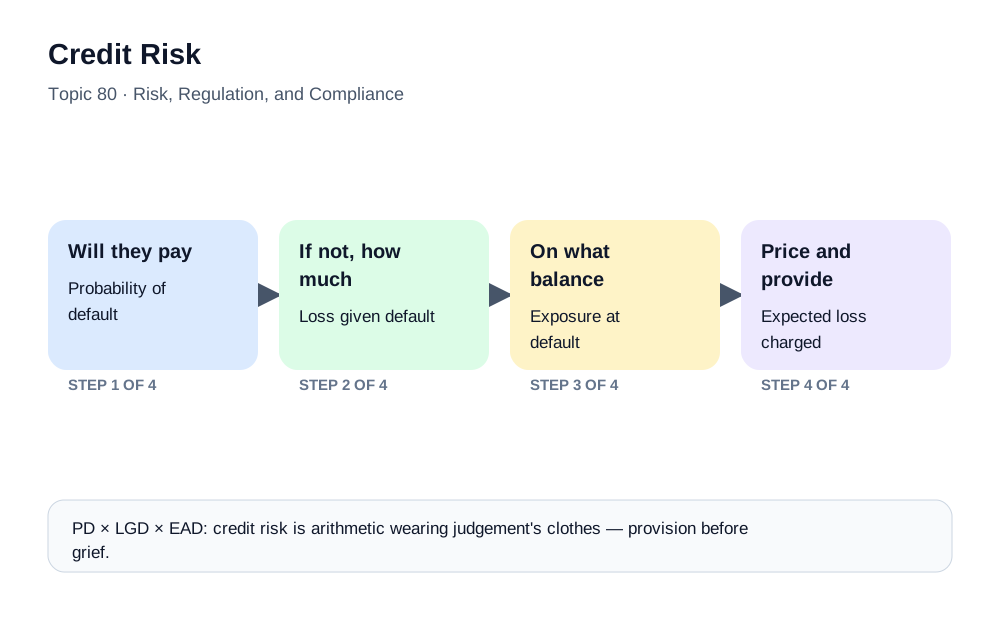
Credit Risk at a glance — PD, LGD, EAD, expected loss, provisioning.
From Borrower Assessment to Portfolio Loss
Credit risk is the risk that a borrower, counterparty, or other obligated party does not perform as agreed and the bank suffers loss. It is central to lending, but it also appears in bonds, guarantees, trade finance, derivatives, settlement exposures, interbank placements, and other financial relationships.
The most important professional habit is to avoid reducing credit risk to one score or one formula. A bank needs to understand who owes what, what cash flow will repay it, what can go wrong, how much exposure exists when default occurs, and what can realistically be recovered afterward.
Modern credit-risk frameworks often use Probability of Default (PD), Loss Given Default (LGD), and Exposure at Default (EAD) as important risk components. Basel's internal-ratings-based framework uses PD, LGD, EAD, and in some cases effective maturity as risk components for regulatory capital calculations. Banks also use related concepts in pricing, stress testing, accounting, portfolio management, and internal decisioning.
But PD × LGD × EAD should be treated as a useful expected-loss intuition, not as one universal accounting or regulatory formula for every credit exposure. Different frameworks define horizons, downturn assumptions, discounting, credit conversion, scenarios, and treatment of guarantees differently.
1. Credit Risk Begins With the Repayment Source
Every credit decision should answer: what cash will repay this exposure?
For a mortgage, repayment usually comes from household income, not from selling the property.
For working-capital finance, repayment comes from converting inventory and receivables into cash.
For a project-finance loan, repayment comes from project cash flows.
For a bond, the issuer must generate or obtain cash for coupon and principal payments.
Collateral matters, but it is normally a secondary source of recovery. A bank that lends mainly because the collateral looks valuable is making a liquidation bet rather than a cash-flow lending decision.
2. Probability of Default
PD estimates the likelihood that an obligor defaults over a defined horizon under the relevant framework.
The definition of default matters. Regulatory capital, accounting, internal risk management, and collections can use related but not identical criteria.
A PD estimate can use:
- financial ratios;
- bureau history;
- repayment behavior;
- internal account conduct;
- industry and macroeconomic data;
- management quality;
- external ratings;
- behavioral models;
- statistical or machine-learning methods.
A PD is not a timeless characteristic of the borrower. It changes as the borrower's circumstances and economic environment change.
3. Loss Given Default
LGD estimates the proportion of exposure that the bank expects to lose if default occurs, after considering recoveries and the time and cost required to obtain them.
LGD depends on factors such as:
- collateral type and value;
- security priority;
- guarantees;
- legal enforceability;
- recovery costs;
- cure rates;
- restructuring outcomes;
- insolvency process;
- time to recovery;
- economic cycle.
A secured exposure does not automatically have low LGD. Security can be defective, collateral can be illiquid, and market value can fall during stress.
4. Exposure at Default
EAD estimates the amount the bank is exposed to when default occurs.
For a fully drawn term loan, current outstanding balance is an important starting point.
For a revolving facility, the borrower may draw more before default. The bank therefore needs to estimate future utilization according to the applicable method or internal risk framework.
Off-balance-sheet commitments are especially important because stressed borrowers often draw available lines to secure liquidity.
The bank should not measure risk only from the amount drawn today.
5. Expected Loss and Unexpected Loss
A simple expected-loss intuition is:
Expected Loss ≈ PD × LGD × EAD
Suppose a portfolio segment has a 2% default probability, 40% loss severity if default occurs, and ₹100 crore of exposure. A simple expected-loss estimate would be ₹80 lakh before considering the detailed framework, discounting, scenarios, or other adjustments.
Expected loss represents the average credit cost anticipated over time under a defined set of assumptions.
Unexpected loss represents adverse outcomes beyond the expected level. Capital exists partly to absorb unexpected loss, while pricing and provisions are intended to reflect expected credit cost under their respective frameworks.
6. Creditworthiness Is Forward Looking
Historic financial statements show what happened. The bank needs to decide what can happen next.
A borrower can have excellent historic profit and still be risky because:
- a major customer is leaving;
- refinancing is due soon;
- interest rates rose;
- regulation changed;
- technology disrupted the business;
- commodity prices moved;
- management changed;
- litigation threatens cash flow.
A strong credit assessment therefore combines historical evidence, current position, forecast, and downside scenarios.
7. Cash Flow Matters More Than Accounting Profit
A company can report profit while running out of cash.
Working capital, capital expenditure, taxes, debt repayment, dividends, and one-time items can cause large differences between profit and available cash.
Credit analysts therefore examine metrics such as:
- operating cash flow;
- free cash flow;
- debt service coverage;
- interest coverage;
- fixed-charge coverage;
- leverage;
- working-capital cycle;
- liquidity headroom.
The right metric depends on the business and financing structure.
8. Household Credit Needs Affordability
Retail lending uses different evidence but the principle is the same: can the customer repay without unsustainable stress?
Banks can evaluate:
- verified income;
- existing debt;
- recurring expenses where available;
- credit bureau data;
- account behavior;
- employment stability;
- loan-to-value for secured lending;
- debt-to-income or affordability measures;
- interest-rate sensitivity.
A high credit score does not automatically make a new loan affordable.
9. Character and Willingness to Pay Still Matter
Credit models focus heavily on capacity, but willingness to pay also matters.
A borrower can have adequate resources and still choose not to honor obligations. Fraud, strategic default, weak governance, or disputes can affect willingness.
Relationship history, credit bureau performance, integrity of financial reporting, management behavior, and legal conduct can therefore influence the decision.
Qualitative judgement should be evidence-based, not stereotype-based.
10. Collateral Is Secondary Protection
Collateral can reduce loss severity but introduces its own risks.
The bank needs to know:
- legal owner;
- security type;
- priority;
- perfection or registration;
- current value;
- valuation method;
- volatility;
- insurance;
- custody or control;
- enforcement process;
- forced-sale discount;
- time to recovery.
A valuation report is not the same as cash recovery.
11. Guarantees Need Independent Capacity
A guarantee is useful only if the guarantor can and will perform when needed.
If a parent company guarantees a subsidiary but both depend on the same failing business, the guarantee may provide little diversification.
Credit teams should assess guarantor capacity, legal enforceability, competing obligations, and connected exposure.
Circular guarantees within a corporate group should not be counted as multiple independent sources of protection.
12. Connected Counterparties Create Hidden Concentration
Several legal entities can represent one economic risk.
Companies can be connected through ownership, control, guarantees, management, or economic dependence.
If the bank lends to ten subsidiaries of one group, a group-level failure can affect all ten at once.
Exposure aggregation should therefore look beyond account name to beneficial ownership and economic connection.
13. Industry Concentration
A bank can diversify across thousands of borrowers while remaining concentrated in one sector.
Commercial property, construction, agriculture, tourism, energy, technology, and other sectors respond differently to economic shocks.
Industry analysis should consider:
- cyclicality;
- regulatory environment;
- pricing power;
- input costs;
- technological change;
- demand sensitivity;
- refinancing dependence;
- commodity exposure.
Portfolio limits can prevent one sector from becoming an existential exposure.
14. Geographic Concentration
A regional bank can understand its local customers deeply while being exposed to one local economy.
A natural disaster, factory closure, property downturn, or political event can affect many borrowers simultaneously.
Geographic concentration can also appear indirectly through collateral. A nationally diversified mortgage book can still be concentrated in a few cities by property value.
Risk teams should therefore measure location at both borrower and collateral level.
15. Country and Sovereign Risk
Cross-border lending introduces country risk beyond the borrower's own credit quality.
A strong company can be unable to pay foreign creditors because of capital controls, currency shortages, political instability, or sovereign restrictions.
Country risk analysis can include:
- sovereign creditworthiness;
- foreign-exchange reserves;
- political stability;
- legal enforceability;
- convertibility and transfer risk;
- external debt;
- banking-system health.
The borrower can be healthy while the country prevents payment.
16. Rating Systems Translate Analysis Into Risk Grades
Banks use internal rating systems to organize credit quality.
A rating can combine quantitative and qualitative factors and map to PD or risk categories according to the bank's methodology.
The rating should support:
- approval authority;
- pricing;
- limits;
- monitoring frequency;
- expected-loss estimation;
- capital;
- watchlist triggers;
- portfolio reporting.
A rating is useful only when it is updated as risk changes.
17. External Ratings Are Inputs, Not Outsourced Decisions
Rating agencies provide useful independent credit opinions for many bonds and corporate borrowers.
Banks should not treat an external rating as a substitute for their own credit judgement when they hold the exposure.
Ratings can lag rapidly changing conditions. They also reflect the agency's methodology and instrument structure.
The bank needs to understand the borrower, facility, seniority, collateral, and its own exposure.
18. Credit Approval Should Be Independent
A relationship manager wants to win business. That incentive is legitimate but different from the credit-risk objective.
Strong governance separates origination from independent credit approval according to delegated authority.
The credit decision should record:
- borrower and group;
- purpose;
- repayment source;
- financial analysis;
- rating;
- downside case;
- collateral and guarantees;
- limits;
- covenants;
- exceptions;
- pricing and return;
- approval authority.
The record should be understandable years later when the loan is reviewed or defaults.
19. Policy Exceptions Need Visibility
Real borrowers do not always fit standard policy.
An exception can be approved when compensating factors are strong, but the bank should record the breached rule, rationale, authority, controls, and review date.
Portfolio-level exception reporting is essential.
If a majority of new lending requires exceptions, the bank either has the wrong policy or is no longer following its stated risk appetite.
20. Pricing Should Reflect Risk
Loan pricing is not simply benchmark rate plus sales margin.
A disciplined price can include:
- funding cost;
- liquidity cost;
- expected credit loss;
- operating cost;
- capital cost;
- optionality;
- facility commitment cost;
- target return;
- relationship economics.
A loan can have a high interest rate and still be underpriced if expected loss and capital usage are higher.
Risk-adjusted return prevents volume growth from being mistaken for value creation.
21. Covenants Are Early-Warning Tools
Covenants can require borrowers to maintain leverage, liquidity, coverage, reporting, collateral, or other conditions.
Their value is often not immediate enforcement. It is early information and decision rights.
A covenant breach can trigger discussion before a payment is missed.
The bank can waive, amend, reduce limits, require equity, obtain additional security, or restructure according to the circumstances.
Automatic waiver destroys the warning function.
22. Monitoring Should Test the Original Credit Thesis
Every material approval is based on assumptions.
If the loan depends on stable rental income, monitor occupancy and rents.
If it depends on three major customers, monitor customer concentration and payment behavior.
If it depends on commodity prices, monitor price and production cost.
Generic annual review is not enough for volatile exposures.
Monitoring frequency should increase as risk increases.
23. Early-Warning Indicators
Useful warning signals include:
- missed forecast;
- declining account turnover;
- rising utilization;
- overdraft excesses;
- delayed financial statements;
- covenant pressure;
- rating downgrade;
- management change;
- auditor qualification;
- legal dispute;
- falling collateral value;
- tax arrears;
- returned payments.
The objective is to act before default.
A watchlist that contains only already-defaulted borrowers is too late.
24. Days Past Due Is Important but Not Sufficient
Payment delinquency is a clear signal, but a borrower can deteriorate while still current.
A company can pay interest by drawing another facility. A household can remain current by using new consumer debt. A project can service debt from a reserve account while operating performance weakens.
Credit risk therefore combines payment status with forward-looking information.
Regulatory classifications, accounting stages, internal ratings, and collections statuses can all differ and should be stored separately.
25. IFRS 9 Expected Credit Loss Is a Separate Framework
For banks applying IFRS 9, financial assets can move through impairment stages based on credit deterioration and credit-impaired status.
Stage 1 generally uses 12-month expected credit losses. Stage 2 generally uses lifetime expected credit losses after a significant increase in credit risk. Stage 3 applies to credit-impaired assets, with detailed interest-recognition treatment.
PD, LGD, and EAD can be model components, but IFRS 9 also requires probability-weighted outcomes, forward-looking information, time value of money, and accounting definitions.
Regulatory default and accounting impairment should not be assumed identical.
26. Significant Increase in Credit Risk
One of the hardest accounting and risk judgements is determining when credit risk has increased significantly since origination.
Signals can include:
- internal rating downgrade;
- PD change;
- watchlist status;
- arrears;
- restructuring;
- covenant breach;
- sector deterioration;
- qualitative concern.
A purely mechanical days-past-due trigger can recognize deterioration too late.
A framework that is too sensitive can move healthy exposures unnecessarily.
Governance should combine model evidence and credit judgement.
27. Forward-Looking Macroeconomic Risk
Credit losses depend on the economy.
Mortgage risk can respond to unemployment and house prices. Corporate risk can respond to GDP, rates, commodity prices, exchange rates, or sector-specific conditions.
Expected-loss and stress-testing models can therefore use multiple macroeconomic scenarios.
The relationship should be evidence-based. Adding GDP to every model does not make it forward-looking if the portfolio is actually driven by another variable.
28. Stress Testing
Credit stress testing asks how the portfolio behaves under adverse conditions.
Scenarios can include:
- recession;
- unemployment rise;
- property-price decline;
- interest-rate shock;
- currency depreciation;
- commodity collapse;
- sector-specific disruption;
- sovereign downgrade.
The bank should estimate changes in PD, LGD, EAD, provisions, capital, income, and concentration.
Stress testing informs capital planning and risk appetite, not just regulatory reporting.
29. Wrong-Way Risk
Credit and market risk can worsen together.
A borrower with large USD debt but local-currency income becomes less creditworthy when the local currency depreciates. At the same time, a derivative with the bank can become more valuable to the bank, increasing counterparty exposure.
This is wrong-way risk.
Risk models should identify relationships where the bank's exposure increases precisely when the counterparty becomes weaker.
30. Counterparty Credit Risk
Derivatives, securities financing, and settlement relationships can create counterparty credit exposure even when no traditional loan exists.
The exposure can change with market prices.
Banks use netting, collateral, margin, limits, and counterparty analysis to control it.
A low current mark-to-market does not mean low future exposure.
Potential future exposure and wrong-way risk matter.
31. Settlement Risk
A bank can pay one side of a transaction and fail to receive the other side if the counterparty defaults.
Foreign exchange settlement risk is a classic example.
Payment-versus-payment and delivery-versus-payment mechanisms reduce this risk by linking the two legs.
Where such mechanisms are unavailable, banks use settlement limits and other controls.
Credit risk therefore appears inside payment operations as well as lending.
32. Portfolio Management
Credit risk should be managed as a portfolio, not just one borrower at a time.
Useful portfolio views include:
- rating distribution;
- PD bands;
- sector;
- geography;
- product;
- collateral;
- vintage;
- maturity;
- currency;
- top groups;
- watchlist;
- stage or impairment category;
- expected loss;
- capital consumption.
A portfolio can deteriorate even while no single exposure looks catastrophic.
33. What Excellent Credit Risk Management Looks Like
A world-class credit-risk function can trace every exposure from origination purpose to repayment source, rating, approval, pricing, collateral, monitoring, deterioration, provision, workout, and recovery. It knows which borrowers can fail together, which guarantees are genuinely independent, which undrawn lines can become funded, and which models are drifting.
The deepest lesson is that credit risk is not the possibility that “someone might not pay.” It is the disciplined study of how repayment can fail, how much value is exposed at that moment, and how much survives afterward. Banks create value by taking credit risk intentionally, pricing it correctly, monitoring it early, and holding enough capital and provisions for the outcomes they cannot avoid.
34. Credit Risk Data Must Survive the Entire Lifecycle
A strong credit platform preserves more than the current balance and current rating. It should retain the origination decision, original risk grade, approval authority, policy exceptions, facility terms, collateral details, covenant definitions, guarantees, drawdown history, repayment behaviour, watchlist events, restructurings, default dates, recoveries, write-offs, and model versions that affected decisions. These data can remain important years later for accounting, regulatory reporting, model validation, audit, litigation, and portfolio analysis.
This becomes especially important during system migration. A migration team can move every outstanding balance correctly and still damage the bank's control framework if it loses origination PD, collateral priority, covenant history, guarantee relationships, or the reason an exposure was restructured. Historical attributes are not archival decoration; they can influence staging, risk-weight calculations, expected-loss estimates, recovery strategy, and supervisory evidence. The bank should also reconcile migrated exposure totals, limits, collateral links, delinquency history, and off-balance-sheet commitments so that the new platform reproduces the same credit reality rather than merely the same headline balance.
35. Credit Decisions Need an Explainable Chain of Responsibility
Automation can make underwriting faster, but the bank should still be able to reconstruct why a material decision was made. For a manually approved corporate exposure, that means a clear credit paper, independent challenge, recorded conditions, delegated authority, and evidence that conditions were satisfied before drawdown. For automated retail lending, it means governed decision rules or models, approved data inputs, override controls, monitoring for drift, and evidence of the decision returned to the customer.
A useful control question is: if this loan defaults three years from now, can the bank still explain who approved it, which facts were relied on, which exceptions were accepted, what repayment source was expected, and what monitoring was supposed to detect deterioration? If the answer depends on one employee's memory, the process is not sufficiently controlled.
36. Pricing, Capital, and Growth Should Tell the Same Story
Credit growth can look successful while destroying economic value. A lending unit may report strong volumes and interest income even when expected loss, funding cost, operating expense, liquidity consumption, and capital usage make the risk-adjusted return unattractive. Credit risk should therefore connect approval to pricing and portfolio economics rather than operate as a separate gatekeeper.
When a bank repeatedly wins business only by accepting weaker covenants, lower margins, higher leverage, or more concentrated collateral, portfolio monitoring should identify the change before losses emerge. Growth targets, risk appetite, capital planning, provisioning, and collections capacity need to remain internally consistent. The healthiest credit culture is not one that avoids all risk; it is one that knows exactly which risks it is taking, why the expected return justifies them, and what evidence would cause the bank to change course.
<!-- MBA-DEEP-DIVE-START -->Deep Dive: Credit Risk as a Bank-Wide Data, Decision, and Control System
Credit risk becomes genuinely difficult when the bank grows beyond a few relationship managers who know every borrower personally. At scale, the institution needs a repeatable system that converts customer information into risk decisions, risk decisions into enforceable contracts, contracts into monitored exposures, and observed performance back into better models and policy. The quality of this feedback loop determines whether the bank learns from its own lending history or repeats the same mistakes every cycle.
A mature credit-risk architecture therefore has at least four connected layers:
- transaction-level underwriting — should this borrower receive this facility on these terms?
- customer/group exposure management — how much total risk does the bank have to this economic counterparty?
- portfolio management — how are exposures correlated across products, sectors, countries, and risk grades?
- capital and provisioning — how much loss absorption does the bank need for expected and unexpected outcomes?
The discipline is strongest when all four use consistent identifiers and data while preserving the different definitions required by accounting, regulatory capital, risk appetite, and collections.
Customer, borrower, obligor, guarantor, and beneficial owner are different roles
Credit systems often begin with a customer ID and assume that one identifier is enough. Corporate structures quickly prove otherwise.
A legal borrower can be a subsidiary. The parent can guarantee. Another group company can provide collateral. An individual owner can control several companies. Cash can be generated in one entity while debt sits in another.
The bank therefore needs a party model that distinguishes:
- legal borrower;
- co-borrower;
- guarantor;
- collateral provider;
- parent;
- subsidiary;
- beneficial owner;
- controller;
- connected counterparty.
This is essential for group exposure and legal enforceability.
Group exposure should be available before approval
A relationship manager can request a ₹50 crore facility for Subsidiary A. The credit officer should see that the bank already has ₹200 crore exposure to the same parent group through other entities.
If group data is scattered across systems or legal names are inconsistent, the bank can unintentionally exceed concentration limits.
Customer-master and beneficial-ownership data are therefore credit controls.
The approval workflow should calculate existing funded exposure, undrawn commitments, guarantees, derivatives, settlement exposures, and other relevant positions according to the bank's aggregation rules.
Limit hierarchy prevents isolated decisions
Banks often use several limit levels:
- country;
- industry;
- group;
- borrower;
- facility;
- product;
- tenor;
- unsecured exposure;
- settlement or counterparty limits.
A new loan can fit within the borrower limit but breach the group or industry limit.
The system should check all applicable levels before commitment.
Limit utilization needs a consistent definition. A guarantee can consume limit before it becomes funded. A revolving line can consume committed exposure even when undrawn. The bank should document which amount is counted at each limit layer.
Facility structure is part of credit risk
Two loans to the same borrower for the same amount can carry different risk because of structure.
A three-month self-liquidating trade facility differs from a ten-year bullet loan. A secured term loan differs from an unsecured overdraft. A committed revolving facility creates different liquidity and EAD behavior from a non-committed line.
Credit approval should therefore record:
- amount;
- currency;
- tenor;
- repayment profile;
- drawdown conditions;
- commitment type;
- collateral;
- guarantee;
- covenants;
- pricing;
- purpose;
- availability period.
Risk is encoded into the legal facility terms.
Tenor should match the financed economic life
Funding permanent capital expenditure with a thirty-day facility creates repeated refinancing risk.
Funding short-term inventory with a ten-year bullet loan can remove natural repayment discipline.
The facility tenor should match the expected cash-generation pattern while considering refinancing and liquidity risk.
A maturity date is not an administrative field. It is a credit-risk control.
If the borrower can repay only by obtaining a new loan at maturity, the bank has refinancing risk even when current cash flow is healthy.
Bullet risk deserves explicit analysis
A bullet facility can show excellent payment performance because only interest is due during the term.
The real test arrives at maturity.
Credit monitoring should therefore track the expected bullet-repayment source well before the final date. If repayment depends on asset sale, refinancing, bond issue, or equity injection, the bank should assess progress toward that exit.
Waiting until thirty days before maturity converts a predictable risk into an emergency.
Amortization creates information
A regularly amortizing loan gradually reduces exposure and gives repeated evidence of repayment capacity.
If the borrower struggles with early instalments, the bank receives a warning before the final maturity.
This does not make amortizing loans automatically safer; the borrower can still default. But repayment structure changes how quickly exposure declines and how early stress becomes visible.
Product design and risk assessment should be connected.
Revolving utilization is an early-warning signal
A working-capital line that fluctuates with business needs can be healthy.
A line that becomes permanently fully drawn can indicate that temporary funding has become structural debt.
Monitoring should examine:
- average utilization;
- peak utilization;
- clean-down periods;
- excesses;
- frequency of limit requests;
- relationship between utilization and receivables/inventory.
The current balance alone misses the pattern.
EAD modelling needs drawdown behaviour
A borrower approaching distress often draws unused lines.
Banks therefore estimate conversion of undrawn commitments into exposure under the relevant capital or internal framework.
Historical data should distinguish customer segment, product, rating, and stress conditions.
A corporate revolver can behave differently from an unused retail credit-card limit.
Model assumptions should be conservative enough for downturn behavior rather than based only on calm periods.
Collateral eligibility is not the same as collateral existence
A borrower can own assets that the bank cannot recognize as effective credit protection.
The collateral might be:
- legally unperfected;
- already pledged to another lender;
- illiquid;
- difficult to value;
- located in another jurisdiction;
- subject to legal dispute;
- too concentrated;
- operationally uncontrolled.
Credit systems should distinguish gross collateral value from eligible and recognized collateral value under the relevant framework.
Haircuts should reflect uncertainty and liquidity.
Collateral revaluation frequency should follow volatility
A pledged listed security can move significantly in one day. A commercial property may be revalued less frequently but still needs periodic review.
The bank should define valuation frequency by asset type and stress trigger.
If collateral value falls below a threshold, the system can generate margin call, additional security request, limit reduction, or risk review according to the contract.
Stale collateral values can create false comfort in LGD estimates.
Security perfection is an operational control
A credit committee can approve “secured lending,” but if legal documentation is never completed correctly, the bank can discover at default that it has no enforceable priority.
Pre-disbursement controls should confirm:
- security documents executed;
- required registration completed;
- title verified;
- insurance in place where required;
- bank's interest noted where appropriate;
- original documents or digital control stored;
- conditions precedent satisfied.
Credit risk therefore depends on legal and operations execution after approval.
Covenant data needs machine-readable definitions
A covenant stating “Net Debt / EBITDA must not exceed 4.0x” sounds simple until systems need to calculate it.
The loan agreement must define:
- net debt components;
- EBITDA adjustments;
- measurement period;
- currency conversion;
- permitted acquisitions;
- exceptional items;
- testing frequency;
- cure rights.
The bank should store enough structured information to calculate and track the covenant.
A PDF agreement that no system can interpret leaves monitoring dependent on manual spreadsheets.
Covenant waiver is a credit event
When a borrower breaches a covenant and the bank waives it, the waiver should be recorded with reason, authority, conditions, and expiry.
Repeated waivers can indicate deterioration even if payments remain current.
Accounting and rating frameworks may need to consider the underlying financial difficulty.
The system should preserve the original breach rather than changing history to show “compliant.”
Internal ratings need governance around overrides
A model can recommend rating 5 while the credit officer chooses rating 4 based on qualitative evidence.
Overrides can add valuable judgment, but management should monitor them.
Useful metrics include:
- percentage of ratings overridden;
- upgrade versus downgrade overrides;
- reason codes;
- approving authority;
- default performance of overridden exposures.
If overrides consistently improve ratings and those borrowers later default more often, incentive bias may be weakening the framework.
Rating migration is as important as default
Credit deterioration happens before default.
A portfolio moving from strong grades to weaker grades can increase expected loss, capital, pricing pressure, and monitoring workload even if non-performing loans remain unchanged.
Management should track rating-migration matrices over time.
This helps answer whether credit quality is improving, stable, or weakening across the whole book.
Vintage analysis is valuable beyond retail credit
Retail lenders commonly group loans by origination month and track delinquency at equal ages.
The same principle can help other portfolios.
A bank entering a new SME segment can compare 2025 and 2026 origination cohorts. If newer loans move to watchlist faster, underwriting or macroeconomic conditions may have changed.
Growth can otherwise hide deterioration because new loans have not seasoned long enough to fail.
Early delinquency can indicate origination fraud
Loans defaulting very soon after disbursement can reflect poor affordability, but unusually high first-payment default can also indicate identity fraud, fabricated income, dealer fraud, or collusion.
Risk teams should investigate whether the cause is credit or fraud.
Tightening PD thresholds will not solve a dealer creating fake loans.
Loss taxonomy is therefore important for policy response.
Collections data should feed underwriting
The origination model should learn from what happened after loans defaulted.
Collections and recovery systems can provide:
- cure rate;
- roll rate;
- time to recovery;
- collateral proceeds;
- legal cost;
- guarantor recovery;
- settlement amount;
- write-off;
- reason for default.
These data improve LGD, pricing, and product design.
A bank that separates origination and collections data permanently loses valuable learning.
Recovery timing affects LGD
Receiving ₹80 after one month is economically different from receiving ₹80 after five years.
LGD models should account for time value and recovery cost according to the applicable methodology.
Slow legal enforcement can therefore increase loss severity even when nominal collateral coverage looks strong.
This is why jurisdiction and collateral enforceability belong in credit analysis.
Downturn LGD recognizes cyclical correlation
Collateral values and borrower defaults can worsen together.
During a property recession, more mortgage borrowers can default while house prices fall. Recovery rates deteriorate precisely when defaults rise.
Basel frameworks and prudent internal models therefore consider downturn conditions rather than assuming average recovery from good years will persist during stress.
This is another example of wrong-way correlation inside credit risk.
Expected loss is not a pricing floor by itself
A loan with expected loss of 1% should not automatically be priced at funding cost + 1%.
The bank also needs operating cost, capital return, liquidity, optionality, taxes, and relationship economics.
Pricing can additionally be constrained by competition and customer affordability.
If market pricing is below the bank's risk-adjusted required return, the correct decision can be not to lend.
Volume is not a substitute for economics.
Risk-adjusted return supports portfolio allocation
Banks have limited capital and balance-sheet capacity.
Risk-adjusted return metrics compare expected earnings with credit loss, capital, and other costs.
This helps management choose between two exposures that offer similar nominal margins but consume different risk.
A low-risk transaction can create more economic value than a high-yield loan if it uses much less capital and loss allowance.
The exact metric varies by bank, but the principle is durable.
Concentration limits should be stress tested, not arbitrary
A 10% sector limit may look conservative until stress testing shows that sector losses are highly correlated with other exposures.
Risk appetite should connect concentration limits to capital impact under adverse scenarios.
The bank can ask: if the largest three groups default under the same stress, how much capital remains?
This converts limits from simple percentages into resilience tools.
Country risk can override borrower strength
A multinational subsidiary can be profitable and liquid locally but unable to transfer foreign currency because the country imposes controls.
Credit approval should distinguish:
- obligor default risk;
- transfer/convertibility risk;
- sovereign action risk;
- local banking-system risk.
A parent guarantee in another country can mitigate some risk only if legally enforceable and economically meaningful.
Cross-border credit is never just company analysis.
Wrong-way risk deserves explicit flags
A bank can lend to an oil producer and take oil as collateral. When oil prices fall, borrower cash flow and collateral value both deteriorate.
This is a classic wrong-way relationship.
Risk systems can flag exposures where the credit quality and protection depend on the same factor.
Other examples include:
- foreign-currency derivative exposure to an unhedged importer;
- real-estate loan secured only by the same project;
- guarantee from a parent whose revenue comes entirely from the borrower.
Protection should be independently robust where possible.
Trade finance has contingent credit risk
An issued letter of credit or bank guarantee may be off balance sheet initially but creates a contingent obligation.
The bank needs limit, tenor, collateral, applicant credit, beneficiary terms, and country risk before issuance.
If the instrument is called or compliant documents are presented, the contingent exposure can become funded.
Credit risk management must therefore include products beyond ordinary loans.
Settlement risk can create very short but very large exposure
In foreign exchange or securities transactions, a bank can deliver value before receiving the counter-value.
The duration may be hours, but the amount can be huge.
Settlement limits and payment-versus-payment/delivery-versus-payment mechanisms are credit-risk controls.
Credit risk should not be measured only by loan maturity; a one-hour principal exposure can be material.
Derivatives need current and future exposure views
A derivative can have low fair value today and large exposure after market movements.
Counterparty credit-risk systems therefore consider current replacement cost and potential future exposure according to the relevant framework.
Collateral and netting reduce exposure only when legally enforceable and operationally effective.
The bank should monitor collateral disputes and margin shortfalls as credit signals.
Netting depends on legal certainty
Two counterparties can owe each other money on multiple trades. Close-out netting can reduce exposure in default if the legal agreement is enforceable.
The bank should not assume netting merely because its risk system can calculate a net number.
Legal opinions, jurisdiction, entity capacity, and master agreement status matter.
If netting cannot be relied upon, gross exposure can be much larger.
Counterparty limits should include related entities
A financial group can trade through several subsidiaries.
If all entities depend on the same parent, separate legal limits can understate economic concentration.
Group-level aggregation and wrong-way analysis are therefore important in counterparty credit as well as lending.
Credit insurance and guarantees transfer risk but create new counterparties
A guarantee, credit insurance policy, or credit derivative can reduce the bank's exposure to the original borrower while creating reliance on the protection provider.
The bank should assess:
- eligibility under the relevant framework;
- legal enforceability;
- coverage amount;
- exclusions;
- maturity mismatch;
- claims process;
- protection-provider credit quality.
If the guarantor fails under the same economic scenario as the borrower, the protection is weak.
Risk data lineage is essential for capital and audit
Regulatory capital and provisioning can depend on borrower rating, PD, LGD, EAD, collateral, maturity, default date, and other attributes.
The bank should be able to trace those data back to source systems and approved model versions.
A wrong collateral code can change both risk-weighted assets and expected loss.
Data controls should include ownership, validation, reconciliation, change history, and issue remediation.
Credit-risk calculation is only as reliable as the underlying data.
Model versioning protects historical reproducibility
Risk models change over time.
A bank may recalibrate PD, change scorecards, update segmentation, or introduce new macroeconomic scenarios.
The system should retain which model version produced each decision and reporting result.
If audit asks why a loan was rated 4 two years ago, today's model should not be silently applied to historical data and presented as the original decision.
Reproducibility matters for governance.
Model validation should challenge use, not only mathematics
A statistically strong model can be used incorrectly.
Examples include:
- applying an SME model to large corporates;
- using a salaried-consumer scorecard for self-employed customers;
- using a model outside its approved geography;
- ignoring missing data that materially changes performance.
Independent validation should test conceptual soundness, data, performance, implementation, and limitations.
The model inventory should state where each model is permitted to be used.
Overrides and fallback rules are part of model risk
When a model service is unavailable, the business may use a fallback score, manual process, or conservative rule.
That fallback should be defined before an outage.
An emergency “approve if bureau score above X” shortcut can change risk dramatically.
Operations and risk should know how many decisions were made under fallback and review their performance.
System resilience is therefore connected to credit quality.
Credit decision engines need deterministic audit trails
For every automated approval or decline, the bank should preserve:
- input data;
- source;
- policy rules triggered;
- model version;
- score;
- limit calculation;
- pricing result;
- fraud outcome;
- manual override;
- final decision;
- timestamp.
This supports customer complaints, fair-lending analysis, model validation, regulatory review, and incident investigation.
A decision that cannot be reconstructed is difficult to govern.
Fraud and credit models should exchange signals carefully
Fraud detection can identify identity theft or manipulation. Credit assessment can identify inability to repay.
The systems should share useful evidence without conflating outcomes.
If a customer is declined for suspected fraud, the bank may need different communication and investigation than a credit decline.
If fraud losses are labelled as credit defaults, PD models become distorted.
Taxonomy and reason codes matter.
Fair-lending analysis should examine outcomes at scale
Automated credit decisions can create disparate outcomes across customer groups.
Banks should test whether model variables, policy rules, overrides, pricing, limits, and collections create unjustified differences under applicable law.
A variable can be statistically predictive yet still inappropriate because it acts as a proxy for protected characteristics or lacks legitimate business justification.
Responsible credit modelling therefore includes legal, compliance, and ethical review alongside statistical validation.
Customer explanations should reflect actual decision logic
A declined customer should receive meaningful reasons where required or appropriate.
Generic statements such as “does not meet policy” can be poor service and may fail legal requirements in some markets.
The decision engine should produce reason codes based on actual drivers rather than a separately maintained list that can drift from the model.
Explainability is part of implementation quality.
Stress testing should feed risk appetite
Stress testing is not useful if results are produced annually and then ignored.
If a scenario shows that a 30% commercial-property decline consumes a large share of capital, management can adjust:
- sector limits;
- LTV appetite;
- pricing;
- collateral haircuts;
- capital buffers;
- new business strategy.
Stress results should change decisions.
Otherwise the exercise is only reporting.
Reverse stress testing finds hidden combinations
The bank can ask: what combination of defaults and recovery deterioration would breach the capital ratio or risk appetite?
The answer might not be a broad recession. It could be default of two large groups plus a property-value shock.
Reverse stress testing highlights concentrations that ordinary scenarios miss.
It also helps management identify recovery actions before the scenario occurs.
Portfolio sales can manage credit concentration
Banks can reduce exposure through syndication, loan sales, securitization, credit derivatives, or other risk-transfer mechanisms according to product and regulation.
Risk transfer should be assessed economically.
If the bank sells part of a loan but retains a guarantee or first-loss position, concentration can remain.
The system should track retained risk after transfer rather than only gross loan balance.
Syndication does not eliminate underwriting responsibility
A lead bank can distribute a large facility across several lenders.
Each participant should still perform credit assessment according to its responsibilities.
The arranger can face underwriting risk if it commits to fund the whole facility before investors are found.
The agent bank also has operational responsibilities for notices, payments, and lender communications.
Credit and operational risk are connected throughout the syndicate lifecycle.
Credit committees should focus on unresolved risk
A strong credit paper should make the core decision easy to understand.
What can cause this borrower to fail? What evidence supports repayment? What is the downside? Which protections are real? Which exceptions exist? How much group and sector exposure results?
The committee should challenge assumptions rather than spend time rereading factual background.
Decision quality improves when the paper clearly separates facts, forecasts, assumptions, and mitigants.
Watchlist governance should force action
Placing a borrower on watchlist should change something.
Possible consequences include:
- more frequent information;
- senior credit review;
- reduced limits;
- additional collateral;
- no new lending;
- updated provisioning assessment;
- workout planning.
If watchlist status is merely a label, it does not reduce risk.
Management should track how long borrowers remain on watchlist and whether they cure or default.
Restructuring must restore sustainable repayment
A restructuring can extend maturity, reduce instalments, change interest, or obtain new security.
The test is whether the revised structure matches realistic cash flow.
If the borrower cannot repay even after modification, the bank is only delaying loss recognition.
Credit teams should compare going-concern value with recovery alternatives and require borrower or sponsor contribution where appropriate.
Restructuring is a new credit decision, not an administrative schedule change.
Workout strategy should use net present recovery
Once default occurs, the bank chooses among restructure, collateral enforcement, settlement, exposure sale, insolvency, or other recovery paths.
The best strategy is the one that maximizes risk-adjusted net recovery after time and cost, not necessarily the one with the highest nominal claim.
A ₹70 recovery today can be better than an uncertain ₹90 after six years of litigation.
Workout teams should document assumptions and update strategy as facts change.
Recovery outcomes should close the model feedback loop
When the case finishes, actual recovery data should return to LGD and pricing teams.
If property recoveries consistently take longer than assumed, future LGD and loan pricing should change.
If guarantees produce little recovery, underwriting should reduce reliance on them.
Credit risk becomes smarter only when the institution learns from realized outcomes.
A complete corporate exposure example
A manufacturing group requests a ₹100 crore revolving facility. The legal borrower is one subsidiary, but group aggregation shows ₹250 crore of existing exposure across three entities.
Credit analysis identifies stable operating cash flow but high customer concentration. Approval sets group and facility limits, a borrowing-base requirement on eligible receivables, leverage covenant, parent guarantee, and quarterly reporting.
The borrower initially draws ₹40 crore. Six months later, one major customer delays payment. Receivable days rise, revolver utilization reaches ₹90 crore, and leverage approaches the covenant threshold.
The bank's monitoring engine triggers watchlist review before any payment default. Credit updates PD and expected-loss assessment, reduces further availability, and requests additional information.
The borrower obtains new equity and collects the delayed receivable. Utilization falls. After sustained performance, watchlist status is removed.
The bank succeeded not because risk disappeared, but because the credit thesis was monitored continuously and action occurred before default.
A retail portfolio example
A bank launches an unsecured personal-loan product using automated scoring. First-year growth is strong and overall delinquency remains low.
Vintage analysis shows that loans originated through one digital marketing partner reach 30-day delinquency twice as fast as other channels. Fraud teams also see more identity mismatches from that partner.
The bank separates fraud loss from credit loss, suspends the partner channel, recalibrates underwriting, and reviews affected applications.
Without vintage and channel analysis, rapid new loan growth would have hidden the deterioration for several more months.
What world-class credit risk looks like
A world-class credit-risk architecture connects customer identity, group exposure, facility terms, limits, collateral, ratings, models, pricing, monitoring, accounting, workout, and realized recovery. Every important decision can be reconstructed. Every model has an approved population and version. Every manual override is visible. Every concentration is stress tested. Every recovery teaches future underwriting something.
The deepest insight is that credit risk is manufactured by decisions over time. Origination decides what enters the bank. Structure decides how exposure evolves. Monitoring decides how early change is seen. Workout decides how much survives default. Data and governance connect all four.
<!-- MBA-DEEP-DIVE-END -->