Visual overview
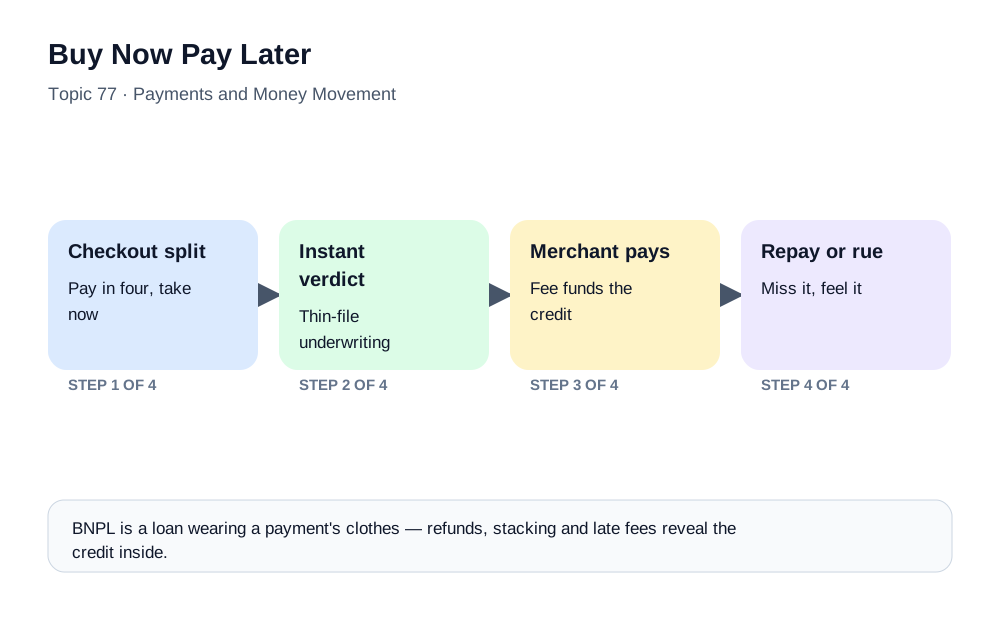
Buy Now Pay Later at a glance — Point-of-sale lending, BNPL models, credit risk.
Embedded Credit at the Point of Purchase
Buy Now Pay Later, or BNPL, is best understood as short-duration consumer credit embedded into a purchase journey. The customer does not leave the merchant website or store to apply for a traditional loan. Instead, the credit decision appears as one of the checkout options. If approved, the provider pays or commits to pay the merchant according to the commercial arrangement, while the customer repays the provider in scheduled instalments.
That simple experience hides a full lending lifecycle: customer identification, affordability or credit assessment, fraud checks, loan creation, merchant settlement, repayment scheduling, payment collection, delinquency management, complaints, refund handling, accounting, provisioning, and regulatory reporting where applicable.
BNPL therefore sits at the intersection of payments, lending, merchant acquiring, digital identity, and consumer protection. Treating it only as a payment method misses the most important fact: someone is extending credit and taking repayment risk.
1. The Economic Structure
A common short-term BNPL product divides a purchase into a small number of fixed instalments. One amount may be due immediately, with the remainder collected over subsequent weeks or months. Other products offer longer tenors and can charge interest.
The merchant usually receives the purchase amount according to its agreement with the provider rather than waiting for the customer's final instalment. The provider therefore assumes the customer's credit risk while giving the merchant faster certainty of payment.
The provider earns revenue from one or more sources:
- merchant service fees;
- customer interest on interest-bearing products;
- late or missed-payment fees where permitted;
- interchange or payment economics in some models;
- merchant marketing or referral arrangements;
- broader customer relationships and cross-selling.
The exact mix varies significantly. It is unsafe to assume that every BNPL product is interest-free or that every provider depends mainly on merchant fees.
2. Why Merchants Offer BNPL
For merchants, BNPL is primarily a conversion and sales tool.
A customer who hesitates at a ₹20,000 price can perceive four ₹5,000 instalments as easier to manage. This can increase conversion or allow the customer to choose a higher-value item.
But the merchant benefit should be judged after total cost. The merchant may pay a higher fee than for a simple bank transfer or basic card acceptance. It can also face refund, dispute, integration, and customer-service complexity.
A merchant should therefore compare:
incremental sales and margin generated by BNPL
against
provider fees + returns + operational cost + fraud + customer-support cost.
If BNPL merely shifts customers who would have paid with a cheaper method, the economics can be weaker than headline conversion statistics suggest.
3. A BNPL Transaction Is Both a Payment and a Loan
Consider a customer buying a phone from an online retailer.
The merchant creates the order and passes transaction data to the BNPL provider. The provider identifies the customer or starts onboarding, performs fraud checks and a credit or affordability decision according to its model, and returns an approval or decline.
If approved, the provider creates a credit agreement and repayment schedule. The merchant receives payment or a settlement obligation according to the commercial arrangement. The customer receives the goods and later pays instalments to the BNPL provider.
This creates at least three separate relationships:
- customer and merchant — purchase of goods or services;
- customer and BNPL provider — credit obligation;
- merchant and BNPL provider — settlement and service agreement.
A refund or dispute can affect all three.
4. Refunds Are More Complex Than in a Cash Purchase
Suppose the customer returns the phone after two instalments have already been paid.
The merchant needs to notify the BNPL provider of the accepted refund. The provider adjusts the outstanding credit balance and, if necessary, returns amounts already collected from the customer. The merchant settlement may also be adjusted.
A weak integration can create confusing states: merchant says refunded, BNPL schedule still collects; customer receives partial refund but loan remains open; merchant refund exceeds the remaining balance; or duplicate refund events are processed.
The refund workflow therefore needs a linked transaction model from original order to credit agreement to merchant settlement to customer repayment.
5. Instant Decisioning Does Not Mean No Underwriting
The defining customer experience of BNPL is fast approval. That speed is achieved through automation, data, and predefined risk rules—not by eliminating underwriting.
Inputs can include:
- verified identity;
- credit bureau information where available and legally permitted;
- existing relationship behavior;
- previous BNPL repayment history;
- bank transaction data with proper permission;
- device and fraud signals;
- purchase amount and category;
- merchant risk;
- outstanding obligations;
- declared or verified income where required;
- affordability indicators.
Different products and jurisdictions require different depth of assessment.
The provider should be able to explain which data influenced approval and whether the product was suitable for the customer segment under applicable rules.
6. Credit Risk Is Small Per Purchase but Large at Portfolio Scale
A ₹3,000 BNPL exposure can look trivial. A portfolio containing millions of similar exposures is not.
Risk management should examine:
- first-payment default;
- delinquency by instalment number;
- vintage performance;
- repeat-user behavior;
- merchant concentration;
- product category;
- customer indebtedness;
- loss rates after recovery;
- fraud versus true credit loss;
- macroeconomic sensitivity.
Small-ticket portfolios can deteriorate quickly because decisions are automated and origination volumes are high.
7. First-Payment Default Is a Powerful Signal
A customer who misses the first instalment or whose first scheduled collection fails may represent several different problems:
- fraud;
- stolen identity;
- payment-method failure;
- insufficient funds;
- poor affordability;
- deliberate non-payment;
- operational error.
Separating these causes matters because treatment differs.
A technical debit failure should not be reported internally as a credit default without investigation. Equally, repeated “technical” failures concentrated in one device or merchant can reveal fraud.
8. Debt Stacking Is the Hidden Affordability Risk
BNPL products can appear manageable one transaction at a time while becoming unaffordable in aggregate.
A customer can have several instalment plans across different providers and merchants. Each individual lender may see only part of the obligation set.
This is called debt stacking or fragmented indebtedness.
Good underwriting therefore needs the best available view of existing obligations and cash flow rather than assuming that a small ticket equals low risk.
Where credit bureau or open-banking data is available under the applicable legal framework, it can improve visibility. Internal limits on the number or total amount of simultaneous plans can also reduce stacking risk.
9. Merchant Risk Matters to the Lender
BNPL credit risk is not only about the customer.
A fraudulent or failing merchant can create:
- fake orders;
- non-delivery disputes;
- excessive refunds;
- collusive applications;
- customer complaints;
- provider chargebacks;
- reputational damage.
The provider should therefore underwrite merchants and monitor their performance.
A travel merchant taking payment months before service delivery can create higher forward-delivery risk than a grocery merchant selling goods immediately.
10. Fraud and Credit Loss Must Be Separated
If a criminal uses a stolen identity and never intends to repay, the resulting loss should not be analysed exactly like a genuine customer who became unemployed after purchase.
Fraud and credit models use different signals and require different responses.
Fraud teams focus on identity, device, transaction pattern, merchant collusion, account takeover, synthetic identities, and mule behavior.
Credit teams focus on repayment capacity, indebtedness, delinquency, economic conditions, and portfolio performance.
Blending the two into one “bad debt” number can hide the root cause and weaken both controls.
11. Repayment Collection Is a Payments Operation
BNPL instalments are often collected automatically from a linked card or bank account according to the customer's mandate and product terms.
The provider must manage:
- due dates;
- payment authorization;
- retries;
- expired or replaced cards;
- insufficient funds;
- partial payment;
- early repayment;
- failed collections;
- duplicate debit prevention;
- customer notification;
- reconciliation.
A lending product can therefore create significant payment-operations complexity.
A failed instalment should not be retried endlessly without regard to customer treatment and applicable rules. Retry policy is both a collections decision and a payment-control decision.
12. Autopay Mandates Need Clear Authority
The customer should understand what payment credential will be used, when instalments are due, what amount can be collected, how mandate changes work, and how cancellation or replacement is handled.
If the provider changes the repayment method after a card expires, that change should be controlled and customer-authorized according to the relevant framework.
The system should also preserve evidence of the original agreement and later modifications.
13. Delinquency Begins Before Formal Default
A customer can show stress before an instalment is seriously overdue.
Useful early signals include:
- repeated payment retries;
- partial payments;
- multiple simultaneous plans;
- increased use of maximum available BNPL limits;
- declining bank balance where lawfully visible;
- missed payments on other products;
- repeated extension requests;
- customer contact indicating hardship.
Early intervention can prevent a small temporary problem from becoming a larger collection case.
14. Hardship and Collections Need Proportionate Treatment
A customer who temporarily lost income may need a different solution from a customer committing fraud.
Collections can include reminders, rescheduling, payment plans, temporary relief, suspension of further BNPL use, or formal recovery depending on the circumstances and legal framework.
Provider incentives must not encourage harassment for small balances.
A high collection rate achieved through abusive contact is not strong risk management. It is conduct risk.
15. Pricing Should Cover the Full Lifetime Cost
An interest-free customer product is not free to the provider.
The economics can be represented as:
merchant/customer revenue – funding cost – expected credit loss – fraud loss – payment cost – servicing – customer acquisition – collections – capital cost – operating expense = economic return.
A provider can grow transaction volume quickly while destroying value if merchant fees do not cover losses and funding.
The funding cost becomes especially important when market interest rates rise. Short-duration receivables still require capital and liquidity.
16. Funding Is a Strategic Risk
Non-bank BNPL providers can fund receivables through equity, warehouse facilities, bank loans, securitization, retained earnings, or other capital-market structures.
A business that depends heavily on short-term wholesale funding can face liquidity stress even when customer repayments remain acceptable.
If funding markets tighten, the provider may need to reduce new approvals quickly. That can hurt merchant relationships and growth.
Banks entering BNPL from their own balance sheet have different funding economics but still need to price liquidity, capital, and credit risk.
17. Provisioning and Accounting Need Product-Level Data
BNPL receivables are credit exposures and require appropriate accounting treatment under the applicable accounting framework.
Systems need reliable data for:
- origination date;
- amount financed;
- repayment schedule;
- payment history;
- days past due;
- modifications;
- write-offs;
- recoveries;
- merchant refund adjustments;
- fraud classification.
A payment-centric platform that stores only “order status” is insufficient for credit accounting.
18. Credit Bureau Reporting Changes Customer Consequences
Whether BNPL activity is reported to credit bureaus depends on jurisdiction, provider, product, and evolving regulatory frameworks.
The important educational point is not to make a universal claim that BNPL never affects credit history.
Providers and customers should understand when positive and negative performance is reported, what type of inquiry occurs, and how delinquency can affect future credit access.
Product disclosures and customer-service scripts need to reflect the actual reporting arrangement.
19. Consumer Protection Is Moving Toward Credit-Like Treatment
Regulators in multiple markets have increasingly treated BNPL as a form of consumer credit rather than a payment convenience outside lending rules.
The policy concerns are consistent:
- affordability and responsible lending;
- transparent cost disclosure;
- fair late-fee treatment;
- complaint and dispute rights;
- credit reporting;
- data use;
- debt accumulation;
- marketing that minimizes the fact that the customer is borrowing.
Exact legal requirements differ by country and continue to evolve. Banks and providers should therefore build product architecture around adaptable credit controls rather than assume a historic exemption will remain permanent.
20. Checkout Design Can Create Conduct Risk
A merchant can make the smallest instalment visually prominent while hiding the total purchase obligation.
For example, “Only ₹2,500 today” can be technically true for a ₹10,000 purchase but psychologically minimize the debt.
Good design shows:
- total purchase price;
- amount financed;
- number of instalments;
- due dates;
- interest if any;
- fees and consequences of late payment;
- cancellation and refund treatment.
The customer should understand the full obligation before acceptance.
21. BNPL and Credit Cards Solve Different Needs
A credit card provides a reusable revolving line with card-network functionality, consumer protections, and potentially rewards. BNPL usually finances a specific purchase through fixed instalments.
Neither model is automatically cheaper or safer.
A customer who pays a credit card in full may pay no revolving interest and may receive rewards. A customer using an interest-free BNPL plan can benefit from fixed instalments. A customer carrying revolving card debt or stacking many BNPL plans can face substantial affordability risk.
Product education should therefore compare actual terms rather than slogans.
22. Card-Based BNPL and Merchant BNPL Are Different Structures
Some banks allow cardholders to convert an existing card purchase into instalments after authorization. The original transaction remains a card payment while the issuer changes how the cardholder repays.
Merchant-integrated BNPL can create a new loan at checkout and settle the merchant through a separate provider relationship.
The customer sees instalments in both cases, but the payment, dispute, merchant, and credit architecture differ.
23. Bank-Led BNPL Uses Existing Relationship Data
Banks can have advantages because they already know the customer's deposit history, income flows, existing credit, card behavior, and verified identity, subject to lawful use of that data.
This can improve affordability assessment and reduce onboarding friction.
However, existing data should not create complacency. A long-standing customer can still become overextended. The bank should include new BNPL obligations in its total customer exposure and affordability view.
24. Partnership Models Need Responsibility Mapping
A bank may fund a fintech BNPL provider. A fintech may own the checkout while a bank is the lender of record. A card network may provide instalment rails. A merchant platform may embed the front end.
Every model needs clear responsibility for:
- customer onboarding;
- credit decision;
- disclosures;
- loan booking;
- merchant settlement;
- repayments;
- fraud;
- complaints;
- hardship;
- bureau reporting;
- collections;
- regulatory reporting;
- data storage.
The customer should not have to understand the partnership structure to resolve a problem.
25. API Design Needs Loan-State Semantics
A BNPL checkout API may return an approval in milliseconds, but later events remain important.
Useful states can include:
- application created;
- identity pending;
- credit approved;
- credit declined;
- agreement accepted;
- merchant authorization confirmed;
- order captured;
- loan active;
- instalment due;
- payment received;
- delinquent;
- refund pending;
- partially refunded;
- fully refunded;
- closed;
- written off.
A single SUCCESS status is not enough for a lending lifecycle.
26. Merchant Capture and Loan Activation Must Align
Some merchant transactions are authorized before the goods are shipped. If the BNPL loan becomes fully active before the merchant actually captures or fulfils the order, the customer can begin owing money for goods never delivered.
The provider should align credit activation with the merchant payment state according to the product design.
Cancelled orders need to release or close unused credit cleanly.
This is a classic integration problem between payment and lending systems.
27. Returns Can Affect Credit Utilization
If a customer returns one item from a multi-item order, the provider may reduce the financed balance rather than cancel the entire plan.
Systems should allocate the refund correctly across principal, fees, interest, and future instalments according to product terms.
The customer should receive a revised schedule promptly.
A refund that sits in suspense while the next automated instalment is collected creates avoidable complaints.
28. Early Repayment Needs Product Rules
Customers may wish to repay early.
The system should define:
- whether early repayment is allowed;
- whether interest is recalculated;
- whether any fee applies under law and contract;
- how autopay mandates are closed;
- whether credit availability resets immediately;
- how accounting recognizes the settlement.
Early repayment is not just “receive remaining balance.” It is a loan-closure event.
29. Fraudulent Refunds Can Attack the Merchant Side
A criminal can compromise a merchant account and create refunds to controlled payment methods or manipulate order status.
BNPL platforms should therefore protect merchant refund permissions with role-based access, maker-checker for large adjustments, anomaly monitoring, and limits.
Merchant-side controls matter because the provider may send real money out even when the original customer loan was legitimate.
30. Portfolio Limits Prevent Concentration
A BNPL provider can become concentrated in one merchant, product category, customer segment, or season.
A large fashion retailer may generate a huge percentage of volume. If the merchant fails or customers return goods at unusual rates, the provider can face correlated stress.
Risk appetite can therefore include merchant limits, industry limits, geography limits, and customer-segment limits in addition to borrower-level limits.
31. Vintage Analysis Reveals Underwriting Drift
BNPL portfolios grow rapidly, which can make overall delinquency ratios look healthy simply because many loans are new.
Vintage analysis groups loans by origination month or quarter and compares their performance at the same age.
If the January cohort reached 5% serious delinquency only after six months but the June cohort reaches the same level after three months, underwriting quality may be deteriorating even if total portfolio delinquency remains unchanged.
This technique is especially important when a provider changes credit policy, marketing channel, merchant mix, or approval model.
32. A Complete BNPL Example
A customer buys a ₹12,000 appliance and selects four instalments.
The provider verifies identity, performs fraud and affordability checks, and approves the plan. The customer accepts the agreement. The merchant captures the order and receives settlement according to the provider agreement. The provider books a ₹12,000 receivable and the customer's repayment schedule.
The first instalment is collected successfully. Before the second is due, the merchant refunds ₹3,000 because one accessory was unavailable.
The BNPL platform receives the refund event, reduces the outstanding principal, recalculates future instalments according to the contract, updates merchant settlement, and notifies the customer.
The third scheduled debit fails because the customer's card expired. The platform does not immediately classify the customer as defaulted. It asks for an updated payment method, records the failed collection event, and follows the approved retry and notification policy.
The customer updates the card and pays. The final instalment completes and the loan closes.
Every stage required both payment and credit state to remain aligned.
33. What Excellent BNPL Looks Like
A world-class BNPL provider can explain exactly when the customer becomes legally obligated, when the merchant is funded, how affordability was assessed, how fraud is separated from credit loss, how simultaneous obligations are controlled, how refunds alter the loan, how payment mandates and retries work, how delinquency and hardship are treated, and how portfolio performance is measured by vintage and merchant.
The deepest lesson is that BNPL succeeds by making credit feel simple. Good banking does not allow that simplicity to hide the underlying responsibility. The product should be easy to use precisely because the provider has built disciplined lending, payment, merchant, and consumer-protection controls underneath it.
34. Management Information Should Join Credit and Payments
BNPL performance should not be managed from a sales dashboard alone. Management needs a joined view of approval rate, merchant conversion, average ticket, customer repeat use, fraud loss, first-payment default, missed instalments, cure rates, refund ageing, collection cost, funding cost, complaints, hardship cases, and net lifetime return. Looking at only approval growth can reward weak underwriting; looking only at delinquency can hide merchant or refund failures that are damaging customers.
The same joined view is valuable for change control. If a new merchant integration raises approval volumes but also produces a surge in duplicate captures, partial-refund breaks, or first-payment defaults, the bank should be able to connect the operational change to portfolio performance quickly. Product, credit risk, fraud, payments operations, finance, collections, and customer service should therefore work from consistent event definitions and common identifiers.
That is the operating discipline behind a good BNPL experience: the customer sees four simple instalments, while the provider continuously proves that the credit decision, merchant settlement, customer repayment, refund, accounting, and conduct outcomes still agree.
<!-- MBA-DEEP-DIVE-START -->Deep Dive: BNPL as a Credit, Payments, Merchant, and Data Platform
BNPL becomes much easier to manage when the provider stops thinking of it as a checkout feature and starts treating it as a lending product with a merchant trigger. The merchant initiates the commercial context, but the provider is still taking a credit decision, creating a receivable, funding or settling a merchant, collecting repayments, recognising losses, handling complaints, and protecting customer data. The speed of the front end should not weaken the disciplines expected of any other credit business.
A mature BNPL operating model therefore connects five systems of truth: the merchant order, the credit agreement, the customer repayment schedule, the merchant settlement record, and the accounting/risk ledger. When these five disagree, customer harm and financial loss follow quickly.
The credit agreement must be tied to the commercial event
The lender should know exactly which purchase the BNPL agreement finances. That sounds obvious until the order changes.
Customers cancel individual items, merchants split shipments, products go out of stock, prices change, discounts are applied after checkout, and merchants can capture an amount lower than the original authorization.
The lending system therefore needs a durable commercial reference and rules for what happens if the merchant order changes before the credit is fully activated.
If a customer is approved for ₹20,000 but the merchant ultimately captures only ₹17,500, the customer should not receive a ₹20,000 loan merely because that was the original checkout amount. The unused credit should be cancelled or adjusted according to the product design.
Authorization and loan booking are separate states
A provider can pre-approve a customer before the purchase completes. The credit decision might be valid for a limited period or amount, while the loan itself should not become an active funded exposure until the defined merchant event occurs.
Useful states can include:
- application received;
- customer verified;
- credit approved;
- offer presented;
- agreement accepted;
- merchant authorization confirmed;
- capture pending;
- loan activated;
- merchant funded;
- repayment active;
- delinquent;
- refunded;
- closed.
Keeping these states separate prevents a common defect: a declined or abandoned purchase appearing as a live customer loan.
Merchant settlement timing changes provider exposure
A provider can settle merchants immediately, after capture, after shipment, or under another schedule defined by the merchant agreement.
Earlier settlement improves merchant cash flow but increases provider exposure to merchant non-delivery and insolvency.
Suppose a travel merchant sells tickets six months before travel and receives BNPL settlement immediately. The provider may collect customer instalments successfully, yet if the merchant fails before the flight, customers can still have refund or consumer-protection claims. The provider's economic exposure therefore depends on both borrower performance and forward-delivery risk.
Merchant reserves, delayed settlement, guarantees, transaction limits, or other risk controls can mitigate this exposure.
Merchant underwriting should reflect fulfilment risk
A grocery merchant delivering instantly is not economically equivalent to a furniture merchant taking deposits for delivery in four months.
Merchant underwriting can consider:
- legal entity and beneficial ownership;
- product category;
- delivery timing;
- refund rate;
- chargeback or dispute history;
- financial strength;
- expected BNPL volume;
- average order size;
- geographic reach;
- concentration in one product or season;
- history with the platform.
Monitoring after onboarding is equally important. A sudden increase in transaction volume can indicate legitimate growth, a marketing event, merchant distress, or fraud.
Consumer credit and merchant risk can interact
The provider may have a strong borrower who stops paying because the merchant never delivered the goods. What initially appears to be credit deterioration is actually a commercial dispute.
Collections teams should therefore have access to merchant dispute information.
If hundreds of customers associated with one merchant simultaneously stop repayment and complain of non-delivery, treating them as independent delinquent borrowers would be both operationally inefficient and potentially unfair.
Portfolio analytics should connect merchant and customer events.
BNPL fraud can occur on both sides of the transaction
Customer-side fraud includes stolen identity, account takeover, synthetic identity, false income information, and deliberate first-party fraud.
Merchant-side fraud can include fabricated orders, collusion with customers, fake delivery, refund manipulation, and rapidly extracting settlement before disappearing.
The provider needs cross-party analytics. A merchant whose transactions cluster around new customers from the same devices or addresses can deserve review even if individual credit scores look acceptable.
Fraud prevention becomes especially important because BNPL approval is expected to be fast. Manual review cannot be the primary control for every small transaction.
Device data is useful but should not become a secret credit system
Digital lenders can observe device age, operating system, IP address, location consistency, session behavior, and other signals. Some of these are powerful for detecting fraud. Their use in credit decisions can raise different fairness, privacy, and explainability questions.
The provider should distinguish fraud features from creditworthiness features and govern each according to lawful purpose.
A device being new can be relevant to account-takeover risk. It does not automatically mean the customer is a poor credit risk.
Clear feature governance helps prevent a fraud model from quietly becoming an unreviewed lending model.
Soft inquiry, hard inquiry, and bureau reporting are product-specific
Training material frequently generalizes that BNPL uses only soft credit checks and does not affect credit history. That is not a safe universal rule.
Different providers and products can use different bureau inquiry types, reporting arrangements, and underwriting approaches. Longer-tenor or interest-bearing instalment credit can be assessed differently from a small pay-in-four product.
The bank or provider should disclose the actual process and ensure customer-service teams understand it.
From a systems perspective, bureau inquiry type, score, report version, reporting status, and reason codes should be captured as governed data rather than embedded only in an external vendor response.
Affordability is not the same as probability of default
A model can predict that a customer is likely to repay while the credit still places unreasonable strain on the customer's budget.
Probability of default asks, broadly, how likely non-payment is. Affordability asks whether the customer can meet the obligation without unsustainable financial difficulty according to the applicable framework and product design.
A customer may prioritize BNPL repayments by skipping essential spending. A purely predictive model can call that a “good” outcome while conduct and consumer-protection analysis sees a problem.
This is why responsible lending needs both credit-risk prediction and affordability logic.
Small-ticket credit still needs total exposure limits
Providers can become comfortable because one purchase is only ₹2,000 or ₹5,000. But a repeat user can accumulate dozens of plans.
The platform should maintain an aggregate customer exposure view that includes:
- current principal outstanding;
- future scheduled instalments;
- delinquent amounts;
- pending merchant captures;
- pre-approved but unused capacity where relevant;
- exposure across related products or entities where the framework requires it.
A product limit that checks only the current cart ignores the real debt burden.
Repeat-user underwriting should evolve with behavior
The provider learns from every completed plan.
A customer who has repaid ten plans on time can deserve different treatment from a first-time user, subject to risk appetite and fairness controls. Conversely, a previously reliable customer who begins using maximum limits, opening many plans, and missing payments should not retain the same approval rules indefinitely.
Behavioral scoring can incorporate repayment history, usage pattern, account stability, and other appropriate data.
The model should still be validated for economic cycles. Excellent repayment during a period of strong employment may not predict performance during recession.
Credit policy and model should not be one opaque object
A production decision can combine:
- mandatory eligibility rules;
- regulatory exclusions;
- fraud decision;
- affordability rules;
- credit model score;
- customer exposure limits;
- merchant restrictions;
- product amount and tenor rules;
- manual exception policy.
Separating these components makes outcomes easier to explain and change.
If a customer is declined because the merchant category is prohibited, the system should not report “low credit score.” Accurate decline reasons are part of fair treatment and useful operations.
Manual overrides need governance
Sales or merchant teams can pressure risk functions to approve a customer or merchant that automated rules rejected.
Overrides are sometimes legitimate, but should be visible.
The system should capture original decision, override reason, approving authority, supporting evidence, and performance of overridden cases.
If overridden applications default much more often than standard approvals, management has evidence that commercial pressure is weakening risk discipline.
Limit management should consider both customer and merchant events
A customer can have an overall BNPL limit, but the provider may also restrict specific merchants, categories, or products.
For example, a customer approved for ₹50,000 overall might receive a lower limit for a high-risk merchant category or a longer-tenor purchase.
Limits can also be dynamic. A recent missed payment can reduce available capacity immediately even before the account becomes formally delinquent.
The customer interface should display available credit carefully so it is not mistaken for guaranteed future approval.
The payment schedule is a financial contract
Once the loan activates, the schedule should be generated from controlled product parameters:
- principal;
- interest or finance charge if any;
- number of instalments;
- due dates;
- day-count rules where relevant;
- first payment timing;
- fees;
- rounding;
- holidays and retry behavior;
- early repayment rules.
A minor configuration error can affect millions of instalments.
Schedule-generation changes therefore need the same controlled testing as other core banking product parameters.
Rounding needs explicit treatment
Dividing ₹1,000 into three equal instalments produces a recurring decimal.
The product must define how rounding works and where the residual amount is placed. One common approach is to adjust the final instalment, but the actual rule should be explicit.
If different systems round independently, the customer schedule can total ₹1,000 while the accounting ledger totals ₹999.99 or ₹1,000.01 equivalent.
At scale, these small mismatches become reconciliation noise and customer complaints.
Repayment mandate failures require controlled retries
A scheduled card or account debit can fail for reasons unrelated to customer intent: expired credential, technical outage, insufficient balance, issuer decline, mandate cancellation, or fraud block.
Retry strategy should distinguish these reasons where possible.
Retrying an expired card ten times is pointless. Retrying immediately after a technical processor outage may be appropriate. Repeatedly debiting a customer after a revoked mandate can be a serious conduct problem.
The provider should cap attempts, space them according to policy, notify the customer, and preserve each payment event.
Collections activity should be linked to the loan state
When a payment becomes overdue, collections begins with accurate data.
The collections platform needs principal outstanding, missed instalment, days past due, customer contacts, payment attempts, refunds in progress, disputes, hardship status, and legal restrictions.
If a merchant refund is pending, automated collections messages demanding the same amount can cause unnecessary harm.
This is why dispute, merchant, loan, and collections systems need integrated state.
Hardship is not a generic status
Customers can experience job loss, illness, bereavement, disaster, or other temporary hardship.
A hardship workflow can include revised payment dates, temporary relief, reduced instalments, or other treatment permitted by the product and law.
The provider should track whether a concession was granted because of financial difficulty because it can affect risk classification, accounting, reporting, and future credit decisions.
Simply editing the due date without recording the reason loses important credit history.
Cure should require evidence, not one successful debit
A delinquent customer who pays one missed instalment may not have resolved the underlying affordability problem.
Risk policy should define when the account returns to normal status and when credit capacity can be restored.
Repeated delinquency followed by short cures can be an early-warning pattern.
The platform should preserve arrears history rather than showing only current days past due.
Write-off does not necessarily end collections
When an exposure is written off for accounting purposes, legal recovery rights may continue depending on the jurisdiction and contract.
The system should therefore distinguish accounting write-off from legal debt forgiveness or settlement.
Recoveries after write-off need separate accounting treatment and should be captured for loss-model calibration.
Loss forecasting should separate credit and fraud vintages
If a new merchant campaign attracts synthetic identities, the first months can show very high defaults. Calling this “credit deterioration” can lead the risk team to tighten affordability thresholds for genuine customers, attacking the wrong problem.
Portfolio reporting should show fraud loss, credit loss, merchant dispute loss, operational adjustment, and other material categories separately where possible.
The better the loss taxonomy, the more targeted the response.
Expected loss needs forward-looking portfolio insight
Depending on accounting framework and regulated entity, BNPL receivables can be subject to expected-credit-loss or similar provisioning requirements.
Models should consider product maturity, repayment behavior, delinquency, customer quality, macroeconomic conditions, and recovery.
Short tenor does not eliminate forward-looking risk. A portfolio that turns over every six weeks can still deteriorate rapidly if unemployment rises or acquisition strategy shifts toward weaker borrowers.
Management overlays should be documented and temporary rather than permanent unexplained adjustments.
Funding facilities can have eligibility tests
A non-bank provider may finance receivables through a warehouse facility. The lender can define which BNPL receivables qualify as collateral.
Eligibility can depend on delinquency, merchant type, customer location, tenor, concentration, refund status, or documentation.
If receivables become ineligible, the provider can face a funding shortfall even before customer losses are realized.
Funding reporting therefore needs loan-level data quality. A broken field can make good receivables ineligible under the financing agreement.
Securitization needs clean receivable data
Mature providers may sell or securitize pools of BNPL receivables.
Investors need reliable information on origination, customer risk, merchant mix, payment performance, delinquency, refunds, recoveries, and servicing.
A platform built only for fast checkout can struggle when capital-markets investors ask for historical loan-level data.
Good architecture stores durable credit data from the beginning rather than reconstructing it years later.
Merchant fee revenue can hide adverse selection
A merchant willing to pay a very high BNPL fee may do so because the provider is enabling sales to customers who otherwise would not buy.
That can be economically attractive—but it can also indicate higher credit risk.
Pricing should therefore consider the interaction between merchant conversion uplift and borrower quality.
A product team should not lower underwriting merely because merchant economics look profitable. High merchant fee is not a substitute for credit discipline.
Customer acquisition cost matters to lifetime economics
BNPL providers often spend heavily on marketing, merchant incentives, rewards, or promotions.
A new customer can be unprofitable on the first plan even if the loan performs perfectly.
Lifetime value depends on repeat usage, merchant revenue, funding cost, losses, servicing, and customer retention.
Risk and marketing should therefore share cohort analysis. A campaign that acquires large volume but produces poor repeat behavior and high delinquency is not successful growth.
Product profitability should be measured by cohort
A useful cohort view follows customers or loans originated in the same period and measures:
- merchant revenue;
- interest/fee revenue;
- funding cost;
- fraud loss;
- credit loss;
- collections cost;
- servicing cost;
- refunds;
- marketing cost;
- capital usage;
- repeat value.
This prevents new volume from hiding weak economics in older cohorts.
Customer disputes need a clear ownership model
A customer can dispute:
- product not delivered;
- product defective;
- refund not processed;
- payment collected twice;
- instalment amount wrong;
- unauthorized BNPL account;
- identity theft;
- merchant cancellation not reflected;
- late fee applied incorrectly.
The provider should route the complaint to the right process without making the customer negotiate between merchant, payment provider, lender, and bank.
Case data should link the order, loan, payment attempts, merchant messages, and refund events.
Complaints are risk intelligence
A rising complaint rate around one merchant can reveal non-delivery. Complaints about payment attempts can reveal processor defects. Complaints about confusing repayment dates can reveal poor disclosure.
Management should therefore analyze complaints by merchant, product version, channel, customer segment, and root cause.
A complaint function that only closes individual tickets wastes valuable control data.
Marketing should not disguise borrowing
BNPL advertising can emphasize convenience, lifestyle, or affordability while minimizing the fact that the customer is taking credit.
Responsible marketing should avoid creating the impression that instalments make a product cheaper unless they actually do.
The customer should see total amount, repayment dates, finance cost, late-payment consequences, and key rights before committing.
Product and compliance teams should review merchant-created BNPL advertising too, because the lender can be exposed to misleading statements made in checkout or promotional material.
Younger customers are not automatically high risk or low risk
BNPL is often associated with younger consumers, but demographic stereotypes are poor underwriting.
Risk should be based on relevant financial and behavioral evidence, not unsupported assumptions about age groups.
Fair-lending and model-governance processes should test whether the decision system creates unjustified differences across protected or sensitive groups under the applicable legal framework.
Explainability matters even for small loans
Automated decisioning can process millions of applications. The scale increases the importance of explainability.
The provider should know why a customer was declined or limited, what model and policy version made the decision, and whether an exception or manual review occurred.
This supports customer communication, model validation, audit, and regulatory review.
A black-box score without reason traceability creates operational risk.
Model drift can be fast in BNPL
Merchant mix, economic conditions, fraud tactics, customer behavior, and acquisition channels can change rapidly.
A model trained six months ago can begin underperforming if the business enters a new market or merchant category.
Monitoring should compare predicted and actual default, approval rate, population characteristics, fraud, and fairness metrics over time.
The provider should define thresholds that trigger recalibration, model review, or policy intervention.
New merchant integration needs negative testing
A BNPL API integration should test more than approval.
Scenarios should include:
- order cancelled before capture;
- partial capture;
- amount changed;
- duplicate capture;
- partial refund;
- full refund after two instalments;
- merchant timeout;
- customer abandons checkout;
- payment method invalid;
- approval expires;
- merchant sends inconsistent currency;
- duplicate customer request;
- webhook delivered twice;
- merchant account suspended.
The loan ledger should remain correct in every case.
Idempotency protects against duplicate loans
A merchant can retry an API call when it does not receive a response. If the provider creates a new loan for every retry, the customer can receive multiple obligations for one purchase.
A stable merchant order reference and idempotency key should allow the provider to return the original decision or state.
Idempotency should cover key financial actions such as loan activation, refund, and merchant settlement as well as application creation.
Unknown outcome must not become duplicate credit
Suppose the provider sends a merchant funding instruction but the bank transfer times out. The provider does not know whether the merchant was paid.
Sending a second transfer blindly can pay the merchant twice.
The merchant settlement system needs an unknown state, status inquiry, reconciliation, and safe retry logic exactly like other payment systems.
BNPL's lending economics do not remove payment-operations risk.
Accounting needs independent reconciliation
The sum of individual loan balances should reconcile to the loan sub-ledger and general ledger.
Merchant payable balances should reconcile to merchant settlement and bank statements.
Customer repayment receipts should reconcile to card or bank collections.
Refund adjustments should reconcile between merchant, customer loan, and payment records.
A provider can have accurate customer screens but wrong financial statements if these ledgers drift apart.
Data lineage matters when terms change
A customer can receive a hardship modification, refund, partial cancellation, early repayment, or fee waiver.
The system should retain the original contract and every later authorized change.
A current balance alone cannot explain how the account arrived there.
Audit, complaints, accounting, and legal recovery all depend on event history.
Business continuity should protect payment dates
If the BNPL platform is unavailable on a scheduled payment day, the provider needs rules for customer impact.
Customers should not be charged late fees because the provider's own collection system failed.
Recovery after outage should avoid duplicate debits when queued payment attempts replay.
The incident process should identify affected customers, suppress inappropriate collections actions, reconcile actual payments, and communicate clearly.
A recession stress test should connect credit and funding
Imagine unemployment rises and consumer spending slows.
BNPL delinquency increases. Merchant sales fall. Refund rates rise in discretionary categories. Investors become less willing to fund fintech receivables. Warehouse lenders tighten eligibility.
The provider therefore faces higher credit loss and tighter funding at the same time.
A useful stress test models both sides: how much capital and liquidity remain if losses increase while new external funding becomes more expensive or unavailable?
A provider that models credit risk without funding risk can underestimate survival pressure.
A merchant-failure scenario
A large furniture merchant represents 18% of BNPL volume and normally delivers within twelve weeks.
The merchant enters insolvency. Thousands of customers have active plans for undelivered goods. Some have paid several instalments. The BNPL provider has already settled the merchant.
The incident requires customer-service, credit, legal, merchant-risk, finance, collections, and payments coordination.
Collections may need to stop for disputed transactions. Refund or consumer-protection treatment must follow the applicable legal and contractual framework. Merchant receivables and reserves are assessed. Provisioning is updated. Future merchant settlement stops. Customer communications explain what happens next.
The exposure came from merchant concentration and forward-delivery risk, not ordinary borrower default.
A debt-stacking scenario
A customer has four active BNPL plans totaling ₹24,000 with one provider and additional obligations elsewhere. The customer applies for another ₹15,000 purchase.
The new purchase is small enough to pass a transaction-level model. An aggregate affordability view shows that scheduled repayments over the next month would consume most available income.
A strong system declines or reduces the new credit despite the low predicted default on the isolated transaction.
The control works because the provider measures customer obligations, not shopping carts.
A refund-state scenario
A customer finances a ₹9,000 order in three instalments. After one ₹3,000 payment, the merchant approves a ₹4,000 partial refund.
The platform should reduce the remaining financed principal appropriately, recalculate future instalments, adjust merchant settlement, and show the customer a revised schedule.
If the next automated collection still debits ₹3,000 because the repayment engine did not receive the refund event, the provider has a system-integration defect.
The correct fix is not a one-off customer refund. It is ensuring merchant, credit, and collections state stay synchronized.
What world-class BNPL operations look like
A world-class BNPL provider can reconstruct a customer journey from checkout to final repayment with no ambiguity. It knows what the merchant sold, what credit was approved, what amount was actually captured, when the loan became active, when the merchant was funded, how each instalment was collected, which refunds changed the schedule, why a customer became delinquent, what concessions were granted, and how the exposure was provisioned and eventually closed.
It also measures the portfolio as a living system: borrower risk, merchant risk, fraud, funding, concentration, model drift, affordability, complaints, and conduct all interact.
BNPL's innovation is not that it discovered instalment credit. The innovation is that it compressed credit into commerce. The discipline required to make that safe is still the discipline of banking.
<!-- MBA-DEEP-DIVE-END -->