Visual overview
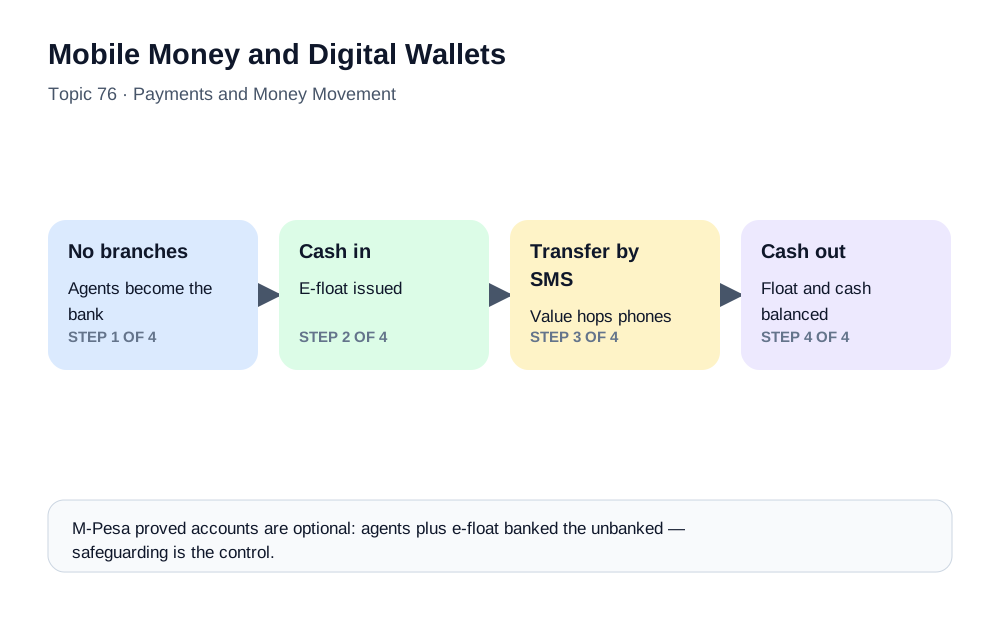
Mobile Money and Digital Wallets at a glance — M-Pesa, Alipay, QR codes, stored value.
Banking-Like Services Beyond the Traditional Bank Account
Mobile money and digital wallets are often grouped together because both let customers use a phone to store or move value. The similarity ends quickly. A mobile money account can be an electronic-money balance created under a dedicated regulatory framework and supported by a network of cash-in/cash-out agents. A device wallet such as Apple Pay can simply present tokenized credentials linked to an existing bank card. A prepaid wallet can hold stored value. A super-app can combine payments, merchant services, lending, investments, transport, shopping, messaging, and identity inside one interface.
The most important question is therefore not “Is it a wallet?” but what is the legal claim represented by the balance and who is responsible for safeguarding, redemption, payment execution, and customer protection?
This matters because the customer interface can look identical even when the underlying money model is very different. One balance may be a bank deposit. Another may be e-money backed by safeguarded funds. Another may be a token that references a card. Another may be a closed-loop merchant credit usable only inside one ecosystem.
For banking professionals, mobile money is best understood as a new delivery and value-storage architecture that connects telecom reach, agent networks, digital identity, payment rails, safeguarding, reconciliation, financial-crime controls, and customer service.
1. Why Mobile Money Emerged
Traditional banking historically depended on branches, bank accounts, identity documentation, minimum economics, and formal payment infrastructure. In many countries, mobile-network coverage expanded faster than bank branches. People could own a phone long before they had convenient access to a formal bank.
Mobile money used that gap.
Instead of asking every customer to travel to a branch, the provider built a network of local agents. A customer could hand cash to an authorized agent. The agent's own electronic float decreased while the customer's mobile-money balance increased. The customer could then send value to another user, pay a merchant, buy airtime, pay a bill, or later withdraw cash from another agent.
The system therefore converted a widely available communications network and retail network into financial-distribution infrastructure.
2. M-Pesa and the Agent-Network Breakthrough
M-Pesa, launched in Kenya in 2007, became the best-known example of mobile money because it proved that a phone-based value system supported by local agents could scale far beyond a pilot.
Its deepest innovation was not the text-message menu. It was the operating model around cash conversion and trusted local access.
A mobile-money balance has limited value if customers cannot convert cash into electronic value and electronic value back into cash. Agents solve that problem. A local shopkeeper, pharmacy, kiosk, or other authorized outlet can act as a cash-in/cash-out point, subject to the provider's rules, liquidity limits, identification requirements, and controls.
The agent network can reach places where a full bank branch is uneconomic, but it creates a new banking-like risk problem: the provider must manage thousands of distributed liquidity points operated by third parties.
3. Electronic Float and Physical Cash Must Balance
The agent model depends on two forms of liquidity.
An agent needs cash to serve customers who want to withdraw and electronic float to serve customers who want to deposit cash into their mobile-money accounts.
Suppose an agent starts the day with ₹50,000 equivalent in cash and ₹50,000 of electronic float. If customers mostly cash in, the agent accumulates physical notes but runs low on electronic float. If customers mostly cash out, the agent runs low on physical cash while electronic float rises.
The provider therefore needs tools for rebalancing. Agents may transfer float, deposit or withdraw through partner banks or super-agents, or use other approved mechanisms.
A technically available mobile-money system can still fail customers if the local agent has no liquidity. Agent liquidity is therefore part of service availability.
4. Mobile Money Is Not Automatically a Bank Deposit
A mobile-money provider can operate under a regulatory model different from a bank. Customer funds may be safeguarded through accounts or trust structures according to local law rather than becoming ordinary deposits on the provider's balance sheet.
This difference affects:
- who holds the underlying customer funds;
- whether funds can be used for lending;
- insolvency treatment;
- deposit-insurance treatment;
- interest or return rules;
- redemption rights;
- capital and liquidity requirements;
- customer disclosures.
The exact framework varies by jurisdiction. Customers and practitioners should never assume that every wallet balance has the same legal protection as a bank savings account merely because both display a number on a phone.
5. Safeguarding Is the Core Balance-Sheet Control
Where a non-bank issuer creates e-money or mobile-money value, regulators commonly require customer funds to be safeguarded in some approved form. The purpose is to prevent the provider from treating customer money as ordinary working capital.
The operating model must reconcile:
total customer e-money liability
against
total safeguarded funds or eligible backing assets
according to the applicable rules.
If customers collectively hold 100 million units of mobile money, the provider needs evidence that the corresponding safeguarded value exists in the required structure.
This is not merely monthly accounting. Large systems need frequent reconciliation because new cash-in, cash-out, transfers, fees, reversals, failed transactions, and settlement events change balances continuously.
6. Wallet Types Are Economically Different
The word wallet covers several models.
A stored-value wallet holds monetary value directly inside the wallet arrangement.
A pass-through wallet can hold tokenized payment credentials and initiate transactions against an underlying card or bank account without holding the economic value itself.
A closed-loop wallet is usable only with one merchant or ecosystem.
A semi-closed or limited-network wallet may work across an approved merchant network but have restrictions on withdrawal or transfer depending on the jurisdiction.
A bank-linked wallet may simply provide a mobile interface over a regulated bank account.
The customer experience can feel similar, but settlement, safeguarding, fraud, fees, refunds, and failure rights can differ materially.
7. Device Wallets and Tokenized Cards
Apple Pay, Google Wallet, and similar device-wallet models commonly allow users to provision tokenized representations of eligible payment cards.
The wallet does not need to expose the original card number to every merchant. Instead, a token or device-related credential can be used in the payment flow, combined with cryptographic transaction data and device authentication.
For banks, this creates a token lifecycle in addition to the card lifecycle.
A card can be active while one device token is suspended. A customer can replace the phone while keeping the same card. A lost device can require token deactivation without closing the entire card account.
Issuer systems therefore need to understand card, token, device, wallet provider, authentication, and transaction context together.
8. QR Payments Lower Acceptance Cost
QR codes became important because they reduce the hardware required for merchant acceptance.
A static QR can identify the merchant or account while the payer enters the amount. A dynamic QR can include amount, invoice, transaction reference, or other data.
For a small merchant, a printed QR can be much easier to deploy than a dedicated payment terminal.
The low cost does not remove fraud risk. Criminals can replace genuine codes with fraudulent ones. Merchant staff can display personal codes instead of business codes. Customers can show fake payment screenshots.
The payer application should display the resolved recipient clearly, and the merchant should rely on the provider's confirmed transaction record rather than a customer-controlled image or notification sound.
9. Phone Numbers and Aliases Need Lifecycle Controls
Mobile-money systems often use phone numbers or simple aliases as customer identifiers. This improves usability but creates risks when identifiers change ownership.
Mobile numbers are recycled. Customers lose SIM cards. SIM swaps can occur legitimately or fraudulently. People change networks or countries.
A provider therefore needs controlled processes for:
- SIM replacement;
- number change;
- account recovery;
- device change;
- alias reassignment;
- dormant-account handling;
- death or incapacity;
- fraud lock;
- identity reverification.
The phone number should not be treated as permanent proof of identity merely because it was once linked successfully.
10. SIM-Swap Fraud Connects Telecom and Banking Risk
Mobile-money security depends partly on the telecom environment. A criminal who fraudulently takes control of a customer's mobile number can intercept one-time passwords, reset credentials, or attempt account recovery.
Banks and wallet providers therefore monitor signals such as recent SIM replacement, device change, unusual login, password reset, beneficiary creation, and high-value transfer occurring close together.
The provider may use cooling periods, stronger authentication, call-back, or transaction restrictions after a high-risk profile change according to its policy.
This is an example of why payment security increasingly depends on external identity and device signals, not only the account ledger.
11. USSD, SMS, Apps, and Smartphones Are Different Channels
Early mobile money often used SMS or USSD-style interfaces because feature phones were widespread. Smartphone applications now dominate many markets, but older channel patterns remain important in areas with weaker data connectivity or lower smartphone penetration.
Each channel has different security and user-experience characteristics.
USSD can work without mobile data but has session limits. SMS can be vulnerable to interception and message confusion. Smartphone apps can use biometrics, device binding, encrypted storage, and richer fraud signals but depend on compatible devices and software updates.
A mobile-money provider can therefore support multiple channel types over the same wallet ledger while applying different transaction limits and authentication controls.
12. Tiered KYC Balances Inclusion and Risk
Mobile money often serves customers who have limited formal documentation. Regulators and providers may therefore use tiered customer due diligence, where lower-risk or lower-limit accounts can be opened with simpler verification and higher-value functionality requires stronger identification.
The exact tiers and limits vary by jurisdiction.
The design principle is that inclusion should not require the provider to ignore financial-crime risk. Instead, permissions scale with verified identity and risk.
Systems must enforce the tier consistently. If a basic account has a balance or transaction ceiling, every channel and agent should apply it. A customer should not be able to bypass the limit simply by using several agents.
13. Agents Are Third Parties but Part of the Customer Experience
Agents can perform onboarding assistance, cash-in, cash-out, balance support, and education depending on the model.
This creates conduct and fraud risk.
An agent may overcharge, request a customer's PIN, create fake transactions, misuse identity documents, collude with criminals, or deny service unless the customer purchases another product.
The provider needs:
- agent due diligence;
- contract and training;
- visible tariff rules;
- transaction limits;
- monitoring;
- complaint handling;
- audit visits;
- suspicious-pattern detection;
- termination controls;
- float and cash management;
- role-based system access.
A provider cannot treat abuse by an authorized agent as unrelated simply because the agent is not an employee.
14. Agent Commissions Must Support Healthy Behavior
Agent economics matter because the network will fail if legitimate agents cannot earn enough to maintain cash and electronic float.
Commission structures can reward cash-in, cash-out, onboarding, bill payment, merchant acquisition, or other activities. Poorly designed incentives can encourage transaction splitting or unnecessary customer activity.
The provider should monitor unusual patterns around commission thresholds and reversals. If one agent consistently breaks large customer withdrawals into multiple smaller transactions that generate more commission, the issue may be incentive design rather than customer demand.
15. Interoperability Changes Network Economics
A closed mobile-money network is easy to design because both sender and receiver use the same provider. The provider controls the ledger and can transfer value internally.
Interoperability allows customers of different providers or banks to transact with one another. This creates wider network value but requires shared rules for routing, clearing, settlement, disputes, fees, identity, and participant risk.
The transition from closed loop to interoperable network can therefore turn a simple internal ledger transfer into an inter-institution payment.
Banks should understand whether wallet-to-bank and wallet-to-wallet transactions settle immediately, through prefunded positions, through clearing batches, or under another local model.
16. Cash-In Is Not the Same as a Bank Transfer
When a customer hands physical cash to an agent and receives mobile-money value, no external bank transfer from the customer may occur. The transaction changes balances within the provider-agent ecosystem.
When a bank customer transfers money into a wallet, a banking payment occurs in addition to the wallet credit.
These flows should be distinguished because reconciliation evidence differs.
For cash-in, the provider needs proof of the agent and wallet ledger movements plus later safeguarding reconciliation. For bank funding, it also needs to match the incoming bank payment to the correct wallet.
17. Cash-Out Creates Physical and Electronic Settlement
Cash-out reverses the process. The customer instructs a withdrawal from the mobile-money balance. The agent gives physical cash. The customer's e-money balance falls and the agent's electronic float rises.
The provider must ensure that the agent had authority, the customer was authenticated, the wallet balance was sufficient, and the electronic transaction completed before the cash is irreversibly handed over.
A timeout creates a dangerous situation. If the agent gives cash but the mobile transaction remains uncertain, the agent can suffer a loss. Good agent applications therefore display authoritative final states and support controlled exception resolution.
18. Merchant Payments Reduce the Need to Cash Out
Mobile money creates more economic value when customers can spend electronic balances directly instead of converting to cash after every receipt.
Merchant acceptance therefore turns mobile money from a remittance tool into a broader payment ecosystem.
The provider must support merchant identity, payment confirmation, refunds, reconciliation, fee logic, transaction limits, fraud controls, and settlement or wallet credit.
Merchants need reliable evidence. A fake SMS saying “payment received” should not be enough to release goods. The merchant app or provider channel should confirm the actual transaction.
19. Government and Payroll Payments Can Scale Inclusion
Governments and employers can use mobile-money or wallet channels for benefits, emergency transfers, wages, or other disbursements where the local framework permits.
These use cases can bring new customers into formal digital finance quickly, but they create operational requirements around beneficiary identity, duplicate prevention, bulk files, inactive numbers, rejected transactions, recovery of erroneous payments, and reconciliation.
A benefit payment sent to a recycled mobile number can create serious customer harm. Bulk-disbursement systems therefore need stronger beneficiary validation than a simple spreadsheet upload.
20. Credit Built on Wallet Data Requires Discipline
Mobile-money transaction histories can provide evidence of income patterns, cash flow, merchant turnover, bill payments, or savings behavior. Lenders may use this data to support underwriting for customers who lack conventional credit histories.
The opportunity is real, but data richness does not eliminate credit risk.
A model trained on transaction behavior must be validated for the target population, monitored for drift, tested for unfair outcomes, and used with lawful data rights. High payment volume can indicate a busy business, but it does not automatically mean high profit or repayment capacity.
The customer should also understand when wallet data is being used for credit decisions according to the applicable legal framework.
21. Savings and Investment Features Change the Product Perimeter
Wallet and super-app providers increasingly offer savings, insurance, investment, and lending products through partnerships or regulated affiliates.
The user may experience all of them inside one application, but the legal provider can differ by product.
The app should clearly disclose whether the customer is holding e-money, a bank deposit, a mutual fund, insurance, or a credit product. The protection, liquidity, return, and risk are not identical.
A polished user interface must not blur regulated product boundaries.
22. Super-Apps Create Concentration and Dependency
A super-app can combine communication, transport, shopping, food delivery, identity, payments, and financial products. The convenience creates strong network effects because customers and merchants already spend time inside the ecosystem.
For banks, a super-app can become the primary customer interface while the bank supplies regulated accounts, settlement, lending, or safeguarding behind the scenes.
That creates strategic dependency. If one platform controls the customer relationship, the bank may become infrastructure rather than brand.
It also creates resilience risk: an outage or cyber incident at one platform can disrupt many financial and non-financial services at once.
23. Wallet Fraud Extends Beyond Account Takeover
Fraud patterns can include:
- account takeover;
- SIM swap;
- fake merchant QR codes;
- social-engineering scams;
- agent collusion;
- mule wallets;
- fake refunds;
- identity farming;
- stolen devices;
- app cloning;
- malicious accessibility-service abuse;
- fraudulent cash-in or cash-out disputes.
The fraud engine should combine device, account, transaction, agent, merchant, and network signals.
A receiving wallet that rapidly receives many unrelated transfers and cashes out through the same small set of agents can be a stronger mule indicator than any one payment alone.
24. Reconciliation Is the Hidden Core of Mobile Money
A mobile-money platform can have several ledgers and external accounts:
- customer wallet ledger;
- agent float ledger;
- merchant wallet balances;
- fee accounts;
- suspense accounts;
- safeguarding bank accounts;
- settlement accounts with partners;
- cash-management records;
- bank transfer interfaces.
These positions must reconcile.
If customer liabilities total 500 million units but safeguarded funds and permitted adjustments support only 499 million, the provider has a serious financial-control problem even if every customer app appears normal.
Reconciliation should identify timing differences, failed bank transfers, duplicate wallet credits, agent exceptions, settlement gaps, fee errors, and aged suspense.
25. Wallet Refunds and Reversals Need State Control
A failed merchant payment can create an automatic reversal. A successful payment can later be refunded. A disputed transfer can enter an investigation process. These are different events.
The ledger should not erase the original transaction. It should create compensating entries linked to the original payment.
This preserves history and makes customer support possible.
If a customer says “my wallet balance came back but the merchant still sees paid,” operations can reconstruct payment, reversal, merchant posting, and reconciliation rather than guessing from the current balance.
26. Dormant Wallets and Unclaimed Value
Customers can abandon numbers, lose phones, move countries, or stop using a wallet for years. Providers need rules for inactivity, dormancy, reactivation, customer contact, and unclaimed balances under local law.
Dormant accounts are fraud targets because customers are less likely to notice unauthorized activity.
Reactivation should therefore require appropriate identity verification rather than a simple password reset to a recycled number.
27. Consumer Protection Is Essential for Trust
Mobile money often serves customers with limited financial experience or few alternatives. Clear fees, reliable receipts, accessible complaints, transparent limits, fraud support, and protection against agent abuse are therefore essential.
A failed digital payment can have severe real-world consequences when it involves rent, food, healthcare, or family support.
Customer-service design should explain whether a transaction is pending, completed, reversed, or under investigation. Telling a customer “the system shows success” is not enough when the recipient did not receive value.
28. Data Privacy Grows With Ecosystem Scope
A simple wallet can know balances and transactions. A super-app can also know location, contacts, shopping, transport, social interactions, merchant preferences, and device behavior.
That creates powerful fraud and credit signals but also significant privacy risk.
Providers need purpose limitation, lawful processing, access control, retention governance, secure data sharing, and transparency according to applicable law.
Financial inclusion should not require customers to surrender unlimited behavioral data without meaningful safeguards.
29. Bank Partnerships Need Clear Responsibility Maps
A non-bank wallet can depend on banks for safeguarding accounts, card issuing, settlement, payment-rail access, treasury, or lending.
Every partnership should identify responsibility for:
- KYC;
- sanctions and AML controls;
- fraud decisions;
- customer terms;
- wallet ledger;
- safeguarding;
- settlement;
- complaints;
- regulatory reporting;
- refunds and disputes;
- data storage;
- cyber incidents;
- business continuity.
A customer should not be trapped between a bank and wallet provider, each claiming the other owns the problem.
30. Operational Resilience Must Include Agents and Telecoms
Mobile money depends on more than the central platform. It depends on mobile networks, devices, SMS or USSD infrastructure where used, app stores, cloud or data centers, banks, identity services, agents, payment rails, and cash logistics.
The provider should identify which dependencies can stop customers from accessing money.
An agent-network outage can be as serious as an application outage. A telecom problem can block authentication. A bank outage can prevent wallet funding. A safeguarding-bank issue can affect liquidity movement.
Resilience should therefore be designed around the customer service, not one application server.
31. A Complete Cash-In to Merchant-Payment Example
A customer gives cash to an authorized agent. The agent authenticates to the provider application and enters the customer's wallet identifier and amount. The customer verifies the transaction according to the service design.
The platform reduces the agent's electronic float and increases the customer's wallet balance. The agent keeps the physical cash. The transaction is recorded in both ledgers.
Later, the customer scans a merchant QR code. The app resolves the merchant identity and displays it. The customer authorizes payment. The wallet platform debits the customer and credits the merchant or creates the relevant merchant-settlement obligation.
The merchant receives authoritative confirmation and releases the goods. Fees are posted according to the tariff. Reconciliation confirms that customer balances, agent float, merchant balances, fee accounts, and safeguarded funds remain consistent.
No traditional branch was involved, yet the system performed many bank-like control functions.
32. What Excellent Mobile Money Looks Like
A world-class mobile-money or wallet provider can explain exactly what customer value represents, where backing funds are safeguarded, how agents obtain cash and electronic float, how wallet and bank balances reconcile, how identifiers survive SIM or device changes, how fraud and KYC controls scale by risk, how merchant payments and refunds work, how third-party responsibilities are divided, and how customers recover access when something goes wrong.
The deepest lesson is that mobile money did not remove financial infrastructure. It reassembled it around phones, agents, digital ledgers, and partnerships. The institutions that succeed are the ones that preserve the same fundamental disciplines of banking—identity, safeguarding, authorization, liquidity, reconciliation, security, and trust—while delivering them through a radically different distribution model.
<!-- MBA-DEEP-DIVE-START -->Deep Dive: Mobile Money as a Distributed Financial Operating Model
Mobile money becomes much clearer when it is viewed as a distributed financial operating model rather than a simplified banking app. The visible customer experience may be a phone number, a balance, and a send button. Behind that experience sit customer identity, an e-money or account ledger, agent float, safeguarded funds, bank settlement accounts, fee accounting, fraud monitoring, merchant acceptance, customer support, regulatory reporting, telecom connectivity, and cash logistics.
The entire model is built around one difficult transformation: turning physical cash into trusted electronic value and allowing that value to circulate safely between people, merchants, banks, governments, and agents before it eventually returns to cash or another financial account.
A banking professional should therefore ask the same questions used for any regulated financial service. Who owes money to whom? Which legal entity keeps the ledger? Where are customer funds protected? Who can create or destroy electronic value? Which events move value between internal balances and external bank accounts? What happens when the system times out after an agent handed over cash? How are fraud and complaints handled when the customer has only a basic phone?
Those questions reveal that mobile money is not “banking without infrastructure.” It is banking-like infrastructure built differently.
The value-creation rule must be tightly controlled
A mobile-money platform should not be able to increase total customer value simply because an application process sends a credit command. Electronic value must be created and extinguished according to defined funding and redemption events.
In a cash-in transaction, the agent accepts physical cash and transfers part of the agent's existing electronic float to the customer. This does not necessarily increase the system's total e-money liability; it redistributes electronic value from the agent to the customer while the agent receives cash.
When new electronic value enters the ecosystem through a bank-funding or safeguarded-funds process, the provider needs a controlled issuance event. When value is redeemed and underlying funds leave the safeguarding structure, the corresponding e-money liability must reduce.
This is why the ledger needs specific transaction types. A generic administrator function that can “adjust wallet balance” without linking the movement to issuance, redemption, transfer, fee, reversal, or approved correction is dangerous.
System-wide balance conservation is a powerful control
Many internal wallet transfers should conserve total customer value.
If Customer A sends 100 units to Customer B and no fee applies, A decreases by 100 and B increases by 100. The system's total liability to customers is unchanged.
If a fee of 2 units applies, A may decrease by 102, B increases by 100, and the provider fee account increases by 2. The accounting still balances.
This simple conservation principle is one of the strongest ways to detect ledger defects. A transaction should not create unexplained value.
At scale, the provider should be able to reconcile the sum of customer wallets, merchant wallets, agent float, fee and suspense positions, and external backing accounts according to the legal model.
Safeguarding reconciliation should be independent of the wallet application
If the same application that creates customer balances also produces the report claiming that safeguarded funds match those balances, a defect can affect both sides of the control.
A stronger model uses independent records. The mobile-money ledger calculates the regulated customer-liability position. Bank statements or independently sourced safeguarding-account records show the backing funds. Reconciliation compares them and investigates differences.
Differences can arise from timing, bank-transfer settlement, fees, interest treatment, pending redemptions, failed cash management, or genuine errors. The provider should classify each difference rather than force the accounts to match through unexplained manual journals.
Aged safeguarding breaks are high priority because they question whether the provider can prove that customer value is fully backed as required.
Agent float is an internal payment instrument
Agent float is sometimes explained casually as “the agent's wallet balance.” Operationally it is more important than that. It is the agent's ability to exchange physical cash and electronic value with customers.
The provider should distinguish agent operational float from personal consumer balances. Agent accounts can have different limits, interfaces, authentication, pricing, and monitoring.
An agent can also have employees. The business owner may authorize several staff devices or tills. That creates entitlement risk. A cashier should not automatically have authority to change the agent's bank-settlement instructions or transfer the entire agent float to another account.
Agent access therefore needs business-level role management, not just one shared PIN taped behind the counter.
Super-agents and rebalancing hubs reduce local liquidity stress
Individual agents cannot operate efficiently if they must travel to a bank branch every time their cash or electronic float becomes unbalanced. Larger networks therefore use super-agents, distributors, banks, cash centers, or other rebalancing arrangements.
A super-agent can provide float or cash to smaller agents. This creates another concentration risk. If one regional super-agent is unavailable, hundreds of downstream agents may lose the ability to serve cash-in or cash-out customers.
Provider monitoring should therefore examine regional liquidity, not only individual agent balances. A dashboard can show which districts are approaching cash shortage, which agents repeatedly require emergency float, and which rebalancing partners are becoming single points of failure.
Agent-network fraud can look like ordinary customer activity
Because agents are legitimate transaction points, fraudulent activity involving an agent can appear superficially normal.
Examples include:
- fake cash-in where the agent credits a wallet without actually receiving cash;
- collusive cash-out using stolen accounts;
- transaction splitting to avoid limits;
- agent-created fake customer accounts;
- unauthorized fees collected outside the platform;
- repeated reversals designed to manipulate commission;
- theft of customer credentials during assisted transactions;
- use of dormant or mule wallets linked to the same agent cluster.
Monitoring should therefore combine customer and agent behavior. One unusual customer may not prove anything. Fifty suspicious wallets all using the same agent can reveal a stronger pattern.
Assisted onboarding needs stronger evidence than self-service onboarding
In an agent-assisted journey, the agent can influence the data entered. That increases both inclusion and risk.
The customer may not read the screen, may not understand which product is being opened, or may hand identity documents to the agent. A dishonest agent can reuse documents, manipulate occupation or income, or register the wrong phone number.
Good assisted onboarding uses controls such as customer confirmation through the customer's own device, biometric or document validation where permitted, photograph or location evidence where appropriate, agent identifier, timestamp, device information, and independent customer notification.
The provider should be able to prove which data the customer provided and which data the agent entered.
Customer identity and phone ownership are separate concepts
The wallet belongs to a legal or natural person. The phone number is a communication and addressing mechanism.
This distinction becomes essential when a number changes.
If the customer loses a SIM, the provider should verify the customer's identity before transferring wallet access to a replacement number or SIM. Telecom confirmation can be useful evidence but should not replace the financial provider's own account-recovery policy automatically.
Similarly, a customer's identity can remain valid after the phone number is surrendered. Dormant-account policy should prevent the new owner of a recycled number from inheriting the old user's wallet.
Device binding improves security but creates recovery obligations
Smartphone wallets can bind the account to a trusted device. This allows stronger fraud signals and can reduce the value of stolen passwords alone.
The provider then needs a safe device-replacement process. A customer will legitimately upgrade or lose a phone. The recovery flow should verify identity strongly enough that a criminal cannot simply claim “new device” and take over the account.
High-risk events can be chained. A recent password reset followed by a new device, new beneficiary, and immediate high-value transfer is more suspicious than any one event separately.
A mature fraud engine preserves event history and evaluates the sequence.
Mobile-money transaction limits serve several purposes
Limits are not only financial-crime controls. They also manage consumer risk, agent liquidity, operational exposure, credit exposure where applicable, and product segmentation.
A platform can apply:
- per-transaction limits;
- daily sent and received limits;
- monthly limits;
- balance caps;
- agent cash-out limits;
- merchant limits;
- new-customer limits;
- risk-triggered dynamic limits.
The rules should be enforced centrally. If one channel checks a daily limit but another does not, customers or criminals can route around the control.
Limit counters also need correct time-zone and reset logic. A daily limit should not reset unexpectedly because one subsystem uses UTC while the customer product uses local business date.
Fees need to reconcile with the published tariff
Mobile-money products can charge for transfer, cash-out, bill payment, merchant service, or other features depending on the market and business model.
The platform should calculate fees from controlled pricing tables with effective dates and customer or transaction eligibility.
Agent commission and customer fee are separate accounting concepts. A ₹10 customer fee does not imply the agent receives ₹10. The provider may retain part and pay the agent part according to the commission model.
Fee changes need end-to-end governance: tariff publication, app and USSD display, agent training, ledger configuration, tax treatment, finance mapping, customer support, and testing.
A provider can damage trust quickly if the agent poster says one price and the ledger charges another.
Cash-out disputes require physical evidence
A customer may claim the wallet was debited but the agent did not hand over cash. The agent may claim the opposite.
The provider needs evidence such as transaction status, agent device, authentication, timestamps, receipt, agent cash reconciliation, customer confirmation method, and possibly CCTV or local investigation according to the operating model.
A simple “transaction successful” flag proves only that the electronic ledger moved value. It does not always prove the physical cash exchange occurred correctly.
This mirrors ATM disputes: electronic and physical truth have to be reconciled.
Cash-in disputes create the opposite evidence problem
A customer can claim they gave the agent more cash than the wallet credit shows. The agent may claim a lower amount was received.
The platform should present the transaction amount to the customer before or immediately after authorization and provide an independent receipt or notification.
Agents should not be permitted to perform hidden netting, where the customer gives 1,000 but the agent credits 950 and claims the difference was a “service fee” not shown by the provider.
Complaint analysis should identify agents with repeated cash-in amount disputes.
Merchant QR identity is a master-data problem
A static QR code normally represents stored merchant or account data. That data needs lifecycle governance.
If a merchant changes ownership, settlement account, legal name, or business location, the QR mapping may need update. Old codes may remain printed in shops for months.
The payment app should show the current resolved merchant identity, while the provider should control changes to the underlying mapping.
A fraudster who compromises the merchant portal and changes the settlement wallet or bank account can redirect thousands of customer payments without touching the QR sticker itself.
Sensitive merchant master-data changes therefore need strong verification and audit.
Merchant settlement can be wallet-based or bank-based
Some merchants keep received funds in a wallet and spend or cash out later. Others receive settlement into a bank account. Marketplaces can split value among several sellers.
These models create different reconciliation chains.
For wallet settlement, the provider needs to prove customer debit and merchant-wallet credit.
For bank payout, it must also create an external bank transfer, monitor its success, and reconcile the bank statement.
A merchant dashboard should distinguish payment received from payout completed. Otherwise a bank-payout failure can be mistaken for a missing customer payment.
Bill payment needs biller reconciliation
Customers often use mobile money for utilities, airtime, taxes, school fees, or other bills.
A bill payment typically contains a customer reference such as meter number, account number, policy number, or invoice number. If that reference is wrong, the payment can reach the correct biller but be applied to the wrong account.
The platform therefore needs validation where the biller supports it and clear customer confirmation before payment.
The provider and biller should reconcile transaction IDs, amounts, customer references, fees, reversals, and settlement. An electronic wallet debit alone does not prove the customer's electricity account was credited correctly.
Airtime is not always equivalent to e-money
Mobile operators often sell prepaid airtime through the same interface used for mobile money. The two values can have different legal and accounting treatment.
Airtime is generally a prepaid telecom service. Mobile money is a financial claim or e-money balance under the relevant framework.
Systems should not treat the two as interchangeable balances simply because a customer can buy airtime from the wallet.
The purchase should debit e-money and create a telecom-service credit according to the product design.
Cross-border mobile money introduces foreign-exchange and settlement layers
A domestic wallet transfer can occur entirely within one ledger. A cross-border transfer cannot be understood that way.
The provider needs an FX rate, cross-border compliance, sender and recipient information, corridor eligibility, funding and payout partners, settlement between providers, and reconciliation in multiple currencies.
The customer may see “send 100, receive 2,300,” but treasury must know when and how the foreign-currency obligation is funded.
A provider can be operationally exposed if it promises a customer FX rate today but settles with its foreign partner later at a different market rate without hedging or pricing the risk.
Corridor liquidity can fail even when the platform is solvent
Suppose a provider receives large remittance inflows into one country and recipients immediately cash out. The provider may have sufficient global assets but not enough local currency or agent cash in the destination market.
Cross-border mobile money therefore needs currency and location-specific liquidity management.
Treasury should monitor expected payouts, local bank balances, partner prefunding, agent cash availability, FX positions, and settlement cut-offs.
Global balance-sheet strength does not guarantee local payout capacity.
Interoperable wallet transfers need clearing identity
When User A of Provider A sends to User B of Provider B, both systems need a common way to identify the destination, validate reachability, exchange the instruction, settle the inter-provider obligation, and resolve errors.
A shared switch or directory can provide these functions. The design then starts to resemble other payment systems.
Questions include:
- Can a transaction be reversed?
- Who handles beneficiary not found?
- How quickly does settlement occur?
- Are providers prefunded?
- Which identifier is used for reconciliation?
- What happens if Provider B is unavailable?
- Which participant compensates the customer for an execution error?
Interoperability creates network value by widening reach but also requires stronger common governance.
Float interest and economic benefit require legal clarity
Safeguarded customer funds may generate interest or another economic return depending on the jurisdiction and account structure.
The provider should not assume it automatically owns that benefit. Local rules, trust arrangements, customer terms, or regulatory requirements can define who receives it or how it can be used.
This is an example of why product economics cannot be designed independently of the safeguarding legal structure.
Wallet insolvency planning should begin before failure
If a mobile-money provider fails, customers need a process for accessing safeguarded funds or transferring balances according to the local framework.
Resolution planning should identify:
- accurate customer balances;
- safeguarding accounts;
- beneficiary ownership or trust structure;
- agent and merchant positions;
- pending transactions;
- dispute balances;
- access to records;
- communication channels;
- operational dependencies needed to repay customers.
A theoretically protected pool of funds is not useful if the failed provider's data cannot identify which customer owns what amount.
Ledger integrity therefore supports both normal operations and failure recovery.
KYC refresh is harder in low-contact populations
Customers can remain active for years without visiting a formal office. Identity documents expire. Address, occupation, phone number, and risk profile change.
Providers need risk-based KYC refresh processes that customers can complete through suitable digital or assisted channels.
Agent-assisted refresh can preserve inclusion but reintroduces document misuse risk. Digital refresh can use updated identity databases or verification services where lawful and available.
The provider should distinguish inability to refresh from suspicious refusal and apply proportionate restrictions according to policy and regulation.
Mule-wallet detection requires network thinking
A mule wallet receives criminal proceeds and helps transfer or cash them out.
Signals can include:
- many unrelated inbound senders;
- immediate cash-out after receipt;
- repeated use of the same agent cluster;
- rapid movement through several wallets;
- account opened shortly before high activity;
- transaction behavior inconsistent with stated occupation;
- linked devices or identifiers across accounts;
- repeated scam complaints naming the wallet.
The provider should not look only at the sender. Receiver behavior is often more revealing.
Rapid action matters because mobile money is designed to move and cash out quickly.
Fraud controls should not destroy inclusion
A risk engine can reduce fraud by blocking every unusual transaction. It can also make the service unusable for people with irregular income, shared devices, changing SIMs, or rural connectivity.
Good fraud management measures false positives by customer segment and channel.
A low-income customer receiving one large annual agricultural payment may look unusual compared with urban salary patterns. A migrant worker may frequently change location. Shared-family devices can be common in some markets.
Models need local context and human escalation paths for edge cases.
Financial inclusion is not served by a digital system that rejects legitimate customers because they do not behave like the population used to train the model.
Customer authentication should match channel risk
A USSD transfer on a feature phone cannot use the same biometric flow as a smartphone wallet. The provider therefore designs different authentication stacks for different channels while maintaining equivalent risk outcomes where possible.
Controls can include:
- PIN;
- device binding;
- SIM information;
- one-time passwords;
- biometric verification;
- behavioral signals;
- transaction confirmation;
- step-up authentication for higher risk.
The provider should avoid treating possession of the phone as sufficient proof for every action.
Privileged-access control protects the ledger
Internal support staff can need the ability to freeze wallets, correct profile data, release holds, resolve disputes, or process approved adjustments.
These privileges can be extremely powerful.
A world-class platform applies:
- least privilege;
- role separation;
- maker-checker for high-risk actions;
- ticket or case reference;
- immutable audit logs;
- privileged-session monitoring;
- periodic access review;
- segregation between development and production;
- alerts for unusual staff activity.
No employee should be able to create a customer credit and erase the evidence.
Manual adjustments need defined accounting reasons
Some exceptions require balance adjustments. The adjustment should be a named financial event, not a database edit.
Examples might include approved dispute credit, correction of duplicate fee, cash-in reconciliation adjustment, or system-error compensation.
Each adjustment should record reason, amount, related transaction, user, approval, and accounting destination.
Repeated adjustments for the same problem are a root-cause signal. Operations should not become a permanent manual patch for a broken automated process.
Settlement partners create third-party concentration
A mobile-money provider can depend heavily on one safeguarding bank, one settlement bank, one telecom network, one cloud provider, one identity service, or one agent aggregator.
Third-party risk should map these dependencies to critical customer services.
If the primary bank is unavailable, can customers still cash out? If the SMS provider fails, can customers authenticate through another method? If the cloud region fails, can the ledger recover without duplicate transactions?
Resilience planning should test real dependencies rather than assume contracted service levels prevent failure.
Data replication must preserve ledger ordering
A wallet ledger can process many transactions per second. Replication across data centers or regions must preserve financial integrity.
If two systems process the same customer's balance concurrently without proper controls, both can believe funds are available and overspend the account.
Distributed architecture therefore needs strong consistency or carefully designed reservation and sequencing mechanisms for money-moving events.
Eventual consistency can be acceptable for analytics or notifications; it is much harder to justify for the authoritative balance used to authorize cash-out.
Technology architecture is therefore directly connected to financial risk.
Offline functionality needs strict value controls
Some wallet designs explore offline payments for areas with unreliable connectivity. Offline value is difficult because the central ledger cannot immediately prevent double spending.
Safe designs need bounded offline amounts, secure hardware or cryptographic controls, expiry, reconciliation after reconnection, and clear allocation of loss if the same value is spent twice.
Offline capability should be treated as a distinct payment product with explicit risk appetite, not simply a “cache the transaction and send later” feature.
Customer notifications are a security control
Immediate transaction notifications help customers detect unauthorized activity quickly.
The notification should include enough context to be useful—amount, transaction type, merchant or recipient where appropriate—without exposing sensitive information.
If the customer reports fraud, the support journey should make it easy to identify the exact transaction.
Attackers can also send fake notifications. The bank or provider should educate customers that a message alone does not prove receipt of funds and merchants should check the authoritative application or ledger.
A regional agent-liquidity stress scenario
Imagine a mobile-money provider serving a region where many workers receive salaries on the same Friday. Thousands of customers immediately withdraw cash.
Agents start the morning with normal cash levels. By noon, many have high electronic float but little physical cash. Customers travel from agent to agent and find none able to pay out.
The central platform remains fully available. No server has failed. Yet from the customer's perspective the service is unavailable.
A strong provider identifies the upcoming salary concentration in advance, prepositions cash through regional distributors, raises agent liquidity alerts, coordinates cash logistics, and monitors real-time cash-out patterns.
This scenario shows why availability is an end-to-end service property, not a system uptime percentage.
A safeguarding-reconciliation scenario
The wallet ledger shows total eligible customer and merchant balances of 200 million. The independent bank statements show safeguarded funds of 198.5 million.
Finance identifies a 1.5 million shortfall.
Investigation finds that a bank-funding file credited customer wallets immediately, but the corresponding bank transfer failed after a settlement-bank outage. The platform treated an unconfirmed external payment as final funding.
The correct fix is not a manual bank-statement adjustment. The provider needs to repair the affected funding transactions, make customers whole according to the applicable process, and change the funding state model so wallet value is not issued before the bank-side event reaches the required certainty.
One reconciliation break exposed a product-design flaw.
A SIM-swap fraud scenario
A criminal obtains enough personal information to perform a fraudulent SIM replacement. The mobile-money password-reset journey sends authentication to the newly controlled number. The criminal takes over the wallet and attempts several transfers to newly created beneficiaries.
A weak provider sees a correct one-time password and approves.
A stronger provider combines signals: SIM replacement two hours ago, new device, password reset, new beneficiary, unusual transaction value, and destination wallets linked to previous fraud reports. The transaction is stepped up or held for review.
The control succeeds because telecom, identity, device, and payment events are connected.
A merchant-refund scenario
A customer pays a merchant 3,000 through a wallet. The merchant later needs to refund 1,000.
The refund workflow references the original payment, verifies that at least 1,000 remains refundable, creates a new linked transaction, debits the merchant position, credits the customer, and updates cumulative refund amount.
The original payment remains in history.
If the merchant attempts another 2,500 refund later, the system rejects or routes it because only 2,000 remains refundable.
This is better than staff manually transferring money back to the customer, which loses the commercial linkage and creates fraud opportunity.
What world-class mobile-money operations look like
A strong mobile-money platform can prove that every unit of customer value has a legitimate origin and a controlled destination. It understands the difference between customer wallet, agent float, safeguarding account, merchant balance, and bank settlement. It manages agent liquidity as part of service availability. It treats phone numbers and devices as changeable access mechanisms rather than permanent identity. It connects telecom events to fraud decisions. It reconciles customer liabilities independently to safeguarded funds. It can reconstruct every manual adjustment, reversal, refund, and cash dispute.
It also recognises that its largest competitive advantage—distribution outside traditional branches—is simultaneously its largest control challenge. Thousands of agents, devices, networks, and third parties extend reach but widen the operational perimeter.
The deepest insight is that mobile money succeeds when the provider turns a fragmented physical world of cash, shops, SIMs, and phones into a financial system whose electronic records remain trustworthy. The interface may be simple. The control architecture underneath cannot be.
<!-- MBA-DEEP-DIVE-END -->