Visual overview
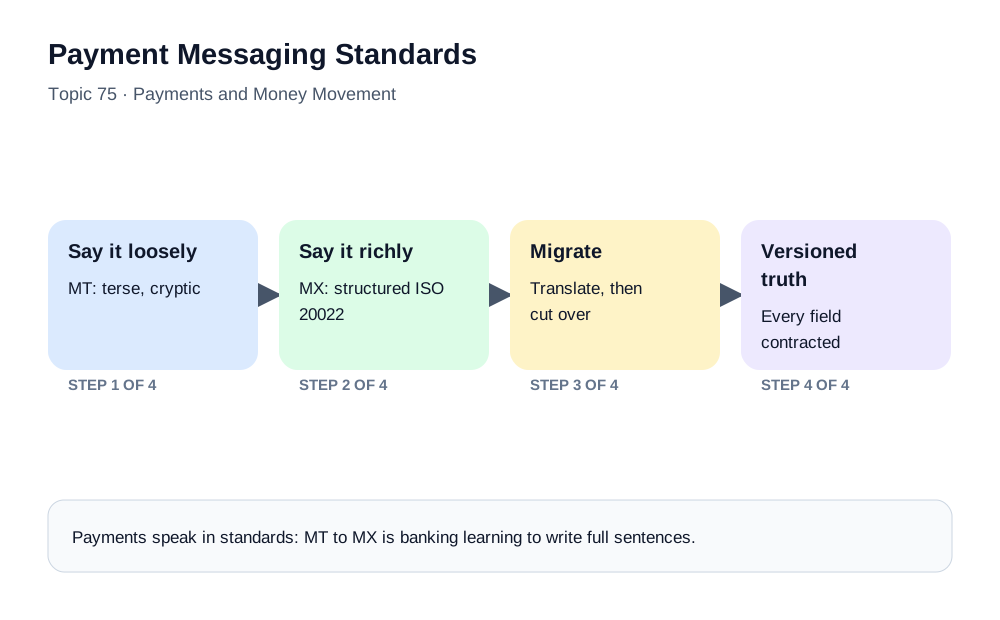
Payment Messaging Standards at a glance — ISO 20022, MT to MX migration, structured data.
The Language, Rules, and Data Contracts Behind Every Payment
A payment message is the structured instruction or report exchanged between systems and institutions during a payment lifecycle. It may tell another system to initiate a transfer, report a status, return funds, provide account information, request a cancellation, or support an investigation.
A messaging standard gives all participants a common way to represent that information. It defines what the data means, how it is structured, which elements are permitted, and how systems should interpret the message.
The most important distinction is:
A message standard is not a payment network, clearing system, or settlement account.
ISO 20022, Swift MT, ISO 8583, FIX, FpML, and NACHA formats describe or transport financial information in different contexts. The actual movement of value occurs through bank accounts, card ledgers, correspondent relationships, clearing systems, central bank accounts, and other settlement arrangements.
1. Why Messaging Standards Matter
Without shared standards, every pair of banks or systems would need a separate bilateral format and interpretation agreement. That would increase cost, manual work, and operational risk.
Standards support:
- Interoperability: Different systems can exchange information using agreed structures.
- Straight-through processing: Machines can validate and process messages without rekeying.
- Data quality: Mandatory fields, code sets, and formats reduce ambiguity.
- Compliance: Structured party and transaction data improves screening and monitoring.
- Reconciliation: References and remittance information help match internal and external records.
- Traceability: Message, transaction, end-to-end, and settlement identifiers can be preserved across the lifecycle.
- Change control: Published versions and usage guidelines give institutions a controlled basis for implementation and testing.
A standard does not guarantee good data. A perfectly valid message can still contain an incorrect account, misleading name, invalid business relationship, duplicate instruction, or unsupported service. Syntax validation and business validation are different controls.
2. The Layers of a Financial Message Standard
A financial message is governed by several layers. Understanding these layers prevents the common mistake of treating an XML file as the complete standard.
Business model
The business model defines concepts such as debtor, creditor, account, agent, amount, charge, settlement method, remittance information, and transaction status.
Message definition
A message definition selects the business components required for a particular purpose. For example, a credit-transfer message and an account statement use different structures because they serve different processes.
Syntax
Syntax is the technical representation used to encode the message. ISO 20022 messages are commonly exchanged as XML, but ISO 20022 is broader than XML. The standard's value lies in its business semantics and reusable model, not merely in angle brackets and tags.
Schema
An XML Schema Definition, or XSD, describes the permitted structure, data types, order, cardinality, and technical constraints for a particular message version.
Passing XSD validation proves only that the document conforms to the technical schema. It does not prove that it follows a market practice or is acceptable to the receiver.
Usage guideline or market practice
A scheme, market infrastructure, network, or community normally narrows the base message for its own business use. It may:
- make optional ISO elements mandatory;
- prohibit elements that exist in the base schema;
- restrict lengths, codes, characters, and repetitions;
- define bilateral or service-specific rules;
- specify how a business scenario must be represented;
- establish version and migration dates.
Examples include Swift CBPR+ usage guidelines, EPC implementation guidelines, and domestic payment-system specifications.
Network and business validation
The transport network may apply technical and usage validation before delivery. The receiving bank then performs its own business, account, compliance, duplicate, routing, and product checks.
A network acknowledgement therefore does not mean that the beneficiary was credited or that interbank settlement completed.
3. Swift MT Messages
Swift MT messages use field-based structures identified by message type and numbered tags.
Examples include:
- MT 103 for a single customer credit transfer;
- MT 202 for a financial-institution transfer;
- MT 202 COV for a cover transfer linked to an underlying customer payment;
- MT 940 and MT 950 for account reporting;
- MT 700-series messages for documentary credits and trade finance.
An MT 103 may contain fields such as:
- Field 20: transaction reference;
- Field 23B: bank operation code;
- Field 32A: value date, currency, and amount;
- Field 50: ordering customer;
- Field 52 or 53: ordering or sender's correspondent information where applicable;
- Field 56 or 57: intermediary or account-with institution;
- Field 59: beneficiary customer;
- Field 70: remittance information;
- Field 71A: charge instruction;
- Field 72: sender-to-receiver information under controlled use.
MT messages are compact and well understood, but many fields rely on limited lines, option-specific formats, and unstructured text. The same business information may be represented differently by different senders, creating transformation, screening, and reconciliation challenges.
It is also inaccurate to say that all MT messages have disappeared. Migration must be assessed by message family, business use case, Swift service, market practice, and implementation date.
4. ISO 20022 Messages
ISO 20022 provides a common financial-services business model and message-development methodology. It supports structured information across payments, securities, trade services, foreign exchange, cards, and other domains.
Payment examples include:
- pain.001: customer credit-transfer initiation;
- pain.002: customer payment status report;
- pacs.008: financial-institution-to-financial-institution customer credit transfer;
- pacs.009: financial-institution credit transfer;
- pacs.002: payment status report;
- pacs.004: payment return;
- camt.052: intraday account report;
- camt.053: account statement;
- camt.054: debit or credit notification;
- camt.056: cancellation request in applicable practices;
- camt.029: resolution of an investigation in applicable practices.
ISO 20022 can represent parties, agents, accounts, references, settlement details, purpose, charges, regulatory reporting, and remittance information in more explicit structures than many legacy formats.
However, the capacity is not unlimited. Every message is constrained by:
- its schema version;
- element cardinality;
- maximum lengths and data types;
- the applicable usage guideline;
- network validation rules;
- the receiving system's supported implementation;
- privacy, compliance, and data-minimisation requirements.
Rich data creates value only when channels capture it correctly, source systems store it, transformations preserve it, controls use it, and receivers can process it.
5. Message Versions Matter
A message name without its version is incomplete for implementation.
For example:
pacs.008.001.08pacs.008.001.10pacs.008.001.12
are related message definitions but not automatically interchangeable.
A new version may add, remove, rename, or restructure elements. A bank must therefore control:
- source and target versions;
- XSD files;
- usage guidelines;
- mapping specifications;
- release and activation dates;
- backward compatibility;
- test packs and expected results;
- archival and replay requirements.
Using the “latest ISO version” is not always correct. The correct version is the one mandated or supported by the relevant scheme, network, counterparty, and service at that point in time.
6. MT-to-ISO 20022 Translation Is Not a Simple Field Copy
An MT 103 and a pacs.008 can describe similar business intent, but they do not have identical data models.
A reliable translation needs to answer:
- Which MT option is present?
- Is the data structured or embedded in free text?
- Which ISO 20022 party or agent should receive it?
- Can the target element repeat?
- Is the original data longer than the target market-practice limit?
- Is enrichment permitted, and what is its source?
- Can the reverse translation reproduce the original meaning?
- Which data must be preserved outside the translated message for audit?
Example: party addresses
An MT party field may contain name and address across several free-text lines. A target ISO 20022 message may support separate elements for street name, building number, town, postcode, country subdivision, and country.
A translator cannot reliably infer every component from poorly formatted text. It may preserve the address as unstructured lines, use a hybrid form, or require repair and enrichment, depending on the applicable rules.
Example: remittance information
Legacy free text may contain invoice numbers, narrative, and internal codes in one field. ISO 20022 can carry structured creditor references and remittance elements, but automatic conversion requires a reliable parsing rule. Otherwise, the text should not be invented or reclassified without evidence.
Translation risks
- truncation;
- misplaced party or agent information;
- loss of repetitions;
- code-value mismatch;
- character-set conversion;
- missing references;
- altered charge information;
- loss of regulatory data;
- false confidence that a valid target message is semantically equivalent.
A bank should maintain the original message, translated message, mapping version, transformation logs, validation results, and any enrichment source required for audit and investigation.
7. Current Swift CBPR+ Position
The coexistence period for in-scope CBPR+ cross-border payment-instruction messages ended on 22 November 2025.
This was not the retirement of every Swift MT message. It was a defined migration milestone for the CBPR+ payment-instruction scope.
The post-coexistence operating model includes:
- ISO 20022 delivery through FINplus for the strategic payment instructions;
- negative acknowledgements for defined unsupported MT instructions;
- chargeable contingency processing for certain eligible MT payment instructions, where applicable;
- in-flow translation support for institutions that still need an embedded MT representation internally;
- continuing migration plans for other message families and business processes.
November 2026 changes (deferred)
Swift had planned to stop supporting unstructured postal addresses for in-scope CBPR+ messages after 14 November 2026. On 27 August 2026 Swift deferred all payments changes in Standards Release 2026, including that removal. A new date has not yet been announced, and Swift expects to give an update by December 2026 at the latest. Unstructured addresses remain accepted until then, but fully structured or hybrid addresses remain best practice and should still be used according to the detailed usage rules and exceptions. Swift deferral announcement.
This affects much more than message generation. Banks need to update customer and counterparty data, onboarding, APIs, file formats, payment hubs, screening, repair processes, reporting, archives, and client communications.
November 2026 was also planned as an important milestone for the in-scope MT 101 interbank-relay migration and for structured exceptions-and-investigations capabilities. Swift's roadmap still lists November 2026 for MT 101 end of coexistence but warns that its dates may no longer be accurate after the deferral, and other payments changes will be phased separately. Institutions must assess each use case against Swift's current published timeline rather than applying one general statement to all messages.
8. Major Market-Infrastructure Migrations
Different payment systems migrated on their own schedules and use their own implementation rules.
Examples include:
- The Eurosystem's T2 wholesale-payment platform migrated in March 2023.
- Australia's high-value RITS service completed its ISO 20022 migration in March 2023.
- CHAPS migrated to ISO 20022 messaging in June 2023.
- Fedwire Funds Service implemented ISO 20022 messages on 14 July 2025.
- Swift CBPR+ ended payment-instruction coexistence on 22 November 2025.
These migrations do not create one universal message profile. A pacs.008 used in one market can have different permitted data, rules, and processing expectations from a pacs.008 used in another.
9. Other Important Financial Messaging Standards
ISO 20022 does not replace every specialised standard immediately or universally.
ISO 8583
ISO 8583 is widely used in card-authorisation and transaction messaging. It commonly represents information through a message-type indicator and numbered data elements.
FIX Protocol
FIX supports electronic trading communication, including orders, execution reports, market data, and post-trade workflows.
FpML
Financial products Markup Language is used for over-the-counter derivatives and complex financial-product representation.
NACHA formats
NACHA file formats support ACH processing in the United States. They use batch and record structures rather than ISO 20022 XML.
APIs and JSON
Banking APIs often exchange JSON over HTTPS. An API can still use ISO 20022-aligned business concepts without transmitting a literal ISO 20022 XML document.
Standards coexist because payment, card, securities, trade, and treasury ecosystems evolved with different business needs, performance requirements, and governance models.
10. The Bank's Internal Canonical Model
A bank may support many external formats:
- mobile or internet-banking requests;
- corporate pain.001 files;
- domestic clearing formats;
- Swift MT;
- CBPR+ ISO 20022;
- card messages;
- proprietary APIs;
- statements and reporting files.
Transforming every source directly into every target creates a large number of point-to-point mappings.
A common architectural approach is to transform incoming instructions into an internal canonical payment model. Internal services then process a consistent representation, and outbound adapters convert it into the required external format.
A canonical model should not become an uncontrolled “lowest common denominator.” It needs to preserve:
- source-message identity;
- business and transaction references;
- party and agent roles;
- account and settlement details;
- charge and FX information;
- regulatory and purpose data;
- remittance information;
- data provenance;
- original and enriched values;
- status history;
- extension data that is not yet common across all rails.
If the canonical model cannot represent required external data, the bank may lose information before the payment reaches the outbound network.
11. Validation Controls
A mature payment platform validates at several levels.
Technical validation
- well-formed XML or file structure;
- correct schema and namespace;
- data types, lengths, and cardinality;
- recognised code values;
- character encoding.
Market-practice validation
- mandatory usage-guideline elements;
- prohibited elements;
- conditional rules;
- scheme-specific codes;
- service and version eligibility.
Business validation
- account and customer status;
- product eligibility;
- currency and amount limits;
- cut-off and value date;
- participant reachability;
- duplicate and idempotency controls;
- routing and settlement method;
- charge-option compatibility.
Financial-crime and fraud validation
- sanctions screening;
- AML monitoring;
- fraud scoring;
- name and account verification where applicable;
- behavioural and velocity controls.
Operational validation
- complete audit trail;
- repair ownership;
- status propagation;
- retry and timeout behaviour;
- reconciliation references;
- alerting and observability.
Passing one layer does not imply that all later layers will pass.
12. Testing a Message Change
A message migration needs more than a happy-path XML sample.
A strong test pack covers:
- minimum and maximum cardinalities;
- every supported party and agent option;
- structured, hybrid, and permitted address scenarios;
- long names and remittance information;
- special characters and transliteration rules;
- multiple transactions and bulk files;
- duplicate message and transaction identifiers;
- invalid codes and missing conditional fields;
- sanction hits and fraud holds;
- network reject and bank reject scenarios;
- return, recall, cancellation, and investigation flows;
- timeout, retry, replay, and idempotency;
- source-to-target and target-to-source translation;
- accounting and settlement postings;
- customer and operations reporting;
- reconciliation and archival retrieval;
- version rollback and coexistence where required.
Testing should compare business meaning, not only whether an XML file validates.
13. Practical End-to-End Example
A corporate customer uploads a pain.001 file containing 500 payments.
- The channel validates the file structure and customer authority.
- The bank separates the group, payment-information, and transaction levels.
- Each instruction receives internal identifiers and duplicate controls.
- The payment hub enriches routing, settlement, and bank reference data from approved sources.
- Fraud, sanctions, limits, and account controls run.
- Domestic payments are mapped to the relevant local clearing format or ISO 20022 profile.
- Cross-border payments are mapped to the applicable CBPR+ message and route.
- Outbound gateways apply schema, usage-guideline, and network validation.
- Status messages return and are translated into customer-level pain.002 or channel statuses.
- Settlement and account reports are reconciled against the original instructions.
- Returns, rejects, cancellations, and investigations remain linked to the original payment identifiers.
The business outcome depends on consistent meaning across every transformation. A syntactically valid message is only one part of that control chain.
Conclusion
Payment messaging standards are the shared language that lets banks and infrastructures coordinate complex financial processes.
The essential lessons are:
- a standard is not the same as a network or settlement mechanism;
- ISO 20022 is a business model and methodology, not merely XML;
- schemas, usage guidelines, network rules, and bank rules form separate validation layers;
- message versions and market practices matter;
- MT-to-ISO 20022 translation can lose meaning unless mappings and provenance are controlled;
- rich data creates value only when it is captured, preserved, validated, screened, reported, and reconciled end to end;
- migration is a business, data, operations, compliance, and technology programme, not only a format change.
A banking professional who understands these layers can connect customer channels, payment hubs, APIs, schemas, mapping, screening, settlement, investigations, reporting, and reconciliation as one complete message lifecycle.
<!-- MBA-DEEP-DIVE-START -->Deep Dive: Messaging Standards as End-to-End Banking Data Contracts
Payment messaging standards become genuinely useful only when they are understood as data contracts between business processes, not as files that happen to contain tags or fields. A message tells another party or system what business event has occurred, what is requested next, who the parties are, which account or institution is involved, which amount and currency apply, what references must survive, and how later statuses, returns, cancellations, investigations, reconciliation, and reporting should relate back to the original event.
That is why a standards migration can never be treated as a narrow XML-development task. A field added to an initiation message can affect channel capture, customer master data, payment-hub processing, sanctions screening, fraud monitoring, routing, settlement, account posting, investigations, reporting, archive retrieval, and the data shown to the customer. A field removed or truncated can create the opposite problem: downstream systems may lose information needed to understand the payment later.
The professional question is therefore not “Does the file validate?” It is “Does the bank preserve the correct business meaning from source to final outcome?”
Message syntax is only one layer
A financial-message implementation normally has several layers that must agree.
The business layer defines what is happening: a customer asks its bank to initiate a transfer, one bank sends an interbank customer payment to another, a receiving bank reports status, a bank returns funds, or an institution reports account activity.
The semantic layer defines the concepts used in that process: debtor, creditor, account, instructing agent, instructed agent, intermediary, settlement amount, instructed amount, remittance reference, charge bearer, purpose, regulatory information, and transaction identifiers.
The message-definition layer selects the components required for a particular business event and defines their structure and cardinality.
The syntax layer expresses the message in a machine-processable form. ISO 20022 can generate XML schemas, but ISO 20022 itself is broader than XML: the official ISO 20022 model is based on a business model, data dictionary, business process catalogue, message definitions, and syntax rules.
The market-practice layer narrows the base standard for a community. A message element that exists in the global ISO 20022 definition can be forbidden by a particular scheme. An element that is optional in the base definition can become mandatory in one usage guideline. Character rules, maximum occurrences, codes, conditional requirements, and business scenarios can all differ.
Finally, the bank implementation layer adds internal rules: product eligibility, customer entitlements, account validation, routing, fraud and compliance controls, settlement logic, repair rules, reconciliation, and operational handling.
Confusion begins when one layer is mistaken for another. Passing an XSD proves structure. It does not prove market-practice compliance, business eligibility, sanctions clearance, settlement success, or beneficiary credit.
ISO 20022 is designed around reusable business semantics
The ISO 20022 Repository separates the Data Dictionary from the Business Process Catalogue. The Data Dictionary holds reusable business concepts and message concepts. The Business Process Catalogue describes business areas, processes, transactions, message flows, and message definitions. This architecture is why concepts can be reused across different financial domains without inventing a new meaning for “party,” “account,” or “amount” every time.
For a banking analyst, this matters because mappings should be based on meaning first, position second. If a source field contains the final beneficiary's institution, the target mapping should identify which ISO 20022 agent role corresponds to that business meaning. Mapping “source field 57 to the seventh agent-like block in the target” without understanding the role is fragile and can become wrong when the source option changes.
Semantic mapping also helps with APIs. A bank can expose JSON externally while using ISO 20022-aligned business concepts internally. The API does not need literal XML tags to benefit from the standard's semantics. What matters is whether the debtor, creditor, account, agent, amount, reference, and purpose concepts remain consistently defined.
Message families describe different parts of the lifecycle
A common learning mistake is to memorize pain, pacs, and camt as if each prefix equals one system boundary forever. They are better understood as business-area groupings whose individual messages serve defined processes.
A customer-to-bank credit-transfer initiation can use pain.001 in an applicable implementation. The bank may respond with a pain.002 status report according to the agreed customer-channel rules.
Interbank payment execution can use pacs.008 for a customer credit transfer between financial institutions and pacs.009 for a financial-institution credit transfer, with the exact usage determined by the applicable scheme or market practice.
A pacs.002 reports the status of a payment instruction. A pacs.004 supports the return of funds in applicable flows.
Cash-management messages such as camt.052, camt.053, and camt.054 can provide intraday reporting, statements, and debit/credit notifications. Messages such as camt.056 and camt.029 can participate in cancellation or investigation processes depending on the market practice.
The important boundary is that message names alone do not define the business workflow. A bank must also know who sends the message, who receives it, under which service, at which lifecycle point, and according to which usage guideline.
Business Application Header and business document are separate concerns
Many ISO 20022 implementations use a Business Application Header, commonly associated with head.001, alongside a business message. The header can carry information needed for application-level addressing, identification, priority, service, or related processing, while the business document carries the payment or reporting content itself.
This creates an important architecture rule: header identity and business-message identity must not be confused.
The sender and receiver in the business application header can describe message endpoints. The debtor agent and creditor agent inside a payment message describe parties in the payment chain. They can be related but are not automatically the same semantic concept.
Likewise, a business-message identifier in the header should not be reused blindly as the customer end-to-end reference or interbank transaction identifier. Each identifier exists for a reason and needs a defined scope and uniqueness rule.
If a bank stores only “the payment ID” without distinguishing which identifier it means, investigations become unnecessarily difficult.
Identifiers form the traceability spine
Payments can carry several identifiers across their lifecycle. Typical implementations may include customer message identifiers, payment-information identifiers, instruction identifiers, end-to-end identifiers, transaction identifiers, interbank settlement references, network references, and tracking identifiers.
The bank should document four properties for each important identifier:
- Who creates it?
- Within what scope must it be unique?
- Can it change during transformation or routing?
- Which later messages are expected to reference it?
A customer EndToEndId is intended to help relate a payment from originator to beneficiary-side processing, but a receiving institution should not assume it is globally unique merely because it looks like an identifier. Some customers reuse values. Some legacy channels populate placeholders. Controls must follow the relevant rulebook rather than invent guarantees the data never promised.
For Swift cross-border payments, the UETR provides transaction tracking value and should be preserved through the relevant payment lifecycle. Losing it during an internal transformation breaks traceability even if every amount and account remains correct.
Structured data is useful because systems can interpret roles
One of the strongest advantages of richer structured messaging is that a bank can tell what a piece of information represents instead of merely knowing where text was placed.
Consider a party address. A free-text block may contain name, street, town, postcode, and country across several lines. A structured model can represent those components separately. That supports better screening, data quality, routing, reporting, and customer repair because a system can distinguish country from town rather than parsing a string every time.
The value appears downstream. A sanctions engine can evaluate structured country and party data. Regulatory reporting can reuse the same elements. An investigations team can display the components clearly. Data quality controls can detect a missing country rather than accepting a line of ambiguous text.
The risk is that banks sometimes generate “structured” fields by guessing from unstructured data. If an old address says 10 KING ST LONDON GB, a parser may be able to infer components with confidence. If the text says ROOP MAHAL PREM GALI 420, automatically deciding which words represent town, building, or street can create false data. Enrichment must be evidence-based and its provenance preserved.
Hybrid postal addresses are a data-governance programme
Swift's cross-border ISO 20022 roadmap moves the industry away from fully unstructured postal addresses for the relevant in-scope messages, using structured or hybrid formats according to the detailed requirements. The planned 14 November 2026 removal was deferred on 27 August 2026 and a new date has not yet been announced, but the deferral changes the deadline, not the direction. A hybrid format combines mandatory structured components such as Town Name and Country with a limited amount of address-line information.
The implementation impact goes far beyond the outbound message mapper.
Customer onboarding must capture better addresses. Existing party master data may need remediation. Corporate file specifications may need new fields. APIs must carry structured components. Payment hubs need a data model that can store them. Screening systems need to consume them. Repair teams need rules for incomplete addresses. Archive and investigations screens need to display both original and transformed values. Testing must include addresses from countries whose formats differ substantially.
This is a model example of why standards work belongs to business architecture, data governance, compliance, operations, channel teams, and technology together.
Legacy MT fields contain option-dependent meaning
Swift MT messages are compact, but many fields have options that change structure and interpretation. A mapping should therefore never be based only on the tag number.
A party field can appear with different options that indicate account data, identifier codes, name-and-address text, or another permitted representation. Fields used for intermediary or account-with institutions can similarly vary.
The mapping engine must first identify the source option, then interpret its business role, then apply the target market-practice rules. A table saying MT field 57 -> ISO CreditorAgent may be directionally useful for one scenario but incomplete as an implementation rule.
This is why detailed mapping specifications need:
- source message and option;
- source subcomponent;
- source business meaning;
- target element and path;
- conditional logic;
- repetition rules;
- transformation rule;
- default or enrichment rule if allowed;
- truncation handling;
- validation rule;
- reverse-mapping consequence;
- example and negative test.
A strong mapping sheet is executable logic described in human form.
Translation can produce syntactically valid but semantically damaged messages
A converter can generate XML that passes an XSD while silently changing business meaning.
Examples include:
- placing an intermediary institution into the wrong agent role;
- dropping a repeated regulatory-reporting block;
- combining separate address components into an incorrect line;
- truncating remittance information without preserving the original;
- converting a customer reference into a network reference;
- changing charge instructions;
- losing the distinction between settlement amount and instructed amount;
- dropping an ultimate debtor or ultimate creditor;
- converting a proprietary purpose code into the wrong standardized code.
For this reason, translation testing must compare business equivalence, not merely target validity.
A useful control is to preserve the original source message or source-data snapshot, the generated target message, the mapping version, and any enrichment or repair decisions. When an investigation occurs months later, the bank can then explain what information entered the translator and how the output was produced.
Truncation requires an explicit policy
Legacy formats and newer formats often have different length and repetition capacity. A transformation can therefore face data that does not fit.
The worst approach is silent truncation.
The bank should classify fields by business criticality and define what happens when data exceeds the target capacity. Possible outcomes include rejection, controlled truncation permitted by a usage guideline, continuation into another permitted element, preservation in supplementary internal data, or repair.
The choice must follow the external rulebook and business need.
If the bank truncates a beneficiary name or address, sanctions screening may behave differently. If it truncates remittance information, the beneficiary may not be able to reconcile the invoice. If it truncates a regulatory reference, the payment may breach reporting requirements.
The mapping design should therefore record whether information loss is possible and who accepts that risk.
Data provenance is essential when a bank enriches messages
A payment may be enriched with data not supplied directly by the customer. Routing data can come from a bank directory. Country data can be derived from an account identifier. A legal-entity name can come from a customer master. Settlement instructions can come from static data. A payment purpose can sometimes be populated from the product context.
Every enrichment should have a known source and ownership model.
A bank should be able to distinguish:
- customer-provided value;
- bank-master-data value;
- network-derived value;
- calculated value;
- manually repaired value;
- translated value.
This helps with audit and disputes. If a payment was rejected because a bank enriched the wrong country code, the customer should not be blamed for data they never provided.
It also helps data quality teams identify which source system should be corrected rather than repeatedly repairing the same payment downstream.
Agent chains must represent the actual route
Cross-border payments can involve debtor agent, creditor agent, intermediary agents, reimbursement agents, correspondents, and other institutions depending on the payment method and settlement structure.
The message agent chain should not be populated merely because the schema provides many optional blocks. Each agent should represent a real role required by the business scenario and permitted by the usage guideline.
Too little information can make routing impossible. Too much or incorrect agent information can misroute the payment, create screening noise, or produce contradictions between message data and settlement instructions.
Static routing data therefore belongs under controlled governance. BICs, clearing identifiers, account numbers, correspondent relationships, currency routes, and service reachability can change. Effective dating and approval matter.
Amounts need role clarity
A payment can contain several monetary concepts:
- customer instructed amount;
- interbank settlement amount;
- equivalent amount;
- charges;
- exchange-rate information;
- returned amount;
- original instructed or settlement amount referenced by a later message.
These values can differ legitimately.
If a customer instructs EUR 1,000 from a USD account, the bank may perform an FX conversion while the interbank payment remains EUR 1,000. If charges are deducted under the applicable model, the beneficiary-side amount may differ from the original instructed economics.
Systems should therefore never use one generic field called amount internally when several business amounts must coexist.
The message standard provides vocabulary; the bank's canonical model must preserve the distinctions.
Charges are business instructions, not descriptive text
Charge information affects customer pricing, interbank economics, beneficiary value, and sometimes payment eligibility.
Legacy messages often represent charge instructions through compact codes. ISO 20022 can represent charge bearer and charge information more structurally. The mapping must follow the payment product and market practice.
A change from one charge option to another is not cosmetic. It can change which party pays fees and how much the beneficiary receives.
Testing should therefore cover charge scenarios through accounting and customer reporting, not only through message creation.
Status codes need business definitions
A status message such as pacs.002 or pain.002 can carry outcomes at message, group, payment-information, or transaction level depending on the implementation.
Banks frequently create confusion by mapping many external statuses into a few internal labels such as ACCEPTED, PROCESSED, and FAILED without defining what each one means.
A useful status model answers:
- Has the message passed technical validation?
- Has the transaction passed business validation?
- Has the payer been booked?
- Has it been released to the external rail?
- Has the external participant accepted it?
- Has interbank settlement occurred?
- Has the beneficiary bank accepted it?
- Has the beneficiary been credited?
- Is the outcome final?
Different schemes expose different evidence. The bank should not claim “beneficiary credited” merely because a network accepted the message.
Reject, return, reversal, and cancellation are not synonyms
An accurate messaging design distinguishes failure timing.
A reject generally indicates that an instruction was not accepted for processing at a defined stage.
A return normally moves funds back after a payment reached a stage at which a separate return transaction is required.
A reversal can correct or negate a previously recorded financial event in contexts where that concept applies.
A cancellation request asks another participant or system to cancel or recover a transaction; it does not guarantee that cancellation will succeed.
The precise definitions come from the applicable scheme and message practice, but the principle is universal: the bank needs different states because accounting, settlement, customer communication, and investigation actions differ.
Collapsing all four into FAILED destroys operational meaning.
Exception and investigation messaging needs original-transaction linkage
Payments that cannot be resolved automatically move into investigations. The investigation case should preserve original payment identifiers, parties, amounts, dates, relevant messages, network references, and the reason for the enquiry.
A cancellation request should link to the transaction being cancelled. A response should link to the request and original payment. A return should identify the original transaction according to the applicable rules. Without these links, operations staff end up searching manually by amount and date.
Structured investigations can reduce free-text ambiguity, but only if the original payment data is still retrievable. Archival design is therefore part of messaging design.
Message archives are operational evidence
Banks need to retain messages and associated processing evidence according to applicable legal, regulatory, operational, and business requirements.
An archive should allow authorized users to retrieve:
- original inbound or outbound message;
- normalized or canonical representation;
- translated message where applicable;
- acknowledgements and status reports;
- repair history;
- validation results;
- related returns or investigations;
- transmission time and endpoint;
- mapping or schema version.
A raw XML blob with no searchable metadata creates poor operations. Conversely, indexing every sensitive field without access controls can create privacy and security problems. Archive design must balance traceability with data protection.
Canonical models reduce mapping explosion but can lose richness
A bank supporting ten source formats and ten target formats could theoretically build one hundred pairwise transformations. A canonical model reduces that complexity by mapping each source into a common internal representation and then mapping the canonical model to each target.
The architecture is powerful, but the canonical model must not become a lowest-common-denominator structure.
If the internal model supports only one intermediary agent because an old system did, richer ISO 20022 messages can lose repetitions before they reach screening or routing. If it stores one free-text address field, the bank can accept structured ISO 20022 input and immediately destroy its value internally.
A mature canonical model supports core business semantics plus extension or provenance mechanisms for information that is not common to every rail.
Event models should preserve message state and business state separately
A payment message can be successfully delivered while the payment business event later fails. Conversely, the payment may succeed while a non-critical acknowledgement is delayed.
The bank should therefore distinguish message transport state from payment business state.
Transport states can include created, queued, transmitted, acknowledged, network-rejected, delivered, or timed out.
Business states can include accepted, booked, released, settled, returned, cancelled, or under investigation according to the product.
This separation improves incident handling. An operations team can see whether the problem is connectivity, syntax, scheme validation, beneficiary rejection, settlement, or customer posting rather than treating every issue as “the message failed.”
Network acknowledgements prove less than many users assume
A technical acknowledgement can prove that a network received or accepted a message at a particular validation layer. It does not automatically prove that the receiving bank posted the payment to the beneficiary, that settlement completed, or that all downstream controls passed.
Customer-facing status should therefore use evidence appropriate to the claim.
If the channel says “payment delivered to beneficiary” when the only evidence is a network acknowledgement, complaints are inevitable. Better wording might distinguish “sent to receiving bank,” “accepted by payment system,” or “completed” according to the actual service definition.
Standards knowledge therefore connects directly to customer communication.
Version control is a production-risk discipline
ISO 20022 message definitions evolve. Market practices evolve on their own schedules. Code lists are maintained. External schemes publish annual or periodic releases. A bank can therefore support multiple versions simultaneously across different services.
Version control should include:
- message definition and namespace;
- usage-guideline version;
- schema set;
- code-set version;
- mapping version;
- validation-rule version;
- effective date;
- test-pack version;
- deployment version;
- archive interpretation rules.
A production issue can occur even when all systems support “pacs.008” if one service expects a different version or usage guideline.
The bank should know exactly which version is valid for each route and business date.
“Use the latest ISO version” is not a safe implementation rule
The ISO 20022 catalogue publishes current message definitions and retains previous versions. Communities are encouraged to stay aligned with current definitions where possible, but live infrastructures choose versions according to their own migration and governance process.
A bank cannot unilaterally send a newer schema to a payment system simply because ISO published it.
The correct implementation version is the one accepted by the specific network, scheme, or counterparty for that service at that time.
This is especially important for global banks because domestic high-value payments, instant payments, customer channels, and cross-border Swift traffic can all be on different release cycles.
Market practice matters more than schema permissiveness
Suppose the base ISO 20022 schema allows an element to repeat five times, but a particular market implementation permits only two occurrences. A message with three occurrences can be perfectly valid against the global XSD and still be rejected by the market infrastructure.
Similarly, the schema may allow an optional element that the local usage guideline explicitly prohibits.
Validation therefore needs at least two technical rule sets: schema validation and market-practice validation. Many infrastructures add additional network or business checks beyond both.
Testing against XSD alone is inadequate.
External code sets need governance too
ISO 20022 uses numerous standardized or externally maintained code sets for concepts such as purpose, category purpose, status, return reason, charges, clearing channels, and other classifications.
A new or changed code can affect routing, compliance, reporting, pricing, and analytics. Systems should not hard-code lists without an update process.
Code-set governance needs ownership, effective dating, backward compatibility, validation, documentation, and regression testing.
If a new valid external code reaches production before the bank updates its reference data, a perfectly legitimate message can be rejected by an internal system.
APIs introduce another contract layer
Modern payment architectures frequently accept REST or event-driven APIs using JSON while external payment rails use ISO 20022 XML or another format.
The API contract should define business semantics explicitly rather than forcing clients to understand internal XML paths. The bank can expose fields such as debtor, creditor, amount, requested execution date, remittance, and purpose in an API model and map them into the appropriate payment message later.
The API needs version governance just like external messages. Removing a field, changing an enum, or altering validation can break corporate clients even if the downstream ISO 20022 mapping is unchanged.
A good architecture manages channel contract, canonical model, and external rail contract as separate but aligned layers.
Batch files add group-level semantics
A corporate pain.001 file can contain message-level, payment-information-level, and transaction-level data. Some information applies to the whole file, some to a group of payments, and some to individual transfers.
Banks should preserve these levels because they matter for authorization, duplicate control, status reporting, totals, and customer reconciliation.
If a file with 1,000 payments contains one invalid transaction, the bank needs a defined partial-processing policy. Does the entire file reject? Does the invalid transaction reject while others proceed? How is the customer status reported? The answer comes from the channel contract and implementation, not from XML syntax alone.
Group totals are also control data. The channel can compare declared counts and sums against parsed transactions before accepting the file.
Duplicate control needs identifiers plus context
Messages contain identifiers, but duplicate detection should not assume every identifier is globally unique or trustworthy.
A corporate client may accidentally resend the same file with the same MsgId. Another channel might regenerate a new message identifier while replaying the same underlying transactions.
Duplicate strategy can use message ID, customer, file hash, transaction IDs, amount, account, business date, and other context depending on the use case.
The system should distinguish true duplicate from legitimate repeat business. Two salary payments of the same amount to the same employee in different months are not duplicates merely because the values match.
Character sets and transliteration can change meaning
Payment data crosses countries and systems with different character capabilities. Names and addresses can contain accents, non-Latin scripts, punctuation, symbols, and local abbreviations.
A transformation may need to apply a restricted character set. The bank should define whether characters are rejected, transliterated, substituted, or otherwise handled under the market rules.
Poor transliteration can create screening and reconciliation problems. A name rendered differently in two systems may generate false sanctions matches or make an investigations analyst believe two parties are different.
The original customer-provided form should be preserved where lawful and useful even when an outbound rail requires a normalized representation.
Data quality should be measured before payments fail
A bank preparing for a richer messaging standard should profile source data early.
Useful measures include:
- percentage of customers with country populated;
- percentage with structured town name;
- invalid or obsolete country codes;
- malformed account identifiers;
- names exceeding target lengths;
- missing beneficial-party data where required;
- free-text fields carrying hidden structured information;
- repeated use of placeholders such as
NAorUNKNOWN; - unsupported characters;
- corporate file fields that are always blank despite future mandatory use.
This reveals whether the migration problem is truly a message-mapping problem or a master-data problem.
Many ISO 20022 programmes discover that the hardest work sits years upstream in customer and reference data.
Screening should use the richest trustworthy representation
Structured ISO 20022 data can improve sanctions and AML screening because names, addresses, countries, agents, and ultimate parties can be separated into explicit roles.
But the screening architecture must consume the data before it is flattened or truncated.
If the payment hub converts a structured party into a legacy four-line text block before sending it to screening, the bank has paid for rich data and then discarded it at the most valuable control point.
Screening systems also need role context. A debtor, ultimate debtor, creditor, ultimate creditor, intermediary bank, and instructing party are not interchangeable from a business perspective even when all are screened under applicable policy.
Regulatory reporting depends on message-data lineage
Payment messages can carry regulatory-reporting elements, purpose information, resident/non-resident indicators, party countries, and other data later used in statutory or supervisory reports.
The bank should know whether a reported field came directly from the customer, was derived from master data, was enriched by the bank, or was repaired manually.
If a regulator questions a reported value, the bank needs lineage back to the original source and transformation rule.
This is another reason not to treat the final outbound XML as the only record that matters.
Reconciliation identifiers should be designed, not inherited accidentally
Operations needs stable keys to match payment-hub records, network messages, settlement statements, customer postings, fees, and general-ledger entries.
External message identifiers can help, but an internal reconciliation model should not depend entirely on one external field whose uniqueness or persistence is outside the bank's control.
A mature design creates internal immutable transaction identifiers and maps all relevant external references to them.
Then a return, status report, or investigation can be attached to the same internal payment even if external identifiers change at different processing layers.
Cut-off and value-date logic belongs beside message semantics
A payment message can request an execution or settlement date, but the bank still needs product and market rules to decide whether that date is valid.
A customer can submit a future-dated instruction. A correspondent route can have currency cut-offs. A payment system can have non-business-day handling. An instant rail can operate continuously while another rail closes.
The message carries the requested or instructed information; the bank applies execution logic.
Requirements should therefore separate what the message says from what the processing engine decides.
Static data can make a valid message fail in production
A message can pass every schema and usage validation and still fail because the bank's routing table contains the wrong participant identifier, settlement account, correspondent, or service reachability.
Reference data used by messaging gateways should have:
- clear ownership;
- controlled source;
- maker-checker approval for sensitive changes;
- effective dates;
- audit history;
- validation;
- rollback capability;
- dependency analysis.
A production message defect is often really a static-data defect.
Testing should prove semantic round trips
Where a bank translates between formats, a powerful test technique is semantic round-trip comparison.
Start with a source business scenario. Transform it into the target representation. Then reconstruct the important business concepts and compare them with the source.
The result does not have to reproduce identical syntax, because the standards may organize data differently. It should preserve the meaning that is required to survive.
Testers should explicitly identify information that cannot round-trip due to genuine structural differences and confirm that the loss is permitted and understood.
This is more valuable than counting matching XML tags.
Negative testing is where standards quality becomes visible
Happy-path examples prove little. Real production traffic contains missing fields, bad codes, duplicate identifiers, long names, unusual agent chains, multiple regulatory blocks, unsupported characters, expired service versions, contradictory dates, and unexpected combinations.
A strong negative pack asks:
- Which layer rejects the message?
- What reason code is returned?
- Is the customer message understandable?
- Does the payment remain unbooked or require reversal?
- Is the failed item repairable?
- Is the original instruction preserved?
- Does monitoring alert the right team?
- Can the item be replayed safely after correction?
The rejection path is part of the product.
Repair must preserve original and corrected values
Operations teams sometimes repair payments that fail due to incomplete or invalid data. The repair process should never silently overwrite history.
The system should preserve:
- original value;
- corrected value;
- person or system making the change;
- reason;
- evidence or source;
- timestamp;
- approval where required;
- resulting outbound message.
This protects both customer and bank. If a repaired beneficiary identifier directs funds incorrectly, the bank can determine whether the error came from the customer, master data, an automated enrichment, or manual intervention.
Observability should use business signals, not only system health
A messaging gateway can report CPU and memory as healthy while every outbound payment is being rejected for the same usage-rule defect.
Production monitoring should include business metrics such as:
- messages received and sent by service;
- technical rejects;
- market-practice rejects;
- top reason codes;
- acknowledgement latency;
- queue age;
- retry count;
- repair volume;
- translation failures;
- schema-version mix;
- unsupported code occurrences;
- status completion rate;
- reconciliation breaks.
A sudden rise in one reason code after a release is often the fastest way to identify a mapping defect.
Release weekends need message-version choreography
Standards migrations frequently have fixed activation windows. The bank may need to stop one version and start another at a precise business time while preserving queued and future-dated transactions.
A release plan should answer:
- What happens to messages created under the old version but not yet sent?
- Can old acknowledgements arrive after the new version is active?
- How are future-dated customer files handled?
- Which counterparties migrate first?
- Are old and new schemas supported concurrently?
- What is the rollback plan?
- Can archived old messages still be displayed and investigated?
Version activation is therefore a business cut-over, not only a deployment.
Backward compatibility includes operations and archives
Even after a network stops accepting an old message version, banks still need to understand historic messages for years.
Investigations, regulatory requests, litigation, customer complaints, audit, and reconciliation can all require old message interpretation.
The bank should retain schemas, usage documentation, mapping versions, display capability, and relevant reference data needed to interpret archived traffic.
Deleting an old XSD because production no longer sends it can create an archival problem later.
Production certification should verify the whole chain
Before a messaging migration is called complete, a bank should prove more than network connectivity.
A strong certification covers:
- customer or source-system capture;
- canonical mapping;
- outbound message construction;
- technical and market validation;
- fraud and compliance consumption;
- routing;
- network delivery;
- inbound status handling;
- customer status translation;
- accounting;
- settlement;
- return and exception flows;
- investigations;
- statements and reporting;
- reconciliation;
- archive retrieval;
- operational dashboards;
- rollback and replay.
A successful external conformance test is necessary but not sufficient if the internal bank can still lose data after passing the gateway.
Practical example: a corporate file becomes a cross-border payment
A corporate customer uploads a pain.001 file with an instruction to pay a supplier overseas.
The channel authenticates the corporate users and validates file totals. It parses the customer message and preserves the original identifiers. The payment hub converts the instruction into the bank's canonical model and enriches routing data from approved static sources.
The debtor account, product, limits, requested execution date, and currency are validated. Fraud and sanctions controls receive the parties and relevant transaction context. FX processing is applied if the debit account currency differs from the instructed payment currency.
The outbound cross-border adapter builds the required interbank ISO 20022 message under the current market practice. The Business Application Header and business document receive their appropriate identifiers and addressing. The gateway validates schema and usage rules before transmission.
A network acknowledgement confirms technical acceptance. A later payment status provides additional business information. The bank maps those events back to the original customer transaction and generates the appropriate customer status. Settlement and correspondent-account movements are reconciled. If the payment later returns, the return message is linked to the original payment and the customer receives a new accounting event rather than the bank deleting history.
Every step uses a message, but the payment succeeds because the meaning remains consistent across all of them.
Practical example: a structured-address defect
A corporate file provides beneficiary name and three free-text address lines. The bank's target cross-border service requires a hybrid postal address with defined structured components.
The mapper cannot simply split line one into street, line two into town, and line three into country. That would invent structure based on position rather than evidence.
Instead, the bank checks whether customer master data or a validated address service contains reliable town and country values. If evidence exists, the bank can enrich according to its approved rules and retain provenance. If reliable data does not exist, the payment may need customer repair or rejection rather than fabrication.
The lesson is profound: better message standards expose poor source data rather than magically repairing it.
Practical example: a status mismatch
The outbound gateway receives a positive network acknowledgement and marks the transport event successful. The payment hub incorrectly maps that event to COMPLETED and the mobile channel tells the customer that the beneficiary has been credited.
Later, the receiving institution rejects the transaction for an account reason.
The message transmission was successful. The payment was not.
The defect lies in status semantics, not connectivity. Fixing it requires the bank to define what evidence is required for each customer-facing status and map every external event accordingly.
What excellence looks like
A world-class messaging implementation can answer a demanding set of questions for every material data element and every lifecycle event. What does the field mean? Who supplied it? Which version and usage guideline governs it? Can it repeat? Can it be truncated? Can the bank enrich it? Which downstream controls consume it? Which later message references it? How is it displayed to operations? How is it reconciled? Can the original value be reconstructed years later?
The best banks also know where standards stop. ISO 20022 does not decide whether a customer has enough balance. Swift does not decide whether a beneficiary account is open. An XSD does not decide whether a transaction is sanctioned. A network acknowledgement does not prove beneficiary credit. Those decisions belong to other layers of the banking system.
Messaging standards provide the shared language. World-class payment architecture ensures that every system speaks that language without losing the business truth behind it.
<!-- MBA-DEEP-DIVE-END -->