Visual overview
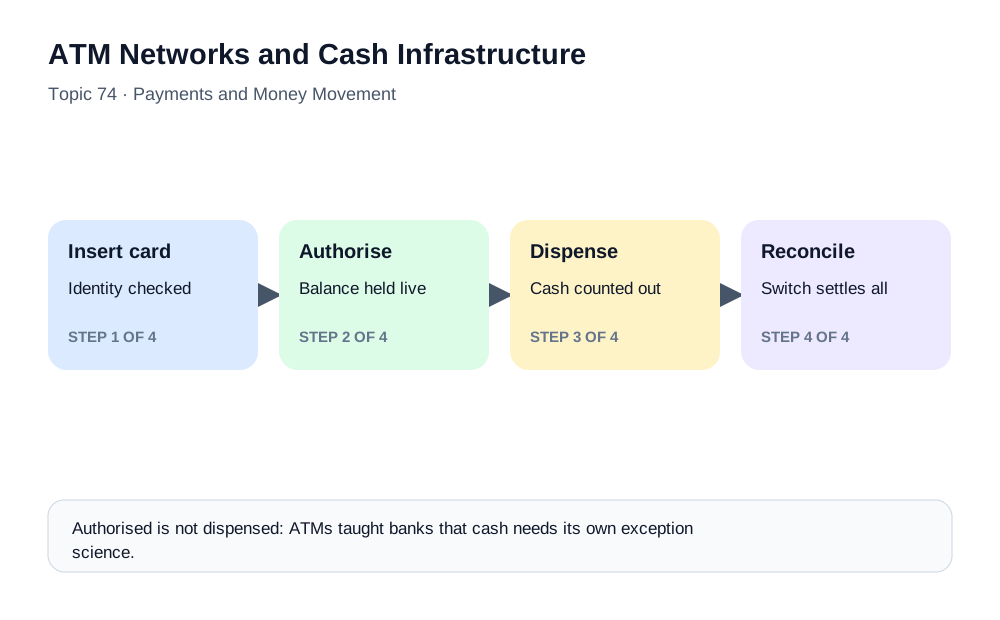
ATM Networks and Cash Infrastructure at a glance — ATM operations, cash distribution, interbank networks.
The Physical Cash Channel Behind a Digital Bank
Automated Teller Machines are often treated as legacy hardware, but that view misses what an ATM actually represents. An ATM is a remote banking endpoint connected to card, account, fraud, switch, settlement, cash-management, reconciliation, security, and service-management systems. A withdrawal that appears to be a simple mechanical event depends on a bank proving customer authority, checking funds, creating a financial hold or debit, routing an authorization, dispensing the correct notes, recording physical cash movement, settling interbank obligations where another bank's card is used, and reconciling the machine's physical cash with electronic records.
The ATM therefore sits at an unusual intersection: it is simultaneously a digital channel and a physical cash vault. That dual nature creates risks that mobile banking does not have. Software can authorize a withdrawal correctly while the dispenser jams. The ATM can dispense cash while the customer ledger fails to post. A network can time out after cash has left the machine. A cassette can contain the wrong denomination. A criminal can attack the card interface, software stack, network connection, or the safe itself.
Understanding ATM banking means following both sides of the transaction: the electronic message and the physical notes.
1. The Withdrawal Lifecycle
Consider a customer withdrawing cash from an ATM.
The machine reads a payment credential from the card or another supported access method. The customer enters a PIN or completes the required authentication. The ATM creates a transaction request and sends it to the relevant switch or processor.
If the ATM belongs to the customer's own bank, the request may route internally. If the card was issued by another institution, the acquiring side routes it through a domestic or international network to the issuer.
The issuer checks the card and account status, authentication result, available funds or credit, account restrictions, daily limits, fraud signals, and any other applicable controls. It returns an approval or decline.
If approved, the ATM commands the dispenser to move the requested notes through the cash path. Sensors count and verify note movement. The machine records whether the cash was presented to the customer, retracted, rejected, or left in the dispenser path.
The electronic authorization and the physical dispense must then agree. That is the heart of ATM control.
2. Authorization Does Not Prove Dispense
An issuer approval proves that the bank allowed the withdrawal. It does not prove that the customer physically received the cash.
Several things can happen after authorization:
- the dispenser can jam;
- the ATM can run out of the required denomination;
- the customer can walk away before taking the notes;
- the cash can be presented and then retracted;
- the terminal can lose connectivity after dispensing;
- the terminal can restart unexpectedly;
- a sensor can report an uncertain cash position.
The ATM and host therefore need a reliable transaction-state model. A bank should be able to distinguish authorization approved, dispense attempted, cash presented, cash taken, cash retracted, partial dispense, no dispense, reversal sent, reversal accepted, and reconciliation resolved where those distinctions are supported by the terminal and network.
The customer-service impact is immediate. A complaint stating “account debited, cash not received” cannot be resolved by checking only the account ledger. Operations need ATM journal data, switch records, dispenser counters, reversal information, settlement records, and sometimes physical cash reconciliation.
3. Partial Dispense Is a Financial Exception
Suppose a customer requests ₹10,000 but the machine dispenses only ₹8,000 because one cassette fails during the transaction.
The ATM must not leave the customer debited for ₹10,000 simply because the issuer approved that amount. The terminal and switch need a defined partial-dispense process, which can involve reversal or adjustment according to the applicable network and terminal design.
Partial dispense also affects physical balancing. The machine's counters should show exactly which notes moved from each cassette. If the electronic record says ₹8,000 was dispensed while physical cash suggests ₹10,000 left the cassette, the bank has another break to investigate.
This is why ATM operations depends on electronic journals and physical cash counts together.
4. On-Us and Off-Us Withdrawals
An on-us withdrawal occurs when the customer's account and ATM are controlled by the same bank or processing domain. The transaction can often be authorized and posted internally.
An off-us withdrawal involves different issuing and acquiring institutions. The ATM owner or acquirer sends the request through a shared network to the issuer. The customer receives cash from one institution while another institution holds the customer's account.
This creates interbank economics and settlement. The acquiring side provided terminal infrastructure, cash, site security, connectivity, and maintenance. The issuing side owns the customer relationship and account. Network rules determine message exchange, fees, disputes, settlement, and liability.
For analysts, the critical lesson is that the ATM that dispenses cash and the bank that debits the customer can be different institutions. Reconciliation must therefore connect the terminal cash event with interbank clearing and settlement.
5. ATM Switches and Routing
The ATM switch is the transaction-routing layer between terminals and the rest of the payment ecosystem.
It can perform functions such as:
- terminal identification;
- message validation;
- routing to issuer or external network;
- PIN-block handling and cryptographic integration;
- stand-in processing where permitted;
- duplicate detection;
- timeout management;
- response translation;
- reversal generation;
- transaction logging;
- network-fee and settlement-data generation.
Large banks may run proprietary switches or use processors. Shared national networks connect many institutions. International card networks extend ATM access across borders.
The architecture should prevent a terminal from becoming a trusted source merely because it is connected. Terminal identity, cryptographic keys, message integrity, allowed transaction types, software version, and network security all need control.
6. PIN Security and Hardware Security Modules
ATM PIN handling is designed so that sensitive PIN values are not casually visible to application staff or stored in ordinary logs.
The PIN entered at the terminal is protected using approved cryptographic controls and typically processed through secure cryptographic infrastructure such as hardware security modules. The issuing bank validates the PIN or associated cryptographic result without exposing it in plain text to normal application workflows.
PIN-block formats, encryption keys, key exchange, key rotation, terminal-key loading, and HSM access are therefore critical security controls. A compromise of the cryptographic chain can affect far more than one ATM.
Operational staff should never solve a PIN problem by logging or printing the customer's actual PIN. Troubleshooting must rely on controlled status and cryptographic evidence rather than secret disclosure.
7. EMV Reduced Counterfeit Risk but Did Not End ATM Fraud
Chip cards improved security because the transaction uses dynamic cryptographic data that is more difficult to clone than magnetic-stripe data alone. However, ATMs still face multiple fraud vectors.
Criminals may attempt:
- card skimming or shimming;
- hidden cameras or PIN observation;
- card trapping;
- cash trapping;
- social engineering around the machine;
- malware or jackpotting attacks;
- unauthorized service access;
- network interception;
- account takeover before the customer reaches the ATM;
- stolen-card use with compromised PINs.
Security therefore must combine card technology, terminal hardware, software hardening, network segmentation, cryptography, physical controls, fraud analytics, customer alerts, and field-service governance.
8. Cash Cassettes and Denomination Management
An ATM does not hold one undifferentiated pile of cash. Notes are normally loaded into controlled cassettes configured for specific denominations or functions.
The terminal must know which cassette contains which note type, how many notes were loaded, how many were dispensed, how many were rejected, and how many remain according to its counters.
A configuration error can create serious customer and accounting problems. If a cassette physically contains ₹500 notes but the system believes it contains ₹200 notes, every dispense can create a cash loss or customer overpayment.
Cash loading therefore requires strong maker-checker controls, cassette identification, denomination validation, sealed transport procedures, count evidence, and reconciliation after loading.
9. Cash Forecasting Is a Treasury Problem at Machine Level
Cash sitting inside an ATM is bank cash that is not available for another use. Too little cash creates customer failures and emergency replenishment. Too much cash creates idle balances, transport cost, insurance exposure, and physical security risk.
Banks therefore forecast withdrawals by machine, denomination, day of week, salary cycle, holiday, festival, local event, weather, geography, and historical trend.
The objective is not simply “never run out.” It is to optimize the balance among availability, replenishment frequency, idle cash, transport cost, and risk.
A high-volume railway-station ATM behaves differently from a low-volume rural machine. A machine near a salary-heavy industrial cluster can have sharp monthly peaks. Forecast models should therefore operate at location level rather than applying one average across the estate.
10. Cash Recyclers Change the Economics
A cash recycler can accept deposits, authenticate notes, store eligible cash, and later use accepted notes for withdrawals according to the machine's design and control framework.
This can reduce the amount of cash that must be transported because deposits help fund later withdrawals. But the control model becomes more complex.
The machine must identify suspect notes, manage deposit ownership, count each denomination, handle rejected notes, preserve deposit evidence, and ensure that cash eligible for recirculation meets the applicable requirements.
If a customer deposits cash and the machine jams before confirming the amount, the bank needs a dispute process that can reconstruct exactly what the machine accepted.
11. Deposit ATMs Add Customer-Credit Risk
A cash withdrawal starts with electronic authorization and ends with physical cash leaving the bank. A cash deposit reverses the direction: physical notes enter the terminal and the customer's account is credited.
The bank must decide when that credit becomes final. Some machines validate notes immediately. Other deposit methods may require later verification. Envelope-based deposit systems historically created different timing and dispute models.
The key requirement is that the customer-facing balance, physical cash, terminal counters, and deposit-processing records eventually reconcile.
If the customer says they inserted ₹20,000 but the machine recorded ₹15,000, operations must investigate the cash, journal, sensor data, and machine events rather than rely on one system alone.
12. Electronic Journals Are Critical Evidence
ATMs maintain transaction and device-event records commonly referred to as electronic journals or similar logs. These records can show card events, transaction steps, dispenser actions, error codes, cash presentation, retraction, device warnings, and terminal restarts.
The journal is important for disputes, fraud investigation, balancing, maintenance, and incident analysis.
It should be protected against unauthorized modification and retained according to policy and applicable requirements. Staff access should be controlled because the journal can contain sensitive operational information.
A mature dispute process knows which journal evidence is decisive and which fields are merely diagnostic.
13. End-of-Day and Terminal Reconciliation
ATM reconciliation compares multiple independent records:
- terminal transaction journal;
- switch transaction records;
- issuer or account postings;
- acquiring or network settlement files;
- general-ledger control accounts;
- physical cash counts and cassette counters;
- fees and surcharge records;
- reversal and adjustment records.
Differences are classified and aged.
A small unexplained cash difference is not harmless simply because the ATM handles large daily volumes. Repeated small differences can indicate a configuration defect, maintenance problem, counting issue, fraud, or control weakness.
The strongest teams measure both financial amount and recurring root cause.
14. Reversals Protect Against Failed Dispense
If an ATM receives authorization but cannot complete the dispense, the transaction may require a reversal according to the network and transaction design.
The reversal tells the issuer that the approved transaction should not remain as a completed withdrawal. The issuer then releases or corrects the financial effect according to its processing model.
A reversal can itself fail or be delayed. That is why the bank needs reconciliation even when the terminal says it sent one.
The customer complaint often arises precisely in this window: the ATM knows the withdrawal failed, but the customer's available balance still reflects the authorization. Fast exception handling is therefore part of ATM customer experience.
15. Stand-In Processing Requires Clear Risk Limits
Some ATM networks or processors can provide limited stand-in authorization when the issuer is temporarily unavailable, subject to agreed rules and risk controls.
Stand-in improves service continuity but creates risk because the decision is made without the issuer's full real-time account and fraud context.
The permitted amount, transaction type, velocity, card status information, and liability should therefore be governed explicitly. Stand-in should not become a hidden unlimited credit decision made by infrastructure that does not own the customer account.
16. Fees and Shared-Network Economics
Off-us ATM transactions create costs among network participants. The ATM operator provides machine, site, cash, maintenance, security, connectivity, and operations. The issuer gains customer convenience without owning the terminal.
Interchange, access fees, surcharges, and customer charging depend on market rules, contracts, network arrangements, and regulation. These should not be taught as one universal global fee model.
For the bank, the strategic question is broader than the fee on one withdrawal. ATM access can support customer retention, cash availability, inclusion, and branch reduction. Economics should therefore be evaluated at network and customer level.
17. White-Label and Third-Party ATMs
Some markets permit non-bank or specialist operators to own and operate ATM infrastructure under defined rules. Banks can also outsource parts of their own ATM estate to managed-service providers.
Outsourcing can reduce capital and operational burden, but accountability does not disappear.
The bank or regulated participant still needs controls over service levels, terminal security, cash management, processor access, software patching, incident escalation, reconciliation, business continuity, and customer complaints according to its role.
A vendor technician with privileged terminal access can create material risk. Field-service identity and activity therefore deserve the same seriousness as logical system access.
18. Physical Security Is Part of Banking Security
ATMs hold cash and are often placed outside tightly controlled branches. Physical attacks can include burglary, ram raids, explosives, cutting tools, forced entry, and theft during replenishment.
Controls can include reinforced safes, anchoring, alarms, CCTV, location design, time locks, cash-staining or protection technology where used, secure replenishment procedures, and coordination with law enforcement.
The correct control depends on local threat conditions. A rural low-volume lobby ATM and a high-volume outdoor machine can require different protection.
19. Software Security and Patch Management
An ATM is a computer running specialized software and device drivers. Unsupported operating systems, weak remote access, default credentials, exposed services, or poor patching can create attack paths.
Security teams should manage ATM software like other critical infrastructure:
- approved builds;
- signed software where supported;
- application allow-listing;
- patch governance;
- vulnerability management;
- endpoint monitoring;
- restricted administrator access;
- secure remote maintenance;
- network segmentation;
- logging and alerting.
The fact that the device sits in a metal cabinet does not make the software safe.
20. Availability Must Be Measured at Service Level
An ATM can be powered on and reachable but still unavailable to customers because the cash cassette is empty, card reader is faulty, dispenser is jammed, receipt printer failure blocks a configured transaction, switch connectivity is degraded, or the machine has been placed out of service.
Banks should therefore measure service availability in a customer-meaningful way.
Useful operational measures include:
- technical uptime;
- cash availability;
- successful transaction rate;
- authorization response time;
- dispense failure rate;
- reversal rate;
- mean time to repair;
- repeat fault rate;
- customer complaint volume;
- cash-out frequency.
One headline uptime percentage can hide a poor customer experience.
21. Business Continuity and Network Failure
ATMs are often expected to provide access when branches are closed, which makes resilience important.
Connectivity can fail. A data center can be unavailable. A switch can suffer an incident. A telecom provider can have a regional outage. Power can fail at the site.
Business continuity should define alternate network routes, failover processing, terminal behavior during loss of connectivity, stand-in policy, recovery procedures, and financial reconciliation after service restoration.
A dangerous recovery design brings terminals back online but loses track of uncertain transactions processed around the incident. Financial state recovery must be part of technical recovery.
22. Accessibility and Customer Safety
ATM design is also a customer-accessibility issue. Height, screen readability, audio assistance, tactile controls, language selection, timeout settings, privacy, lighting, physical access, and assistance for customers with disabilities can determine whether the channel is genuinely usable.
Security controls should not make accessibility impossible. For example, privacy measures must protect PIN entry without preventing legitimate assistance needs under the bank's policies.
A bank should also design clear customer messaging for retained cards, failed withdrawals, unavailable cash, fees, and dispute contact information.
23. ATMs in a Digital-Payments World
The growth of instant payments, contactless cards, mobile banking, and wallets does not produce one universal outcome for ATM demand. Cash usage differs by country, customer segment, geography, merchant acceptance, resilience needs, and social preference.
Banks therefore need local evidence rather than global assumptions.
In some locations, an ATM can replace part of branch cash activity. In others, usage may fall enough that shared networks or fewer machines are more efficient. Cash recyclers may reduce logistics cost. Assisted-service or video capabilities may extend the role of self-service devices.
The strategic question is not “Are ATMs dead?” It is “What cash and assisted-service role remains necessary for this customer population, and what infrastructure delivers it safely at acceptable cost?”
24. A Complete Failed-Withdrawal Example
A customer requests ₹5,000 at another bank's ATM. The acquiring ATM sends the authorization through the shared network. The issuer approves and places the appropriate financial effect on the customer's account.
The ATM attempts to dispense ten ₹500 notes. A dispenser fault occurs after the authorization. No cash reaches the customer. The terminal records a failed dispense and sends the required reversal message.
The reversal response does not return because of a temporary network problem.
The customer immediately sees a reduced available balance and complains.
The issuing bank's customer-service team sees the original approval but not yet the completed reversal. The acquiring bank's journal shows no cash presented. Reconciliation later confirms the machine remains over by ₹5,000 relative to a successful-dispense assumption. The network records support the reversal resolution, and the issuer restores the customer funds according to the applicable process.
No single record was enough to resolve the case. The truth came from issuer posting + network status + ATM journal + physical cash position + reconciliation.
25. What Excellent ATM Banking Looks Like
A world-class ATM operation can trace every transaction from credential read to PIN validation, switch route, issuer response, dispenser event, cash counter, reversal, interbank settlement, customer posting, and reconciliation. It knows which party owns each step. It protects cryptographic keys and terminal software, controls cash loading and denomination configuration, monitors physical and cyber threats, measures cash availability rather than only machine uptime, and resolves customer disputes using evidence instead of guesswork.
The deepest lesson is that an ATM is not just a cash box connected to a network. It is a distributed bank branch compressed into a machine, with all the financial, security, operational, and customer responsibilities that description implies.
<!-- MBA-DEEP-DIVE-START -->Deep Dive: An ATM Is a Cash-Handling Bank Endpoint
An ATM is often described as a customer channel, but operationally it is much more demanding than a mobile application. It authenticates a customer, requests authorization from banking systems, controls a machine containing physical currency, dispenses or accepts notes, records a local electronic journal, communicates across one or more payment networks, and later has to reconcile digital records with actual cash. A software defect can therefore create a cash difference, and a cash-handling error can create a customer-account dispute. The ATM sits where cyber risk, payments risk, physical security, cash operations, fraud, customer service, and reconciliation meet.
The strongest way to understand ATM operations is to separate authorization, cash movement, account posting, network clearing, and physical cash reconciliation. These events are related but not identical. A withdrawal can be authorised and the customer account debited even though the dispenser jams and no cash reaches the customer. An ATM can dispense cash while the final host response is lost. A machine can report its cash counters correctly while the physical cassette contains a different amount because of a loading error. Good ATM operations are built around detecting and resolving these mismatches.
Issuer and acquirer roles exist in ATM transactions too
When a customer uses an ATM operated by the same bank that issued the card, the transaction can stay largely within one bank's systems. When the customer uses another institution's ATM, the ATM operator or its acquirer sends the transaction through the applicable network to the issuing bank.
The ATM acquirer controls the terminal, merchant or terminal identifiers, cash device, local monitoring, and network connectivity. The issuer controls the customer card or account relationship, PIN validation or the relevant authentication process, account status, available balance or credit, withdrawal limits, and issuer fraud decision.
The network provides routing and rule framework between them. Settlement and fee arrangements then allocate the financial result among participants according to the network model.
This means a customer complaint can belong to more than one institution. The ATM owner has the device evidence; the issuer has the customer-account posting; the network connects the dispute process. A mature investigation process brings the evidence together rather than sending the customer back and forth between banks.
PIN security depends on cryptography and controlled hardware
The PIN should never travel through the ATM environment as readable plain text. The terminal encrypts the PIN using secure cryptographic processes and protected PIN-entry hardware. The issuing or network environment validates the PIN using hardware security modules and governed cryptographic keys according to the applicable standards and network design.
Key management is therefore critical. Banks and processors need ceremonies and controls for generating, distributing, rotating, storing, and retiring cryptographic keys. No single operator should be able to reconstruct a production PIN key independently.
The ATM application should also prevent sensitive values from being written into logs. Debugging a production incident should never expose PIN blocks, unprotected card credentials, cryptographic keys, or other restricted authentication data.
A secure-looking user interface cannot compensate for weak key management underneath it.
EMV protects against counterfeit risk but does not remove ATM fraud
Chip cards create dynamic transaction data that makes simple copying of magnetic-stripe information less useful for counterfeit fraud at properly configured chip terminals. ATM fleets should therefore support current EMV and scheme requirements and restrict magnetic-stripe fallback according to the applicable network and issuer policy.
But criminals adapt. They can still target cards and PINs through skimming, shimming techniques, social engineering, card trapping, compromised terminals, or account takeover. They can also target the ATM itself rather than the card.
Fraud monitoring should combine terminal behaviour and customer behaviour. A surge in fallback transactions at one ATM can indicate terminal tampering. Several withdrawals from distant locations in a short period can indicate compromised credentials. Repeated small balance inquiries before maximum withdrawals can be a fraud pattern.
The bank should therefore monitor both transaction-level fraud and terminal-level anomalies.
Cash dispensing is a mechanical state machine
An ATM withdrawal is not complete merely because authorization succeeded. The dispenser has to pick notes from configured cassettes, count them, transport them through the mechanism, detect doubles or mispicks, present them to the customer, and confirm whether the customer actually took the cash.
Machines maintain counters for notes loaded, notes dispensed, notes rejected internally, notes retracted because the customer did not take them, and notes remaining. Different ATM models provide different levels of sensor evidence, but the principle is the same: every physical movement should correspond to an electronic event.
If the machine requests ten notes and its sensors confirm that only nine reached the presentation area, the ATM should not report a clean ₹10,000 dispense. It should follow the configured exception logic and preserve detailed journal evidence.
This mechanical reality is why ATM customer disputes cannot be decided from the host authorization log alone.
Partial dispense is a distinct failure scenario
Suppose a customer requests ₹10,000 and the account is debited ₹10,000, but the ATM delivers only ₹8,000 because one note path jams. The customer's statement and the machine's physical state disagree by ₹2,000.
The terminal may be able to detect the partial dispense and create a reversal or exception immediately. If it cannot, the difference can appear later when cash is physically balanced.
Investigation should combine issuer posting, acquirer transaction log, electronic journal, dispenser counters, cassette reconciliation, network messages, and sometimes CCTV under controlled procedures.
A bank should not reject the complaint merely because an authorization approval exists. Authorization proves permission to dispense, not proof that all notes reached the customer.
Cash retract creates another customer dispute pattern
Many ATMs pull cash back into a retract area if the customer does not remove it within a defined period. The machine can therefore debit the account, present cash, retract the notes, and retain them inside the ATM.
The electronic journal should identify the retract. Operations then needs a controlled process to verify the cash and post the appropriate customer correction or dispute outcome under the applicable rules.
Retracted notes should not simply be returned to a normal dispense cassette without accounting. The machine and cash team need to preserve which notes belong to exception handling so physical balancing remains auditable.
Host timeout creates uncertain financial state
An ATM can send a withdrawal request and lose the response because network connectivity fails. The issuer may have approved and debited the account, while the ATM believes the request failed. The opposite uncertainty can occur after cash is dispensed but before confirmation completes.
The ATM switch therefore needs reversal and advice logic appropriate to the network. The terminal should not simply send the same withdrawal again because the customer presses a button twice.
An unknown outcome should be resolved through message references, reversal logic, network reconciliation, and electronic journal evidence.
This is the physical-cash version of idempotency in online payments: a technical retry must not become a second cash dispense.
Stand-in processing needs conservative limits
Networks or processors can sometimes authorise ATM transactions on behalf of an issuer when the issuer is unavailable, subject to configured rules and scheme arrangements.
Stand-in improves customer access during an outage, but it creates risk because the normal account balance and fraud systems may not be available. The issuer should therefore define conservative limits by transaction type, card category, geography, and other risk factors.
When connectivity returns, stand-in transactions must be posted and reconciled quickly so the issuer's account state catches up with what customers already withdrew.
A bank should test this recovery process. If the issuer returns after a two-hour outage and thousands of stand-in withdrawals are applied simultaneously, the core system, fraud monitoring, and customer balances must remain consistent.
ATM cash forecasting is a liquidity optimisation problem
Loading too little cash causes customer failure and emergency replenishment. Loading too much ties up non-earning cash inside machines and increases physical-risk exposure.
Cash forecasting uses historical withdrawals, location, day of week, salary dates, holidays, festivals, local events, nearby branch closures, weather, tourism, and changes in digital-payment behaviour. The correct model operates at the individual ATM and cassette denomination level where necessary.
The bank should also model replenishment lead time. A city ATM two kilometres from a cash centre can be replenished faster than a rural machine reached through a long cash-in-transit route. The rural machine may need a larger buffer even with lower daily volume.
Forecast quality should be measured by stock-outs, emergency runs, residual cash, forecast error, and cost rather than simply whether the ATM ended the month with positive cash.
Denomination management affects customer experience and utilisation
An ATM with ₹20 lakh in cash can still be unable to serve a ₹5,000 request if the necessary note denominations are exhausted or a cassette has failed.
Cash management therefore considers denomination mix. Low-denomination notes are valuable for small withdrawals but consume cassette capacity faster. High-denomination notes maximise value per cassette but may not match customer demand.
The ATM application can use dispense algorithms that combine denominations while respecting cassette availability. If one cassette goes out of service, the terminal may continue with reduced capabilities rather than fail every withdrawal.
Customer messaging should be accurate. “Insufficient cash” can mean the machine cannot make the requested amount even though cash remains physically present.
Cash loading requires dual control and chain of custody
Physical cash is one of banking's highest-risk assets. Replenishment should therefore use controlled preparation, counting, cassette sealing or equivalent secure handling, transport, terminal access, loading, counter reset, and reconciliation.
Cash-in-transit providers, branch staff, cash centres, ATM custodians, and vendors can all participate depending on the operating model. Responsibilities should be contractually and operationally clear.
Dual control reduces insider fraud. One person should not be able to prepare cash, access the ATM safe, alter terminal counters, and reconcile the result without independent evidence.
Every transfer of custody should be recorded. If an ATM is short by ₹1 lakh, the bank needs to determine whether the difference arose at the cash centre, in transit, during loading, in dispensing, in retract handling, or during physical balancing.
Cash recyclers need note validation and inventory controls
A cash recycler accepts customer deposits, validates notes, records the deposit, and can later use eligible notes for withdrawals. This can reduce replenishment cost because incoming cash offsets outgoing demand.
The machine must detect suspect or unfit notes according to the relevant currency and operational rules. It also needs to associate deposited value with the customer transaction before making funds available according to the bank's product policy.
A deposit jam is a difficult case. The customer may insert cash, the machine may count some notes, and then the transport mechanism can fail. The account credit should correspond to verified notes, and the remaining physical contents need controlled investigation.
Recycler reconciliation therefore has both deposit and withdrawal sides and can be more complex than a cash dispenser.
ATM deposits create provisional-credit questions
Where ATMs accept cash or cheques, the bank must define when the customer receives credit and whether that credit is final.
Cash can be validated immediately by advanced machines, but exceptions still exist. Cheques require later clearing and can be returned. The channel should not imply that a displayed deposit receipt means every deposited instrument is irrevocably collected.
Deposit images, note counts, envelope identifiers where legacy processes remain, and machine journals should be stored according to operational and legal requirements.
The customer-service team should be able to distinguish a deposited amount, a verified amount, a posted amount, and a later returned item.
Electronic journal is the ATM's operational memory
The electronic journal records terminal events such as card insertion, transaction request, host messages, dispenser actions, errors, retracts, replenishment events, and administrative actions subject to the ATM design.
It is crucial evidence for disputes and incidents. The journal should be time-synchronised, tamper-resistant, retained appropriately, and protected from exposing sensitive authentication data.
Operations should be able to search by terminal, date, transaction sequence, card reference, or network reference while respecting privacy and access controls.
If the ATM is replaced or reimaged, historical journals should remain retrievable. A hardware refresh should not erase the evidence needed to resolve an older cash dispute.
Terminal counters and host records need daily reconciliation
An ATM has several sources of truth: physical notes, cassette counters, electronic journal, switch transaction records, network clearing, issuer postings, and the bank's ATM cash GL account.
A strong reconciliation process compares these sources. If the machine claims ₹12,40,000 remains but physical count shows ₹12,30,000, the ₹10,000 difference needs investigation. If the host shows a reversal but the physical cash left the machine, the bank can have both a customer credit and a cash loss.
Breaks should be classified by dispense error, loading difference, retract, duplicate, reversal mismatch, network difference, fee, or other cause.
The reconciliation team should track ageing and recurring terminal patterns. Repeated unexplained differences at one ATM can indicate mechanical defect or fraud.
Customer cash disputes need evidence-based automation
High ATM volume makes manual investigation of every complaint expensive. Banks can automate much of the decision using host status, ATM journal, dispenser counters, network response, and cash reconciliation.
For example, if the ATM shows no dispense and a successful reversal, the customer correction may be straightforward. If the machine shows successful dispense with no cash difference, the case may require different evidence. If the ATM later balances over by exactly the disputed amount, that strongly supports the customer's claim.
Automation should not become a rigid denial rule. Evidence can be incomplete, and network or terminal failures can produce unusual combinations. High-risk or ambiguous cases should escalate to a specialist.
ATM fees should be separated by who charges them
A customer using another bank's ATM may encounter several economic components: network interchange between institutions, a fee charged by the ATM operator where permitted, a fee charged by the customer's own bank under the account terms, and foreign-exchange or international withdrawal charges for cross-border use.
The screen and statement should make applicable customer fees as clear as the local rules require.
Banks should not assume that an interchange fee paid between participants is automatically the same amount charged to the customer. Customer pricing and interbank economics are distinct.
Dynamic currency conversion can appear at ATMs
An international cardholder can sometimes be offered a withdrawal converted into the card's home currency at the ATM. This dynamic currency conversion offer changes who performs the currency conversion and at what disclosed rate.
The customer should have a genuine choice under the applicable rules. The ATM should not preselect DCC in a misleading way.
For operations, the transaction now includes terminal currency, card-account currency, conversion information, and potentially different clearing economics. Customer complaints need visibility into whether DCC was accepted and what rate was displayed.
International ATM routing relies on card-network reach
A traveller's card can be used at a foreign ATM because the issuer and acquirer participate in a compatible network and the card product permits international cash access.
The acquirer routes authorization to the issuer through the relevant card network. The issuer applies international withdrawal limits, fraud rules, card status, and account balance. Clearing and settlement later allocate value between institutions in the agreed currencies.
A bank should distinguish network reach from customer entitlement. An ATM can display a card-network logo while a particular card is disabled for international ATM use or exceeds a country-specific risk restriction.
White-label and outsourced ATMs change accountability, not customer expectations
Banks increasingly use third-party ATM operators, managed-service providers, cash-in-transit firms, telecom providers, maintenance vendors, and switch processors.
Outsourcing can lower cost and extend reach, but it creates third-party risk. The bank or regulated participant remains accountable for the customer experience and the responsibilities assigned to it under the applicable regulatory and network framework.
Service-level agreements should cover uptime, cash availability, repair time, dispute evidence, security incidents, patching, cash differences, data protection, subcontractors, business continuity, and exit arrangements.
A vendor saying “the ATM was online” is not enough if the terminal had no cash for six hours.
Remote monitoring turns every ATM into an observable device
Modern ATM management platforms monitor connectivity, cassette status, cash levels, printer paper, card reader, dispenser, temperature, door alarms, software version, security events, and error codes.
This allows proactive maintenance. A dispenser showing rising reject rates can be serviced before it stops dispensing completely. A cash level approaching the forecast threshold can trigger replenishment.
Monitoring data should also support fraud. An unexpected safe-door opening, software change, peripheral disconnect, or repeated reboot can indicate tampering.
Alerts need prioritisation. A receipt-printer failure is not the same severity as a safe alarm or inability to dispense cash.
Patch management is difficult because ATMs are distributed computers
ATM estates can contain thousands of devices in unattended locations with specialised hardware, operating systems, drivers, security software, and vendor applications.
Security patching must be timely but controlled. An operating-system patch that breaks the dispenser driver can remove an ATM from service. Banks therefore test patches against representative hardware before staged deployment.
Remote software distribution should use secure signing, authentication, and rollback controls. An attacker who compromises software distribution can affect the entire fleet at once.
Legacy ATMs running unsupported operating systems create elevated risk and should have a governed remediation or replacement plan.
ATM malware and jackpotting target the machine itself
Criminals can attempt to compromise ATM software to command the dispenser directly, bypassing a legitimate customer withdrawal. These attacks may involve physical access, malicious software, compromised maintenance credentials, or network intrusion.
Controls include application allowlisting, secure boot, hardening, locked-down USB and service ports, segmented networks, privileged-access management, encrypted communications, monitoring, and physical tamper detection.
The ATM should not trust every command simply because it originates from the local computer. Critical dispenser actions should operate within secure device and application controls.
Network segmentation limits cyber blast radius
ATMs should not share an unrestricted network with ordinary office devices. A malware infection on an employee laptop should not provide a route to ATM controllers.
Network architecture should isolate ATM traffic, restrict permitted destinations and protocols, authenticate devices, encrypt sensitive communications, and monitor unusual connections.
Third-party remote support should use controlled access, strong authentication, approved windows, session logging, and least privilege.
An outsourced maintenance engineer should not receive permanent broad network credentials simply because urgent field support may occasionally be needed.
Physical attacks require location-specific design
An ATM inside a staffed branch has a different threat profile from an unattended drive-through machine or rural kiosk.
Physical controls can include anchoring, safes, alarms, cameras, bollards, shutters, ink or note-neutralisation systems where used, secure vestibules, lighting, and limits on available cash.
The bank should analyse attack history and police or insurer information by location. A machine repeatedly attacked should not simply be repaired and returned with the same design.
Physical security also affects customer safety. Location, lighting, privacy, and surveillance should reduce robbery and shoulder-surfing risk without creating inaccessible or intimidating environments.
Accessibility is part of ATM product quality
ATMs serve customers who may have visual, hearing, mobility, literacy, or cognitive accessibility needs. Accessible design can include tactile key layouts, audio guidance through headphones, readable contrast, reachable controls, appropriate height and space, clear language, and sufficient transaction time.
Accessibility requirements vary by jurisdiction, but the product principle is universal: self-service should not exclude customers who cannot use a standard touchscreen flow.
Testing should include real users and physical ergonomics, not only software screenshots.
Cardless withdrawals create new authentication models
Banks can allow customers to initiate an ATM withdrawal from a mobile app and authenticate at the machine using a one-time code, QR, NFC, or another controlled method.
This can reduce dependence on the physical card, but the bank needs to bind the withdrawal securely to the customer, amount, terminal or transaction window as appropriate.
A reusable static code is unsafe. A fraudster who tricks a customer into sharing a one-time cash code can still steal the withdrawal. Customer messaging should clearly state that cash-withdrawal credentials should not be shared.
The ATM and mobile channel also need a common transaction state so an expired or cancelled cardless request cannot later dispense cash.
Micro-ATM and agent models shift the physical trust boundary
In agent-assisted banking, a small device and a human agent can provide cash-in, cash-out, balance, or account services in areas without a full ATM.
The agent now becomes part of the control environment. The bank must manage agent onboarding, cash float, device security, customer authentication, receipts, commissions, transaction limits, complaints, and fraud.
Customers should never be required to reveal secrets such as PINs or one-time passwords to the agent. Assisted service should preserve customer control of authentication.
Agent liquidity also matters. A transaction can be digitally authorised while the agent lacks physical cash to complete the withdrawal. The system should not treat this as a normal completed cash-out.
Business continuity includes access to physical cash
ATMs can be valuable during branch closures or disruptions, but they themselves depend on power, telecoms, cash replenishment, host systems, and network connectivity.
Resilience planning should identify critical locations, backup power, alternate communication, emergency cash loading, vendor response, and priority restoration.
During a widespread digital-payment outage, cash demand can rise exactly when ATM communication is stressed. Capacity planning should consider this adverse correlation rather than assuming digital and cash channels fail independently.
ATM estate strategy should follow customer need, not machine count
A bank with fewer well-located, reliable, cash-available ATMs can provide better service than a bank with a large but frequently empty estate.
Location strategy should use transaction volume, customer distribution, nearby alternatives, cash dependency, merchant ecosystem, branch strategy, accessibility, crime risk, rental cost, and financial inclusion considerations.
The bank should also ask which functions belong on the machine. Adding video advisory, account opening, or complex servicing can turn the ATM into a self-service kiosk, but every extra capability adds maintenance and security complexity.
Technology should solve a real customer need rather than make the machine impressive.
A complete ATM withdrawal scenario
A customer uses another bank's ATM to withdraw ₹8,000. The ATM reads the chip and asks for the PIN. The protected PIN entry device creates the encrypted authentication data. The ATM sends the authorization through the acquirer's switch and shared network to the issuing bank.
The issuer validates the card, PIN, account, available funds, daily withdrawal limit, and fraud risk. It approves the transaction and places or posts the account effect according to its design.
The ATM receives approval and commands the dispenser. Eight notes are selected and sensors confirm they reach the presentation area. The customer takes the cash. The machine updates its counters and writes the transaction to the electronic journal.
Later, network clearing and settlement determine the interbank financial obligations and applicable fees. The ATM operator reconciles the transaction to switch records and physical cash. The issuer reconciles the network item to the customer-account debit.
Now change the physical event: the dispenser jams after six notes. The customer receives ₹6,000 while the account shows ₹8,000. The journal and dispenser counters show the partial event. The dispute process should use that evidence and cash balancing to correct the customer according to the applicable rules. The financial system is strong only if it can recover correctly from the physical failure.
What excellence looks like
A world-class ATM operation can prove the relationship among card authorization, PIN validation, physical dispense, electronic journal, network clearing, customer posting, settlement, and physical cash. It controls cryptographic keys, cash custody, software, vendors, and terminal access. It can detect partial dispense, retract, timeout, duplicate, fallback, skimming, malware, and physical attack patterns.
Most importantly, it does not treat the ATM as a box that happens to contain money. It treats the ATM as a bank endpoint whose digital and physical ledgers must agree. Every note loaded, dispensed, rejected, retracted, deposited, or found during balancing should have a controlled explanation. That discipline is what lets customers trust a machine to hand them real cash without a human teller standing beside it.
<!-- MBA-DEEP-DIVE-END -->