Visual overview
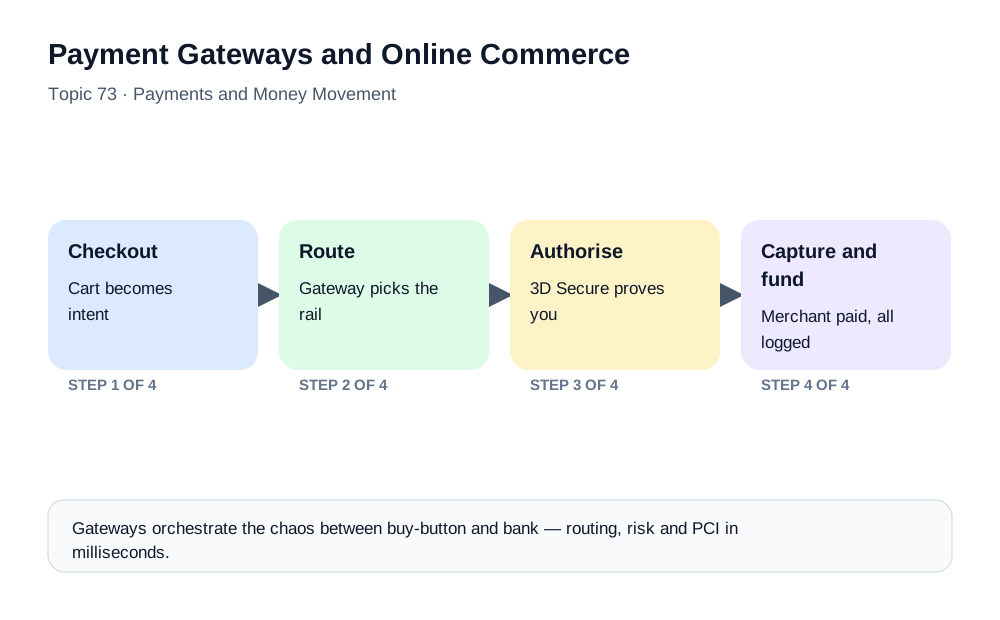
Payment Gateways and Online Commerce at a glance — Acquirers, processors, 3D Secure, PCI DSS.
The Orchestration Layer Between Checkout and the Financial System
A payment gateway is often described as the technology that carries card details from an online checkout to a bank. That description is directionally correct but too narrow for modern commerce. A serious gateway is an orchestration layer that accepts a customer's chosen payment method, protects sensitive credentials, creates the right authorization request, routes the transaction through an appropriate processor or acquiring connection, manages authentication, receives the response, returns a usable result to the merchant, and preserves enough state for capture, refund, dispute, settlement, reconciliation, and support.
The gateway does not itself make a cardholder creditworthy, guarantee that a merchant will fulfil an order, or automatically become the institution that settles money to the merchant. Those responsibilities may sit with issuers, acquirers, processors, schemes, payment institutions, banks, or the merchant itself. The exact division varies by provider and market, which is why practitioners should focus on functions and legal roles rather than brand labels.
A merchant may buy gateway, processing, acquiring, fraud, tokenization, recurring billing, and settlement services from one provider and experience them as one product. Another merchant may assemble the same capabilities from several providers. Both can present an identical “Pay now” button to the customer while the risk and operating model behind the button is completely different.
1. What the Gateway Actually Does
At a basic level, the gateway receives a payment request from the merchant's checkout or application and turns it into a controlled payment event.
The gateway may:
- create or validate the payment session;
- collect or reference card, wallet, bank-account, or tokenized credentials;
- protect sensitive data in transit;
- identify the merchant and transaction context;
- apply payment-method-specific validation;
- trigger authentication where required;
- select an acquiring or processing route;
- transmit an authorization or payment initiation request;
- interpret the response;
- return a stable merchant-facing status;
- create an audit trail and webhook or callback event;
- support later capture, cancellation, refund, or dispute activity.
The gateway's value is therefore not merely connectivity. It is state management and abstraction. The merchant can integrate once while the gateway handles multiple networks, banks, wallets, local methods, authentication services, and operational differences behind the scenes.
2. Gateway, Processor, Acquirer, and Aggregator Are Different Concepts
The payment industry uses overlapping commercial terms, which creates confusion.
A gateway normally focuses on the merchant-facing technical layer that accepts and routes payment requests.
A processor performs transaction processing and connectivity to card networks, banks, or other payment infrastructures.
An acquirer or acquiring institution provides the merchant acceptance relationship for card payments and participates in the relevant card-scheme model. It is responsible for activities such as merchant underwriting and settlement according to the applicable arrangement.
A payment facilitator, aggregator, or similar platform model can onboard sub-merchants under a broader acquiring arrangement, depending on the market, card-scheme rules, and regulatory structure.
One company can perform several of these roles. That does not make the roles identical. Requirements teams should document which legal entity performs onboarding, holds the merchant contract, submits authorization, receives scheme settlement, creates merchant payable balances, handles chargebacks, and ultimately pays the merchant.
3. A Card Checkout End to End
Consider a customer buying a laptop from an online merchant.
The merchant application creates an order and requests a payment session from the gateway. The gateway returns a secure reference or client token. The customer enters or selects a payment credential. Sensitive card data may be collected directly by the gateway or by an approved component so the merchant reduces its exposure to raw card data.
The gateway prepares the authorization request and sends it through the configured processing and acquiring route. The request travels through the card network to the issuing bank. The issuer evaluates the card status, available funds or credit, transaction characteristics, fraud risk, authentication result, and other controls before approving or declining.
The response returns through the same commercial chain. The gateway translates the result into a merchant-facing status. The merchant should fulfil the order only when its payment logic reaches the correct state.
The important point is that authorization is not the same as settlement. An approval means the issuer has accepted the authorization request under the card rules. The transaction may still need capture, clearing, settlement, and merchant funding later.
4. Authorization, Capture, Clearing, and Merchant Funding
Many online card transactions contain at least two merchant-controlled stages: authorization and capture.
Authorization reserves or approves the amount against the cardholder's account or credit availability. Capture confirms that the merchant wants to complete the financial transaction for clearing.
This separation is useful for businesses that do not know the final amount at checkout or that want to authorize before shipping. Hotels, car rental companies, marketplaces, and merchants with delayed fulfilment often depend on this distinction.
After capture, the transaction moves into clearing and settlement under the card-network and acquiring arrangements. The merchant is then funded according to its settlement schedule, net of applicable fees, reserves, chargebacks, refunds, or other adjustments.
A merchant can therefore have several balances at once:
- authorized amount;
- captured amount;
- cleared amount;
- settled amount;
- merchant payable amount;
- available payout amount.
Collapsing these into one “paid” flag causes reconciliation and customer-service problems.
5. Hosted Checkout Versus Direct Integration
Gateways offer several integration patterns.
A hosted payment page redirects the customer or embeds a provider-hosted component. The gateway controls more of the card-data collection environment, reducing the merchant's direct exposure to sensitive credentials.
A direct API or custom checkout gives the merchant more control over user experience but can increase security and compliance responsibilities depending on how credentials are handled.
A client-side tokenization component lets the customer enter data in the merchant experience while the sensitive credential is sent directly to the gateway or token service, returning a token to the merchant.
The correct design balances customer experience, regulatory and PCI obligations, security, integration complexity, conversion, and operational support.
6. Tokenization Changes the Security Boundary
Tokenization replaces a reusable sensitive credential with a controlled reference value. A merchant can store the token for recurring or future payments without retaining the original card number in the same way.
Not all tokens are equivalent. A gateway token may be meaningful only inside one provider. A network token is associated with the card network's tokenization ecosystem and can have different lifecycle and security characteristics. Wallet tokens can represent a device- or wallet-specific payment credential.
Systems must therefore know token type, token provider, domain of use, lifecycle status, underlying account relationship, and what happens when the physical card is replaced or expires.
A token is valuable because it reduces exposure, but it is still a payment credential. Access, logging, encryption, and misuse controls remain necessary.
7. Authentication and 3-D Secure
Online card payments can require cardholder authentication according to market rules, issuer risk decisions, and merchant configuration. EMV 3-D Secure provides a framework for exchanging transaction and device data with the issuer and, where needed, challenging the customer.
The objective is not to challenge every purchase. A well-designed authentication flow uses available context to allow lower-risk transactions to proceed with minimal friction while escalating transactions that require stronger verification.
The gateway has to manage several states: authentication initiated, frictionless result, challenge required, challenge completed, failed, unavailable, or abandoned. These states need to map correctly into authorization requests and merchant responses.
A payment should not be marked successful merely because authentication succeeded. Authentication proves or supports a customer-verification event; the issuer can still decline authorization for funds, credit, card status, fraud, or other reasons.
8. Alternative Payment Methods Need Different State Machines
A modern gateway can support cards, wallets, bank transfers, account-to-account payments, buy-now-pay-later, local methods, QR-based payments, and other instruments. These are not simply card transactions with different logos.
Some methods authorize synchronously. Others require the customer to leave the merchant application and authenticate in a banking app. Some confirm immediately; others send asynchronous status later. Some support partial refunds; others have different return models. Some provide guaranteed funds; others remain subject to later reversal or dispute.
The gateway should normalize what can be normalized while preserving method-specific meaning. A generic merchant status such as SUCCESS is dangerous if one payment method interprets it as authorization while another interprets it as final credit.
9. Webhooks and Asynchronous Events
Online systems cannot rely on the customer's browser returning to the merchant as proof of payment. The customer can close the page, lose connectivity, or manipulate the client-side flow.
Gateways therefore use server-to-server callbacks or webhooks to deliver authoritative payment events to the merchant.
Webhook design needs:
- authentication or signature verification;
- replay protection;
- idempotent processing;
- event identifiers;
- ordering strategy;
- retry handling;
- dead-letter or failed-delivery monitoring;
- clear event versioning.
The merchant should be able to receive the same event multiple times safely. Networks fail; duplicate delivery is normal. The financial system must not create duplicate fulfilment or duplicate refunds because a webhook was retried.
10. Idempotency Protects Customer Money
A customer can click the payment button twice. A merchant server can retry after a timeout. A gateway can return no response even though the authorization reached the issuer.
Without idempotency, every technical retry can become a new financial transaction.
A mature gateway accepts a merchant-generated idempotency or business-request key and ensures that repeated submission of the same intended operation returns or resolves the original result rather than creating an uncontrolled duplicate.
Idempotency should be designed per business operation. Creating a payment, capturing it, and refunding it are separate actions and need separate controls.
11. Timeouts Create Unknown Outcomes
Suppose the gateway sends an authorization request but times out before receiving the issuer response. The payment is not automatically failed. It is unknown.
The gateway may need to query the processor, wait for an asynchronous response, use scheme reversal procedures, or reconcile later. The merchant should not blindly resubmit a new payment while the first one remains unresolved.
Unknown outcome is one of the most important concepts in payment engineering because it prevents “retry until it works” logic from turning network instability into customer loss.
12. Routing and Smart Acquiring
Large gateways may connect to multiple acquirers or processors. Routing logic can select a path based on country, card type, currency, merchant entity, cost, historical approval rates, regulation, issuer location, token capability, or technical health.
This is sometimes called smart routing or payment orchestration.
Routing should not optimize only for authorization rate. A cheaper route may create worse settlement, dispute, or reconciliation complexity. A route with strong authorization performance may be unavailable for a regulated merchant category. Currency conversion or cross-border acquiring can alter cost and customer statement presentation.
The best route is the one that optimizes the full economic and risk outcome, not one isolated metric.
13. Fraud Controls Sit Beside Issuer Controls
The issuer performs fraud checks, but merchants and gateways also need their own protection.
Gateway-side signals can include device characteristics, account age, email or phone history, IP reputation, velocity, previous disputes, basket characteristics, shipping address, billing address, card fingerprint, merchant history, and links between accounts.
The gateway can block, challenge, route, or send additional risk information before authorization. This reduces fraud and chargeback cost, but overly aggressive rules damage legitimate conversion.
Fraud strategy therefore needs continuous measurement of false positives, fraud loss, approval rate, customer abandonment, and manual-review cost.
14. PCI DSS and Scope Reduction
Entities that store, process, or transmit cardholder data have obligations under the Payment Card Industry Data Security Standard according to their role and environment. A gateway can help a merchant reduce direct exposure through hosted collection, tokenization, or other approved architectures, but no integration pattern should be assumed to remove every security responsibility automatically.
The practical lesson is to minimize sensitive data. If the merchant does not need raw card data, it should not collect or store it. Reducing data exposure reduces both attack surface and compliance complexity.
Security design should also cover encryption, key management, access control, vulnerability management, logging, incident response, secrets management, and third-party dependencies.
15. Merchant Onboarding Is Risk Management
A gateway or acquiring platform cannot safely allow any newly created website to receive unlimited payments immediately.
Merchant onboarding establishes legal identity, beneficial ownership, business model, product or service, expected volumes, refund pattern, delivery model, geography, bank account, financial-crime risk, prohibited or restricted activity, and chargeback exposure.
A merchant selling downloadable software has a different risk profile from a merchant taking large advance payments for travel or furniture delivered months later. The second business can create substantial customer exposure if it fails before fulfilment.
Merchant risk therefore continues after onboarding. Sudden volume spikes, excessive refunds, changed websites, new products, unusual cross-border activity, or rising chargebacks can trigger review or reserve changes.
16. Reserves and Merchant Credit Risk
Acquiring creates contingent risk because customers can dispute transactions after the merchant has already been paid. If the merchant disappears or becomes insolvent, the acquirer or payment provider may still face chargeback obligations under the applicable arrangement.
Providers can manage this through delayed settlement, rolling reserves, guarantees, transaction limits, risk-based pricing, or other controls.
This is why fast merchant payout is not purely a technology decision. Payout timing transfers credit and fraud risk between the provider and the merchant.
17. Refunds Are New Financial Events
A refund should be linked to the original transaction but treated as its own controlled event.
The gateway should validate that the original payment exists, the refundable amount remains available, the merchant has authority, the currency and method are supported, and duplicate refund protection applies.
Partial refunds need cumulative tracking. If an order was paid for ₹10,000 and two partial refunds of ₹3,000 already occurred, the system should know that only ₹4,000 remains refundable unless an exceptional workflow says otherwise.
A refund is not the same as voiding an uncaptured authorization. The customer experience can look similar while the underlying financial path differs.
18. Disputes and Chargebacks
Card disputes operate under scheme rules and evidence timelines. The merchant may need to provide proof of authorization, authentication, delivery, refund policy, customer communication, or other evidence depending on the dispute reason.
The gateway or acquirer needs a case workflow with reason codes, deadlines, documents, representment status, financial postings, and merchant communication.
Dispute operations also provide product intelligence. A spike in “goods not received” disputes can signal merchant fulfilment failure. A spike in “card not present fraud” can signal compromised credentials or weak authentication. Risk teams should use this data rather than treat disputes as isolated back-office cases.
19. Reconciliation Is the Merchant's Financial Truth
A merchant may process thousands of successful payments yet still be unable to close its books if gateway, order, settlement, refund, fee, and payout data cannot be matched.
A robust reconciliation model links:
- merchant order ID;
- gateway payment ID;
- processor or network reference;
- authorization and capture amounts;
- refund and dispute events;
- fee entries;
- settlement batch;
- payout reference;
- bank statement credit.
The gateway's dashboard is not a substitute for accounting control. The merchant needs independently reconcilable records and clear treatment of timing differences.
20. Settlement and Payout Are Separate From Authorization
A payment can be authorized on Monday but included in a later settlement cycle. The provider may receive scheme settlement and then create a payable to the merchant. Merchant payout can occur according to a separate schedule.
This separation is especially important for marketplaces, where one customer payment may ultimately fund several sellers after commissions, taxes, refunds, or reserve amounts are applied.
Systems should therefore distinguish scheme settlement, provider ledger movement, merchant payable creation, and bank payout.
21. Marketplaces Add a Party Model
A marketplace is not simply one merchant with many products. It may onboard sellers, split customer payments, collect platform fees, manage reserves, process seller payouts, and handle refunds that affect multiple parties.
The platform needs clear data for buyer, seller, marketplace, acquiring entity, beneficiary bank account, commission, tax, and settlement ownership.
If a seller changes its payout bank account, that static-data change can redirect future money and deserves strong verification. Marketplace fraud frequently attacks the payout leg rather than the customer checkout.
22. Payment Gateways as Banking Architecture
For banks, gateway integration affects more than merchant acquisition. It connects channels, fraud systems, token services, cards, account-to-account payments, settlement, treasury, fee accounting, customer service, and data analytics.
A bank offering acquiring services needs to know whether its platform can support modern merchant APIs, webhook reliability, tokenization, local payment methods, real-time reporting, fraud tooling, dispute workflows, and reconciliation at the scale customers expect.
A bank partnering with an external gateway still retains responsibilities defined by its role. Outsourcing technology does not automatically outsource regulatory, financial, operational, or reputational accountability.
23. What Excellent Gateway Design Looks Like
A world-class gateway can answer simple questions even when the underlying ecosystem is complex. What exactly is the transaction state? Which provider and legal entity is responsible for the next step? Was the customer authenticated? Did the issuer authorize? Was the transaction captured? Which route was used? Has the scheme cleared and settled it? What is payable to the merchant? Has the merchant been funded? Can the event be refunded? Is a dispute open? Do all records reconcile?
The deepest lesson is that online checkout is not one API call. It is a controlled lifecycle. The gateway earns its value by hiding unnecessary complexity from the merchant while preserving enough financial truth that banks, merchants, customers, auditors, and operations teams can still reconstruct exactly what happened.
<!-- MBA-DEEP-DIVE-START -->Deep Dive: A Payment Gateway Is an Orchestration Layer, Not the Money Itself
A payment gateway sits at the point where a merchant's commerce journey meets financial infrastructure. Its most important job is not simply to “send card details to the bank”. It converts a customer checkout decision into a controlled payment attempt, routes the transaction to the appropriate payment method and processor, protects credentials, handles asynchronous responses, prevents duplicates, exposes a reliable status back to the merchant, and creates enough transaction evidence for refunds, disputes, settlement, reconciliation, fraud investigation, and customer support.
The merchant normally does not want to integrate separately with every acquirer, card network, bank-transfer system, wallet, BNPL provider, or local payment method. The gateway or broader payment service provider abstracts much of this complexity. That abstraction is valuable only if it preserves the true business state. A single API response saying success is not sufficient when the underlying method may have separate authorization, capture, clearing, settlement, and refund events.
Gateway, processor, acquirer, PSP, and orchestrator are different roles
The payments industry uses overlapping commercial labels, which can make architecture discussions confusing. A gateway usually provides the merchant-facing technical layer for collecting payment information and initiating payment requests. A processor provides backend transaction processing and connectivity. An acquirer or acquiring institution enables the merchant to accept card transactions and carries the acquiring-side scheme and merchant risk obligations. A payment service provider can bundle gateway, acquiring, alternative methods, reporting, fraud, and settlement services. A payment orchestrator can connect one merchant to several PSPs or acquirers and choose among them dynamically.
One company can perform several of these roles. The requirement should therefore describe the actual responsibility rather than infer it from the vendor's marketing label.
For example, if a gateway sends a transaction to an external acquirer, who owns merchant underwriting? Who receives card-network settlement? Who funds the merchant? Who handles chargebacks? Who controls the merchant category code? Who is liable if a prohibited merchant is onboarded? Those answers define the operating model more accurately than the word “gateway”.
The payment object should outlive the browser session
A customer can close a browser, lose mobile connectivity, refresh the checkout page, or return hours later. The payment must not depend on one web session staying alive.
A merchant should create a durable payment or order object with a stable identifier before asking the customer to pay. The gateway can then link each authorization attempt, redirect, challenge, callback, capture, refund, and failure to that object.
This makes retries safer. If the shopper presses Pay twice after a slow response, the merchant can determine whether the second request belongs to the same commercial order. Without a durable payment object, every HTTP retry can become a new financial transaction.
The same design improves support. A service agent can search the merchant order and see all related payment attempts instead of asking the customer for a bank statement screenshot.
Idempotency is mandatory in payment APIs
Payment APIs operate over networks that fail. The merchant can send an authorization request, the gateway can process it successfully, and the response can be lost. The merchant does not know whether the payment happened.
An idempotency key allows the merchant to retry the same business request safely. The gateway recognises the key and returns the existing result instead of creating another authorization or charge.
The key should represent one business intent, not one technical network call. It also needs retention long enough to cover realistic retry windows. If the gateway forgets idempotency keys after two minutes while merchants retry for an hour, duplicate risk returns.
Idempotency does not remove the need for reconciliation. A downstream acquirer or alternative payment method can still create uncertainty. The gateway must preserve external references and provide a controlled unknown state when the final outcome is not yet known.
Checkout security begins by reducing credential exposure
The safest card number for a merchant to store is usually the card number it never receives. Hosted fields, hosted payment pages, client-side tokenisation, and wallet-based payment credentials can reduce the merchant's direct exposure to primary account numbers.
This can reduce the scope and consequence of a merchant breach, but it does not make the merchant or gateway “outside PCI” automatically. The applicable PCI DSS responsibilities depend on how the environment stores, processes, transmits, or can affect the security of cardholder data and on the precise integration model.
PCI SSC identifies PCI DSS v4.0.1 as the current supported version in 2026 while gathering feedback for future evolution. Payment teams should therefore work from the current PCI Security Standards Council documentation rather than old checklists copied from earlier versions.
Security architecture should also include content-security controls, secure software development, dependency management, script integrity, logging, secrets management, vulnerability management, and incident response. A payment page can avoid storing PAN and still be compromised by malicious JavaScript that steals credentials before tokenisation.
Tokenisation changes the merchant's data model
A token represents a payment credential under defined rules. It should not be treated as a random substitute string with no lifecycle.
A gateway token can represent a card stored in the gateway's vault for one merchant. A network token can represent a card credential in the card-network tokenisation framework. A wallet token can be provisioned to a device. These tokens have different domains, update mechanisms, cryptographic properties, and portability.
Merchants need stable customer-payment-method references that survive card expiry and reissue where the relevant updater or token service permits it. At the same time, the merchant should be able to remove a stored credential when the customer revokes consent or closes the account.
A strong design therefore separates customer, merchant account, payment method, token, underlying credential, and mandate or consent.
Authorization and capture should remain separate concepts
In a simple e-commerce purchase, the merchant can authorize and capture immediately. In other businesses, the merchant first reserves funds and captures later.
A hotel may authorize before checkout. A marketplace may authorize when an order is placed and capture only when the seller ships. An airline may split an itinerary into several clearing events. A grocery-delivery service may authorize an estimated basket and capture the final amount after substitutions.
The gateway needs explicit states: authorization requested, authorized, partially captured, captured, reversed, expired, declined, or unknown. It should also enforce how much remains available to capture.
If a merchant captures twice because the first response timed out, the gateway should prevent over-capture or clearly identify that two captures occurred under the applicable scheme rules. Customer balance integrity depends on this state machine.
Void, reversal, refund, and chargeback are not synonyms
A reversal usually releases or cancels an authorization before final clearing. A void is a merchant-facing concept often used to cancel an uncaptured transaction. A refund is a new merchant-initiated transaction returning value after the original payment has been captured. A chargeback is a dispute mechanism under scheme rules.
The gateway should expose these separately. A merchant clicking Refund after an authorization that never captured can create unnecessary financial movements if the platform should have voided or reversed instead.
Refunds also need idempotency. A customer-service agent pressing Refund twice should not pay the customer twice because the page appeared slow.
Partial refunds and multiple refunds require remaining-refundable-amount logic and a clear relationship with the original capture.
Asynchronous payment methods make webhooks part of financial state
Not every payment completes while the customer waits on the checkout page. Bank transfers, wallet redirects, 3DS challenges, BNPL, and local methods can return the customer before the final payment state is known.
The merchant therefore needs an authenticated server-to-server callback or webhook that tells it when the financial state changes.
Webhook design is a banking control. The receiver should verify authenticity, process events idempotently, tolerate duplicates and out-of-order delivery, persist the event before acknowledging it, and support replay after outages.
The merchant should never treat the browser redirect alone as proof of payment. A fraudster can manipulate client-side navigation. The backend should mark the order paid only after a trusted gateway or payment-provider event, or after independent account evidence where that is the method's design.
Webhook ordering must not be assumed
Distributed systems can deliver events out of order. A merchant might receive payment_captured before an earlier authorization_updated event because queues retry independently.
The merchant should use event timestamps, versions, or payment-object state rather than blindly applying every message in arrival order. The gateway should document whether events are ordered and what merchants should do if they are not.
An event that arrives twice should not create two shipments, two invoices, or two refunds. Payment integration reaches into order-management controls, not only finance.
EMV 3-D Secure is an authentication framework, not one static version label
EMV 3-D Secure allows merchants and issuers to exchange transaction and device information to support cardholder authentication in card-not-present commerce. The issuer can allow a frictionless outcome or require a challenge depending on risk and the applicable rules.
As of 2026, EMVCo publicly documents 3DS v2.3.1.1 while also progressing later specification work. A gateway should therefore support the versions required by card schemes and markets rather than hard-code the phrase “3DS 2.0” as though it were one permanent standard.
The merchant integration needs more than a challenge screen. It needs authentication identifiers, result codes, exemptions or regulatory context where applicable, fallback behaviour, liability information, and a reliable link from the authentication event to the subsequent authorization.
A successful challenge does not itself mean the issuer approved the financial transaction. Authentication and authorization remain separate decisions.
Strong customer authentication can change checkout conversion
In markets with regulatory authentication requirements, checkout design needs to manage both compliance and customer experience. Authentication can fail because of issuer unavailability, customer abandonment, unsupported browser context, app-switch problems, expired sessions, or incorrect challenge data.
Merchants should measure conversion by authentication path. A provider boasting a high authorization rate may still create poor overall checkout success if many customers abandon earlier in the authentication flow.
The correct funnel is broader: checkout started, payment method selected, authentication required, authentication completed, authorization approved, capture completed, order fulfilled, and later dispute or refund behaviour.
Alternative payment methods require method-specific state machines
A gateway supporting fifty payment methods should not force all of them into card terminology.
An instant account-to-account payment can have request, payer approval, bank processing, settlement, credit, rejection, return, and refund states. A wallet can have balance and token behaviour. BNPL can include eligibility and financing approval before merchant payment. A bank redirect can be asynchronous. A direct debit uses a mandate and can later be returned under scheme rules.
The gateway can expose a common merchant API, but the common model should preserve method-specific semantics. Over-abstraction creates dangerous assumptions such as promising instant refunds on a method whose refund takes days or treating a revocable direct debit as equivalent to a final instant credit transfer.
Payment orchestration can improve resilience and economics
Large merchants often connect to more than one acquirer or PSP. An orchestration layer can route transactions based on geography, card range, payment method, cost, approval performance, capacity, or outage status.
Smart routing can improve conversion if one acquirer performs better for a certain issuer population. It can reduce concentration risk if a provider is unavailable. It can support local acquiring to reduce cross-border cost.
However, routing itself becomes a financial control. The merchant must preserve a single transaction identity across providers, avoid retrying a decline that should not be retried, prevent double authorization, and reconcile settlement from several sources.
A gateway retrying a soft technical failure through a second acquirer can be valuable. Retrying a genuine issuer decline across multiple acquirers can violate scheme rules, increase fraud risk, and irritate issuers. Retry policy should therefore be reason-code aware.
Cascading should distinguish technical failure from financial decline
Not all failures deserve another attempt.
A timeout can mean the outcome is unknown. An issuer unavailable response can sometimes justify controlled retry under the applicable rules. Insufficient funds is a business decline. Suspected fraud should not be routed repeatedly in search of a more permissive issuer path.
The gateway should normalise provider-specific codes into a governed internal taxonomy while retaining the raw response for evidence. Merchant analytics then needs to distinguish hard decline, soft decline, technical failure, customer abandonment, fraud block, authentication failure, and configuration error.
A single “failed payments” percentage hides all of these causes.
Merchant onboarding is part of the gateway risk model
A gateway or PSP that boards merchants may be taking regulatory, scheme, fraud, credit, reputational, and consumer-protection risk.
Onboarding should establish legal entity, beneficial ownership, business model, website or application, expected products, transaction volume, average ticket, refund pattern, delivery timeframe, countries, settlement account, merchant category, and prohibited or high-risk activities.
The risk does not stop after onboarding. A legitimate low-risk merchant can change what it sells. Transaction laundering can hide an undeclared business behind an approved merchant account. Ongoing monitoring should compare actual activity with the profile established at onboarding.
A merchant suddenly processing ten times expected volume or receiving many unrelated cardholder complaints deserves investigation even if its KYC documents remain valid.
Marketplace payments add seller and funds-flow complexity
A marketplace accepts payment from a buyer while the goods or services may be provided by a third-party seller. The platform can therefore sit between customer funds and many sellers.
The operating model must define who is the merchant of record, who owns the customer contract, who handles tax, who bears disputes, when sellers are paid, whether reserves are held, and how regulated payment-funds rules apply in the jurisdiction.
A simplistic gateway integration that credits the platform's bank account and lets it manually distribute money to sellers can create regulatory and reconciliation problems.
Marketplace payment platforms often use sub-merchant onboarding, split-settlement logic, seller balances, reserves, fees, refunds, and negative-balance recovery. Every seller payout should be traceable back to the underlying orders and buyer payments.
Merchant settlement is a separate lifecycle
The customer payment can succeed today while the merchant receives funds tomorrow or later under the acquiring agreement.
Merchant settlement can include gross sales, refunds, chargebacks, gateway fees, interchange-related components, scheme fees, taxes, reserves, prior adjustments, and rolling balances. The gateway or PSP should produce a settlement report that lets the merchant reconcile the bank deposit to individual transactions.
A merchant should not need to compare a single ₹9,73,421 bank credit manually with thousands of checkout records. Good settlement reporting provides batch or payout identifiers and explains every deduction.
This is a major differentiator between a gateway that merely accepts payments and a mature merchant-payments platform.
Settlement reconciliation needs at least three levels
Merchants need to reconcile orders to payments, payments to provider settlement, and provider settlement to bank statement.
The first proves that every fulfilled order has a valid payment and every payment is tied to an order. The second proves that captured transactions were included in provider payouts with correct fees and adjustments. The third proves that the expected payout actually arrived in the merchant's bank account.
A gateway or PSP needs its own deeper reconciliation across acquirer files, network clearing, bank settlement, merchant ledger, fees, refunds, and disputes.
Timing differences should be classified. A captured transaction may belong to tomorrow's settlement batch because of cut-off. That is different from a permanently missing item.
Ledger design matters when the PSP holds merchant balances
A PSP, marketplace, or aggregator that maintains merchant balances needs a robust internal ledger. Merchant available balance, pending balance, reserve, fees, refunds, chargebacks, and payouts should be represented as explicit accounting events.
The ledger should be double-entry or otherwise designed so that total financial obligations can be proven and reconciled. A balance should not be a number updated by arbitrary application logic with no transaction history.
Manual adjustments require strong approval and audit controls because a merchant-balance adjustment can move real money.
Refund operations are a major source of customer complaints
A merchant may initiate a refund immediately, but the cardholder or bank-account customer can see the money later depending on payment method and processing.
The merchant interface should distinguish “refund requested”, “refund accepted by provider”, “refund submitted externally”, and “refund completed” where evidence exists.
Customer support should be able to provide a refund reference useful to the payment provider or bank rather than simply say “we already refunded”. The original payment, refund amount, refund date, payment method, and destination should remain linked.
Refund fraud also needs control. Attackers can compromise merchant admin accounts and direct refunds to manipulated instruments if the platform allows arbitrary refund destinations. A strong design normally returns value through a controlled path linked to the original payment unless the method and policy explicitly support something else.
Payment links are convenient but security-sensitive
Gateways often let merchants generate hosted payment links for invoices, call-centre sales, or social commerce. The link should carry a signed or opaque reference rather than sensitive data that customers or attackers can edit.
The customer should see the merchant identity, amount, currency, and purpose before authorising payment. Expiry, single-use behaviour, maximum attempts, and status visibility should match the use case.
Fraudsters can create fake payment links that impersonate merchants. Merchants and gateways need verified domains, communication controls, and customer education. A legitimate gateway URL does not prove the person sending the link is a legitimate merchant unless the hosted page clearly identifies the merchant.
Recurring payments require consent and merchant-initiated transaction logic
Subscription businesses need to charge customers after the original checkout. The system should record what the customer agreed to, which credential or token can be reused, the schedule or trigger, how cancellation works, and what notice is required.
Subsequent transactions can follow different card or regulatory indicators from the original customer-initiated payment. A gateway that sends every recurring charge as though the cardholder were actively checking out can reduce approval quality or violate processing rules.
Merchants should also handle failed renewals intelligently. Repeated rapid retries can increase fees and issuer concern. Dunning strategies should distinguish expired credentials, insufficient funds, issuer decline, and technical failure.
Account updater services reduce involuntary churn but need transparency
When cards expire or are reissued, eligible network or issuer services can update stored credentials or tokens for participating merchants. This can keep legitimate subscriptions working without asking the customer to re-enter details.
The feature is commercially valuable, but it reinforces an important customer-service lesson: replacing a plastic card does not always cancel every recurring merchant relationship. Customers should cancel the subscription itself if that is their intent.
Gateway data models should record whether a credential was automatically updated so merchant support can explain why a payment continued after card replacement.
Fraud controls should be merchant-specific
A universal fraud rule such as “decline every purchase above ₹50,000” ignores business context. A luxury merchant and a digital-content merchant have different risk patterns.
Gateway fraud platforms can use merchant-specific models, device fingerprints, customer history, email and address signals, velocity, card range, shipping, basket contents, account age, and consortium data where permitted.
Merchants should be able to tune risk within guardrails, but they should not be able to disable mandatory controls that protect the PSP or acquirer. The platform also needs reason explainability so merchants can understand whether a transaction was blocked for credential risk, account abuse, velocity, or another factor.
False positives are an economic loss
Fraud models are often evaluated on fraud loss prevented, but excessive declines reject good customers. The merchant loses revenue, the customer may abandon the brand, and the issuer receives repeated attempts.
A strong fraud programme measures approval, fraud, chargeback, manual-review cost, and customer friction together. The optimal point is not zero fraud at any price.
Manual review itself must meet checkout reality. A two-hour review queue is useless for a food-delivery order that should be confirmed in thirty seconds.
Merchant dispute evidence should be generated during the transaction
Waiting until a chargeback arrives to reconstruct evidence is inefficient. The gateway can preserve authentication outcome, device data, customer login, delivery information supplied by the merchant, transaction identifiers, refund history, and communication references subject to privacy and scheme rules.
When the dispute arrives, the platform can assemble relevant evidence within the scheme deadline.
The merchant should not upload irrelevant documents simply because more pages feel persuasive. The evidence needs to address the specific dispute reason.
Gateway availability depends on downstream dependencies
A gateway can report 99.99% API uptime while customers still fail to pay because its acquirer connection, 3DS server, fraud provider, DNS, token vault, or bank-transfer connector is down.
Service monitoring should therefore follow the payment success path, not only the front-door API.
Synthetic transactions can test each method. Provider health can drive routing. Queue depth and latency should trigger alerts before timeouts become widespread.
A partial outage should not necessarily take down every payment method. If one card acquirer fails, the gateway may route eligible traffic to another. If 3DS is unavailable for transactions that require authentication, card processing may need to stop while UPI or bank-transfer methods continue.
Circuit breakers protect systems during downstream failure
When a provider begins timing out, uncontrolled retries can amplify the outage. A circuit breaker can temporarily stop sending new requests after a defined failure threshold, allowing queues and downstream systems to recover.
Financial state must still be respected. Requests already sent but awaiting outcome cannot simply be abandoned. They need inquiry or reconciliation before retry through another provider.
The gateway should distinguish not sent, sent with confirmed failure, and sent with unknown outcome. Only the first two may be safely rerouted according to method rules without further evidence.
Rate limiting and bot protection are payment controls
Checkout endpoints attract card-testing attacks in which criminals submit many small authorizations to determine which stolen cards remain active. This creates issuer fraud, merchant fees, and operational load.
Gateways and merchants can use velocity controls, CAPTCHA or bot detection where appropriate, device intelligence, IP reputation, account controls, and minimum transaction logic to reduce automated testing.
Rate limiting should not block legitimate flash-sale traffic. The system needs merchant and customer context and enough capacity to distinguish popularity from attack.
API versioning should protect merchants from breaking change
Payment APIs become embedded deeply into merchant checkout, finance, and order systems. A provider cannot change field semantics casually.
Versioning should define deprecation periods, migration guides, backward compatibility, webhook changes, SDK support, and test environments. A field that changes from optional to mandatory can break thousands of merchants if introduced without coordination.
For banking partners, this matters because a bank may depend on the gateway's stable API while the gateway depends on changing scheme or regulatory rules. The provider has to absorb external change without creating unnecessary merchant disruption.
Test environments should simulate financial edge cases
A sandbox that always approves transactions is not adequate.
Merchants need deterministic test cases for decline, insufficient funds, 3DS challenge, authentication failure, timeout, duplicate request, capture failure, partial capture, refund, partial refund, webhook retry, out-of-order event, chargeback, alternative-payment pending state, and settlement adjustment.
The test environment should preserve the same state model as production even if no real money moves. Otherwise integration defects appear only after launch.
Data privacy and fraud analytics need purpose discipline
Gateways observe rich commerce data: payer identifiers, devices, merchants, amounts, products, locations, and behaviour. These data can improve fraud and conversion, but collection and retention should remain lawful, proportionate, secure, and transparent under applicable privacy rules.
A provider should distinguish data needed to process the payment, data needed for fraud or legal obligations, and data used for analytics or marketing. Access controls should reflect these purposes.
A raw payment-data lake available to every internal team because “analytics may need it” is a security and governance failure.
A complete online checkout scenario
A customer buys a laptop for ₹85,000. The merchant creates order O-4812 and a gateway payment object with a stable idempotency key. Hosted fields collect card data directly into the gateway-controlled environment and return a token to the merchant.
The gateway determines that issuer authentication is required and begins an EMV 3DS flow. The issuer performs a challenge in the customer's banking application. Authentication succeeds, and the gateway sends the authorization through the chosen acquirer. The issuer approves.
The merchant does not ship immediately. It keeps the authorization open until the warehouse confirms inventory. Two hours later it captures the ₹85,000. Clearing and settlement proceed through the acquiring and card-network processes. The PSP includes the transaction in a merchant payout two days later, net of the agreed fees. The merchant reconciles order to capture, capture to payout, and payout to bank statement.
Now suppose the capture API times out. The merchant does not send another capture blindly. It queries the gateway using the payment identifier and discovers the first capture succeeded. The order moves to fulfilment without double charging.
Three days later the customer requests a ₹5,000 partial refund for an accessory. The merchant creates an idempotent partial refund linked to the original capture. The gateway tracks refund status separately and later reports completion. The entire financial history remains connected to one commercial order.
What excellence looks like
A world-class payment gateway makes complex financial state understandable without pretending every payment method is identical. It exposes explicit authorization, capture, pending, failure, refund, and dispute states. It supports idempotency and safe retry. It authenticates webhooks, protects credentials, follows current PCI and EMV specifications, and reduces merchant PCI exposure without making false compliance claims.
It also connects checkout to acquiring risk, fraud, settlement, merchant funding, and reconciliation. A payment is not finished when the customer sees a green tick. It is finished operationally only when the merchant can prove what was authorised, what was captured, how it settled, what fees applied, whether any refund or dispute occurred, and how the resulting bank credit reconciles to the underlying orders.
<!-- MBA-DEEP-DIVE-END -->