Visual overview
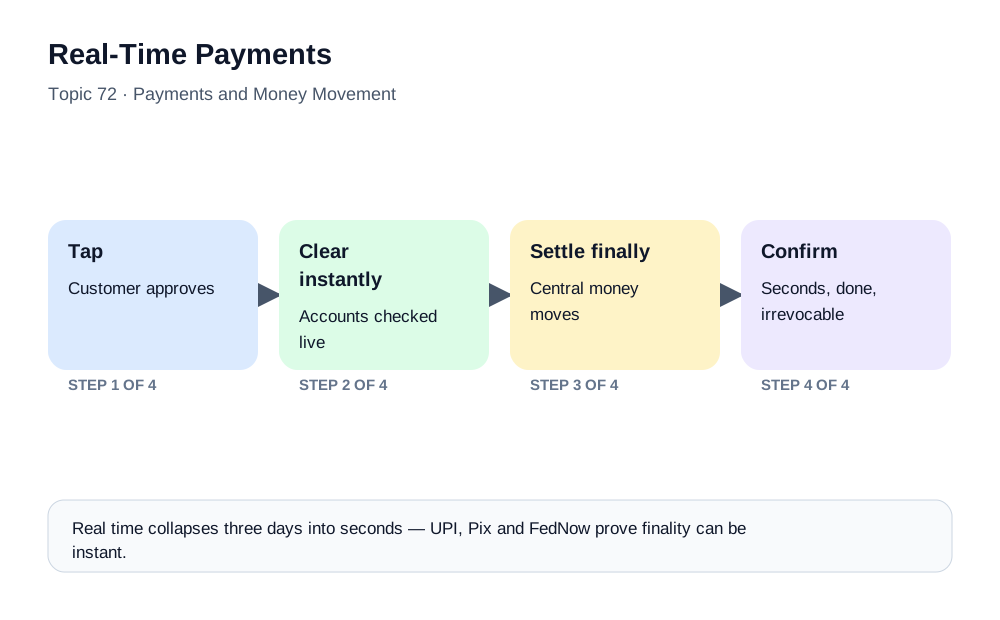
Real-Time Payments at a glance — UPI, PIX, FedNow, instant payment systems.
From Customer Tap to Final Settlement in Seconds
Real-time payments are often described as transfers that arrive in seconds, but speed alone does not define the service. A genuine instant-payment operating model has to authenticate the payer, validate the account and instruction, assess fraud and compliance risk, confirm that the receiving institution is reachable, reserve or debit funds, route the payment, complete or secure the interbank settlement obligation according to the scheme design, credit the beneficiary, return a meaningful status, and preserve enough data for reconciliation and later investigation. The customer sees a simple confirmation screen. The bank is coordinating a chain of tightly timed financial events.
This distinction matters because different instant-payment systems use different clearing and settlement models. Some settle transaction by transaction in central-bank money. Others depend on prefunding, technical settlement positions, or other arrangements defined by the market infrastructure. A practitioner should therefore avoid the shortcut that every instant payment is settled in exactly the same way. The durable question is: what becomes final, at which point, in which ledger, and using what settlement asset?
Real-time payments also change bank behaviour because they remove the comfort of business hours. A payment rail can be available every day of the year only if the bank can support customer authentication, ledger posting, fraud monitoring, liquidity, exception handling, reconciliation, operations support, certificate management, and incident response at the same time. A switch that accepts a payment at 2:00 AM while the fraud team, core ledger, or liquidity process waits for Monday morning is not a complete 24/7 banking service.
1. What “Real Time” Actually Means
A real-time payment normally combines several characteristics that older batch payment methods separated.
Immediate processing means the instruction is evaluated as soon as it is received rather than stored for a later clearing cycle.
Immediate or near-immediate beneficiary availability means the receiving customer can use the money shortly after the payment is accepted, subject to the rules of the relevant scheme and account.
Continuous service availability means the infrastructure is designed to operate outside traditional banking days and cut-off windows.
Rapid status feedback means the sender receives a useful confirmation or rejection quickly rather than waiting for an end-of-day file.
Strong finality or irrevocability characteristics mean the payment reaches a state where the sending customer or sending bank cannot simply cancel it unilaterally. The exact legal and scheme definition must be checked market by market.
These ideas sound similar but should not be collapsed into one vague status called “processed.” A bank should be able to distinguish received, authenticated, validated, accepted, booked, released, settled, beneficiary-credited, rejected, returned, recalled, and reconciled states where the relevant service needs them.
2. Clearing, Settlement, and Customer Posting Are Different Layers
A customer transfer can look complete before every internal control process has finished. That is why payments professionals separate customer posting, interbank clearing, and settlement.
Suppose Customer A at Bank A sends money to Customer B at Bank B. Bank A first validates the instruction and confirms that Customer A can pay. The payment is then routed through the instant-payment infrastructure. The infrastructure determines the destination participant and applies its scheme processing. Interbank value is discharged according to the settlement model. Bank B credits Customer B and returns the relevant status.
The customer experience is one transaction, but at least three balance-sheet views may be involved:
- the payer's account at Bank A;
- the beneficiary's account at Bank B;
- the settlement position between the two banks through the relevant infrastructure.
A customer debit without successful external settlement creates a break. External settlement without the beneficiary credit creates another break. This is why reconciliation remains essential even when everything happens within seconds.
3. Central-Bank Money and Settlement Finality
Where an instant-payment infrastructure settles in central-bank money, participating institutions discharge obligations through balances held with the central bank or through arrangements linked to those balances. This removes the credit exposure that would arise if the banks merely promised to settle with each other later.
The Eurosystem's TARGET Instant Payment Settlement service, TIPS, is a clear example: it is designed for settlement of instant payments in central-bank money on a 24/7/365 basis. The important lesson is not that every instant-payment system copies TIPS. It is that settlement design determines liquidity requirements, legal finality, participant risk, and treasury operations.
A bank therefore needs to know whether the payment system uses gross settlement, prefunded positions, net settlement, or another model. The customer may receive funds immediately under several different models, but the treasury and risk consequences are not interchangeable.
4. UPI: Interoperability as the Product
India's Unified Payments Interface illustrates how a real-time rail can become a broad payment ecosystem rather than a feature of one bank. UPI allows participating bank accounts to be accessed through interoperable applications and supports payment initiation using identifiers and interfaces that are simpler for customers than manually entering account details for every transaction.
The strategic shift is important. The bank can hold the customer's account while a separate application owns much of the day-to-day payment experience. That makes API reliability, account linking, consent, authentication, fraud monitoring, dispute support, service availability, and data governance central competitive capabilities.
UPI also shows why QR codes and aliases matter. They lower merchant acceptance friction, especially for small businesses that do not want traditional card-terminal economics. But easy addressing creates new control requirements. The system must know which account an alias resolves to, who can change that mapping, how identity is presented to the payer, and how old or recycled identifiers are handled.
5. Pix: Central Infrastructure and Broad Use Cases
Brazil's Pix demonstrates a different institutional design with the same customer expectation: funds should move within seconds at any time. Pix supports payments between individuals, businesses, and public-sector entities and has become embedded in ordinary commerce.
The transferable lesson is that instant-payment success depends on more than a fast switch. Reachability, easy addressing, merchant acceptance, trusted rules, competitive access, usable customer interfaces, and reliable dispute handling all influence adoption. A technically excellent rail with weak participation or poor merchant experience can remain marginal. A well-integrated rail can become part of everyday economic behaviour.
6. FedNow and the Importance of Current Rulebooks
The United States launched the FedNow Service in 2023 as a Federal Reserve instant-payment service for participating financial institutions. One practical lesson from FedNow is that transaction limits and service features evolve. Federal Reserve Financial Services increased the network transaction limit for customer credit transfers and payment returns to $10 million effective 12 November 2025, while participants remain free to impose lower limits for their own customers and risk appetite.
That distinction is operationally important everywhere. A scheme maximum is not the same thing as a customer entitlement. Banks can apply lower product limits, channel limits, user limits, new-beneficiary limits, dynamic fraud limits, or corporate maker-checker controls. When an external scheme limit changes, channel validation, fraud rules, liquidity assumptions, pricing, customer communication, and test packs may all need review.
7. SEPA Instant and the Difference Between Scheme and Settlement Infrastructure
In Europe, the SEPA Instant Credit Transfer scheme provides business rules for instant euro credit transfers, while infrastructures such as TIPS and other clearing and settlement mechanisms support the interbank execution model. A bank must therefore distinguish the scheme rulebook from the clearing and settlement mechanism.
The scheme answers questions such as who can participate, what business process applies, which message and timing rules are used, and how exceptions are handled. The settlement mechanism answers how value is discharged between participants. Treating the two as the same thing creates poor architecture and poor requirements.
Historic training material often memorised fixed scheme-level maximum amounts or older reachability assumptions. Those details change. Practitioners should always use the current rulebook and regulatory obligations rather than design systems around an old number remembered from a previous implementation.
8. Why 24/7/365 Changes Bank Operations
Continuous payment availability forces continuous supporting capability. The bank needs to answer practical questions that do not arise in the same way for a weekday batch system.
What happens if the fraud engine is unavailable at 3:00 AM? Can the bank continue, degrade safely, or must it stop accepting new instructions?
Who can add settlement liquidity during a holiday?
How are sanctions or other mandatory controls performed within the response-time budget where they apply?
What happens when a cryptographic certificate expires on Sunday?
Who owns a queue that begins growing during the night?
How does the bank perform maintenance without losing customer service or financial integrity?
The answers normally combine resilient architecture, active monitoring, automated controls, on-call staffing, predefined degraded modes, and clear authority to protect the service.
9. Fraud Moves Faster Too
Instant payments compress the time available to stop fraud. In a slower system, an unusual transaction might sit in a queue before release. In an instant system, a fraud decision may need to be made within seconds.
The bank therefore needs to evaluate more than whether the credentials are technically valid. Useful signals can include device history, recent password reset, beneficiary age, transaction velocity, payer behaviour, beneficiary behaviour, unusual value, new payee, location changes, linked mule-account intelligence, and known scam patterns.
Authorised push payment scams create a particularly difficult problem because the genuine customer may authenticate the payment while acting under deception. Strong authentication alone cannot solve that. Banks need behavioural detection, customer warnings that are relevant rather than generic, beneficiary-risk intelligence where lawful, and fast post-payment recovery procedures.
10. Name Checks and Verification of Payee
A payment can be technically valid and still go to the wrong person. Name-check and verification-of-payee services reduce this risk by comparing the intended beneficiary information with information associated with the destination account before the payment is released.
These services should be treated as decision support rather than an absolute guarantee. Names can differ because of abbreviations, transliteration, joint accounts, legal names, trading names, spacing, or spelling. The bank needs governed match logic and clear customer presentation for match, close match, no match, or unavailable outcomes.
A name match does not prove that the underlying invoice, investment opportunity, or caller is genuine. It reduces one class of misdirection risk; it does not eliminate scam risk.
11. Alias and Directory Risk
Mobile numbers, email addresses, QR codes, virtual payment addresses, and other proxies make payment initiation easier because customers do not need to remember full account identifiers. The convenience introduces a directory layer that becomes part of payment integrity.
The bank or scheme must control registration, change, deactivation, reassignment, and audit history. A mobile number can be recycled. A business can change its account. An attacker may attempt to hijack an alias. Sensitive mapping changes should therefore receive strong authentication and, where appropriate, notification or cooling controls.
At payment time, the bank should preserve which destination account the alias resolved to. That evidence becomes important in complaints and fraud investigations.
12. QR Payments Need More Than a Camera
A QR code is effectively a compact payment instruction. A static code may identify the payee while the customer enters the amount. A dynamic code can include amount, invoice reference, merchant information, or transaction context.
Fraud can occur when a criminal places a fake QR sticker over a genuine merchant code or sends a manipulated code to a customer. The payer application should display the resolved payee clearly before authorisation. Merchants should reconcile the actual bank or provider confirmation rather than rely on a screenshot, sound alert, or customer claim.
For commerce, the payment also needs to be linked to the order. A successful bank credit that cannot be matched to the correct invoice creates an operational problem even though the payment rail performed perfectly.
13. Unknown Outcome Is a Real Financial State
A network timeout creates one of the hardest payment scenarios. Bank A sends an instruction but does not receive the response. Did the payment fail before acceptance, or did it complete and the response get lost?
If Bank A retries blindly, the beneficiary may be paid twice. If it assumes success, the customer may believe funds were delivered when they were not.
The architecture therefore needs a controlled unknown state and a resolution mechanism such as status inquiry, scheme duplicate control, transaction identifiers, settlement evidence, or reconciliation. Generic technical retry logic is dangerous when applied to a financial instruction whose state is uncertain.
API idempotency serves the same purpose at the customer edge. If a mobile application resubmits the same request after a timeout, the bank should recognise the original business instruction rather than create a second payment.
14. Duplicate Detection Must Understand Business Context
A simplistic rule such as “same payer, same beneficiary, same amount” generates false positives. A customer may legitimately make two identical payments. A merchant may receive many transactions for the same price. A payroll file can contain repeated salary amounts.
At the same time, a duplicate retry may arrive with a new technical message identifier even though it represents the same underlying customer instruction.
Strong duplicate controls use stable business references where available and combine them with channel, payer, beneficiary, amount, timing, request identifiers, and transaction history. The decision can then reject, hold, or ask the customer depending on the use case.
15. Liquidity Becomes an Intraday and Overnight Discipline
Instant payments can consume settlement capacity at any hour. Treasury therefore needs behavioural forecasts by time of day, day of week, customer segment, season, salary cycle, merchant events, and stress scenario.
A bank that normally sends modest overnight volumes can experience a sudden outflow because a corporate releases a large payment batch, a popular merchant campaign changes customer behaviour, or a fraud event drains many accounts quickly.
The liquidity design should specify warning thresholds, hard limits, top-up mechanisms, contingency sources, and who can act outside ordinary market hours. It should also distinguish customer limits from settlement capacity: accepting a payment that the scheme allows is useless if the bank cannot fund the resulting position.
16. Corporate Instant Payments Are Not Just Bigger Retail Payments
As limits and use cases expand, instant rails increasingly support business payments. Corporate payments introduce stronger entitlement, approval, reconciliation, and liquidity requirements.
A corporate treasury user may create a payment while another user approves it. File releases may contain hundreds or thousands of instructions. Payment references need to support enterprise-resource-planning reconciliation. Limits can exist at company, account, user, transaction, and daily aggregate level.
The bank should not simply reuse a consumer mobile-payment control model for high-value corporate use. The rail can be the same while the authority and risk model differs substantially.
17. Reconciliation Still Closes the Loop
Instant does not mean unreconciled. The bank should compare customer postings, payment-hub records, scheme messages, settlement positions, returns, fees, and general-ledger entries.
Real-time or near-real-time reconciliation can identify breaks quickly. End-of-day control still provides an independent completeness check. Suspense items should be aged aggressively because a customer who expects instant certainty experiences an overnight unexplained item as a serious failure.
A mature bank can trace a payment from customer instruction through authentication, risk decision, account posting, routing, external acceptance, settlement, beneficiary status, reconciliation, and any later return or investigation.
18. Returns, Recalls, and Recovery Requests
A completed instant payment is not the same as a transaction that can be cancelled freely. Where a scheme provides recall or recovery processes, those are separate messages or cases around the original payment.
If a customer reports a scam, the sending bank may ask the receiving bank to recover funds. The receiving bank may investigate whether funds remain and what action is permitted under law and scheme rules. The beneficiary may return the money voluntarily. Law enforcement may also become involved.
Customer communication must be exact. “We have requested recovery” is different from “the payment has been reversed.” Preserving that distinction reduces false expectations and supports accurate complaint handling.
19. Real-Time Payments as a Platform
The real strategic importance of instant payments is that they create a platform for additional services: request-to-pay, merchant checkout, account-to-account commerce, payroll, government disbursement, invoice reconciliation, mobile wallets, alias directories, and new treasury services.
Each extension adds controls. Request-to-pay needs a distinction between a request and an authorised payment. Merchant checkout needs order correlation and secure refunds. Payroll needs corporate authority and liquidity forecasting. Government payments need eligibility and reconciliation. Open application access needs consent, authentication, API governance, and service-level management.
The payment rail is therefore infrastructure. The customer value comes from the services built around it.
20. What Excellent Instant-Payment Banking Looks Like
A world-class instant-payment bank can explain the payment state at every point rather than hiding behind “processing.” It knows which settlement model applies, how liquidity is funded around the clock, how duplicate and unknown outcomes are controlled, how customer and corporate limits interact with scheme limits, how fraud decisions are made within seconds, how aliases and QR codes are governed, how returns and recovery requests differ from reversals, and how every payment reconciles to customer and settlement records.
The deepest lesson is simple: instant payments do not eliminate banking complexity. They compress it. The same responsibilities that once had hours or days to complete must now operate safely in seconds, every hour of every day.
21. The Production-Control View
A mature bank treats the instant-payment service as one continuous production chain rather than a fast front end attached to slower back-office processes. Operations should be able to see transaction throughput, technical rejects, business rejects, fraud holds, external acknowledgements, unknown outcomes, liquidity usage, beneficiary-credit confirmation where available, returns, and reconciliation breaks from a shared operating view. Thresholds need business meaning: a queue of one hundred payments may be harmless during a planned burst but critical if the queue is growing because the external rail is no longer accepting traffic.
Runbooks should therefore connect symptoms to actions. A rising timeout rate can require status inquiry and duplicate protection rather than blind retry. A liquidity threshold can require treasury top-up rather than channel shutdown. A fraud-engine outage can invoke an approved degraded mode, lower limits, or a controlled stop depending on risk appetite. Certificate expiry, clock drift, DNS failure, database latency, or an upstream account-service outage can all present to customers as a simple ‘payment failed’ message while demanding very different internal responses.
Capacity testing also has to reflect real customer behaviour. Salary days, tax deadlines, major shopping events, emergency government disbursements, and viral merchant campaigns can produce sharp volume spikes. Performance testing should therefore cover sustained throughput, sudden bursts, duplicate submissions, delayed external responses, partial component failure, and recovery with queued transactions still in flight. The goal is not merely to prove that the happy path can process a target transactions-per-second figure; it is to prove that financial integrity survives overload and recovery.
Finally, management information should connect service reliability to customer outcome. Availability percentages alone can hide a service that is technically online while customers receive delayed credits or repeated false rejections. Useful measures include end-to-end success rate, percentile response time, unknown-outcome rate, duplicate-prevention events, recovery-request volumes, reconciliation ageing, fraud loss, customer complaints, and liquidity exceptions. When those measures are understood together, the bank can improve the service without trading away safety for speed.
<!-- MBA-DEEP-DIVE-START -->Deep Dive: What Makes an Instant Payment Truly Instant
An instant payment is not defined only by a fast message. The banking service has to complete several things within a tightly controlled time window: authenticate the payer, validate the account and transaction, assess fraud and compliance risk, reserve or debit funds, route the instruction to a reachable receiving institution, settle or otherwise secure the interbank obligation under the scheme model, credit the beneficiary, return a meaningful status, and preserve enough evidence for reconciliation and investigations. A notification arriving in one second while interbank settlement remains uncertain is not the same operating model as an end-to-end instant payment.
This distinction matters because different fast-payment systems use different settlement arrangements. Some settle individual transactions in central bank money in real time. Others use prefunding, technical positions, or another scheme-specific model. The customer can still receive an immediate experience, but treasury, liquidity, default management, and reconciliation differ materially. A banking professional should therefore ask what becomes final, where, and with which settlement asset rather than assuming every instant scheme works like every other one.
24/7/365 is an operating model, not an opening-hours statement
A payment scheme can run continuously only if participants can operate continuously. The bank needs more than a switch that accepts messages at 03:00 on Sunday. Core ledgers, fraud engines, sanctions controls where applicable, customer authentication, beneficiary validation, settlement liquidity, reconciliation, alerting, and incident support must all support the service.
Traditional banks often designed controls around end-of-day and weekday staffing. Instant payments remove that comfort. A liquidity threshold can be breached on a public holiday. A fraud attack can begin at midnight. A certificate can expire on a weekend. A queue can build while the operations team is asleep. If every serious exception waits until Monday morning, the service is technically open but operationally incomplete.
The practical answer is a combination of automation and on-call governance. Banks define thresholds that trigger alerts, automate safe liquidity movements where possible, maintain support rotations, and give incident teams authority to protect the service outside ordinary business hours. The design should also define when the bank will temporarily reject or restrict new transactions rather than continue processing with degraded controls.
Speed changes the location of risk
A slower payment process gives the bank time to investigate anomalies before money becomes difficult to recover. An instant payment compresses that decision into seconds. This changes the value of fraud data and pre-transaction controls.
An account-takeover payment may arrive with correct credentials because the attacker stole them. An authorised push payment scam may be approved by the genuine customer because the customer was deceived. A mule beneficiary may have passed ordinary onboarding before being recruited to receive fraudulent funds. None of these problems is solved by checking whether the payment format is valid.
Instant-payment fraud therefore relies on a broader risk picture: device history, authentication event, beneficiary age, beneficiary risk, transaction velocity, recent profile changes, account behaviour, payment purpose, geographic signals, linked accounts, known scam patterns, and network intelligence where lawful and available. The decision engine has to combine these signals quickly enough that protection does not destroy the instant customer experience.
Irrevocability and recoverability are not the same concept
Instant-payment systems are commonly designed to provide rapid finality. Once the payment reaches the defined final state, the payer's bank may no longer have a unilateral right to reverse it. That does not mean recovery is impossible in every case.
The sending bank may be able to send a recall or recovery request. The receiving bank may freeze remaining funds under fraud procedures or legal authority. The beneficiary may agree to return money. Law enforcement may intervene. Scheme processes can support interbank communication. But these are recovery mechanisms around a completed payment, not evidence that the original transaction remained revocable.
Customer language should be precise. If a victim reports a scam after settlement, the bank should not say “we cancelled it” when it has only asked the receiving institution to recover funds. The distinction matters because false certainty delays the customer's understanding of the situation and creates complaints when recovery is incomplete.
Prefunding creates a 24-hour treasury discipline
Many instant-payment arrangements protect the scheme by requiring participants to maintain a funded position or otherwise ensure sufficient settlement capacity. This reduces settlement credit risk but shifts attention to liquidity management.
Suppose a bank expects ordinary overnight outflows of ₹50 crore and maintains a buffer above that level. A fraud event, payroll concentration, merchant campaign, or unexpected customer behaviour can consume the buffer quickly. The bank needs thresholds that warn treasury before the position reaches a hard limit.
A robust liquidity design answers several questions. Which account or technical position funds instant payments? Can liquidity be moved into it outside ordinary market hours? Is the transfer automatic or manual? What happens if the central-bank or funding service needed to top up the position is unavailable? Which team can reduce customer limits in an emergency? How much stress outflow should the bank assume for weekends and holidays?
The correct buffer is therefore behavioural. It depends on actual transaction patterns, customer mix, seasonal peaks, fraud stress, and the time required to mobilise additional liquidity.
Real-time gross settlement and instant retail settlement are related but distinct
An instant retail payment can settle through a platform that processes individual obligations in central bank money, but the customer service and settlement service should still be distinguished conceptually.
The Eurosystem's TIPS platform, for example, provides 24/7/365 settlement of instant payments in central bank money. The SEPA Instant Credit Transfer scheme provides the business rules for the euro credit transfer. A payment service provider must integrate scheme processing with the relevant clearing and settlement mechanism. The customer sees one transfer, while the bank manages rulebook obligations, message exchange, settlement account, liquidity, and beneficiary posting.
This separation is useful in every market. The scheme defines who can send what to whom and the service-level obligations. The settlement infrastructure determines how participant obligations are discharged. A bank can change its clearing or settlement arrangement without changing the customer's basic product, provided the new arrangement still meets scheme and regulatory requirements.
UPI shows the power of interoperable addressing and applications
India's Unified Payments Interface demonstrates how an instant-payment rail can become an ecosystem rather than a bank feature. NPCI describes UPI as an instant payment system that allows users to access participating accounts through UPI applications, with immediate transfers available 24/7/365. The customer does not need to use the mobile application of the bank that holds the account; interoperable applications can initiate payments against linked bank accounts under the UPI framework.
This separation of account provider and customer interface changed competition. A bank could provide the deposit account while a third-party app owned the daily payment experience. For banks, this made API reliability, account-linking controls, consent, fraud monitoring, dispute support, and data governance strategically important. A bank that considered UPI only a low-value payment rail could lose customer engagement even while retaining the underlying account.
The UPI lesson generalises: open interoperable infrastructure can shift competitive value away from proprietary reach and toward customer experience, reliability, risk management, data, and adjacent services.
Aliases simplify payment initiation but create directory risk
Many instant-payment systems let customers address payments with a mobile number, email, virtual address, proxy, QR code, or another alias instead of entering full account details. This makes payments easier but introduces a directory or mapping layer.
The bank must know whether the alias is valid, which account it maps to, who controls changes, how quickly updates take effect, and what happens when a phone number is recycled. Fraudsters may try to take over aliases or manipulate customers into paying the wrong proxy.
Directory changes should therefore be treated like sensitive account-maintenance events. Strong authentication, notification, cooling-off rules where appropriate, and audit history can reduce abuse. The payment engine should also use the directory result valid at the time of the transaction and preserve enough evidence to explain later which beneficiary account the alias resolved to.
QR codes are payment instructions in visual form
A QR code can carry merchant or account information that the payer's application reads to construct the payment. Static QR codes can identify the merchant while the customer enters the amount. Dynamic QR codes can include amount, invoice reference, transaction context, or other data.
The key banking risk is that the customer trusts what the app resolves from the QR. A fraudulent sticker placed over a genuine merchant QR can redirect payment. The app should therefore display the resolved payee clearly before authorisation, and verification-of-payee or merchant identity controls can add confidence where the ecosystem supports them.
For merchants, QR acceptance dramatically reduces hardware cost compared with a traditional card terminal, but operations still needs reconciliation. The merchant needs to know which incoming payment belongs to which sale, whether it succeeded, and whether the application notification is genuine rather than a forged screenshot or sound alert.
Confirmation of payee and name checks address misdirection risk
A fast payment sent to the wrong account can become difficult to recover. Name-check or verification-of-payee services reduce this risk by comparing the intended payee information supplied by the payer with information held or provided for the destination account.
The EU Instant Payments Regulation introduced verification-of-payee obligations for the relevant payment service providers and euro credit transfers on the applicable dates. The service can return outcomes such as match, close match, no match, or another result before the payer proceeds.
The control should assist the customer rather than create a false guarantee. Names contain abbreviations, transliteration differences, joint-account conventions, company legal names, trading names, and spelling variations. A close-match decision needs governed logic. Customers should understand that a match reduces one class of error or impersonation risk; it does not prove that the underlying commercial transaction is genuine.
Unknown outcome is a first-class transaction state
One of the hardest instant-payment failures is a timeout after the sending bank has transmitted an instruction. The sender may not know whether the receiving infrastructure accepted and settled the payment.
If the bank assumes failure and submits again, the beneficiary can be credited twice. If it assumes success and does nothing, the customer's payment can remain incomplete. The architecture therefore needs an unknown outcome state and a safe way to resolve it.
Resolution can involve a status inquiry, scheme duplicate controls, a unique transaction identifier, settlement-position evidence, or later reconciliation. The exact mechanism depends on the scheme. What matters is that the bank does not use a generic technical retry for a financial transaction whose state is uncertain.
Idempotency should also extend through APIs. If a mobile app retries because the customer lost connectivity after pressing Pay, the bank should recognise the same business request rather than create a second payment.
Duplicate prevention needs business context
Simple duplicate logic such as “same amount to same account today” is unsafe. A customer can legitimately pay the same merchant the same amount several times. Payroll files can contain many employees with identical salaries. Conversely, a retry can arrive with a new technical message identifier while representing the same customer instruction.
The bank should use stable business references where available and combine them with channel context, payer, beneficiary, amount, time, and transaction history. Duplicate rules should be tuned to the product.
When a transaction is flagged as potential duplicate, the system should know whether it can reject automatically, ask the customer, or route to review. A false duplicate block is a service failure; a missed duplicate can be a direct financial loss.
Limits are risk controls, not just product features
An instant-payment ecosystem can have several limits at once: a scheme limit, a participant limit, a bank product limit, a customer limit, a corporate-user limit, a channel limit, and dynamic fraud controls.
The FedNow Service illustrates why practitioners should use current authoritative rules rather than memorised numbers. Federal Reserve Financial Services increased the network transaction limit for customer credit transfers and payment returns to $10 million effective 12 November 2025, while participants can set lower limits according to their own risk appetite and customer use cases.
The same distinction applies globally. A scheme's maximum is not a promise that every customer can send that amount. Banks may set lower limits based on customer segment, authentication method, new beneficiary, account age, transaction purpose, or fraud risk. Corporate channels can have maker-checker and user-level limits in addition to the payment rail limit.
Real-time systems need real-time sanctions and compliance decisions where applicable
Not every domestic instant payment faces the same sanctions regime or screening design, but where screening is required, the control cannot be a slow batch process. The bank needs a decision within the scheme time budget.
This creates a data-quality requirement. Structured payer and beneficiary information, account identifiers, and other relevant fields should reach the screening service without unnecessary truncation. False positives need fast resolution or risk-based handling consistent with law and policy.
The system should not automatically release a payment merely because the scheme deadline is approaching. Service speed does not override legal obligations. The operating model instead needs enough capacity and data quality to make compliant decisions quickly.
Fraud response has to continue after settlement
Pre-transaction fraud controls will never catch every scam. Instant-payment ecosystems therefore need strong post-event response.
When a customer reports fraud, the sending bank should rapidly identify the transaction, preserve authentication and device evidence, assess whether other suspicious payments occurred, notify the receiving side through the supported channel, and create the appropriate recovery or investigation case. The receiving bank should be able to assess whether funds remain and whether its legal and scheme framework permits action.
Mule-account monitoring is especially important. If one receiving account suddenly collects small payments from many unrelated senders and disperses them immediately, the pattern can indicate scam proceeds. Network-level intelligence can improve detection because one bank sees only part of the pattern.
Transaction monitoring must become event driven
Traditional AML or fraud systems sometimes relied on end-of-day files. Instant payments expose the limits of that design. By the time the batch runs, money may have moved through several accounts.
Event-driven monitoring lets the bank update risk signals as transactions happen. A beneficiary newly created ten minutes ago, an account password reset, a device change, and a high-value instant payment can be evaluated together.
The data architecture should preserve the event order. If the fraud system receives the payment before the device-change event because asynchronous messages arrive out of sequence, the risk score can be wrong. Sequence, timestamps, and durable event processing therefore become financial controls.
Request-to-pay can improve collections without being a debit mandate
Request-to-pay services allow a payee or biller to send a request that the payer can review and authorise. This can improve invoice reconciliation and customer convenience because the request contains structured payment context.
But a request is not automatically permission to debit the payer. The payer may accept, reject, or ignore it according to the service rules. Systems should separate request state from payment state.
This distinction prevents a common design error in which a merchant application marks an invoice paid as soon as a request is accepted by the messaging service rather than when the associated payment completes.
Merchant instant payments change checkout economics
Account-to-account instant payments can give merchants an alternative to card acceptance. The merchant can receive funds rapidly and may face different fee and dispute economics.
However, merchant payments need more than a bank transfer button. The checkout needs payment initiation, merchant identity, amount integrity, customer authentication, confirmation, order correlation, refunds, reconciliation, and fraud controls. If the merchant cannot reliably match the incoming credit to the correct order, the payment rail can be fast while the commerce experience is poor.
Refunds also need design. A merchant should not ask customers to send account details by email and then manually create an unrelated payment. A secure refund process should link the original order and payment where the ecosystem supports it and protect against refund redirection fraud.
Instant payroll and corporate payments change liquidity peaks
As transaction limits rise and corporate use expands, instant rails can carry business payments as well as retail transfers. This changes volume patterns.
A corporate treasury can submit large supplier or payroll batches at times that historically belonged to batch clearing. If those payments settle individually in real time, the bank can face concentrated liquidity outflows. Treasury needs forecasts from corporate channels and may need customer-level controls around file size, release time, and available settlement liquidity.
Corporate customers also need stronger authority models. A ₹5 payment from a retail app and a ₹5 million treasury payment should not use identical entitlement and approval assumptions merely because the rail can carry both.
FedNow, Pix, UPI, and TIPS demonstrate different institutional choices
The world's major instant-payment systems share customer outcomes but differ in governance and settlement design.
NPCI describes UPI as an instant system available around the clock for participating accounts and applications. Brazil's central bank describes Pix as allowing people, businesses, and government entities to send and receive payments within seconds at any time, including non-business days. Federal Reserve Financial Services operates FedNow for participating institutions in the United States. The Eurosystem's TIPS provides real-time settlement of instant payments in central bank money on a 24/7/365 basis.
These examples should not be flattened into one architecture. The operator, access model, message model, alias services, settlement account, liquidity method, transaction limits, regulatory obligations, and commercial pricing differ. The transferable skill is to analyse those dimensions systematically.
SEPA Instant now operates without the old scheme-level €100,000 cap
Historic material often describes SCT Inst as having a €100,000 maximum. That is no longer a reliable current description. The 2025 SCT Inst rulebook removed the old scheme-level maximum apart from the maximum framework set by the amended SEPA Regulation, while payment service providers can still apply customer and risk limits consistent with applicable rules.
The durable lesson is that payment limits change. Product documentation, channel validation, fraud rules, liquidity assumptions, customer communication, and test cases all need to change together when the external rule changes.
The same applies to timing and reachability obligations under the EU Instant Payments Regulation. Regulatory change can convert a service that was optional for some institutions into a required capability on specified dates, which creates programme impacts far beyond the payment gateway itself.
Reconciliation is still necessary when everything happens in seconds
Speed does not remove reconciliation. It makes reconciliation more continuous.
The bank should compare customer postings, payment-hub transactions, scheme messages, settlement positions, fees, returns, and general-ledger entries. A position that appears balanced at the scheme may still hide a missing customer posting. A customer debit may exist while the external payment failed and should have been reversed.
Real-time reconciliation can detect these breaks quickly, while end-of-day control provides a complete independent close. The two are complementary.
Suspense balances need especially tight ageing in instant payments because the customer expects immediate certainty. An unexplained item left overnight in a 24/7 service is already old from the customer's perspective.
Capacity planning must assume synchronized behaviour
Average transaction rate is a poor sizing metric for instant payments. Real users behave in bursts: salaries arrive, ticket sales open, tax deadlines approach, festivals begin, sporting events end, or a popular merchant launches a promotion.
The platform needs to handle peak transactions per second with enough headroom for retries, fraud checks, directory calls, and downstream services. A fraud engine that supports only half the payment hub's peak capacity becomes the real limit of the bank.
Capacity tests should also include failure. If one data centre is lost, can the surviving site handle the full peak? If a downstream service slows rather than fails completely, do queues grow until memory or database limits are exhausted? Resilience is a capacity problem as much as a redundancy problem.
Incident management should measure the business service
An instant-payment service can be technically online while customers receive delays, duplicate statuses, or failed credits. Incident teams should therefore measure business outcomes: transaction acceptance, processing latency, settlement success, beneficiary credit confirmation where available, queue depth, fraud-decision latency, and reconciliation breaks.
A partial outage can require selective action. If one receiving institution is unreachable, the bank may continue payments to others while temporarily rejecting that route. If the settlement position cannot be replenished, the bank may lower limits or stop outbound payments while keeping inbound processing available.
The incident runbook should identify these options before the crisis, including who can authorise them and how customers will be informed.
Customer notifications need trustworthy timing
Instant payments encourage instant notifications, but the notification should correspond to a real state.
The payer can be told that the instruction was accepted, that funds were sent, or that the payment completed depending on what evidence the bank has. The beneficiary should not receive a 'money received' notification before the account credit is durable.
Merchants are particularly vulnerable to fake payment confirmations. The merchant application should rely on authenticated backend status or account credit, not a customer's screenshot or device sound. The faster the ecosystem, the more valuable trustworthy machine-to-machine confirmation becomes.
A complete instant-payment scenario
A customer opens the bank app at 23:48 on Sunday and scans a merchant QR for ₹12,500. The application resolves the merchant identity and amount, displays the payee, and asks the customer to authenticate. The channel sends an idempotent payment request to the bank.
The payment service validates the account, available balance, limits, beneficiary reachability, and duplicate risk. Fraud analytics sees that the device is established, the merchant is known, and the payment is consistent with the customer's behaviour. The bank reserves or debits funds according to its posting model and sends the instruction through the instant-payment rail.
The infrastructure validates and processes the payment. The interbank obligation reaches the defined settlement state. The receiving bank credits the merchant. Positive status returns to the sending bank, which finalises its posting and notifies the customer. The merchant backend receives authenticated confirmation and marks the order paid.
Later, reconciliation confirms that the customer debit, payment record, scheme transaction, settlement position, merchant-side status, and GL entries agree. No operator touched the payment, but dozens of controls operated within seconds.
Now change one fact: the bank sends the instruction but loses the response. The transaction enters unknown outcome. The bank does not resend blindly. It queries or reconciles using the scheme identifier, determines that settlement actually completed, finalises the customer state, and avoids a duplicate. That recovery logic is as important as the happy path.
What excellence looks like
A world-class instant-payment service knows what 'instant' means at every layer. Customer authentication is strong but proportionate. Payment states are explicit. Unknown outcomes are recoverable without duplication. Fraud and compliance decisions fit within the service time budget. Settlement liquidity is available around the clock. Limits are layered and governed. Alias and name-check services are controlled. Returns and recovery requests preserve history. Reconciliation proves customer and interbank books agree.
The deepest lesson is that instant payments do not remove banking operations. They compress operations into software. Every control that used to depend on time, a batch window, or a human queue has to be redesigned so that safety and finality survive at the speed customers now expect.
<!-- MBA-DEEP-DIVE-END -->