Visual overview
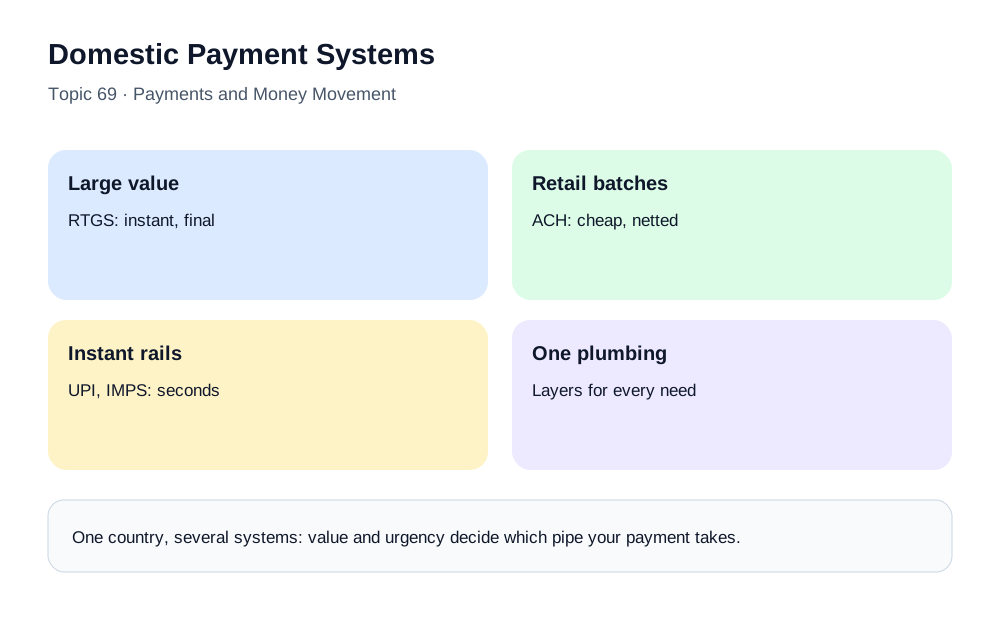
Domestic Payment Systems at a glance — RTGS, ACH, NEFT, IMPS, Fedwire, TARGET2.
The Plumbing of a National Economy
Every nation maintains infrastructure to move money between bank accounts within its borders. These domestic payment systems handle everything from salary deposits and bill payments to high-value corporate transfers and government disbursements. Their design reflects each country's economic structure, technological capabilities, and policy priorities. Understanding how these systems work reveals the plumbing of national economies and the choices that shape financial access and efficiency.
This topic maps that plumbing layer by layer. We begin with the first-principles question — why one country needs several payment systems rather than one — then descend through the three great layers: large-value systems that move the economy's big money, retail batch systems that move its everyday money, and instant payment systems that are dissolving the boundary between the two. We then examine the components beneath every system — messaging, settlement, access, governance — and close with the global trends reshaping payments and what they mean for banks. Cross-border payments, deliberately, are the next chapter's subject; here we stay inside national borders, where the architecture is complete enough to teach every principle that matters.
What you will learn in this topic:
- Why payment systems are layered by value and urgency, and what each layer optimizes
- How RTGS systems like India's RTGS, Fedwire, CHAPS, and the Eurosystem's T2 anchor the financial system
- Why batch systems like NEFT and ACH still dominate everyday payments by volume
- How UPI, PIX, and FedNow represent three different playbooks for instant payments
- The four components — messaging, settlement, access, governance — beneath every payment system
- Who pays for "free" payments, and why the answer differs by country
- What payment-system design means for banks' liquidity, fees, and competitive position
- Where domestic systems are heading: 24×7, instant, interoperable, and increasingly borderless
1. First Principles: Why One Country Needs Several Payment Systems
A naive design would build a single payment system: submit instruction, move money, done. No country works this way, and the reason is the same trade-off we met in the clearing and settlement chapter — certainty costs liquidity, and liquidity savings cost certainty. Different payments sit at radically different points on that spectrum, so economies evolved layered systems, each optimized for its segment.
Payment systems are typically organized in layers, with different systems serving different value ranges and urgency requirements. Large-value payment systems handle wholesale transactions between banks and large corporate payments where immediacy and finality are paramount — an interbank loan repayment or a securities settlement cannot wait for a batch, and cannot fail. Retail payment systems handle the high volume of smaller transactions that constitute everyday economic activity — salaries, bills, groceries — where a few hours' delay is acceptable and cost per transaction must approach zero. Instant payment systems, a more recent development, combine retail accessibility with immediate settlement, attacking the assumption that retail must wait. Together, these layers provide comprehensive coverage for the diverse payment needs of a modern economy.
There is a second reason for layering: settlement money. The safest asset in any economy is a claim on the central bank — central bank money — and the apex systems settle in it exclusively, eliminating credit risk between participants entirely. Retail systems historically settled net positions in central bank money at intervals, while the individual customer payments within a batch are technically exchanges of commercial bank money — claims on banks, not on the central bank. Customers neither know nor care, because deposit protection and bank regulation stand behind the difference — but for the system architect, the distinction between settling in central bank money and commercial bank money is the line between risk-free and risk-bearing infrastructure.
A third principle completes the foundation: payment systems are networks, and networks exhibit strong economies of scale and scope. A system every bank joins is exponentially more useful than a fragmented set of bilateral arrangements, which is why payment infrastructure gravitates toward natural monopoly or tight oligopoly — and why central banks everywhere take a direct role in operating, regulating, or catalyzing it. Payment systems are public goods wearing private clothes, and national design choices reflect how each country resolves that tension.
2. Large-Value Payment Systems: The Apex Layer
Real-time gross settlement systems form the apex of domestic payment infrastructure. These systems settle large-value transactions individually and immediately, with finality that makes them suitable for interbank settlements, securities transactions, and major corporate payments. Because they settle in central bank money, they eliminate credit risk between participants: once an RTGS payment settles, the receiver holds a claim on the central bank itself, and nothing — not even the sender's immediate collapse — can claw it back.
India's RTGS, operated by the Reserve Bank of India, processes payments with no upper limit, making it suitable for the largest transactions. A minimum threshold of two lakh rupees keeps the system focused on wholesale payments rather than retail traffic — small payments are deliberately pushed toward cheaper layers. Since December 2020, it operates twenty-four hours a day, seven days a week, three hundred sixty-five days a year, ensuring that urgent payments can be made regardless of time or date. Banks offer online initiation without charge, encouraging digital adoption while generating revenue from branch-initiated transactions — a pricing structure that quietly steers customers toward self-service channels.
In the United States, Fedwire provides similar functionality, operated by the Federal Reserve Banks. Federal Reserve Financial Services reported in July 2025 that the Fedwire Funds Service settles more than $4.7 trillion in wire transfers on an average day. It handles critical payments across interbank funding, financial-market settlement, and corporate treasury activity. The service migrated to the ISO 20022 message format on July 14, 2025; that messaging change did not itself alter the legal settlement model or processing speed. Fedwire has historically operated during defined business hours rather than continuously, though extending availability has been discussed to accommodate global markets and instant payment demands; the launch of FedNow for instant retail payments has sharpened that debate.
The United Kingdom's CHAPS handles large-value sterling payments with same-day settlement, operated under the Bank of England's oversight as the backbone of London's wholesale markets. The Eurosystem's T2 service is the current large-value RTGS platform for euro payments. T2 went live on 20 March 2023 and replaced TARGET2. It combines an RTGS service with Central Liquidity Management across TARGET Services, allowing participants across the euro area to settle central-bank operations, interbank payments, customer payments exchanged between banks, and ancillary-system obligations in central bank money. Each of these systems represents substantial investment in technology and operations, justified by the systemic importance of reliable large-value settlement: a day-long RTGS outage is a financial stability event, not an IT incident.
The practitioner's view of the apex layer centers on intraday liquidity. Every RTGS participant must fund each payment in full as it falls due, so banks hold buffers of central bank balances and eligible collateral precisely to keep payments flowing — low-yielding assets carried purely as operational fuel. Central banks assist with intraday credit facilities, queue-management algorithms, and throughput guidelines, because an RTGS that gridlocks — banks hoarding liquidity, each waiting for inflows before releasing outflows — reproduces the very settlement risk it was built to eliminate. Much of the invisible craft of treasury management is keeping this layer flowing cheaply.
3. Retail Batch Payment Systems: The Workhorse Layer
While RTGS systems handle individual large payments efficiently, their design is poorly suited for high volumes of small payments — the liquidity demands and per-transaction costs of gross settlement make no sense for a grocery bill. Retail batch systems accumulate transactions and settle them in bulk, achieving efficiency through aggregation while accepting some delay in settlement.
India's NEFT, the National Electronic Funds Transfer, operates on a half-hourly batch schedule. Transactions submitted throughout the day are collected into batches, with settlement occurring at regular intervals. This enables banks to net obligations before settlement, dramatically reducing liquidity requirements compared to gross settlement — the arithmetic of the clearing chapter's worked example, operating at national scale. NEFT handles transactions as small as one rupee with no upper limit, serving the full range of retail payment needs. Like RTGS, it now operates continuously, with transactions settling within thirty minutes of batch closure — a worst-case delay of under an hour that has quietly blurred the line between "batch" and "fast."
The United States maintains FedACH, the automated clearing house operated by the Federal Reserve, processing on the order of thirty billion transactions annually. Payroll deposits, bill payments, and government benefits flow through this system — the invisible machinery behind "direct deposit" and "auto-pay." Historically operating on next-day settlement, FedACH has expanded same-day capabilities to meet demands for faster settlement while maintaining batch efficiency, and the private-sector ACH operator runs parallel rails on the same rules. The ACH model illustrates a different governance pattern from India's: rule-making by an industry association, operation split between public and private utilities.
These batch systems balance accessibility and efficiency. They serve customers who do not need immediate settlement, offering lower costs than real-time alternatives. The batch architecture, while introducing delay, enables the high volumes and low costs that support universal payment access. Their durability surprises many observers: even where instant systems exist, batch rails persist because recurring, predictable payments — payroll on the 30th, a utility bill on the 5th — gain nothing from immediacy and everything from cheap, reliable bulk processing. The workhorse layer is not being replaced; it is being specialized.
4. Instant Payment Systems: The New Frontier
The last decade has seen explosive growth in instant payment systems that combine retail accessibility with real-time settlement. These systems process individual transactions immediately, twenty-four hours a day, providing the speed of cash with the convenience of electronic transfer. Three national playbooks illustrate how differently the frontier can be built — and how much design choices matter.
India's Unified Payments Interface represents the most successful instant payment implementation globally. UPI enables immediate fund transfers between bank accounts using mobile phones, with transactions authenticated through secure PINs. The system processes over ten billion transactions monthly, a scale that dwarfs other instant payment systems worldwide. Transaction limits of one lakh rupees for standard payments keep the system focused on retail use cases while preventing excessive risk concentration. Remarkably, person-to-person transfers carry no charge, with costs borne by the ecosystem participants and supported by the policy objective of promoting digital payments.
UPI's innovation extends beyond speed to include features that address specific payment scenarios. QR codes enable merchants to accept payments without expensive point-of-sale terminals — a roadside vendor with a printed code is, payment-wise, as equipped as a department store. Request-to-pay functionality allows billers to initiate collection rather than waiting for customer push payments. Recurring payments can be automated with customer authorization. Just as important is the architecture: UPI is an interoperable layer over bank accounts, open to third-party apps, so competition happens in user experience while the rails stay shared. These features have made UPI not merely a payment system but a comprehensive payment platform that has transformed Indian commerce.
Brazil's PIX, launched in November 2020, achieved comparable success through different design choices. Mandatory participation by large banks ensured universal availability from launch — no waiting for network effects to assemble themselves. Free person-to-person transfers drove rapid adoption, reaching roughly one hundred fifty million users within three years — an extraordinary penetration of the adult population. QR codes and payment links enabled merchant acceptance without traditional card infrastructure. PIX demonstrates that successful instant payment systems can emerge quickly when supported by regulatory mandate and ecosystem coordination: where UPI grew through open-platform organic adoption, PIX grew through central bank decree — and both worked.
The United States launched FedNow in July 2023, years behind comparable instant-payment systems in several other major markets. FedNow provides real-time settlement for participating institutions. Its network transaction limit has changed as the service has matured: Federal Reserve Financial Services raised the customer-credit-transfer and payment-return limit to $10 million effective 12 November 2025, while participants may set lower internal limits according to their own risk appetite and customer use cases. Adoption has been gradual as banks assess integration costs and use cases, illustrating that technical capability alone does not guarantee immediate transformation of payment behavior. The American case is the counterfactual made real: a country with the world's deepest financial markets was late to instant retail payments because its existing card infrastructure was lucrative, its banking sector fragmented across thousands of institutions, and no regulator mandated change. Payment-system success, it turns out, is a policy outcome as much as a technology outcome.
| System | Launch model | Pricing to users | Defining design choice |
|---|---|---|---|
| UPI (India) | Organic, open-platform | Free P2P | Interoperable app layer over bank accounts |
| PIX (Brazil) | Regulatory mandate, 2020 | Free P2P | Compulsory participation by large banks |
| FedNow (US) | Voluntary, 2023 | Bank-determined | Optional overlay beside entrenched card rails |
A Worked Example: Three Payments, Three Rails
One Friday afternoon in Mumbai, three payments are initiated within the same hour — and each travels a different layer of the architecture this chapter describes.
A corporate treasurer must pay 5 crore rupees to settle a securities purchase before end of day. Her bank sends it through RTGS: the instruction is validated, the bank's settlement account at the Reserve Bank of India is debited 5 crore in central bank money, and the receiving bank's account is credited — individually, immediately, irrevocably. Finality arrives in seconds; the securities leg can settle against it with complete confidence. The bank funded the payment from intraday liquidity held precisely for this purpose.
At six o'clock, a mid-sized company's payroll run — two thousand salary credits totaling 3 crore — goes out through NEFT. The file joins the next half-hourly batch; at batch closure, the company's bank nets its position against thousands of other banks' flows and settles the residual through its central bank account. Salaries land within the hour. Nobody needed immediacy to the second, so nobody paid for it; the batch carried two thousand payments at a per-transaction cost of paise.
Meanwhile, a customer at a vegetable stall scans the vendor's printed QR code and pays 85 rupees through UPI. Her app authenticates with a PIN; the system's switches route the instruction between her bank and the vendor's bank; both accounts update in seconds, the vendor's phone chimes confirmation, and the interbank obligations accumulate for settlement through the day. Cost to her: nothing. Cost to the vendor: nothing. Cost to the system: real — and borne, as the next sections explain, by the ecosystem under a policy choice that treats digital payments as public infrastructure.
Same city, same hour, same currency — three systems, three settlement designs, three price points. The layering is not bureaucratic duplication; it is engineering, and knowing which rail a payment should take is a practical skill every treasury and operations professional exercises daily.
5. The Components Beneath Every Payment System
Behind every payment system lies infrastructure that enables its operation. Understanding these components illuminates how payment systems actually function and evolve — and explains why apparently similar national systems behave so differently.
Messaging standards define how payment instructions are formatted and transmitted. Traditional systems use proprietary formats or national standards that vary across countries and systems. ISO 20022, an international standard for financial messaging, is being adopted globally to enable richer data, better interoperability, and more efficient processing — an invoice number, purpose code, and remittance detail traveling with the payment rather than in a separate email. This migration represents substantial investment but promises long-term benefits in efficiency and innovation capacity, and it is the quiet enabler of the cross-border ambitions discussed in the next chapter.
Settlement mechanisms determine how finality is achieved. Some systems settle in central bank money, providing maximum safety. Others use commercial bank money or settlement guarantees from system operators. The choice involves trade-offs between risk, cost, and availability that reflect system design priorities — an instant retail system settling each transaction in central bank money around the clock demands that central bank systems themselves run around the clock, an operational commitment many central banks have only recently made.
Access arrangements determine who can initiate payments through the system. Direct participation requires technical infrastructure and liquidity commitments that only large banks can meet. Indirect participation, through correspondent relationships with direct participants, extends access to smaller institutions — at the cost of dependency and additional intermediation. Tiered participation models balance efficiency, with fewer direct participants reducing system complexity, against resilience and competition considerations: a system of three direct participants is cheap to run and fragile to a fault.
Governance structures vary from central bank operation to private sector consortia. Central bank operated systems, like RTGS and TARGET2, emphasize safety and public policy objectives. Privately operated systems may prioritize efficiency and commercial returns — card networks being the extreme case. Hybrid models combine public oversight with private operation, attempting to capture benefits of both approaches. Governance decides the questions that matter most in a crisis: who sets fees, who funds investment, who is forced to participate, and who answers when the system fails.
6. Who Pays for "Free" Payments?
The proliferation of zero-fee consumer payments conceals a real economic question: payment systems cost money to build and run, so someone is paying — and banking professionals need to know who. The answers differ by model. In India's UPI, the costs are borne by ecosystem participants — banks fund the processing while monetizing adjacent services, and the state absorbs subsidy costs — all underwritten by the policy judgment that digital-payment externalities (tax visibility, inclusion, reduced cash handling) exceed the subsidy. In card-based systems, merchants pay interchange and network fees, passing costs into prices — meaning cash-paying customers historically subsidized card users, a regressive quirk regulators increasingly scrutinize. In FedNow's model, banks pay participation and transaction fees and decide for themselves what to charge customers.
For banks, the strategic implication is double-edged. Free instant payments erode transaction-fee income and card-interchange revenue — a genuine profit headwind — while slashing cash-handling costs, deepening customer engagement, and creating data-rich relationships that support cross-selling. The banks that thrive in zero-fee environments are those that treat payments as the relationship layer rather than the profit layer; those that treated payment fees as an entitlement have found the ground moving under them.
7. Global Trends in Payment Systems
Several trends are reshaping domestic payment systems worldwide, driven by technology, competition, and changing expectations.
Real-time capability is becoming the norm rather than the exception. Batch systems are enhancing speed or being replaced by instant alternatives. The expectation that payments should settle immediately, once limited to cash and large-value systems, now extends across the payment spectrum — and regulators increasingly treat instant capability as baseline infrastructure rather than innovation.
Twenty-four-hour availability is replacing limited operating hours. Global commerce and gig economy work do not respect business hours, creating demand for payment access at all times. Systems that once closed on weekends and holidays now operate continuously — India's RTGS going 24×7 in December 2020 being a landmark, since even large-value money now moves on Sunday night.
Free consumer payments are becoming standard, with costs absorbed by banks, merchants, or governments rather than charged directly to payment originators. This reflects policy priorities of promoting financial inclusion and digital adoption, along with competitive pressure to match free offerings from rivals — and it permanently reprices the economics of retail banking, as the previous section described.
Interoperability is expanding across borders. Regional payment arrangements enable transfers between countries using domestic payment infrastructure. Bilateral links, like the connection between India's UPI and Singapore's PayNow, demonstrate the technical feasibility of cross-border instant payments — a migrant worker sending money home in seconds at near-zero cost, where the legacy correspondent chain quoted days and percentage points. The vision of a globally interoperable payment network, while distant, is becoming more concrete, and it threatens the correspondent-banking economics that the next chapter examines.
A fifth trend runs beneath all of these: payments as data. Rich ISO 20022 messaging and instant-system ubiquity generate transaction data of unprecedented granularity, feeding credit scoring, fraud analytics, and monetary policy observation. The payment system is becoming the economy's nervous system, sensing activity in near real time — an opportunity for better banking and a standing question for privacy policy.
Domestic payment systems are essential infrastructure for modern economies, as fundamental as transportation networks or power grids. Their design affects transaction costs, financial inclusion, economic efficiency, and monetary policy transmission. As these systems evolve, they shape how commerce is conducted and how value flows through societies.
8. Common Misconceptions About Domestic Payment Systems
"One good payment system should be enough for a country." The layers exist because certainty, liquidity, cost, and volume pull in opposite directions. Forcing payroll through RTGS would waste liquidity; forcing an interbank settlement through a batch would recreate Herstatt-era risk. Layering is optimization, not redundancy.
"Instant payments settle in some special new money." They settle in the same money as everything else — central bank money at the interbank leg, commercial bank money at the customer leg. The innovation is speed and availability of processing, not a new monetary substance.
"Free payments cost nothing." Zero user fees shift costs rather than eliminate them — to banks, merchants, or the state. Someone funds the rails; the policy question is whether the distribution is efficient and fair, not whether costs exist.
"Batch systems are obsolete now that instant systems exist." Recurring, predictable payments gain nothing from immediacy and everything from cheap bulk processing. Batch rails persist by specializing — payroll and bill runs remain their natural habitat even in UPI's India and PIX's Brazil.
"Payment systems are purely technical infrastructure." They are policy instruments: pricing shapes inclusion, access rules shape competition, operating hours shape commerce, and data standards shape surveillance and innovation. Every "technical" parameter embeds a political choice.
"The US leads in payment innovation." In instant retail payments the United States was a decade behind India, Brazil, and others — incumbent card economics and a fragmented banking sector delayed FedNow to 2023, with gradual adoption since. Leadership in finance and leadership in payment infrastructure are different things.
"Central banks run payment systems to make money." Central bank operation of RTGS and instant rails is a public-good function: fees, where levied, recover costs. The motivation is systemic safety and policy objectives — inclusion, competition, monetary transmission — not profit; where private returns were the goal, the systems would price accordingly and exclude the unprofitable, defeating the purpose.
"Bigger transaction limits are always better for instant systems." Caps like UPI's one-lakh standard limit are deliberate risk design: they keep retail systems retail, bound fraud exposure per transaction, and push genuinely large payments toward rails built for their risk profile. Limit-setting is system architecture, not inconvenience.
9. Frequently Asked Questions
What is the difference between RTGS, NEFT, and UPI in India? RTGS is the large-value layer: individual, immediate settlement in central bank money, minimum two lakh rupees. NEFT is the retail batch layer: half-hourly net settlement, from one rupee up. UPI is the instant retail layer: immediate person-to-person and merchant payments via mobile, limits around one lakh rupees for standard transactions. All three now run continuously; they differ in what they optimize.
Why do large-value systems settle in central bank money? Because it eliminates credit risk between participants: a settled claim on the central bank cannot default. For payments that are themselves systemic — interbank funding, securities settlement — anything less would leave the core of the financial system resting on the solvency of its weakest member.
Who can use FedNow, PIX, or UPI — banks or customers? Customers never touch these systems directly; banks and payment providers participate, and customers use their apps and interfaces. Access design — direct versus indirect participation — determines which institutions can offer the service and on what economics.
What is ISO 20022 and why does it matter? An international standard for financial messaging that lets rich, structured data travel with each payment — invoice references, purpose codes, party identification. It improves reconciliation, compliance screening, and interoperability, and it is the technical foundation for linking domestic systems across borders.
Why did Brazil's PIX adopt so fast while FedNow's uptake was gradual? Mandate versus voluntarism: PIX required large banks to participate and made person-to-person transfers free at launch, creating instant universal coverage. FedNow launched as an optional overlay in a market with entrenched card rails and thousands of banks, each making its own cost-benefit calculation.
Are instant payments safe from fraud? Speed cuts both ways: funds arrive instantly and, once gone, are hard to recall, making authorized-push-payment fraud a growing concern. Systems respond with confirmation-of-payee checks, transaction limits, cooling periods, and liability frameworks — but instant finality permanently shifts the fraud battle to prevention rather than reversal.
What happens to my payment if a system goes down mid-transaction? Well-designed systems are atomic: a payment either completes fully or does not happen at all — there is no state where money leaves one account and never arrives at another. Outages delay rather than lose payments; reconciliation and queue-restart procedures then drain the backlog. Ambiguous customer-facing states are resolved by the bank against system logs, which is why banks invest heavily in reconciliation tooling.
Do instant payment systems replace cash? They substitute at the margin — UPI and PIX visibly reduced cash and card growth in their markets — but cash persists for privacy, resilience during outages, and populations outside digital reach. The realistic trajectory is cash as a declining fallback rather than a vanished instrument, which is also why central banks keep issuing it.
How do domestic payment systems connect across borders? Traditionally through correspondent banking and messaging networks — the next chapter's subject. Increasingly also through direct bilateral links between instant systems, such as UPI–PayNow, which route cross-border transfers through domestic rails at domestic speed and cost.
10. Key Terms in This Chapter
- Large-value payment system — wholesale rails settling big, urgent payments individually with finality.
- RTGS — real-time gross settlement; the apex design, settling in central bank money.
- Retail payment system — high-volume, low-value rails for everyday transactions.
- Batch / deferred net settlement — accumulating payments and settling net positions at intervals.
- ACH — automated clearing house; the batch model behind payroll and bill payments in the US and elsewhere.
- Instant payment system — retail payments settled individually in seconds, around the clock.
- UPI / PIX / FedNow — India's open-platform, Brazil's mandated, and America's voluntary instant-payment models.
- Central bank money vs commercial bank money — claims on the central bank versus claims on banks; the safety hierarchy of settlement assets.
- ISO 20022 — the global standard for rich, structured payment messaging.
- Direct / indirect participation — full system membership versus access through a correspondent participant.
- Interchange — card-system fees paid by merchants' banks to cardholders' banks; the economics free P2P systems bypass.
- Confirmation of payee — verifying the recipient's name before sending; a frontline instant-payment fraud defense.
- Intraday liquidity — balances and collateral held to fund RTGS payments as they fall due within the day.
- Interoperability — systems exchanging payments seamlessly, domestically or across borders.
11. Interview Insights: How This Topic Appears in Banking Interviews
"Explain the layered structure of a country's payment systems." Value and urgency define the layers: RTGS for wholesale finality, batch for cheap retail volume, instant for immediacy at retail scale. Add the "why" — certainty versus liquidity versus cost trade-offs, and settlement in central bank versus commercial bank money — and you demonstrate architecture, not just labels.
"Why is UPI considered the world's most successful instant payment system?" Scale (over ten billion transactions monthly), design (interoperable layer over bank accounts, open to third-party apps, QR-driven merchant acceptance), and economics (free P2P as inclusion policy). Comparing it to PIX's mandate model and FedNow's voluntary model shows you understand that payment success is a policy-and-design outcome, not merely a technology one.
"Who pays for free payments, and is that sustainable?" Costs shift to banks, merchants, or the state rather than vanishing. Discuss the trade-offs — interchange loss versus cash-handling savings and engagement value for banks; inclusion and formalization gains for the state — and conclude that sustainability depends on whether ecosystem value exceeds ecosystem cost, which in high-volume digital economies it generally does.
"What risks do instant payment systems introduce?" Instant finality makes fraud losses hard to reverse — authorized-push-payment fraud is the headline risk — plus 24×7 operational resilience demands, liquidity management around the clock, and fraud-velocity problems when mule accounts move funds faster than investigators follow. Mitigants: confirmation of payee, limits, behavioral analytics, liability rules.
"How do RTGS systems avoid gridlock when liquidity is tight?" Describe the toolkit: intraday central bank credit against collateral, queue-management that releases offsetting payments together, throughput expectations that discourage end-of-day hoarding, and hybrid continuous-netting designs. Recognizing gridlock as a behavioral equilibrium — banks waiting on inflows before releasing outflows — rather than a software bug shows operational maturity.
"If you were designing a payment system for a developing economy, what would you choose?" Strong answers start from objectives — inclusion, cost, safety — then design: instant retail rails with mandated or catalyzed participation, QR acceptance to skip card-terminal economics, central-bank-money settlement at the interbank leg, ISO 20022 from day one. Citing UPI and PIX as proven templates while noting FedNow's cautionary adoption lesson signals real comparative understanding.
Summary and Key Takeaways
- Domestic payment systems are layered by value and urgency because certainty, liquidity, cost, and volume cannot be optimized in one design.
- RTGS systems — India's RTGS, Fedwire, CHAPS, TARGET2 — anchor finance by settling large payments individually in risk-free central bank money, at the price of heavy intraday liquidity.
- Batch systems like NEFT and ACH remain the workhorses of everyday payments, specializing in cheap, reliable bulk processing even in the instant era.
- UPI, PIX, and FedNow are three playbooks for instant payments — organic open platform, regulatory mandate, voluntary overlay — proving payment outcomes are policy and design choices, not just technology.
- Messaging (ISO 20022), settlement asset, access tiers, and governance are the four components that determine how any system actually behaves.
- "Free" payments shift costs to banks, merchants, or the state; banks must treat payments as the relationship layer, not the fee layer.
- The direction of travel is clear: real-time, 24×7, zero-fee at the point of use, data-rich, and increasingly interoperable across borders — the subject of the next chapter.
Next: Topic 70 — Swift and Cross-Border Payments →
<!-- MBA-DEEP-DIVE-START -->Deep Dive: Domestic Payment Systems as a Portfolio of Service Levels
A national payment landscape is best understood as a portfolio of service levels rather than a list of rails. Customers care about speed, certainty, availability, price, limits, reachability, and the ability to recover when something goes wrong. Banks care about the same things plus settlement liquidity, scheme obligations, fraud exposure, operating cost, technology resilience, regulatory reporting, and integration complexity. A payment rail exists because a particular combination of those requirements cannot always be delivered efficiently by the same infrastructure.
This is why domestic payments should not be designed around the question “Which system is fastest?” The better question is which system gives the right economic and operational outcome for this payment. A high-value treasury transfer, a salary file, a recurring utility debit, an e-commerce purchase, and a person-to-person instant payment can all move the same currency while requiring different controls and settlement behaviour.
Service selection should be rule-driven
A bank that offers multiple rails needs a routing framework. Inputs can include amount, urgency, requested execution time, beneficiary reachability, transaction type, customer entitlement, scheme availability, cut-off, cost, fraud risk, settlement-liquidity position, and product promise.
Suppose a corporate customer sends a ₹15 lakh payment. The amount is eligible for more than one domestic service. If the customer requests immediate final settlement for a time-critical securities obligation, RTGS may be appropriate. If the payment is a routine supplier transfer with no urgency, another supported rail may be cheaper and consume less intraday liquidity. If both parties are reachable through an instant scheme and the customer product supports it, instant processing may be possible subject to the scheme and bank limits.
The bank should not make routing opaque. Customer terms and channels should clearly distinguish “instant”, “same day”, “scheduled”, and “best effort” where those concepts apply. A payment engine can optimise internally, but it must not silently downgrade a service promise.
Limits exist at several layers
Payment limits are often misunderstood because a customer sees one number in an app while the infrastructure contains several.
There can be:
- a scheme or network maximum;
- a bank product limit;
- a customer-specific limit;
- a channel limit;
- a user or corporate-authority limit;
- a fraud-control threshold;
- a regulatory or risk limit for a particular category;
- a liquidity or settlement exposure limit.
The effective limit is whichever applicable rule is most restrictive at that moment.
This is why an instant-payment network increasing its maximum does not automatically mean every customer can immediately send that amount. Banks may retain lower limits based on risk, product design, and operational readiness.
Availability must be defined end to end
A scheme can be available 24/7 while a bank’s complete customer service is not. Planned maintenance in the mobile channel, unavailable fraud screening, core-banking downtime, exhausted prefunding, or sponsor-bank maintenance can still prevent customer processing.
A bank should therefore measure end-to-end service availability, not merely external scheme uptime. The service is available only when the customer can submit a valid instruction and the bank can process it to the promised outcome.
This distinction is especially important for 24/7 instant payments. Weekend operations require on-call technology, fraud, treasury, reconciliation, customer support, and incident management. A bank that connects to an always-on scheme but staffs its exceptions only during weekday office hours has not truly built an always-on payment service.
High-value systems turn liquidity into an operational resource
RTGS is frequently described through finality and safety, but practitioners experience it through intraday liquidity. Each outgoing settlement consumes central-bank money or the relevant settlement balance. Large flows are therefore coordinated with treasury.
Banks forecast opening balances, expected customer payments, interbank obligations, securities settlement, central-bank operations, incoming receipts, and potential stress outflows. Queue information matters because a bank may have enough liquidity for the day in aggregate but not at the moment a large payment becomes due.
Liquidity-saving mechanisms and intraday credit can reduce the amount of idle funds required, but they do not remove the need for control. Treasury should know which assets can be mobilised as collateral, how quickly they can be used, and what happens if an expected incoming payment does not arrive.
Batch systems remain economically valuable
The existence of instant payments does not make batch processing obsolete. Predictable bulk flows often benefit from aggregation, scheduling, standardised processing, and lower unit cost.
Payroll is a good example. A company may need 50,000 salary credits to arrive on a defined date, not within five seconds of file submission. The bank can validate the file, check authorisation, process exceptions, and release the payments through the appropriate bulk mechanism. The important service level is completeness and correct value date, not immediate individual settlement.
Batch systems also support reconciliation efficiently because expected totals, file controls, and settlement cycles are well defined. Their continued role is therefore a design choice, not technological backwardness.
Instant payments convert operational delay into fraud risk
When a payment becomes final or near-final in seconds, the bank loses the long review window that existed in slower systems. Fraud detection has to move earlier and become more automated.
Useful controls include beneficiary risk, device behaviour, transaction velocity, account history, amount patterns, recent credential changes, unusual geography, mule-account intelligence, and confirmation-of-payee or name-check mechanisms where available.
But the bank must balance fraud control against the purpose of instant payments. Holding every new beneficiary for hours would reduce fraud but destroy the service. Risk-based step-up authentication, targeted holds where permitted, transaction limits, and post-transaction interbank response mechanisms create a more proportionate model.
Request-to-pay is not the same as a debit
Modern domestic ecosystems increasingly support a request or collection message that asks the payer to approve a payment. The key legal and operational point is that a request is not automatically a transfer of funds.
The customer may accept, reject, ignore, or dispute the request according to the service. Systems should preserve the difference between request state and payment state. A biller should not mark an invoice paid merely because a request was delivered.
This distinction becomes important in recurring and merchant scenarios where the user experience can make a request appear similar to a direct debit or standing instruction even though the underlying authority is different.
Direct debit and push credit create different risk
A push payment is initiated by the payer or someone authorised by the payer. A direct debit or pull model allows the creditor to initiate collection under a mandate.
The risk allocation differs. Pull payments require mandate management, collection rules, refund or return rights, presentment timing, and control of unauthorised collections. Push payments focus more on payer authentication and beneficiary fraud.
A domestic payment architecture should therefore not use one generic “transfer” lifecycle for every instrument. Mandate-based payments need their own states and evidence.
Participant access affects competition
Payment systems can permit direct access to banks, non-banks, payment institutions, clearing entities, or other regulated participants depending on the jurisdiction and service. Broader access can increase competition and innovation, but it also changes the risk framework.
A direct participant may need settlement liquidity, operational resilience, security, compliance capability, financial resources, and governance strong enough to meet scheme obligations. An indirect participant relies on a sponsor and therefore adds concentration and third-party dependency.
Regulators and operators balance these considerations when setting access criteria. For banks, a decision to move from indirect to direct access should be supported by a business case that includes not just transaction fees but liquidity, technology, staffing, testing, resilience, and compliance cost.
Scheme rules are part of the product specification
A domestic payment product cannot be defined only by the bank’s own requirements. Scheme rules determine message requirements, eligibility, cut-offs, settlement, returns, dispute windows, participant responsibilities, fraud procedures, and operational obligations.
A product team should translate these external rules into internal behaviour. If a scheme introduces a new mandatory reason code, the change may affect channel validation, payment-hub mapping, operations queues, customer messages, reporting, and analytics.
This is why payment-rule changes often touch many systems even when the external message change appears small.
Reference data controls routing and settlement
Domestic payment systems depend on directories and reference data: participant identifiers, routing numbers, bank codes, account formats, branch data, scheme reachability, holidays, limits, and service capabilities.
A wrong routing entry can send a payment to the wrong participant or cause rejection. A stale reachability directory can make a bank offer an instant service to a beneficiary institution that is not actually reachable for that transaction type.
Reference data should therefore have clear ownership, versioning, effective dates, automated distribution where possible, and reconciliation between source and consuming systems.
Reconciliation differs by settlement model
For RTGS, a bank can often reconcile individual settled transactions against the settlement account. For a batch system, customer transactions may reconcile to files and clearing totals while the external cash movement represents a net position. For instant systems using prefunded or technical positions, the bank may need both transaction reconciliation and position reconciliation.
The reconciliation design should mirror the economics. Comparing every retail customer payment directly with one net central-bank debit will not work unless the system also preserves the clearing calculation that connects them.
A strong control chain can explain how thousands of customer entries became one settlement amount and then prove that the settlement amount posted correctly to the bank’s books.
Domestic does not mean simple financial-crime risk
A payment staying within one country can still involve fraud, money laundering, mule networks, scam proceeds, sanctions exposure where domestic law applies, tax evasion, or prohibited activity.
Instant domestic networks are especially attractive to fraudsters because funds can be split rapidly across multiple accounts. Banks therefore need network-level collaboration as well as institution-level controls. Information sharing, mule-account reporting, beneficiary-risk data, and rapid freezing or recovery mechanisms can improve outcomes within the applicable legal framework.
The presence of a national identity or account-numbering system helps data quality but does not eliminate misuse of legitimate accounts.
Customer complaints reveal system design weaknesses
Payment complaints are valuable operational data. Repeated complaints about “debited but not credited”, unexplained fees, delayed reversals, duplicate transactions, failed refunds, or confusing statuses can indicate a process defect rather than isolated customer misunderstanding.
Banks should categorise complaints by payment rail, failure stage, root cause, and customer impact. Product and operations teams can then distinguish infrastructure problems from bank-specific defects.
A decline in technical failure rate does not necessarily mean customer experience improved if the remaining exceptions take days to resolve.
Migration between domestic rails needs coexistence planning
When a country modernises a payment infrastructure or introduces a new standard, old and new rails often coexist. Banks need routing rules, customer migration, message transformation, operational training, test environments, reporting alignment, and fallback plans.
The highest-risk period is frequently not the final cutover but coexistence, when two formats or services are supported and data can diverge between them.
A bank should decide which system is the canonical source for payment status, how identifiers are preserved across translation, and how reconciliation distinguishes old-rail from new-rail transactions.
A domestic payment incident scenario
Imagine an instant-payment switch at a bank remains online, but its core ledger begins responding slowly. The channel continues accepting customer payments. Fraud checks pass and the external scheme accepts the instructions, yet internal posting responses are delayed.
If the bank keeps sending blindly, it can create a dangerous mismatch: external settlement may become final while the payer account has not been booked correctly. If it stops every payment immediately, customers lose service even if the ledger slowdown is temporary.
The correct response depends on architecture. The bank may have a controlled reservation model, durable queue, duplicate protection, and reconciliation that allow safe continuation for a limited period. Or it may need to reject new instructions until ledger integrity is restored.
The incident demonstrates why availability is subordinate to financial correctness. A payment service that remains technically “up” while its books become inconsistent is not available in any meaningful banking sense.
What excellence looks like
A strong domestic-payments organisation understands every rail as a combination of customer promise, eligibility, message flow, settlement model, liquidity requirement, fraud exposure, exception model, and reconciliation method. It does not route purely by speed. It distinguishes network limits from customer limits, scheme availability from bank availability, and a request-to-pay from an authorised debit.
It also maintains current knowledge of infrastructure change. Names, limits, operating hours, message formats, and participation rules evolve. The durable skill is not memorising one year’s values; it is knowing which operator or central-bank rule defines them and ensuring product configuration, customer communication, and operations change together when the rule changes.
<!-- MBA-DEEP-DIVE-END -->