Visual overview
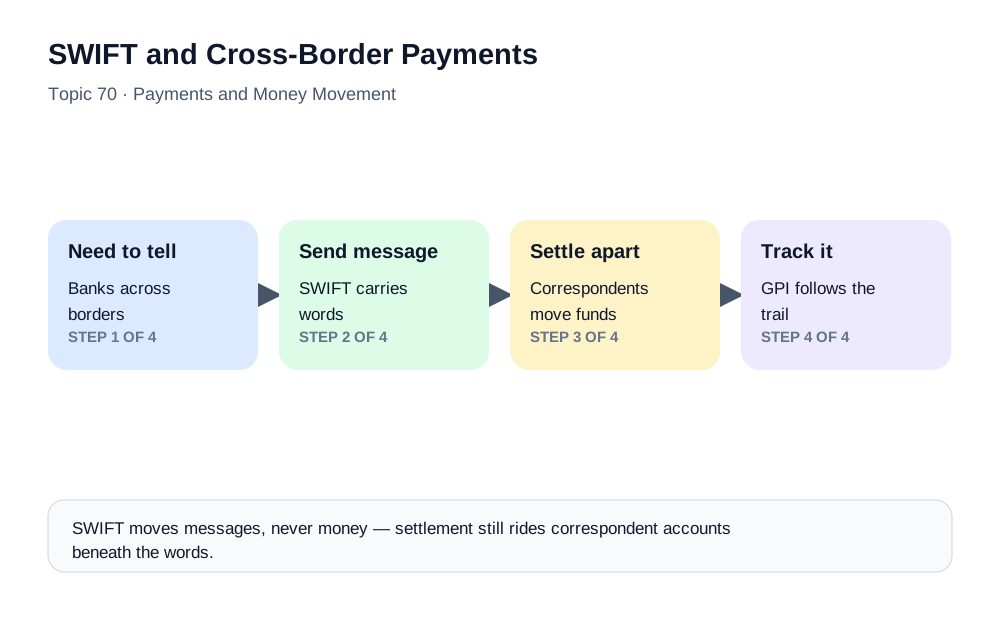
SWIFT and Cross-Border Payments at a glance — Message types, GPI, intermediary banks.
The Secure Messaging Network Behind Global Finance
Swift is a member-owned cooperative that provides secure financial messaging services to banks, financial institutions, market infrastructures, and large corporates. Its network connects more than 11,500 institutions across more than 200 countries and territories.
The most important fact is also the most frequently misunderstood:
Swift sends financial messages. Swift is not a bank, does not hold customer accounts, and does not itself settle the money.
The actual transfer of value occurs through correspondent accounts, central bank accounts, clearing and settlement systems, securities infrastructures, and the internal books of participating institutions. Swift provides the trusted communication layer that helps those institutions exchange instructions, confirmations, reports, and investigation messages.
1. Why Swift Was Created
Before Swift, international financial communication relied heavily on telex, proprietary formats, manual interpretation, and bilateral authentication arrangements. This created operational risk:
- instructions could be ambiguous;
- authentication was difficult to standardise;
- message formats varied by institution;
- manual processing increased delays and errors;
- scaling correspondent relationships was expensive.
Swift was founded in 1973 and began live operations in 1977. Its value came from combining a secure network with standard message formats and common operating rules.
2. Messaging Is Not Funds Settlement
Consider a bank in India sending US dollars to a beneficiary at a bank in the United States.
The sending bank may use Swift to instruct a US correspondent to debit its dollar Nostro account and transfer value onward. The correspondent may then settle through Fedwire, CHIPS, an internal book transfer, or another correspondent relationship.
Swift transports the instruction and related status information. The funds move through the account and settlement relationships.
This distinction explains several real operational situations:
- A Swift message can be delivered successfully while the payment is held for compliance review.
- A payment can be rejected by a correspondent after the original message passed network validation.
- A customer can be debited before interbank settlement completes.
- Interbank settlement can complete before a beneficiary bank posts the final customer credit.
- A message acknowledgement confirms network or format processing, not necessarily beneficiary receipt.
3. Swift Services and Interfaces
Swift supports several services for different financial use cases.
FIN
FIN is the traditional store-and-forward service used for MT messages. It provides message validation, secure delivery, acknowledgements, and non-repudiation controls for supported message categories.
FINplus
FINplus supports ISO 20022 financial messages, including CBPR+ cross-border payments and reporting traffic. It applies the relevant usage guidelines and network validation rules.
InterAct
InterAct supports structured message exchange and is used by several market infrastructures and Swift services. Depending on the service, it can support store-and-forward or real-time interaction patterns.
FileAct
FileAct supports the secure transfer of files. It is useful when institutions need to exchange bulk data, reports, securities files, or other content that is not suited to a single financial message.
The service used does not by itself define the payment's legal finality. Finality comes from the relevant scheme, settlement system, account relationship, and law.
4. MT Messages and ISO 20022
Swift MT messages use established field-based formats. Examples include:
- MT 103 for a single customer credit transfer;
- MT 202 for a financial-institution transfer;
- MT 202 COV for the cover leg linked to an underlying customer credit transfer;
- MT 940 and MT 950 for account reporting;
- MT 700-series messages for documentary credits and trade finance.
ISO 20022 messages use a richer business model and structured XML syntax. Examples relevant to payments include:
- pacs.008 for a financial-institution-to-financial-institution customer credit transfer;
- pacs.009 for financial-institution credit transfers;
- pacs.002 for payment status reporting;
- pacs.004 for payment returns;
- camt.052, camt.053, and camt.054 for account reporting;
- camt.056 and camt.029 for cancellation and investigation-related flows in applicable practices.
ISO 20022 does not mean that every field is unlimited or optional. Each message is constrained by its schema, business rules, market practice, network validation, and the receiving institution's implementation.
5. What Changed in November 2025
On 22 November 2025, the coexistence period for CBPR+ cross-border payment-instruction messages ended.
This does not mean that every MT message disappeared from Swift. The change applied to the defined CBPR+ payment-instruction scope.
After the end of coexistence:
- certain unsupported MT payment instructions are negatively acknowledged;
- certain MT payment instructions may use chargeable contingency processing, where Swift validates and converts them into ISO 20022 for delivery through FINplus;
- in-flow translation remains relevant for institutions that still require an embedded MT representation for internal processing;
- the migration roadmap continues for additional message families and use cases beyond the original payment-instruction scope.
A bank therefore cannot simply state “MT ended.” It must identify the exact message type, business use case, Swift service, market practice, and applicable transition rule.
6. The Deferred November 2026 Milestones
The next major CBPR+ operational milestone was planned for November 2026. On 27 August 2026 Swift accepted a community request to extend the structured address migration and deferred all payments changes in Standards Release 2026. No new date has been set, and Swift expects to give an update by December 2026 at the latest. Swift deferral announcement.
Postal addresses
Swift had planned to remove fully unstructured postal addresses from the in-scope CBPR+ messages after 14 November 2026. That removal is deferred, and unstructured addresses remain accepted until Swift publishes a new date. Hybrid addresses remain valid and fully structured addresses remain the recommended target, so parties and agents should keep moving to fully structured or hybrid postal addresses, subject to the detailed usage rules and exceptions.
The deferral changes the deadline, not the direction. For banks, this is not only a message-format change. It affects:
- customer and counterparty master data;
- onboarding and KYC processes;
- channel screens and APIs;
- payment-hub canonical models;
- sanctions and AML screening;
- mapping and transformation logic;
- repair interfaces;
- data warehouses, reporting, and archives;
- corporate-client communication and testing.
MT 101 interbank relay
Swift's roadmap still lists November 2026 as the end of coexistence for the in-scope MT 101 interbank relay use case, with pain.001 becoming the strategic ISO 20022 message, but Swift warns that its dates may no longer be accurate after the deferral and other payments changes will be phased separately. Treat the date as unconfirmed and check Swift's current published timeline. Institutions must distinguish between the specific interbank relay migration and other customer-to-bank arrangements they may support.
Exceptions and investigations
Swift's exceptions and investigations roadmap is moving toward structured ISO 20022 messages and Case Management capabilities. Banks need to prepare operations, workflow, correspondence, RMA arrangements, integration, and archival processes rather than treating investigations as a simple message-format conversion.
7. Serial and Cover Payments
Serial payment
In a serial payment, the customer transfer instruction passes through the chain of institutions toward the beneficiary bank. Each institution processes and forwards the payment according to its account relationships and routing decision.
Cover payment
In a cover payment, the customer payment information moves toward the beneficiary bank while a separate financial-institution transfer moves the cover funds through correspondents.
The underlying customer transfer and the cover payment must remain linked. In MT flows, this relationship is commonly associated with MT 103 and MT 202 COV. In ISO 20022 CBPR+ flows, pacs.008 and pacs.009 COV are used under the relevant market practice.
Poor linkage creates compliance, investigation, and reconciliation risk because an institution may see the funds movement without sufficient underlying customer information.
8. UETR and Swift GPI
The Unique End-to-end Transaction Reference, or UETR, provides a globally unique reference for tracking an eligible payment through the correspondent chain.
Swift GPI uses the UETR and shared tracking information to improve visibility over:
- where the payment is in the chain;
- when an intermediary processed it;
- when it reached the beneficiary institution;
- whether it was rejected, held, returned, or credited;
- relevant status and charge information available through the service.
The UETR must survive mapping, enrichment, screening, routing, repair, and archival processes. If an internal system drops or replaces it incorrectly, the bank can lose end-to-end traceability even though the external network supports tracking.
Tracking also does not replace settlement. A tracker reports lifecycle information; it does not itself move the funds.
9. Validation and Acknowledgements
A Swift payment passes through several layers of validation.
Network and syntax validation
The network checks whether the message meets the applicable format and usage rules. A message that fails may receive a negative acknowledgement and never reach the receiver.
Bank business validation
A message that passes network validation can still fail at the receiving institution because of:
- an invalid or closed account;
- unsupported service or currency;
- missing bilateral agreement;
- sanctions or AML concerns;
- duplicate detection;
- routing restrictions;
- local regulatory requirements;
- scheme or product rules.
An acknowledgement therefore needs careful interpretation. A network ACK does not prove that the payment was booked, settled, or credited to the beneficiary.
10. RMA, Security, and the Customer Security Programme
The Relationship Management Application, or RMA, helps institutions control which counterparties may send particular categories of Swift messages to them. RMA is a messaging authorisation control; it is not a substitute for account mandates, credit limits, sanctions controls, or settlement agreements.
Swift's Customer Security Programme establishes a common security-control framework for institutions using the network. Banks remain responsible for securing their own environments, interfaces, identities, privileged access, transaction controls, logging, and incident response.
A secure Swift network cannot compensate for a compromised bank endpoint. End-to-end security requires both network resilience and strong controls within every participating institution.
11. Operational Payment Flow
A simplified Swift-enabled cross-border payment may follow this lifecycle:
- A customer submits a payment through a branch, online channel, API, or file.
- The bank validates authority, balance, limits, beneficiary data, and duplicate risk.
- Fraud, sanctions, and AML controls are performed.
- The payment hub selects a correspondent and determines serial or cover routing.
- The bank creates the applicable MT or ISO 20022 message under the current rules.
- The Swift interface applies technical controls and sends the message through FIN or FINplus.
- The receiving institution acknowledges network receipt and performs its own business controls.
- Correspondent accounts or market infrastructures settle the financial obligation.
- The beneficiary bank credits the customer according to its posting model and applicable rules.
- Statuses, confirmations, account reports, and statements return through the chain.
- Operations and reconciliation teams compare messages, internal postings, Nostro entries, charges, and settlement records.
Every step needs its own status. Using one generic “Swift sent” status is insufficient for customer service, investigations, and operational control.
12. Swift and Alternative Infrastructures
Swift should not be compared simplistically with every clearing or settlement system.
- Swift is primarily a financial messaging network and cooperative platform.
- A domestic RTGS system settles high-value obligations in a currency.
- A correspondent bank provides accounts and settlement reach.
- CIPS provides renminbi payment clearing and settlement capabilities and can interact with Swift services.
- Instant-payment systems provide scheme rules, reachability, processing, and a defined settlement model.
- Digital-asset or DLT platforms may combine messaging, asset representation, and settlement differently.
These infrastructures can compete in some areas, complement one another in others, and connect through gateways or common standards. The correct comparison starts by identifying the function: messaging, clearing, settlement, liquidity, compliance, or customer experience.
13. Audit Evidence Is Part of Payment Correctness
A bank should be able to reconstruct the complete Swift history of a material payment without depending on screenshots or individual memory. That history should include the original customer instruction, the bank's canonical transaction, each transformed outbound payload, the UETR and internal identifiers, approval and repair actions, technical acknowledgements, correspondent references, account-settlement evidence, investigation correspondence, and final reconciliation. The record should preserve versions rather than overwrite earlier states when data is legitimately corrected.
This evidence has practical value beyond audit. It lets operations distinguish a customer-data problem from a mapping defect, a network rejection, a correspondent compliance hold, or a settlement delay. It also allows migration teams to prove that archived transactions remain searchable after a platform replacement. Retention, privacy, and access rules still apply, but traceability should survive for as long as the bank's legal, regulatory, operational, and customer-service obligations require it.
13. The Swift Interface Is a Controlled Banking Gateway
Inside a bank, the Swift interface should not be treated as a simple network adapter. It is a privileged gateway capable of sending legally and financially significant instructions to other institutions. Its architecture therefore requires strong separation between message creation, approval, release, network transmission, and technical administration.
A payment hub may create the business message, but the interface still needs to validate service, sender, receiver, message type, authentication, and technical readiness before transmission. Privileged users who administer certificates, RMA, routing, or interface configuration should not also have unrestricted ability to create and approve financial messages. Sensitive changes require maker-checker control, audit logging, and periodic entitlement review.
The interface should also preserve evidence. Operations may need to prove when a message was created, approved, queued, transmitted, acknowledged, negatively acknowledged, or retried. A screenshot is not a sufficient audit trail. Durable logs and transaction records are part of the financial control environment.
14. ACK, NAK, Delivery, and Business Status Need Separate Meanings
Swift processing produces technical states that should not be confused with payment outcomes. A message can be accepted by the bank's interface but not yet transmitted. It can be transmitted and receive a network acknowledgement. It can be delivered to the receiver and later fail the receiver's business controls.
A negative acknowledgement usually indicates that the message did not pass the applicable network or usage validation and therefore needs technical or data correction before the intended receiver can process it. A positive technical acknowledgement proves successful handling at that layer, not beneficiary credit.
This distinction should appear in support tooling. If a customer asks whether a payment reached the beneficiary, the service agent should not answer from a network ACK alone. The bank should combine Swift state with correspondent status, tracker information where applicable, settlement evidence, beneficiary-bank response, and internal posting state.
An operational dashboard that compresses all of these into one green tick creates false certainty.
15. Message Validation Should Be Layered
A robust implementation normally contains several validation layers. The customer channel validates what it can at capture: mandatory fields, account ownership, basic format, and product rules. The payment hub validates the business transaction: service eligibility, limits, routing, dates, party data, and duplicate logic. The message adapter validates the market-practice representation. Swift applies network and usage validation. The receiving bank then applies its own business and compliance rules.
Each layer should reject for a precise reason. If the payment hub says only 'Swift validation error', operations cannot tell whether the problem is a missing customer field, bad BIC, invalid code, market-practice rule, or network configuration. Reason codes and error ownership should be mapped end to end.
The same principle improves testing. A test should not stop at 'message generated'. It should prove which layer catches invalid data and what customer or operations outcome follows.
16. Business Application Header and Transport Context Must Stay Distinct
ISO 20022 business messages can be exchanged with supporting header and transport information. Teams should distinguish the business document from network transport and addressing. The payment business data belongs to the applicable message definition and usage guideline; network-level routing, authentication, and service context serve a different purpose.
This separation matters when a bank stores or transforms messages. A downstream archive may need both the business message and enough envelope or header information to reconstruct sender, receiver, service, and processing history. A data warehouse should not mix transport metadata into customer business fields merely because both appear in the same transmitted package.
For business analysts, the requirement is simple: define the semantic owner of each element. If the customer channel did not provide it, identify which banking component enriched it and why.
17. Correspondent Routing Is a Data and Liquidity Problem
Selecting a correspondent is not only choosing a BIC. The bank needs a usable account relationship in the relevant currency, sufficient liquidity or credit, an eligible payment route, agreed operating cut-offs, current settlement instructions, and acceptable risk.
A route can be technically reachable but economically poor because it introduces additional intermediaries, fees, late cut-offs, or compliance friction. Another route may be cheaper but require prefunding. Routing engines therefore need governed reference data from correspondent banking and treasury rather than hard-coded technical tables.
When a correspondent relationship changes, the impact can spread across Swift addressing, Nostro accounts, fee rules, routing priorities, sanctions controls, statements, reconciliation, and customer pricing. This is why correspondent changes should be treated as end-to-end banking changes, not merely configuration at the gateway.
18. Nostro Statements Complete the Swift Payment Story
Swift messages tell the bank what was instructed and reported. Nostro statements tell the bank what actually happened to its correspondent account. A mature operating model links the two.
If the bank sends an outbound payment expected to debit a USD Nostro, reconciliation should later find the corresponding account entry. The amount may differ because of charges or the value date may differ because of timing, but the difference must be explainable. If no debit appears, operations should determine whether the correspondent held, rejected, rerouted, or never processed the payment.
Inbound account reporting can also create unmatched credits. A Nostro credit may represent an incoming payment, return, interest, fee adjustment, securities settlement, or another treasury event. The reconciliation engine should use references and transaction codes to classify the entry rather than assume every credit is a customer payment.
Swift expertise therefore includes account reporting and reconciliation, not only payment initiation.
19. Investigations Need a Transaction Timeline
When a payment is delayed, the investigator should be able to reconstruct a chronological chain: customer instruction, internal validation, screening, outbound message, network acknowledgement, correspondent receipt, tracker event, settlement debit, beneficiary-bank status, return or cancellation request, and customer communication.
The transaction timeline prevents teams from sending generic 'please advise status' messages when the bank already holds enough evidence to identify the responsible institution. It also improves SLA management because the clock can be measured from the event that actually requires action.
A structured Case Management model strengthens this principle by turning an investigation into an identifiable case with parties, category, status, owner, correspondence, and timestamps. The bank should preserve links between the case and the underlying payment rather than copying payment data into an isolated workflow.
20. Returns, Recalls, and Investigations Are Different Business Processes
A return is a new payment event that sends value back after the original payment was processed according to the relevant rules. A recall or cancellation request asks another institution to stop or return a payment; success is not guaranteed once the transaction has progressed beyond the point where the requester can unilaterally stop it. An investigation asks for information or resolution about a payment state.
These should not share one generic 'exception' status. The financial accounting is different, the messages are different, the legal rights are different, and customer expectations are different.
If a recall request is sent after settlement, the customer should be told that recovery has been requested rather than that the payment has been cancelled. If a return arrives, the bank should link the new credit and return reason to the original debit while preserving both records.
21. Standards Release Management Needs an Inventory
Swift and ISO 20022 standards evolve. A bank should maintain a controlled inventory of every relevant message and service: inbound or outbound, FIN or FINplus, business owner, application owner, counterparty population, volume, usage guideline, translation dependency, RMA requirement, and planned retirement or migration milestone.
Without this inventory, teams tend to discover dependencies during testing. A message thought to be unused may still support one corporate client, treasury process, trade product, or overseas branch. One residual message can block decommissioning of an entire legacy interface.
Release impact analysis should start from the inventory and trace each changed element into channel capture, canonical data, screening, routing, mapping, operations, reporting, archive, and tests. This is especially important for code-list changes and validation-rule changes that may not alter the visible XML structure but can still cause production rejection.
22. Migration Testing Must Include Coexistence and Failure
A payment migration is not proven by showing that one happy-path ISO 20022 message reaches a test receiver. The difficult period is coexistence, when legacy and new flows share customer channels, screening, accounting, reconciliation, and correspondent relationships.
Testing should include native ISO 20022, translated residual traffic where supported, unsupported messages, negative acknowledgements, RMA missing, invalid structured data, cover linkage, returns, recalls, duplicated instructions, timeout after transmission, and reconciliation of both FIN and FINplus traffic.
Cutover tests should prove ownership of in-flight transactions. A payment released in the legacy system before cutover must not be recreated in the new system simply because its acknowledgement has not yet arrived. The bank needs transaction identifiers and reconciliation checkpoints that prevent duplicate external value.
23. A Strong BA Requirement Connects Business Meaning to Evidence
For each important Swift state, a requirement should identify the business meaning and the evidence proving it. 'Sent' should mean a defined interface or network event. 'Accepted' should identify whether it refers to technical acknowledgement or receiver business acceptance. 'Settled' should identify the settlement account or infrastructure evidence. 'Credited' should identify the beneficiary-bank evidence available to the sending bank.
The requirement should also identify who owns failure at each point. Channel data errors belong to customer or channel repair. Mapping defects belong to the bank. Network validation failures belong to interface or data correction. Correspondent compliance holds belong to the correspondent unless more information is requested. Beneficiary-account rejection belongs to the receiving side.
This ownership map turns cross-border payment operations from a chain of emails into a controlled service.
Conclusion
Swift is essential because it gives global finance a secure, standardised communication layer. Its role becomes clear when four concepts are kept separate:
- Swift transports financial messages.
- Banks and infrastructures move and settle the value.
- ISO 20022 structures the business data.
- Scheme rules, account relationships, and law determine processing and finality.
For banking professionals, genuine Swift understanding means more than recognising message names. It means connecting channels, message creation, validation, RMA, security, correspondent routing, liquidity, settlement, tracking, investigations, reporting, and reconciliation as one end-to-end payment lifecycle. A mature bank can also prove this lifecycle from evidence: the original customer instruction, canonical transaction, outbound message, network acknowledgement, correspondent or settlement-account entry, beneficiary-side status, any exception case, and the final accounting reconciliation. That evidence chain matters in audits, customer complaints, sanctions reviews, incident recovery, and migration testing because it prevents technical message status from being mistaken for financial completion.
The strongest operating model also assigns ownership before something goes wrong. Channel teams own capture quality, payment teams own business validation and routing, interface teams own secure transport, treasury owns settlement liquidity, compliance owns financial-crime decisions, correspondent banking owns account relationships, operations owns repair and investigation workflow, and finance owns accounting control. The boundaries will vary by institution, but ambiguity should not. Cross-border payment quality depends on these teams seeing one transaction rather than eleven unrelated system events.
A final operational discipline is evidence retention. When a payment is repaired, returned, recalled, converted, or investigated, the bank should preserve the original business data and every subsequent event rather than overwriting history. That allows investigators to explain what the customer instructed, what the bank changed through authorised enrichment, what Swift transported, what each correspondent did, and how the final financial entry reached the account. It also supports regulatory reviews and post-incident analysis because the institution can distinguish a data-quality defect from a routing decision, a compliance hold, a liquidity delay, or a beneficiary-side problem.
This event history should survive platform migration and archival. A modern gateway is not truly an improvement if replacing it makes old UETRs, acknowledgements, repair decisions, or correspondent references impossible to retrieve. Long-lived traceability is part of payment correctness, especially for high-value corporate payments and cases that can be investigated months after settlement. A mature bank can also prove this lifecycle from evidence: the original customer instruction, canonical transaction, outbound message, network acknowledgement, correspondent or settlement-account entry, beneficiary-side status, any exception case, and the final accounting reconciliation. That evidence chain matters in audits, customer complaints, sanctions reviews, incident recovery, and migration testing because it prevents technical message status from being mistaken for financial completion.
This event history should survive platform migration and archival. A modern gateway is not truly an improvement if replacing it makes old UETRs, acknowledgements, repair decisions, or correspondent references impossible to retrieve. Long-lived traceability is part of payment correctness, especially for high-value corporate payments and cases that can be investigated months after settlement.
<!-- MBA-DEEP-DIVE-START -->Deep Dive: Swift as an End-to-End Banking Operating Model
Knowing message names is not the same as understanding Swift. A bank can correctly identify pacs.008, pacs.009, MT 103, MT 202 COV, camt.053, and still misunderstand how a cross-border payment actually works. The practical skill is to connect the customer instruction, bank-to-bank messaging, correspondent accounts, compliance controls, liquidity, settlement, tracking, investigations, reporting, and reconciliation into one lifecycle.
Swift sits inside that lifecycle as a secure communication and service layer. It does not replace the commercial relationships that make settlement possible. Two banks can exchange a message only because legal, account, operational, and risk arrangements exist around the message. This is why a technically valid Swift instruction can still be rejected by a bank that has no account relationship, cannot process the currency, lacks the required RMA authorisation, identifies a sanctions concern, or receives an instruction outside the agreed service.
The business flow should be designed before the message
A common implementation mistake is to begin with a message schema and ask which fields the bank can populate. The better sequence is the reverse: define the business flow, parties, obligations, and data ownership first, then map them into the applicable message.
For a customer credit transfer, requirements should identify the ordering customer, debtor, debtor agent, intermediary agents where required, creditor agent, beneficiary, ultimate parties where applicable, account relationships, settlement method, charges, remittance information, regulatory data, and identifiers. Only then should the team decide how that business information is represented under the relevant CBPR+ usage guideline.
This prevents “field-led design”, where teams populate data because a tag exists rather than because the data has a clear business meaning. ISO 20022 provides a rich model, but richness without governance can create inconsistent or misleading messages.
Party and agent roles must not be inferred from position alone
Cross-border payments can contain several parties and several financial institutions. The same bank can play different roles in different transactions. A correspondent may be an intermediary agent, reimbursement institution, account servicer, or creditor agent depending on the flow.
The role should come from the business relationship, not from the fact that a BIC appears second or third in a chain.
This is especially important when mapping legacy MT data into ISO 20022. MT fields sometimes combine information that ISO 20022 represents as distinct parties or agents. A migration team must understand the semantic difference rather than simply copying field content into the first plausible XML element.
Incorrect party-role mapping can affect screening, routing, reporting, investigations, and downstream analytics even when the message passes syntax validation.
Canonical data models can protect the bank from format-driven architecture
Large banks often support several channels and external formats. A corporate customer may send a pain.001 file, another may use an API, a branch may capture a payment manually, and a legacy host-to-host client may still use a proprietary format. The bank should not force every internal service to understand every external message.
A canonical payment model can represent the bank’s business concepts independently of a particular wire format. Channel adapters map customer input into the canonical model. Payment services validate and enrich it. Scheme adapters then map the canonical data into the required external message.
The model should be governed carefully. If it is too narrow, rich data is lost before the outbound message is created. If it is designed as a copy of one external format, it becomes difficult to support others. The correct model represents the bank’s own business meaning and preserves data lineage.
Data lineage is one of the most important ISO 20022 controls
A structured field is valuable only if its origin is known and its meaning survives the full chain.
For each important element, the bank should be able to answer:
- Who captured it?
- Was it supplied by the customer or enriched by the bank?
- Which validation applies?
- Which screening engine receives it?
- Can any intermediary system truncate or flatten it?
- Which outbound message carries it?
- Is it stored for investigations and reporting?
- Can it be reconstructed after a return or recall?
Postal address is a good example. A channel might collect town, country, street, building number, and postcode separately. If a legacy customer-information system stores only three free-text lines, the structure can be lost before the payment reaches the hub. The bank may appear “ISO 20022 ready” at the gateway while the underlying data remains unstructured.
The CBPR+ address migration, originally planned for November 2026 and now deferred, therefore belongs to customer data, onboarding, channels, master data, and screening as much as messaging.
Hybrid postal address is a transition design, not free text with a new name
Swift had planned that, from 14 November 2026, fully unstructured postal addresses would no longer be accepted for in-scope cross-border payment messages. On 27 August 2026 that removal was deferred and a new date has not yet been announced, but structured or hybrid addresses remain best practice for screening, straight-through processing, and data quality. Swift’s hybrid approach requires key structured elements and permits limited address-line content under the applicable rules.
Banks should not respond by taking the old three unstructured lines and placing them unchanged into an “address line” element while leaving the structured components empty. That defeats the purpose and can create rejection.
A strong readiness programme profiles current customer and counterparty data, identifies missing town and country information, changes capture screens, enriches or repairs master data with appropriate evidence, updates APIs and file specifications, adapts screening, and tests the complete end-to-end data path.
The end of coexistence did not mean the end of FIN
The CBPR+ payment-instruction coexistence period ended on 22 November 2025. This was a major migration milestone, but it should not be described as “Swift MT ended”. Other MT categories and use cases continue according to their own roadmaps and services.
This distinction matters in architecture because many banks still operate FIN and FINplus together. Trade finance, securities, treasury, reporting, corporate connectivity, and exception workflows can follow different timelines. Interface teams therefore need message-family governance rather than one global “MT off” switch.
A bank should maintain an inventory of every outbound and inbound Swift message type, business owner, service, counterparty population, volume, migration target, translation dependency, and retirement date. Without this inventory, the organisation can complete the headline payment migration while leaving critical residual dependencies invisible.
Contingency conversion should not become the target architecture
Where contingency or in-flow translation services exist, they can protect operational continuity during transition. They should not be mistaken for a permanent substitute for native ISO 20022 processing.
Translation can preserve much of the business meaning, but a less rich source format cannot manufacture data that was never present. A bank originating an old MT instruction and relying on conversion will not suddenly create high-quality structured ultimate-party, remittance, address, or regulatory information.
Native processing is therefore the strategic end state. Contingency exists to manage residual readiness risk, not to remove the need for migration.
RMA controls messaging permission, not the underlying business relationship
RMA is sometimes described as if it were a counterparty credit or payment mandate. It is not. It helps control which categories of Swift messages a counterpart can send to an institution.
The bank still needs separate controls for:
- whether an account relationship exists;
- which currencies can be settled;
- credit and overdraft limits;
- sanctions and AML requirements;
- product agreements;
- correspondent pricing;
- operating cut-offs;
- settlement instructions.
An RMA relationship can therefore be necessary for a message flow without being sufficient for the transaction itself.
RMA changes also deserve strong governance. Opening a new permission can expose the institution to new message traffic. Changes should be approved by the appropriate business and security owners, tested, effective-dated, and reviewed periodically.
Swift security begins at the bank endpoint
Swift’s network security does not guarantee that every instruction entering the network was legitimately created inside a bank. Historic cyber incidents demonstrated that attackers can compromise local environments and create fraudulent payment messages that appear valid to the network.
The bank therefore needs layered endpoint controls: privileged-access management, segregation of duties, secure interface zones, transaction monitoring, hardened operator workstations, software integrity, multi-factor authentication, logging, backup, anomaly detection, and incident response.
The Customer Security Programme provides a common security framework, but the institution remains accountable for implementation. Compliance should not be treated as a once-a-year attestation exercise. Controls need to operate every day.
Message acknowledgement and business acceptance are different events
A network acknowledgement can confirm that a message passed technical processing and was accepted by the Swift service. It does not prove that the receiving bank accepted the payment economically.
The receiving institution can subsequently hold, reject, return, or repair the transaction for reasons such as sanctions review, invalid account, unsupported currency, bilateral restrictions, duplicate suspicion, or local regulatory requirements.
A payment hub should therefore keep separate statuses for network delivery and receiver business outcome.
Customer-service systems that interpret a network ACK as “beneficiary bank accepted the payment” create misleading information and poor investigations.
UETR should be immutable across the payment chain
The UETR is most useful when every internal component preserves it exactly. It should not be regenerated because a payment passed through a different gateway, repair queue, or data model.
A bank may have its own transaction ID, channel ID, clearing reference, accounting ID, and correspondent reference in addition to the UETR. These identifiers can coexist. The architecture should map them rather than replace one with another.
If a repair process creates a new internal record, the original UETR and transaction relationship should remain accessible. Otherwise the tracker may show an external lifecycle that internal operations cannot connect to the customer case.
Tracking improves transparency but does not define legal finality
A tracking service can show that an institution received or processed a payment, but the meaning of each status depends on the service and participant reporting. Legal settlement finality remains defined by the relevant settlement mechanism and law.
This matters during disputes. A tracker status should be treated as operational evidence, not as a substitute for the bank’s settlement-account records, correspondent statements, or scheme finality rules.
The strongest investigations combine tracker information with internal payment state and financial settlement evidence.
Serial routing can change the data at every hop
In a serial payment, each intermediary may need to process and forward the instruction. The bank should preserve required party and remittance information while adding its own agent or processing data according to the applicable rules.
This creates a data-quality risk. A legacy intermediary can flatten structured data. A bank may enrich incorrectly. A repair user may alter a field without understanding downstream meaning. The payment can arrive at the beneficiary bank with technically valid but semantically degraded information.
End-to-end ISO 20022 benefits therefore depend on every participant preserving data quality, not only on the originating bank producing a valid XML document.
Cover payments require operational linkage between information and funds
In a cover model, the underlying customer payment and the cover transfer take different routes. Operations should be able to prove that the cover leg belongs to the underlying transaction.
Weak linkage can create compliance and reconciliation problems. A correspondent processing the funds leg needs the required underlying customer information under the applicable market practice. The beneficiary bank needs to know whether cover has arrived before crediting according to its process.
Systems should preserve references connecting the pacs.008 and pacs.009 COV flow, just as legacy operations needed disciplined linkage between MT 103 and MT 202 COV.
A missing or mismatched cover payment is a classic investigation scenario: the information may reach the beneficiary bank while settlement funds are still held elsewhere.
Charges need to be traced through the correspondent chain
Cross-border payments can involve sender charges, intermediary deductions, receiver charges, and FX margins depending on product terms and charging arrangements.
The originating bank should communicate charging options accurately and avoid implying that the instructed amount will always equal the credited amount when intermediary deductions are possible.
Operations should capture charge information returned by correspondents where available. Reconciliation should distinguish a legitimate fee difference from an unexplained amount mismatch.
Payment transparency improves when the bank can explain not only where a payment is but how the final beneficiary amount was derived.
Nostro settlement is the financial proof behind the message
For a correspondent payment, the decisive financial evidence is often the Nostro or Vostro account movement. A sent Swift message creates an instruction; the account debit or credit proves that the correspondent processed settlement value.
Banks should therefore link Swift message records with Nostro reconciliation. If a pacs.009 was sent but no expected Nostro debit appears, operations needs to know whether the instruction is queued, rejected, delayed, or settled through a different arrangement.
Likewise, an unexpected Nostro credit with no matching inbound payment message can indicate missing data, a return, a fee adjustment, or another account event requiring investigation.
Exceptions and investigations are becoming structured business processes
The industry historically handled many investigations through free-format or semi-structured messages and manual correspondence. Swift’s Case Management roadmap is intended to make the process more structured and trackable.
The current transition should be understood precisely. Swift had planned that, from November 2026, financial institutions would need to be able to receive a camt.110 investigation request through Case Management, with in-flow translation providing an embedded MT 199 path for institutions not yet natively using the Case Management workflow. Swift is re-phasing payments changes after the August 2026 deferral, so check Swift's current published timeline for this step. The broader migration continues to November 2027, when investigation requests and responses move to the structured Case Management model without the same in-flow translation support and payment-cancellation use of Stop and Recall becomes mandatory according to Swift’s roadmap.
For banks, this is a workflow change, not only a message change. Case creation, assignment, SLA, correspondence, evidence, escalation, customer communication, and archival processes need redesign.
MT 101 relay migration is a corporate-to-bank ecosystem issue
The interbank relay use of MT 101 is different from a corporate simply sending its own bank a payment instruction through a proprietary channel. The milestone planned for November 2026, which Swift's roadmap warns may no longer be accurate after the deferral, concerns the in-scope interbank relay model and migration toward pain.001 under the relevant rulebook and Swift arrangements.
Banks should identify which customers and correspondent chains actually use relay. A generic project that replaces every corporate payment file because “MT 101 ends” can create unnecessary disruption.
The migration requires agreement among debtor agents and forwarding agents, RMA readiness, pain.001 processing, customer data mapping, status handling, and testing of forwarded instructions.
Screening should use the richest available party data
Structured ISO 20022 data can improve screening because names, addresses, countries, agents, ultimate parties, and remittance information can be represented more explicitly.
But more fields also mean more decisions. Which parties should be screened? Which data elements are authoritative? How are transliterations handled? How are false positives linked back to the original structured field? Can a repair operator change a screened party without rescreening?
The screening architecture should consume the business model, not an arbitrary text concatenation. Every material post-screening change should trigger the appropriate control.
Sanctions holds must not be confused with payment repairs
A technical repair user may be permitted to fix an invalid account or routing field. A sanctions hold requires different authority and investigation.
Workflow systems should prevent ordinary operations users from bypassing compliance decisions in the interest of speed. Equally, compliance teams need enough payment context to decide the alert without requesting screenshots from several systems.
The best design brings structured message data, customer profile, transaction history, correspondent route, and alert evidence into one case view.
Reconciliation should follow both message and money
A Swift gateway can reconcile sent and received network messages. That does not prove that the bank’s financial books are correct.
End-to-end reconciliation should cover at least:
- channel instruction to payment-hub transaction;
- payment-hub transaction to outbound Swift message;
- inbound acknowledgements and status messages;
- customer-account debit or credit;
- correspondent or settlement-account movement;
- fees and FX entries;
- returns and reversals;
- general-ledger control accounts.
A message can reconcile perfectly while money is wrong. A bank needs both communication integrity and financial integrity.
Release management should treat standards changes as business change
Annual Swift standards releases and CBPR+ usage-guideline changes can affect schemas, validation rules, code lists, fields, market practice, and operational behaviour.
A mature release process starts with impact analysis. Which messages change? Which channels source the affected data? Which mappings, validators, screening rules, reports, test packs, and customer specifications need updates? Which counterparties must coordinate testing?
The organisation should avoid making the gateway team solely responsible. The gateway can support a new tag while the upstream customer master still cannot produce the required value.
Testing needs semantic assertions, not only schema validation
A message that validates against XML schema can still be wrong for the business.
Testing should assert that the correct party is placed in the correct role, amounts and currencies reconcile, charge logic is correct, UETR survives, address data meets market-practice rules, cover references link correctly, returns reference the original payment, and investigations route to the correct case.
Negative testing matters. The bank should prove what happens when mandatory structured data is absent, RMA is missing, the receiver is unreachable, a message is NAKed, a correspondent holds the payment, the Nostro is insufficient, or the beneficiary bank returns funds.
A complete CBPR+ payment scenario
A corporate client sends a EUR supplier payment to its bank through an API. The channel captures structured debtor and creditor information, remittance data, requested execution date, and customer reference. The payment hub validates the instruction, creates the bank’s canonical transaction, assigns a UETR, and runs fraud and compliance controls.
Routing determines that the beneficiary bank is reached through a correspondent. The hub builds a pacs.008 according to the CBPR+ usage guideline and sends it through FINplus. The Swift service returns technical acknowledgement. The correspondent performs its own controls, debits the sending bank’s EUR Nostro, and forwards the payment.
The beneficiary bank receives the instruction, credits the supplier according to its process, and provides the relevant status or confirmation. The sending bank’s Nostro statement later shows the debit. Reconciliation links the statement entry, pacs.008, internal payment, customer debit, charges, and UETR.
If the beneficiary account is closed, the receiving bank creates a return flow rather than erasing the original payment. The return is linked to the original identifiers. When the funds come back through the correspondent chain, the sending bank reconciles the Nostro credit and posts the customer refund under its product terms.
That is Swift in practice: messages and services enabling a controlled interbank conversation around value that actually moves through banking accounts and settlement infrastructure.
What excellence looks like
A world-class Swift operation knows the business meaning of every important field, preserves data lineage, keeps party and agent roles correct, protects UETR, manages RMA independently from credit and account permissions, links message state to financial settlement evidence, and understands the precise migration scope of every message family.
It treats November 2025, the deferred November 2026 changes, and later re-phased dates as different operational milestones rather than one slogan. It prepares customer data and screening for structured addresses, handles MT 101 relay separately from unrelated corporate channels, and transforms investigations as workflows rather than merely replacing one message with another.
The deepest lesson is that Swift expertise is not memorising syntax. It is understanding how secure standardised communication supports the much larger banking system of correspondent relationships, liquidity, settlement, compliance, operations, customer service, and financial control.
<!-- MBA-DEEP-DIVE-END -->