Visual overview
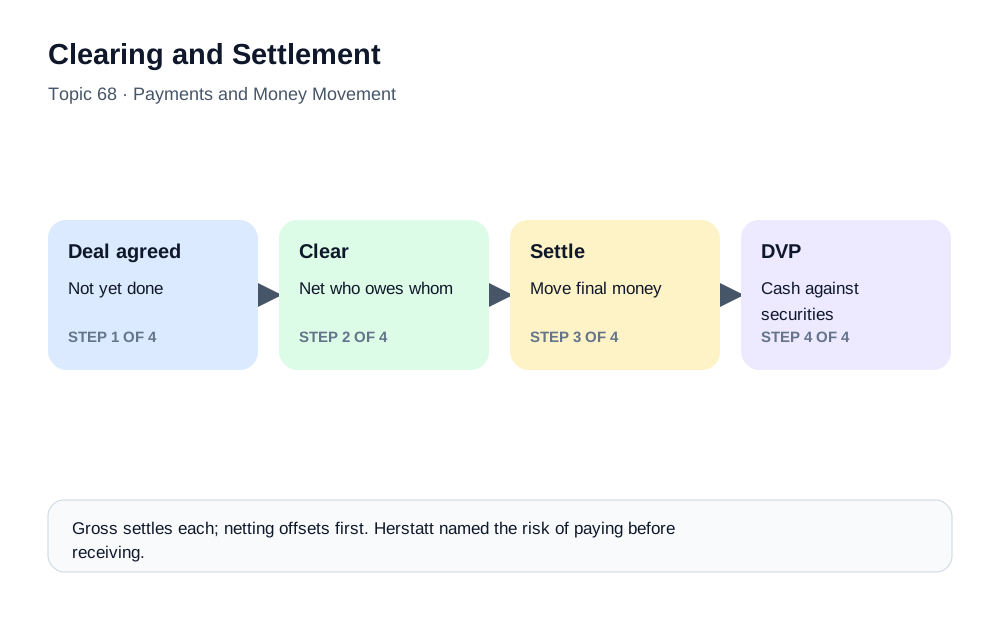
Clearing and Settlement at a glance — Gross vs net settlement, real-time vs deferred, CCPs.
The Invisible Machinery That Makes Every Transaction Real
Every financial transaction, whether a stock trade, a card payment, or a currency exchange, involves two parties exchanging value. Before that exchange is complete, the transaction must clear and settle. Clearing confirms the details of the trade and calculates what each party owes. Settlement is the actual transfer of money and securities that completes the exchange. These processes, though invisible to most market participants, constitute the infrastructure on which all financial markets depend. When clearing and settlement fail, markets seize and confidence evaporates.
This topic takes you inside that machinery. We start from first principles — why a trade is not finished when it is agreed — then build up through the mechanics of gross and net settlement, the risk-transformation magic of central counterparties, the choreography of delivery versus payment, the economics of settlement cycles, and the legal bedrock of settlement finality. We close with the practitioner's view: how these systems fail, what they cost, and why the people who run them are among the most important risk managers in finance.
What you will learn in this topic:
- The precise difference between clearing and settlement — and why confusing them causes real operational errors
- How gross and net settlement trade liquidity against risk, and why systems choose differently
- What a central counterparty actually does, and the layered defenses that keep it standing
- The settlement risk problem — including the 1974 bank failure that gave it a name
- How delivery versus payment and payment versus payment eliminate principal risk
- Why settlement cycles keep shortening, and what T+1 means operationally
- How settlement finality is created by law, not technology
- Where clearing and settlement fit in a bank's daily operations and risk framework
1. First Principles: A Deal Is Not Done When It Is Agreed
Start with a simple observation that most people never consider. When you shake hands on a deal — when a trader clicks "buy" or a treasurer agrees a swap — nothing has moved yet. No money has changed hands, no securities have been delivered. What exists is only a promise: each party now owes the other something. Between the promise and its fulfillment lies a gap, and in that gap live most of the risks in finance.
Consider what could go wrong in the gap. The counterparty might go bankrupt before delivering. The terms might have been recorded differently by each side — you think you bought ten thousand shares at fifty, they recorded a sale of a hundred thousand at five. Markets might move, giving one party an incentive to "forget" the deal. The counterparty might be perfectly solvent but simply fail operationally — a systems outage on settlement day. Multiply these possibilities by the millions of transactions a market processes daily and you understand why an entire industry of infrastructure exists to close the gap safely.
Clearing and settlement are the two functions that close it, and the distinction between them reflects a practical division of labor in financial transactions. Clearing handles the administrative and risk management functions that prepare for settlement. It verifies that both parties agree on trade terms, calculates net obligations when multiple trades are involved, and manages the collateral and margin that protect against counterparty default. Clearing is everything that must be true before value moves. Settlement executes the final exchange, transferring ownership of securities and payment of funds with finality that cannot be reversed. Settlement is the moment value actually moves.
A banking analogy makes the division intuitive. Clearing is like the paperwork and verification before a property sale completes: title checks, agreed price, deposit held in escrow. Settlement is the completion day itself: keys and money change hands, the register is updated, and the deal is irrevocable. Everything before completion can be renegotiated or unwound; after completion, the world has genuinely changed. Financial markets run on the same architecture, compressed into hours or days and scaled to trillions of dollars in daily value.
2. Gross Settlement and Net Settlement
Settlement systems operate on either gross or net principles, with important implications for risk, liquidity, and efficiency. This choice is the single most fundamental design decision in payment and settlement infrastructure.
Real-time gross settlement processes each transaction individually and immediately. When a bank sends a payment through an RTGS system, the full amount transfers from the sender's account to the receiver's account at the moment of processing. No netting occurs; each payment stands alone. This provides maximum certainty — the receiver knows immediately that funds are irrevocably theirs. However, RTGS requires participants to maintain substantial liquidity at the settlement agent, as each outgoing payment must be fully funded. A bank that must pay out ten billion dollars over a day needs the liquidity to cover each payment in full, as it falls due.
Net settlement, by contrast, accumulates transactions over a period and settles only the net differences at the end. If Bank A owes Bank B five million and Bank B owes Bank A three million, net settlement requires only one transfer of two million rather than two transfers totaling eight million. This netting reduces liquidity requirements by eighty to ninety-five percent, as only net positions rather than gross obligations need funding. The trade-off is that participants face uncertainty until settlement occurs, and the failure of one participant can disrupt settlement for others. If a bank that owes on net cannot pay, the entire calculated net position may have to be unwound and recalculated — a process that can cascade through every other participant's expectations.
A worked example shows the liquidity arithmetic. Suppose four banks end a batch with these gross obligations: A owes B 100, A owes C 40, B owes C 70, B owes D 30, C owes D 90, D owes A 50. Gross settlement requires six transfers totaling 380, and each bank must fund every outgoing payment in full — A needs 140, B needs 100, C needs 90, D needs 50. Now net the positions: A pays 140 and receives 50, so A is a net payer of 90. B pays 100 and receives 100 — perfectly flat, needing nothing. C pays 90 and receives 110 — a net receiver of 20. D pays 50 and receives 120 — a net receiver of 70. Net settlement requires only the net payers to fund: A pays 90, which distributes 20 to C and 70 to D. Total liquidity required falls from 380 in motion (with 380 of funding capacity held ready) to 90 — a reduction of over three-quarters in this tiny example, and far more in real systems where thousands of participants largely offset one another. Bank B, notably, participates fully in the market while holding zero settlement liquidity. That is the seductive power of netting — and the systemic catch: if A cannot produce its 90 at settlement time, C and D do not receive funds they may already have committed elsewhere, and the unwind begins.
The choice between the two is a genuine dilemma, and it is best understood as choosing where the risk sits. Gross settlement makes risk visible and immediate: you cannot send what you do not have, so problems surface in real time and stop with the failed payment. Net settlement defers and concentrates risk: everything is smooth until the moment of settlement, when one failure can poison the whole batch. Modern large-value systems overwhelmingly chose RTGS after the risk logic became clear in the 1980s and 1990s — certainty for the payments that matter most — while netting survives where volumes are huge and values small.
Deferred net settlement systems typically operate on a batch basis, processing accumulated transactions at scheduled times throughout the day. This provides some of the liquidity benefits of netting while reducing the duration of settlement risk. Many retail payment systems, including automated clearing houses, use deferred net settlement to handle high volumes of lower-value payments efficiently — the risk per transaction is trivial, so the liquidity savings dominate the calculus. Hybrid designs now blur the boundary further, with systems queuing payments and releasing them continuously against offsetting flows, harvesting netting's liquidity savings while preserving something close to real-time finality.
| Design | Liquidity need | Risk profile | Typical use |
|---|---|---|---|
| RTGS | Very high — every payment fully funded | Minimal — immediate finality per payment | Large-value interbank transfers |
| Deferred net settlement | Low — only net positions funded | Concentrated at settlement time; unwind risk | Retail batch payments, card clearing |
| Hybrid / continuous net | Moderate — offsetting flows released together | Managed intraday with queues and limits | Modern large-value systems |
3. The Day Settlement Risk Got a Name
No concept in this chapter is abstract, and settlement risk least of all. In June 1974, a mid-sized German institution, Bankhaus Herstatt, was active in foreign exchange markets, buying and selling Deutsche marks against US dollars with counterparties around the world. FX settlement at the time operated on correspondence: each side of a currency trade paid its own leg through its own national payment system, in its own time zone. On 26 June, German regulators withdrew Herstatt's license and closed the bank in the middle of the German banking day — after it had received Deutsche mark payments from its counterparties, but before the corresponding dollar payments were due in New York, hours behind.
The dollars never arrived. Counterparties had paid one leg of their trades in full and received nothing in return. The losses rippled through New York's payment system, and for days banks refused to release payments against expected inflows, nearly freezing the entire international payments network. The episode burned a permanent lesson into the industry's memory: principal risk — the risk of paying away the full value of a trade and receiving nothing — is the most dangerous risk in settlement, and time-zone gaps in FX settlement made it structural.
The aftermath shaped the infrastructure we have today. The risk became known as Herstatt risk (or settlement risk, or cross-currency settlement risk). Central banks, led by the Bank for International Settlements, spent decades studying and measuring it — surveys in the 1990s found trillions of dollars of daily FX settlement exposure, some banks carrying risk to single counterparties exceeding their capital. The eventual answer was payment versus payment (PvP): linking the two legs of a currency trade so that one currency moves if and only if the other does. The market-built utility that now provides PvP for the world's major currencies — created in 2002 and known as CLS, for "continuous linked settlement" — today settles the large majority of global FX value with both legs moving simultaneously, eliminating principal risk for those trades. Herstatt's ghost is why your FX settlement today is safe.
4. Central Counterparties and Risk Transformation
Central counterparties represent a profound innovation in financial market infrastructure. A CCP interposes itself between buyers and sellers, becoming the buyer to every seller and the seller to every buyer. This novation transforms bilateral counterparty risk into risk to the CCP, which manages this risk through margin requirements, default funds, and loss-sharing arrangements.
Before CCPs, trading relationships were bilateral: each party bore the risk that their counterparty might fail before settlement. If a buyer purchased securities from a seller who subsequently defaulted, the buyer might pay for securities never delivered. If a seller delivered securities to a buyer who defaulted, the seller might lose securities without receiving payment. This counterparty risk constrained trading volumes and complicated risk management — every participant had to assess and monitor the creditworthiness of every other participant it traded with, a web of bilateral exposures growing with the square of the number of traders.
By interposing itself, the CCP guarantees performance to both parties. The buyer receives securities from the CCP regardless of whether the original seller delivers. The seller receives payment from the CCP regardless of whether the original buyer pays. The effect on market structure is dramatic: instead of managing hundreds of bilateral exposures, each participant manages exactly one exposure — to the CCP. Multilateral netting compounds the benefit: a member's trades with all counterparties collapse into a single net position with the CCP in each instrument, shrinking the obligations that must be funded and margined.
The CCP manages the risk of guaranteeing these obligations through a layered defense, conventionally called the default waterfall:
- Initial margin collected from clearing members provides the first line of defense — collateral sized to cover potential losses on a defaulting member's portfolio over the days needed to close it out, liquidated if a member defaults.
- Variation margin settles gains and losses daily (or intraday in stressed markets), preventing losses from accumulating unrealized. Variation margin is why CCP exposures never quietly build: losses are collected in cash as they occur.
- The defaulting member's default fund contribution — its prepaid share of the mutualized backstop — is consumed next.
- The CCP's own capital represents skin in the game, placed ahead of surviving members' money so the CCP's incentives stay honest.
- The mutualized default fund, contributed by all clearing members, provides additional resources if a defaulter's margin proves insufficient.
- Only if all these resources are exhausted would surviving members face additional assessments, though CCP rules typically require recapitalization before such assessments are imposed.
The safety of CCPs is essential to financial stability. Because CCPs concentrate risk that was previously distributed across bilateral relationships, their failure would be catastrophic — the CCP is deliberately designed as the one institution that must never fail. Regulators therefore impose stringent requirements on CCPs, including capital standards, stress testing, and recovery and resolution planning, under international principles for financial market infrastructures. The central role of CCPs in derivatives markets, particularly since post-2008 regulatory mandates increased clearing of standardized derivatives, has made their resilience a paramount concern. The honest qualification: concentration cuts both ways. CCPs remove the bilateral web but create a single node whose failure would be systemic — which is why the waterfall's adequacy, and the "too big to fail" question applied to the clearers themselves, remain live policy debates.
5. Delivery Versus Payment
Securities settlement introduces complications that pure payment systems do not face. When securities and money must exchange simultaneously, neither party wants to deliver first and risk that the other will not complete their side of the bargain. Delivery versus payment mechanisms solve this coordination problem.
DvP ensures that securities transfer and payment occur simultaneously, or so nearly simultaneously that one cannot occur without the other. This eliminates principal risk — the same species of risk that sank Herstatt's counterparties, here in securities form. Without DvP, settlement failures could cascade through markets as parties who did not receive expected securities or payments failed to meet their own obligations, each failure triggering the next down the chain.
Different DvP models offer various implementations of this principle. Model 1 processes securities and funds on a trade-by-trade basis with no netting, providing maximum safety at the cost of efficiency — every obligation settles in full, in real time. Model 2 nets funds but settles securities gross, providing some efficiency gain while maintaining securities safety — deliveries happen individually through the day, while the money side accumulates and settles net. Model 3 nets both securities and funds, settling only net positions at the end of the cycle — maximum liquidity efficiency, with the settlement-time concentration risk that netting always carries. The choice among models involves trade-offs between risk, efficiency, and liquidity that vary by market and participant needs: a large-value government bond market chooses differently from a high-volume equity market.
The operational choreography behind DvP is worth pausing on, because it is where theory meets the back office. Settlement instructions from buyer and seller must be matched — identical on security, quantity, price, and date — before anything moves; unmatched instructions simply wait, and matching failures are the bread and butter of settlement operations teams. On settlement day, the securities settlement system checks the seller's account for the securities and the payment system for the buyer's funds, then moves both in one coordinated act. If either leg is missing, nothing happens — the trade queues, penalties may accrue, and operations staff begin the phone calls. Fails — trades that miss their intended settlement date — are the key operational metric of the whole apparatus: low fail rates signal healthy markets; spiking fails signal stress, as they did dramatically in the 2008 crisis.
6. Settlement Cycles and Market Efficiency
The time between trade execution and settlement — the settlement cycle — affects market risk and capital efficiency. Longer cycles expose participants to counterparty risk for extended periods, as market conditions may change dramatically between trade and settlement: a trade agreed Monday and settled Friday carries five days in which the counterparty can fail or the price can run away. Long cycles also tie up capital in pending transactions, reducing market liquidity and increasing costs, since margin must be held against the exposure for every day it remains unsettled.
Global trends have shortened settlement cycles substantially. Equity markets have moved from five-day settlement to three days, then to two days, with major markets recently completing the move to one day — India phasing in T+1 across its equity market and the United States, Canada, and Mexico following in 2024. The European Union continues to evaluate migration to one-day settlement following the American and Indian precedents, weighing the particular complication of time-zone misalignment with US markets now settling a day faster. Treasury securities in many markets already settle on a one-day basis or even intraday.
Each shortening of the cycle requires substantial infrastructure investment and operational changes. Securities lending markets must adapt to shorter borrowing periods, since recalls of lent stock must now complete faster. Foreign exchange transactions must align to avoid settlement mismatches — an investor selling US shares on T+1 to fund a purchase elsewhere faces a currency leg that may settle on a different clock. Custodians and broker-dealers must process higher volumes with less time for error correction; the slack that once absorbed mistakes disappears. The benefits of reduced risk and capital requirements justify these investments, driving continued pressure for compression.
The ultimate aspiration is real-time settlement, where trades settle immediately upon execution. Technology increasingly enables this vision, though legacy infrastructure and operational practices slow adoption. Instant settlement would eliminate settlement risk entirely while maximizing capital efficiency — the gap between agreement and fulfillment, the gap this whole chapter is about, would close to zero. The transition requires coordination across market participants and often regulatory mandate to overcome collective action problems: no single firm benefits enough from moving alone to justify the cost, while everyone benefits when all move together. That coordination challenge, more than any technical limit, is why settlement cycles shorten in regulated steps rather than continuous improvement.
7. The Importance of Settlement Finality
Settlement finality — the irrevocability of settled transactions — is the foundation on which financial markets operate. When a transaction settles with finality, it cannot be unwound, even if a participant subsequently fails. This finality enables market participants to rely on completed transactions: lending out received securities, withdrawing settled funds, or entering into subsequent trades with confidence. The entire chain of finance — securities re-lent, collateral re-used, payments re-paid — is built on the assumption that each completed link stays complete.
Legal frameworks establish settlement finality through specific statutes protecting transactions processed through designated systems. These laws ensure that even if a participant enters insolvency proceedings, transactions settled before the insolvency cannot be reversed by insolvency administrators seeking to improve the estate. Ordinary insolvency law gives administrators powers to claw back payments made before a collapse — reasonable in commerce, fatal in settlement systems. Without such protection, settlement might be delayed or reversed, creating uncertainty that would paralyze markets: no one would dare re-use a received security if it might be snatched back tomorrow.
The interaction between settlement finality and insolvency law requires careful calibration. Too much protection for settlement systems might enable fraud or preferential transfers that disadvantage other creditors. Too little protection creates systemic risk as participants hesitate to settle transactions. The compromise that emerged internationally shields designated system transactions from the general clawback rules while preserving remedies for actual fraud. International standards promote consistent approaches to finality across jurisdictions, reducing uncertainty in cross-border transactions — where a payment final in one country but reversible in another would recreate Herstatt risk through the legal system instead of the time zones.
Finality also has a precise operational meaning worth knowing: systems define the moment of finality — typically when accounts are debited and credited in the settlement agent's books — and everything before that moment is revocable, everything after it is not. Intraday liquidity, queue management, and gridlock-resolution mechanisms all operate in the revocable zone. When an operations team says a payment "went final," they are naming the exact instant risk ended.
8. Clearing and Settlement in Daily Banking Life
For bank practitioners, this infrastructure is not background — it is where operational risk lives. Every bank runs settlement operations that reconcile the day's instructions against actual movements, chase fails, manage intraday liquidity at the central bank and correspondents, and monitor the credit lines extended to counterparties pending settlement. The costs are real: liquidity buffers held for RTGS participation are low-yielding assets carried purely for settlement purposes; fails generate penalties, compensation claims, and regulatory attention; and the operational teams themselves represent a significant fixed cost that automation continuously pressures.
The risk-management perspective ties the chapter together. Settlement operations sit at the intersection of every major risk category: credit risk (the counterparty may fail before settling), liquidity risk (funding gross obligations as they fall due), operational risk (instruction errors, matching failures, system outages), legal risk (finality protections varying by jurisdiction), and systemic risk (the bank's own failure disrupting others). Regulators treat payment and settlement access as a privilege conditional on demonstrating control over exactly these dimensions, and the major post-crisis reforms — central clearing mandates, faster settlement cycles, intraday liquidity rules — all aimed at shrinking the gap between agreement and fulfillment where these risks breed.
Clearing and settlement infrastructure represents one of the great engineering achievements of modern finance. Processing billions of transactions daily, managing counterparty risk, and ensuring final transfer of trillions in value requires sophisticated technology, robust legal frameworks, and continuous operational excellence. This infrastructure enables the trust on which financial markets depend — trust that payments will be made, that securities will be delivered, and that the system will function even when individual participants fail. The next chapter descends from these principles into the specific domestic payment systems that put them to work.
9. Common Misconceptions About Clearing and Settlement
"A trade is complete when it is executed." Execution creates only mutual promises. Completion requires clearing (verification, netting, margin) and settlement (actual transfer with finality). The gap between them is where counterparty, liquidity, and operational risk all live — and where the 1974 Herstatt losses occurred.
"Clearing and settlement are the same thing." They are distinct functions with different owners: clearing prepares and de-risks obligations; settlement irrevocably moves value. Confusing them produces real errors — for example, assuming a cleared trade is settled when it may still be days from finality.
"Netting is just an accounting convenience." Netting is a risk and liquidity transformation: cutting funding needs by eighty to ninety-five percent changes what markets can do, while concentrating risk into the settlement moment. Every netting benefit is purchased with a corresponding exposure profile.
"A central counterparty eliminates risk." It transforms and concentrates risk. Bilateral exposures become a single exposure to the CCP, managed through margin and the default waterfall — safer by design, but creating one node whose failure would be systemic. CCP resilience is a policy obsession precisely because elimination is impossible.
"Faster settlement is purely a technology question." Cycle compression is mostly a coordination problem: aligned cut-offs, securities lending recalls, FX timing, and collective investment. Technology has permitted real-time settlement for years; the industry moves in steps because everyone must move together.
"Settlement finality is automatic once systems confirm a payment." Finality is a legal construct, not a technical one. Statutes shield designated-system transactions from insolvency clawback; without them, technically "completed" payments could be reversed by administrators. Technology executes; law protects.
10. Frequently Asked Questions
What is the difference between clearing and settlement in one sentence? Clearing determines what must be exchanged — verified, netted, margined — while settlement is the irrevocable exchange itself.
Why did large-value payment systems move to RTGS? Because netting defers and concentrates risk: one participant's failure at settlement time can unwind an entire batch. RTGS makes every payment final on arrival, containing failures to the failed payment itself — worth the heavy liquidity cost for payments that are themselves systemic.
What is Herstatt risk? The principal risk in foreign exchange settlement — paying one currency and never receiving the other — named for the German bank whose 1974 mid-day closure stranded the dollar legs of its FX trades. Modern payment-versus-payment infrastructure exists to make a repeat impossible for settled currencies.
What happens when a clearing member of a CCP defaults? The waterfall: the defaulter's initial margin is liquidated, its default-fund contribution consumed, then the CCP's own capital, then the mutualized default fund — while the CCP closes out or auctions the defaulter's positions. Surviving members' trades continue performing throughout.
What does DvP actually prevent? Principal risk in securities settlement: the seller delivering securities without receiving payment, or the buyer paying without receiving securities. DvP links the legs so neither can occur alone; a missing leg means the trade queues rather than half-completes.
Why is the industry moving to T+1 settlement? Every day between trade and settlement carries counterparty exposure and demands margin and capital. Halving the cycle roughly halves that exposure, freeing capital and reducing risk — at the cost of compressed operational timelines and coordination across FX, lending, and custody.
Can a settled payment be reversed? Within designated systems protected by finality law: no — not even by insolvency administrators, fraud remedies aside. That irrevocability is the entire point: downstream users of received funds and securities must be able to rely on them instantly.
What is a settlement fail, and does it matter beyond the two parties? A fail occurs when a trade misses its intended settlement date — securities or funds unavailable. Beyond the pair involved, fails matter systemically: the party left waiting may fail on its own onward obligation, and chains of fails signal funding or collateral stress. Persistent high fail rates attract regulatory intervention precisely because they precede wider dysfunction.
How do clearing and settlement affect ordinary customers? Invisibly, when working — card payments, salary credits, and share trades "just happen" because this machinery works. Visibly, when stressed: delayed settlements, frozen funds, or market halts. Customers experience the infrastructure only at its failure points, which is why its operators prize boring reliability above all else.
11. Key Terms in This Chapter
- Clearing — verification, netting, and risk management preparing a trade for settlement.
- Settlement — the final, irrevocable transfer of money and/or securities completing a transaction.
- RTGS — real-time gross settlement; each payment settled individually, immediately, and finally.
- Deferred net settlement — batch settlement of accumulated net positions at scheduled times.
- Netting — offsetting mutual obligations so only differences require transfer.
- Principal risk — the risk of delivering full value and receiving nothing in return.
- Herstatt risk — principal risk in FX settlement across time zones, named for the 1974 failure.
- Payment versus payment (PvP) — simultaneous exchange of both currency legs of an FX trade.
- Delivery versus payment (DvP) — simultaneous exchange of securities and funds.
- Central counterparty (CCP) — an entity interposed between buyer and seller, guaranteeing performance to each.
- Novation — the legal substitution of the CCP as counterparty to both sides of a trade.
- Initial / variation margin — collateral against potential future exposure / daily settlement of realized gains and losses.
- Default waterfall — the ordered layers of resources absorbing a clearing member's default.
- Settlement cycle (T+n) — days between execution and settlement; compressing globally toward T+1 and beyond.
- Settlement finality — the legal irrevocability of completed settlement, protected against insolvency clawback.
- Fail — a trade not settled on its intended date; the key operational health metric of settlement.
12. Interview Insights: How This Topic Appears in Banking Interviews
"Explain clearing versus settlement." Give the one-sentence distinction, then immediately add the why: clearing closes the information and risk gap (matching, netting, margin), settlement closes the value gap (irrevocable transfer). Mentioning that a cleared-but-unsettled trade still carries counterparty risk shows you understand the gap is the whole point.
"What is Herstatt risk and how is it managed today?" Tell the 1974 story compactly — closure after mark receipts, before dollar payments — name the concept (principal risk across time zones), and give the modern answer: payment-versus-payment settlement for major currencies. Adding that surveys found daily FX settlement exposures exceeding individual banks' capital demonstrates historical depth beyond the anecdote.
"How does a CCP survive a member default?" Walk the waterfall in order — initial margin, defaulter's fund contribution, CCP capital, mutualized fund — and note the position-management process (hedging and auctioning the defaulter's portfolio) happening in parallel. Conclude with the systemic trade-off: concentration removes the bilateral web but demands the CCP itself never fail, hence regulation.
"Why did markets move from T+2 to T+1?" Risk and capital: counterparty exposure and margin scale with cycle length, so compression frees balance sheet. Then show nuance — operational compression, securities-lending recalls, FX misalignment, and the collective-action reason moves happen by mandate. The second half of that answer is what separates operators from textbook readers.
"What keeps you up at night in settlement operations?" Strong answers name fails cascades, intraday liquidity squeezes (RTGS funding), unmatched-instruction backlogs on compressed cycles, and cross-border finality mismatches. Framing settlement as where credit, liquidity, operational, and systemic risk intersect — rather than as back-office plumbing — is the senior-level perspective interviewers probe for.
Summary and Key Takeaways
- Clearing prepares obligations — verifying terms, netting, margining — while settlement irrevocably moves value; the gap between agreement and fulfillment is where financial risk concentrates.
- Gross settlement buys certainty with liquidity; net settlement saves eighty to ninety-five percent of liquidity by concentrating risk into the settlement moment; design choices follow transaction size and systemic importance.
- Herstatt's 1974 failure named principal risk in FX and ultimately produced payment-versus-payment settlement, now protecting most global currency trades.
- Central counterparties transform bilateral risk webs into a single, margined, waterfall-defended exposure — safer markets built on one node that must never fail.
- Delivery versus payment eliminates principal risk in securities; its three models trade liquidity efficiency against settlement-time concentration.
- Settlement cycles keep compressing — T+5 to T+1 within a generation — because every day of delay carries exposure and capital cost; coordination, not technology, sets the pace.
- Settlement finality is created by statute, shielding completed transactions from insolvency clawback; law, not software, makes settlement irrevocable.
- For banks, clearing and settlement concentrate credit, liquidity, operational, legal, and systemic risk in one operational zone — making its teams first-line risk managers, not back-office clerks.
Next: Topic 69 — Domestic Payment Systems →
<!-- MBA-DEEP-DIVE-START -->Deep Dive: Clearing and Settlement as a Controlled Risk Engine
The safest way to think about clearing and settlement is to ask what risk still exists after a trade or payment has been agreed. Before settlement, each party holds a claim on someone else. Clearing organises those claims, validates them, calculates obligations, applies risk controls, and prepares them for completion. Settlement then discharges the obligations by transferring the relevant settlement assets, securities, or other value. The infrastructure is therefore not merely administrative plumbing. It is a machine for converting uncertain promises into final positions.
This distinction matters inside banks because front-office, payment, securities, treasury, operations, risk, and accounting teams often see different parts of the same lifecycle. A trader can regard a transaction as executed while operations still sees an unmatched instruction. A payment hub can regard a transaction as accepted while treasury still needs settlement liquidity. A securities platform can show a trade ready to settle while the custodian lacks stock. The transaction is economically incomplete until every required settlement condition is met.
Clearing begins by establishing a common version of the transaction
Many settlement failures originate before settlement day because the parties do not hold identical trade details. Securities settlement, for example, requires agreement on instrument, quantity, price, currency, trade date, settlement date, counterparty, settlement location, and account or custody details. If one side records 10,000 shares while the other records 100,000, no settlement system can safely guess which is correct.
Matching therefore belongs to the control framework. Straight-through-processing systems compare trade economics automatically. Unmatched items enter exception queues where operations teams investigate. The quality metric is not only the percentage matched, but how early mismatches are detected. An unmatched trade identified minutes after execution has time to be corrected; the same break discovered shortly before settlement can create borrowing cost, penalties, liquidity disruption, or market risk.
A strong operating model captures the reason for each break. Wrong quantity, wrong account, late affirmation, missing standing settlement instructions, incorrect place of settlement, or counterparty disagreement are different root causes and should not be hidden under one generic “settlement fail” label.
Netting changes the amount that must settle but not the underlying economics
Netting is powerful because financial institutions often owe each other in both directions. Instead of exchanging every gross obligation, a system can offset eligible claims according to its rules and settle only the resulting net amount.
The legal basis matters. Payment netting, position netting, and close-out netting solve different problems. Payment netting reduces settlement cash flows. Position netting reduces quantities or obligations in instruments. Close-out netting determines a single net amount after default or termination under enforceable contractual arrangements.
Operations should therefore never assume that because two trades economically offset, they can automatically be netted for settlement or credit purposes. Eligibility depends on the infrastructure, product, legal agreement, counterparty, currency, account, and applicable law.
This is especially important in cross-border derivatives and securities financing. A risk system may calculate a net exposure under a master agreement, while settlement operations still need to process gross cash movements because the payment obligations are not operationally netted. The bank should know which form of netting applies at each layer.
Liquidity saving mechanisms are controlled queuing, not free liquidity
RTGS systems reduce settlement credit risk by settling payments individually, but pure gross settlement can require large intraday liquidity. Modern infrastructures often use liquidity-saving mechanisms that hold, offset, prioritise, or release queued payments when sufficient balances or matching incoming flows exist.
This creates a dynamic relationship between treasury and payments operations. A queued payment is not necessarily failed. It may be waiting for liquidity, priority, or an offsetting flow. Treasury needs visibility because the queue represents future cash demand. Operations needs to know whether the transaction remains within the scheme’s service level. Risk teams may set limits on how long certain payments can wait.
Participants can also prioritise payments. A securities settlement obligation, central-bank operation, or critical market payment may be more important than a routine interbank transfer. Priority logic should be governed because changing it can alter liquidity usage and customer outcomes.
Settlement finality has to survive insolvency
The most important property of a settlement system is not speed but legal certainty. When settlement is final, participants need confidence that a later insolvency cannot simply unwind completed transfers in a way that destabilises every dependent transaction.
This is why payment-system and securities-settlement law gives special attention to the point of entry, irrevocability, netting, collateral, and finality. A system’s rules define the operational event, but applicable law gives the event legal effect.
For bank practitioners, the practical lesson is to avoid casual language such as “final when our system marks it complete.” Internal status does not create legal finality. The relevant scheme rules and law determine when an instruction becomes irrevocable and when settlement is legally complete.
This distinction matters in incident recovery. If an internal application fails after a settlement event is legally final, the bank should rebuild its books around the external final settlement rather than attempting to reverse history inside the application.
CCP clearing transforms bilateral risk into concentrated infrastructure risk
A central counterparty can reduce the complexity of bilateral exposures by stepping between buyers and sellers. But the transformation should not be misunderstood as risk elimination. The risk becomes concentrated in the CCP, which must be able to absorb member default without itself becoming the source of systemic failure.
The operational lifecycle therefore includes margin calls, collateral eligibility, valuation, default-fund contributions, position limits, stress testing, and default-management procedures. Clearing members need systems capable of responding to intraday margin demands, sometimes during severe market volatility when cash is already scarce.
A clearing member that is profitable on its positions can still face liquidity stress if collateral requirements rise quickly. This is a recurring theme across market infrastructure: solvency and liquidity are different dimensions of safety.
The bank’s treasury and collateral teams should therefore treat expected and stressed margin requirements as funding needs, not merely accounting entries.
Variation margin turns market moves into daily or intraday cash flows
In centrally cleared derivatives, variation margin commonly transfers current market gains and losses between participants. This prevents large unrealised exposures from accumulating.
From a liquidity perspective, however, variation margin can be demanding. Imagine a bank has a hedge that protects the economic value of an asset portfolio. A sharp market move can make the hedge profitable overall but still require the bank to post cash on one leg before receiving offsetting economic benefits elsewhere.
The hedge may be economically correct while liquidity is temporarily stressed. Treasury therefore needs to model collateral cash flows by timing and legal entity.
This is why market-risk management and liquidity-risk management cannot be separated completely. A market shock changes valuations; valuations change margin; margin changes settlement liquidity.
Initial margin is a default-risk buffer, not a current loss payment
Initial margin is designed to cover potential future exposure during the period needed to manage a defaulting participant’s positions. It is different from variation margin, which transfers current mark-to-market gains and losses.
The distinction matters operationally because the assets and processes can differ. Initial margin may be posted as cash or eligible securities subject to haircuts. The collateral must be valued, segregated or protected according to the relevant model, and replaced if it becomes ineligible or loses value.
A bank should track which assets are encumbered as margin because pledged collateral is no longer freely available for another liquidity need. During stress, the institution may face both higher margin requirements and lower market value of the assets available to meet them.
Default management requires speed and governance
If a clearing member defaults, the infrastructure needs to contain the failure without destabilising the market. The CCP may hedge the defaulted portfolio, auction positions to surviving members, use the defaulter’s margin and default-fund contribution, and then use additional waterfall resources according to its rules.
For surviving clearing members, a default can therefore create operational obligations even if they had no bilateral relationship with the failed firm. They may need to participate in auctions, provide liquidity, or contribute further resources under the framework.
Banks should know these contingent obligations in advance. A default-management rule buried in membership documentation can become a real same-day cash requirement during a crisis.
Securities settlement adds inventory risk to cash risk
A payment system mainly needs the payer to have sufficient settlement funds. Securities settlement needs both cash and the correct securities to be available in the correct account.
A seller can fail because it does not have the security, even if it is solvent. The stock may have been lent, delivered to another account, subject to a corporate action, blocked, or expected from an incoming trade that itself failed. This creates a settlement chain: one failed delivery can cause another participant to fail onward.
Operations therefore monitors stock availability, expected receipts, securities borrowing, settlement priority, and partial settlement where the infrastructure supports it.
The liquidity equivalent exists on the buyer side. The buyer may have the securities entitlement but insufficient settlement cash. DvP protects principal, but it does not ensure every trade settles on time.
Settlement fails have economic cost even when principal is safe
DvP means one party should not deliver principal without receiving the other leg, but a failed trade can still create costs. The buyer may miss an onward sale. The seller may need to borrow securities. Cash remains tied up or uninvested. Corporate-action entitlement can become complicated. Regulators or market infrastructures may impose penalties or mandatory processes.
A good fail-management process therefore identifies root cause and economic consequence. Operations should not focus only on the number of failed trades. A small-value fail in a hard-to-borrow security can be more disruptive than a larger fail in a liquid government bond.
Ageing is also important. A one-day operational fail and a repeated long-running fail point to different control weaknesses.
Standing settlement instructions are high-risk static data
Banks maintain settlement instructions describing where cash or securities should be delivered. These can include correspondent accounts, custodian accounts, depository details, agent banks, beneficiary accounts, and other reference data.
Changing settlement instructions can redirect large amounts of value. Fraudsters therefore target static-data changes, sometimes through compromised email or impersonation.
Strong controls include independent verification, maker-checker approval, effective dating, restricted entitlements, audit trail, and callback or authenticated confirmation for high-risk changes. The settlement team should not accept an urgent email changing payment instructions simply because it appears to come from a familiar counterparty.
Static data is one of the clearest examples of a low-technology error causing high financial loss.
DvP removes principal risk only when the linkage is real
A process should not be called DvP merely because cash and securities usually move on the same day. The mechanism needs to ensure that final transfer of one leg is conditional on final transfer of the other according to the relevant model.
If operations manually sends cash in one system and later confirms securities in another without enforceable linkage, principal risk remains.
This matters in cross-border securities settlement where cash and securities can sit in different infrastructures. Custodians and settlement agents may provide contractual or technical mechanisms that coordinate the legs, but teams should understand exactly where finality occurs.
The same principle applies to FX payment-versus-payment. The risk reduction comes from conditional linkage of the two settlement legs, not from faster messaging.
Shorter settlement cycles reduce exposure but compress operations
Moving from T+2 to T+1 reduces the period in which counterparty exposure can change, but it also halves much of the operational time available for allocation, confirmation, matching, FX funding, securities lending, and error correction.
A global investor trading in one time zone and settling in another may have only a few hours to arrange currency funding. A broker that previously corrected unmatched instructions the next morning may now need same-day automation.
This is why settlement-cycle reform is not simply a rule change in one field. It affects front-office cut-offs, reference data, trade affirmation, custody, treasury, FX, lending, reconciliation, staffing, and client communication.
Banks should test the full operating day under the shortened cycle rather than only changing the settlement-date calculation.
Corporate actions complicate failed securities settlement
If a trade fails across a dividend, interest, split, rights issue, or other corporate-action record date, the economic entitlement may need special treatment. The registered holder and the economically entitled buyer can differ because the trade should have settled but did not.
Market practices use claims, compensation, buyer protection, or other mechanisms depending on the event and market. Operations therefore needs to connect settlement status with corporate-action processing.
This is another reason settlement data should not live in an isolated operations silo. A failed trade can affect client reporting and economic entitlements elsewhere in the bank.
Reconciliation must connect clearing positions, settlement movements, and books
A clearing or settlement operation produces several independent records: trade capture, clearing obligations, settlement instructions, depository movements, cash-account movements, margin movements, fees, and general-ledger entries.
The bank needs reconciliation across these views.
For a CCP-cleared trade, the front-office position should reconcile to the cleared position. Margin calls should reconcile to collateral and cash movements. Settlement cash should reconcile to the bank’s account at the settlement institution or correspondent. Securities movements should reconcile to custody records. Fees should reconcile to invoices and accounting.
A difference at any layer can represent a real exposure. An unrecorded margin payment can distort liquidity. A security received externally but missing internally can cause the bank to borrow stock unnecessarily. A duplicate settlement entry can misstate cash.
Settlement operations should model “unknown” outcomes
Technology outages create difficult states. A bank may send a settlement instruction but lose connectivity before receiving confirmation. It may not know whether the instruction was accepted, queued, rejected, or settled.
The safest response is not always to resend. A duplicate instruction can create a second settlement obligation if the infrastructure does not automatically identify it as duplicate.
Systems therefore need inquiry, unique identifiers, reconciliation, and controlled replay. “Unknown outcome” should be a recognised state with a recovery procedure.
This principle applies across payments, securities, FX, and collateral movement. Distributed financial systems need a safe way to recover truth after communication failure.
Intraday monitoring should follow obligations, not only balances
A settlement account can look healthy at 10:00 while a large queue of obligations is scheduled for 10:15. Treasury needs both current balance and expected near-term outflows.
The same applies to securities. Current stock may be sufficient until a large delivery becomes due. Collateral may be available until a margin call consumes it.
Operational dashboards should therefore combine current resources, queued obligations, expected receipts, cut-offs, and stressed shortfalls.
This forward-looking view helps the bank intervene before a settlement fail rather than explain the fail afterward.
Business continuity must protect finality and duplicate control
During a major outage, the objective is not merely to restore screens. The bank must preserve which instructions were submitted, which became irrevocable, which settled, which remain queued, and which can safely be resent.
Recovery should reconcile against the external infrastructure before large-scale replay. If the internal system restores from a backup that predates already-final settlement events, it must rebuild those events rather than treating them as missing transactions.
Contingency procedures may include alternate connectivity, manual high-priority settlement, emergency liquidity arrangements, and pre-agreed communication with infrastructures and counterparties.
The more critical the market, the more important it is to test these procedures under realistic conditions.
A full securities settlement scenario
Consider a bank buying government bonds for a client. The trade is executed today for settlement tomorrow.
Trade capture sends the economics to the settlement platform. Allocation identifies the client account. The bank and counterparty exchange or submit settlement instructions. Matching confirms quantity, price, settlement date, and accounts. The custodian or depository validates that the seller has securities and the buyer’s cash agent can fund the payment.
Treasury includes the cash outflow in the next-day forecast. If the client pays through another currency, FX funding is arranged early enough to meet the cash cut-off. On settlement day, the DvP mechanism transfers bonds to the buyer side and cash to the seller side conditionally.
The custody system updates the client position. The cash account is debited. The GL receives the accounting entries. Reconciliation matches the external securities movement and cash debit to the trade.
Now suppose the seller lacks the bonds. DvP prevents the bank from paying away cash without receiving securities, but the trade fails. Operations contacts the counterparty, monitors retry, and assesses whether the client has an onward sale. If the client needs the bonds immediately, securities borrowing or another market transaction may be required. The failure is safe from principal loss yet still operationally and economically significant.
What excellence looks like
A world-class clearing and settlement operation can prove what each participant owes, when the obligation becomes irrevocable, what settlement asset will discharge it, how much liquidity or collateral is required, and what happens if a participant fails. It matches instructions early, controls static data, understands netting legally and operationally, distinguishes current margin from default resources, manages settlement chains, and reconciles external finality back to internal books.
The deepest insight is that clearing and settlement do not merely process transactions after the “real” business is done. They determine whether the real business ever becomes legally and financially complete. Markets can tolerate price volatility; they cannot function for long if participants stop trusting that agreed obligations will actually settle.
<!-- MBA-DEEP-DIVE-END -->