When a customer sends money to an account at another bank, the banks do not normally move physical cash. They update records, exchange instructions, perform controls, and settle obligations through accounts or infrastructures recognised by the relevant payment scheme.
The customer sees one transfer. The banking system sees several connected movements:
- A customer instruction enters the sending bank.
- The sending bank validates, screens, and books the transaction.
- A payment message is sent through the applicable channel or network.
- The participating institutions settle the interbank obligation.
- The receiving bank credits the beneficiary according to scheme rules, internal controls, and funds availability.
- Status, reporting, and reconciliation records are produced.
Understanding these layers prevents one of the most common payment misunderstandings: a payment message, a customer-account posting, and interbank settlement are related events, but they are not the same event.
Visual overview
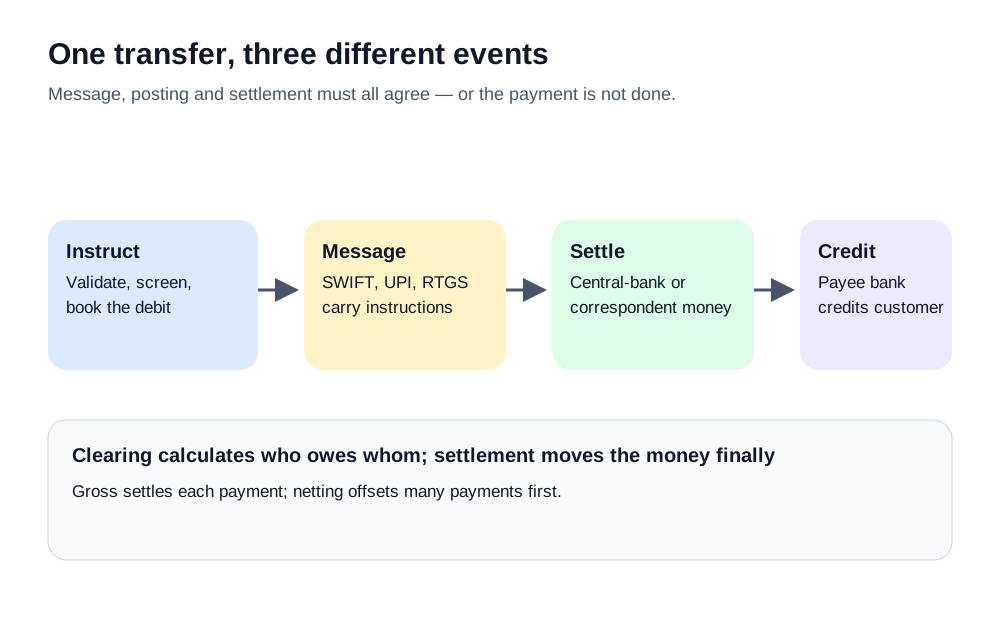
Phase 8 map: instruct → message → settle → credit. Clearing calculates; settlement moves money finally.
1. Customer Money and Interbank Money
A customer's bank-account balance is a liability of the commercial bank. If a customer has a balance of ₹10,000, the bank owes that amount to the customer under the account agreement.
When the customer sends ₹1,000 to another bank, the sending bank reduces its liability to the sender. The receiving bank increases its liability to the beneficiary. Between the two banks, a separate obligation must also be settled.
That interbank settlement may occur in:
- Central bank money, across accounts held by direct settlement participants at a central bank.
- Commercial bank money, across correspondent or settlement-bank accounts.
- A payment-system ledger, backed by prefunded or subsequently settled positions.
- A net settlement arrangement, where many payments are offset and only the resulting net positions are settled.
The exact model depends on the currency, scheme, participant type, payment value, and market infrastructure.
2. Direct and Indirect Participation
Not every bank or payment service provider holds its own settlement account in every payment system.
A direct settlement participant has the required legal, operational, technical, liquidity, and risk arrangements to settle its own obligations in the relevant infrastructure. Where a payment system settles in central bank money, the direct participant normally holds or has access to the required central bank settlement account.
An indirect participant uses a direct participant, often called a sponsor, settlement bank, or correspondent, to settle on its behalf. The indirect participant may still connect technically to parts of the scheme, but its financial settlement occurs through the direct participant's account.
This distinction matters because it changes:
- who holds liquidity;
- who sends the final settlement instruction;
- who bears sponsor and concentration risk;
- who performs scheme-level reconciliation;
- which service levels and cut-off times apply;
- how an operational incident is escalated.
A smaller institution may choose indirect access because direct participation can require substantial investment in resilience, testing, liquidity, compliance, and 24/7 operations.
3. Nostro and Vostro Accounts
In correspondent banking, the same account is described differently depending on perspective.
- A Nostro account means “our account with you.” It is an account a bank holds with another bank, usually in the currency or market of the account-providing bank.
- A Vostro account means “your account with us.” It is how the account-providing bank describes the same balance on its books.
Suppose an Indian bank holds a US-dollar account with a bank in New York.
- For the Indian bank, the account is a US-dollar Nostro.
- For the New York bank, it is a Vostro liability owed to the Indian bank.
When the Indian bank sends a dollar payment, the correspondent may debit the Indian bank's Nostro and transfer value onward to the beneficiary bank or another intermediary.
Nostro accounts support settlement, liquidity, fees, and reconciliation. They also create important operational responsibilities: balance forecasting, intraday monitoring, statement processing, investigation of unmatched entries, and control of overdraft or credit exposure.
4. Correspondent Banking Networks
Most banks do not maintain direct account relationships with every bank in every currency. Correspondent banking creates a reachability network.
A cross-border payment may involve:
- the ordering customer;
- the debtor bank;
- one or more reimbursing or intermediary institutions;
- the creditor bank;
- the beneficiary customer.
The message route and the funds-settlement route may be identical, but they do not have to be.
Serial method
In a serial payment, the customer payment instruction moves from one bank to the next along the chain. Each institution forwards the instruction and settles through its relationship with the next institution.
Cover method
In a cover payment, the customer instruction is sent toward the beneficiary bank while a separate interbank cover instruction moves the funds through correspondent banks. The two legs must remain correctly linked so compliance, tracking, and reconciliation teams can understand the complete transaction.
Each additional institution can introduce:
- another sanctions or AML control point;
- additional fees or foreign-exchange treatment;
- another operating calendar and cut-off time;
- additional data transformation;
- another potential repair, hold, return, or investigation;
- greater reconciliation complexity.
However, it is inaccurate to assume that every correspondent payment necessarily takes several days. Many reach the beneficiary bank rapidly. The end-to-end customer experience depends on the route, data quality, time zones, currency, liquidity, compliance outcome, beneficiary-bank processing, and local market rules.
5. Messaging Does Not Equal Settlement
Networks and standards such as Swift and ISO 20022 help institutions exchange structured financial messages. They do not automatically mean that Swift itself holds the money or performs settlement.
A message may instruct a bank to:
- debit or credit an account;
- transfer funds to another institution;
- confirm acceptance or rejection;
- report an account entry;
- return a payment;
- request cancellation or investigation.
The actual settlement occurs through the relevant accounts and market infrastructure.
This distinction is essential during incidents. A message can be successfully delivered but the payment may still be held by a bank. A bank can book a customer debit before external settlement completes. A payment can settle between banks while the beneficiary credit is delayed by a downstream control or posting failure.
Operational teams therefore track several statuses rather than one generic “sent” status.
6. Central Bank Settlement
Central banks commonly provide the settlement asset and infrastructure used by directly settling participants in domestic payment systems.
If Bank A and Bank B are direct participants, settlement may involve:
- Bank A's settlement account being debited.
- Bank B's settlement account being credited.
- The payment acquiring settlement finality under the applicable system rules and law.
If Bank C is an indirect participant sponsored by Bank B, Bank C's payment obligations may be included in entries settled through Bank B's account. Bank C and Bank B then maintain their own contractual and accounting relationship.
Settlement in central bank money reduces settlement-asset credit risk because the asset is a liability of the central bank rather than a commercial correspondent. It does not remove every other risk. Liquidity risk, operational risk, cyber risk, fraud risk, legal risk, and participant default arrangements still need to be managed.
7. RTGS, Net Settlement, and Instant Payments
Real-time gross settlement
An RTGS system settles eligible transactions individually, in gross amounts, during its operating window. Once the system's legal conditions for finality are met, the interbank settlement is final under the applicable rules.
RTGS reduces interbank credit exposure but requires participants to manage intraday liquidity carefully. Queue management, prioritisation, collateralised intraday credit, liquidity-saving mechanisms, and treasury monitoring may all be important.
Deferred net settlement
A net settlement system accumulates obligations and calculates each participant's net position. Instead of settling every retail payment individually in central bank money, participants settle the final net debit or credit positions at defined cycles.
Netting reduces liquidity needs but introduces dependencies on risk controls, settlement cycles, participant limits, prefunding, guarantees, or loss-allocation arrangements.
Instant payment systems
An instant payment scheme can provide customer confirmation within seconds, 24/7, while using different underlying settlement models. Some settle transaction by transaction. Others use prefunded positions, technical settlement accounts, or periodic settlement of accumulated obligations.
Therefore, instant customer experience does not by itself prove that every underlying interbank leg is a separate real-time central bank settlement entry.
8. Settlement Finality, Returns, and Reversals
Settlement finality means that a transfer is legally final at the point defined by the system rules and applicable law. It does not mean that no subsequent transaction can ever occur.
A payment may later be:
- returned because the beneficiary account is closed;
- recalled at the request of the sender;
- refunded under a consumer-protection rule;
- recovered following fraud procedures or a court order;
- corrected through a new compensating entry.
These actions normally create new messages and accounting entries. They do not simply erase a legally final settlement event from history.
Customer-account finality can also differ from interbank finality. A receiving bank may show a provisional credit before settlement, or it may wait until scheme conditions are met. The exact treatment depends on product terms, law, scheme rules, and the bank's posting model.
9. Cost and Speed Drivers
It is misleading to assign one universal fee or duration to all domestic or cross-border payments. Cost and speed vary by:
- currency and corridor;
- direct or indirect participation;
- number of intermediaries;
- charging option and correspondent deductions;
- foreign-exchange spread;
- cut-off time and operating calendar;
- sanctions or AML review;
- completeness of party and remittance data;
- beneficiary-bank posting practice;
- payment value and priority;
- scheme service level;
- repair, return, or investigation activity.
Domestic instant payments may be low-cost for the customer while still requiring banks to fund infrastructure, fraud controls, liquidity, and 24/7 operations. Cross-border payments may be fast at the messaging and interbank stages but delayed by beneficiary-bank processing or regulatory review.
The useful operational question is not merely “How long do cross-border payments take?” It is:
At which stage is the payment now, which institution controls the next action, and what rule or dependency determines the remaining time?
10. Reconciliation and Traceability
Every bank needs to prove that its internal books agree with external settlement and correspondent records.
Typical reconciliation inputs include:
- payment-hub transaction records;
- core-banking or customer-account postings;
- central bank or clearing-system reports;
- Nostro statements;
- correspondent advices;
- fees and FX entries;
- returns and reversals;
- scheme acknowledgements and status messages.
Shared references are critical. Depending on the flow, these may include message identifiers, transaction identifiers, end-to-end references, UETRs, clearing references, settlement references, and account-servicer references.
A lost or transformed reference can turn an automatically matchable item into a manual investigation. Strong payment architecture preserves identifiers across channels, payment hubs, screening engines, gateways, settlement interfaces, reporting systems, and archives.
11. A Simplified End-to-End Example
A customer at Bank A sends EUR 1,000 to a customer at Bank B.
- Initiation: Bank A receives the instruction from mobile banking or a corporate channel.
- Validation: Bank A checks authority, account status, balance, limits, format, duplicate risk, and beneficiary data.
- Financial crime controls: Fraud, sanctions, and AML controls are applied according to the payment type and bank policy.
- Customer posting: Bank A records the debit or reserves the amount according to its posting model.
- Routing: The payment hub selects the appropriate scheme or correspondent route.
- Message exchange: Bank A sends the required payment instruction.
- Interbank settlement: Direct participants settle through the scheme's settlement arrangement. An indirect participant's sponsor may settle on its behalf.
- Beneficiary processing: Bank B validates the incoming payment and credits the beneficiary according to applicable rules.
- Status and reporting: Confirmations, account reports, and customer notifications are generated.
- Reconciliation: Both banks compare internal records with external settlement and account statements.
A failure can occur at any step. Good operations depend on knowing exactly which step failed and which system, institution, or rule owns the recovery action.
12. Liquidity Has a Location, Currency, and Legal Owner
A bank can appear liquid at group level and still be unable to settle a payment if the usable funds sit in the wrong currency, correspondent account, subsidiary, or legal entity. A payment in US dollars needs usable dollar liquidity in the account or settlement arrangement that can actually discharge the dollar obligation. Rupee cash elsewhere in the group does not solve the immediate problem unless it can be converted and transferred in time.
This is why payment liquidity should be forecast by currency, legal entity, settlement account, and time bucket. Treasury teams monitor expected customer flows, interbank obligations, securities settlement, FX trades, correspondent balances, and committed facilities together. A payment hub deciding to route more traffic through one correspondent can therefore change treasury needs even if total customer volume is unchanged.
Operational teams should also know whether the bank has an agreed overdraft or intraday credit facility on the relevant account, which collateral supports it, what limit applies, and what happens if the limit is exceeded. A payment that is commercially valid can still fail because the bank has reached a settlement-account limit. That is a liquidity event, not a customer-data defect.
13. Payment Repair Must Preserve the Original Instruction
Manual repair is sometimes unavoidable. A beneficiary identifier may be invalid, required data may be missing, or an external infrastructure may reject a field. The repair user should be able to correct only what the operating model permits and should never silently rewrite the commercial meaning of the customer instruction.
If the customer asked to pay one beneficiary and the bank discovers that the account number is invalid, operations cannot simply substitute another account because it looks plausible. Some repairs require customer contact and a new instruction. Others, such as correcting an internal routing code derived by the bank, may be handled without changing customer intent. The system should distinguish these cases.
Every manual change should retain the original value, changed value, user, timestamp, reason, and approval where required. Material changes may need rescreening because sanctions or fraud results were based on the earlier data. A repair process that edits a party after screening but does not trigger the appropriate control creates a serious gap.
14. Operational Metrics Should Describe the Lifecycle
Payment operations can look healthy when measured only by total processed volume. Better metrics show where friction and risk occur. Useful measures include straight-through-processing rate, rejection rate, repair rate, duplicate rate, average exception age, percentage settled within service level, return rate, recall success rate, unmatched reconciliation items, aged Nostro breaks, sanctions-review duration, fraud-hold duration, and customer complaints by failure stage.
These measures should be segmented. A 99.8% straight-through rate can hide a poor cross-border corridor if domestic instant payments dominate the denominator. A low average investigation age can hide a small group of very old high-value cases. Management needs distribution and ageing, not only averages.
Metrics should also connect to customer impact. A technical incident affecting ten thousand low-value transfers may be more significant than one failed high-value transfer from a service perspective, while the high-value item may create greater liquidity or financial risk. Severity therefore depends on value, volume, customer type, legal obligations, and downstream consequences.
15. A Payment Cutover Must Protect Financial Continuity
When a bank replaces a payment engine, gateway, or message format, the most dangerous transactions are often those already in flight at the moment of cutover. Some may have been accepted by the old system but not yet sent. Others may have been sent but not acknowledged. Some may have settled externally but not yet posted internally.
A migration plan should define exactly which system owns each state before and after cutover. Pending transactions may need to complete on the legacy platform rather than being recreated in the new one. If they are migrated, identifiers, customer references, screening status, settlement status, and accounting state must move consistently.
Duplicate control is critical. Recreating a transaction in the new system because the old system appears silent can result in two external payments if the original had already been accepted. The safest cutovers therefore use controlled queues, reconciliation checkpoints, transaction freezes where needed, and explicit rules for unknown outcomes.
The same principle applies to rollback. A bank cannot simply restore yesterday's application state if today's payments have already become final in an external infrastructure. Recovery must rebuild the internal state around the financial events that actually occurred.
Conclusion
Money movement between banks is not one event. It is a coordinated lifecycle of customer instructions, accounting entries, messages, controls, liquidity movements, interbank settlement, beneficiary posting, reporting, and reconciliation.
The most important distinctions are:
- customer-account money versus interbank settlement money;
- direct versus indirect participation;
- messaging versus funds settlement;
- settlement finality versus a later return or compensating transaction;
- payment speed versus the speed of each individual processing stage.
Once these distinctions are clear, domestic payments, correspondent banking, RTGS, instant payments, investigations, and reconciliation become parts of one connected story rather than separate banking concepts. The practical test of understanding is whether a team can trace one transaction across customer authority, booking, routing, external message, settlement account, beneficiary processing, return or recall if any, and reconciliation without losing the original identifiers or changing the meaning of the customer instruction. That traceability is what turns payment processing from a collection of interfaces into a controlled banking service. It also creates a common language for product, operations, treasury, compliance, finance, architecture, development, and testing teams when they diagnose incidents or design change. The practical test of understanding is whether a team can trace one transaction across customer authority, booking, routing, external message, settlement account, beneficiary processing, return or recall if any, and reconciliation without losing the original identifiers or changing the meaning of the customer instruction. That traceability is what turns payment processing from a collection of interfaces into a controlled banking service. It also creates a common language for product, operations, treasury, compliance, finance, architecture, development, and testing teams when they diagnose incidents or design change. The practical test of understanding is whether a team can trace one transaction across customer authority, booking, routing, external message, settlement account, beneficiary processing, return or recall if any, and reconciliation without losing the original identifiers or changing the meaning of the customer instruction. That traceability is what turns payment processing from a collection of interfaces into a controlled banking service. It also creates a common language for product, operations, treasury, compliance, finance, architecture, development, and testing teams when they diagnose incidents or design change. The practical test of understanding is whether a team can trace one transaction across customer authority, booking, routing, external message, settlement account, beneficiary processing, return or recall if any, and reconciliation without losing the original identifiers or changing the meaning of the customer instruction. That traceability is what turns payment processing from a collection of interfaces into a controlled banking service. It also creates a common language for product, operations, treasury, compliance, finance, architecture, development, and testing teams when they diagnose incidents or design change. The practical test of understanding is whether a team can trace one transaction across customer authority, booking, routing, external message, settlement account, beneficiary processing, return or recall if any, and reconciliation without losing the original identifiers or changing the meaning of the customer instruction. That traceability is what turns payment processing from a collection of interfaces into a controlled banking service. It also creates a common language for product, operations, treasury, compliance, finance, architecture, development, and testing teams when they diagnose incidents or design change. The practical test of understanding is whether a team can trace one transaction across customer authority, booking, routing, external message, settlement account, beneficiary processing, return or recall if any, and reconciliation without losing the original identifiers or changing the meaning of the customer instruction. That traceability is what turns payment processing from a collection of interfaces into a controlled banking service. It also creates a common language for product, operations, treasury, compliance, finance, architecture, development, and testing teams when they diagnose incidents or design change. The practical test of understanding is whether a team can trace one transaction across customer authority, booking, routing, external message, settlement account, beneficiary processing, return or recall if any, and reconciliation without losing the original identifiers or changing the meaning of the customer instruction. That traceability is what turns payment processing from a collection of interfaces into a controlled banking service. It also creates a common language for product, operations, treasury, compliance, finance, architecture, development, and testing teams when they diagnose incidents or design change. The practical test of understanding is whether a team can trace one transaction across customer authority, booking, routing, external message, settlement account, beneficiary processing, return or recall if any, and reconciliation without losing the original identifiers or changing the meaning of the customer instruction. That traceability is what turns payment processing from a collection of interfaces into a controlled banking service. It also creates a common language for product, operations, treasury, compliance, finance, architecture, development, and testing teams when they diagnose incidents or design change. The practical test of understanding is whether a team can trace one transaction across customer authority, booking, routing, external message, settlement account, beneficiary processing, return or recall if any, and reconciliation without losing the original identifiers or changing the meaning of the customer instruction. That traceability is what turns payment processing from a collection of interfaces into a controlled banking service. It also creates a common language for product, operations, treasury, compliance, finance, architecture, development, and testing teams when they diagnose incidents or design change. The practical test of understanding is whether a team can trace one transaction across customer authority, booking, routing, external message, settlement account, beneficiary processing, return or recall if any, and reconciliation without losing the original identifiers or changing the meaning of the customer instruction. That traceability is what turns payment processing from a collection of interfaces into a controlled banking service. It also creates a common language for product, operations, treasury, compliance, finance, architecture, development, and testing teams when they diagnose incidents or design change. The practical test of understanding is whether a team can trace one transaction across customer authority, booking, routing, external message, settlement account, beneficiary processing, return or recall if any, and reconciliation without losing the original identifiers or changing the meaning of the customer instruction. That traceability is what turns payment processing from a collection of interfaces into a controlled banking service. It also creates a common language for product, operations, treasury, compliance, finance, architecture, development, and testing teams when they diagnose incidents or design change. The practical test of understanding is whether a team can trace one transaction across customer authority, booking, routing, external message, settlement account, beneficiary processing, return or recall if any, and reconciliation without losing the original identifiers or changing the meaning of the customer instruction. That traceability is what turns payment processing from a collection of interfaces into a controlled banking service. It also creates a common language for product, operations, treasury, compliance, finance, architecture, development, and testing teams when they diagnose incidents or design change. The practical test of understanding is whether a team can trace one transaction across customer authority, booking, routing, external message, settlement account, beneficiary processing, return or recall if any, and reconciliation without losing the original identifiers or changing the meaning of the customer instruction. That traceability is what turns payment processing from a collection of interfaces into a controlled banking service. It also creates a common language for product, operations, treasury, compliance, finance, architecture, development, and testing teams when they diagnose incidents or design change. The practical test of understanding is whether a team can trace one transaction across customer authority, booking, routing, external message, settlement account, beneficiary processing, return or recall if any, and reconciliation without losing the original identifiers or changing the meaning of the customer instruction. That traceability is what turns payment processing from a collection of interfaces into a controlled banking service. It also creates a common language for product, operations, treasury, compliance, finance, architecture, development, and testing teams when they diagnose incidents or design change. The practical test of understanding is whether a team can trace one transaction across customer authority, booking, routing, external message, settlement account, beneficiary processing, return or recall if any, and reconciliation without losing the original identifiers or changing the meaning of the customer instruction. That traceability is what turns payment processing from a collection of interfaces into a controlled banking service. It also creates a common language for product, operations, treasury, compliance, finance, architecture, development, and testing teams when they diagnose incidents or design change. The practical test of understanding is whether a team can trace one transaction across customer authority, booking, routing, external message, settlement account, beneficiary processing, return or recall if any, and reconciliation without losing the original identifiers or changing the meaning of the customer instruction. That traceability is what turns payment processing from a collection of interfaces into a controlled banking service. It also creates a common language for product, operations, treasury, compliance, finance, architecture, development, and testing teams when they diagnose incidents or design change. The practical test of understanding is whether a team can trace one transaction across customer authority, booking, routing, external message, settlement account, beneficiary processing, return or recall if any, and reconciliation without losing the original identifiers or changing the meaning of the customer instruction. That traceability is what turns payment processing from a collection of interfaces into a controlled banking service. It also creates a common language for product, operations, treasury, compliance, finance, architecture, development, and testing teams when they diagnose incidents or design change. The practical test of understanding is whether a team can trace one transaction across customer authority, booking, routing, external message, settlement account, beneficiary processing, return or recall if any, and reconciliation without losing the original identifiers or changing the meaning of the customer instruction. That traceability is what turns payment processing from a collection of interfaces into a controlled banking service. It also creates a common language for product, operations, treasury, compliance, finance, architecture, development, and testing teams when they diagnose incidents or design change. The practical test of understanding is whether a team can trace one transaction across customer authority, booking, routing, external message, settlement account, beneficiary processing, return or recall if any, and reconciliation without losing the original identifiers or changing the meaning of the customer instruction. That traceability is what turns payment processing from a collection of interfaces into a controlled banking service. It also creates a common language for product, operations, treasury, compliance, finance, architecture, development, and testing teams when they diagnose incidents or design change. The practical test of understanding is whether a team can trace one transaction across customer authority, booking, routing, external message, settlement account, beneficiary processing, return or recall if any, and reconciliation without losing the original identifiers or changing the meaning of the customer instruction. That traceability is what turns payment processing from a collection of interfaces into a controlled banking service. It also creates a common language for product, operations, treasury, compliance, finance, architecture, development, and testing teams when they diagnose incidents or design change. The practical test of understanding is whether a team can trace one transaction across customer authority, booking, routing, external message, settlement account, beneficiary processing, return or recall if any, and reconciliation without losing the original identifiers or changing the meaning of the customer instruction. That traceability is what turns payment processing from a collection of interfaces into a controlled banking service. It also creates a common language for product, operations, treasury, compliance, finance, architecture, development, and testing teams when they diagnose incidents or design change. The practical test of understanding is whether a team can trace one transaction across customer authority, booking, routing, external message, settlement account, beneficiary processing, return or recall if any, and reconciliation without losing the original identifiers or changing the meaning of the customer instruction. That traceability is what turns payment processing from a collection of interfaces into a controlled banking service. It also creates a common language for product, operations, treasury, compliance, finance, architecture, development, and testing teams when they diagnose incidents or design change. The practical test of understanding is whether a team can trace one transaction across customer authority, booking, routing, external message, settlement account, beneficiary processing, return or recall if any, and reconciliation without losing the original identifiers or changing the meaning of the customer instruction. That traceability is what turns payment processing from a collection of interfaces into a controlled banking service. It also creates a common language for product, operations, treasury, compliance, finance, architecture, development, and testing teams when they diagnose incidents or design change. The practical test of understanding is whether a team can trace one transaction across customer authority, booking, routing, external message, settlement account, beneficiary processing, return or recall if any, and reconciliation without losing the original identifiers or changing the meaning of the customer instruction. That traceability is what turns payment processing from a collection of interfaces into a controlled banking service. It also creates a common language for product, operations, treasury, compliance, finance, architecture, development, and testing teams when they diagnose incidents or design change. The practical test of understanding is whether a team can trace one transaction across customer authority, booking, routing, external message, settlement account, beneficiary processing, return or recall if any, and reconciliation without losing the original identifiers or changing the meaning of the customer instruction. That traceability is what turns payment processing from a collection of interfaces into a controlled banking service. It also creates a common language for product, operations, treasury, compliance, finance, architecture, development, and testing teams when they diagnose incidents or design change. The practical test of understanding is whether a team can trace one transaction across customer authority, booking, routing, external message, settlement account, beneficiary processing, return or recall if any, and reconciliation without losing the original identifiers or changing the meaning of the customer instruction. That traceability is what turns payment processing from a collection of interfaces into a controlled banking service. It also creates a common language for product, operations, treasury, compliance, finance, architecture, development, and testing teams when they diagnose incidents or design change. The practical test of understanding is whether a team can trace one transaction across customer authority, booking, routing, external message, settlement account, beneficiary processing, return or recall if any, and reconciliation without losing the original identifiers or changing the meaning of the customer instruction. That traceability is what turns payment processing from a collection of interfaces into a controlled banking service. It also creates a common language for product, operations, treasury, compliance, finance, architecture, development, and testing teams when they diagnose incidents or design change. The practical test of understanding is whether a team can trace one transaction across customer authority, booking, routing, external message, settlement account, beneficiary processing, return or recall if any, and reconciliation without losing the original identifiers or changing the meaning of the customer instruction. That traceability is what turns payment processing from a collection of interfaces into a controlled banking service. It also creates a common language for product, operations, treasury, compliance, finance, architecture, development, and testing teams when they diagnose incidents or design change. The practical test of understanding is whether a team can trace one transaction across customer authority, booking, routing, external message, settlement account, beneficiary processing, return or recall if any, and reconciliation without losing the original identifiers or changing the meaning of the customer instruction. That traceability is what turns payment processing from a collection of interfaces into a controlled banking service. It also creates a common language for product, operations, treasury, compliance, finance, architecture, development, and testing teams when they diagnose incidents or design change.
<!-- MBA-DEEP-DIVE-START -->Deep Dive: What Actually Has to Happen for Money to Move Between Banks
A payment becomes much easier to understand when we stop describing it as “money travelling” and instead describe the obligations that change. The payer’s bank must recognise a valid instruction, reduce or reserve the payer’s available funds, create an obligation toward another institution, settle that obligation through an accepted settlement asset, and make enough information available for the receiving bank to identify and credit the beneficiary. Every stage creates records, controls, timestamps, responsibilities, and failure possibilities. The customer experiences one transfer, but the banking system coordinates a chain of independently controlled events.
That chain matters because a payment can look successful from one system and still be incomplete from another perspective. The channel may show “submitted” because the customer instruction was accepted. The payment hub may show “sent” because a message left the bank. The external scheme may show “accepted” because the instruction passed format and participant checks. Treasury may still be waiting for settlement. The beneficiary bank may still be running sanctions or account-validation controls. Reconciliation may later reveal that the expected settlement entry never matched. Strong payment operations therefore avoid one ambiguous status and instead preserve the state of each economically meaningful event.
Payment ownership begins with the customer instruction
The first control question is whether the bank has a valid authority to act. For a retail customer this may involve app authentication, transaction limits, device or behavioural checks, beneficiary controls, and available funds. For a corporate customer it can involve user entitlements, account mandates, maker-checker rules, signing groups, cut-off times, bulk-file authorisation, and contractual service levels. If authority is wrong, every downstream message can be technically perfect while the payment itself remains unauthorised.
The payment record should therefore capture the original instruction faithfully enough to reconstruct what the customer asked for. That means payer account, beneficiary data, amount, currency, requested execution date, remittance information, charging preference where relevant, channel, authorising users, and identifiers. Systems may enrich or transform the instruction later, but they should not destroy the original customer intent. Investigations become much harder when a bank can see only the final outbound message and not the instruction that produced it.
A useful architecture separates customer instruction, payment transaction, and settlement transaction as related but distinct records. One customer instruction can sometimes create more than one operational transaction, for example where a bulk file contains many payments or where a payment is re-routed after an infrastructure problem. A settlement event can also aggregate many customer transactions under a net position. Treating everything as one database row eventually creates confusion around retries, returns, reconciliation, and investigations.
Reservation, booking, and settlement should not be collapsed into one debit
Banks use different posting models. Some debit the customer account before the payment leaves the bank. Others first reserve funds, then convert the reservation into a booked debit after a later processing stage. Some instant-payment systems require the bank to commit funds before sending. High-value or treasury payments can follow different controls again.
The distinction between available balance and booked balance is therefore important. Suppose a customer has ₹1,00,000 and initiates a ₹60,000 transfer. The bank may immediately reduce available funds by placing a hold while the booked balance remains unchanged until the transaction is released. If fraud review later rejects the payment, the hold is released. If the payment is accepted, the hold becomes a debit. A system that does not distinguish these states can either allow double spending or leave customers without access to funds after failed payments.
This also affects customer communication. “Payment accepted” should not mean “beneficiary credited” unless the bank genuinely has evidence for that statement. Customer-facing statuses should map to real operational states rather than marketing language.
Routing is a financial decision, not just a technical one
A payment hub may have several possible routes to the destination. The route can depend on currency, beneficiary bank, value, urgency, service level, cut-off time, transaction type, direct participation, correspondent relationship, cost, liquidity, sanctions restrictions, or scheme availability.
For domestic payments, the hub may choose between an instant service, an ACH-style service, or RTGS depending on eligibility and customer request. For cross-border payments, the bank may choose a direct correspondent, an intermediary chain, a regional clearing arrangement, or another supported route. A technically available route is not automatically the best route if the bank lacks settlement liquidity, the beneficiary bank is unreachable through that service, or the transaction violates the scheme’s eligibility rules.
Routing therefore belongs to product and treasury governance as much as architecture. Product teams define the service promise. Treasury defines how currencies and settlement accounts are funded. Operations understands cut-offs and repair behaviour. Compliance constrains prohibited corridors or parties. Technology implements the decision logic. If any one function changes routing independently, the economic result can change even though the customer screen remains identical.
Direct participation changes both economics and accountability
Direct access to a payment system gives a bank more control but also more responsibility. The bank may need dedicated connectivity, certificates, testing, operational support, liquidity, contingency arrangements, settlement accounts, scheme compliance, incident response, and 24/7 coverage for instant services.
Indirect participation can reduce this burden because a sponsor bank settles on behalf of the indirect participant. However, the indirect participant acquires dependency on the sponsor’s service levels, limits, liquidity arrangements, technology, and financial health. A sponsor outage can become the indirect participant’s customer outage. A sponsor can also impose cut-offs earlier than the payment system itself because it needs time to process its clients’ instructions.
This is why the phrase “the scheme is open until 17:00” does not necessarily mean an indirect participant can accept customer instructions until 17:00. Internal preparation time, sponsor cut-offs, funding deadlines, fraud review, and channel rules can create earlier customer deadlines. Banking operations needs to distinguish scheme cut-off, participant cut-off, and customer cut-off.
Liquidity determines whether a bank can honour payment obligations
A bank can be profitable and solvent yet still fail to settle a payment if the required settlement liquidity is not available at the required moment. Payments therefore connect directly to treasury.
In an RTGS environment, outgoing payments consume settlement balances individually. A large corporate file can create a sudden intraday need. Incoming payments replenish the position, but their timing is uncertain. Treasury therefore forecasts expected flows, monitors actual outflows, and may use intraday credit, collateral, money-market borrowing, or liquidity-saving mechanisms where available.
In net settlement systems, the liquidity need is different. The bank may process thousands or millions of customer payments during a cycle but settle only a net debit later. This reduces gross liquidity consumption but creates a concentrated obligation at settlement time. Risk controls therefore focus on participant limits, prefunding, collateral, default funds, or loss-sharing arrangements depending on the scheme.
Instant payments add another challenge: customers can send money at night, weekends, and holidays. The bank cannot assume treasury staff will manually top up a position every time liquidity falls. Prefunding thresholds, automatic alerts, liquidity transfer processes, and overnight governance become part of the product design.
On-us payments show why settlement is not always external
When payer and beneficiary use the same bank, the transfer may require no external interbank settlement. The bank reduces one deposit liability and increases another. Operationally this can be much simpler, faster, and cheaper.
However, an on-us transfer still requires controls. The bank must authenticate the payer, check account status, screen for fraud and financial crime according to policy, validate limits, post both sides correctly, and preserve the audit trail. If the transfer is between different legal entities within a banking group rather than two accounts in the same legal bank, external or intercompany settlement may still be required.
This distinction matters in product analytics. A customer may experience “instant transfer” in both cases, but the bank’s cost and risk are different. On-us routing can avoid external fees and settlement liquidity, while off-us routing depends on infrastructure and counterparties.
Correspondent banking is an account network before it is a message network
The heart of correspondent banking is the account relationship. A bank can send a beautifully formatted instruction, but value still needs to move through accounts maintained by correspondents or settlement institutions.
Suppose Bank A in India needs to pay dollars to Bank D in another country. Bank A may hold a dollar Nostro with Bank B in New York. Bank D may use Bank C. The payment can require Bank B to debit Bank A’s Nostro and transfer value to Bank C for Bank D. The message chain tells each institution what to do; the account entries create the financial movement.
The practical consequences are significant. Bank A needs enough balance or credit in its dollar Nostro. It must know the correspondent’s cut-off time. It must reconcile the debit when the statement arrives. It must understand fees deducted by correspondents. If a payment is returned, the return may travel through the same or a different chain. Operations therefore needs both payment-message knowledge and account-servicing knowledge.
Correspondent relationships also create concentration risk. A bank heavily dependent on one global correspondent for a major currency can lose substantial reach if that relationship is terminated or restricted. This is why correspondent due diligence, service resilience, pricing, sanctions capability, liquidity, and alternative routing are strategic concerns rather than only back-office administration.
Nostro reconciliation is where payment truth is tested
A payment system can say an instruction was sent, but the Nostro statement reveals whether the correspondent actually debited or credited the account. Reconciliation compares internal expected movements with external account entries.
A robust reconciliation process should match at transaction level where possible, using amount, currency, value date, reference, correspondent reference, and other identifiers. Breaks should be classified rather than dumped into one generic queue. Typical categories include missing external entry, missing internal entry, amount difference, value-date difference, duplicate, fee difference, return, unmatched credit, or timing difference.
Timing differences are normal. An outgoing payment created late today may appear on tomorrow’s statement depending on value date and correspondent process. A reconciliation system should distinguish expected timing from unexplained breaks. The control objective is not to force every record to match instantly; it is to ensure every mismatch has a known reason, owner, ageing rule, and resolution path.
Aged Nostro breaks are dangerous because they can hide duplicate payments, unposted returns, correspondent fees, fraud, or accounting errors. Small unexplained differences can accumulate into significant balance-sheet uncertainty.
Payment fees can alter the amount received
Cross-border payment charging can be confusing because several banks may be involved. Depending on product terms and charging conventions, fees can be paid by the sender, shared, or deducted from the transferred amount. Correspondent deductions may cause the beneficiary to receive less than the original instructed amount where the payment arrangement permits it.
This creates a common customer complaint: “I sent 1,000; why did the beneficiary receive 985?” The answer may involve sender fees, intermediary charges, beneficiary-bank fees, or foreign-exchange conversion. Customer-service systems need visibility into the fee path where possible rather than simply confirming that the original instruction was 1,000.
For product design, transparency is as important as fee level. A low advertised transfer fee can be offset by a wide FX margin. The total customer cost should therefore be understood across explicit fees and currency conversion.
Serial and cover flows create different investigation paths
In a serial correspondent payment, the customer payment instruction travels through the chain of institutions. Each intermediary receives information about the payment and forwards it onward. In a cover flow, the customer payment instruction and the interbank funding movement travel through separate but related paths.
This creates investigation complexity because the information leg and the funds leg can have different states. The beneficiary bank may receive the customer instruction while the cover funds are delayed. An intermediary in the funds path may place a compliance hold even though the beneficiary bank already sees the customer details. Systems need references that link the legs so operations can determine whether the problem sits in the instruction route or the cover route.
The safest design avoids assuming that “message received by beneficiary bank” means “funds received by beneficiary bank”. Investigators should be able to trace both information and settlement evidence.
Cut-off management is part of the payment promise
A requested execution date is meaningful only if the bank can meet every relevant deadline. The payment may need customer approval before an internal cut-off, sanctions clearance before release, FX execution before a market deadline, funding before correspondent cut-off, and submission before the external scheme closes.
Holiday calendars complicate this further. A payment involving two currencies may require business days in both markets. A correspondent may observe a local holiday while the customer’s country is open. A cross-border payment initiated late Friday may therefore have a value date different from what the customer intuitively expects.
Banks should manage calendars as controlled reference data. Wrong holiday configuration can create failed settlement, unexpected overdrafts, interest claims, or broken customer promises. Calendar changes deserve testing and effective dating just like code changes.
Returns are new payment events, not erasers
A return should preserve the original transaction history. The bank may need to return because the beneficiary account is closed, the account cannot accept the payment type, the beneficiary bank rejected the transaction, compliance rules require return, or the beneficiary customer requests action according to local rules.
The return has its own amount, currency, reason, date, message, and settlement event. Fees or FX movement may mean the returned amount differs from the original customer debit under some products and circumstances. Operations should therefore link original and return without overwriting the original transaction.
This design is essential for audit and investigations. If the original payment record is simply changed from “completed” to “returned”, the system loses the fact that the payment was once processed and subsequently reversed by a separate financial event.
Recalls and cancellations depend on where the payment is in its lifecycle
Customers often ask to cancel a payment after sending it. Whether cancellation is possible depends on the stage and scheme.
Before release, the bank may be able to stop the instruction internally. After submission but before final settlement, some infrastructures support cancellation or recall requests under defined conditions. After settlement finality, the sending bank generally cannot simply reverse another bank’s settled funds unilaterally. It may request return, invoke fraud-recovery processes, or use legal mechanisms, but the outcome is no longer guaranteed.
Customer-service language should reflect this. “Recall requested” is not the same as “payment cancelled”. Overpromising recovery creates conduct risk and customer disputes.
Investigations are a controlled search for the missing state
Most payment investigations ask one of a small number of questions: Where is the payment? Why was it rejected? Why was the beneficiary not credited? Why was the amount reduced? Why was it returned? Can it be recalled? Which institution has the next action?
A good investigation system assembles evidence rather than relying on free-text emails. Useful data include the original instruction, outbound message, acknowledgements, status messages, settlement reference, Nostro entry, beneficiary-bank response, screening history, repair history, and return information.
The investigator should be able to build a timeline. If the bank can answer “sent at 10:02, accepted by scheme at 10:02:04, settled at 10:02:05, receiving bank acknowledged at 10:02:07”, the issue is likely downstream of settlement. If no settlement evidence exists, the investigation moves earlier in the chain.
This is why payment observability is a business capability, not merely a technical logging concern.
Exception queues need reason, ownership, and ageing
Payments that cannot proceed automatically enter exception handling. Common causes include invalid account data, missing mandatory fields, sanctions review, insufficient funds, duplicate suspicion, route unavailable, technical timeout, settlement limit, or external rejection.
The queue should not simply say “manual repair”. Each exception needs a reason code, current owner, permissible action, service-level target, and escalation rule. Some exceptions can be repaired by operations. Others require customer contact. Compliance holds should not be editable by ordinary payment repair users. Technical retries should preserve duplicate protection.
Ageing matters because the customer impact increases over time. A two-minute repair in an instant-payment service can already be a service failure, while a same-day high-value payment may have a longer but still strict deadline. Exception SLAs should therefore reflect the product promise.
Duplicate prevention is an end-to-end control
Networks fail. Channels retry. APIs time out. Users press the submit button twice. Corporate customers can resend files because they did not receive confirmation. A bank must assume duplicate requests will occur.
Duplicate prevention can use customer references, file identifiers, message identifiers, amount-account-date combinations, idempotency keys, and transaction history. The exact method depends on product and channel.
The control must distinguish a true duplicate from a legitimate repeated payment. A company may intentionally pay the same supplier the same amount on consecutive days. Overly broad duplicate logic can block valid business. Weak duplicate logic can debit the customer twice.
This is a good example of why banking controls need both technology and business semantics.
Timeouts require state recovery, not blind retry
A difficult distributed-system scenario occurs when Bank A sends a payment request to an external infrastructure but the response is lost. Bank A does not know whether the external system accepted the payment.
Blindly resending can create a duplicate. Assuming failure can leave the customer underpaid. The correct recovery usually requires an inquiry using a unique identifier, a safe retry mechanism defined by the scheme, or reconciliation against later status and settlement evidence.
Payment architecture should therefore design for unknown outcome as a legitimate state. Systems that model only success or failure are incomplete.
Fraud controls and payment speed create a deliberate tension
Faster payments reduce the time available to detect fraud before funds leave the bank. A customer can be socially engineered into authorising a transfer that appears technically valid. Account takeover can create payments that pass basic credentials. Mule accounts can receive and disperse funds rapidly.
Fraud controls therefore use device, behavioural, beneficiary, velocity, amount, account history, and network signals. High-risk transactions may require step-up authentication or temporary hold where the scheme and law allow.
However, excessive friction can destroy the value of instant payments. Product teams must tune controls to risk rather than add blanket delays. Post-transaction monitoring and interbank fraud-response channels are also important because some fraud becomes visible only after payment.
Sanctions screening depends on data quality
Payments crossing jurisdictions may require screening of parties, financial institutions, countries, or other relevant data under applicable law and bank policy. Screening quality depends heavily on the information carried in the payment.
Poorly structured names, missing addresses, truncated fields, or inconsistent transliteration increase false positives and can also reduce detection quality. This is one reason richer structured payment data has operational value beyond compliance formality.
A sanctions hit creates a different process from an ordinary repair. Access should be restricted, decisions auditable, and the bank’s response governed by legal and compliance requirements. Payment operations should not “fix” a compliance hold simply to meet a service-level target.
Data transformation is a hidden payment risk
A customer channel may capture rich structured information while an older downstream interface supports fewer fields. The bank may map, truncate, concatenate, or drop data during processing.
Every transformation should be understood. If the beneficiary address is split across structured fields but an intermediary receives only one line, important information can disappear. If identifiers change format, reconciliation can break. If a payment purpose code is lost, reporting can become inaccurate.
Migration projects should therefore perform field lineage: where each business data element originates, how it is transformed, which system stores it, and which external message or report consumes it.
This is especially important when a bank modernises one component while keeping legacy downstream systems. A new ISO 20022-capable payment hub does not create end-to-end structured data if the core, screening engine, warehouse, or correspondent adapter still flattens everything.
Payment ledger and accounting ledger need reconciliation
A payment hub usually records operational status. The core or product ledger records customer-account effects. The general ledger records accounting. The external settlement statement records the interbank movement.
All four views should ultimately agree economically.
Suppose the payment hub reports 100 outgoing payments worth ₹50 lakh. Customer accounts show ₹50 lakh debited. The settlement statement shows only ₹49 lakh. That difference requires explanation. Perhaps one payment was rejected externally and should be reversed. Perhaps settlement used netting and the expected comparison is wrong. Perhaps a posting is duplicated.
The point is that no single system can declare itself the truth for every dimension. Reconciliation establishes consistency across independent records.
Operational resilience must preserve financial state
Payment services are critical because failure prevents customers from accessing or moving money. Resilience therefore goes beyond server uptime.
A bank needs to know whether transactions in queues survive failover, whether duplicate protection survives recovery, whether pending authorisations can be reconstructed, whether external acknowledgements can be replayed, and how settlement reconciliation will identify transactions processed during the incident.
A disaster-recovery site that comes online but loses the last ten minutes of payment state is not a successful recovery.
Runbooks should define what operators do if the external scheme is unavailable, the internal hub is unavailable, the core ledger is unavailable, screening is unavailable, or connectivity becomes one-way. Different failures require different controls. A bank may accept instructions but hold them, reject new instructions, route through an alternate path, or switch to contingency processing depending on risk and service rules.
Customer communication should follow operational truth
During an incident, customers need accurate status. A bank should avoid broad messages such as “payments are delayed” when only one scheme or currency is affected. Equally, it should not claim “service restored” merely because the application is reachable if queued payments are still unprocessed.
The best operational metric is the customer service itself: can customers submit, are transactions progressing, are settlement obligations met, are beneficiaries receiving funds, and are exceptions returning to normal levels?
This connects incident management with business observability. Technical health indicators are necessary but not sufficient.
A BA or product team should model the lifecycle, not just the happy path
Requirements for a payment feature should describe states, transitions, controls, ownership, and evidence.
For example, a payment can move through received, validated, authorised, held, released, routed, sent, accepted, settled, credited, rejected, returned, recalled, cancelled, or investigated states depending on the product. Not every scheme uses these exact labels, but the business meanings should be explicit.
For each state, requirements should answer: Who owns the transaction? Can the customer cancel? Are funds reserved or booked? Has financial-crime screening completed? Has interbank settlement occurred? What message or event proves the state? What customer status is displayed? What timeout or SLA applies? What happens if the next step fails?
This approach produces testable banking behaviour instead of vague user stories such as “system should process payment”.
Testing should prove money integrity under failure
A world-class payment test pack includes more than successful transfers. It should cover insufficient funds, expired mandate, duplicate request, malformed data, sanctioned party, fraud hold, unavailable route, external timeout, delayed acknowledgement, settlement rejection, beneficiary rejection, return, recall, fee deduction, FX conversion, holiday cut-off, partial infrastructure outage, and replay after recovery.
Testing should also reconcile money. After each scenario, the team should know the customer balance, payment status, settlement position, fee posting, suspense balance, and GL effect. A test is incomplete if the screen displays the right message but the accounting is wrong.
Negative scenarios often reveal the most expensive defects. A payment sent twice because of retry logic can create immediate financial loss. A failed payment whose hold is not released creates customer harm. A return posted without linking the original transaction creates reconciliation and reporting problems.
What excellence looks like
A strong bank can trace a payment from customer authority through booking, routing, messaging, settlement, beneficiary processing, reporting, and reconciliation. It knows whether it participates directly or through a sponsor, where settlement liquidity sits, which cut-off applies, which reference links external and internal records, and which team owns every exception. It can distinguish a sent message from settled funds, a recall request from a successful cancellation, and a customer credit from interbank finality.
The deepest operational lesson is that money movement is a chain of controlled promises. The bank promises the payer it will act on an authorised instruction. Payment infrastructures and correspondents provide rules for exchanging obligations. Settlement assets discharge those obligations. The receiving bank promises the beneficiary an accurate account credit under the applicable rules. Reconciliation then proves that the chain remained financially consistent.
Once this model is understood, almost every payments problem becomes easier to diagnose because the question is no longer “Where is the money?” The better question is: which obligation, record, control, or settlement event has not yet reached the state it should have reached?
<!-- MBA-DEEP-DIVE-END -->