Visual overview
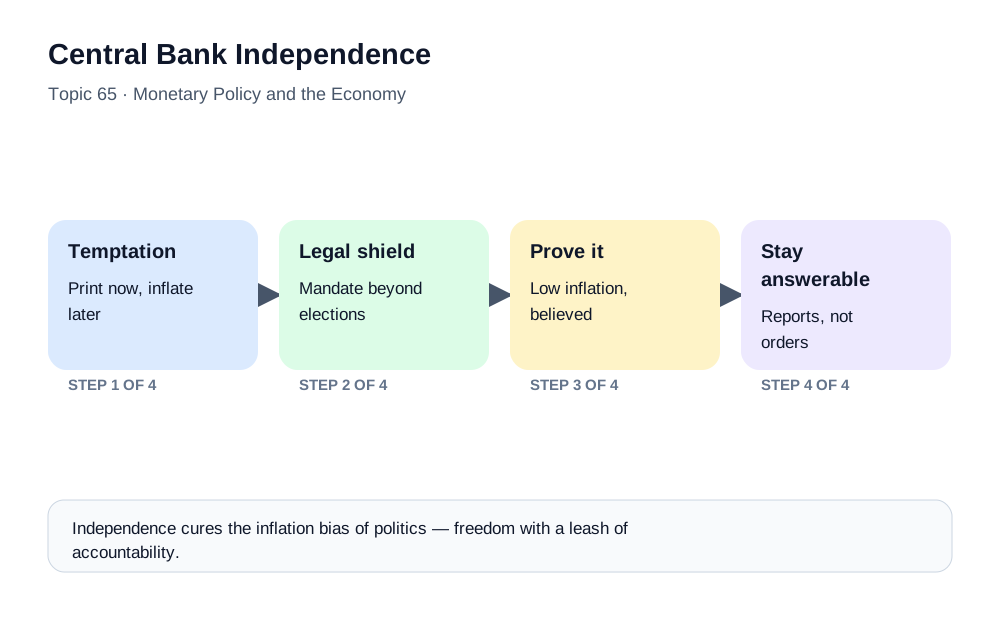
Central Bank Independence at a glance — Why independence matters, accountability, case studies.
Why the Most Powerful Economic Institution Must Be Free from Politics
Central bank independence represents one of the most consequential institutional arrangements in modern economic governance, determining whether monetary policy serves long-term price stability or short-term political expediency. A large body of research associates stronger central-bank independence with lower and more stable inflation, particularly where legal protections are supported by credible fiscal institutions and political norms. The relationship is not a universal guarantee of superior growth or financial stability: causality is difficult to isolate, institutional quality differs across countries, and an independent central bank can still make policy mistakes. The durable lesson is that operational autonomy can strengthen credibility by reducing short-term political pressure on monetary decisions, while accountability and a coherent fiscal framework remain essential. Understanding the rationale for independence, the various forms it can take, the evidence supporting its benefits, and the challenges that threaten it in practice provides essential context for banking professionals who must anticipate monetary policy decisions and their implications for financial markets.
This topic examines why societies deliberately place monetary policy beyond the reach of elected governments — a design choice that seems, at first glance, undemocratic. We progress from first principles (why money needs a guardian with a long horizon) through the dimensions of independence, the theoretical case, the empirical evidence, landmark institutional examples, cautionary tales of independence destroyed, and the modern debates that are testing the arrangement. Throughout, the banking practitioner's perspective stays in view: central bank independence is not an abstract constitutional question — it shapes every interest rate a bank prices, every bond it holds, and every risk model it runs.
What you will learn in this topic:
- Why monetary policy suffers from a structural "time inconsistency" problem that politicians cannot easily escape
- The five dimensions of central bank independence and how they combine to protect — or fail to protect — policy autonomy
- What the cross-country evidence actually shows about independence, inflation, and growth
- How the Federal Reserve, the European Central Bank, and the Reserve Bank of New Zealand embody different independence models
- What happened in Turkey, Argentina, Zimbabwe, and India when independence was eroded or challenged
- Why independence without accountability is both democratically problematic and economically risky
- How quantitative easing, climate mandates, and digital currencies are blurring the old boundaries
- How independence — or its absence — flows directly into banking operations, pricing, and risk management
1. First Principles: Why Money Needs a Guardian
Begin with the most basic observation in all of monetary economics: the value of money depends entirely on how much of it exists relative to the goods and services it buys. Whoever controls the quantity of money controls, with a lag, the price level of the entire economy. In modern systems, that controller is the central bank, which sets short-term interest rates and manages the growth of money and credit.
Now ask who should hold that power. The intuitive democratic answer — the elected government — turns out to be structurally compromised, for a reason that has nothing to do with the honesty or competence of any particular politician. Governments face elections every few years. Voters respond to how the economy feels now: jobs, growth, asset prices, credit availability. Monetary stimulus delivers those good feelings quickly — typically within months — while its cost, inflation, arrives one to three years later, often after the election is safely won. A government that controls the printing press therefore faces a permanent, built-in temptation: stimulate before the vote, and let the inflation arrive on the other side. Even a well-intentioned government that resists the temptation suffers, because everyone knows the temptation exists. Workers demand higher wages and lenders demand higher interest rates to protect themselves against the inflation they fear might come — and that defensive behavior alone pushes inflation and interest rates up.
This is the core problem that independence solves. By handing monetary policy to an institution that does not face elections, that is forbidden by law from financing government deficits, and whose leadership cannot be fired for making unpopular decisions, a society ties its own hands — deliberately. The arrangement resembles Odysseus binding himself to the mast before sailing past the sirens: the binding is not a constraint on freedom but a device for achieving what unbound choice could not. When a genuinely independent central bank says it will hold inflation at 2 percent, workers and lenders can believe it, because the institution has no electoral incentive to break the promise. Believed promises are cheap: wages and interest rates settle at low levels, and the economy gets price stability without recession. Unbelieved promises are expensive — and governments that control their own central banks, history shows, eventually break them.
It is worth noting what independence is not. It is not a claim that central bankers are wiser than politicians; the evidence shows no systematic difference in forecasting ability. It is not independence from law — central banks operate under legislated mandates and report to legislatures. And it is not independence from accountability — modern independent central banks are among the most transparent institutions in government. Independence is narrower and more precise: insulation of operational monetary decisions from short-term political direction. Everything else — goals, oversight, transparency, democratic legitimacy — remains firmly within the political sphere, by design.
2. The Five Dimensions of Independence
Independence encompasses multiple dimensions that collectively determine a central bank's operational autonomy. These dimensions can exist in different combinations, and a central bank may be strongly independent on some while weakly independent on others.
Goal independence refers to the central bank's authority to establish its own policy objectives, such as selecting an inflation target without government approval. Full goal independence is rare: most modern frameworks have the government or legislature set the objective (for example, a 2 percent inflation target) and leave the central bank to pursue it. The European Central Bank is a partial exception — its mandate hierarchy is written into treaty, placing it beyond the reach of any single government. Goal independence is the most democratically sensitive dimension, which is why societies usually reserve goal-setting for the political process.
Instrument independence allows the central bank to choose whatever policy tools it deems appropriate to achieve objectives that may be set by the government or mandated by law. This is the workhorse dimension of modern independence: the government says "deliver 2 percent inflation," and the central bank decides whether that means raising the policy rate, adjusting reserve requirements, or expanding its balance sheet. Most developed-country central banks possess instrument independence while operating within government-established mandates, though the precise distribution of authority varies across jurisdictions.
Operational independence ensures that day-to-day policy decisions occur without requiring political approval of specific interest rate changes or other measures. A finance minister who must countersign every rate decision controls monetary policy in fact, whatever the statute says. Operational independence is what allows a central bank to move quickly — within hours in a crisis — and to make the unpopular rate increase in the year before an election.
Financial independence means the central bank funds its own operations through earnings on its assets rather than relying on government budget appropriations that could be manipulated to influence behavior. A central bank whose budget is set annually by parliament can be quietly disciplined by budget cuts — no public confrontation required. Financial independence also matters in extremis: a central bank that cannot be forced into insolvency by mark-to-market losses (because it issues the currency) can absorb losses on crisis interventions that a budget-dependent institution could not.
Personnel independence protects central bank leadership from arbitrary removal, typically through fixed terms of office and specified grounds for dismissal that do not include policy disagreement. This dimension is the most visible and the most contested. Turkey's firing of three governors in quick succession demonstrated how quickly formal independence collapses when personnel protection fails; conversely, the long, staggered terms of Federal Reserve governors exist precisely to prevent any single administration from capturing the institution.
3. The Theory: Time Inconsistency and the Inflation Bias
The economic rationale for central bank independence rests on the concept of time inconsistency in policymaking, which recognizes the temptation facing political authorities to pursue short-term gains at the expense of long-term stability. The idea, formalized in the late 1970s and recognized with a Nobel Prize in 2004, is simple but powerful: a policy that is optimal when announced becomes suboptimal to follow through on later, because conditions — and incentives — change.
Applied to monetary policy, the logic runs in stages. Politicians facing re-election every four to five years have strong incentives to stimulate the economy before elections through monetary expansion that temporarily boosts growth and employment, even when such stimulus threatens future inflation. They may pressure central banks to maintain artificially low interest rates that support asset prices and consumer spending despite building inflationary pressures. They may favor printing money to finance fiscal deficits rather than making difficult spending cuts or tax increases. Each temptation is individually rational; collectively they produce an inflation bias — a systematic tendency for politically controlled monetary policy to run looser than the economy's long-run interest requires.
The deeper insight is that rational private actors anticipate all of this. If workers, firms, and bond investors expect the government to inflate eventually, they build that expectation into wage demands, price-setting, and interest rates immediately. The economy then suffers the costs of expected inflation — higher nominal rates, indexation, shortened contracts — without the government even enjoying the temporary stimulus, because stimulus works only when it surprises. Politically controlled monetary policy thus ends up in the worst of both worlds: inflation is high and growth is no higher. Independence breaks the trap by making the promise of stability credible, converting the game from one of anticipated betrayal to one of believed commitment.
Independent central banks can resist these political pressures, making unpopular but necessary decisions to raise rates when inflation threatens, even when doing so creates short-term economic discomfort. The canonical demonstration is the Volcker disinflation discussed below: a decade of double-digit interest rates that no elected body could have sustained through two recessions, delivered by an institution whose leadership could not be removed for inflicting them.
4. The Evidence: Does Independence Actually Work?
Cross-country research has repeatedly found a negative association between measures of central-bank independence and inflation, especially in advanced economies, but the size of the relationship varies by sample, period, institutional measure, and methodology. Legal independence can also be endogenous: countries with a strong social and political preference for price stability may both create independent central banks and deliver lower inflation. For practitioners, the evidence supports treating independence as one contributor to credibility rather than a mechanical formula that subtracts a fixed number of percentage points from inflation. The classic studies of the early 1990s plotted legal independence indices against inflation outcomes across dozens of countries and found a striking negative relationship — the most independent central banks (Germany's Bundesbank, the Swiss National Bank, the Federal Reserve) presided over the lowest inflation, while the least independent presided over the highest.
Importantly, this lower inflation does not appear to come at the cost of lower growth or higher unemployment, suggesting that independence improves the inflation-output trade-off rather than merely shifting to a different point on the frontier. This finding matters enormously: if independence bought price stability only by sacrificing employment, the democratic case for it would be weak. Instead, the evidence indicates that credible stability is free in long-run output terms — and possibly beneficial, since stable prices improve planning, contracting, and investment.
Bond markets reward independence with lower government borrowing costs, as investors demand smaller risk premiums when they trust the central bank to prevent inflation from eroding the real value of fixed-income securities. The practical magnitude is visible whenever independence is questioned: yields on the affected country's bonds rise within days, sometimes within hours, as investors price the return of inflation risk. These benefits accrue not from any special wisdom of central bankers but from the institutional insulation that allows them to focus on long-term price stability without the myopic pressures facing elected officials.
Two honest qualifications belong in any professional discussion. First, correlation and causation are entangled: countries that grant independence may be countries whose political cultures already abhor inflation — Germany after Weimar being the archetype — so part of the measured "effect" reflects national preferences rather than institutional design. Second, the strong independence-disinflation correlation is clearest among developed economies; in developing economies, de jure independence often diverges so far from practice that legal indices mislead, and turnover of central bank governors — a behavioral measure — proves the better predictor. Both qualifications refine rather than overturn the core finding.
5. De Jure versus De Facto: Law on Paper, Practice in Reality
Formal independence can be assessed through both legal frameworks and actual practice. De jure independence examines the statutory provisions governing the central bank: whether the mandate clearly prioritizes price stability, the length and security of the governor's term, prohibitions on direct financing of government deficits, the process for appointing board members, and the transparency requirements imposed on decision-making. Legal scholars have constructed detailed indices scoring these provisions across countries, and they form the backbone of the empirical literature.
De facto independence assesses whether these legal protections translate into genuine autonomy: how frequently governors are removed before their terms expire, whether governments override policy decisions, how much political pressure is applied behind the scenes even when formal authority is respected. Countries may possess impressive legal independence that proves hollow in practice if political culture does not respect institutional boundaries or if governments find informal ways to influence decisions. A governor who is legally irremovable but socially and professionally dependent on the finance minister will behave accordingly.
The practical markers practitioners watch for de facto erosion include: governors serving shortened or frequently truncated terms; public criticism of rate decisions by heads of government; pressure on the central bank's dividend or surplus transfers to the treasury; appointment of overtly political figures to monetary policy boards; and sudden "reviews" of the central bank's mandate or governing legislation. None of these requires changing a single statute — which is precisely the point. Independence lives in norms as much as in law, and norms can be violated without any legislator casting a vote.
6. Three Models of Strong Independence
The United States Federal Reserve exemplifies strong independence within a dual mandate framework that requires balancing price stability with maximum employment. The Federal Reserve Act establishes the Fed's independence from direct political control while requiring regular reporting to Congress and adherence to legislated objectives. The Fed Chair serves a four-year term that can span presidential administrations, providing continuity and insulation from electoral cycles. While the President appoints Board members subject to Senate confirmation, the staggered fourteen-year terms ensure that no single administration can reshape the Board entirely. This institutional design has enabled the Fed to make difficult decisions, such as the Volcker disinflation of the early 1980s, that required sustained high interest rates to break inflationary psychology despite significant short-term economic pain. Paul Volcker raised the federal funds rate above 19 percent, drove the economy through two recessions, and faced public fury — farmers blockaded the Fed's headquarters with tractors — yet could not be dismissed for it. When inflation fell from over 13 percent to under 4 percent, the credibility purchased at that cost anchored American price stability for decades.
The European Central Bank represents perhaps the strongest independence protections among major central banks, reflecting both its supranational character and German influence emphasizing anti-inflation credibility. The ECB's primary mandate unambiguously prioritizes price stability, with other objectives legitimate only to the extent they do not conflict with this overriding goal. Treaty provisions explicitly prohibit monetary financing of government deficits, preventing the central bank from purchasing bonds directly from member governments. These strong protections emerged partly from German experience with hyperinflation during the Weimar period and the subsequent success of the Bundesbank in maintaining price stability, which Germany insisted upon replicating at the European level. The supranational structure adds a unique layer of protection: changing the ECB's mandate requires treaty amendment by all member states, a hurdle no single government — however frustrated — can clear.
The Reserve Bank of New Zealand was a pioneer of modern inflation targeting, with the 1989 framework becoming internationally influential. The current institutional architecture is governed by the Reserve Bank of New Zealand Act 2021: monetary policy is formulated through a statutory Monetary Policy Committee, the Minister sets an MPC remit within the legislative framework, and the Act contains explicit provisions safeguarding the Bank's independence alongside governance, review, and accountability mechanisms. New Zealand therefore remains an important example not because the 1989 model was frozen permanently, but because its framework evolved from a highly governor-centred inflation-targeting model into a committee-based system that continues to combine a publicly defined objective with operational monetary-policy autonomy.
| Institution | Mandate structure | Key protection | Distinctive feature |
|---|---|---|---|
| Federal Reserve | Dual: price stability + maximum employment | 14-year staggered governor terms; self-funding | Chair reports regularly to Congress |
| European Central Bank | Hierarchical: price stability primary | Treaty-level mandate; no monetary financing | Supranational — no single government can amend |
| Reserve Bank of New Zealand | Contractual inflation target | Governor removable only for missing target | Original explicit inflation-targeting model |
| Bank of England | Government-set 2% target | Instrument independence since 1997 | Open-letter requirement on target misses |
7. Cautionary Tales: When Independence Fails
Instances of challenged independence provide cautionary tales about the consequences of political interference, and they illustrate with unusual clarity what the theory predicts.
Turkey between 2019 and 2023 represented the most dramatic recent example of independence erosion, as President Erdogan fired three central bank governors and numerous other officials for raising interest rates to combat inflation that eventually exceeded eighty percent annually. Erdogan's unorthodox belief that high interest rates cause rather than curb inflation directly contradicted established economic consensus, yet his political authority enabled imposition of this view upon monetary policy. The Turkish lira lost approximately eighty percent of its value against the dollar during this period, destroying savings, fueling inflation, and destabilizing the banking system. The episode is instructive precisely because Turkey's central bank possessed respectable legal independence on paper — and it collapsed within two years once personnel protection failed. Notably, after the 2023 election, the government reversed course, appointed orthodox leadership, and raised rates dramatically — an implicit confession of the experiment's cost.
Argentina's central bank has historically suffered repeated government pressure to finance fiscal deficits through monetary expansion, contributing to chronic inflation and periodic hyperinflationary crises. The convertibility law of the 1990s temporarily restored credibility through currency board discipline — effectively abolishing discretionary monetary policy altogether — but subsequent abandonment of this framework returned Argentina to patterns of political interference and monetary instability, with inflation again reaching triple digits in the 2020s. Argentina demonstrates the recurring pattern: each stabilization buys a few years of credibility, which is then spent financing the next fiscal emergency.
India experienced a prominent debate about central-bank autonomy in 2018 amid disagreements between the government and the Reserve Bank of India over regulatory, balance-sheet, and policy issues. Public reporting focused heavily on Section 7 of the RBI Act, which provides a statutory mechanism for government directions after consultation with the Governor; the episode should not be simplified into a claim that a public Section 7 direction was formally issued and directly caused the Governor's resignation. Governor Urjit Patel resigned in December 2018 citing personal reasons after a period of visible institutional tension. The episode is best used as a case study in how legal powers, consultation, public rhetoric, board governance, and institutional norms can affect perceived independence even without a simple binary event of 'independent' versus 'captured'. The episode ended without lasting institutional damage — the framework held, consultations remained private, and subsequent relations normalized — but it reminded markets that even well-regarded emerging-market independence rests partly on convention. India's flexible inflation-targeting framework, legislated in 2016 with a 4 percent target and a statutory monetary policy committee, represents the formal strengthening that followed.
Zimbabwe's hyperinflation of 2008 emerged directly from central bank financing of government spending through money creation, demonstrating how complete absence of independence destroys monetary stability. With the central bank operating as an arm of the treasury, money printing funded everything from farm subsidies to security forces; inflation ultimately reached levels that required the issuance of a one-hundred-trillion-dollar banknote before the currency was abandoned entirely in favor of foreign money. Zimbabwe is the terminal case of the time-inconsistency logic: once the printing press becomes the budget, there is no equilibrium short of currency death.
8. The Other Half of the Bargain: Accountability
Independence without accountability would be democratically problematic and potentially damaging to economic performance. Modern central banks balance autonomy with multiple accountability mechanisms that ensure their power is exercised transparently and in pursuit of legitimate public purposes.
Inflation targeting provides clear, measurable objectives against which performance can be assessed and criticized. When the target is 2 percent and inflation prints 6 percent, no expertise is required to judge performance — the numbers speak. Regular publication of meeting minutes, monetary policy reports, and economic forecasts enables external scrutiny of decision-making processes; the Federal Reserve's minutes, the ECB's accounts, and the Bank of England's Monetary Policy Reports are studied by markets line by line. Parliamentary testimony requires governors to explain their decisions to elected representatives and respond to questioning. Press conferences following policy announcements provide immediate opportunity for journalist inquiry and public communication. Open letter requirements, triggered when inflation deviates significantly from target, force explicit acknowledgment of misses and explanation of corrective actions — the Bank of England's Governor must write publicly to the Chancellor whenever inflation strays more than one percentage point from target.
These mechanisms ensure that independent central banks remain accountable for their performance without being subject to political micromanagement of day-to-day decisions. The distinction professionals draw is between accountability for outcomes — legitimate and essential — and direction of decisions — the thing independence exists to prevent. New Zealand's original formulation captures it perfectly: the governor answers for whether the target was hit, never for whether the finance minister liked the interest rate path taken to hit it.
9. Independence and the Banking System
For commercial banks, central bank independence is not constitutional trivia — it is an operating condition with direct balance-sheet consequences.
Pricing and predictability. Every loan rate, deposit rate, and bond yield in the banking system keys off expectations of central bank policy. Credible independence compresses the range of plausible policy outcomes, which lowers the term premium embedded in longer rates and reduces the volatility banks must hedge. Banks in high-credibility jurisdictions operate with thinner interest-rate risk buffers; banks where policy is politically driven face wider rate distributions and price accordingly.
Asset valuation. Government bonds are the core liquid asset of every banking system. When independence erodes, inflation risk premiums rise, bond prices fall, and bank balance sheets absorb immediate mark-to-market losses — the mechanism that turned Turkey's monetary unorthodoxy into a banking stability problem within months. Supervisors in emerging markets watch central bank politics as a leading indicator of bank capital pressure.
Regulatory authority. In many jurisdictions the central bank is also the prudential supervisor or shares that role. Political capture of the monetary arm can extend to supervisory forbearance — pressure to keep weak banks open, to relax lending restrictions before elections, or to steer credit toward favored sectors. India's 2018 friction reportedly involved precisely such supervisory questions. Independence of supervision is inseparable from independence of policy.
Lender-of-last-resort credibility. In a crisis, a bank's survival may depend on the central bank's willingness and legal ability to lend freely. An independent central bank can act on technical judgment; a captured one may weigh the political cost of rescuing institutions connected to the opposition, or may lack the resources to act because its balance sheet was drained financing the deficit. Deposit insurance and payment-system credibility ride on the same foundation.
Practical monitoring. Sophisticated banks maintain explicit frameworks for tracking institutional risk: governor turnover, legislative proposals affecting the central bank act, patterns of public pressure, deviations between policy actions and the central bank's own stated reaction function. When the indicators flash, the correct response is not commentary but positioning — shorter duration, wider hedges, repriced country risk. Central bank independence is, in the end, an input to credit decisions like any other.
10. The Modern Stress Tests
The post-2020 period has complicated the independence landscape as central banks engaged in unprecedented policy interventions that blurred traditional boundaries between monetary and fiscal policy. Quantitative easing programs involved central bank purchases of government bonds on a massive scale, effectively financing government deficits even if conducted in secondary markets rather than directly from treasuries. The scale of these interventions raised questions about whether central banks could maintain independence when their balance sheets had become so entwined with government finances — particularly when unwinding those balance sheets generated central bank losses that require, in some jurisdictions, treasury indemnities.
Climate policy debates have questioned whether central banks should incorporate climate risk into their operations or whether such engagement exceeds their mandates and threatens to politicize monetary policy. The strongest version of the case holds that climate risk is financial risk and therefore squarely within prudential competence; the sharpest critique warns that steering credit toward or away from industries is industrial policy — a function belonging to elected governments, not technocrats. Concerns about inequality have prompted some to argue central banks should consider distributional effects of their policies, while others warn this represents dangerous mission creep beyond their price stability competence. Each expansion of mandate, however well-motivated, dilutes the singular focus that makes independence defensible: an institution answerable for everything is accountable for nothing.
Digital currencies pose a quieter question. A retail central bank digital currency would place the central bank in direct competition with commercial bank deposits and in direct relationship with millions of citizens — a visibility and political exposure central banks have never carried. Whether CBDCs strengthen monetary sovereignty or entangle central banks in retail politics is an open design question that the next decade will answer.
Through all of this runs the fundamental lesson from decades of experience: central bank independence delivers superior economic outcomes by insulating monetary policy from the short-term pressures that would otherwise generate inflationary bias. Preserving this independence requires continuous vigilance against both overt political interference and gradual erosion through expanded mandates that dilute focus on price stability. For banking professionals, independence enhances the predictability of monetary policy and the credibility of inflation commitments, supporting better-informed decision-making about asset pricing, risk management, and strategic positioning.
11. Common Misconceptions About Central Bank Independence
"Independent central banks are undemocratic." They are democratically delegated: legislatures create them, set their mandates, appoint their leadership, and can change the law. Independence is a choice democracies make about how to exercise power — the same logic as independent courts. The question is never whether power is accountable, but whether accountability works best through daily direction or through mandate, transparency, and outcome review.
"Central bankers are wiser than politicians." The case for independence assumes no such thing. It rests on incentive structure, not intelligence: even identical people make systematically better long-run monetary decisions when freed from electoral horizons. The evidence supports insulation, not genius.
"Independence means the central bank does whatever it wants." Independent central banks operate under tighter public scrutiny than almost any other institution — published targets, minutes, forecasts, testimony, and quantified performance. A central bank that persistently misses its legislated mandate loses credibility, leadership, and eventually its independence, as New Zealand's dismissal-for-miss model made explicit from the start.
"Politicians always want looser money, so independence always means tighter money." Independence means policy follows the mandate rather than the electoral calendar — which cuts both ways. Independent central banks cut aggressively in recessions and crises, sometimes against political pressure to tighten for appearances. The Volcker case is famous precisely because tightening is the harder political act, but the insulation is symmetric.
"Legal independence is what matters." Turkey had respectable statutes; Zimbabwe's central bank had a charter. De facto independence — personnel security in practice, norms of non-interference, cultural respect for the boundary — determines outcomes. Practitioners price governor turnover, not constitutional text.
"Independence is a rich-country luxury." Some of the most consequential independence reforms happened in emerging markets — New Zealand itself was an inflation-prone small economy in 1989, and statutory inflation targeting transformed credibility in Brazil, India, Mexico, and elsewhere. Emerging markets, with thinner credibility reserves, arguably gain the most per unit of institutional reform.
12. Frequently Asked Questions
What does central bank independence actually mean in practice? That decisions about interest rates and monetary tools are made by the central bank's own bodies, on technical judgment, without requiring or accepting political direction — within a mandate set by law, and subject to intensive public accountability for results.
Who sets the inflation target — the government or the central bank? Usually the government or legislature sets the goal (2 percent in the UK, a jointly agreed target in New Zealand's original model), while the central bank chooses instruments — the standard division of democratic labor. The ECB is exceptional: its mandate hierarchy is treaty law, beyond any single government's reach.
Can a central bank governor be fired? Under well-designed statutes, only for cause — incapacity, misconduct, breach of duty — never for policy disagreement. The practical test of independence is whether that protection holds under pressure; Turkey showed what happens when it does not, while New Zealand deliberately allowed dismissal for missing the inflation target, distinguishing outcome accountability from political interference.
What is the difference between independence and accountability? Independence protects the process of decision-making from direction; accountability reviews the outcomes against the mandate. Modern frameworks maximize both simultaneously — operational freedom inside a transparent, measurable contract.
Why do governments voluntarily give up control of monetary policy? Because they gain more in credibility than they lose in flexibility: lower inflation expectations, lower borrowing costs, and a scapegoat-free stabilization framework. The delegation is self-binding — a government that cannot inflate is believed when it promises stability, and belief is the cheapest stabilization tool that exists.
Does independence work during crises? Crises force coordination — central bank and treasury acting together — which can look like lost independence. The professional distinction: cooperation on shared objectives is compatible with independence; subordination, where the central bank's balance sheet becomes the treasury's financing arm permanently, is not. The post-2008 and post-2020 period tested this boundary, and the verdict remains contested.
How does central bank independence affect my bank's daily work? Through the predictability of the policy rate path (pricing and hedging), the stability of government bond values (capital and liquidity), the credibility of the inflation anchor (long-term contracting), and the reliability of the lender of last resort (crisis survival). Independence is upstream of virtually every rate on the balance sheet.
13. Key Terms in This Chapter
- Central bank independence — insulation of monetary policy decisions from short-term political direction, within a legislated mandate.
- Goal independence — authority to set policy objectives; usually reserved to government.
- Instrument independence — freedom to choose tools to achieve a given objective; the core of modern independence.
- Operational independence — day-to-day decisions made without political approval.
- Financial independence — self-funding through asset earnings rather than budget appropriation.
- Personnel independence — protected tenure and for-cause-only removal of leadership.
- Time inconsistency — the tendency of optimal announced policy to become suboptimal to execute later; the theoretical foundation of independence.
- Inflation bias — the systematic looseness of politically controlled monetary policy.
- Inflation targeting — a public numerical inflation objective with operational autonomy and outcome accountability.
- De jure / de facto independence — statutory protection versus actual autonomy in practice.
- Monetary financing — central bank funding of government deficits; prohibited in credible frameworks.
- Dual mandate — the Federal Reserve's joint objectives of price stability and maximum employment.
- Open letter requirement — mandatory public explanation when inflation misses target by a defined margin.
- Mission creep — gradual expansion of central bank mandates beyond core price stability.
- Fiscal dominance — the condition where government financing needs, not price stability, drive monetary policy.
- Quantitative easing — large-scale bond purchases that blurred monetary-fiscal boundaries after 2008 and 2020.
14. Interview Insights: How This Topic Appears in Banking Interviews
"Why should central banks be independent?" Lead with time inconsistency and the inflation bias — the temptation to stimulate before elections is structural, not personal, and rational expectations make even resisted temptation costly. Add the evidence: two to three percentage points lower inflation at no measured growth cost, plus lower bond risk premiums. Close with the accountability point: independence is delegation with outcome review, not unaccountable power. This sequence — problem, mechanism, evidence, safeguard — is what separates a professional answer from a textbook recital.
"Give an example of independence succeeding and failing." Volcker for success: double-digit rates through two recessions, impossible for an elected body, purchasing decades of credibility. Turkey 2019–2023 for failure: three governors fired, unorthodox theory imposed, 80+ percent inflation and an 80 percent lira collapse — then the post-2023 reversal as implicit confession. Bonus depth: explain that Turkey's statutes looked fine on paper, demonstrating that de facto independence is what gets priced.
"Is the ECB more independent than the Fed?" Yes, structurally: treaty-embedded mandate requiring multilateral amendment, hierarchical price-stability objective, explicit prohibition of monetary financing, versus the Fed's legislated dual mandate that Congress could in principle amend. Mention the origin — Weimar memory and Bundesbank success exported to the European level — and you show you understand institutions as history, not just organograms.
"Should central banks take on climate objectives?" The balanced answer distinguishes financial risk from industrial policy: incorporating climate risk into prudential supervision sits within mandate; steering credit across sectors does not, and dilutes the single objective that makes independence defensible. Recognizing the mission-creep trade-off — an institution answerable for everything is accountable for nothing — signals judgment rather than partisanship.
"Does quantitative easing threaten independence?" The sophisticated answer concedes the entanglement: massive government bond holdings blur monetary-fiscal lines, and loss-making unwind creates treasury dependencies. But it distinguishes secondary-market purchase for monetary purposes from direct deficit financing, and notes that the exit test — whether balance sheets normalize and policy rates move freely against fiscal preferences — is the real measure. Interviewers ask this to find candidates who can hold a genuine dilemma without reaching for slogans.
Summary and Key Takeaways
- Central bank independence exists to solve the time-inconsistency problem: politically controlled monetary policy carries a structural inflation bias that rational expectations make costly even when resisted.
- Independence has five dimensions — goal, instrument, operational, financial, and personnel — and modern frameworks typically grant instrument and operational independence while governments retain goal-setting.
- The evidence is consistent: more independent central banks deliver inflation roughly two to three percentage points lower at no measured cost in growth, plus lower government borrowing costs.
- De facto independence matters more than de jure: Turkey and Zimbabwe had statutes; what failed was personnel protection and norms.
- The Fed (dual mandate, staggered terms), the ECB (treaty-level protection), and New Zealand (contractual inflation targeting) represent three successful models; Turkey, Argentina, and Zimbabwe are the cautionary ledger.
- Independence requires accountability — targets, minutes, testimony, open letters — with the line drawn between outcome review (essential) and decision direction (fatal).
- For banks, independence is an operating condition: it sets rate predictability, bond valuations, supervisory integrity, and lender-of-last-resort credibility.
- QE, climate mandates, inequality concerns, and CBDCs are stress-testing the boundaries; the defense of independence now runs through resisting mission creep as much as resisting politicians.
Next: Topic 66 — Economic Indicators and Banking →
<!-- MBA-DEEP-DIVE-START -->Deep Dive: Central Bank Independence Through the Eyes of a Commercial Bank
Central bank independence sounds constitutional until a bank has to price a five-year loan, hedge a bond portfolio, forecast deposit costs, or decide how much liquidity to hold. At that point the issue becomes very practical. Banks do not only respond to today's policy rate; they respond to how credible they believe the future policy path will be. If markets trust the monetary framework, yield curves, inflation expectations, and exchange-rate risk premia can remain more stable. If political pressure creates doubt about whether inflation will be controlled, market prices can adjust long before the central bank formally changes policy.
The practical banking question is therefore not whether a central bank is 'independent' as a label. It is: can the institution make and implement difficult policy decisions according to its legal mandate without short-term political direction, and do markets believe that framework will survive when the decisions become painful?
Credibility enters loan pricing through the yield curve
Suppose the policy rate is 5% today. Bank A operates in a country where markets trust the central bank's inflation framework. Five-year government yields trade near 5.5%, and expected inflation is stable.
Bank B operates in another country with the same current policy rate, but investors believe political pressure will prevent future tightening if inflation rises. Five-year yields trade at 8% because lenders demand compensation for expected inflation and policy uncertainty.
A corporate customer in Country B can therefore face a much higher long-term borrowing rate even though today's policy rate is identical. The difference is not a mysterious bank markup. It reflects the market's view of future policy credibility, inflation, and sovereign risk.
This is why independence can affect banking through the term premium and risk premium, not only through the overnight rate.
Political pressure can show up first in the currency
When investors doubt that monetary policy will respond adequately to inflation or external pressure, the currency can weaken. That creates a second banking channel.
Import-dependent borrowers face higher costs. Unhedged foreign-currency debt becomes heavier in domestic terms. FX liquidity becomes more expensive. The central bank may later need to raise rates more aggressively to restore confidence, creating additional credit stress.
A bank that watches only the policy meeting misses the early warning. Treasury and country-risk teams should also monitor inflation expectations, sovereign spreads, FX forwards, capital flows, central-bank communication, and institutional events such as leadership turnover or changes to legal powers.
These are not political opinions. They are market-risk and funding indicators.
Leadership turnover can be a risk signal without proving capture
A governor leaving early does not automatically mean monetary policy is politically controlled. Governors resign for personal, professional, health, governance, or policy reasons.
But repeated unexpected leadership changes during periods of disagreement deserve attention. Personnel security is one of the mechanisms through which operational autonomy is protected. If policymakers believe a difficult rate increase can cost them their job immediately, the legal mandate can become less credible in practice.
Banks should therefore treat unusual turnover as one piece of an institutional-risk assessment, not as a binary conclusion. The relevant questions are: Was the removal legally permitted? Was a policy disagreement involved? Did the replacement process follow established rules? Did market expectations change? Did the central bank's subsequent decisions deviate materially from its stated framework?
Accountability is part of independence, not its opposite
An independent central bank still exercises public power. It can raise mortgage costs, change unemployment dynamics, affect asset prices, influence exchange rates, and expand its balance sheet during crises. Democratic accountability therefore matters.
Good frameworks normally include a legislated mandate, published decisions, minutes or records where appropriate, regular reports, testimony to legislatures, audited financial statements, and clear explanation of target misses.
For banks, transparency reduces uncertainty. A predictable reaction function lets treasury model scenarios more effectively. Customers also receive clearer explanations for rate changes.
Secrecy does not create independence. Credible rules plus transparent accountability generally create a stronger policy framework than either direct political control or unaccountable discretion.
Central bank losses are not the same as commercial bank insolvency
Large-scale asset purchases and changes in interest rates can create accounting losses for central banks. A central bank that issues the monetary base is structurally different from a commercial bank and should not be analysed using ordinary depositor-solvency logic.
However, persistent losses can still create political and institutional pressure, especially if the central bank needs recapitalisation under its legal framework or stops remitting profits to the government for a period.
Financial independence therefore matters because political actors may be tempted to use budgetary pressure, dividend demands, or balance-sheet rules to influence policy.
For commercial banks, the lesson is to separate the economic capacity of the central bank to implement policy from the political and accounting debate over who ultimately bears balance-sheet gains and losses.
Fiscal pressure can weaken independence without a direct order
A government with high debt can become sensitive to interest rates because tighter monetary policy increases debt-service costs as debt reprices.
No finance minister needs to issue a formal instruction for tension to arise. Public criticism, appointment decisions, pressure over central-bank transfers, or proposed changes to the mandate can all alter perceptions.
Banks should monitor the interaction between sovereign debt sustainability and monetary policy. If markets begin to suspect that rates will be held artificially low to protect government financing, inflation and currency risk premia can increase.
This is the practical meaning of fiscal dominance risk: not that every highly indebted country loses central-bank independence, but that the government's balance sheet can become an increasingly powerful constraint on the credibility of the monetary framework.
Independence is tested most when policy hurts someone important
During benign periods, almost every institutional arrangement looks independent. The real test arrives when the central bank needs to take an action that is unpopular with powerful groups.
A rate increase can hurt mortgage borrowers, property developers, leveraged companies, government financing, and asset markets. Tight liquidity can expose weak banks. A currency adjustment can be politically embarrassing.
A credible framework allows the central bank to make the decision required by its mandate while the political process remains responsible for fiscal distribution, social support, and the legal objectives given to the bank.
Commercial bank scenario analysis should therefore ask what happens if the central bank does act against inflation and what happens if markets believe it cannot. Both scenarios can create risk, but through different paths.
Scenario one: credible tightening
Imagine inflation rises materially above target. The central bank is institutionally credible and raises rates quickly despite public criticism.
The currency stabilises. Long-term inflation expectations remain anchored. The bank's floating-rate loan book reprices upward. Deposit costs eventually rise. Fixed-rate bond values fall. Leveraged borrowers come under pressure.
This is painful, but the financial system can model it. The central bank's reaction is broadly consistent with its mandate, so long-term rates need not include a large extra credibility premium.
The commercial bank's main risks are ordinary tightening-cycle risks: credit affordability, deposit beta, duration, liquidity, and slower loan growth.
Scenario two: perceived political constraint
Now assume the same inflation shock occurs, but the market believes the central bank will not be allowed to tighten sufficiently.
The currency weakens. Inflation expectations rise. Long-term bond yields move higher even without equivalent policy tightening. Foreign investors reduce local exposures. Banks face more expensive wholesale funding. Importers and unhedged FX borrowers deteriorate.
Eventually the authorities may be forced into a much larger adjustment to restore confidence.
The bank now experiences both credibility risk and later policy shock. This can be more destabilising than an early, predictable tightening path.
The comparison explains why markets care about independence even when the legal debate sounds remote from day-to-day banking.
Monetary-policy committees reduce one-person dependency
Many modern central banks use committees rather than leaving policy entirely to one governor. Committee structures can diversify expertise, reduce key-person risk, and make decisions more robust to individual pressure.
But committees do not automatically guarantee independence. Appointment rules, voting structure, term security, access to information, publication of votes, and the role of government observers all matter.
From a risk perspective, banks should understand the actual decision process. Is policy consensus-driven? Are individual votes published? How often does the committee meet? What legal remit governs it? What conditions permit dismissal?
These features help treasury interpret communication and estimate how policy may react to new data.
Mandate expansion creates a boundary-management problem
Modern central banks often have responsibilities extending beyond narrow inflation control: financial stability, payments, banking supervision, market infrastructure, employment objectives, and in some jurisdictions climate-related risk within their legal mandate.
The more functions a central bank performs, the more decisions can have distributional or quasi-fiscal consequences. Emergency lending can allocate liquidity. Asset purchases influence particular markets. Prudential policy can affect mortgage and business credit.
This does not mean the functions are inappropriate. It means governance must be explicit about which decisions are monetary, which are prudential, which require government indemnity or fiscal backing, and where democratic authorisation sits.
Banks benefit from clarity because the same institution can be their monetary authority, supervisor, settlement provider, and lender of last resort. Each relationship has different rules.
Supervision independence can matter as much as rate independence
A central bank can be operationally independent in monetary policy but constrained in bank supervision. Political pressure can arise when supervisors need to restrict lending, recognise losses, remove management, resolve a bank, or impose capital requirements.
For a banking professional, this is critical. Weak supervisory independence can allow problems to accumulate even while inflation remains stable.
The strongest frameworks protect supervisors from pressure to hide bad loans or delay intervention while also making them accountable for proportional, evidence-based decisions.
Independence should therefore be analysed function by function. A central bank may have strong monetary autonomy and weaker authority over state-owned banks, resolution, or other areas depending on the legal system.
Communication errors can damage credibility even without political interference
Independence is not a substitute for competence. A central bank can be legally protected and still lose credibility through poor forecasts, inconsistent communication, unexplained policy changes, or failure to acknowledge mistakes.
Markets update beliefs from behaviour. If guidance repeatedly proves unreliable, the yield curve can become more volatile even though no politician interfered.
Commercial banks should therefore distinguish institutional independence from policy credibility. They are related but not identical. Credibility is earned through a combination of mandate, decisions, communication, and outcomes.
Bank product teams need a policy-governance translation layer
A policy-rate decision can require immediate changes across retail deposits, mortgages, corporate lending, overdrafts, treasury products, customer disclosures, interest accrual, and forecasting.
The bank needs clear governance over which products reprice automatically, which require management approval, when new rates become effective, and how customers are notified.
Central bank independence matters indirectly here because predictable policy and communication reduce operational surprises. But the commercial bank remains responsible for implementing rate changes accurately and fairly.
A central bank can make a perfectly credible decision and a commercial bank can still create customer harm through a defective repricing engine.
A practical banking early-warning dashboard
A bank assessing institutional monetary risk can monitor a small set of practical indicators rather than relying on commentary alone:
- inflation expectations relative to the stated target or objective;
- sovereign yield and term-premium changes;
- currency and forward-market pressure;
- unexpected central-bank leadership turnover;
- changes to appointment or dismissal rules;
- public or legislative proposals affecting the mandate;
- government financing stress;
- divergence between central-bank communication and subsequent action;
- reserve or liquidity pressure where relevant;
- supervisory or financial-stability decisions that appear delayed for non-economic reasons.
No one signal proves loss of independence. The value comes from the pattern.
A complete bank stress case
A universal bank operates in a country with stable inflation and a long history of credible monetary policy. It holds a large sovereign bond portfolio, funds mortgages with retail deposits, and lends to importers.
A new government publicly argues that interest rates are too high. Inflation rises because of a supply shock and strong domestic demand. The central bank initially signals that tightening may be necessary.
Political pressure escalates. Legislation is proposed to shorten leadership terms and increase government appointment influence. No law has changed yet, but markets react. The currency falls 12%, five-year sovereign yields rise 250 basis points, and offshore investors reduce local bond holdings.
The commercial bank's policy rate is still unchanged.
Yet risk has already moved. The sovereign portfolio loses market value. Deposit customers demand higher rates because bond yields are higher. Importers' credit quality deteriorates as the currency weakens. FX liquidity becomes more expensive. The bank's treasury team increases collateral buffers and hedges duration.
Two weeks later the central bank raises rates aggressively and communicates a strong commitment to its mandate. Markets stabilise.
The episode demonstrates why a banking institution cannot measure monetary risk only from the overnight policy rate. Institutional credibility reprices the balance sheet before the formal decision reaches the core banking system.
What excellence looks like
A world-class bank treats central-bank independence as an institutional risk factor with measurable financial consequences. Treasury connects credibility to curves, currency, and funding. Credit teams identify borrowers vulnerable to credibility-driven FX and rate shocks. ALM models both early credible tightening and delayed forced tightening. Product teams implement policy decisions accurately. Country-risk teams distinguish legal independence, de facto practice, accountability, and supervisory authority. Leadership turnover or political debate triggers analysis, not partisan judgement.
The deepest lesson is that central bank independence is valuable not because central bankers should be beyond democracy, but because society can delegate a clearly defined operational task while retaining democratic control over the mandate and accountability framework. Banks benefit when that delegation is credible: prices become easier to interpret, long-term contracts carry less policy uncertainty, and difficult adjustments can occur before a loss of confidence turns a normal tightening cycle into a currency, funding, and credit crisis.
<!-- MBA-DEEP-DIVE-END -->