Visual overview
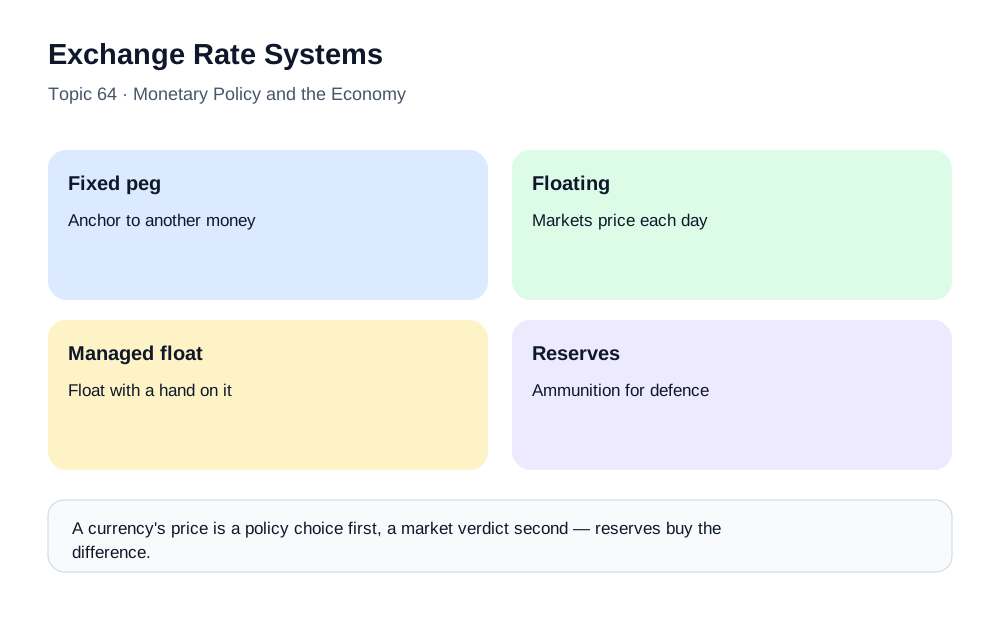
Exchange Rate Systems at a glance — Fixed vs floating, currency pegs, balance of payments.
How Countries Price Their Currencies — And Why It Matters
Exchange rates determine the price at which one currency converts into another, serving as the fundamental valuation mechanism for international trade, investment, and financial flows. The exchange rate regime that a country adopts — whether allowing market forces free rein or constraining movements through official intervention — profoundly influences its economic performance, inflation dynamics, monetary policy autonomy, and banking sector stability. Understanding how exchange rates are determined, what factors drive their movements, and how different regime choices create trade-offs among competing policy objectives provides essential context for banking professionals operating in an increasingly interconnected global economy.
This chapter covers the full terrain: the regime spectrum from free float to dollarization, the forces that move currencies, the balance of payments framework, the reserves that defend currencies, the anatomy of currency crises, and what all of it means for banks. By the end you will be able to:
- Describe every major exchange rate regime and its trade-offs.
- Explain the forces that drive currency values under floating systems.
- Read the balance of payments and connect it to exchange rate pressure.
- Assess reserve adequacy and the role of foreign exchange intervention.
- Recognize the anatomy and warning signs of a currency crisis.
- Trace exchange rate risk into banking operations and balance sheets.
1. First Principles: A Currency Is a Price, Not Just a Thing
Every other chapter of this series treats money as the measuring stick; this chapter asks what measures the measuring stick. A currency's external value — how much of another currency it buys — is set in the world's largest market: the foreign exchange market, where trillions of dollars change hands daily, dwarfing every stock and bond market combined. That price matters far beyond trading floors. It decides what a country's exports cost foreigners and what imports cost at home; it revalues every cross-border debt; it transmits or blocks foreign inflation; and it disciplines — or destroys — governments whose promises exceed their credibility.
The regime question is therefore one of the deepest choices a country makes: who sets this price, and how rigidly? Let markets set it and the currency becomes a shock absorber, flexing to absorb external blows. Fix it and the currency becomes an anchor, stable but rigid — transmitting shocks into the domestic economy instead, and holding only as long as the anchor's credibility and reserves last. Everything in this chapter is a variation on that single trade-off: flexibility versus credibility, absorber versus anchor.
2. The Regime Spectrum
Countries have adopted diverse exchange rate arrangements spanning a continuum from completely free-floating to rigidly fixed systems, with each regime offering distinct advantages and imposing particular constraints. At the flexible end of the regime spectrum, exchange rates are predominantly market-determined and authorities do not maintain a fixed parity or narrow target path. Major currencies such as the United States dollar, euro, British pound, and Japanese yen trade under flexible arrangements, but 'floating' should not be interpreted as a legal promise that authorities can never transact in foreign-exchange markets. The durable distinction is that the currency is not defended at a fixed official rate: market prices can adjust as capital flows, trade, expected interest rates, risk sentiment, and other fundamentals change. This flexibility enables automatic adjustment to external shocks: when a country experiences reduced export demand, its currency depreciates, making exports more competitive and imports more expensive, thereby facilitating external rebalancing without requiring painful domestic deflation. However, floating rates create uncertainty for international trade and investment, expose economies to potentially disruptive capital flow volatility, and can amplify inflationary or deflationary pressures through exchange rate movements.
Managed floating occupies the middle ground, where exchange rates are primarily market-determined but central banks intervene periodically to smooth excessive volatility or prevent movements deemed inconsistent with economic fundamentals. India operates a market-determined exchange-rate framework in which the Reserve Bank of India can intervene to maintain orderly market conditions and curb excessive volatility rather than defend a pre-announced fixed parity. RBI publications describe intervention in spot, forward, and swap markets as one part of exchange-rate and liquidity management. This illustrates an important distinction for learners: a market-determined currency can still be actively managed during disorderly conditions without becoming a fixed exchange-rate regime. This managed flexibility seeks to combine the adjustment benefits of floating with the stability advantages of fixed rates, though the discretionary nature of intervention creates uncertainty about authorities' commitment and may invite speculative attacks if market participants perceive intervention as unsustainable.
Fixed exchange rate regimes commit authorities to maintaining their currency's value within narrow bands around a specified parity, whether against a single currency such as the United States dollar or against a basket of currencies representing major trading partners. The Saudi riyal maintains a long-standing peg to the dollar, providing stability for oil exports priced in dollars while requiring domestic monetary conditions to shadow those of the United States. Currency boards represent an extreme form of fixation, where domestic currency issuance is fully backed by foreign exchange reserves and monetary policy automatically adjusts to maintain the peg, as exemplified by Hong Kong's linked exchange rate system. Dollarization extends this logic to its ultimate conclusion, abandoning domestic currency entirely in favor of a foreign currency such as the United States dollar, as practiced by Panama and Ecuador.
Currency unions eliminate exchange rates among member countries by establishing a single shared currency administered by a common central bank. The eurozone represents history's most ambitious currency union, replacing multiple national currencies with the euro managed by the European Central Bank. While eliminating transaction costs and exchange rate risk within the union, currency unions sacrifice independent monetary policy for individual members and require fiscal discipline to prevent unsustainable imbalances from accumulating. The eurozone crisis of 2010-2012 demonstrated how currency union without fiscal union can create severe tensions when member states face asymmetric shocks — the fiscal chapter's case study applies here with full force.
| Regime | Currency set by | Monetary autonomy | Shock absorption | Crisis risk |
|---|---|---|---|---|
| Free float | Markets entirely | Full | High — currency flexes | Volatility, overshoot |
| Managed float | Markets + intervention | Mostly full | Moderate | Speculative testing of resolve |
| Peg / band | Authority, defended | Subordinated to anchor | Low — rigidity transmits shocks | Peg collapse if defense fails |
| Currency board | Law, fully reserve-backed | Essentially none | Very low | Severe if reserves questioned |
| Dollarization | Foreign currency adopted | None | None — full import of foreign policy | Loss of lender of last resort |
| Currency union | Shared central bank | Pooled, not national | None between members | Asymmetric shocks, fiscal stress |
3. What Moves a Floating Currency
The determination of exchange rates under floating regimes involves multiple interacting factors that shift continuously as economic conditions evolve. Interest rate differentials between countries significantly influence capital flows and currency values: higher domestic rates attract foreign capital seeking superior returns, increasing demand for the domestic currency and causing appreciation. However, this relationship is modified by inflation differentials, as higher nominal rates that merely reflect higher expected inflation rather than higher real returns will not attract sustainable capital inflows — the Fisher decomposition of the previous chapter operating across borders. Inflation differentials themselves affect exchange rates through purchasing power parity: currencies of low-inflation countries tend to appreciate against high-inflation currencies over time, maintaining relatively stable real exchange rates despite nominal movements.
Trade balances influence exchange rates through their effects on currency demand and supply. Persistent trade surpluses create net demand for the domestic currency as exporters convert foreign earnings, tending toward appreciation, while persistent deficits create net supply and depreciation pressure. Capital flows, including foreign direct investment building productive capacity, portfolio investment in securities markets, and banking sector flows, often dwarf trade flows in their exchange rate impact, particularly for financial centers and economies with deep capital markets. Political stability affects exchange rates through risk premiums: instability triggers capital flight and currency weakness, while credible governance attracts investment and supports currency strength. Economic growth prospects influence exchange rates through their effects on expected returns and risk perceptions, with strong growth typically supporting currency values.
The practitioner's summary: in the short run, capital flows and sentiment dominate — the currency is a financial asset, priced by expected returns and risk. In the long run, the real fundamentals assert themselves — inflation differentials and productivity determine where the currency's purchasing power settles. Forecasters do poorly in both horizons, which is why the wisest market participants treat exchange rates as risks to manage rather than outcomes to predict.
4. The Balance of Payments: The External Accounting Frame
The balance of payments accounting framework organizes all international transactions into current, capital, and financial accounts that must sum to zero, revealing the relationship between exchange rates and external positions. The current account captures trade in goods and services, income flows, and transfer payments, with surpluses indicating that a country earns more from abroad than it spends and deficits indicating the opposite. The capital account records capital transfers and non-produced asset transactions, typically small relative to other balances. The financial account records investment flows, including foreign direct investment establishing lasting economic interests, portfolio investment in tradable securities, and other capital flows. Countries running persistent current account deficits must finance these deficits through capital account surpluses, meaning they must attract foreign investment or reduce foreign assets, creating potential vulnerability if capital flows reverse.
The framework's power lies in its identities. A current account deficit is, by arithmetic, a dependence on foreign capital — the country consumes and invests beyond what it earns abroad, and someone must fund the gap. The quality of that funding decides the vulnerability: long-term foreign direct investment in factories is stable funding; short-term portfolio and bank flows are flighty funding that can reverse in weeks. Every currency crisis in this chapter's roster was, at its core, a balance-of-payments funding failure — deficits financed by money that could leave, leaving faster than anyone planned. Watch what funds the deficit, and you are watching the crisis before it starts.
5. Reserves: The Central Bank's Ammunition
Foreign exchange reserves constitute the primary instrument through which central banks manage exchange rates and maintain confidence in their commitment to currency stability. These reserves, held predominantly in United States dollars, euros, yen, and pounds sterling, provide ammunition to defend the currency during periods of market stress. When depreciation pressure emerges, central banks sell reserves and purchase domestic currency, reducing supply in foreign exchange markets and supporting the exchange rate. Reserve adequacy should not be reduced to one universal months-of-imports rule. Import cover, short-term external debt, broad money, portfolio liabilities, export income, the exchange-rate regime, access to markets, and country-specific stress scenarios can all matter. The IMF's Assessing Reserve Adequacy framework deliberately combines several potential drains because different crises arise from different outflow channels. For a country with substantial market access and mobile capital, short-term external debt and portfolio outflows can matter as much as import needs; for other economies, trade shocks or resident capital flight can dominate. The professional question is therefore whether reserves are liquid, usable, and sufficient for the country's plausible stress channels, not whether one headline ratio crosses a universal threshold.
Countries hold very different reserve portfolios and amounts depending on their exchange-rate arrangements, external liabilities, trade structure, policy history, and desired insurance against shocks. Some major Asian and emerging-market economies hold exceptionally large reserve stocks, while other advanced economies with deep markets and freely floating currencies hold much less relative to the size of their economies. Exact rankings and reserve values change continuously, so they should be checked against current official data rather than memorised from a static chapter. A further lesson from recent geopolitical sanctions is that gross reserve value is not identical to usable reserve capacity: currency, custodian location, legal access, liquidity, marketability, and sanctions or counterparty constraints can all affect whether an asset can actually be mobilised in stress.
Two operational truths complete the picture. Intervention sterilizes or it inflates: buying your own currency with reserves contracts domestic money supply, tightening conditions whether you intended it or not, unless offsetting operations neutralize the effect. And reserves defend credibility, not prices: a central bank that defends a level the market believes indefensible is simply transferring its reserves to speculators at favorable prices, which is why reserve defense works only while the market believes it can succeed — a belief problem dressed as an accounting one.
6. The Anatomy of a Currency Crisis
Currency crises follow predictable patterns that banking professionals should recognize as early warning indicators of potential instability. Typically, a country maintains a fixed or managed exchange rate that becomes increasingly misaligned with economic fundamentals as inflation differentials accumulate or external competitiveness erodes. Speculators recognize this misalignment and begin building short positions in the currency, anticipating eventual devaluation. The central bank intervenes to defend the peg, selling reserves and raising interest rates to make short positions expensive. As reserves deplete and economic damage from high interest rates mounts, the defense becomes unsustainable. Eventually, the peg breaks, the currency collapses, and the economy faces severe disruption as import prices spike, foreign debt burdens balloon, and domestic balance sheets implode.
The stages deserve names because they recur so reliably. Misalignment: the pegged rate drifts from what inflation differentials and competitiveness justify — the real exchange rate appreciates even while the nominal one holds. Recognition: markets notice, and positioning shifts from trickle to tide. Defense: reserves fall, rates rise, and each defense raises the cost of the next. Break: the peg collapses, usually overshooting far below what fundamentals justified, because the same momentum that attacked the peg now stampedes past the exit. Aftermath: the real damage lands — foreign-currency debts balloon in domestic terms, import prices spike inflation, and banks holding the mismatches take the losses. The foreign exchange chapter's lesson is brutal and consistent: the collapse is rarely the disease; it is the delayed treatment of a misalignment the regime forbade from adjusting gradually.
7. Case Studies: The Crisis Ledger
The Asian financial crisis of 1997 exemplified this pattern across multiple countries simultaneously. Thailand maintained a dollar peg for the baht despite deteriorating competitiveness and mounting short-term dollar debt, eventually exhausting reserves in defense and allowing the currency to float, whereupon it lost half its value within months. Contagion spread rapidly to Indonesia, Malaysia, South Korea, and other regional economies as investors reassessed regional risk. The crisis's bank-specific lesson echoed for decades: the region's banks and companies had borrowed in dollars against domestic earnings, an innocent-seeming arbitrage on cheap foreign rates that became a solvency catastrophe when currencies halved — the original sin of currency-mismatched borrowing that regulators have policed ever since.
The Russian crisis of 1998 saw ruble devaluation and sovereign debt default as plummeting oil prices and fiscal weakness made the exchange rate unsustainable. Argentina's convertibility law fixing the peso one-to-one with the dollar collapsed in 2001-2002 after years of recession and deflation made the peg politically and economically intolerable, producing economic collapse and social unrest — the definitive demonstration that a currency board's rigidity, which kills inflation, also forbids the exchange rate from absorbing a downturn, so the adjustment exits through unemployment instead. Turkey experienced severe currency crises in 2018 and 2021 as political interference with central bank independence undermined investor confidence and the lira lost over eighty percent of its value across years of unorthodox rate policy. Sri Lanka's 2022 crisis followed years of persistent deficits and borrowing that eventually exhausted reserves, forcing abandonment of the peg and an IMF program — the full sequence from misalignment through defense to collapse and external rescue.
Across the ledger, the constants are unmistakable: rigid regimes with eroding fundamentals, short-term foreign-currency funding, and defenses that spend reserves against a belief the market has already lost. The countries that avoided these outcomes shared the opposite profile: flexible rates or credible anchors, deep local-currency funding, and reserves sized to their short-term foreign debts rather than to convention.
8. The Impossible Trinity, Revisited
The monetary policy chapter introduced the trilemma: no country can simultaneously run free capital flows, an independent monetary policy, and a fixed exchange rate — at most two of three. This chapter's regimes are the menu of those choices made concrete. Free floaters (the United States, eurozone, Japan, Britain) chose open markets and monetary independence, accepting currency volatility. Peggers and currency boards (Saudi Arabia, Hong Kong) chose stability and open markets, subordinating their monetary policy to the anchor's. Countries with capital controls chose the peg and domestic policy, walling off the flows. And the eurozone's members chose each other — pooling monetary sovereignty into a shared central bank.
The trilemma is not academic: it is the reason peg defenses require raising domestic rates into recessions (no monetary independence to do otherwise), the reason reserve adequacy is measured against flight-prone capital (open flows can leave), and the reason every crisis in Section 7 forced a country to discover which vertex of the triangle it had actually been occupying all along.
9. Exchange Rates and the Banking System
Exchange rate movements create significant impacts for banking operations across multiple dimensions. Foreign exchange trading generates revenue for banks through bid-ask spreads and proprietary positioning, with volatility generally increasing trading opportunities and volumes. Translation risk affects banks with foreign currency assets or liabilities, as exchange rate movements change the domestic currency value of these positions even absent underlying changes in the foreign currency amounts. Trade finance operations face exchange rate exposure through letters of credit and guarantees denominated in foreign currencies, where appreciation of the financing currency against the borrower's domestic currency can impair repayment capacity. NRI deposits denominated in foreign currency create direct exchange rate exposure for Indian banks, as rupee depreciation increases the rupee value of foreign currency liabilities. Capital adequacy calculations must account for foreign currency risk weightings and the treatment of currency mismatches in regulatory capital requirements.
The deeper banking exposures reward separate attention. Credit risk through the customer: a bank with no foreign currency positions of its own still carries exchange rate risk through borrowers who earn rupees and owe dollars — the customer's devaluation loss becomes the bank's credit loss, which is why foreign currency lending to unhedged domestic earners is supervisory red-flag territory. Hedging markets: banks are the economy's FX risk intermediaries, selling forwards, swaps, and options that let exporters, importers, and borrowers fix their currency outcomes — a fee business built on the volatility this chapter describes. Funding structure: banks that borrow in foreign currency to fund domestic lending recreate the 1997 mistake at institutional scale, and liquidity rules now constrain exactly that. And settlement: cross-border payments settle across time zones and currencies, the payment-versus-payment mechanisms of the market infrastructure chapter closing the principal risk that FX settlement once carried. The exchange rate is never just a macro variable for a bank; it is embedded in products, borrowers, funding, and capital.
10. A Worked Example: Defending a Peg Under Pressure
Numbers make the crisis script concrete. Imagine a mid-sized economy — call it Meridian — whose central bank has pegged its currency, the merid, at 25 per dollar for three years. During those years, domestic inflation ran at 9 percent annually while the anchor country ran 3 percent. The nominal rate never moved, but the real exchange rate appreciated roughly 18 percent: Meridian's goods became steadily less competitive, its current account swung from balance to a deficit of 4 percent of GDP, and exporters began quietly routing earnings offshore rather than converting at the peg.
The funding structure completes the setup. Meridian's banks and corporates, confident in the peg, borrowed 40 billion dollars abroad — much of it short-term — against merid earnings. The central bank holds 28 billion dollars of reserves. On the crucial adequacy metric, reserves cover only 70 percent of short-term foreign debt. A fund manager running the numbers reaches the same conclusion the 1997 speculators reached: the defense is outgunned.
Now the attack sequence. Speculators borrow merids and sell them for dollars at 25; the central bank buys the merids to hold the peg, spending 3 billion dollars of reserves in a fortnight and sterilizing to keep domestic liquidity stable. It raises the overnight rate from 8 to 15 percent to punish short positions. Each defense round weakens the economy: the rate hike throttles borrowers, the reserve decline becomes front-page news, and local firms rush to buy dollars to hedge — joining the attack. After six weeks, reserves stand at 19 billion dollars against 40 billion of short-term debt maturing within the year. The arithmetic is now public knowledge.
The break comes on a Tuesday. The central bank announces a "widening of the trading band" — the euphemism is traditional — and the merid trades at 31 by Friday, 38 within a month: a 52 percent depreciation that overshoots the roughly 18–25 percent real misalignment, as crisis rates always do. The corporate with 100 million dollars of unhedged debt now owes 3.8 billion merids instead of 2.5 billion; dozens of such firms default simultaneously, and the banks that lent to them — and borrowed abroad themselves — fail in clusters. The international rescue arrives with conditions: floating rate, fiscal cuts, bank recapitalization. Output falls 7 percent before the depreciation's export stimulus and the cleanup begin the recovery, three years in.
Every element of this example has a real-world twin: the real appreciation and the euphemistic "band widening" from 1990s Thailand; the reserve arithmetic from the adequacy metrics earlier; the overshoot from every crisis on the ledger; the fused currency-banking collapse from original sin. The professional's takeaway is not that pegs always fail — many hold for decades — but that a peg is a claim on the central bank's balance sheet, and balance sheets can be audited by anyone with a spreadsheet. When the claim exceeds the assets, the regime's days are numbered by mathematics, not malice.
11. Common Misconceptions About Exchange Rate Systems
"A strong currency means a strong economy." Currency strength reflects relative returns and flows, not virtue: chronically strong currencies often signal weak domestic demand and export dependence, and many policymakers fight appreciation as hard as depreciation. The exchange rate is a price, not a score.
"Depreciation is always bad for a country." Depreciation makes exports cheaper and imports dearer — painful for consumers of imports, stimulative for exporters and import competitors. Whether it helps depends on the economy's structure; the Asian crises showed collapse, but managed depreciations have powered many recoveries.
"Fixed exchange rates eliminate currency risk." They suppress visible volatility while concentrating it into a single break-risk. Businesses under pegs routinely under-hedge, discovering their exposure in the week the peg breaks — the risk was stored, not removed.
"Central banks can set their currency's value wherever they like." They can lean against markets with reserves and rates, but sustained defense against fundamentals spends credibility and reserves into the speculators' hands. Central banks manage currencies; they do not repeal the balance of payments.
"Big reserves make a country crisis-proof." Reserves help only if adequate against flight-prone liabilities, usable (not frozen or encumbered), and believed. Russia's frozen reserves and Thailand's exhausted ones show the two ways the shield fails.
"The balance of payments must be balanced by policy." It balances by accounting identity, always — the question is what balances it: stable investment, flighty flows, reserve depletion, or crisis. Policymakers choose the composition, not the sum.
"Devaluation is a policy lever available on demand." Only countries that issue their own currency can devalue — and they can only do it once against the same creditors before credibility is spent. Members of currency unions and dollarized economies have surrendered the lever entirely, which is why their adjustments fall on wages and prices instead: the slow, grinding "internal devaluation" that external devaluation exists to avoid.
12. Frequently Asked Questions
What is the difference between a fixed and floating exchange rate? Under a float, markets set the currency's price continuously and it absorbs external shocks by moving. Under a fix, the authority commits to a parity and defends it with reserves and interest rates — stability in normal times, break-risk in stressed ones.
What is a managed float? A market-determined rate that the central bank smooths through occasional intervention — the rupee's regime. It trades some float flexibility for calmer volatility, at the cost of constant speculation about the authorities' resolve.
What is a currency board? A hard fix by law: domestic money is issued only against full foreign reserve backing, so monetary policy automatically follows the anchor currency. Hong Kong runs the canonical example — maximum credibility, minimum flexibility.
What is dollarization? Adopting a foreign currency outright, as Panama and Ecuador have with the US dollar — importing that country's monetary policy and stability wholesale, and surrendering both seigniorage and a lender of last resort in domestic currency.
What drives the rupee (or any floating currency) day to day? Capital flows and rate differentials at the margin, risk sentiment globally, and the central bank's smoothing operations; over months, inflation differentials, trade balances, and growth prospects. Short-term prediction is a loser's game; risk management is the professional's answer.
What are foreign exchange reserves for? To defend currency stability in stress, to ensure essential imports and external obligations can be paid through crises, and to signal credibility. Adequacy is judged against imports, short-term external debt, and broad money — the short-term debt metric being the one that predicted crises best.
What is a currency crisis, in one sentence? The collapse of an exchange rate commitment that fundamentals no longer supported — followed by overshooting depreciation, spiking import inflation, and the implosion of foreign-currency-denominated balance sheets.
How do exchange rates affect ordinary bank customers? Through import and fuel prices, through foreign travel and education costs, through exporters' and importers' businesses, and through any borrowing or saving denominated in foreign currency — the rate touches the wallet even when it is never looked at directly.
Why do so many countries hold reserves in US dollars specifically? Because trade invoicing, commodity pricing, and international debt markets run predominantly in dollars, so dollar reserves are the most usable assets for intervention and crisis payments. The dollar's reserve-currency status is a network effect: everyone holds dollars because everyone accepts dollars — which also explains why displacing it is discussed constantly and achieved rarely.
Can a country just print money to pay its foreign debts? Only if the debts are denominated in its own currency — most emerging-market foreign debt is not. Printing domestic money to buy the needed foreign currency simply depreciates the exchange rate until the same real resources change hands through inflation instead of default: the bill is paid either way, by someone.
13. Key Terms in This Chapter
- Exchange rate — the price of one currency in another; the economy's external measuring stick.
- Free float / managed float — market-set rates, with versus without smoothing intervention.
- Peg / band — a committed parity defended by the central bank.
- Currency board — a legislated hard fix with full reserve backing.
- Dollarization — wholesale adoption of a foreign currency.
- Currency union — a shared currency and central bank across countries.
- Purchasing power parity — the long-run pull of inflation differentials on nominal exchange rates.
- Interest rate differential — the cross-border return gap driving capital flows and currency demand.
- Balance of payments — the accounting frame of current, capital, and financial accounts summing to zero.
- Current account — trade, income, and transfers; the country's external earnings position.
- Foreign exchange reserves — the central bank's stock of foreign assets for defense and confidence.
- Reserve adequacy — coverage of imports, short-term external debt, and broad money.
- Sterilization — offsetting intervention's monetary impact so the defense doesn't tighten policy by accident.
- Original sin — borrowing in foreign currency against domestic earnings; the crisis multiplier.
- Impossible trinity — open capital flows, monetary independence, fixed rate: pick two.
- Translation risk — revaluation of foreign currency positions in domestic terms.
- Contagion — crisis transmission across borders through reassessed risk and common creditors.
- Seigniorage — the profit from issuing money, surrendered under dollarization.
14. Interview Insights: How This Topic Appears in Banking Interviews
"Fixed versus floating: which is better?" A trade-off, not a ranking: floats absorb shocks and preserve monetary autonomy at the cost of volatility; pegs buy credibility and stability at the cost of autonomy and break-risk. The strong answer adds the trilemma, asks about the country's inflation history and trade structure, and concludes that regime quality — reserves, fiscal discipline, banking soundness — matters more than regime label.
"Walk me through how a currency crisis unfolds." Misalignment builds under a rigid rate; markets position against it; defense spends reserves and raises rates; the defense becomes the costlier proposition; the break overshoots; foreign-currency balance sheets implode. Naming the stages and the funding structure that made it possible — short-term foreign debt against domestic earnings — shows you see crises as processes, not events.
"Why do central banks hold reserves, and how much is enough?" Defense, payment assurance, and credibility; adequacy measured against imports, short-term external debt, and broad money, with the short-term debt metric the most crisis-relevant. Mentioning usability — frozen reserves taught the world that custody and jurisdiction are part of adequacy — marks current awareness.
"How does currency depreciation hit a bank with no FX positions?" Through borrowers: unhedged customers earning domestic currency against foreign debts become credit losses; through funding costs and inflation transmission; through trade finance and capital calculations. "No FX position" is a trading-desk statement, never a whole-bank one.
"Was the 1997 Asian crisis a currency crisis or a banking crisis?" Both, fused by original sin: banks and firms borrowed dollars against domestic earnings, so the currency collapse and the banking collapse were one event viewed from two sides. The regulatory legacy — currency mismatch limits, reserve metrics, local-currency market development — is the answer's evidence of understanding.
Summary and Key Takeaways
- The exchange rate is the price of the measuring stick itself — set in the world's largest market, and central to trade, inflation, debt, and banking stability.
- Regimes span a continuum — free float, managed float, peg, currency board, dollarization, currency union — each trading flexibility against credibility, with the impossible trinity forcing the choice.
- Floating currencies are moved in the short run by capital flows and sentiment, in the long run by inflation differentials and fundamentals; prediction fails, risk management succeeds.
- The balance of payments must balance by identity: the quality of the financing — stable investment versus flighty flows — is where vulnerability hides.
- Reserves defend credibility, not levels; adequacy against short-term foreign debt matters most; and frozen reserves proved usability is part of adequacy.
- Currency crises follow a script — misalignment, recognition, defense, break, aftermath — and 1997, 1998, 2001, 2018, and 2022 all read from it.
- Banks carry exchange rate risk through trading, translation, customers' mismatches, funding, and capital — original sin being the deadliest channel and the most regulated.
- Regime quality beats regime label: reserves, fiscal discipline, and banking soundness decide outcomes more than the name of the system on the sign.
Next: Topic 65 — Central Bank Independence →
<!-- MBA-DEEP-DIVE-START -->Deep Dive: Exchange Rates Through Bank Balance Sheets, Customers, and Liquidity
An exchange rate is a market price, but banks experience it as a network of balance-sheet conversions. A corporate borrower can owe dollars and earn rupees. A bank can fund a euro asset with dollar liabilities and swap the currency. A customer can hold a foreign-currency deposit while the bank invests the proceeds elsewhere. An exporter can hedge expected receipts that later arrive late or not at all. A central bank can intervene in the market and change both foreign-exchange supply and domestic liquidity.
The practical lesson is that exchange-rate risk rarely stays inside the FX trading desk. It can migrate into credit risk, liquidity risk, collateral, capital, accounting, payments, and customer conduct. A bank may have a very small open currency position of its own while still being heavily exposed to a devaluation through borrowers and funding structures.
Transaction, translation, and economic exposure should be separated
A bank or customer can face several kinds of currency exposure at once.
Transaction exposure arises from a contracted cash flow in another currency: an importer must pay USD 5 million in ninety days, or an exporter expects EUR 2 million from a customer.
Translation exposure arises when a banking group consolidates assets, liabilities, income, and capital held in foreign subsidiaries into the group reporting currency. A subsidiary can be profitable in local currency while contributing less group profit after the currency weakens.
Economic exposure is broader. A domestic manufacturer may invoice entirely in local currency but compete against imported goods. Currency appreciation can make imports cheaper and reduce its pricing power. No foreign-currency invoice appears in the accounts, yet the exchange rate still changes future cash flow.
Risk analysis should identify which exposure is being managed. A forward contract can hedge a defined future payment. It cannot by itself hedge every long-term competitive effect of a currency move.
Customer FX risk can become bank credit risk
Suppose a company earns ₹500 crore annually in domestic currency and has USD 40 million of unhedged debt. At an exchange rate of ₹80 per dollar, the debt is equivalent to ₹320 crore. If the currency depreciates to ₹100, the same dollar principal becomes ₹400 crore before any repayment.
Nothing changed in the contractual dollar amount, but leverage and debt-service burden increased sharply in local currency. If the company cannot raise prices or earn foreign revenue, the currency shock can turn into a default.
Banks should therefore assess currency of cash flow versus currency of obligation. Foreign-currency lending can be entirely sensible for exporters with matched revenues. It can be dangerous for domestic businesses borrowing abroad only because the headline interest rate appears cheaper.
Credit approval should stress both exchange rate and interest-rate movements, including whether hedges exist, their maturity, counterparty, collateral terms, and effectiveness.
Natural hedges are valuable but rarely perfect
A company that receives USD revenue and pays USD expenses has a natural hedge. A bank with dollar assets and dollar liabilities has the same principle at balance-sheet level.
But amounts and timing can differ. An exporter may earn USD 10 million over a year but owe USD 8 million next month. The annual totals look matched while the near-term liquidity need is not.
Currency risk therefore needs a cash-flow ladder by date, not merely a net annual amount. Treasury teams monitor expected inflows and outflows by currency and value date because a bank can be economically hedged over the year while unable to settle today's dollar obligation.
FX liquidity is distinct from FX market risk
A bank can have no directional view on a currency and still face foreign-currency liquidity risk.
Imagine the bank must pay USD 300 million today and expects USD 320 million of receipts tomorrow. Economically the two-day position is nearly balanced. Operationally, the bank still needs USD 300 million today.
It can obtain the currency through correspondent balances, deposits, interbank borrowing, FX swaps, secured funding, or other approved sources. During stress, those sources may become expensive or unavailable.
This is why treasury measures currency-specific liquidity. Domestic central-bank reserves cannot automatically settle foreign-currency obligations. A solvent bank in its home currency can still experience acute dollar or euro funding pressure.
FX swaps convert currency without eliminating funding risk
An FX swap exchanges two currencies now and reverses the exchange later. Banks use swaps extensively to transform funding from one currency into another.
Suppose a bank raises EUR funding but needs USD for three months. It swaps euros into dollars today and agrees to reverse the trade at maturity. The bank has avoided a directional spot-currency exposure, but it has created a future settlement obligation and depends on the swap market for ongoing funding if the need persists.
During global stress, the cross-currency basis can widen, making synthetic foreign-currency funding much more expensive. A bank that appears diversified because it has no direct USD borrowing can still be heavily dependent on the swap market for dollars.
Funding analysis should therefore include both cash liabilities and derivative-based currency transformation.
Hedging removes one risk while creating others
A forward contract can fix the domestic-currency value of a future foreign-currency cash flow. That reduces exchange-rate uncertainty but introduces counterparty, timing, and potentially collateral risk.
If the underlying commercial transaction is cancelled, the hedge remains unless it is closed. If the hedge is collateralised, market movements can generate cash margin calls before the underlying receivable is collected. If the hedge counterparty fails when the contract is valuable, replacement can be expensive.
The professional view is therefore not 'hedged versus unhedged'. It is what risk remains after the hedge.
Banks should capture underlying exposure, hedge notional, maturity, product, counterparty, collateral, and effectiveness together rather than storing a generic hedged = yes flag.
Real effective exchange rates help explain competitiveness
A bilateral exchange rate such as USD/INR shows the price between two currencies. A country's trade competitiveness depends on many partners and relative prices.
A real effective exchange rate (REER) combines movements against a basket of trading-partner currencies and adjusts for relative inflation or cost measures. It is therefore more useful for judging whether a country's goods have become broadly more or less expensive relative to foreign competitors.
A nominally stable currency can appreciate in real terms if domestic inflation persistently exceeds trading partners' inflation. That can weaken exports even though the headline exchange rate barely moves.
For banks financing exporters, the relevant stress is therefore not only nominal devaluation or appreciation. Persistent real appreciation can erode customer margins and market share gradually, creating credit deterioration long before any dramatic currency crisis.
Exchange-rate pass-through differs by sector
Currency depreciation makes imports more expensive in local currency, but the final effect on consumer prices depends on how much companies can pass through.
A fuel importer may face rapid pass-through because global prices are transparent. A retailer can absorb part of the currency loss in margin rather than raise prices immediately. A manufacturer with long supplier contracts may experience a delayed effect.
Credit teams should therefore ask three questions: how much of the borrower's cost base is foreign-currency linked, how quickly prices can be changed, and how sensitive customers are to those price changes.
A company can be fully hedged financially for six months and still face a structural profitability problem after the hedge expires if it cannot pass through higher import costs.
Central-bank intervention changes domestic liquidity unless offset
When a central bank buys foreign currency from the market, it normally pays domestic currency, increasing domestic liquidity through the settlement mechanism. When it sells foreign currency and receives domestic currency, liquidity is withdrawn.
Authorities can use separate operations to offset or sterilise those liquidity effects depending on the monetary framework and policy objective.
For commercial banks, intervention can therefore affect both the FX market and domestic money-market conditions. Treasury should not analyse them as unrelated events.
A large reserve sale can support the currency while also tightening domestic liquidity unless offset. That tightening can raise short-term funding rates and influence bank lending conditions — a second transmission channel from the same intervention.
Reserve adequacy is a liquidity-and-liability matching problem
Official reserves are often discussed as a headline number. The more useful approach is to ask what outflows the country might need to meet.
Relevant drains can include short-term external debt, portfolio outflows, resident capital flight, lost export income, essential import needs, and foreign-currency obligations of the public sector or banking system.
The composition matters too. An asset counted in gross reserves may be less useful if it is illiquid, pledged, subject to legal restrictions, held in the wrong currency, or difficult to access during geopolitical stress.
This is conceptually similar to bank liquidity management: gross assets are not the same as usable liquidity. The reserve manager needs the right currency, in the right place, under legal control, within the time horizon of the expected outflow.
Banks need limits on open currency positions
A bank acting as market maker naturally accumulates temporary long and short currency positions. Risk governance limits how large those positions can become and how long they can remain open.
Controls can include currency-specific limits, aggregate net open position limits, intraday and overnight limits, stop-loss limits, stress tests, and Value-at-Risk or Expected-Shortfall measures where appropriate.
The limit framework should distinguish market risk from customer flow. A trader can stay within a headline net position while holding large offsetting gross positions that create settlement and liquidity needs.
Gross cash flows therefore remain important even when the net market exposure is small.
Translation effects can alter capital and performance reporting
A banking group with foreign subsidiaries consolidates their local-currency financial statements into the group reporting currency. Currency moves can therefore affect reported assets, revenue, profit, and equity even when the subsidiary's local business is unchanged.
Some translation movements are recorded through other comprehensive income or other relevant accounting treatments depending on the applicable standards and structure. The accounting detail varies, but the management lesson is consistent: reported group growth can be driven partly by exchange rates.
A subsidiary growing 5% in local currency can appear to shrink in group reporting if its currency depreciates more than 5%.
Management reporting should therefore separate underlying local performance from FX translation effect rather than interpreting every group-level change as business growth or decline.
Cross-border capital and liquidity may be trapped by legal entity
A banking group can have surplus dollars in one subsidiary and a shortage in another. Local regulation, capital controls, resolution rules, tax, ring-fencing, or transfer restrictions can prevent instant movement.
This becomes important in a currency crisis. Authorities may restrict capital movement to protect domestic reserves. A parent bank may be unable to extract liquidity from a subsidiary precisely when group treasury expected to use it.
Treasury should therefore manage foreign-currency liquidity by legal entity and jurisdiction, not only at consolidated group level.
Exchange controls change customer journeys and operations
Countries can impose rules governing conversion, repatriation, foreign borrowing, resident investments, or documentary evidence for cross-border transactions. These controls can change quickly during external stress.
For banks, the impact is operational. Customer channels may need new purpose codes or documentary requirements. Limits may change. Certain transactions may need approval. Existing instructions can be delayed while compliance and regulatory interpretation are updated.
A policy announcement therefore becomes product, workflow, entitlement, screening, and customer-communication change.
Systems should support effective-dated rules rather than hard-coded assumptions about convertibility that are difficult to change during a crisis.
Currency crises test data quality before strategy
When a currency moves 15% in a week, senior management immediately asks: which customers have foreign-currency debt, which loans are unhedged, which collateral is currency-sensitive, which nostro accounts need funding, which derivative counterparties owe margin, and what limits have been breached?
A bank can answer only if currency attributes are accurate across credit, treasury, payments, collateral, and customer systems.
A corporate loan recorded merely as 'USD facility' without the borrower's revenue currency or hedge status gives little insight. A guarantee amount converted at stale FX rates can understate exposure. A payment system with wrong value-date logic can create unexpected nostro shortages.
Exchange-rate risk therefore depends on reference data and lineage as much as on traders' market views.
A complete devaluation scenario inside a bank
Consider a bank operating in a country whose currency depreciates 20% over one month after a sudden stop in portfolio inflows.
The bank's FX trading book is nearly flat because dealers hedge customer flows. At first glance, management believes currency risk is small.
The credit book tells a different story. Several importers have dollar loans but domestic-currency revenue. Their debt-service burden rises immediately. A property developer has foreign-currency construction costs and fixed-price local sales contracts, squeezing project margins. An airline has hedged fuel prices but not all of its currency exposure.
Treasury faces its own pressure. Corporate customers convert deposits into dollars. USD funding costs rise and the cross-currency basis widens. The bank needs more dollar liquidity for customer payments and derivative margin. Some foreign-currency collateral loses value after market haircuts increase.
At group level, the local subsidiary's capital translates into less parent-company reporting currency. Government bond yields rise as the central bank tightens policy to stabilise the currency, creating duration losses in the securities portfolio.
No one large open FX trading position caused the problem. The exchange rate acted as a common risk factor across borrowers, funding, collateral, liquidity, and capital.
A strong bank had already mapped these channels. It limits unhedged foreign-currency lending, tracks borrower revenue currency, stresses FX alongside interest rates, maintains currency-specific liquidity buffers, and reconciles group and legal-entity exposures. A weak bank discovers that 'net open position = small' was never the same as 'currency risk = small'.
What excellence looks like
A world-class bank manages exchange rates as a cross-functional risk, not a dealer number. It separates transaction, translation, and economic exposure. Foreign-currency lending is matched to borrower cash flow or credible hedging. Natural hedges are analysed by timing. FX swaps are included in funding risk. Reserve and bank liquidity are judged by usable currency and legal location. Open-position limits sit alongside gross settlement and nostro forecasts. Exchange controls are translated into effective-dated customer and operational rules. Stress tests combine devaluation, rates, collateral, and credit deterioration.
The deepest lesson is that a currency is both a price and a settlement asset. Its movement changes the value of promises already written and the ability to fund promises due today. Banks manage exchange-rate risk well when they can trace both effects from the market quote all the way to the borrower, the nostro account, the balance sheet, and the customer experience.
<!-- MBA-DEEP-DIVE-END -->