Visual overview
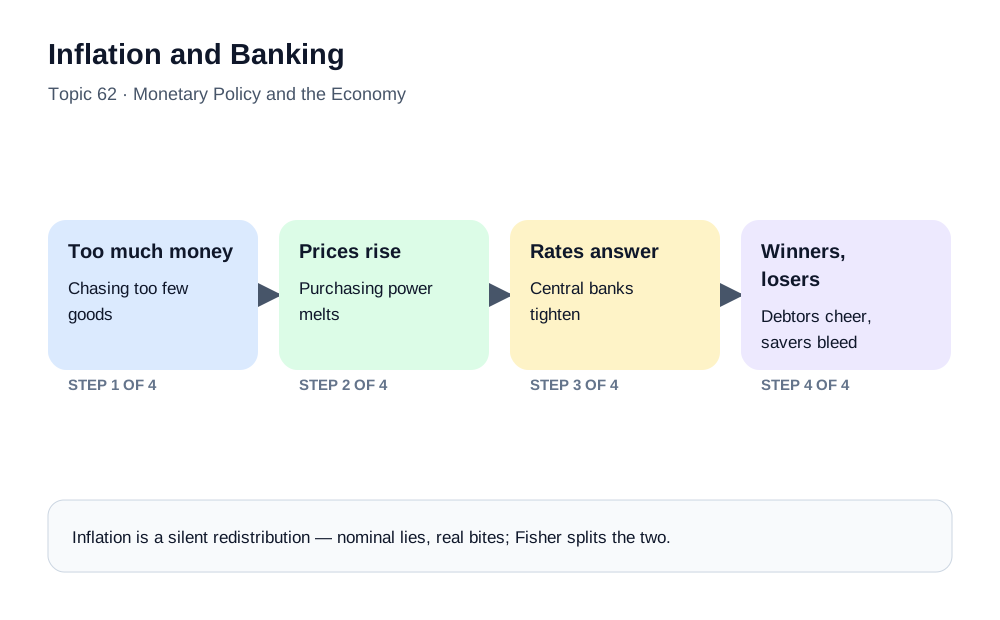
Inflation and Banking at a glance — Real vs nominal rates, CPI, WPI, central bank targets.
The Silent Tax That Reshapes Every Financial Decision
Inflation represents the sustained increase in the general price level of goods and services within an economy over time, functioning as an invisible force that gradually erodes purchasing power and fundamentally reshapes every financial decision made by individuals, businesses, and institutions. For central banks, controlling inflation constitutes their paramount operational objective; for banking professionals, understanding inflation dynamics proves essential to managing assets, pricing liabilities, and preserving real returns. This phenomenon, often characterized as the silent tax upon wealth accumulation, influences everything from the attractiveness of savings accounts to the affordability of mortgages, from corporate investment decisions to government fiscal sustainability.
This chapter explains inflation from first principles to bank operations. By the end you will be able to:
- Define inflation and distinguish its four mechanisms: demand-pull, cost-push, built-in, and imported.
- Read the main price indices and understand what core inflation strips out.
- Apply the Fisher equation to separate nominal from real returns.
- Identify who wins and who loses when inflation rises — including the borrower's advantage.
- Explain inflation targeting frameworks across major central banks.
- Describe how inflation expectations become the real battleground.
- Connect inflation to bank pricing, deposit economics, bond portfolios, and credit risk.
1. First Principles: Purchasing Power Is the Point
Money's usefulness rests on a promise: that the unit you accept today will buy roughly the same basket tomorrow. Inflation is the slow breaking of that promise. When the general price level rises five percent, every unit of currency buys five percent less — and every financial contract written in nominal terms quietly reprices in real terms. The saver's deposit, the borrower's mortgage, the pensioner's fixed annuity, the worker's wage contract: all of them are bets on future purchasing power, and inflation settles the bets.
Two clarifications keep the concept honest. First, inflation is a rise in the general price level — a single commodity getting expensive is relative price change, not inflation; inflation is when the whole basket climbs. Second, the damage lies less in the level than in the uncertainty: steady three percent inflation is a calculable cost of doing business, while volatile inflation between two and twelve percent makes every long-term contract a gamble. This is why central banks target low and stable inflation — predictability is the public good they actually supply.
The phrase 'silent tax' can be a useful metaphor for the erosion of purchasing power in cash and fixed nominal claims, but it is not literally a tax and the distributional effect is more complex than a simple transfer to government. Unexpected inflation can reduce the real value of fixed-rate nominal liabilities and therefore benefit some debtors relative to creditors, including governments with suitable nominal debt structures. At the same time it can raise borrowing costs, weaken currencies, change tax receipts and expenditures, increase index-linked obligations, and damage real incomes. The professional habit is therefore to analyse who holds nominal assets, who owes nominal liabilities, how quickly wages and rates reset, and which contracts are inflation-linked rather than assuming every inflation episode produces the same winners and losers.
2. The Four Mechanisms: Where Inflation Comes From
The phenomenon of inflation manifests through several distinct mechanisms, each with different causes and implications for policy response. Demand-pull inflation emerges when aggregate demand for goods and services exceeds the economy's productive capacity, creating what economists describe as "too much money chasing too few goods." This demand pressure can arise from various sources: expansionary monetary policy that increases money supply and credit availability, fiscal stimulus that injects purchasing power through government spending or tax cuts, or positive wealth effects from rising asset prices that encourage household consumption. The post-COVID inflation surge of 2021-2022 exemplified demand-pull dynamics, as pandemic-related supply constraints interacted with unprecedented fiscal and monetary stimulus to generate the highest inflation rates in four decades across many developed economies.
Cost-push inflation operates through a different channel, originating on the supply side of the economy rather than the demand side. When essential input costs rise, whether through energy price shocks, supply chain disruptions, wage increases, or currency depreciation raising import costs, producers pass these higher costs to consumers through increased prices. The oil crises of the 1970s represented classic cost-push inflation, as dramatic petroleum price increases propagated through transportation, manufacturing, and heating costs throughout the economy. More recently, supply chain disruptions during the COVID-19 pandemic, including semiconductor shortages affecting automobile production and shipping capacity constraints, contributed to cost-push pressures that combined with demand factors to create unusually persistent inflation.
Built-in inflation, sometimes termed wage-price inflation, describes a self-reinforcing cycle in which rising prices lead workers to demand higher wages to maintain their real purchasing power, which increases production costs and forces further price increases, perpetuating the inflationary spiral. This dynamic becomes particularly entrenched when inflation expectations become unanchored, meaning households and businesses no longer believe central banks will maintain price stability and instead build expected inflation into their wage and price-setting behavior. The experience of the 1970s demonstrated how difficult such inflationary psychology can be to reverse once established, requiring aggressive monetary tightening that often produces significant economic disruption before credibility is restored.
Imported inflation affects open economies through exchange rate movements and international price transmission. When a country's currency depreciates against trading partners, the domestic price of imported goods rises immediately, directly increasing consumer price indices. Even without currency movements, global commodity price increases or foreign inflation can transmit to domestic prices through import channels. Emerging market economies with significant import dependence and volatile exchange rates face particular vulnerability to imported inflation, complicating their monetary policy challenges since domestic interest rate decisions cannot directly affect external price developments.
The mechanism matters because the remedy differs. Demand-pull inflation yields to monetary tightening: cool demand and prices stabilize. Cost-push inflation presents a crueler trade-off — tightening reduces demand but cannot produce oil or unclog ports, so the central bank must choose between accepting temporary inflation or forcing a recession to suppress it. Built-in inflation is the most dangerous of all because it is self-sustaining: it continues without any new shock, powered purely by expectation, and stopping it requires convincing millions of price-setters to change their minds. Imported inflation tests small open economies most severely, since the cause lies beyond the reach of domestic policy.
3. Measuring Inflation: The Price Indices
Measuring inflation requires constructing price indices that track representative baskets of goods and services over time, with different indices serving different analytical purposes. The Consumer Price Index tracks price changes for a comprehensive basket of consumer goods and services purchased by households, providing the headline measure most closely related to cost-of-living concerns and typically serving as the primary inflation target for central banks. The Wholesale Price Index measures price changes at earlier stages of distribution, capturing producer-level pressures that may eventually transmit to consumer prices; this measure has historically received significant policy attention in India. The Personal Consumption Expenditure deflator, preferred by the United States Federal Reserve, weights consumption components according to actual spending patterns and includes certain expenditures excluded from CPI. Core inflation measures exclude volatile food and energy components to reveal underlying inflation trends obscured by temporary commodity price fluctuations. The GDP deflator provides the broadest measure, capturing price changes for all goods and services produced domestically, including those consumed by government and businesses rather than households alone.
Two practical points reward attention. First, core inflation is not a denial that food and fuel matter — it is a forecasting tool: commodity prices whipsaw and revert, so the core measure reveals the persistent trend that policy should answer, while headline captures what households actually feel. Second, every index embeds choices — which basket, which weights, how to handle quality improvements — so your lived inflation can differ from the published number if your spending pattern differs from the average household's. The indices are estimates of a national average, not measurements of any individual's cost of living.
4. Nominal Versus Real: The Fisher Equation
The distinction between nominal and real interest rates constitutes one of the most consequential concepts in banking and investment, captured formally in the Fisher Equation which states that the real interest rate approximately equals the nominal interest rate minus the inflation rate. This relationship determines whether investments actually grow in purchasing power or merely appear to grow in nominal terms while losing real value. Consider a savings account paying seven percent interest when inflation runs at four percent: the depositor achieves a positive real return of approximately three percent, meaning their purchasing power genuinely increases over time. Conversely, the same seven percent nominal return during eight percent inflation produces a negative real return of approximately one percent, meaning the depositor loses purchasing power despite the nominal growth in their account balance. Deflation, when prices fall, creates the opposite dynamic: even modest nominal returns can produce attractive real returns, though deflationary environments typically signal economic distress that may increase credit risk.
The equation runs both ways in practice, and bankers apply it daily in both directions. Looking forward, markets price expected inflation into nominal rates — lenders demand compensation for anticipated erosion, which is why nominal interest rates in high-inflation countries sit permanently higher. Looking backward, realized inflation decides who actually won the contract: the lender who charged seven percent expecting four percent inflation profits handsomely if inflation turns out to be two, and loses if it turns out to be nine. Every nominal loan is thus a shared bet on inflation, with the borrower and lender on opposite sides. The interest rate theory chapter picks up this thread in detail; here the operative skill is the reflex: whenever you see any interest rate, ask what inflation is doing to it.
5. Winners and Losers: Inflation's Great Redistribution
Banking products respond to inflation in complex and often contradictory ways that create winners and losers across different market positions. Savings accounts and other liquid deposits typically offer low nominal rates that become negative in real terms during periods of even moderate inflation, effectively transferring wealth from depositors to banks and borrowers. Fixed deposits lock in returns at inception, meaning depositors who commit funds when inflation is low suffer reduced real returns if inflation subsequently rises, while benefiting if inflation falls unexpectedly. Home loans and other long-term fixed-rate borrowing create substantial advantages for borrowers during inflationary periods, as the real burden of debt repayment declines with rising prices while nominal incomes typically adjust upward. Bond portfolios, particularly those holding fixed-rate securities, suffer capital losses when inflation rises because the fixed future payments become less valuable in real terms, pushing market prices downward to restore competitive yields. Bank treasury operations must carefully manage duration risk as interest rates respond to inflation developments. Even bank operating costs rise with general inflation, affecting staffing expenses, technology investments, and physical infrastructure maintenance.
The redistribution follows a simple rule of thumb: inflation rewards those who owe fixed nominal amounts and punishes those who are owed them. Debtors win, creditors lose; borrowers win, depositors lose; governments with large debts win, bondholders lose. The economy's largest debtor is usually the government itself — which is why inflation is politically tempting as a quiet debt-reduction device, and why savers' vigilance about real returns is a form of self-defense.
6. The Borrower's Advantage: A Worked Example
The borrower's advantage during inflation deserves particular emphasis because it represents such a powerful wealth transfer mechanism. Consider a household that borrows ten lakh rupees for a twenty-year mortgage at a fixed rate: if inflation averages seven percent annually over the loan term, the real purchasing power of the outstanding principal declines by approximately half over the first decade, even as the borrower's nominal income likely increases with inflation. The fixed monthly payment represents a declining real burden over time, effectively making the loan progressively more affordable. This dynamic explains why governments with significant debt burdens sometimes find high inflation politically tempting, as it erodes the real value of their obligations without requiring explicit default or painful fiscal consolidation.
Extend the example to see the bank's side. The same mortgage on the bank's books is a fixed-rate asset whose real value is eroding at the same seven percent; the bank's funding, meanwhile, reprices upward as depositors demand inflation compensation. The borrower's windfall is the lender's squeeze — and the squeeze is worst for institutions holding long fixed-rate assets against short funding, the classic mismatch that asset-liability management exists to control. Inflation does not merely move prices; it systematically re-prices every balance sheet in the economy, and the banking system's balance sheet most of all.
7. Inflation Targeting: The Modern Framework
Central banks have adopted inflation targeting as their dominant monetary policy framework, recognizing that anchoring inflation expectations around a specific numerical target provides a transparent and credible anchor for price stability. The United States Federal Reserve targets two percent inflation as measured by the Personal Consumption Expenditure deflator, believing this modest positive rate provides sufficient buffer against deflationary risks while maintaining reasonable price stability. The European Central Bank similarly targets two percent inflation measured by the Harmonized Index of Consumer Prices. The Bank of England targets two percent CPI inflation with the operational independence to choose the instruments for achieving this objective. The Reserve Bank of India operates a flexible inflation targeting framework with a four percent target and a tolerance band of plus or minus two percentage points, reflecting the greater inflation volatility typical of emerging market economies. The Bank of Japan has targeted two percent inflation for decades but has struggled to achieve even this modest rate amid persistent deflationary pressures — the proof that inflation targeting works both ways, and that escaping too little inflation can be as hard as escaping too much.
Why two percent and not zero? A small positive target buys insurance against deflation, whose trap — falling prices rewarding delay, real debt burdens growing, policy rates pinned at zero — is harder to escape than moderate inflation. The number is a buffer and a convention, not a physical constant, and the tolerance bands around emerging-market targets acknowledge that food-heavy baskets and volatile exchange rates make precision unachievable. What matters is not the digit but the anchor: everyone in the economy can write contracts, set wages, and price loans against a credible expectation, and that shared expectation does most of the stabilizing work before the central bank moves at all.
8. The Central Bank's Response Toolkit
Central banks deploy their full toolkit to combat inflation when it rises above target ranges. Raising the policy interest rate increases borrowing costs throughout the economy, discouraging consumption and investment spending and thereby reducing aggregate demand pressures. Quantitative tightening through bond sales or allowing holdings to mature withdraws liquidity from the financial system and pushes up longer-term interest rates. Forward guidance communicating hawkish intentions helps anchor inflation expectations and may reduce the actual rate increases required to achieve price stability. Adjusting reserve requirements constrains bank lending capacity when necessary. The effectiveness of these measures depends significantly on central bank credibility, the source of inflationary pressures, and the broader economic context including fiscal policy stance and external conditions. The monetary policy chapter details the transmission machinery; the inflation-specific point is that every tool ultimately works through one variable: expectations. Rate hikes persuade the economy that the central bank will pay any price for stability, and it is the persuasion — backed by demonstrated willingness — that stops the spiral.
9. Expectations: The Real Battleground
Modern inflation control is, at bottom, the management of beliefs. If workers expect three percent inflation and demand three percent raises, and firms expect three percent inflation and price for it, the economy delivers roughly three percent inflation — the expectation fulfills itself. A credible central bank target therefore does the heavy lifting silently: wage rounds, price lists, and bond yields all anchor to the target, and actual inflation rarely strays far for long. When the anchor slips — when wage demands and price-setting start chasing last year's inflation instead of the target — the built-in spiral begins, and restoring the anchor costs real pain: the 1970s required Volcker's twenty percent rates and deep recessions, as the previous chapter's case study recounted.
This is why central bankers watch wage settlements, inflation-protected bond yields, and household surveys more anxiously than last month's CPI print. The print tells you where inflation was; expectations tell you where it is going. And it is why they speak in carefully weighed sentences: communication is not commentary on policy — in the expectations game, communication is policy.
10. Deflation: The Opposite and Worse Trap
Inflation's opposite number deserves its own warning. Deflation — a sustained fall in the general price level — sounds like a consumer's gift and behaves like an economy's disease. When prices fall, delay is rewarded: why buy today what costs less next month? Spending and investment freeze; real debt burdens grow as nominal debts stay fixed while prices and incomes shrink; and policy rates hit the zero floor with real rates stuck positive, so monetary policy loses its lever. Japan's decades of near-deflation and the 1930s Depression stand as the two great lessons: deflation is easy to fall into, brutal to escape, and the reason every inflation target sits above zero. For banks, deflation is the worst macro environment of all — credit demand collapses, real defaults rise as debts grow in real terms, and margins vanish at the zero bound.
11. Hyperinflation: When Money Itself Fails
Hyperinflation represents the catastrophic failure of monetary systems, occurring when inflation accelerates beyond control and destroys the purchasing power of money so rapidly that it ceases to function as a store of value or medium of exchange. Historical episodes demonstrate the devastating consequences of such breakdowns. Weimar Germany during 1923 experienced monthly inflation rates reaching twenty-nine thousand percent as the government printed money to meet war reparation obligations, wiping out savings and destroying the middle class. Zimbabwe during 2008 experienced monthly inflation estimated at nearly eighty billion percent following political crisis and economic mismanagement. Venezuela during 2018 experienced inflation exceeding one million percent annually as oil dependency and policy failures combined to collapse the currency. Hungary in 1946 experienced the most extreme hyperinflation in recorded history, with prices doubling every fifteen hours. In each case, hyperinflation destroyed savings, wiped out bank deposits, collapsed financial systems, and produced profound social and political instability. These cautionary tales underscore why central banks prioritize inflation control above virtually all other objectives: monetary credibility represents the fundamental foundation upon which stable banking and economic activity depend.
Hyperinflation episodes usually involve a collapse of fiscal and monetary credibility, very rapid money creation relative to the economy's capacity and demand for the currency, and a self-reinforcing flight from money into goods, foreign currency, or real assets. The historical causes differ — war, lost tax capacity, collapsing output, external obligations, political crisis, exchange-rate breakdown, and fiscal monetisation can all interact — so it is too simple to attribute every case to one mechanism. Durable stabilisation generally requires restoration of credible fiscal finance and monetary control together, often alongside institutional, exchange-rate, banking, or currency reforms. For banking students, hyperinflation marks the outer boundary of everything this series teaches: deposits, loans, payments, and capital all presuppose a money that holds its meaning.
12. Case Study: The 2021–2023 Inflation Cycle
The most instructive recent inflation episode unfolded in three acts, each illustrating a section of this chapter. Act one, the surge (2021): economies reopened from pandemic lockdowns with supply chains still broken — semiconductors, shipping, energy — while trillions in fiscal transfers and zero interest rates powered demand. Headline inflation in the United States climbed through five, then seven percent, and many central banks, reading the shock as cost-push and temporary, held policy steady. Act two, the entrenchment (2022): the energy shock from the war in Ukraine compounded the pressure, inflation spread from goods into services and wages, and the danger shifted from the price level to expectations — the built-in spiral's early warning signs appeared in wage settlements and surveys. Central banks pivoted to the fastest tightening in decades. Act three, the disinflation (2023–2024): as supply chains healed and demand cooled, headline inflation fell substantially back toward targets, accomplished in many economies without the deep recession feared — a "soft landing" outcome that was neither guaranteed nor universal.
The case yields three durable lessons. First, mechanism diagnosis is not academic: treating an entrenched demand problem as transitory supply noise costs a year of policy delay. Second, expectations are the true target: once wage-setting began chasing past inflation, only demonstrated tightening resolve stopped the spiral — and the credibility cost of the "transitory" misjudgment had to be repaid in higher rates. Third, inflation's incidence is regressive: essentials like food and energy dominate the budgets of lower-income households, so inflation's "silent tax" falls hardest on those least able to hedge it — a distributional fact that drives the politics as much as the economics.
13. Inflation in the Bank: Operational Consequences
Inflation reaches into every corner of a bank's operations. Asset-liability management sits at the center: fixed-rate assets lose real value as inflation rises, while funding costs reprice, and duration mismatches turn inflation surprises into capital events — the bond chapter's duration mathematics is inflation risk in numerical form. Deposit economics shift: customers move money from low-yield accounts to fixed deposits and market instruments as nominal rates rise, forcing banks to compete harder and earlier for funding — the deposit beta of earlier chapters is inflation's footprint on the liability side. Credit risk follows with a lag: borrowers' nominal incomes and revenues may rise with inflation, helping fixed-rate debtors, but real disposable income squeezed by essentials can impair consumer credit, and input-cost inflation punishes business borrowers with fixed-price contracts. Pricing discipline tightens: every long-dated fixed-rate product the bank writes embeds an inflation forecast, and the pricing committee's inflation view is as consequential as its credit view. Finally, operating costs inflate too — salaries, technology, premises — squeezing cost-income ratios precisely when revenue quality is hardest to maintain. A bank that manages inflation well is not one that predicts it perfectly; it is one whose balance sheet survives being wrong.
14. Common Misconceptions About Inflation
"Inflation means all prices are rising." Inflation is a rise in the average level: individual prices fall constantly even amid high inflation, and relative price changes (oil up, electronics down) coexist with — and are often mistaken for — inflation itself.
"A little inflation is harmless, so a lot must just be a bigger nuisance." Inflation's damage is nonlinear: moderate, predictable inflation is a lubricant; high, volatile inflation breaks contracting, planning, and trust in money. The difference between five percent and fifty percent is not degree but kind.
"Inflation is always caused by money printing." Money is a permissive condition, not the proximate cause: the 1970s ran on oil shocks, 2021–22 ran on supply chains plus stimulus, and hyperinflations run on fiscal collapse. Every inflation is monetary in the long run, but the trigger varies — and the trigger determines the remedy.
"High interest rates mean the central bank wants to hurt borrowers." The tightening is aimed at expectations and demand, not at any group: the goal is to stop price-setting from chasing itself, and the pain is the regrettable mechanism, not the purpose.
"Deflation would be great for consumers." Deflation rewards waiting, so spending freezes, debts grow in real terms, and policy loses traction. Falling prices signal a failing economy, not a generous one — ask any Japanese household of the lost decades.
"My savings account keeps me safe from inflation." Only if its rate exceeds inflation after tax. Most liquid deposits pay negative real returns in inflationary periods — the account preserves nominal value while purchasing power quietly leaks.
"Inflation destroys everyone's savings equally." Inflation redistributes: it harms creditors, fixed-income holders, and cash savers while benefiting debtors — above all governments and fixed-rate borrowers. The question is never whether you are affected, but on which side.
15. Frequently Asked Questions
What is inflation, in one sentence? A sustained rise in the general price level, which is the same thing as a sustained fall in money's purchasing power.
What is the difference between demand-pull and cost-push inflation? Demand-pull comes from spending outrunning capacity; cost-push comes from input costs (energy, wages, imports) forcing prices up from the supply side. The first responds to monetary tightening; the second forces a painful choice between tolerance and recession.
Why do central banks target two percent rather than zero inflation? To keep a buffer against deflation — the harder trap — and to let relative prices adjust without nominal declines. The digit is a convention; the anchor it provides to expectations is the point.
What is core inflation and why strip out food and fuel? The headline index minus volatile food and energy prices. Those components whipsaw on commodity markets and revert, so core reveals the persistent trend policy should answer — though households rightly note they cannot eat "core."
How do I calculate my real return? Nominal return minus inflation (the Fisher approximation). Seven percent interest with four percent inflation is roughly three percent real; with nine percent inflation it is roughly minus two — a loss in purchasing power despite a growing balance.
Who benefits from inflation? Debtors — governments, fixed-rate mortgage holders, leveraged firms — because they repay in cheaper money. Creditors, cash holders, and fixed-income investors lose correspondingly. Inflation is redistribution, not uniform erosion.
What is hyperinflation and what causes it? Inflation so extreme that money loses function — historically fifty percent monthly or worse — caused in every major case by governments financing themselves through money printing when taxation and borrowing fail. The cure is fiscal credibility, often with a new currency, not monetary fine-tuning.
Why is deflation dangerous if prices falling sounds good? Because delay becomes profitable: spending and investment freeze, real debt burdens rise, and interest rates cannot fall below zero to stimulate. Deflation is a trap with no easy exit, as Japan's experience showed.
16. Key Terms in This Chapter
- Inflation — a sustained rise in the general price level; a fall in money's purchasing power.
- Demand-pull inflation — excess demand over productive capacity.
- Cost-push inflation — supply-side input costs propagating into prices.
- Built-in / wage-price inflation — the self-sustaining expectations spiral.
- Imported inflation — price pressure arriving through exchange rates and global commodities.
- CPI / WPI / PCE / GDP deflator — consumer, wholesale, expenditure-based, and economy-wide price measures.
- Core inflation — the index excluding volatile food and energy.
- Fisher equation — real rate ≈ nominal rate − inflation.
- Real vs nominal return — purchasing-power-adjusted versus face-value return.
- Inflation targeting — the framework anchoring expectations to a published numerical target.
- Inflation expectations — beliefs about future inflation; the true battleground of price stability.
- Deflation — sustained general price decline; the harder trap.
- Hyperinflation — monetary collapse through runaway price growth, rooted in fiscal failure.
- Silent tax — inflation's unlegislated transfer from nominal asset holders to debtors.
- Duration risk — the sensitivity of fixed-rate portfolios to inflation-driven rate moves.
- Soft landing — disinflation achieved without recession; aspired to, not guaranteed.
17. Interview Insights: How This Topic Appears in Banking Interviews
"Explain the difference between demand-pull and cost-push inflation, and why it matters for policy." Source and remedy: excess demand versus supply-side costs; tightening cures the first and merely suppresses the second at recessionary cost. The strong answer adds the 2021–23 example — a compound shock that punished single-mechanism diagnosis — and notes that built-in inflation, the expectations spiral, is the form that demands credibility rather than stimulus withdrawal.
"A customer asks why their seven percent deposit is 'losing money.' What do you explain?" The Fisher relationship: real return equals nominal minus inflation, so seven percent against nine percent inflation is a two percent annual purchasing-power loss despite a growing balance. Then the constructive half: real-return thinking, not product selling — the distinction between nominal safety and real safety is the lesson that builds trust.
"Who wins and who loses from inflation inside a bank?" Fixed-rate borrowers win; the bank's fixed-rate assets and bond portfolio lose; depositors holding low-yield balances lose real value; the bank's funding costs reprice upward. The synthesis: inflation systematically transfers value from the bank's asset side to its liability holders and borrowers — which is why ALM and duration management are inflation management.
"Why did the 'transitory' call of 2021 prove so costly?" It mistook an entrenching demand-and-expectations problem for a passing supply shock, delaying tightening until wage-setting had begun chasing past inflation — requiring a faster, harder correction later. The meta-lesson: in inflation, the expensive mistake is being late, because expectations compound while policy waits.
"Could hyperinflation happen in a developed economy?" Mechanically possible but institutionally remote: hyperinflation requires fiscal collapse financed by the printing press, which independent central banks and functioning tax systems exist to prevent. The honest answer notes the preconditions rather than declaring impossibility — confidence is a stock that can be spent.
Summary and Key Takeaways
- Inflation is a sustained fall in money's purchasing power — the silent, unlegislated tax on every nominal contract, and predictability matters more than level.
- Four mechanisms drive it: demand-pull (excess spending), cost-push (supply shocks), built-in (the expectations spiral, most dangerous), and imported (exchange rates and global prices) — and the remedy depends on the mechanism.
- Indices differ by purpose: CPI for cost of living, WPI for producer pressure, PCE for the Fed, core for the persistent trend.
- The Fisher equation separates nominal from real: seven percent is a gain at four percent inflation and a loss at nine — every rate quoted in this industry is an inflation bet.
- Inflation redistributes systematically: debtors win, creditors lose, governments quietly deleverage — and fixed-rate bank assets sit on the losing side unless managed.
- Inflation targeting anchors expectations, which are the true battlefield; once wage-setting chases the past, only costly credibility restoration stops the spiral.
- Deflation is the worse trap; hyperinflation is fiscal collapse through the printing press — the outer boundary of everything banking presupposes.
- For banks, inflation is operational: duration, deposit betas, credit quality, pricing, and costs all move with it — and resilience means surviving the forecast you got wrong.
Next: Topic 63 — Interest Rate Theory →
<!-- MBA-DEEP-DIVE-START -->Deep Dive: Inflation as a Balance-Sheet Shock for Banks and Customers
Inflation is often taught as a percentage published once a month. Banks experience it as a repricing problem across almost every contract they hold. Deposits, loans, bonds, wages, property, collateral, fees, capital expenditure, customer income, and central-bank policy all adjust at different speeds. The resulting mismatch determines who gains, who loses, and where risk accumulates.
The practical banking question is therefore not simply 'Is inflation high?' It is: which prices and incomes are rising, which interest rates are resetting, which contracts are fixed, and how quickly can the bank and its customers adapt? Two economies with the same headline inflation rate can produce very different credit and profitability outcomes if the structure of wages, mortgages, deposits, and exchange rates differs.
Headline, core, and services inflation answer different questions
Headline inflation measures the broad basket and is closest to what households experience. Core measures are designed to reduce the noise from particularly volatile components such as food and energy under the relevant methodology. Services inflation can be useful because labour and rent-related costs often adjust more slowly than commodity prices.
A bank should not choose the measure that supports the story it wants to tell. Each serves a purpose.
A surge in energy prices can push headline inflation sharply higher while underlying services inflation remains moderate. That matters for household affordability because fuel and electricity still consume cash today. But it may imply a different monetary-policy path than an economy where wages and services prices are accelerating broadly.
Credit teams therefore combine price indices with sector and customer information. A transport company is exposed directly to fuel prices. A restaurant is exposed to food and wages. A software company may be affected more by salaries than by commodity inflation. One CPI number cannot describe every borrower's cost base.
Inflation expectations matter because contracts are written before inflation arrives
Banks price new lending using expected future rates, funding costs, credit risk, and inflation-sensitive market curves. Employees negotiate wages based partly on expected living costs. Businesses set prices based on what they expect suppliers and customers to accept.
If everyone expects inflation to return toward a stable target, one-off energy or tax changes may not become persistent. If businesses and households begin expecting high inflation indefinitely, they can build larger increases into wages, rents, supplier contracts, and pricing decisions.
For banks, expectation measures matter because market rates can rise before current inflation does. Government bond yields, inflation-linked securities, swaps, and survey measures can all provide signals. Treasury desks therefore monitor both realised inflation and the market's implied path.
Deposit customers care about real return even when statements show nominal growth
A deposit paying 5% looks attractive if inflation is 2% and unattractive if inflation is 8%, ignoring tax and compounding for the simple comparison. Customers react to that loss of purchasing power by moving into higher-rate term deposits, money-market funds, government securities, gold, equities, or other assets depending on their risk tolerance and market access.
The bank experiences this as deposit beta and deposit migration. It may need to raise rates to retain funding. Customers who previously accepted low interest because they valued liquidity and convenience become more rate-sensitive when inflation makes the opportunity cost obvious.
This can compress net interest margin even while loan yields are rising. Inflation can therefore appear beneficial to banking revenue at first and then become a funding-cost problem as deposit behaviour catches up.
Fixed-rate loans redistribute inflation risk between borrower and lender
A long-term fixed-rate loan locks the nominal payment terms. If inflation turns out higher than expected and the borrower's income rises broadly with prices, the real burden of the debt can fall. The lender receives cash flows whose purchasing power is worth less than anticipated.
But the borrower does not automatically win. Wages may fail to keep up with prices. Food and energy costs may rise faster than income. Property taxes or insurance can increase. If the central bank responds with higher rates, any floating-rate or refinanced portion of debt becomes more expensive.
The correct analysis is therefore debt service relative to the borrower's actual nominal income and expenses, not a general statement that inflation helps all borrowers.
Floating-rate lending converts inflation into credit risk through policy rates
When persistent inflation triggers monetary tightening, floating-rate borrowers can experience immediate cash-flow pressure at the applicable reset dates.
Consider a company with ₹100 crore of floating-rate debt. If the all-in rate rises from 7% to 10%, annual interest expense increases by roughly ₹3 crore before considering changes in principal and detailed conventions. A business with ₹20 crore of EBITDA can absorb that differently from one with only ₹6 crore of free cash flow after tax and capital expenditure.
Credit stress testing should therefore translate an inflation scenario into a plausible rate path and then into borrower-level debt service. Inflation itself does not cause the default; the combination of higher costs, weaker demand, and higher financing expense can.
Inflation can raise nominal revenue while weakening real credit quality
A company may report 10% revenue growth during 8% inflation. That looks strong until volumes and margins are analysed. If prices rose but units sold did not, real growth is much smaller. If input costs rose faster than selling prices, profit can fall despite record nominal revenue.
Credit analysis should therefore decompose price, volume, and margin. Historical comparisons based only on nominal figures can exaggerate business strength during inflationary periods.
The same applies to collateral values. A property may rise 5% in nominal price while falling in real terms. What matters for the lender is whether the market value, liquidity, and income supporting the asset remain sufficient relative to the nominal loan.
Working-capital needs usually rise with prices
Inflation increases the cash required to carry the same physical quantity of inventory and receivables. A manufacturer that previously needed ₹10 crore to hold sixty days of inventory may need materially more when raw-material prices rise.
Receivables also become larger in nominal terms. If customers take the same number of days to pay, the amount of credit tied up rises. Supplier terms may not expand equally.
Banks can therefore see higher working-capital utilisation even when production volume is flat. This should not automatically be treated as growth or stress; the cause needs to be identified.
Borrowing-base facilities need updated collateral values and limits. A fixed facility that was adequate at old price levels can become too small for normal operations, while increasing the limit without assessing margin pressure can simply add leverage to a weakening borrower.
Inventory inflation can temporarily flatter earnings
Accounting methods and inventory turnover can affect how rising input prices appear in reported profit. A company may sell goods at new higher prices while some inventory on the books was purchased at older lower costs, temporarily widening reported margins. Later, replacement inventory arrives at higher costs and the margin normalises.
Credit analysts should therefore avoid extrapolating one strong quarter during rapid inflation. Cash flow and replacement cost can reveal a less attractive picture than reported gross margin.
The banking lesson is broader: inflation creates timing differences in accounting, and those timing differences can make both borrowers and banks look stronger or weaker before the full economic effect arrives.
Inflation changes bank operating expenses as well as interest margins
Banks are large employers and technology buyers. Wage inflation raises staff expense. Data centres, cloud services, cybersecurity, branch leases, vendor contracts, cash logistics, insurance, and professional services can all become more expensive.
A bank can report expanding net interest income while operating costs are rising quickly. Cost-to-income ratios may improve or deteriorate depending on which side reprices faster.
Long-term transformation programmes are particularly exposed. A core-banking migration budgeted at ₹500 crore can exceed plan when specialist labour, software licences, and vendor rates rise. Inflation therefore affects strategic investment capacity, not only treasury.
Fees can lag inflation because conduct and competition constrain repricing
A bank may want to raise account, card, custody, or service fees as costs rise. Contractual notice periods, regulation, customer fairness, competition, and reputational risk can slow that repricing.
Some fee schedules are fixed for years. Others depend on transaction amounts and rise automatically with nominal activity. Product teams should understand which revenues have natural inflation protection and which do not.
A simple rule such as 'raise every fee by inflation' can create conduct problems if the underlying service cost or customer value does not justify the increase. Pricing governance should link changes to product economics, disclosures, and fair treatment.
Bond portfolios are exposed through real yields and inflation expectations
Fixed-rate bond prices respond to nominal yields, which reflect expectations for policy rates, real rates, inflation, term premia, and credit risk. An inflation shock can therefore produce large market-value changes even before a central bank acts.
Long-duration securities are especially sensitive. Banks holding such assets for liquidity or investment should understand that high credit quality does not remove inflation-driven interest-rate risk.
Inflation-linked bonds behave differently because principal or coupons are tied to an inflation index under the instrument's terms. They can help hedge inflation exposure, but their price also responds to real yields and market liquidity. They are not a simple guarantee of profit whenever CPI rises.
Inflation and liquidity risk can interact through confidence
Rising rates after an inflation shock can reduce the market value of securities. If depositors simultaneously seek higher returns elsewhere, a bank may face outflows.
The institution can be solvent on a hold-to-maturity economic view while experiencing pressure to monetise assets at current market prices. This is why ALM and liquidity teams should stress inflation, rates, deposit behaviour, and securities values together.
A scenario that changes only the policy rate but leaves depositor behaviour unchanged can materially understate the risk.
FX can turn global inflation into a local banking shock
An economy importing fuel, food, machinery, or intermediate goods can experience inflation when global prices rise or the local currency weakens. The effect is strongest for businesses whose costs are foreign-currency linked while revenue is domestic.
A bank lending to those companies should assess pass-through ability. Can the borrower raise customer prices? How quickly? Are contracts fixed? Is demand price-sensitive? Is the FX exposure hedged?
An importer can therefore suffer three pressures together: higher global commodity prices, weaker local currency, and higher domestic interest rates. Credit stress tests should capture the combination rather than apply one factor at a time.
Inflation can distort capital ratios through nominal balance-sheet growth
When prices rise, customers may need larger nominal loan limits for the same real activity. Property and business values can rise nominally. Bank balance sheets can expand even without equivalent real growth.
Capital planning should ask whether retained earnings and new capital are keeping pace with risk-weighted asset growth. A bank can appear to grow strongly in nominal terms while capital buffers are gradually consumed.
This matters especially in high-inflation economies where nominal asset expansion is rapid. Management should distinguish real franchise growth from balance-sheet growth driven mainly by the changing value of money.
Expected credit loss models need inflation-sensitive macro variables
Forward-looking impairment frameworks often use macroeconomic scenarios. Inflation can influence defaults indirectly through unemployment, interest rates, real income, house prices, FX, and sector costs.
A model should not simply add CPI as another variable without evidence. The relevant relationship differs by portfolio. Consumer credit may respond to real disposable income and rates. Commercial real estate may respond to yields, rents, and refinancing. Exporters may benefit from currency depreciation even while imported inflation rises.
Management overlays can be appropriate when a new inflation shock lies outside historical model experience, but the overlay should have a documented mechanism, amount, affected portfolios, review process, and exit criteria.
Inflation changes fraud patterns and customer vulnerability
Financial stress can increase scams, first-party fraud, account misuse, and vulnerability. Customers facing higher living costs may become more receptive to fraudulent investment promises offering unrealistically high returns. Businesses under cash pressure may manipulate invoices or borrowing-base data.
Banks should not treat inflation as a fraud cause in itself, but financial pressure is part of the behavioural environment. Collections, fraud, and customer-service teams should share signals where law and policy permit.
Vulnerable-customer processes also matter. A customer whose income does not keep pace with essential costs may need hardship support even before missing a payment.
Disinflation creates a different transition risk
When inflation falls, interest rates may eventually decline, but the transition is not automatically positive for banks.
Fixed-rate securities can gain value. Deposit pricing can fall, potentially supporting margin. Borrower affordability can improve. At the same time, loan demand can remain weak if disinflation follows a recession. Customers may refinance fixed-rate loans at lower rates, shortening asset duration. Credit losses from the previous tightening cycle can continue rising even after the central bank begins easing.
Risk management should therefore avoid treating lower inflation as the instant reversal of every earlier effect. Banking cycles have lags.
Deflation makes nominal debt heavier
If prices and incomes fall while debt principal remains fixed, the real burden of debt rises. Borrowers may need to service yesterday's nominal obligations from lower nominal cash flow.
Property and collateral values can also decline, reducing recovery coverage. Banks face weak credit demand, compressed margins, and higher real default burdens simultaneously.
This explains why central banks generally prefer a small positive inflation buffer to persistent deflation. From a bank-credit perspective, mild inflation can help nominal incomes grow around fixed debts, while deflation can make balance sheets increasingly difficult to repair.
A complete inflation stress scenario
Imagine a universal bank entering a year with inflation at 3%, a policy rate at moderate levels, and stable deposit behaviour. An external energy shock and strong domestic demand push inflation much higher.
The central bank tightens. Variable-rate corporate loans reprice quickly, raising interest income. Deposits initially lag, so net interest margin improves. Management sees strong nominal revenue and a growing balance sheet.
Several months later the second-round effects arrive. Deposit customers demand higher rates. Wage and technology costs increase. Household disposable income is squeezed by food, energy, and loan payments. Mortgage and personal-loan arrears begin rising. Corporate working-capital utilisation grows because inventory costs more. Commercial-property valuations fall as market yields rise. The treasury bond portfolio records large economic value losses.
At the same time, the local currency weakens, increasing costs for import-dependent borrowers. One industrial portfolio cannot pass higher costs to customers and sees margins collapse.
The bank's initial inflation benefit — higher asset yields — has become a multi-risk challenge involving funding, credit, market value, liquidity, operations, and customer vulnerability.
A strong bank had already modelled the sequence rather than only the first-round rate benefit. It monitors deposit beta, real household income, working-capital inflation, sector margin pressure, collateral values, ECL scenarios, and cost inflation together.
What excellence looks like
A world-class bank treats inflation as a cross-balance-sheet risk factor rather than a monthly macro statistic. It separates headline and persistent drivers, understands real and nominal returns, models deposit migration, stresses floating-rate borrower affordability, analyses price-volume-margin effects in corporates, updates working-capital needs, measures duration risk, and connects inflation with FX and liquidity. It recognises that some customers benefit from nominal growth while others suffer because incomes lag essential costs.
The deepest lesson is that inflation changes the unit in which every banking promise is written. The amount printed on a deposit, loan, bond, salary, or fee can stay the same while its economic meaning changes. Banks manage inflation well when they can see that change early enough to reprice fairly, protect liquidity, support viable customers, and keep nominal accounting growth from hiding real risk.
<!-- MBA-DEEP-DIVE-END -->