Visual overview
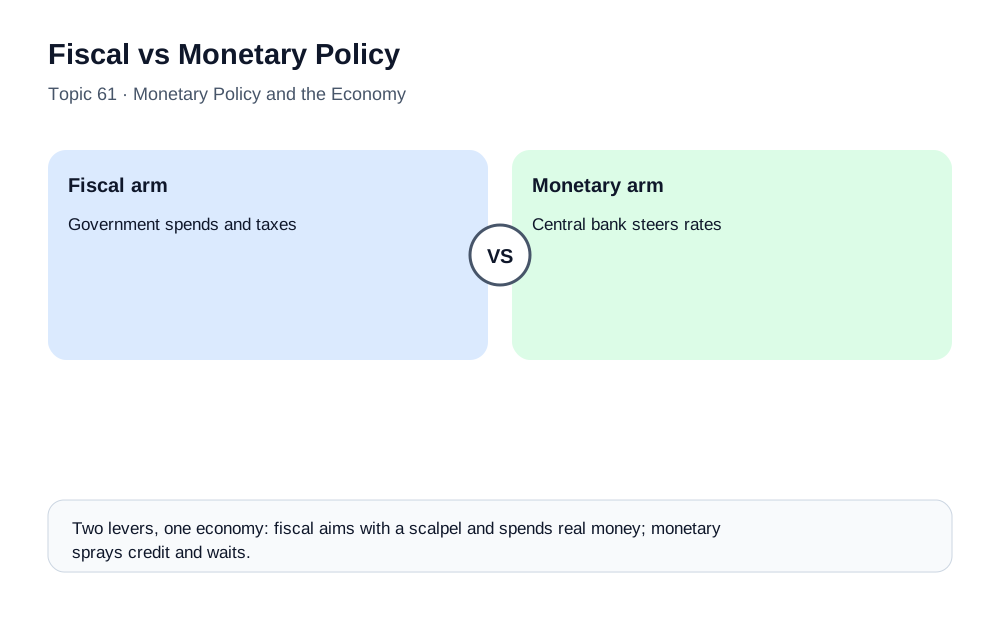
Fiscal vs Monetary Policy at a glance — Government spending, budget deficits, crowding out.
The Two Arms of Economic Management
The management of modern economies relies fundamentally upon two complementary yet distinct policy frameworks: fiscal policy, exercised through government spending and taxation decisions, and monetary policy, conducted by central banks through interest rate adjustments and money supply management. Together these twin pillars of macroeconomic management shape the environment in which banks operate, determining everything from loan demand and credit quality to interest rate margins and bond portfolio valuations. Understanding how these policy domains interact, reinforce each other, and occasionally work at cross-purposes provides essential context for banking professionals navigating the complex economic landscape.
The previous chapter examined monetary policy in depth; this chapter places it beside its fiscal counterpart. By the end you will be able to:
- Define both policies and identify who controls each.
- Compare their toolkits, implementation speeds, and targeting precision.
- Explain why central banks are independent and what political economy does to fiscal choices.
- Describe how the two policies coordinate in crisis and collide in conflict.
- Trace how government borrowing and deficits flow through to banks and bond markets.
- Assess the debate over which lever works better — and where Modern Monetary Theory fits.
1. First Principles: Two Levers on One Economy
An economy's total demand — the spending of households, businesses, government, and foreigners — drives output and employment in the short run and inflation when it outruns productive capacity. When demand falls short, unemployment rises; when it overshoots, prices climb. Both fiscal and monetary policy exist to steer aggregate demand toward the economy's capacity, but they steer by different handles. Fiscal policy moves demand directly: the government itself spends, or hands households and firms more of their own money to spend. Monetary policy moves demand indirectly: it changes the price and availability of credit, coaxing private actors to spend more or less of their own accord.
This difference in mechanism produces every other difference in this chapter — in speed, precision, politics, and side effects. It also explains why economies keep both levers: each is strong where the other is weak, and the historical record of relying on either alone is poor.
2. Who Holds Each Lever
The fundamental distinction between fiscal and monetary policy begins with their institutional locus of control. Fiscal policy emerges from the political branches of government, typically through legislative appropriations and executive budget implementation, with finance ministries and treasury departments bearing operational responsibility. This political provenance means fiscal decisions necessarily reflect democratic preferences and electoral considerations, subject to the full spectrum of political debate, negotiation, and compromise. Monetary policy, by contrast, resides with central banks that enjoy varying degrees of operational independence from direct political control, designed specifically to insulate interest rate decisions from short-term political pressures that might prioritize immediate electoral gains over long-term price stability.
The institutional design is deliberate and hard-won. History supplied repeated evidence that politicians with control over the money supply tend to print or ease before elections and leave the inflation to their successors. Delegating the monetary lever to a technocratic institution with a stability mandate — while keeping the fiscal lever with elected representatives who answer for taxes and spending — is the modern settlement between democratic accountability and economic credibility. The next chapter on central bank independence examines that settlement in detail.
3. The Two Toolkits
The tools available to fiscal and monetary authorities differ substantially in both character and mechanism. Fiscal policymakers manipulate government spending across countless programs and agencies, adjusting infrastructure investment, social welfare benefits, defense expenditures, and transfer payments to achieve their objectives. Simultaneously, they modify tax codes to alter the after-tax income that households and businesses retain, thereby influencing consumption and investment decisions. These fiscal tools operate through direct demand effects: increased government spending or reduced taxation immediately injects purchasing power into the economy, while contractionary fiscal measures withdraw such purchasing power. Monetary policymakers, conversely, work through interest rates, reserve requirements, and balance sheet operations that influence financial conditions and credit availability, operating indirectly by modifying the incentives and constraints facing private economic actors.
| Dimension | Fiscal policy | Monetary policy |
|---|---|---|
| Controller | Elected government (treasury, legislature) | Independent central bank |
| Primary tools | Spending, taxation, transfers | Policy rate, open market operations, QE, guidance |
| Mechanism | Direct injection or withdrawal of demand | Indirect, via credit cost and availability |
| Speed to implement | Months (legislation, appropriation) | Days (a committee vote) |
| Targeting | Precise: regions, sectors, groups | Broad: economy-wide financial conditions |
| Political exposure | Fully democratic | Deliberately insulated |
| Constraint | Debt sustainability, politics | Effective lower bound, credibility |
4. Speed: The First Responder and the Reinforcement
The speed of implementation represents another crucial dimension of differentiation between these policy domains. Monetary policy decisions can be implemented almost instantaneously: central bank policy boards meet at regular intervals, vote on rate changes, and these changes take immediate effect in money markets. Financial markets respond within seconds, and the real economy begins adjusting within weeks or months. Fiscal policy, by contrast, typically requires extensive legislative deliberation, budgetary appropriation processes, and administrative implementation that can stretch over many months or even years. The American stimulus checks distributed during the COVID-19 pandemic, for instance, required congressional legislation, Treasury Department logistics, and Internal Revenue Service distribution mechanisms that took weeks to deploy even in an emergency context. This speed differential means monetary policy often serves as the first responder to economic shocks, while fiscal policy provides more sustained but slower-acting support.
There is an important inversion hidden in this comparison: monetary policy is fast to decide but slow to fully transmit — its lags into real activity run a year or more, as the previous chapter detailed. Fiscal policy is slow to decide but can be immediate in effect once deployed — a transferred dollar is spent within weeks. In a deep crisis, the sequence writes itself: the central bank moves within days to stabilize financial conditions, buying time for the fiscal authority to legislate the heavier, targeted support.
5. Precision: The Scalpel and the Broad Brush
The precision with which each policy type can target specific economic outcomes also varies considerably. Fiscal policy offers the possibility of highly targeted interventions: governments can direct spending toward specific geographic regions, demographic groups, or industrial sectors based on policy priorities. Tax credits for research and development encourage corporate innovation in ways that broad interest rate cuts cannot replicate. Infrastructure spending creates construction employment in particular localities. This targeting precision comes with potential costs in terms of political favoritism, administrative complexity, and market distortions that may reduce economic efficiency. Monetary policy operates with much broader brushstrokes: when a central bank reduces interest rates, the effect spreads across the entire economy regardless of sector, region, or demographic characteristics. While this universality avoids the political allocation problems of discretionary spending, it also means monetary policy cannot address structural imbalances or distributional concerns with the same precision that fiscal instruments permit.
The precision asymmetry has a darker twin: fiscal targeting invites lobbying. Every tax credit and subsidy creates a constituency that organizes to preserve it, which is why fiscal expansions are easier to start than to stop — programs acquire defenders, and temporary stimulus has a way of becoming permanent structure. Monetary policy's bluntness, for all its imprecision, is at least evenhanded: the rate is the rate for everyone.
6. Political Economy: Why the Separation Exists
Political influence represents perhaps the most consequential distinction between these policy domains. Elected officials directly control fiscal policy, creating natural incentives to use spending and taxation for electoral advantage through strategically timed stimulus before elections or popular tax cuts that may compromise long-term fiscal sustainability. This political economy dimension explains why many countries have established independent central banks specifically to remove interest rate decisions from such electoral calculations. The trade-off between democratic accountability and technocratic expertise represents one of the enduring tensions in macroeconomic governance, with different countries striking different balances between these legitimate but competing values.
The pattern is visible across history: politically controlled monetary authorities deliver pre-election booms and post-election inflation; independent central banks deliver lower average inflation at the cost of occasional democratic friction — legislators railing against rate hikes is a feature of the design, not a bug. Fiscal policy's political character cannot be engineered away in the same fashion, and perhaps should not be: spending and taxing are the core of what democracies vote on. The institutional answer is not to depoliticize fiscal policy but to bind it — through debt rules, independent fiscal councils, and transparency requirements that make long-term costs visible at the moment of short-term decision.
7. Coordination: The Crisis Partnership
During periods of economic crisis, fiscal and monetary policies typically operate in coordinated fashion to support aggregate demand and stabilize financial conditions. The COVID-19 pandemic response during 2020 exemplified such coordination at unprecedented scale. Fiscal authorities in the United States deployed approximately five trillion dollars through stimulus checks to households, Paycheck Protection Program loans to businesses, enhanced unemployment benefits, and direct aid to state and local governments. Simultaneously, the Federal Reserve cut interest rates to zero, launched massive quantitative easing purchases exceeding four trillion dollars, and established emergency lending facilities to maintain market functioning. This complementary deployment of both policy arsenals proved essential to preventing economic collapse during the pandemic's initial shock, though it also created challenges when inflation subsequently emerged.
The crisis playbook has a clear division of labor, visible across 2008 and 2020 alike. The central bank moves first and fast: cut rates, provide liquidity, backstop markets — buying calm in days. The fiscal authority follows with scale: replace lost income, keep firms alive, and fund the recovery over quarters. Central bank purchases of government bonds grease the partnership by keeping the government's borrowing costs low while it spends. The partnership works — and its danger is the same feature: when fiscal expansion is financed at central-bank-suppressed rates, the line between coordinated stabilization and monetary financing of government begins to blur, and the inflation that follows tests who blinks first.
8. Conflict: When the Arms Pull Opposite Ways
The inflation crisis that developed during 2022 and 2023 illustrated how fiscal and monetary policies can work at cross-purposes when coordination breaks down. The Federal Reserve responded to persistent above-target inflation by raising interest rates rapidly from zero to five and a quarter percent over eighteen months, implementing the most aggressive tightening cycle in decades to cool demand and restore price stability. Meanwhile, fiscal authorities continued substantial deficit spending through legislation such as the Inflation Reduction Act, infrastructure investment programs, and ongoing pandemic-related expenditures. This fiscal-monetary divergence meant that while the central bank attempted to restrict aggregate demand, fiscal policy continued stimulating it, potentially requiring even more aggressive monetary tightening than would otherwise have been necessary. Such conflicts highlight the institutional and political challenges of maintaining policy coherence across separate government entities.
The conflict is structural, not personal: the central bank's mandate says fight inflation; the legislature's incentives say deliver programs. When they diverge, the monetary authority must tighten more to offset fiscal stimulus — higher rates for everyone because the two arms could not pull together. The reverse conflict also occurs: governments imposing austerity while central banks ease, leaving monetary policy carrying the whole stabilization burden — the eurozone's early-2010s experience, where fiscal consolidation and monetary stimulus pushed in opposite directions through a long, weak recovery.
9. Deficits, Debt, and the Banking Channel
Government borrowing and the resulting fiscal deficits create specific channels through which fiscal policy affects banking operations and financial conditions. When governments spend more than they collect through taxation, they must issue debt securities to finance the shortfall. These bond issuances compete with private borrowers for the available pool of savings, potentially pushing up interest rates in a phenomenon economists term "crowding out." The mechanics operate through the market for loanable funds: increased government borrowing raises demand for funds, driving up the price of borrowing represented by interest rates, which makes private investment more expensive and may reduce business capital formation. Banks find themselves compelled to purchase government securities, either voluntarily as safe assets or mandatorily through regulatory requirements such as statutory liquidity ratios, reducing funds available for private lending. Rating agencies carefully monitor debt-to-GDP ratios and fiscal trajectories, with downgrades potentially increasing government borrowing costs and triggering broader financial instability.
Crowding out deserves its nuance, because the mechanism is condition-dependent. When the economy runs at full capacity and savings are fully employed, extra government borrowing genuinely competes with private investment. In a depressed economy with idle savings, the same borrowing mobilizes funds that would otherwise sit unspent — crowding in private activity by restoring demand. The honest formulation: fiscal deficits crowd out private investment to the degree the economy is already near capacity, which is why the same deficit is stimulus in a recession and inflationary pressure in a boom.
For banks specifically, the sovereign-bank nexus runs deep. Government bonds fill bank balance sheets as liquidity buffers and collateral; the sovereign's credit underpins the banks' own ratings; and a fiscal crisis becomes a banking crisis by direct transmission — when a government's bonds fall, its banks' balance sheets weaken, their funding costs rise, and credit to the real economy contracts. The eurozone debt crisis made this "doom loop" infamous, and its lessons echo through the banking regulation chapters.
10. Automatic Stabilizers: The Fiscal Policy That Runs Itself
Not all fiscal policy requires a vote. Tax revenues fall automatically in downturns — incomes and profits shrink, so collections shrink — while unemployment benefits and welfare payments rise automatically as people qualify. These automatic stabilizers inject support precisely when the economy weakens and withdraw it as it recovers, with no legislation, no delay, and no political dispute. They are, in effect, fiscal policy on autopilot, and in many economies they are the largest and fastest stabilizing force in a typical recession.
The contrast with discretionary stimulus is instructive: discretionary programs arrive late (legislated after the recession is visible), sometimes persist past their need, and carry political fingerprints; automatic stabilizers are timely by construction and temporary by design. Economists of nearly every school agree on their value, which is why debates about fiscal activism are really debates about the discretionary margin beyond them.
11. The Great Debate — and the MMT Challenger
The debate between fiscal and monetary policy advocates has persisted throughout modern economic history, with each side emphasizing different strengths and weaknesses. Proponents of fiscal activism emphasize its direct impact on employment and output, its ability to target specific economic needs, and its effectiveness even when interest rates approach zero and monetary policy loses traction. They point to the success of New Deal programs during the Great Depression and the effectiveness of automatic stabilizers such as unemployment insurance that cushion economic downturns without requiring discretionary political action. Advocates for monetary policy leadership emphasize its speed of implementation, its insulation from political manipulation, its less distortionary effects on market allocation decisions, and its appropriateness for managing inflationary pressures. They note that well-designed monetary frameworks, such as inflation targeting, have delivered remarkable price stability across diverse economies.
Modern Monetary Theory emerged as a controversial heterodox perspective challenging conventional views of fiscal constraints. Its proponents emphasise that a government issuing debt in a currency it controls faces different financing constraints from a household, business, or foreign-currency borrower. That does not make default, market dysfunction, currency depreciation, or inflation impossible: legal and political constraints can still produce payment failures, and real-resource and inflation constraints remain fundamental. The useful analytical point is that sovereign financing capacity depends strongly on monetary sovereignty, debt currency, institutions, and credibility rather than on a simple household-budget analogy. From this perspective, fiscal policy should be deployed aggressively to achieve full employment and social objectives, with monetary policy reserved for managing any resulting inflationary pressures. Critics contend this framework underestimates the risks of currency depreciation, inflationary spirals, and political economy dynamics that may prevent timely fiscal consolidation. While remaining outside mainstream economic consensus, Modern Monetary Theory influenced policy discussions during the pandemic period when large fiscal expansions did not immediately trigger the inflationary or currency crises that traditional frameworks might have predicted.
The post-2021 inflation episode reinforced a more cautious conclusion than either slogan permits. Large fiscal support can be highly effective when private demand collapses, but its inflationary effect depends on the size, timing, financing conditions, supply capacity, household saving behaviour, and other shocks affecting the economy. Monetary sovereignty can provide substantial fiscal room, yet that room is constrained by inflation, real resources, exchange-rate credibility, market functioning, institutions, and political choices. Practitioners therefore assess fiscal sustainability through a combination of debt service, maturity, currency denomination, growth, revenue capacity, investor base, inflation risk, and monetary-fiscal credibility rather than treating either default or inflation as the only possible constraint.
12. Case Study: The Euro Area — One Monetary Policy, Multiple Fiscal Authorities
The euro area offers the world's great natural experiment in fiscal-monetary mismatch. Following Bulgaria's adoption of the euro on 1 January 2026, twenty-one countries share the European Central Bank's common monetary policy while retaining national fiscal authorities with different debts, deficits, economic structures, and political cycles. The number of members can change as additional EU countries adopt the euro, so the durable lesson is the institutional design: one monetary authority alongside multiple national fiscal authorities. When recession strikes the bloc unevenly, the single monetary stance fits no member exactly — too tight for the struggling south, too loose for the booming north — and the fiscal responses that could compensate are constrained by shared debt rules and by markets that price each government's bonds separately.
The 2010–2012 sovereign debt crisis exposed the design's stress points: governments facing banking crises could not print euros to backstop their banks, so bank weakness dragged sovereigns down and sovereign weakness dragged banks down in the doom loop of Section 9, broken only when the central bank declared it would do "whatever it takes" to preserve the currency — a monetary backstop substituting for the missing fiscal union. Subsequent years brought partial repairs: joint borrowing for pandemic recovery and closer banking supervision among them. The case's lesson generalizes beyond Europe: monetary and fiscal frameworks must be designed as a system, because in a crisis they will act as one whether designed or not.
13. What the Policy Mix Means for Banks
For banking institutions, the fiscal-monetary policy environment shapes strategic and operational decisions across virtually every dimension of activity. Interest rate changes directly affect net interest margin, the spread between what banks earn on assets and pay for liabilities, with rate increases generally benefiting banks that hold more rate-sensitive assets than liabilities. Government borrowing patterns influence bond yields and the valuation of treasury portfolios that constitute significant portions of bank balance sheets. Corporate tax policy changes affect the after-tax profitability of banking operations and the creditworthiness of commercial borrowers. Stimulus spending programs increase deposits as government transfers flow into customer accounts while simultaneously generating loan demand as households and businesses increase spending. Inflation erodes the real value of fixed-rate assets and requires careful management of asset-liability duration mismatches. Banks thus find themselves positioned between fiscal and monetary authorities, their performance significantly determined by how these macroeconomic forces interact.
Reading the policy mix is therefore a core banking skill. A bank watching coordinated easing (low rates plus fiscal expansion) positions for deposit growth, loan demand, and eventual inflation hedges. A bank watching fiscal-monetary conflict (deficits plus tightening) positions for higher-for-longer rates, bond portfolio caution, and the credit costs that follow restrictive conditions. Two concrete exposures sharpen the point. First, duration: fiscal expansion financed by long-dated issuance steepens yield curves, and treasury teams that misread the supply outlook wear the mark-to-market consequences. Second, deposit beta: fiscal transfers swell deposits that later drain as recipients spend, and banks that mistook pandemic-era transfer deposits for permanent funding learned the difference between a balance and a behavior. And every bank watches the sovereign nexus: its home government's fiscal health is, in a real sense, its own.
14. Common Misconceptions About Fiscal and Monetary Policy
"The central bank is part of the government, so the two policies are the same." They are institutionally separate by design: different controllers, tools, mandates, and timelines. Their coordination is a choice that can be made or unmade — and the distinction protects the price level from electoral cycles.
"Government budgets work like household budgets." Households cannot tax, issue currency, or borrow in money they print. Sovereign currency issuers face inflation and confidence constraints, not the household's income constraint — which is why deficits can be sustainable for decades and why "living within our means" is an analogy, not an analysis.
"Tax cuts pay for themselves." They pay for themselves only in the narrow case where lower rates unleash enough activity to recoup the full revenue loss — a threshold the evidence supports rarely. Most cuts increase deficits; whether that is worthwhile is a policy judgment, not arithmetic.
"Government borrowing always crowds out private investment." Only near full capacity. In a slack economy, deficit spending mobilizes idle savings and can crowd private activity in. The mechanism is conditional, not automatic.
"Quantitative easing and fiscal stimulus are the same thing." QE swaps bonds for reserves in the financial system; fiscal stimulus spends money into households and firms. The first changes portfolio composition, the second changes incomes — they interact powerfully but are different instruments with different transmission.
"More government spending always means bigger government forever." Stabilizer-driven spending recedes automatically as the economy recovers; the permanent ratchet applies mainly to discretionary programs with constituencies. Distinguishing the two is what the policy debate is actually about.
"Independent central banks are undemocratic and therefore illegitimate." Independence is delegated, not seized: legislatures create the mandate, appoint the governors, and can amend the framework. The design removes timing decisions from politics while keeping the goals themselves democratically chosen — delegation with accountability, not abdication.
"Deficits cause inflation, always." Deficits financed at capacity without monetary accommodation cause inflation; deficits in slack economies, or absorbed by willing savers, may not for years. Inflation is the constraint's edge, not its definition — as the post-2021 experience finally demonstrated to everyone at once.
15. Frequently Asked Questions
What is the difference between fiscal and monetary policy? Fiscal policy is the government steering the economy through spending and taxation; monetary policy is the central bank steering through interest rates and money conditions. Different institutions, tools, speeds, and politics — one economy.
Which is more powerful? Each dominates in its domain: monetary policy is faster, more agile, and better at fighting inflation; fiscal policy is more targeted, works at the zero lower bound, and is the only lever that reaches specific sectors and people directly. Crises are fought with both.
What are automatic stabilizers? Tax and transfer mechanisms that expand support automatically in downturns and withdraw it in recoveries — unemployment benefits rising, tax collections falling — with no legislation required. They are the fastest and least controversial fiscal tool.
What is crowding out? Government borrowing competing with private borrowers for savings, pushing up interest rates and displacing private investment — a real effect near full capacity, largely absent in deep recessions.
What is Modern Monetary Theory? A heterodox framework arguing that currency-issuing governments cannot be forced to default in their own money, so their real constraint is inflation, not solvency — implying aggressive fiscal use with monetary management of the inflationary consequences. Mainstream economists accept pieces of the logic while rejecting its comfort with scale.
Why do fiscal and monetary policy sometimes conflict? Because their controllers answer to different incentives: central banks to stability mandates, legislatures to voters. When one tightens and the other stimulates, the economy gets mixed medicine — and usually higher interest rates than either alone would require.
How do government deficits affect banks directly? Through bond issuance that fills bank portfolios and sets yield curves, through statutory requirements to hold government paper, through the sovereign rating that anchors banks' own credit standing, and through the deposit and loan flows that fiscal transfers generate.
What is the sovereign-bank doom loop? The feedback cycle in which weak sovereigns weaken their banks (through falling bond values and ratings) and weak banks weaken their sovereign (through bailout expectations and credit contraction). The eurozone crisis made it famous; banking union and central bank backstops were built to break it.
What is a fiscal multiplier? The ratio of total economic response to an initial fiscal injection — a dollar of spending producing more than a dollar of output as recipients re-spend it. Multipliers are largest in recessions and smallest near full capacity, which is why timing dominates the stimulus debate.
Why do governments issue long-term debt if short-term debt is cheaper? To manage refinancing risk: short debt must be rolled constantly, exposing the budget to every rate spike and market seizure. Long maturities lock funding through crises — the same maturity-ladder discipline the bond markets chapter describes for any large borrower.
Can a central bank refuse to cooperate with fiscal policy? Yes, and independence exists precisely so it can: the central bank can decline to suppress government borrowing costs and can tighten into fiscal expansion. The refusal's limit is practical, not legal — sustained institutional conflict damages both authorities' credibility.
How quickly can either policy respond to a sudden shock? The central bank can cut rates and open liquidity facilities within days — hours in emergencies. Fiscal support requires legislation and administration, so even emergency programs take weeks, and full deployment takes months. The sequence in every modern crisis reflects exactly this asymmetry.
16. Key Terms in This Chapter
- Fiscal policy — government use of spending, taxation, and transfers to steer the economy.
- Monetary policy — central bank management of interest rates and money conditions.
- Aggregate demand — total spending in the economy; the variable both policies steer.
- Automatic stabilizers — self-activating fiscal support (taxes, transfers) requiring no legislation.
- Discretionary stimulus — deliberately legislated fiscal action, as distinct from automatic stabilizers.
- Crowding out / crowding in — government borrowing displacing versus mobilizing private spending.
- Budget deficit / public debt — the annual shortfall and its accumulated stock, measured against GDP.
- Central bank independence — insulation of monetary decisions from electoral politics.
- Net interest margin — banks' asset yield minus funding cost, moving with the policy mix.
- Sovereign-bank nexus / doom loop — the mutual dependence of government credit and bank balance sheets.
- Monetary financing — central bank support of government borrowing; the bright line coordination can cross.
- Modern Monetary Theory — the heterodox framework treating inflation, not solvency, as the currency issuer's constraint.
- Debt sustainability — the capacity to service public debt without explosive dynamics, driven by growth versus interest rates.
- Fiscal council — an independent body assessing government budgets against long-term rules.
- Policy mix — the combined stance of fiscal and monetary policy at a given time.
- Refinancing risk — the exposure created when maturing debt must be rolled over, potentially at punitive rates or in closed markets.
- Fiscal multiplier — the total output response per unit of fiscal injection; highest in slack economies.
- Deposit beta — the share of a policy-rate change banks pass to deposit rates; a margin-critical parameter.
- Transfer payments — government payments without exchange of goods (pensions, benefits, stimulus checks).
17. Interview Insights: How This Topic Appears in Banking Interviews
"Compare fiscal and monetary policy across tools, speed, and politics." Fiscal: spending and taxes, legislated slowly, targeted precisely, democratically controlled. Monetary: rates and balance sheet, decided in days, broad in reach, technocratically insulated. The candidate who adds transmission lags — monetary fast to decide, slow to bite; fiscal slow to decide, fast to spend — demonstrates the full picture.
"When is fiscal policy more effective than monetary policy?" At the effective lower bound, where rates cannot fall further; when targeted relief is needed for specific sectors or groups; and when credit channels are broken and monetary transmission is impaired. The reverse — monetary dominance in inflation fights — completes the answer.
"Do government deficits matter?" A layered answer wins: deficits are sustainable while growth exceeds borrowing costs and markets stay confident; the true constraint for currency issuers is inflation, not household-style insolvency; and confidence can shift abruptly, which is why debt trajectories and credibility, not single-year deficits, are what to watch.
"How did fiscal and monetary policy interact in 2020, and what happened after?" Coordination at unprecedented scale — fiscal transfers replacing income while the central bank cut to zero and bought trillions in bonds — prevented collapse, then overshot into inflation as stimulus persisted into recovery, forcing the sharpest tightening cycle in decades. The lesson: the exit is harder than the entry.
"What is the doom loop, and how was it addressed?" Weak sovereigns dragging down banks holding their bonds, weak banks dragging down sovereigns expected to rescue them. Europe's answer combined central bank backstops, banking supervision centralization, and joint fiscal instruments — designing the two policies as a system because crises treat them as one.
"What would you watch to assess whether a country's fiscal position is sustainable?" The debt-to-GDP trajectory, the gap between economic growth and average borrowing cost, the maturity and currency composition of the debt, the share held by stable domestic investors, and the credibility of the fiscal framework. Sustainability is a trajectory judgment, not a level judgment — a point candidates miss when they quote a single deficit number.
Summary and Key Takeaways
- Economies are steered by two arms: fiscal policy (government spending and taxation, politically controlled) and monetary policy (central bank rates and balance sheets, deliberately insulated).
- Fiscal moves demand directly and precisely but slowly; monetary moves it indirectly and broadly but fast — each is strong where the other is weak.
- Central bank independence exists because electoral cycles and money printing mix badly; fiscal policy stays democratic, bounded instead by debt rules and fiscal councils.
- Crises reveal the partnership: monetary policy stabilizes in days, fiscal policy reinforces at scale — and the same coordination, prolonged, becomes the inflation problem of the following cycle.
- Conflict between the arms means higher rates and weaker stabilization than either would need alone.
- Deficits crowd out private investment only near capacity; the true constraint on currency-issuing governments is inflation, not household-style solvency — the lesson the MMT debate forced the mainstream to articulate.
- Automatic stabilizers are fiscal policy's unsung first responders — timely, targeted by design, and politics-free.
- Banks sit at the junction of both policies: margins, bond portfolios, deposit flows, and the sovereign nexus all move with the policy mix, making macro-policy fluency a banking core competency.
Next: Topic 62 — Inflation and Banking →
<!-- MBA-DEEP-DIVE-START -->Deep Dive: The Policy Mix Through Banks, Sovereigns, and Customer Balance Sheets
Fiscal and monetary policy are easiest to compare when we follow the same economic shock through both institutions. A recession reduces household income, business revenue, tax receipts, and credit demand. The central bank can lower the cost of money and support market liquidity. The government can replace lost income, increase spending, cut taxes, guarantee credit, or invest directly. Both can support demand, but they reach banks and customers through different balance-sheet channels.
For banking professionals, the useful question is not which policy is 'better' in the abstract. It is what combination is operating now, who receives the cash flow, who carries the debt, and what happens to interest rates, deposits, credit quality, sovereign risk, and inflation afterward. The interaction can strengthen recovery or create new stress depending on timing and scale.
Fiscal spending creates deposits somewhere in the banking system
When a government pays a supplier, employee, pensioner, or transfer recipient, the beneficiary normally receives money through the banking system. At the aggregate level, government spending can increase private-sector bank deposits, while taxation removes purchasing power from private accounts. The exact reserve and settlement effects depend on the monetary and banking architecture, but the banking consequence is tangible: fiscal flows change customer balances.
A large transfer programme can therefore produce rapid deposit growth even when banks did not compete for those deposits. Customer liquidity improves. Loan utilisation can decline as businesses use government support to repay revolving credit. Card balances can fall. Household savings can rise.
This helps explain why deposit growth and loan growth can diverge sharply during a fiscal response. The bank's funding base can expand before there is any equivalent demand for new credit.
Government guarantees are fiscal policy delivered through bank underwriting
Governments sometimes support the economy by guaranteeing part of eligible bank lending rather than making loans directly. The programme can lower the bank's expected loss and encourage credit to borrowers who would otherwise face severe temporary constraints.
The guarantee does not eliminate underwriting responsibility. A bank still needs to verify borrower eligibility, purpose, affordability, documentation, fraud risk, and programme conditions. If the bank ignores those requirements, the guarantee may not be enforceable or may not cover the loss.
This creates an important policy-operating link: fiscal design becomes a bank product rule. Product owners, credit teams, operations, legal, finance, and technology need to encode guarantee percentage, claim conditions, expiry, reporting, fees, borrower disclosures, and evidence. A policy announced at a press conference becomes hundreds of detailed banking requirements before one customer receives a loan.
Fiscal stimulus can improve credit quality before it increases inflation
Income support and business grants can reduce defaults during a downturn. A household that keeps receiving enough income can continue paying a mortgage. A small business that receives wage support can retain staff and service debt.
Banks may therefore see lower realised losses than a pure macroeconomic shock model predicted. But if fiscal support is very large relative to the economy's available goods and services, and private demand also recovers strongly, inflation pressure can emerge later.
The timing is important for risk models. Fiscal support can make near-term credit loss lower while contributing to a policy environment that creates higher interest-rate risk later. One bank portfolio can benefit first and face stress later from the same policy episode.
Government borrowing changes the supply of safe assets
Deficit spending is normally financed through government debt issuance within the relevant institutional framework. Larger issuance changes the supply of sovereign bonds available to banks, insurers, pension funds, money-market investors, and other buyers.
For bank treasury, this matters because government securities can serve several roles: liquidity buffer, collateral, investment, regulatory asset, and market-making inventory. More issuance can alter yield curves, repo markets, collateral availability, and funding conditions.
A bank should not assume that government bonds are economically risk-free simply because they are treated favourably for some prudential purposes. Interest-rate duration, market liquidity, currency denomination, and sovereign credit still matter. A long fixed-rate bond can suffer a large market-value loss when yields rise even if the sovereign never misses a payment.
Fiscal dominance is a risk to policy credibility
A highly indebted government can become very sensitive to interest rates because higher yields raise debt-service costs over time. If markets begin to believe the central bank will keep monetary policy too loose primarily to protect the government's financing position rather than to meet its mandate, inflation expectations and currency credibility can weaken.
This condition is often discussed as fiscal dominance, although the term is used in different ways in economics. The practical banking signal is the same: monetary policy appears constrained by sovereign financing needs.
Banks are exposed through sovereign bond portfolios, local funding markets, collateral values, and the broader economy. The sovereign and banking system can become tightly connected, especially when domestic banks hold large amounts of home-country government debt.
The sovereign-bank nexus can amplify a fiscal shock
Imagine a country enters a fiscal crisis and sovereign bond yields rise sharply. Domestic banks hold large sovereign portfolios. The market value of those bonds falls. The banks' funding spreads widen because investors expect that a weaker sovereign has less capacity to support the banking system. The economy slows because the government cuts spending or raises taxes. Bank borrowers weaken. Credit losses rise.
The sovereign stress has now moved into bank capital, funding, and asset quality.
The direction can also reverse. A banking crisis forces the government to guarantee deposits or recapitalise institutions, increasing public debt and weakening the sovereign. This feedback became known as a sovereign-bank doom loop in the European debt crisis.
Risk management should therefore stress sovereign and banking exposures together rather than assuming government debt and private credit are independent risk buckets.
Fiscal austerity can strengthen the sovereign while weakening borrowers
A government facing unsustainable debt may reduce spending or raise taxes. These measures can improve the fiscal balance, but they can also reduce household disposable income, corporate revenue, and economic growth in the short term.
For banks, the credit effect depends on where the adjustment falls. Public-sector contractors can lose orders. Households can face lower benefits or higher taxes. Property demand can weaken. Small businesses can experience lower sales.
A sovereign-risk team may welcome fiscal consolidation while a retail-credit team raises expected losses. Both can be correct. Policy analysis should distinguish the government balance sheet from the private-sector cash-flow effect.
Monetary tightening can offset fiscal expansion, but at a price
Suppose the economy is already near capacity and the government launches a large spending programme. If the additional demand raises inflation pressure, the central bank can respond with higher rates.
The fiscal authority has directed spending toward its chosen priorities; the monetary authority then raises the cost of borrowing across the wider economy to keep aggregate demand consistent with price stability.
The distributional consequence is significant. The government programme's beneficiaries receive direct support, while mortgage borrowers, companies refinancing debt, and other rate-sensitive customers bear part of the monetary offset.
For bank strategy, this policy mix often means stronger government-linked activity but slower private credit demand, higher deposit competition, more duration risk, and eventual pressure on leveraged borrowers.
Coordinated easing can create a powerful recovery and a difficult exit
During a severe recession, fiscal expansion and monetary easing can work in the same direction. Government spending replaces lost demand while low rates and central-bank liquidity prevent financial conditions from tightening excessively.
This combination can be highly effective when factories, workers, and credit capacity are idle. The challenge comes when the economy recovers. Fiscal programmes can be slow to withdraw because legislation and politics take time. Monetary policy may therefore need to tighten even while fiscal support remains in place.
Banks should plan for the exit, not only the crisis. Deposit balances created during emergency support can run down. Customers can move from savings to spending. Inflation can rise. Yield curves can reprice. Fixed-rate securities accumulated during the low-rate period can fall in value.
The policy mix that stabilised the bank in year one can create ALM challenges in year three.
Automatic stabilisers are important to credit forecasting
Tax and benefit systems change household and corporate cash flow automatically as the economy moves through the cycle. When employment falls, tax receipts decline and unemployment or social payments can increase according to law. During recovery, the process reverses.
Credit models that rely only on gross income or GDP can miss this cushioning effect. Net disposable income may fall less than employment income because fiscal stabilisers absorb part of the shock.
The size differs by country and household type, so banks operating across markets should not copy one stress assumption globally. Mortgage affordability in a country with extensive income replacement can behave differently from a market with a smaller safety net.
Tax policy reaches banking products through customer behaviour
Changes in taxation can alter demand for mortgages, savings, pensions, investments, business structures, and debt.
A tax incentive for retirement saving can increase flows into pension or investment products. Changes to property taxes or mortgage-interest treatment can affect housing demand. Corporate tax changes can alter after-tax project returns and acquisition structures. Withholding taxes can influence cross-border deposits and investments.
Banks therefore need product and tax teams to translate fiscal changes into customer journeys, disclosures, pricing, reporting, and data. The macro label 'tax cut' is not enough. The operational question is which customer, product, transaction, and effective date are affected.
Infrastructure spending can create sector-specific credit cycles
Fiscal spending is more targeted than monetary policy. A government infrastructure programme can increase demand for construction companies, equipment suppliers, transport firms, utilities, and local labour even when other sectors remain weak.
Banks can see higher working-capital needs, guarantees, project finance, payroll flows, and transaction banking in the supported sectors. The credit opportunity should still be underwritten carefully. Government spending can attract rapid capacity expansion, aggressive bidding, and concentration.
A borrower whose business model depends almost entirely on one public programme carries policy risk. If a future budget cuts the programme, revenue can fall quickly. Fiscal support can therefore create both growth opportunity and a new form of concentration.
Fiscal transfers can affect fraud and financial crime
Large emergency programmes move public money quickly, often under pressure to reach customers before normal verification processes can operate at full depth. Fraudsters exploit the urgency through fake companies, stolen identities, false payrolls, duplicate claims, and account takeover.
Banks participating in government support need controls for eligibility evidence, unusual transaction patterns, mule accounts, rapid cash-out, linked entities, and suspicious beneficiary changes. The programme authority and banks may need information-sharing arrangements under applicable law.
This is another example of fiscal policy becoming banking operations: a public objective to distribute money quickly must be balanced with controls that keep the programme from becoming a fraud channel.
Debt management and monetary policy interact through maturity
A government's treasury or debt-management office decides the maturity mix and instruments through which debt is issued, subject to the national framework. Issuing more short-dated debt can reduce current interest cost in some environments but exposes the government to faster refinancing when rates change. Issuing longer debt locks funding for longer but can carry a higher term premium.
The maturity structure affects banks because sovereign bonds form key reference points for pricing and collateral. A wave of long-dated issuance can influence long yields and duration supply. Large bill issuance can influence money markets and short-term liquidity demand.
Fiscal policy determines the borrowing need; debt management determines how that need enters markets; monetary policy influences the rate environment in which it is funded. Banking analysis should connect all three.
Foreign-currency sovereign debt changes the constraint entirely
A government borrowing heavily in a currency it does not control faces a different risk from a government borrowing mainly in its own currency. Currency depreciation can increase the local-currency burden of debt service. Foreign investors can withdraw. The central bank cannot create the foreign currency needed for repayment.
Banks lending to the sovereign or local companies should therefore examine debt currency, foreign-exchange reserves, export capacity, maturity, and investor base. The phrase 'sovereign debt' hides very different structures.
The same logic applies to companies: fiscal and monetary flexibility at national level does not automatically protect a borrower whose obligations are in foreign currency.
Policy uncertainty can matter before any policy changes
Businesses and households respond to expectations. An election that creates uncertainty about taxes, spending, regulation, or debt sustainability can delay investment even before legislation changes. Sovereign yields and exchange rates can move. Corporate borrowers can hold more cash.
Banks should therefore monitor policy uncertainty as a behavioural risk rather than waiting for enacted measures. Pipeline conversion can slow. Loan drawdowns can be delayed. Depositors can shift currency or maturity.
Scenario planning should separate announced policy, enacted policy, funded policy, and market expectation. Not every political promise becomes a cash flow.
A complete conflicting-policy scenario
Imagine an economy with persistent inflation and weak productivity growth. The government launches a large household-support and infrastructure package financed through additional borrowing. At the same time, the central bank raises policy rates because aggregate demand remains too strong.
For the bank, the fiscal package initially boosts deposits and transaction volumes. Contractors request working capital and guarantees. Household arrears improve because transfers support disposable income.
Bond yields then rise as markets price both higher policy rates and larger government issuance. The bank's fixed-rate sovereign portfolio loses market value. Deposit customers demand higher rates. Mortgage affordability worsens. Highly leveraged corporate customers face refinancing stress.
The policy mix has created support on the income side and restriction on the financing side. Credit performance depends on which force dominates for each customer.
A strong bank maps the effects by portfolio: households receiving transfers, contractors benefiting from spending, property borrowers exposed to rates, companies dependent on refinancing, treasury securities exposed to duration, and deposits exposed to repricing. A weak bank uses one macro label — 'fiscal stimulus' or 'monetary tightening' — and misses the combined effect.
What excellence looks like
A world-class bank reads fiscal and monetary policy as one policy mix with separate transmission channels. It knows how government spending changes deposits and customer cash flow, how guarantees change credit risk, how deficits change bond supply, and how sovereign stress connects to bank funding. It knows how central-bank rates change borrowing cost, deposit pricing, duration, and credit quality. It distinguishes local-currency and foreign-currency sovereign risk. It plans for both emergency support and the exit from support.
The deepest lesson is that fiscal policy decides who receives or pays public money, while monetary policy strongly influences the price and availability of money through the financial system. Banks stand between those two forces. Their job is not to choose a favourite policy tool, but to understand how the interaction changes every promise on the balance sheet — government, bank, business, and household alike.
<!-- MBA-DEEP-DIVE-END -->