How Central Banks Steer the Economy
Monetary policy stands as the most powerful instrument any institution wields over modern economies. Through careful adjustments to interest rates, precise control of money supply, and strategic communication of intentions, central banks shape everything from the mortgage rates families pay on their homes to the exchange rates that determine export competitiveness, from stock market valuations to the fundamental pace of economic growth and price stability. This intricate system of economic management touches virtually every financial transaction occurring within an economy, making it essential for banking professionals to understand not merely what central banks do, but how their actions ripple through the complex web of financial relationships that define contemporary commerce.
This chapter builds that understanding from first principles to practice. By the end you will be able to:
- Define monetary policy and its three core objectives.
- Distinguish expansionary from contractionary stances and when each applies.
- Explain the policy rate, the transmission mechanism, and its time lags.
- Describe the full toolkit: open market operations, reserve requirements, quantitative easing, and forward guidance.
- Explain the impossible trinity's constraint on open economies.
- Assess what monetary policy can and cannot do, from 2008 and 2020 to the inflation fight of the 2020s.
- Connect monetary policy to daily banking decisions on pricing, funding, and risk.
Visual overview
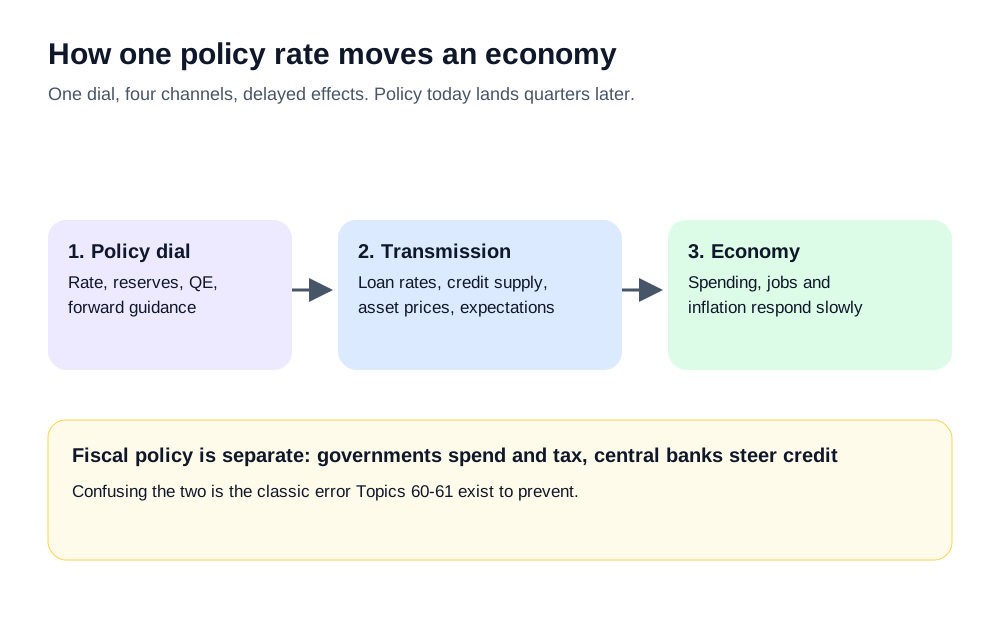
Phase 7 map: one policy dial → transmission channels → economy, with long lags. Fiscal policy stays separate.
1. First Principles: Why Money Needs Managing
Start with a paradox: money is both the economy's lubricant and its potential poison. Too little money and credit, and commerce seizes — businesses cannot finance inventory, households defer purchases, deflation entrenches delay. Too much, and prices rise as more money chases the same goods, eroding savings and distorting every contract written in nominal terms. Left entirely to itself, a banking system tends to overshoot in both directions: exuberant credit creation in booms, panicked contraction in busts.
Monetary policy exists to steer between these failures. Someone must manage the aggregate quantity and price of money and credit with the whole economy in view — a perspective no individual bank, optimizing its own balance sheet, can possess. That someone is the central bank, an institution deliberately insulated from both commercial pressure and short-term politics so it can take the economy-wide, long-horizon view. At its core, monetary policy encompasses the deliberate actions undertaken by a nation's central bank to manage both the money supply and the cost of borrowing money, represented by interest rates.
It is worth naming what monetary policy is not: it does not build roads, set taxes, or write budgets — that is fiscal policy, the subject of the next chapter. The central bank steers through money and credit conditions; the government steers through spending and taxation. The two interact constantly, and confusing them is the first error this chapter exists to prevent.
2. The Objectives: What Central Banks Are Trying to Achieve
Central bank actions serve specific macroeconomic objectives that societies have collectively deemed essential for prosperity: maintaining price stability through low and predictable inflation, fostering conditions conducive to full employment of the workforce, and ensuring the overall stability of the financial system upon which all economic activity depends. While central banks may phrase their mandates differently across countries, these three objectives form the universal foundation of monetary policymaking in the modern era.
Price stability is the near-universal anchor, typically defined as low, positive, predictable inflation — around two percent annually in many advanced economies, a target low enough to ignore in daily decisions but high enough to keep the economy safely away from deflation, which is far harder to escape once entrenched. Full employment means the lowest joblessness sustainable without igniting inflation — not zero unemployment, which is neither achievable nor desirable in a dynamic economy where people move between jobs. Financial stability recognizes that a banking system in crisis cannot transmit policy at all — a lesson formalized after 2008, when central banks accepted explicit responsibility for the plumbing's integrity alongside the price level's.
The objectives can conflict. Taming inflation may require raising unemployment; rescuing financial stability may require liquidity that later feeds inflation. Monetary policy is therefore always an exercise in balancing, and the balance point shifts with circumstances — which is why mandates grant central banks discretion rather than formulas.
3. The Two Stances: Doves and Hawks
The stance of monetary policy fundamentally divides into two orientations, each appropriate for different economic circumstances. Expansionary monetary policy, often characterized by policymakers as "dovish," emerges during periods of economic recession, sluggish growth, or threatening deflation. Under this approach, central banks cut interest rates aggressively, inject liquidity into the banking system through various mechanisms, and signal their commitment to supporting economic activity. The intended effects flow naturally: cheaper borrowing costs stimulate household spending on durable goods like automobiles and appliances, encourage businesses to invest in new equipment and facilities, and generally accelerate the velocity of money circulating through the economy. This stimulus comes with an important caveat, however, as excessive monetary accommodation risks igniting inflationary pressures that may prove difficult to contain once unleashed.
Contractionary monetary policy, conversely, represents the "hawkish" orientation that central banks adopt when inflation rises above acceptable thresholds or when economies overheat from excessive demand. In these circumstances, central banks raise interest rates, withdraw liquidity from the financial system, and communicate their determination to cool economic activity. Higher borrowing costs discourage discretionary spending, slow business investment, and ultimately reduce aggregate demand throughout the economy. While these actions may cause temporary discomfort, including potential increases in unemployment and slower growth, they serve the essential long-term function of preserving price stability and preventing inflationary psychology from becoming entrenched in household and business expectations.
The dove-hawk vocabulary pervades market commentary for a practical reason: traders price the next move, not the last one, and every central bank speech is parsed for lean. For bankers, the stance cycle is the business cycle's co-driver — loan demand, deposit flows, credit quality, and net interest margins all rotate with it.
4. The Policy Rate: The Master Dial
The policy interest rate is the most visible instrument in modern monetary policy, but it should not be described universally as 'the rate at which the central bank lends to commercial banks' or as a literal floor for every market rate. Operating frameworks differ. The Federal Reserve implements policy around a target range for the federal funds rate using administered rates and liquidity tools; the ECB uses a set of key policy rates and an operational framework for euro-area money markets; the Bank of England uses Bank Rate; the Reserve Bank of India uses the policy repo rate within its liquidity-management framework; and other central banks use their own target rates, corridors, floors, or quantity-based arrangements. The shared principle is that the central bank controls or strongly influences very short-term monetary conditions and thereby anchors the broader structure of market and bank rates through arbitrage, expectations, liquidity, and credit transmission.
The money markets chapter explains the operational machinery — how standing facilities bound a corridor and open market operations pin overnight rates inside it. What matters here is the architecture's genius: the central bank does not set mortgage rates, corporate loan rates, or bond yields directly. It sets one short rate with absolute credibility, and arbitrage does the rest, propagating the policy signal outward along every yield curve and across every credit product in the economy.
5. The Transmission Mechanism: How One Rate Moves an Economy
The transmission mechanism through which policy rate changes affect the broader economy operates through multiple interconnected channels with varying time lags. When a central bank reduces its policy rate, the immediate effect falls upon commercial banks' cost of obtaining funds, either directly from the central bank or indirectly through money market pressures. Banks typically pass these reduced funding costs to their customers through lower lending rates on everything from home mortgages to business credit lines. Cheaper loans incentivize both consumption and investment spending, which increases aggregate demand and stimulates economic growth. However, this heightened demand simultaneously creates inflationary pressures, as increased spending chases a relatively fixed supply of goods and services in the short term. This delicate balancing act explains why central bankers must possess both technical expertise and considerable judgment in calibrating their policy stance.
Economists distinguish several channels, and professionals should recognize each:
- The interest rate channel: policy rate → money market rates → bank lending and deposit rates → borrowing and saving decisions. The workhorse channel, strongest where floating-rate lending dominates.
- The credit channel: policy tightening squeezes banks' willingness and capacity to lend, beyond the price effect — credit standards tighten, marginal borrowers are cut off, and small firms dependent on bank finance feel it first.
- The asset price channel: lower rates lift bond and equity valuations (higher prices for the same cash flows), making households wealthier and companies' cost of capital cheaper — stimulus through balance sheets.
- The exchange rate channel: lower rates tend to depreciate the currency, boosting exports and import prices — a channel that can dominate in small open economies.
- The expectations channel: beliefs about future policy shape behavior today — the channel forward guidance weaponizes, as Section 9 explains.
The timing is the catch. Transmission lags are famously "long and variable": money markets reprice in seconds, bank lending rates in weeks or months, real activity in quarters, and full inflation effects often in a year or more. Policy made today lands in an economy that may look entirely different by the time it bites — the central banker is always steering by the rearview mirror's reflection of the road ahead.
6. Open Market Operations: The Daily Steering Wheel
Beyond the policy rate, central banks employ open market operations as a flexible tool for managing daily liquidity conditions in the banking system. Through these operations, central banks buy or sell government securities in the open market to influence the availability of funds for commercial banks. When a central bank purchases government securities from banks, it pays for these purchases by crediting the selling banks' reserve accounts, thereby injecting money into the banking system and increasing overall liquidity. Conversely, when a central bank sells government securities, the buyers pay by debiting their reserve accounts, which absorbs money from the banking system and reduces available liquidity. These operations allow central banks to fine-tune monetary conditions on a daily basis, smoothing temporary fluctuations in liquidity caused by government cash flows, seasonal patterns, or unexpected developments.
The distinction to hold: open market operations implement a policy rate decision — they are the steering wheel that keeps the car in its lane. The policy rate announcement sets the destination. In systems with abundant reserves (after years of quantitative easing), the emphasis shifts from daily fine-tuning toward administered rates on reserves and standing facilities, but the logic is identical: make the chosen short rate the market's gravitational center.
7. Reserve Requirements: The Traditional Lever
Reserve requirements are a traditional policy and prudential tool whose role differs materially across jurisdictions. A reserve requirement can oblige banks to hold a defined amount of eligible reserves against specified liabilities, while other liquidity requirements may require holdings of liquid assets without being reserve requirements in the same monetary-policy sense. In India, the Cash Reserve Ratio requires scheduled banks to maintain the prescribed cash reserve with the Reserve Bank of India, whereas the Statutory Liquidity Ratio is a separate statutory liquidity requirement satisfied with eligible liquid assets under the applicable framework; the two should not be collapsed into one reserve-ratio mechanism. Changes in such requirements can affect bank liquidity and the economics of intermediation, but modern bank lending is also constrained by capital, liquidity regulation, funding conditions, credit demand, risk appetite, and the central bank's interest-rate framework.
Why did the tool fade in advanced economies? Because it is a blunt, tax-like instrument: required reserves typically earn little or nothing, imposing a cost on intermediation that competitive systems learned to avoid, and because rate-corridor systems achieved the same control more precisely. Where reserve requirements remain active, they serve double duty as prudential liquidity buffers — the line between monetary tool and safety regulation blurs, a theme the banking regulation chapters develop fully.
8. Quantitative Easing and the Unconventional Toolkit
Quantitative easing emerged as an unconventional but now well-established monetary policy tool when conventional interest rate reductions approached their effective lower bound near zero. Under quantitative easing, central banks purchase massive quantities of longer-dated government bonds and, in some cases, corporate securities, directly from financial markets rather than exclusively from banks. These purchases accomplish multiple objectives simultaneously: they push down long-term interest rates across the yield curve, force investors seeking yield into riskier assets such as corporate bonds and equities, and signal the central bank's commitment to maintaining accommodative conditions for an extended period. The Federal Reserve, European Central Bank, Bank of Japan, and Bank of England all deployed quantitative easing extensively during the 2008-2014 period following the global financial crisis and again during 2020-2022 in response to the COVID-19 pandemic, collectively expanding their balance sheets by trillions of dollars.
The unconventional toolkit extends further. Quantitative tightening reverses the process, shrinking balance sheets by letting holdings mature or selling them — withdrawing the stimulus without touching the policy rate. Negative interest rates, deployed in the euro area, Japan, Switzerland, and elsewhere, charge banks for excess reserves to discourage hoarding and encourage lending — a deliberate inversion of banking's oldest rule. Yield curve control, practiced by the Bank of Japan, caps specific longer-term yields outright through unlimited purchase commitments. Each tool pushes further from the simple policy-rate world, and each carries side effects — distorted markets, compressed bank margins, exit difficulties — that keep central bankers humble about their own ingenuity.
9. Forward Guidance: Words as Policy
Forward guidance represents a more subtle but increasingly important dimension of monetary policy, recognizing that central bank communications themselves constitute a powerful policy tool. When central bank officials state that they expect interest rates to remain low for an extended period, financial markets immediately incorporate these expectations into asset prices, effectively delivering stimulus even without immediate policy action. Conversely, when central bankers signal concern about inflationary pressures and commitment to taking necessary action, markets anticipate future tightening and adjust behavior accordingly. The words of central bank governors can move markets as dramatically as actual policy changes, creating what economists term the "announcement effect" of monetary policy communications. This reality places enormous importance on the clarity, consistency, and credibility of central bank communications.
Guidance works because long rates — the ones that actually drive mortgages and corporate investment — are built from expected future short rates. Convince the market that rates stay low for two years, and the two-year rate falls today: policy delivered without a single transaction. The fragility is symmetric: guidance depends on credibility, and credibility is spent whenever forecasts prove wrong. The post-2021 inflation surge damaged guidance everywhere, as "transitory" messaging aged badly and central banks pivoted to meeting-by-meeting data dependence — a quieter but more honest era of communication.
10. The Impossible Trinity: The Open-Economy Constraint
The impossible trinity, also known as the trilemma of international economics, establishes fundamental constraints on what monetary policy can achieve in an open economy. This principle states that a country cannot simultaneously maintain free capital flows across its borders, exercise independent monetary policy, and sustain a fixed exchange rate. At most, two of these three objectives may be pursued simultaneously. Most developed economies have chosen to maintain free capital flows and independent monetary policy, accepting the resulting floating exchange rates as the necessary adjustment mechanism. Some emerging economies have historically prioritized exchange rate stability, sacrificing either capital mobility or monetary independence. Understanding this constraint helps explain why countries face difficult policy choices during financial crises and why monetary autonomy remains limited for nations with open capital accounts and fixed exchange rates.
The logic is inescapable: with free capital movement, a fixed exchange rate forces the domestic interest rate to match the anchor currency's — any gap triggers arbitrage flows that either break the peg or force the rate back. Countries that peg, in effect, import the anchor country's monetary policy, for better or worse. The trilemma explains everything from why pegged regimes import foreign inflation to why defending a peg in a crisis can cost a central bank its entire reserve stock.
11. Limits, Lags, and Humility
The practical implementation of monetary policy requires central banks to navigate considerable uncertainty about economic conditions, transmission lags, and the behavior of households and businesses. Policy decisions made today may not fully affect the economy for many months or even years, forcing central bankers to act prospectively based on forecasts that inevitably contain significant error margins. Moreover, the structure of economies evolves over time, potentially altering the relationships between policy instruments and outcomes that historical experience has established. These challenges explain why monetary policy remains as much an art as a science, requiring judgment, flexibility, and humility from those entrusted with its execution.
Three structural limits deserve explicit recognition. The zero lower bound (more precisely, the effective lower bound): rates cannot fall far below zero because cash offers a yieldless alternative, which is why QE and guidance were invented. Supply shocks: monetary policy manages demand, but inflation driven by broken supply chains or energy shocks cannot be fixed by demand management without crushing the economy to compensate — the central bank can only prevent the shock from becoming embedded psychology. Financial side effects: long periods of very low rates compress bank margins, inflate asset prices, and encourage leverage, storing up the next problem while solving the current one. The honest summary: monetary policy is powerful over the demand side of the economy, at long and uncertain lags, with real side effects — and it cannot substitute for sound fiscal policy, functioning supply chains, or productive structural reform.
12. Stress Tests: 2008, 2020, and the Inflation Fight
The global financial crisis of 2008 and the COVID-19 pandemic of 2020 demonstrated both the power and the limitations of monetary policy in addressing severe economic disruptions. Central banks responded with unprecedented speed and scale, deploying their full toolkit of conventional and unconventional measures to prevent financial system collapse and support economic recovery. Yet these experiences also highlighted that monetary policy alone cannot address all economic challenges, particularly when fundamental shocks require structural adjustments or when fiscal policy remains constrained by political considerations. The relationship between monetary and fiscal authorities, always complex, assumed new dimensions as central bank balance sheets expanded to absorb government securities on an extraordinary scale.
The years 2021 through 2023 added the third stress test, in the opposite direction. Inflation surged across advanced economies to levels unseen in decades — a mix of post-pandemic demand, supply disruption, and energy shock. Central banks, having initially judged the surge transitory, tightened at the fastest pace in a generation: policy rates rose from near zero to five percent or more within roughly a year and a half in the United States, with balance sheets simultaneously shrinking. The episode tested every element of this chapter: transmission worked (housing and rate-sensitive sectors cooled promptly), lags asserted themselves (inflation took many months to decline), side effects materialized (bond portfolio losses contributed to the 2023 regional bank failures examined in the bond markets chapter), and credibility — damaged by the "transitory" call — had to be rebuilt through action rather than words. For students of monetary policy, the whole modern syllabus is compressed into those three years.
13. Case Study: The Volcker Disinflation
The defining historical proof of monetary policy's power — and its price — came between 1979 and 1982. The United States had suffered a decade of entrenched inflation, with expectations so embedded that wages and prices chased each other upward automatically. The Federal Reserve under Paul Volcker abandoned fine-tuning and targeted money supply directly, letting interest rates rise to whatever level broke the spiral — the federal funds rate reached twenty percent. The consequences were severe: deep back-to-back recessions, unemployment above ten percent, furious farmers and builders blockading the Fed with letters and two-by-fours. And the result was decisive: inflation fell from double digits to roughly four percent by 1983, and, crucially, inflation expectations were broken for a generation.
The case teaches the lessons this chapter keeps circling. Credibility is the central bank's true capital — Volcker's willingness to inflict short-term pain bought long-term stability that later central banks spent decades enjoying. Expectations, once anchored, are the cheapest stabilization mechanism available — which is why modern central banks defend their inflation targets so jealously. And the social contract matters: the disinflation was possible because an independent central bank was permitted to do what elected politicians could not survive doing. Central bank independence, examined in its own chapter later in this series, is the institutional foundation the whole monetary policy edifice stands on.
14. What Monetary Policy Means for Banks
For banking professionals, understanding monetary policy provides essential context for strategic decision-making across virtually all areas of operations. Lending rates, funding costs, asset valuations, and risk premia all respond directly to central bank actions. The yield curve shape reveals market expectations of future policy moves, guiding decisions about asset-liability management and duration positioning. Credit demand fluctuates with the business cycles that monetary policy influences, affecting loan growth and provisioning requirements. In this fundamental sense, monetary policy literacy constitutes a core competency for anyone seeking to understand or participate in modern banking.
Make it concrete across the bank. The treasury reprises its bond portfolio with every policy move and manages the duration exposure that 2022 punished so severely. The lending desks watch floating-rate books reprice instantly with the policy rate while fixed-rate margins compress or widen — the shape of the loan book determines whether tightening helps or hurts. Deposit franchises discover their value in rising-rate environments, when stable low-cost deposits become the industry's most contested asset. Credit risk teams see the lag in human form: today's tightening becomes next year's payment defaults among leveraged borrowers. And strategy reads the stance cycle: the hawkish years reward margin discipline, the dovish years reward volume growth. Every trading desk in the world pauses for the central bank's decision; the smart commercial banks structure for it all year.
15. Common Misconceptions About Monetary Policy
"The central bank sets mortgage and loan rates directly." It sets one overnight policy rate; everything else is market transmission through the channels of Section 5 — which is why long rates sometimes rise while the central bank cuts, if markets expect future inflation.
"Printing money always causes inflation." Money creation causes inflation when it outruns the economy's productive capacity and velocity cooperates; QE expanded base money enormously after 2008 with subdued inflation for a decade, because the transmission into broad credit was weak. The 2021–22 surge came when fiscal transfers, reopened demand, and supply shocks combined — a compound cause, not a mechanical one.
"Lower rates are always good for banks." The opposite is often true: low rates compress net interest margins between loan yields and deposit costs, which floored near zero. Moderate, predictable rates are banking's comfort zone; the extremes in both directions hurt different business lines.
"Central banks control the economy like a thermostat." Long and variable lags, uncertain transmission, and supply-side shocks make the control loose and delayed. Policy is closer to sailing — adjusting to winds you influence but do not command — than to thermostatic control.
"Quantitative easing is free money for the government." QE purchases bonds in the market and pays with reserves bearing interest; it changes the maturity structure of public debt and remits profits to the treasury, but it is not a cancellation of obligations — and quantitative tightening can reverse the profit flow, as several central banks' recent losses attest.
"The central bank can fix any crisis." It can stabilize financial conditions and demand; it cannot unclog ports, produce energy, or legislate budgets. The crises where monetary policy looks omnipotent are demand crises; supply and solvency crises expose its limits.
16. Frequently Asked Questions
What is monetary policy, in one sentence? The central bank's management of interest rates, money, and credit conditions to achieve price stability, full employment, and financial system stability.
What is the difference between monetary and fiscal policy? Monetary policy is the central bank steering through interest rates and money supply; fiscal policy is the government steering through taxation and spending. The next chapter compares them in full.
Why do central banks target two percent inflation rather than zero? A small positive target buffers against deflation — which is far harder to escape — and gives relative prices room to adjust without outright nominal declines. Zero sounds purer and is more dangerous in practice.
How long does a rate change take to affect the economy? Financial markets react in seconds; bank lending rates in weeks to months; spending and hiring in quarters; full inflation effects typically in a year or more. These "long and variable lags" force central banks to act on forecasts, not current data.
What is quantitative easing, simply? The central bank buying long-term bonds with newly created reserves to lower long-term interest rates and push investors toward riskier assets — used when the policy rate is already near zero and more stimulus is needed.
Why can't a country have free capital flows, a fixed exchange rate, and independent monetary policy? Because with open capital markets, any gap between domestic and foreign rates triggers flows that either break the peg or force the domestic rate to match the foreign one. The impossible trinity permits only two of the three.
What does "hawkish" versus "dovish" mean? Hawkish: leaning toward tighter policy to fight inflation. Dovish: leaning toward looser policy to support growth and employment. The labels describe the stance and the officials advocating it.
How does monetary policy affect my mortgage? Floating-rate mortgages reprice with the policy rate within weeks or months; fixed-rate mortgages are priced off longer-term yields, which respond to expected policy — one reason fixed rates can rise before the central bank actually moves.
17. Key Terms in This Chapter
- Monetary policy — central bank management of money and credit conditions toward macroeconomic objectives.
- Price stability — low, predictable inflation, typically around two percent in advanced economies.
- Policy rate — the central bank's key short-term rate: fed funds, main refinancing, bank rate, repo rate.
- Expansionary / contractionary (dovish / hawkish) — the two policy stances.
- Transmission mechanism — the channels (interest rate, credit, asset price, exchange rate, expectations) from policy to the real economy.
- Open market operations — buying and selling securities to manage reserves and implement the policy rate.
- Reserve requirements — mandated reserve holdings against deposits; CRR and SLR in India.
- Quantitative easing / tightening — large-scale bond purchases to ease when rates near zero; the reverse to unwind.
- Forward guidance — communication about the expected policy path, itself a policy instrument.
- Impossible trinity / trilemma — the impossibility of combining free capital flows, a fixed exchange rate, and independent monetary policy.
- Effective lower bound — the floor below which policy rates lose traction, near or slightly below zero.
- Yield curve control — capping specific longer-term yields through purchase commitments.
- Inflation expectations — beliefs about future inflation; anchoring them is policy's core credibility task.
- Net interest margin — the spread between banks' loan yields and funding costs, squeezed at rate extremes.
- Long and variable lags — the delayed, uncertain timing of policy effects on the real economy.
- Negative interest rates — charging for excess reserves to spur lending; an unconventional tool.
18. Interview Insights: How This Topic Appears in Banking Interviews
"Explain how a rate hike reaches the real economy." Walk the channels: policy rate to money markets instantly, to bank lending and deposit rates in weeks, to asset prices and the currency simultaneously, to spending and investment over quarters, to inflation in a year or more. Naming the channels and the lags — rather than asserting "higher rates slow the economy" — is what distinguishes the answer.
"Why did QE not cause inflation after 2008, but inflation surged after 2020?" Transmission differs: post-2008 QE repaired balance sheets while broad credit stayed weak; post-2020 stimulus met reopened demand, fiscal transfers, and supply shocks together. Money creation is necessary context for inflation, not a sufficient trigger — the candidate who resists mechanical answers shows real understanding.
"What can monetary policy not do?" Fix supply shocks, substitute for fiscal policy, escape the effective lower bound conventionally, or operate without side effects at extremes. Add the impossible trinity for open economies and the answer covers both theory and constraint.
"How do rate cycles affect a bank's P&L?" Rising rates reprice floating loans faster than deposits initially, then deposit costs catch up; bond portfolios take mark-to-market losses; credit costs follow with a lag. Falling rates compress margins. The treasury's asset-liability management exists to position the balance sheet across these phases — connect policy to the ALM desk and you are speaking the interviewer's language.
"Was the 2021 inflation 'transitory' call a policy failure?" A forecast failure with a credibility cost, followed by a forceful correction: the fastest tightening in a generation restored the anchor. The balanced answer — humility about forecasts, the price of lost credibility, and the institutional capacity to course-correct — demonstrates judgment rather than hindsight certainty.
Summary and Key Takeaways
- Monetary policy is the central bank's steering of money, credit, and interest rates toward price stability, full employment, and financial stability — distinct from fiscal policy, the next chapter's subject.
- Stances divide into expansionary (dovish) and contractionary (hawkish); every market participant prices the lean before the move.
- The policy rate is the master dial; arbitrage transmits it through interest rate, credit, asset price, exchange rate, and expectations channels — with long and variable lags.
- The toolkit runs from open market operations and reserve requirements through quantitative easing, negative rates, yield curve control, and forward guidance — words now move markets as surely as transactions.
- The impossible trinity binds open economies: free capital flows, fixed exchange rates, and monetary independence — pick two.
- 2008, 2020, and the 2021–23 inflation fight stress-tested the entire framework; Volcker's disinflation remains the founding proof that credibility, once earned, is the cheapest stabilization there is.
- For banks, monetary policy is not background but business environment: margins, bond portfolios, deposit value, and credit costs all rotate with the cycle — and monetary policy literacy is a core banking competency.
Next: Topic 61 — Fiscal vs Monetary Policy →
<!-- MBA-DEEP-DIVE-START -->Deep Dive: Monetary Policy Through a Bank's Balance Sheet
Monetary policy becomes practical when we stop treating the central bank announcement as the end of the story and follow what happens inside commercial banks afterward. A policy decision changes the price and availability of short-term money, shifts the yield curve, alters deposit competition, changes the economics of fixed- and floating-rate assets, affects collateral values, and influences how customers borrow, save, invest, and repay. The transmission mechanism is therefore not an abstract macroeconomic channel. It is implemented through thousands of bank pricing, treasury, credit, and customer decisions.
The central principle is that a bank does not receive a policy-rate change and mechanically add the same number of basis points to every product. Each balance-sheet item has its own repricing rule, behavioural maturity, competitive market, funding source, credit spread, and optionality. Understanding monetary policy in banking means understanding those differences.
The first minutes: money markets and the yield curve
Financial markets react before most bank customers notice anything. Overnight and short-dated market rates move toward the new expected policy path. Government bond yields adjust according to both the current decision and expectations for future decisions. FX markets, equity markets, credit spreads, and derivatives reprice simultaneously.
For a bank treasury desk, this changes the internal transfer-pricing curve used to value new deposits and loans. A five-year mortgage is not priced from today's overnight rate alone; it is priced against the cost and risk of funding five-year exposure, the expected behaviour of deposits, hedging costs, liquidity, credit risk, capital, and competition. If markets believe the central bank will reverse today's move next year, long-term rates can move much less than the policy rate.
This is why a 100-basis-point tightening cycle does not imply that every five-year bank loan becomes exactly 100 basis points more expensive.
Deposit repricing determines much of the bank's earnings response
When policy rates rise, banks often benefit initially if variable-rate loans reprice faster than deposits. But depositors eventually notice higher market rates and demand better returns or move funds into term deposits, money-market products, or competing banks.
The deposit beta measures how much of the market-rate change passes into deposit pricing over a period. A bank with a strong transaction-account franchise may reprice slowly because customers value salary credit, payments, cards, and convenience. A bank dependent on rate-sensitive online deposits may need to reprice almost immediately.
The sequence matters. Early in a tightening cycle, net interest margin can widen. Later, deposit mix migration and competition can raise funding costs sharply and compress the margin. Monetary policy therefore changes bank profitability through timing as well as level.
Fixed-rate assets can become economic losses before they become credit losses
Suppose a bank bought a long-dated fixed-rate government bond when yields were low. The central bank then raises rates aggressively and market yields rise. The bond's market value falls even though the government remains fully capable of paying principal at maturity.
That is interest-rate risk, not credit default. The accounting treatment may determine whether the market-value movement appears immediately in profit, equity, or another measurement view, but the economic sensitivity exists regardless of classification.
If the bank can hold the bond and does not need liquidity, the loss may remain unrealised. If deposit outflows force the bank to sell, the market loss becomes cash reality. Monetary tightening can therefore connect interest-rate risk to liquidity risk — one of the most important lessons from recent banking stress episodes.
Floating-rate borrowers feel policy sooner than fixed-rate borrowers
The distributional effect of monetary policy depends on product structure. A household with a long-term fixed-rate mortgage can be insulated from immediate policy increases, while a borrower with a floating-rate mortgage sees payments change at the contractual reset date. A corporate borrower using a floating benchmark plus a spread can experience rising interest expense within weeks or months.
Credit teams need to stress affordability accordingly. A borrower that looked comfortable at a 5% all-in rate may face serious pressure at 8%. The policy change has not altered the loan principal, but it has altered the customer's cash-flow burden.
The bank should therefore connect rate scenarios to debt-service coverage, household affordability, covenant headroom, and early-warning indicators. Monetary policy becomes credit risk through the borrower's income statement.
Tightening changes loan demand before it changes every default rate
Higher rates reduce the economic attractiveness of new borrowing. Households defer homes, cars, and discretionary credit. Companies postpone projects whose expected return no longer exceeds the cost of capital. Property developers face weaker demand and higher financing costs.
Banks can therefore experience slower origination while existing portfolios remain healthy. Later, if growth weakens and unemployment rises, credit quality can deteriorate. This delay is one reason monetary policy appears to work unevenly: the pricing effect is immediate, the activity effect follows, and the full credit-loss effect can arrive much later.
Portfolio forecasting should therefore separate volume transmission from loss transmission rather than assuming both occur at the same time.
Easing does not guarantee credit growth
The reverse mechanism also has limits. A central bank can cut policy rates and supply abundant liquidity, but it cannot force creditworthy customers to borrow or banks to take risk they do not understand.
During a recession, businesses may postpone investment regardless of cheap money because demand is uncertain. Households may choose to repay debt instead of borrowing. Banks facing capital pressure may tighten underwriting even when central-bank funding is inexpensive.
This is the classic 'pushing on a string' problem. Monetary policy can improve financing conditions, but loan creation still requires willing lenders, willing borrowers, sufficient capital, acceptable risk, and viable economic opportunities.
Collateral values are another transmission channel
Lower interest rates generally support asset valuations by reducing discount rates and financing costs. Higher rates can do the opposite. Property, bonds, and leveraged investment assets can therefore move in ways that affect bank collateral.
Consider a commercial property financed at 65% loan-to-value. A rise in required market yield can reduce the property's valuation even if rent is initially unchanged. The same loan balance now represents a higher LTV. Refinancing becomes harder, and covenant headroom can shrink.
Credit policy should therefore avoid treating monetary policy as only an interest-expense variable. It can influence the value of the secondary repayment source at the same time it weakens cash-flow coverage.
Central-bank liquidity and monetary-policy stance are not the same thing
A central bank can tighten monetary policy while simultaneously providing emergency liquidity to solvent banks facing short-term funding pressure. These actions may appear contradictory only if all central-bank operations are treated as 'printing money'.
The objectives differ. The policy rate manages aggregate monetary conditions and inflation. Lender-of-last-resort or market-stabilisation operations can address liquidity dysfunction so that the financial system continues transmitting policy rather than collapsing.
A bank receiving emergency liquidity has not necessarily received a policy subsidy. It can face collateral requirements, pricing, supervision, and reputational implications while the wider policy stance remains restrictive.
This distinction is fundamental in crisis analysis: monetary stance and financial-stability liquidity can move in different directions at the same time.
Quantitative easing works through portfolios and balance sheets
When a central bank purchases longer-dated securities, it changes the composition of assets held by the private sector. Investors who sell bonds receive reserve-linked or cash-like assets and may rebalance toward other bonds, credit, equities, or loans. Long yields and term premia can fall, easing broader financial conditions.
Commercial banks can experience large increases in reserve balances as a consequence of the settlement process, but those reserves do not mechanically multiply into a predetermined amount of lending. Banks decide whether to lend based on capital, risk, demand, funding economics, and creditworthiness.
This is an important correction to the simplistic claim that 'QE gives banks money to lend'. QE changes financial conditions and balance-sheet composition; credit creation still follows the banking constraints discussed throughout this curriculum.
Quantitative tightening changes liquidity distribution gradually
When a central bank allows securities to mature without reinvestment or sells assets, its balance sheet contracts. Reserve balances or other central-bank liabilities can decline depending on the operating framework and counterparties.
The banking effect depends not only on the aggregate amount of reserves but on how they are distributed. One banking group can hold ample liquidity while another faces tighter funding conditions. Money-market rates, repo conditions, government cash balances, and non-bank behaviour all affect the distribution.
Treasury teams therefore monitor actual funding markets rather than assuming that a published central-bank balance-sheet number describes their own liquidity position.
Forward guidance enters product pricing before the next meeting
A bank pricing a fixed-rate loan uses market curves that already embed expectations of future policy. If the central bank signals that inflation is likely to keep rates high for longer, two- and five-year yields can rise immediately even without a same-day policy move.
Customer pricing can therefore change between formal meetings. The driver is not a secret bank decision; it is the market's updated view of future funding costs.
The same logic applies in reverse. Credible guidance toward future easing can lower longer-term yields before the first cut occurs. Monetary policy is partly about expectations because banks and customers make multi-year decisions today.
Monetary policy changes FX risk and imported inflation
In an open economy, a relative change in expected interest rates can influence exchange rates. A weaker domestic currency can increase the local cost of imported fuel, machinery, components, and foreign-currency debt. That can feed inflation and borrower risk.
A corporate borrower that earns local currency but has unhedged foreign-currency debt can therefore become more vulnerable during a policy or currency shock. Treasury and credit teams should stress the combined rate and FX exposure rather than assessing them separately.
For banks themselves, foreign-currency liquidity also matters. Domestic policy easing does not automatically create dollars, euros, or other foreign settlement currencies. Currency-specific funding remains a separate treasury problem.
Monetary transmission can differ across the same banking system
Large corporates can borrow through bond markets and may react to market yields immediately. Small businesses dependent on bank loans experience changes through lending rates and credit standards. Households with fixed-rate mortgages can be slow to react. Households with variable consumer debt can react quickly.
The same policy move therefore reaches sectors at different speeds. Bank portfolio composition determines how strongly the institution feels each channel.
A mortgage-heavy bank in a fixed-rate market experiences one transmission profile. A corporate bank with floating-rate loans experiences another. A payments bank with little lending but large deposit balances experiences the cycle primarily through treasury returns and deposit competition.
There is no single 'banking transmission coefficient'.
Policy scenarios belong in ALM and capital planning
Banks should not rely on one central forecast for rates. Asset-liability management normally considers parallel shifts, curve steepening or flattening, basis changes, deposit repricing, prepayment changes, and other scenarios. Credit stress testing can layer unemployment, property values, GDP, and borrower income on top.
A policy rate that rises 200 basis points can have very different effects depending on the curve and customer behaviour. If long rates rise less than short rates, the yield curve can flatten or invert and pressure maturity transformation. If deposit betas surge, funding cost can rise faster than asset yield.
Capital planning should therefore translate macro scenarios into income, credit losses, market values, liquidity, and risk-weighted assets rather than treating monetary policy as a standalone economics assumption.
A complete tightening scenario inside a commercial bank
Imagine a bank entering a tightening cycle with a large book of variable-rate corporate loans, long-duration government securities, and a strong retail deposit franchise.
The central bank raises policy rates several times. Corporate loan yields reprice quickly, so net interest income initially increases. Retail deposit rates move slowly. Management celebrates margin expansion.
Six months later, competitors offer attractive term-deposit rates and customers begin moving money from low-rate savings accounts. Deposit beta rises. Funding costs catch up. Meanwhile, the market value of the bank's long-duration securities has fallen materially.
Corporate borrowers now face higher interest bills. A leveraged commercial-property portfolio starts showing weaker debt-service coverage and lower valuations. Loan growth slows.
A rumour causes several large corporate depositors to move cash elsewhere. Treasury can meet the outflow, but selling long-duration securities would crystallise losses, so it uses other liquidity sources and pre-positioned collateral while management reviews funding concentration.
The original policy action has now touched every major function: treasury, ALM, retail deposits, corporate pricing, credit risk, securities valuation, liquidity, capital planning, and customer communication.
That is monetary-policy transmission in a bank — not one arrow from 'rate up' to 'loans down', but a sequence of balance-sheet interactions whose timing determines whether the institution benefits or becomes vulnerable.
What excellence looks like
A world-class bank reads monetary policy through its own balance sheet. It knows which assets and liabilities reprice first, how deposit customers behave, how fixed-rate portfolios respond to yield changes, how borrower affordability changes, which collateral values are rate-sensitive, and where foreign-currency exposure sits. ALM scenarios connect policy paths to net interest income and economic value. Credit teams connect rates to cash flow and defaults. Treasury separates monetary stance from emergency liquidity operations. Product teams explain repricing clearly to customers.
The deepest lesson is that central banks influence the price of time across the financial system. Commercial banks translate that price into deposits, loans, securities, liquidity, and risk. The quality of that translation determines whether monetary policy passes through smoothly to the economy or reveals weaknesses hidden on bank balance sheets during the previous cycle.
<!-- MBA-DEEP-DIVE-END -->