A banker's lens on why private credit is structurally different
Private credit sits between traditional bank lending and public bond markets, but it should not be treated as merely a higher-yield version of either. A bank originates loans on a regulated balance sheet funded substantially by deposits and wholesale liabilities; a bond issuer raises money from investors through a security designed for broader distribution and, often, secondary trading; a private-credit fund deploys investor capital into negotiated loans that may never have a liquid public market. The core credit question remains repayment capacity, yet the surrounding funding, liquidity, valuation, governance, and workout architecture is different.
That architecture matters most in stress. A commercial bank can face rapid depositor outflows even when the loan book is fundamentally sound, so bank liquidity regulation and central-bank access are crucial. A closed-end direct-lending fund usually has much longer investor capital and can wait through temporary market dislocation, but it may have fund-level leverage, capital-call obligations, or valuation uncertainty. An open-ended private-credit vehicle introduces yet another model because investor redemptions can arrive faster than private loans can be sold. The label 'private credit' therefore tells us the asset class but not the liability structure supporting it.
Illiquidity is a source of both premium and responsibility
Private lenders often earn more than public-market lenders because borrowers value certainty, speed, bespoke documentation, confidentiality, and the willingness to finance situations that do not fit standard bank or bond-market templates. Investors also demand compensation for holding assets that cannot be sold easily. That extra spread is frequently called an illiquidity premium, but it is not free money. Illiquidity removes the convenience of continuous market exit and replaces it with a requirement for deeper underwriting and stronger workout capability.
If a listed bond weakens, an investor can reduce exposure in the market, although perhaps at a loss. A direct lender may have no practical exit at a reasonable price. Its real protection is the quality of the original credit decision, the contractual information and control rights, the sponsor or borrower dialogue, and the ability to restructure before enterprise value disappears. Private credit earns its premium only when the manager is genuinely better equipped to live with the borrower through the entire cycle.
Origination advantage must not become adverse-selection blindness
Private lenders compete on access and speed, but the deals that reach them can be complex for a reason. A borrower may choose direct lending because public markets are too slow, the amount is too small, the transaction needs certainty, or the structure is bespoke. It can also arrive because banks and bond investors are unwilling to accept the risk on available terms.
A strong manager therefore separates complexity premium from adverse selection. The lender should know why the borrower selected private credit and what alternative financing was available. If every conventional source declined the deal, the private lender needs a better explanation than 'our mandate is flexible'. Flexibility should allow a superior structure — stronger covenants, more equity, better collateral, higher price, tighter information rights — rather than simply accepting a risk others rejected.
Bank and fund risks increasingly reconnect through financing
Private credit does not sit outside the banking system simply because the fund makes the loan. Banks can provide subscription lines, NAV facilities, warehouse financing, FX and interest-rate hedges, custody, cash accounts, payment services, and revolving facilities to portfolio companies. Banks may also finance investors or buy risk transferred from private-credit managers. The system therefore contains significant interconnectedness even when the underlying corporate loan is held by a fund rather than a bank.
This is why supervisors and bank risk teams monitor non-bank financial intermediation. A stress at private funds can transmit through margin calls, credit lines, asset sales, bank counterparty exposures, and borrower refinancing. Equally, tighter bank regulation can push more origination toward private funds. The sectors are complements and competitors at the same time. Understanding private credit properly means following the entire chain of capital rather than drawing a simple boundary between 'regulated bank' and 'unregulated lender'.
Visual overview
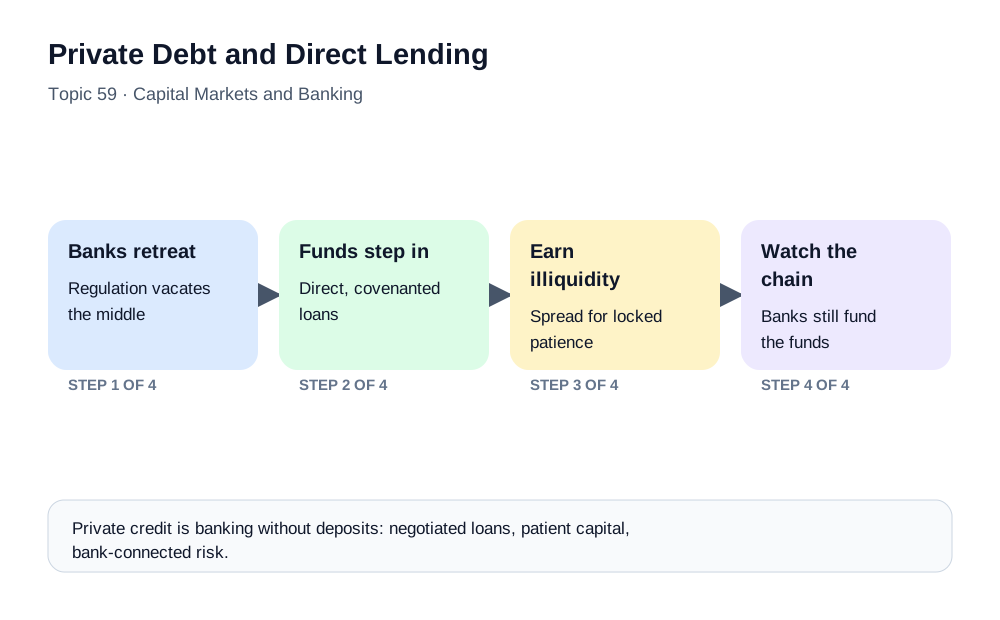
Private Debt and Direct Lending at a glance — Private credit, unitranche, mezzanine.
How Private Credit Differs From Bank and Bond Lending
Industry context: private credit in the corporate-lending landscape
The global financial landscape has undergone a tectonic shift since the 2008 Global Financial Crisis. As regulators imposed stringent capital and liquidity constraints on traditional commercial banks, a quiet revolution occurred in the corporate credit markets. Private credit—specifically Private Debt and Direct Lending—stepped into the vacuum left by banks, evolving from a niche asset class into a massive, multi-trillion-dollar parallel lending ecosystem. Today, private credit funds actively compete with and bypass traditional commercial bank lending and public syndicated debt markets, fundamentally changing how middle-market companies access growth capital.
This module details the economics, operational mechanics, risk profiles, regulatory frameworks, and real-world execution of private debt and direct lending transactions.
1. What Private Debt Is: Lending Without Bank Intermediation
Private debt is an umbrella term for debt investments that are non-bank, non-publicly traded, originated by asset management firms, and typically held to maturity. Direct lending is the largest sub-segment of private credit, representing senior secured loans issued directly to corporate borrowers without bank intermediation.
The Macroeconomic Utility of Private Credit
The exponential growth of private credit is driven by specific regulatory and economic drivers:
- Bank Disintermediation: Post-crisis regulatory regimes like Basel III/IV imposed high capital charges on risk-weighted assets (RWA), making it highly expensive for banks to hold leveraged loans or middle-market exposures on their balance sheets.
- The Middle-Market Financing Gap: Middle-market companies (typically defined as businesses with annual EBITDA between $10,000,000$ and $100,000,000$) require customized, flexible capital structures that public markets cannot accommodate and commercial banks are too risk-averse to underwrite.
- Yield Search: In a prolonged low-interest-rate environment, institutional investors (pension funds, insurance companies, sovereign wealth funds) turned to private debt to capture an illiquidity premium (typically 150 to 300 basis points over comparable public syndicated debt or high-yield bonds).
Structural Terminology and Instruments
Private credit operates through specialized, highly structured instruments:
- Senior Direct Lending: First-lien, senior secured debt that sits at the top of the borrower's capital structure, providing the highest recovery rate in default scenarios.
- Unitranche Debt: A hybrid structure that blends senior and subordinated debt into a single, unified loan facility under a single interest rate (typically priced at SOFR + 550 to 750 bps). This simplifies capital structure and documentation for the borrower.
- Mezzanine Debt: Subordinated debt that sits junior to senior debt but senior to common equity. Mezzanine loans often include equity kickers (warrants or co-investment rights) and features like Payment-in-Kind (PIK) interest, which capitalizes unpaid interest back into the principal rather than requiring cash payout.
- Covenant-Lite (Cov-Lite) Loans: Loans that lack traditional maintenance covenants (which require borrowers to meet financial health metrics quarterly), relying instead on incurrence covenants (which are triggered only when a specific event occurs, like issuing additional debt).
Comparative Financing Architecture
The table below contrasts private credit with traditional bank loans and public high-yield debt:
| Structural Feature | Traditional Bank Loans | Private Credit / Direct Lending | Public High-Yield Debt |
|---|---|---|---|
| Primary Underwriter | Commercial Banks | Private Credit Funds (Asset Managers) | Investment Banks (underwritten & distributed) |
| Pricing Structure | Floating rate (SOFR + 150-350 bps) | Floating rate (SOFR + 550-800 bps) | Fixed rate coupon |
| Transaction Execution | Slow; highly standardized; committee-driven | Rapid; highly customized; bilateral execution | Slow; requires public registration, ratings, and roadshows |
| Covenant Structure | Tight financial maintenance covenants | Flexible; often covenant-lite or bespoke | Loose incurrence-only covenants |
| Hold Strategy | Distributed, syndicated, or held on balance sheet | Held to maturity in closed-end funds | Fully liquid; traded on public OTC markets |
2. How a Direct Lending Fund Operates: From Capital Call to Monitoring
The operations of a direct lending fund differ substantially from those of a depository bank. Because private credit funds are funded by Limited Partners (LPs) rather than retail deposits, the transaction lifecycle revolves around capital calls, bilateral deal sourcing, and specialized portfolio monitoring.
Direct Lending Systems Architecture
- LP CRM / Portal: Specialized software (e.g., eFront, iLevel) used to manage relationships with institutional investors, track capital commitments, and process capital calls.
- Fund Portfolio Monitoring Engine: Tracks active loan covenants, portfolio company EBITDA metrics, and computes risk valuations.
- Central Treasury / Custody Bank: External depository institution that physically holds the fund’s cash and assets under a tripartite custody agreement.
- Core General Ledger (GL): Closed-end fund accounting ledger that tracks capital commitments, drawn capital, management fees, carried interest, and loan principal/interest assets.
Operational Lifecycle Flowchart
  [DEAL ORIGINATION]          [FUNDING OPERATIONS]          [PORTFOLIO SERVICING]

    Sourcing & CRM              Capital Call Issued             Daily Accruals &
   (Direct to Sponsors)          to LPs (eFront)               Monitoring (iLevel)
          │                             │                              │
          ▼                             ▼                              ▼
    Due Diligence &              Tripartite Custody              Cash Interest &
   RAROC Underwriting            Funding (pacs.008)             PIK Capitalization
End-to-End Transaction Execution Workflow
Phase 1: Bilateral Deal Sourcing & Origination
- Action: The Private Credit Fund’s Deal Team pitches to a private equity sponsor or corporate executive, securing the role of sole lender for a $75,000,000$ unitranche loan facility.
- System Input: The pipeline details, pricing structures, and commitment sizes are logged in the deal management system.
Phase 2: Underwriting & Investment Committee Approval
- Due Diligence: Analysts evaluate the borrower's Adjusted EBITDA, Leverage Multiples (Debt/EBITDA), and Interest Coverage Ratios (EBITDA/Interest Expense).
- Compliance & KYC: Complete background, AML, and corporate registry checks are executed via specialized intelligence databases to identify any PEP or sanctioned beneficial owners.
- Structure Negotiation: Legal teams construct credit agreements defining maintenance covenants, financial covenants, and warrants.
- Investment Committee (IC) Approval: The IC approves the transaction, setting the funding date.
Phase 3: LP Capital Call & Funding Operations
- Sourcing Liquidity: Direct lending funds do not have retail deposit books. To fund the $75,000,000$ loan, the fund must issue a Capital Call Notice to its LPs via the LP Portal.
- The Execution: LPs are given 10 business days to wire their pro-rata portion of the capital commitment.
- Funding and cash reporting: LP capital contributions arrive through the payment rails and bank services used by the investors, fund, and custodian. The exact wire format and clearing route depend on the banks, currencies, jurisdictions, and service design; ISO 20022 payment messages may be used in relevant interbank infrastructures, but a
pacs.008is not an inherent property of every private-fund capital call. The custody or cash bank updates the fund's cash position and provides agreed reporting through statements, files, APIs, or other channels; ISO 20022 cash-reporting messages such ascamtcan be used where supported, but the fund-control requirement is accurate, timely, reconcilable reporting rather than one mandatory message type. - Fund Accounting Ledger Entries (Capital Drawdown):
$\text{Debit: } \text{Fund Cash at Custodian Bank} \quad $75,000,000$ $\text{Credit: } \text{Partners' Capital (LP Paid-In Capital)} \quad $75,000,000$
Phase 4: Loan Booking & Disbursement
- Loan Booking: The operations team books the loan asset in the Fund Portfolio Engine, configuring the interest rate (e.g., Daily Compounded SOFR + 650 bps, with a $1.00%$ SOFR floor).
- Disbursement Instruction: The fund issues a secure payment instruction to the Tripartite Custody Bank to release $75,000,000$ to the corporate borrower.
- Accounting Ledger Entries (Loan Funding):
$\text{Debit: } \text{Direct Loans Receivable (Asset)} \quad $75,000,000$ $\text{Credit: } \text{Fund Cash at Custodian Bank (Cash Asset)} \quad $75,000,000$
Phase 5: Income Servicing, PIK Accounting, and Valuation
- Cash Interest Accrual: Daily floating interest is accrued on the outstanding principal.
- Payment-in-Kind (PIK) Capitalization: Under the bespoke loan agreement, the interest is structured as $7.00%$ cash interest and $2.00%$ PIK interest. The PIK portion does not require cash payout; instead, it is capitalized directly back into the loan principal quarterly.
- Accounting Ledger Entries (Quarterly PIK Accrual & Capitalization):
$\text{Debit: } \text{Direct Loans Receivable (Capitalized Loan Asset)} \quad \text{PIK Interest Amount}$ $\text{Credit: } \text{PIK Interest Revenue (Revenue/P&L)} \quad \text{PIK Interest Amount}$
3. Private Credit Risks, Controls and Oversight
While direct lenders are shielded from classic retail bank runs, they are highly exposed to long-term illiquidity, credit defaults, structural opacity, and governance risks.
Portfolio Risk Matrix
The primary risks inherent to private credit operations are detailed below, along with industry-standard controls.
| Risk Category | Specific Risk Vector | Enterprise Operational Source | Advanced Internal Control Mitigation |
|---|---|---|---|
| Credit & Default Risk | Leverage creep; borrower bankruptcy. | Relaxed "covenant-lite" credit agreements; macroeconomic downturns. | - Independent Valuation Committees.<br>- Bi-weekly portfolio reviews tracking leading credit metrics.<br>- Board observer seats in portfolio companies. |
| Illiquidity Risk | Inability to liquidate loan assets to meet LP redemption demands. | Locked-up fund capital in closed-end vehicles. | - Closed-End Fund Structure: capital is locked up for 7-10 years, preventing redemption pressure.<br>- Strict cash reserve maintenance buffers. |
| Valuation Risk | Overstating asset net asset value (NAV) due to illiquid secondary markets. | Mark-to-model accounting (Level 3 inputs under IFRS 13/ASC 820). | - Mandatory engagement of Third-Party Valuation Firms (e.g., Houlihan Lokey, Duff & Phelps) quarterly.<br>- Valuation committee challenger models. |
| Operational & Key-Man Risk | Loss of investment professionals; transaction processing errors. | Heavy reliance on small investment teams; manual execution flows. | - Dual-authorization ("four-eyes principle") on all capital call notices.<br>- Robust succession planning and structured carried-interest vesting schedules. |
| Regulatory Risk | Regulatory crackdowns on "shadow banking" or changes in private fund rules. | Opaque reporting; non-transparent fee allocations. | - Real-time regulatory monitoring dashboards.<br>- Structured LP Advisory Committees (LPAC) to oversee fee allocations. |
Global Regulatory Guardrails
- US private-fund adviser framework: Private funds and their advisers remain subject to the applicable federal securities-law framework, including adviser registration or exemptions, antifraud duties, custody requirements where applicable, books and records, and regulatory reporting such as Form PF for in-scope advisers. The SEC's 2023 Private Fund Adviser Rules that would have added a new mandatory private-fund audit rule, quarterly statements, restricted-activity rules, adviser-led secondary requirements, and preferential-treatment rules were vacated by the U.S. Court of Appeals for the Fifth Circuit on 5 June 2024; the SEC subsequently amended the CFR to reflect that vacatur. Any statement of current US private-fund obligations should therefore rely on the rules actually in force rather than those vacated provisions.
- AIFMD / AIFMD II (Europe): The EU AIFMD framework regulates in-scope alternative investment fund managers through authorisation, governance, risk and liquidity management, leverage, transparency, reporting, and depositary requirements. Directive (EU) 2024/927 (AIFMD II) specifically amended the framework for loan origination, including requirements for effective loan-granting and credit-risk processes and harmonised rules for loan-originating AIFs. The detailed application depends on EU implementation and the relevant national law, so private-credit funds should be assessed against the current jurisdiction-specific framework rather than a generic claim that every fund faces one identical capital or custody rule.
- Non-bank financial intermediation monitoring: The Financial Stability Board monitors and analyses non-bank financial intermediation and systemic vulnerabilities at the international level, but it is not itself a direct compliance regime requiring individual private-credit funds to file an 'FSB shadow banking report'. Direct lenders and fund managers comply with the laws, supervisory reporting, and fund rules applicable in their jurisdictions; authorities can then use those data in broader domestic and international monitoring of non-bank leverage, liquidity, interconnectedness, and credit intermediation.
4. Case Study: A $75M Unitranche Loan Under Stress
To understand the dynamic relationship between a private direct lender, a borrower, and the traditional clearing banking system, let us analyze a detailed credit stress scenario.
The Scenario: The Cross-Border Unitranche Recapitalization
- The Direct Lender: Blackwood Credit Partners (BCP) Fund IV (a $3,000,000,000$ closed-end direct lending fund).
- The Administrative Agent: Global Zenith Bank (GZB) acts as administrative agent and payment gateway.
- The Borrower: AeroCare Diagnostics Inc. (a clinical laboratory business with an Adjusted EBITDA of $15,000,000$).
- The Transaction: BCP Fund IV extends a $75,000,000$ Unitranche Loan Facility to fund AeroCare's acquisition of a regional competitor.
- Pricing Parameters: SOFR + 650 bps ($1.00%$ SOFR floor), with interest split as $6.00%$ cash and $1.50%$ PIK, structured with a Total Leverage Covenant maximum of $5.50\times$ Debt/EBITDA.
       [Blackwood Credit Partners] ─── $75M Unitranche Loan ───► [AeroCare Diagnostics]
                                                                      │
     [GZB (Administrative Agent)] ◄─── Processes Flows & Alerts ──────┘
The Funding Mechanics
- BCP issues LP capital calls to draw the $75,000,000$.
- Once the capital arrives at BCP’s custody account at GZB, the back office executes the loan funding.
- GZB as the processing bank executes the approved disbursement through the appropriate payment rail for the currency, jurisdiction, beneficiary bank, and service. The underlying bank-to-bank instruction may use ISO 20022 where the relevant infrastructure supports it, but the private-credit transaction itself does not require one universal message type.
- General Ledger Booking at BCP Fund IV:
$\text{Debit: } \text{Direct Loans Receivable (AeroCare Diagnostic Asset)} \quad $75,000,000$ $\text{Credit: } \text{Cash at Custody Bank} \quad $75,000,000$
The Exception: Post-Acquisition Integration Failure & Covenant Breach
The Stress Trigger
Twelve months post-transaction, AeroCare experiences severe supply chain disruptions and loss of a major health insurance partnership. Quarterly financials indicate:
- EBITDA Falls: EBITDA declines from $15,000,000$ to $11,000,000$.
- Leverage Multiplier Surges: With the outstanding loan principal at $75,000,000$ (plus capitalized PIK interest bringing it to $76,125,000$), the leverage ratio rises to:
$ \text{Total Leverage Ratio} = \frac{$76,125,000}{$11,000,000} = 6.92\times $
This significantly exceeds the contractual maximum covenant threshold of $5.50\times$, triggering an Event of Default (EoD) alert inside BCP’s Fund Portfolio Engine.
The Restructuring & Resolution Mechanism
Rather than initiating foreclosure—which would destroy enterprise value—direct lenders utilize their structural agility to execute a rapid workout:
    [EBITDA Declines] ──► [Covenant Breach Alert] ──► [Direct Restructuring]
                                                             │
    ┌────────────────────────────────────────────────────────┴────────────────────────────────────────────────────────┐
    ▼                                                        ▼                                                        ▼
[Covenant Waiver Issued]                                [PIK Conversion]                                    [Equity Warrants Triggered]
Relax limit to 7.00x                                    Convert cash portion to                             BCP takes 5.0% equity
in exchange for fee                                     PIK interest to preserve cash                       to capture upside
- Direct Negotiation: Because BCP is the sole bilateral lender, it avoids the coordination delays of public syndicated banks. The BCP credit workout team meets immediately with AeroCare's private equity sponsor.
- Covenant Waiver & Amendment Agreement:
- BCP agrees to temporarily waive the default and amend the covenant limit to $7.00\times$, providing operational breathing room.
- In exchange, BCP charges a $100\text{ bps}$ Amendment Fee ($750,000$), which is capitalized directly into the loan principal.
- Accounting Entry (Amendment Fee Capitalization):
$\text{Debit: } \text{Direct Loans Receivable} \quad $750,000$ $\text{Credit: } \text{Unearned Fee Revenue (LMR Asset)} \quad $750,000$
- PIK Capitalization Pivot (Liquidity Preservation):
- To preserve cash for AeroCare, the interest pricing is restructured for the next four quarters: the cash interest is reduced from $6.00%$ to $2.00%$, and the PIK capitalized interest is increased from $1.50%$ to $6.00%$ (bringing the total pricing to $8.00%$).
- This restructuring preserves approximately $3,000,000$ in annual operational cash flow for AeroCare, allowing it to re-engineer its health insurance partnerships.
- Equity Warrant Activation (Upside Capture):
- As a condition for the covenant modification, BCP exercises warrants to acquire a $5.00%$ equity ownership in AeroCare at a nominal cost. This structures a massive potential upside for BCP’s LPs if the company successfully turnaround.
- Successful Turnaround: Under the revised capital structure, AeroCare stabilizes its operations, secures a new diagnostic partnership, and returns its EBITDA to $14,500,000$ within 18 months, reducing leverage to an acceptable $5.30\times$.
Conclusion
Private debt and direct lending represent a fundamental shift in corporate credit. By combining the customized credit-structuring capabilities of investment banking with the operational agility of private capital, direct lenders provide indispensable liquidity to the corporate middle market. When managed under rigorous portfolio-monitoring controls and strategic workout mechanisms, direct lending stands as a resilient, high-yielding cornerstone of modern global finance.
Next: Topic 60 — Monetary Policy →
<!-- MBA-DEEP-DIVE-START -->Deep Dive: Private Credit as a Full Lending System Outside the Deposit Bank
Private credit is often described as lending without a bank. That is directionally useful but incomplete. A direct lender still performs most of the disciplines a good bank performs: origination, underwriting, documentation, collateral analysis, funding, servicing, covenant monitoring, valuation, restructuring, recovery, investor reporting, and risk governance. What changes is the funding and institutional architecture. Instead of financing loans mainly with deposits and bank wholesale liabilities, a private-credit vehicle is funded by investor commitments, fund-level facilities, asset-backed financing, or other capital structures permitted by its mandate. Instead of continuously quoting a balance sheet to a broad customer base, it deploys committed capital into a narrower portfolio of negotiated assets.
That difference changes incentives and risk. A closed-end private-credit fund can hold an illiquid loan for years without facing daily retail deposit withdrawals. At the same time, it cannot create durable value simply by hiding from market prices. Borrowers still default. Interest still has to be collected. PIK interest can compound while cash generation deteriorates. Valuations can become stale. Fund-level leverage can create liquidity pressure. Investors eventually expect distributions. The professional question is therefore not whether private credit is safer or riskier than bank lending. It is which risks moved, who now bears them, and whether the fund's capital and controls match the structure.
Direct lending starts with the repayment source, not the sponsor name
Many private-credit transactions are sponsor-backed: a private-equity firm owns the borrower and arranges financing for an acquisition, refinancing, dividend recapitalisation, or growth plan. Sponsor quality matters because experienced sponsors can provide governance, additional equity, and access to management expertise. But the lender is not lending to the sponsor's reputation. The legal borrower must generate or obtain enough cash to service the debt.
A strong underwriting memo therefore begins with the business model. What does the company sell? Who pays it? How recurring are revenues? What percentage of earnings converts to cash? How cyclical is demand? What capital expenditure is unavoidable? How much working capital absorbs cash during growth? What can go wrong with pricing, suppliers, regulation, technology, or customer concentration?
The sponsor's investment thesis is useful evidence, but it should be challenged. A lender should ask what the business can pay under a downside case in which the sponsor's operational plan takes longer, cost savings fail, or a planned exit market closes. Private credit earns a premium partly because it is willing to underwrite complexity; that premium disappears if complexity is simply accepted rather than analysed.
EBITDA needs to be converted back into cash
Private-credit underwriting frequently discusses leverage as debt divided by EBITDA. The ratio is useful, but adjusted EBITDA can become dangerous when every optimistic adjustment is accepted as if it were cash already earned.
Suppose a company reports USD 20 million of EBITDA. Management adds USD 3 million of expected cost savings, USD 2 million of acquisition synergies, and USD 1 million of one-time expenses it expects not to repeat. The lender may be shown an 'adjusted EBITDA' of USD 26 million. A USD 130 million debt package then appears to be 5.0x leveraged rather than 6.5x on actual historic EBITDA.
The lender should not automatically reject adjustments; some are economically reasonable. It should classify them. Which savings have contracts behind them? Which require layoffs not yet completed? Which depend on revenue growth? Which 'one-time' expenses have appeared every year? What is the timing of realisation? A credit agreement may define EBITDA for covenant purposes differently from the lender's conservative underwriting view. Risk governance should preserve both rather than allowing the contractual definition to become the sole measure of repayment capacity.
Free cash flow ultimately services cash interest and principal. A business can report strong EBITDA while consuming cash through capital expenditure, tax, working capital, leases, restructuring, or acquisition costs. The underwriting bridge from EBITDA to free cash flow is therefore one of the most important documents in a direct-lending deal.
Unitranche simplifies the borrower but not the lender economics
A unitranche facility gives the borrower one blended debt instrument rather than separate first-lien and second-lien or mezzanine tranches. The simplicity can speed execution and reduce intercreditor negotiation for the borrower. Behind the scenes, however, lenders may still divide economics through an agreement among lenders or similar arrangement.
One lender or tranche may receive a lower-risk 'first-out' return while another receives a higher-return 'last-out' position. The borrower can see one interest rate and one facility, while the lenders have internal rules governing payment priority, voting, enforcement, and allocation of recoveries.
This matters in stress. If the borrower breaches a covenant, who can waive it? If new money is required, who has priority? If collateral is sold, how are proceeds shared? A lender buying a last-out interest should not analyse the exposure as if it were ordinary senior debt merely because the borrower signed one unitranche agreement.
First lien is a legal priority, not a guarantee of full recovery
A senior secured loan can still lose money. 'First lien' means the lender has an agreed priority over specified collateral subject to applicable law, perfection, intercreditor arrangements, and other claims. It does not mean collateral will cover the debt at all times or that enforcement will be quick.
Private-credit portfolios often finance businesses whose enterprise value depends more on recurring earnings, contracts, software, customer relationships, or brand than on hard assets. If the business fails, desks and laptops may have little liquidation value. The real protection may be control of the enterprise through security and covenants, giving lenders the ability to restructure or sell a going concern before value disappears.
Collateral analysis should therefore distinguish asset value from enterprise value. Asset-heavy borrowers such as equipment businesses can offer recoverable collateral. Asset-light service or software companies may require a credit thesis based primarily on recurring cash flow and the value of the operating company. The label 'secured' should never substitute for a recovery model.
Covenants are early decision rights
Maintenance covenants are valuable not because lenders want borrowers to fail them, but because they create a contractual moment for discussion before payment default.
A leverage covenant can force a conversation when earnings fall but the borrower is still current. The lender may obtain additional reporting, a fee, a pricing increase, sponsor equity, reduced distributions, tighter acquisition limits, or a revised business plan in exchange for a waiver or amendment.
An incurrence covenant operates differently. It restricts an action — taking more debt, making a dividend, acquiring a company — if a test is not met. A borrower can deteriorate without technically breaching the covenant so long as it avoids the restricted action.
The lender should understand which protections are genuinely continuous. A deal marketed as 'covenant-lite' may still contain strong information rights, debt-incurrence restrictions, liquidity covenants, or springing tests on revolvers. Conversely, a deal advertised as covenant-protected may contain definitions and cure rights that allow the borrower substantial flexibility.
Covenant quality is in the drafting, definitions, baskets, exceptions, and reporting frequency — not the number of covenant headings.
Documentation is part of underwriting
Private credit's advantage is often described as flexibility. Flexibility becomes dangerous when the commercial deal and legal agreement diverge.
If the investment committee approved a leverage limit, the credit agreement must define debt and EBITDA consistently enough to reproduce the intended test. If the lender expects a first-ranking security interest, perfection steps and legal opinions must support it. If a sponsor equity contribution is a condition, operations should confirm the contribution before funding.
Documentation should also control leakage. Restricted payments, affiliate transactions, asset sales, acquisitions, additional debt, liens, and transfers can all move value away from lenders if permitted too broadly. The credit team should understand the major baskets and exceptions rather than delegating the entire document to counsel.
A well-underwritten loan with weak documents can become a weak loan. A well-drafted agreement cannot rescue a business that was never able to service its debt. Both disciplines are required.
Capital calls are a funding mechanism with timing risk
Closed-end funds receive commitments from limited partners and draw them as investments are made. The capital-call process therefore creates a timing obligation between investment close and investor cash.
A fund should not commit to a loan without knowing how the funding will arrive. Capital-call notices need correct investor allocations, banking instructions, due dates, and authorised approval. Investor defaults are uncommon among institutional LPs but cannot be assumed impossible. Large funds therefore maintain liquidity planning around uncalled commitments, expected investment closings, management fees, fund expenses, and distributions.
The operational control is straightforward but important: the fund's commitment ledger, investor register, bank cash, and investment settlement schedule must agree. A capital call sent with the wrong bank details is a fraud risk. A call calculated from stale ownership percentages can misallocate contributions across LPs. Dual approval and independently verified standing instructions should be standard for sensitive cash changes.
Subscription lines change the timing but not the economics of capital
A subscription credit facility can allow a fund to borrow against the contractual capital commitments of eligible investors. The fund may use the line to bridge investment closings, reduce the frequency of capital calls, or manage short-term liquidity.
This can improve operational efficiency, but it changes performance optics and fund leverage. If the fund buys an investment using the line and calls investor capital later, the investor's measured internal rate of return can appear higher because the investor's cash was outstanding for less time even if the investment itself generated the same economic return.
Fund governance should therefore disclose and monitor subscription-line use according to the fund terms and applicable requirements. Risk teams need borrowing-base rules for eligible LP commitments, concentration, investor credit quality, advance rates, covenants, and maturity.
A subscription line should bridge timing, not conceal a structural inability to fund investments from investor capital.
NAV facilities create a different form of fund-level leverage
Later in a fund's life, the remaining uncalled commitments can be too small to support a subscription facility. Some funds use NAV-based financing secured or supported by the value of portfolio investments and distributions.
A NAV facility can provide liquidity for follow-on investments, portfolio support, distributions, or other permitted purposes. It also creates leverage against assets whose valuations may be illiquid and correlated. If portfolio companies deteriorate together, NAV can fall and covenant headroom can shrink at the same time cash distributions weaken.
The lender to the fund therefore underwrites the portfolio, diversification, valuation policy, distribution capacity, legal structure, and control over proceeds. For the private-credit manager borrowing at fund level, the facility should be included in stress analysis rather than treated as separate from portfolio risk.
Fund leverage and borrower leverage can stack
A private-credit fund may own loans to companies that are themselves highly leveraged and may also borrow at the fund level. This creates layered leverage.
Suppose portfolio companies average 5.5x debt-to-EBITDA. The fund then uses a secured warehouse or NAV facility to finance part of its loan portfolio. Investors own equity in a fund whose assets are already leveraged corporate claims and whose own balance sheet may be leveraged again.
This is not automatically inappropriate. The risk is that a common downturn affects both layers. Borrower credit deteriorates, loan fair values fall, fund collateral haircuts rise, and fund financing becomes more expensive. The fund may need liquidity precisely when portfolio companies are asking for amendments or new money.
Investors and lenders should therefore distinguish unlevered asset return from return enhanced by fund-level financing.
Warehouses can bridge origination into a larger financing structure
Private-credit managers and specialty lenders can use warehouse facilities to finance newly originated loans before the assets are transferred into a fund, securitisation, or longer-term structure. The warehouse lender advances against eligible loans subject to concentration, quality, and borrowing-base rules.
Warehouses create execution risk. If the expected take-out market closes, assets remain in the warehouse longer than planned. If loan values fall, advance rates can tighten. If new originations underperform, the collateral pool can breach triggers.
The originator should therefore have a credible alternative if distribution or refinancing does not occur. A strategy that only works while the warehouse continuously expands is vulnerable to a funding shock even when underlying borrowers are still paying.
Loan servicing is a financial control, not administrative plumbing
Once a direct loan is funded, someone must calculate interest, track reference-rate resets, apply floors, process cash receipts, capitalise PIK, maintain principal balances, test covenants, issue notices, and distribute lender payments where multiple investors exist.
A servicing error can change the economics of the asset. If a floating-rate reset is applied incorrectly, income and borrower obligations are misstated. If PIK interest is not capitalised according to the agreement, the outstanding principal becomes wrong. If a prepayment is allocated incorrectly among lenders, cash and ownership records diverge.
Private-credit operations should reconcile the portfolio system to bank cash, agent notices, borrower records, and fund accounting. Changes to loan terms after amendments need effective dates and controlled configuration. Excel can support analysis, but a multi-billion-dollar portfolio should not depend on one uncontrolled spreadsheet as its authoritative loan ledger.
PIK interest can delay the signal of distress
Payment-in-kind interest allows interest to be added to principal instead of paid in cash. It can be an appropriate feature for growth companies, transitional periods, or subordinated instruments where near-term cash preservation is part of the structure.
The lender must remember what PIK is economically: more credit exposure. The lender records income while receiving no cash, and principal compounds upward.
Suppose a USD 100 million loan carries 4% PIK. After one year, approximately USD 4 million is added to principal before considering detailed compounding and timing. If the company's enterprise value is not rising at least enough to support the larger claim, recovery coverage deteriorates.
A portfolio showing strong accounting yield can therefore have weak cash yield. Risk reporting should separate cash interest from PIK and monitor the proportion of return that depends on eventual refinancing, sale, or recovery rather than current borrower cash generation.
Valuation requires a documented exit price, not a desired return
Private loans do not trade every day, so valuation involves judgement. A fund cannot simply carry every performing loan at par because no public quote exists.
Valuation can consider observable transactions, public credit spreads, comparable borrowers, changes in credit quality, enterprise value, projected cash flows, reference rates, contractual spread, call protection, and recovery assumptions. The objective under the relevant accounting framework is to estimate value according to the applicable measurement basis, not to smooth performance.
Independent valuation committees, third-party inputs, administrator review, and auditors can strengthen governance, but management still needs to understand the assumptions. A model that always returns par until default is not a valuation model; it is a delay mechanism.
Valuation changes should be connected to credit monitoring. If the investment team places a borrower on a serious watchlist but the valuation remains unchanged without explanation, governance should ask why.
Liquidity is determined by fund terms and asset reality together
A closed-end fund with long investor lock-up is structurally well matched to illiquid direct loans. An open-ended vehicle offering frequent redemptions while holding the same assets faces a different challenge.
Private loans may take weeks or months to sell, and secondary-market prices can gap lower when many funds sell together. Investor liquidity therefore needs buffers, notice periods, gates, side pockets, borrowing capacity, or other tools permitted by the fund structure and applicable law.
The important principle is identical to bank liquidity management: liabilities determine the time available to monetise assets. An asset can be fundamentally sound and still be a poor source of cash tomorrow morning.
Portfolio monitoring should test the original investment thesis
A quarterly covenant certificate is not enough. Direct lenders often receive private monthly or quarterly management information precisely because the loan is illiquid and held for years.
Monitoring should track the economic drivers identified at underwriting: revenue retention, customer concentration, margins, working-capital conversion, capital expenditure, cash balance, liquidity runway, leverage, interest coverage, covenant headroom, sponsor behaviour, management turnover, and sector indicators.
A useful watchlist is early. If every watchlist credit is already in payment default, the process failed.
The lender should also track variance to underwritten case. If the business consistently misses the plan but remains covenant-compliant because definitions are generous, risk has still increased. Credit judgement should not wait for a legal breach.
Sponsor behaviour is an important but imperfect signal
When a borrower weakens, the private-equity sponsor's willingness to contribute new equity can be informative. A sponsor that injects fresh capital demonstrates belief in future enterprise value and improves lender protection.
But lenders should not assume support. A rational sponsor can decide that its existing equity is already impaired and refuse to put good money after bad. The sponsor's fund may have limited remaining capital, internal conflicts, or a different view of recovery.
Credit approval should therefore treat future sponsor equity as an upside or negotiated condition, not an unconditional source of repayment unless legally committed.
Amend-and-extend can preserve value or hide it
Private lenders often have flexibility to restructure faster than a large public bondholder group. That is a genuine advantage when the underlying business is viable.
A restructuring can extend maturity, adjust amortisation, change cash and PIK interest, waive covenants, obtain new collateral, require sponsor equity, tighten reporting, or modify baskets. The lender may also charge an amendment fee or receive warrants subject to the negotiated structure.
The decision should answer one question: does the amended capital structure restore sustainable repayment or maximise expected recovery?
If the borrower cannot generate enough cash even under realistic revised assumptions, repeatedly capitalising interest and moving maturity dates is not a solution. It can inflate reported principal while enterprise value deteriorates — the private-credit version of evergreening.
Restructuring needs enterprise-value and recovery analysis
In stress, lenders compare going-concern value with liquidation or alternative recovery. A company with a strong customer franchise but temporary overleverage may be worth much more alive than broken into assets. Lenders can exchange debt for equity, reduce debt, inject new money, or change ownership to preserve enterprise value.
A business with structurally negative economics may require a different answer. Continuing to fund losses can destroy remaining recovery.
Recovery analysis should model multiple scenarios, time to resolution, legal costs, collateral priority, tax, working-capital needs, management continuity, and the amount of new money required. The headline contractual claim is not the same as recoverable value.
New money is a governance test
Distressed borrowers often need liquidity to complete a turnaround. Existing lenders must decide whether advancing more capital protects or worsens their position.
A disciplined new-money decision asks whether the incremental funding increases expected recovery of the existing exposure. It may require priority, enhanced security, tight use-of-proceeds controls, milestones, cash sweeps, or sponsor participation.
Refusing all new money can force a viable borrower into destructive insolvency. Providing new money simply because the fund does not want to recognise a loss can compound the problem. The correct decision is economic, not emotional.
Administrative agents and paying agents still matter in private deals
Even when one private fund underwrites the full transaction, administration can involve a bank, specialist agent, or internal servicing function. With multiple lenders, an administrative agent maintains lender records, notices, drawdowns, interest calculations, payments, amendments, and communications under the agreement.
The agent is not automatically the credit decision-maker for every lender. Each investor remains responsible for its own exposure unless the documents provide otherwise.
Operationally, lender registers and payment instructions are sensitive. A fraudulent request to change a lender's bank account can redirect large interest or principal payments. Standing-data changes should therefore receive independent verification and strong entitlement control.
Payments are important, but private credit is not a messaging-standard topic
A direct loan generates real cash movements: LP contributions, borrower disbursement, interest, fees, principal, distributions, collateral proceeds, and recoveries. Banks and payment systems carry those cash flows using the rails appropriate to each currency and jurisdiction.
For a private-credit professional, the essential controls are authority, value date, beneficiary verification, currency, funding, reconciliation, and final receipt. The exact interbank message can matter to the servicing bank or payment-operations team, but it does not define the economics of direct lending. This is why private-credit education should mention messaging only where it explains a genuine operational dependency rather than turning a lending chapter into an ISO 20022 catalogue.
A complete sponsor-backed stress scenario
A private-credit fund lends USD 150 million first-lien term debt to a sponsor-owned healthcare services company. At underwriting, EBITDA is USD 30 million, leverage is 5.0x, cash interest coverage is comfortable, and the sponsor contributes substantial equity. The credit agreement includes a maintenance leverage covenant, information rights, restrictions on additional debt, and security over material assets and equity interests subject to the legal structure.
For the first year the company performs near plan. Then a reimbursement change reduces revenue and labour costs rise. EBITDA falls to USD 22 million. The loan has accumulated some PIK from a permitted election, so debt is now USD 154 million. Leverage has risen to 7.0x before considering detailed covenant definitions. Cash interest coverage is tight and the borrower requests a waiver.
The lender does not begin with the fee it can charge for the waiver. It rebuilds the business case. Customer demand remains strong, the reimbursement problem appears manageable, and management has a credible cost programme, but the company needs twelve months of liquidity. The sponsor is willing to inject USD 15 million of new equity.
The fund agrees a restructuring: the sponsor equity is contributed first, the covenant is reset to a declining schedule, distributions are blocked, reporting becomes monthly, part of cash interest is temporarily shifted to PIK, and excess cash after a minimum liquidity threshold sweeps to debt. The fund receives an amendment fee but does not count the fee as evidence that credit quality improved.
Six months later, operating performance stabilises. If the company continues recovering, the restructuring preserved enterprise value and avoided an unnecessary enforcement process.
Now change one fact: the sponsor refuses new equity and the company's main customer terminates its contract. Under the revised forecast, even reduced debt service cannot be supported. The correct strategy may shift toward a sale, debt-for-equity restructuring, or formal insolvency. Continuing to extend maturity merely because the fund has locked capital would destroy value.
The case demonstrates the core skill in private credit: flexibility is valuable only when it follows a realistic diagnosis.
What excellence looks like
A world-class private-credit platform can explain every loan from investor capital to borrower repayment. Underwriting starts with cash flow, not adjusted labels. Leverage adjustments are challenged. Unitranche and intercreditor economics are understood. Security is legally real and recovery is modelled. Covenants create useful early decision rights. Capital calls, subscription facilities, NAV facilities, and warehouses are included in liquidity analysis. PIK is separated from cash income. Valuations move when credit reality moves. Servicing balances reconcile. Watchlists test the original thesis. Amendments restore viability rather than conceal loss. Regulatory statements reflect the rules actually in force.
The deepest lesson is that private credit did not abolish banking disciplines when it moved lending into investment funds. It reassembled those disciplines around a different source of capital. The funds that deserve an illiquidity premium are not those that simply charge higher spreads; they are those that use patient investor capital to underwrite, monitor, and resolve complex credit more intelligently while remaining rigorous about leverage, valuation, liquidity, and investor protection.
<!-- MBA-DEEP-DIVE-END -->