In the global investment universe, standard public equities and fixed-income assets form the bedrock of retail portfolios. However, institutional investors, sovereign funds, and ultra-high-net-worth individuals require financial structures that can decouple returns from broader market movements. This need is met by Hedge Funds and Alternative Investments—specialized investment vehicles utilizing leverage, short-selling, complex derivatives, and illiquid holdings to generate absolute returns. Operating at the frontier of financial engineering, these vehicles rely heavily on the operational, credit, and clearing engines of global Tier-1 banks, specifically through their Prime Brokerage divisions.
This module explores the mechanics of hedge funds and alternative investments, their operational dependency on the banking system, their associated risks, global regulatory frameworks, and a detailed institutional clearing and margin stress scenario.
Visual overview
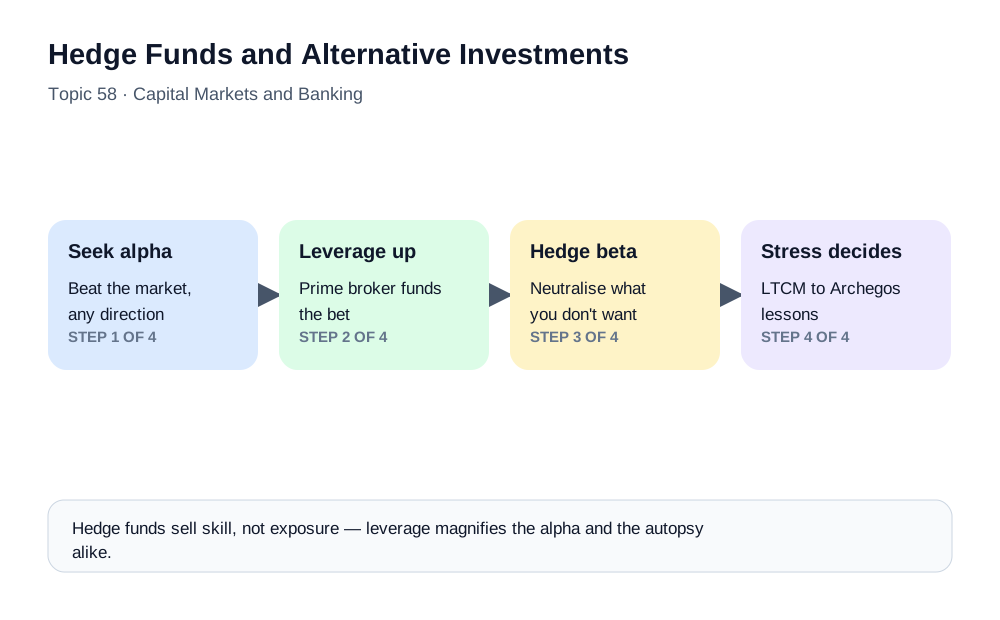
Hedge Funds and Alternative Investments at a glance — Long-short, private equity, REITs.
1. What Hedge Funds Are: Absolute Return, Alpha and Structure
Alternative investments encompass hedge funds, private equity, venture capital, real estate, commodities, and infrastructure. What unites these disparate asset classes is their deviation from traditional "long-only" public securities and their focus on active, absolute performance.
Absolute Return Philosophy: Alpha vs. Beta
Traditional mutual funds are judged on relative performance—how well they perform compared to a benchmark like the S&P 500. Under Modern Portfolio Theory (MPT), a portfolio's return ($R_p$) is defined by the Capital Asset Pricing Model (CAPM):
$ R_p = R_f + \beta_p (R_m - R_f) + \alpha_p $
Where:
- $R_f$: Risk-Free Rate.
- $R_m$: Market Return.
- $\beta_p$ (Beta): The portfolio's sensitivity to market systematic risk.
- $\alpha_p$ (Alpha): The idiosyncratic excess return generated by active manager skill.
Hedge funds seek to construct portfolios where market beta is managed or hedged out, leaving pure, uncorrelated alpha. A true market-neutral fund, for example, aims for $\beta_p = 0$, generating positive returns regardless of whether global stock markets are surging or crashing.
Specialized Fund Structuring and Fees
Unlike public mutual funds, hedge funds are structured as private partnerships (typically limited partnerships or limited liability companies) to avoid restrictive public security regulations.
- The Modern Fee Structure: Historically defined by the "Two and Twenty" model ($2.00%$ annual management fee and $20.00%$ performance/incentive fee), modern funds utilize more investor-aligned fee models:
- Hurdle Rate: A contractual minimum rate of return (e.g., $8.00%$ or SOFR + 300 bps) that the fund must exceed before the manager can collect performance fees.
- High-Water Mark (HWM): Establishes that performance fees can only be charged on new net profits. If a fund loses $10,000,000$ in Year 1, the manager cannot collect performance fees in Year 2 until those losses are fully recovered and the fund’s Net Asset Value (NAV) exceeds its previous peak.
- Liquidity Restrictions: To protect portfolios from forced selling of illiquid assets during market panics, hedge funds utilize specific liquidity management terms:
- Lock-Up Periods: A designated period (typically 1 to 3 years) post-subscription during which investors are contractually prohibited from redeeming capital.
- Redemption Gates: A provision allowing the manager to limit redemptions to a maximum percentage of the fund’s total assets (e.g., $10.00%$ per quarter) during periods of extreme market stress.
- Side Pockets: Structural accounting sub-ledgers used to isolate highly illiquid or distressed assets (e.g., defaulted sovereign bonds or private equity shares) from the fund’s main liquid portfolio, allowing regular redemptions to continue for the liquid portion.
2. How a Hedge Fund Trades: Prime Brokerage and the Trade Lifecycle
A hedge fund’s investment strategy is only as viable as its operational integration with its Prime Broker. Prime Brokerage (PB) is a specialized suite of services offered by investment banks (e.g., Goldman Sachs, Morgan Stanley, GZB Prime) to institutional clients, encompassing clearing, settlement, securities lending (for short-selling), margin financing, and portfolio reporting.
Prime Brokerage Systems Architecture
To execute and clear transactions, a hedge fund's internal infrastructure integrates directly with the Prime Broker's systems:
- PMS (Portfolio Management System): The fund's internal system that tracks fund holdings, computes real-time P&L, and monitors asset exposures.
- EMS/OMS (Execution & Order Management System): The trading platform used by the fund's execution traders to route orders to institutional equity, FX, and derivatives desks.
- Risk Engine (Value-at-Risk/VaR): Monitors the fund's aggregate margin, leverage, and portfolio risk limits.
- Central Clearing & Settlement Gateways (Custodian Bank): Manages interbank settlement, matching trade logs, and moving cash and securities across international clearinghouses (e.g., DTCC, Euroclear).
Operational Handoffs & Trade Lifecycle
   [HEDGE FUND PMS]             [EXECUTION DESK]             [PRIME BROKER]

   ┌──────────────┐             ┌──────────────┐            ┌──────────────┐
   │ Strategy     ├────────────►│ Trade        ├───────────►│ Trade        │
   │ Formulation  │             │ Execution    │            │ Matching &   │
   └──────────────┘             └──────────────┘            │ Clearing     │
                                                            └──────┬───────┘
                                                                   │
                                                                   ▼
   ┌──────────────┐             ┌──────────────┐            ┌──────────────┐
   │ Mark-to-     │◄────────────┤ Margin &     │◄───────────┤ Security     │
   │ Market Ledger│             │ Collateral   │            │ Settlement   │
   └──────────────┘             └──────────────┘            └──────────────┘
Phase 1: Strategy Formulation & Execution
- Action: A Portfolio Manager (PM) at a long-short equity hedge fund decides to initiate a short position of $500,000$ shares of a highly valued technology stock ("GlobalTech Inc.") at $100$ per share, representing a short exposure of $50,000,000$.
- Securities Lending Request: Because shorting requires selling a security the fund does not own, the fund’s EMS issues an automated securities locate request to its Prime Broker's Securities Lending Desk.
- The Locate: The PB system locates the $500,000$ shares within its custody network or borrows them from an institutional lender (e.g., a pension fund custodian), locking the borrow rate (e.g., $1.50%$ borrow cost per annum).
Phase 2: Trade Execution & Order Routing
- Execution: The fund's execution trader routes the short order via FIX (Financial Information eXchange) protocol to GZB’s institutional equity trading desk, executing the short sale at $100.00$.
- Confirmation: GZB's execution system confirms the fill, transmitting a FIX execution report to the fund's PMS.
Phase 3: Clearing, Settlement, and Security Settlement Messaging
- Clearing: To settle the transaction, the PB clearing engine matches GZB’s sell instructions with the buyer’s clearing bank.
- Settlement instruction and reporting: The prime broker or its settlement agent sends the required securities-settlement instruction through the interface supported by the relevant CSD or market infrastructure. Some markets use ISO 20022 securities messages such as the
sesefamily, while others use proprietary or market-specific interfaces, and the exact message version is determined by the infrastructure. Status and settlement confirmation are processed through the relevant market channel. Cash and securities sub-ledgers are then updated and the hedge fund receives agreed reporting through statements, files, APIs, or other services; ISO 20022 cash-reporting messages can be used where the service and market support them, but they are not inherent to every prime-brokerage settlement.
Phase 4: Prime Brokerage Accounting & General Ledger Bookings
At the moment of settlement, the Prime Broker’s General Ledger processes the cash inflow from the short sale and locks it as collateral, creating the following double-entry ledger impact:
$\text{Debit: } \text{Clearing Cash at Custodian} \quad $50,000,000$ $\text{Credit: } \text{Hedge Fund Short-Sale Cash Collateral Payable} \quad $50,000,000$
Simultaneously, the broker records the liability of the borrowed stock:
$\text{Debit: } \text{Securities Borrowed Asset (Receivable)} \quad $50,000,000$ $\text{Credit: } \text{Hedge Fund Securities Short Position Liability} \quad $50,000,000$
Phase 5: Daily Mark-to-Market (MTM) and Margin Adjustments
- Daily Revaluation: Every business day at market close, the Prime Broker revalues the short position based on the closing stock price.
- If the stock falls to $95$:
- The short position liability decreases to $47,500,000$. The fund realizes an MTM paper profit of $2,500,000$, which is credited to its margin equity.
- If the stock rises to $105$:
- The liability surges to $52,500,000$. The fund realizes an MTM paper loss of $2,500,000$.
- The Prime Broker locks an additional $2,500,000$ of the fund's cash balances as maintenance margin, triggering an MTM margin debit ledger entry.
3. Hedge Fund Risks and Regulatory Guardrails
The high-leverage, complex derivative strategies deployed by alternative investment managers generate massive risk concentrations that can propagate systemic shocks if left unmitigated.
Portfolio and Prime Brokerage Risk Matrix
The primary risk categories faced by alternative managers and their prime brokers are detailed below:
Financing tenor, liquidity transformation, and the hidden maturity question
Prime-broker financing can look continuously available because positions are rolled day after day, but the contractual and behavioural maturity of funding matters. A hedge fund may hold a strategy whose economic horizon is measured in months while its broker can re-margin the position daily and, subject to the governing agreement, can have rights to reduce financing or demand additional collateral much sooner. This creates a maturity mismatch even when no formal loan maturity is approaching.
A relative-value trade illustrates the problem. The manager believes two bonds will converge over six months and expects a modest gain if the relationship normalises. The trade is financed with short-term secured borrowing. A market shock pushes the spread wider for reasons the manager believes are temporary. The investment thesis may eventually prove correct, but the prime broker does not finance beliefs; it finances collateral under current risk conditions. If volatility rises, the bank can increase margin, reduce advance rates, or make expensive assets ineligible. The fund can therefore be forced out before convergence occurs.
This is why liquidity risk should be measured across asset liquidation horizon, investor redemption horizon, and financing horizon together. A portfolio that takes thirty days to liquidate safely, offers weekly investor liquidity, and depends on financing that can reprice every day contains three clocks that may conflict during stress. The strongest funds hold liquidity buffers and negotiate financing diversity so that one clock cannot destroy the strategy before another has time to work.
Crowded trades create common-liquidation risk across prime brokers
A position can be individually liquid but collectively illiquid when many leveraged investors hold the same trade. Prime brokers should therefore ask not only how much daily volume an asset normally trades but how much of that volume could be competing with other forced sellers during a stress event.
Suppose five funds each hold large leveraged positions in the same equity factor and finance them across several banks. Historical market volume suggests each fund could exit within two days. If a common shock triggers margin calls at all five funds, every prime broker may begin reducing exposure at the same time. The true liquidation capacity is now shared, not dedicated to one client. Prices gap lower, normal correlations change, and market impact becomes much larger than a single-client model predicted.
This is a central lesson from crowded hedge-fund failures: market liquidity is endogenous to everyone else's need to use it. Stress tests should therefore include common-position indicators, concentration across clients where the bank can observe it, and liquidation assumptions that worsen as crowding rises. For a bank, the risk is not only that Client A defaults; it is that Client A defaults on the same day Clients B and C need the same exit.
Prime-broker economics should include funding and capital, not just spread revenue
A financing balance that earns a healthy client spread can still consume significant bank resources. The prime broker funds margin loans, holds hedges, carries intraday settlement exposures, provides committed operational capacity, and may need regulatory capital against counterparty and market exposures. Treasury funding cost can change quickly when markets become stressed.
Risk-adjusted profitability therefore needs to include the cost of the balance sheet and liquidity consumed by the client. A highly leveraged but liquid portfolio may be attractive when collateral is diversified and easy to monetise. A concentrated book of hard-to-borrow securities, illiquid swaps, or positions with high gap risk may require much higher economics to justify the same nominal exposure.
This matters for client behaviour. Commercial pressure can tempt a broker to reduce margin or price financing aggressively to win a prestigious fund. Independent risk and finance functions should ensure that competitive pricing does not silently transfer tail risk to the bank. The relationship should remain profitable after realistic funding, capital, expected-loss, operational, and stress costs — not only under the calm-market assumptions used in the sales case.
Margin-system testing is a banking control, not only a technology task
Because margin determines when a fund must deliver cash or collateral, defects in a prime-broker risk engine can become direct credit losses. Testing should cover normal pricing as well as boundary and failure conditions: missing prices, stale prices, corporate actions, currency conversion, wrong security mappings, concentrated positions, option sensitivities, settlement fails, duplicate trades, rejected collateral, and intraday position changes.
A particularly important test is state consistency. If a trade is executed but has not yet settled, should it already consume exposure? If a collateral transfer has been instructed but not confirmed, can the system count it as available margin? If a price feed fails, does the engine freeze the previous price, apply a conservative fallback, or escalate the position? Each answer changes the bank's risk.
Margin calls also need idempotent operational handling. A retry after a network timeout should not create two independent calls for the same deficit. Amendments and withdrawals should retain history rather than overwrite the original demand. Cash received must reconcile to the correct call, legal entity, currency, and account. In a crisis, the ability to reconstruct exactly what the bank demanded, what the client disputed, what collateral arrived, and when the exposure changed can determine both recovery and legal outcome.
Prime-broker risk-control framework
| Risk Category | Specific Risk Vector | Enterprise Operational Source | Advanced Internal Control Mitigation |
|---|---|---|---|
| Market & Leverage Risk | Exponential losses on leveraged or unhedged short positions. | Unhedged derivatives; excessive leverage ratios. | - Daily Value-at-Risk (VaR) boundaries.<br>- Multi-factor stress testing (e.g., simulating historical events like the 1987 crash or 2008 Lehman collapse). |
| Counterparty Credit Risk | Counterparty default on over-the-counter (OTC) derivatives. | Direct trading of bilateral OTC swaps and custom options. | - Execution of standardized ISDA Master Agreements with Credit Support Annexes (CSAs).<br>- Mandatory daily exchange of variation margin. |
| Liquidity & Redemption Risk | Asset-liability mismatch (investors redeem, assets are locked). | Investing in private loans, pre-IPO equity, or structured products. | - Implementation of Redemption Gates, Lock-Up structures, and Side Pockets.<br>- Structuring matching fund redemptions to underlying asset liquification speeds. |
| Operational & Fraud Risk | Rogue trading; inaccurate valuation of illiquid securities. | Internal operational failures; collusion between managers and custodians. | - Complete segregation of the Investment Team from the Valuation/Operations Team.<br>- Mandatory independent third-party fund administration. |
| Regulatory Risk | Sanctions or heavy regulatory fines. | Weak KYC/AML controls on underlying fund LPs. | - Automated investor onboarding screening (PEP, Sanctions, OFAC watchlists) during the subscription process. |
Global Regulatory Guardrails
To prevent systemic collapses like Long-Term Capital Management (1998) or the Archegos collapse (2021), global regulators enforce extensive reporting and operational limits:
- Dodd-Frank / Volcker Rule (US): The Volcker Rule generally restricts banking entities from proprietary trading and from acquiring or retaining certain ownership interests in, or sponsoring, covered funds, subject to detailed statutory and regulatory exclusions and permitted activities. It should not be described as a blanket prohibition on every banking relationship with hedge funds or private-equity funds; banks can continue providing permitted financing, clearing, custody, prime-brokerage, market-making, and other services within the applicable rules and controls.
- SEC Form PF Reporting: Mandates that large hedge fund advisers file periodic reports detailing their leverage multiples, asset concentrations, counterparty exposures, and liquidity profiles to allow regulators to assess systemic risk.
- Alternative Investment Fund Managers Directive (AIFMD - Europe): Establishes authorisation, governance, risk-management, leverage, transparency, reporting, valuation, and depositary requirements for in-scope alternative investment fund managers and funds. The depositary has safekeeping, cash-monitoring, and oversight duties under the framework; valuation responsibilities are governed separately and should not be reduced to a claim that a custodian bank simply verifies every asset value.
- MIFID II (Europe): Enforces transaction reporting rules, best execution obligations, and strict transparency boundaries on research fee allocations for hedge funds operating in European markets.
4. Case Study: A Leveraged Merger-Arbitrage Stress Event
To understand how prime brokerage risk management, clearing engines, and collateral valuations function during extreme market stress, let us analyze a detailed scenario.
The Scenario: The Leveraged Merger Arbitrage Stress Event
- The Hedge Fund: Vanguard Sovereign Capital (VSC), a multi-strategy alternative manager with $5,000,000,000$ in Assets Under Management (AUM).
- The Prime Broker: GZB Prime Brokerage Division.
- The Deal: A high-profile pharmaceutical giant, BioPharma Inc., announces a definitive cash acquisition of a smaller biotech innovator, Genex Labs, at $200.00$ per share in a cash transaction valued at $12,000,000,000$.
- The Arbitrage Strategy: VSC executes a classic Merger Arbitrage trade. Genex Labs currently trades at $180.00$ (representing a $20$ deal spread due to regulatory closing risks). VSC buys $1,500,000$ shares of Genex Labs at $180.00$ using significant leverage provided by GZB Prime.
- Transaction Funding Structure:
- Total Long Position Value: $270,000,000$.
- VSC Equity Contribution: $54,000,000$ ($20.00%$ margin).
- GZB Prime Margin Financing: $216,000,000$ ($80.00%$ leverage, structured as a secured margin loan).
- GZB locks the $1,500,000$ Genex shares in GZB's segregated custody account as collateral.
       [GZB Prime Brokerage] ─── $216M Margin Loan ───► [Vanguard Sovereign Capital]
                                                               │
     [Genex Labs Stock Collateral] ◄── Segregated Custody Account (GZB) ───┘
The Stress Event: Federal Antitrust Block and Liquidity Crisis
The Market Shock
Six weeks post-announcement, the Federal Trade Commission (FTC) files an unexpected federal antitrust lawsuit to block the BioPharma/Genex acquisition, citing monopoly concerns in critical oncology drugs.
Within 5 minutes of the news bulletin, Genex Labs stock plunges from $190.00$ to $100.00$, a catastrophic drop of $47.37%$.
GZB’s Prime Brokerage Risk Assessment & Response
   ┌────────────────────────────────────────────────────────┐
   │ 1. Market Shock: Stock Plunges from $190 to $100        │
   └───────────────────────────┬────────────────────────────┘
                               │
                               ▼
   ┌────────────────────────────────────────────────────────┐
   │ 2. Real-time Risk Assessment: Collateral drops to $150M │
   │    Collateral Value ($150M) < Outstanding Loan ($216M) │
   └───────────────────────────┬────────────────────────────┘
                               │
                               ▼
   ┌────────────────────────────────────────────────────────┐
   │ 3. Automated Margin Call Issued: Demand $66M immediately │
   └───────────────────────────┬────────────────────────────┘
                               │
                               ▼
   ┌────────────────────────────────────────────────────────┐
   │ 4. Exception: VSC has illiquid assets locked in gates  │
   │    GZB triggers forced liquidation of liquid assets    │
   └────────────────────────────────────────────────────────┘
- Collateral Value Collapse: The value of the $1,500,000 Genex shares held in GZB's collateral accounts falls from $285,000,000$ (at $190$) to $150,000,000$ (at $100$).
- Deficit Evaluation: GZB Prime’s real-time risk engine assesses the exposure:
- Margin Loan Outstanding: $216,000,000$.
- Collateral Fair Value: $150,000,000$.
- GZB Exposure Deficit (Undercollateralized Position): $-$66,000,000$.
- Margin Call Execution: GZB’s Risk Committee issues an immediate, automated Margin Call to Vanguard Sovereign Capital. VSC is contractually required to deposit $66,000,000$ in cash or eligible treasury collateral within 2 hours to cure the undercollateralized deficit.
The Operational Exception & Resolution
- The Communication: VSC’s Chief Operating Officer contacts GZB’s Prime Brokerage Risk Desk. VSC's liquid cash cash balances are currently fully deployed. VSC has significant capital tied up in illiquid holdings that are locked behind gates, preventing them from meeting the 2-hour cash margin call.
- Forced Liquidation Protocol: Because GZB Prime holds security over VSC's entire cross-collateralized multi-strategy portfolio, GZB’s Risk Committee exercises its contractual rights under the Prime Brokerage Agreement to initiate forced liquidation of VSC's liquid assets.
- Order Execution & Market Stabilization:
- GZB’s Trading Desks programmatically sell liquid blue-chip holdings (e.g., Apple, Microsoft, Treasury Bills) owned by VSC across GZB custody structures, raising the required $66,000,000$ to cure the margin deficit.
- GZB avoids market impact by routing the liquidations through algorithmic block-trading engines (VWAP) across dark pools and public exchanges.
- Accounting Ledger Entries (Forced Liquidation & Margin Paydown):
- Upon selling VSC's liquid blue-chip stock assets, GZB records the cash inflow:
$\text{Debit: } \text{Clearing Cash at Custodian Bank} \quad $66,000,000$ $\text{Credit: } \text{Hedge Fund Margin Loan Balance Receivable} \quad $66,000,000$
- This paydown reduces the outstanding margin loan from $216,000,000$ to $150,000,000$.
- Final Position Alignment:
- The outstanding margin loan balance of $150,000,000$ is now perfectly matched by the remaining $150,000,000$ in Genex Labs stock collateral.
- GZB halts further liquidations, places VSC on tight trading restrictions (reducing its leverage limits from $5.00\times$ to $1.50\times$), and mandates daily collateral reporting.
- The systemic default is averted, protecting GZB's balance sheet and maintaining clearinghouse stability.
Conclusion
Hedge funds and alternative investments play a vital role in global capital markets by providing liquidity, price discovery, and sophisticated risk diversification options for institutional investors. However, their reliance on heavy leverage and complex derivative instruments creates substantial credit and operational dependencies on the banking system. By enforcing strict Prime Brokerage risk controls, daily margin mark-to-market protocols, and robust compliance screening, GZB and the broader banking sector ensure that these alternative vehicles can safely navigate extreme market stress, contributing to a more resilient and integrated global financial ecosystem.
Next: Topic 59 — Private Debt and Direct Lending →
<!-- MBA-DEEP-DIVE-START -->Deep Dive: How Hedge Funds Actually Operate — Strategy, Leverage, Prime Brokerage, Liquidity, and Control
A hedge fund is not defined by one strategy. It is defined more accurately by the freedom of its mandate and the professional infrastructure required to support that freedom. A traditional long-only fund normally invests investor capital in eligible securities and measures performance against a benchmark. A hedge fund can combine long and short positions, borrow cash and securities, trade derivatives, concentrate exposures, hold less-liquid assets, use relative-value relationships rather than directional market views, and structure investor liquidity around the strategy.
That freedom can create valuable diversification, but it also means that a hedge fund cannot be understood from its net asset value alone. Two funds with the same NAV may carry completely different gross exposures, financing terms, liquidity, collateral demands, counterparty concentrations, and tail risks. For banks providing prime brokerage, the central question is therefore not simply whether the fund is profitable. It is whether the bank can exit, hedge, or collateralise its exposure if the fund's positions move violently and the client cannot meet a margin call.
Strategy comes before the hedge-fund label
Professional due diligence begins by identifying the economic source of return.
A long-short equity fund buys companies it believes are undervalued and shorts companies it believes are overvalued. Returns can come from market direction, sector exposure, stock selection, and leverage. A fund that is 130% long and 30% short has 160% gross equity exposure and 100% net exposure. Another that is 80% long and 80% short has the same 160% gross but zero net exposure. The second is more market-neutral in directional terms, but its gross positions still create financing, liquidity, and stock-specific risk.
A global macro fund expresses views on interest rates, currencies, equity indices, commodities, and sovereign markets, often through futures, forwards, options, and swaps. The strategy can move quickly across countries and asset classes. Its risk is often driven by factor exposures — duration, curve shape, FX, volatility, or commodity beta — rather than by individual securities.
An event-driven fund trades around mergers, restructurings, spin-offs, bankruptcies, tender offers, and other corporate events. Merger arbitrage, for example, earns the spread between the target's trading price and the proposed acquisition price while bearing the risk that the transaction is delayed, repriced, or abandoned.
A relative-value fund trades relationships between instruments rather than outright market direction: one bond versus another, cash versus futures, convertible bond versus equity, or different points on a yield curve. The apparent market neutrality can be misleading because these strategies frequently rely on leverage to turn small pricing differences into meaningful returns.
A credit or distressed fund buys loans, bonds, claims, or structured securities where value depends on credit deterioration, restructuring, recovery, or complex legal outcomes. The assets can be much less liquid than listed equities, so investor redemption terms and financing maturity become crucial.
The first risk-control principle is therefore simple: the prime broker, administrator, investor, and regulator should understand what makes the fund money and what event would make that mechanism fail.
Gross, net, and economic leverage tell different stories
Leverage is one of the most misunderstood hedge-fund measures.
Gross exposure adds the absolute value of long and short positions relative to NAV. A fund with USD 150 million long and USD 100 million short on USD 100 million NAV has 250% gross exposure.
Net exposure subtracts short from long exposure. The same fund has 50% net long exposure.
Neither measure fully captures derivatives. A large interest-rate swap book can have little initial cash investment while creating substantial sensitivity to rates. Options can have notional amounts that exaggerate or understate economic risk depending on delta, gamma, and volatility exposure. A fund can therefore have modest balance-sheet leverage but significant economic leverage through derivatives.
Risk teams use several lenses together: gross and net exposure, notional, delta-adjusted exposure, Value at Risk or Expected Shortfall, stress tests, factor sensitivities, liquidity-adjusted loss estimates, and financing leverage. No single leverage number is reliable across strategies.
Leverage amplifies path dependence, not just final loss
A simplified example shows why leverage changes the survival problem.
A fund has USD 100 million of investor equity and borrows USD 200 million to hold a USD 300 million portfolio. A 10% fall in asset value reduces the portfolio by USD 30 million, leaving USD 70 million of equity — a 30% loss to investors.
If the lender simultaneously raises margin requirements because volatility increased, the fund may need to post additional collateral even though it still has positive NAV. If investors also redeem, the fund can be forced to sell into a falling market. Leverage therefore amplifies the path to the final outcome: market loss, margin call, and liquidity need interact before the long-run investment thesis has time to recover.
This is why prime brokers focus intensely on liquidation horizon and collateral, not merely on expected return.
Short selling requires a borrow chain
A short equity position begins with securities borrowing. Before selling, the fund or executing broker generally needs to satisfy the applicable locate and borrowing requirements. The prime broker's securities-finance desk sources shares from internal inventory, custodial lenders, agent lenders, or the wider securities-lending market.
The economics of the short include more than the share-price move. The borrower pays a borrow fee. For hard-to-borrow securities, the fee can become very high. The borrower may need to make the lender whole for dividends and other distributions. Shares can be recalled. Corporate actions can change the position. A crowded short can become difficult or expensive to maintain precisely when the price starts rising.
The short seller's downside is theoretically unbounded because the security price can rise without a fixed maximum. Prime-broker margin therefore reacts quickly to price volatility, concentration, liquidity, and borrow availability.
A short squeeze is simultaneously market and funding stress
Suppose a fund shorts one million shares at USD 20. The USD 20 million position represents 20% of a USD 100 million fund. Unexpected news causes the stock to rise to USD 50 while borrow becomes scarce.
The mark-to-market loss is USD 30 million. The prime broker may increase the margin requirement because volatility and concentration have surged. The securities lender may recall shares or the borrow fee may increase sharply. Other short sellers may also try to buy back, pushing the price higher.
The fund therefore faces a feedback loop: price increase → loss → higher margin → forced buying → further price increase. A position that looked hedged as part of a diversified book can become the dominant liquidity need in hours.
Concentration stress tests are designed to expose exactly this nonlinearity.
Prime brokerage is a bundle of balance-sheet and operating services
Prime brokerage is often described as trade clearing plus financing. In practice, it is an integrated relationship that can include custody or asset servicing, margin lending, securities borrowing, synthetic financing, clearing, settlement, cash management, corporate actions, reporting, capital introduction, and operational support.
The bank earns spreads and fees but also consumes scarce resources: balance sheet, liquidity, regulatory capital, collateral capacity, operations, and counterparty credit appetite. A hedge-fund relationship is therefore evaluated on risk-adjusted economics, not only gross revenue.
A client producing USD 20 million of annual revenue can still be unattractive if it requires large unsecured intraday exposure, illiquid financing, concentrated stock borrow, and heavy capital consumption. Conversely, a lower-revenue client with diversified, liquid collateral and stable financing can generate better risk-adjusted return.
Cash prime brokerage and synthetic prime brokerage create different exposures
In a traditional cash prime relationship, the fund may hold securities and borrow against them through margin financing. The prime broker has direct collateral and settlement flows.
In synthetic prime brokerage, the fund can obtain economic exposure through derivatives such as total-return swaps. The prime broker may own or hedge the reference asset while paying the fund the asset's economic return in exchange for financing and contractual payments.
Synthetic exposure can be operationally efficient and allow access to markets or leverage without the fund directly owning the securities. It also concentrates bilateral derivative exposure. The bank must manage mark-to-market, potential future exposure, legal netting, collateral, hedging, dividend and corporate-action economics, and termination rights.
The Archegos failure demonstrated why synthetic positions must be aggregated across counterparties and underlying names rather than assessed as isolated swap trades.
Margin methodology should reflect liquidation risk
Prime-broker margin is not simply a fixed percentage applied to market value. A serious risk engine considers volatility, liquidity, concentration, correlation, wrong-way risk, market depth, borrow availability, gap risk, asset class, and the time required to liquidate.
A diversified portfolio of highly liquid large-cap shares can receive materially different financing terms from a concentrated position in one small-cap stock even if the current market value is identical.
The risk question is: if the client defaults now, how much could the position lose before the prime broker can safely close it?
This is why stressed liquidation assumptions matter. A security that normally trades USD 100 million per day may trade far less during crisis conditions. Selling a huge position relative to normal market volume can move the price against the bank during liquidation.
Portfolio margin recognises offsets but can overestimate diversification
Prime brokers can grant margin benefit when long and short positions genuinely offset risk. A long position in one broad equity index and a short position in a closely related index may have lower net market risk than either position alone.
But correlation is unstable in stress. Two securities that historically move together can decouple. A cross-asset hedge can fail. Options can change delta. Liquidity can disappear in one leg but not the other.
Margin models therefore need stress scenarios in addition to historical covariance. The most dangerous assumption in leveraged relative-value trading is that a relationship which was stable for years must remain stable during the few days in which the fund needs to liquidate.
Concentration is the prime broker's central counterparty question
A fund may appear diversified at portfolio level while one prime broker sees only part of the picture. If the fund uses five prime brokers, each can observe the positions financed with it but may not have a complete view of the client's exposure elsewhere.
This creates counterparty opacity. A bank can believe it is providing moderate leverage against a concentrated stock while four other banks are financing similar exposures to the same client.
Credit due diligence therefore goes beyond the positions booked at one bank. Prime brokers request fund-level leverage, NAV, strategy, other financing relationships, liquidity, investor concentration, and stress information subject to legal and commercial constraints. Credit terms can require periodic reporting and notification of material changes.
The lesson from major prime-broker losses is that bilateral comfort is not enough when the client is systemically leveraged across multiple banks.
Independent collateral and exposure reconciliation is essential
Hedge funds and prime brokers calculate positions and margin independently. They should reconcile them regularly.
Breaks can arise from missing trades, different prices, corporate actions, fees, financing accruals, FX, collateral movements, or settlement timing. A small difference can become material when leverage is high.
Margin disputes need governed processes. The bank should not ignore a call because the client disagrees, and the client should not be forced to pay unexplained amounts without evidence. Master agreements and service documents define valuation, dispute, and collateral mechanics, while operational teams track unresolved differences by value and age.
Rehypothecation links client collateral to bank funding
Subject to contract, law, and regulatory restrictions, prime brokers may have rights to reuse or rehypothecate certain client collateral. This can help finance the prime-brokerage business and reduce client borrowing cost.
For the hedge fund, rehypothecation creates dependency on the prime broker. If the bank fails, the timing and legal treatment of reused assets can become important. After the global financial crisis, funds paid much greater attention to custody segregation, excess collateral, legal entity, and the amount of assets exposed to a prime broker.
A sophisticated fund therefore manages prime-broker counterparty risk just as the bank manages fund risk. Multi-prime arrangements can diversify exposure, but they increase operational complexity and make total leverage harder for each provider to observe.
NAV is an accounting process with high control value
A hedge fund's NAV determines investor subscriptions, redemptions, management fees, and often performance fees. Incorrect valuation transfers wealth between entering, exiting, and remaining investors.
For liquid exchange-traded positions, prices are relatively observable. OTC derivatives, distressed debt, private securities, and other Level 3 assets require models and judgement. The fund manager has an incentive conflict because higher valuation can increase reported performance and fees.
Strong structures therefore use independent fund administrators, valuation policies, pricing hierarchies, model governance, broker quotes, valuation committees, and auditor challenge. The administrator does not eliminate judgement, but it creates independent control over how portfolio positions become investor NAV.
Side pockets need a clear economic purpose
A side pocket separates illiquid assets from the main redeemable portfolio. Existing investors retain economic participation in the side-pocket asset while new investors normally do not acquire the same exposure under the fund's terms.
The mechanism can protect remaining investors from forced sale of an illiquid position when others redeem. It can also create valuation and governance concerns because the manager controls when an asset is designated illiquid and how it is carried.
A strong policy defines eligibility, approval, valuation, fee treatment, investor reporting, and exit. Side pockets should solve a liquidity mismatch, not become a warehouse for positions whose losses the manager does not want visible in the main NAV.
Gates and suspensions protect the pool but restrict investor liquidity
A redemption gate limits the amount that can leave during a period. A suspension can stop dealing altogether under defined circumstances. These tools can prevent forced liquidation and protect equal treatment when markets are disorderly or valuations unavailable.
They also demonstrate a basic alternative-investment principle: investor liquidity cannot safely be more generous than asset liquidity without a buffer or credible financing plan.
A fund offering monthly redemption while holding assets that take a year to sell is effectively making a liquidity promise. In calm markets it may appear harmless. In a run, early redeemers can receive cash while remaining investors inherit the illiquid portfolio. Gates, notice periods, lock-ups, and side pockets are mechanisms for managing that first-mover problem.
Investor concentration can become liquidity risk
A fund with USD 10 billion of NAV can still be vulnerable if one investor owns 30% and can redeem with short notice. The manager may need to sell assets or reduce positions rapidly when that investor exits.
Prime brokers therefore consider investor concentration and redemption terms when assessing credit. A stable institutional investor base is different from short-term capital chasing recent performance.
The fund itself should stress large redemptions alongside market losses and margin calls. Those events can occur together: poor performance causes investor outflows, while the same market move increases collateral needs.
Counterparty diversification is not free
Using multiple prime brokers reduces dependency on one bank and can improve access to financing and securities borrow. But every additional prime creates another set of positions, collateral, cash movements, reconciliations, legal agreements, and reports.
The fund needs a consolidated risk view across all primes. A portfolio management system that sees economic positions but not collateral or financing terms is incomplete. Treasury needs to know which bank holds which assets, what can be transferred, which margin calls are due, and where excess cash sits.
Operationally, multi-prime funds often use an independent administrator and sometimes a separate custodian or control-account structure to maintain a fund-level view.
Wrong-way risk can turn collateral into false comfort
Wrong-way risk occurs when exposure to a counterparty increases as the value of protection supporting that exposure falls or as the counterparty's credit quality worsens.
Suppose a fund borrows heavily to buy shares in a company closely linked to the fund's major investor or sponsor. A shock to that company reduces collateral value and may also cause the investor to withdraw support. The prime broker loses collateral value precisely when the client becomes weaker.
Another example is financing a commodity trader with collateral concentrated in the same commodity driving the trader's solvency. The collateral appears protective in normal conditions but is highly correlated with default.
Prime brokerage risk therefore requires correlation between client, position, collateral, and funding source, not separate checks on each.
Stress testing should focus on liquidation, not only portfolio VaR
A hedge fund can report an acceptable one-day VaR while still being dangerous to its prime broker if the positions are concentrated or illiquid.
Prime-broker stress tests ask questions such as:
- What if the largest long positions fall 30% overnight?
- What if the largest short positions rise 100%?
- What if correlations move toward one?
- What if volatility doubles and margin requirements rise?
- What if securities borrow is recalled?
- What if a market closes for several days?
- What if the fund's largest investor redeems?
- How many days would it take to liquidate the portfolio without assuming normal volume?
The relevant output is the bank's residual loss after collateral and realistic liquidation, not merely the client's reported performance loss.
Long-Term Capital Management showed how relative value can become systemic
LTCM in 1998 was managed by highly sophisticated investors and held positions built around convergence: related securities were expected to move back toward historical relationships. The individual spreads were often small, so the fund used substantial leverage to make them economically meaningful.
After Russia's default and a global flight to liquidity, spreads moved apart rather than together. Positions that were expected to diversify became correlated because investors sold less-liquid assets and bought the safest instruments simultaneously. The fund's losses and leverage threatened large counterparties that had extended financing.
The lesson is not that relative-value strategies are inherently unsound. It is that liquidity and correlation are state-dependent. Historical relationships can fail exactly when everyone tries to exit at once, and leverage converts a temporary dislocation into a solvency deadline.
Archegos showed the danger of opaque synthetic concentration
Archegos in 2021 was a family office rather than a conventional hedge fund, but the prime-brokerage lessons apply directly. It used total-return swaps and similar financing with multiple banks to build enormous concentrated exposures to a small set of equities.
Each bank saw its bilateral relationship, but the total market concentration across counterparties was much larger. When underlying shares fell and margin calls could not be met, prime brokers tried to liquidate collateral and hedges. Banks that moved quickly reduced losses; others suffered billions.
Several principles became unavoidable: aggregate synthetic and cash exposures to the same underlying name, demand enough information about total leverage, treat concentrated positions as gap-risk exposures, stress simultaneous liquidation by other brokers, and escalate when client transparency is inconsistent with the risk being financed.
A bank's legal collateral right is valuable, but collateral is not a guarantee of recovery when every prime broker is selling the same asset into the same falling market.
Banks need governance outside the revenue line
Prime brokerage can be an extremely profitable franchise, which is exactly why independent risk governance matters.
The relationship manager or prime-broker salesperson benefits from client activity and financing balances. The credit and market-risk functions must be able to reduce limits, increase margin, demand information, or reject a trade even when the client is commercially important.
Escalation should be triggered by objective indicators: rapid leverage growth, concentration, repeated margin disputes, delayed reporting, large changes in strategy, worsening liquidity, unusual use of derivatives, or discrepancies between the fund's reported risk and the bank's observed positions.
Risk appetite is credible only when the independent function can say no before losses arrive.
Fund operational due diligence looks beyond performance
Investors allocating to hedge funds investigate the operating company as well as the portfolio manager. They examine governance, administrator, auditor, prime brokers, valuation policy, cyber controls, disaster recovery, cash movement authority, personal dealing, compliance, fund documents, and segregation of duties.
This scrutiny exists because many fund failures were not caused by bad market views but by fraud, misvaluation, weak custody, or misuse of investor cash.
A strong manager cannot be the only person who can create a trade, value it, move cash, approve a payment, and report the NAV. Four-eyes control and independent records matter just as they do in a bank.
Cash controls deserve special attention
Hedge funds move large amounts of cash between prime brokers, custodians, counterparties, administrators, and investors. Fraudsters target these flows through payment redirection and social engineering.
Sensitive wire instructions should use controlled standing data, dual approval, callback or independent verification for changes where appropriate, restricted entitlements, and audit trails. Email alone should not be enough to redirect a redemption or collateral payment to a new bank account.
Treasury should also reconcile cash across every prime. A profitable fund can fail operationally if cash is trapped at the wrong institution while a margin call is due elsewhere.
Regulatory reporting does not replace bank due diligence
Alternative-fund managers in major jurisdictions can be subject to registration, leverage and systemic-risk reporting, market-abuse rules, investor disclosure, derivatives requirements, and other obligations depending on the fund, manager, instruments, and location.
Those frameworks provide regulators with important information but do not make every hedge fund low risk. A prime broker still owns its counterparty decision. It should not assume that because the client is regulated, the client's leverage, liquidity, valuation, and collateral are safe.
The same principle applies to investors: regulatory status is a governance baseline, not an investment recommendation.
A complete prime-broker stress scenario
Consider a hedge fund with USD 2 billion NAV. It operates a long-short equity strategy through three prime brokers. Across all providers it has USD 5 billion of long positions and USD 3.5 billion of shorts, producing USD 8.5 billion gross exposure and USD 1.5 billion net long exposure.
One prime broker finances a USD 900 million concentrated long position in a technology company. The current margin requirement is 30%, so the fund posts substantial collateral. The bank is comfortable because the stock is liquid under normal trading volume.
An accounting investigation is announced overnight. The share opens 45% lower. Trading volume surges but the order book is one-sided. Other banks are also financing the client's exposure to the same company through swaps.
The prime broker revalues the position and calls additional margin. At the same time, several short positions elsewhere rise sharply, creating losses at the other primes. The fund's investors receive the same news and large investors begin asking about redemption.
The client cannot meet all margin calls. The bank invokes default rights and starts closing exposure. But every dealer is selling the same technology stock, so realised prices are worse than the previous close and worse than the modelled normal-market liquidation assumption.
A strong risk framework had already applied concentration add-ons, collected enough margin to survive a large overnight gap, obtained fund-level exposure information, and stress-tested simultaneous dealer liquidation. The bank still loses money on execution, but the loss remains within appetite.
A weak framework had relied on the stock's historic liquidity, the client's strong performance, and the apparent comfort of collateral. It discovers that collateral value and client solvency were the same trade.
What excellence looks like
A world-class hedge-fund and prime-brokerage operating model can explain the strategy, gross and net exposure, economic leverage, financing, collateral, liquidity, investor terms, and counterparty concentration as one joined story. Short positions are supported by controlled securities borrow. Margin reflects liquidation and gap risk, not simple percentages. Synthetic and cash exposures are aggregated by underlying driver. Fund and bank calculations reconcile. Illiquid assets are valued independently. Investor liquidity is aligned with asset liquidity. Cash and collateral can be mobilised across primes. Risk functions can challenge commercially valuable clients.
The deepest lesson is that hedge funds do not become dangerous merely because they short securities or use derivatives. Risk emerges when freedom, leverage, opacity, concentration, and liquidity mismatch combine faster than collateral and governance can respond. Prime brokerage exists to make sophisticated strategies operationally possible; its discipline is to ensure that the bank can survive the day when those strategies stop behaving as expected.
<!-- MBA-DEEP-DIVE-END -->