Visual overview
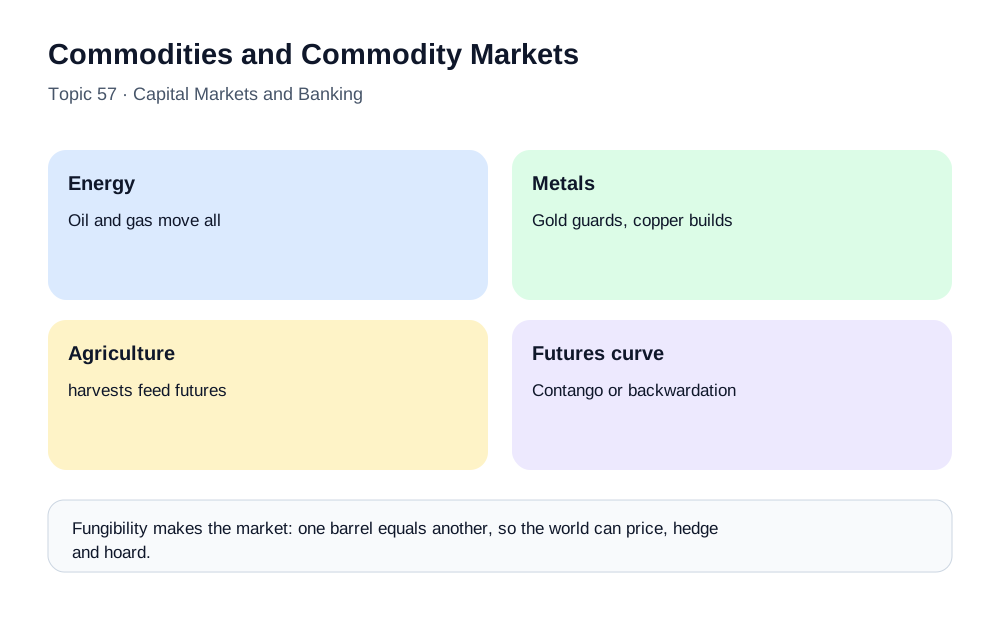
Commodities and Commodity Markets at a glance — Gold, oil, agricultural commodities, futures.
Trading the Raw Materials That Power the World
Before there were stocks and bonds, before banks and currencies as we know them today, there were commodities. The trading of physical goods represents the oldest form of commerce in human civilization. Yet commodity markets today are sophisticated financial ecosystems where producers and consumers manage price risk, speculators seek profit, and banks earn substantial fees facilitating trade.
This chapter explains how commodity markets work — what makes a good a commodity, how spot and futures markets interact, why gold and oil each deserve their own analysis, and how banks plug into the physical economy's pricing machinery. By the end you will be able to:
- Define fungibility and explain why it makes exchange trading possible.
- Map the major commodity categories and their benchmarks.
- Distinguish spot, forward, futures, and options markets for commodities.
- Explain contango and backwardation and what the futures curve reveals.
- Describe the unique economics of gold and oil.
- Identify market participants and the roles banks play.
- Understand the distinctive risks of commodity markets, from delivery squeezes to negative prices.
1. First Principles: Fungibility Makes the Market
Commodities are standardized, fungible goods where one unit is perfectly interchangeable with another. This fungibility distinguishes commodities from manufactured products. A barrel of West Texas Intermediate crude oil is identical regardless of which producer extracted it. This standardization makes commodities tradeable on exchanges — because if every barrel were unique, every trade would require inspection, negotiation, and trust between specific parties, and there could be no continuous market, no reference price, and no way to hedge.
Fungibility is manufactured, not natural. It requires grades and standards: contracts define precisely what "WTI crude" or "No. 2 yellow corn" means — sulfur content, delivery location, moisture limits — so that a trader in one country can buy from a stranger in another with confidence about what will arrive. It requires warehouses and delivery points where the physical good can be standardized, stored, and verified. And it requires settlement rules that let most participants trade the price without ever touching the product. The entire financial superstructure of commodity markets rests on this unglamorous physical foundation — a fact the market relearns whenever the physical layer breaks, as Section 12's case study shows.
The other first principle is that commodity prices are set by physical supply and demand in a way financial asset prices are not. A share's price reflects expectations about a company's future; a wheat price reflects this year's harvest, the weather in growing regions, shipping costs, and what millers will pay this season. Financial flows can amplify and distort, but physical reality always has the last word — which is why commodity market analysis starts with harvests, inventories, and freight rates, not with earnings calls.
2. The Commodity Universe
The commodity universe spans several major categories. Energy commodities include crude oil in various benchmarks such as West Texas Intermediate and Brent, natural gas, and coal. The energy complex dominates commodity trading by value. Precious metals encompass gold, silver, and platinum. Gold's role as a store of value spans millennia. Base metals include copper, aluminum, zinc, and nickel — industrial inputs whose prices are so sensitive to global manufacturing cycles that copper earned the nickname "Dr. Copper" for its diagnostic value about the economy's health. Agricultural commodities range from wheat and corn to cotton and coffee — the "softs" — where weather, seasons, and perishability add risks metals never face.
Each category has its own market physics. Energy trades in enormous volumes around strategic and geopolitical fault lines. Precious metals trade partly as monetary assets, their demand driven by investment rather than consumption. Base metals trade as leveraged plays on industrial growth, with exchange-monitored warehouse stocks as the key supply signal. Agricultural markets trade on planting reports, weather forecasts, and harvest cycles, with storage limits making some crops effectively untradeable across seasons. A commodity professional does not learn "commodities"; they learn a complex, and the complexes behave as differently as industries do.
3. How Commodity Markets Work: Spot, Forwards, Futures, Options
Commodity markets operate through multiple mechanisms. Spot markets involve the actual exchange of physical commodities for immediate delivery — the refiner buying crude for next month's processing, the jeweler buying gold for this quarter's production. Futures markets trade contracts for future delivery, allowing participants to lock in prices months or years ahead. Options markets provide rights but not obligations — price insurance for those who want protection without commitment. Over-the-counter forward markets facilitate customized contracts where standardized exchange terms do not fit.
The layered structure serves different needs. The spot market prices the physical present. The futures market prices expectations and provides hedging — a standardized, exchange-traded, margined contract that can be bought and sold without any intention of delivery. Forward contracts do the same job privately, with customization and counterparty risk the exchange structure removes. Options cap downside while preserving upside, at the cost of a premium. The derivatives chapter covers the pricing mechanics of futures, forwards, options, and swaps in full; this chapter's concern is what those instruments do specifically in commodity markets, where an underlying can be harvested, stored, shipped, and consumed.
One structural fact surprises newcomers: the vast majority of futures contracts never result in delivery. Hedgers and speculators close or roll positions before expiry; only a small fraction goes to physical settlement. The futures market is thus primarily a price-discovery and risk-transfer machine floating on top of a physical market — but the possibility of delivery is what keeps the two prices honest.
4. The Futures Curve: Contango, Backwardation, and What They Reveal
Because futures trade for many delivery months simultaneously, commodities have not one price but a curve — prices across time — and the curve's shape is information. When later-dated futures trade above spot, the market is in contango: the curve slopes up, typically reflecting the cost of storing and financing the commodity until delivery — storage tanks, insurance, and tied-up capital are not free, and contango is the market paying for them. When later futures trade below spot, the market is in backwardation: the curve slopes down, signaling scarcity — buyers are paying a premium to have the commodity now rather than later, as happens when inventories run tight or supply is disrupted.
The curve matters beyond diagnosis. It determines the economics of rolling futures positions: an investor holding a long futures position in a contango market repeatedly sells expiring contracts cheap and buys the next month dear, paying a "roll cost" that can quietly consume returns even when spot prices are flat — the hidden reason commodity index products often underperform the headline commodity price. For hedgers, the curve sets the price of certainty: a producer locking in next year's output sells at the curve's forward level, not at today's spot. And for the physical trade, deep contango makes storage itself a strategy — buy spot, store, sell forward, and earn the spread, a trade that fills tank farms whenever the curve steepens.
5. The Major Exchanges
Major commodity exchanges have evolved into global powerhouses. The CME Group dominates energy and metals trading — its WTI crude contract is the North American benchmark and among the most liquid futures on earth. The Intercontinental Exchange handles Brent crude, the reference for most of the world's internationally traded oil. The London Metal Exchange maintains its open-outcry system for base metals — the famous "Ring" — alongside electronic trading, a century-and-a-half-old institution whose warehouse network and delivery standards define global base metal pricing. In India, the Multi Commodity Exchange provides domestic markets across metals, energy, and agricultural contracts.
The exchange's role in commodities runs deeper than in financial markets because delivery is real: the exchange accredits warehouses, defines acceptable grades, supervises the delivery process, and stands behind contract performance through its clearing house. When those physical linkages strain — as in the London Metal Exchange's 2022 nickel crisis, when a violent short squeeze forced the exchange to suspend trading and cancel trades — the whole commodity world watches, because the exchange's credibility is the market's reference price.
6. Gold: The Monetary Commodity
Gold occupies a unique position in commodity markets. Central banks hold approximately thirty-six thousand tonnes as reserve assets — a collective position built over centuries and enlarged in recent years as several central banks diversified reserves. During crises, investors flock to gold as a safe haven. Gold serves as an inflation hedge in the long view, though its short-run behavior can defy the label for years at a stretch. For banks, gold generates revenue through gold loans, ETFs, and sovereign gold bonds — products that let customers hold, pledge, or earn from gold without vaults of their own.
The factors driving gold prices include dollar strength, real interest rates, geopolitical risk, and central bank buying. Gold typically exhibits an inverse relationship with the United States dollar, and an even more telling inverse relationship with real interest rates — since gold pays no yield, its opportunity cost falls when inflation-adjusted rates fall, and rises when they rise. This single relationship explains more of gold's modern price behavior than any jewelry or industrial demand: gold competes with yield.
Official-sector behavior has reinforced this identity in recent years: central banks collectively have been net buyers of gold for an extended stretch, diversifying reserves amid geopolitical fragmentation — a demand source insensitive to price in the way jewelry buyers are not. Gold's dual identity is the analytical key. It is a commodity — mined, refined, fabricated — whose production costs form a soft floor under long-run prices. And it is a monetary asset — no one's liability, no default risk, a five-thousand-year track record as final settlement — whose investment demand swamps industrial use. Treating gold as merely a metal misses why central banks hold it; treating it as merely money misses why miners and refiners set its supply terms.
7. Oil: The Strategic Commodity
Oil stands as the world's most important commodity. West Texas Intermediate serves as the North American benchmark. Brent crude serves as the global reference, pricing most waterborne international trade. Oil prices affect corporate profitability, sovereign revenues, and inflation across economies — an oil importer's trade balance, an airline's margins, and a central bank's inflation forecast all move with the same barrel.
Oil's market structure adds layers other commodities lack. Supply responds to geology slowly and to politics quickly: a cartel of major producers coordinates output targets, spare capacity concentrates in a few states, and sanctions can reroute global flows in months. Demand tracks economic growth with stubborn regularity, making oil a macro indicator as much as a commodity. And storage is finite and costly — land tanks and tankers fill, and when they do, the spot price can detach violently from any notion of fundamental value, as 2020 proved. Refining adds a second market entirely: crude is priced against products — gasoline, diesel, jet fuel — through the "crack spread" that refiners live on, a whole derivatives ecosystem of its own.
For banks and markets, oil is systemic: it anchors inflation expectations, drives petrocurrency flows into global bonds, and creates concentrated credit exposure to producers and sovereigns whose solvency rises and falls with the barrel.
8. The Participants: Hedgers, Speculators, Arbitrageurs
Commodity futures allow producers and consumers to manage price risk. A farmer can sell futures at planting to lock in a harvest price; an airline can buy futures to cap its fuel cost. Hedgers use futures to reduce uncertainty — accepting a fixed outcome in place of an uncertain one, and paying for that certainty by giving up favorable moves. Speculators provide liquidity — they accept the price risk hedgers shed, in exchange for expected profit. Arbitrageurs exploit price discrepancies between markets — cash versus futures, one exchange versus another, one grade versus its benchmark — and in doing so stitch prices together across the system.
The ecosystem needs all three. Without hedgers there is no risk to transfer and no economic purpose; without speculators, hedgers would find thin, expensive markets and wide spreads; without arbitrageurs, prices in related markets would drift apart and the benchmark would lose meaning. A worked example shows hedging's real arithmetic. A wheat farmer planting in spring expects a hundred tonnes at harvest; the harvest futures price is two hundred fifty per tonne, and she sells futures covering her crop. At harvest, prices have fallen to two hundred ten: her physical wheat sells for twenty-one thousand, but her futures position buys back with a forty-per-tonne gain — four thousand — restoring an effective price of two hundred fifty. Had prices risen to two hundred ninety, the futures loss would have offset the gain, and she would still net two hundred fifty. The hedge did not make her money; it removed the question. The mirror image is the airline buying fuel futures: capped costs in a spike, foregone savings in a slump, and a finance department that can finally budget. Both sides of the same contract are certainty purchased with optionality.
Beyond hedging, investors reach commodities through several vehicles, each with its own physics. Physically backed products hold the metal itself — dominant for gold — tracking spot minus fees and storage. Futures-based funds and indices hold rolling futures positions, inheriting the roll costs and yields of Section 4; their long-run returns can diverge dramatically from spot prices, a surprise that has educated many buyers of oil products. Producer equities — miners, drillers, agribusinesses — offer leveraged commodity exposure wrapped in company risk: the stock of a gold miner amplifies gold's moves, in both directions, plus management's own contribution to outcomes. Structured notes from banks package commodity exposure with caps and buffers for defined-payoff buyers. Choosing among them is choosing which risk you actually want: the price, the curve, the company, or a formula.
Regulators watch the mix: when speculative positioning overwhelms hedging volume, prices can detach from physical reality, and position limits and reporting rules exist to keep the risk-transfer machine anchored to the trade it serves.
9. Banks in Commodity Markets
Banks engage with commodity markets through diverse activities. Commodity finance provides funding for physical trade — the letters of credit, borrowing bases, and pre-export financings that move cargoes from producer to consumer, covered in depth in the trade finance chapter. Structured products allow investors commodity exposure without futures accounts. Commodity swaps enable price certainty for corporate clients — an airline fixing fuel costs through a swap with its bank rather than through exchange positions. Supply chain finance provides working capital along the production chain. Gold loans allow borrowing against gold collateral — a product with deep roots in markets like India, where household gold doubles as the family's emergency credit line.
The bank's commodity business is where finance most literally touches the physical economy. A borrowing-base facility is secured by actual crude in actual tanks, revalued against price moves with margin calls like any leveraged position; a commodity swap book must be hedged in futures markets, connecting the bank's trading desk to the exchanges; and commodity trade finance lives or dies on documents — bills of lading, warehouse receipts, inspection certificates — whose fraud is the sector's perennial scandal. The collapses of several commodity trading firms in recent years, built on fabricated or double-pledged warehouse receipts, taught banks that in commodity finance the collateral verification is the credit decision.
10. Risks: Volatility, Delivery, and the Physical Tail
Commodity markets carry risks financial markets rarely meet. Volatility is structural: supply and demand both adjust slowly, so shocks move prices violently — agricultural prices on weather, energy on geopolitics, metals on industrial cycles. Delivery risk is unique to physical underlyings: a short position held to expiry obligates delivery of the real thing, and traders who forget this have received unpleasant educations. Squeeze risk haunts concentrated markets: when deliverable supply is cornered, shorts must buy back at any price — the 2022 nickel episode saw prices more than double in days before the exchange halted trading. Basis risk undermines imperfect hedges: the airline hedging jet fuel with crude futures owns the spread between the two. And storage constraints can produce outcomes that sound impossible, as the case study shows.
Risk management in commodity markets therefore starts with respect for the physical tail: position limits, delivery awareness, verified collateral, and stress scenarios that include the market's structure itself breaking, not just prices moving.
11. Case Study: April 2020 — When Oil Went Negative
On April 20, 2020, the May WTI crude futures contract settled at roughly negative thirty-seven dollars a barrel: sellers were paying buyers to take oil. The mechanics were a perfect storm of the physical principles this chapter has covered. Pandemic lockdowns collapsed demand by a fifth or more almost instantly; supply, with wells already drilled, could not shut down as fast; and the surplus flowed to storage — including Cushing, Oklahoma, the delivery point for the WTI contract — until storage approached capacity. As the May contract neared expiry, holders of long positions faced the prospect of taking physical delivery of barrels they had nowhere to put. In a fungible, deliverable market, a financial position had become a physical obligation, and the obligation's price went negative.
The episode taught three lessons at once. First, delivery is not a technicality: the possibility of physical settlement disciplines futures prices, and when the physical layer clogs, the financial layer reflects it brutally. Second, storage is a price too: the cost of keeping a commodity can exceed the commodity's value in extreme gluts. Third, instruments built on futures — including retail-facing oil products — inherit roll and expiry risks their holders may never have imagined. Banks, exchanges, and regulators all revised procedures afterward; the negative print remains the defining modern proof that commodity markets are physical markets first.
Two years later, the London Metal Exchange's nickel market supplied the complementary lesson. A large industrial producer held a massive short position — a hedge against its production — when the invasion of Ukraine upended supply expectations and nickel prices spiked. The short's margin calls became unpayable, prices more than doubled in days toward levels detached from any industrial logic, and the exchange took the extraordinary step of suspending trading and canceling a session's trades to prevent a cascade of member defaults at its clearing house. The intervention saved the market's plumbing and scarred its credibility: lawsuits, regulatory reviews, and a lasting debate about whether an exchange should ever rewrite executed prices. Between oil 2020 and nickel 2022 sits the full syllabus of commodity market structure risk — physical clog on one side, financial squeeze on the other, and the clearing house's margin calls as the transmission belt in both.
12. Common Misconceptions About Commodity Markets
"Commodities are an inflation hedge, always." Over long horizons, broad commodity exposure correlates with inflation — they are its ingredients. Over months and years, individual commodities can fall through any inflationary period on supply gluts. The hedge is real but lumpy, and gold's version of it has failed for decade-long stretches.
"Futures prices predict future spot prices." A futures price is today's price for future delivery, shaped by storage costs, scarcity, and hedging pressure — not a forecast. Contango and backwardation tell you about the present balance of the market, not about where prices are going.
"Buying a commodity ETF is like buying the commodity." Futures-based products pay roll costs in contango and earn roll yield in backwardation; their returns can diverge from spot for years. Only physically backed products track the metal itself, minus fees.
"Gold is money, so its price must rise with money printing." Gold responds to real interest rates and confidence more than to any single money-supply measure; decades of expanding money supply have included long periods of falling gold prices. The relationship is conditional, not mechanical.
"Commodity investing means owning barrels and bars." Almost no investor stores anything; exposure comes through futures, funds, equities, or notes. The physical layer belongs to producers, traders, and refiners — everyone else rents the price.
"Hedging is betting against your own business." Hedging is refusing to bet: the producer who sells futures gives up windfall gains to avoid ruin losses, converting an unknown revenue into a budgetable one. The unhedged producer is the one speculating — on prices, with the entire business as stake.
"Speculators cause high commodity prices." Speculators provide the liquidity hedgers need; sustained price levels come from physical supply and demand. Speculative flows amplify moves at the margin — and equally on the way down.
"Negative oil prices meant oil was worthless." They meant a specific contract, at a specific delivery point, with full storage, days before expiry, forced financial holders to pay to escape physical delivery. The physical commodity retained value everywhere storage existed.
13. Frequently Asked Questions
What makes something a commodity? Fungibility: one unit is interchangeable with another of the same grade. Standardized quality, deliverability, and storability turn a raw material into a tradeable commodity; uniqueness is what makes everything else a product.
What is the difference between spot and futures prices? Spot is today's price for immediate delivery; futures are prices agreed today for later delivery. The gap between them — the curve — reflects storage costs, scarcity, and hedging pressure, and the two converge as the delivery date arrives.
What are contango and backwardation? Contango: futures above spot, the normal shape reflecting storage and financing costs. Backwardation: futures below spot, signaling current scarcity. The shape determines roll costs for anyone holding futures-based exposure.
Why do central banks hold gold? As a reserve asset that is no one's liability: it cannot default, cannot be printed by another country, and diversifies reserves away from any single currency. Roughly thirty-six thousand tonnes sit in official vaults for those reasons.
What actually happened when oil went negative in 2020? Demand collapsed, storage filled, and holders of expiring futures — facing physical delivery with nowhere to store barrels — paid buyers to take the contracts. It was a storage-and-delivery event as much as a price event.
How do airlines and manufacturers hedge commodity costs? Through futures, options, or bank-provided swaps that fix or cap input prices, trading certainty for foregone upside. The hedge's quality depends on the basis between the hedged instrument and the actual input bought.
Can individuals invest in commodities? Indirectly and conveniently: physically backed metal products, commodity funds, and producer equities. Direct futures trading is open to individuals but carries leverage, margin calls, roll costs, and delivery mechanics that make it a professional's arena.
What is a gold loan? A secured loan against pledged gold, common in markets like India: the borrower gets liquidity at rates below unsecured credit, the lender gets liquid collateral, and the gold returns on repayment. Banks and specialized lenders run large gold-loan books for exactly these economics.
What is the roll cost everyone warns about? In a contango market, an expiring futures contract is cheaper than the next month's, so maintaining exposure means repeatedly selling low and buying higher — a slow leak that can outweigh years of flat-to-modestly-rising spot prices. Backwardation reverses the leak into a trickle of income.
Why are agricultural commodities riskier than metals to trade? Weather replaces geology as the supply driver, crops are perishable or seasonal so storage cannot always bridge gluts and shortages, and a single forecast revision can reprice the whole curve overnight. Metals wait in warehouses; harvests happen once.
What does a bank's commodity desk actually hedge with? Exchange futures and options wherever liquidity allows, and interbank or OTC offsetting trades where it does not. A swap written for an airline becomes a managed futures position on the bank's own book — the bank manufactures certainty for clients and then manages the residue itself.
Is silver just cheap gold? No — silver is a hybrid: part precious metal, part industrial input with meaningful demand from electronics and solar manufacturing. That industrial load makes it more volatile than gold in both directions, and its market is far smaller, so moves amplify.
What is open interest? The number of outstanding futures contracts not yet closed or delivered — the market's measure of depth and commitment. Rising prices on rising open interest suggest new money entering; rising prices on falling open interest suggest shorts covering, a weaker signal.
Why do commodity prices matter to people who never trade them? Because they are the economy's input costs: oil feeds transport and inflation, metals feed construction and manufacturing, grains feed food prices. Every consumer meets commodity markets at the petrol pump and the grocery shelf, whether or not they ever see a futures quote.
14. Key Terms in This Chapter
- Commodity — a standardized, fungible raw good tradeable by grade.
- Fungibility — perfect interchangeability of units; the precondition for exchange trading.
- Spot market — immediate physical exchange.
- Futures / forward — standardized exchange-traded versus customized private contracts for future delivery.
- Contango / backwardation — futures above spot (storage cost) versus futures below spot (scarcity).
- Roll cost — the recurring loss (or gain) from moving futures exposure to later months.
- Benchmark — the reference grade pricing a market: WTI, Brent, LME copper.
- Basis — the difference between a hedged instrument's price and the actual exposure's price.
- Delivery point / warehouse — the physical location and storage underpinning a futures contract.
- Short squeeze — forced buy-backs when deliverable supply is cornered.
- Real interest rates — inflation-adjusted rates; gold's key macro driver.
- Crack spread — the refining margin between crude and petroleum products.
- Hedger / speculator / arbitrageur — risk-shedders, risk-takers, and price-stitchers.
- Borrowing base — commodity-secured lending revalued against collateral prices.
- Gold loan — secured lending against pledged gold.
- Position limits — regulatory caps keeping speculative concentration in check.
- Warehouse receipt — the document evidencing stored commodity collateral; its verification is the credit decision.
- Cash-and-carry — buying spot, storing, and selling forward to earn the contango spread.
- Producer equity — commodity exposure via the shares of miners and drillers, with company-specific leverage and risk.
- Open interest — the count of outstanding futures contracts; a depth and commitment gauge.
- Petrocurrency flows — the recycling of oil exporters' revenues into global financial markets.
- Margin call (commodities) — the daily demand to top up futures collateral when prices move against a position.
- Safe haven — an asset bought in stress; gold's historic role, real but unreliable in the short run.
15. Interview Insights: How This Topic Appears in Banking Interviews
"Why did oil prices go negative in April 2020?" Demand collapse, slow supply response, and full storage at the delivery point turned expiring futures into unwanted physical obligations; financial holders paid to escape delivery. The answer that mentions fungibility, delivery mechanics, and storage economics shows you understand commodities as physical markets with financial wrappers, not as tickers.
"Explain contango and backwardation, and why they matter." Curve shape reflecting storage costs versus scarcity; it determines roll costs for futures-based investors, sets the hedger's locked price, and creates the cash-and-carry storage trade in steep contango. Curve literacy is the commodity desk's first test.
"Is gold a commodity or money?" Both: produced and consumed like a commodity, held like a monetary asset — no one's liability, driven by real rates and confidence rather than industrial use. The dual identity explains central bank holdings, crisis demand, and why supply-side analysis alone never explains the price.
"How do banks serve commodity clients?" Trade and commodity finance against physical collateral, commodity swaps and structured products for price certainty, gold loans, and supply chain finance — with collateral verification as the core control, since fabricated warehouse receipts are the sector's historic fraud.
"What risks are unique to commodity markets?" Delivery and squeeze risk, basis risk, storage constraints, and structural volatility from slow-adjusting physical supply and demand. Contrasting these with financial-asset risks — where nothing is ever delivered to your door — is the differentiating insight.
"When would you advise a corporate treasurer to hedge commodity exposure, and when not?" Hedge when input volatility can break the business plan — fuel for an airline, metals for a manufacturer — and when certainty is worth more than the foregone upside; leave exposure when volumes are small, margins can pass costs through, or the hedge's basis and roll costs exceed the risk it removes. The answer's spine: hedging is buying budget certainty, and like every insurance, it is priced.
Summary and Key Takeaways
- Commodity markets are the oldest markets, built on fungibility — standardized grades that make strangers' goods interchangeable and exchange trading possible.
- The universe spans energy (the value leader), precious metals (part monetary), base metals (industrial cycle barometers), and agriculturals (weather and seasons).
- Spot prices the physical present; futures, forwards, and options price the future and transfer risk; most contracts never deliver, but the possibility of delivery keeps prices honest.
- The futures curve is diagnostic: contango prices storage, backwardation signals scarcity, and roll costs quietly shape every futures-based product's returns.
- Gold is a monetary commodity driven by real rates and confidence; oil is a strategic commodity whose price moves inflation, trade balances, and sovereign solvency.
- Hedgers, speculators, and arbitrageurs form a necessary ecosystem — risk transfer, liquidity, and price stitching.
- Banks touch commodities through trade finance, swaps, structured products, and gold loans — businesses where collateral verification is the credit decision.
- April 2020's negative oil prices proved the chapter's core truth: commodity markets are physical markets first, and the physical tail — storage, delivery, squeezes — can seize the financial price.
Next: Topic 58 — Hedge Funds and Alternative Investments: Portfolio Engineering and Prime Brokerage →
<!-- MBA-DEEP-DIVE-START -->Deep Dive: Commodity Banking From Physical Flow to Hedge, Credit, Collateral, and Settlement
Commodity markets become truly understandable when the financial contract is tied back to the physical chain. A copper future may trade electronically in milliseconds, but somewhere beneath the contract sit mines, smelters, warehouses, shipping routes, grades, storage costs, financing, and industrial demand. A crude-oil hedge may appear as a derivative position, but the company behind it has production schedules, tank capacity, pipeline access, freight exposure, and customers who pay on specific terms.
For banks, this physical connection changes the risk model. Commodity banking combines ordinary credit risk with price volatility, inventory verification, title, storage, fraud, logistics, country risk, FX, derivatives, margin, and settlement. The bank cannot simply ask whether the borrower is financially strong. It must understand what is being financed, where the commodity is, who owns it, how its value moves, and how the exposure is supposed to turn back into cash.
Commodity finance follows the self-liquidating trade cycle
A classic commodity-finance transaction is designed around a commercial cycle. A trader buys a cargo, transports or stores it, sells it to an end buyer, and uses the sale proceeds to repay the bank. The financing is attractive when repayment is linked directly to a short, observable flow of goods rather than to the borrower's general balance sheet alone.
Suppose a bank finances a shipment of refined metal costing USD 50 million. The trader has a confirmed buyer expected to pay USD 55 million after delivery. The bank may finance part of the purchase price, take security over the goods or receivable where legally effective, control payment accounts, and require insurance and inspection evidence.
The strongest structure creates a clear path:
bank funds purchase → goods exist and are controlled → goods move → buyer accepts → receivable is created → sale proceeds enter controlled account → bank is repaid.
Every break in that chain creates a different risk.
Borrowing-base finance turns inventory value into a dynamic credit limit
Commodity lenders often use borrowing bases instead of fixed limits. Eligible inventory and receivables are valued, haircuts are applied, and the amount the borrower can draw changes as the collateral changes.
Imagine a trader holds copper inventory with a market value of USD 100 million. The bank applies a 20% haircut, giving USD 80 million of borrowing value. If copper prices fall 15%, the inventory is worth only USD 85 million. Applying the same haircut gives USD 68 million of borrowing value. If the customer has already drawn USD 75 million, a borrowing-base shortfall exists and must be cured through repayment, additional collateral, or another agreed action.
This is commodity credit in its purest form: market risk becomes credit risk through collateral value. The bank therefore needs reliable price feeds, eligible-grade rules, inventory quantities, location, title, and frequent revaluation.
Collateral existence is as important as collateral value
A commodity can have an excellent market price and still provide no protection if it does not exist or if the bank has no enforceable right over it.
Commodity-finance fraud has repeatedly involved fake warehouse receipts, duplicate financing of the same inventory, manipulated inspection certificates, false bills of lading, or goods that were lower quality than represented. The bank's risk framework must therefore separate three questions:
- Existence: are the goods physically present?
- Ownership and control: does the borrower own them, and does the bank have enforceable security or control?
- Value: what could the goods realistically be sold for under stress?
A spreadsheet proving the third point cannot substitute for evidence of the first two.
Warehouse control requires independent governance
Where stored commodities support lending, warehouses and collateral managers can become critical third parties. The bank may require approved facilities, periodic inspections, controlled release procedures, insurance, inventory reporting, and restrictions on movement without lender consent.
Third-party dependency creates its own risk. A warehouse operator can fail financially, collude with the borrower, issue duplicate receipts, or suffer theft, fire, flood, or cyber disruption. Banks therefore perform due diligence not only on borrowers but on the infrastructure holding the collateral.
Release procedures should be explicit. If the borrower wants to remove part of the inventory for sale, the bank should know how much collateral remains after release and where the sale proceeds will go. Manual release instructions without independent checking can defeat the entire secured structure.
Mark-to-market discipline is essential in volatile goods
Commodity collateral can move several percentage points in a day. Credit files valued once per quarter are therefore useless for some products.
Banks commonly define margining frequency, trigger levels, independent price sources, concentration add-ons, and stressed haircuts. A volatile or illiquid commodity receives a larger haircut than a deep, transparent benchmark commodity. A commodity stored in a difficult jurisdiction may receive additional discount because legal enforcement and liquidation are uncertain.
The haircut should represent more than normal daily volatility. It may need to cover the time required to seize, transport, and sell the goods under stressed conditions, including basis differences between the benchmark price and the specific grade or location actually held.
Basis risk is everywhere in commodity hedging
A hedge rarely matches the underlying exposure perfectly. An airline may consume jet fuel but hedge with gasoil or crude contracts because those markets are more liquid. A farmer's local wheat price may not move exactly with the exchange-deliverable grade. A producer selling one crude grade may hedge using Brent.
The difference between the exposure and the hedging instrument is basis risk.
Suppose jet fuel costs rise 25% while the crude future used as a hedge rises only 15%. The hedge made money, but not enough to offset the actual fuel increase. The company was protected from broad oil-market movement but remained exposed to the refining spread between crude and jet fuel.
Good hedge effectiveness therefore compares the economics of the underlying exposure with the hedge rather than simply asking whether the derivative gained money.
Hedge volume must follow expected physical volume
A producer that sells futures for output it expects to produce can accidentally become a speculator if production falls.
Imagine a mining company hedges 100,000 tonnes of expected production. A major operational failure reduces actual production to 60,000 tonnes. The company now has short futures covering 40,000 tonnes for which no physical metal will be sold. If prices rise sharply, the financial loss on the over-hedged position is no longer offset by higher physical sale revenue.
Hedge governance should therefore link derivative notional to forecast confidence, inventory, production, and sales contracts. Exposure forecasts need regular refresh, and excess hedges require controlled close-out or redesign.
Margin turns hedging into a liquidity problem
Exchange-traded futures reduce bilateral counterparty risk through margining, but margin creates immediate cash requirements.
A producer may hedge future output by selling futures. If commodity prices rise, the physical product becomes more valuable, but the short futures position loses money and generates variation-margin calls today. The physical product may not be sold for months.
Economically, the hedge can be working perfectly while the company faces severe liquidity pressure.
Banks providing working-capital lines to commodity hedgers therefore need to understand derivative margin as part of the financing requirement. Treasury cash forecasts should combine physical purchase and sale flows with exchange margin, OTC collateral, freight, storage, and FX.
OTC swaps shift the counterparty model
Many corporate customers use bilateral commodity swaps with banks rather than exchange futures. The bank may agree to pay the customer when a commodity price rises and receive when it falls, or vice versa, according to the hedge objective.
The customer avoids managing futures positions directly, but the bank now carries counterparty exposure and must hedge its own market risk. Master agreements, netting, collateral, credit limits, valuation, and potential future exposure become important.
The bank's commodity desk may offset the swap using futures or another dealer. That means a customer trade can create a chain of market, margin, credit, and settlement obligations across multiple venues even though the customer sees one simple monthly swap settlement.
Commodity derivatives need independent valuation controls
Straightforward futures have transparent market prices. Longer-dated swaps, options, location spreads, quality spreads, and structured commodity products can be less observable.
Trading desks may build models using forward curves, volatility surfaces, correlations, storage assumptions, and other inputs. Independent product-control or valuation functions should verify the official marks used for P&L, collateral, financial statements, and counterparty exposure.
Model risk becomes particularly important for optional structures. A producer may buy a floor, sell a call, or enter a collar whose value changes nonlinearly with price and volatility. Two products with the same notional can create very different tail risk.
Physical optionality has financial value
Commodity businesses often possess real-world options that matter just like financial derivatives. A storage operator can choose when to sell inventory. A power generator can decide whether to run a plant depending on fuel and electricity prices. A refinery can change product mix within operational limits. A miner may slow high-cost production when prices fall.
These flexibilities have economic value and affect hedging. A company that hedges as if production were fixed may remove the benefit of being able to respond to market conditions.
Banks analysing commodity clients should therefore understand operating optionality, not just contractual debt service.
Storage economics connect spot and futures prices
The relationship between spot and forward prices reflects financing cost, storage, insurance, convenience yield, and market scarcity.
In a normal contango structure, a trader may buy physical inventory, finance it, store it, and sell a future for later delivery. The trade is attractive only if the forward premium exceeds financing, storage, insurance, handling, and other costs.
Deep backwardation sends the opposite signal: immediate possession is valuable. A holder may prefer to sell inventory now rather than store it because the market is paying a scarcity premium for prompt delivery.
Banks financing inventory need to understand this curve because it influences both borrower behaviour and collateral liquidity. A structure that looked safe in contango can change when the curve flips and inventory is rapidly released to the market.
Commodity price risk can become sovereign and bank credit risk
Commodity prices do not stay inside trading desks. For commodity-exporting countries, they can determine government revenue, foreign-exchange reserves, fiscal balance, and the health of domestic banks. For commodity importers, high prices can worsen inflation, current-account deficits, and corporate margins.
A bank with heavy lending to oil producers may appear diversified across many companies while remaining concentrated in one macro factor: the oil price. The same applies to agricultural regions, mining economies, and energy-intensive industries.
Credit concentration should therefore be analysed by risk driver, not only legal borrower or industry code. Multiple borrowers can default for the same commodity shock.
FX and commodity exposure often arrive together
Many commodities are globally priced in major currencies while producers and consumers operate in local currencies. A borrower can therefore face two simultaneous price risks.
An Indian importer buying USD-priced crude may see the global oil price rise and the rupee weaken at the same time. Even if the company hedges the oil price, an unhedged FX position can still raise the local-currency purchase cost dramatically.
Hedge programmes should therefore map the full economic exposure: commodity benchmark, basis, FX, timing, volume, and financing. Hedging one dimension can create false confidence if another dominates the final cash flow.
Trade finance and sanctions controls are integral to commodity banking
Physical commodities cross borders, ports, vessels, traders, storage companies, and jurisdictions. This creates significant financial-crime and sanctions complexity.
Banks may need to understand counterparties, beneficial ownership, vessel history, ports, goods, origin, destination, pricing, trade documents, and unusual intermediaries. A seemingly ordinary payment can be part of a restricted trade or a trade-based money-laundering scheme.
The control objective is not to turn bankers into shipping inspectors. It is to compare the transaction with the customer's known business, identify material red flags, and escalate where the trade structure, goods, routing, or parties do not make economic sense.
ESG and transition risk change long-dated commodity finance
A commodity can be profitable today while facing long-term regulatory, technology, or demand transition. Coal, oil, gas, metals, agricultural products, and critical minerals each face different environmental and social considerations.
Banks financing long-lived assets should consider whether the borrower's economics remain viable through the financing tenor. A project designed for twenty-five years needs more than today's commodity price. Carbon policy, substitution, technology change, water use, land rights, community impact, and permitting can all affect repayment.
The analytical discipline is the same as any other long-term credit: identify the cash-flow assumptions that must remain true and stress the ones most likely to change.
A complete commodity-finance stress scenario
Consider a trading company with a USD 200 million borrowing-base facility secured by metal inventory and receivables. The bank advances up to 75% of eligible collateral value. The trader also hedges price risk using futures.
A global slowdown causes metal prices to fall 20% in two weeks. The borrowing base shrinks. At the same time, one major buyer delays payment, making some receivables ineligible. The trader must post additional cash margin on a separate derivatives position. Market liquidity weakens and the bank applies a larger collateral haircut under its stress policy.
The exposure that looked comfortably collateralised a month earlier now has several simultaneous pressures: lower inventory value, delayed receivables, higher margin cash needs, and reduced advance rates.
A strong bank sees the combined event. It recalculates the borrowing base daily, controls inventory releases, confirms warehouse positions independently, monitors derivative margin, restricts further drawings, and agrees a cure plan before the shortfall becomes unmanageable. A weak bank looks at each system separately and discovers too late that the same price shock affected all of them.
What excellence looks like
A world-class commodity-banking operation can trace the exposure from physical purchase to inventory, hedge, finance, sale, settlement, and repayment. It verifies collateral existence and title, not just value. Borrowing bases react quickly to price and eligibility changes. Hedge volumes remain connected to real production or consumption. Margin liquidity is forecast. Basis and FX risk are measured separately. Commodity concentration is understood across borrowers. Trade documents, vessels, and counterparties receive appropriate financial-crime review. Long-dated lending considers transition and operating risks.
The deepest lesson is that commodity finance sits at the boundary between balance sheets and the physical world. A bank that understands only the derivative price misses the cargo. A bank that understands only the cargo misses the margin call. Excellence comes from joining both into one controlled view of how real goods become financial exposure and, ultimately, cash repayment.
<!-- MBA-DEEP-DIVE-END -->