Visual overview
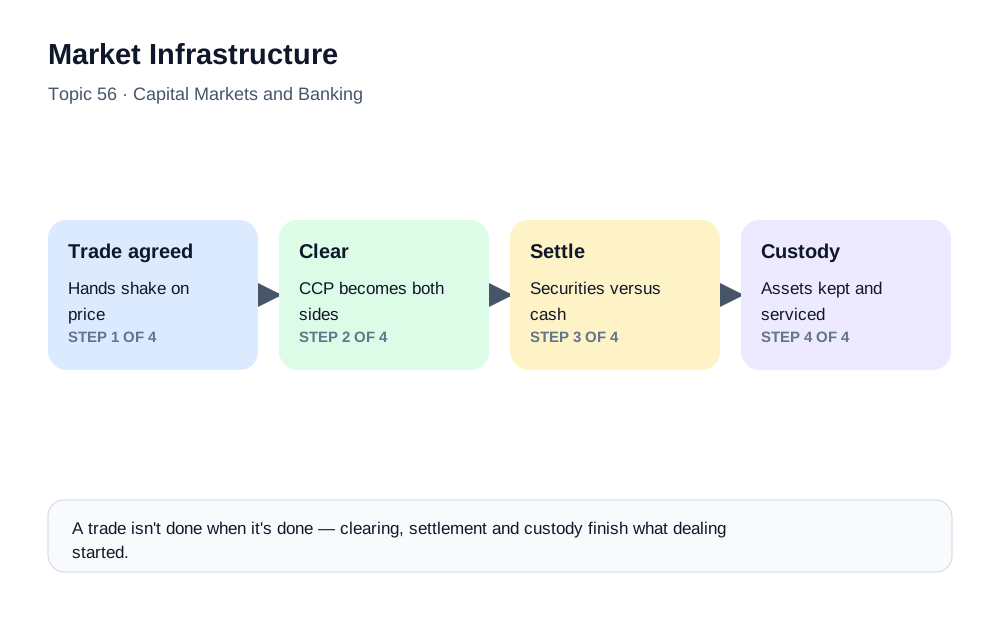
Market Infrastructure at a glance — Exchanges, depositories, clearing, custodians.
The Invisible Plumbing That Makes Trading Possible
Every day, trillions of dollars in securities change hands across global markets. Yet behind every executed trade lies an elaborate infrastructure of institutions and processes that ensures transactions settle correctly. This market infrastructure, while invisible to most participants, represents the essential plumbing of the financial system.
This chapter opens the machine room: what happens after you click "buy," who stands between the buyer and seller, where ownership records actually live, and why the whole arrangement is treated as systemically critical. By the end you will be able to:
- Trace a trade through its full lifecycle — execution, clearing, settlement, custody.
- Explain what exchanges do beyond matching orders.
- Describe how a central counterparty eliminates counterparty risk and what protections back it.
- Distinguish depositories from custodians and explain dematerialization.
- Understand settlement cycles, delivery-versus-payment, and why T+1 matters.
- Assess the systemic risks of the infrastructure itself and the reforms addressing them.
1. First Principles: A Trade Isn't Done When It's Done
When two parties agree a price on an exchange, something important has happened — but the most important things have not. The buyer does not yet own the shares; the seller does not yet have the money. Between the handshake and the reality lies a chain of obligations: someone must confirm what was agreed, someone must guarantee performance if one side fails, someone must actually move the securities and the cash, and someone must keep the ownership records straight forever afterward.
In the early centuries of trading, all of this was bilateral and physical: paper certificates, couriered checks, weeks of delay, and frequent failure — one counterparty's collapse could unravel a chain of trades across the market. Modern market infrastructure exists because markets learned, through repeated crises, that execution without trusted completion is just conversation. The infrastructure's four functions — execution, clearing, settlement, custody — each answer a specific failure of that older world: Was the trade real? Will it be honored? Did value actually move? Whose asset is it now?
2. The Trade Lifecycle
Every financial transaction follows a lifecycle from execution through clearing to settlement and finally custody. This journey begins when a buyer and seller agree on price and quantity. The execution phase establishes the economic terms. Clearing follows, during which a central counterparty validates the trade and calculates net obligations. Settlement then occurs, representing the actual exchange of securities for payment. Finally, custody encompasses ongoing safekeeping and processing of corporate actions.
The lifecycle's design deserves one observation before the detail: each stage is owned by a different institution type, deliberately. Separating execution, clearing, settlement, and custody across entities means no single failure can corrupt the whole chain, and each specialist is supervised against its own risk. Watch one trade make the journey. A pension fund's order to buy a hundred thousand shares matches with a seller at mid-morning — execution, done in microseconds. By evening, the clearing house has validated the trade, interposed itself between the two parties, and netted this trade against thousands of others, so that instead of every trade settling individually, each participant settles only its net position per security. On settlement day — the next business day in the major equity markets — the depository debits the seller's account and credits the buyer's while the payment system moves the cash in the opposite direction, simultaneously. From then on, the buyer's custodian safekeeps the position: collecting dividends, processing splits and rights issues, and reporting holdings for tax and regulation. The whole post-execution sequence, which a century ago consumed weeks of clerks and couriers, now completes in hours and mostly without human hands.
3. Exchanges: More Than Matching Engines
Stock exchanges serve as the primary venues for trade execution. The history stretches back centuries, from the coffee houses of seventeenth-century London to the buttonwood tree of 1792 New York. Beyond merely matching orders, exchanges provide fair price discovery through transparent order books. They enforce listing rules requiring companies to maintain minimum standards — disclosure, governance, and financial thresholds that make the venue's brand a quality signal. They conduct market surveillance to detect manipulation, monitoring order patterns for spoofing, layering, and insider-driven anomalies, and referring findings to regulators.
The exchange business has transformed structurally in one generation. Floor trading gave way to electronic matching engines; member-owned mutuals demutualized into listed companies; and competition fragmented single national exchanges into ecosystems of multiple venues and alternative trading systems, connected by smart order routers that hunt the best available price across all of them. Technology reshaped the economics as well: matching engines colocated beside trading firms' servers, market data became a product line as valuable as trading fees, and speed itself became an industry — high-frequency firms now provide much of the displayed liquidity on major venues, earning spreads by being fastest to rest quotes. Regulators responded with market-wide rules on order-to-trade ratios, kill switches, and minimum resting times in some jurisdictions, attempting to keep speed a service to liquidity rather than a tax on it. The exchange's core public functions, though, survive every structural fashion: a visible price, enforced rules, and a venue where a willing buyer can always find the standing offers.
4. Central Counterparties: The Shock Absorber
Central Counterparties, known as CCPs, address counterparty risk in financial markets. In traditional bilateral trading, each party bears the risk that the other might default. CCPs solve this problem by inserting themselves between buyers and sellers, becoming the buyer to every seller and the seller to every buyer — a legal transformation called novation. After novation, no trader faces any other trader; everyone faces the clearing house, an institution designed from the ground up never to fail.
The CCP manages its own exposure through a layered defense known as the default waterfall. Initial margin — collateral posted by every participant, sized to cover potential losses over the days needed to close out a defaulted portfolio — stands first. Variation margin settles gains and losses daily, preventing large unpaid exposures from accumulating. The default fund — mutualized contributions from all clearing members — absorbs losses exceeding a defaulter's margin. The CCP's own capital sits in the waterfall as well, so the institution's skin is in the game, and the largest structures hold further assessments in reserve. The design principle is "defaulter pays": the failed participant's own resources must burn first, mutualized resources only after, and the system keeps running throughout.
CCPs also net. A dealer with thousands of offsetting trades owes and is owed only net amounts per instrument, compressing the gross traffic of the market into a fraction of itself — less settlement traffic, less liquidity demand, less operational risk. After 2008, regulators worldwide mandated central clearing for standardized derivatives precisely to move those markets' tangled bilateral exposures onto this shock absorber; LCH's interest-rate-swap clearing volumes are the result of that mandate.
5. The Systemically Important Few
Major CCPs have become systemically important institutions. CME Clearing dominates United States futures and options markets. LCH clears the majority of global interest rate swaps — a notional traffic measured in the quadrillions annually, since nearly every cleared swap in the world passes through it. The Depository Trust and Clearing Corporation handles United States equities settlement, processing securities transactions with a daily value in the trillions.
This concentration is deliberate — netting and mutualization work best at scale — but it creates a new category of institution: the financial market utility whose failure is almost unthinkable because everything routes through it. Regulators therefore treat major CCPs and depositories as systemically important financial market infrastructures, supervising them directly, requiring recovery and resolution plans, and stress-testing their waterfalls against the simultaneous default of their largest members. Supervision runs on specifics, not sentiment: major CCPs must demonstrate, through regular stress tests, that their resources survive the simultaneous default of their largest members under extreme-but-plausible market moves; they maintain recovery plans describing how they would allocate losses and continue operating through a crisis short of failure; and resolution regimes give authorities tools to keep critical clearing services running even if the institution itself must be wound down. The post-2008 settlement is clear-eyed: central clearing removed counterparty risk from the many and concentrated it, managed, in the few — which makes the few among the most heavily supervised institutions on earth.
6. Depositories and Dematerialization
Depositories provide the infrastructure for holding securities in electronic form, a transformation known as dematerialization. These institutions maintain ownership records, process transfers during settlement, and handle corporate actions. In India, the National Securities Depository and Central Depository Services handle these functions; other markets operate their own central securities depositories, often linked internationally so that cross-border holdings settle through chains of custodians and depositories.
The benefits of dematerialization extend far beyond convenience. Electronic records eliminate the risk of theft, loss, and forgery. Settlement can occur nearly instantaneously. Corporate actions process automatically. Dematerialization has enabled the compression of settlement cycles that paper made physically impossible. The paper era's failure modes sound quaint until you price them: certificates lost in mail, forged endorsements, trades failing because a certificate sat in the wrong vault, and "bad deliveries" discovered weeks later. The depository replaced all of it with a single authoritative ledger — legally, the depository's record is the ownership, and every broker and custodian account is a window into it.
7. Custodians: The Institutional Vaults
Custodians provide safekeeping services for institutional investors. The largest global custodians manage staggering quantities of assets: BNY Mellon holds approximately forty-six trillion dollars, State Street approximately thirty-seven trillion, JPMorgan approximately thirty trillion. These institutions settle trades, collect dividends, process corporate actions, and provide tax reporting.
The custody business is banking at its most operational and most fiduciary. A global custodian for a pension fund maintains accounts across dozens of markets, settles trades in each local depository, handles currency conversion, collects income with correct tax treatment, executes the fund's choices in voluntary corporate actions, lends securities where mandated, and delivers the consolidated reporting that lets the fund see its world in one statement. Beyond the core, custodians run adjacent businesses that institutions rely on daily: securities lending programs that lend clients' idle positions to short sellers for fee income; fund administration — calculating the NAVs described in the mutual funds chapter; and performance measurement and compliance reporting that trustees and regulators require. The economics are scale economics — fees of a few basis points on enormous balances — which is why the industry consolidated into a handful of giants. And the risk profile is inverted from lending: custody is credit-light but operationally absolute, because the custodian that loses an entitlement or misprocesses a corporate action fails at its one job. Banks' custody arms, noted in the capital markets and funds chapters, are steady fee machines precisely because the world's sixty-trillion-dollar institutional asset base cannot function without them.
8. Settlement Cycles and Delivery-Versus-Payment
Settlement cycles have shortened dramatically over recent decades. India moved to T+1 settlement for equities in 2023. The United States followed in May 2024. This compression reduces the period during which participants are exposed to each other's credit risk — every day of settlement lag is a day in which a completed trade can be unwound by a counterparty's failure, so shrinking the cycle shrinks the system's latent exposure, lowers margin requirements, and frees capital.
The safety heart of settlement is delivery-versus-payment: the securities move if and only if the money moves, atomically, so neither side can end up having delivered without being paid. DvP sounds obvious and was once revolutionary — the 1974 failure of Bankhaus Herstatt, which took counterparty payments in one time zone and collapsed before delivering in another, taught the system that settlement risk is principal risk. Modern settlement systems enforce DvP mechanically, with the cash leg typically moving through central bank money for finality — the ultimate guarantee that the payment side cannot itself default.
The cash leg of settlement runs through payment systems, the market infrastructure's other half. Large-value transfers move on real-time gross settlement systems operated by central banks, where each payment settles individually, immediately, and irrevocably in central bank money — the foundation that makes DvP's promise real. Securities settlement systems link to these payment rails so that the two legs of every trade complete together. In foreign exchange, where two currencies must move simultaneously across jurisdictions, specialized settlement arrangements provide payment-versus-payment — both currency legs settling or neither — closing the Herstatt gap that bilateral FX settlement once left open.
Settlement also has an operations floor that never makes headlines. Trades must first match: buyer's and seller's instructions compared field by field, with mismatches repaired before settlement day. Most trades settle; some fail — the seller lacks the securities, the buyer lacks the cash — and failed trades queue, age, attract penalties in many regimes, and can trigger buy-ins where the market forcibly sources the missing securities at the defaulter's cost. Custodians and clearing houses publish fail statistics precisely because fails are the plumbing's fever reading: a sudden rise signals stress somewhere upstream, as happened in repo and Treasury markets during past squeezes.
The frontier is T+0 and atomic settlement. Several markets run instant retail payment rails, and experiments with distributed-ledger settlement aim to make delivery and payment a single simultaneous event with no lag at all. The obstacles are less technical than financial: netting across a day saves enormous liquidity, and instant gross settlement would demand that every buyer pre-fund every purchase — the market's current compression toward T+1 is, in part, a search for the sweet spot between risk reduction and liquidity efficiency.
9. Case Study: Lehman, 2008 — The Day the Plumbing Proved Itself
When Lehman Brothers collapsed in September 2008, it was not only a bank failure but a live-fire test of market infrastructure at global scale. Lehman sat inside every major pipeline: thousands of open trades, enormous swap books, positions across exchanges and clearing houses worldwide.
The bilateral parts of Lehman's book were chaotic — counterparties scrambled to terminate, value, and litigate exposures, and some disputes ran for years. The centrally cleared parts told the opposite story. LCH, which cleared a vast interest-rate-swap portfolio for Lehman, invoked the default waterfall: it hedged the defaulter's positions, auctioned the portfolio to other clearing members, and absorbed the process entirely within Lehman's own posted margin — without calling meaningfully on the mutualized default fund, and without interruption to other participants. Equity and futures clearing houses managed their Lehman exposures the same way.
The contrast became the strongest practical argument for the post-2008 clearing mandates: where the plumbing was bilateral, failure cascaded into confusion; where a CCP stood in the middle, the largest bankruptcy in history was processed as an operational procedure. Infrastructure rarely gets credit for disasters that do not happen; September 2008 is the counterfactual made visible.
A decade later, a smaller episode tested the waterfall's middle layers. In September 2018, a single Norwegian power trader's outsized positions in Nordic electricity futures moved sharply against him, and he defaulted at Nasdaq Clearing — a clearing house where he was one of many members. His posted margin covered only part of the loss; the mutualized default fund absorbed the remainder, costing the other clearing members a material share of the fund. Nobody outside the market noticed, no trades unwound, and the clearing house operated normally throughout — the waterfall working exactly as designed, this time drawing on the mutualized layer its architecture exists for. The case's lessons are the calibration questions regulators now ask every CCP: are margins aggressive enough for concentrated positions, is the default fund sized for the largest plausible member failure, and does the "defaulter pays" principle hold before others' money burns?
10. Systemic Risks of the Infrastructure Itself
The interdependence of infrastructure components creates systemic vulnerabilities. The failure of a major CCP could cascade through the financial system — which is why waterfalls, recovery plans, and resolution regimes exist. A cyber attack on a major depository could freeze ownership records, which is why operational resilience standards and redundant architectures are now regulatory requirements rather than good practice. Operational disruptions could prevent investors from accessing assets — exchanges and clearing houses have experienced outages that halted national markets for hours, each one a reminder that the real economy's pricing machinery has single points of failure.
International standards — the Principles for Financial Market Infrastructures, adopted globally after the crisis — codify the expectations: legal certainty of settlement finality, robust risk management, DvP where possible, transparent rules, and governance that treats resilience as the product. The direction of travel is unmistakable: infrastructure is regulated as utility, tested as a fortress, and planned for failure with the same seriousness banks plan for runs.
11. Common Misconceptions About Market Infrastructure
"When I buy shares, the exchange sells them to me." The exchange only matches your order with another participant's. The exchange never owns the shares; the clearing house then guarantees completion, and the depository records your ownership.
"My broker holds my shares." Your broker holds an account entry; legal ownership lives in the depository's central ledger. This separation is deliberate — it is why broker failure does not take client assets with it.
"Clearing and settlement are the same thing." Clearing determines who owes what — validation, novation, netting. Settlement is the actual movement of securities and cash. Every settlement follows clearing; not everything cleared settles on the same terms it was traded.
"A CCP eliminates risk." It transforms and concentrates risk: counterparty risk becomes a managed, margined, mutualized exposure to a heavily defended institution. The risk is engineered, not abolished — which is why the waterfall's layers exist.
"Faster settlement is always better." Each step faster cuts counterparty exposure but reduces netting efficiency and demands earlier funding. T+1, not T+0, became the modern standard precisely because the trade-off has an optimum.
"Settlement is when I can sell my shares." You can sell shares the moment you own them on the ledger; settlement lag does not restrict trading. What the cycle governs is the completion of each trade's obligations, not your freedom to trade again.
"Clearing houses only matter for derivatives." Equity, bond, and repo markets clear through CCPs in most major jurisdictions; derivatives clearing got the regulatory headlines after 2008, but the shock absorber sits under the cash markets too.
"Market infrastructure is a technology business now, so the institutions matter less." The technology runs inside regulated legal constructs — novation, finality, mutualized default resources — that no software provides by itself. The plumbing is law plus operations; the code is only the pipes.
"Netting means my trade disappeared." Netting aggregates obligations for settlement efficiency; your trade remains legally real and its economics fully yours. Only the settlement movement is compressed — you still receive exactly what you bought.
"Central bank money and bank money are the same thing in settlement." Settlement in central bank money is final and default-free; settlement across commercial bank books carries the intermediary's credit. Systemic settlement deliberately anchors on the central bank's ledger for exactly that reason.
"Custody is just storage." Custody is an operating business — settlement, income collection, corporate actions, tax, reporting across dozens of markets — where the storage metaphor hides decades of operational machinery.
12. Frequently Asked Questions
What happens after I click "buy" on my trading app? Your order routes to an exchange and matches (execution); the clearing house validates and guarantees it (clearing); the next business day the depository moves the shares to your account while payment moves the other way (settlement); and your broker-custodian records and services the position thereafter (custody).
What is the difference between a depository and a custodian? The depository is the central legal ledger of ownership for a market; a custodian is a service provider that safekeeps and services holdings for institutions, operating across many depositories. Every security sits in a depository; only institutional holdings typically engage custodians.
What is novation? The legal substitution that makes the CCP the buyer to every seller and seller to every buyer. After novation, your original counterparty's default is the clearing house's problem, not yours.
What is the default waterfall? The CCP's layered defenses against a member's failure: the defaulter's initial margin, its default-fund contribution, a slice of the CCP's own capital, then mutualized member contributions — designed so the defaulter's resources burn first and the system never stops.
Why did settlement move from T+3 to T+1? Each day of lag is a day of counterparty exposure and margin. Compression reduces risk and frees collateral; India moved to T+1 in 2023, the US in 2024, and paper-era T+5 is now unthinkable in major markets.
What is delivery-versus-payment? The principle that securities move only if payment moves, atomically. It removes principal risk from settlement — you cannot deliver and not be paid — and usually settles the cash leg in central bank money for finality.
Could a clearing house itself fail? In theory, yes — which is why major CCPs are supervised as systemically important, hold layered resources sized to the simultaneous default of their largest members, and maintain recovery and resolution plans. No major CCP failed in 2008, but the planning assumes the possibility.
What is a corporate action, and who processes it? Any issuer event affecting holders — dividends, splits, rights issues, mergers. Depositories and custodians process them across millions of accounts, converting announcements into entitlements, cash, and adjusted positions.
What is netting, and why does it save the system money? Instead of settling every trade gross, the clearing house offsets each participant's buys and sells per instrument and settles only the difference. Netting routinely compresses the day's settlement traffic to a small fraction of gross trading volume — less cash and securities movement, less liquidity demand, fewer fails.
What happens if my trade fails to settle? It queues: the counterparty lacking securities or cash must cure the shortfall, penalties accrue in many regimes, and persistent fails can trigger a buy-in that sources the securities forcibly at the failing party's cost. For the end investor, custodians and brokers absorb the mechanics; for the market, fail rates are monitored as a stress indicator.
Who regulates market infrastructure? Securities regulators license and supervise exchanges, CCPs, and depositories, while central banks oversee payment and settlement systems; systemically important infrastructures answer to both, under international standards adopted after 2008. The layered oversight reflects the layered risk: conduct, prudence, and systemic stability are different jobs.
What is securities lending, and where does it fit in the plumbing? The temporary transfer of securities from long-term holders to borrowers (usually short sellers or market makers) against collateral, with fees split among lender, custodian, and agent. It supports settlement efficiency — borrowed securities cure fails — and price discovery, while adding its own counterparty and collateral-management machinery.
How does cross-border settlement work if every country has its own depository? Through links: international central securities depositories and global custodians hold accounts in local depositories worldwide, so a foreign investor's purchase settles domestically through the chain while ownership records pass back up it. The chain works smoothly in normal times and is why cross-border corporate actions and tax reclaims take the time they do.
What is the legal status of the depository's record? In dematerialized systems, the depository's register is the definitive record of ownership — statute-backed, not merely administrative. Broker and custodian statements are views of that ledger, which is why rectifying the central record is a serious legal act, not a bookkeeping edit.
Do retail investors ever interact with a CCP directly? Never. Retail clients face their broker; the broker faces the clearing house as a member or through a member. The layered access keeps the CCP's risk community limited to regulated, capitalized institutions.
Why do some markets settle faster than others? Settlement speed reflects the maturity of the full chain — depositories, payment rails, netting arrangements, and law. Markets move to T+1 only when every link can keep pace, which is why the global shift happened market by market rather than all at once.
What is straight-through processing? The ideal state where a trade flows from execution to settlement with no manual re-entry — every system passing data to the next automatically. STP rates are the industry's quiet quality metric: manual touches are where errors, delays, and fails are born.
13. Key Terms in This Chapter
- Market infrastructure — the institutions that execute, clear, settle, and safekeep trades.
- Trade lifecycle — execution → clearing → settlement → custody.
- Clearing — validation, novation, and netting of trades before settlement.
- Settlement — the actual exchange of securities for payment.
- Custody — ongoing safekeeping and servicing of holdings.
- Exchange — the execution venue providing price discovery, listing standards, and surveillance.
- Central counterparty (CCP) — the institution interposed between buyer and seller via novation.
- Novation — legal substitution making the CCP every trade's counterparty.
- Initial / variation margin — collateral against potential future loss; daily settlement of realized loss.
- Default fund / waterfall — mutualized resources and the ordered layers absorbing a member default.
- Netting — offsetting obligations so only net amounts settle.
- Central securities depository (CSD) — the authoritative electronic ownership ledger.
- Dematerialization (demat) — replacement of paper certificates with electronic records.
- Custodian — institutional safekeeper handling settlement, income, corporate actions, reporting.
- T+1 — settlement one business day after trade.
- Delivery-versus-payment (DvP) — atomic exchange of securities against payment.
- Settlement finality — the legal moment a transfer becomes irrevocable.
- Real-time gross settlement (RTGS) — immediate, irrevocable, individual settlement of payments in central bank money.
- Payment-versus-payment (PvP) — simultaneous settlement of both currency legs of an FX trade.
- Failed trade / buy-in — a trade that misses settlement; the forced sourcing of missing securities at the defaulter's cost.
- Securities lending — temporary, collateralized transfer of securities, supporting settlement and short selling.
- Recovery and resolution planning — pre-arranged frameworks for keeping critical infrastructure services running through crisis or wind-down.
- Smart order router — technology directing orders to the best price across multiple trading venues.
- Colocation — placing trading servers beside the exchange's matching engine for speed.
- Settlement lag — the interval between trade date and settlement date; the window of counterparty exposure.
- Matching — the pre-settlement comparison of buyer and seller instructions.
- Financial market infrastructure (FMI) — the regulatory category for systemically important utilities.
14. Interview Insights: How This Topic Appears in Banking Interviews
"Walk me through the lifecycle of a trade." Execution at the venue, clearing with validation and novation by the CCP, netting of obligations, DvP settlement through depository and payment system, then custody. The candidate who names the institution type at each stage — and notes T+1 timing — shows operational literacy rather than vocabulary.
"How does a CCP protect the system, and what risks does it create?" Novation plus margin plus the default waterfall protect against member failure — Lehman's cleared book proved it in practice. The created risk is concentration: the CCP itself becomes systemically critical, hence recovery planning, stress tests, and direct supervision. Holding both halves is the answer's point.
"Why is settlement risk called principal risk, and how is it controlled?" Because without synchronized exchange, one party can deliver full value and receive nothing — the Herstatt lesson. DvP makes delivery and payment atomic, and settlement in central bank money makes the cash leg default-proof.
"What's the difference between a depository, a custodian, and a broker?" Depository: the legal ownership ledger. Custodian: institutional safekeeping and servicing across markets. Broker: order access and the client interface. Broker failure doesn't touch ownership; custodian failure doesn't touch the ledger — the layering is the protection.
"Is T+0 coming?" Possibly in segments, but the trade-off is real: instant gross settlement sacrifices netting's liquidity savings and forces pre-funding. Expect continued compression and pilots — distributed-ledger atomic settlement among them — rather than a universal overnight flip, and say why: risk reduction versus liquidity efficiency.
"Why do regulators care more about a clearing house than about a mid-sized broker?" Because infrastructure is the market's single point of failure: a broker's collapse inconveniences its clients, but a CCP or depository failure freezes everyone simultaneously. Hence utility-grade supervision, layered financial resources, recovery and resolution plans, and cyber-resilience standards — the regulatory logic treats infrastructure the way aviation treats air traffic control.
"Where can market infrastructure still improve?" Three fronts are credible answers: cross-border settlement friction (chains of depositories and custodians add days and cost), collateral mobility (moving margin efficiently across venues and time zones), and resilience against cyber and concentration risk. Mentioning that each improvement trades against liquidity efficiency or cost shows engineering judgment rather than slogans.
Summary and Key Takeaways
- Behind every trade stands infrastructure answering four questions: Was it real? Will it be honored? Did value move? Whose asset is it? — execution, clearing, settlement, custody.
- Exchanges match orders but also manufacture trust: price discovery, listing standards, and surveillance.
- CCPs replace thousands of bilateral exposures with one defended institution through novation, margin, netting, and the default waterfall — proven under maximum stress in September 2008.
- Depositories are the legal ledgers of ownership; dematerialization killed paper's theft, forgery, and delay, and enabled modern settlement speed.
- Custodians are the institutional vaults — tens of trillions under administration — converting safekeeping into a full operating service.
- Settlement has compressed to T+1 on DvP rails settled in central bank money, with T+0 experiments weighing risk reduction against liquidity efficiency.
- The infrastructure is itself systemically critical — supervised, stress-tested, and planned for failure — because when the plumbing stops, prices become fiction and markets stop meaning anything.
Next: Topic 57 — Commodities and Commodity Markets →
<!-- MBA-DEEP-DIVE-START -->Deep Dive: The Post-Trade Control Chain From Execution to Final Asset Ownership
Market infrastructure becomes much easier to understand when every institution is linked to a specific question. The trading venue answers what trade was agreed? The clearing layer answers who owes what after netting and risk transformation? The settlement system answers did securities and cash actually move with finality? The depository answers who is recorded as holding the security? The custodian answers how is the investor's position serviced, controlled, and reported over time?
Problems occur when these roles are blurred. A trading screen can display an executed order while settlement is still outstanding. A broker can show a client position while the underlying depository record sits in an omnibus account. A CCP can guarantee the financial performance of a cleared trade without guaranteeing that a corporate action will later be processed correctly. A complete market-infrastructure view therefore follows the same asset through its entire life rather than treating execution as the end.
Trade capture is the first control point
Once an order matches, the venue creates an execution record containing the instrument, quantity, price, counterparties or clearing members, time, venue, and other required attributes. That record must reach downstream systems accurately.
A surprisingly large class of post-trade problems starts with bad trade capture: wrong account, wrong quantity, incorrect settlement currency, stale standing settlement instruction, or an instrument mapped to the wrong security identifier. In highly automated markets, one defective reference-data field can contaminate thousands of transactions before a human notices.
Firms therefore reconcile executions between the venue, order-management system, execution-management system, clearing broker, and internal books. The objective is to discover disagreement while there is still time to correct it before settlement day.
Allocation turns one block trade into many beneficial positions
Institutional investors often execute a block trade and later allocate pieces to multiple funds or accounts. An asset manager may buy one million shares in the market and allocate 200,000 to a pension mandate, 300,000 to a mutual fund, and 500,000 across several other portfolios.
The market saw one execution; custody and accounting need many final owners.
Allocation controls must therefore validate mandate, quantity, price treatment, account eligibility, and timing. Late or incorrect allocation can create settlement failures or fairness concerns if managers selectively direct better executions to favoured accounts. Firms commonly use average-price and allocation rules so that clients are treated consistently and the decision is auditable.
Confirmation and matching prevent two versions of the same trade
Before settlement, the buyer and seller need to agree on the economic and settlement details. Modern systems automate this through matching platforms, but the control principle is unchanged from the paper era.
A trade can be economically agreed yet fail matching because one side records 100,000 shares and the other 10,000, one side expects USD settlement while the other expects another currency, or one side has outdated custodian instructions. Unmatched trades should enter exception queues with reason codes, ownership, ageing, and escalation.
The most dangerous operational culture is one in which staff wait until settlement day to investigate mismatches. By then the problem is no longer data quality; it has become a potential funding, securities-borrowing, client, or regulatory issue.
Netting reduces obligations but creates dependency on the netting engine
Clearing systems can reduce thousands of gross trades into smaller net settlement obligations. If a dealer buys 1.2 million shares and sells one million shares of the same security for the same settlement date within the relevant netting framework, it may need to receive only the net 200,000 rather than settle every trade separately.
This dramatically reduces securities and cash requirements, but the firm still needs the gross trade history. Client accounting, fees, tax lots, best-execution evidence, and profit calculations may depend on the individual transactions even though settlement occurs on a net basis.
A system design that keeps only the net obligation loses important business history. Market infrastructure therefore maintains a distinction between gross economic activity and net settlement obligation.
The CCP changes the identity of the counterparty
Novation is sometimes explained as an abstract legal step. Operationally it means that once an eligible trade is accepted for clearing, the original buyer and seller no longer manage bilateral performance risk against each other for that cleared obligation. Each faces the CCP according to the clearing rules.
This changes credit and operations simultaneously. Margin is calculated against the member's cleared portfolio. Settlement instructions point through the clearing arrangement. Default management can transfer or close positions without bilateral negotiation with every original counterparty.
For a bank, the relevant exposure is therefore not simply ‘trade with Broker X’. It may include exposure to the CCP, the clearing member through which the bank accesses the CCP, client margin, default-fund contributions, and settlement banks. The legal chain matters.
Initial margin is a future-loss buffer; variation margin settles today's move
Initial margin and variation margin solve different problems.
Variation margin transfers current mark-to-market gains and losses so that large unpaid exposures do not build up. If a futures portfolio loses ₹20 crore today, that loss is generally reflected in a margin payment according to the market's schedule.
Initial margin protects against potential adverse movement during the period needed to close or transfer positions after a default. It is modelled from market risk, concentration, liquidity, and the expected liquidation horizon.
The distinction is important in liquidity management. A portfolio can be economically hedged and still face huge variation-margin calls when market prices move. Treasury therefore needs to forecast margin cash flows independently of final investment profit.
Intraday margin can make market infrastructure a liquidity engine
In volatile markets, CCPs can call margin more than once per day. This protects the clearing system but transfers the need for speed to members.
A member may have enough assets to remain solvent while lacking immediately usable cash or collateral to meet an intraday call. Failure to pay can itself trigger default procedures. Banks therefore pre-position eligible collateral, maintain liquidity lines, monitor market moves, and integrate clearing obligations into intraday treasury forecasts.
This is one reason financial-market infrastructure and payment-system liquidity cannot be separated. A margin obligation becomes a high-priority payment that may need central-bank or commercial-bank settlement cash within hours.
Default management is an auction problem as well as a capital problem
When a clearing member defaults, the CCP must stop the portfolio from creating further uncontrolled risk. It can hedge the positions, port eligible client positions, and auction the remaining portfolio to surviving members according to its rules.
The quality of the default auction matters enormously. A poor auction can crystallise losses larger than the margin and default resources collected. Clearing members are often expected to participate because they are the firms with the expertise and balance sheet to absorb the positions.
Regular default-management drills are therefore not ceremonial. They test contact details, valuation files, auction technology, decision authority, collateral movements, and the ability of members to price a stressed portfolio while markets are moving.
A default waterfall is meaningful only if the resources are usable
A CCP may report substantial financial resources, but risk managers need to know their order, legal availability, liquidity, and replenishment rules. Defaulter margin, default-fund contributions, CCP capital, mutualised resources, assessment powers, and recovery tools can each sit at different layers depending on the rulebook.
The stress question is not only whether the nominal waterfall is large enough. It is whether resources can be converted into settlement value when losses are crystallising. Assets subject to large haircuts or legal restrictions may be less useful than their face value suggests.
This mirrors bank liquidity management: eligible resources and immediately usable resources are not always the same thing.
Central securities depository and custodian records must reconcile
A central securities depository maintains the authoritative infrastructure for securities positions at the participant level under the relevant market structure. Custodians maintain detailed records for their clients, often through omnibus accounts at the depository or a local sub-custodian.
Suppose a global custodian's account at a local CSD shows one million shares while its internal client sub-ledgers total 999,500. The 500-share break must be explained. It could arise from an unsettled trade, corporate-action timing, manual adjustment, failed transfer, or data error.
Custody reconciliation is therefore a core safeguarding control. The custodian should be able to prove that the aggregate of client entitlements agrees with the external asset record, subject to identifiable timing items.
Omnibus and segregated accounts create different operational models
In an omnibus structure, holdings for many clients can sit in one external account while the custodian's books identify each beneficial entitlement. This is operationally efficient and supports netting, but it makes the custodian's internal records critical.
A segregated account structure identifies a client or fund separately at the external infrastructure level. It can improve transparency or legal separation but may cost more and reduce operational efficiency.
Neither model is automatically superior. The correct design depends on law, insolvency protection, investor type, market practice, asset class, and cost. What matters is that the investor understands where the legal and beneficial records sit and what happens if an intermediary fails.
Settlement finality is a legal property, not merely a status message
A system can display SETTLED, but true finality depends on the legal framework governing the settlement system. Finality means that once the defined point is reached, the transfer cannot be unwound merely because a participant later becomes insolvent, subject to the applicable law and rules.
This legal certainty is essential. Without it, participants could discover that transactions believed complete are reversed after a bankruptcy, reopening chains of exposures across the market.
Technology teams implementing settlement states therefore need to know which external acknowledgement or ledger event corresponds to legal finality. A successful API response from an intermediary may not be that point.
Delivery-versus-payment controls principal risk
DvP links the securities leg to the cash leg so that one side does not deliver value and remain exposed for the full principal while waiting for the other. Different DvP models can settle gross or net obligations in different ways, but the underlying protection is the same: securities should not become irrevocably delivered while the corresponding payment remains unsecured.
This protection requires coordination between securities and cash infrastructure. If the cash system is unavailable, securities settlement may stop even when the depository itself is healthy. Operational resilience must therefore consider dependencies rather than individual-system uptime.
Settlement fails are information, not just operations noise
A failed settlement can arise from missing securities, insufficient cash, wrong instructions, unmatched details, late allocation, market shortage, sanctions hold, corporate-action restriction, or system outage.
Firms should classify fails by cause because each needs a different response. Repeated shortages in one security may indicate a market squeeze. Repeated wrong-instruction fails point to reference-data weakness. Frequent client cash fails can become credit risk.
Fail ageing matters too. One-day timing differences are different from positions outstanding for weeks. Penalties and mandatory remedies in some markets increase the economic cost of poor settlement discipline.
A mature operations team measures fail rate, value, age, root cause, counterparty, market, and recurrence, and uses the data to fix upstream processes.
Securities borrowing is often the operational cure for a short position
If a seller is due to deliver securities it does not currently hold, borrowing the security may prevent settlement failure. Securities lending markets therefore support settlement efficiency as well as short selling.
The borrower provides collateral and pays a fee. Hard-to-borrow securities command higher fees because supply is scarce. Operations must manage recall, collateral, manufactured dividends, voting rights, and return dates.
A settlement desk that can borrow securities quickly may protect a client relationship and avoid fail penalties, but repeated borrowing to cure the same problem can hide weak inventory controls or aggressive trading behaviour.
Corporate actions test ownership records after settlement
Holding a security creates ongoing entitlements: dividends, interest, redemptions, rights issues, tender offers, mergers, splits, conversions, and voting events. Custodians and depositories must identify entitled positions using record dates and market rules, receive cash or securities, and allocate them correctly to beneficial owners.
Voluntary events require instruction management. A client may choose between cash and shares or decide whether to tender securities. Deadlines can differ between the issuer, depository, local custodian, and global custodian because each intermediary needs time to process the next layer.
Missing a voluntary corporate-action deadline can create irreversible loss even when every trade settled perfectly. This is why custody is not passive safekeeping; it is continuous asset servicing.
Tax processing is part of market infrastructure for cross-border investors
A foreign investor receiving a dividend may face withholding tax. Treaty relief, reclaim procedures, documentation, beneficial-owner evidence, and deadlines can materially affect net return.
Custodians often manage these processes because they sit between the investor and local market infrastructure. Incorrect tax status can cause over-withholding, under-withholding, penalties, or long-delayed reclaims.
For institutional investors, tax data is therefore part of security master and account master data, not a year-end afterthought.
Reference data is the shared language of the post-trade chain
Security identifiers, market codes, currencies, settlement calendars, account numbers, legal entities, corporate-action event codes, and standing settlement instructions allow separate institutions to interpret a trade consistently.
Reference-data governance is critical because errors propagate. A security mapped to the wrong market can receive the wrong settlement cycle. An incorrect currency can create an unexpected FX funding need. A stale settlement instruction can send assets to the wrong account.
Market infrastructure depends on standardisation not because standardisation is elegant, but because millions of automated transactions cannot stop for human interpretation.
Operational resilience must be service-based
An exchange can be online while market data is unusable. A CSD can be available while the cash settlement link is down. A custodian can process trades but fail to calculate corporate actions. Infrastructure resilience should therefore be measured by the critical business service, not only server uptime.
Recovery plans need alternate connectivity, backup sites, cyber isolation, queue replay, manual fallbacks where feasible, reconciliation after recovery, and clear industry communication. The recovery itself must not duplicate or lose transactions.
A particularly dangerous scenario is partial recovery: one party replays messages that another already processed before the outage. Idempotency, unique identifiers, sequence controls, and end-to-end reconciliation are therefore as important in securities infrastructure as in payments.
A complete failed-settlement scenario
A pension fund buys government bonds through a dealer for settlement tomorrow. The trade executes correctly and clears. Overnight, the asset manager allocates the trade to the wrong fund account. The custodian receives an instruction that does not match the dealer's clearing record, so matching fails.
On settlement morning the problem remains unresolved. The dealer has delivered securities into the clearing process, but the buyer-side instruction cannot complete. The cash forecast prepared by the pension fund still assumes the payment will occur. Operations investigates the mismatch, corrects the allocation, and resubmits the instruction before the final deadline. Settlement completes late but within the day.
Several controls prevented a small data error from becoming a financial incident: unmatched-trade monitoring identified the break, the custodian had clear exception ownership, the fund retained enough cash during the uncertainty, and the corrected message did not duplicate the original transaction.
The lesson is that post-trade safety is produced by layers. No single institution ‘settled the trade’; the venue, clearer, custodian, depository, payment system, and investor's own books all had to agree.
What excellence looks like
A world-class market-infrastructure operating model can trace every trade from execution through allocation, confirmation, clearing, margin, settlement, custody, corporate action, and final accounting. Gross trades remain auditable even when obligations are netted. Margin calls are integrated into treasury liquidity. CCP default-management procedures are tested, not merely documented. CSD and custodian records reconcile. Settlement fails have reason codes and owners. Corporate-action deadlines are controlled. Reference data is versioned and governed. Recovery from outages preserves transaction integrity.
The deepest lesson is that financial markets are not made safe by fast trading. They are made safe by reliable completion. Price discovery creates the deal; infrastructure turns the deal into final ownership, final cash movement, and a record that can still be trusted years later.
<!-- MBA-DEEP-DIVE-END -->