Visual overview
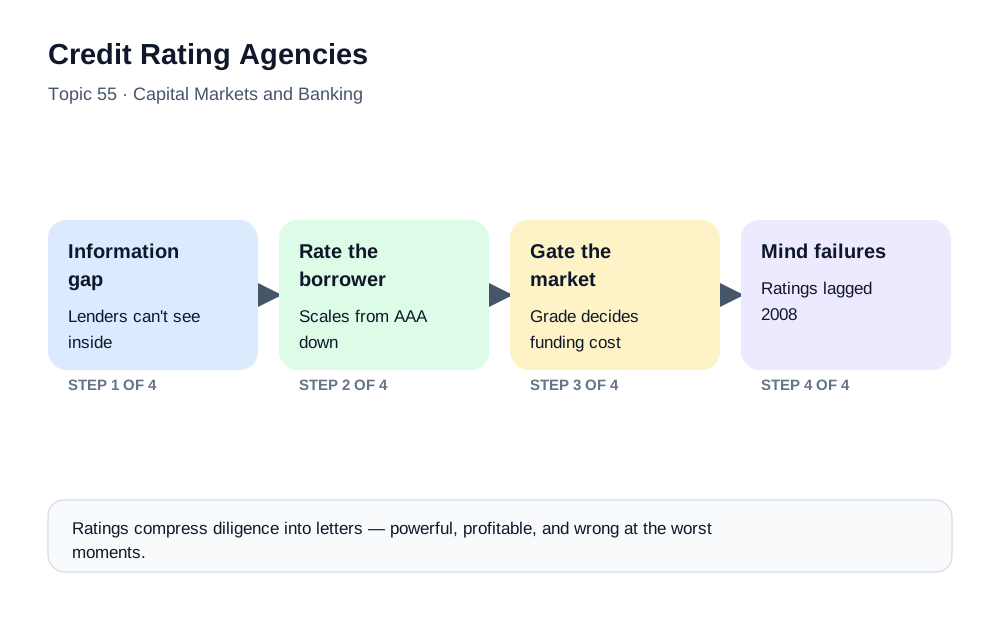
Credit Rating Agencies at a glance — Rating scales, sovereign ratings, rating failures.
The Gatekeepers Who Grade the World's Borrowers
In the complex ecosystem of global finance, three companies exercise influence disproportionate to their public recognition. Moody's Investors Service, S&P Global Ratings, and Fitch Ratings collectively control approximately ninety-five percent of the world's credit rating business. Their letter grades determine whether governments can borrow at affordable rates, whether corporate bonds qualify for institutional investment portfolios, and whether complex securitized products find buyers.
This chapter explains what ratings are, how they are made, why the industry looks the way it does, what went catastrophically wrong in 2008, and how to use ratings without being used by them. By the end you will be able to:
- Define a credit rating and what it does — and does not — measure.
- Read the full rating scale from AAA to D across the major agencies.
- Explain why the investment-grade boundary is the most consequential line in fixed income.
- Describe how sovereign and corporate ratings are actually produced.
- Understand the issuer-pays conflict and the 2008 structured-finance failures.
- Outline the post-crisis reforms and the role ratings play inside banks today.
1. First Principles: The Information Problem in Credit
Every lender faces the same question: will I be repaid? Answering it properly requires analyzing the borrower's finances, industry, management, and prospects — work that is expensive, skilled, and repetitive. A pension fund considering hundreds of bond issues cannot perform that analysis on each one; a small investor cannot perform it at all. The result is a classic information asymmetry: borrowers know their own condition, investors do not, and the gap chills lending or misprices it.
Credit rating agencies exist to close that gap at industrial scale. One thorough analysis, published as a standardized grade, serves every investor simultaneously. The rating is thus an information product — a compression of complex credit analysis into a symbol that travels through mandates, regulations, collateral schedules, and pricing models. Understanding ratings as infrastructure for delegation — investors outsourcing first-pass credit judgment — explains both their power and their failure modes: when millions delegate judgment to the same three firms, an error at the source propagates everywhere at once.
2. What a Credit Rating Actually Is
A credit rating represents an opinion about the creditworthiness of a borrower, specifically the likelihood that debt obligations will be repaid on time and in full. Unlike equity analysis, credit rating focuses exclusively on downside risk: the probability of default and the expected recovery should default occur. This opinion is expressed through a standardized letter grade system.
Three qualifiers in that definition carry the entire weight of honest usage. Opinion: a rating is a reasoned judgment about the future, not a measurement and not a promise — agencies say so in every document they publish. Downside only: a rating says nothing about upside, value, or suitability; an AA bond can be a terrible purchase at the wrong price, and a BB bond a fine one at the right price. Relative, not absolute: ratings rank order expected default risk; a AAA in one year is meant to be safer than a BBB, not immune to loss in every scenario. Investors who treat grades as guarantees have misread the product's own label.
3. A Short History
The history dates to the early twentieth century when John Moody published the first manual of railroad securities ratings in 1909 — an era when America's railroad bonds were held by investors who had no other way to judge distant borrowers. The industry expanded during the 1920s, contracted during the Great Depression, and expanded again in the post-war period as bond markets grew. The modern era began in the 1970s when agencies shifted to the issuer-pays model — charging the rated entity rather than selling manuals to subscribers — a commercial decision that funded global expansion and planted the conflict of interest examined in Section 8. The same decade, regulators began embedding ratings into rules: capital requirements, eligible-investment lists, and collateral schedules referenced agency grades, converting a private opinion service into quasi-public infrastructure and multiplying its influence far beyond what subscribers alone had ever conferred. This regulatory adoption is the hinge of the industry's history — the moment a useful private service became load-bearing public plumbing. Every subsequent controversy, from issuer-pays to 2008, is downstream of that choice: once rules referenced grades, the grades could no longer be merely opinions, whatever the disclaimers said.
4. The Rating Scale
The rating scale uses a hierarchy of grades. At the pinnacle stand the triple-A ratings, indicating obligations of the highest quality. Double-A ratings represent very high quality credits. Single-A ratings indicate strong capacity to meet obligations. The triple-B category marks the lowest tier of investment-grade ratings. Below this threshold lies the speculative grade, colloquially known as junk bonds.
The two major agencies use parallel but distinct notation:
| Tier | S&P / Fitch | Moody's | Meaning |
|---|---|---|---|
| Prime | AAA | Aaa | Highest quality, minimal risk |
| High grade | AA+, AA, AA− | Aa1, Aa2, Aa3 | Very strong capacity |
| Upper medium | A+, A, A− | A1, A2, A3 | Strong, somewhat cyclical |
| Lower medium | BBB+, BBB, BBB− | Baa1, Baa2, Baa3 | Adequate; lowest investment grade |
| Speculative | BB+, BB, BB− | Ba1–Ba3 | Major ongoing uncertainties |
| Highly speculative | B range | B range | High default risk |
| Substantial risk | CCC/C | Caa/Ca/C | Vulnerable; default plausible |
| Default | D | C / — | Obligations not being met |
The fine gradations matter less than the order: each notch represents a step in expected default frequency, and historical default statistics broadly validate the ladder — defaults are rare in the A-and-above range and rise steeply through the B range. Agencies publish cumulative default studies that let investors attach rough probabilities to grades: over long historical windows, three-year default rates for investment-grade cohorts sit in low single digits or below, while B-rated cohorts default at many times that frequency. The exact figures shift by period and agency, but the shape never does — risk rises gently through the A range and then steeply below the investment-grade line. Ratings also come in horizons: long-term issuer ratings for the entity's overall capacity, short-term ratings for instruments under a year, and issue-specific ratings that can differ from the issuer's when a bond is secured, guaranteed, or structurally subordinated.
5. The Investment-Grade Boundary
The boundary between investment-grade and speculative-grade represents the most consequential dividing line in fixed income markets. Investment-grade ratings unlock access to the largest pools of institutional capital — pension funds, insurers, and many mutual funds are restricted by mandate or regulation to investment-grade paper. A downgrade across this threshold triggers forced selling by those mandate-bound holders, the fallen-angel dynamic examined in the bond markets chapter: prices drop mechanically, spreads widen, and the issuer's funding costs jump precisely when its credit is already deteriorating.
The boundary's power is institutional rather than informational. The difference between BBB− and BB+ in expected default frequency is modest; the difference in who may own the bond is enormous. Issuers therefore manage toward ratings — structuring balance sheets, timing issuance, and communicating with agencies to defend the grade — and a whole advisory practice exists to help companies protect the line.
6. How Ratings Are Made
Determining credit ratings involves sophisticated analysis of quantitative and qualitative factors. For sovereign ratings, agencies evaluate GDP growth prospects, fiscal position, monetary flexibility, institutional strength, and external position — a government with its own currency and deep domestic savings rates very differently from one borrowing in foreign currency against a narrow tax base. Corporate rating analysis considers industry risk, business position, financial policy, profitability, and management quality, translated into ratio frameworks — leverage, interest coverage, cash flow adequacy — benchmarked against peers and history.
The process is committee-driven and deliberative. Analysts build the assessment, a rating committee debates and votes the grade, the issuer receives the rationale and may appeal on factual grounds, and the rating publishes with a written analysis. Ratings are then surveilled: monitored continuously, reviewed at least annually, and flagged through outlooks (positive, stable, negative) and watch listings that telegraph likely direction. The outlook system is the market's early-warning channel — a negative outlook on a BBB credit is, functionally, a yellow light two lanes before the junk boundary.
The operational workflow for a first-time corporate rating runs on a predictable calendar. The issuer engages the agency weeks before its planned bond issue — a company preparing a five-hundred-million debut issue cannot market to most institutions without a grade. Management presentations follow: strategy, order books, financial policy, and the numbers behind the ratio framework. Analysts model base and stress cases, compare against the published methodology's benchmarks, and draft a recommendation. The committee votes; the issuer reviews the draft rationale for factual errors; the rating publishes, often days before pricing, because the grade feeds directly into the book-building conversation — every notch is worth measurable basis points of coupon. Thereafter surveillance begins: annual reviews, event-driven reassessments when the company makes an acquisition or its industry turns, and the outlook adjustments that telegraph direction. For the issuer's treasury team, the relationship is permanent homework: agencies expect timely information, and surprises delivered through the press rather than the briefing room cost credibility that takes years to rebuild.
Methodological honesty requires noting what the process cannot do: it relies on issuer-provided information, it extrapolates from history, and committee consensus tends toward gradualism — ratings move in steps, while credit reality sometimes moves in cliffs.
7. The Big Three — and the Rest
The dominance of Moody's, S&P, and Fitch reflects decades of market consolidation. Moody's traces its origins to 1909. S&P descended from a publishing company founded in 1860. Fitch was founded in 1914. Their oligopoly persists less from legal protection than from network effects: investors demand ratings from agencies other investors recognize, and mandates and regulations written around the big three's scales are self-reinforcing.
Beyond the big three, numerous domestic rating agencies serve national markets. In India, CRISIL operates as a subsidiary of S&P, ICRA as a subsidiary of Moody's, and several independent agencies complete the field; other major markets host their own domestic players, and specialized agencies cover insurers, Islamic finance, and other niches. China's domestic agencies illustrate a recurring caution: where local markets assign systematically higher grades than global peers, comparability suffers — one more reason a rating must always be read with its issuer, scale, and jurisdiction attached.
8. The Issuer-Pays Conflict
The revenue model creates an inherent conflict of interest. Agencies are paid by the issuers they rate rather than by the investors who use their ratings. This issuer-pays model creates incentives toward leniency: an issuer unhappy with a prospective grade can shop for a friendlier agency, and agencies competing for mandates face pressure — rarely explicit, never absent — to keep clients.
Defenders offer real counterweights: reputation is the agency's only durable asset, and a rating that defaults embarrassingly destroys the credibility its fee depends on; analyst pay is separated from commercial negotiation; and the investor-pays alternative has its own conflicts and its own access problems. The conflict has a specific anatomy worth naming. Rating shopping lets an issuer take its deal to whichever agency signals the friendliest outcome, so commercial pressure flows even without a single improper conversation. Threshold engineering lets structurers design products backwards from the model — slicing tranches until the senior piece just clears AAA — which means the model's edge cases determine the product's shape. And fee concentration means the most complex, least understood products were also the most profitable to rate. The balanced verdict is that issuer-pays does not make every rating wrong, but it tilts the system — grades skew generous at the margin, most dangerously where fees are largest and methodologies newest. Which is precisely where 2008 came in.
9. 2008: When the Gatekeepers Failed
The 2008 global financial crisis exposed the magnitude of rating agency failures. In the years preceding the crisis, agencies assigned triple-A ratings to complex structured products backed by subprime mortgages — securities engineered so that even if some underlying borrowers defaulted, the senior layers were modeled as nearly riskless. When the housing bubble burst, these supposedly ultra-safe investments lost seventy to one hundred percent of their value.
The mechanics reward a moment's study because they recur in every structured-finance generation. Thousands of mortgages were pooled; the pool's cash flows were sliced into tranches; the senior tranche, paid first, was modeled as so well protected that it earned AAA — the same grade as a sovereign government, backed by nothing more than subprime borrowers and a correlation assumption. The failure was layered. The models assumed national housing prices would not fall together, because they never had in the data; correlation among borrowers proved far higher in a downturn than the models allowed. The complexity outran the analysis — ratings were applied to structures whose risk depended on assumptions few understood. And the fee economics were at their most perverse: structured products were the agencies' most lucrative business line, and issuers actively structured securities to hit rating thresholds, shopping drafts between agencies until the desired grade emerged. The lesson that outlived the crisis: a rating is only as good as the model and incentives behind it, and when those two align badly, the grade is not merely unhelpful but actively misleading — it certifies risk away.
10. Post-Crisis Reforms
Post-crisis reforms have sought to address these failures on several fronts. Disclosure requirements mandate greater transparency — agencies must publish methodologies, performance statistics showing how their rated cohorts actually defaulted, and conflict-of-interest policies. Regulatory bodies supervise rating agency operations directly: registration, examinations, and enforcement powers now exist in the United States and Europe, ending the industry's century of effective self-regulation. Banking regulations have reduced automatic reliance on external ratings — regulators deliberately cut the mechanistic links that turned downgrades into forced selling and rating thresholds into capital cliffs, pushing institutions toward internal credit assessment as a complement.
Reform changed the guardrails more than the structure: the big three still dominate, issuer-pays still prevails, and ratings still anchor mandates worldwide. The system's resilience reflects a genuine absence of alternatives — no one has yet built a cheaper way to standardize credit judgment for a hundred-trillion-dollar bond market.
11. Case Study: Enron and the Lagging Grade
In 2001, Enron — then one of America's largest companies — unraveled through accounting fraud in a matter of weeks. Through most of the collapse, the major agencies maintained investment-grade ratings on Enron's debt, downgrading to junk only days before the bankruptcy filing, when the outcome was already obvious to every newspaper reader. Bondholders who had relied on the grades as current intelligence absorbed losses that a stale opinion could neither predict nor prevent.
The case is the standard exhibit for ratings' gradualism: committee processes, issuer relationships, and reliance on management-provided information all bias toward late action in fast-moving fraud and liquidity crises. Agencies defended their record by noting that fraud concealed from auditors is concealed from raters too — true, and precisely the point investors must hold: a rating surveils reported reality, and reported reality can be manufactured. Ratings lag most badly exactly when speed matters most.
A second case shows the sovereign dimension. Through the mid-2000s, Greece borrowed at spreads barely wider than Germany's — eurozone membership and investment-grade ratings had persuaded markets that sovereign risk inside the currency union had nearly converged. When post-2008 revisions revealed the true scale of Greek deficits, the agencies downgraded in steps through 2009 and 2010, each notch raising borrowing costs that worsened the fiscal position that justified the next downgrade: the sovereign version of the fallen-angel spiral. By 2012 Greece had executed the largest sovereign debt restructuring in history, and investors had relearned that monetary union eliminates currency risk but not credit risk. The episode fed directly into the regulatory rethink of mechanistic rating reliance — when a downgrade can itself deepen a sovereign's distress, embedding grades in rules creates the procyclicality regulators now try to damp.
12. Ratings Inside the Banking System
For banks, external ratings are an operating input across the business. Regulatory capital calculations use ratings to risk-weight exposures in standardized approaches; collateral schedules hair-cut securities by rating; counterparty limits tier by counterparty grade; and treasury portfolios hold rating floors for eligible bonds. A downgrade of a counterparty can trigger collateral calls, reduced limits, and repricing across every contract that references the grade.
The plumbing is concrete: a treasury's collateral schedule might haircut AA corporate bonds a few percent but BB bonds a fifth or reject them outright, so one notch changes how much funding a position can support; a counterparty limit framework might grant a double-A bank several times the exposure line of a triple-B one; and loan pricing grids reference ratings where they exist. Alongside this runs the banks' own machinery: internal rating systems score borrowers independently, both because regulation now requires it and because dependence on three external opinions is itself a concentration risk. The sophisticated position — and the one examiners now expect — treats external ratings as one input among several, valuable for standardization, dangerous as a substitute for the bank's own judgment.
13. Ratings Versus Market Signals: Two Clocks on the Same Wall
Professionals never read ratings alone; they read them against the market's own continuous assessment. The credit spread — a bond's yield premium over the risk-free rate — reprices every trading second as new information arrives, while the rating waits for committee calendars. The two measures usually agree in direction but diverge in timing: spreads typically start widening weeks or months before a downgrade, as traders act on the same deteriorating fundamentals that analysts are still processing. Sophisticated desks therefore track "ratings-implied" versus "market-implied" credit quality, and a wide gap between the two is itself information — either the market is overreacting, or the rating is stale, and deciding which is a genuine investment edge.
The divergence matters for rule-makers too. Regulation written on ratings inherits their lag; regulation written on spreads inherits their noise and occasional panic. Post-crisis frameworks chose a deliberate middle: ratings for structure and floors, internal models for judgment, market signals for early warning. For the student, the durable lesson is that credit assessment has two clocks — the deliberative clock of the agency and the continuous clock of the market — and competence means reading both while knowing exactly what each one cannot see.
14. Common Misconceptions About Credit Rating Agencies
"Ratings predict the future." They are designed to be stable through the cycle — rank orderings of creditworthiness that change slowly by construction. Investors wanting forecasts must look to market prices; investors wanting durable relative judgments get ratings. Confusing the two jobs produces most rating disappointment.
"More rating agencies would fix the conflicts." Competition among issuer-paid raters can worsen leniency, since issuers shop for the friendliest grade — "rating shopping" was part of the 2008 problem. Competition improves ratings only when buyers of ratings, not issuers, choose the rater.
"A stable outlook means the rating cannot change." Outlooks signal direction over the medium term, but events override them — a sudden acquisition, fraud revelation, or sovereign shock can move a rating without any outlook warning. The outlook is a weather forecast, not a contract.
"A rating is a guarantee of repayment." It is an opinion of relative creditworthiness with a documented historical error rate. Even AAA entities have defaulted; the grade compresses probability, not certainty.
"AAA means the investment cannot lose money." AAA speaks to default probability, not price. A AAA bond can lose twenty percent of market value on rising rates, and AAA-rated structured products lost up to everything in 2008.
"Agencies work for investors." They are paid by issuers. Investors consume the product; issuers purchase it. Keeping that flow of money in view is the beginning of rating literacy.
"A downgrade means the agency knows something new." Often it means the agency confirmed what markets already priced — ratings frequently lag spreads by weeks or months. Watch market signals for speed; use ratings for structure.
"All agencies mean the same thing by the same grade." Scales differ in notation and calibration, domestic agencies grade on local curves, and a rating detached from its agency and jurisdiction is only half a fact.
"Ratings are illegal to ignore if you're a bank." Regulation encourages and structures their use but post-crisis rules deliberately reduced mechanistic reliance; banks are expected to maintain internal assessment alongside.
15. Frequently Asked Questions
What does a credit rating measure? The likelihood of full and timely repayment — default probability plus expected loss if default occurs — expressed as a letter grade. Nothing about value, upside, or suitability.
Who are the big three rating agencies? Moody's, S&P Global Ratings, and Fitch — together roughly ninety-five percent of the global ratings business.
What is the difference between investment grade and junk? BBB−/Baa3 and above is investment grade, eligible for most institutional mandates; BB+/Ba1 and below is speculative grade — "junk" — with higher yields compensating higher default risk and a much narrower buyer base.
How often do ratings change? Continuously but gradually: surveillance reviews, outlooks, and watch listings precede changes, and grades typically move one notch at a time — which is why they lag fast-moving credit events.
Do companies pay for their ratings? Yes — the issuer-pays model funds the industry and creates its central conflict. Unsolicited ratings exist but are a small minority.
Can a rating be wrong? Regularly in degree, occasionally in catastrophe: Enron held investment grade days before bankruptcy, and AAA structured products failed wholesale in 2008. Historical default statistics validate the broad rank order, not any single grade.
What happens when a country's sovereign rating is downgraded? Its borrowing costs typically rise, its banks and companies often get downgraded with it (the sovereign ceiling convention), capital can flow out, and the political fallout is often larger than the market one — sovereign downgrades make front pages because they grade a government's stewardship itself.
How should an ordinary investor use ratings? As a first-pass risk filter, not a decision: check the grade, note the outlook, prefer the middle of the scale over the edge of a category, and never let AAA substitute for diversification.
Can a company have different ratings from different agencies? Yes, routinely — a notch apart is common because methodologies weigh factors differently. Issuers seeking two ratings treat persistent gaps as a problem to manage; large divergences signal genuine analytical disagreement and invite scrutiny of both.
What is an unsolicited rating? A grade published without the issuer's request or fee, usually from public information, often to pressure the issuer into an engagement. They carry less information access and sometimes a punitive reputation, and some jurisdictions regulate their labeling.
Why do some bonds carry higher ratings than their issuers? Structure can elevate an issue: collateral, guarantees, or seniority mean that specific bond's expected recovery beats the issuer's general obligation. Covered bonds and guaranteed issues routinely outrate their sponsors — a reminder that ratings attach to obligations, not just names.
How do rating agencies make money? Issuers pay per rating engagement and, for frequent borrowers, ongoing surveillance arrangements; structured-finance ratings commanded premium fees before 2008. The investor side pays nothing for public grades, which is the heart of the issuer-pays debate.
What should I look at besides the letter grade? The outlook and watch status (direction of travel), the written rationale (what would trigger change), the agency and jurisdiction (whose scale), and the market's own verdict in credit spreads. The grade alone is the least informative part of the package.
Do credit ratings apply to bank deposits? Not to your individual deposit — but the bank itself carries an issuer rating, and that grade is the market's judgment of the institution standing behind your deposit. Deposit insurance, where it exists, protects you within its limits regardless of the rating; the rating tells you about the risk beyond them.
How do agencies rate a brand-new company with no history? Largely on forward-looking fundamentals — industry structure, business plan credibility, sponsor strength, projected cash flows under stress — but newness itself is a risk factor, so untested issuers rarely debut at the top of the scale. Credit history, like reputation, must be accumulated.
Can ratings be appealed or challenged? Yes, on factual grounds: issuers review draft rationales before publication and can correct errors or supply omitted information. What they cannot do is negotiate the analytical conclusion itself — an appeal that changed grades on argument alone would destroy the process's credibility, which is the industry's only real asset.
Why do sovereign downgrades make front-page news? Because a sovereign grade prices the state's own stewardship, sets the ceiling for its banks and companies, and feeds directly into national borrowing costs — a notch can move a government's interest bill by sums that matter to budgets.
Are rating agencies liable when their ratings prove wrong? Generally not in the way investors hope: courts have largely treated ratings as protected opinion rather than advice, though post-crisis settlements extracted significant penalties over structured-finance conduct. The legal shield reinforces the practical rule — reliance is the user's risk.
16. Key Terms in This Chapter
- Credit rating — an agency's graded opinion of the likelihood of full, timely repayment.
- Default probability / recovery — the two components of credit loss a rating compresses.
- Investment grade — BBB−/Baa3 and above; the institutional eligibility threshold.
- Speculative grade / junk — BB+/Ba1 and below.
- Fallen angel — an issuer downgraded across the investment-grade boundary.
- Issuer-pays model — the rated entity pays the agency; the industry's central conflict.
- Outlook / watch — forward indicators (positive/stable/negative; watch listing) signaling likely rating direction.
- Sovereign rating — a government's credit grade, factoring fiscal, monetary, institutional, and external strength.
- Notching — fine gradations (+/− or 1/2/3) within a letter category.
- Structured finance rating — grades on securitized products; the epicenter of the 2008 failure.
- Surveillance — continuous monitoring of outstanding ratings.
- Rating committee — the deliberative body that votes grades.
- Sovereign ceiling — the convention that domestic issuers rarely rate above their government.
- Market-implied rating — the grade suggested by a bond's spread, compared against the agency's published grade.
- Rating agency regulation — post-2008 registration, examination, and enforcement regimes supervising the agencies themselves.
- Internal rating — a bank's own credit score, complementing external grades.
- Rating shopping — issuers seeking the most favorable grade across competing agencies.
- Unsolicited rating — a grade assigned without the issuer's engagement or fee.
- Covered bond — a bank bond secured by a ring-fenced asset pool, often outrating its issuer.
- Tranche — a slice of a structured product with its own payment priority and rating.
- Surveillance review — the periodic (at least annual) re-examination of an outstanding rating.
- Procyclicality — regulation-induced amplification of cycles, as when downgrade-triggered selling deepens a downturn.
- Credit spread — the market's own continuous rating, priced in yield over risk-free.
17. Interview Insights: How This Topic Appears in Banking Interviews
"What does a credit rating measure, and what doesn't it?" Default probability and loss severity — downside only. It does not measure value, upside, liquidity, or suitability, and it is an opinion with a track record, not a guarantee. Candidates who volunteer the 2008 structured-finance caveat demonstrate judgment rather than memorization.
"Explain the issuer-pays conflict and whether it invalidates ratings." Issuers pay, investors use; incentives tilt toward leniency, restrained by reputation and regulatory oversight. The mature answer: it biases but does not invalidate — historical default data still validates the broad ladder — and the remedy is using ratings as one input, not the decision.
"Why did AAA-rated securities fail in 2008?" Model assumptions (no national housing decline, low correlation), complexity outrunning analysis, and fee incentives aligned with issuers engineering to thresholds. The generalizable lesson — a rating is only as good as its model and its incentives — is the sentence interviewers wait for.
"What happens when a BBB issuer is downgraded to BB?" Mandate-driven forced selling, spread widening, funding cost escalation feeding back into credit metrics — the fallen-angel cycle, connecting this chapter to the bond markets chapter's mechanics.
"How do banks use external ratings, and what changed after 2008?" Capital risk-weights, collateral haircuts, counterparty limits, eligibility floors — with post-crisis regulation cutting mechanistic reliance and requiring internal assessment alongside. Knowing ratings are inputs to a bank's plumbing, not just research PDFs, marks operational understanding.
"Should regulators embed ratings in rules, given 2008?" A genuine dilemma with no clean answer. Embedding gives a trillion-dollar system a common standard cheaply; it also concentrates error, induces herding, and creates procyclical cliffs at downgrade boundaries. The post-crisis settlement — keep ratings as inputs, cut the mechanical triggers, require internal due diligence alongside — is less elegant than either extreme and wiser than both. Candidates who hold both sides without flinching demonstrate the institutional judgment the question probes.
Summary and Key Takeaways
- Three firms — Moody's, S&P, Fitch — grade the world's borrowers, an oligopoly built on network effects and regulatory embedding rather than law.
- A rating is a downside opinion: default probability and recovery, compressed into a letter — never a guarantee, never a valuation.
- The scale runs AAA to D; the BBB/BB boundary is the market's most consequential line because mandates make it mechanical.
- Ratings are made by analyst teams and committees using structured sovereign and corporate frameworks, surveilled with outlooks — and they move in steps while credit reality sometimes moves in cliffs.
- The issuer-pays model tilts the system toward leniency; reputation and post-crisis supervision restrain but do not remove the tilt.
- 2008 proved the catastrophic case: models, complexity, and incentives aligned to certify risk away in structured products; Enron proved the lagging-grade case in fraud.
- Reforms added transparency and oversight and cut mechanistic reliance, but left the structure — big three, issuer-pays — intact for want of an alternative.
- The professional's rule: use ratings as infrastructure — a standardized first pass — and never as a substitute for judgment, diversification, and watching what spreads are already saying.
Next: Topic 56 — Market Infrastructure →
<!-- MBA-DEEP-DIVE-START -->Deep Dive: Credit Ratings as an Operating Input, Not a Substitute for Credit Judgment
Credit ratings become most useful when they are treated as one component of a wider credit process rather than as a verdict handed down from outside the institution. Banks, asset managers, pension funds, insurers, corporates, clearing houses, and treasury teams all use ratings differently. The same rating can influence investment eligibility, counterparty limits, collateral haircuts, bond pricing, regulatory capital, liquidity buffers, covenant triggers, and internal governance. The letter grade is simple; the operating consequences around it are not.
A serious practitioner therefore asks four questions whenever a rating appears in a rule or decision. Who is rated? The legal entity, the parent group, a specific debt issue, or a structured-finance tranche may each carry different grades. What does the rating measure? Long-term issuer default risk, short-term obligations, insurer financial strength, or recovery characteristics are different opinions. Which agency and scale apply? Symbols that look similar may not be directly interchangeable. What action does the bank take if the rating moves? If no one can answer that, the rating is being collected rather than governed.
Issuer rating and issue rating are not the same thing
A company can have an issuer-level rating and issue-specific ratings that differ because particular debt instruments rank differently in the capital structure. A secured senior bond may benefit from collateral and stronger recovery prospects. A subordinated note absorbs losses later or earlier depending on structure and may therefore carry a lower issue rating. A guaranteed subsidiary issue may reflect the guarantor's strength if the guarantee is legally robust.
This distinction is especially important for banks because bank capital structures contain senior debt, covered bonds, subordinated instruments, and regulatory capital securities with different loss-absorption features. Using the parent bank's general rating for every instrument can understate the risk of securities specifically designed to absorb losses in stress.
Credit systems should therefore store the rated entity, instrument identifier, rating type, agency, date, outlook, watch status, and source rather than one generic field called credit_rating.
Ratings move through a lifecycle
A rating is not assigned once and forgotten. The lifecycle begins with an initial assessment, continues through surveillance, may enter review or watch, can be upgraded or downgraded, and can eventually be withdrawn.
The difference between an outlook and a watch or review matters. An outlook generally expresses the likely direction over a medium-term horizon under the agency's framework. A watch or review usually indicates that a specific event or rapidly changing condition could lead to a rating action sooner. Banks should not treat these signals as identical.
Suppose a counterparty remains rated BBB but is placed on negative watch following a major acquisition financed with debt. A mechanical system waiting for an actual downgrade may do nothing. A stronger risk framework may reduce new exposure, request more information, or escalate the name for review before the grade changes. The rating symbol is therefore one part of the early-warning process; the status around it can be equally important.
The rating date matters
A current-looking grade can be based on information that is already stale. A bank should know when the rating was last affirmed and whether material events have occurred since then.
A company may announce a profit warning, lose a major licence, suffer a cyberattack, face a liquidity run, or launch a debt-funded acquisition after the last formal rating review. The market can reprice the bond immediately while the agency takes time to analyse the event.
This does not necessarily mean the agency is failing. Deliberate review is part of the product. But operational users need to understand that ratings are periodic opinions embedded in a continuous market. Internal risk monitoring must operate between agency actions.
External and internal ratings solve different problems
Banks commonly maintain internal borrower ratings even when external ratings exist. Internal grades can incorporate private information obtained through the banking relationship: management accounts, account turnover, covenant information, utilisation patterns, collateral, group exposures, and payment behaviour. They can also be calibrated specifically to the bank's own default definition and portfolio experience.
External ratings, by contrast, provide common language across institutions and markets. They are useful for benchmarking, investment mandates, public-market comparisons, and regulatory frameworks where external credit assessment is permitted.
The strongest model uses both and investigates divergence.
If a corporate is externally rated A but the bank's internal rating has deteriorated materially because account cash flows have collapsed, the bank should not wait for the agency. If the internal model remains very weak while public bonds tighten and multiple agencies upgrade, the bank should review whether its internal information or model is missing something. Divergence is a prompt for analysis, not a reason automatically to prefer one source.
Rating mapping requires governance
Different agencies use different symbols and sometimes different definitions. Banks often convert them into an internal master scale so that credit limits, collateral rules, and reporting can operate consistently.
This mapping needs controlled methodology. What internal grade corresponds to Moody's Baa2 versus S&P BBB? How are split ratings treated when two agencies disagree? Does the bank take the best, worst, second-best, or a rule defined by the relevant regulation? How are unrated exposures handled? What happens when a rating is withdrawn?
These are not technical implementation details. A change from ‘best rating’ to ‘worst rating’ can materially alter risk-weighted assets, collateral eligibility, investment limits, or counterparty capacity across large portfolios.
The mapping table should therefore have ownership, approval, effective dates, version history, testing, and clear links to the rule that requires it.
Split ratings contain information
A bond rated BBB+ by one agency and BBB− by another should not be simplified away without investigation. The difference may reflect methodology, timing, assumptions, or access to information. It can also indicate that the credit sits near an important threshold and that small changes in assumptions produce different outcomes.
For market participants, split ratings can affect pricing because investors and index providers may follow different conventions. For banks, the treatment can depend on the regulatory or internal framework. The important analytical point is that disagreement itself is information. It tells you the credit is less obvious than a single symbol suggests.
Ratings influence bond pricing through expected loss and investor access
Credit spreads reflect more than expected default loss. They include liquidity, risk premium, market technicals, tax, optionality, and supply-demand conditions. Ratings influence several of these channels at once.
A downgrade can widen a bond's spread because investors revise default risk. It can also cause forced selling if the bond leaves an investment-grade index or breaches mandate restrictions. Dealer inventories may shrink, making the bond less liquid. The issuer's new borrowing cost rises, which can weaken future credit metrics. The rating action can therefore have both informational and mechanical market effects.
This is why a downgrade through the investment-grade boundary can produce a much larger price move than the change in statistical default probability alone would justify.
Fallen angels and rising stars create predictable operational events
A fallen angel is an issuer or bond downgraded from investment grade into speculative grade. A rising star moves in the opposite direction.
For an institutional investor, these events can trigger mandatory portfolio actions. The investment mandate may require sale within a specified period. Index membership may change. Haircuts can increase. Repo counterparties may alter eligibility. Risk limits may tighten.
Good investment operations prepare for the transition before the effective index date. Portfolio managers decide whether to sell immediately, hold temporarily where rules permit, or buy more if forced selling creates value. Operations confirms settlement capacity. Risk updates limits. Compliance verifies mandate treatment. Performance teams separate market loss from implementation cost.
A one-notch rating action can therefore create work across an entire institution.
Counterparty credit limits should not be rating-only limits
Banks frequently use ratings to define broad counterparty-limit bands. A highly rated bank may receive more unsecured settlement or derivatives capacity than a lower-rated one. This is logical, but a rating-only limit can be dangerous.
A counterparty can be highly rated but already represent a large concentration. Wrong-way risk may exist. Country stress can affect many institutions together. Settlement exposure can be large even for a strong counterparty. Market signals may deteriorate faster than the rating.
A robust limit framework combines rating with exposure, tenor, collateral, legal netting, country, sector, concentration, market indicators, and stress testing. The rating is an input to risk appetite, not a replacement for it.
Collateral schedules translate ratings into liquidity
In secured funding and derivatives, the rating of collateral or issuer can influence whether an asset is eligible and how much haircut is applied.
Suppose a bank accepts a corporate bond worth ₹100 crore with a 5% haircut while it is rated A. If a downgrade moves the bond into a riskier band with a 12% haircut, the same collateral supports only ₹88 crore rather than ₹95 crore of exposure. The counterparty may need to post additional assets immediately.
This creates a liquidity link between rating actions and collateral calls. During systemic stress, many bonds can be downgraded simultaneously, increasing haircuts exactly when market liquidity is weakest. Stress testing should therefore include rating migration, not only outright default.
Rating triggers can create cliff effects
Contracts sometimes contain rating triggers: if a party falls below a specified grade, it must post more collateral, prepay debt, transfer business, or accept reduced limits.
These clauses protect counterparties but can amplify stress. A company under pressure is downgraded, the downgrade triggers large collateral calls, the collateral calls worsen liquidity, and the liquidity deterioration causes further downgrades. The mechanism can become procyclical.
Treasury and legal teams should maintain an inventory of material rating triggers and model their cumulative effect. A bank should know not only its current ratings but how much cash or collateral would be required if they fell by one, two, or three notches.
Sovereign ratings affect more than sovereign bonds
A sovereign downgrade can influence banks, corporates, infrastructure projects, and local capital markets. Domestic banks often hold large quantities of government debt, rely on the sovereign for emergency support, and operate in the same economic environment. Country ceilings or transfer-and-convertibility assessments can constrain how agencies rate private issuers in some contexts.
For a multinational lender, country risk therefore cannot be separated completely from borrower risk. A strong company may generate excellent local-currency cash flow but still struggle to service foreign-currency debt if capital controls or convertibility restrictions emerge. External ratings can help frame this interaction, but internal country-risk analysis remains essential.
Structured-finance ratings require a different analytical mindset
A structured-finance tranche is not rated in exactly the same way as an ordinary corporate. Its credit quality depends on the asset pool, priority of payments, credit enhancement, triggers, prepayment behaviour, servicer performance, legal isolation, and model assumptions.
A senior tranche can receive a high rating even when many underlying loans are individually much weaker because subordination and other protection absorb expected losses first. That makes the rating highly sensitive to correlation and stress assumptions.
The 2008 crisis demonstrated what happens when historical data understate joint deterioration. It also produced a broader lesson: a rating on a structure should never be mistaken for transparency about the underlying assets. Investors still need to understand what produces the cash flow and what assumptions protect the tranche.
Rating agency methodology should be read, not merely the grade
Agencies publish methodology describing key factors, ratio ranges, qualitative adjustments, and assumptions. For important exposures, reading the methodology is often more useful than memorising the final symbol.
A corporate rating may be constrained by leverage above a threshold, weak business diversification, aggressive financial policy, or exposure to a volatile commodity. Knowing the driver tells the bank what could cause the next action.
If the rating rationale says a downgrade could occur if debt-to-EBITDA remains above a defined range or free cash flow stays negative, the bank has an observable early-warning indicator. Relationship and credit teams can monitor it before the next agency review.
Rating transition matrices help stress migration risk
Historical transition matrices show how issuers moved between rating categories over time. They are useful because credit portfolios experience far more migration than default.
A bank holding a large BBB portfolio may suffer material mark-to-market, capital, and collateral effects if a recession moves many borrowers into BB even when ultimate defaults remain limited. Stress testing can therefore model a migration matrix under adverse scenarios rather than jumping directly from current rating to default.
This matters especially for trading books, insurance portfolios, and liquidity buffers whose value or eligibility can change sharply when ratings migrate.
Data lineage is critical in automated rating consumption
Large institutions receive rating feeds electronically. The data may enter market-data platforms, risk engines, collateral systems, investment-compliance tools, regulatory reporting, and reference-data stores.
A data-quality defect can propagate everywhere. An outdated rating might allow an ineligible bond into a liquidity buffer. A mistaken issuer mapping could apply a parent rating to a weaker subsidiary. A missed withdrawal could leave a stale grade active for months.
Controls should therefore cover source authentication, security master mapping, duplicate agencies, effective timestamps, rating action type, manual overrides, and downstream reconciliation. Users should be able to trace a rating displayed in a risk report back to the originating agency event.
A complete downgrade scenario
Imagine a large industrial company rated BBB− by two agencies and Baa3 by another. The bank has a term loan, an FX derivative, holds the company's bonds in treasury, and accepts some of those bonds as collateral from an investment client.
The company announces a major debt-funded acquisition. One agency places the rating on negative watch. Internal credit reduces new lending appetite but existing limits remain. Bond spreads widen.
Two months later, the company is downgraded to BB+/Ba1, crossing into speculative grade.
The event now affects multiple systems. Credit reviews covenant and facility pricing. Treasury reassesses whether the bond remains eligible for its portfolio mandate and whether it leaves relevant indices. Market risk updates spread shocks. Collateral systems increase haircuts or remove eligibility according to policy. Derivatives credit checks whether any rating trigger affects collateral terms. Regulatory capital systems apply the relevant treatment. Relationship managers discuss refinancing capacity with the client.
No single ‘rating team’ can own this event. The grade is a shared reference-data event that changes decisions across the bank.
What excellence looks like
A world-class institution uses ratings with discipline and scepticism. It stores the exact rated entity, instrument, agency, type, date, outlook, and watch status. It maps agencies into internal scales through governed rules. Split ratings are investigated rather than hidden. Market spreads and internal credit information are used as independent signals. Rating triggers are inventoried and stress-tested. Collateral and investment rules update reliably when grades change. Structured-finance ratings are accompanied by analysis of the underlying pool and waterfall.
The deepest lesson is that credit ratings are valuable because they create a common language for credit risk. They become dangerous when that common language replaces thinking. A strong bank uses the grade to organise information, set boundaries, and trigger review — while keeping responsibility for the final credit judgment firmly inside its own risk process.
<!-- MBA-DEEP-DIVE-END -->