Visual overview
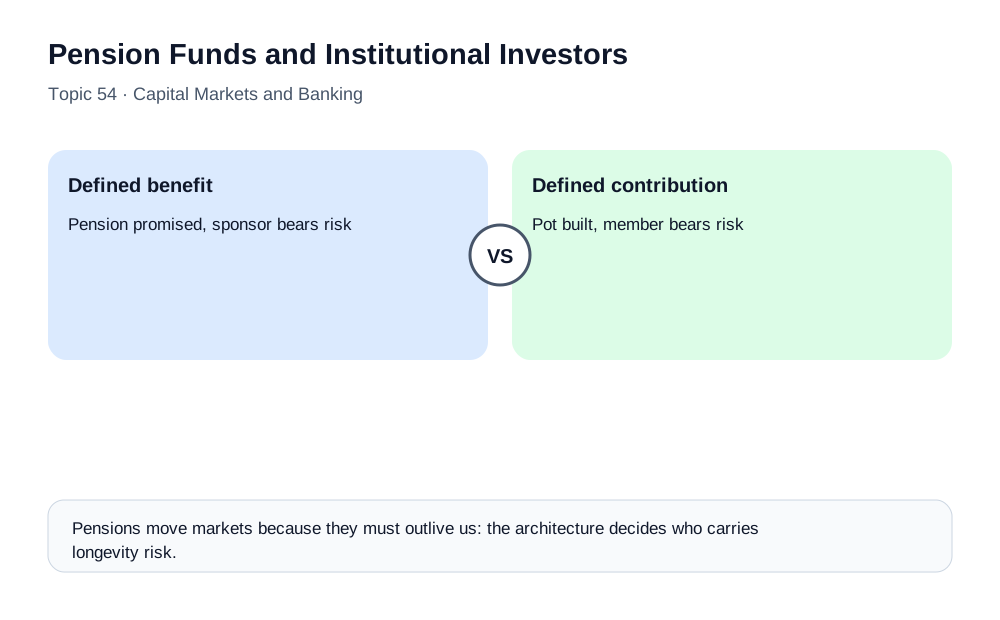
Pension Funds and Institutional Investors at a glance — Defined benefit, defined contribution, SWFs.
The Giants That Move Markets
When we think of financial markets, we often imagine individual investors making trading decisions or hedge fund managers placing bold bets. Yet the true movers of global markets are the institutional investors whose decisions shift trillions of dollars across asset classes. Pension funds, insurance companies, and sovereign wealth funds collectively manage over sixty trillion dollars in assets. These institutions operate with investment horizons measured in decades rather than quarters.
This chapter introduces the giants: what pension funds are and the two architectures they take, how they invest, what the 2022 UK pension crisis revealed, and the other institutional heavyweights — insurers, sovereign wealth funds, and endowments — that shape modern markets. By the end you will be able to:
- Explain the retirement funding problem that pension funds exist to solve.
- Distinguish Defined Benefit from Defined Contribution plans and identify who bears the risk in each.
- Describe the world's major pension systems and their approaches.
- Explain Liability-Driven Investment and what went wrong in the UK in 2022.
- Describe how insurers, sovereign wealth funds, and endowments invest and why their styles differ.
- Assess the collective market impact of institutional flows.
- Understand the historic shift from DB to DC and what it means for individuals and markets.
1. First Principles: The Retirement Problem
Pension funds occupy a unique position as the ultimate long-term investors. Their fundamental purpose is elegantly simple: collect contributions from workers and employers during employment years, invest these contributions wisely, and pay retirement benefits when workers reach old age. This straightforward mission belies the extraordinary complexity involved in managing these obligations across generations, market cycles, and changing demographics.
The underlying problem is one of time and certainty. A working life spans roughly four decades; retirement can span three more. Money saved at twenty-five must survive inflation, market crashes, and changing interest rates to buy groceries at eighty-five. No individual can reliably manage that seventy-year problem alone — the required saving rate is hard to calculate, the temptation to interrupt is constant, and the risk of outliving one's money (longevity risk) is uninsurable by individual effort. Pension funds solve the problem collectively: they pool longevity risk across many lives, invest at institutional scale and cost, and enforce the discipline that individuals struggle to sustain. Where the previous chapter's mutual funds serve any savings goal, pension funds serve one goal with the longest horizon in finance — and that horizon shapes everything about how they invest and why they move markets.
2. Two Architectures: Defined Benefit and Defined Contribution
Two fundamentally different pension architectures have evolved. Defined Benefit plans promise workers a specified retirement income, typically calculated as a function of final salary and years of service — say, one and a half percent of final salary per year of service, so a thirty-year employee retires on forty-five percent of final pay. Under this structure, the employer bears all investment risk: if markets disappoint, the employer must top up the fund to meet the promise. Defined Contribution plans make no guaranteed promises. Employers and employees contribute specified amounts to individual accounts, and retirement benefits depend entirely on investment performance. Under this model, all investment risk transfers to the employee.
The distinction is really about who carries which risk, and the table makes it explicit:
| Dimension | Defined Benefit | Defined Contribution |
|---|---|---|
| What is fixed | The retirement income promise | The contribution rate |
| Investment risk | Employer | Employee |
| Longevity risk | Pooled by the plan | Borne individually |
| Employer obligation | Open-ended top-up duty | Ends with each contribution |
| Transparency to worker | Simple promise, opaque funding | Visible account, uncertain outcome |
| Where the world is heading | Shrinking, legacy | Dominant, growing |
The twentieth century's great employer pension promises were DB; the twenty-first century's reality is DC. The reasons are actuarial and accounting: people live longer than the old promises assumed, low interest rates raised the cost of guarantees, and accounting rules began forcing DB deficits onto corporate balance sheets in full view. Employers responded by closing DB plans and offering DC instead. The consequences run through the rest of this chapter and through the wealth of nations.
3. The World's Major Pension Systems
The world's largest pension systems reflect diverse approaches. The United States operates a hybrid system combining Social Security — a pay-as-you-go public pillar where current workers fund current retirees — with employer-sponsored 401(k) plans, the DC accounts into which workers direct their own investments, holding approximately thirty-five trillion dollars across retirement channels. Japan's Government Pension Investment Fund manages roughly one and a half trillion dollars, the world's largest single pension pool, tilted heavily toward domestic bonds for decades and progressively diversified since. The Netherlands maintains sophisticated defined benefit systems that have made Dutch pension funds among the most sophisticated liability matchers anywhere. India's National Pension System and Employees Provident Fund Organization represent growing retirement assets for a workforce still early in its pension-accumulation journey. Australia's superannuation system — compulsory employer contributions into individual DC accounts — has accumulated approximately two and a half trillion dollars and is often cited as the most successful mandatory DC design.
Three design lessons emerge from the variety. First, compulsion works: systems that require participation accumulate; voluntary systems chronically under-save. Second, defaults rule: in DC systems, most participants never change their default fund or contribution rate, making default design a matter of national retirement policy. Third, scale professionalizes: large pooled systems achieve investment costs and governance quality that fragmented individual accounts cannot. Canada's large public pension plans illustrate the fourth lesson — governance independence: structured at arm's length from government with professional boards and in-house investment teams, they invest directly in global infrastructure and private markets at costs far below outsourced equivalents, and their model is studied by pension systems worldwide. The Nordic countries add a fifth: transparency builds legitimacy, with several funds publishing every holding they own.
4. How Pension Funds Invest
How pension funds invest their assets has profound implications for capital markets. Traditional defined benefit funds historically maintained conservative allocations heavily weighted toward government bonds. A typical allocation might include thirty to forty percent in government bonds, ten to twenty percent in corporate bonds, twenty to thirty percent in domestic equities, and allocations to alternatives such as real estate, infrastructure, and private equity. The logic matches the liability: pension payments stretch decades into the future, so the assets backing them must generate returns over decades — which is why pension funds can hold illiquid assets that would be intolerable for an investor who might need cash next year, earning the illiquidity premium that shorter-horizon investors cannot capture.
Liability-Driven Investment represents a sophisticated approach to match assets with projected future pension payments. This methodology recognizes that pension liabilities have bond-like characteristics — a stream of payments stretching far into the future whose present value rises when interest rates fall, exactly like a bond's price. Long-duration bonds provide natural hedges against these obligations: when rates fall and the liability grows, the bond portfolio grows in parallel, leaving the plan's funded status stable. However, this approach carries risks that became apparent during the 2022 United Kingdom LDI crisis, examined as a case study below.
Allocation is not static. Funds rebalance — selling what has appreciated beyond its target weight and buying what has lagged — which makes pension funds systematic contrarians, forced buyers in crashes and forced sellers in booms, a stabilizing presence whose quiet discipline few headlines ever record. The investment governance behind these allocations is itself an industry: pension boards set strategic asset allocations on actuarial advice, hire external managers through rigorous selection, and monitor performance against liability benchmarks rather than market indices — because a pension fund that beats the S&P 500 while its liabilities grow faster is failing at its actual job.
5. The Operational Cycle: From Paycheck to Pension
Abstract pension design becomes concrete when you follow the money through one complete cycle. Contribution: each payday, percentages of salary flow from employer and employee into the fund — in mandatory systems like Australia's, the employer's share is set by law; in voluntary systems, matching formulas coax participation, and the match left unclaimed is the most expensive free money refused in all of personal finance. Pooling and investment: contributions aggregate into the fund's accounts, where the investment office deploys them across the strategic allocation — this is where custodian banks, fund managers, and the market machinery of earlier chapters connect to the worker's payslip. Record-keeping: administrators track every member's balance or accrued entitlement, a data operation of surprising scale in systems covering millions of workers across decades of job changes. Decumulation: at retirement the flow reverses — a DB plan begins paying the promised monthly amount; a DC member must convert a lump balance into income, through annuity purchase, programmed withdrawals, or some blend, facing the hardest problem in the cycle: not knowing how long the money must last.
Each stage has its own risk, and mature pension systems are really machines for managing the sequence: contribution risk (people save too little), investment risk (markets disappoint), longevity risk (money outlived), and inflation risk (purchasing power erodes across a thirty-year retirement). Inflation-linked indexation of benefits, where it exists, is expensive precisely because it transfers that last risk from the retiree back to the plan.
6. Insurance Companies: The Other Liability Matchers
Insurance companies represent another major category of institutional investor, managing approximately thirty-five trillion dollars globally with conservative, liability-matching investment styles. The parallel with pension funds is exact: a life insurer collects premiums today against claims stretching decades ahead, so it invests in long-duration bonds that mature as claims come due. The fixed income chapter's duration mathematics is the insurer's daily bread — mismatch the duration of assets and liabilities, and a rate move can open a solvency gap even when every bond pays in full.
Consider the arithmetic a life insurer runs: it has promised a policyholder a payout in twenty-five years, discounted today at four percent. If it buys a twenty-five-year bond yielding four percent, the promise is funded regardless of what rates do meanwhile — the asset and liability reprice together. If instead it buys five-year bonds, every reinvestment becomes a bet on future rates; a two-point fall in yields opens a hole that premium increases may not fill. Duration matching is not an optimization for these institutions; it is survival arithmetic. General insurers — covering property, casualty, and health — run shorter liabilities and correspondingly shorter, more liquid portfolios. Regulation reinforces conservatism: solvency regimes across jurisdictions tie capital requirements to investment risk, effectively forcing insurers toward high-grade bonds. The result is that insurance portfolios form one of the largest, most stable sources of demand for long-dated government and corporate debt — a structural bid that shapes bond markets whether or not any headline mentions it.
7. Sovereign Wealth Funds: Nations as Investors
Sovereign Wealth Funds add another dimension. These state-owned investment funds manage national savings — typically commodity revenues, foreign exchange surpluses, or fiscal reserves — for purposes ranging from intergenerational savings to economic stabilization. Norway's Government Pension Fund Global, built from oil revenues, invests across global markets and holds roughly one and a half percent of every listed company on earth — a single fund that is simultaneously the world's largest and its most diversified owner. The Abu Dhabi Investment Authority manages approximately nine hundred billion dollars. Singapore, Saudi Arabia, Kuwait, and China operate similarly massive funds.
Sovereign funds fall into recognizable types. Savings funds convert finite resources — oil, gas, minerals — into permanent financial capital so that the wealth outlives the commodity; Norway is the archetype. Stabilization funds buffer budgets against commodity price swings, holding liquid assets for rainy years. Strategic development funds invest domestically to build industries and infrastructure. Some, like Singapore's, manage national reserves with explicit return objectives. The investment logic differs subtly from pension funds: sovereign funds have no fixed liabilities, effectively infinite horizons, and — in the best-governed cases — freedom to be countercyclical, buying when others must sell. Their governance standards vary widely, which is why voluntary transparency principles emerged to build trust that these giants invest commercially rather than politically. For markets, sovereign funds matter as the deepest of deep pockets: patient, price-insensitive at the margin, and increasingly significant in private markets and infrastructure where their horizon fits the asset.
8. Endowments and the Endowment Model
Endowments and foundations, while smaller in aggregate, have pioneered innovative investment approaches. University endowments such as Harvard and Yale developed the endowment model featuring heavy allocations to alternative investments — private equity, venture capital, hedge funds, real assets — justified by the same logic as pension illiquidity: a perpetual institution never needs all its money at once, so it can harvest illiquidity and complexity premiums unavailable to public-market-only investors. Yale's long-term results under this model made it the most imitated investment strategy in institutional history.
The imitation carries a warning the pioneers themselves issued: the model demands access to top-tier private managers, sophisticated risk staff, and governance that can tolerate years of apparent underperformance — resources few institutions possess. Many imitators bought the allocations without the capabilities and earned the costs without the returns. The lesson generalizes: in institutional investing, the strategy is the organization, and copying a portfolio is not copying a capability.
9. Case Study: The UK LDI Crisis of 2022
The 2022 UK pension crisis deserves close study because it showed how a sound hedging idea can fail through its plumbing. British defined benefit pension schemes had spent years hedging their interest-rate risk through Liability-Driven Investment programs, many of which used derivatives — interest rate swaps and gilt repo — to gain long-duration exposure with leverage, freeing capital for growth assets. The hedge was conceptually correct: when rates fell, the derivative positions gained value to offset rising liabilities.
In September 2022, a UK government budget announcement triggered an abrupt rise in long-dated gilt yields — among the sharpest in modern market history. For LDI programs, rising rates meant derivative losses, and derivative losses meant margin calls — demands for cash collateral within days or hours. Pension schemes sold gilts to raise the cash; the selling pushed gilt prices lower and yields higher; the higher yields generated more margin calls. A hedging program designed to stabilize pension funding had become a forced seller amplifying the very move it was hedging. The Bank of England intervened with emergency gilt purchases to break the spiral, and the episode passed — with pension schemes' funding positions ultimately improved by the higher rates, but only after the near-collapse of the mechanism in between.
The lessons travel far beyond pensions. Leverage converts hedges into liquidity demands; liquidity risk, not solvency risk, is what kills in a crisis; and derivatives-based strategies must be stress-tested for the speed of collateral calls, not just the size of rate moves. The derivatives chapter's mechanics and the fixed income chapter's duration mathematics meet here in real-world wreckage — and every risk textbook now includes the case.
10. The Great Shift: From DB to DC
The evolution from defined benefit to defined contribution structures represents a significant shift in investment behavior. As responsibility shifts from employers to employees, investment decision-making increasingly falls to individuals — individuals who mostly did not choose this responsibility and are rarely trained for it. The consequences are observable everywhere DC dominates: chronic under-contribution, default-fund dependence, panic selling in crashes, and hard puzzles at retirement when an account balance must somehow become a lifetime income.
The market-level consequences are subtler. DB funds invested as single giant pools with professional governance; DC assets invest as millions of small accounts heavily channeled into default funds and index products. The shift is therefore one driver of the passive-investing rise described in the previous chapter, of the concentration of stewardship in a few large asset managers, and of a slow change in market time horizons — from institutions that thought in decades to individuals who check balances on phones. Pension design, it turns out, is market design.
The Netherlands offers the shift's most deliberate national case. Its famous collective DB systems — among the world's most admired — concluded that guaranteeing nominal pensions had become unaffordable in a low-rate, long-life world, and legislated a transition toward a more DC-like collective structure in which benefits move with funding reality rather than standing as rigid promises. The transition of millions of members' accrued rights into the new framework is among the largest pension engineering projects ever attempted, watched by every aging economy facing the same arithmetic. Its lesson for this chapter: the DB-to-DC shift is not merely a corporate cost decision but a societal renegotiation of who bears longevity and market risk — and even the best-funded systems in the world could not exempt themselves from the math.
11. The Collective Market Impact of the Giants
The collective impact of institutional investors on markets cannot be overstated. In bond markets, pension fund demand has structurally depressed yields — decades of liability matching by pension and insurance buyers kept persistent downward pressure on long-term interest rates, one strand in the long decline of yields through the early twenty-first century. In equity markets, inflows into index funds have created persistent upward pressure and concentrated ownership of the largest companies in a handful of asset managers, raising governance questions regulators now actively debate. Most recently, institutional demand has driven the ESG investing revolution, as pension funds and sovereign funds embedded environmental, social, and governance criteria into mandates covering trillions.
Understanding institutional investors is essential for comprehending capital markets. Their long time horizons and massive scale create demand patterns that differ from retail investors — slower, more valuation-anchored, and capable of moving entire asset classes when allocations shift. Their allocation decisions ripple through markets: when pension funds rebalance from equities to bonds, or sovereign funds redirect commodity windfalls, the flows are large enough to be macroeconomic events in themselves.
12. Governance and Regulation of the Giants
Institutions managing other people's retirements operate under fiduciary standards stricter than ordinary commerce: pension trustees must act solely in beneficiaries' interests; investment decisions must satisfy prudence tests; funding levels face regulatory minimums with recovery plans when deficits open. Sponsor oversight runs through dedicated pension regulators in most developed markets, with deposit-style guarantee arrangements in some countries insuring DB promises against sponsor failure. Disclosure has steadily tightened — funding status, fees, and increasingly climate and stewardship reporting.
The deeper governance theme is agency: between the worker and the portfolio stand trustees, consultants, asset managers, and custodians, each paid from the pension's assets and each a potential leak of value. The industry's best-run funds obsess over this chain — insourcing management to cut fees, publishing costs, aligning mandates with liabilities — because over a fifty-year horizon, small annual leakages compound into enormous differences in retirement outcomes, exactly the fee arithmetic of the previous chapter written at national scale.
13. Common Misconceptions About Pension Funds and Institutional Investors
"My pension contributions sit in an account waiting for me." In pay-as-you-go public systems, your contributions pay today's retirees; your pension depends on tomorrow's workers. Even in funded systems, the money is invested across markets, not stored — which is the point: returns, not storage, pay for long retirements.
"Defined Contribution means my employer guarantees my pension." It guarantees the contribution, not the outcome. The retirement income depends on markets and on the employee's choices — the risk transfer is the entire design.
"Pension funds are conservative and boring, so they can't cause crises." The 2022 UK LDI episode nearly crashed the gilt market precisely through pension hedging. Scale plus leverage plus margin calls can make even the most conservative investor a systemic actor.
"Sovereign wealth funds invest their country's pension money." Usually not: most sovereign funds manage commodity or fiscal surpluses with no pension liabilities at all, Norway's name notwithstanding. Their horizon is the nation's, not the retiree's.
"Public sector pensions are always fully guaranteed." Funded status and legal backstops vary widely; some public plans are among the world's best funded, others carry severe unfunded promises that fall ultimately on taxpayers. "Government" describes the sponsor, not the funding.
"A bigger pension fund is always a safer pension fund." Size helps with costs and access, but safety lives in the funded status and the sponsor covenant behind the promise — a huge fund can be deeply in deficit, and history's pension failures were large plans whose promises outgrew their assets.
"Institutions always beat individuals." Scale buys costs and access, but mandates constrain, governance varies, and size itself limits agility. Institutions win on consistency and cost, not omniscience — and their herding can move markets against themselves.
"Endowment-style alternatives are a free lunch for any investor." The premiums are real but gated: manager access, due diligence capacity, and tolerance for years of illiquidity separate those who harvest them from those who merely pay their fees.
14. Frequently Asked Questions
What is the difference between a pension fund and a mutual fund? Purpose and horizon. A mutual fund is a general savings vehicle redeemable anytime; a pension fund accumulates specifically for retirement, usually with tax advantages and withdrawal restrictions, and invests against liabilities measured in decades. Pension funds are often major investors in mutual funds — one is a goal, the other a tool.
Who bears the risk in my retirement plan? If your plan promises a defined income, your employer does (DB). If your statement shows an account balance that moves with markets, you do (DC). Most workers joining today are in DC — which makes the investing chapters of this series personally relevant, not just professional.
What does "funded status" mean? The ratio of a DB plan's assets to the present value of its promised payments. Below one hundred percent, the plan is in deficit and the sponsor owes top-ups; the figure moves with both markets and interest rates, since liabilities reprice like bonds.
Why did falling interest rates hurt pension funds? Because liabilities are long-dated promises whose present value rises as discount rates fall — a fund could earn good asset returns yet watch its deficit widen. This bond-like behavior of liabilities is the insight behind Liability-Driven Investment.
What happened in the UK pension crisis of 2022? Leveraged LDI hedges generated margin calls when gilt yields spiked, forcing gilt sales that pushed yields higher in a spiral, stopped by emergency central bank purchases. The hedges were conceptually right; the liquidity plumbing was not.
What is a sovereign wealth fund? A state-owned investment fund managing national savings — oil revenues, trade surpluses, reserves — for long-term purposes like intergenerational savings and stabilization. The largest hold meaningful stakes in markets worldwide.
Why do pension funds invest in illiquid assets like infrastructure? Because their liabilities stretch decades, they rarely need sudden liquidity, and illiquid assets pay a premium to investors who can wait. Horizon is the pension fund's one structural advantage, and illiquidity is how it monetizes it.
Are pensions guaranteed if my employer goes bankrupt? Depends on the system: funded pension assets are legally separate from the employer and survive its failure, but DB promises may be only partly covered — some countries run pension insurance schemes that pay most, not all, of the promise. DC accounts are entirely the employee's property regardless.
What is an annuity, and where does it fit? An insurance product that converts a lump sum into a guaranteed income for life — the individual solution to longevity risk. DC retirees use annuities (fully or partly) to rebuild the lifetime-income promise that DB plans provided collectively, which is why the pension and insurance chapters are really one subject viewed from two sides.
Why are default funds so important in DC systems? Because most members never make an active choice. The default — typically a lifecycle fund that de-risks as retirement approaches — therefore determines the real investment policy of the system. Policymakers designing defaults are, in effect, managing the nation's retirement assets by proxy.
Do pension funds pay taxes? Pension vehicles are generally tax-advantaged by design — contributions often tax-deferred, investment growth sheltered, benefits taxed on payment — because states want to encourage retirement saving. The specifics vary sharply by country and change with budgets, so the structure matters more than any current rule.
What happens to my pension when I change jobs? In DC systems the account is yours and moves with you — transferred or preserved; portability is one of DC's genuine advantages. In DB systems, accrued rights are typically frozen and revalued by scheme rules, which is why serial job-changers in DB eras often retired on less than lifetime colleagues.
Why do pension funds own so much of the stock market? Because retirement savings are the largest pool of household long-term capital, and equities are the classic long-horizon growth asset. Through pension and mutual funds, ordinary workers — often unknowingly — are the ultimate owners of much of the corporate world.
15. Key Terms in This Chapter
- Pension fund — a pooled institution investing contributions to pay retirement benefits.
- Defined Benefit (DB) — a plan promising a specified retirement income; employer bears investment risk.
- Defined Contribution (DC) — a plan fixing contributions, not outcomes; employee bears investment risk.
- Funded status — plan assets as a percentage of the present value of liabilities.
- Liability-Driven Investment (LDI) — matching assets to the bond-like behavior of pension liabilities.
- Longevity risk — the risk of outliving one's savings; pooled by pension design.
- Pay-as-you-go — public pensions funded by current contributions rather than accumulated assets.
- Superannuation — Australia's mandatory employer-contribution DC system.
- Sovereign wealth fund — a state-owned fund investing national savings across global markets.
- Endowment model — alternative-heavy institutional investing pioneered by major universities.
- Illiquidity premium — extra return earned by investors able to lock capital away.
- Margin call — a demand for cash collateral on losing derivative positions; the trigger of the 2022 LDI spiral.
- Fiduciary duty — the legal obligation to act solely in beneficiaries' interests.
- Default fund — the investment option receiving DC contributions when members make no choice.
- Annuity — an insurance contract converting a lump sum into guaranteed lifetime income.
- Decumulation — the retirement phase of drawing down accumulated assets.
- Lifecycle fund — a default DC fund that automatically de-risks as the member ages.
- Pension regulator — the authority supervising scheme funding, governance, and member protection.
- Actuary — the professional who models pension liabilities and funding requirements.
- Rebalancing — restoring portfolio weights to targets, forcing buy-low-sell-high discipline.
- Unfunded liability — promised benefits with no matching assets, resting on the sponsor's future capacity.
- ESG — environmental, social, and governance criteria embedded in institutional mandates.
16. Interview Insights: How This Topic Appears in Banking Interviews
"Explain the difference between Defined Benefit and Defined Contribution." What is fixed — the promise versus the contribution — and therefore who bears investment and longevity risk. Add the global shift from DB to DC, its causes (longevity, low rates, accounting), and its consequence (risk moving to individuals), and the answer covers economics, not just definitions.
"Why do pension funds matter to capital markets?" Scale (tens of trillions), horizon (decades, enabling illiquid investment), and flow impact (structural demand depressing long yields, index concentration in equities). The strongest answers note the feedback loop: markets move pension funded status, which moves pension allocations, which move markets.
"What went wrong in the UK LDI crisis?" Sound hedging, leveraged through derivatives, met a violent rate rise; margin calls forced gilt sales that amplified the rise; the central bank intervened. The generalizable lesson — liquidity risk kills faster than solvency risk, and hedges must be stress-tested for collateral speed — is what interviewers listen for.
"How do insurance companies invest, and why?" Conservatively, long-duration, high-grade bonds matched to claims liabilities, reinforced by solvency regulation tying capital to asset risk. The matching logic unites insurers with pension funds — both are duration managers first and return seekers second.
"Is the shift to DC good or bad?" Both, for different parties: employers escaped open-ended promises; employees gained portability and ownership but inherited risk and complexity they are rarely equipped for. Systemically, it changed market structure toward passive, defaults, and individual behavior — an answer that sees the second-order effects earns the mark.
"How would you explain longevity risk to a client?" The risk that you live longer than your money lasts — the one risk an individual cannot diversify alone. Pooled solutions exist precisely for it: DB plans absorb it institutionally, annuities insure it individually, and DC retirees must consciously buy or budget against it. Framing retirement planning as longevity-risk management, rather than account maximization, shows the maturity interviewers want.
Summary and Key Takeaways
- The true market giants are institutions — pension funds, insurers, sovereign wealth funds — managing over sixty trillion dollars with horizons in decades.
- Pension funds solve the retirement problem by pooling longevity risk and investing across generations; the mission is simple, the execution spans actuarial science to market microstructure.
- Defined Benefit promises outcomes and burdens employers; Defined Contribution fixes contributions and burdens employees — and the world has decisively shifted toward the latter.
- Liabilities behave like bonds: falling rates inflate them, which is why Liability-Driven Investment exists and why its leveraged 2022 UK variant nearly broke the gilt market.
- Insurers are liability matchers like pensions; sovereign funds are liability-free national savers; endowments pioneered alternatives — each style follows from its obligations.
- Institutional flows are macroeconomic forces: they shape yield levels, index concentration, and the rise of ESG.
- The DB-to-DC shift moved risk from boardrooms to individuals, driving passive investing and making financial literacy a retirement necessity.
- Governance and fiduciary discipline matter because agency chains leak value — and over fifty-year horizons, small leaks sink retirements.
Next: Topic 55 — Credit Rating Agencies →
<!-- MBA-DEEP-DIVE-START -->Deep Dive: Pension Funds as Liability-Driven Financial Institutions
Pension funds are usually introduced as large investors, but that description starts in the middle of the story. A pension fund is first a long-dated liability system. It receives contributions today, invests them across decades, keeps records for millions of members, and must eventually turn assets into reliable retirement income. Investment performance matters enormously, but the investment portfolio exists to serve a schedule of future obligations. This makes pension management closer to bank asset-liability management than to ordinary portfolio speculation.
For a defined-benefit scheme, the crucial question is not simply whether assets earned 8% last year. The fund must compare the present value of assets with the present value of promised pensions. Both sides can move at once. Equity markets may fall and reduce asset values. Interest rates may fall and increase the discounted value of future pension payments. Inflation assumptions can change benefit projections. Longevity improvements can extend the period over which pensions must be paid. A scheme can therefore report positive investment returns and still become less well funded if its liabilities rise faster.
Funded status is the central balance-sheet measure
A simplified funded ratio compares the market value of plan assets with the actuarial value of pension liabilities. If a scheme has assets of ₹95,000 crore and liabilities valued at ₹100,000 crore, its funded ratio is 95%. The ₹5,000 crore shortfall does not mean that retirees miss tomorrow's payment; it means the plan would not have enough assets to meet all projected obligations under the current assumptions if no further contributions or investment gains arrived.
The liability value is model-dependent. It changes with discount rates, inflation assumptions, salary growth where benefits are linked to earnings, mortality tables, retirement ages, member options, and benefit indexation. Governance therefore has to distinguish a real economic improvement from an actuarial assumption change. A higher discount rate can reduce the reported liability instantly without changing one rupee of cash in the fund. That accounting effect may be economically justified, but it should never be confused with investment profit.
Cash-flow matching is different from duration matching
Liability-driven investment can operate at several levels. Duration matching aligns the interest-rate sensitivity of assets with the sensitivity of liabilities. Cash-flow matching goes further by seeking assets whose coupon and principal payments arrive close to the dates on which pension benefits are expected to be paid.
Suppose a mature scheme expects ₹2,000 crore of pension payments each year for the next decade. Holding long-duration bonds can protect the present value of the liability against rate changes, but the fund still needs actual cash each month. A ladder of government and high-quality corporate bonds can create contractual cash flows that reduce dependence on selling assets during market stress. Mature schemes with negative net cash flow often care more about this practical liquidity profile than younger schemes still receiving large contributions from active workers.
Scheme maturity changes the acceptable risk budget
A young pension plan with many active contributors and few retirees has a long investment horizon and positive contribution cash flow. It can generally tolerate more equity, private markets, infrastructure, and other return-seeking assets because it is unlikely to become a forced seller after a short-term market decline.
A mature plan can be the opposite. Benefit payments may exceed new contributions every month. If the fund holds too much illiquid private equity or real estate, a market shock can create a problem even when the long-run investment case remains sound. The scheme may need cash now but have assets that can only be sold slowly or at a severe discount. Asset allocation should therefore evolve with the membership profile rather than remain permanently fixed because a strategic benchmark was approved years earlier.
Contributions are part of risk management
Defined-benefit deficits cannot always be solved by investing more aggressively. Increasing equity exposure may improve expected return, but it also increases the probability of a deeper shortfall at exactly the wrong time. Sponsors and trustees therefore use a combination of contributions, benefit design, investment strategy, hedging, and time.
A recovery plan might require the employer to contribute an additional amount over several years while the investment portfolio gradually reduces risk as the funded position improves. This is sometimes called a glide path. The concept is important because the objective is not maximum return. The objective is to increase the probability that promised pensions can be paid with acceptable volatility and sponsor cost.
Defined-contribution plans shift the operating problem to the member account
In a defined-contribution system, there is no collective promise of a specified pension amount. But the institution still has serious operational obligations. Contributions must be allocated to the correct member quickly, investment choices must be executed at the correct price, fees must be applied accurately, switches must be processed, beneficiary data must be maintained, and retirement withdrawals must be controlled.
A payroll file that allocates one employee's contribution to another account is not a trivial administration error. Over years it affects investment returns, tax records, employer matching, member statements, and retirement outcomes. DC administrators therefore require reconciliation between employer payroll, bank cash receipts, the pension record-keeping platform, investment fund units, custody records, and the general ledger or trust accounting records.
Default funds are one of the most powerful financial-design decisions
Most DC members do not actively construct portfolios. They remain in the default option chosen by the scheme. That turns the default fund into a policy instrument affecting millions of retirement outcomes.
A common design is a target-date or lifecycle strategy. Younger members hold more growth assets because retirement is distant. As the expected retirement date approaches, the portfolio gradually changes toward a mix intended to support the likely retirement choice. The exact glide path should reflect the system's decumulation rules. If members typically buy annuities, bond sensitivity may matter. If members withdraw flexibly, excessive de-risking into cash can create longevity and inflation risk instead.
Default design therefore requires an assumption about human behaviour as much as an assumption about markets.
Decumulation is a different risk problem from accumulation
Saving for retirement is only half the problem. Once employment income stops, the retiree must convert accumulated wealth into spending while facing uncertain lifespan, inflation, medical costs, market returns, and sequence risk.
Sequence risk means that two retirees with the same average investment return can experience very different outcomes if losses occur at different times. A severe market fall in the first years of retirement can force withdrawals from a depressed portfolio and permanently reduce the amount left to recover. The same market decline fifteen years later may be much less damaging because fewer future withdrawals remain.
Annuities solve part of this problem by pooling longevity risk and converting capital into contractual income, but they reduce liquidity and inheritance flexibility. Drawdown products preserve flexibility but leave the retiree exposed to market and longevity risk. Hybrid designs try to combine both. A strong pension system therefore treats retirement-income design as a core financial-engineering problem rather than simply allowing a lump-sum withdrawal and calling the job complete.
Custody and investment operations sit behind every pension portfolio
Large pension funds can hold thousands of securities across dozens of markets, currencies, fund vehicles, and private investments. The fund usually depends on custodians for safekeeping, settlement, income collection, corporate actions, tax processing, cash accounts, and independent records of holdings.
The investment manager may decide to buy a bond, but the trade must still be confirmed, matched, settled, paid for, recorded, valued, and reconciled. Coupon income must arrive. Maturities must be collected. Foreign taxes may need reclaim. Corporate actions require elections. Private-market capital calls must be funded before deadlines. FX exposures have to be managed. Collateral calls on derivatives may require cash within hours.
This operational machinery is one reason institutional investors depend so heavily on global banks and market infrastructure. A pension portfolio can have excellent strategic asset allocation and still suffer avoidable losses through failed settlements, stale valuations, missed corporate actions, incorrect cash forecasts, or weak collateral processes.
Collateral management is the hidden side of hedging
The UK LDI episode showed why derivatives cannot be analysed only by their final economic payoff. Interest-rate swaps and repo can hedge long-term liabilities effectively while creating short-term collateral demands as market values move.
A fund should therefore measure at least three things separately: the economic hedge ratio, the amount of liquid collateral currently available, and the amount of collateral that could be required under severe but plausible market moves. High-quality bonds held for long-term liability matching may need to be sold or repoed quickly if margin calls arrive. If too much of the portfolio is illiquid, the scheme can become a forced seller even though its solvency position has improved.
Collateral waterfalls should be operationally tested. The fund needs to know which assets are eligible, where they are custodied, what haircuts apply, how quickly they can be mobilised, who has authority to transfer them, and what happens outside normal market hours.
Currency risk can be large even when the pension promise is domestic
A pension plan may owe benefits in its home currency while investing globally. Foreign equities, bonds, infrastructure, and private assets introduce exchange-rate exposure. Currency diversification can help long-term returns, but it can also create large short-term movements in funded status.
Funds commonly hedge part of their foreign-currency exposure using forwards or other instruments. The correct hedge ratio is not automatic. Full hedging reduces currency volatility but creates derivative cash flows and collateral needs. Leaving the exposure open can diversify domestic shocks but may dominate returns during sharp currency moves. Strategic policy should therefore specify why the fund is taking currency risk rather than allowing it to emerge accidentally from asset selection.
Private assets require commitment and liquidity modelling
Pension funds are major investors in private equity, infrastructure, private credit, and real estate because their long horizons can tolerate illiquidity. But an allocation target such as 15% private equity does not capture the actual cash-flow problem.
Private funds draw committed capital over time and return cash unpredictably through distributions. During a public-market decline, private valuations may adjust more slowly, causing private assets to become a larger share of the total portfolio mechanically. At the same time, managers may continue issuing capital calls. The pension fund can then face the denominator effect: a rising private-asset percentage and continuing cash requirements precisely when liquid public assets have fallen.
Commitment pacing, cash-flow forecasts, secondary-market capacity, and liquidity stress tests are therefore essential parts of private-market governance.
Securities lending can improve returns but adds counterparty plumbing
Large institutional portfolios often lend securities to broker-dealers or other market participants in exchange for fees and collateral. At scale, these small fees can improve returns without changing strategic asset allocation.
The activity is not risk-free. The fund must manage borrower credit, collateral type, daily margining, legal agreements, corporate actions, recall procedures, and reinvestment risk where cash collateral is accepted. A securities-lending programme should never be judged only by fee income. Net return should be measured after indemnification cost, collateral risk, operational cost, and stress behaviour.
Governance is a chain of delegated authority
Pension investing contains multiple layers of agency. Members rely on trustees or governing boards. Boards rely on executives, actuaries, investment consultants, external managers, custodians, administrators, and legal advisers. Each delegation creates the possibility of misaligned incentives or information loss.
A world-class governance structure makes decision rights explicit. The board owns funding policy and strategic risk appetite. Investment staff manage portfolios within approved limits. External managers receive clear mandates. Risk teams independently measure exposures. The administrator controls member records. The custodian provides independent asset records. Internal and external audit test whether controls actually operate.
The board should receive information that links these parts together rather than hundreds of disconnected investment reports. A return number without funded-status movement, liquidity, risk, costs, and operational incidents is not sufficient governance information.
Costs compound exactly like returns
Institutional scale can reduce fees, but complex portfolios can also accumulate layers of cost: investment-management fees, performance fees, custody, transaction costs, consulting, administration, legal costs, FX spreads, carried interest, and private-fund expenses.
A difference of even a few tenths of a percentage point matters over decades. If two otherwise identical retirement portfolios earn 7% before fees but one loses 0.4% more per year to costs, the final difference after forty years can be substantial. Cost transparency is therefore not an administrative concern. It is part of fiduciary performance.
This is one reason some of the largest pension organisations have brought investment management in-house. Paying teams directly can be cheaper than paying asset-based fees to many external managers, especially in private markets. But insourcing only creates value if governance, technology, risk management, talent, and operational capability are strong enough to support it.
A complete pension-fund stress scenario
Consider a mature defined-benefit fund that is 98% funded. Forty percent of assets are in long-duration government bonds and interest-rate hedges, 30% in global equities, 15% in private markets, and the remainder in credit and cash. The scheme pays more in pensions each month than it receives in contributions.
Now imagine long-term interest rates rise sharply while equities fall 20%. The liability value falls because the discount rate is higher, which improves the funding position. However, the LDI hedge generates large margin calls. Public equities are down. Private-market managers issue capital calls based on commitments made years earlier. Retiree benefits still have to be paid on schedule.
On a solvency dashboard the plan may look healthier because liabilities fell more than assets. On a liquidity dashboard the plan can be under severe pressure.
A strong fund has already modelled this combination. It holds enough liquid collateral, has repo and cash facilities operationally ready, stages asset sales according to a pre-agreed waterfall, and protects benefit payments. A weak fund discovers in real time that its best long-term assets cannot be converted to cash fast enough.
What excellence looks like
A world-class pension institution can explain its obligations as clearly as its investments. It knows how funded status changes with rates, inflation, longevity, and markets. It matches liability risk deliberately, but it also understands the liquidity consequences of every hedge. It adapts asset allocation as the member population matures. Contributions, investment risk, and sponsor capacity are considered together. DC defaults are designed around member behaviour and retirement outcomes rather than marketing simplicity. Custody, collateral, valuation, reconciliation, and member administration are treated as financial controls.
The deepest lesson is that pension funds are not simply enormous pools of patient money. They are promises stretched across generations. Investment skill matters because those promises must be funded; operational discipline matters because the money must actually arrive for the right member at the right time; and governance matters because the people making today's decisions will often be gone long before the consequences are fully visible.
<!-- MBA-DEEP-DIVE-END -->