Visual overview
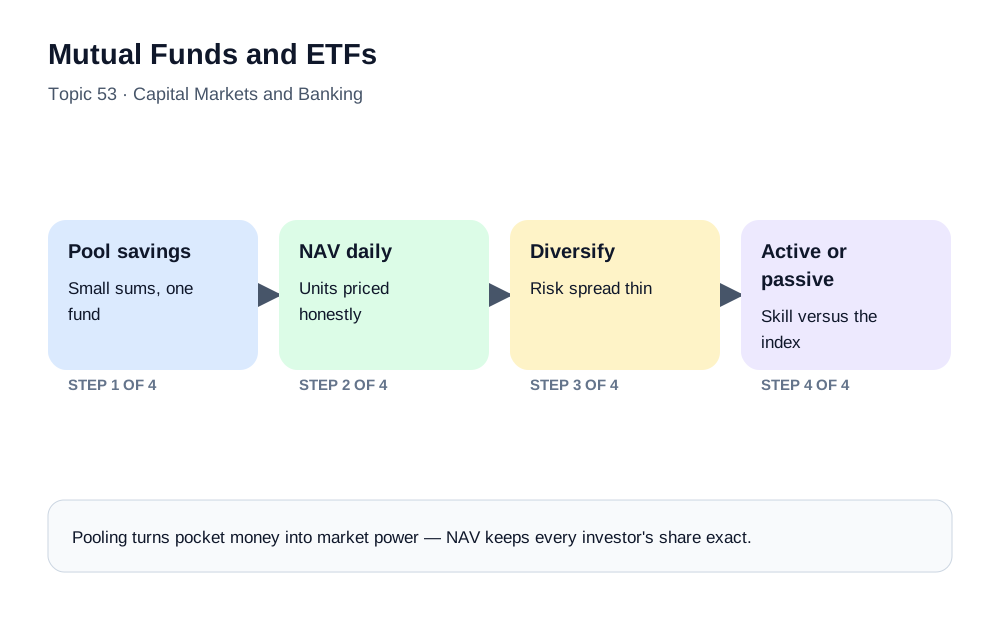
Mutual Funds and ETFs at a glance — Pooled investment, NAV, active vs passive.
Pooled Investment — Making Markets Accessible to Everyone
The invention of the mutual fund stands as one of the most democratizing developments in financial history. Before mutual funds became widely available, building a diversified investment portfolio required substantial capital, extensive research capabilities, and the time to actively manage holdings. Individual investors faced an impossible choice between concentrated risk in a few stocks they could afford or the safety of low-yielding bank deposits. Mutual funds solved this dilemma by pooling money from thousands of investors, providing professional management, diversification, and market access to ordinary people with modest savings. This innovation has enabled millions of families worldwide to participate in wealth creation through capital markets.
This chapter explains pooled investment from the ground up — how funds work, the varieties available, the active-versus-passive debate, the discipline of systematic investing, what fees really cost, and how banks and regulators fit in. By the end you will be able to:
- Explain the pooling principle and why it transforms small savings into diversified portfolios.
- Describe how mutual funds operate — units, Net Asset Value, and how returns reach investors.
- Classify funds by asset class, style, and structure, including the differences between mutual funds and ETFs.
- Weigh the evidence in the active-versus-passive debate.
- Explain Systematic Investment Plans and cost averaging with actual numbers.
- Read fund costs — expense ratios and loads — and understand their long-term impact.
- Identify the risks investors most often miss, especially in debt funds.
- Describe the roles banks play and the regulatory protections in place.
1. First Principles: Why Pooling Works
Three problems keep small savers out of capital markets, and pooling solves all three at once. The first is diversification: spreading risk properly requires dozens of securities, but a saver with a few thousand rupees or dollars cannot buy fifty stocks without transaction costs devouring the capital. A fund holding five hundred investors' money buys the fifty stocks once, and each saver owns a proportional slice of all of them. The second is expertise: evaluating companies, bonds, and macro conditions is a full-time profession; the fund hires that profession and divides its cost across every investor. The third is access: many instruments — commercial paper, institutional bond lots, foreign securities — are simply unavailable below wholesale denominations, but a fund trades at wholesale scale on behalf of its retail owners.
The legal architecture makes the pooling safe. The fund's assets belong to the investors, not the management company; they are held by an independent custodian, valued independently, and cannot be seized by the manager's creditors if the management company fails. This separation — ownership by investors, management by professionals, safekeeping by a custodian, oversight by a trustee or board — is why a fund manager's bankruptcy does not take your savings with it, and it is the single most important structural fact about the industry.
2. A Brief History
The origins of mutual funds trace back to the nineteenth century, with the first modern mutual fund, the Massachusetts Investors Trust, launched in Boston in 1924. This fund introduced the open-end structure that remains dominant today, allowing investors to redeem shares at net asset value rather than trading at market-determined prices. The industry grew slowly at first, with significant expansion only beginning in the 1950s and 1960s as post-war prosperity created a middle class with savings to invest. The introduction of money market funds in the 1970s brought millions of new investors into the mutual fund ecosystem. The 1990s and 2000s saw explosive growth as retirement systems shifted toward defined contribution plans — employers moving workers from guaranteed pensions into individual investment accounts, examined in the next chapter — which turned fund investing from a choice into a default for entire generations.
The index fund arrived in the 1970s on the back of academic evidence that most managers failed to beat the market, and exchange-traded funds followed in the 1990s. Together they initiated the great fee compression that continues today — arguably the largest transfer of value from financial intermediaries to ordinary savers in the industry's history.
3. How Mutual Funds Work: Units, NAV, and Returns
The mechanics of mutual fund operation, while sophisticated behind the scenes, remain conceptually straightforward. Investors contribute money to the fund, which aggregates these contributions into a substantial pool of capital. A professional fund manager then invests this pooled money according to the fund's stated objectives. In exchange for their investment, each participant receives units representing their proportional ownership of the fund's underlying assets. The value of these units is calculated daily as the Net Asset Value, determined by dividing the total value of all assets held by the fund — minus its small accrued expenses — by the number of units outstanding. This calculation occurs after markets close each trading day. Returns accrue to investors through two primary channels: capital gains when the fund's holdings appreciate in value, and income distributions from dividends and interest received by the portfolio.
A worked example fixes the mechanics. A fund holds securities worth ninety-eight crore rupees and cash of two crore, with accrued expenses of half a crore: net assets of ninety-nine and a half crore. With five crore units outstanding, today's NAV is nineteen rupees ninety paise. If you invest ten thousand rupees today, you receive roughly 5,025 units. Tomorrow the portfolio rises one percent; NAV rises to roughly twenty rupees ten paise, and your holding is worth about ten thousand one hundred — the market's movement, scaled by your proportionate share, with no action required from you. Open-ended funds create new units when money flows in and cancel units on redemption, so the fund shrinks and grows with investor flows while the NAV arithmetic stays clean.
4. The Fund Universe by Asset Class
Mutual funds come in myriad varieties designed to meet different investor needs and risk tolerances. When classified by asset class, equity funds invest primarily in stocks and offer the highest growth potential alongside the greatest volatility. Debt or bond funds invest in government and corporate fixed-income securities, providing more stable returns with lower risk — though "lower risk" deserves the scrutiny Section 11 gives it. Hybrid or balanced funds combine both equity and debt instruments to achieve a middle ground between growth and stability. Money market funds invest in short-term instruments such as treasury bills and commercial paper, offering capital preservation with modest returns; their mechanics, their 2008 stress episode, and their post-crisis regulation are covered in the money markets chapter.
Gold funds, real-estate-oriented funds, and international funds extend the same pooling logic to other asset classes, letting a small investor hold diversified exposure to assets that would otherwise be impractical to own directly. The classification's practical use is matching: the investor's horizon and loss tolerance should dictate the asset class before any fund within it is chosen. Money needed in two years has no business in an equity fund, and retirement money thirty years away is wasted in one holding cash.
5. Classification by Style and Market Capitalization
Investment style represents another important dimension of fund classification. Large-cap funds concentrate on established companies with substantial market capitalizations. Mid-cap funds target growing companies that have moved beyond startup phase but retain significant expansion potential. Small-cap funds invest in the smallest listed companies — historically higher returning over long periods, and reliably the most violent in downturns, with liquidity thin precisely when everyone wants to sell. Index funds take a passive approach, seeking merely to replicate the performance of a market index. Sectoral or thematic funds concentrate on specific industries such as technology, banking, or healthcare — concentration dressed as a fund, suitable only as a satellite around a diversified core. Value funds seek undervalued stocks trading below their intrinsic worth, while growth funds target companies with above-average earnings expansion; each style leads the other for years at a time, which is itself an argument for holding broad market exposure rather than betting on a style.
6. Fund Structures: Open-Ended, Close-Ended, Interval
Structural differences also distinguish various fund types. Open-ended funds allow investors to purchase or redeem units at any time at the current net asset value, providing maximum flexibility — and placing the liquidity burden on the fund, which must hold cash or sell assets to meet redemptions. Close-ended funds have fixed maturities and fixed numbers of units, trading on exchanges like stocks; the manager never faces redemption pressure, but the units can trade at premiums or discounts to NAV, adding a second layer of price risk. Interval funds offer a hybrid approach, opening for transactions only at specified intervals — a structure suited to less liquid underlying assets, since the manager knows exactly when cash must be available.
The structural choice is really about who bears liquidity risk. In an open-ended fund, redeeming investors get NAV and the remaining investors bear the portfolio impact of forced sales — a dynamic regulators watch closely after episodes where heavily-redeemed funds had to sell their most liquid assets first, leaving the loyal investors holding the illiquid remainder.
7. Exchange-Traded Funds: The Fund That Trades Like a Stock
Exchange-Traded Funds, or ETFs, represent an evolution of the mutual fund concept that has gained tremendous popularity. While mutual funds trade only once per day at NAV, ETFs trade continuously on stock exchanges throughout market hours. This real-time pricing allows investors to react immediately to market developments. ETFs typically offer significantly lower expense ratios than actively managed mutual funds. Most ETFs follow passive strategies, tracking indices rather than attempting to beat them. ETFs disclose their complete holdings daily rather than monthly.
The mechanism keeping an ETF's market price glued to its NAV is worth understanding because it is elegant. Specialized institutions called authorized participants can create new ETF units by delivering the underlying basket of securities to the fund, or redeem units for the basket. If the ETF's price drifts above the value of its holdings, authorized participants buy the cheap underlying securities, create ETF units, and sell them for the difference; if the price drifts below, they do the reverse. This arbitrage runs continuously and keeps premiums and discounts to a few basis points in normal markets — without any obligation on the fund itself to trade with you. In stressed markets, however, ETF prices can diverge from NAVs when the underlying assets stop trading freely, a phenomenon observed in bond ETFs during March 2020 and a reminder that the wrapper is only as liquid as what it wraps.
8. Active Versus Passive: The Debate the Evidence Settled
The debate between active and passive investing has raged for decades, with empirical evidence increasingly favoring the passive approach. Studies consistently show that the vast majority of active managers underperform their benchmarks over extended periods — in major markets, typically three-quarters or more of active equity funds trail their index over fifteen-year horizons, with the survivors of one period rarely repeating in the next. Warren Buffett famously demonstrated this principle through a million-dollar bet that an S&P 500 index fund would outperform a collection of hedge funds over a decade. He won decisively.
The logic underneath the data is arithmetic before it is anything else: investors as a whole are the market, so the average investor earns the market return before costs and less than the market after costs. Fees, trading costs, and cash drag make underperformance the default outcome, not the exception. Honest framing still leaves active management a role — in less efficient market segments, in downside management, and for investors who need it — but the burden of proof has shifted: an active fund must now justify its fee, where once the index fund had to justify its existence.
9. Systematic Investment Plans: Discipline as a Product
The Systematic Investment Plan, commonly known as SIP, has emerged as perhaps the most powerful tool for retail wealth creation. This approach allows investors to commit fixed amounts at regular intervals, typically monthly, regardless of market conditions. The mechanism of rupee cost averaging ensures that investors automatically purchase more units when prices are low and fewer units when prices are high. More importantly, SIPs remove the psychological burden of timing decisions, automating investment discipline — the behavioral benefit is worth more than the arithmetic one, because the average investor's worst enemy has always been their own entry and exit timing.
The power of compounding means that even modest regular investments grow remarkably over extended periods. Consider an investor contributing five thousand rupees monthly at an assumed twelve percent annual growth rate. After ten years, total contributions of six lakh grow to roughly eleven and a half lakh. After thirty years — contributions of eighteen lakh — the corpus approaches one and three-quarter crore: nearly ten times the money contributed, with the final decade alone adding more than the first two combined. The twelve percent assumption is illustrative, not promised — equity returns vary and some decades disappoint — but the structure of the result is robust: in compounding, time contributes more than money does. This is why the industry's most repeated honest advice is to start early and interrupt rarely.
10. What Funds Cost: Expense Ratios, Loads, and the Compounding of Fees
Understanding fee structures remains essential for mutual fund investors. The expense ratio represents the annual fee deducted from NAV daily to cover fund operations — management, administration, distribution, and compliance, typically from a few basis points for index funds to two percent or more for actively managed equity funds in some markets. Entry loads have been abolished in many jurisdictions. Exit loads discourage early redemption, usually applying only within the first year. Many markets now offer direct plans, bought without a distributor, whose expense ratios run meaningfully lower than regular plans sold through intermediaries — the same fund, the same manager, different fee.
Fees compound exactly like returns, in reverse. One percent annually sounds trivial until the arithmetic: over thirty years, a one percent annual fee consumes roughly a quarter of the ending wealth compared with a zero-fee equivalent, and a two percent fee consumes nearly half of the differential. This is the mechanical reason the passive revolution mattered — not ideology, but arithmetic. When comparing funds, the expense ratio is one of the very few numbers that reliably predicts relative future performance, and it predicts it negatively.
11. The Risks Investors Miss
Every fund document carries the disclosure that investments are subject to market risk, and most investors nod past it. The risks that actually bite deserve naming. Market risk is the obvious one: equity funds fall with markets, and the fund structure provides zero protection against a bear market — only against single-stock catastrophe. Credit risk in debt funds is the insidious one: investors treat debt funds as fixed-deposit substitutes, but a debt fund holding lower-rated paper can lose principal when an issuer defaults, and its NAV will show it immediately. Liquidity risk crystallized in April 2020 when Franklin Templeton's India business abruptly wound up six debt funds holding over twenty-five thousand crore rupees, citing severe redemption pressure and evaporated liquidity in lower-rated bonds; investors waited years for staggered repayments, learning that an open-ended fund over illiquid assets is a promise that depends on markets staying open. Concentration risk hides in sectoral funds and in portfolios of multiple funds that secretly hold the same top stocks. Inflation risk stalks the conservative investor whose "safe" money market and short-term debt funds return less than prices rise.
The unifying lesson: a fund is a wrapper, and the wrapper is only ever as safe, liquid, and diversified as what it wraps.
12. How Banks Participate in the Fund Ecosystem
Banks participate extensively in the mutual fund ecosystem. As distributors, banks sell third-party funds to their customers — a significant fee business, and one regulators monitor because commission structures can bias which funds get recommended. In their custodian role, banks safekeep fund assets, settle trades, and maintain the records that make the investor-protection architecture of Section 1 real. Several major banks own asset management companies outright, manufacturing the funds their distribution arms sell — vertically integrated models that are profitable and conflict-prone in equal measure, and therefore disclosure-regulated.
Banks also lend against fund units, provide the settlement and payment rails for SIP collections, and treat fund holdings as near-cash collateral in some secured lending. For banking professionals, fund literacy is thus not an investment elective: it touches the branch's product shelf, the treasury's counterparties, and the credit desk's collateral.
13. Regulation and Investor Protection
Regulatory frameworks for mutual funds vary by jurisdiction, though the architecture converges. In the United States, the Investment Company Act of 1940 establishes the regulatory structure — registration, independent boards, custody rules, and disclosure. In India, SEBI regulates mutual funds through a trustee-and-asset-management-company structure with prescribed investment limits, valuation norms, and the standardized risk-o-meter disclosures that force every fund to display its risk grade. Common threads run across regimes: segregation of fund assets from manager assets, independent custody and valuation, portfolio diversification limits, standardized disclosure of costs and risks, and rules against misleading performance advertising. The consistent principle, as everywhere in securities regulation: the regulator polices honesty and structure, not outcomes — the fund can lose half your money without breaking any rule, as long as it told you the truth.
14. Digital Transformation: The Direct-Plan Era
Fund distribution has digitalized end to end. Account opening and identity verification happen on phones in minutes; SIPs auto-debit without paperwork; apps compare funds, display portfolios, and execute switches instantly. The most consequential shift is the rise of direct-plan investing through apps and fund house websites, bypassing distributors and their embedded commissions entirely — a structural transfer of value to informed investors, and a competitive earthquake for traditional distribution. Robo-advisory layers add automated portfolio construction and rebalancing on top. The caution that travels with convenience: the same app that makes disciplined investing effortless makes impulsive redemption equally effortless, and the behavioral benefit of friction — the cooling-off that a branch visit once provided — has to be self-supplied now.
15. Case Study: Two Investors, One Decade
Meera and Arun each begin investing ten thousand rupees monthly in the same diversified equity index fund in the same month, both planning a fifteen-year horizon. Their fund choice is identical; their behavior is not.
Three years in, a sharp bear market cuts the fund's value by thirty percent. Arun, watching his accumulated four and a half lakh shrink toward three lakh, stops his SIP "until things calm down" and redeems half "to be safe." Meera, who automated her SIP and deliberately does not check the app during crashes, continues unchanged. Her ten thousand now buys roughly forty percent more units each month than it did at the peak — the cost-averaging mechanism working exactly as designed, visible only to someone who stayed.
The market recovers over the following two years, as markets historically have. Meera's cheap-accumulated units compound from the bottom; her corpus crosses her total contributions and accelerates. Arun re-enters eighteen months after the bottom, at prices well above where he sold, having converted the fund's temporary volatility into his own permanent loss, and having missed the recovery's steepest segment. By year ten, with identical contributions into an identical fund, Meera's corpus exceeds Arun's by a wide five-figure percentage margin — a gap created entirely by behavior, not by fund selection, market timing skill, or luck.
The industry's data confirms the story's generality: studies of investor returns versus fund returns consistently find that investors underperform the very funds they own, because they buy after rises and sell after falls. The fund was the same; the wrapper worked; the humans differed. Every structural feature discussed in this chapter — SIPs, automation, long horizons, low fees — is ultimately engineering against Arun's outcome.
16. Common Misconceptions About Mutual Funds and ETFs
"A mutual fund is guaranteed by the government or the bank that sold it." Neither. The fund is an investment vehicle; the bank is only a distributor, and no one stands behind the NAV. Deposit insurance covers deposits, not funds.
"A fund with a lower NAV is cheaper than one with a high NAV." NAV is an accounting artifact — unit count times price equals assets either way. A ten-rupee fund and a thousand-rupee fund holding identical portfolios will deliver identical percentage returns; comparing NAVs compares nothing.
"Debt funds are like fixed deposits." Fixed deposits carry a bank's promise and often deposit insurance; debt funds hold marketable bonds whose prices and credits fluctuate. The 2020 debt fund closures taught this distinction expensively.
"Past performance rankings tell me which fund to buy." Performance tables are backward-looking and dominated by whichever style recently led; persistence of top rankings is weak to nonexistent. Costs and consistency predict more than trophies.
"ETFs are always better than index mutual funds." Same assets, different wrapper: ETFs add intraday trading and usually lower fees, but introduce bid-ask spreads, brokerage, and the temptation to trade. For a monthly SIP investor, the index mutual fund is often operationally simpler.
"New fund offers are bargains because units start at ten." A new fund offer's launch price of ten rupees is a convention, not a discount — you are buying an unbuilt portfolio at an arbitrary starting number, with no track record to evaluate. Existing funds with identical mandates offer the same economics with visible histories.
"More funds means more diversification." Ten equity funds holding the same fifty large stocks is one undiversified portfolio with ten account statements. Diversification lives in the underlying holdings, not the fund count.
17. Frequently Asked Questions
What exactly do I own when I invest in a mutual fund? Units of the fund, each representing a proportional slice of everything the fund holds. You do not directly own the underlying shares or bonds — the fund does, on your behalf, held by an independent custodian.
How is NAV calculated and when? Total assets minus expenses, divided by units outstanding, computed after each trading day's market close. Purchases and redemptions in open-ended funds execute at that day's NAV (subject to cut-off times), not the price you saw when you clicked.
What is the real difference between an ETF and an index mutual fund? Both track an index; the ETF trades on an exchange all day like a stock and usually costs less, while the index fund trades once daily at NAV directly with the fund house and needs no brokerage account. The assets are the same; only the wrapper and trading mechanics differ.
How much do fees actually matter? Decisively. A one percent annual fee compounds into roughly a quarter of thirty-year ending wealth; fees are also the single most reliable predictor of relative fund performance. This is why index funds won the argument.
Are SIPs a product I can buy? No — a SIP is a method: investing a fixed amount into a chosen fund at fixed intervals. The discipline and the cost averaging come from the method; the returns come from the fund.
What happens if the fund company goes bankrupt? Your money is not in the company's estate: fund assets are segregated with an independent custodian under trustee oversight. Another manager takes over or the fund is wound up with proceeds to investors. This segregation is the industry's foundational protection.
Should I choose a regular plan or a direct plan? Same fund, same manager, different fee: direct plans skip the distributor commission embedded in regular plans, so they cost less every year you hold. If you genuinely use an advisor's guidance, that is what the regular plan's commission pays for; if you self-direct, direct is cheaper.
When should I redeem? When the goal you invested for arrives, when the fund's strategy or management materially changes, or when rebalancing demands it — not because markets fell. Redeeming in panic converts the fund's volatility into your permanent loss.
How much do I need to start investing in a mutual fund? In most markets, very little — minimums of a few hundred rupees or tens of dollars are common, and many platforms have removed minimums for SIPs entirely. The industry's whole purpose is that the entry ticket should not be the barrier.
Are mutual fund returns taxed? Yes, in most jurisdictions — capital gains on redemption and distributions are taxable, with rates usually depending on asset class and holding period. Rules differ widely by country and change frequently, so verify the current treatment where you live rather than relying on generic guidance.
Can I lose all my money in a mutual fund? In a diversified fund, essentially never in one stroke — dozens or hundreds of holdings would all have to fail simultaneously. Concentrated sector funds and leveraged products can fall catastrophically, and any equity fund can lose half its value in a severe bear market. The realistic risk is large temporary decline, not total wipeout.
18. Key Terms in This Chapter
- Mutual fund — a pooled vehicle investing many investors' money under professional management.
- Unit / NAV — the investor's proportional share; net assets divided by units, struck daily.
- Open-ended / close-ended / interval fund — continuous issuance and redemption; fixed units traded on exchanges; periodic transaction windows.
- Equity / debt / hybrid / money market fund — asset-class categories mapping to risk levels.
- Large- / mid- / small-cap fund — equity funds segmented by company size.
- Index fund — a passive fund replicating a market index.
- ETF — an exchange-traded fund, arbitrage-anchored to NAV by authorized participants.
- Authorized participant — the institution that creates and redeems ETF units against the underlying basket.
- SIP — systematic investment plan; fixed-amount regular investing with cost averaging.
- Rupee/dollar cost averaging — buying more units when prices are low, fewer when high, automatically.
- Expense ratio — the fund's total annual operating cost, deducted from NAV daily.
- Direct vs regular plan — the same fund without versus with distributor commission.
- Exit load — a fee on early redemption, typically within the first year.
- Custodian / trustee / AMC — the safekeeper, the investors' overseer, and the fund's management company.
- Active vs passive management — attempting to beat the index versus replicating it.
- Compounding — returns earning returns; the engine behind long-horizon wealth.
- Load — a sales or redemption charge, as distinct from the ongoing expense ratio.
- Risk-o-meter — the regulator-mandated label displaying a fund's risk grade on its documents.
- Folio — the investor's account with a fund house, under which holdings are recorded.
- Sectoral/thematic fund — a concentrated industry bet in fund form.
19. Interview Insights: How This Topic Appears in Banking Interviews
"Why do most active managers underperform index funds?" The arithmetic answer first: investors collectively are the market, so the average must earn the market before costs and less after — fees guarantee average underperformance. Add efficiency (prices incorporate information quickly), cost drag, and poor persistence of winners, and you have the complete case. Candidates who answer "managers aren't skilled" miss that the outcome is structural, not a talent verdict.
"Explain how an ETF's price stays close to its NAV." Through the creation-redemption mechanism: authorized participants arbitrage any gap by exchanging baskets of underlying securities for ETF units or vice versa. Mentioning that the arbitrage can strain when underlying markets freeze — March 2020 bond ETFs — shows you understand the mechanism's limits, not just its slogan.
"A customer says debt funds are safer than equity funds, so they want everything in debt funds. What do you clarify?" Safer against volatility, yes; safe, no — credit events, interest-rate moves, and liquidity stress all mark debt fund NAVs down, and the 2020 wind-ups showed redemption risk in illiquid portfolios. Match the fund to the horizon and read the portfolio, not the category label.
"How do banks make money from mutual funds?" Distribution commissions, asset management fees through owned AMCs, custody and fund administration fees, and secured lending against units. The conflict-of-interest follow-up — commission bias in recommendations — is where regulators focus and where strong answers go unprompted.
"Why do SIPs work?" Arithmetic (cost averaging buys more units at low prices) plus behavior (automation defeats timing impulses) plus compounding (time contributes more than money). The honest caveat — cost averaging does not guarantee profit in a falling market — demonstrates you advise rather than sell.
"What protects the investor if the asset management company collapses?" The tripartite structure: fund assets sit with an independent custodian under trustee oversight, legally separate from the AMC's own balance sheet, so the manager's creditors cannot reach them. A successor manager is appointed or the fund winds up with proceeds returned. The AMC is a service provider to your money, not its owner.
Summary and Key Takeaways
- Mutual funds democratized investing by solving diversification, expertise, and access for small savers — with legal segregation of assets making the structure safe even if the manager fails.
- The mechanics are clean: pooled money, professional management, units priced daily at Net Asset Value, returns through appreciation and distributions.
- Funds classify by asset class, style, and structure; the classification's purpose is matching horizon and risk tolerance, not collecting labels.
- ETFs wrap the same assets in an exchange-traded form, arbitrage-anchored to NAV by authorized participants, usually at lower cost.
- The active-passive debate is arithmetic at bottom: after costs, most active managers lose to their index over long horizons, which is why fee compression is the industry's defining trend.
- SIPs convert discipline into a mechanism; compounding converts time into wealth — a five-thousand-rupee monthly habit illustrates both.
- Fees compound in reverse: a one percent annual difference costs roughly a quarter of thirty-year wealth.
- Funds are wrappers — only as safe, liquid, and diversified as their contents; debt funds are not deposits, and 2020 proved it.
- Banks permeate the ecosystem as distributors, custodians, manufacturers, and lenders, with the attendant conflicts regulated.
- Regulation guarantees honesty and structure, never outcomes; the final risk decision always belongs to the investor.
Next: Topic 54 — Pension Funds and Institutional Investors →
<!-- MBA-DEEP-DIVE-START -->Deep Dive: Mutual Funds and ETFs as Pooled Portfolios, Daily Valuation, Liquidity, and Distribution Systems
A mutual fund is not merely a basket of investments. Operationally, it is a pooled legal vehicle whose investors own units or shares, whose assets are held separately from the fund manager, whose portfolio must be valued under defined rules, and whose subscriptions and redemptions continuously convert customer cash into portfolio ownership and back again. ETFs add a second trading layer by allowing those fund units to trade on an exchange while specialised participants create and redeem large blocks against the underlying portfolio.
That structure explains almost every important risk. Investment risk comes from the portfolio. Liquidity risk arises because investors may demand cash faster than assets can be sold. Valuation risk appears when holdings do not have clean observable prices. Conduct risk appears when distributors sell a fund because of commission rather than customer need. Operational risk appears when the NAV, unit registry, custody, cash, and trading records disagree.
The fund is separate from the manager
The asset-management company or investment manager makes investment decisions, but it does not ordinarily own the fund assets for its own benefit. The fund, trust, company, or other permitted legal structure owns or holds the portfolio for investors according to the jurisdiction.
Custodians, trustees, boards, administrators, transfer agents, auditors, and regulators provide additional separation and oversight.
This separation is fundamental. If an asset manager suffers corporate financial distress, customer securities should not simply become ordinary assets of the manager where the legal structure provides appropriate segregation.
The exact governance model varies by country, but the principle is stable: management company risk and portfolio investment risk are different things.
Units convert a large portfolio into proportional ownership
When investors subscribe, the fund issues units or shares according to the applicable price. The investor's percentage ownership equals their units relative to total units outstanding.
If a fund holds ₹1,000 crore of net assets and has 10 crore units, a simplified NAV is ₹100 per unit. An investor contributing ₹1 lakh at that NAV receives roughly 1,000 units before considering any permitted charges or timing rules.
The investor does not own a particular company share inside the fund. They own a proportional interest in the fund as a whole.
This matters for redemptions. The investor generally asks the fund to redeem units for cash rather than selecting which underlying security should be sold.
NAV is an accounting calculation with market consequences
The net asset value is generally the market value of assets minus liabilities divided by units outstanding, calculated under the fund's valuation policy and regulatory framework.
The simple formula hides substantial work. The administrator must capture every portfolio position, cash balance, accrued income, fee, tax, receivable, payable, derivative value, corporate action, and FX conversion. Prices must come from approved sources and illiquid assets may require valuation methodologies rather than exchange closes.
A wrong NAV transfers value between investors. If the NAV is too low, subscribing investors receive too many units and dilute existing holders. If it is too high, redeeming investors can take more value than they should.
NAV errors therefore require defined tolerance, correction, investor compensation, root-cause analysis, and regulatory treatment according to jurisdiction.
Cut-off times protect fairness between entering and existing investors
Open-ended funds accept subscriptions and redemptions under defined dealing rules. The applicable NAV may depend on when a valid instruction and funds are received relative to a cut-off.
Cut-offs prevent customers from waiting until after market-moving information becomes known and then obtaining an earlier price. They also give the manager enough time to forecast cash and trade the portfolio.
A digital channel should display the effective dealing date clearly. ‘Order submitted today’ does not always mean ‘today's NAV’ if the instruction arrives after cut-off or lacks required funds or documentation.
The order system needs immutable timestamps because disputes about cut-off can become disputes about investor value.
Subscription cash must be reconciled to unit creation
A successful fund purchase has at least three records: customer cash left an account, the fund or collection account received it, and units were created in the investor registry.
If cash succeeds but unit allocation fails, the customer has funded the fund without receiving ownership evidence. If units are created but cash never arrives, existing investors can be diluted.
Reconciliation therefore links bank payment, collection account, transfer-agent instruction, NAV, units issued, and general ledger.
Suspense items should be aged. Unidentified investment cash should not be left indefinitely because the fund cannot know whether it belongs to a valid subscription, refund, or another payment.
Redemption creates portfolio liquidity needs
When investors redeem, the fund needs cash. It can use existing cash balances, incoming subscriptions, maturing instruments, or asset sales.
For a highly liquid government-bond or large-cap equity fund, that process can be straightforward in normal markets. For a fund holding private credit, small-cap securities, property, or thinly traded bonds, large redemptions can be difficult.
This creates liquidity mismatch: investors may have frequent redemption rights while underlying assets require days, months, or longer to sell without severe discounts.
Fund design should align dealing frequency with asset liquidity. A daily-dealing wrapper around deeply illiquid assets creates structural pressure during stress.
Redemptions can disadvantage investors who stay
Suppose a fund faces heavy withdrawals. To raise cash it sells the most liquid holdings first. Remaining investors can be left with a portfolio that is less liquid and potentially riskier.
Trading costs created by departing investors can also be borne by those who remain if the NAV does not adjust for the cost of selling assets.
Some jurisdictions and fund structures use tools such as swing pricing, dilution adjustments, redemption fees, gates, notice periods, or in-kind redemptions under defined circumstances. These tools aim to allocate liquidity cost more fairly or slow destabilising outflows.
They must be governed transparently because restricting access to money is a significant investor event.
Active management should be judged after fees and risk
An active manager chooses securities with the objective of outperforming a benchmark or achieving another mandate. Performance should be evaluated after management fees, transaction costs, and relevant risks.
A manager can outperform by taking much more market, sector, credit, liquidity, or concentration risk than the benchmark. Raw return alone does not prove skill.
Useful analysis examines tracking error, information ratio, drawdowns, factor exposures, turnover, concentration, and consistency with the stated investment process.
Style drift is an important control. A fund marketed as conservative investment-grade credit should not quietly move into high-yield or illiquid securities merely to defend performance.
Passive funds still make active implementation decisions
An index fund aims to track a benchmark, but implementation is not automatic. The manager must handle index changes, corporate actions, cash flows, transaction costs, withholding taxes, securities lending, sampling, and market closures.
Tracking difference measures the return gap between fund and index. Tracking error measures the variability of that gap.
Fees explain some underperformance, but poor execution or cash drag can add more. A fund may hold only a representative sample of a very broad index rather than every constituent, increasing modelling choices.
Passive management removes security-selection discretion; it does not remove operational skill.
ETFs have a primary market and a secondary market simultaneously
Retail investors usually buy and sell ETF shares on an exchange. Those trades occur between investors and do not automatically send cash into or out of the fund.
Large institutional participants known as authorised participants can create or redeem large blocks directly with the ETF according to the product mechanism. They may deliver a basket of securities or cash and receive ETF shares, or return ETF shares and receive the underlying basket or cash.
This arbitrage mechanism helps keep the ETF's market price close to its NAV or indicative portfolio value.
If ETF shares trade above the value of the underlying basket, an authorised participant can potentially create new units and sell them. If shares trade below value, the participant can potentially buy units and redeem them. Competition narrows the gap under normal conditions.
ETF market price can differ from NAV
Unlike a traditional open-ended mutual fund dealt at calculated NAV, an ETF trades continuously at market prices. During volatile or illiquid conditions, the ETF price can trade at a premium or discount to its reported NAV.
That difference does not automatically mean the ETF is malfunctioning. The underlying market may be closed, stale, or less liquid than the ETF itself. In some cases the ETF price can be the more current estimate of where the underlying assets would trade.
Investors should examine bid-ask spread, average trading volume, underlying asset liquidity, premium/discount behaviour, and creation-redemption activity rather than choose ETFs only by expense ratio.
A tiny fee saving can be overwhelmed by a wide trading spread.
Bond ETFs reveal the difference between portfolio liquidity and fund liquidity
A bond ETF may trade actively even though many underlying bonds trade infrequently. The ETF provides a secondary-market instrument through which investors can transfer exposure without forcing the fund itself to sell each bond.
During stress, ETF discounts can widen because the market price adjusts faster than modelled or evaluated bond prices. Authorised participants decide whether the arbitrage is attractive after considering the real cost of trading the underlying bonds.
This is an important insight: an ETF can add a layer of liquidity without making illiquid underlying assets magically liquid.
Liquidity analysis should therefore consider both levels.
Money market funds aim for stability but still hold investment risk
Money-market funds invest in short-duration eligible instruments according to their regulatory category and mandate. They are widely used for cash management because of liquidity and relatively low volatility.
They are not automatically equivalent to insured bank deposits. Structure, valuation, liquidity protections, and investor rights differ by jurisdiction.
Stress can arise if investors fear portfolio losses or liquidity restrictions and redeem rapidly. Fund regulation therefore pays close attention to maturity, credit quality, liquid-asset buffers, concentration, valuation, and redemption mechanisms.
A bank distributing a money-market fund should not present it as ‘the same as a savings account with a higher rate’.
Credit funds need portfolio-level default and liquidity analysis
A corporate bond or private-credit fund spreads exposure across many issuers, which reduces single-name concentration. It can still be exposed to one sector, rating bucket, economic cycle, or liquidity shock.
Investors should look at duration, average credit quality, rating distribution, sector concentration, top holdings, maturity profile, liquidity, derivatives, and historical loss experience where relevant.
An average rating can hide a barbell portfolio containing both high-quality and very weak debt. Weighted averages should never replace distribution analysis.
When credit spreads widen, a fund can lose market value before any issuer actually defaults.
Equity funds can hide factor concentration
A diversified-looking equity fund may hold many securities but be dominated by the same economic factor—technology growth, small caps, one country, high dividend, or momentum.
Risk systems can decompose portfolio exposure by sector, geography, market capitalisation, currency, valuation factor, and other drivers.
A fund marketed as broad diversification should be judged on underlying risk, not merely number of holdings.
Ten companies in the same industry do not provide the same diversification as ten economically unrelated exposures.
Expense ratio is only one layer of investor cost
Funds can incur management fees, administration, custody, transaction costs, taxes, brokerage, spreads, performance fees in some structures, and distribution charges according to the product and jurisdiction.
Some costs appear directly in the NAV rather than as a separate debit from the investor.
A low headline fee can still coexist with high turnover and trading cost. Conversely, a higher-cost active fund may provide a specialised exposure not available cheaply elsewhere.
The professional question is whether the total cost is reasonable for the service and outcome provided, not whether one number is the lowest in the market.
Distributor commissions create a suitability conflict
Banks and advisers can receive remuneration for distributing funds depending on the market and business model. Different products may pay different amounts.
That creates an incentive to recommend the most profitable product to the distributor rather than the best fit for the customer.
Product governance should define target markets and suitability, disclose fees and conflicts as required, monitor concentration of sales by adviser, and examine early redemptions or complaints.
A branch where nearly every customer is sold the same fund deserves review even if the fund itself is legitimate.
Direct and regular plans can have different economics
Some markets distinguish direct distribution from adviser or distributor channels through different fee classes or plans. The underlying investment portfolio may be the same while expenses differ.
Customers should understand what service they receive for the additional distribution cost. A customer receiving ongoing advice, portfolio review, and service has a different relationship from one executing an independent self-directed purchase.
The bank should not conceal cheaper available classes where regulation or conduct standards require transparent comparison.
SIPs manage contribution timing, not investment risk
A systematic investment plan spreads purchases across dates. When prices are lower, a fixed contribution buys more units; when prices are higher, it buys fewer.
This reduces the need to choose one entry date and can support disciplined saving. It does not guarantee profit, eliminate market risk, or ensure a particular return.
A falling market can leave a long-running SIP below cost for a period. Its advantage is behavioural and averaging-based, not mathematical immunity from loss.
Customer education should separate regular investing discipline from guaranteed outcome.
Fund accounting needs independent asset records
The investment manager decides what to buy and sell, but fund administration and custody should provide independent records and controls. Trades settle through custodians. Cash accounts collect subscriptions and pay redemptions. Corporate actions change positions. Income accrues. Expenses are charged.
Daily or periodic reconciliation compares investment-management records, custodian positions, cash, trade confirmations, and accounting ledger.
A portfolio manager who believes the fund owns a security while the custodian shows no settled position creates both valuation and settlement risk.
Independent records protect investors from operational mistakes and misconduct.
A complete mutual-fund customer scenario
A customer invests ₹2 lakh into a diversified equity fund through a bank app before the applicable cut-off.
The bank validates customer eligibility and investment account status, captures the order and required disclosures, and debits the customer's funding account. The order and cash move to the fund's authorised processing chain. The transfer agent determines the applicable NAV and creates units. The bank receives confirmation and displays the units in the customer's investment view.
The fund manager invests aggregated subscriptions according to portfolio strategy. Custody records the securities, and the administrator calculates NAV using positions, prices, cash, accrued income, and expenses.
Two years later the customer redeems half the units. The transfer agent cancels those units at the applicable redemption price. The fund provides cash from portfolio liquidity and asset sales as necessary. Redemption proceeds are transferred to the customer's nominated account and reconciled.
Now imagine the bank's payment succeeded but the order file failed before reaching the transfer agent. A strong system identifies cash without units, routes the item to exception management, and resolves or refunds it promptly. A weak system simply tells the customer to ‘wait for NAV update’ while money sits unexplained.
A complete ETF scenario
An investor buys 10,000 ETF shares on exchange. The broker executes against market sellers; the ETF itself may receive no cash because this is a secondary-market trade.
Later, market demand pushes the ETF above the value of its underlying basket. An authorised participant assembles the required basket, delivers it through the ETF creation mechanism, receives new ETF shares, and sells those shares into the market. The additional supply helps narrow the premium.
The ETF's portfolio, custody, creation basket, exchange shares, and investor positions must remain consistent even though primary and secondary markets are operating simultaneously.
What excellence looks like
A world-class fund operation can reconstruct NAV, subscriptions, redemptions, unit registry, portfolio positions, custody, fees, and cash. It understands liquidity mismatch and allocates trading cost fairly under the applicable framework. Active funds remain within mandate. Passive funds control tracking. ETFs manage creation-redemption and market-price differences transparently. Distributors recommend based on customer need rather than commission. Investors are not told that diversification or SIPs eliminate loss.
Mutual funds and ETFs are powerful because they turn institutional portfolios into accessible units. They remain trustworthy only when portfolio value, investor ownership, liquidity rights, and distribution conduct all stay aligned.
<!-- MBA-DEEP-DIVE-END -->