Visual overview
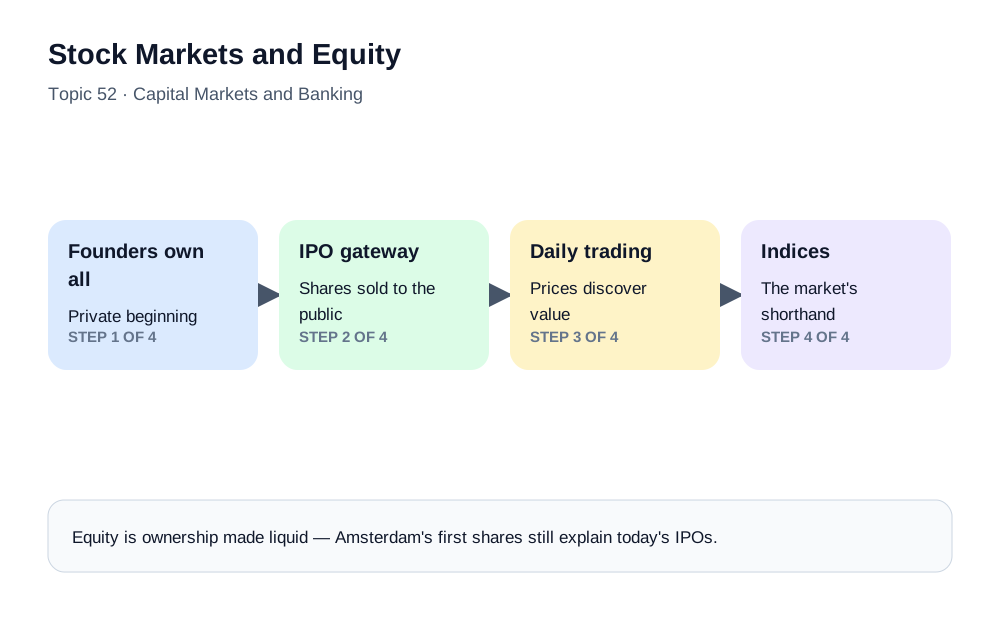
Stock Markets and Equity at a glance — Exchanges, IPOs, secondary trading, market indices.
Ownership, Wealth Creation, and the Engine of Capitalism
Stock markets represent one of the most powerful mechanisms for wealth creation ever devised by human civilization. They serve as the visible face of capitalism, where companies raise capital by selling ownership shares to investors, and where individuals and institutions alike can participate in the growth of the global economy. When you walk past the New York Stock Exchange or check your portfolio on a smartphone, you are witnessing the culmination of centuries of financial evolution that has transformed how businesses grow and how wealth is accumulated across generations.
This chapter explains what stock markets are, how they work, and why they matter — from the legal nature of a share to the mechanics of an exchange, from IPOs to indices, and from bull markets to crashes. By the end you will be able to:
- Explain what equity ownership legally means — dividends, votes, residual claims, and limited liability.
- Trace how stock markets emerged and why they changed economic history.
- Describe how exchanges match buyers and sellers and how prices are discovered.
- Follow the IPO process end to end and explain why companies list.
- Read market indices and understand what they do and do not tell you.
- Identify the participant ecosystem and the roles banks play in equity markets.
- Understand bull and bear markets, corrections, and crashes.
- Appreciate the risks, the regulation, and the digital transformation of equity investing.
The previous chapter covered bond markets, where investors are lenders; this chapter is about the other side of the balance sheet, where investors are owners.
1. First Principles: Equity Is Ownership
The fundamental concept underlying stock markets is remarkably simple yet profoundly transformative: equity represents ownership. When you purchase a share of stock, you are acquiring a fractional ownership stake in a real business. This ownership confers several important rights upon shareholders, including the right to receive dividends when the company distributes profits, the right to vote on major corporate decisions such as board elections and mergers, and the right to residual value should the company ever be liquidated after all debts have been paid. Importantly, this ownership comes with limited liability, meaning that even in the worst-case scenario of corporate bankruptcy, shareholders cannot lose more than their initial investment. This principle of limited liability was itself a revolutionary innovation that enabled the formation of modern corporations and the mobilization of capital from risk-averse investors.
Each right deserves a moment's attention. The dividend right is discretionary, not contractual — unlike a bond's coupon, no dividend is owed until the board declares one, which is why equity is risk capital. The voting right is what makes shareholders owners rather than merely investors: in principle, they hire and fire the board that oversees management, though in practice dispersed shareholders exercise this power imperfectly, a governance tension at the heart of corporate finance. The residual claim defines the pecking order: employees, suppliers, tax authorities, and lenders are all paid before shareholders, who take whatever remains — everything in prosperity, nothing in ruin. And limited liability caps the downside at the investment itself, without which ordinary savers could never prudently own businesses at all.
The mirror image of these rights explains why companies issue equity at all: equity capital never has to be repaid, carries no fixed payment obligation, and absorbs losses before debt does. It is the most expensive capital a company raises — shareholders demand the highest expected return for standing last in line — but it is also the most permanent and the most shock-absorbing. The fixed income chapter's creditor perspective and this chapter's owner perspective are two views of the same corporate balance sheet.
2. The Varieties of Equity: Common Shares, Preferred Shares, and Depositary Receipts
Not all shares are created equal, and the distinctions matter in practice. Common (ordinary) shares are the standard form described in Section 1 — full voting rights, discretionary dividends, last in the liquidation queue. When people say "stocks," they almost always mean common shares. Preferred shares sit between equity and debt: they typically carry a fixed dividend paid before common dividends, rank ahead of common shares in liquidation, but usually sacrifice voting rights. Companies issue them to raise capital without diluting control; banks issue them as regulatory capital; investors buy them for income with less volatility than common stock — accepting capped upside in exchange.
Companies also structure common equity into share classes with different voting rights — Class A shares with ten votes each held by founders, Class B with one vote sold to the public. The structure lets founders raise public capital while keeping control, and it is common among technology companies; index providers and governance advocates dispute its fairness, but investors encounter it routinely and should always check what a share's vote is actually worth before comparing prices across classes.
Depositary receipts solve a different problem: cross-border access. An investor in New York cannot conveniently buy and settle shares listed only in Mumbai or Shanghai through their domestic broker. A depositary bank solves this by holding the foreign shares in custody in the home market and issuing receipts against them that trade locally in local currency — American Depositary Receipts in the United States, Global Depositary Receipts in international markets. The receipt holder gets the economic exposure, dividends converted and passed through by the depositary bank, without touching foreign settlement systems. For the issuing company, a depositary receipt program opens an entirely new investor base; for banks, issuing and administering these programs is a fee business built directly on the custody machinery described in Section 8.
3. Corporate Actions: What Happens to Your Shares After You Buy
Ownership is not static; companies constantly act in ways that change what a share represents, and the machinery that processes these changes — corporate actions — is one of the least visible and most operationally demanding parts of market infrastructure. Dividends require the depository and custodians to identify every holder on the record date and route cash to each, converting currencies and withholding taxes where cross-border holdings are involved. Stock splits and bonus issues multiply share counts and must be reflected in every account simultaneously. Rights issues offer existing shareholders new shares at a discount, and the rights themselves trade for a window — a shareholder who ignores a rights notice can suffer real dilution. Mergers and takeovers convert one company's shares into cash, another company's shares, or both, with elections, deadlines, and fractions to settle.
For the individual investor, most of this arrives as seamless account adjustments — which is precisely the point. Behind each seamless adjustment stand custodian banks and depositories reconciling millions of positions against issuer announcements, chasing entitlements, and absorbing the operational risk of error. When corporate actions go wrong — an entitlement missed, a conversion mishandled — the losses are real and the liabilities litigated. Banking students should register that a large, unglamorous, fee-earning industry exists purely to make ownership events happen correctly at scale.
4. A Short History: From Amsterdam to Wall Street
The history of stock markets stretches back centuries, with the Amsterdam Stock Exchange often cited as the world's first formal stock market, established in 1602 by the Dutch East India Company. This innovation allowed the company to raise capital from thousands of investors rather than relying on a single monarch or wealthy patron, fundamentally changing how commerce could be financed. A voyage to the East Indies was ruinously risky for any single backer; divided into two thousand tradeable shares, the same risk became bearable, and the world's first joint-stock company with a permanent share-trading venue was born. The London Stock Exchange followed in 1698, and the New York Stock Exchange was founded in 1792 when twenty-four stockbrokers signed the Buttonwood Agreement beneath a buttonwood tree on Wall Street. These early markets established the principle that ownership of enterprises could be divided, traded, and transferred, creating liquidity for investors and permanence for businesses.
The pattern those markets set — divide ownership, make it transferable, enforce the rules of trading — has repeated across every economy that has industrialized since. Wherever large-scale enterprise outgrew the wealth of individuals, stock markets appeared to aggregate the savings of the many into the capital of the few who build.
5. Why Companies Go Public: The IPO Gateway
Initial Public Offerings represent the gateway through which private companies enter public capital markets. The process spans several months from planning to trading. Companies engage investment banks to serve as lead managers, guiding them through due diligence and preparation of detailed prospectuses. Roadshows follow, during which executives present to institutional investors. Book building commences with investors submitting bids within price bands. The final offer price is set based on demand, shares are allocated, and the company lists on the exchange. The capital markets chapter walks through this issuance workflow in operational detail; here the focus is the strategic question of why a company submits to it.
Companies pursue public listings for compelling reasons. Access to capital for growth and acquisitions allows businesses to fund expansion without excessive debt. Liquidity benefits founders and early investors who can sell portions of their holdings. Public status provides currency for mergers and acquisitions — listed shares are accepted as payment in takeovers in a way private shares rarely are. The prestige and visibility of being publicly traded enhances brand recognition and helps attract top talent, whose stock options become meaningful only when a market prices them.
The costs are equally real, and honest boards weigh them: underwriting and advisory fees consume a meaningful percentage of smaller offerings; disclosure obligations expose strategy and margins to competitors; quarterly reporting pressure can distort long-term decisions; and control dilutes as ownership disperses. The modern trend of companies staying private longer — funded by deep private equity and venture capital pools examined in their own chapters — is precisely this cost-benefit calculation tipping toward delay.
6. How an Exchange Actually Works
Understanding how exchanges function requires familiarity with core mechanisms that have evolved over decades. The order book serves as the central nervous system of modern exchanges, displaying all buy orders and sell orders arranged by price. Price discovery occurs at the intersection where the highest bid meets the lowest ask. When a buyer's bid reaches a seller's ask, the exchange's matching engine executes the trade instantly — today in microseconds, entirely electronically on virtually all major exchanges.
The order types are the investor's vocabulary. A market order says "buy now at whatever price is available" — guaranteed execution, uncertain price. A limit order says "buy only at this price or better" — guaranteed price, uncertain execution. Between them sits the bid-ask spread, the gap between the best buying and selling prices, which narrows with liquidity and widens with fear; it is the invisible transaction cost every investor pays. Large institutions slice big orders into small pieces executed over time to avoid moving the price against themselves — an operational discipline called execution management that employs whole desks at brokerages.
To prevent catastrophic market dislocations, exchanges employ circuit breakers that temporarily halt trading if prices move too rapidly. These mechanisms represent hard-won lessons from market crashes throughout history — most directly the 1987 crash, when the US market fell over twenty percent in a single day without any pause mechanism. A trading halt does not change fundamentals, but it interrupts panic feedback loops and lets information catch up with prices. Post-trade, settlement has compressed from weeks to next-day in major markets, with ownership recorded electronically in central depositories — the market infrastructure chapter covers clearing and settlement in full.
7. The Major Exchanges and What Scale Means
The world's major stock exchanges today stand as monuments to modern capitalism. The New York Stock Exchange commands a market capitalization of approximately twenty-five trillion dollars. The NASDAQ, home to technology giants such as Apple, Microsoft, and Amazon, represents roughly twenty trillion dollars in market value. The Shanghai Stock Exchange represents China's economic ascent with six trillion dollars in listed securities. India's National Stock Exchange and Bombay Stock Exchange together represent approximately seven trillion dollars in market value. The London Stock Exchange maintains its position as a global financial hub. Treat these figures as orders of magnitude rather than measurements — market capitalization moves with prices daily, and rankings shift accordingly.
Scale matters for practical reasons beyond prestige. Large exchanges offer deeper liquidity, so big investors can trade without moving prices; they impose listing standards that confer credibility; and their home market's currency and legal system determine which global investors can participate comfortably. A company choosing where to list is choosing its investor base, its regulator, and its currency of valuation — a strategic decision, not a formality.
8. Market Indices: The Scoreboard
Market indices serve as essential navigation tools. The S&P 500 tracks five hundred of the largest American companies. The Dow Jones Industrial Average maintains iconic status despite tracking only thirty companies and weighting them by share price rather than size — a nineteenth-century methodology that survives on fame rather than logic. In India, the Nifty 50 represents the fifty largest companies by market capitalization. Fund managers obsessively compare returns against these benchmarks.
Three things about indices reward understanding. First, weighting: most modern indices weight by market capitalization, so the largest companies dominate the number — an index can rise on the strength of a handful of giants while the median stock falls. Second, survivorship: indices drop failing companies and add rising ones, so index returns flatter the experience of a static buy-and-hold investor. Third, benchmarking: because beating a capitalization-weighted index after fees is demonstrably difficult over long periods, indices became investable products themselves through index funds and ETFs — the subject of the next chapter.
9. The Participant Ecosystem
The stock market ecosystem comprises diverse participants. Retail investors range from students to retirees, trading from mobile apps in sizes from single shares upward. Institutional investors such as mutual funds, pension funds, and insurance companies deploy trillions in assets and dominate volumes in developed markets. Foreign Institutional Investors bring international capital flows — and their arrivals and departures can move entire national markets, which is why emerging-market policymakers track FII flows as a macro variable. Market makers provide crucial liquidity by continuously quoting two-way prices. Brokers serve as intermediaries between investors and exchanges. Regulators maintain market integrity through disclosure rules, conduct supervision, and enforcement against manipulation and insider trading.
The retail-institutional balance has shifted across eras: mid-twentieth-century markets were retail-dominated; institutionalization through pension and mutual funds followed; and the recent decade has seen a retail resurgence powered by zero-commission apps. Each cohort behaves differently — institutions are slower, larger, and more valuation-anchored; retail flows are faster, smaller, and more sentiment-driven — and their interaction shapes short-term price behavior.
10. How Banks Plug Into Equity Markets
Banks participate through multiple channels. Investment banking divisions underwrite IPOs and provide mergers and acquisitions advisory, earning the fees that make equity capital markets a marquee business line. Custody services involve holding securities for institutional investors, with the operational machinery of settlement, corporate actions, and reporting behind them. Margin lending extends credit secured by share portfolios — profitable in calm markets and a source of forced liquidations in falling ones, which is why regulators and risk officers cap loan-to-value ratios on volatile collateral. As depository participants, banks serve as interfaces between investors and central depositories. Banks also distribute mutual funds to retail clients, earning distribution commissions while expanding investment access.
Less visibly, banks run proprietary and client facilitation trading desks, provide prime brokerage services to hedge funds, and finance the settlement plumbing of the whole system. The custody and fund services businesses, examined in later chapters on market infrastructure and funds, are among banking's steadiest fee generators precisely because equity markets never stand still.
11. Reading Risk: Valuation, Volatility, and Cycles
A share's price is the market's continuously updated estimate of the value of its future cash flows — which means prices embed expectations, and expectations overshoot in both directions. The simplest valuation yardstick is the price-to-earnings ratio: price divided by annual earnings per share. A P/E of twenty says investors pay twenty years of current earnings for the business, implying expectations of growth, durability, or both; comparing a stock's P/E with its history, its peers, and the market is the beginner's first valuation habit. The dividend yield — annual dividends over price — measures the cash return component. Neither metric is a verdict; both are questions in numerical form.
Market cycles shape investment experiences. Bull markets represent sustained periods of rising prices exceeding twenty percent from lows. Bear markets describe sustained declines. Corrections represent less severe declines of ten to twenty percent. Crashes describe sudden, severe declines that can trigger broader economic crises. The statistics every equity investor should internalize: corrections are routine — most decades see several; bear markets arrive irregularly but inevitably; and recoveries have historically followed every decline, though over horizons that can test any investor's patience. Volatility is the price of the equity risk premium — the excess return stocks have historically delivered over bonds and cash precisely because they are uncomfortable to hold. The behavioral trap is symmetrical: euphoria at tops invites buying high, panic at bottoms invites selling low, and the industry's entire apparatus of diversification, systematic investing, and long horizons exists to protect investors from their own timing instincts.
12. Regulation and Investor Protection
Equity markets concentrate every temptation finance offers — asymmetric information, other people's money, and prices that move on rumors — so they are correspondingly regulated. The pillars mirror those of capital markets generally: mandatory disclosure through audited financial statements and immediate announcement of material events; prohibitions on insider trading and market manipulation, enforced with criminal penalties in serious cases; licensing and conduct rules for brokers and advisors, including suitability obligations toward retail clients; and listing standards that gate access to public capital. Regulators also police the gatekeepers — auditors, analysts, and investment banks — because each has failed the public memorably in past scandals. The consistent philosophy: the regulator does not certify that a stock is a good investment, only that its description is honest and its market is fair. The investor's judgment remains the investor's own.
13. Digital Transformation: The Dematerialized Market
No market has digitalized more completely than equities. Physical share certificates have virtually disappeared in developed markets, replaced by electronic records at central depositories — dematerialization that eliminated theft, forgery, and settlement delays in one stroke. Trading moved from floor shouting to server rooms; execution costs collapsed; settlement shortened to next-day in leading markets. Zero-commission mobile broking opened direct market access to hundreds of millions of retail investors worldwide, and IPO applications moved from paper forms to phone screens.
The same digitization reshaped market structure in ways regulators still grapple with: algorithmic and high-frequency trading now generate the majority of order flow in major markets, providing tighter spreads in normal times and occasional fragility in stressed ones; social media has demonstrated its power to coordinate retail flows into single stocks; and fractional shares have made even the highest-priced stocks accessible at small denominations. The substance of equity — ownership of productive enterprise — is unchanged; everything about how that ownership is recorded, traded, and accessed has been rebuilt in one generation.
14. Case Study: The Journey of One IPO
A payments company, twelve years old and freshly profitable, decides to list. Its board appoints two investment banks as lead managers in January. Through spring, lawyers and accountants rebuild five years of financial statements to listing standards, the prospectus drafts and redrafts, and the securities regulator's comments arrive in batches — every risk factor sharpened, every related-party transaction explained. In June, management spends two weeks on the road: forty investor meetings across three financial centers, answering the same hard questions about competition and margins until the answers are crisp.
Book building opens with a price band. Institutional orders accumulate; by day three the book is covered several times over at the top of the band. The price fixes at the top; shares allocate across institutions and retail applicants; listing day arrives with the stock opening above the offer price. The company receives its proceeds — minus fees — and its founders watch a screen display, for the first time, the market's live valuation of their life's work.
Eighteen months later the same company taps the market again with a follow-on offering completed in days, priced off the secondary market quote that the IPO created. The case illustrates the chapter's through-line: the IPO was never the destination but the construction of a permanent financing capability — and every stage, from diligence to book building, existed to bridge the information gap between those who knew the company and those asked to own it.
15. Common Misconceptions About Stock Markets
"The stock market is the economy." The market is a capital-raising and pricing mechanism populated by large companies; the economy includes every small business, worker, and transaction that never touches an exchange. The two correlate over time but diverge for long stretches, in both directions.
"A high share price means an expensive stock." Price per share is arithmetic, not valuation — a function of how many shares exist. A fifty-rupee stock can be wildly expensive and a fifty-thousand-rupee stock cheap; valuation lives in ratios like P/E, not in the price tag.
"Dividends are free money." When a dividend is paid, the stock price drops by roughly the same amount — the company simply converted part of itself into cash in your hand. Dividends are a distribution, not a creation, of value.
"You should sell when the market crashes." Panic selling converts temporary paper losses into permanent real ones and locks in the behavioral pattern — buying high in euphoria, selling low in fear — that destroys more retail wealth than any crash itself. Time in the market has historically beaten timing the market.
"Past performance predicts future returns." Every regulator on earth requires the opposite disclosure, and means it: momentum reverses, strategies decay, and last decade's winner regularly becomes next decade's cautionary tale.
"Owning a few stocks is diversification." Genuine diversification requires spreading across dozens of companies, sectors, and ideally geographies — which is precisely what index funds deliver cheaply, as the next chapter explains.
16. Frequently Asked Questions
What is the difference between a stock and a share? "Stock" is the general concept of equity ownership; a "share" is one unit of it. In everyday use the words are interchangeable.
What rights do I actually get as a small shareholder? Proportionate dividends when declared, one vote per share on resolutions put to shareholders, a residual claim in liquidation, and protection under securities law. Your practical influence on management is negligible; your economic rights are identical per share to the largest institution's.
How do I actually buy a stock? Open an account with a licensed broker (or a bank's broking arm), complete identity verification, fund the account, and place an order — market or limit — through their platform. Shares are credited to your electronic depository account, typically settling the next business day in major markets.
Why do stock prices move every second? Because orders arrive continuously and each trade rebalances the intersection of supply and demand for that stock against constantly updating information — earnings, news, rates, sentiment. Prices are the market's running conversation, not periodic announcements.
What is a stock split? Dividing each share into several — say, one share into ten — which reduces the price per share proportionally without changing anyone's ownership percentage or the company's value. Splits exist to keep share prices psychologically accessible, nothing more.
Is investing in stocks gambling? Structurally no: you are buying ownership of productive businesses with expected positive long-term returns, not betting on zero-sum outcomes. Behaviorally it can become gambling — undiversified, leveraged, short-term speculation — and the distinction lies in the investor's method, not the instrument.
What happens to my shares if my broker fails? Your shares are held in the depository in your name, segregated from the broker's own assets, so broker failure does not take your holdings with it — you simply transfer to another broker. This segregation is a core design feature of modern market infrastructure.
Why do companies buy back their own shares? To return cash to shareholders (an alternative to dividends), to signal management's view that the stock is undervalued, or to offset dilution from employee stock compensation. Buybacks reduce share count, raising each remaining share's claim on earnings.
What is the difference between common and preferred shares? Common shares carry full voting rights and unlimited upside with last-place claims; preferred shares carry a fixed dividend and priority over common in liquidation but usually no votes and capped upside. Preferred behaves like a bond-equity hybrid; common is the true ownership instrument.
How does an Indian investor's Infosys share end up trading in New York? Through an American Depositary Receipt: a depositary bank holds the underlying shares in custody in India and issues receipts against them that trade in dollars on a US exchange, with dividends converted and passed through. The mechanism lets companies reach foreign investors without a full foreign listing.
What should I do when a company announces a rights issue? Decide consciously rather than ignore it: either subscribe (paying the discounted price to keep your ownership percentage), sell the rights in the market during their trading window, or accept dilution. Doing nothing is the worst option if the rights trade with value.
17. Key Terms in This Chapter
- Equity / share / stock — fractional ownership of a company, carrying dividend, voting, and residual rights.
- Limited liability — the shareholder's loss is capped at the amount invested.
- Residual claim — shareholders are paid last, after all creditors.
- IPO — initial public offering; the first sale of shares to the public.
- Order book — the exchange's live list of buy and sell orders by price.
- Bid / ask / spread — best buying price, best selling price, and the gap between them.
- Market order / limit order — execution-certain versus price-certain order types.
- Circuit breaker — an automatic trading halt triggered by extreme price moves.
- Market capitalization — share price times shares outstanding; the market's valuation of the company.
- Index — a weighted basket of stocks used as a market benchmark.
- P/E ratio — price divided by earnings per share; the basic valuation yardstick.
- Dividend yield — annual dividends divided by price.
- Bull / bear market / correction / crash — sustained rise; sustained fall; 10–20% decline; sudden severe collapse.
- Custodian — an institution safekeeping securities for investors.
- Depository — the electronic registry of share ownership.
- Margin lending — borrowing against share collateral, with forced-sale risk in declines.
- Buyback — a company repurchasing its own shares.
- Preferred shares — hybrid equity with fixed dividends and liquidation priority, usually without voting rights.
- Depositary receipt (ADR/GDR) — a locally traded certificate representing foreign shares held by a depositary bank.
- Corporate action — any issuer event affecting shareholders: dividends, splits, rights issues, mergers.
- Record date — the cut-off date determining which holders receive a corporate action entitlement.
- Equity risk premium — the extra return stocks historically deliver over safer assets as compensation for volatility and loss risk.
- Dematerialization (demat) — the replacement of paper certificates with electronic ownership records.
18. Interview Insights: How This Topic Appears in Banking Interviews
"What is the difference between equity and debt?" Ownership versus lending: equity carries residual claims, discretionary dividends, votes, and no repayment obligation; debt carries contractual coupons, seniority, and maturity. The sophisticated addendum: equity is the company's shock absorber and most expensive capital — which is why regulators make banks hold so much of it.
"Why does a company list on an exchange?" Permanent capital without repayment, liquidity for existing owners, acquisition currency, and credibility — weighed against fees, disclosure, quarterly pressure, and dilution. Candidates who mention only "raising money" miss the strategic half of the answer.
"Explain how a stock price is determined." Continuously, at the margin, where the next willing buyer meets the next willing seller in the order book — embedding the market's aggregate expectation of future cash flows, discounted. Distinguish price (what the market pays) from value (what the business is worth), and you have answered like an investor rather than a spectator.
"What happens in a market crash, and what should an investor do?" Forced and panic selling cascades through leveraged and fearful holders, correlations converge, liquidity thins, and circuit breakers pause the feedback loop. The disciplined response — rebalance rather than liquidate, because recovery historically follows — separates candidates who understand cycles from those who merely fear them.
"How do banks earn from equity markets without owning stocks?" IPO underwriting and M&A advisory fees, custody and fund services, margin lending interest, depository participant services, and distribution commissions. Fee income from market activity rather than risk income from market positions — the answer shows you understand modern banking's revenue architecture.
Summary and Key Takeaways
- Stock markets divide business ownership into transferable shares, letting thousands of savers fund enterprises too large for any individual — the mechanism that has financed industrial growth for four centuries.
- Equity means ownership: dividends when declared, votes on major decisions, residual claims in liquidation, and limited liability capping losses at the investment.
- Exchanges match orders electronically in a central order book; prices form continuously at the bid-ask intersection; circuit breakers, depositories, and fast settlement keep the machinery safe.
- IPOs convert private companies into public ones through a months-long disclosure and price-discovery process, buying permanent capital and liquidity at the cost of transparency and dilution.
- Indices are scoreboards with biases — capitalization weighting and survivorship — and have become investable products in their own right.
- Banks permeate equity markets as underwriters, custodians, lenders, depository participants, and distributors, earning fees from activity rather than positions.
- Prices embed expectations and overshoot; cycles of bulls, bears, corrections, and crashes are permanent features; the investor's defense is diversification, discipline, and time.
- Regulation guarantees honest description and fair markets, not good outcomes; judgment remains the investor's own.
- Digitalization has dematerialized ownership, collapsed costs, and democratized access — changing everything about the machinery and nothing about the substance: equity is still a claim on the future of a real business.
Next: Topic 53 — Mutual Funds and ETFs →
<!-- MBA-DEEP-DIVE-START -->Deep Dive: Stock Markets as Ownership, Price Discovery, Trading, Clearing, and Corporate Control
Stock markets are easiest to understand when a share is treated first as a legal ownership claim and only second as a price moving on a screen. A shareholder may have voting rights, economic rights to dividends and residual value, rights in corporate actions, and exposure to every success and failure of the company. The market exists so those ownership claims can be issued, transferred, priced, financed, lent, pledged, and ultimately cancelled or converted when companies restructure.
For banks, equity markets create several businesses at once: underwriting new shares, broking and execution, market making, custody, margin lending, securities lending, wealth distribution, research, derivatives, prime brokerage, and the bank’s own investment or hedging activity. A single equity order can therefore touch customer suitability, market conduct, exchange connectivity, clearing, collateral, settlement, custody, fees, and regulatory reporting.
The order book is a real-time auction
An electronic exchange typically matches buy and sell orders under transparent priority rules defined by the venue. A limit order states the worst acceptable price. A market order prioritises execution over price within the available book. Other order types can add conditions such as stop triggers, time-in-force, or execution constraints.
Price-time priority is common: a better price ranks ahead of a worse price, and among equal prices the earlier order ranks first. This creates a continuously changing auction in which displayed demand and supply determine the next executable price.
A customer seeing a last traded price of ₹500 should not assume a large order can be executed entirely at ₹500. The order book may contain only a small quantity at that level. A large market order can walk the book, filling at progressively worse prices and creating slippage.
Execution quality therefore depends on spread, depth, volatility, order size, and urgency, not simply whether the order completed.
Bid-ask spread is a visible cost of liquidity
The best bid is the highest current buying price; the best offer is the lowest selling price. The difference is the bid-ask spread.
Highly liquid large-cap shares can trade with narrow spreads because many participants compete. Smaller or stressed securities may have wider spreads because market makers and investors require compensation for inventory and adverse-selection risk.
A customer who buys and immediately sells can lose money even if the midpoint price does not move because they cross the spread twice.
Banks and brokers should therefore distinguish explicit brokerage from implicit execution cost. A ‘zero brokerage’ proposition does not create zero-cost trading if customers repeatedly transact across wide spreads or suffer poor execution.
Market orders exchange price certainty for execution certainty
A market order is appropriate when speed matters more than exact price and the market is sufficiently liquid. In a fast-moving or thin security, however, the final average price can be far from the last displayed trade.
A limit order controls the worst acceptable price but can remain unexecuted. Partial execution is also possible if only part of the requested quantity is available.
Customer channels should display order state accurately: accepted, open, partially filled, fully filled, cancelled, rejected, expired. ‘Placed successfully’ is not the same as ‘trade completed’.
The system should also preserve individual fills because one order can execute against several counterparties and prices while producing one customer-facing average.
Volatility controls protect orderly markets without guaranteeing prices
Exchanges can use price bands, circuit breakers, volatility interruptions, call auctions, or other mechanisms to slow trading during extreme moves according to their rules.
These mechanisms give participants time to reassess information and reduce disorderly feedback. They do not guarantee that the prior price will return. When trading resumes after genuinely bad news, the security can reopen materially lower.
Broker systems should understand exchange states. An order rejected because a security is in auction or at a price band should not be reported as a generic technology failure.
Market-status data is part of trading functionality, not an optional information feed.
IPO allocation and first-day trading are different markets
In an IPO, shares are created or sold in the primary offering and allocated to investors under the issue process. Once listed, secondary trading begins among investors.
The first traded price can differ significantly from the IPO price because supply and demand are now determined by the open market. A large first-day rise is positive for allocated investors but can also indicate that the issuer sold shares below the price the market was willing to pay. A first-day fall can signal aggressive pricing, changing conditions, or weak demand.
Banks should evaluate IPO success across issuer proceeds, investor quality, aftermarket stability, disclosure, and long-term performance rather than celebrate only a dramatic opening-day pop.
Market capitalisation is not the cash inside a company
Market capitalisation equals share price multiplied by shares outstanding. It represents the market value of equity ownership, not the amount of cash available to management.
If a company's market capitalisation rises by ₹10,000 crore in one day, the company has not received ₹10,000 crore of new cash unless it actually issued shares. Existing shareholders' claims became more valuable because the market price changed.
This distinction matters when comparing equity markets with bank lending. Secondary equity trading transfers ownership between investors; it does not automatically fund the company. Funding occurs when new securities are issued in the primary market or through other capital transactions.
Enterprise value connects equity price to the full capital structure
Equity investors often use enterprise value to compare businesses with different debt and cash positions. A simplified concept adds net debt and other relevant claims to equity value to estimate the value of the operating enterprise.
Two companies with identical market capitalisation can therefore have very different leverage and financial risk.
For banks advising on acquisitions, this distinction is essential. An acquirer buying the shares of a company may also inherit or refinance debt. The headline equity purchase price is not necessarily the total economic transaction value.
Corporate actions change investor rights after purchase
Shares can generate dividends, rights issues, bonus issues, splits, consolidations, tender offers, mergers, spin-offs, buybacks, voting events, and other corporate actions.
Custodians and brokers determine which customers are entitled based on record dates, settlement status, and market rules. They then allocate cash or securities and process elections for voluntary events.
A stock split can change quantity and price without changing total economic value at the event moment. A rights issue gives eligible shareholders an opportunity, but failure to exercise or sell rights before expiry can dilute value.
Customer systems must therefore keep positions, cost bases where relevant, entitlements, and communications consistent through every corporate action.
Dividends are a capital-allocation decision, not guaranteed interest
A board may declare dividends from available profits or reserves according to law and company policy. Unlike a bond coupon, an ordinary dividend is not normally a contractual payment that shareholders can demand every period.
A mature company with limited reinvestment opportunities may distribute a large share of earnings. A growing company may retain earnings to fund expansion. A company under stress can cut or suspend dividends.
Dividend yield should therefore not be marketed like a fixed deposit rate. A high historical yield can result from a collapsing share price and may precede a dividend cut.
Investors should examine payout sustainability, cash flow, leverage, and capital needs rather than yield alone.
Share buybacks change ownership concentration
A company can repurchase its own shares under applicable rules. If shares are cancelled or held as treasury stock according to the framework, the number of shares available to outside investors can fall.
Buybacks can return capital, offset employee stock issuance, or signal that management believes shares are undervalued. They can also be controversial if funded with excessive debt or used mainly to support short-term per-share metrics.
From an operational perspective, tender buybacks and market repurchases require different processes. Custodians must communicate voluntary tender terms and process shareholder elections accurately.
Short selling requires borrowing the security
A short seller sells shares it does not currently own, expecting to buy them back later at a lower price. In many market structures the seller needs to borrow or otherwise ensure delivery under applicable rules.
Securities lending therefore connects directly to short selling. The lender temporarily transfers securities and receives collateral and a fee; the borrower obtains the shares needed for settlement.
The short seller faces theoretically large loss if the price rises sharply. The lender faces counterparty and collateral risk. The broker faces margin and buy-in obligations.
Customers should understand that short selling is not simply ‘reverse investing’. It combines market risk, leverage, borrow availability, fees, recalls, and potentially abrupt loss amplification.
A short squeeze is a funding and positioning event as well as a price move
If a heavily shorted stock rises, short sellers may receive margin calls or choose to close positions by buying shares. Their buying can push the price higher, forcing more shorts to cover.
If borrow becomes scarce, securities-lending fees can also rise and shares can be recalled. The cost of maintaining the position increases even before the stock price changes further.
Broker and prime-broker systems therefore monitor not only market value but borrow availability and concentration.
The episode illustrates a broader principle: market positions are constrained by financing and settlement mechanics, not only investor opinions.
Margin trading turns market movement into credit exposure
A broker can allow eligible customers to buy securities using borrowed funds or other leverage under applicable regulation. The customer's securities serve as collateral, but their value changes continuously.
If collateral value falls below required maintenance levels, the broker can require additional funds or liquidate positions according to the agreement and rules.
This creates gap risk. In a rapidly falling market, the security can fall below the amount owed before liquidation completes, leaving the broker with credit loss.
Margin systems therefore need real-time valuation, haircuts, concentration limits, margin calls, customer notification, and controlled liquidation logic.
Settlement risk survives electronic execution
A trade matched on exchange still needs cash and securities to settle. The clearing framework calculates obligations, applies risk controls, and coordinates final delivery.
A customer who sells shares must have deliverable securities; a buyer must have funds or approved financing. Failed settlement can trigger penalties, auctions, buy-ins, or other market processes according to the venue.
Brokers should reconcile executed trades to clearing obligations, customer positions, depository records, and bank cash accounts.
A trade appearing in the customer's app but missing from the depository position is not ‘almost correct’. Securities ownership must agree across the chain.
Beneficial ownership and custody need clear separation
In modern markets, investors usually do not hold paper certificates. Securities are recorded through depositories, custodians, brokers, nominees, or other account structures under national law.
The bank or broker must maintain accurate books identifying each customer's beneficial interest and distinguish client assets from proprietary holdings.
Client asset segregation becomes critical if the intermediary becomes insolvent. Customers should not become ordinary creditors merely because internal records failed to distinguish their securities from the broker's inventory where the law provides segregation.
Reconciliation between internal client positions and external depository or custodian balances is therefore a foundational control.
Insider information creates trading restrictions before an order exists
A bank can possess material non-public information through lending, advisory, investment banking, research, or corporate relationships. Employees with access should not trade or tip others in affected securities according to applicable law and policy.
Restricted lists, watch lists, wall-crossing, employee-dealing controls, surveillance, and information barriers help enforce this.
The challenge is cross-business. A corporate banker can learn information unrelated to the equity desk's normal work, but it may still be price sensitive. Information controls must operate at the institution level, not within isolated departments.
Manipulation can target orders, prices, volume, or information
Market abuse is not limited to insider dealing. Spoofing or layering can create deceptive order-book signals. Wash trades can create false volume. Marking the close can influence end-of-day prices. Coordinated false information can move investor behaviour.
Surveillance systems examine sequences and relationships across orders, cancellations, executions, accounts, devices, and communications where permitted.
A suspicious pattern requires investigation, not automatic guilt. High-frequency strategies can generate many cancellations legitimately. Surveillance combines quantitative alerts with market context and evidence.
Best execution requires more than the cheapest fee
Brokers may route customer orders to exchanges, market makers, or other venues depending on the jurisdiction and product. Execution quality can include price, speed, likelihood of execution, settlement, order size, and customer instruction.
A routing arrangement that pays the broker more should not override the customer's applicable execution interests. Conflicts must be governed and disclosed as required.
Banks should measure execution after the event using benchmarks appropriate to the order. A large institutional order executed patiently across the day cannot be judged by the same metric as a small retail market order.
Index inclusion can create mechanical demand
When a stock enters a major index, passive funds tracking that index may need to buy it. Removal can create forced selling. These flows can move prices even without new fundamental information.
Index providers therefore exercise substantial influence through transparent methodologies and periodic rebalances.
Banks managing index funds, ETFs, derivatives, or client execution need to plan for rebalance dates, liquidity, corporate actions, and tracking error.
The index is a rule-based portfolio, not a neutral list of ‘best’ companies.
Equity valuation is an expectation, not an accounting fact
Price-to-earnings, price-to-book, dividend discount, and discounted cash-flow methods translate assumptions about future earnings, growth, risk, and capital allocation into estimated value.
A high valuation can be justified by durable growth or can reflect excessive optimism. A low valuation can signal opportunity or genuine structural weakness.
Banks advising investors should distinguish valuation from price prediction. A stock can remain expensive or cheap relative to a model for long periods because markets continuously update assumptions.
Risk communication should focus on what assumptions make the valuation work and what events would invalidate them.
A full customer trade scenario
A customer decides to buy 5,000 shares of a liquid listed company. The app shows the live market depth. Instead of submitting a market order without constraint, the customer places a limit order at ₹812.
The broker authenticates the customer, validates account status and available funds, applies product and risk controls, then sends the order to the exchange. The order joins the book. It receives three fills—2,000 shares at ₹811.80, 1,500 at ₹811.90, and 1,500 at ₹812—before becoming fully executed.
The broker calculates the weighted execution price, fees, and settlement obligation. On settlement date, cash is delivered through the clearing arrangement and shares are credited through the depository chain. Internal positions reconcile to the external securities account.
Weeks later the company announces a dividend. The custodian identifies the customer as eligible based on the market's record and settlement rules, receives the dividend, and credits the customer's cash account after reconciliation.
Now imagine the original order had been placed seconds before an employee at the bank learned confidential takeover information through an advisory team. The trading system could execute perfectly and the bank could still have a severe market-conduct problem. Correct settlement does not excuse improper information use.
What excellence looks like
A world-class stock-market operation understands ownership rights, order types, order-book depth, execution quality, exchange states, clearing, custody, corporate actions, securities lending, margin, short selling, market abuse, and conflicts. Customer balances and depository positions reconcile. Market orders are not misrepresented as price guarantees. Leverage is controlled in real time. Inside information does not leak across businesses. Surveillance examines behaviour, not only completed trades.
The stock market is not merely a scoreboard of company prices. It is the infrastructure through which ownership changes hands, expectations become prices, and corporate rights remain enforceable after millions of daily transactions.
<!-- MBA-DEEP-DIVE-END -->