Visual overview
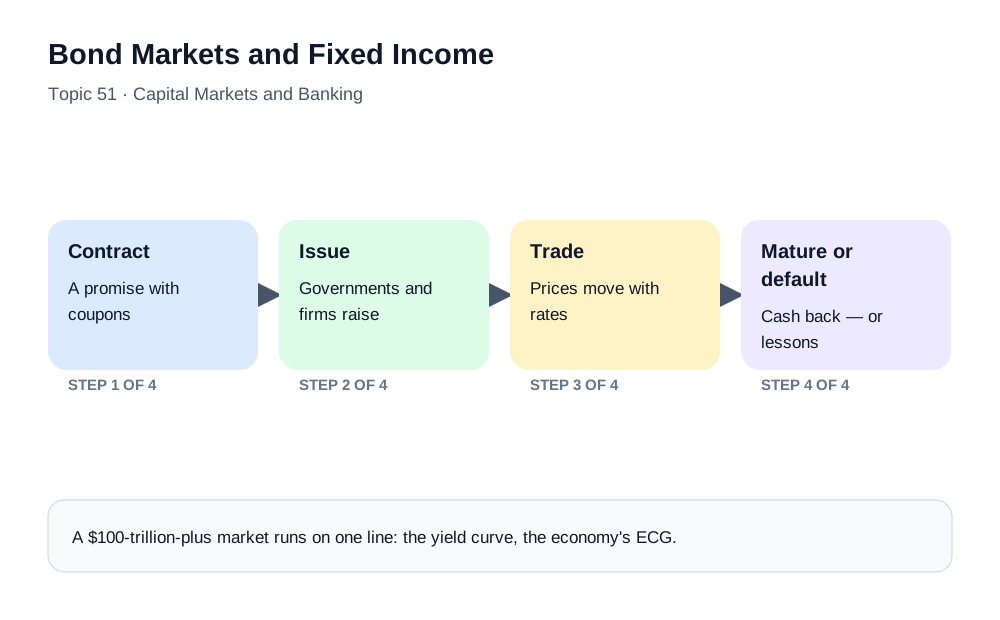
Bond Markets and Fixed Income at a glance — Government bonds, corporate bonds, yield curves.
The $133 Trillion Market That Funds Governments and Corporations
The global bond market, with outstanding securities exceeding one hundred thirty-three trillion dollars, surpasses the size of global stock markets by a substantial margin, yet it receives far less attention from the general public and financial media. This disparity in attention belies the bond market's profound importance in funding government operations, financing corporate expansion, and providing the stable investment returns that underpin retirement security for millions of people. Understanding bond markets is essential for comprehending how modern economies finance themselves, how interest rates are determined, and how financial institutions manage the risks inherent in their operations. For banks particularly, bond markets serve as investment venues, funding sources, and risk management tools, making bond market expertise a core competency for institutional success.
This chapter builds that understanding from the contract up. By the end you will be able to:
- Define a bond and its core terms — face value, coupon, maturity, yield, and credit spread.
- Map the issuer landscape from government bonds to supranationals and the risk each carries.
- Describe the main bond structures beyond plain vanilla — floating, zero-coupon, convertible, callable, perpetual, and inflation-linked.
- Read the yield curve and explain what normal, inverted, flat, and steep shapes signal.
- Explain the inverse price-yield relationship and duration as its measure.
- Describe how bonds actually trade in over-the-counter dealer markets, and who the participants are.
- Interpret credit ratings and the investment-grade boundary.
- Connect bond markets to the macroeconomy and to a bank's daily treasury work.
One boundary note before we begin: the chapter on fixed income products covers bond mathematics — pricing formulas, duration and convexity calculations, immunization — in full depth. This chapter summarizes those mechanics only as far as market understanding requires, and focuses instead on the market itself: who issues, who buys, how trading works, and why it matters.
1. First Principles: A Bond Is a Contract
A bond, in its simplest form, is a loan made by an investor to a borrower who might be a government, a corporation, or another entity capable of issuing debt. In exchange for the investor's capital, the borrower promises two things: regular interest payments, known as coupons, throughout the life of the bond, and the return of the principal amount, known as face value or par value, when the bond reaches its maturity date. This contractual structure provides investors with predictable income streams and defined maturity dates when capital will be returned, distinguishing bonds from equities where neither dividends nor capital returns are guaranteed.
Two features of this contract explain the bond market's existence and its scale. First, standardization: because a bond spells out fixed cash flows in a transferable document, the lender can sell the loan to someone else. That transferability turns a private lending relationship into a market — the same insight that makes bank loans largely illiquid while bonds trade by the trillion. Second, seniority: bondholders are creditors, not owners. In insolvency they rank ahead of shareholders, which is why bonds are called "fixed income" and why conservative institutions — pension funds, insurers, banks — anchor their portfolios in them.
The name "coupon" is itself a history lesson: paper bonds once carried detachable slips that holders physically clipped and presented for each interest payment. The payments are electronic now, but the vocabulary — coupons, clipping, maturing — survives from that era.
2. The Language of Bonds
The terminology of bond markets reflects this fundamental loan structure. The face value or par value represents the amount the borrower promises to repay at maturity, typically one thousand dollars or one hundred rupees per bond though institutional bonds may carry much higher denominations. The coupon rate specifies the annual interest payment as a percentage of face value — a seven percent coupon on a bond with one thousand rupees face value pays seventy rupees annually, usually in semi-annual installments of thirty-five rupees each. The maturity date marks when the principal must be repaid, ranging from short-term maturities of one to three years through intermediate ten-year maturities to long-term bonds extending thirty years or more. The yield represents the investor's actual return, accounting for both coupon payments and any difference between the price paid and face value received at maturity. The credit spread measures the extra yield investors demand above the risk-free rate to compensate for the possibility that the borrower might default.
The coupon-yield distinction trips up every beginner, so fix it now with numbers. You buy a ten-year bond, face value one thousand, coupon six percent, at a price of nine hundred fifty. The coupon is fixed forever at sixty a year. Your yield, however, is higher than six percent, because you also gain the fifty gap between purchase price and repayment at maturity — roughly six point nine percent annualized. Coupon describes the contract; yield describes your economics at the price you paid. Market professionals speak almost entirely in yield, because it is the only number that makes different bonds comparable.
3. The Issuer Landscape
Bond markets categorize securities by issuer type, with each category carrying distinct risk characteristics and investor bases. Government bonds, issued by national governments, carry the lowest risk because sovereign borrowers can tax their populations and, in extremis, create money to meet obligations. This sovereign status makes government bonds the benchmark risk-free assets against which all other bonds are measured. Municipal bonds, issued by state and local governments, offer slightly higher yields reflecting modestly elevated credit risk, though they often provide tax advantages that enhance their after-tax returns for investors in certain jurisdictions. Corporate bonds, issued by companies seeking to finance operations and growth, carry credit risk that varies enormously based on issuer financial health, with yields reflecting this risk variation. Bank bonds, issued by financial institutions, occupy a middle ground with credit risk reflecting both the institution's financial strength and the systemic importance that might lead to government support in crisis. Supranational bonds, issued by organizations like the World Bank and International Monetary Fund, enjoy very low credit risk backed by the collective creditworthiness of member governments.
The landscape is usefully read as a risk ladder anchored by the sovereign. Government yields form the base; every other issuer prices as the government yield plus a spread reflecting its additional risk. A AAA supranational adds little; a BBB corporate adds meaningfully; a speculative-grade issuer adds a lot. When you hear that "spreads are tightening," the market is saying that investors are demanding less extra compensation for risk — typically a sign of confidence or of abundant liquidity searching for yield.
A caveat worth holding: "risk-free" sovereign status applies to debt in the government's own currency. Governments that borrow heavily in foreign currency can and do default, because they cannot print the money they owe — a distinction that separates developed-market sovereign bonds from much emerging-market hard-currency debt.
4. Bond Structures Beyond Plain Vanilla
Bond structures vary considerably beyond simple fixed-rate instruments. Floating rate bonds tie their coupon payments to a reference rate such as SOFR plus a fixed spread, protecting investors against rising interest rates while exposing issuers to rate fluctuations. Zero coupon bonds make no periodic payments, instead issuing at deep discounts to face value and gradually appreciating toward par as maturity approaches — these instruments appeal to investors with defined future liabilities they wish to match. Convertible bonds include options to convert into equity shares of the issuing company, offering upside participation if the company performs well while providing bond downside protection if it does not. Callable bonds give issuers the right to redeem before maturity, typically when interest rates have fallen and refinancing at lower rates becomes attractive — this call option benefits issuers at the expense of investors who face reinvestment risk. Perpetual bonds have no maturity date, continuing indefinitely unless called by the issuer — these structures are particularly common for bank Additional Tier 1 capital instruments, where the perpetual nature aligns with regulatory capital requirements. Inflation-linked bonds adjust principal and coupon payments based on inflation indices, protecting investors' purchasing power during inflationary periods.
Each structure exists to solve a specific problem, and reading them that way makes the taxonomy stick:
| Structure | Problem it solves | Who it favors |
|---|---|---|
| Floating rate | Investor's fear of rising rates | Investor |
| Zero coupon | Matching a single future liability | Investor (liability matching) |
| Convertible | Issuer wants cheaper coupon; investor wants equity upside | Both, at a price |
| Callable | Issuer wants refinancing flexibility | Issuer |
| Perpetual | Bank's regulatory capital needs permanence | Issuer |
| Inflation-linked | Investor's fear of purchasing-power erosion | Investor |
The perpetual AT1 structure deserves a banker's special attention: these instruments can be written down or converted to equity if the bank's capital falls below regulatory triggers, and coupon payments can be skipped at the supervisor's discretion. They are bonds in form but capital in substance, and their treatment in bank resolution — most dramatically in the 2023 write-down of Credit Suisse's AT1 instruments ahead of its shareholders' full loss — taught the market that regulatory capital instruments carry risks ordinary bonds do not.
5. The Yield Curve: The Market's ECG
The yield curve represents one of the most closely watched relationships in financial markets, plotting interest rates across different bond maturities. A normal yield curve slopes upward, with longer maturities offering higher yields than shorter ones, reflecting the greater uncertainty and interest rate risk associated with longer-term commitments. This upward slope typically prevails during periods of economic expansion, when investors expect growth to continue and demand higher compensation for locking up capital for extended periods.
An inverted yield curve, where short-term rates exceed long-term rates, has proven to be one of the most reliable predictors of economic recession. This counterintuitive pattern occurs when investors expect future economic weakness that will force central banks to cut rates, driving down long-term yields even as short-term rates remain elevated. Historically, an inverted yield curve has preceded every United States recession over the past fifty years, making it a closely watched indicator for economists and policymakers — though the lag between inversion and recession has varied widely, from months to a couple of years, so it is a warning light, not a timer. A flat yield curve, where rates are similar across maturities, signals economic uncertainty and transition periods. A steep yield curve, with large gaps between short and long rates, typically emerges early in economic recoveries when central banks hold short rates low while long rates reflect expectations of future growth and inflation.
For banks, the curve's shape is not just a forecast but a business model variable. Banks borrow short and lend long; a normal upward-sloping curve makes that transformation profitable, while a flat or inverted curve squeezes the margin between funding costs and loan yields. Bank treasuries therefore watch the curve the way farmers watch the weather.
6. Pricing Fundamentals: The Inverse Law and Duration
Bond pricing operates according to fundamental mathematical relationships that every fixed income investor must understand. The most important principle is the inverse relationship between bond prices and yields: when interest rates rise, existing bond prices fall, and when interest rates fall, existing bond prices rise. This inverse relationship arises because existing bonds pay fixed coupons that become more or less attractive relative to new bonds issued at current market rates. If you hold a bond paying five percent coupons and new bonds offer six percent, your bond must trade at a discount to attract buyers who could otherwise purchase the higher-yielding new issue. Conversely, if rates fall to four percent, your five percent bond commands a premium.
Duration measures a bond's price sensitivity to interest rate changes, quantifying the inverse relationship with a single number that represents the weighted average time until cash flows are received. Higher duration means greater price sensitivity — a bond with modified duration of seven will decline approximately seven percent in price for every one percentage point increase in interest rates, and increase seven percent for every one percentage point decrease. Zero-coupon bonds have the highest duration, equal to their maturity, because all cash flow arrives at maturity with no interim payments to reduce sensitivity. Bonds with higher coupons have lower duration because more of their total return comes earlier through coupon payments rather than waiting until maturity.
The intuition behind duration is a seesaw: cash flows placed further out in time lengthen the lever, and small yield changes at the fulcrum swing the far end hard. The practical consequences are severe and regularly relearned: an institution holding thirty-year bonds in a rising-rate environment can lose a fifth or more of market value in a single year — precisely what happened to several banks' bond portfolios in the rapid rate rises of 2022, when hold-to-maturity accounting concealed losses that became fatal when deposit withdrawals forced sales. The fixed income chapter works through the pricing formulas and convexity refinements in full; here the operational rule suffices: duration is the translation key from "rates moved" to "I lost or gained this much."
7. How Bond Markets Actually Trade
The bond trading ecosystem comprises diverse participants each serving specific functions. Primary dealers are institutions authorized to deal directly with central banks in government securities, underwriting new issuance and making continuous markets in outstanding bonds. These dealers provide the liquidity that enables other market participants to trade efficiently. Institutional investors — pension funds, insurance companies, and mutual funds — constitute the largest bond holders, matching long-duration bond assets against their long-term liabilities. Banks hold bonds both as investments in their treasury portfolios and as inventory for trading with clients. Central banks participate as monetary policy implementers, buying and selling bonds to influence interest rates and market conditions. Retail investors, historically limited in bond market access, have gained participation opportunities through platforms like RBI Retail Direct in India, which enables individuals to purchase government securities directly.
Most bonds trade over-the-counter rather than on organized exchanges, meaning transactions occur through bilateral negotiations between buyers and sellers rather than through centralized order books. This structure provides flexibility for customizing large transactions but reduces price transparency compared to exchange-traded equities. Dealer banks provide essential liquidity by quoting bid prices at which they will buy bonds and ask prices at which they will sell, earning the spread between these prices as compensation for their market-making services. During periods of market stress, these spreads widen as dealers become less willing to commit capital to bond inventories, potentially impairing market liquidity when it is most needed.
The contrast with equity markets is structural, not accidental. A company has one class of shares; the same company may have dozens of bonds outstanding differing by maturity, coupon, seniority, and currency, and a government has hundreds. With so many instruments, continuous order-book trading cannot sustain liquidity in each one, so dealers intermediate instead, holding inventory and matching buyers with sellers over hours or days. The consequence students should retain: bond liquidity is dealer liquidity, and when dealer balance sheets shrink — from stress, regulation, or losses — the whole market's tradability shrinks with them, as episodes in March 2020 demonstrated when even the US Treasury market briefly strained.
8. Credit Ratings and the Investment-Grade Boundary
Credit risk represents the defining concern in bond investing beyond government securities, with rating agencies providing standardized assessments of issuer creditworthiness. The major rating agencies — Moody's, Standard and Poor's, and Fitch — evaluate bond issuers and assign ratings indicating their assessment of default probability. The highest ratings — Aaa from Moody's or AAA from S&P — indicate extremely strong capacity to meet obligations, with default risk considered negligible. High quality ratings of Aa or AA indicate very strong capacity, while upper medium ratings of A indicate strong capacity that is nevertheless somewhat susceptible to adverse economic conditions. Medium ratings of Baa or BBB indicate adequate capacity but vulnerability to deteriorating conditions — these represent the lowest investment-grade ratings.
The boundary between BBB and BB ratings marks the critical threshold between investment-grade and speculative-grade, commonly called "junk" territory. Many institutional investors are restricted to holding only investment-grade bonds, making this dividing line enormously consequential for issuer access to capital and investor portfolio composition. Bonds rated BB or below face higher borrowing costs and more limited investor bases, reflecting their speculative nature and substantial default risk. The lowest ratings indicate either substantial default risk or actual default, with D ratings from S&P and equivalent ratings from other agencies indicating that payment obligations are not being met.
Understanding this rating hierarchy is essential for bond market participants because ratings influence not only yields but also regulatory treatment, collateral eligibility, and investor accessibility. A downgrade from investment-grade to speculative-grade, sometimes called falling to "junk" status, can force selling by institutional investors who must divest non-investment-grade holdings, potentially depressing prices and creating self-reinforcing cycles. Conversely, upgrades can trigger buying and price appreciation as new investor categories become eligible to hold the bonds. The credit rating chapter examines the agencies, their methodologies, and their post-2008 regulatory treatment in depth; for bond market purposes, the key operational fact is that ratings are embedded in mandates, regulations, and collateral rules, so a rating change moves markets mechanically, not merely through changed opinion.
9. Bonds and the Macroeconomy
The relationship between bond markets and broader economic conditions is intimate and bidirectional. Economic growth influences bond yields through its effect on inflation expectations and central bank policy — strong growth typically leads to higher yields as investors anticipate inflation and policy tightening. Conversely, bond yields influence economic activity through their effect on borrowing costs for businesses and consumers — lower yields stimulate economic activity by reducing financing costs, while higher yields restrain activity. This interconnection makes bond markets essential transmission mechanisms for monetary policy and crucial indicators of economic expectations.
The transmission works through benchmark pricing: government bond yields anchor the entire credit system. Mortgage rates price off sovereign yields plus a spread; corporate loan rates reference bond benchmarks; the discount rates that value equities, real estate, and infrastructure all embed the risk-free rate. When the central bank buys bonds in quantitative easing, it is deliberately pressing on this anchor to lower every borrowing cost in the economy at once. This is why the bond market is sometimes called the economy's master market — its prices are simultaneously inputs to policy and outputs of expectations, a mirror and a lever at the same time.
10. Banks in Bond Markets: Four Hats
For banks, bond market expertise is not optional but essential, and banks wear at least four distinct hats in these markets. As investors, treasury operations require continuous management of bond portfolios for liquidity, yield, and risk management purposes — government bonds satisfy regulatory liquidity requirements and collateral needs. As underwriters and dealers, banks structure and distribute bond issues for corporate and sovereign clients and make markets in outstanding bonds, earning spreads and fees. As issuers, banks fund themselves in bond markets with senior debt, subordinated debt, and capital instruments, managing their own credit spreads and maturity towers. As advisors, client services depend on bond market knowledge to advise corporate borrowers on debt issuance and to assist investor clients with bond investments.
Each hat carries its own risk discipline. The investment portfolio needs interest-rate hedging and concentration limits; the dealing book needs inventory and counterparty controls; the issuance program needs refinancing ladders so that no single year carries a maturity wall; the advisory business needs independence from the trading desk. The bond market is thus not a side activity for a bank but the connective tissue between its balance sheet and the wider financial system.
11. Case Study: Anatomy of a Fallen Angel
Consider a large, long-respected industrial company rated BBB — the bottom of investment grade. A cyclical downturn hits its sector; leverage rises; the agencies place it on negative outlook and then downgrade it to BB. The mechanical consequences begin immediately: index funds tracking investment-grade benchmarks must sell; insurance portfolios with investment-grade mandates must sell; the bonds drop several points in forced liquidation before any new buyer steps in. The company's next bond issue prices at a spread two to three percentage points wider, raising its interest expense and further pressuring its credit metrics — the self-reinforcing cycle described in Section 8, now with a real balance sheet attached.
Management's response follows the standard playbook: asset sales, dividend cuts, and deleveraging targets communicated explicitly to the agencies, because regaining the rating means regaining the investor base. Two years later, with debt reduced, an upgrade restores investment-grade status, mandatory buyers return, spreads compress, and the bonds rally. The case teaches the chapter's central lesson: in bond markets, ratings are not opinions but switches that connect issuers to entire pools of capital, and the price impact of crossing the boundary exceeds anything the underlying finances alone would justify.
12. Digital Developments in Bond Markets
Bond trading was voice-dominated for decades, but electronification is advancing steadily: a large and growing share of government bond and liquid corporate bond volume now executes on electronic platforms, portfolio trading and exchange-traded funds have created new ways to move bond risk in blocks, and algorithmic market makers have entered segments once exclusive to dealer banks. Issuance has digitalized through electronic book-building and, in several jurisdictions, pilot bonds recorded on distributed-ledger platforms exploring faster settlement and automated coupon handling. Retail access is broadening through direct-purchase platforms and bond-focused funds. Post-trade, dematerialized settlement through depositories is near-universal in developed markets. The trajectory mirrors every other market: more electronic price discovery, more straight-through processing, more data — though the over-the-counter dealer structure, rooted in the fragmentation described in Section 7, is proving durable.
13. Common Misconceptions About Bond Markets
"Bonds are safe investments." Credit-safe government bonds still carry interest-rate risk: a thirty-year bond can lose twenty percent of its market value in a sharp rate rise, as 2022 demonstrated. "Safe" must always be qualified: safe from default, or safe from price swings — rarely both at once.
"If I hold to maturity, price changes don't matter." True for a single bond's cash flows, false for the institution: opportunity cost is real, accounting may force loss recognition, and liquidity needs can force sales at the worst time. The 2023 bank failures turned this misconception into actual insolvencies.
"Higher yield means a better bond." Higher yield is compensation for higher risk or longer duration — it is a price, not a gift. Chasing yield without reading the spread's reason is how portfolios accumulate hidden credit risk.
"The bond market is smaller than the stock market." The reverse is true by outstanding value — roughly one and a third hundred trillion dollars of bonds against roughly one and a tenth of equities — the stock market merely generates more news.
"Falling bond prices mean the issuer is in trouble." Not necessarily: prices fall when market-wide rates rise, even for flawless issuers. Distinguish rate risk (prices move together) from credit risk (one issuer's spread moves alone).
"Buying a bond fund is the same as buying a bond." A bond held to maturity returns face value on a known date; a bond fund has no maturity, so rising rates can produce lasting losses even as its holdings pay in full. The fund is a rolling portfolio, not a contract with an end date.
"Ratings are investment advice." Ratings are opinions of relative default probability, embedded in regulation and mandates; they are not buy recommendations, and agencies insist on the distinction in every report's fine print.
14. Frequently Asked Questions
What exactly is a bond? A standardized, transferable loan contract: the issuer promises fixed interest payments (coupons) and repayment of face value at maturity, and the holder can sell the contract to another investor before then.
Why do bond prices fall when interest rates rise? Because existing fixed coupons become less attractive relative to new bonds issued at higher rates; the price must drop until the old bond's yield matches the new market level. Duration tells you how far it drops per rate move.
What is the difference between coupon and yield? The coupon is the fixed payment set in the contract; the yield is your actual return given the price you paid, including the gain or loss to face value at maturity. Markets speak in yield because it makes all bonds comparable.
Are government bonds really risk-free? In their own currency, major sovereigns carry negligible default risk, but they carry full interest-rate risk, and governments borrowing in foreign currency can and do default. "Risk-free" is a benchmark convention, not an absolute.
What does an inverted yield curve signal? That markets expect future weakness and rate cuts — historically the most reliable single recession indicator, though its timing is imprecise. It also squeezes bank margins by making short funding cost more than long lending earns.
What is a "fallen angel"? An issuer downgraded from investment grade (BBB and above) to speculative grade (BB and below), triggering forced selling by mandate-constrained investors and a sharp repricing of its bonds.
Can individuals buy bonds directly? Increasingly yes: government securities through retail platforms in several countries, and corporate bonds through brokers, though minimums and OTC pricing favor institutions. Bond funds remain the practical route for most individuals.
Why do banks issue perpetual bonds? Because regulators count properly structured perpetual instruments as capital — AT1 — helping banks meet capital requirements without diluting shareholders, in exchange for higher coupons and write-down risk borne by investors.
What does "the ten-year yield" in the news actually refer to? The yield on the benchmark ten-year government bond of the country in question — the single most-watched interest rate in that economy, anchoring mortgage rates, corporate borrowing costs, and equity valuation models. When commentators say "yields rose," they mean prices fell.
Why would an investor buy a bond yielding less than inflation? For safety, liquidity, and regulation rather than real return: banks must hold government bonds for liquidity ratios, pension funds need matching assets, and in crises capital parks in sovereign paper accepting negative real yields as the price of certainty. Not every purchase is a return-seeking decision.
15. Key Terms in This Chapter
- Bond — a transferable debt contract promising coupons and repayment of face value at maturity.
- Face / par value — the principal repaid at maturity.
- Coupon — the periodic interest payment, set as a percentage of face value.
- Yield — the investor's total return at the purchase price; the market's common language.
- Credit spread — yield premium over the risk-free rate compensating for default risk.
- Sovereign / municipal / corporate / supranational bonds — the issuer categories forming the risk ladder.
- Floating rate bond — coupon resets against a reference rate plus spread.
- Zero-coupon bond — issued at deep discount, no interim payments; duration equals maturity.
- Convertible bond — exchangeable into the issuer's equity.
- Callable bond — redeemable early at the issuer's option; embeds reinvestment risk for investors.
- Perpetual bond / AT1 — no maturity; bank capital instruments with write-down and coupon-skip features.
- Inflation-linked bond — principal and coupons indexed to inflation.
- Yield curve — yields plotted across maturities; normal, inverted, flat, steep shapes carry macro signals.
- Duration — weighted average cash-flow timing; the measure of price sensitivity to rate changes.
- Over-the-counter (OTC) — dealer-intermediated bilateral trading, the dominant bond market structure.
- Primary dealer — institution authorized to deal directly with the central bank in government securities.
- Benchmark bond — the most-traded issue at a key maturity, whose yield anchors pricing across the economy.
- Quantitative easing — central bank bond purchases intended to lower long-term yields and ease financial conditions.
- Investment grade / speculative grade — the BBB/BB boundary separating mandated institutional capital from higher-risk paper.
- Fallen angel — an issuer downgraded across the investment-grade boundary.
16. Interview Insights: How This Topic Appears in Banking Interviews
"Why do bond prices move inversely to yields?" Because coupons are fixed while required returns float: the price adjusts until the old bond's package matches the new market yield. Anchor it with a number — a five percent bond in a six percent market must trade below par — and you demonstrate mechanism rather than recitation.
"What is duration and why does it matter to a bank?" Weighted average cash-flow timing; the multiplier translating rate moves into price moves. It matters because banks hold enormous bond portfolios for liquidity: a duration-seven portfolio loses roughly seven percent when rates rise one point, which is why treasury desks hedge and why 2022–23 punished banks that did not.
"Explain the yield curve and what an inversion means." Yields across maturities; normal slopes up, reflecting term risk; inversion reflects expected policy easing amid weakness and has preceded recessions historically. Add the bank-margin angle — borrow short, lend long gets squeezed — to show commercial awareness.
"How is bond trading different from stock trading?" Instrument fragmentation forces OTC dealer intermediation instead of centralized order books; liquidity is dealer balance sheet, transparency is lower, and stress shows up as widening bid-ask spreads and vanishing inventory rather than halted order books.
"What happens when a BBB issuer is downgraded to BB?" Forced selling from mandate-constrained holders, spread blow-out, higher funding costs feeding back into credit metrics — the fallen-angel cycle. Strong candidates add that ratings are embedded in regulation and collateral rules, making their market impact mechanical, not merely informational.
Summary and Key Takeaways
- The bond market — over one hundred thirty-three trillion dollars outstanding — is larger than the equity market and is the primary funding channel for governments and a core one for corporations and banks.
- A bond is a standardized, transferable loan: coupon plus face value at maturity; yield, not coupon, is the investor's real economics and the market's common language.
- Issuers form a risk ladder anchored by the sovereign benchmark; everything else prices as government yield plus a credit spread.
- Structures beyond plain vanilla — floating, zero, convertible, callable, perpetual/AT1, inflation-linked — each solve a specific investor or issuer problem.
- Price and yield move inversely; duration quantifies the sensitivity, and ignoring it has sunk real institutions.
- The yield curve is simultaneously a recession signal and a driver of bank profitability through the borrow-short-lend-long model.
- Bonds trade over-the-counter through dealers because instrument fragmentation defeats order-book liquidity; dealer balance sheet is the market's true liquidity.
- Credit ratings are switches embedded in mandates and regulation; crossing the investment-grade boundary moves markets mechanically.
- Banks engage as investors, underwriters, issuers, and advisors — bond market fluency is core banking competency, not a specialization.
Next: Topic 52 — Stock Markets and Equity →
<!-- MBA-DEEP-DIVE-START -->Deep Dive: Bond Markets as Issuance, Benchmarking, Liquidity, and Balance-Sheet Infrastructure
Bond markets become much more practical once we stop treating a bond as a static investment and follow its entire life. A bond is conceived because an issuer needs funding, priced against a benchmark curve, sold through an auction or syndication process, settled through securities infrastructure, traded in the secondary market, revalued every day, used as collateral where eligible, serviced through coupon payments, and finally redeemed or restructured. Every one of those stages creates a different banking control.
The central professional idea is that a bond market is a mechanism for turning long-term borrowing into a transferable, continuously priced claim. That transferability changes funding economics. A bank loan normally remains on one lender’s book or within a lending syndicate. A bond can be held by thousands of investors and can move between them throughout its life without changing the issuer’s contractual obligation.
Government issuance builds the benchmark curve
Sovereign debt markets usually provide the foundation against which other fixed-income securities are priced. Governments issue across a range of maturities, creating observable yields from short bills through longer bonds. Those yields form reference points for corporate, bank, municipal, and structured debt.
The benchmark curve is not created by one bond alone. Market participants identify the most liquid securities at important maturities, interpolate between points, and often use swaps or other market instruments alongside government securities when constructing pricing curves.
A corporate issue might therefore be described as pricing at a spread over a government benchmark or swap reference. The spread represents the market’s compensation for additional credit, liquidity, structure, and other risks beyond the base curve.
For treasury and investment teams, the benchmark curve is a common language. It allows a five-year bank bond, a five-year corporate bond, and a five-year government security to be compared through relative value rather than coupon alone.
Auctions convert government borrowing needs into market prices
Government securities can be issued through auction mechanisms under the applicable national framework. Investors or primary dealers submit bids, and the auction determines allocation and price or yield according to the announced method.
The operational discipline begins before the auction. Treasury decides the amount and maturity it wants, assesses market conditions, obtains internal limits, and ensures settlement liquidity. Bids must be submitted within cut-off, in valid format, and under the correct legal entity.
After allocation, the securities and cash settle through the market infrastructure. A successful bid creates both an investment position and a cash obligation. Failing to fund the settlement because the dealing desk and treasury cash team were disconnected is an avoidable operational error.
Auction results also become market information. A weak bid-to-cover ratio, unusually high accepted yield, or concentration of demand can change secondary-market pricing even before the new securities settle.
Corporate issuance begins with funding strategy, not a coupon guess
A company considering a bond issue should first decide what funding problem it is solving. Is the objective refinancing a maturity, funding an acquisition, lengthening debt tenor, diversifying away from banks, funding capital expenditure, or raising debt in a particular currency?
That purpose influences maturity, fixed versus floating rate, secured versus unsecured form, ranking, covenants, call options, issue size, and investor base.
A company with volatile cash flows may value a longer maturity even if the initial coupon is higher. A bank may issue subordinated debt because the instrument can satisfy regulatory capital objectives under the applicable framework, not because it is the cheapest funding available. A multinational may issue in a deep foreign bond market and swap the proceeds into its home currency.
Debt capital markets teams therefore work with treasury strategy, not only market timing.
Syndication is a controlled price-discovery process
Large corporate and bank bond issues are often distributed through a syndicate. Lead managers announce initial price guidance, collect investor orders, assess demand, refine pricing, and allocate securities.
An order book needs quality analysis. Ten billion of orders for a two-billion issue does not automatically mean five-times genuine demand. Some investors submit inflated orders expecting partial allocation. Some orders disappear when pricing tightens. Others are stable, price-insensitive buy-and-hold demand.
Syndicate desks therefore examine investor type, order size, price sensitivity, geographic diversity, and existing relationship. The objective is a price that satisfies the issuer without creating an unstable allocation likely to sell immediately.
The final spread is a negotiation between market evidence and issuer ambition. Tightening price guidance too aggressively can convert an oversubscribed book into a fragile deal within minutes.
New-issue premium links primary and secondary markets
An issuer rarely prices a new bond without reference to its existing secondary-market bonds and those of comparable issuers. Investors may demand a new-issue premium to compensate for absorbing a large amount of fresh supply or taking uncertainty around initial liquidity.
If an issuer’s existing five-year bond trades at benchmark plus 120 basis points, a new nearby maturity might need to price at 125 or 130 basis points depending on market conditions. Strong demand can compress that premium; volatile markets can widen it.
The issuer sees the extra spread as additional funding cost. Investors see it as compensation for committing capital to a new deal. Banks sit between them and must interpret where the market will genuinely clear.
Secondary-market liquidity is uneven across the curve
Unlike listed equities, bonds from the same issuer are not perfectly fungible. One company may have many issues with different maturity, coupon, currency, ranking, and call terms. Trading therefore concentrates in benchmark or recently issued securities while older or smaller issues can become illiquid.
A bond can have a reliable valuation model yet be difficult to sell at that value. During stress, dealer balance sheets can shrink and bid-ask spreads widen sharply.
Investment teams should distinguish mark-to-market value from executable value. A portfolio valued using evaluated prices or models may experience larger realised losses if it must sell a significant position quickly.
Liquidity risk is especially important for banks that intend to rely on securities for contingency funding. The asset must be saleable or repo-eligible in size when stress occurs, not merely classified as ‘marketable’ in policy.
Dealer inventory creates market liquidity but consumes bank balance sheet
Bond dealers quote prices to clients and hold inventory between buyer and seller demand. This service improves market liquidity, but it creates market and funding risk for the bank.
A dealer buying ₹500 crore of corporate bonds from a client may not have another buyer immediately. The position can lose value if rates or spreads move before distribution.
Risk limits therefore control inventory by issuer, sector, rating, tenor, duration, and other factors. Treasury charges funding cost. Market risk monitors sensitivities. Compliance monitors conduct and information barriers.
Dealer willingness to hold inventory is not unlimited. Capital, liquidity regulation, volatility, and risk appetite all influence market depth. This is one reason bond-market liquidity can deteriorate rapidly during systemic stress.
Yield curves contain several different messages at once
A yield curve is often interpreted as a forecast of future interest rates, but it also contains term premium, liquidity effects, supply-demand pressure, and market segmentation.
An inverted curve can reflect expectations of future policy easing, but the exact economic signal depends on context. Large central-bank asset holdings, regulatory demand for long securities, pension liability hedging, or unusual government issuance patterns can affect curve shape independently of recession expectations.
Professional analysis therefore avoids treating one curve shape as a mechanical economic prophecy. It asks which maturities moved, why, and whether the change came from policy expectations, inflation, term premium, credit, or technical flows.
For banks, curve movements affect both securities portfolios and customer products. A steepening driven by long rates has different implications from one driven by falling short rates.
Spread curves reveal issuer-specific risk
A company can have several bonds across maturities, allowing investors to observe a credit spread curve. A rising spread curve can reflect greater uncertainty over long-term credit. An inverted credit curve can signal near-term distress or event risk.
Relative-value traders compare one issuer’s curve with peers and with derivatives such as credit default swaps where available. They look for securities that appear cheap or expensive after adjusting for maturity, seniority, liquidity, and optionality.
A bank credit analyst should use market spreads as information, not as a substitute for fundamental analysis. Markets can move on technical flows or fear, but a sudden persistent widening often deserves investigation even before rating agencies act.
Duration should be managed by key rate, not only one average number
Portfolio duration is a useful headline measure, but large bond portfolios need more detail. Two portfolios can both have duration five while reacting differently if one is concentrated around the five-year point and another combines two-year and ten-year exposures.
Key-rate duration or similar curve-bucket measures show sensitivity to movements at different maturities. This helps treasury understand curve steepening, flattening, or twisting rather than only parallel rate shifts.
A hedge using one interest-rate swap can reduce total duration while leaving important basis or curve exposure. Risk management should verify which specific factor the hedge actually offsets.
Convexity and embedded options change behaviour under large moves
Option-free bonds tend to benefit from positive convexity, but callable bonds, mortgage-backed securities, and other instruments with embedded options can behave differently.
When rates fall, a callable bond may not rise as much because the issuer becomes more likely to redeem early. When mortgage rates fall, borrowers may refinance, shortening expected cash flows. When rates rise, prepayments can slow and duration extends.
This creates extension and contraction risk that cannot be captured fully by simple maturity or duration.
Banks holding such securities should model expected cash flows under multiple rate scenarios rather than assume contractual maturity determines economic life.
Credit events affect price before payment default
A bond does not need to miss a coupon for investors to lose money. Deteriorating earnings, leverage, litigation, regulatory action, acquisition risk, or sector stress can widen spreads and reduce market value long before default.
Banks therefore monitor both accounting credit indicators and market indicators. A security can remain current and investment grade while generating a significant mark-to-market loss.
For trading books and fair-value portfolios, that loss affects current results according to accounting classification. For other portfolios, the market-value change can still matter economically and for liquidity even if current P&L treatment differs.
Covenant and documentation quality affect recovery
Corporate bonds can contain covenants governing additional debt, asset sales, security, change of control, restricted payments, or other issuer behaviour. Covenants vary significantly by market and credit quality.
A higher-yield bond with weak covenants can expose investors to risk that is not visible in the headline rating. If the issuer moves valuable assets away from creditors or adds secured debt ahead of existing holders, recovery prospects can deteriorate without immediate default.
Institutional investors therefore read offering documents, not just term sheets. Bond analysis is partly legal analysis because creditor rights depend on contract and insolvency law.
Repo makes government bonds part of the funding system
Highly liquid government bonds often serve as collateral in repo markets. That gives them value beyond coupon and expected price return.
A bank can hold government securities as a liquidity buffer, then temporarily exchange them for cash in secured funding markets. The security may also be eligible at a central bank depending on the framework.
This collateral utility can lower required yield because investors value the instrument’s ability to generate liquidity. A slightly lower-yielding bond can be economically superior to a higher-yielding one if it is easier to finance and more reliable under stress.
Treasury portfolio construction should therefore measure return after considering funding and liquidity value.
Securities lending supports settlement and short positions
Bond holders can lend securities to dealers or other investors, receiving collateral and a fee. Securities lending helps market makers deliver bonds they have sold and supports short selling or relative-value strategies.
The lender retains economic exposure under the contract but assumes counterparty and collateral risk. Corporate actions, coupon compensation, recalls, and settlement need operational control.
A bond that is ‘on loan’ cannot be treated as freely available for every other purpose simultaneously. Collateral and inventory systems should know whether it is encumbered, lent, pledged, or available.
Bank investment books need clear purpose and accounting alignment
A bank can hold bonds for trading, liquidity management, long-term collection of cash flows, customer facilitation, or other business models. The intended use affects risk limits, accounting classification, liquidity treatment, and transfer pricing.
A common control failure occurs when a portfolio is economically managed one way but documented or accounted for another. If a bank claims it will hold securities long term but routinely sells them for short-term profit, the stated business model may not match behaviour.
Treasury, finance, risk, and accounting policy should align before large portfolios are built.
A complete corporate bond issue and secondary trade
Consider a bank client that needs ₹3,000 crore to refinance bank loans and extend maturity.
The debt-capital-markets team recommends a seven-year unsecured bond. Existing bonds trade near the relevant government curve plus 140 basis points. Initial investor discussions suggest a new issue may need around 155 basis points because market volatility is elevated.
The issuer approves launch. Banks publish price guidance and build an order book. Demand reaches ₹8,000 crore, but part is price-sensitive. Guidance tightens carefully, and the final spread is set at 148 basis points. Allocations favour a diversified mix of insurers, mutual funds, pension investors, and other institutions rather than one concentrated buyer.
On settlement date, investors deliver cash and receive securities through the depository and settlement infrastructure. The issuer repays part of its bank debt.
Three months later, market rates fall but the issuer’s sector weakens. The government benchmark yield declines while the corporate credit spread widens. The bond price reflects both effects. A dealer bank buys ₹100 crore from an investor, holds the position briefly, and later sells it to another client. Dealer P&L reflects the spread move, funding cost, and bid-ask margin.
Throughout the bond’s life, coupon payments flow through the paying-agent and custody chain until redemption. The single financing decision has become a seven-year market and operations relationship.
What excellence looks like
A world-class bond-market function understands issuance mechanics, benchmark curves, credit spreads, relative value, liquidity, dealer inventory, duration by curve bucket, embedded options, covenants, settlement, custody, repo, and collateral. It distinguishes contractual cash flow from executable market value. It knows why a security is held and how that purpose affects accounting and liquidity. It treats auction, syndication, secondary trading, and redemption as one lifecycle rather than unrelated desks.
The bond market is not simply where governments and companies borrow. It is the pricing and collateral infrastructure through which interest rates, credit risk, and long-term funding are continuously translated into market value.
<!-- MBA-DEEP-DIVE-END -->