Visual overview
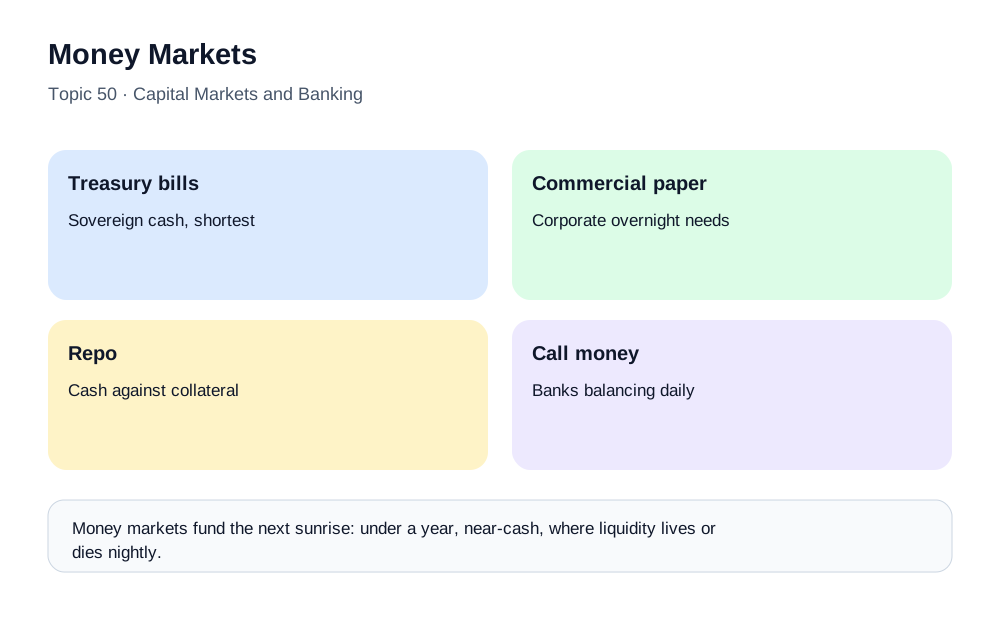
Money Markets at a glance — Treasury bills, commercial paper, repo, LIBOR, SOFR.
The Short-Term Funding Engine of the Financial System
Money markets operate as the largely invisible but absolutely essential plumbing of the global financial system, handling the borrowing and lending activities that keep institutions liquid and functioning on a daily basis. While capital markets attract headlines with their dramatic price movements and high-profile initial public offerings, money markets quietly manage the temporary cash surpluses and deficits that arise continuously for banks, corporations, and governments. These markets handle transactions ranging from overnight to one year, providing the short-term funding mechanisms that ensure payments clear, payrolls are met, and financial institutions maintain the liquidity necessary to serve their customers and meet their obligations.
This chapter explains how that plumbing works, from first principles to daily operations. By the end you will be able to:
- Define money markets and explain the three defining characteristics of their instruments.
- Describe each major instrument — treasury bills, commercial paper, certificates of deposit, repurchase agreements, and interbank lending — and who uses it and why.
- Calculate simple money market yields from discount pricing.
- Explain how benchmark rates work and why LIBOR was replaced by risk-free rates such as SOFR, SONIA, and €STR.
- Describe how central banks use money markets to implement monetary policy through open market operations and standing facilities.
- Identify the main participants and the role of money market mutual funds — including what "breaking the buck" means.
- Follow a corporate treasurer's daily liquidity workflow and understand the post-2008 reforms.
1. First Principles: The Liquidity Problem
Every economic entity faces a timing mismatch between money coming in and money going out. A bank's depositors withdraw unpredictably while its loans repay on fixed schedules. A corporation pays suppliers monthly but collects from customers in sixty days. A government spends daily but collects most taxes quarterly. These mismatches are not signs of distress — they are the normal texture of economic life — but they must be bridged continuously, sometimes for a single night.
The economy could bridge these gaps crudely: everyone could hold large idle cash buffers against every contingency. But idle cash is expensive, earning nothing while it waits. Money markets exist so that temporary surpluses and temporary deficits can find each other. The bank with excess reserves tonight lends to the bank that is short; the corporation with cash idle for ninety days funds the company that needs inventory financing for ninety days. Both sides gain — the lender earns a return on otherwise idle money, the borrower pays only for the days it needs — and the economy's total cash buffer shrinks dramatically.
This is why money markets are called the plumbing: you never notice them until they clog. When they function, liquidity circulates and the visible economy runs. When they seize — as in 2008 — payments stall, credit evaporates, and commerce itself is threatened within days.
2. Defining Characteristics: Short, Safe, and Stable
The defining characteristics of money market instruments include short maturities, high credit quality, and low price volatility. These characteristics reflect the fundamental purpose of money markets: not to generate high returns but to manage liquidity safely and efficiently. Participants in money markets accept lower yields than available in longer-term investments in exchange for the assurance that their capital will be available when needed and that its value will remain stable regardless of market conditions. This emphasis on safety and liquidity over return makes money markets suitable for managing funds that may be needed on short notice, whether for operational requirements, regulatory compliance, or contingency purposes.
Each characteristic follows from the purpose. Short maturity — overnight to one year — means the instrument repays before much can go wrong. High credit quality means issuers are governments, top-tier banks, and highly rated corporations, because a liquidity instrument that might default fails its only job. Low price volatility is a mathematical consequence of the first two: a bond's price sensitivity to interest rates grows with its maturity, so a ninety-day bill barely moves when rates change, while a thirty-year bond swings violently. The fixed income chapter develops this duration mathematics; here it is enough to know that shortness is what makes money market instruments nearly cash-like in price behavior.
The trade-off is return. Money market yields are the lowest in the debt universe, and participants accept this cheerfully because they are buying certainty and availability, not growth. The treasurer's rule of thumb: money you might need next week belongs in money markets; money you can commit for years belongs in capital markets.
3. The Mechanics of Daily Participation
The mechanics of money market participation are straightforward in concept. A commercial bank with excess cash at the end of the trading day can lend those funds overnight in the interbank market, earning a modest return while ensuring the funds remain available for withdrawal the next morning. A corporation anticipating a large payment in ninety days can invest surplus cash in commercial paper maturing when the payment is due, preserving principal while earning some return. A government facing a temporary revenue shortfall can issue treasury bills to bridge the gap until tax revenues arrive. These simple transactions, repeated millions of times daily across the financial system, constitute the money market activities that keep the global economy functioning.
Notice the matching logic: maturities are chosen to match known cash needs. This is the liquidity ladder — spreading placements across maturities so that some funds always mature just before they are needed. A treasury team managing five hundred million of operating cash might keep a portion in overnight deposits, a portion in thirty-day treasury bills, and a portion in ninety-day commercial paper, so that liquidity arrives continuously without sacrificing all yield. The ladder concept recurs throughout treasury management and appears again in the asset-liability management material covered elsewhere in this series.
4. Treasury Bills: The Foundation Instrument
Treasury bills represent the foundation of money markets in most jurisdictions. These instruments are issued by national governments with maturities typically structured around three-month, six-month, and one-year intervals — in India, for example, the standard maturities are ninety-one, one hundred eighty-two, and three hundred sixty-four days. Treasury bills are issued at a discount to their face value and redeemed at par upon maturity, with the difference representing the investor's return. A treasury bill purchased at ninety-seven rupees and redeemed at one hundred rupees after ninety-one days generates an annualized return of approximately twelve point four percent, though actual yields fluctuate with monetary policy and market conditions — in most recent years, policy rates well below that level have produced correspondingly lower bill yields.
The discount mechanics are worth internalizing because they recur across money markets. There is no coupon payment; the investor's entire return is the gap between purchase price and face value. The annualized yield scales that gap by price and time: return divided by purchase price, multiplied by days in the year divided by days to maturity. This is why "discount yield" conventions differ slightly from bond yield conventions — a nuance that matters in treasury operations and examinations alike.
The risk-free nature of treasury bills — backed by the full faith and credit of sovereign governments with the power to tax and create money — makes them the benchmark against which all other money market instruments are measured. Investors accept lower yields on treasury bills compared to other instruments because they bear virtually no credit risk. For banks, treasury bills serve multiple functions: they satisfy regulatory liquidity requirements, provide collateral for borrowing, and offer a safe parking place for funds awaiting deployment. For corporations and institutional investors, treasury bills provide a secure repository for cash that must remain absolutely safe even if returns are modest. Governments benefit too: regular bill auctions smooth their cash management between tax receipts and spending obligations, and the bill yield curve gives the central bank a read on market expectations.
5. Commercial Paper: Corporate Short-Term Funding
Commercial paper represents the primary mechanism through which corporations access money market funding. These unsecured promissory notes are issued by established companies and non-banking financial companies with maturities ranging from seven days to one year. Unlike treasury bills, commercial paper carries credit risk — investors must assess the issuer's ability to repay at maturity. To address this concern, money market regulations typically require minimum credit ratings for commercial paper issuers, ensuring that only creditworthy entities can access these markets. Minimum issuance sizes — typically five lakh rupees in India or one hundred thousand dollars in the United States — ensure that the market remains efficient by excluding very small transactions that would generate disproportionate administrative costs.
Corporations issue commercial paper primarily to manage working capital needs — financing inventory, receivables, and other short-term requirements more efficiently than maintaining large cash balances or drawing on bank credit lines. The rates paid on commercial paper reflect both general money market conditions and the specific credit quality of the issuer, with stronger companies paying rates closer to treasury bill yields while weaker credits must offer spreads compensating investors for additional default risk. For investors, commercial paper offers yields modestly higher than treasury bills with manageable credit risk, provided proper attention is paid to issuer credit quality and diversification.
Being unsecured is the feature to respect. Commercial paper is a promise with no collateral behind it, which is why the rating requirement exists and why issuers maintain committed bank credit lines as backup — if the commercial paper market closes to them at rollover, as happened to many issuers in 2008, they draw the credit line instead. The rating agencies' short-term grades function as the market's gatekeepers; a downgrade can lock an issuer out within days. This dependence on continuous market access makes commercial paper funding cheap but fragile, and treasury policy in prudent companies limits the share of funding rolled over in any short window.
6. Certificates of Deposit: Negotiable Bank Funding
Certificates of deposit issued by banks serve as another important money market instrument, particularly for managing bank funding and providing investment options for cash-rich entities. These instruments combine the safety of bank deposits with the tradeability of securities. Unlike traditional fixed deposits, certificates of deposit are negotiable — they can be bought and sold in secondary markets before maturity, providing liquidity that appeals to institutional investors. Bank-issued CDs typically carry maturities of seven days to one year and offer yields reflecting both the bank's credit quality and competitive conditions in the deposit market.
For banks, certificates of deposit provide a stable funding source that, unlike traditional deposits, will not be withdrawn before maturity regardless of interest rate movements or competitive offerings. This stability supports asset-liability management by providing known funding for defined periods. For investors, CDs offer bank-deposit safety with the flexibility to sell if cash needs arise before maturity. The negotiable nature of CDs distinguishes them from non-negotiable fixed deposits, justifying slightly different yield profiles based on liquidity characteristics.
The bank's perspective deserves emphasis: a fixed deposit can walk out the door early; a certificate of deposit cannot — its holder must find a buyer instead. That single difference makes CDs a treasury tool rather than merely a deposit product, and banks issue them deliberately to lock funding over periods when they expect deposit competition to intensify.
7. Repurchase Agreements: Collateralized Short-Term Lending
Repurchase agreements, universally known as repos, constitute a sophisticated money market mechanism that functions essentially as collateralized short-term lending. In a repo transaction, one party sells securities to another with an agreement to repurchase them at a specified price on a future date, typically the next business day for overnight repos or within two weeks for term repos. The difference between the sale price and repurchase price represents the interest on the loan. Government securities typically serve as collateral, providing security to the cash lender that they can seize and sell the collateral if the borrower fails to repurchase as agreed.
The economic substance of a repo is a collateralized loan — the "seller" is actually a borrower using securities as collateral, while the "buyer" is a lender protected by the collateral value. Repos are fundamental to money market functioning, enabling securities holders to obtain short-term funding while allowing cash-rich entities to earn secured returns. The repo rate set by central banks often serves as the benchmark interest rate for the broader economy, representing the cost of short-term secured funding for the most creditworthy borrowers.
Two operational details matter in practice. First, the haircut: the cash advanced is slightly less than the collateral's market value, so a small adverse price move does not leave the lender undersecured. Second, legal title actually transfers — this is a true sale and repurchase, not a pledge — which makes repos robust in bankruptcy and explains their dominance over unsecured interbank lending after 2008. The mirror transaction, from the cash lender's side, is called a reverse repo: same trade, opposite perspective. Repo markets are enormous — the daily volume of Treasury repo in the United States runs into the trillions of dollars — and they are where monetary policy bites first, as Section 9 explains.
8. The Interbank Market: Banks Lending to Banks
Underneath every other money market activity sits the interbank market, where banks lend reserves to each other, most famously overnight. Its purpose is mundane and vital: every day, payment flows leave some banks with more reserves at the central bank than they need and others with less. The interbank market redistributes those reserves so that every bank ends the day meeting its reserve and settlement obligations, and no bank's surplus sits idle.
Overnight interbank rates are the most sensitive interest rates in the economy — the first to move when central bank policy changes and the reference point from which other money market rates are priced. The health of this market is also a diagnostic: when banks trust each other, interbank rates sit close to the policy rate; when trust evaporates, as during the 2008 crisis, the spread between interbank rates and policy rates widens dramatically, signaling stress before almost any other indicator. Central banks and supervisors watch this spread the way physicians watch blood pressure.
9. Benchmark Rates: From LIBOR to Risk-Free Rates
The transition in benchmark interest rates represents one of the most significant developments in money market history. For half a century, LIBOR — the London Interbank Offered Rate — served as the world's most important interest rate benchmark, referenced in contracts with a total notional value exceeding three hundred fifty trillion dollars. LIBOR represented the rate at which major banks estimated they could borrow from other banks in the London interbank market for various maturities and currencies. However, LIBOR suffered from fundamental flaws that ultimately led to its discontinuation in 2023.
The first flaw was methodological — LIBOR was based on bank estimates of borrowing costs rather than actual transactions. As interbank lending declined following the financial crisis, these estimates became increasingly hypothetical rather than grounded in real market activity. The second flaw proved more scandalous — the 2012 LIBOR manipulation revelation showed that banks had colluded to submit false estimates, either to benefit their own trading positions or to project false confidence about their creditworthiness during periods of stress. These failures undermined confidence in LIBOR and necessitated its replacement.
The new generation of risk-free reference rates is based on actual overnight transactions in deep and liquid markets, making them more robust and less susceptible to manipulation. In the United States, SOFR — the Secured Overnight Financing Rate — is based on actual transactions in the Treasury repo market, representing the cost of overnight borrowing collateralized by government securities. The United Kingdom adopted SONIA — the Sterling Overnight Index Average — while the Eurozone uses €STR — the Euro Short-Term Rate. Japan's TONA — the Tokyo Overnight Average Rate — serves similar functions for yen transactions. In India, MIBOR — the Mumbai Interbank Offered Rate — continues to serve as a key reference, though market participants globally have shifted toward the new overnight risk-free rates.
The transition's legacy for banking practitioners: the new rates are overnight and nearly credit-risk-free, whereas LIBOR was a term rate embedding bank credit risk. Contracts, loans, and derivatives had to be re-documented, term structures had to be built from compounding overnight rates, and the subtle difference — a benchmark that no longer rises when banks' creditworthiness falls — changed how loan pricing behaves in crises.
10. Central Banks: Monetary Policy Through Money Markets
Central banks use money markets as their primary mechanism for implementing monetary policy. Through open market operations — the purchase and sale of government securities — central banks influence the supply of reserves in the banking system and thereby guide short-term interest rates toward policy targets. When a central bank purchases securities, it pays by crediting the selling bank's reserve account, increasing the supply of reserves and putting downward pressure on interest rates. When it sells securities, it debits reserve accounts, reducing reserve supply and putting upward pressure on rates.
The repo facility enables central banks to lend reserves to commercial banks against collateral, providing liquidity when needed and establishing a ceiling for short-term rates — banks will not pay more in private markets than the central bank charges for direct borrowing. Reverse repo allows central banks to borrow reserves from banks, absorbing excess liquidity and establishing a floor for rates — banks will not lend in private markets for less than they can earn from the central bank. These standing facilities create a corridor within which market-determined rates fluctuate, with the policy repo rate representing the central bank's target for short-term funding costs.
The transmission chain runs from here outward: the policy rate moves overnight money market rates, which move deposit and short lending rates, which influence bond yields, which shape the cost of capital across the whole economy. Money markets are the first link in that chain — which is why a central bank's interest rate announcement is, operationally, a statement about where it intends money market rates to trade, enforced by its willingness to transact in unlimited size at its corridor boundaries.
11. The Participant Ecosystem
The participants in money markets form a diverse ecosystem with complementary roles. Central banks set policy rates and conduct operations to maintain financial stability and achieve macroeconomic objectives. Commercial banks constitute the largest participants on both sides of money markets — borrowing when short of reserves and lending when holding excesses. Money market mutual funds aggregate investments from individuals and institutions, deploying these funds across money market instruments while offering liquidity and stable net asset values. Corporations participate both as issuers of commercial paper and as investors of surplus cash. Primary dealers serve as market makers in government securities, maintaining continuous two-way markets and ensuring that central bank operations transmit smoothly to broader markets. Non-banking financial companies access money markets for funding through commercial paper and repo, though they typically face slightly higher rates than banks due to their non-depository status.
| Participant | Typical role | Main instruments |
|---|---|---|
| Central bank | Policy implementation, liquidity corridor | OMOs, repo/reverse repo facilities |
| Commercial banks | Both sides — lend surpluses, fund shortages | Interbank, repo, CDs, T-bills |
| Money market funds | Aggregate small investors into wholesale instruments | T-bills, CP, CDs, repo |
| Corporations | Issue CP; park surplus cash | Commercial paper, T-bills, MMFs |
| Primary dealers | Market making in government securities | T-bills, repo |
| Non-bank financial companies | Borrow short-term funding | Commercial paper, repo |
12. Money Market Funds and "Breaking the Buck"
Money market funds occupy a particularly important position, serving as intermediaries that enable retail and small institutional investors to access money market investments that would otherwise be unavailable due to high minimum denominations. These funds aim to maintain stable net asset values — typically one dollar per share in the United States or ten rupees in India — allowing investors to treat money market fund shares essentially as cash equivalents earning modest yields. However, this stable NAV objective creates risks that became apparent during the financial crisis.
In September 2008, the Reserve Primary Fund, a prominent money market fund, "broke the buck" when its net asset value fell below one dollar per share due to exposure to Lehman Brothers debt that became worthless when Lehman filed for bankruptcy. This rare event — money market funds had maintained stable NAVs for decades — triggered a panic run as investors rushed to withdraw funds from all money market funds, fearing similar losses. The run threatened to freeze money markets and disrupt the essential funding flows that keep the financial system functioning. Only extraordinary government guarantees and liquidity provisions halted the run and stabilized the market.
The episode revealed a structural fragility: a fund promising bank-deposit stability while holding marketable securities is running a maturity and valuation mismatch without a central bank behind it. When investors believe the promise, they treat the fund as cash; when doubt appears, they run exactly as they would from an uninsured bank. The mutual funds chapter covers fund structures generally; the money market fund's peculiar promise of perfect stability makes it a banking topic as much as an investment one.
Post-crisis reforms have addressed these vulnerabilities. Institutional money market funds in many jurisdictions must now use floating NAVs that reflect actual market values rather than rounding to the nearest dollar or rupee, ensuring that investors understand that money market funds are investments, not guaranteed deposits. Liquidity gates and redemption fees enable funds to restrict withdrawals during periods of stress, preventing runs by imposing costs on early redeemers. Tighter credit quality requirements limit the riskiness of holdings, and enhanced disclosure improves transparency. These reforms have made money market funds more resilient, though they have also reduced the appeal of these funds as perfect cash equivalents.
13. A Treasurer's Day: The Workflow in Practice
Abstract instrument descriptions come alive in a daily workflow. A corporate treasurer starts the morning with the day's cash position: opening balances across bank accounts, confirmed receipts and payments, and a forecast of the day's net flow. If the company will end the day with a surplus of, say, eighty million, that cash must be placed before the market closes — idle balances earn nothing or a pittance. The treasury team splits the placement across its liquidity ladder: some into the overnight bank deposit or money market fund sweep for tomorrow's uncertainty, some into thirty-day treasury bills through its dealer, some rolled in maturing commercial paper.
If instead the forecast shows a deficit, the same team works the other side: drawing a committed credit line, issuing commercial paper if the company's program is active, or selling near-maturity bills. Every choice weighs cost against certainty — the credit line costs more but is contractually reliable; commercial paper is cheaper but depends on market access that day.
Banks run the identical routine at larger scale through their treasury desks, with the added obligation of meeting reserve requirements and liquidity ratios, and with the interbank and repo markets as their venues. The discipline is identical: know your position, ladder your maturities, keep backup funding committed, and never assume the market will be open to you tomorrow.
14. Digital Developments in Money Markets
Money markets were wholesale telephone markets for most of their history — dealers calling dealers, voice-brokered. Electronic trading has transformed large parts of this: treasury bill auctions are fully electronic, repo trading increasingly runs through electronic platforms and centrally cleared tri-party arrangements where a custodian manages collateral allocation, and commercial paper issuance and settlement are dematerialized in major markets. Payment-versus-payment and delivery-versus-payment settlement through central bank systems has removed principal risk from the settlement leg.
The frontier developments are incremental rather than revolutionary: shorter settlement cycles compress counterparty exposure; central banks are experimenting with wholesale digital settlement infrastructure, including pilots of central bank digital currency for interbank settlement in several jurisdictions; and intraday liquidity analytics give treasurers real-time positions that once arrived only at end of day. None of this changes the instruments or the economics — it changes the speed, transparency, and safety of the plumbing.
15. Common Misconceptions About Money Markets
"Money markets are where currencies are traded." A persistent confusion from the name. Currency trading is the foreign exchange market. Money markets trade short-term debt instruments denominated in a currency, not the currency itself.
"Money market instruments are riskless." Treasury bills carry sovereign risk (small but not zero everywhere), commercial paper is unsecured corporate risk, and even repos carry collateral and counterparty risk. "Low risk" is not "no risk," as 2008 demonstrated.
"The repo rate is the rate banks charge each other." The policy repo rate is the central bank's rate for lending to banks against collateral. Market repo rates and interbank rates float around it inside the corridor; conflating them muddles how policy transmits.
"Money market funds are bank deposits." They are investments in marketable securities without deposit insurance. The stable NAV is an objective, not a guarantee — which is precisely what "breaking the buck" proved.
"Discount pricing means a bargain." A treasury bill's discount is not a markdown; it is the interest itself. The gap between price and face value is the return, and comparing it to coupon yields requires the annualization arithmetic of Section 4.
"Central banks set all short rates directly." They set policy rates and defend a corridor; market rates are determined by trading within it. The corridor disciplines the market; it does not replace it.
16. Frequently Asked Questions
What is the difference between money markets and capital markets? Maturity and purpose. Money markets handle funding up to one year for liquidity management, emphasizing safety and availability; capital markets handle long-term funding for investment, emphasizing return. The previous chapter covers capital markets in full.
Why would anyone lend money overnight? Because idle cash earns nothing, and large institutions cannot leave millions unplaced even for a night. Overnight lending — interbank, repo, or central bank facilities — converts idle balances into income at essentially one day's risk.
Is commercial paper safe for individual investors? It is a wholesale instrument with high minimums and no collateral, designed for institutions able to assess credit and diversify. Individuals access the same risk more sensibly through money market funds, which pool and diversify commercial paper and similar instruments.
What does "breaking the buck" mean? A money market fund's share value falling below its stable target (one dollar, or ten rupees) — meaning investors lost principal in a product treated as cash. It is rare but transformative: the 2008 episode triggered a market-wide run and permanent regulatory reform.
Why did LIBOR have to die? It measured estimated, increasingly hypothetical bank borrowing costs and was demonstrably manipulated. Replacements like SOFR, SONIA, and €STR measure actual overnight transactions in deep markets, making them harder to game and more representative.
How do I calculate the return on a treasury bill bought at a discount? Return equals face value minus price, divided by price, then annualized by days in the year over days to maturity. Ninety-seven to one hundred over ninety-one days: three divided by ninety-seven, times 365 over 91 — about twelve point four percent annualized in that example.
What is the difference between a repo and a bank loan? A repo is technically a sale and repurchase of securities, so title to the collateral transfers and the lender can liquidate immediately on default. A loan creates a claim that must be enforced. This legal robustness is why repo displaced much unsecured interbank lending after 2008.
Who decides money market interest rates? Trading does, within boundaries the central bank enforces. The policy corridor — lending facility above, deposit or reverse repo facility below — frames the range; supply and demand for reserves set the actual prints.
17. Key Terms in This Chapter
- Money market — the market for debt instruments maturing within one year, used for liquidity management.
- Treasury bill (T-bill) — short-term sovereign paper issued at a discount and redeemed at face value.
- Commercial paper (CP) — unsecured short-term corporate promissory notes, rating-gated.
- Certificate of deposit (CD) — a negotiable, tradeable bank deposit with a fixed maturity.
- Repurchase agreement (repo) — a sale of securities with agreement to repurchase; economically a collateralized loan.
- Reverse repo — the same transaction viewed from the cash lender's side; also a central bank liquidity-absorption tool.
- Haircut — the margin by which collateral value exceeds cash advanced in a repo.
- Interbank market — banks lending reserves to each other, typically overnight.
- Liquidity ladder — staggering placements across maturities so funds mature as needed.
- Discount yield — money market return convention based on price discount, annualized.
- LIBOR — the discontinued estimate-based interbank benchmark, replaced in 2023.
- SOFR / SONIA / €STR / TONA — transaction-based overnight risk-free rates for dollars, sterling, euro, and yen.
- Open market operations — central bank purchases and sales of securities to manage reserves and rates.
- Rate corridor — the band between the central bank's lending and absorption facilities within which market rates trade.
- Money market fund (MMF) — a fund holding money market instruments, targeting stable value; an investment, not a deposit.
- Breaking the buck — an MMF's NAV falling below its stable target, crystallizing principal loss.
- Primary dealer — a bank appointed to make markets in government securities and support central bank operations.
- Tri-party repo — a repo where a custodian manages collateral between the two parties.
18. Interview Insights: How This Topic Appears in Banking Interviews
"Explain the difference between a treasury bill, commercial paper, and a certificate of deposit." Issuer and risk: sovereign and near-riskless; corporate and unsecured; bank-issued and negotiable. Add purpose — government cash management, corporate working capital, bank funding stability — and the discount-versus-interest-bearing mechanics, and you have the complete comparison interviewers want.
"How does the central bank actually control interest rates?" Not by decree but by transaction: open market operations adjust reserve supply, while standing repo and reverse repo facilities bound the corridor from above and below. Banks arbitrage between the central bank and the market, pinning overnight rates inside the corridor. Mention that longer rates transmit from there and the answer shows mechanism, not mantra.
"Why was LIBOR replaced, and what replaced it?" Estimate-based methodology, shrinking underlying transactions, and proven manipulation; replaced by overnight transaction-based risk-free rates — SOFR, SONIA, €STR, TONA. Strong candidates note the deeper change: benchmarks no longer embed bank credit risk, which alters how floating-rate pricing behaves under stress.
"A money market fund promises one dollar per share. What could go wrong?" Everything the 2008 crisis taught: the fund holds marketable securities whose values fluctuate, the stable NAV is an objective rather than a guarantee, and the promise invites runs the moment credibility cracks. Reforms — floating NAVs for institutional funds, liquidity gates, redemption fees, tighter credit rules — are the institutional memory of that lesson.
"Walk me through a repo and its risks." Sale and repurchase with the price gap as interest; title transfers, so default remedies are fast; residual risks are collateral price gaps (mitigated by haircuts), counterparty failure between settlement legs, and the systemic risk of repo market runs, where lenders simultaneously shorten maturities or raise haircuts. The last point — repo runs as a shadow-banking vulnerability — distinguishes senior-level answers.
Summary and Key Takeaways
- Money markets are the financial system's short-term liquidity engine: instruments from overnight to one year, defined by short maturity, high credit quality, and price stability, trading return for certainty and availability.
- The core instruments map to issuers' needs: treasury bills for government cash management and the risk-free benchmark; commercial paper for corporate working capital; certificates of deposit for stable bank funding; repos for collateralized lending; the interbank market for redistributing reserves among banks.
- Discount pricing is the money market convention — the gap between price and face value is the interest, annualized by time.
- Benchmark rates moved from estimate-based LIBOR to transaction-based overnight risk-free rates (SOFR, SONIA, €STR, TONA) after methodological decay and manipulation; the change removed embedded bank credit risk from the world's reference rates.
- Central banks implement monetary policy through money markets — open market operations move reserve supply, and standing facilities bound a rate corridor within which market rates trade.
- Money market funds democratize access but are investments, not deposits; the 2008 "breaking the buck" run drove reforms to floating NAVs, liquidity gates, and tighter credit standards.
- Daily practice is a treasurer's discipline: know the position, ladder maturities, keep committed backup funding, never assume market access.
- The functioning of money markets reveals the extraordinary complexity underlying seemingly simple transactions: when a corporation pays a supplier, funds flow through multiple money market instruments and institutions — perhaps moving from a commercial paper investment to a bank deposit, then through the central bank's settlement system, and finally to the supplier's account. Disruptions to these markets can paralyze economic activity, demonstrating that the invisible plumbing of money markets is in fact essential infrastructure upon which the visible economy depends.
Next: Topic 51 — Bond Markets and Fixed Income →
<!-- MBA-DEEP-DIVE-START -->Deep Dive: Money Markets as the Daily Funding and Liquidity Engine of the Financial System
Money markets are often defined as markets for short-term instruments, usually up to one year. That definition is technically useful but economically incomplete. The money market is the system through which banks, governments, companies, funds, and other institutions turn tomorrow's cash into today's liquidity, place temporary surpluses safely, and transmit central-bank policy into actual funding prices.
A bank can be profitable on paper and still fail if it cannot obtain cash today. Money markets exist because the timing of cash inflows and outflows rarely matches perfectly. They are where that timing problem is continuously priced and repaired.
Liquidity need can arise without credit deterioration
Imagine a healthy bank whose customers withdraw ₹5,000 crore in one week to pay taxes or complete a major acquisition. Its loan book has not suddenly become bad, but loans cannot all be converted into cash instantly. The bank needs short-term funding or must monetise liquid assets.
It can borrow in unsecured interbank markets, enter repo using eligible securities, issue short-term instruments, draw committed lines, access central-bank facilities according to the framework, or sell liquid assets.
The choice depends on price, collateral, tenor, market access, regulation, and confidence. Money-market management therefore sits at the intersection of treasury, liquidity risk, collateral, and monetary policy.
Overnight money is the purest price of bank liquidity
The shortest money-market transactions mature overnight. Banks with temporary surplus funds lend to banks needing cash, subject to the market's credit and regulatory structure.
An overnight rate reflects the marginal price of very short bank liquidity. Central banks influence this price through their operating frameworks: policy rates, reserve remuneration, standing facilities, open-market or repo operations, and liquidity supplied or absorbed from the banking system.
This is why changes in monetary policy first become visible in very short market rates before flowing outward to deposits, loans, bonds, and broader asset prices.
A policy rate is not simply an administrative number announced at a press conference. It becomes economically powerful when money-market trading and central-bank facilities anchor actual short-term funding around it.
Unsecured interbank lending prices counterparty credit directly
In an unsecured transaction, one bank lends to another without specific collateral. The lender therefore bears the borrowing bank's credit risk over the short term.
Under normal conditions, that risk may appear modest. During stress, unsecured markets can fragment quickly because banks become uncertain about each other's solvency or liquidity.
A widening spread between unsecured and secured short-term rates can therefore signal fear in the banking system. The lender is demanding extra compensation not for time alone but for the possibility that the borrower may not repay.
Counterparty limits and maturity limits are essential even for overnight lending. Short tenor reduces exposure duration; it does not make a weak bank safe.
Repo converts securities into secured funding
A repurchase agreement, or repo, is economically a secured borrowing. One party transfers securities for cash and agrees to repurchase equivalent securities later at a higher price. The price difference produces the repo rate.
For the cash lender, the securities provide protection if the borrower defaults. For the cash borrower, repo converts a security holding into usable cash without an outright economic sale of the position.
The collateral creates several controls: eligibility, market value, haircut, margining, custody, substitution, and close-out rights.
A ₹100 crore bond position may support less than ₹100 crore of cash because the lender applies a haircut. If the haircut is 2%, the cash advanced may be roughly ₹98 crore under a simplified example. The haircut protects against market-value changes and liquidation costs during default.
Haircuts rise when markets become uncertain
Collateral is not equally liquid in all conditions. A highly liquid government security may receive a low haircut in normal markets. A lower-quality or volatile asset receives a higher haircut or may become ineligible.
During stress, lenders can increase haircuts. The borrower must then provide more collateral for the same cash or repay part of the funding.
This creates a liquidity feedback loop. Falling asset prices reduce collateral value; higher haircuts increase cash needs; forced asset sales push prices lower.
Treasury should therefore stress not only repo rates but haircut and collateral-eligibility shocks.
Collateral availability can constrain funding before total assets do
A bank may own plenty of assets but have little usable collateral because securities are already pledged, encumbered, legally unavailable, operationally trapped, or not accepted by the funding counterparty.
Collateral management should therefore maintain an inventory showing asset, location, owner, legal entity, currency, eligibility by central bank or counterparty, market value, haircut, encumbrance, and settlement readiness.
An asset that theoretically qualifies but cannot be delivered before the funding cut-off is not useful liquidity today.
This is why large banks treat collateral as an enterprise resource rather than a back-office record.
Treasury bills are government short-term funding instruments
Governments issue short-dated securities such as Treasury bills to finance temporary cash needs and manage maturity profiles. These instruments are generally sold at discount or through other defined structures depending on market convention and repay face value at maturity.
Because sovereign short-term securities in strong domestic-currency frameworks are often highly liquid, banks and funds use them as liquidity investments and collateral.
Their yield helps anchor the short end of the sovereign curve. It reflects policy expectations, system liquidity, government cash needs, and market demand.
A bill can carry little credit risk and still have price movement if yields change before maturity, though short maturity limits duration relative to longer bonds.
Commercial paper funds companies without a bank loan
Commercial paper (CP) is short-term unsecured debt issued by eligible companies or financial institutions under the applicable market framework.
It allows issuers to fund working capital, inventories, receivables, or other short-term needs directly from investors rather than drawing bank credit.
The issuer must refinance CP when it matures unless operating cash flow or other funding repays it. That creates rollover risk. A company can appear well funded while markets are open and face severe liquidity stress if investors suddenly refuse to buy new paper.
Credit lines from banks often backstop CP programmes. This connects capital-market funding back to bank liquidity: during stress, companies can draw committed bank facilities at the same time banks themselves face funding pressure.
Certificates of deposit provide wholesale bank funding
Banks can issue negotiable certificates of deposit under applicable rules to raise short-term market funding. Investors gain short-term exposure to the issuing bank and receive a return reflected in issue price or coupon structure.
CD pricing reveals how the market views the bank's funding quality relative to peers and benchmarks. A bank forced to pay significantly more than competitors may be experiencing credit concern, liquidity need, or both.
Wholesale CD funding can be efficient but less stable than granular transactional deposits because sophisticated investors can move rapidly to a better yield or safer institution.
Treasury should therefore distinguish deposit volume from deposit behaviour.
Money-market funds transform cash management for investors
Money-market funds pool investor cash into short-term high-quality instruments according to their mandate and regulation. They provide investors with liquidity and diversification while supplying funding to governments, banks, and companies.
The fund itself introduces liquidity transformation. Investors may expect rapid redemption while some assets can become difficult to sell under stress.
Historic episodes have shown that investors can run from funds if they fear losses or liquidity restrictions. Regulation and fund structures seek to manage this through asset quality, maturity, liquidity buffers, valuation, and redemption mechanisms appropriate to the jurisdiction.
Banks should therefore not assume that institutional deposits from money-market funds behave like household current accounts.
Weighted average maturity hides less than a simple final maturity date
A money-market portfolio can contain many instruments with different maturities and reset features. Treasury and investment teams use measures such as weighted average maturity or related liquidity measures according to their framework to understand how quickly the portfolio turns into cash or reprices.
A portfolio with one-year legal maturities but floating rates that reset monthly behaves differently from a portfolio of fixed-rate one-year instruments. Similarly, a security that matures soon but has no active secondary market may be less useful for immediate liquidity than a longer security that can be repoed instantly.
Maturity should therefore be analysed alongside marketability and collateral utility.
Central-bank reserves are settlement liquidity
Commercial banks settle many domestic interbank obligations using balances held at the central bank under the national payment and monetary framework.
A bank can have ample customer deposits yet still need the right settlement liquidity at the right time. Outbound payments can move central-bank money to other banks even though the banking system's aggregate reserve balance is unchanged.
Treasury forecasts these flows and obtains liquidity through money markets or central-bank facilities as needed.
The link between money markets and payment systems is therefore direct: payment obligations create intraday and overnight funding needs, and funding conditions influence how comfortably banks can settle.
Intraday liquidity deserves separate management
A bank may start and end the day with sufficient liquidity yet experience a dangerous shortfall at noon because large payments leave before incoming receipts arrive.
Intraday liquidity management monitors opening settlement balances, expected receipts, payment queues, collateral, credit lines, central-bank intraday facilities, and timing of securities settlement.
Delaying payments to conserve liquidity can create customer and system risk. Sending everything immediately without regard to funding can exhaust settlement capacity.
Large-value payment operations and treasury therefore need shared visibility of cash position and queued obligations.
Netting reduces settlement funding but can concentrate timing risk
Payment, securities, derivative, and money-market infrastructures often net obligations so participants settle only net amounts rather than every gross transaction individually.
Netting reduces liquidity needs dramatically. But the final net obligation can still be large and is often due at a precise cut-off.
Treasury must know the expected net settlement and have cash or collateral available before the deadline. A last-minute data or funding error can become systemic because other participants rely on final settlement.
The same principle appears throughout banking: netting reduces gross movement but does not eliminate the need for final money.
Liquidity coverage rules influence money-market demand
Prudential liquidity requirements encourage banks to hold defined stocks of high-quality liquid assets and maintain stable funding relative to their risk profile. The exact rules depend on jurisdiction and bank type.
This regulatory demand affects money-market pricing because some securities are more valuable when they qualify for liquidity buffers or central-bank operations.
Treasury cannot choose instruments solely by yield. A lower-yielding security with superior regulatory and collateral value can be economically more useful to the bank than a higher-yielding instrument that is difficult to monetise.
Internal transfer pricing should recognise this liquidity value so businesses do not consume scarce stable funding for free.
Funds transfer pricing sends money-market economics into customer products
A five-year loan should not be priced using overnight funding cost simply because today's overnight rate is cheap. Treasury assigns internal funding curves reflecting tenor, liquidity, optionality, and other factors.
Product teams then price customer loans and deposits using those internal costs or benefits.
A stable retail deposit can receive an internal funding credit because it reduces the bank's need for wholesale borrowing. A long-dated loan receives a funding charge because treasury must support it through the cycle.
This mechanism connects the external money market to branch and digital product pricing without requiring every relationship manager to become a money-market trader.
Benchmark rates should be understood by construction
Short-term financial contracts reference benchmarks such as secured overnight rates, unsecured interbank rates, or central-bank-linked indices depending on currency and market.
A benchmark is not just a number. Its construction determines what economic risk it represents. A secured overnight rate built from repo transactions reflects secured funding conditions. An unsecured interbank benchmark reflects bank credit and liquidity to a different degree.
After the LIBOR transition, banks learned the importance of basis risk: two rates that both look like ‘short-term interest rates’ can move differently.
Contracts, hedges, pricing, and transfer curves should reference benchmarks appropriate to the underlying economics.
Term structure converts overnight expectations into funding prices
Money-market instruments exist across days, weeks, and months. Their rates incorporate expectations about future policy, liquidity, credit, and supply-demand conditions.
If the market expects policy rates to fall, three-month or six-month rates may trade below today's overnight level. If investors expect tightening, term rates may be higher.
Treasury can lock term funding to reduce rollover uncertainty, but longer funding can cost more than overnight borrowing. The decision balances current cost against future funding risk.
A bank that funds every day overnight because it is cheapest can appear efficient until markets close.
Rollover risk can turn a solvent borrower into a liquidity crisis
Short-term funding creates a maturity wall that must be refinanced repeatedly. If investors lose confidence, refuse to roll, or demand a prohibitive rate, the borrower needs cash from somewhere else.
Banks stress this by modelling the loss of unsecured funding, deposit outflows, haircut increases, and inability to issue new debt for defined periods.
Contingency funding plans identify actions: monetise liquid assets, draw central-bank facilities where eligible, reduce new lending, raise secured funding, activate committed lines, or take other approved measures.
A plan is credible only if collateral, legal documents, limits, and operational connectivity are ready before stress begins.
Central-bank facilities should be operationally testable
A bank can assume it has access to a central-bank liquidity facility but discover during stress that collateral is not pre-positioned, legal documentation is incomplete, system connectivity fails, or staff do not know the process.
Treasury and operations should periodically test the mechanics permitted by the framework. Emergency liquidity is not useful if it takes three days to mobilise when the need is today.
Using a facility can also carry market or reputational considerations depending on disclosure and conditions. Those concerns belong in contingency planning, but they should not prevent the bank from understanding its genuine usable options.
Money-market dealing requires segregation and limits
Dealers can place or borrow large amounts quickly. Front-office limits should cover counterparty, tenor, product, currency, and market risk as appropriate.
Independent operations confirm trades, settle cash and securities, and reconcile accounts. Risk monitors limits separately from the dealing desk.
A dealer should not be able to create a fictitious deposit placement and also confirm that the counterparty owes the bank money. The same segregation principles used in derivatives and securities apply here.
Brokered trades need controls over broker authority, recorded terms, fees, and confirmation with the actual counterparty.
Settlement instructions are a high-value fraud target
Money-market trades can involve hundreds of crores or more. A fraudster who convinces operations to change a counterparty bank account can redirect enormous value.
Standing settlement instructions should therefore be maintained through controlled static-data processes with independent verification, effective dating, and audit trail. Last-minute email changes deserve exceptional scrutiny.
Payment messages should be generated from approved instructions rather than manually retyped wherever possible.
The most sophisticated market risk model cannot protect a bank from sending the right amount to the wrong account.
Interest accrual and day-count conventions must be exact
Short-term instruments use market-specific day-count and interest conventions. A one-day error matters when notional amounts are large.
Systems need trade date, value date, maturity, rate, principal, day-count basis, holiday calendar, and business-day adjustment. Interest should accrue consistently between trading, treasury, accounting, and settlement systems.
At maturity, principal and interest should reconcile to the counterparty's calculation before payment. Repeated small breaks can signal convention mismatch in system configuration.
A full liquidity-management scenario
A bank enters a week expecting normal cash flows. On Monday, a corporate client announces it will transfer ₹3,000 crore out on Wednesday to complete an acquisition. At the same time, ₹2,000 crore of the bank's wholesale deposits mature on Thursday.
Treasury updates the liquidity forecast. The bank has sufficient overall assets, but selling long-term loans is not practical. It identifies government securities available for repo, maturing Treasury bills, central-bank balances, expected customer inflows, and unsecured market capacity.
Rather than wait until Wednesday, treasury locks part of the needed cash through a one-week repo and raises some term money to cover the wholesale maturity. Collateral is allocated and settlement instructions confirmed. The payment operations team knows the major outflow timing and preserves enough intraday settlement liquidity.
On Wednesday, the corporate payment leaves successfully. Settlement balances remain within limits. On Thursday, wholesale funding is repaid without stress. The repo later unwinds, securities return, and accounting reconciles principal and repo interest.
Nothing dramatic happened—which is exactly the point. Money-market excellence is often invisible because it prevents a timing mismatch from becoming a crisis.
What excellence looks like
A world-class money-market and liquidity function knows today's cash, tomorrow's maturities, available collateral, unsecured capacity, repo capacity, central-bank options, intraday obligations, and stressed outflows. Funding concentrations and rollover needs are visible. Haircuts and collateral eligibility are stressed. Transfer pricing sends real liquidity costs into products. Dealers operate within independent limits. Settlement instructions are controlled. Interest calculations reconcile. Contingency facilities are operationally usable.
Money markets are called short term because the instruments mature quickly. Their importance is long term: they are the daily mechanism that keeps solvent institutions liquid enough to survive until tomorrow.
<!-- MBA-DEEP-DIVE-END -->