Where Money Meets Opportunity at Scale
Capital markets represent the grand financial arenas where savings from around the world are channeled into productive investment, serving as the essential mechanism through which economies grow, companies expand, and governments fund their operations. These markets connect those who possess surplus capital — individual savers, institutional investors, and foreign participants seeking returns — with those who require funding to pursue opportunities: entrepreneurs building new businesses, corporations financing expansion, and governments funding infrastructure and public services. The efficiency with which capital markets perform this allocation function profoundly influences economic prosperity, determining not merely who receives funding but at what cost and under what terms.
This chapter builds that picture from the ground up: what capital markets are and why economies cannot do without them, how primary and secondary markets differ, who participates and why, how banks operate inside these markets, how a real securities issuance works end to end, how regulation keeps the game honest, and what digitalization is changing. By the end you will be able to:
- Define capital markets and distinguish them from money markets by purpose and maturity.
- Explain the difference between primary and secondary markets and why each depends on the other.
- Distinguish direct finance from indirect (bank-intermediated) finance.
- Identify the major participants — issuers, investors, investment banks, brokers, dealers, regulators, and market infrastructure — and what each contributes.
- Describe how banks participate as underwriters, market makers, advisors, investors, custodians, and distributors.
- Walk through the operational workflow of a bond or share issuance.
- Explain the economic functions of capital markets: capital allocation, price discovery, risk sharing, liquidity, and wealth creation.
- Appreciate the scale of global capital markets and why regulators treat them as systemically important.
Visual overview
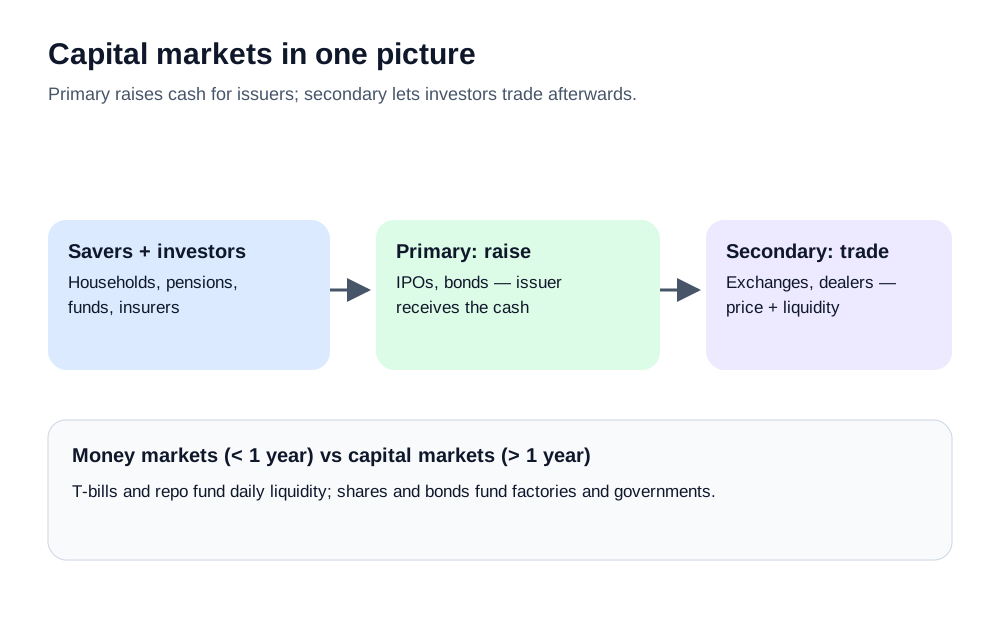
Phase 6 map: primary markets raise cash for issuers; secondary markets let investors trade afterwards.
1. First Principles: Why Capital Markets Exist
Start with a simple problem. Somewhere in the economy, an entrepreneur has a factory to build that will cost five hundred million and take seven years to pay back. Somewhere else, millions of households have savings they want to grow for retirement twenty or thirty years away. The factory needs patient, large-scale funding; the savers have exactly that, scattered in small amounts across millions of accounts. Neither side can find the other on its own, and even if they could, no individual saver can assess the factory's prospects, enforce a contract with its owner, or bear the risk of the whole project alone.
Capital markets exist to solve this matching problem at scale. They provide the instruments (shares and bonds), the venues (exchanges and trading systems), the intermediaries (investment banks, brokers, dealers), the information infrastructure (disclosure rules, credit ratings, price reporting), and the legal framework (securities law, contract enforcement) that allow savings to flow into long-term investment. Where banks solve the matching problem through intermediation — pooling deposits and making loans from their own balance sheets — capital markets solve it directly: the saver ends up holding a claim on the ultimate user of funds.
The "capital" in capital markets refers to long-term funding, conventionally meaning instruments with maturities beyond one year and often spanning decades. A thirty-year government bond, a share of stock with no maturity at all, a ten-year corporate debenture — these are capital market instruments because they fund long-lived activities with long-lived claims. This time dimension is what distinguishes capital markets from money markets, and it shapes everything about how they work: who participates, how risk is priced, how instruments are traded, and how they are regulated.
2. Capital Markets Versus Money Markets
The distinction between capital markets and money markets provides a useful framework for understanding how financial systems organize funding activities across different time horizons. Money markets, which the next chapter examines in detail, focus on short-term borrowing and lending with maturities of less than one year. These markets address immediate liquidity needs — a corporation managing its cash position, a bank funding its daily operations, or a government bridging temporary revenue shortfalls. The instruments traded in money markets, such as treasury bills, commercial paper, and repurchase agreements, emphasize safety and liquidity over return, with participants accepting lower yields in exchange for the ability to convert holdings to cash quickly and with minimal risk of principal loss.
Capital markets, by contrast, address long-term funding needs with maturities extending beyond one year and often spanning decades. The instruments traded in these markets — stocks, bonds, and their associated derivatives — involve greater risk and offer commensurately higher potential returns. Investors in capital markets commit their capital for extended periods, accepting the uncertainty of distant cash flows in exchange for the prospect of superior returns compared to money market investments. This risk-return tradeoff reflects fundamental economic reality: long-term investments carry greater uncertainty about future conditions, and investors demand compensation for bearing this uncertainty. The efficiency of capital markets lies in their ability to price these risks accurately, ensuring that capital flows to its highest-value uses while compensating investors appropriately for the risks they assume.
The boundary matters operationally. A treasurer raising ninety-day money to cover a seasonal inventory build goes to the money market; the same treasurer funding a new plant issues bonds or shares in the capital market. The instruments, the investors, the documentation, the regulatory filings, and the risks are different enough that banks organize separate desks for each, and regulators often apply different rulebooks.
3. Primary Markets: Where Securities Are Born
Capital markets divide functionally into primary markets and secondary markets, each serving distinct but complementary purposes. Primary markets are where new securities are created and sold for the first time, with the issuing entity receiving the proceeds directly. Initial Public Offerings, commonly known as IPOs, represent the most visible form of primary market activity — the moment when a private company first offers its shares to the public, transforming from a closely held entity into one with dispersed public ownership. Follow-on Public Offerings, or FPOs, occur when already-public companies return to the market to raise additional capital through new share issuance. Bond issuance by governments and corporations similarly represents primary market activity, with the proceeds funding budget deficits, capital investments, or refinancing of existing debt.
Rights issues offer existing shareholders the opportunity to purchase additional shares, typically at a discount to market price, before the shares are offered to the public. This structure protects shareholders from dilution while enabling companies to raise capital efficiently. In each of these primary market transactions, the essential characteristic is that the issuer receives the funds raised, making the primary market the direct channel through which savers' capital reaches those who will deploy it productively. The primary market is where securities are born, created through the contractual arrangements that establish the rights and obligations between issuers and investors.
The primary market answers the economy's core funding question: who gets capital, and on what terms? Every IPO prospectus, every bond term sheet, every rights issue circular is a negotiation — sometimes explicit, sometimes conducted through price — between those who want capital and those who have it.
4. Secondary Markets: Where Securities Live
Secondary markets, by contrast, are where existing securities trade among investors after their initial issuance. When you purchase shares of a company on the New York Stock Exchange, the National Stock Exchange of India, or the London Stock Exchange, you are participating in secondary market activity. The company whose shares you purchase receives no money from this transaction — the seller receives your payment, having purchased the shares previously either in the primary market or from another secondary market participant. The secondary market is where securities live, changing hands among investors as circumstances, views, and needs evolve.
The secondary market's importance extends far beyond providing liquidity to existing investors. By enabling investors to sell when they need cash or wish to redeploy capital, secondary markets reduce the risk of committing funds for long periods, thereby encouraging participation in primary market offerings. An investor who purchases shares in an IPO knows they can subsequently sell those shares in the secondary market if their circumstances change or if they become dissatisfied with the investment. This liquidity reduces the effective risk of long-term investment, lowering the cost of capital for issuing entities. Additionally, secondary market prices provide continuous signals about the value of securities, informing both corporate decision-making and the pricing of subsequent primary market offerings.
This interdependence is the point most beginners miss: the primary market cannot function well without the secondary market behind it. Nobody wants to buy a thirty-year bond with no way to sell it in year three. The deeper and more reliable the secondary market, the cheaper primary issuance becomes — which is why exchanges, clearing houses, and settlement systems, covered in the market infrastructure chapter, matter so much to the real economy.
5. Direct Finance Versus Indirect Finance
Capital markets represent the domain of direct finance, where borrowers raise funds directly from investors through the issuance of securities. This contrasts with indirect finance, where financial intermediaries such as banks stand between savers and borrowers. When a company issues bonds, it engages in direct finance — investors purchase the bonds directly from the company, establishing a direct contractual relationship. When a customer deposits money in a bank and the bank lends those funds to a borrower, indirect finance occurs — the depositor has a claim on the bank, not on the ultimate borrower, and the bank manages the credit relationship.
The two channels distribute risk and work differently:
| Dimension | Direct finance (capital markets) | Indirect finance (banks) |
|---|---|---|
| Saver's claim | On the ultimate issuer (company, government) | On the bank |
| Who bears credit risk | The investor | The bank |
| Terms | Standardized, market-priced securities | Customized, negotiated loans |
| Monitoring | Disclosure rules, analysts, rating agencies | Bank's ongoing relationship monitoring |
| Scale | Suited to very large funding needs | Suited to smaller, information-sensitive borrowers |
| Maturity transformation | Investor holds the long-term claim | Bank transforms short deposits into long loans |
Both channels serve essential economic functions. Direct finance through capital markets enables large-scale funding that might exceed any single bank's capacity or risk appetite. It allows risk to be distributed among many investors rather than concentrated in bank balance sheets. It provides transparency through market pricing and disclosure requirements. Indirect finance through banks offers relationship-based lending with customized terms, ongoing monitoring of borrowers, and transformation of short-term deposits into long-term loans. The coexistence of both channels creates a more robust and efficient financial system than either could achieve independently — and the mix differs by economy, with some financial systems bank-dominated and others market-dominated, reflecting history, law, and institutional development.
6. The Participant Ecosystem
The participants in capital markets form a complex ecosystem with diverse roles and motivations. Issuers — corporations, governments, and occasionally other entities — seek capital to fund activities they believe will generate returns exceeding their cost of capital. Investors range from individual retail participants managing personal portfolios to massive institutional investors including pension funds, insurance companies, mutual funds, and sovereign wealth funds deploying billions in capital; the chapters on mutual funds and pension funds examine these institutions in depth. Investment banks serve as intermediaries in primary market transactions, underwriting securities offerings and advising on capital structure decisions. Brokers and dealers facilitate secondary market trading, providing liquidity and execution services. Regulators establish and enforce the rules that govern market conduct, disclosure requirements, and investor protection. Market infrastructure providers — exchanges, clearing houses, and depositories — provide the platforms and mechanisms that enable trading to occur safely and efficiently.
A worked example makes the ecosystem concrete. When a mid-sized manufacturer issues a hundred million in five-year bonds: the issuer is the manufacturer; the investment bank structures the deal and underwrites it; a rating agency grades the credit; lawyers draft the documentation; institutional investors — pension funds, insurers, mutual funds — subscribe; the exchange or over-the-counter market lists or hosts trading afterward; a clearing and settlement system moves money and securities; a depository records ownership; and the regulator supervises the disclosure and conduct throughout. Roughly a dozen distinct institutional roles stand behind a single bond line on an investor's statement.
7. How Banks Participate in Capital Markets
Banks participate in capital markets in multiple capacities that extend well beyond their traditional deposit-taking and lending activities. As underwriters, banks guarantee the sale of new securities, purchasing them from issuers and reselling them to investors. In firm commitment underwriting, the bank bears the risk that securities cannot be sold at the anticipated price, requiring substantial capital and risk management capabilities. As market makers, banks provide liquidity by continuously quoting prices at which they will buy and sell securities, profiting from the bid-ask spread while enabling investors to trade promptly at known prices. As advisors, banks provide guidance on mergers and acquisitions, capital structure optimization, and strategic transactions, earning fees for their expertise and execution capabilities.
Banks also participate in capital markets as investors, holding bonds in their treasury portfolios as part of liquidity management and interest rate risk hedging strategies. In their capacity as custodians, banks safekeep securities for institutional investors, handling settlement, corporate actions, and record-keeping functions. As distributors, banks sell mutual funds, bonds, and other capital market products to retail clients, expanding access to investment opportunities while earning distribution fees. This multifaceted participation reflects the evolution of banking from simple intermediation to comprehensive financial services, with capital market activities often generating significant revenue while requiring sophisticated risk management capabilities.
Each capacity carries its own risk profile, which is why regulators pay close attention to banks' market activities. Underwriting concentrates risk for days or weeks between purchase and resale; the derivatives chapter describes the hedging tools banks use to manage that window. Market making holds inventory that loses value when prices move adversely. Custody is operationally intensive but credit-light. The 2008 financial crisis showed what happens when market risk on bank balance sheets is underestimated, and post-crisis regulation — higher capital for trading activities, stress testing, and in some jurisdictions structural separation rules — reflects that lesson.
8. Inside an Issuance: The Operational Workflow
Abstract descriptions of "primary markets" become much clearer when you follow a single issuance through its workflow. Consider a corporation raising five hundred million through a ten-year bond.
Preparation (weeks to months). The company appoints an investment bank as lead arranger. Together they decide size, tenor, currency, and structure — fixed or floating rate, secured or unsecured, covenants. The arranger commissions a credit rating, since most institutional investors require one; lawyers draft the offering document describing the issuer's business, finances, and risks; accountants verify the numbers. Where the issue will be publicly offered, the regulator reviews the disclosure document before marketing may begin.
Marketing and price discovery (days to weeks). The arranger presents the deal to institutional investors — roadshows for large equity offerings, investor calls for bonds — and builds an order book of indications of interest at various yield levels. This book-building process is genuine price discovery: strong demand tightens the pricing, weak demand widens it or kills the deal.
Pricing and allocation. On pricing day, issuer and arranger fix the final terms — say a coupon that places the bond at par — and allocate the bonds among subscribers. Under firm commitment underwriting, the bank is contractually on the hook for any unsold portion.
Settlement and listing. At closing, investors pay, the securities are credited to their depository accounts, and the issuer receives the proceeds net of fees. The bond then begins life in the secondary market, where the arranger typically acts as a market maker for some time.
Equity issuance follows the same skeleton with heavier disclosure and usually a retail tranche. Two practical points matter for banking students: first, the issuer pays fees typically amounting to a small percentage of the amount raised, which is why investment banking is lucrative; second, almost everything in this workflow exists to manage information asymmetry — the issuer knows more about its prospects than investors do, and the rating, the audited accounts, the regulatory review, and the underwriter's reputation all serve to bridge that gap.
9. The Economic Functions That Justify It All
The importance of capital markets to economic functioning can hardly be overstated. Efficient allocation of capital ensures that scarce savings flow to their highest-value uses — to the entrepreneurs with the most promising ideas, the companies with the strongest competitive positions, and the governments with the most productive investment opportunities. Price discovery in capital markets aggregates information from millions of participants, incorporating diverse perspectives into security prices that reflect collective assessments of value. This continuous pricing process informs resource allocation throughout the economy, directing investment toward opportunities that the market judges most attractive.
Risk sharing represents another crucial capital market function. By enabling risk to be distributed among many participants, each bearing small portions of large risks, capital markets make it possible to undertake projects that no single investor could bear alone. Large infrastructure projects, innovative technology ventures, and global expansions become feasible when risks are shared through diversified ownership. Economic growth itself depends heavily on capital market functioning — long-term investment in productive capacity, research and development, and human capital requires patient capital that capital markets are designed to provide. Finally, capital markets enable wealth creation and participation in economic growth, allowing individuals to invest in businesses and share in the prosperity generated by successful enterprise.
The relationship between capital markets and economic development has been extensively studied, with strong evidence that well-functioning capital markets contribute to growth, innovation, and economic resilience. Markets that allocate capital efficiently enable productive enterprises to expand while channeling resources away from failing ventures. Markets that provide accurate price signals inform managerial decision-making and discipline underperforming management. Markets that offer diverse risk management tools enable participants to optimize their risk exposures according to their specific circumstances and preferences. Conversely, capital market failures — whether through mispricing, manipulation, or instability — can impose enormous economic costs, as demonstrated by periodic financial crises throughout history.
10. The Scale of Global Capital Markets
The scale of global capital markets reflects their central economic importance. Global stock market capitalization — the total value of all publicly traded equities — reached approximately one hundred nine trillion dollars by 2023, representing ownership claims on the productive capacity of corporations worldwide. The global bond market, encompassing government and corporate debt securities, exceeded one hundred thirty-three trillion dollars, providing the fixed income investments that form the foundation of institutional portfolios and individual retirement savings. Global derivatives markets, with notional amounts exceeding six hundred trillion dollars, enable the risk management and speculative activities that underpin modern finance — though notional amounts overstate economic exposure, since most derivative positions offset others. For context, global bank assets totaled approximately one hundred eighty trillion dollars, indicating that capital markets and banking systems operate at roughly comparable scales, each serving essential but distinct functions in the global financial architecture.
Two cautions accompany any such figures. First, markets move: capitalization rises and falls with prices, so treat these magnitudes as indicative of scale rather than current values. Second, size is not the same as depth — a market can be large yet illiquid, and many smaller economies have capital markets that are modest in absolute terms but vital domestically.
11. Regulation and Investor Protection
Capital markets run on trust, and trust is manufactured by regulation. Because issuers know more than investors, and because professional intermediaries know more than their clients, every developed market imposes a regulatory framework with three pillars.
Disclosure. Issuers must reveal material information — audited financials, business risks, management interests — before selling securities and continuously afterward. The philosophy, inherited from the reforms of the 1930s in the United States and adopted worldwide in various forms, is that sunlight is the best disinfectant: regulators generally do not judge whether an investment is good, only that its description is truthful.
Conduct rules. Insider trading, market manipulation, and fraud are prohibited and prosecuted, because if investors believe the game is rigged they withdraw, and the market's allocation function dies. Intermediaries are licensed, supervised, and required to deal fairly with clients, with suitability obligations when advising retail customers.
Infrastructure safeguards. Clearing houses stand between buyers and sellers to manage counterparty risk; depositories maintain ownership records; settlement rules ensure trades complete. The market infrastructure chapter covers these systems in depth.
Regulation is always a balance. Too little, and fraud and instability drive investors away; too much, and compliance costs push issuance elsewhere or into private markets. The visible trend of recent decades — companies staying private longer, and growth of private debt and private equity examined in their own chapters — partly reflects issuers weighing public-market regulatory burdens against private alternatives.
12. Digital Transformation of Capital Markets
Capital markets were early adopters of computing, and the transformation continues on several fronts. Trading migrated from physical floors to electronic order books decades ago; most equity and bond trading now executes electronically, with settlement cycles shortening progressively — several major markets have moved to next-day settlement for equities, compressing counterparty risk and freeing collateral. Access has democratized: retail investors trade from mobile apps at near-zero commission in many markets, and IPO applications that once required paper forms are filed electronically.
Issuance is digitalizing too. Electronic book-building is standard; regulators accept digital filings; several jurisdictions and institutions have piloted or completed bond issues recorded on distributed ledger platforms, exploring whether tokenized securities can shorten settlement and reduce reconciliation costs. Whether or not blockchain-based issuance becomes dominant, the direction is consistent: less paper, faster settlement, more straight-through processing, and data-rich supervision, with regulators increasingly using market data analytics to detect manipulation rather than relying on reports alone.
For banks, digitalization cuts both ways: it lowers the cost of their market operations but also intensifies competition from electronic trading firms and direct-access platforms, compressing the margins on which traditional intermediation depended.
13. A Case Study: The IPO That Almost Wasn't
Consider a profitable family-owned consumer goods company, forty years old, seeking three hundred million to build export capacity. Its board debates two routes: a syndicated bank loan or an IPO. The loan is faster and private, but the amount strains its banks' single-borrower limits, the five-year tenor mismatches a fifteen-year investment, and covenants would constrain dividends for a decade. The IPO is slower and demands audited track records, independent directors, and continuous disclosure — disciplines the family has never accepted — but it delivers permanent capital with no repayment schedule and establishes a public valuation for future fundraising.
The company chooses the IPO. The lead bank prices the offering through book building; institutional demand at the top of the range lets the family sell thirty percent of the company at a valuation no single lender would have underwritten. Five years later the company returns to the primary market with a follow-on offering priced off its secondary market share price — the very signal function described in Section 4 — and raises another two hundred million in a week. The case illustrates the chapter's core logic: the family traded privacy and control for permanent, scalable capital, and the secondary market's continuous pricing turned a one-time fundraising into a repeatable financing channel.
14. Common Misconceptions About Capital Markets
"Buying shares on an exchange gives money to the company." Only primary issuance does. Secondary trades move money between investors; the company's benefit from its share price is indirect — cheaper future capital raising, collateral value, currency for acquisitions.
"Capital markets are casinos." Speculation exists and can dominate short-term price movements, but the underlying function is allocation of real savings to real investment. A casino creates no productive assets; capital markets fund factories, infrastructure, and enterprises. The test is time horizon: over years, prices track underlying value creation, not spins of a wheel.
"Only the wealthy benefit from capital markets." Pension funds and mutual funds channel ordinary households' retirement savings into these markets. A teacher's pension is invested in the same bonds and shares as a billionaire's portfolio, which is precisely why investor protection matters so much.
"High trading volume means a healthy market." Volume measures activity, not function. A market allocates capital well when issuance funds productive investment at fair prices and trading provides reliable liquidity — both can be true at modest volumes, and frenzied volume can accompany bubbles.
"Capital markets and banks are competitors." They are complements. Banks underwrite issues, make markets, provide settlement and custody, and hold securities in treasury; the fixed income chapter's discussion of bank bond portfolios is a capital markets story as much as a banking one.
"Stock prices tell you what a company is worth." Prices reflect the collective, continuously updated judgment of market participants — usually the best available estimate, but subject to sentiment, liquidity, and error. Prices are information, not verdicts.
15. Frequently Asked Questions
What is the simplest definition of a capital market? A marketplace — institutional rather than physical — where long-term funding instruments, mainly shares and bonds with maturities beyond one year, are created and traded, connecting savers directly to those who need long-term capital.
How is a capital market different from a stock market? The stock market is one component. Capital markets also include bond markets, and the instruments' associated derivatives. "Stock market" refers only to equity trading.
Why do companies go public if they must disclose so much? Because public capital is deep, patient, and often cheaper than private capital, and listing provides liquidity for founders and early investors plus an acquisition currency. The disclosure burden is the price of access to that depth.
Who actually buys all these bonds and shares? Overwhelmingly institutions: pension funds, insurance companies, mutual funds, sovereign wealth funds, banks, and increasingly exchange-traded funds. Retail investors participate directly in equities but are a minority of bond ownership, since institutional lot sizes and over-the-counter dealing dominate fixed income.
Can a country develop without capital markets? It can grow, especially through bank finance and retained earnings, but evidence consistently associates deeper capital markets with faster growth, more innovation financing, and greater resilience — which is why developing local bond and equity markets is a standard item on national reform agendas.
What happens to my shares if the stock exchange closes? Your ownership is recorded in the depository, independent of the exchange's trading status; you simply cannot sell until trading resumes. This separation of ownership records from trading venues is a deliberate resilience feature of modern market design.
Why do bond markets matter more than stock markets for the economy, despite less publicity? By outstanding value, bond markets are larger than equity markets globally, and they set the interest rates that price everything else — mortgages, corporate loans, government budgets. Equity markets get the headlines; bond markets set the cost of capital.
What is market capitalization? Share price multiplied by shares outstanding — the market's current valuation of a company's equity. Aggregated across all listed companies, it measures the size of an equity market.
16. Key Terms in This Chapter
- Capital market — the market for long-term funding instruments (beyond one year), principally equities and bonds.
- Money market — the market for short-term instruments (under one year); the subject of the next chapter.
- Primary market — where new securities are issued and the issuer receives the proceeds.
- Secondary market — where existing securities trade among investors.
- IPO / FPO — initial public offering; follow-on public offering of shares.
- Rights issue — an offering of new shares to existing shareholders, typically at a discount.
- Direct vs indirect finance — raising funds from investors directly via securities versus through a bank intermediary.
- Underwriting — an investment bank's commitment to sell or take up a new securities issue.
- Market maker — a dealer continuously quoting buy and sell prices to provide liquidity.
- Book building — collecting investor demand indications to discover an offering's price.
- Liquidity — the ability to trade quickly at a price close to the last trade.
- Price discovery — the process by which trading aggregates information into security prices.
- Market capitalization — share price times shares outstanding; a company or market valuation measure.
- Custodian — a bank that safekeeps securities and handles settlement and corporate actions for investors.
- Depository — the institution maintaining electronic ownership records of securities.
- Credit rating — an agency's graded opinion of an issuer's creditworthiness; covered in the rating chapter.
- Prospectus / offering document — the regulated disclosure document supporting a public securities issue.
- Bid-ask spread — the gap between buying and selling quotes; the market maker's compensation and a liquidity measure.
17. Interview Insights: How This Topic Appears in Banking Interviews
"Explain the difference between primary and secondary markets, and why secondary markets matter if companies get no money from them." The expected answer covers issuance versus trading, then the liquidity argument: exitability lowers the effective risk of long-term investment, which lowers the cost of primary capital. Add the price-signal function — secondary prices guide corporate decisions and price future issuance — and you have a complete answer. Candidates who say secondary markets "don't matter to the company" fail the conceptual test.
"Direct finance versus indirect finance — which is better?" A trap question. The professional answer is comparative, not competitive: direct finance distributes risk, scales, and prices transparently; indirect finance monitors relationships, customizes terms, and transforms maturities. Financial systems need both, and the mix varies by country.
"Walk me through how a bond comes to market." Arranger appointment, structuring and rating, documentation and regulatory review, book building, pricing and allocation, settlement and listing, secondary market-making. Interviewers use this to test whether you understand markets operationally or only theoretically.
"How do banks make money in capital markets?" Underwriting and advisory fees, market-making spreads, distribution commissions, custody fees, and investment returns on treasury portfolios. Strong candidates also name the risks: underwriting exposure, inventory risk, and the regulatory capital these activities consume.
"Are capital markets efficient?" A nuanced answer distinguishes informational efficiency (prices reflect available information, broadly supported for liquid markets) from allocation efficiency in the real economy, acknowledges bubbles and crises as evidence of limits, and concludes that markets are efficient enough to make beating them consistently very difficult — which is the practically relevant claim.
Summary and Key Takeaways
- Capital markets channel the world's savings into long-term investment, connecting surplus capital to funding needs for maturities beyond one year; money markets handle the short end, covered in the next chapter.
- Primary markets create securities and deliver proceeds to issuers; secondary markets provide the liquidity and price signals that make primary issuance viable.
- Capital markets are direct finance — the investor's claim runs to the ultimate issuer — complementing bank-intermediated indirect finance.
- The ecosystem spans issuers, institutional and retail investors, investment banks, brokers, dealers, regulators, and market infrastructure, each managing part of the information and risk problem.
- Banks participate as underwriters, market makers, advisors, investors, custodians, and distributors — deeply embedded in markets even though markets compete with bank lending.
- Every issuance follows a workflow — structuring, rating, disclosure, book building, pricing, settlement — engineered to bridge the information gap between issuer and investor.
- The economic functions are allocation, price discovery, risk sharing, liquidity, and wealth creation; the global scale — bond markets exceeding equity markets, both comparable to the banking system — makes their stability a matter of public policy, hence disclosure, conduct, and infrastructure regulation.
- Digitalization is compressing settlement, widening access, and experimenting with tokenized issuance, while the substance — matching patient savings with productive long-term investment — remains exactly what it has always been.
Next: Topic 50 — Money Markets →
<!-- MBA-DEEP-DIVE-START -->Deep Dive: Capital Markets as Issuance, Trading, Custody, Settlement, and Market Integrity
Capital markets are often defined as markets for long-term debt and equity. That definition is useful but hides the machinery that makes them trustworthy. A functioning capital market must answer five questions reliably: Who is allowed to issue a claim? What information must investors receive? How is the claim priced and allocated? How can it be traded later? How do cash and securities reach the correct owners with enforceable finality?
Banks participate in almost every layer: as issuers, underwriters, lenders, market makers, brokers, custodians, settlement banks, trustees, research providers, wealth distributors, derivative counterparties, and investors. Understanding capital markets therefore means understanding how banking balance sheets connect savers and borrowers through securities rather than only through loans and deposits.
Direct and indirect finance are two paths to the same economic objective
In indirect finance, a bank takes deposits or other funding and makes a loan. The depositor has a claim on the bank; the bank has a claim on the borrower. The bank performs intermediation on its own balance sheet.
In direct finance, an issuer sells securities to investors. The investor has a claim directly on the company, government, fund, or vehicle according to the instrument. Banks can still intermediate the transaction through underwriting, distribution, custody, and markets, but the long-term asset need not remain on the bank's balance sheet.
The distinction explains why capital markets can expand funding capacity beyond bank lending. A corporation that has reached its bank-credit limits may issue bonds to pension funds and insurers. A growing company may raise equity rather than borrow at all.
Neither model is universally superior. Bank lending offers relationship knowledge, flexibility, confidentiality, and restructuring capability. Capital markets can offer scale, maturity diversification, investor breadth, and tradability. Sophisticated borrowers use both.
The primary market creates the security
The primary market is where new securities are issued and capital reaches the issuer or selling shareholder according to the transaction structure. The process differs for equity, bonds, rights issues, private placements, and other instruments, but several controls recur.
The issuer and advisers define the funding need and security terms. Legal and accounting due diligence test disclosures. Offering documents explain business, financials, risks, use of proceeds, governance, and instrument rights. Underwriters or arrangers help price and market the issue. Investors submit indications or orders. Allocations are made. Securities are issued into the relevant depository or registration structure, and cash settles to the issuer.
A successful primary transaction therefore requires legal disclosure, price discovery, investor eligibility, allocation, settlement, and post-issue reporting to work together. Marketing alone cannot repair a security that is badly structured or inaccurately disclosed.
Secondary markets make primary issuance possible
Investors are more willing to fund long-term securities if they can sell them before maturity. The secondary market provides that exit through exchanges, trading venues, dealers, or OTC markets depending on the asset.
Liquidity reduces the investor's required return because capital is less trapped. This is why a highly liquid government bond can finance at a lower yield than an otherwise similar but illiquid obligation.
Secondary-market price also becomes information. It tells issuers and investors the market's evolving view of credit, growth, interest rates, and risk appetite. Future primary deals are priced against that evidence.
The primary and secondary markets are therefore not separate worlds: secondary liquidity lowers primary funding cost.
Equity and debt create fundamentally different claims
An equity shareholder owns a residual interest in the company. Returns depend on dividends and change in share value. The shareholder participates in upside but also bears first-loss risk before creditors in ordinary insolvency ordering.
A bondholder or other debt investor has contractual claims to interest and principal, subject to ranking and terms. Upside is generally capped at those contractual returns, while downside depends on default and recovery.
This difference affects corporate decisions. Equity does not require scheduled repayment but dilutes existing ownership and can be expensive if investors demand high returns. Debt preserves ownership but creates fixed obligations and leverage.
A bank advising a client on capital structure should therefore ask about cash-flow stability, leverage, ratings, control, market valuation, maturity needs, covenant capacity, and strategic flexibility rather than simply compare coupon with dividend.
Underwriting transfers execution risk to the bank
In a firm-commitment underwriting, banks can agree to purchase securities from the issuer and distribute them to investors, taking the risk that market demand is weaker than expected. In other offerings, banks may act on a best-efforts basis or use different commitment structures.
The underwriting bank therefore needs limits, approval, market-risk analysis, syndication strategy, and distribution evidence. If markets move sharply after the bank commits but before securities are placed, the bank can be left holding inventory at a loss.
Underwriting risk should not be confused with the issuer's long-term credit risk. The bank may intend to hold the securities for days while distribution occurs, but those days can be volatile.
Syndicates spread risk and broaden investor access, but they also require controlled order books and information sharing.
Bookbuilding is price discovery with conflict risk
In a bookbuilt offering, investors indicate demand at prices or yields. The lead banks use that order book to recommend final pricing and allocations.
The bank is balancing several interests. The issuer wants maximum proceeds or minimum yield. Investors want attractive value and stable aftermarket performance. The bank wants both sides to remain long-term clients.
Inflated or duplicate orders can distort the picture of demand. Order-book management should identify investor, size, price sensitivity, and order quality. Allocations should follow documented principles rather than secret side deals.
The bank should also manage information carefully. Before public launch, knowledge of a major offering can be price-sensitive. Wall-crossing and confidential marketing processes need controlled access and records.
Research must remain credible despite investment-banking relationships
Banks can advise issuers while their research analysts cover the same companies and their traders make markets in the securities. This creates obvious conflicts.
Information barriers, supervision, disclosure, restricted lists, and personal-account dealing rules seek to prevent confidential investment-banking information from influencing research or trading improperly.
Research credibility depends on analytical independence. If positive recommendations are understood as payment for underwriting mandates, investors stop trusting them and market integrity deteriorates.
The bank should therefore know which employees possess inside information and restrict trading or communication accordingly.
Market abuse can occur without a customer losing money directly
Capital-market integrity depends on preventing insider dealing, manipulation, misleading statements, spoofing, wash trading, front-running, and other prohibited conduct under applicable law.
Banks monitor both employee and customer activity. A customer account that repeatedly trades just before merger announcements can require investigation even if every trade settles correctly.
Market surveillance looks for patterns across orders and executions, not only completed trades. Cancelling deceptive orders can be as important as actual transactions.
Communication channels matter too. Trading decisions discussed through unapproved messaging platforms can create supervision and recordkeeping gaps.
Listing converts a private claim into a public-market obligation
A company that lists shares or debt accepts continuing obligations beyond the initial offering: periodic financial reporting, timely disclosure of material events, governance requirements, investor communication, and market rules according to jurisdiction.
This continuing disclosure reduces information asymmetry and supports secondary trading. The market price depends on investors receiving material information broadly and fairly rather than through privileged private channels.
Banks supporting listed clients should understand that relationship confidentiality cannot be used to help selected investors trade on non-public information.
Exchanges and OTC markets solve different trading problems
Exchange trading standardises access, rules, order matching, market data, and often clearing arrangements. It works especially well for fungible instruments with broad investor participation.
OTC markets allow customised or dealer-mediated transactions, common in many bonds, derivatives, and large institutional trades. Liquidity can depend on market makers rather than a central order book.
The absence of an exchange does not mean the market is unregulated or informal. It means price discovery, reporting, and counterparty arrangements operate through a different structure.
Banks acting as dealers quote bid and offer prices and manage inventory. That inventory creates market risk and requires independent limit monitoring.
Clearing and settlement complete the trade
A trade is not complete when buyer and seller agree on price. Securities and cash must be delivered according to market convention.
Post-trade processing can include trade capture, confirmation or matching, clearing, netting, settlement instruction, securities availability, cash funding, custody updates, and reporting.
Delivery-versus-payment links securities delivery with cash payment, reducing principal risk. Central securities depositories and custodians maintain ownership or entitlement records according to the market structure.
Failed settlement can occur from incorrect instructions, insufficient securities, insufficient cash, corporate-action restrictions, or operational errors. Fails should be aged and investigated because persistent breaks can become liquidity and counterparty problems.
The securities account is different from the cash account
An investor buying a bond or share needs both cash settlement and securities custody. The bank or broker may operate separate ledgers and external accounts for the two.
A reconciliation should confirm that the customer's securities position matches depository or custodian records and that cash movements match the settlement account. One side can succeed while the other fails if the transaction is not properly linked.
Segregation is crucial in client asset protection. Securities beneficially owned by customers should not be confused with the bank's proprietary inventory.
This becomes especially important when a broker or custodian fails.
Corporate actions keep securities alive after settlement
Securities create events long after purchase: dividends, coupons, redemptions, rights issues, splits, tender offers, calls, conversions, mergers, voting, and consent solicitations.
Custodians and brokers need to identify eligible positions, notify clients, collect elections, submit instructions before deadlines, receive cash or securities, and reconcile entitlements.
A mandatory corporate action can be processed automatically. A voluntary event may require the investor to choose among alternatives.
Missing a voluntary deadline can permanently destroy value. Corporate-action processing is therefore a fiduciary-like operational responsibility, not back-office housekeeping.
Margin and collateral allow leveraged participation
Brokers, clearing members, and derivatives markets use margin to protect against losses on leveraged or unsettled positions. Customers may pledge cash or securities according to the product and regulation.
Margin requirements can rise during volatility, forcing customers to provide additional collateral or reduce positions. The bank must calculate calls accurately, value collateral, apply haircuts, monitor concentration, and liquidate according to agreed rules when necessary.
Leverage can turn a modest market move into a large customer loss. Suitability and risk disclosures matter particularly for retail or less sophisticated clients using margin products.
Market liquidity is different from funding liquidity
A bank may hold a security that is theoretically tradeable but find few buyers during stress. That is market liquidity risk. At the same time, the bank may need immediate cash to meet obligations, which is funding liquidity risk.
The two can reinforce each other. A bank needing cash may sell securities. Widespread forced selling depresses prices, making market liquidity worse and creating further losses or collateral calls.
Treasury and market-risk functions therefore stress both dimensions. Assets held as liquidity buffers should be assessed not only by normal trading volume but by monetisation capacity under stress.
Benchmark indices influence huge pools of capital
Equity and bond indices provide reference portfolios for passive funds, derivatives, performance measurement, and asset allocation. Inclusion or exclusion can therefore generate substantial trading demand independent of a company's immediate fundamentals.
Banks supporting index-linked products need accurate corporate-action treatment, rebalancing, and tracking. Customers should understand that an index fund follows methodology; it does not continuously select the ‘best’ companies through human judgment.
Benchmark governance matters because a flawed or manipulable index can affect products far beyond the benchmark administrator itself.
Primary-market allocations and secondary trading need conflict controls
A bank that receives a valuable allocation in an IPO or scarce bond issue controls something investors want. Allocation policy should prevent favours linked to unrelated business, employee relationships, or improper inducements.
The bank's own trading desk should not misuse confidential order-book information to position ahead of clients. Client orders should be handled according to best-execution or other applicable duties.
These controls protect the market from a subtle form of unfairness: using the bank's intermediary position to trade against the people it serves.
Securities lending and short selling add another ownership layer
Investors can lend securities to other market participants, often to support short selling or settlement. The lender temporarily transfers securities and receives collateral plus a fee, with contractual rights to equivalent securities later.
This creates collateral, counterparty, corporate-action, and recall risk. The beneficial economic exposure can remain with the lender while legal title or possession moves according to the arrangement.
Custody systems need to distinguish available, pledged, lent, and settled positions. Selling securities that have already been lent without arranging recall can create settlement failure.
A complete bond issuance scenario
A large infrastructure company needs ₹5,000 crore for long-term projects and wants to diversify beyond bank loans.
The company appoints banks as arrangers. They analyse capital structure, maturity, currency, likely investor demand, covenants, and expected rating. Legal counsel and the issuer prepare offering documentation and disclosures. Credit-rating work and investor due diligence proceed under the applicable framework.
The banks market the proposed bonds to institutional investors. Orders show stronger demand for a five-year tranche than a ten-year tranche, so the final size and pricing are adjusted. The bank's syndicate desk records orders and allocations under controlled procedures.
On issue date, investors fund through the settlement system and securities are credited to their custody accounts. The issuer receives proceeds after transaction expenses. The bonds begin secondary trading, where dealer quotes and market conditions determine price.
Over the next five years, the issuer pays coupons through the paying-agent and depository chain. Custodians allocate cash to beneficial owners. If the issuer seeks covenant changes, a consent process is run. At maturity, principal is redeemed and positions close.
The capital-market transaction worked because disclosure, pricing, allocation, settlement, custody, and ongoing issuer obligations formed one continuous system.
What excellence looks like
A world-class capital-markets function can distinguish primary funding from secondary liquidity and direct finance from bank balance-sheet intermediation. Underwriting commitments stay within risk appetite. Order books and allocations are controlled. Confidential information is protected. Research and trading conflicts are managed. Client assets reconcile to custody records. Settlement fails are owned. Corporate actions reach investors on time. Surveillance monitors market abuse. Issuers continue disclosing material information after the deal closes.
Capital markets are not simply places where securities trade. They are an institutional system that turns information and legal rights into transferable claims, then keeps those claims trustworthy through every trade and settlement that follows.
<!-- MBA-DEEP-DIVE-END -->