In the complex world of commercial transactions, particularly those spanning national borders and involving parties who may never have met, trust is both essential and scarce. Bank guarantees and letters of credit serve as the institutional mechanisms that bridge this trust gap, transforming uncertain commercial relationships into secure contractual arrangements backed by the creditworthiness of established financial institutions. These instruments have become the essential plumbing of international commerce, enabling trillions of dollars in trade to flow smoothly while protecting both buyers and sellers from the risks of non-performance and non-payment.
By the end of this chapter, you will be able to:
- Explain what a bank guarantee is and how it differs from a loan and from insurance
- Describe the full guarantee lifecycle: underwriting, issuance, monitoring, invocation, recovery
- Distinguish the main guarantee types and their commercial purposes
- Explain the independence principle and the fraud exception
- Compare letters of credit, standby LCs, and demand guarantees precisely
- Analyze how guarantees are priced, margined, and treated for capital
- Understand counter-guarantees and the international chain structure
- Evaluate the risks, for bank, applicant, and beneficiary, and the digital future of guarantees
Topic 37 covered the letter of credit side of trade finance in depth, including UCP 600 document mechanics. This chapter treats guarantees comprehensively and letters of credit in summary, with cross-references rather than repetition.
Visual overview
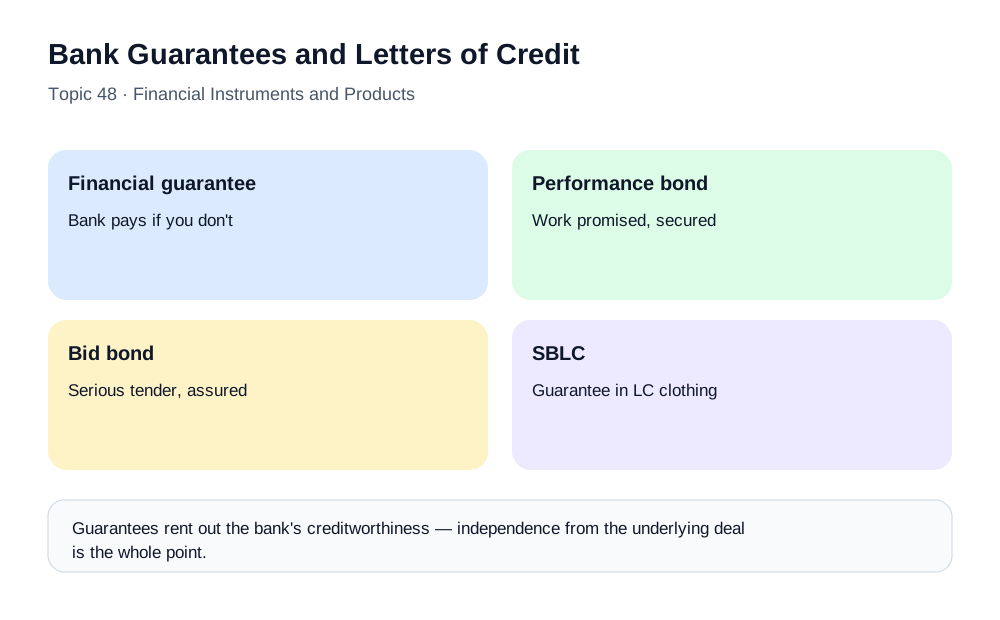
Bank Guarantees and Letters of Credit at a glance — Financial guarantees, performance bonds, SBLC.
1. First Principles: Renting the Bank's Creditworthiness
A bank guarantee is fundamentally a written commitment issued by a bank on behalf of its customer, known as the applicant, promising to pay a specified sum to a beneficiary if the applicant fails to meet a defined contractual obligation. This promise transforms a commercial uncertainty into a bankable certainty: the beneficiary no longer relies on the creditworthiness of a potentially unknown counterparty but on the established financial strength of a regulated banking institution. For the applicant, the guarantee provides credibility that enables transactions that might otherwise be impossible due to lack of established trust or limited operating history.
Notice what is actually being sold. The bank does not expect to pay; it expects the applicant to perform. What the applicant purchases is the rental of the bank's balance sheet reputation, a contingent promise that stands behind the applicant's own promise. This is why guarantee issuance is priced like credit but settled like insurance: the bank underwrites the applicant as rigorously as for a loan, because the guarantee is a loan that might be forced upon it, then collects a commission for a risk it hopes never to fund.
This distinguishes the guarantee from its two nearest relatives. Unlike a loan, no money moves at inception; the bank's exposure is contingent, crystallizing only on default. Unlike insurance, the bank pays first and argues later: insurance pays after loss adjustment against a policy the insurer interprets, while a demand guarantee pays against documents alone, and the bank's remedy is recovery from its own customer, not dispute with the beneficiary. That second distinction, pay now, recover later, is the source of both the instrument's commercial power and its sharpest legal edges.
2. The Guarantee Lifecycle: How Banks Actually Run This Business
The mechanics of a bank guarantee operate through a clearly defined sequence, and each stage carries its own discipline.
Application and underwriting. The process begins when an applicant, a buyer in a commercial transaction, a contractor bidding on construction work, or a borrower seeking financing, approaches their bank requesting a guarantee in favor of a specific beneficiary. The bank conducts thorough credit assessment of the applicant, evaluating their financial capacity to perform the underlying obligation and their ability to reimburse the bank if the guarantee is invoked. This assessment mirrors the underwriting process for loans, as the bank's guarantee represents a contingent liability that may become an actual obligation. In practice, guarantees are issued against sanctioned limits: a contractor receives an annual guarantee facility, sized against net worth, turnover, and track record, within which individual guarantees are issued as contracts demand. Underwriters examine not only the applicant but the wording: an open-ended guarantee, an unlimited amount, or a beneficiary-controlled invocation clause can convert a routine facility into an unpriceable risk, and experienced guarantee desks negotiate text as carefully as they assess credit.
Issuance. Upon satisfactory credit review, the bank issues the guarantee to the beneficiary, specifying the conditions under which payment will be made, the maximum amount payable, and the guarantee's expiration date or termination conditions. International guarantees increasingly travel as authenticated SWIFT messages rather than paper, the message text itself constituting the instrument. Margins and collateral are collected at this stage, and the commission clock starts.
The life of the guarantee. Most guarantees live uneventfully: the applicant performs, the beneficiary holds the paper as security, and at expiry the guarantee lapses. The bank's exposure reduces or ends, and the contingent liability rolls off. During the guarantee's life, the bank monitors the applicant's financial health exactly as it would a borrower's, because deterioration converts dormant contingency into live risk.
Invocation. If the applicant defaults on their obligation, the beneficiary may invoke the guarantee by presenting the specified documents, typically a written demand stating that the applicant has defaulted, and whatever supporting statements the guarantee requires. Upon verification that the invocation conditions are satisfied, the bank pays the beneficiary, and it pays promptly, because delay would destroy the instrument's credibility. The bank does not investigate whether default truly occurred or whether the invocation is commercially fair; that is the independence principle examined in Section 4.
Recovery. The bank then seeks reimbursement from the applicant, who remains ultimately responsible for the amounts paid. The recovery may draw on margin deposits, collateral, or the applicant's general credit, and a paid guarantee converts instantly into a loan, usually an overdue one, with all the collection machinery that implies. An invocation is therefore a credit event in the bank's books, and banks track invocation rates by customer and sector as a leading indicator of portfolio stress.
3. The Guarantee Family: Types and Purposes
The commercial applications of bank guarantees span numerous scenarios, with different guarantee types addressing specific transaction risks.
Performance guarantees ensure that contractors complete projects according to specifications, on time, and within budget. When a construction company bids on a major infrastructure project, the project owner typically requires a performance guarantee as security against the possibility that the contractor abandons the work or fails to meet quality standards. The guarantee amount, often five to ten percent of contract value, provides compensation that enables the owner to engage alternative contractors to complete the work if the original contractor defaults.
Financial guarantees extend to payment obligations rather than performance, ensuring that borrowers repay loans or that buyers make required payments. A company issuing bonds might obtain a bank guarantee to enhance the credit quality of the issuance, or an importer might provide a financial guarantee to secure credit terms from a supplier. Because financial guarantees back pure payment obligations, regulators treat them as closer to direct credit substitutes than performance guarantees when computing capital, a distinction with real pricing consequences.
Bid bonds accompany tender submissions for large contracts, guaranteeing that the bidder will not withdraw their bid after winning or will enter into the contract and provide required performance guarantees. The bid bond amount, typically one to three percent of estimated contract value, compensates the tendering authority for costs of re-tendering if the winning bidder withdraws.
Advance payment guarantees protect buyers who make upfront payments to suppliers. In international trade and capital projects, buyers often must pay a portion of the purchase price in advance to enable suppliers to procure materials or begin production. The advance payment guarantee ensures that if the supplier fails to deliver after receiving the advance, the buyer can recover the prepaid amount from the bank. These guarantees commonly amortize: the guaranteed amount reduces as delivery milestones are certified, matching the declining prepayment at risk.
Deferred payment guarantees support transactions where payment is structured over time, with the bank guaranteeing installment payments for equipment purchases or project finance arrangements. Retention guarantees complete the construction set: where a project owner would otherwise withhold a percentage of each payment as security against defects, a retention guarantee releases that cash to the contractor immediately while keeping the owner protected through the defects-liability period.
The pattern across all six is identical: a commercial relationship needs one party to trust the other's future performance, and the guarantee substitutes the bank's promise at the exact point where that trust runs out. Learning to read commercial contracts for their guarantee clauses, what triggers them, what amounts, what expiries, is a genuinely bankable skill.
4. The Independence Principle and the Fraud Exception
The guarantee operates independently of the underlying contract; this principle of independence is fundamental to how guarantees function. The bank's obligation runs to the beneficiary on the guarantee's own terms. Disputes between applicant and beneficiary, whether the work was truly defective, whether the contract was properly terminated, are irrelevant to the bank's duty to pay against a conforming demand.
The principle exists for a reason, and the reason is commercial speed. A guarantee that could be stopped by contractual argument would be no better than the applicant's own promise; litigation would replace payment, and the instrument's entire value, certainty, would evaporate. International practice codifies this in the ICC's Uniform Rules for Demand Guarantees (URDG 758), under which the guarantor deals with documents and not with the underlying performance.
Yet absolute independence would license extortion, and every developed legal system therefore recognizes the fraud exception: where the beneficiary's demand is clearly fraudulent, where there is no plausible basis for any claim of default, courts will enjoin payment. The exception is deliberately narrow and hard to invoke, with the applicant bearing a heavy burden of proof, because a wide exception would quietly repeal the independence principle. The practical guidance this produces for banking professionals is consistent worldwide: applicants must treat every issued guarantee as money already spent, because recovering a payment, or blocking one, succeeds only in the clearest cases of bad faith. Beneficiaries, correspondingly, should demand precisely what the guarantee text allows, because an overreaching invocation may survive at the bank counter only to be clawed back, with interest and reputation costs, in court.
5. Letters of Credit: The Trade Instrument in Brief
Letters of credit represent a related but distinct instrument specifically designed for international trade transactions. While guarantees respond to defaults after they occur, letters of credit establish a payment mechanism that executes upon presentation of compliant documents, eliminating the credit risk of the buyer for the seller and ensuring that buyers receive documentary evidence of shipment before paying. This structure addresses the fundamental dilemma of international trade: the seller wants payment before releasing goods, while the buyer wants assurance of shipment before paying.
A letter of credit is the issuing bank's irrevocable commitment to pay the beneficiary, typically the seller, a specified amount upon presentation of required documents evidencing shipment of goods or performance of services in accordance with the underlying sales contract. This commitment substitutes the bank's credit for the buyer's credit, ensuring that a seller shipping goods to a distant buyer receives payment regardless of the buyer's subsequent willingness or ability to pay, provided the seller presents compliant documents.
The full choreography, applicant, issuing bank, advising bank, beneficiary, document flows, the five-banking-day examination clock, sight versus usance terms, confirmation, transferable and back-to-back structures, the strict compliance doctrine, and the UCP 600 framework adopted by banks across more than one hundred seventy-five countries, is covered comprehensively in the trade finance chapter and is not repeated here. What this chapter adds is the boundary that matters for practice: the commercial LC is a payment instrument, expected to be drawn in the ordinary course, while the standby LC and the demand guarantee are default instruments, expected never to be drawn. Products on opposite sides of this line behave differently, price differently, and are regulated differently, and confusing them is a professional error with balance-sheet consequences.
6. Standby Letters of Credit: The Guarantee in LC Clothing
The standby letter of credit is the instrument that straddles both families, and it deserves its own treatment because it dominates guarantee practice in some of the world's largest markets. In form, a standby is a letter of credit: issued under LC rules, advised and confirmed like any credit, documentary in operation. In function, it is a guarantee: it is invoked only if the applicant defaults, and the documents required for drawing typically amount to little more than a statement of default.
Why does this hybrid exist? Because some jurisdictions, most notably the United States, historically constrained banks from issuing surety-style guarantees, and the standby LC evolved as the lawful equivalent. Market practice settled into geography: standbys dominate in the Americas, demand guarantees under URDG dominate in Europe, the Middle East, and Asia. A banker structuring cross-border protection therefore asks first which instrument the beneficiary's jurisdiction and legal counsel prefer, then matches the form.
A standby may support almost any obligation: payment for goods supplied on open account, completion of a project, repayment of commercial paper, or performance under a service contract. The parties should specify which rules govern, LC practice (UCP 600) or the purpose-built International Standby Practices (ISP98), because the choice affects expiry, presentation, and transfer mechanics. Operationally, everything Section 2 said about the guarantee lifecycle applies unchanged: underwritten against limits, issued for commission, paid against conforming documents on invocation, and recovered from the applicant afterward.
7. Counter-Guarantees: The International Chain
Cross-border guarantee business rarely involves just one bank. A contractor in one country needs a guarantee in favor of a project owner in another, and the beneficiary typically wants an instrument from a local bank, governed by local law, enforceable locally. The solution is the counter-guarantee chain: the applicant's bank issues a counter-guarantee in favor of a bank in the beneficiary's country, and that second bank issues the actual guarantee to the beneficiary.
Each link carries its own credit decision and its own independence. The instructing bank assesses the applicant; the issuing bank assesses the instructing bank, and its country's transfer risk, before agreeing to issue. If the beneficiary invokes, the local bank pays and then claims under the counter-guarantee; the instructing bank pays and then recovers from the applicant. The chain works because each guarantee is independent: disputes at one link do not travel to the others. The cost of the structure is equally logical, two banks, two sets of charges, and a country-risk premium where the beneficiary's market is stressed, which is why international guarantee pricing varies so widely by corridor.
8. Pricing, Margins, and Capital: The Bank's Economics
The pricing of bank guarantees reflects the risk assumed by the issuing bank. Commission charges typically range from half a percent to three percent per annum of the guarantee amount, varying based on the applicant's credit quality, the nature of the guaranteed obligation, and the jurisdiction and duration of the guarantee. In addition to commission income, banks often require margin deposits, typically ten to twenty-five percent of the guarantee amount, held as security against potential invocation. Additional collateral may be required for higher-risk applicants or large guarantee exposures.
From an accounting perspective, guarantees represent off-balance sheet items: contingent liabilities that don't appear as assets or liabilities on the bank's balance sheet until actually invoked, though regulatory capital must be held against potential exposures. The capital computation converts the guarantee into a loan-equivalent using a credit conversion factor, financial guarantees convert at or near full value because they back pure payment obligations, while performance guarantees convert at a partial factor reflecting their lower historical invocation rates, and capital is then charged on the converted amount. This is why financial guarantees price higher than performance guarantees for the same customer: the bank's capital consumption differs even when the paperwork looks similar.
Letter of credit economics follow the same fee logic, as the trade finance chapter details: issuance commissions typically from a tenth to a half percent of credit value, confirmation fees scaled to country risk, amendment charges, and discrepancy fees. Guarantee and LC income is prized across the industry because it is fee income with historically low loss rates, self-liquidating, short-dated exposure that consumes modest capital per unit of revenue, but the low average loss rate conceals the distribution's shape: guarantee losses arrive in clusters, exactly when construction cycles turn or trade corridors seize, which is why limit discipline in Section 2 matters more than the benign averages suggest.
9. Digitalization: The E-Guarantee Era
Guarantees were, until recently, stubbornly physical: stamped papers, couriered originals, manual registries, and verification letters that took days. The inefficiency invited both delay and fraud, forged paper guarantees surfaced periodically in every major market, discovered only when a beneficiary tried to invoke.
Digital issuance is closing that gap. Electronic guarantees, issued through secure platforms with digitally signed texts and online verification, remove the forged-paper attack entirely: a beneficiary verifies the instrument against the issuer's registry in minutes rather than writing to the bank and waiting. India has been a notable mover, with e-bank guarantees issued through a regulated digital platform becoming standard for an increasing share of new business, and trade corridors worldwide are adopting authenticated electronic messages in place of paper originals. The substance of Sections 1 through 8 does not change, underwriting, independence, invocation, recovery, but the operational risk profile improves dramatically: no lost originals, no forged texts, no weeks of verification, and an audit trail from application to expiry that supervisors can actually examine.
10. Case Studies: Guarantees in the Real World
Case Study 1: The Road Contractor and the Cascade of Guarantees. A mid-sized civil contractor wins a highway contract worth forty million in local currency. The tender conditions require a performance guarantee of ten percent of contract value (four million), an advance payment guarantee covering the twenty percent mobilization advance (eight million), and, later, a retention guarantee replacing the five percent withheld from each interim payment. The contractor approaches its bank, which already knows the company's audited accounts, order book, and equipment. The credit team sizes a combined guarantee facility of fifteen million against the contractor's net worth, takes a fifteen percent cash margin on the advance guarantee (declining as the advance amortizes), a registered charge over plant and machinery, and caps any single guarantee at eight years. Two years in, the project hits monsoon delays; the employer threatens invocation. Because the wording was negotiated as a conditional guarantee requiring an engineer's certificate of default, the demand must arrive with that certificate; the engineer declines to certify, the employer settles for a time extension, and the guarantees lapse quietly at expiry. The lesson: the wording negotiated at issuance decided the outcome two years later, and the margin and facility discipline meant the bank was never at risk of paying an uncertified demand it could not recover.
Case Study 2: The Forged Guarantee That Passed Every Visual Check. A trading company receives what appears to be a bank guarantee securing a supplier's performance, complete with letterhead, signatures, and stamp. It accepts the paper without verification, ships goods, and discovers months later, on attempted invocation, that no such guarantee exists on the issuing bank's books. The paper was forged end to end. The failure was not documentary sophistication but process: no verification message to the issuer, no confirmation through banking channels, no registry check. Where electronic guarantees with online verification are used, this fraud class disappears, because the beneficiary validates the instrument against the issuer's own records before relying on it. The case is why Section 9's digitalization is not cosmetic: verification before reliance is the cheapest control in the entire guarantee business, and skipping it converts a bank-grade instrument into decorative stationery.
Case Study 3: The Counter-Guarantee Chain in a Cross-Border Infrastructure Bid. An Asian engineering firm bids for a power project in the Gulf. The employer's tender rules require guarantees from a locally licensed bank. The firm's home bank has no local presence, so it issues a counter-guarantee in favor of a Gulf correspondent bank, which issues the operative bid bond and, on award, the performance guarantee, both subject to local law. The home bank charges the firm its commission and takes collateral; the correspondent charges the home bank for its counter-guarantee risk and its knowledge of local courts. When the employer later makes a demand, it presents documents to the local bank under the local instrument; the local bank pays and claims under the counter-guarantee; the home bank pays and recovers from the firm. Three independent instruments, three independent examinations, one chain of trust, and no court anywhere was asked about the underlying contract before payment.
11. Common Misconceptions About Guarantees and Letters of Credit
"A bank guarantee means the bank guarantees my deal is good." The bank guarantees only payment against the stated conditions. It has not assessed the deal's wisdom, the goods' quality, or the counterparty's honesty, and it pays even when the deal turns out badly.
"The bank will check whether default really happened before paying." It will not; that is the independence principle. The bank checks documents, not facts. Contractual disputes belong to courts and arbitrators after payment, not to the guarantee counter before it.
"An expired guarantee can still be invoked if the default happened earlier." Only if a compliant demand was presented within the guarantee's validity, including any claim period the text provides. After final expiry, the instrument is dead regardless of how real the underlying default was, which is why beneficiaries must calendar expiries as seriously as applicants do.
"Standby LCs and guarantees are interchangeable paperwork." Functionally similar, legally distinct: different governing rules, different market conventions, different default treatments by jurisdiction. Choosing the wrong form for the beneficiary's market can make a good instrument practically unenforceable.
"Off-balance sheet means off-risk." Contingent liabilities convert to real loans at the worst possible time, when the applicant has defaulted. Banks hold capital against them precisely because "contingent" describes the timing, not the probability, of loss.
"Guarantee fees are just bank margin." Fees compensate for capital consumption, recovery risk, monitoring cost, and the option the applicant has purchased. A guarantee priced far below the applicant's loan rate is not a bargain; it usually means the bank expects never to be called, and the applicant should hope the bank is right.
12. Frequently Asked Questions
What is the difference between a bank guarantee and a letter of credit? Purpose and trigger. An LC is a payment instrument drawn in the ordinary course against shipping or service documents; a guarantee is a default instrument invoked only on non-performance or non-payment. The LC facilitates the transaction; the guarantee insures it.
How much does a bank guarantee cost? Commissions commonly run from half a percent to three percent per annum of the guaranteed amount, plus margin deposits of ten to twenty-five percent, scaled to credit quality, obligation type, tenor, and jurisdiction. Financial guarantees price at the expensive end; bid bonds at the cheap end.
Can a beneficiary invoke a guarantee unfairly? They can, and the bank will generally pay against conforming documents; the applicant's remedy is afterward, in court or arbitration, and only clear fraud stops payment at the counter. This harshness is not a flaw; it is the source of the instrument's commercial value.
What happens to my guarantee if the underlying contract ends early? The guarantee survives until its own expiry unless the beneficiary returns it or formally releases the bank. Early contract completion does not automatically extinguish the guarantee, which is why applicants should always obtain written release or the original instrument back.
What is a counter-guarantee and why are there two banks? In cross-border cases the beneficiary demands a local bank's instrument. The applicant's bank counter-guarantees a local bank, which issues the operative guarantee. Each bank underwrites the previous link, and each guarantee is independent of the others.
Does issuing a guarantee use up my borrowing capacity? Yes. Guarantees consume sanctioned limits and the bank converts them to loan-equivalents for its own exposure tracking. A large guarantee facility reduces the working capital lines available to the same customer, because the bank sees one aggregate credit exposure, not separate product boxes.
What documents are needed to invoke a guarantee? Whatever the guarantee text demands, typically a written demand stating the default, sometimes with supporting statements or certificates. Under URDG-style demand guarantees, the required documents are deliberately minimal; under conditional or suretyship forms, they can be extensive. The text, negotiated at issuance, decides everything at invocation.
How long does it take to get a bank guarantee issued? For an existing customer with sanctioned limits and a standard wording, issuance can happen within a day or two, and electronically transmitted guarantees move at message speed. A new applicant or a bespoke wording stretches the timeline to weeks: credit approval, legal review of the text, and collateral perfection each take their own time. Tender deadlines punish late applications, so treasurers treat guarantee lead time as a procurement input, not an afterthought.
Can a guarantee be cancelled before expiry? Only with the beneficiary's cooperation. The applicant cannot unilaterally cancel, because the instrument belongs, commercially, to the beneficiary. Practical routes are return of the original, a written release from the beneficiary, or the guarantee's own expiry. Banks that release margin or limits without one of those three are lending against hope.
What is the difference between a demand guarantee and a suretyship guarantee? A demand guarantee pays against a written demand (and any listed documents) without proof of actual default; a suretyship or conditional guarantee pays only when default is established as the text requires, sometimes up to a court judgment or arbitral award. Demand forms give beneficiaries certainty and speed; suretyship forms give applicants procedural protection. Which one you hold matters enormously at the moment of invocation.
13. Key Terms in This Chapter
- Bank guarantee — a bank's written commitment to pay a beneficiary if its customer defaults on a defined obligation.
- Applicant / beneficiary — the customer requesting the guarantee and the party protected by it.
- Contingent liability — an obligation that crystallizes only on default; the accounting and capital status of guarantees.
- Limit / facility — the sanctioned aggregate within which a customer may draw guarantees.
- Performance / financial guarantee — default protection for contract performance versus payment obligations.
- Bid bond — tender-stage guarantee against withdrawal or refusal to contract.
- Advance payment guarantee — recovery protection for prepayments, commonly amortizing with delivery.
- Retention guarantee — replaces withheld retention money in construction contracts.
- Independence principle — the guarantee stands apart from the underlying contract; documents, not facts.
- Fraud exception — the narrow judicial ground for stopping payment on a clearly fraudulent demand.
- URDG 758 — the ICC's Uniform Rules for Demand Guarantees.
- Demand vs conditional (suretyship) guarantee — pay-on-documents versus pay-on-proven-default forms.
- Standby letter of credit — an LC-format default instrument, dominant in the Americas, governed by UCP 600 or ISP98.
- Counter-guarantee — the instructing bank's indemnity enabling a local bank to issue the operative guarantee.
- Credit conversion factor — the regulatory translation of guarantees into loan-equivalent exposure for capital.
- Margin / collateral — cash and security held against potential invocation.
- Invocation — the beneficiary's demand for payment under the guarantee.
- Claim period — the window after expiry of the guarantee period within which a demand may still be presented.
- Extend or pay — a beneficiary's demand to lengthen validity or face invocation; the classic pressure lever near expiry.
- Operative guarantee — the local instrument issued against a counter-guarantee in cross-border chains.
- E-guarantee — digitally issued and verifiable guarantees eliminating forged-paper risk.
- UCP 600 — the ICC documentary credit rules referenced for LCs and standbys.
14. Interview Insights: How This Topic Appears in Banking Interviews
"What is the difference between a guarantee and a standby LC, and when would you use each?" Functionally equivalent default instruments differing in legal framework and market convention: URDG demand guarantees in Europe, the Middle East, and Asia; standbys under UCP or ISP98 in the Americas. The professional answer adds that the choice follows the beneficiary's jurisdiction and counsel, not the applicant's convenience.
"A beneficiary invokes your client's guarantee, but the client insists the contract was performed. What does the bank do?" Pay, if the demand conforms. The independence principle obliges the bank to honor conforming documents regardless of the underlying dispute; the client's remedy is recovery litigation afterward, with only clear fraud justifying refusal. Candidates who hesitate here, who suggest the bank should "look into it first," are showing they would destroy the instrument's value.
"How does a guarantee affect the bank's balance sheet?" It sits off-balance sheet as a contingent liability, converted to loan-equivalent exposure through a credit conversion factor for capital purposes, financial guarantees converting more heavily than performance guarantees. On invocation it moves on-balance sheet as a recovery claim against the applicant, typically an impaired one.
"How would you underwrite a contractor's request for a large performance guarantee facility?" Assess the contractor's financials, order book, track record of completion, and the spread of projects; examine the guarantee wordings for open-ended or beneficiary-controlled clauses; size the facility against net worth and aggregate exposure; set margins, collateral, and tenor limits; and monitor invocation history as the facility seasons. The point: you are underwriting both a credit and a text.
"Why do guarantees have such low average loss rates, and why do banks still fear them?" Because most applicants perform and most guarantees lapse unused. But losses cluster in downturns, construction and trade cycles turn together, and the benign average conceals correlation. Limit discipline, wording control, and margin cover are how banks survive the clustering.
Summary and Key Takeaways
- A bank guarantee rents the bank's creditworthiness: a contingent promise, underwritten like a loan, priced like insurance, that substitutes institutional trust for commercial trust.
- The lifecycle is disciplined end to end: limits and wording at underwriting, SWIFT-speed issuance, loan-style monitoring, prompt payment on conforming invocation, and recovery from the applicant thereafter.
- Guarantee types map one-to-one onto commercial trust gaps: performance, financial, bid, advance payment, retention, deferred payment.
- The independence principle makes the instrument certain; the narrow fraud exception keeps it honest; everything else is litigation after payment.
- Letters of credit are payment instruments for trade; standbys and demand guarantees are default instruments, and the choice between URDG guarantees and standbys is jurisdictional.
- Counter-guarantee chains extend the trust across borders, each link independent, each bank assessing the previous one plus country risk.
- Economics run on commissions, margins, and capital conversion factors; fee income is prized, but losses cluster exactly when cycles turn.
- Digitalization is removing paper's fraud and friction; the substance, underwriting, independence, and recovery, endures unchanged.
Next: Topic 49 — What Are Capital Markets →
<!-- MBA-DEEP-DIVE-START -->Deep Dive: Guarantees and Standby Undertakings as Contingent Credit, Legal Text, and Claim Operations
A bank guarantee looks deceptively simple: the bank promises to pay if its customer fails. The real banking product is more precise. A guarantee is a contingent obligation created by exact legal wording, supported by a credit decision, recorded against a customer limit, monitored through expiry and amendment, and converted into a funded exposure if a complying claim is honoured and the customer does not reimburse the bank.
The most important distinction is between the underlying commercial contract and the bank's independent undertaking. In many demand guarantees and standby instruments, the bank examines the beneficiary's demand against the guarantee terms rather than deciding whether the applicant truly breached the commercial contract. That independence gives the beneficiary reliable bank risk instead of relying only on the customer's promise.
Start with the commercial obligation being secured
The bank should understand why the guarantee exists before drafting it. A bid bond secures a bidder's obligations during tender. A performance guarantee supports contractual performance. An advance-payment guarantee protects money paid before delivery. A financial guarantee supports payment of a debt. A retention-money guarantee substitutes a bank undertaking for cash retained by the buyer.
Each purpose creates different exposure behaviour. A bid bond is usually shorter and may expire when a contract is awarded. A performance guarantee can remain open through construction and warranty periods. An advance-payment guarantee may reduce as the advance is recovered.
The guarantee wording should match this commercial lifecycle. If a guarantee that should reduce with milestones remains at full amount because the bank never receives or processes reduction evidence, risk and customer charges can remain unnecessarily high.
Issuance is a credit decision even when no cash leaves the bank
At issue date, the bank records a contingent liability or off-balance-sheet exposure according to accounting and prudential rules, but it may have paid nothing. The absence of immediate cash does not mean the product is low risk.
If the beneficiary makes a complying demand, the bank may have to pay immediately or within the instrument's terms, after which it has a reimbursement claim against its customer. The customer's credit quality therefore matters from day one.
Credit underwriting considers applicant financial strength, purpose, amount, tenor, beneficiary, contract, past guarantee performance, sector, country, collateral, and the likelihood and severity of call. A construction company with many outstanding performance guarantees can create a large contingent portfolio even if its funded loans are modest.
Risk systems should aggregate funded and contingent exposure to the same customer and group.
Guarantee text is the product
In ordinary lending, small wording differences can matter. In guarantees, wording can determine whether the bank must pay millions.
The document should define applicant, beneficiary, guarantor, amount, currency, underlying reference, effective date, expiry, place and method of presentation, documents required for demand, reduction provisions, governing rules where incorporated, and any transfer or assignment provisions.
Ambiguous phrases such as ‘valid until completion of all obligations’ can create open-ended exposure if completion is never objectively evidenced. A date-certain expiry or clearly defined event can be safer where commercially acceptable.
Banks therefore use approved templates and legal review for deviations. A customer-provided guarantee format should not be issued blindly merely because it came from a powerful beneficiary.
Demand guarantees and suretyship are not identical concepts
Legal systems distinguish independent demand guarantees from accessory guarantees or suretyship obligations in different ways. Under an independent guarantee, the bank's payment obligation is generally determined by the guarantee's own terms, subject to applicable law and recognised exceptions such as fraud in relevant jurisdictions.
An accessory surety may depend more directly on the underlying debtor's liability. The exact classification matters enormously on claim.
A bank should therefore know which legal instrument it has issued and should not use the generic word ‘guarantee’ as if all forms create identical obligations.
URDG and ISP reduce ambiguity when incorporated
International practice uses standard rules to make independent undertakings more predictable. URDG 758, published by the International Chamber of Commerce, provides rules for demand guarantees. ISP98 is widely used for standby letters of credit. Documentary credits commonly use UCP rules, while standby structures can be subject to UCP or ISP depending on their terms.
These rules apply when incorporated as appropriate; they do not replace the text of the individual instrument or mandatory law.
The operations team should know which rulebook governs each transaction because presentation standards, timing, expiry, amendments, and other questions can differ.
A standby letter of credit resembles a guarantee economically but uses LC form
A standby letter of credit is generally designed to be drawn only if the applicant fails to perform or pay, unlike a commercial documentary credit that is normally expected to be drawn as part of ordinary trade.
Operationally, a standby uses documentary presentation and bank undertaking concepts familiar from letters of credit. It can support debt repayment, lease obligations, performance, advance payments, or other commitments.
The bank should not classify a standby solely from its name. The economic purpose determines credit risk, while the documentary terms determine claim processing.
Counter-guarantees enable cross-border issuance
A customer may need a guarantee issued by a bank in the beneficiary's country. The customer's bank can issue a counter-guarantee to a local bank, which then issues the local guarantee to the beneficiary.
This creates two linked undertakings. The local issuing bank has an obligation to the beneficiary. The counter-guarantor has an obligation to reimburse the local bank according to the counter-guarantee terms.
The documents should align but are not necessarily identical. Expiry dates often need a buffer so the local bank has time to present under the counter-guarantee after receiving a beneficiary claim.
If both instruments expire on the same day, the counter-guarantor could leave the local issuer exposed after honouring a last-day claim. Tenor design is therefore a credit and operational control.
Advising or authenticating a guarantee is not the same as guaranteeing it
A bank may receive a guarantee from another bank and advise or authenticate it to a beneficiary. That service can verify apparent authenticity without adding the advising bank's own payment obligation unless the structure explicitly creates one.
Beneficiaries and customers need to understand the difference. Receiving a guarantee through a trusted local bank does not automatically convert the foreign issuer's credit risk into local-bank risk.
Bank staff should avoid informal language such as ‘we stand behind this guarantee’ unless the bank truly has an undertaking.
Amendments can increase risk silently
Guarantee amendments can extend expiry, increase amount, change beneficiary, alter claim wording, or modify reduction terms. Each change can alter the bank's credit exposure and legal obligation.
An extension requested shortly before expiry deserves the same authority and credit review required by policy. The bank should not let operations extend a guarantee because ‘the customer has always done it’ when the underlying credit limit has expired or the customer's condition has deteriorated.
Amendment history should be preserved. The final instrument is the original plus valid amendments, not a silently overwritten document.
Expiry needs a legally meaningful event
Guarantees can expire on a fixed date, on presentation of specified evidence, or under other defined mechanisms. Operational systems must distinguish these.
A fixed-date guarantee can be diarised reliably. An event-based expiry can remain open until the bank receives acceptable evidence. An instrument that says it remains valid until the original is returned may create different operational consequences from one that expires automatically on a date regardless of physical return, depending on wording and law.
The system should not close exposure merely because a relationship manager says the project is finished. Risk release requires the contractual expiry or acceptable release event.
Auto-extension clauses require proactive diary management
Some guarantees or standbys renew automatically unless the bank gives non-extension notice by a specified date.
The critical date is therefore not only final expiry but the notice deadline. Missing that deadline can extend the bank's obligation for another period without a fresh conscious credit decision.
Systems should alert well in advance, route the item to credit and relationship teams, and record whether the bank will continue, request collateral, or issue non-renewal notice according to contract and law.
A calendar failure can create a year of unintended exposure.
Claims must be examined against the undertaking, not the customer's emotion
When a beneficiary presents a demand, the applicant often insists the claim is unfair. The bank's duty depends on the guarantee type, text, incorporated rules, and applicable law.
Operations and legal teams should examine whether the demand was presented in time, at the right place or channel, by the proper beneficiary, for an amount within the guarantee, and with the required statements or documents.
The bank should not refuse a complying independent demand simply because the applicant disputes the underlying contract, unless a valid legal basis exists. Equally, it should not pay a demand that fails the guarantee conditions merely because the beneficiary is commercially important.
This independence is emotionally difficult and professionally essential.
Claim examination needs a controlled clock
Applicable rulebooks or terms can prescribe periods for examination and response. The bank should timestamp receipt and know exactly when the decision is due.
High-value claims should enter a dedicated workflow with maker-checker, legal escalation, sanctions checks as applicable, and clear evidence of the final decision.
If a demand is rejected, the notice should state discrepancies or reasons in the form required by the governing framework. A vague rejection can undermine the bank's position.
If a demand is honoured, payment instructions, accounting, customer reimbursement, and credit classification must follow immediately.
Honour converts contingent exposure into funded exposure
Suppose a bank pays ₹5 crore under a performance guarantee. Economically, the bank now has a ₹5 crore claim against its customer if not prefunded or reimbursed.
The contingent limit should reduce and the funded receivable should be recorded according to the bank's accounting and credit framework. Interest or charges then follow the contractual reimbursement arrangement and applicable law.
Credit risk can deteriorate sharply at the same moment because the guarantee was often called due to a commercial problem that also weakens the customer.
A bank should therefore not treat invocation as an operations event only. It is a credit-event signal that can affect other facilities, ratings, provisions, and limits.
Collateral must be enforceable and liquid enough for the risk
Banks can take cash margin, deposits, securities, property, receivables, or other collateral to support guarantee lines. The protection depends on legal perfection, valuation, currency, liquidity, and correlation.
A guarantee supporting a construction project secured mainly by receivables from the same project may have strong wrong-way risk: if the project fails and the guarantee is called, the collateral can deteriorate at the same time.
Cash margin is strong but can reduce the customer's liquidity, which can itself increase default risk. Collateral should therefore be treated as secondary protection after repayment or reimbursement capacity, not as a substitute for understanding the customer's business.
Pricing should reflect contingent risk and capital usage
Guarantee commission is not simply a processing fee. It compensates the bank for credit risk, capital, tenor, liquidity in case of call, operational work, and sometimes country or currency risk.
A high-quality short-term bid bond for a strong customer should not necessarily price like a long-dated financial guarantee for a leveraged borrower.
Internal profitability should consider expected call loss, collateral, regulatory conversion factors or capital treatment, operational cost, and funds-transfer implications. Low nominal utilisation can hide significant contingent risk.
Portfolio concentration matters
A bank can have hundreds of individually sound guarantees linked to the same sector, project owner, government counterparty, or economic cycle.
Construction guarantees can be highly correlated if public infrastructure spending is delayed. Shipping guarantees can correlate with freight cycles. Guarantees for one corporate group can aggregate across subsidiaries and jurisdictions.
Portfolio reporting should therefore include applicant group, beneficiary concentration, sector, country, guarantee type, expiry profile, collateral, and call history.
The expiry profile is especially useful for liquidity planning. A large block of financial guarantees maturing or potentially callable in the same stress period can create concentrated funding needs.
Fraud risk exists on issuance and claim sides
Criminals can create fake guarantees, forge bank messages, alter documents, impersonate beneficiaries, or present fraudulent claims. Beneficiaries should authenticate undertakings through reliable bank-to-bank or agreed channels rather than trust a PDF sent by the applicant.
Banks need controlled issuance, unique references, secure message channels, restricted templates, authorised signatories, and audit logs. Blank signed guarantee paper or editable templates are serious operational risks.
Claim payment instructions should also be verified. A fraudster who compromises beneficiary email can attempt to redirect proceeds just before a valid claim is paid.
Static settlement-instruction changes deserve independent verification.
Sanctions and financial-crime controls apply to contingent products
A guarantee can involve applicant, beneficiary, instructing bank, local issuer, underlying project, country, and payment if called. Sanctions or legal restrictions can affect issuance, amendment, advice, or claim payment.
The bank should not assume there is no financial-crime risk because no cash moves at issuance. The undertaking can facilitate trade or contractual activity and create future payment obligations.
Customer due diligence and transaction-purpose understanding should therefore occur before issue, with screening at relevant lifecycle events according to law and policy.
A complete performance-guarantee scenario
An engineering company wins a ₹200 crore contract to build a processing plant. The buyer requires a 10% performance guarantee valid through completion plus a defined claims period.
The company asks its bank for a ₹20 crore guarantee. Credit reviews financial capacity, project risk, existing contingent exposures, contract terms, collateral, and the beneficiary. The request fits an approved guarantee limit subject to cash margin and covenants.
Operations uses an approved guarantee template incorporating the agreed rules. Legal reviews two customer-requested deviations. The expiry date and any reduction milestones are captured in the guarantee system. A second officer verifies amount, beneficiary, underlying contract, wording, and transmission before issuance.
The bank sends the undertaking through the agreed authenticated channel. Fees accrue according to the approved schedule. Risk systems include the ₹20 crore contingent exposure in the customer's group limit.
Halfway through the project, the contract value changes and the beneficiary requests an increase to ₹22 crore. The amendment goes back through credit approval; operations does not treat it as a clerical edit.
Later, a dispute occurs. The beneficiary presents a demand for ₹8 crore with the statement required by the guarantee. The bank timestamps receipt and examines the demand independently. It complies with the undertaking. The customer seeks an injunction, so legal reviews the court position urgently. Absent a valid prohibition, the bank honours according to its obligation.
The ₹8 crore payment becomes a reimbursement claim against the customer. Credit re-rates the borrower and reviews the rest of its facilities. The remaining guarantee exposure is adjusted according to the instrument.
The example shows why guarantee banking is not document printing. It is contingent lending whose trigger is controlled by legal text.
What excellence looks like
A world-class guarantee operation can explain the underlying purpose, legal nature, credit approval, exact wording, governing rules, expiry mechanism, collateral, amendments, and claim requirements of every instrument. Contingent exposure aggregates with funded risk. Auto-extension notice dates are controlled. Claims are examined independently and within deadline. Honour converts correctly into funded reimbursement exposure. Fraud and sanctions controls operate at issue and claim. Releases occur only when legally effective.
The value of a bank guarantee comes from certainty. That certainty exists only when credit capacity, legal wording, operational diary, and claim decision all remain aligned from issue to final release.
<!-- MBA-DEEP-DIVE-END -->