Fixed income products constitute the largest pool of investable assets in the global financial system, representing the foundation upon which individual savings, institutional portfolios, and government finances are constructed. For banks, these instruments serve multiple roles simultaneously: they are products offered to retail customers, investments held in treasury portfolios, tools for regulatory compliance, and mechanisms for managing balance sheet risk. Understanding the universe of fixed income products, from simple fixed deposits to complex government securities and corporate bonds, is essential for anyone seeking to comprehend modern banking operations and the broader financial ecosystem.
By the end of this chapter, you will be able to:
- Explain what "fixed income" means and why predictability has economic value
- Compare bank-originated products: fixed deposits, certificates of deposit, recurring deposits
- Describe government securities and the role of the risk-free rate
- Analyze corporate bonds: credit ratings, spreads, and structures
- Work the core bond mathematics: price-yield relationship, yield measures, duration
- Read the yield curve and understand what its shape signals
- Explain why banks hold bonds: regulation, liquidity, and asset-liability management
- Apply the safety-yield-liquidity trade-off to real investment decisions
Visual overview
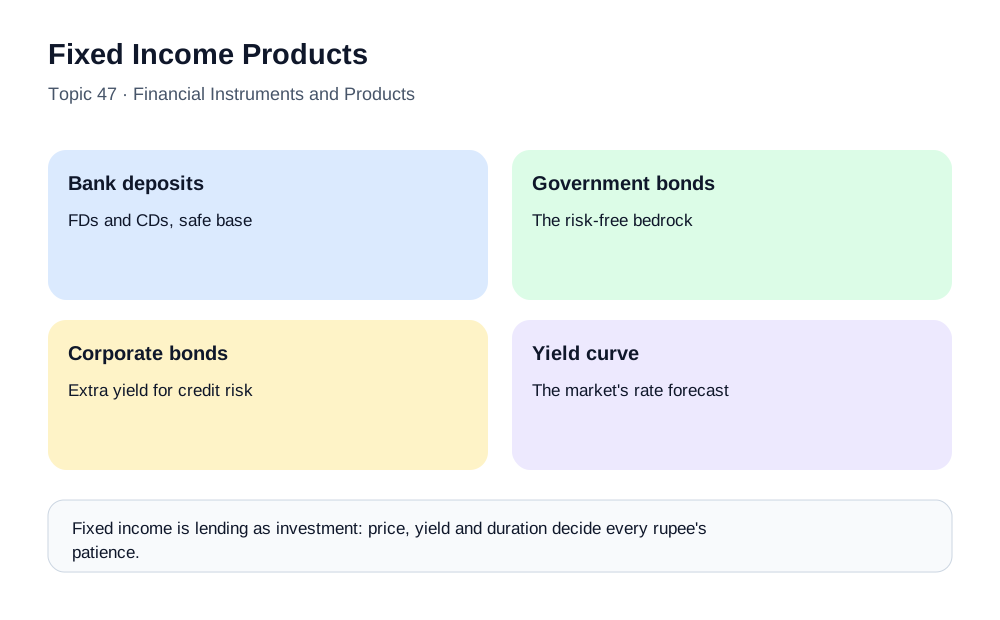
Fixed Income Products at a glance — FDs, CDs, bonds, retail investment products.
1. First Principles: Lending as an Investment
The term "fixed income" refers broadly to any investment that promises a predictable stream of income at regular intervals along with the return of principal at maturity. The "fixed" designation refers to the predictable payment schedule rather than necessarily a fixed interest rate, as many fixed income products incorporate floating rates or inflation adjustments. This predictability distinguishes fixed income from equity investments, where dividends are discretionary and capital returns depend on market prices.
Strip the product away and a fixed income investment is simply a loan viewed from the lender's side. When you open a fixed deposit, you are lending to the bank. When a bank buys a government bond, it is lending to the state. When a pension fund buys a corporate bond, it is lending to a company. Every fixed income product is a promise with four parameters: how much is lent, at what rate, for how long, and how reliably it will be repaid. Everything else in this chapter, ratings, spreads, duration, regulation, is machinery for pricing and managing those four parameters at scale.
The predictability has genuine economic value, and it is priced. An investor who knows exactly what cash flows will arrive can plan against them: a retiree can match income to living costs, an insurer can match payouts to expected claims, a bank can match assets to liabilities. Equities offer higher expected returns precisely because their buyers accept that the future is unknowable; fixed income buyers accept lower returns in exchange for contractual certainty. For banks and their customers, fixed income products provide certainty, stability, and the contractual assurance that capital will be preserved and compensated according to agreed terms, an assurance that, as the sections on credit risk and interest rate risk show, is itself carefully priced rather than free.
2. Bank-Originated Products: The Retail Foundation
Banks originate a wide range of fixed income products that serve as the foundation of retail savings and investment activity.
Fixed deposits, also known as term deposits in many jurisdictions, represent the most fundamental of these products. When a customer opens a fixed deposit, they commit to leaving a specified sum with the bank for a predetermined period, ranging from as short as seven days to as long as ten years, in exchange for a guaranteed interest rate. The bank benefits from the certainty of funding for the deposit term, allowing it to match these liabilities against assets with corresponding maturities. Customers benefit from rates typically higher than savings accounts, reflecting the reduced liquidity associated with locking up funds for fixed periods.
Fixed deposit interest rates vary considerably based on tenure, prevailing monetary policy, and competitive dynamics in the banking sector. In most markets, rates range across the low-to-mid single digits depending on economic conditions and the specific term selected. Deposit insurance schemes protect these investments up to specified limits, providing customers with confidence that their principal is secure even if the bank encounters financial difficulties. Early withdrawal is typically permitted but attracts penalties, often in the form of reduced interest rates, compensating the bank for the disruption to its asset-liability matching and discouraging fickle deposit behavior.
A worked example grounds the arithmetic. A customer places 500,000 in a three-year fixed deposit at 7 percent compounded annually. At maturity the deposit grows to 500,000 × 1.07³ ≈ 612,500, the depositor's reward for surrendering liquidity. If the customer breaks the deposit at eighteen months, the bank typically pays the rate applicable to the actual tenure held, minus a penalty margin, perhaps the one-year rate of 6 percent less one percent, illustrating how the penalty reallocates the cost of the customer's change of mind. The lesson generalizes: a fixed deposit is a contract in which liquidity has a stated price.
Certificates of Deposit represent a related but distinct product category. These short-term instruments, with maturities typically under one year for bank-issued CDs, are usually issued at a discount to face value rather than paying periodic interest. The difference between the purchase price and face value represents the investor's return. A key feature distinguishing CDs from fixed deposits is their negotiability: certificates of deposit can be traded in secondary markets, providing liquidity that fixed deposits lack. This tradeability comes with higher minimum denominations, one hundred thousand rupees in India or one hundred thousand dollars for US jumbo CDs, making CDs accessible primarily to wealthier individuals and institutional investors rather than mass-market retail customers. For banks, CDs are wholesale funding: priced by the market daily, sensitive to the bank's perceived strength, and among the first liabilities to reprice when confidence wobbles.
Recurring deposits address the needs of customers who wish to build savings systematically over time rather than investing a lump sum upfront. Under a recurring deposit arrangement, customers commit to fixed monthly contributions for a set period, earning interest rates generally comparable to those available on fixed deposits of similar maturity. These products appeal particularly to salaried individuals seeking to establish disciplined savings habits, with the contractual commitment of regular contributions helping overcome the behavioral tendency to postpone saving. Like fixed deposits, premature withdrawal attracts penalties, though many banks allow loans against recurring deposit balances, providing some liquidity without terminating the accumulation program.
3. Government Securities: The Bedrock
Government securities, universally considered the safest fixed income instruments due to their backing by sovereign guarantee, form a crucial component of fixed income markets and bank portfolios alike.
Treasury bills represent the short-term segment of government debt, issued with maturities of ninety-one, one hundred eighty-two, or three hundred sixty-four days in most jurisdictions. These instruments are issued at a discount to face value and redeemed at par, with the implicit interest represented by the difference between purchase and redemption values. For example, purchasing a ninety-one day treasury bill at ninety-seven rupees with redemption at one hundred rupees implies a return of roughly three percent over the quarter, an annualized yield of approximately twelve percent under simple annualization, though actual yields vary with market conditions and central bank policy rates and typically track them closely.
Government bonds extend to longer maturities ranging from five to forty years, paying semi-annual coupon payments that provide regular income to investors. These bonds serve as the reference rate for the entire fixed income universe, with the yield on ten-year government bonds typically regarded as the risk-free rate against which all other investments are measured. The phrase deserves precision: "risk-free" means free of credit default risk, since a sovereign issuing in its own currency can always pay, not free of interest rate risk, which can produce large price swings, as every bond investor relearned during the rate rises of 2022 and 2023. Inflation-indexed bonds offer returns that adjust with inflation measures, protecting investors from purchasing power erosion during inflationary periods. State development loans issued by sub-national governments offer slightly higher yields than central government securities, reflecting the modestly elevated credit risk of state entities compared to the sovereign itself.
How governments issue this debt is itself worth understanding, because the process sets the prices the whole market references. Most sovereigns sell securities through regular auctions, announced calendars of competitive bidding in which banks and designated primary dealers submit bids and the government accepts the best prices until the issue is filled. Primary dealers, banks obligated to bid and to make markets afterward, form the distribution spine: they absorb issuance at auction and redistribute it to investors in the secondary market, where bonds then trade daily. The auction's average accepted yield becomes the market's read on the cost of sovereign borrowing for that maturity, and the secondary market's continuous repricing produces the yield curve discussed in Section 6.
Banks hold government securities for multiple strategic reasons extending beyond simple investment returns. Regulatory requirements mandate that banks maintain specified percentages of their deposits in government securities, in India, the Statutory Liquidity Ratio has required holdings in the high-teens percentage range of deposits, as described in the treasury chapter. These holdings serve as liquidity buffers, as government securities can be readily sold or used as collateral in repurchase agreements when banks need short-term funding. The risk-free nature of government securities means banks can earn returns without assuming credit risk, though interest rate risk remains. Finally, government securities play essential roles in bank asset-liability management, enabling duration matching that hedges against interest rate movements.
4. Corporate Bonds: Pricing Credit Risk
Corporate bonds extend the fixed income universe beyond government issuers to encompass debt securities issued by companies, banks, and non-banking financial companies. These instruments offer yields higher than comparable government securities, with the difference, known as the credit spread, compensating investors for the default risk assumed. Credit rating agencies assess and grade corporate bonds on scales running from AAA for the highest quality issuers down through various investment grade ratings to speculative grades and ultimately to D for bonds in default.
The yield spread hierarchy in corporate bond markets reflects this credit quality differentiation. If government bonds trade at five percent, the risk-free rate, AAA-rated corporate bonds might offer six percent, representing a one hundred basis point spread compensating for the small but non-zero risk that even the highest-rated corporations might default. AA-rated bonds might yield six point eight percent, A-rated bonds seven point five percent, and BBB bonds eight point five percent. The critical threshold occurs at the BBB rating, which represents the lowest investment grade. Bonds rated below BBB, BB and below, fall into speculative or "junk" territory, where yields of ten percent or higher reflect substantial default risk.
Two dynamics make spreads more than a static price list. First, spreads move with fear: in calm markets they compress as investors reach for yield, and in crises they widen violently as everyone re-prices default risk simultaneously, a widening that can impose mark-to-market losses on perfectly sound bonds and, in the worst episodes, freeze new issuance entirely. Second, the investment-grade boundary is a cliff with real consequences: many institutional investors are mandated to hold only investment-grade paper, so a downgrade from BBB to BB forces mechanical selling by an entire class of holders regardless of the company's fundamentals. Bonds that cross this boundary down are known as fallen angels, and their forced-selling price dislocations are a recurring feature of credit cycles.
Corporate bond structures vary considerably based on issuer needs and investor preferences. Secured bonds are backed by specific collateral that bondholders can claim if the issuer defaults, providing additional protection that typically results in lower yields. Unsecured bonds, sometimes called debentures, rely solely on the issuer's general creditworthiness without specific asset backing. Convertible bonds include options to convert into equity shares, offering upside participation if the issuer performs well while providing the downside protection of bond status. Perpetual bonds have no maturity date, paying coupons indefinitely unless called by the issuer; these are particularly common for bank Additional Tier 1 capital instruments, where the perpetual nature aligns with regulatory capital requirements, and where investors must understand that coupons can be skipped and principal written down in regulatory stress scenarios, features that make AT1 instruments behave more like equity than like the "fixed income" their marketing suggests.
5. Bond Mathematics: Price, Yield, and Duration
Bond pricing fundamentals reveal essential relationships that govern fixed income markets. The most fundamental principle is the inverse relationship between interest rates and bond prices: when interest rates rise, existing bond prices fall, and when interest rates fall, existing bond prices rise. This relationship arises because existing bonds paying fixed coupons become more or less attractive relative to new bonds issued at current market rates. If you hold a bond paying five percent coupons and new bonds offer six percent, your bond must trade at a discount to attract buyers who could otherwise purchase the higher-yielding new issue.
A compact worked example makes this real. A bond with face value 1,000 pays a 5 percent annual coupon, fifty per year, and matures in two years. If market rates are also 5 percent, the bond is worth exactly 1,000: the coupons are worth what new money earns. If market rates rise to 6 percent, the same cash flows must be discounted at 6 percent: 50/1.06 + 1,050/1.06² ≈ 47.2 + 934.5 ≈ 981.7. A two-point rise in rates cost the holder about 1.8 percent of value in eighteen months. Scale that duration up to a ten-year bond and the same rate move costs several times more, which is the entire content of interest rate risk.
Several key metrics quantify bond characteristics and returns. The coupon rate represents the fixed interest payment as a percentage of face value: a seven percent coupon on a bond with one thousand rupees face value pays seventy rupees annually, typically in semi-annual installments. Current yield divides the annual coupon by the current market price, providing a snapshot of income return that ignores capital gains or losses. Yield to maturity represents the total annualized return an investor will earn if the bond is held to maturity, incorporating both coupon payments and any difference between purchase price and face value received at redemption. YTM is the number that matters for comparison: it is the single rate that makes the bond's price consistent with all its future cash flows.
Duration measures a bond's price sensitivity to interest rate changes, quantifying how much a bond's price will move when interest rates shift. A bond with a modified duration of seven will decline in price by approximately seven percent for every one percentage point increase in interest rates, and increase by seven percent for every one percentage point decrease. Modified duration specifically estimates the percentage price change for a given interest rate change, providing a practical tool for interest rate risk management. Bonds with longer maturities and lower coupons exhibit higher duration and therefore greater interest rate sensitivity; zero-coupon bonds, which make no interim payments, have the highest duration, equal to their maturity. Duration is the treasurer's speedometer: the treasury chapter showed how a portfolio of high-duration "safe" government bonds produced the losses that sank Silicon Valley Bank, because credit safety and price safety are different things entirely.
6. The Yield Curve: The Market's Forecast in One Line
Plot government bond yields across maturities, from three months to thirty years, and you have the yield curve, the single most watched picture in fixed income. In normal times it slopes upward: longer money costs more because lenders demand compensation for tying up funds and bearing inflation and rate risk. The curve steepens when markets expect growth and inflation, and it inverts, short rates above long rates, when central banks have pushed policy rates high and markets expect them to fall as growth weakens. Inversions have preceded most modern recessions, which is why the curve's shape is read as both a forecast and a policy verdict.
For banks the curve is not abstract: it is the gross margin of the entire business model drawn as a line. Banks borrow at the short end and lend at the long end, so an upward-sloping curve flatters net interest margins and an inverted curve squeezes them. The treasury chapter's funding and ALM machinery, and the derivative chapter's swaps, are in large part tools for surviving whatever shape the curve takes.
7. Specialized Retail Products and New Access Channels
Beyond these core fixed income categories, banks distribute various specialized retail investment products that combine fixed income characteristics with additional features. Sovereign gold bonds offer returns linked to gold prices plus a fixed interest component, typically two and a half percent annually in the Indian market, combining the inflation-hedging characteristics of gold with the income generation of fixed income instruments, and eliminating the storage and purity problems of physical gold. Tax-saving fixed deposits provide five-year lock-in periods in exchange for tax deductions under specific provisions, appealing to customers seeking to reduce taxable income while earning guaranteed returns. Senior citizen savings schemes offer preferential interest rates for customers aged sixty and above, recognizing that retirees depend heavily on investment income and have limited ability to assume risk.
The Reserve Bank of India's Retail Direct platform and similar initiatives in other countries have begun democratizing access to government securities, allowing individual investors to purchase bonds directly rather than through intermediaries. These platforms eliminate distribution costs and provide transparent pricing, though they require investors to manage their own portfolios rather than relying on bank advice and convenience. The direction is notable: the same disintermediation that transformed payments and remittances is now reaching the safest corner of investing, giving retail customers direct access to the instruments that were once the exclusive province of institutions.
8. Inside the Bank: Managing the Bond Portfolio
The management of fixed income products within banking institutions requires sophisticated understanding of yield curves, credit analysis, duration management, and regulatory requirements. Bank treasuries must balance the pursuit of yield against liquidity needs, regulatory constraints, and risk tolerance.
One accounting decision shapes everything: how each bond is classified. Bonds designated as held to maturity are carried at cost, insulating reported earnings from market swings but locking the bank into holding them; bonds held available for sale or for trading are marked to market, with price movements flowing through equity or profit. The classification is a strategic choice about which risk you prefer to show, and it disciplines behavior: a treasury that loads the held-to-maturity book with long-duration bonds to avoid showing volatility is not avoiding risk, it is hiding it, as the 2023 bank failures demonstrated when forced sales converted paper losses into real ones.
A worked example shows the liquidity function in action. A bank facing an unexpected deposit outflow of two hundred crores need not sell its bond holdings into a falling market. Instead it enters an overnight repurchase agreement: it sells two hundred crores of government securities to another bank with an agreement to buy them back the next day at a slightly higher price, the price difference being the repo interest. The securities never really leave in any economic sense; they function as collateral converting an illiquid asset into overnight cash at money-market rates. This is why the liquidity buffer must be in government paper specifically: it is the one asset class every counterparty accepts as collateral without argument, in size, on the worst days, which is precisely when the buffer matters.
The asset-liability management function ensures that the timing and characteristics of fixed income assets align appropriately with the bank's funding structure, hedging against interest rate risk while optimizing returns within established risk parameters. In practice this means the investment portfolio is run as the balance sheet's shock absorber: liquid enough to fund deposit outflows, long enough to earn spread income, and duration-managed so that rate moves do not silently erode the bank's capital, the three-way tension that defines treasury work everywhere.
9. The Investor's Perspective: Safety, Yield, and Liquidity
For individual investors navigating the fixed income landscape, understanding the trade-offs between safety, yield, and liquidity is essential. Government securities offer maximum safety but lower yields. Corporate bonds offer higher yields but carry credit risk that must be evaluated. Fixed deposits provide convenience and deposit insurance but sacrifice liquidity.
The three-cornered trade-off admits no escape, only choices. Any product promising high yield, high safety, and high liquidity simultaneously is mispriced, misunderstood, or fraudulent, a test that would have saved investors in every fixed income scandal on record. Practical portfolio construction follows from it. Emergency funds belong in liquid, safe instruments regardless of yield. Money not needed for years can accept duration and credit risk in exchange for spread. And a ladder, deposits or bonds maturing in staggered years, converts the liquidity-yield trade-off from an either-or decision into a managed sequence, providing regular maturities to reinvest at whatever rates then prevail. The optimal fixed income portfolio combines these instruments in proportions reflecting individual circumstances, time horizons, and risk tolerance. Banks serve as essential intermediaries in this process, offering products, advice, and execution capabilities that connect savers with the fixed income investments best suited to their needs.
10. Common Misconceptions About Fixed Income
"Fixed income means fixed value." The income is fixed; the price is not. A government bond can lose ten or twenty percent of its market value in a rising-rate year despite zero credit risk, as 2022 proved to a generation of investors who had never seen rates rise.
"Government bonds are risk-free." They are free of credit default risk, full stop. Interest rate risk, inflation risk, and, for foreign investors, currency risk all remain, and confusing credit safety with price safety is the most expensive misconception in this market.
"Higher yield means a better investment." Higher yield is the market's price for higher risk. An unusually high yield is not a gift; it is a warning label, and the investor's job is to find out which risk is being priced before collecting it.
"Ratings are guarantees." Ratings are opinions about default probability, revised over time, and historically late in crises. They are inputs to analysis, not substitutes for it, as the securitisation chapter's 2008 post-mortem established.
"Selling a bond before maturity means losing money." Selling at a loss after rates rise locks in a price loss, but holding to maturity is not free either: it means earning the old, below-market rate for years. The relevant comparison is always against the alternative use of the money, not against the original purchase price.
"Fixed deposits are always better than bonds for conservative investors." Deposits carry insurance and convenience but no liquidity and no mark-to-market discipline; bonds offer tradability and often better post-tax yields for informed investors. The choice is about liquidity needs and knowledge, not a universal ranking.
11. Frequently Asked Questions
What is the difference between a fixed deposit and a certificate of deposit? Both are bank borrowings at fixed rates. Fixed deposits are non-transferable retail contracts; CDs are negotiable, tradeable instruments in larger denominations used by institutions and wealthy investors. The CD's tradability is what makes it wholesale funding, priced by the market daily.
If interest rates rise after I buy a bond, do I lose money? Only if you sell before maturity. Held to maturity, you receive the contracted coupons and principal exactly as promised; the interim price fall is a paper loss. The real cost of holding is the opportunity cost of earning yesterday's lower rate.
What exactly is the risk-free rate and why does it matter? The yield on government securities at a given maturity, treated as free of default risk. It anchors all pricing: every other yield is quoted as the risk-free rate plus a spread for credit, liquidity, or complexity, so when the risk-free rate moves, the entire fixed income universe reprices around it.
What does a bond downgrade mean for an investor? The price typically falls as the market reprices default risk, and a downgrade below investment grade forces mandated sellers to exit regardless of price. For a hold-to-maturity investor the question is whether the issuer can still pay; for a mark-to-market investor the loss is immediate either way.
Are perpetual bonds safe for retirees seeking income? Caution is warranted. Bank perpetuals (AT1) can skip coupons and, in regulatory stress, be written down or converted; they are capital instruments behaving partly like equity. The income looks attractive precisely because these features are priced in, and they have been enforced in real bank resolutions.
What is a bond ladder and why build one? A portfolio with bonds maturing in staggered years. Each maturity provides cash to reinvest at current rates, smoothing reinvestment risk, preserving liquidity, and removing the need to guess where rates are going.
What is a repo and why do banks use it constantly? A repurchase agreement: selling securities with an agreement to repurchase them shortly after at a slightly higher price, effectively a collateralized overnight loan. Banks use repos to convert bond holdings into cash without selling, and central banks use the repo rate as their primary lever for transmitting monetary policy into market rates.
Can individuals buy government bonds directly? Increasingly yes: retail access platforms, such as India's RBI Retail Direct, let individuals open accounts and buy government securities at auction and in secondary markets, without a bank intermediary, though investors then manage pricing and portfolio decisions themselves.
12. Key Terms in This Chapter
- Fixed income — investments promising scheduled payments plus principal at maturity; lending viewed from the lender's side.
- Fixed / term deposit — a locked bank deposit at a guaranteed rate, with early-exit penalties pricing liquidity.
- Certificate of deposit (CD) — a negotiable bank deposit instrument, wholesale funding in large denominations.
- Recurring deposit — contractual monthly saving at FD-comparable rates.
- Treasury bill — short-term sovereign debt issued at discount, redeemed at par.
- Government bond / gilt — longer-dated sovereign debt paying periodic coupons.
- Risk-free rate — the sovereign yield anchoring all fixed income pricing; credit-risk-free, not price-risk-free.
- Inflation-indexed bond — principal and coupons adjusted for inflation.
- Credit spread — the yield premium over government bonds compensating for default risk.
- Investment grade / speculative (junk) — the BBB boundary and the mandate cliff below it.
- Fallen angel — a former investment-grade bond forced into speculative territory.
- Secured / unsecured bond (debenture) — collateral-backed versus general-credit obligations.
- Convertible bond — debt with an equity conversion option.
- Perpetual bond / AT1 — maturity-less bank capital instruments with skippable coupons and write-down risk.
- Coupon rate / current yield / yield to maturity — the three yield measures, from contractual to all-in.
- Modified duration — percentage price sensitivity per one-point rate move; interest rate risk quantified.
- Zero-coupon bond — no interim payments; maximum duration for its maturity.
- Yield curve — yields across maturities; its slope is the banking margin and a recession signal.
- Held-to-maturity / available-for-sale — accounting classifications deciding whether price swings show in earnings.
- Bond ladder — staggered maturities converting the liquidity-yield trade-off into a managed sequence.
- Statutory Liquidity Ratio (SLR) — the mandate requiring banks to hold a share of deposits in government securities.
13. Interview Insights: How This Topic Appears in Banking Interviews
"Why do bond prices fall when interest rates rise?" Because existing coupons must compete with new issuance. Work the two-year example: a 5 percent bond repriced to a 6 percent market must discount its fixed cash flows at 6 percent, pushing the price below par. Then add duration: the longer and lower-coupon the bond, the harder it falls. Candidates who can quantify, not just state, the inverse relationship stand out immediately.
"Is a government bond risk-free?" Credit risk, essentially yes for sovereigns borrowing in their own currency. Price risk, emphatically no: duration makes long government bonds capable of equity-like drawdowns in rate shocks, and 2022-2023 supplied the case study, including a bank failure caused by exactly this confusion. The distinction is the question's entire point.
"How would you explain yield to maturity to a fixed deposit customer considering bonds?" YTM is the FD rate's true equivalent: the single annualized return locking in all coupons plus the gain or loss to face value at maturity. Warn them the parallel breaks on liquidity and price risk, deposits do not reprice daily, bonds do, and on insurance coverage differences.
"Why do banks hold so many government securities when yields are low?" Four reasons in order: regulation mandates them (SLR-type requirements), they are the liquidity buffer that funds stress outflows through sale or repo, they carry no credit risk, and they are the raw material of duration management. Yield is the least of the reasons, and realizing that is the treasury mindset.
"A corporate bond yields three percent over governments. Is it attractive?" Unanswerable without knowing why: rating, sector, covenants, liquidity, and what the spread compensates. Strong candidates describe the analysis, default probability, recovery, spread versus rating peers, before any judgment, and note that a spread wider than peers is a question before it is an opportunity.
Summary and Key Takeaways
- Fixed income is lending viewed from the lender's side: every product is a promise defined by amount, rate, term, and reliability, and predictability itself is priced.
- Bank-originated products, fixed deposits, CDs, recurring deposits, trade liquidity for yield in progressively more wholesale forms.
- Government securities are the system's bedrock: credit-risk-free reference rates, regulatory holdings, and the bank's liquidity buffer, but never free of price risk.
- Corporate bonds price default risk through ratings and spreads; the investment-grade boundary is a cliff with forced-selling consequences.
- Bond mathematics, the price-yield inverse, yield to maturity, and duration, is the working toolkit; duration, not credit rating, is what sank rate-shocked portfolios.
- The yield curve is both forecast and business model: banks live off its slope, and inversions squeeze the margin that funds it.
- Retail access is democratizing, from gold bonds to direct government securities, while the safety-yield-liquidity triangle remains immovable: promises of all three are warnings, not opportunities.
- For banks, the bond portfolio is the balance sheet's shock absorber; for investors, the ladder is the humble strategy that needs no forecast to work.
Next: Topic 48 — Bank Guarantees and Letters of Credit →
<!-- MBA-DEEP-DIVE-START -->Deep Dive: Fixed Income as Cash-Flow Contract, Credit Risk, Interest-Rate Risk, and Liquidity
Fixed income is often presented as the ‘safe’ side of investing. That label is useful only if it is immediately qualified. A fixed-income instrument can promise defined contractual cash flows and still expose the holder to issuer default, interest-rate movement, inflation, reinvestment, liquidity, currency, optionality, and early-exit risk. The professional skill is not memorising bond names; it is identifying which of those risks each instrument transfers to the investor.
For banks, fixed income has three different meanings at once. Banks issue fixed-income liabilities such as deposits and debt securities to fund themselves. They invest in government and corporate securities for liquidity, treasury, and return. And they distribute or intermediate fixed-income products for customers. The same bond can therefore appear as someone's asset, someone else's liability, a trading position, collateral, and a customer investment at the same time.
A deposit and a bond are both promises, but they are not the same legal product
A fixed deposit or term deposit is generally a contractual liability of the bank to the depositor. The customer places money for an agreed term and rate under the deposit contract, subject to withdrawal, renewal, insurance, tax, and product rules.
A bond is a security issued under capital-market documentation. The investor holds a tradable or transferable claim against the issuer, subject to the bond's terms, market infrastructure, and insolvency ranking.
The economic cash flows can look similar—principal now, interest through time, principal returned later—but customer protections and operational treatment can differ substantially. Deposit insurance may apply to eligible bank deposits within jurisdictional limits, while ordinary bonds do not become insured deposits merely because a bank issued them.
This distinction matters when banks sell their own bonds to retail customers. The customer should understand whether they are buying a deposit, subordinated debt, senior unsecured debt, or another security. Brand familiarity does not make every bank liability equally protected.
Yield is the price of time, credit, liquidity, and optionality
A bond yield is not simply ‘the interest rate’. It compensates the investor for several things.
There is a base time-value component linked to the risk-free or benchmark yield curve. Credit spread compensates for default and downgrade risk. Liquidity premium compensates for difficulty selling. Term premium reflects uncertainty over longer horizons. Optionality can favour either issuer or investor. Currency and inflation expectations influence nominal returns.
Two bonds with the same maturity can therefore trade at very different yields because their issuers, liquidity, structures, and options differ.
When a bank relationship manager says one bond ‘pays more’, the next question should be: what additional risk is paying for the difference?
Coupon rate and yield are different numbers
The coupon is defined by the bond contract. The yield depends on the market price and expected cash flows.
Suppose a ₹1,000 bond pays a 6% annual coupon, or ₹60. If market rates rise and investors now require 8% for comparable risk, nobody will pay ₹1,000 for a security yielding only ₹60 a year. Its price falls until the total return to maturity is competitive.
If the bond trades below par, the investor receives coupon income plus a capital gain if it redeems at par. If it trades above par, part of the coupon advantage is offset by a capital loss toward redemption.
This inverse relationship—yields up, fixed-rate bond prices down—is the foundation of interest-rate risk.
Yield to maturity is a useful model, not a guaranteed realised return
Yield to maturity calculates the discount rate that equates current price with promised coupon and principal cash flows, assuming the investor holds to maturity and the issuer pays as promised. It also implicitly relies on assumptions about reinvestment of intermediate coupons.
Realised return can differ because the investor sells early, the issuer defaults, the bond is called, coupons are reinvested at different rates, or transaction costs and taxes intervene.
A customer comparing a bond's quoted YTM with a fixed deposit's contractual rate should understand that the two figures are not identical guarantees.
Duration converts maturity into price sensitivity
Maturity tells when principal is due. Duration measures the timing of all cash flows and provides a practical approximation of price sensitivity to yield changes.
A long-duration bond generally moves more in price for a given change in rates than a short-duration bond. A zero-coupon bond has high duration relative to a high-coupon bond of similar maturity because more of its value arrives at the end.
For a simple approximation, if a portfolio has modified duration of five, a one-percentage-point parallel increase in yields may reduce value by roughly five percent before considering convexity and other effects.
This is why ‘government bond’ does not mean ‘price stable’. A long-dated sovereign security can suffer a large market-value decline when rates rise even if there is no meaningful change in credit risk.
Convexity explains why the duration approximation bends
Bond price and yield do not move in a straight line. Convexity captures the curvature. For ordinary option-free bonds, price gains when yields fall can be somewhat larger than price losses predicted by a simple linear duration approximation, and vice versa.
Callable securities can have very different convexity because the issuer is more likely to redeem when rates fall, limiting the investor's upside. Mortgage-backed securities can also display unusual duration behaviour as borrower prepayments change with rates.
The lesson is not that every retail investor needs a convexity formula. It is that fixed-income risk becomes less linear when embedded options change expected cash flows.
Credit risk exists on a spectrum
Government securities, bank debt, investment-grade corporate bonds, high-yield bonds, securitisation notes, and emerging-market debt carry different default and recovery risks.
Credit analysis asks whether the issuer can service debt under stress. For a corporation, that includes cash flow, leverage, interest coverage, liquidity, business model, industry, covenant structure, and debt ranking. For a bank, capital, asset quality, liquidity, funding, profitability, and regulatory regime matter. For a sovereign, fiscal capacity, currency regime, external balances, institutions, and monetary flexibility can matter.
Ratings are useful summaries but should not be the sole basis for investment. Rating changes can lag market information, and two securities with the same rating can have different liquidity, seniority, and structural protection.
Seniority matters when default happens
Not all debt issued by one entity ranks equally. Secured debt can have claims on specified collateral. Senior unsecured debt ranks according to insolvency law and contract. Subordinated debt absorbs losses after senior claims in defined order, and some bank capital instruments can have conversion or write-down features under regulatory frameworks.
Higher yield can therefore compensate for lower ranking, not simply a higher probability of issuer failure.
A bank distributing its own subordinated instrument should make the loss-absorption and ranking clear. A customer should never interpret the familiar bank logo as equivalent to deposit safety.
Accrued interest explains why bond settlement value differs from quoted price
Many bonds pay coupons periodically. Between coupon dates, the seller has economically earned part of the next coupon. The buyer typically pays the quoted clean price plus accrued interest to arrive at the dirty or settlement price, according to market convention.
This is an operationally important distinction. A trading screen may show a clean price of 99.50, while the cash settlement amount is higher because accrued interest is added.
Systems need the correct day-count convention, last coupon date, next coupon date, settlement date, and ex-coupon rules where relevant.
A wrong calendar or day-count convention creates both customer and accounting errors.
Settlement date is not trade date
A bond trade creates a contractual commitment on trade date. Cash and securities typically exchange on the market's settlement date according to local convention.
The period creates settlement exposure and operational tasks: trade confirmation, matching, cash forecasting, securities availability, settlement instructions, and custody movements.
Delivery-versus-payment mechanisms reduce principal risk by linking securities delivery with payment, but failed settlement can still occur because of insufficient securities, cash, instruction mismatch, or operational problems.
Fails should be monitored by value, age, counterparty, and cause. Persistent settlement failure can indicate weak inventory management or broken static data.
Custody separates beneficial ownership from operational safekeeping
Customers can own bonds held through a custodian or depository structure rather than possessing certificates. The custodian maintains records, processes settlement, collects coupons and redemptions, handles corporate actions, provides statements, and may support tax documentation.
A bank acting as custodian should segregate client assets according to law and maintain accurate entitlement records. Securities held for customers should not be confused with the bank's own proprietary inventory.
Corporate actions such as calls, conversions, consent requests, or tender offers require timely customer notification because missing an election deadline can create financial loss.
Fixed deposits have their own operational lifecycle
A bank term deposit begins with placement amount, currency, term, rate, value date, maturity date, interest payment frequency, nomination, tax treatment, and maturity instruction.
The maturity instruction matters. The customer may want principal and interest paid to an account, principal renewed and interest paid out, or full automatic renewal. If the instruction is unclear, the bank can create unwanted reinvestment or leave funds idle.
Premature withdrawal can alter the applicable rate or create a penalty according to product terms and law. The system should calculate this from the original contract and actual holding period, not by manually improvising at the branch.
Renewal should use the applicable rate on the renewal date unless the product validly specifies otherwise. A customer should be able to reconstruct how maturity proceeds were calculated.
Certificates of deposit bridge deposit funding and capital markets
A certificate of deposit is a negotiable money-market instrument representing a deposit claim under the relevant market framework. Unlike an ordinary retail term deposit, it can be designed for market investors and transferred according to applicable rules.
For the issuing bank, CDs diversify wholesale funding. For investors, they provide short-term bank credit exposure. Pricing reflects maturity, bank credit, liquidity, and prevailing money-market conditions.
Because they can be market instruments, their value before maturity can change with rates and credit spreads. ‘Deposit’ in the name should not lead an investor to assume identical treatment to a small retail savings product.
Floating-rate notes shift rate risk rather than remove it
A floating-rate note periodically resets its coupon to a benchmark plus or minus a spread. This reduces price sensitivity to ordinary rate moves compared with a long fixed-rate bond because cash flows reprice.
But the instrument still has credit-spread risk, reset lag, benchmark risk, liquidity risk, and potential caps or floors. If the issuer's credit deteriorates, the contractual spread may no longer compensate the market, and price can fall.
The investor has exchanged one kind of uncertainty—fixed coupon in a changing-rate market—for another—future coupon level.
Inflation-linked bonds separate real and nominal return
Inflation-linked securities adjust principal, coupon, or both according to a specified inflation index, protecting purchasing power more directly than ordinary nominal bonds.
They introduce indexation rules and timing differences. The inflation measure is usually published with a lag, and tax treatment can differ by jurisdiction.
The investor should compare real yield rather than nominal coupon alone. A conventional bond yielding 7% in an environment where inflation averages 6% produces a very different real outcome from 7% when inflation is 2%.
Reinvestment risk matters most when cash returns early
A bond with frequent coupons or callable features returns cash to the investor that must be reinvested. If market rates have fallen, the investor may not be able to earn the original yield on that cash.
Callable bonds make this asymmetric: issuers tend to call when refinancing is favourable to them, which is often when reinvestment is least attractive to investors.
A higher coupon on a callable bond may therefore compensate for the investor granting the issuer an option.
Liquidity is a risk even when credit is strong
A bond can be issued by a strong borrower and still be difficult to sell at a fair price if the issue is small, rarely traded, held by a concentrated investor base, or markets are stressed.
Bid-ask spread, dealer inventory, trading volume, issue size, and market depth provide clues. During stress, liquidity can disappear exactly when an investor wants to exit.
Banks holding securities for liquidity-buffer purposes must distinguish assets that are legally eligible from assets that can actually be monetised quickly in size under stress, including through repo where available.
Repo converts securities into short-term funding
A repurchase agreement economically combines securities sale and forward repurchase to create secured funding. The cash borrower provides securities; the cash lender receives collateral and earns the repo return.
The collateral's market value, haircut, eligibility, margining, and settlement matter. A government bond can therefore be valuable to a bank not only for coupon and liquidity but because it can be pledged for secured funding.
This collateral utility is one reason highly liquid sovereign securities can trade at yields below less usable instruments.
Customer suitability depends on horizon and need
A customer needing school fees in six months should not be placed in a long-duration illiquid bond simply because the yield is attractive. A retiree depending on stable cash flow has different tolerance for credit and market losses from a young investor with long horizon.
The bank should ask about holding period, liquidity need, currency, income requirement, risk capacity, tax, and concentration. A ‘fixed income’ label should never substitute for product-specific risk explanation.
For retail distribution, the customer should understand whether they can exit before maturity, at what kind of market price, what happens on issuer default, and whether principal is guaranteed by anyone.
A complete bank investment scenario
A bank's treasury has ₹2,000 crore of temporary surplus liquidity and expects part of it may be needed within six months.
It does not simply buy the highest-yielding bonds. Treasury separates operational cash, short-term liquidity buffer, and genuinely investable surplus. Risk limits define eligible issuers, maturities, ratings or internal credit quality, duration, concentration, and market liquidity.
The team buys a mix of short government securities and high-quality short-dated instruments. Trades are independently confirmed and settle delivery-versus-payment. Securities enter custody and the investment sub-ledger. Finance classifies them under the appropriate accounting category. Market-risk systems calculate duration and sensitivities. Credit systems track issuer exposure.
A month later rates rise. Market values fall slightly, but the short duration limits the loss. Treasury still has enough readily monetisable assets to meet outflows. Some holdings are used in repo to raise cash without outright sale.
The portfolio succeeded not because every instrument had the highest return, but because yield, liquidity, credit, duration, accounting, and funding purpose were aligned.
What excellence looks like
A world-class fixed-income function can distinguish deposit from security, coupon from yield, maturity from duration, rating from actual credit analysis, and quoted price from settlement value. It understands seniority, embedded options, liquidity, currency, inflation, and reinvestment. Trading records reconcile to custody and cash settlement. Customer portfolios reflect liquidity need and risk capacity. Bank treasury holdings serve a defined funding or investment purpose rather than chasing yield blindly.
Fixed income is called ‘fixed’ because parts of the cash-flow contract are specified. The investor's economic outcome is never fixed unless every relevant risk is also controlled—and that is rarely true.
<!-- MBA-DEEP-DIVE-END -->