Derivatives represent one of the most sophisticated and consequential corners of modern finance, financial contracts whose value derives from underlying assets such as interest rates, currencies, commodities, or equities without requiring direct ownership of those assets. Within the banking sector, derivatives serve as essential tools for risk management, client service, and revenue generation, enabling institutions to transform, transfer, and trade risks in ways that would be impossible through traditional banking activities alone. Understanding how banks use derivatives is essential to comprehending contemporary financial markets and the mechanisms through which modern banking institutions manage their complex risk exposures.
By the end of this chapter, you will be able to:
- Define what a derivative is and why risk transfer without asset transfer is so powerful
- Distinguish the four building blocks: forwards, futures, options, and swaps
- Explain interest rate swap mechanics and their role in asset-liability management
- Describe credit default swaps, their uses, and the AIG lesson
- Explain how banks earn from derivatives: spreads, structuring, valuation adjustments
- Identify the risk categories derivatives create and the controls each requires
- Understand the post-2008 reform architecture: clearing, margin, reporting
- Judge the line between hedging and speculation, in clients and in banks
Visual overview
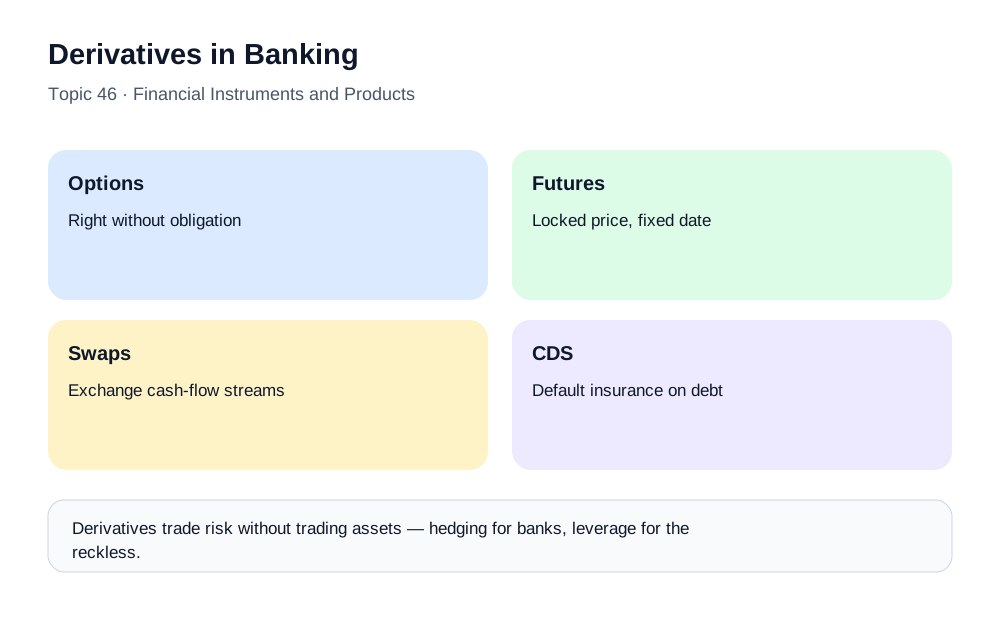
Derivatives in Banking at a glance — Options, futures, swaps, CDS, hedging.
1. First Principles: Trading Risk Without Trading Assets
A derivative, at its most fundamental level, is a contractual agreement between two parties whose financial outcome depends on the future price or value of an underlying reference asset. Unlike spot transactions where assets change hands immediately, derivatives establish obligations or options for future settlement based on predetermined formulas. No physical asset typically changes hands in a derivative transaction, only the financial obligations determined by the contract terms are exchanged, making derivatives remarkably efficient for transferring risk without transferring the underlying assets themselves.
Why does this matter so much? Because risk and ownership are different things, and commerce constantly needs to separate them. A farmer owns wheat but fears its price will fall before harvest. An airline earns revenue in many currencies but pays for fuel in dollars. A bank owns fixed-rate loans but owes floating-rate deposits. In each case, the party wants to keep the asset or liability and shed the risk attached to it. Selling the asset would work, but it is often impossible or undesirable, the farmer needs to grow the wheat, the bank wants to keep the loan relationship. The derivative solves the problem surgically: keep the asset, transfer the price risk to someone willing to hold it, for a price.
This reveals the derivative's dual nature, which every honest treatment must hold simultaneously. For the party shedding risk, the derivative is insurance, a cost paid for certainty. For the party accepting it, the derivative is either a matched offset against an opposite exposure or a deliberate bet. A wheat forward is simultaneously the farmer's hedge and, if the counterparty has no wheat needs, a speculator's position. The instrument is identical; only the purpose differs. This is why derivatives debates so often talk past each other: the same contract that stabilizes one balance sheet is leverage on another. The banking profession's task is not to choose between hedging and speculation, it is to know, always and demonstrably, which one any given position is.
2. The Four Building Blocks
The derivative universe encompasses four fundamental contract types that form the building blocks for all more complex structures.
Forwards represent the simplest derivative form, a private agreement between two parties to buy or sell an asset at a specific price on a future date. A bank might use a forward contract to lock in an exchange rate for a corporate client expecting foreign currency revenues in six months, eliminating the uncertainty of exchange rate movements during that period, the same instrument dissected in the foreign exchange chapter. Forwards are customized to the specific needs of the contracting parties, traded over-the-counter rather than on exchanges, and carry counterparty credit risk since each party relies on the other's ability to fulfill the contract.
Futures are standardized forward contracts traded on organized exchanges with clearinghouse guarantees. Interest rate futures allow participants to speculate on or hedge against movements in benchmark rates without negotiating individual contract terms. The standardization and clearinghouse intermediation eliminate counterparty risk and create liquid markets where positions can be easily closed, though this comes at the cost of reduced flexibility compared to customized forwards. The trade-off is fundamental and recurring: customization versus liquidity and safety. Futures also introduce daily mark-to-market and margining, gains and losses are settled every day, which prevents losses from silently accumulating to catastrophic size, the feature whose absence in over-the-counter markets proved so dangerous in 2008.
Options provide the right, but not the obligation, to buy or sell an asset at a predetermined price during or at the end of a specified period. This asymmetry distinguishes options from forwards and futures, where both parties are obligated to perform. A bank might purchase put options to hedge a portfolio against adverse rate movements: if rates move against it, the options generate offsetting gains; if markets stay favorable, the bank simply lets the options expire, losing only the premium paid. This insurance-like characteristic makes options valuable for protecting against adverse outcomes while preserving upside potential, though the premium cost must be weighed against the protection provided. The premium is not arbitrary: it reflects the volatility of the underlying, because volatility is what the option seller is insuring against.
A miniature example fixes the option logic. A bank holds a bond portfolio that loses value if interest rates rise. It buys put options on bond futures for a premium of, say, 0.5 percent of the protected amount. If rates rise sharply, the puts pay out in proportion to the rate move, cushioning the portfolio's loss; if rates fall, the portfolio gains and the bank is out only its 0.5 percent premium. The asymmetry is the entire point: defined, bounded cost against an unbounded adverse move, the same insurance logic as the currency options of the foreign exchange chapter, applied to rates.
Swaps involve the exchange of cash flows between two parties according to predetermined rules. The most common type, interest rate swaps, has become the largest derivative market in existence, with notional amounts outstanding in the hundreds of trillions of dollars globally. In a typical interest rate swap, one party pays a fixed rate while receiving a floating rate tied to a benchmark such as SOFR, the Secured Overnight Financing Rate that replaced LIBOR after that benchmark's manipulation scandal and discontinuation. Only the net difference between the fixed and floating payments changes hands periodically, with the notional principal serving merely as the calculation base rather than changing hands.
3. Interest Rate Swaps: The Workhorse of Bank Risk Management
Interest rate swaps deserve particular attention given their dominant role in banking and financial markets. The mechanics are straightforward in concept though complex in practice: Party A agrees to pay a fixed rate, say five percent, on a notional amount, while Party B pays a floating rate, perhaps SOFR plus a spread, on the same notional amount. The parties exchange only the net difference periodically. If the floating rate fixes at four percent, Party A, paying five percent fixed and receiving four percent floating, pays Party B the one percent difference. If floating rises to six percent, the flow reverses: Party B pays Party A the one percent difference. This net settlement makes swaps efficient for managing interest rate exposure without requiring large principal exchanges.
Banks deploy interest rate swaps for multiple strategic purposes. Asset-liability management represents perhaps the most fundamental application. A bank that makes long-term fixed-rate loans but funds itself with short-term floating-rate deposits faces significant interest rate risk, if short-term rates rise above the fixed rates earned on loans, the bank's net interest margin turns negative. This is not a theoretical danger: the 2023 failure of Silicon Valley Bank, described in the treasury chapter, was at root an unmanaged version of this mismatch in bond form. By entering into interest rate swaps where the bank receives floating and pays fixed, this mismatch can be neutralized. The floating receipts from the swap offset the floating deposit costs, while the fixed loan payments offset the fixed swap payments, transforming the bank's overall position to a matched book.
Client hedging services generate substantial derivative activity as banks help corporate customers manage their own interest rate exposures. A corporate client with floating-rate debt who wants certainty about future interest expenses can enter into a swap with the bank, receiving floating to offset its debt payments while paying fixed to lock in a known rate. The bank faces the opposite exposure but can aggregate positions across multiple clients, hedging residual risk in interbank markets or maintaining positions within its authorized interest rate views.
Trading activities contribute to derivative volumes as banks take directional positions on interest rate movements. While post-crisis regulations have limited proprietary trading in many jurisdictions, market-making activities inevitably create positions that banks manage through active trading. Yield enhancement strategies use swaps to restructure cash flows in ways that improve returns within specified risk parameters, though these structures require careful risk assessment to ensure that apparent yield improvements don't mask hidden risks.
The scale of the interest rate swap market, notional outstanding in the hundreds of trillions of dollars, reflects its centrality to modern finance. This figure represents the sum of all notional amounts underlying swap contracts, not the actual amount at risk, since swaps involve net settlement and participants typically hold offsetting positions. The true economic exposure is a small fraction of the headline notional, a distinction every journalist covering derivatives should learn and few headlines respect. Nevertheless, the market's size indicates how thoroughly interest rate swaps have penetrated financial practice, serving as essential tools for virtually every major financial institution and many non-financial corporations.
4. Credit Default Swaps: Insurance on Debt, and Its Shadow
Credit Default Swaps represent another derivative category with particular significance for banking, functioning essentially as insurance contracts on bonds or loans. In a CDS transaction, the protection buyer pays periodic premiums to the protection seller, who agrees to compensate the buyer if a specified reference entity defaults on its debt obligations. The buyer need not actually own the underlying bond: so-called "naked" CDS positions allow speculators to bet on credit deterioration without having an insurable interest in the reference entity.
Used as designed, CDS are valuable risk tools. A bank holding a large loan to a single corporate borrower can buy CDS protection to cap its exposure while preserving the client relationship and the loan's yield; investors use CDS to express credit views and to price credit risk transparently. The CDS market created, for the first time, a visible, continuously updated market price for the creditworthiness of companies and countries, information of genuine public value.
The role of credit default swaps in the 2008 financial crisis illustrates both the utility and dangers of derivative instruments. AIG, the insurance conglomerate, sold hundreds of billions of dollars in CDS protection on mortgage-backed securities and other structured products, collecting premiums while assuming that housing prices would not decline nationally and that correlations between mortgage defaults would remain low. When these assumptions proved catastrophically wrong, AIG faced claims it could not meet. The potential failure of AIG threatened systemic contagion, as its CDS counterparties included virtually every major financial institution. The United States government ultimately provided AIG with a support package whose authorized size peaked above one hundred eighty billion dollars to prevent a disorderly collapse that would have propagated through the derivative network.
The AIG lesson is the counterparty lesson: a derivative is only as good as the entity standing behind it. Unlike an exchange-traded future with a clearinghouse guarantee, the bilateral CDS was a private promise, and AIG had made more promises than it could keep, without posting meaningful collateral as its positions moved against it. The reform architecture of Section 9 exists almost entirely to answer this single failure.
5. Currency Derivatives: Managing Cross-Border Risk
Currency derivatives address foreign exchange risk that arises whenever banks or their clients conduct business across national borders, building directly on the instruments introduced in the foreign exchange chapter. FX forwards allow parties to lock in exchange rates for future dates, essential for companies with known foreign currency payables or receivables. An Indian company expecting dollar revenues in ninety days can use an FX forward to lock in the rupee equivalent today, eliminating exchange rate uncertainty. FX swaps involve exchanging currencies now with an agreement to reverse the exchange at a future date, essentially a collateralized short-term loan in foreign currency commonly used to manage funding needs across currencies, and among the highest-volume instruments in all of global finance, largely invisible outside treasury circles.
Currency options provide the right to exchange currencies at predetermined rates, offering more flexibility than forwards at the cost of option premiums. A company with uncertain foreign currency needs might purchase currency options to protect against adverse rate movements while retaining the ability to benefit from favorable movements if they occur. Cross-currency swaps exchange both principal and interest payments in different currencies over extended periods, enabling parties to transform obligations denominated in one currency into another: a corporation with dollar revenues but euro debt might use a cross-currency swap to transform its euro obligations into dollar obligations that match its revenue stream.
6. How Banks Earn from Derivatives
Banks generate substantial revenue from derivative activities through multiple channels. The bid-ask spread, the difference between prices at which banks will buy and sell derivatives, represents fundamental compensation for market-making services. A bank might quote a swap rate of five percent to pay and five point one percent to receive, earning the ten basis point spread on transactions with customers while hedging the resulting exposure in interbank markets. Structuring fees compensate banks for designing customized derivative solutions addressing specific client needs, particularly for complex exposures that cannot be addressed with standardized products.
Credit Valuation Adjustments and Debit Valuation Adjustments reflect adjustments to derivative valuations accounting for counterparty credit risk. CVA reduces the value of derivatives where the bank is owed money, recognizing that the counterparty might default before fulfilling its obligations. DVA adjusts liabilities where the bank owes money, recognizing that the bank's own credit deterioration reduces the value of what it owes. These adjustments, while technically complex, have become significant components of derivative accounting and pricing, and large banks now run dedicated CVA desks whose job is to hedge the counterparty risk embedded across the entire derivative book.
Prime brokerage services provide hedge funds and other sophisticated investors with comprehensive derivative trading capabilities, including execution, clearing, financing, and reporting. Banks earn fees for these services while generating additional trading volume and deposits. The prime brokerage business has become highly competitive, with only the largest institutions possessing the capital and infrastructure required to serve the most demanding clients, and the 2021 Archegos collapse, in which a family office's total return swap positions unraveled across multiple prime brokers for over ten billion dollars in bank losses, demonstrated that counterparty risk management in this business remains a live discipline, not a solved problem.
7. Inside the Bank: Running a Derivative Book
Between the instruments and the risks sits the daily machinery of a bank's derivative operation, and it rewards a look because most derivative disasters are operational before they are financial.
The day runs on revaluation. Every position is marked to market daily, priced against observable curves and volatilities, with the profit and loss explained: how much came from market moves, how much from new trades, how much from the passage of time. Unexplained profit and loss is treated as a warning light, because it usually means a mis-modeled position or a booking error, either of which grows more expensive by the day.
Positions live inside limits. Trading desks operate within market-risk limits measured through sensitivities and value-at-risk, counterparty limits per name, and notional caps, all monitored independently of the desk by a risk function that reports up a separate line. A trader's economic incentive is to use the full limit; the control system's job is to make the limit visible, enforceable, and impossible to exceed quietly.
Collateral moves constantly. Under margining agreements, counterparties exchange collateral daily as values move, cash mostly, sometimes securities. The collateral management team reconciles calls, disputes valuations, and tracks what is posted where, unglamorous work that was, in 2008, the difference between institutions that merely lost money and institutions that lost count of what they were owed.
The middle office confirms everything. Every trade is documented, confirmed with the counterparty, and settled through a chain independent of the traders, the segregation-of-duties rule written in Barings' ashes. In derivatives, the front office makes the money and the rest of the machine exists to make sure the money is real.
8. The Risks Derivatives Create
Derivative activities expose banks to multiple risk categories requiring sophisticated management. Market risk, the possibility that price movements in underlying assets create losses on derivative positions, requires continuous monitoring and hedging. Counterparty risk, the chance that the other party to a derivative contract fails to fulfill its obligations, demands credit analysis, collateral management, and in many cases, central clearing. Liquidity risk arises when banks cannot close or hedge positions at reasonable prices, particularly during market stress when bid-ask spreads widen dramatically and market depth evaporates.
Model risk reflects the possibility that derivative pricing or risk measurement models contain errors or inappropriate assumptions. The complexity of many derivative structures exceeds the capacity of simple models, and the very act of hedging can influence market prices in ways that models don't capture. Operational risk encompasses settlement failures, documentation errors, and systems failures that can create unexpected exposures or prevent timely execution of intended trades; in derivatives, an unsigned confirmation or a wrong payment instruction is not a paperwork issue but a live financial exposure.
Two further risks deserve explicit naming because history demands it. Rogue trading risk sits at the intersection of all the above: derivatives allow a single trader to accumulate enormous positions invisibly, because notional exposure costs nothing upfront. The 1995 collapse of Barings Bank, a 233-year-old institution destroyed by one trader's concealed futures losses in a Singapore back office he also controlled, remains the founding case study of operational control failure, and its core lesson, never let the same person trade and settle, is now the most basic segregation-of-duties rule in the industry. And client suitability risk arises when banks sell derivatives to customers who cannot understand or afford them: the post-2008 review of interest rate swaps mis-sold to small businesses in the UK, in which shops and small manufacturers were bound into complex swap contracts whose break costs dwarfed anything they had been led to expect, forced billions in redress and hardened the conduct rules requiring that derivative sales to non-sophisticated clients be suitable, explained, and documented.
9. The Post-Crisis Reform Architecture
Post-crisis reforms have imposed substantial new requirements on derivative markets, amounting to the most comprehensive redesign of any market's infrastructure in modern financial history.
Central Counterparty Clearing for standardized derivatives reduces counterparty risk by interposing a well-capitalized clearinghouse between buyers and sellers, though it concentrates risk in these central nodes and requires careful oversight of clearinghouse resilience. Margin requirements, for both initial margin, posted upfront to cover potential future exposure, and variation margin, adjusting daily for current mark-to-market gains and losses, ensure that derivative exposures remain collateralized, directly answering the uncollateralized AIG failure. Trade reporting to repositories provides regulators with comprehensive visibility into derivative positions, enabling systemic risk monitoring that simply did not exist before 2008, when no authority could see the web of exposures until it began to fail.
The Volcker Rule in the United States specifically limits proprietary trading by banks, though market-making and client facilitation activities remain permitted. This distinction between prohibited proprietary trading and permitted market-making has proven difficult to enforce in practice, with banks and regulators engaging in ongoing dialogue about where the line should be drawn. Similar restrictions in other jurisdictions have reshaped how banks organize their trading activities and compensate traders.
The architecture's logic can be stated in one sentence: everything that made the pre-2008 market dangerous, opacity, uncollateralized bilateral promises, and banks betting for their own account, now has a specific mechanism aimed at it. The costs are real too: margin requirements tie up liquidity across the system, clearing concentrates risk in a handful of critical nodes, and compliance burdens have pushed smaller players out of markets they once intermediated. Regulation, like the derivatives it governs, transfers risk rather than deleting it; the post-crisis settlement moves risk into clearinghouses and collateral pools where it can at least be seen, measured, and managed in daylight.
10. Common Misconceptions About Derivatives
"Derivatives are weapons of mass destruction." The famous phrase captures one true half: misused, unmargined, misunderstood derivatives are dangerous. The other half: interest rate swaps quietly stabilize the net interest margins of nearly every bank on earth, and farmers, airlines, and exporters hedge daily without incident. The instrument amplifies the user's intent; it has none of its own.
"Hundreds of trillions in notional means hundreds of trillions at risk." Notional is the calculation base, not the exposure. Net settlement and offsetting positions mean actual risk is a small fraction of the headline figure, though not zero, and not to be dismissed either.
"Hedging with derivatives is free insurance." Every hedge has a price: the option premium, the forward's removal of upside, the margin calls that demand cash precisely when markets move against you. Hedging converts price risk into cost and liquidity risk; treasurers who forget the liquidity half discover it in crises.
"Only gamblers buy options." Options are the purest risk-management instrument ever designed, bounded cost for defined protection. The gambling happens when options are sold naked or bought as lottery tickets; used as designed, they are insurance.
"Central clearing eliminated counterparty risk." It mutualized and concentrated it. Clearinghouses are safer than thousands of bilateral webs, but they are now systemically critical nodes whose own failure modes, member defaults, liquidity spirals, require their own careful regulation.
"A hedge that loses money was a bad hedge." If the hedged exposure gained the same amount, the hedge worked perfectly. Judging hedges in isolation is the single most common error in derivative discussions, in boardrooms as much as in comment sections.
11. Frequently Asked Questions
What is the difference between a forward and a future? Both fix a price for future delivery. Forwards are private, customized, and carry counterparty risk; futures are standardized, exchange-traded, cleared, and margined daily. The forward fits your exact need; the future fits you approximately but will almost certainly be honored.
Why would a bank swap fixed for floating if it already earns fixed on loans? Because its funding is floating. The swap aligns the two sides of the balance sheet: the bank ends up paying and receiving floating in matched amounts, with the fixed loan income offsetting fixed swap payments. The mismatch, not the level of rates, is what kills banks, and the swap removes the mismatch.
Is buying a CDS on a company I don't own like betting on its failure? Structurally, yes: naked CDS positions profit from credit deterioration without any insurable interest. Defenders argue they add liquidity and price discovery; critics argue they amplify stress. Either way, post-crisis rules now require clearing, margin, and reporting, so the bet is collateralized and visible.
What happens if my counterparty in a swap goes bankrupt? For cleared swaps, the clearinghouse steps in and your position continues. For bilateral swaps, your claim ranks in the bankruptcy, collateral posted by the counterparty protects you up to its value, and netting agreements let you offset what you owe against what you are owed. Documentation quality decides outcomes, which is why derivative legal teams are large.
Why did replacing LIBOR with SOFR matter? LIBOR was a polled, judgment-based rate that proved manipulable and ceased publication; SOFR is based on actual overnight transactions, making it robust and manipulation-resistant. The transition rewired trillions in contracts and changed how floating payments are calculated, one of the largest plumbing projects in market history.
Can a small business safely use derivatives to hedge? Yes, with discipline: simple instruments matched to real exposures, understood break costs, documented suitability, and board-approved policy. The disasters, in the UK swap mis-selling review and elsewhere, involved complex products sold to clients who could not price them. Complexity sold to the unsophisticated is the pattern to avoid.
What is mark-to-market and why does it matter so much? Revaluing positions daily at current prices rather than at cost. It forces losses into the open immediately, triggers the margin calls that keep exposures collateralized, and makes hidden loss accumulation, the Barings pattern, vastly harder. Its critics blame it for amplifying crises when prices gap; its defenders note that the alternative is discovering the losses later, larger.
Do derivatives create risk or just move it? They move risk, and movement can create stability or fragility depending on where the risk lands. Risk moved to parties who understand it and hold capital against it is stabilizing; risk concentrated in parties who mismeasured it, AIG being the canonical case, is how localized shocks become systemic ones.
12. Key Terms in This Chapter
- Derivative — a contract whose value derives from an underlying asset, rate, or index, settling obligations rather than transferring the asset.
- Underlying — the reference asset or rate: interest rates, currencies, commodities, equities, credit.
- Forward — a private, customized agreement to transact at a set price on a future date.
- Futures — standardized, exchange-traded, cleared, and daily-margined forwards.
- Option — the right, not the obligation, to transact at a set price; insurance with a premium.
- Premium — the price of an option, driven largely by expected volatility.
- Swap — an exchange of cash flow streams by formula; the largest derivative family.
- Interest rate swap — fixed-versus-floating exchanges used for ALM and client hedging.
- Notional — the calculation base of a swap; calculation reference, not amount at risk.
- SOFR — the transaction-based benchmark that replaced LIBOR.
- Credit default swap (CDS) — protection sold against a reference entity's default; insurance on debt.
- Naked CDS — protection bought without owning the underlying exposure.
- FX forward / FX swap / cross-currency swap — the currency derivative family for hedging and funding.
- Bid-ask spread / structuring fee — the market-making and customization revenues of derivative desks.
- CVA / DVA — valuation adjustments pricing counterparty and own-credit risk into derivatives.
- Prime brokerage — bundled execution, clearing, financing, and reporting for sophisticated clients.
- Central counterparty (CCP) — the clearinghouse standing between buyers and sellers.
- Initial / variation margin — upfront and daily collateral securing derivative exposures.
- Netting — offsetting mutual obligations to reduce exposure on counterparty failure.
- Volcker Rule — the US prohibition on bank proprietary trading.
- Suitability — the conduct requirement that derivative sales match client sophistication and need.
- Rogue trading / segregation of duties — the Barings lesson: never let one person trade and settle.
- Mark-to-market — daily revaluation of positions at current prices, the discipline that surfaces losses early.
- Value-at-risk (VaR) — the standard statistical bound on how much a portfolio might lose over a set horizon at a set confidence level.
- Netting agreement (ISDA Master Agreement) — the industry-standard documentation making mutual obligations offsettable on default.
13. Interview Insights: How This Topic Appears in Banking Interviews
"Explain an interest rate swap and why a bank would use one." Fixed-versus-floating exchange on a notional, settled net. Then the ALM logic: fixed-rate loans funded by floating deposits create margin risk; a receive-floating, pay-fixed swap neutralizes it. Candidates who work the net-payment example in both directions, floating below and above the fixed rate, demonstrate actual understanding rather than memorized definition.
"Are derivatives dangerous?" The best answer is the dual-nature one: the same contract is insurance to the hedger and leverage to the speculator. Then show control literacy: margin, clearing, netting, suitability, segregation of duties. Candidates who answer only "yes" or only "no" have not thought about the instrument; interviewers are probing for the judgment in between.
"What exactly went wrong at AIG?" Enormous uncollateralized CDS protection sold on correlated mortgage risk, under assumptions that defaulted together precisely in a downturn; no clearing, no meaningful margin, claims that could not be met, and counterparties spanning the entire system. Conclude with the reform mapping: clearing, margin, and reporting each answer a named AIG failure.
"A corporate client wants to hedge floating-rate debt. Walk me through the trade." Client pays fixed, receives floating on a matching notional and schedule; the floating receipt offsets the loan's floating cost, locking an effective fixed rate. Discuss break costs, collateral or margin implications, documentation, and suitability checks. The best answers ask about the underlying loan first, hedge sizing follows exposure, never the reverse.
"What is the difference between hedging and speculation, and how do you tell them apart in practice?" Intent evidenced by structure: a hedge is sized to a real underlying exposure, reduces net risk, and loses when the exposure gains; speculation has no offsetting exposure and is sized to conviction. In practice, banks prove the distinction through documentation, limits, and hedge accounting, which is why post-crisis supervision demands the paper trail.
Summary and Key Takeaways
- Derivatives separate risk from ownership: they let parties keep assets while transferring price risk, which is why they are simultaneously essential insurance and potential leverage.
- Four building blocks, forwards, futures, options, swaps, combine into nearly every structure; each embodies a trade between customization and liquidity.
- Interest rate swaps, the largest derivative market, exist primarily to fix the banking system's core mismatch: long fixed assets against short floating funding.
- CDS created a market price for credit risk and, in AIG, the canonical lesson that a derivative is only as good as the counterparty and collateral behind it.
- Bank derivative economics run on spreads, structuring fees, and valuation adjustments, with prime brokerage extending the model to sophisticated clients.
- The risk stack, market, counterparty, liquidity, model, operational, plus rogue trading and client suitability, defines the control agenda, from segregation of duties to suitability documentation.
- Post-crisis reform rebuilt the market's infrastructure: central clearing, mandatory margin, trade reporting, and prop-trading limits, each answering a named failure of 2008.
- The professional standard is purpose discipline: hedge exposures, document intent, price the counterparty, and never confuse notional with risk.
Next: Topic 47 — Fixed Income Products →
<!-- MBA-DEEP-DIVE-START -->Deep Dive: Derivatives as a Lifecycle of Trade, Valuation, Collateral, Settlement, and Risk
The most dangerous way to learn derivatives is to memorise payoff diagrams and stop there. Inside a bank, a derivative is a long-lived contract whose value changes continuously and whose operational state must stay aligned across front office, confirmation, valuation, risk, collateral, accounting, settlement, and regulatory reporting. A five-year swap may be economically simple but generate thousands of daily valuation, margin, cash-flow, and reporting events before maturity.
The core control question is always the same: what risk did the bank agree to take, what risk did it hedge, what is the contract worth today, and can the bank prove the number and cash flows independently of the trader who booked it?
Trade capture is the first financial control
When a trader or salesperson executes a derivative, the economics must enter the system correctly: counterparty, legal entity, product, notional, currency, trade date, effective date, maturity, fixed rate or strike, floating index, reset frequency, day-count convention, business-day calendar, payment frequency, settlement instructions, option style, and any special provisions.
A small static-data error can create a large loss. Booking a ten-year swap as five years changes valuation and risk. Using the wrong day-count convention changes every coupon. Selecting the wrong legal entity can create an unauthorised exposure and invalidate netting assumptions.
Trade capture should therefore include validation, product templates, permitted-value controls, and independent confirmation. Traders should not be able to correct material economics silently after the market moves without an amendment trail and approval.
Confirmation proves that both parties believe they traded the same contract
After execution, the bank and counterparty exchange or electronically match confirmation details. The objective is to eliminate ‘economic breaks’ before they become payment or valuation disputes.
Unconfirmed trades should be aged and escalated. A trade that remains unmatched for weeks is not merely an operations backlog; the bank may be valuing and hedging a contract the counterparty disputes.
Standard master agreements and product definitions reduce ambiguity, while transaction confirmations record the specific economics. The legal agreement and system record should describe the same deal.
The master agreement matters most when the relationship is stressed
OTC derivatives are commonly governed by a master agreement that sets close-out, default, termination, payment netting, representations, and other terms across many transactions. Collateral terms can be documented through a related credit-support agreement.
The key risk concept is close-out netting. If one counterparty defaults, the parties do not necessarily settle every winning and losing trade separately. Under an enforceable netting arrangement, values can be combined into one net claim according to the agreement.
That can transform counterparty exposure. A bank may have ₹1,000 crore of positive-value trades and ₹900 crore of negative-value trades with the same counterparty. Gross replacement cost looks enormous, but enforceable netting may leave a much smaller net exposure before collateral.
Legal enforceability is jurisdiction-specific. Risk systems should not assume netting merely because the front-office system displays a net number. Legal opinions and agreement status determine whether prudential and credit systems may recognise it.
Valuation is a model plus market data plus contract terms
A derivative's fair value is not usually printed on an exchange screen. The bank calculates it from projected cash flows or option payoffs using market curves, prices, volatilities, correlations, credit information, and product models.
For a plain interest-rate swap, valuation discounts the expected difference between fixed and floating cash flows using appropriate curves. For an option, volatility and optionality matter. For a cross-currency structure, multiple curves and FX relationships can matter.
The bank must control both model and market data. A perfect pricing model using a stale curve produces the wrong value. Correct market data fed into an inappropriate model produces the wrong value. Governance covers both.
Market-data sources should be defined, timestamped, quality-checked, and subject to fallback rules. Manual price overrides should be visible and approved.
Independent price verification prevents the desk marking its own homework
The trading desk needs intraday prices to manage positions, but official valuation should receive independent challenge. Valuation-control teams compare trader marks with observable market data, independent models, broker quotes, or other credible sources.
Differences beyond tolerance are investigated. The objective is not to assume traders are dishonest; it is to remove the incentive conflict created when compensation depends on reported profit.
Illiquid instruments need stronger governance because market evidence is thinner. Valuation reserves or adjustments may be needed for model uncertainty, bid-offer, funding, credit, or other effects according to applicable accounting and risk frameworks.
A position that cannot be exited at the model mid-price should not automatically be valued as if it could.
Sensitivities explain how value changes
A single fair-value number tells the bank where it is today. Risk sensitivities explain what will happen when market factors move.
Interest-rate products can be measured by changes in value for small shifts in rates or curve points. Options require delta, gamma, vega, and other measures that describe sensitivity to price, curvature, volatility, and time. FX and credit products have their own risk factors.
Risk should be aggregated across trades so the bank can see natural offsets and concentrations. A desk that is close to zero overall interest-rate sensitivity can still have a dangerous curve exposure if it is long one maturity and short another.
Limits should therefore reflect the actual risk dimensions, not merely notional amount.
Notional is important but not the same as exposure
The notional amount determines contractual cash-flow calculations, but it is not normally the amount the bank would lose if the counterparty failed.
A ₹1,000 crore interest-rate swap might have a current replacement value of only ₹10 crore. Conversely, a smaller option can have substantial market sensitivity.
Notional remains useful for activity, concentration, operational capacity, and some regulatory measures, but risk analysis should distinguish notional, market value, potential future exposure, and stressed loss.
This distinction is essential when interpreting large derivative-market statistics.
Counterparty credit risk changes as markets move
A bank's credit exposure to a derivative counterparty is dynamic. A swap worth zero at trade date can become significantly positive to the bank after rates move. If the counterparty defaults at that moment, the bank may lose the cost of replacing the contract.
Counterparty limits therefore consider current exposure plus potential future exposure rather than only initial trade value.
Wrong-way risk deserves special attention. This occurs when exposure grows precisely as the counterparty becomes less able to pay. A bank buying protection on a country's credit from a bank whose own solvency depends heavily on that same country creates obvious wrong-way risk.
The correlation between exposure and counterparty quality can matter more than either factor alone.
Collateral turns mark-to-market into cash and liquidity needs
Under collateral agreements, counterparties exchange variation margin as derivative values move. Initial margin can also protect against potential value changes during the period required to close or replace positions, depending on the clearing or bilateral framework.
Collateral reduces counterparty credit exposure but creates liquidity risk. A bank can be economically solvent and still face stress if market moves trigger enormous margin calls that require cash immediately.
Treasury therefore needs visibility into derivative margin scenarios. Stress testing should estimate collateral outflows under severe but plausible rate, FX, credit, or volatility moves.
The 2008 crisis showed that collateral calls can accelerate distress. A downgrade can increase collateral requirements exactly when market funding becomes harder to obtain.
Collateral operations must reconcile every call
Each margin call depends on agreed portfolio valuation, thresholds, eligible collateral, haircuts, minimum-transfer amounts, currencies, and dispute rules. Counterparties often calculate independently and can disagree.
Collateral teams reconcile trade populations and valuations, issue or receive calls, investigate differences, settle collateral, and update exposure systems.
A collateral dispute should be decomposed. Is the trade missing from one side? Is market data different? Is one side applying the wrong agreement threshold? Has a prior payment not been recognised?
Repeated disputes with one counterparty or product can reveal systematic booking or valuation problems.
Central clearing changes, but does not eliminate, counterparty risk
Standardised derivatives subject to clearing requirements can be novated to a central counterparty (CCP). The original bilateral trade becomes exposures to the CCP under its rulebook.
Clearing reduces the web of bilateral exposures and imposes standard margin and default-management processes. It does not make risk disappear. Members are exposed through margin requirements, default-fund contributions, liquidity needs, and the resilience of the clearing ecosystem.
Banks need to distinguish customer clearing from house positions and understand the segregation and portability rules applicable to client collateral.
A CCP's strength comes from rigorous margining and mutualised default resources, not from being incapable of failure.
Hedge accounting is different from economic hedging
A bank can economically hedge an exposure without qualifying for hedge-accounting treatment. Accounting standards impose documentation and effectiveness requirements that determine how hedge gains and losses are presented.
This distinction matters because a hedge can reduce economic risk while creating earnings volatility if accounting recognition differs between the hedging instrument and hedged item.
Finance and treasury should therefore align hedge strategy, documentation, designation, effectiveness testing, and accounting before or at the required time under the applicable standard. Accounting treatment discovered after the hedge is executed can defeat the intended reporting outcome even when economics are sound.
Client suitability begins with the risk being hedged
Corporate clients often use derivatives to manage FX, rate, commodity, or other exposures. The bank should understand the client's underlying risk before proposing a structure.
A company with floating-rate debt may genuinely benefit from paying fixed through a swap. A company with uncertain future borrowing may need optionality rather than a rigid swap. A client whose exposure could disappear may be harmed by a hedge that remains legally binding after the commercial transaction is cancelled.
The bank should distinguish hedge amount, hedge horizon, and hedge certainty. Over-hedging converts risk management into a new speculative position.
Complexity should be proportionate to the client's sophistication and need. A structured derivative that produces a lower initial rate in exchange for leveraged or path-dependent downside needs much stronger explanation than a plain forward.
Scenario analysis is often more useful to clients than Greeks
A customer does not need to become a quantitative analyst to understand a hedge. Clear scenarios can show what the derivative pays if rates rise, fall, or stay unchanged; what happens if the underlying exposure ends early; and what termination could cost under adverse markets.
Break costs deserve explicit discussion for long-dated swaps. A customer may believe the fixed rate is simply cancellable when in fact terminating a valuable contract can require a substantial payment.
Sales documentation should make asymmetry, barriers, leverage, optionality, and termination economics understandable in ordinary financial language.
Derivatives can create settlement risk even after credit is controlled
Cash flows must settle on correct dates in correct currencies. A cross-currency swap can involve large principal exchanges. FX derivatives can create principal settlement exposure if one currency is paid before the other is received.
Payment-versus-payment mechanisms reduce principal risk for eligible currencies and arrangements, but not every flow enjoys simultaneous finality.
Operations should maintain confirmed settlement instructions, cut-offs, holiday calendars, and payment controls. Static settlement-instruction changes are high-risk because a fraudster who redirects a derivative payment can steal far more than by compromising a retail transfer.
High-value instruction changes should receive independent verification rather than relying solely on email.
Payment netting should not be confused with close-out netting
Two counterparties may owe multiple derivative cash flows on the same day and agree to net eligible payments into one amount. This reduces operational and liquidity needs.
Payment netting handles ordinary due cash flows while both parties remain performing. Close-out netting applies when transactions are terminated after a default or other specified event under the agreement.
Systems and legal analysis should distinguish the two. A relationship can allow one without giving identical rights under the other.
Lifecycle events must amend the contract without losing history
Derivatives can undergo resets, fixings, novations, partial terminations, compressions, allocations, amendments, exercises, barriers, corporate-action adjustments, and early termination.
Each event should update future economics while preserving the original trade and event history. A partial termination should not look like the original notional was always smaller. Audit and P&L explain require the full lifecycle.
Compression deserves special mention. Market participants can terminate offsetting trades and replace them with a smaller set that preserves economic risk. This reduces gross notional, operational burden, and sometimes capital or counterparty exposure without changing the intended market position.
Benchmark transition demonstrated the importance of contract fallbacks
The transition away from LIBOR forced banks to identify enormous populations of loans and derivatives referencing benchmarks that were being discontinued or changed.
Derivative contracts needed fallback rates, spread adjustments, operational changes, valuation updates, client communication, and hedge alignment. The industry learned that a reference index is not a minor static-data field; it can be embedded in legal contracts and cash-flow engines for decades.
New products should therefore have robust fallback provisions for benchmarks, market-data sources, and calculation agents wherever appropriate.
Regulatory reporting depends on unique and consistent trade data
Post-crisis derivative frameworks require reporting of specified transaction information to trade repositories in many jurisdictions. Data can include parties, product, notional, price, maturity, collateral, lifecycle events, and identifiers under the relevant rules.
The reporting system should source from controlled trade data and reconcile submissions to the front-office population. Rejections should be repaired, and counterparties may need to reconcile key reportable fields.
A derivative that is accurately valued but incorrectly reported is still a regulatory defect. Data quality is part of market integrity.
A full corporate swap scenario
A manufacturing company has a five-year ₹500 crore floating-rate bank loan. Management wants predictable interest expense.
The derivatives salesperson and relationship team establish the underlying exposure, desired hedge amount, term, and customer sophistication. Credit approves the derivative counterparty limit. Legal confirms the master agreement and collateral terms.
The client enters a five-year interest-rate swap paying fixed and receiving the agreed floating benchmark on ₹500 crore. The trade is captured and independently confirmed. The bank hedges its market exposure in the interdealer market so it retains only the intended client spread and residual risks.
Daily, both client and hedge trades are revalued. Risk monitors rate sensitivities and counterparty exposure. If collateral terms require margin, calls are calculated and settled. On each reset date the floating rate fixes, the system calculates the net coupon, and operations pays or receives according to confirmed instructions.
After three years the company sells the financed business and prepays the loan. The swap does not automatically disappear. Its current fair value is calculated. The customer chooses to terminate, and the bank explains the market-value settlement under the contract. The termination is confirmed, final cash settles, accounting and risk positions close, and regulatory reports record the lifecycle event.
The hedge succeeded because the derivative was managed as a contract for its full life, not because someone understood the initial payoff diagram.
What excellence looks like
A world-class derivatives operation can prove every trade's legal terms, valuation, market data, counterparty exposure, collateral, risk sensitivities, lifecycle events, payments, and reporting. Traders do not control official marks without challenge. Netting is recognised only where legally enforceable. Margin reduces credit risk without surprising treasury. Client hedges are tied to real exposures and clearly explained. Settlement instructions are controlled. Unconfirmed trades and collateral disputes are aged. Hedge accounting is aligned with economic intent. Reporting reconciles to the book.
Derivatives are not dangerous because they are mathematically complex. They become dangerous when contract, model, risk, collateral, cash, and accounting stop describing the same economic position.
<!-- MBA-DEEP-DIVE-END -->