Securitisation stands as one of the most consequential financial innovations of the modern era, a sophisticated mechanism that transforms individual loans into marketable securities, thereby reshaping how banks manage their balance sheets, distribute risk, and fund economic activity. This process, which converts illiquid assets such as home loans, auto loans, and credit card receivables into tradeable instruments, has fundamentally altered the landscape of global finance, enabling banks to recycle capital more efficiently while offering investors access to diversified asset pools that would otherwise remain beyond their reach.
By the end of this chapter, you will be able to:
- Explain why securitisation exists: the balance-sheet problem it solves for banks
- Trace the full mechanics: originator, SPV, true sale, servicer, securities
- Describe the major product families: MBS, ABS, CDOs, CLOs, CMBS
- Explain tranching and the payment waterfall, with worked numbers
- Identify the credit enhancement tools that make senior tranches safe
- Weigh the benefits for banks, investors, and the economy
- Explain exactly what failed in 2008 and how regulation responded
- Assess modern securitisation, including synthetic structures and newer markets
Visual overview
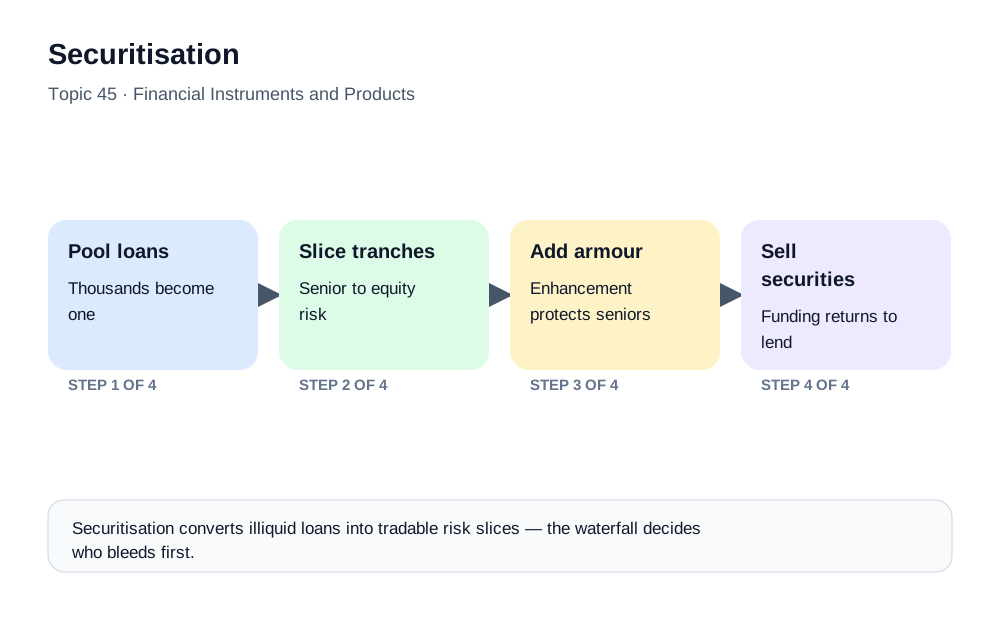
Securitisation at a glance — MBS, ABS, CDOs, SPVs, credit enhancement.
1. First Principles: The Problem Securitisation Solves
Every bank lives with a structural tension described throughout this series: it borrows short and lends long. A thirty-year home loan funded by deposits that can leave tomorrow is profitable but balance-sheet-hungry. The loan locks up money for decades, consumes regulatory capital the whole time, and concentrates credit risk on the bank's books. A bank that can only originate loans it is willing to hold forever will hit its balance-sheet ceiling long before it runs out of good borrowers.
There are three classical escapes from this ceiling, and securitisation is the most sophisticated of them. The bank can raise more capital, expensive and dilutive. It can sell individual loans, but each loan is a unique contract requiring bespoke due diligence, so single-loan sales are slow and price poorly. Or it can transform thousands of loans at once into something investors already know how to buy: standardized securities with defined cash flows, rated risk layers, and daily liquidity. That transformation is securitisation, and at its essence it is the financial alchemy that converts thousands of individual loan agreements, each a unique contract between a borrower and a lender, into standardized securities that can be bought and sold in capital markets.
The transformation serves multiple purposes simultaneously. For originating banks, it provides a mechanism to remove loans from their balance sheets, freeing up regulatory capital for new lending while transferring the associated credit risk to investors better positioned to bear it. For investors, securitised products offer exposure to underlying loan portfolios with risk-return characteristics tailored to their specific investment objectives. For the economy, it connects the vast pools of capital held by pension funds and insurers directly to the credit needs of households and businesses, without requiring banks to warehouse every loan to maturity.
2. The Mechanics: From Loan Pool to Security
The securitisation process begins with an originator, typically a bank or specialized finance company that has accumulated a pool of loans meeting specific criteria, perhaps ten thousand home mortgages with similar interest rates, maturities, and credit quality characteristics. These loans generate predictable cash flows as borrowers make their monthly payments of principal and interest. However, while these cash flows represent valuable assets, the individual loans themselves are illiquid; they cannot be easily sold to other investors because each loan is unique and evaluating its creditworthiness requires specialized due diligence.
To address this illiquidity, the originator sells the loan pool to a Special Purpose Vehicle, commonly called an SPV, a separate legal entity created specifically to hold these assets and issue securities backed by them. The SPV structure serves a crucial legal and financial purpose: it creates what practitioners call bankruptcy remoteness. If the originating bank were to fail, the loan pool within the SPV remains protected from the bank's creditors. Investors who purchase securities issued by the SPV have claims only against the SPV itself, not against the original bank. This separation is fundamental to securitisation's functioning, ensuring that the quality of the securities depends on the underlying loans rather than the creditworthiness of the originating institution.
Bankruptcy remoteness is a legal achievement, not a marketing phrase, and it is engineered carefully. The transfer must be a true sale, a genuine, final disposition of the assets, documented so that no court would later recharacterize it as a secured loan from the SPV to the bank. Lawyers issue true-sale and non-consolidation opinions; the SPV is capitalized thinly, governed independently, and restricted from any business other than holding the pool and paying the securities. These formalities matter because the entire rating of the securities rests on them: if the pool could be dragged back into a failed originator's bankruptcy, the securities would inherit the originator's credit risk, and the whole structure would collapse into an expensive secured borrowing.
The SPV issues securities to investors, with the proceeds from these sales used to purchase the loan pool from the originator. These securities represent claims on the cash flows generated by the underlying loans: as borrowers make their monthly payments, those funds flow through the SPV to security holders. A servicer, often the original bank but sometimes a specialized third party, continues to manage the loan portfolio, collecting payments, handling delinquencies, and managing defaults, ensuring that the operational aspects of loan administration continue seamlessly despite the transfer of ownership. Borrowers usually never know their loan was securitised; their payments simply pass through a longer chain behind the scenes.
A worked miniature makes the money flows concrete. An originator pools 1,000 auto loans totaling 100 million, average yield 9 percent. It sells the pool to an SPV, which issues 95 million of securities to investors and is structured so that interest collected (9 percent on the pool) comfortably exceeds the coupon promised to investors plus servicing and trust expenses. Monthly borrower payments flow into the SPV's collection account; the trustee pays expenses and investor coupons in strict priority; any surplus builds protection or flows to the residual holder. The originator books 100 million in cash, removes the loans from its balance sheet, frees the capital they consumed, and immediately has room to write the next 100 million of loans. That recycling, the same balance sheet funding several generations of lending, is the economic engine of the entire industry.
3. The Product Families
The securitisation market encompasses several distinct product categories, each defined by the type of underlying assets that back the securities.
Mortgage-Backed Securities, universally known as MBS, represent the largest segment, with underlying pools of residential home loans providing the cash flows that support these instruments. In the United States alone, the MBS market runs into the tens of trillions of dollars in outstanding securities, much of it guaranteed by government-sponsored housing agencies, making it one of the largest fixed income markets in the world, larger in some measures than the market for corporate bonds. The scale matters: securitisation is not a niche technique but the primary funding mechanism of the American housing market.
Asset-Backed Securities, or ABS, are backed by non-mortgage consumer and commercial loans, auto loans, credit card receivables, student loans, and equipment leases. Each asset class exhibits distinct cash flow patterns and risk characteristics: auto loans typically amortize over fixed periods with relatively predictable default rates, while credit card receivables involve revolving balances with no fixed maturity, requiring more complex structuring to create securities with defined payment schedules.
Collateralised Debt Obligations, or CDOs, represent a more complex variation where the underlying assets are themselves bonds, loans, or other asset-backed securities rather than individual consumer obligations. These structures gained notoriety during the 2008 financial crisis when CDOs backed by subprime mortgages experienced catastrophic losses. A related structure, the Collateralised Loan Obligation or CLO, specifically pools corporate leveraged loans, loans made to companies with significant existing debt burdens. The CLO market has grown to roughly a trillion dollars globally, representing an important funding source for corporate borrowers and, unlike its CDO cousin, came through the 2008 crisis and the 2020 pandemic stress with far better loss experience than its reputation suggests.
Commercial Mortgage-Backed Securities, or CMBS, are backed by loans on commercial real estate properties, office buildings, shopping centers, hotels, and industrial facilities. These securities differ from residential MBS in important ways, as commercial real estate loans are typically larger, have fewer properties in each pool, and exhibit more idiosyncratic risk related to specific property performance and local market conditions, risk that the post-2020 shift in office usage has made vividly concrete for a generation of investors.
4. Tranching and the Waterfall: Slicing Risk to Order
Perhaps the most sophisticated aspect of securitisation is tranching, the division of securities into layers with different risk and return characteristics. The French word "tranche" literally means "slice," and this metaphor accurately describes how a single pool of loans is carved into multiple securities with distinct payment priorities.
The senior tranche, typically rated AAA or AA by credit rating agencies, enjoys the highest level of protection against losses. In the payment waterfall structure that governs most securitisations, senior tranche holders receive their principal and interest payments before any funds flow to subordinate tranches. This priority of payment means that senior tranche investors can withstand significant defaults in the underlying loan pool before experiencing any losses, making these securities attractive to conservative investors such as pension funds and insurance companies.
Below the senior tranche sits the mezzanine tranche, generally rated in the A to BBB range, offering higher yields than the senior tranche in exchange for bearing losses after the equity tranche is exhausted but before the senior tranche is affected. Mezzanine investors occupy a middle position in the capital structure: they enjoy some protection from the equity layer below them but must absorb losses before the senior tranche above them. Asset managers and hedge funds often find mezzanine tranches attractive for their yield enhancement potential relative to corporate bonds with similar ratings.
The equity tranche, sometimes called the "first loss" piece, sits at the bottom of the capital structure. Unrated by credit agencies, this tranche absorbs losses first if borrowers default. If defaults in the underlying loan pool exceed the equity tranche's thickness, losses begin affecting mezzanine investors, and only if losses are catastrophic do senior tranche holders suffer. The equity tranche offers the highest potential returns, if the loan pool performs well, equity holders capture all excess cash flows after paying senior obligations, but also faces the greatest risk of principal loss. Originators or sponsors may retain junior, vertical, or other defined economic interests to demonstrate "skin in the game" and align incentives. Post-crisis regulatory frameworks in major markets formalised risk-retention requirements, but the required amount and form depend on the jurisdiction and transaction; retaining the equity tranche is one possible structure, not a universal rule for every securitisation.
A numerical waterfall shows the machine at work. Suppose a 100 million loan pool is securitised into an 85 million senior tranche, a 10 million mezzanine tranche, and a 5 million equity tranche. If the pool suffers 4 million of losses over its life, the equity tranche absorbs almost all of it, equity investors lose most of their money, while mezzanine and senior investors are paid in full. If losses reach 9 million, equity is wiped out entirely and mezzanine takes a 4 million hit; senior still receives everything. Only if losses exceed 15 million do senior investors lose anything. The same pool of loans thus produces an ultra-safe instrument and a highly speculative one simultaneously, manufactured from identical raw material. This is the genuine magic of tranching, and also, as 2008 proved, the precise location where things go catastrophically wrong when the loss estimates themselves are wrong.
5. Credit Enhancement: Armor for the Senior Layers
Multiple credit enhancement techniques strengthen securitisation structures beyond tranching alone. Subordination, the layering of tranches described above, represents the primary form of credit enhancement, with lower tranches protecting higher ones. Over-collateralisation occurs when the loan pool contains more principal value than the securities issued against it, creating a cushion that absorbs losses before any tranche is affected. Excess spread refers to the situation where the interest rate collected from borrowers exceeds the interest paid to security holders plus servicing fees, with this surplus available to cover losses or accelerate principal repayment to senior tranches. Reserve accounts hold cash specifically earmarked for loss absorption, while third-party guarantees from insurance companies or banks can provide additional protection for specific tranches.
The logic unifying all five is the same: someone or something must stand between the rated investor and the first defaults. The skill of structuring is calibrating that armor honestly, enough enhancement that the senior tranche genuinely deserves its rating, not so much that the deal destroys its own economics by locking up value investors refuse to pay for.
6. The Benefits: Why the System Exists at All
The benefits of securitisation extend across multiple stakeholders and the broader economy.
For originating banks, securitisation provides a mechanism to free up capital for new lending, improving capital efficiency and enabling greater credit expansion than would be possible if all loans remained on bank balance sheets. By transferring credit risk to investors, banks reduce their exposure to potential loan losses while generating fee income from the structuring and servicing of securitisation transactions. These capital efficiency gains translate into lower funding costs for borrowers as competition among lenders intensifies.
Investors benefit from access to diversified asset pools that would be impractical to assemble independently, with the ability to select tranches matching their specific risk-return objectives. A pension fund can hold AAA senior pieces; a hedge fund can hold the equity; each is served from one pool. Securitised products often offer yields higher than similarly rated corporate bonds, reflecting the complexity premium associated with these structures and the specialized knowledge required to analyze them. Portfolio diversification benefits arise from the low correlation between many securitised asset classes and traditional equity and fixed income investments.
The economy as a whole benefits from securitisation through increased credit availability and potentially lower borrowing costs. When banks can sell loans into the capital markets, they are less constrained by their own balance sheet capacity, enabling more lending to creditworthy borrowers. The broader distribution of credit risk across the financial system, rather than concentration within the banking sector, enhances systemic resilience, at least in theory, though practice has demonstrated important caveats to this proposition, to which the next section is devoted.
7. 2008: When the Machine Amplified Risk Instead of Distributing It
Securitisation's history includes a dark chapter that fundamentally reshaped financial regulation and market practices. The 2008 financial crisis revealed how securitisation, when combined with misaligned incentives and inadequate oversight, could amplify rather than distribute risk. The crisis demonstrated that the theoretical benefits of securitisation could be undermined by practical failures at every stage of the process.
Banks originated low-quality subprime mortgages with little regard for borrowers' ability to repay, knowing these loans would be securitised and sold to investors, a phenomenon called originate to distribute that eliminated the traditional incentive for careful underwriting. Without "skin in the game," originators prioritized loan volume over loan quality, knowing they would not bear the consequences of defaults. Rating agencies, compensated by issuers for their ratings, assigned AAA ratings to complex CDOs backed by these subprime loans, often using models that underestimated correlation risk, the tendency for defaults to cluster during economic downturns rather than occurring independently.
Investors, both sophisticated institutions and less experienced participants, trusted these ratings without fully understanding the underlying assets or the complex structures that governed cash flow distributions. When housing prices began declining and borrowers defaulted in unprecedented numbers, losses cascaded through the tranche structure. Equity tranches were quickly wiped out, mezzanine tranches followed, and eventually even some senior tranches experienced losses. The complexity was compounded by CDO-squared structures, CDOs backed by tranches of other CDOs, which amplified losses exponentially as underlying defaults propagated through multiple layers of securities.
Counterparty risk through credit default swaps added another dimension to the crisis. AIG, the insurance giant, had sold hundreds of billions of dollars in CDS protection on mortgage-backed securities without maintaining adequate reserves to cover potential payouts. When mortgage defaults surged, AIG faced claims it could not meet, threatening a cascade of failures throughout the financial system and necessitating a government bailout whose authorized support peaked above one hundred eighty billion dollars.
The lesson is more precise than "securitisation is dangerous." Every structural element worked as designed: the SPVs held, the waterfalls paid in order, the true sales survived bankruptcy. What failed were the inputs: underwriting degraded because originators bore no risk, ratings mismeasured correlation because incentives rewarded generosity, and investors outsourced judgment to ratings because complexity exceeded diligence. The machine faithfully processed bad inputs into distributed losses. Risk retention, disclosure, and capital rules, the subjects of the next section, are all aimed at the inputs, not the machine.
8. The Regulatory Response
The regulatory response to these failures fundamentally reshaped securitisation markets. Risk retention rules in major jurisdictions require specified originators, sponsors, or other relevant parties to retain a prescribed economic interest so that underwriting incentives remain aligned, but the exact amount, form, exemptions, and holding conditions are jurisdiction-specific. A 5% concept is common in some major frameworks, while India's RBI securitisation directions prescribe minimum-retention requirements according to the applicable transaction and asset characteristics. Enhanced disclosure requirements mandate loan-level data sharing with investors, enabling more sophisticated due diligence and reducing reliance on rating agencies. Rating agency reforms have reduced conflicts of interest and increased transparency around rating methodologies. Basel III capital regulations impose higher capital requirements on bank holdings of securitisation exposures, particularly for junior tranches that absorb losses first. Several jurisdictions have gone further with quality labels, frameworks for "simple, transparent and standardised" securitisations that earn preferential capital treatment, deliberately rewarding structures that remain legible to investors.
The philosophy is consistent across all five measures: force the party with the best information to keep exposure, force the information itself into the open, and price the residual risk honestly through capital. Whether the medicine permanently cures originate-to-distribute remains an open question, markets are already innovating around retention through financed retention and synthetic structures, but the post-crisis era has so far avoided a repeat of 2008's input failures at anything like the same scale.
9. Modern Developments: Synthetic, Sustainable, and Global
Despite these challenges and the regulatory overhaul they prompted, securitisation markets have recovered and continue serving essential functions in the global financial system. The United States mortgage-backed securities market maintains outstanding volumes in the tens of trillions of dollars, while the broader asset-backed securities market adds trillions more. European securitisation totals over a trillion euros, and the global collateralised loan obligation market has grown to around a trillion dollars, demonstrating the enduring utility of these structures when implemented with appropriate safeguards.
The recovery itself is instructive. Post-crisis issuance collapsed at first, as investors rediscovered diligence and regulators rewrote the rulebook, then rebuilt on different foundations: cleaner collateral, thicker enhancement, standardized disclosure, and buyers who analyze rather than outsource. The market that re-emerged is smaller in its exotic corners, CDO-squared effectively died and has not been mourned, and larger in its plain-vanilla core, where auto, card, and mortgage securitisations continued paying investors through multiple stress episodes, including the 2020 pandemic shock, with senior tranches performing as their ratings implied. That performance record, more than any advocacy, is why regulators now treat well-structured securitisation as infrastructure worth encouraging rather than a hazard to be contained.
Three modern currents deserve attention. Synthetic securitisation transfers risk without moving assets at all: instead of selling loans to an SPV, the bank buys credit protection, typically through guarantees or credit-linked notes, on a portfolio it keeps on its balance sheet. The capital relief and risk transfer are real even though no loan changes hands, and regulators now treat significant risk transfer through synthetics as a recognized, supervised capital tool. Green and social securitisation pools assets aligned with sustainability objectives, solar loans, energy-efficient mortgages, electric-vehicle financing, channeling capital-market money toward transition assets. And emerging-market securitisation continues to develop: in India, for example, direct loan assignments and pass-through certificates allow banks and non-bank lenders to trade loan pools, integrating securitisation with the priority sector framework by letting originators sell qualifying loan pools to banks seeking priority sector assets, a market-based complement to the certificate mechanisms described in that chapter.
10. The Bank's and the Investor's Playbooks
For a bank deciding whether to securitise, the analysis is a four-way comparison: the capital released, the funding cost versus alternatives like covered bonds or deposits, the risk transferred versus retained, and the execution cost of structuring. Securitisation wins when capital is scarce and the asset pool is clean, standardized, and large; it loses when pools are small, heterogeneous, or when simpler funding is cheaper. The structuring desk's craft is matching pool, structure, and investor appetite so that the tranches price at levels that make the whole exercise worthwhile.
For an investor analyzing a securitisation, the discipline inverts the bank's. Start with the collateral: what are the loans, who underwrote them, and what does loan-level data show about the borrowers. Then the structure: how thick is the protection beneath your tranche, what triggers redirect cash in stress, and who is aligned with you through retention. Then the parties: the servicer's quality determines whether troubled loans are worked out or abandoned. Ratings inform but do not conclude this analysis; the post-crisis investor's creed is that the rating is the beginning of diligence, never its substitute.
11. Common Misconceptions About Securitisation
"Securitisation caused the 2008 crisis." Bad underwriting, conflicted ratings, and risk-free origination caused it; securitisation was the transmission belt. Auto loan and credit card securitisations, and CLOs, performed through the same crisis with manageable losses. The structure is neutral; the inputs were rotten.
"A AAA tranche cannot lose money." AAA measures expected loss under modeled scenarios; when the model's correlation and housing assumptions failed, some AAA CDO tranches failed too. Ratings are opinions calibrated to data, and the data of 2006 had never seen a national housing decline.
"When my loan is securitised, my terms change." Nothing changes for the borrower: same payment, same servicer experience, same contract. Securitisation moves ownership of the loan's cash flows, not the borrower's obligations.
"The SPV is just accounting trickery." The SPV is the load-bearing legal structure: true sale and bankruptcy remoteness are what let securities be rated above their originator. Remove it and you have an expensive secured borrowing, not a securitisation.
"Risk retention rules mean originators now care as much as hold-to-maturity lenders." Five percent retention aligns incentives meaningfully but not completely; a fee-rich originator can still profit from volume while carrying a sliver of risk. Retention improves underwriting; it does not make vigilance optional for investors.
"Securitisation is only for mortgages." Mortgages are the largest pool, but auto loans, credit cards, student loans, equipment leases, corporate loans, trade receivables, royalties, and even future toll revenues have all been securitised. Any predictable cash flow is candidate raw material.
12. Frequently Asked Questions
What is the difference between securitisation and selling a loan? Selling a loan transfers one unique contract to one buyer who must diligence it fully. Securitisation pools thousands of loans, standardizes the cash flows through a legal structure, and sells rated slices to many investors. It is loan selling industrialized.
Who pays me if borrowers default, as a senior tranche investor? The structure's protections pay first: excess spread, reserves, over-collateralisation, then the equity and mezzanine tranches absorb losses in order. You lose only after all enhancement below you is exhausted, which is exactly what your rating claims to measure.
What does the servicer do, and why does it matter so much? The servicer collects payments, manages delinquencies, and works out or forecloses troubled loans. Two identical pools with different servicers can produce materially different losses, which is why servicer quality is a first-order diligence item.
Why would a bank keep the equity tranche? Sometimes because it must, risk retention rules, and sometimes because equity is where the residual profit lives if the pool performs. Either way, retained equity signals alignment: the originator eats the first losses it underwrote.
How is a CLO different from the CDOs that blew up in 2008? CLOs pool corporate leveraged loans, real, diversified, covenant-monitored exposures with recovery value, and their structures survived both 2008 and 2020 with strong performance. The toxic 2008 CDOs pooled concentrated bets on housing, often of other securities, with correlation risk their models missed.
What is synthetic securitisation? Risk transfer without asset transfer: the bank keeps the loans but buys credit protection on them, through guarantees or credit-linked notes, achieving capital relief while the portfolio never leaves the balance sheet. Regulated, supervised, and increasingly common in Europe.
What happens to a securitisation when the originating bank fails? Because the pool was moved by true sale into a bankruptcy-remote SPV, the originator's failure does not pull the assets into its estate. Payments continue to flow to investors, typically under a backup servicer. The 2008 crisis supplied real-world tests of exactly this, and the structures held, which is why the legal engineering of Section 2 is taken so seriously.
Is securitisation good or bad for borrowers? Mostly good: it expands credit supply and lowers funding costs. The qualification is underwriting discipline, when originate-to-distribute removes consequences, borrowers get loans they cannot sustain, which is the least visible but most human cost of 2008.
13. Key Terms in This Chapter
- Securitisation — transforming pools of illiquid loans into tradeable securities.
- Originator — the institution that made the loans and sells the pool.
- Special Purpose Vehicle (SPV) — the bankruptcy-remote entity holding the pool and issuing the securities.
- True sale — the legally final transfer that keeps the pool out of the originator's bankruptcy.
- Bankruptcy remoteness — insulation of the pool from originator failure; the structure's foundation.
- Servicer — the party collecting payments and managing delinquencies post-transfer.
- MBS / ABS / CDO / CLO / CMBS — the product families: mortgages, consumer assets, securities of securities, corporate loans, commercial property.
- Tranche — a slice of the structure with defined payment priority and risk.
- Senior / mezzanine / equity tranche — the protected, middle, and first-loss layers.
- Payment waterfall — the strict priority ordering of cash distributions.
- Credit enhancement — subordination, over-collateralisation, excess spread, reserves, guarantees.
- Excess spread — the surplus of pool yield over investor coupons and costs; the first loss-absorber.
- Originate to distribute — the model that severed underwriting from consequences pre-2008.
- Risk retention ("skin in the game") — mandatory originator exposure, typically five percent.
- Correlation risk — defaults clustering in downturns; the variable the 2008 models misread.
- Credit default swap (CDS) — insurance-like protection on debt; AIG's downfall and the counterparty lesson.
- Synthetic securitisation — risk transfer via credit protection without asset transfer.
- Pass-through certificate / direct assignment — emerging-market (notably Indian) pool transfer formats.
- STS (simple, transparent, standardised) — the quality label earning preferential capital treatment.
- Covered bond — the main alternative to securitisation: loans stay on the bank's balance sheet while bondholders gain a preferential claim on the pool, trading risk transfer for dual recourse.
14. Interview Insights: How This Topic Appears in Banking Interviews
"Explain securitisation to a client in two minutes." Pool loans, sell the pool to a bankruptcy-remote SPV, issue rated slices against the cash flows, service as before. Then say why: the bank frees capital and transfers risk; investors buy tailored exposure; the economy gets more credit. Interviewers reward candidates who can do this without jargon before they reward technical depth.
"Why did AAA securities fail in 2008?" Because AAA is a model output, and the models misread correlation and housing. Walk the chain: degraded underwriting from originate-to-distribute, conflicted ratings, leverage on leverage through CDO-squared, and counterparty concentration via CDS. End with the precision point: the structures performed mechanically; the inputs were corrupted.
"Senior tranche investors were protected by tranching, so how did they still lose?" Tranching protects against losses up to the enhancement thickness. When actual losses exceed modeled worst cases, the waterfall simply delivers the losses in order to whoever remains. Protection is arithmetic, not magic, and it is only as good as the loss estimates that sized it.
"What changed after the crisis to make securitisation safer?" Five percent risk retention, loan-level disclosure, rating agency reform, higher capital on securitisation exposures, and STS-style quality labels. Then the professional nuance: each fix targets an input, incentives, information, or capital, not the structure, because the structure was never the problem.
"Should our bank securitise its auto loan book or fund with deposits?" Compare capital released, all-in funding cost, risk transferred, and execution cost. Deposits are usually cheaper funding but provide no capital relief or risk transfer; securitisation wins when capital is scarce, the pool is clean and scalable, and investor pricing cooperates. The answer shows whether you can think in treasury trade-offs rather than products.
Summary and Key Takeaways
- Securitisation exists because hold-to-maturity lending hits balance-sheet ceilings; converting loan pools into rated securities recycles capital and connects capital markets directly to borrowers.
- The mechanics are a legal-financial machine: originator, true sale, bankruptcy-remote SPV, servicer, and securities, each element load-bearing.
- Product families span MBS, ABS, CDOs, CLOs, and CMBS; each asset class has distinct cash flow physics that drive distinct structures.
- Tranching manufactures safety and speculation from the same pool through the payment waterfall; protection is arithmetic sized by loss estimates.
- Credit enhancement, subordination, over-collateralisation, excess spread, reserves, guarantees, is the armor that earns senior ratings.
- 2008 was an input failure, not a machine failure: originate-to-distribute, conflicted ratings, and correlation blindness; regulation responded with retention, disclosure, and capital.
- Modern securitisation adds synthetic risk transfer, sustainability-linked pools, and emerging-market formats, all governed by post-crisis discipline.
- The enduring lesson for bankers and investors alike: the structure is only ever as honest as its inputs, so diligence belongs on the collateral, the servicer, and the incentives, not merely on the rating.
- The bank's securitisation decision is a treasury trade-off among capital released, funding cost, risk transferred, and execution cost; the investor's is a diligence sequence across collateral, structure, and servicer.
Next: Topic 46 — Derivatives in Banking →
<!-- MBA-DEEP-DIVE-START -->Deep Dive: Securitisation as a Loan-Transfer, Funding, Servicing, and Waterfall Control System
Securitisation is often taught as ‘bundle loans, sell them to an SPV, issue securities’. That is the skeleton. The banking reality is a chain of controlled decisions that must remain valid for years: which loans enter the pool, whether the transfer is legally effective, who owns the cash flows, how borrowers continue to be serviced, how collections move into the transaction accounts, how losses are allocated through the waterfall, how investors receive data, and what happens when the servicer, originator, account bank, or borrower fails.
The deepest principle is that securitisation does not make credit risk disappear; it changes who owns which part of it and how that ownership is funded, measured, and controlled. The underlying borrower still has to pay. The sophistication sits between that borrower payment and the investor who ultimately bears loss.
Start with the purpose of the transaction
Not every securitisation has the same objective. An originator may want funding, capital relief, liquidity, concentration reduction, balance-sheet capacity, investor diversification, or a combination of these. The structure should be evaluated against the actual objective.
A transaction can provide cash funding without achieving accounting derecognition. It can transfer some economic credit risk without producing the same regulatory-capital relief. It can legally sell assets while the originator still retains significant exposure through junior tranches, guarantees, liquidity facilities, or other support.
Bankers should therefore separate four questions:
Legal transfer: did ownership or beneficial interest move as intended?
Accounting: does the applicable standard permit derecognition or require continued recognition?
Prudential capital: how does the regulator treat the retained and transferred exposures?
Economic risk: who actually loses money when borrowers default?
Those answers can differ. Calling a transaction a ‘sale’ does not settle all four.
Pool construction is the first line of investor protection
A securitisation begins with eligibility criteria. The originator identifies loans that satisfy defined conditions: asset type, seasoning, delinquency status, remaining maturity, geography, borrower characteristics, collateral, interest-rate type, documentation quality, and other transaction-specific rules.
Pool selection should be reproducible from source systems. If a mortgage pool requires every loan to be current, the originator should be able to prove the delinquency status on the cut-off date. If concentration limits restrict one geography, the data should demonstrate compliance.
Manual selection creates adverse-selection risk. An originator that knows its book intimately could be tempted to transfer weaker assets while retaining stronger ones. Investor due diligence, representations and warranties, data disclosure, and risk-retention frameworks are designed partly to counter this information asymmetry.
Cut-off date creates a boundary between seller and transaction
The cut-off date defines the pool at a particular point in time. Balances, arrears, accrued interest, and eligibility are measured around that boundary. Collections received before and after the cut-off need defined ownership treatment.
Suppose a borrower pays an instalment one day after the cut-off but before legal closing. Does the cash belong to the originator, reduce the transferred principal, or pass to the SPV? The transaction documents and data tape must answer the question consistently.
A mismatch between legal cut-off, accounting cut-off, servicing system, and investor data can create reconciliation breaks immediately after closing.
True sale is a legal conclusion supported by operational behaviour
For a traditional securitisation, the asset transfer is generally structured to be a true sale to a bankruptcy-remote entity rather than a secured borrowing disguised as a sale. Legal opinions examine the transaction documents and relevant law.
But operations also matter. If the originator continues to act as though it owns the assets—freely replacing loans, redirecting cash, forgiving balances without permitted authority, or using collections for its own purposes—the economic reality can conflict with the intended legal structure.
The servicing agreement should therefore specify exactly which decisions the servicer can make, which require trustee or investor direction, and which modifications are permitted under normal servicing standards.
The SPV should be boring by design
A securitisation SPV normally exists for a narrow purpose: acquire the pool or relevant rights, issue securities, hold transaction accounts and permitted assets, receive collections, and distribute cash according to the documents.
It should not become an operating company taking unrelated business risk. Bankruptcy-remoteness relies on restrictions that reduce the possibility that the SPV incurs obligations or becomes entangled with the originator beyond the transaction.
Governance can include an independent trustee or other transaction parties, separate accounts, limited-purpose constitutional documents, and restrictions on additional debt. The ‘special’ in special-purpose vehicle is a risk-control feature, not a branding term.
Servicing survives the sale
Borrowers often continue paying the same bank after their loan has been securitised because the originator remains servicer. The customer experience may not change, but the economic ownership of the cash flows has.
The servicer collects instalments, manages arrears, applies payments, communicates with borrowers, handles permitted modifications, maintains collateral records, and reports pool performance. It then transfers collections into the transaction structure according to agreed timing.
This creates commingling risk. If collections sit in the servicer's own account and the servicer becomes insolvent before remitting them, investors can be exposed even though the borrowers paid correctly.
Structures manage this with collection-account arrangements, sweep frequency, account-bank requirements, triggers, reserves, and replacement provisions. A transaction with perfect borrower credit can still suffer operational loss if cash is trapped in a failed servicer.
Servicer replacement should be planned before failure
A transaction may last ten or twenty years. The original servicer can merge, lose capability, breach covenants, or fail.
Documents should define servicer-termination events and replacement mechanics. But having a legal clause is not enough. A replacement servicer needs borrower records, payment history, contact information, mandates, collateral data, arrears status, complaints, and system interfaces.
Data portability is therefore part of securitisation resilience. If the only complete servicing history sits inside a failed originator's inaccessible systems, the SPV's legal ownership is not very useful operationally.
Backup or successor-servicing arrangements are especially important for specialist originators with non-standard platforms.
Collection accounts and waterfalls make cash ownership explicit
Borrower payments enter collection accounts and are distributed according to a defined priority of payments, or waterfall. The waterfall determines which expenses, interest, principal, reserves, and residual amounts are paid first.
A simplified sequence might pay taxes and trustee expenses, senior servicing costs, senior-note interest, senior principal according to the amortisation rules, mezzanine interest and principal, reserve replenishment, and finally residual distributions.
The exact order is transaction-specific and legally important. A payment engine should implement the document, not an analyst's informal spreadsheet.
Every distribution date should be reproducible: opening account balances, collections, recoveries, fees, trigger status, due amounts, shortfalls, payments, and closing balances.
Interest and principal waterfalls may be separate
Some structures distinguish interest collections from principal collections. Excess interest can sometimes cover losses or principal shortfalls under defined rules. Principal may be allocated sequentially or pro rata depending on transaction performance.
This creates complex state transitions. A deal may pay tranches pro rata while performing but switch to sequential senior paydown after delinquency or credit-enhancement triggers are breached.
The waterfall engine therefore needs current trigger values before allocating cash. If a trigger is calculated after the distribution rather than before it, the structure can pay junior investors money that should have been trapped for senior protection.
Triggers convert deteriorating performance into stronger protection
Securitisations use performance triggers such as delinquency, cumulative loss, excess spread, reserve level, or over-collateralisation tests. Breaching a trigger can change the waterfall, stop residual payments, trap excess cash, accelerate senior principal, or require other protective action.
Triggers are valuable because they respond before losses reach senior investors. But they are only as reliable as the data and calculation.
A monthly investor report should therefore show the variables used, thresholds, pass/fail status, and effect. Manual override of a failed trigger should be exceptionally controlled because it reallocates cash between investor classes.
Credit enhancement is not one pool of protection
Subordination, over-collateralisation, reserve funds, excess spread, guarantees, and other enhancements protect investors differently.
A cash reserve is immediately available but finite. Excess spread depends on performing assets continuing to generate interest and can disappear as defaults rise. Over-collateralisation can absorb principal losses but may decline with prepayments or charge-offs depending on structure. Subordination determines who bears losses first.
Analysts should therefore ask how the enhancement behaves under stress, not merely quote a percentage at closing.
A deal with 10% credit enhancement made mostly of projected future excess spread is economically different from one with 10% hard subordination already funded.
Prepayment risk changes investor cash flows even without default
Borrowers can repay mortgages, auto loans, or other assets early. Prepayment returns principal sooner than investors expected and changes interest income.
When rates fall, mortgage borrowers may refinance, causing higher prepayments precisely when investors would prefer to keep the older high-rate assets. This is contraction risk. When rates rise, prepayments can slow, extending the life of lower-yielding securities; this is extension risk.
Securitisation therefore contains behavioural optionality even when every borrower remains creditworthy.
Pool analytics model prepayment alongside default because both determine duration and yield.
Revolving pools need replenishment controls
Credit-card and some receivables securitisations can have a revolving period during which principal collections are used to purchase new receivables rather than immediately pay down investors.
That creates a moving pool. Eligibility criteria and concentration limits must be tested on new receivables continuously. An originator should not be able to replenish a previously strong pool with progressively weaker assets unnoticed.
Early-amortisation triggers can end the revolving period if performance deteriorates or other events occur, redirecting cash toward investor principal.
The replenishment process therefore needs automated eligibility testing and audit trail for every asset added.
Representations and warranties are quality promises, not insurance against credit loss
Originators usually make representations about matters such as valid loan documentation, ownership, absence of specified defects, compliance with eligibility criteria, and data accuracy.
If a representation is breached, the originator may be required to cure, repurchase, or compensate according to the documents. That is different from guaranteeing that the borrower will perform.
A borrower default on an accurately represented loan is generally investor credit risk. A loan that should never have entered the pool because its documentation was invalid can create a repurchase obligation.
Repurchase tracking is therefore an important indicator of origination and data quality.
Risk retention is jurisdiction-specific
Post-crisis frameworks often require originators or sponsors to retain economic exposure so that underwriting incentives remain aligned, but the exact amount and form are not universal.
For example, European and US frameworks commonly use a 5% concept in their own legal structures, while India's RBI securitisation framework specifies minimum-retention requirements according to the applicable transaction and underlying asset characteristics. Other jurisdictions can differ.
The correct professional statement is therefore: risk-retention rules require the relevant party to keep a prescribed economic interest under the rules that govern the transaction. Do not assume every securitisation everywhere uses one identical 5% rule.
The retained interest should also be monitored for prohibited hedging or transfer where the regulation restricts these actions; otherwise the economic alignment can disappear while nominal retention remains.
Minimum holding or seasoning requirements address originate-to-distribute incentives
Some regulatory frameworks require loans to remain on the originator's books for a minimum period before securitisation, subject to asset type and current rules. The policy objective is to ensure the originator experiences at least some initial performance and cannot create assets solely for immediate transfer without any seasoning.
The operational system needs reliable origination, security-registration, and holding-period dates where these affect eligibility. A one-day date error can make an entire pool ineligible under the relevant rule.
As with risk retention, exact periods should be taken from the current applicable regulation rather than memorised generically.
Investor due diligence should look through ratings
A rating summarises an agency's view of credit risk under its methodology. It does not replace investor analysis.
Investors should examine pool composition, underwriting standards, historical vintages, delinquency, default, recovery, prepayment, geographic concentration, borrower scores, collateral, legal structure, servicing quality, enhancement, triggers, and scenario sensitivity.
A senior tranche can be highly protected against expected losses but still exposed to model error, liquidity risk, extension, legal risk, or severe correlated stress.
The lesson from 2008 is not that ratings have no value. It is that outsourcing the entire credit judgment to a rating destroys the information discipline on which markets depend.
Rating models are sensitive to correlation
Tranching relies on diversification. If defaults are relatively independent, losses concentrate in junior pieces and senior tranches can remain safe. If many borrowers fail together because they share exposure to housing prices, unemployment, interest rates, or one economic region, diversification weakens.
Correlation assumptions are therefore critical. A model that estimates individual default probabilities well but underestimates how defaults cluster can materially understate senior risk.
Stress testing should include systematic scenarios rather than only random independent defaults.
Synthetic securitisation transfers risk without necessarily selling the loans
In a synthetic transaction, the bank can keep loans on its balance sheet while transferring defined credit risk through guarantees, credit derivatives, funded credit protection, or other permitted structures.
The customer loan may remain legally with the bank and continue to be funded by it. Investors or protection providers absorb losses under the transaction terms if specified credit events occur.
This can be useful for capital or risk management, but it introduces counterparty, legal, collateral, and basis risk. The bank must be certain that protection will actually pay when the underlying portfolio suffers losses and that regulatory capital treatment matches the structure.
Synthetic risk transfer demonstrates why securitisation should be understood as risk transformation, not only asset sale.
Accounting derecognition requires its own analysis
Under applicable accounting standards, transferring assets to an SPV does not automatically mean the loans disappear from the originator's consolidated financial statements. The analysis can consider transfer of contractual rights, risks and rewards, control, and consolidation of the SPV depending on the framework.
A transaction may therefore be legally a sale while accounting still recognises some or all assets or consolidates the vehicle.
Finance, legal, treasury, and risk should align before execution so that expected balance-sheet treatment is not discovered after closing.
This is especially important when transaction economics depend on capital or leverage outcomes.
Investor reporting is a monthly proof of the structure
A securitisation can close perfectly and then fail operationally through poor reporting. Investors need regular performance data: pool balance, collections, delinquencies, defaults, recoveries, prepayments, additions, removals, concentration, trigger calculations, credit enhancement, note balances, and waterfall distributions.
The report should reconcile to servicing data and transaction bank accounts. If investor numbers are produced from manual spreadsheets disconnected from the servicer ledger, errors can accumulate.
Data corrections should be versioned and explained. Quietly replacing a prior month's delinquency number destroys confidence and auditability.
Trustee and transaction parties create a control ecosystem
A securitisation may involve trustee, security trustee, account bank, paying agent, calculation agent, rating agencies, swap counterparties, liquidity providers, and other parties depending on complexity.
Each role should have defined duties, data, deadlines, and replacement events. Operational resilience must consider correlated failure: if the same banking group acts as originator, servicer, account bank, and swap counterparty, one group failure can affect several protections simultaneously.
Eligibility and downgrade triggers can require replacement or collateralisation of certain counterparties if their credit quality falls.
Borrower treatment should not deteriorate because the loan was securitised
The borrower may not have chosen for the loan to enter a securitisation. Servicing standards, consumer rights, hardship processes, privacy, complaints, and legal obligations should continue according to the applicable framework.
A servicer should not refuse a legitimate restructuring solely because the loan is securitised if the transaction documents permit ordinary prudent servicing. Equally, it should not modify loans arbitrarily in ways that shift value between investors.
The servicing agreement should balance borrower treatment with investor rights through clear authority and standards.
A complete auto-loan securitisation scenario
A finance company has ₹1,000 crore of seasoned performing auto loans and wants funding to originate new loans.
It defines a pool using eligibility criteria: current loans, specified seasoning, remaining maturity, borrower and geographic limits, valid security, complete documentation, and no prohibited restructurings. The source-system extract is independently reconciled to the loan ledger.
Legal and transaction teams establish the SPV and documents. The loans or relevant receivables are transferred under the chosen structure. Investors fund senior and junior securities. The originator retains the regulatory or contractual exposure required for the transaction under applicable rules and remains servicer.
Borrowers continue paying through existing channels. The servicer identifies securitised accounts, applies instalments correctly, and transfers collections to the transaction account on the required schedule. A monthly data file reports each loan's performance. The calculation agent aggregates cash, evaluates triggers, and runs the waterfall. The trustee or paying agent distributes interest and principal.
After a regional economic shock, delinquencies rise. A cumulative-loss trigger breaches. The waterfall switches from pro-rata amortisation to faster senior paydown, residual distributions stop, and excess cash strengthens senior protection. Investor reports show the trigger and calculation.
Some borrowers cure; others default and vehicles are repossessed. Recoveries enter the collection account and are allocated under the documents. The servicer tracks complaints and hardship treatment normally.
Years later, enough principal has amortised for the notes to redeem. Final collections, reserves, fees, and residual amounts are reconciled, remaining security interests and records are handled according to law, and the SPV winds down.
The transaction succeeded not because risk vanished but because ownership, cash, data, servicing, and loss allocation stayed consistent for the full life of the pool.
What excellence looks like
A world-class securitisation programme can reconstruct every loan entering a pool, prove eligibility at cut-off, explain legal and accounting treatment, and identify retained risk. Borrower collections reconcile to servicer ledgers and SPV accounts. Waterfalls are implemented exactly as documented. Performance triggers are calculated before distributions and are independently reviewable. Servicer replacement is operationally possible. Investor reporting is sourced and versioned. Risk retention and holding-period rules follow the governing jurisdiction rather than generic assumptions. Borrowers continue receiving compliant servicing.
Securitisation is powerful because it separates origination, funding, servicing, and risk ownership without allowing them to become disconnected. The structure is world-class only when every party can see exactly which risk it owns, which cash it is entitled to, and which evidence proves that entitlement.
<!-- MBA-DEEP-DIVE-END -->