In the evolving landscape of financial services, few partnerships have proven as transformative as bancassurance, the strategic alliance between banking and insurance institutions that has fundamentally reshaped how insurance products reach consumers. This convergence represents more than a simple distribution arrangement; it embodies a sophisticated ecosystem where banks leverage their extensive customer relationships, trusted brand positioning, and vast branch networks to deliver insurance solutions that might otherwise remain inaccessible to millions of potential policyholders.
By the end of this chapter, you will be able to:
- Explain what insurance is at first principles and why banks became its best salespeople
- Describe the bancassurance models, from simple referral to joint ventures, and their trade-offs
- Distinguish the main insurance products banks distribute and what each actually does
- Analyze the economics: commission structures, fee income without capital, and persistency
- Understand credit-linked insurance and the conduct risks of bundling
- Explain the regulatory frameworks that govern bank insurance distribution
- Recognize mis-selling patterns and the scandals that reshaped conduct rules
- Evaluate how digital and embedded insurance is changing the model
Visual overview
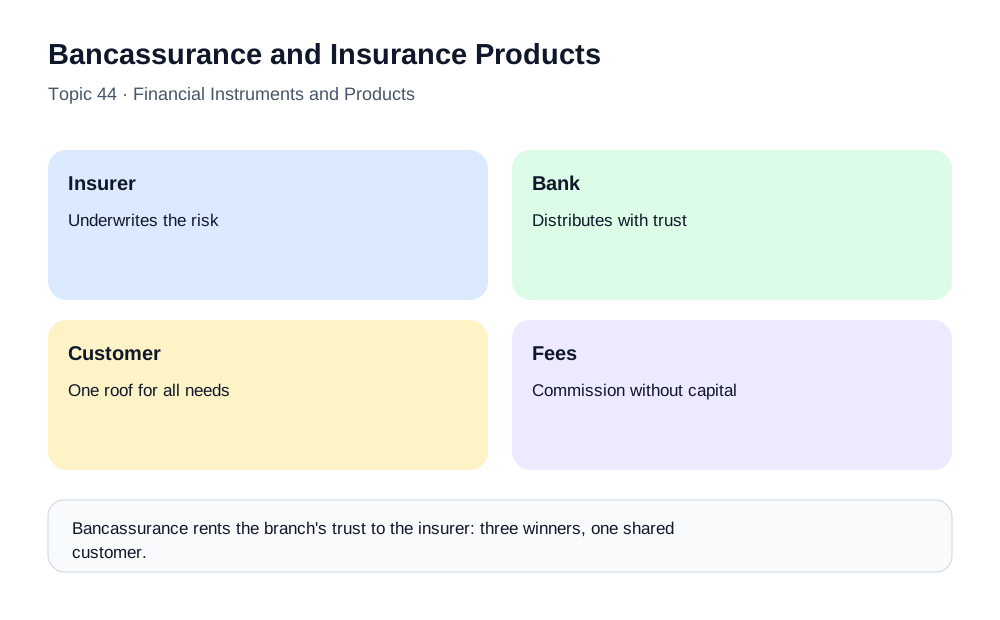
Bancassurance and Insurance Products at a glance — Insurance distribution and product types.
1. First Principles: What Insurance Is and Why Banks Sell It
Before the partnership, the product. Insurance is a mechanism for pooling risk: many people pay small, certain premiums into a common pool, from which the few who suffer defined losses are compensated. The insurer's craft is pricing, estimating the probability and cost of the loss accurately enough that pooled premiums, plus investment income, exceed claims and expenses. Everything else in the insurance industry, underwriting, actuarial science, reinsurance, claims management, is elaboration on this single mechanism.
Two features of insurance make it unlike anything else a bank distributes. First, it is a promise against a future contingency, often decades away, which makes trust in the seller unusually important, customers buy from whoever they believe will stand behind the claim. Second, insurance is sold, not bought: most people under-purchase protection because contemplating death, illness, and disaster is unpleasant, so distribution, someone proactively making the case, is the industry's bottleneck. More people need insurance than ever seek it out.
Now the bank enters. A bank possesses exactly what insurance distribution starves for: a trusted relationship, detailed financial knowledge of the customer, regular contact through branches and apps, and natural moments when protection becomes relevant, a mortgage approved, a child born, a business loan signed. The term "bancassurance" itself reflects this union, combining "bank" with "assurance," the European term for insurance. At its core, bancassurance is the distribution of insurance products through a bank's established channels, physical branches, mobile banking applications, internet banking platforms, and relationship managers who already understand their clients' financial situations. This arrangement has emerged as one of the most powerful distribution channels in global financial services, creating what many describe as a one-stop financial shop where customers address multiple needs within a single trusted relationship.
2. The Three-Way Value Proposition
The success of bancassurance rests on a fundamental alignment of interests between three key stakeholders, each deriving distinct advantages from this partnership.
For banks, bancassurance offers an opportunity to generate significant fee income without assuming the capital risk associated with traditional lending activities. Every insurance policy sold adds to the bank's non-interest revenue, helping diversify income streams and reducing dependence on the often-volatile spread between deposit and lending rates. Beyond the financial benefits, insurance products deepen customer relationships, creating additional touchpoints and reasons for clients to engage with their bank beyond routine transactions. These cross-selling opportunities strengthen customer loyalty while providing valuable data about client needs and risk profiles. The capital point deserves emphasis because it is the deepest economic driver: a loan consumes regulatory capital and creates credit risk for years; an insurance sale consumes none, the risk lives on the insurer's balance sheet, while the bank keeps the commission. Fee income without capital is the closest thing banking has to a free lunch, which is precisely why the conduct risks of Section 8 exist.
Insurance companies, for their part, gain access to the bank's massive customer base, a distribution network that would take decades and billions in investment to replicate independently. The cost of acquiring customers through bank channels typically runs significantly lower than maintaining extensive networks of individual agents, with better customer data enabling more sophisticated underwriting and risk assessment. Perhaps most importantly, policies sold through banks demonstrate higher persistency rates, customers who purchase insurance from their trusted bank are less likely to let policies lapse compared to those who buy from unfamiliar agents. Persistency is not a soft metric: life insurance economics depend on policies staying in force for years, because the insurer recovers its acquisition costs only gradually from renewal premiums.
Customers benefit from the convenience of one-stop shopping, eliminating the need to research and approach separate insurance providers. The trusted brand of their bank provides reassurance about product quality and claims reliability. Many find that insurance products bundled with loans, such as mortgage protection insurance with home loans, simplify their financial lives and ensure comprehensive coverage without additional effort. The customer's benefit is real but conditional, as later sections show: convenience is valuable only if the product sold is the product needed.
3. The Bancassurance Models
The bancassurance ecosystem operates through several distinct models, each representing different levels of integration and commitment between the banking and insurance partners.
The referral model represents the simplest arrangement, where banks merely introduce customers to insurance companies, earning a commission for successful referrals while the insurer handles all subsequent processes including underwriting, policy issuance, and claims management. This model requires minimal investment from the bank but also generates lower revenue per sale.
The corporate agency model has become particularly prevalent in markets like India, where banks obtain licenses to act as authorized agents for insurance companies. In this arrangement, bank staff are trained to sell insurance products directly, earning commissions on sales while the insurer remains responsible for product design and risk management. This model offers banks greater control over the sales process and higher revenue potential, though it requires substantial investment in staff training and compliance infrastructure. A related broker model lets the bank represent multiple insurers rather than being tied to a few, offering wider choice at the cost of deeper compliance obligations, because a broker owes duties to the customer that an agent of the insurer does not.
More deeply integrated arrangements include joint ventures, where banks and insurance companies create entirely new insurance entities that combine the strengths of both parents. SBI Life represents a notable example of this approach, combining the State Bank of India's unparalleled branch network with an international partner's insurance expertise. ICICI Prudential, similarly, is a long-standing joint venture between a major Indian bank and a global insurer, now publicly listed, illustrating how successful ventures can outgrow their origins. The most integrated form occurs when banks or their groups establish their own insurance subsidiaries, capturing full economics but also taking on insurance risk, capital requirements, and regulatory obligations that pure distribution avoids. The models form a clear ladder: more integration means more revenue retained, but more capital consumed, more risk owned, and more regulatory surface to manage. Banks choose their rung according to how much of the insurance business, rather than the insurance commission, they actually want.
4. The Product Shelf: What Banks Actually Sell
The range of insurance products distributed through banking channels spans both life and general insurance categories, each serving different customer needs and risk management objectives.
4.1 Life Insurance and Savings Products
Within life insurance, banks commonly offer term insurance, the purest form of life coverage that provides substantial death benefits at relatively low premiums. A term policy pays only if the insured dies during the term; there is no savings component, which is exactly why it is cheap, and why it is the product consumer advocates most often recommend and sales incentives least often promote. These products appeal to bank customers who recognize the need for family protection without the complexity of investment-linked alternatives.
Endowment plans combine savings and insurance elements, attracting customers who want disciplined savings alongside life coverage. The honest professional assessment: endowment plans historically deliver modest investment returns precisely because part of the premium buys protection and pays commissions, a trade-off customers should make knowingly. Unit-Linked Insurance Plans (ULIPs) appeal to those seeking investment growth potential within an insurance wrapper, investing premiums in market-linked funds; they are legitimate products whose early generations deserved their poor reputation for opaque, front-loaded charges, and whose modern versions carry regulated, disclosed cost structures that buyers should still read line by line.
Whole life policies provide coverage for the insured's entire lifetime, often building cash value that can be borrowed against, making them attractive to customers seeking permanent protection. Annuity plans address retirement income needs, converting accumulated savings into regular post-retirement payments, a particularly relevant offering as populations age and traditional pension systems face strain. Group life insurance, often sponsored by employers for their employees, leverages bank relationships with corporate clients to provide coverage at favorable group rates.
4.2 General Insurance
General insurance products distributed through banks address property and liability risks that affect virtually every household and business. Home insurance, frequently bundled with mortgage loans, protects the collateral that secures the bank's lending while providing homeowners with comprehensive protection against fire, natural disasters, and other perils. Motor insurance, which is mandatory for vehicle operation in most jurisdictions, is conveniently offered at the point of vehicle financing, ensuring that financed assets remain protected throughout the loan term.
Health insurance plans, both individual policies and family floater arrangements, address the growing concern about medical expenses, while travel insurance is often linked to credit card offerings, providing automatic coverage for cardholders journeying abroad. In agricultural economies, crop insurance linked to farm lending protects both farmers and their bankers against weather-related losses, dovetailing with the agricultural finance structures of the priority sector chapter, while commercial fire and property coverage supports the business customers who form a significant portion of most banks' lending portfolios.
4.3 Credit-Linked Insurance
Credit-linked insurance deserves particular attention as it represents a major revenue stream within bancassurance while serving important risk management functions. When a customer takes out a home loan, banks typically offer or require mortgage protection insurance that will pay off the outstanding balance if the borrower dies during the loan term. This protects the borrower's family from losing their home while ensuring the bank's loan doesn't become an estate liability. Personal loans are often paired with credit life insurance, while education loans may include student insurance covering both life and disability risks.
The dual nature of these products must be stated plainly: they are simultaneously genuine protection and premium fee income. A family losing its breadwinner mid-mortgage is precisely the catastrophe insurance exists for. But the same product, sold single-premium, financed into the loan, and incentivized by commissions, became the vehicle of the largest mis-selling scandal in banking history, as Section 8 recounts. The product is not the problem; the sale is where virtue and abuse separate.
5. The Economics: Why Banks Love This Business
The revenue model underlying bancassurance makes it one of the most attractive fee income opportunities for banks. Commission structures typically provide banks with a substantial share of the first-year premium on life insurance products, with lower but still meaningful percentages on renewal premiums as long as the policy remains in force, the renewal trail being what converts a one-time sale into an annuity for the bank. High-volume producers may earn override commissions, while cross-sell incentives reward relationship managers who successfully introduce insurance to existing banking customers.
For banks, bancassurance represents one of the highest-margin fee income sources precisely because it requires no balance sheet capital, unlike lending, where every rupee or dollar advanced consumes regulatory capital and creates credit risk. Insurance distribution generates recurring revenue streams that continue year after year as policies renew, building substantial value in the bank's fee income portfolio. A well-executed bancassurance strategy can contribute meaningfully to overall profitability while enhancing customer satisfaction through comprehensive financial solutions.
A worked example makes the economics tangible. A relationship manager sells a savings-type life policy with an annual premium of one hundred thousand rupees. Under a representative structure, the bank might earn a first-year commission of fifteen to twenty-five percent, fifteen to twenty-five thousand rupees, plus perhaps two to five percent of each renewal premium for years afterward. One sale thus creates a revenue stream that, if the policy persists for a decade, can total thirty thousand rupees or more, all with no credit extended and no capital consumed. Now multiply by a branch network selling thousands of policies monthly, and bancassurance's contribution to bank profitability explains itself. Notice, though, where the value sits: nearly all of it materializes only if the policy stays in force. A lapsed policy in year two claws back the insurer's economics, ends the bank's trail, and usually costs the customer money. Every number in this business points toward the same conclusion: the sale is the beginning of the value, not the value itself.
Two management disciplines determine whether the economics stay healthy. Persistency management tracks how many sold policies remain in force; high early-lapse rates destroy value for insurer, bank, and customer simultaneously, and regulators increasingly publish persistency data by channel precisely to expose distribution that sells products customers abandon. Needs-based selling frameworks attempt to match products to documented customer circumstances, dependents, existing coverage, affordability, rather than to the week's incentive campaign. Both disciplines exist because the incentive gradient points the other way: first-year commissions reward the sale, while the customer's value arrives over decades.
6. Inside the Operation: How a Bank Runs Bancassurance
Between the strategy and the sale sits an operational machine that customers never see and professionals must understand.
People and certification. Frontline staff who sell insurance must be trained and certified under the applicable regulatory regime, with periodic refreshers, because an insurance sale made by an uncertified seller is a compliance breach regardless of the product's quality. Banks maintain specialists, often one insurance-trained officer per cluster of branches, who support generalist relationship managers on complex cases.
The lead engine. Insurance sales in banks are rarely cold. They flow from triggers in the banking relationship: a new mortgage prompts protection cover; a salary account with growing balances prompts term and health offers; a business loan prompts asset and key-person cover. The data-driven targeting described in the marketing chapter supplies these leads, and the corporate agency agreement with each insurer defines products, commissions, service standards, and claim-turnaround expectations.
After-sales service is the differentiator. Policy servicing, nominee changes, address updates, premium reminders, and, above all, claims assistance, is where bank distribution earns or loses its trust premium. A family filing a death claim with help from their own bank's staff experiences the model at its best; a customer abandoned after the sale experiences the model as pure extraction. Banks that track claim settlement support as a measured service metric, rather than leaving it to the insurer, build the persistency and referrals that Section 5's economics reward.
Grievance and audit trails. Every sale generates documentation, the suitability or needs analysis, disclosures signed, benefit illustrations acknowledged, that later disputes will test. Regulators and internal audit sample these files; an immaculate trail is the operation's proof that growth was clean.
7. The Customer's Perspective: Buying Insurance from Your Bank Wisely
The customer sitting across from a relationship manager, or tapping through an app offer, holds more power than they usually realize, and a few questions convert bancassurance's convenience into genuine value.
Ask first whether you need the coverage at all, and how much: a term cover sized to replace income for dependents is a calculation, not a sales target. Ask what the product costs, including the premium over the full term and, for investment-linked products, the total charges deducted from your money each year. Ask for the comparison: the same protection from the open market, because as the next section makes clear, you are never obliged to buy from the bank's partner. And ask what happens if you say no, because where the answer is pressure, the product is rarely the point.
The convenience of the bank channel is worth using rather than refusing: the bank knows your finances, the paperwork is minimal, and claims support through an institution you already deal with has real value. The discipline is simply to buy the product because it fits, not because it was offered. Suitability is a right, not a favor.
8. Mis-Selling and the Conduct Reckoning
The bundling of insurance with lending has attracted regulatory scrutiny due to concerns about mis-selling, the practice of pushing unnecessary or unsuitable insurance products primarily to generate fee income.
The defining case is the United Kingdom's payment protection insurance scandal. PPI was credit-linked cover sold alongside loans, credit cards, and mortgages, ostensibly to meet repayments if the borrower fell ill or lost their job. Across the industry it was sold on an industrial scale to customers who did not need it, could not claim on it, or did not know they had bought it, self-employed buyers sold unemployment cover they were ineligible to claim, premiums financed silently into loans, sales staff driven by commission structures that paid multiples of base salary. When regulators and courts forced accountability, the redress bill exceeded thirty-eight billion pounds across the industry, making it the most expensive conduct failure in retail banking history, and a claims deadline was eventually imposed in 2019 to close the episode. The scandal's legacy is the modern conduct rulebook: suitability requirements, commission disclosure, prohibition of opt-out selling, and the principle that lending decisions may not be conditioned on buying the bank's insurance.
Regulators worldwide have cracked down on forced bundling, requiring banks to demonstrate that insurance products genuinely benefit customers and are sold through transparent processes with appropriate disclosures. Customers must understand they have the right to purchase insurance from providers other than those recommended by their bank, and that loan approval cannot be conditioned on purchasing specific insurance products. The patterns that flag mis-selling are consistent across markets: single premiums quietly added to loan amounts, protection sold to people ineligible to claim, investment products presented as deposits, and surrender terms never mentioned at the point of sale. Banking professionals should recognize these not as sales techniques but as career-ending conduct failures.
9. Regulatory Frameworks Across Markets
The regulatory framework governing bancassurance varies significantly across jurisdictions, reflecting different approaches to consumer protection and financial integration.
In India, the Insurance Regulatory and Development Authority of India (IRDAI) permits banks to operate as corporate agents for a limited number of insurers, up to three life, three general, and three standalone health insurers under the prevailing framework, a structure designed to prevent any single insurer from dominating bank distribution while ensuring banks can offer customers meaningful choice across product categories. Distribution is policed jointly with conduct and disclosure norms, and banks' insurance arms and partner insurers answer to their respective regulators.
The United Kingdom's Financial Conduct Authority and Prudential Regulation Authority impose conduct regulations requiring banks to ensure insurance products are suitable for customer needs, with detailed suitability assessments and clear documentation, a regime hardened directly by the PPI experience. The European Union's Insurance Distribution Directive, overseen at the European level by the European Insurance and Occupational Pensions Authority, establishes standardized requirements across member states, focusing on product governance, conflicts of interest management, and transparent disclosure of commissions.
In the United States, state-level insurance regulators maintain primary oversight, though the Gramm-Leach-Bliley Act of 1999 enabled broader bank participation in insurance activities by dismantling Depression-era separations between banking and insurance. The fragmented regulatory landscape creates compliance complexity for banks operating across multiple states, each with its own licensing requirements and consumer protection standards.
The global direction is consistent even where structures differ: commissions must be disclosed or capped, suitability must be documented, choice must be genuine, and the sales process must leave an audit trail. Distribution that cannot survive transparency is, by the modern standard, mis-selling.
10. The Digital Turn: Embedded Insurance
Bancassurance's next chapter is being written inside the app. Where the branch-era model depended on a relationship manager spotting an opportunity across a desk, embedded insurance presents protection at the digital moment of need: travel cover at flight booking, gadget cover at phone purchase, home cover within the mortgage journey, each offer pre-filled from data the bank already holds and purchasable in a few taps. The same data-driven marketing machinery described in the bank marketing chapter powers the targeting, with the same conduct obligations attached.
The economics shift accordingly. Digital distribution compresses acquisition cost further, raises the value of clean data, and makes comparison easier for customers, a transparency that pressures overpriced products. It also creates new conduct surfaces: pre-ticked boxes, dark patterns, and frictionless purchase of unsuitable cover are the digital descendants of the pressured branch sale, and regulators have begun treating them as such. The institutions that win this phase will be those that use the moment-of-need timing to sell the right cover, because embedded distribution makes suitability failures scalable, and therefore visible, in a way branch mis-selling never was.
11. Common Misconceptions About Bancassurance
"Insurance from my bank is guaranteed by the bank." The bank is the distributor; the insurer is the risk carrier. Claims are paid from the insurer's funds under the policy contract. A strong bank brand says nothing about policy terms, exclusions, or claim ratios.
"Buying the bank's insurance helps my loan get approved." Loan approval cannot lawfully be conditioned on buying the bank's partner insurance. If protection is genuinely required, you may buy equivalent cover from the open market, often cheaper.
"ULIPs and endowment plans are like fixed deposits with insurance added." They are insurance contracts with very different liquidity, cost, and return profiles from deposits. Early exit typically forfeits a substantial part of your money, a fact disclosed in the fine print and rarely in the pitch.
"Term insurance is a waste because you get nothing back." Getting nothing back is the point: the premium buys pure protection at its cheapest. The "return" is that your family keeps the house if the worst happens. Products that promise money back charge for it.
"Mis-selling scandals were a few bad agents." PPI was sold systematically by major institutions under head-office incentive design. Mis-selling is usually a governance failure wearing a salesperson's face, which is why modern rules target product governance and incentives, not just individuals.
"More integration between bank and insurer is always better for customers." Integration improves experience but narrows choice and sharpens conflicts of interest. The corporate agency ladder trades customer optionality against institutional economics, and regulators cap insurer counts per bank precisely to manage that trade.
12. Frequently Asked Questions
What is the difference between bancassurance and just buying insurance myself? The product contract is with the insurer either way; the channel differs. Bank distribution offers convenience, financial context, and often smoother documentation, while direct purchase offers wider comparison. The right question is not the channel but whether the specific product, price, and terms fit your need.
If my bank sells me a policy, who do I claim from? The insurer, always. The bank may assist, and good bancassurance partners provide claims support through the bank, but the legal obligation and the money sit with the insurance company named in your policy document.
Why do bank staff push insurance so hard? Because commissions on life insurance, especially first-year premiums, are among the richest in retail finance, and because staff targets reflect that. The push itself is not proof of a bad product, but it is a reason to slow down, compare, and check suitability before signing.
What does "persistency" mean and why does it matter to me as a customer? Persistency measures how many policyholders keep paying and stay covered. If you lapse a savings-type policy early, you typically lose money, so a product you cannot sustain for its full term is a product you should not start. Industry persistency statistics by channel are also a rough honesty test for distribution quality.
Is credit life insurance on my loan mandatory? Genuine lender requirements for protection exist in some markets and products, but you generally have the right to provide equivalent cover from any insurer. A refusal to accept outside cover, or a premium folded into the loan without clear disclosure, are red flags worth escalating to the bank's grievance channel or the regulator.
Are bank-sold investment-insurance plans good for retirement? They can be, when costs are transparent and the horizon is long, but they are rarely the cheapest way to invest. Compare the plan's disclosed charges against a simple term-plus-fund strategy; the comparison, done honestly, tells you which structure suits you.
What should I check in the benefit illustration before signing? The guaranteed versus projected benefits separated clearly, the full premium-paying term and total outlay, all charges deducted each year for investment-linked products, surrender values at early exit points, and the exclusions list. These five items, read slowly, reveal most of what a sales pitch leaves out.
How is the insurance company regulated if the bank sells its products? Insurers answer to insurance regulators regardless of distribution channel, and the bank's conduct in selling is separately regulated. The customer thus has two regulatory backstops: one for the product's soundness and one for the sale's fairness.
13. Key Terms in This Chapter
- Bancassurance — distribution of insurance products through a bank's channels and customer relationships.
- Risk pooling — insurance's core mechanism: many premiums fund few losses.
- Persistency — the share of policies remaining in force; the health metric of both product fit and distribution honesty.
- Referral model — the bank introduces, the insurer sells; lowest revenue, lowest investment.
- Corporate agency — the bank is licensed to sell for a limited number of partner insurers.
- Broker model — the bank represents multiple insurers, owing advisory duties to the customer.
- Joint venture / insurance subsidiary — progressively deeper integration up the revenue-risk ladder.
- Term insurance — pure protection, no savings component, the cheapest life cover.
- Endowment plan — bundled savings and protection with modest investment returns.
- ULIP — market-linked investment inside an insurance wrapper, with regulated but real charges.
- Whole life / annuity — lifetime cover and retirement income conversion products.
- General insurance — home, motor, health, travel, crop, and commercial property covers.
- Credit-linked insurance — cover that repays a loan on death or disability; protection and conduct risk in one product.
- First-year commission / renewal trail — the upfront and recurring economics of insurance distribution.
- Fee income without capital — the bank's core motivation: revenue consuming no balance sheet.
- Mis-selling — selling unsuitable or unwanted products for fee income.
- PPI scandal — the UK's multi-billion-pound credit-insurance redress, the industry's conduct watershed.
- Suitability / needs-based selling — the documented matching of product to customer circumstances.
- IRDAI / FCA-PRA / IDD / state regulators — the governing frameworks in India, the UK, the EU, and the US.
- Embedded insurance — protection offered digitally at the moment of need.
14. Interview Insights: How This Topic Appears in Banking Interviews
"Why are banks so interested in selling insurance?" Lead with the economics: fee income that consumes no regulatory capital and carries no credit risk, renewal trails that build recurring revenue, deeper customer relationships and data. Then show judgment by naming the shadow side: rich first-year commissions create conduct risk, which is why suitability rules, disclosure, and persistency monitoring exist.
"What went wrong with PPI in the UK?" Credit-linked cover sold at industrial scale to customers who did not need it, could not claim it, or did not know they had it, driven by commission-heavy incentives; redress exceeding thirty-eight billion pounds; and a permanent rulebook legacy: suitability, disclosure, and the ban on conditioning credit on insurance purchases. Strong candidates frame it as governance failure, not a few bad actors.
"Explain the bancassurance models and their trade-offs." Referral, corporate agency, broker, joint venture, subsidiary: rising integration means rising revenue retention but rising capital consumption, risk ownership, and regulatory exposure. Add the regulatory constraint where relevant, capped insurer counts per bank, to show you know the models exist inside rules, not above them.
"A customer asks whether to buy the term plan your bank offers or one from a comparison site. What do you say?" Compare cover amount, premium, exclusions, claim settlement record, and insurer strength, and say plainly that they are free to buy elsewhere. Bankers who can recommend losing a sale when the numbers say so demonstrate exactly the suitability mindset regulators now mandate, and interviewers probe for it.
"How do you grow fee income without creating conduct risk?" Needs-based selling frameworks, disclosed commissions, persistency targets alongside sales targets, product governance reviews before launch, and incentive design that rewards retained customers rather than raw volume. The point: sustainable bancassurance economics come from policies that stay in force, which only suitable sales produce.
Summary and Key Takeaways
- Insurance is pooled risk sold against future contingencies; because protection is under-purchased and trust-critical, distribution is the industry's bottleneck, and banks own the best distribution.
- Bancassurance aligns three parties: banks gain fee income without capital, insurers gain cheap reach and high persistency, customers gain convenience, provided the product fits the need.
- The models form an integration ladder, referral, corporate agency, broker, joint venture, subsidiary, trading revenue retention against capital, risk, and regulatory surface.
- The product shelf spans term and savings-linked life covers, annuities, general insurance, and credit-linked protection; each has a legitimate use and a characteristic abuse.
- Commission economics, rich first-year payouts plus renewal trails, power the business and simultaneously create its conduct risk.
- PPI in the UK is the standing lesson: bundling plus incentives without suitability produced the costliest conduct failure in retail banking and today's conduct rulebook.
- Regulation across India, the UK, the EU, and the US converges on suitability, disclosure, genuine choice, and audit trails, with capped insurer counts to protect competition.
- Digital embedded insurance makes moment-of-need distribution scalable, and therefore makes suitability failures scalable too; the winners will sell the right cover, faster.
Next: Topic 45 — Securitisation →
<!-- MBA-DEEP-DIVE-START -->Deep Dive: Bancassurance as Product Distribution, Suitability, Servicing, and Conduct Control
Bancassurance is often described as a partnership in which a bank sells an insurer's products. That is correct but operationally incomplete. A bank that distributes insurance creates a customer journey that begins with a banking relationship, passes through need identification and insurance solicitation, moves to the insurer for underwriting and policy issuance, and then returns to the bank repeatedly for premium service, complaints, claims support, renewals, and relationship management.
The most important principle is that the bank is distributing a promise made by another regulated balance sheet. The insurer owns the insurance risk and contract. The bank owns much of the customer relationship and therefore much of the conduct and reputational risk. A policy can be actuarially sound and legally valid while still becoming a bad banking outcome if the customer was pressured, misled, or sold something unsuitable.
Distribution status must be clear before the sale
The bank should know the legal capacity in which it is acting: corporate agent, broker, referral partner, or another permitted intermediary model under the applicable jurisdiction. The customer's rights, the bank's obligations, available insurers, remuneration, and advice or recommendation responsibilities can depend on that status.
In India, banks acting as corporate agents operate within the IRDAI corporate-agent framework, including registration, trained principal and specified persons, board-approved policy, tie-up arrangements, records, and conduct obligations. Current IRDAI material continues to describe the maximum number of insurer tie-ups under the corporate-agent model as three in each relevant line of life, general, and health business for a composite corporate agent. Because insurance distribution regulation can change, however, bank systems and training should always use the current IRDAI framework rather than treat a historical rule as permanent.
A customer should also be told that the insurance product is issued by the insurer. The bank's brand and channel do not convert an insurance policy into a deposit or bank guarantee.
Needs analysis should precede product selection
The safest way to sell insurance is to begin with the risk the customer needs to manage.
For life protection, relevant questions include dependants, income replacement, liabilities, existing cover, savings available to survivors, and duration of financial obligations. For health, the bank or insurer may consider existing cover, family structure, age, location, and exclusions subject to the product process. For property insurance, the insured asset, replacement value, perils, deductibles, and existing policies matter.
Only after the need is understood should a product be selected.
This order matters because commission can otherwise reverse the process: start with the product paying the strongest incentive and search for customers who can be persuaded to buy it. Needs-based selling makes the customer's problem the anchor rather than the seller's target.
Protection and investment should not be blurred
Life insurance products can contain pure protection, savings, investment-linked, or annuity elements. Customers often misunderstand the trade-offs because all are sold under the broad word ‘insurance’.
A term policy generally uses most of the premium to fund mortality risk and expenses, so it can provide substantial protection for a relatively low premium. A savings-oriented or market-linked policy allocates premium across insurance cover, investment, charges, and other elements according to the contract.
The bank should explain the product's economic purpose clearly. If the customer's objective is family protection, comparing the available death cover for a given premium is useful. If the objective is long-term investment, the customer should understand charges, lock-ins or surrender consequences, market risk, and how the product compares with other suitable savings or investment options.
Presenting a market-linked insurance product as if it were a fixed bank deposit is a serious conduct failure because it hides both market risk and product structure.
Credit-linked insurance needs separate consent from the loan
A loan naturally creates a protection need. If a borrower dies or suffers a covered event, insurance can protect family, collateral, and lender. That makes credit-linked protection genuinely useful.
The danger is tying: making the customer believe that the loan will be refused unless they buy a particular policy from the bank's partner when that is not legally required. Even where insurance on an asset or exposure is required, the customer may have rights regarding provider choice under applicable law and contract.
The loan decision and insurance sale should therefore be distinguishable. Systems should capture whether insurance is mandatory as a condition of the lending product or merely recommended, what kind of cover is required, and whether the customer can source equivalent coverage elsewhere.
Consent should be affirmative. A pre-ticked box or premium silently added into the financed amount can convert convenience into mis-selling.
Single-premium financing changes the true cost of the loan
Some credit-linked insurance uses a single premium paid upfront. If that premium is financed as part of the loan, the customer can pay interest on the insurance premium as well as on the borrowed purchase amount.
Suppose a borrower takes a ₹40 lakh home loan and a ₹1 lakh single-premium protection policy is added to the financing. The economic borrowing becomes ₹41 lakh if the premium is fully financed. Over a long mortgage term, the total interest on that extra ₹1 lakh can be material.
The customer should therefore see the premium, whether it is financed, how it affects total borrowing and instalments, and what happens if the loan is repaid early. If the insurance terminates or continues independently after prepayment, that should also be clear.
The correct comparison is not ‘premium looks small relative to loan’. It is total cost and protection received.
Policy underwriting belongs to the insurer, but the bank controls input quality
Insurance underwriting may require age, occupation, medical history, financial information, asset details, lifestyle information, or other data depending on the product. The insurer determines acceptance, pricing, exclusions, or additional requirements under its underwriting framework.
The bank's responsibility is to capture and transmit customer information accurately and not coach the customer into hiding facts merely to obtain acceptance. If a relationship manager tells a customer not to disclose a medical condition because ‘it will make approval difficult’, the bank has created a future claims dispute.
Application data should be completed by or confirmed with the customer, and material declarations should be visible before submission. Digital journeys should not let an employee answer health or suitability questions silently on the customer's behalf.
Free-look and cancellation rights must be operationally usable
Many insurance regimes provide a period or process under which a policyholder can review a new policy and cancel under defined conditions. A right that exists only in fine print is not meaningful.
The bank should tell the customer how to access policy documents, where the review period begins under the applicable rules, how to cancel, and what deductions or refund treatment can apply. Service teams should know whether the request belongs to the bank or insurer and should not bounce the customer between institutions until the right expires.
Early cancellation is also a quality signal. A branch or employee with unusually high free-look cancellations may be selling policies customers did not understand or want.
Persistency is a conduct metric as well as a business metric
Life insurance products often create value only if customers continue paying premiums and keep policies in force. Persistency therefore matters to insurer economics and bank renewal income.
But persistency also tells the bank something about sales quality. If customers stop paying soon after purchase, the product may have been unaffordable, poorly explained, or sold to meet a target rather than a real need.
Management should analyse persistency by product, branch, seller, customer segment, acquisition channel, and campaign. High sales volume combined with poor early persistency is a warning sign even if the first-year commission looks attractive.
The bank should also distinguish genuine lapse from operational failure. A policy can lapse because a standing instruction failed, the bank changed an account number, or a mandate was not migrated correctly. Reconciliation between premium collection and insurer policy status is therefore part of good service.
Renewal collection needs clear mandate and reconciliation
Where premiums are collected from bank accounts, the mandate should specify amount or variable basis, frequency, insurer, policy, and cancellation process as required. Failed collections should be reported accurately and customers should receive appropriate notice.
The bank needs to reconcile debit from customer account, transfer to insurer, policy allocation, reversals, and refunds. A premium debited but not allocated to the correct policy can leave a customer unexpectedly uninsured even though the bank took the money.
That is a high-severity operational event. Payment success is not enough; policy status must reflect the payment.
Claims are where the distribution promise is tested
The bank usually does not make the insurer's claim decision, but it can materially improve or damage the customer's experience.
A good claims-assistance process identifies the policy, explains required documents, helps the claimant contact the insurer, records handoff, monitors unresolved cases, and escalates service failures under the partnership arrangement. It should be especially sensitive to death claims because the person seeking help may be bereaved and unfamiliar with the deceased customer's financial affairs.
The bank should not promise that a claim will be paid. Coverage depends on policy terms and insurer assessment. It should also not distance itself entirely by saying ‘this is the insurer's problem’ after having used bank trust to make the sale.
Claims experience feeds back into product governance. Repeated claim rejection for the same misunderstood exclusion can indicate poor customer communication even if the insurer is applying the contract correctly.
Policy servicing creates long-lived data dependencies
Insurance policies can last far longer than a bank marketing campaign or even the employee who sold them. Customer address, nominee, premium account, contact data, tax status, or beneficiary information can change.
The bank and insurer need clear ownership for servicing changes and reliable transfer of data where the bank supports them. A change made in internet banking should not create a false belief that the insurance policy's address or nominee has changed if the insurer did not receive and accept the instruction.
Customer interfaces should distinguish bank-profile data from policy-contract data.
Commission should be transparent and governed
Bancassurance is attractive because distribution generates fee income without the same credit-risk capital as lending. That economic advantage can create aggressive sales incentives.
The bank should govern remuneration at multiple levels: commercial agreement with insurer, product profitability, employee or channel incentives, disclosure where required, and quality adjustments for cancellation, lapse, complaint, or mis-sale.
A product should not become the default recommendation merely because its commission is higher. Product panels, target-market governance, and suitability controls should be independent enough to challenge commercial pressure.
Where the bank receives different compensation from different insurers or products, conflicts should be managed and disclosed as required. Choice is meaningful only if the recommendation process is not secretly determined by commission.
Insurance lead generation must respect sensitive data
Bank transaction history can indicate travel, medical spending, mortgage borrowing, dependants, or business activity. Some of these signals could be useful for protection offers, but they can also be intrusive or sensitive.
Marketing teams should define which data may be used for insurance leads, under what lawful basis or consent, and which categories are excluded. A bank should be particularly cautious about inferring health conditions from payment data and using them for targeted solicitation.
The insurer should receive only the information permitted and necessary for the agreed process. A partnership agreement does not automatically authorise unrestricted customer-data sharing.
Insurance underwriting data should not silently contaminate banking decisions
A customer may disclose sensitive medical information for an insurance application. That information belongs to a specific purpose and legal context. It should not automatically flow into unrelated credit, employment, or marketing decisions unless lawfully permitted and appropriately governed.
Purpose limitation matters because bancassurance places banking and insurance data close together organisationally. Technical architecture should enforce the boundary rather than rely on staff remembering not to look.
Complaints need joint ownership, not institutional ping-pong
A bancassurance complaint can involve the sale, policy wording, premium debit, underwriting, claim, cancellation, or service. Some issues are owned primarily by the bank, some by the insurer, and some by both.
The customer should not have to diagnose the legal allocation before receiving help. The bank and insurer need agreed complaint categories, service levels, handoff evidence, escalation, and root-cause reporting.
A mis-selling complaint about what the bank employee promised cannot simply be sent to the insurer because the insurer issued the policy. Likewise, a complex claim interpretation may require insurer expertise. The customer needs one coherent process across both.
Sales-call and digital evidence protect both customer and institution
For complex or high-value products, the bank should retain evidence that key information was provided and customer choices were recorded. Depending on channel and law, this can include proposal forms, benefit illustrations, suitability records, digital consent, acknowledgement, call recordings, or meeting notes.
Evidence should be intelligible. A one-hundred-page document with a checkbox saying ‘I agree’ is weaker proof of understanding than a clear journey that highlights material risks and requires explicit confirmation.
Audit teams should sample not only whether documents exist but whether they are internally consistent. A customer's declared low risk tolerance combined with an aggressive investment-linked insurance recommendation deserves review even if every form is signed.
Product governance should use post-sale outcomes
Before distribution, the bank should understand target market, benefits, risks, exclusions, complexity, costs, expected customer holding period, and service model. After launch, it should test what actually happens.
Useful post-sale indicators include conversion, early cancellation, lapse, persistency, claims, claim rejections, complaints, surrender, affordability issues, premium failures, and customer demographics.
If outcomes differ materially from the intended target market, distribution should change. Product governance is not an approval meeting held once before launch; it is a feedback loop.
Embedded insurance raises a new version of the same conduct question
Digital banking can place insurance directly inside a payment, travel, loan, card, or purchase journey. Embedded protection can be convenient because the need arises naturally at the transaction moment.
It can also reduce deliberate consideration. A customer buying a flight may accept travel insurance without reading exclusions. A borrower may accept credit protection because it appears to be part of the loan button.
Good embedded design makes the optional nature, price, insurer, coverage, and key exclusions visible without forcing the customer out of the journey. It should be easy to decline. The convenience should come from integration, not from hiding choice.
A complete mortgage-protection scenario
A customer is approved for a ₹60 lakh mortgage. During the process, the bank identifies a genuine protection gap because the borrower has dependants and limited existing life cover.
The relationship manager explains that insurance is separate from the credit decision except for any legitimate asset-insurance requirement stated in the loan terms. The customer receives options, including the ability to obtain suitable cover elsewhere where permitted. The recommended policy's insured amount, term, exclusions, premium structure, and beneficiary or claim mechanism are explained.
The customer chooses protection from one of the bank's partner insurers. Insurance application data is captured accurately and sent to the insurer. The insurer underwrites and issues the policy. The bank receives confirmation of policy number and effective cover before treating the protection as active.
Premium collection is set up under a clear mandate. The bank's system links the policy to the customer relationship for service, but policy data remains distinguished from the mortgage ledger. Commission is recorded as fee income according to accounting policy.
Two years later, the customer refinances the mortgage elsewhere. The bank explains what happens to the insurance under its own contract rather than assuming the policy automatically ends with the loan. The customer chooses whether to maintain, alter, or terminate the cover under the applicable terms.
This is bancassurance done well: the loan created a need, but the customer made a separate informed insurance decision.
What excellence looks like
A world-class bancassurance operation can explain the bank's intermediary status, why a product is in the customer's interest, which insurer owns the risk, and how remuneration is governed. Loan approval and insurance consent are separate where they should be. Product and investment risks are not disguised as deposits. Underwriting information is accurate. Premium collection reconciles to policy status. Persistency, cancellation, claims, and complaints feed back into sales-quality monitoring. Sensitive data is purpose-controlled. Claims receive coordinated support. Seller incentives reward durable customer outcomes rather than first-year volume alone.
Bancassurance creates value when the bank lends its greatest asset—customer trust—to an insurance promise that genuinely fits the customer's risk. If that trust is used only to maximise commission, the model's strongest advantage becomes its greatest conduct risk.
<!-- MBA-DEEP-DIVE-END -->