The piece of plastic in your wallet represents one of the most significant transformations in payment history. Cards converted the physical act of exchanging cash into electronic messages that traverse networks, verify identities, and settle accounts across institutions and borders. What feels like a simple tap or swipe conceals a complex ecosystem of issuers, acquirers, networks, and merchants that processes billions of transactions daily. Understanding this system reveals how modern retail payments actually work.
By the end of this chapter, you will be able to:
- Explain the four-party card model and why it beat every alternative
- Distinguish debit, credit, and prepaid cards as economic products, not just pieces of plastic
- Trace a card transaction through authorization, clearing, and settlement
- Break down who earns what on a card purchase: interchange, merchant discount, issuer revenues
- Explain credit card billing: grace periods, minimum payments, and the revolving debt trap
- Describe the dispute and chargeback system that protects cardholders
- Understand the security stack: chips, tokens, authentication, and fraud scoring
- Assess where cards are heading as account-to-account payments rise
Visual overview
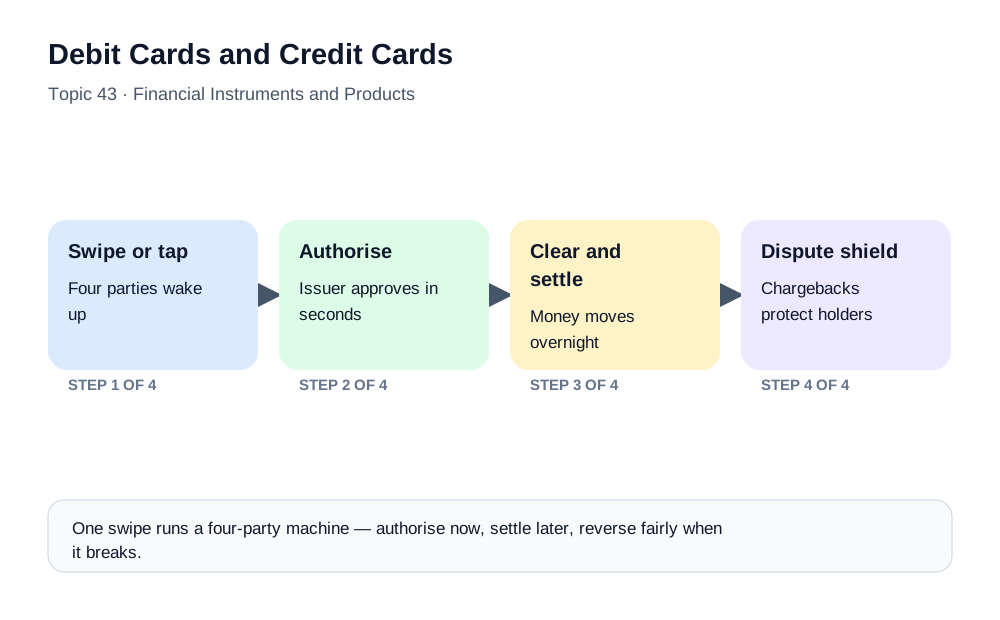
Debit Cards and Credit Cards at a glance — Four party model, interchange, credit limits.
1. The Four-Party Model: Why Cards Work
Card payments operate through a four-party model that distributes roles and revenues across the payment ecosystem. The cardholder holds the card and authorizes transactions. The merchant accepts the card as payment for goods and services. The issuing bank provides the card to the cardholder and maintains their account. The acquiring bank serves the merchant, processing card transactions and crediting their account. Connecting these parties are card networks, the infrastructure that routes transaction messages and settles funds between issuers and acquirers.
The model's genius is that it lets two strangers transact without trusting each other, by inserting two institutions each of them already trusts. The cardholder trusts their issuing bank; the merchant trusts their acquiring bank; the two banks trust the network's rules and settlement. This is the same trust-substitution pattern seen in trade finance, industrialized for retail scale. It also explains the model's economics: four parties must be paid from one transaction, and the allocation of that payment, especially the interchange fee, is the most contested number in retail banking, fought over by regulators, merchants, and banks for decades.
The model solved a chicken-and-egg problem that kills most payment innovations. A new payment method needs cardholders to attract merchants and merchants to attract cardholders. The bank networks of the 1960s and 1970s, which evolved into today's global card networks, cracked it by recruiting banks on both sides simultaneously: issuers signed up cardholders en masse, acquirers signed up merchants, and the network standardized the rules between them. Scale begat scale, and the resulting acceptance ubiquity, a card from a small bank in one country works at a market stall on another continent, remains the card system's deepest moat even as new payment rails emerge.
2. Debit Cards: Direct Access to Your Money
Debit cards provide direct access to funds held in bank accounts. When a debit card transaction is authorized, the cardholder's account is debited immediately or within hours, with the merchant receiving payment through the settlement system. This immediate linkage to deposited funds makes debit cards feel like electronic cash, spending only what one has.
The economics of debit cards favor merchants and cardholders over banks. Because funds are already deposited and available, debit cards carry less risk than credit products. Interest income is nonexistent since no credit is extended. Banks earn primarily from interchange fees, the small percentages merchants pay on each transaction, and from account fees where applicable. The value proposition for banks is largely defensive: debit cards prevent deposit attrition by providing account utility that keeps customers engaged. A bank without a working debit card would watch its deposits walk to a bank that has one.
Debit cards serve different customer needs depending on how they access accounts. ATM cards, the earliest form, enabled cash withdrawal and balance inquiry at machines. Point of sale debit cards extended this to merchant purchases, initially requiring PIN entry to authorize. Signature debit, which processes through credit networks, offers similar functionality with different economics, historically higher interchange for issuers, one reason US banks encouraged signature transactions until regulation intervened. Contactless debit now allows tap-to-pay transactions under specified limits without PIN or signature, accelerating checkout while managing fraud risk through transaction limits and velocity checks.
A third sibling completes the family: the prepaid card, loaded with funds in advance and unlinked to any deposit account. Prepaid cards serve the unbanked, gift and travel use cases, government benefit distribution, and corporate expense control. Economically they resemble debit, spend only what was loaded, but the funds sit in a pooled account the program manager controls, and consumer protections differ by jurisdiction in ways cardholders rarely read about until something goes wrong.
One operational nuance worth knowing: a debit authorization places a hold on funds before settlement completes. The hotel that pre-authorizes your card at check-in, or the fuel pump that reserves an estimated amount, has frozen part of your balance against a final amount not yet known. Customers experience this as money missing from their account for days; operationally it is the system reserving funds against a commitment not yet settled.
3. Credit Cards: The Revolving Credit Line
Credit cards operate on fundamentally different principles than debit cards. When a credit card is used, the issuing bank extends credit to the cardholder, creating a loan that need not be repaid immediately. This extension of credit transforms the card from a payment mechanism into a lending product with distinct economics and risk characteristics.
The credit card transaction creates a liability for the cardholder and an asset for the issuing bank. The cardholder receives goods or services while deferring payment. The merchant receives payment from the acquirer, less merchant discount fees. The issuer pays the acquirer through the network settlement system, creating a claim against the cardholder that will be settled when the cardholder pays their bill.
This deferral of payment creates the revolving feature that distinguishes credit cards. Cardholders may pay their full balance by the due date, incurring no interest charges and effectively receiving an interest-free loan for the grace period, typically twenty to fifty days depending on the market and where in the billing cycle the purchase fell. Or they may pay a minimum amount and carry the remainder as a revolving balance, on which interest accrues at rates typically ranging from eighteen to over forty percent annually depending on the market and cardholder risk profile.
Credit card economics depend heavily on this revolving behavior. Transactors who pay in full monthly generate interchange revenue but no interest income. Revolvers who carry balances generate both interchange and substantial interest income, making them highly profitable customers. This profitability must be weighed against credit risk, as some revolvers will default on their obligations, requiring charge-offs that reduce issuer earnings. The credit card business is therefore a lending business with a payments interface, and it is underwritten like one: credit limits are set against income and bureau history, utilization is monitored for early warning signs, and pricing reflects expected loss as much as expected revenue.
3.1 The Billing Cycle and the Minimum Payment Trap
Every credit card runs on a monthly billing cycle. Purchases accumulate through the cycle; a statement closes on the closing date; payment is due roughly three weeks later. Pay the statement balance in full by the due date and the grace period makes the entire cycle interest-free. Pay anything less and interest applies, in most markets, from the date of each transaction, not merely from the due date, and the grace period typically disappears for the following cycle too until the balance is cleared.
The minimum payment, commonly set at a small percentage of the balance plus fees and interest, is where the product's danger lives. A worked example shows the mathematics. Suppose a cardholder carries a 50,000 balance on a card charging 36 percent annually, roughly 3 percent monthly, with a minimum payment of 5 percent of the balance. The first minimum payment is 2,500, of which about 1,500 is interest and only 1,000 reduces principal. Paying only the minimum, the balance declines so slowly that clearing it takes well over a decade, and total interest paid approaches or exceeds the original purchases. This is not an edge case: regulators in several markets now require statements to disclose exactly how long minimum-only repayment would take, precisely because so many cardholders never do this arithmetic.
The lesson is not that credit cards are bad, the grace period, fraud protection, dispute rights, and rewards are genuinely valuable, but that the product has two modes with radically different economics. Used as a transactor, the cardholder borrows free and is paid in rewards from the interchange the merchant funds. Used as a revolver, the cardholder holds one of the most expensive mainstream loans in consumer finance. Financial sophistication with cards is almost entirely the discipline of staying in the first mode.
The customer who wants that discipline has a simple toolkit. Set the statement to auto-pay in full, which makes revolving an active choice rather than a default. Keep utilization comfortably below the limit, both for credit-score reasons and because a card at its ceiling is a card with no fraud headroom. Use credit, not debit, for online and travel spending, so that disputes and fraud touch the bank's money before yours. And read the statement's minimum-payment disclosure once; the decade-long timeline printed there is the most honest piece of marketing the regulator ever forced onto a bank.
4. How Card Transactions Work
The apparent simplicity of a card transaction conceals a sophisticated multi-step process that completes in seconds but continues for days afterward.
Authorization occurs at the point of sale when the cardholder presents their card. The merchant terminal reads the card data and transmits an authorization request through the acquiring bank to the card network. The network routes this request to the issuing bank, which checks whether the card is valid, whether sufficient credit or funds are available, and whether the transaction triggers any fraud alerts. The issuer responds with an approval code or decline, which flows back through the same channels to the merchant terminal. This entire cycle typically completes in two to three seconds, and it carries only a message, no money moves yet.
Clearing occurs after authorization, as the transaction details flow through the network for reconciliation. The merchant submits captured transactions in batches, typically at day's end. The network processes these submissions, calculating net positions between issuers and acquirers and preparing for settlement. Authorization and clearing usually match, but where they differ, tips added at restaurants, final hotel bills, fuel adjustments, the clearing record corrects the estimate.
Settlement is the actual transfer of funds. The issuing bank transfers funds to the network, which distributes them to acquiring banks, which credit merchant accounts. For debit cards, this settlement typically occurs within a day. For credit cards, the settlement to merchants occurs within similar timeframes, though the cardholder's obligation to the issuer remains until they pay their bill.
A worked example makes the money flows concrete. A customer buys groceries for 100 units of currency with a credit card. On settlement, the issuer pays the acquirer 100; the acquirer credits the merchant approximately 98, retaining a merchant discount of about 2; from that 2, roughly 1.5 flows to the issuer as interchange, a small fraction goes to the network, and the remainder is the acquirer's margin. The merchant accepted a 2 percent cost for guaranteed payment and increased sales; the issuer earned 1.5 percent plus whatever the cardholder later pays in interest and fees; the cardholder paid nothing extra and possibly earned rewards funded largely from that interchange. Every card transaction in the world is a variation on this division.
5. Disputes and Chargebacks: The Cardholder's Shield
One feature distinguishes cards from nearly every other payment method, and customers rarely appreciate it until they need it: the right to dispute a transaction and reverse it.
A chargeback is a forced reversal initiated through the cardholder's issuing bank. The cardholder reports a problem, goods never delivered, a duplicate charge, a subscription that would not cancel, an unrecognized transaction. The issuer investigates and, if the claim fits the network's reason codes, pulls the funds back from the acquirer, which debits the merchant. The merchant may contest with evidence, signed receipts, delivery records, logs, and the dispute can escalate to network arbitration. The timelines and evidentiary rules are set by network regulations, not by the goodwill of either party.
The system reallocates risk deliberately. The party best positioned to prevent a problem bears it: merchants who fail to deliver lose the sale; issuers absorb fraud when authentication was weak; cardholders absorb losses when they were grossly negligent with their credentials. Consumer protection regulation in many jurisdictions caps cardholder liability for unauthorized transactions, near zero when the loss is reported promptly, which is why a stolen card number is an inconvenience while stolen cash is simply gone.
Chargebacks cut both ways commercially. They are the merchant's incentive to deliver and the cardholder's insurance, but they are also abused: friendly fraud, where a customer disputes a purchase they actually made, costs merchants billions annually and is policed through evidence requirements and repeat-dispute analysis. For banking professionals, the dispute operation is a core card function: every chargeback is coded, timed, tracked, and fed back into fraud models and merchant monitoring.
6. The Economics of Card Payments
Card payments generate revenues and costs distributed across the ecosystem participants, with complex interdependencies that shape market structure.
Interchange fees are the payments acquirers make to issuers for each transaction. Set by card networks, these fees compensate issuers for processing costs, fraud losses, and the float benefit issuers receive between transaction and cardholder payment. Interchange rates vary by card type, transaction type, and merchant category, with premium cards and card-not-present transactions typically commanding higher rates. Regulatory caps in some jurisdictions have compressed interchange below unregulated levels: the European Union capped consumer debit interchange at 0.2 percent and credit at 0.3 percent, while the United States capped debit interchange for large issuers under the Durbin Amendment. The consequences of capping are a live policy debate: merchants pay less, but issuers recover revenue elsewhere, annual fees rise, rewards shrink, free banking erodes, and the evidence on whether consumers ultimately benefit is genuinely mixed.
The merchant discount rate represents what merchants actually pay to accept cards. This rate includes interchange, network fees, and the acquirer's margin for processing services. Merchants may pay rates ranging from one to three percent or more depending on their size, industry, and negotiating power. Large retailers with significant leverage often negotiate custom rates well below published schedules, which is why small merchants feel card costs most acutely and why some impose surcharges or minimum purchase amounts where local rules permit.
Issuer revenue comes from multiple sources. Interchange fees provide steady income on every transaction. Interest income from revolving balances is the largest revenue source for credit card issuers, particularly in markets with high credit penetration. Annual fees, charged on premium cards and some standard products, generate revenue directly from cardholders. Late fees and other charges add to the mix, though regulators increasingly cap and scrutinize penalty fees. The issuer's profit engine is thus a portfolio equation: interchange on all spend, plus interest on revolving balances, plus fees, minus credit losses, minus rewards costs, minus fraud losses, minus funding and operating costs.
Acquirer revenue comes primarily from the spread between merchant discount rates and interchange fees, plus fees for value-added services like analytics, fraud prevention, and terminal provision. The acquiring business is highly competitive, with thin margins that reward scale and operational efficiency.
From the issuer's management chair, a card portfolio is run like a factory with three control panels. Risk-based pricing and limits calibrate each account: credit limits and pricing reflect bureau history and behavior, limits rise as accounts season well, and early-warning indicators, rising utilization, minimum-only payments, cash-advance usage, trigger interventions long before default. Activation and usage economics receive constant attention because an issued-but-unused card is pure cost: the plastic, the credit line reserved against it, and the rewards promised all spend money with no revenue, which is why issuers campaign so hard for first use and for top-of-wallet status. Vintage analysis tracks each acquisition cohort's delinquency and profitability over time, telling management whether last year's growth came from good customers or from loosened standards that have not yet produced their losses. Card portfolios fail slowly and then suddenly; the vintage curve is where the "slowly" is visible in time to act.
7. Card Security and Fraud Prevention
The security of card payments has evolved continuously as fraudsters develop new methods of attack. Each layer of security addresses specific vulnerabilities while maintaining the convenience that makes cards attractive.
EMV chip cards replaced magnetic stripe technology in most markets, dramatically reducing counterfeit card fraud. Chips generate unique transaction codes that cannot be reused, making stolen transaction data worthless for creating fake cards. The liability shift, which made merchants accepting magnetic stripe transactions responsible for counterfeit fraud, accelerated EMV adoption globally, and the fraud that followed was entirely predictable: it migrated to the channel without chips, card-not-present e-commerce.
Card verification values, the three or four digit codes printed on cards but not stored in magnetic stripes or chips, provide security for card-not-present transactions. Requiring CVV entry for online purchases ensures the buyer possesses the physical card, not merely stolen account data.
Three-D Secure protocols add authentication layers for online transactions, requiring cardholders to complete additional verification, typically one-time passwords or biometric confirmation, before purchases are authorized. Modern versions (3DS2) analyze dozens of risk signals invisibly and challenge only the suspicious minority, shifting fraud liability toward issuers when authentication succeeds while keeping checkout smooth for most transactions.
Tokenization replaces sensitive card data with non-sensitive equivalents for storage and transmission. When a card is added to a mobile wallet or stored by a merchant, the actual card number is replaced by a token usable only in specific contexts. Breaches of tokenized data expose attackers to useless information rather than card numbers they could use elsewhere.
Real-time fraud detection uses machine learning models to score every transaction for risk, declining suspicious transactions or requiring additional verification. These models analyze transaction patterns, device fingerprints, location data, and behavioral signals to identify anomalies. The operational art is calibration: every false positive is a genuine customer embarrassed at a checkout, and the fraud team's true job is optimizing the trade-off between fraud caught and customers insulted.
The fraud taxonomy completes the picture: counterfeit fraud (killed by chips), lost and stolen card fraud (killed by instant app-based card freezing), card-not-present fraud (the dominant category today, fought with authentication and tokens), account takeover (fought with behavioral analytics), and first-party or friendly fraud (fought with evidence). Each era's defense displaces fraud to the next weakest surface rather than eliminating it, an arms race with no final round.
8. The Future of Card Payments
Card payments continue evolving as technology advances and consumer preferences shift. Mobile wallets embed card credentials in smartphones, enabling payments through near-field communication without physical cards, and notably, wallets did not displace the card rails; they ride on them, tokenized. Wearables extend this to watches and other devices. Biometric authentication replaces PINs and signatures with fingerprint or facial recognition.
The more fundamental challenge comes from account-to-account payment systems. Instant payment networks, India's UPI, Brazil's Pix, and similar systems across dozens of countries, let customers pay merchants directly from bank accounts, often free to the payer and cheaper for the merchant than card acceptance. Where these systems have scaled, they have measurably displaced card and cash volume, proving that the four-party model's economics are contestable. The card networks' response, embedding cards into wallets, building their own account-to-account capabilities, and pushing value-added services, acknowledges the threat while monetizing the acceptance and dispute infrastructure that instant rails have yet to replicate fully. Buy-now-pay-later products attack from another angle, replacing the revolving line with fixed installments at the point of sale. Central bank digital currencies may eventually provide government-backed alternatives to private payment networks.
Yet the fundamental value proposition of card payments, convenience, security, and universal acceptance, continues to drive growth. Cards have converted economies from cash-dependent to cash-optional, enabling e-commerce and reducing the costs of cash handling. The likely future is coexistence: cards, wallets, instant transfers, and credit at the point of sale sharing a wallet the customer chooses transaction by transaction. Understanding how cards work, the model, the money flows, the security stack, remains the foundation for evaluating every challenger, because each new rail is ultimately a re-negotiation of the same four questions: who pays, who bears risk, who settles, and who the customer trusts.
9. Common Misconceptions About Debit and Credit Cards
"Using a credit card means being in debt." Only if you revolve. Paying the statement balance in full means the card is a free short-term loan with rewards and protections attached. The debt is a choice the product permits, not one it imposes.
"Debit cards are always safer than credit cards." Debit cards spend your own money directly, fraud drains your actual balance while disputes are resolved, and legal protections are often weaker than for credit. Credit cards spend the bank's money first, which is precisely what makes them the safer instrument for online and travel spending.
"The minimum payment is the bank's recommended payment." It is the smallest payment that keeps the account current, calibrated to keep balances revolving for years. Section 3.1's arithmetic shows what following it costs.
"Merchants pay nothing extra for premium reward cards." Premium cards carry the highest interchange, and merchants cannot easily surcharge by card type, so reward programs are substantially funded by merchant fees, and ultimately by prices paid by all customers, including those paying cash.
"An unrecognized charge means the bank was hacked." The overwhelming majority of card fraud involves compromised card numbers, skimming, data breaches at third parties, phishing, not compromised banks. The card number is the credential; guarding it is a shared responsibility.
"Closing an old credit card improves your credit profile." Usually the reverse: it shrinks total available credit, raising utilization, and shortens credit history, both of which can lower scores. The professional advice is generally to keep old no-fee cards open and lightly used.
10. Frequently Asked Questions
What is the difference between my billing date and due date? The billing date closes your statement cycle and totals the month's charges; the due date, typically around three weeks later, is when payment must arrive. Purchases just before the billing date get the shortest grace; those just after get the longest, up to roughly fifty days interest-free.
Why was my debit card declined when I have money in the account? Common causes: a merchant pre-authorization holding funds, daily spending or withdrawal limits, an international transaction block, a fraud system flag, or an expired or frozen card. The available balance, not the ledger balance, is what the authorization system sees.
What happens when I dispute a transaction? Your issuer reviews the claim against network reason codes, issues a temporary credit in many cases, and initiates a chargeback to the merchant's bank. The merchant can contest with evidence. The whole cycle typically resolves in weeks, and your liability for genuinely unauthorized transactions is minimal if you report promptly.
Are reward points and cashback actually free? They are funded primarily from interchange paid by merchants and from interest paid by revolvers. For a transactor who pays in full, rewards are genuinely net positive; for a revolver, any reward is dwarfed by the interest that funds it.
Is it safe to save my card on shopping websites? Saving with reputable merchants that use tokenization is reasonably safe; the stored token is useless elsewhere if breached. The greater risks are phishing sites imitating real merchants and your own device hygiene. Virtual card numbers and wallet payments reduce exposure further.
What does a chargeback cost a merchant? The reversed sale, the goods or services already delivered, a chargeback fee, and, at elevated dispute rates, higher processing costs or termination of their acquiring relationship. This is why evidence retention, delivery records, clear billing descriptors, is a core merchant discipline.
Should I pay my credit card before the statement closes? Paying before the closing date reduces the balance reported to credit bureaus, lowering measured utilization, useful before applying for a loan. For interest purposes, only the due date matters if you pay in full.
11. Key Terms in This Chapter
- Four-party model — cardholder, merchant, issuer, acquirer, connected by card networks.
- Issuer / acquirer — the cardholder's bank and the merchant's bank.
- Card network — the rules-and-rails infrastructure routing messages and settling funds.
- Debit card — draws directly on deposited funds; electronic cash.
- Prepaid card — preloaded value unlinked to a deposit account.
- Credit card — a revolving credit line with a payments interface.
- Transactor / revolver — the pay-in-full user versus the balance carrier; the industry's fundamental segmentation.
- Grace period — the interest-free window when the statement balance is paid in full.
- Minimum payment — the smallest payment keeping the account current, and the revolving trap's entry point.
- Authorization / clearing / settlement — the three acts of a card transaction: approve, reconcile, pay.
- Interchange fee — the acquirer-to-issuer payment per transaction, set by networks, capped in some markets.
- Merchant discount rate — the merchant's all-in cost of card acceptance.
- Chargeback — the network-rule reversal protecting cardholders and disciplining merchants.
- Friendly fraud — disputes filed on transactions the customer actually made.
- EMV chip — dynamic cryptogram technology that ended mass counterfeiting.
- CVV — the printed verification code securing card-not-present transactions.
- 3-D Secure (3DS2) — risk-based authentication for online payments.
- Tokenization — replacing card numbers with context-bound substitutes; the security basis of mobile wallets.
- Durbin Amendment / EU interchange caps — regulatory limits on debit and credit interchange.
- Utilization ratio — balance relative to credit limit, a key credit-score input.
- Account-to-account (A2A) payments — instant bank-transfer rails challenging the card model.
- Vintage analysis — tracking each acquisition cohort's performance over time to see credit quality before losses fully emerge.
- Top-of-wallet — the card a customer reaches for first, the position issuers campaign for because it captures the majority of spend.
- Pre-authorization hold — funds frozen against an estimated final amount, common with hotels and fuel, before settlement completes.
12. Interview Insights: How This Topic Appears in Banking Interviews
"Explain the economics of a credit card transaction. Who pays whom?" Walk the worked example: issuer pays acquirer at settlement; merchant receives sale minus merchant discount; the discount splits into interchange to the issuer, network fees, and acquirer margin; the cardholder pays nothing at the point of sale and either nothing more (transactor) or interest (revolver). Interviewers are testing whether you can see all four parties at once.
"Why are credit cards profitable when so many customers pay no interest?" Three engines: interchange on all volume, interest and fees on revolving balances, and annual fees on premium products, net of credit losses, rewards costs, and fraud. Strong answers add that transactors are interchange assets, revolvers are lending assets, and the portfolio balances both against expected charge-offs.
"A customer says paying the minimum is fine because the bank offers it. How do you respond as a banker?" Distinguish contract from advice: the minimum keeps the account current, but the arithmetic, show the decade-long, interest-doubling example, makes it the most expensive mainstream borrowing most consumers ever hold. Recommend paying in full where possible, or fixed amounts above the minimum, and flag that regulators now require statements to disclose minimum-payment timelines for exactly this reason.
"How would you reduce card-not-present fraud without hurting conversion?" Layer the controls: tokenization to make stolen data useless, 3DS2 risk-based authentication so only suspicious transactions face friction, real-time scoring tuned to the false-positive cost, and merchant-side practices like address verification. The trade-off framing, fraud caught versus customers insulted, is what interviewers want to hear.
"Will UPI-style instant payments kill the card networks?" A genuinely two-sided question. Instant rails win on cost for merchants and simplicity for payers, and have taken real volume where they have scaled. But cards retain universal cross-border acceptance, embedded credit, dispute rights, and rewards economics that instant rails do not yet replicate. The sophisticated answer is coexistence and role division, with cards absorbing the challenge by riding inside the same wallets.
Summary and Key Takeaways
- Cards industrialized trust substitution: the four-party model lets strangers transact through two banks and a network, and its acceptance ubiquity remains the system's deepest moat.
- Debit, credit, and prepaid cards are different products sharing a form factor: spending deposited money, spending the bank's money on a revolving line, and spending preloaded value.
- Credit cards are lending products with a payments interface; the transactor/revolver split drives all economics, and the grace period and minimum payment are the two numbers every cardholder must understand.
- A card transaction runs three acts, authorization in seconds, clearing overnight, settlement within days, and the merchant discount divides among issuer interchange, network fees, and acquirer margin.
- Chargebacks are the cardholder's shield and the merchant's discipline; they make cards the safest mainstream way to pay online, and friendly fraud is their abuse.
- Interchange is the industry's most contested number; caps transfer value from issuers toward merchants with debatable net consumer benefit.
- Security is an arms race: chips killed counterfeiting, tokenization guards stored credentials, 3DS2 authenticates online, and fraud migrates to each era's weakest surface.
- Instant account-to-account rails are the first credible structural challenge to card economics; the future is coexistence, with cards monetizing credit, acceptance, and dispute infrastructure.
- Issuers run portfolios on risk-based pricing, activation economics, and vintage analysis; cardholders win by auto-paying in full, keeping utilization low, and spending the bank's money, via credit rather than debit, where fraud risk lives.
Next: Topic 44 — Bancassurance and Insurance Products →
<!-- MBA-DEEP-DIVE-START -->Deep Dive: Cards as a Real-Time Authorization System, a Delayed Settlement System, and a Credit Product
Cards become much easier to understand when three different things are kept separate: the card credential, the payment transaction, and the underlying funding relationship. The credential may be a physical card, token in a mobile wallet, or stored credential at a merchant. The payment transaction moves through authorization, clearing, and settlement. The funding relationship may be a deposit account, credit line, or prepaid balance. Confusing these layers creates bad product design and poor incident analysis.
A card transaction can be authorised successfully and later clear for a different amount. It can be declined even when the customer has money because the fraud engine intervened. A merchant can receive settlement while the cardholder later disputes the transaction. A physical card can be cancelled while a valid digital token continues under controlled lifecycle rules. The card ecosystem is therefore a state machine, not one instant ‘tap and pay’ event.
The parties are roles, not always separate companies
The familiar four-party model names cardholder, merchant, issuer, and acquirer, connected by a network. In practice, one banking group can perform more than one role, and processors or payment facilitators may perform operational functions on behalf of issuers or acquirers.
The roles still matter because they define responsibility. The issuer decides whether to approve the cardholder's transaction and manages the cardholder account. The acquirer provides acceptance services to the merchant and receives clearing and settlement records. The network provides rules, routing, processing services, and settlement arrangements according to its model.
When troubleshooting, the useful question is not ‘Which company failed?’ but ‘Which role owned the failing step?’ A processor outage at a vendor can prevent an issuer from responding even though the issuer remains legally and commercially responsible to its customers.
Authorization is a decision based on incomplete information
At authorization time, the issuer receives a request containing transaction data such as amount, merchant, terminal or e-commerce context, currency, credential information, authentication results, and other scheme-defined fields. The issuer has seconds to decide.
It checks account or credit status, available funds or limit, card status, restrictions, merchant category, geography, transaction velocity, fraud score, authentication, and product rules. The issuer then approves, declines, or in some environments requests additional action.
The decision is based on what is known at that moment. The final amount can differ. Restaurants may add tips. Hotels and car-rental companies may use estimated authorisations. Fuel dispensers may pre-authorise an amount before the final purchase is known. Partial shipments in e-commerce can create multiple clearing records.
Systems should therefore link clearing to prior authorization without assuming exact equality in every valid case.
Available balance and credit limit must reflect holds correctly
When an issuer approves a debit transaction, it can place a hold against the customer's available balance. On a credit card, the authorization generally reduces available credit. That prevents the same funds or limit being spent repeatedly before clearing arrives.
If a hold is too small, the customer can overspend. If it is too large or remains after the transaction fails, the customer loses access to money or credit unnecessarily.
Hold lifecycle is therefore a major service-control issue. Systems need rules for creation, adjustment, expiry, reversal, completion, and unmatched clearing. A reversal message should release the relevant hold promptly, but duplicate reversals must not create extra available balance.
A common customer complaint—‘the transaction failed but my money is blocked’—is usually a hold-state problem rather than a completed debit.
Clearing creates the financial record of the purchase
Authorization says the issuer was willing to support the transaction. Clearing presents the financial transaction for posting and interparty calculation. It can contain the final amount, currency information, fees, merchant data, and references needed to connect it to the earlier authorization.
Issuers should match clearing records to authorization where possible. Unmatched clearing can be legitimate, but it deserves defined treatment because it can indicate delayed presentment, offline transactions, recurring payments, transit or toll scenarios, or data defects.
The customer ledger should record the final clearing amount according to the card product's posting and FX rules. If authorization used one estimated amount and clearing uses another, the hold and posted transaction should reconcile without double counting.
Settlement is between financial participants, not the same as customer posting
Network settlement determines amounts owed between issuers and acquirers after clearing and applicable fees. The issuer's settlement obligation is not identical to the customer purchase amount because interchange, network fees, reversals, chargebacks, and other adjustments may affect net positions.
Card operations therefore need multiple reconciliations:
- transaction clearing to customer posting;
- clearing to network settlement reports;
- settlement reports to bank settlement accounts;
- acquiring records to merchant funding;
- fees and interchange to the GL.
A card system can show every customer purchase correctly while the settlement account is out of balance. That is why card reconciliation is a specialised operating discipline.
Merchant acquiring is a credit and fraud business too
Acquirers do more than pass transactions to networks. They onboard merchants, assess business legitimacy, configure acceptance, manage settlement, monitor fraud and chargebacks, and carry exposure when merchants fail after receiving funds.
Consider a travel merchant that sells future holidays and then becomes insolvent. Customers can raise disputes for services never delivered. If the merchant's account is empty, the acquirer may still face financial responsibility through scheme rules and contractual arrangements.
Acquirers therefore evaluate future-delivery risk, refund patterns, chargeback ratios, business model, transaction size, seasonality, and financial strength. They may hold reserves or delay part of settlement for higher-risk merchants.
A merchant with strong sales is not automatically a low-risk merchant.
Payment facilitators add another layer of merchant risk
Modern acquiring often uses payment facilitators or aggregators that onboard many sub-merchants under a broader relationship. This improves distribution but creates a look-through requirement.
The acquirer needs enough visibility into sub-merchant identity, activity, prohibited business types, fraud, disputes, and settlement flows. An aggregator cannot become a blind spot through which unacceptable merchants access the card network.
Responsibility mapping matters: who performs merchant due diligence, who monitors transaction laundering, who handles disputes, and who bears losses when a sub-merchant disappears?
Debit and credit have different risk engines
A debit transaction spends money already held by the customer, although overdrafts or linked credit can complicate the picture. A credit-card transaction creates or increases a receivable owed to the issuer.
That means credit cards need a full lending lifecycle alongside the payment engine: application underwriting, credit limit assignment, limit management, statement generation, minimum payment calculation, interest, fees, delinquency, collections, hardship, charge-off, and credit reporting where applicable.
A payment product manager who looks only at authorization rates is seeing half the credit-card business. Portfolio quality can deteriorate while transaction performance remains excellent.
Credit limit management is a continuous risk decision
The limit approved at origination should not remain automatically correct for the life of the account. Issuers monitor utilisation, repayment behaviour, income information where available and permitted, bureau changes, delinquency, cash advances, and other risk indicators.
Limit increases can improve customer utility and revenue but increase exposure. Limit decreases can reduce risk but harm customers if done unexpectedly or if pending transactions rely on the old limit.
Automated limit-management strategies should have eligibility, affordability or risk controls as required, customer communication, and model governance. Marketing propensity should never be the sole reason to increase a lending commitment.
Statement generation must reconcile to the transaction ledger
A credit-card statement is a legal and customer-facing financial record. It should reconcile opening balance, purchases, cash advances, fees, interest, payments, refunds, reversals, adjustments, and closing balance.
The statement engine also determines payment due date, minimum amount, grace-period treatment, and interest consequences. Small configuration errors can affect millions of accounts.
For example, an incorrect billing-cycle calendar can shorten a customer's payment period. A misclassified transaction can attract cash-advance pricing instead of purchase pricing. A missing payment can cause interest and late-fee cascades.
Banks should reconcile statement balances to the card sub-ledger and control product parameter changes with effective dates and independent review.
Interest calculation deserves precise product logic
Credit-card interest is more complex than quoting an annual percentage rate. The system needs daily balances or other defined basis, transaction date, posting date, grace-period rules, payment allocation hierarchy, compounding treatment, cash-advance treatment, promotional rates, and regulatory disclosures.
The bank should be able to reproduce a customer's interest charge from transaction-level data. If service staff cannot explain the calculation, the product is not operationally controlled.
Promotional ‘zero interest’ offers also need precise expiry behaviour. The customer should understand what rate applies after the promotion and whether any deferred interest mechanism exists in markets where such structures are permitted.
Card-not-present fraud moved the attack surface from plastic to identity
EMV chips dramatically reduced traditional counterfeit fraud where deployed, but e-commerce and stored credentials created new opportunities. Criminals now focus on account takeover, phishing, malicious merchant compromise, credential stuffing, social engineering, and token or device abuse.
The issuer fraud engine therefore scores context: device, merchant, location, behavioural pattern, transaction history, authentication outcome, velocity, and known compromised credentials.
The objective is not maximum decline rate. Every false decline is a legitimate customer blocked at checkout and can drive the card out of the wallet. Fraud strategy optimises loss prevented versus good customer friction.
Authentication is not the same as authorization
Customer authentication attempts to establish that the legitimate cardholder is participating. Authorization decides whether the issuer will approve the transaction. A strongly authenticated transaction can still be declined because of insufficient credit or other policy. A low-risk transaction can be authorized without an interactive challenge where rules permit.
This distinction should appear in system statuses. ‘Authentication successful’ must never be treated as ‘payment successful’.
For e-commerce, risk-based authentication can allow low-risk purchases to proceed frictionlessly while challenging higher-risk activity. The bank should retain authentication evidence because liability and dispute outcomes can depend on it.
Tokenization creates a credential lifecycle separate from the card number
When a card is provisioned into a mobile wallet or merchant token vault, the usable credential can be a token mapped to the underlying account. Tokens can have their own device, merchant, or domain restrictions.
This creates useful control options. A compromised merchant token may be suspended without replacing the customer's physical card. A lost phone token can be removed while the account remains active.
The card-lifecycle system therefore needs to coordinate PAN status and token status. Closing the underlying account must disable related tokens, but replacing a physical card does not always require every network token to be destroyed if secure lifecycle services can update them appropriately.
The customer experience should be clear: ‘card replaced’ and ‘wallet credential active’ are related but not identical states.
Recurring and stored-credential payments need mandate clarity
Subscriptions and merchant-initiated transactions create different operational behaviour from one-time purchases. The cardholder may give the merchant permission to charge later without being present for each transaction.
Issuers and merchants need accurate indicators so systems understand whether the transaction is recurring, instalment, unscheduled credential-on-file, or customer-initiated under the applicable network framework.
A customer cancelling a card does not necessarily resolve the underlying subscription contract. Conversely, a merchant should not continue charging after a valid cancellation according to the commercial agreement and applicable rules.
Dispute operations need to distinguish card credential problems from merchant-contract problems.
Chargebacks are structured claims with deadlines and evidence
A cardholder dispute enters a rule-based process. The issuer identifies the appropriate reason category, checks eligibility and timing, may provide provisional credit according to law or policy, and submits the claim through the network. The acquirer and merchant can accept or represent the transaction with evidence. Further escalation can follow.
Reason selection matters. Fraud, duplicate processing, goods not received, cancelled recurring transaction, incorrect amount, and processing error require different evidence.
A weak dispute operation chooses whatever reason code appears easiest. A strong one identifies the actual event because inappropriate claims create losses and can breach network rules.
The bank should track deadlines automatically. A valid claim missed because a manual queue aged too long is an avoidable financial loss.
Friendly fraud requires balanced investigation
Some cardholders dispute legitimate transactions because they forgot the merchant, another household member used the card, the merchant descriptor is unclear, or they intentionally seek a refund through the dispute process.
Issuers should make merchant information understandable before assuming fraud. Enhanced merchant descriptors, logos, location, digital receipts, and contact information can reduce unnecessary disputes dramatically.
The aim is not to make cardholders prove innocence. It is to resolve uncertainty quickly and route genuine fraud into the correct protection process.
Cash withdrawal has a different control profile
ATM transactions combine card authentication, PIN or other verification, cash dispensing, ATM balancing, and network messaging. A successful authorization followed by cash not dispensed creates a different exception from cash dispensed with the account not debited.
ATM reconciliation compares electronic journals, switch records, cassette counts, customer postings, and settlement. Cash differences require investigation.
Partial dispense, cash retraction, network timeout, duplicate message, and customer claim each need specific transaction states. ‘ATM failed’ is not detailed enough to resolve money accurately.
Foreign-currency card transactions create FX and timing questions
The customer may see an authorization in one currency and a posted amount in another after clearing. The exchange rate can be determined according to network and issuer rules at a later processing date, so the final domestic-currency amount can differ from the amount the customer estimated at purchase.
Dynamic currency conversion adds another choice: the merchant or ATM offers to convert into the cardholder's home currency. The customer should see the rate and markup sufficiently clearly to make an informed choice where the service is offered.
Banks should be able to reconstruct the currency, rate source, markup or fee, processing date, and final amount applied to a posted transaction.
Card controls are increasingly customer-operated
Mobile apps let customers freeze and unfreeze cards, disable international usage, change transaction limits, control contactless or e-commerce access, create virtual cards, and receive instant alerts.
These controls reduce fraud and service calls, but they need reliable propagation. If the app says international use is disabled while the authorization host still approves international transactions because of a delayed update, the control is misleading.
Customer-configured limits should feed the authorization engine in near real time and be auditable. Security changes themselves may require strong authentication to prevent an attacker from raising limits after account takeover.
A full e-commerce card scenario
A customer buys a laptop online for ₹85,000 with a credit card stored in a mobile wallet.
The merchant submits an authorization using a network token. Authentication data and transaction context travel through the acquirer and network to the issuer. The issuer checks token status, available credit, merchant and device risk, customer velocity, and fraud score. The transaction is approved and ₹85,000 of credit is reserved.
The merchant ships the laptop the next day and submits clearing. The clearing record is matched to the authorization. The issuer posts the purchase, releases or consumes the authorization hold correctly, and includes the item in the next statement. Network settlement transfers the issuer's net obligation to the acquiring side, while interchange and fees are recorded separately.
Now suppose the customer reports that the laptop never arrived. This is not automatically card fraud. The issuer opens the appropriate merchandise dispute, obtains required information, and sends a chargeback if eligible. The merchant can respond with delivery evidence. The dispute follows network timelines until resolved.
If instead the customer never made the purchase and account-takeover evidence appears, the case follows fraud handling and may lead to token suspension, card reissuance, account-security reset, and separate liability treatment.
The original authorization message is the same kind of object in both cases; the later facts determine the operating process.
What excellence looks like
A world-class card operation can trace every transaction across credential, authentication, authorization, hold, clearing, settlement, customer posting, fees, and dispute. Available balance and limit remain correct through reversals and late clearing. Tokens have controlled lifecycles. Fraud models reduce loss without indiscriminate declines. Merchant acquiring monitors future-delivery and transaction-laundering risk. Statements and interest can be reproduced. Chargeback deadlines and evidence are controlled. ATM cash reconciles to messages. FX treatment is explainable.
The customer sees a tap that takes two seconds. The bank succeeds only if every state before and after that tap remains financially consistent for days, months, and sometimes years afterward.
<!-- MBA-DEEP-DIVE-END -->