The cheque, for centuries the dominant instrument of commercial payment, represents a remarkable legal and financial innovation. It transformed the physical transfer of coins and notes into a paper-based instruction that traveled between parties, clearing through banking systems to settle obligations without the weight and risk of cash. Though electronic payments have now overtaken cheques in volume, understanding these negotiable instruments remains essential for comprehending how commercial payments evolved and how certain transactions continue to function.
By the end of this chapter, you will be able to:
- Define a negotiable instrument and explain why negotiability was such a powerful idea
- Identify the parties, forms, and anatomy of a cheque
- Trace a cheque's journey from deposit to settlement, and its return journey when dishonored
- Distinguish cheques, bills of exchange, and promissory notes and their commercial roles
- Explain the legal machinery, especially the holder in due course, that made paper transferable
- Describe the main cheque fraud patterns and the controls banks use against them
- Understand the consequences of dishonor across major legal traditions
- Assess why paper instruments are declining yet refuse to disappear
Visual overview
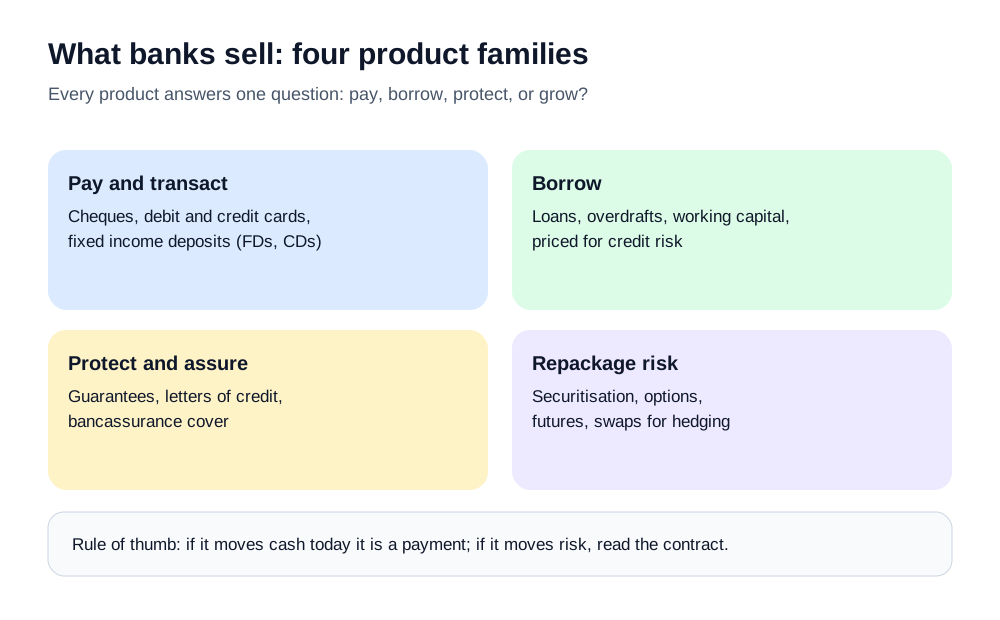
Phase 5 map: pay, borrow, protect, or repackage risk. If it moves cash today it is a payment; if it moves risk, read the contract.
1. First Principles: What Makes an Instrument "Negotiable"
A negotiable instrument is a document that represents a promise or order to pay a sum of money. The term negotiable means it can be transferred from one party to another, with the transferee gaining rights that may be stronger than those of the original holder.
That last clause is the entire magic, and it is worth pausing on because it violates the ordinary rule of property law. Under the normal principle, no one can transfer better title than they have: if a thief sells you a stolen bicycle, you own nothing, however honestly you paid. Negotiable instruments are the deliberate legal exception. A person who takes a cheque or bill for value, in good faith, and without notice of any defect can acquire a clean right to be paid even if the person who transferred it to them had a defective title. Commerce needed this exception: without it, every recipient of a payment instrument would have to investigate the entire history of the paper before accepting it, and paper money-substitutes would be as suspicious as strangers' bicycles. With it, a merchant could accept a bill from a customer without knowing or caring how many hands it had passed through.
The price of the exception is formalism. Because the law protects good-faith transferees so strongly, it demands that the instruments themselves meet strict formal requirements: writing, signature, an unconditional order or promise, a sum certain, defined parties, and defined timing. Nearly every technical rule in this chapter, what makes a valid cheque, what defects destroy negotiability, what endorsements must look like, flows from this bargain: exceptional transferability in exchange for exceptional formality.
Three instruments dominate this category: cheques, bills of exchange, and promissory notes. Each serves different purposes in commerce, governed by legal frameworks that have evolved over centuries of commercial practice and were largely codified in the nineteenth century, the Bills of Exchange Act 1882 in Britain, the Negotiable Instruments Act 1881 in India, and, in the United States, the Uniform Commercial Code's articles on negotiable instruments and bank deposits. The remarkable fact is that these Victorian-era frameworks still work well enough to govern transactions today, including the electronic image-based clearing that their drafters never imagined.
2. The Cheque: A Modern Payment Order
A cheque is a bill of exchange drawn on a bank, payable on demand. When an account holder writes a cheque, they are instructing their bank to pay a specified sum to the named recipient or to whoever holds the cheque. This instruction transforms the bank's liability to its customer into a liability to the cheque holder, creating a payment mechanism that has served commerce for centuries.
Unpack that definition, because each word is load-bearing. "Drawn on a bank" distinguishes a cheque from an ordinary bill of exchange, which may be drawn on any party. "Payable on demand" means the cheque is due the moment it is presented, unlike a bill, which commonly matures at a future date. And "an instruction to the bank" locates the legal relationship precisely: the cheque is the customer's order to their own bank, and the bank that pays the wrong person, or refuses to pay the right person without cause, answers for it. A bank that honors a cheque after the customer has validly stopped it, or pays against a forged signature, generally bears the loss itself, one reason signature verification survived as a control long after everything else was automated.
The parties to a cheque each have distinct roles and liabilities. The drawer is the account holder who writes the cheque, creating the instruction to pay. The drawee is the bank on which the cheque is drawn, obligated to honor the instruction if funds are available. The payee is the party named to receive payment, who may endorse the cheque to transfer it to another party. Each endorsement adds another party who may be liable if the cheque is dishonored, a chain of recourse that gave transferred paper its commercial strength.
Cheques come in various forms suited to different needs. Bearer cheques are payable to whoever holds them, requiring no endorsement to transfer. These are convenient but risky, as loss or theft means loss of the funds. Order cheques are payable to a named recipient who must endorse them to transfer, providing some protection against unauthorized transfers. Crossed cheques bear two parallel lines across the face, indicating they must be deposited to an account rather than cashed over the counter, creating an audit trail and reducing theft risk. Account payee cheques include this instruction explicitly, ensuring they can only be credited to the named payee's account. The crossing device is elegantly simple: it converts paper that a thief could cash into paper that is worthless outside the banking system's records.
The Magnetic Ink Character Recognition encoding printed on cheques enables automated processing. The MICR line contains the bank code, branch code, account number, and cheque number in a format that machines can read even if other parts of the cheque are damaged or poorly written. This encoding was essential for the high-volume clearing systems that processed millions of cheques daily before electronic payments became dominant, and as the branch chapter noted, it was one of the first successful detachments of banking operations from pure manual labor.
Two cousins of the cheque deserve mention because customers constantly confuse them. A demand draft or banker's cheque is drawn by the bank itself rather than by a customer: the buyer pays the bank upfront, and the bank's own obligation replaces the customer's. Since the bank, not an individual, promises payment, drafts cannot bounce for insufficient funds, which is why they persist in high-stakes contexts like university admissions, government fees, and tender submissions where the recipient refuses the risk of a personal cheque.
3. The Bill of Exchange: Trade Finance Foundation
Bills of exchange predate cheques and remain important in international trade. A bill of exchange is an unconditional order in writing, addressed by one person to another, signed by the person giving it, requiring the person to whom it is addressed to pay on demand or at a fixed or determinable future time a sum certain in money to or to the order of a specified person or to bearer.
In trade transactions, bills of exchange allow sellers to extend credit to buyers while maintaining a claim that can be transferred or discounted. An exporter might draw a bill on an importer, requiring payment sixty days after sight. The importer accepts the bill by signing it, creating a legal obligation to pay. The exporter can then hold the bill until maturity or discount it with a bank to receive immediate cash, less the discount representing interest for the remaining term. The trade finance chapter covered the surrounding machinery; here the point is the instrument itself: the accepted bill is a self-contained, transferable, enforceable promise that exists independently of the goods that created it.
The negotiability of bills made them foundational to international commerce before modern banking infrastructure. A bill drawn in London on a merchant in Bombay could pass through multiple hands as trade goods moved, with each holder able to enforce payment. Banks developed expertise in accepting and discounting bills, providing the liquidity that kept trade flowing, and the banker's acceptance, a bill carrying a bank's own acceptance, became a money-market instrument traded like short-term debt. While letters of credit and electronic transfers have reduced bill usage, they remain relevant in jurisdictions where banking infrastructure is less developed, and their legal DNA survives inside every modern receivables-financing and supply chain finance structure.
4. The Promissory Note: A Written Promise
A promissory note is a written promise by one party to pay another a definite sum either on demand or at a specified future date. Unlike a cheque or bill, which orders a third party to pay, a promissory note is the direct obligation of the maker. The structural difference matters in practice: a bill involves at least two parties and becomes fully binding on the payer only upon acceptance, while a note is binding on its maker the moment it is signed.
Promissory notes formalize debt obligations in contexts ranging from personal loans to commercial financing. A simple form might record a loan between friends, while sophisticated versions underlie corporate debt issuance. The key elements are the promise to pay, the amount, the timing, and the parties involved.
In banking, promissory notes are used for various credit products. Demand promissory notes accompany working capital facilities, allowing banks to call repayment when needed. Term notes document specific loan agreements with defined repayment schedules. In many jurisdictions, taking a promissory note alongside the loan agreement is standard credit practice because the note is a cleaner instrument to enforce: in litigation, the holder of a note typically needs to prove far less than a lender relying on contract alone, which is precisely why banks insist on them. The negotiability of these instruments means the holder can transfer them, though in practice most bank loans are not freely negotiable and remain with the originating institution, or move through the assignment and securitization channels described in the lending chapters.
5. Clearing and Settlement: The Cheque's Journey
For negotiable instruments to function as payment mechanisms, systems must exist to clear them and settle the underlying funds. The clearing process matches instruments presented for payment against the accounts on which they are drawn, while settlement transfers the actual funds between banks.
Follow a single cheque through the modern system. Meena deposits a fifty-thousand-rupee cheque from a customer of another bank at her branch on Monday morning. Her bank, the collecting or presenting bank, captures the cheque's image and MICR data and transmits them into the clearing system. That afternoon the clearing house sorts millions of such presentations, matching each against the bank on which it is drawn and calculating the net amounts each bank owes every other. On Tuesday, the drawee bank's systems verify the signature against its records, confirm the account balance, and check for stop-payment instructions; cheques failing any test are returned through the same electronic channel with a reason code. The paying decision made, settlement occurs through accounts the banks hold at the central bank, with finality assuring that cleared cheques will be paid. Meena's account, which showed the deposit as a provisional credit on Monday, now holds cleared funds. What once took a week of physical paper transport now completes in a day or two.
The Cheque Truncation System revolutionized clearing by eliminating the physical movement of paper. Rather than transporting cheques from collecting banks to paying banks, the CTS captures cheque images and MICR data at the point of deposit. These electronic records travel through the clearing system while the physical cheques remain at the collecting branch. Banks exchange and settle based on the electronic data, dramatically reducing processing time from days to hours and eliminating the costs and risks of physical transport. In the United States, the same transition arrived through the Check 21 legislation of 2004, which gave digital images the legal standing of the original paper; Britain's completion of image-based clearing in 2019 compressed its cycle to the next weekday. The pattern repeated everywhere because the economics were overwhelming: the cheque's content had value, but its paper body was pure cost.
A subtle operational concept governs the customer's experience throughout: the difference between ledger balance and available balance. The deposit may appear immediately, but funds become available only when the clearing cycle matures, a delay that exists because the presenting bank is advancing money against a payment it has not yet finally received. Fraudsters have exploited this gap for generations, as Section 7 shows.
Inside the drawee bank, the verification step is itself a small production line with an exception queue. High-value cheques route to human officers for signature and alteration review; mismatches, stops, and technical defects are coded and returned within the clearing window, because a bank that misses its return deadline can be deemed to have paid. This is one of the least-known operational facts in retail banking: silence is acceptance. The discipline of the return deadline, not any technology, is what keeps clearing final and trustable.
6. Dishonor and Legal Consequences
Not all cheques are honored. When a drawee bank refuses payment, the cheque is dishonored, triggering legal consequences that vary by jurisdiction.
A cheque may bounce for several reasons. Insufficient funds means the account lacks adequate balance to cover the cheque amount. Stop payment instructions, when properly given by the drawer, direct the bank to refuse payment. Account closure removes the basis for payment entirely. Signature mismatches, when the drawer's signature does not match bank records, cause returns as a security measure. Post-dated cheques presented before their effective date are properly returned, as are stale cheques presented long after issue, most systems treat cheques as valid for only a few months from their date. Technical defects, mismatched amounts in words and figures, missing dates, unauthorized alterations, complete the list, each rooted in the formality principle of Section 1: an ambiguous instruction is one a bank cannot safely execute.
Bounced cheques carry serious consequences in many jurisdictions. Civil liability requires the drawer to make good the amount and may expose them to damages. Criminal penalties, in jurisdictions that treat cheque bouncing as an offense, can include fines and imprisonment. India's Negotiable Instruments Act famously makes cheque dishonor for insufficient funds a criminal offense under its Section 138, with strict liability that does not require proving fraudulent intent, though the drawer retains defined defenses and the payee must follow a prescribed notice-and-complaint procedure. This reflects the importance of cheque integrity to commercial confidence: if a cheque can be issued carelessly, it ceases to function as a substitute for cash, and commerce loses a tool it had relied on for centuries. Banks feel the consequences too, regulators in several jurisdictions track repeat offenders, and customers with frequent dishonors find their cheque facilities restricted or withdrawn.
The legal framework for negotiable instruments seeks to balance the need for payment certainty with fair treatment of all parties. Holders in due course, who acquire instruments for value, in good faith, without notice of defects, receive protections that encourage the free transfer of these instruments. Defenses available against original holders may not be available against holders in due course, promoting negotiability and liquidity. Alongside this sits the drawer's own protection: a stop-payment instruction allows a drawer who has lost a cheque or been defrauded to block payment, and the collecting bank that credits a cheque for someone other than the proper payee can be liable for conversion. Every party's power is matched by a liability, which is what makes the system self-policing.
7. Fraud and Control: The Dark Side of Paper
Because a cheque is worth exactly what it says it is, and because it passes through many hands, paper instruments have attracted fraud for as long as they have existed. The classic patterns:
Forgery is the crudest: a stolen cheque book and a practiced signature. Signature verification at the drawee bank is the primary defense, which is why banks still maintain specimen signatures and why customers must update them when signatures evolve. Alteration keeps a genuine cheque but changes its content, the payee's name rewritten, a digit added to the amount; chemical "cheque washing" removes ink entirely so the fraudster can rewrite everything. Security features, chemically sensitive paper, watermarks, microprinting, exist precisely to make alteration visible. Counterfeit cheques are fabricated outright, often astonishingly good, and are usually paired with a social engineering scheme: the victim receives an overpayment, a prize, or an advance fee, deposits the realistic-looking cheque, sees the provisional credit, wires back the "excess," and discovers days later that the cheque has been returned as counterfeit. The provisional-versus-final-credit gap of Section 5 is the accomplice in every such scheme. Cheque kiting exploits the same float between banks: the fraudster writes cheques between accounts at different banks, spending money that exists in neither, inflating apparent balances through the clearing delay until the cycle collapses.
The most instructive historical figure remains Frank Abagnale, who in the 1960s forged and kited cheques across dozens of countries before turning consultant to the banks he had robbed; his career, later dramatized in film, taught the industry that paper security is ultimately about process, not paper. The modern control suite reflects that lesson. Positive pay flips verification around: the corporate customer sends the bank a file of every cheque issued, number, amount, payee, and the bank honors only presentations that match the file, catching altered and counterfeit items automatically. Daily reconciliation, dual authorization for cheque issuance, secure stock control, and immediate reporting of lost cheque books complete the defense. The deeper point for banking professionals is that cheque fraud today is rarely about the cheque at all: the paper is merely the prop, and the real attack is on the victim's trust in clearing mechanics.
8. The Decline and Persistence of Paper Instruments
Electronic payments have dramatically reduced cheque usage in most developed markets. Credit transfers, direct debits, and instant payment systems offer speed, cost, and convenience advantages that paper cannot match. Many countries have announced plans to phase out cheques entirely, though progress has been slower than predicted due to residual demand from certain businesses and demographic groups. Britain's experience is emblematic: the payments industry announced a 2018 target date for closing cheque clearing, then reversed the decision in 2011 in the face of public and small-business resistance, committing instead to keep cheques as long as customers need them. Even Sweden, the frontier of cashlessness, still processes a small residual of paper instruments.
Yet negotiable instruments persist in specific contexts. Real estate transactions often require cheques or demand drafts for their finality and documentation. Legal settlements and government payments in some jurisdictions continue to use instruments. Corporate accounts payable systems with legacy processes still issue cheques, and small businesses value the paper trail a cheque stub provides. Charitable donations, rent payments in older housing markets, and payments to tradespeople all show surprising resilience. In developing markets with limited electronic infrastructure, negotiable instruments remain important payment mechanisms.
The persistence is not mere inertia; cheques still do a few things uniquely well. A cheque works when the payer knows the payee's name but not their bank details. It defers the payment decision, the payer hands over paper now; money leaves the account later, which suits commercial negotiation. It carries its own documentation. And it needs no connectivity, device, or digital literacy on either side. Each of these niches shrinks yearly as electronic alternatives learn the same tricks, but none has yet gone to zero.
Understanding cheques and negotiable instruments provides insight into the evolution of payment systems. These paper-based mechanisms solved the problems of their era, enabling commerce to flourish without the immediate exchange of cash. Their legal frameworks, designed to promote negotiability and confidence, influenced the development of electronic payment law: the allocations of fraud loss between banks and customers, the concept of finality, and the duties of care on both sides of a payment all descend from the paper era. Even as their practical importance wanes, negotiable instruments remain part of the foundation on which modern banking rests.
9. Common Misconceptions About Cheques and Negotiable Instruments
"The money is mine the moment I deposit a cheque." The credit is provisional until the clearing cycle completes and the drawee bank pays. Spending against an uncleared deposit is spending the bank's advance, not your money, the gap every overpayment scam exploits.
"A cheque is as good as cash." A cheque is an instruction that depends on the drawer's account containing funds when presented. Only bank-drawn instruments like demand drafts remove that dependence, which is why institutions insist on them for high-stakes payments.
"Stopping a cheque cancels my obligation." Stop payment blocks the bank from honoring the paper; it does not erase the underlying debt. The payee retains every civil remedy, and in criminalized jurisdictions, stopping payment to dodge a genuine liability can itself create exposure.
"Crossing a cheque makes it completely safe." Crossing forces the payment through an account, creating a trail, but it does not verify that the account belongs to the intended payee or that the cheque itself is genuine. It reduces theft risk; it does not eliminate fraud risk.
"Cheque fraud is a historical curiosity." In several major markets, cheque fraud losses have grown even as volumes fell, precisely because fraudsters migrated to a channel where controls and attention had weakened. Declining volume is not declining risk.
"Electronic payments made negotiable-instrument law obsolete." The legal concepts, finality, fraud-loss allocation, duties of care, holder protections, migrated into electronic payment law almost intact. The paper is optional; the principles are load-bearing.
10. Frequently Asked Questions
How long is a cheque valid? Typically a few months from the date of issue, the exact period varying by jurisdiction and banking practice, after which it becomes stale and will be returned. If you hold an old cheque, ask the drawer to reissue rather than depositing and hoping.
What should I do immediately if my cheque book is lost or stolen? Report it to the bank at once so the missing cheque numbers can be flagged, review the account for unfamiliar items, and stop any cheques you suspect are in circulation. Speed matters because your liability can depend on how promptly you reported.
What is the difference between a cheque and a demand draft? A cheque is drawn by a customer on their own account and can bounce for insufficient funds; a demand draft is drawn by the bank itself after taking your money upfront, so payment is the bank's own obligation and cannot fail for want of the drawer's funds.
Can I deposit a cheque into someone else's account? Only if it is endorsed or made out appropriately and the receiving bank's rules permit it; an account-payee cheque can go only to the named payee's account. Banks scrutinize third-party deposits because they are a classic laundering and fraud route.
Why was my deposited cheque returned even though there was money in the drawer's account? Funds are only one test. Signature mismatch, a stop instruction, technical defects, altered content, staleness, or a frozen account each independently cause return, and the return memo's reason code tells you which applied.
Is it illegal for a cheque to bounce? It depends on the jurisdiction. Everywhere it creates civil liability to pay; some jurisdictions, most notably India under Section 138 of the Negotiable Instruments Act, additionally criminalize dishonor for insufficient funds, with a defined notice procedure the payee must follow.
What does the return reason code on my bounced cheque mean? Every returned instrument carries a standardized code identifying the cause: insufficient funds, signature mismatch, stop payment, stale date, altered instrument, account closed, and so on. The code matters because the remedy differs completely: a funds return can be re-presented after the account is topped up, while a signature or alteration return demands investigation before anything else moves.
Are cheques still worth using when everything is digital? In most cases, no, electronic transfers are faster, cheaper, and safer. Cheques retain a niche where the payee's bank details are unknown, where documentation and deferred presentment are valued, or where either party lacks digital access. Within that niche, use crossed, account-payee instruments and reconcile promptly.
11. Key Terms in This Chapter
- Negotiable instrument — a document embodying a payment order or promise, transferable with rights that can exceed the transferor's own title.
- Holder in due course — a good-faith transferee for value without notice of defects, protected against many prior claims.
- Cheque — a bill of exchange drawn on a bank, payable on demand.
- Drawer / drawee / payee — the writer, the bank, and the recipient of a cheque.
- Endorsement — the signature transferring an instrument, adding the endorser's recourse liability.
- Bearer / order / crossed / account-payee cheque — the form spectrum from cash-like to account-locked.
- MICR line — machine-readable magnetic encoding of bank, branch, account, and cheque numbers.
- Demand draft / banker's cheque — an instrument drawn by the bank itself, prepaid and therefore non-bouncing.
- Bill of exchange — an unconditional written order to pay at sight or at a future date, the ancestor of the cheque.
- Acceptance — the drawee's signed undertaking to pay a bill, converting it into an enforceable obligation.
- Discounting — selling an accepted bill to a bank for immediate cash less interest to maturity.
- Promissory note — a written promise by the maker to pay, binding on signature without acceptance.
- Clearing / settlement — the matching of presented instruments and the transfer of funds between banks.
- Cheque Truncation System (CTS) — image-based clearing that retires the physical movement of paper.
- Provisional vs final credit — the collecting bank's advance versus the completed clearing cycle.
- Dishonor — the drawee bank's refusal to pay; "bouncing."
- Stale / post-dated cheque — instruments presented after validity or before their date, properly returned.
- Stop payment — the drawer's instruction blocking payment of a specified cheque.
- Positive pay — the corporate control matching presentations against the customer's issued-cheque file.
- Cheque kiting — exploiting clearing float between banks to spend nonexistent balances.
- Section 138 (NI Act) — India's criminal provision for dishonor due to insufficient funds.
- Return reason code — the standardized identifier on a dishonored instrument stating exactly why payment was refused.
- Check 21 (US) — the 2004 law giving digital cheque images the legal standing of original paper.
12. Interview Insights: How This Topic Appears in Banking Interviews
"Why is a negotiable instrument different from an ordinary contract?" Lead with the title anomaly: negotiability lets a good-faith transferee acquire better rights than the transferor had, a deliberate exception to ordinary property law that made paper acceptable in commerce without investigating its history. Then the price: strict formal requirements. Candidates who connect the two, exceptional transferability bought with exceptional formality, show real understanding.
"Walk me through what happens when a customer deposits a cheque from another bank." Capture image and MICR data at the collecting bank; transmission into clearing; net-position calculation at the clearing house; drawee-bank verification of signature, funds, and stops; return or acceptance with reason codes; settlement at the central bank; provisional credit maturing into available funds. Interviewers listen for the provisional-versus-final distinction, the operational fact customers most misunderstand.
"A customer was scammed by a counterfeit cheque overpayment. Who bears the loss and why?" The depositor, in the standard case: the credit was provisional, the cheque was worthless, and the outgoing wire was the customer's own authorized act. The teaching point is the clearing gap: provisional credit is the bank's advance, not the drawer's money. Strong answers add the controls: hold policies, positive pay, and customer education as the cheapest fraud control of all.
"Why does India criminalize cheque bouncing? Should it?" Section 138 exists to protect the cheque's cash-equivalence: strict liability preserves commercial confidence in paper payment. The balanced answer weighs the enforcement burden and the trapping of honest but failed businesses against the deterrence value, and notes the procedural safeguards, mandatory notice, defined defenses, that keep it from being pure strict liability in practice.
"Are cheques dead? Should a bank still invest in the channel?" Volumes are in structural decline, but residual niches, legal payments, drafts, legacy corporate payables, the digitally excluded, persist and the channel's fraud risk rises as attention wanes. The professional answer: run it down gracefully, image-based, controlled, monitored, while steering customers to better rails, rather than either investing for growth or neglecting it into a fraud magnet.
Summary and Key Takeaways
- Negotiable instruments are law's deliberate exception to ordinary title rules: good-faith transferees can acquire clean payment rights, and commerce traded strict formalism for that transferability.
- A cheque is a demand bill drawn on a bank, the customer's instruction converting the bank's liability to them into a liability to the holder; parties, forms, and crossings allocate convenience against safety.
- Bills of exchange financed centuries of trade through acceptance and discounting; promissory notes make the borrower the direct obligor and remain standard credit documentation.
- Clearing moved from physical paper to image-based truncation, compressing settlement from days to hours, but the provisional-to-final credit gap persists, and fraud exploits it.
- Dishonor carries civil liability everywhere and criminal exposure in some jurisdictions; integrity of the instrument was treated as a public good worth defending with strict liability.
- Cheque fraud, forgery, alteration, counterfeits, overpayment scams, kiting, attacks clearing mechanics and human trust; controls from signature verification to positive pay attack the same points.
- Paper instruments are declining but durable in niches, law, real estate, government, the offline world, and their legal concepts migrated wholesale into electronic payment law.
- The professional stance: understand the instruments deeply, run the channel safely, and steer its remaining volume toward the rails that replaced it.
Next: Topic 43 — Debit Cards and Credit Cards →
<!-- MBA-DEEP-DIVE-START -->Deep Dive: Cheques as a Payment, Clearing, Legal, and Fraud-Control System
A cheque looks simple because the customer sees only a paper instruction. Inside a bank, however, it combines several disciplines at once: legal authority, account mandate, image capture, data extraction, funds availability, fraud detection, clearing, settlement, return deadlines, accounting, customer notification, and physical-document custody. That makes cheques an excellent teaching instrument for understanding how a payment system turns a private instruction into an interbank settlement event.
The core principle is that a cheque is not money itself. It is an instruction by the drawer to the drawee bank to pay according to the instrument and the governing law. Until the cheque is honoured and settlement completes, the collecting bank may have a claim against the presenting customer rather than final funds. This distinction explains provisional credit, cheque holds, returns, and a large part of cheque fraud.
The first control is authority
Before a drawee bank can pay a cheque, it must establish that the instruction is authorised under the account mandate. For an individual account, that includes signature validity and account status. For a company, authority may also depend on signing rules, limits, multiple signatories, or mandate conditions.
The cheque-processing system should therefore have access to current mandate data. A signature specimen stored years earlier is not enough if the authorised signatory has since been removed. A cheque issued before a mandate change may need different treatment from one issued after the effective date, depending on the account agreement and applicable law.
This is the paper-payment equivalent of digital entitlement management. Whether authority is proved by ink or cryptographic authentication, the bank needs evidence that the person giving the instruction had the right to do so.
Image-based clearing changed transport, not legal responsibility
Cheque truncation removes the need to physically transport every paper cheque from collecting bank to drawee bank. The presenting bank captures the instrument and sends prescribed image and data records through the clearing infrastructure. But truncation does not remove the legal responsibilities attached to the original instrument.
The collecting bank must capture a usable image, read or correct encoded data, preserve the physical instrument for the required period, prevent re-presentation of the same cheque as a new item, and produce the original or legally acceptable evidence if a dispute requires it.
Image quality is therefore a financial control. A blurred signature, missing corner, unreadable crossing, or cropped amount field can prevent reliable payment decisioning. Image-quality validation should occur before the item enters clearing rather than leaving the drawee bank to discover that the evidence is unusable.
MICR and cheque data should reconcile
Cheque processing uses structured information such as routing details, account or instrument identifiers, cheque number, amount, and presentment details. Data can be captured from encoded fields, image recognition, manual keying, or customer deposit information.
The bank should compare these sources where practical. If the amount keyed by the collecting bank differs from the written amount on the cheque, the item requires controlled resolution. If the MICR cheque number does not match other captured identifiers, duplicate or counterfeit risk may exist.
A common operational failure is to treat image and data as separate artefacts. They represent the same legal instruction and should remain linked by a unique item identifier throughout clearing, return, investigation, and archival.
Positive Pay moves fraud detection to the point of issue
For high-value or business cheques, Positive Pay can materially improve control. The drawer sends the bank advance details of issued cheques—such as cheque number, date, amount, and payee—through an agreed channel. When a cheque is presented, the bank compares it with the issuer's record.
A mismatch does not automatically prove fraud. The customer may have entered the file incorrectly or legitimately changed an item. But the mismatch creates a reason for review before payment.
Positive Pay is powerful because it changes the question from ‘Does this cheque look genuine?’ to ‘Did the customer tell us this exact cheque should exist?’ That is a stronger control against alteration and counterfeit items than signature comparison alone.
The issuer's file itself must be protected. If a fraudster can compromise corporate online banking and upload fake Positive Pay records, the control has merely moved. Strong authentication, maker-checker, limits, and audit trail remain necessary.
Crossing affects the permitted collection path
Crossing and account-payee instructions are intended to reduce the ability to convert a stolen cheque into anonymous cash. Operational systems should identify relevant markings and ensure the instrument follows the permitted collection route under applicable law and banking practice.
The bank should also validate the relationship between payee and credited account where rules require it. A cheque made payable to a company but credited to an unrelated individual's account is a much more important exception than a minor image defect.
For corporate customers, changes in legal name, mergers, trade names, or collection through approved pooling accounts can create legitimate complexity. The control needs documented exceptions rather than a simplistic exact-text match.
Collection creates a timing risk for the presenting bank
When a customer deposits a cheque, the bank can choose when to make funds available subject to law, clearing rules, and product terms. If it gives immediate usable credit before the cheque is finally paid, the bank is effectively advancing funds against the instrument.
That exposure is normally small and short-lived, but fraudsters deliberately exploit it. A counterfeit cheque is deposited, the account displays a balance, and the customer or fraudster withdraws or transfers funds before the cheque returns unpaid.
Banks manage this with hold policies based on instrument type, amount, customer history, risk indicators, and legal requirements. The customer interface should distinguish booked or provisional credit from available funds clearly enough that customers do not mistake a pending deposit for final money.
Return reason codes carry operational and legal meaning
A returned cheque should have a precise reason. Insufficient funds, signature mismatch, stop payment, account closed, stale instrument, post-dated instrument, material alteration, invalid account, duplicate presentation, and technical image defects are not interchangeable.
The reason determines customer communication, fees, legal consequences, fraud investigation, and possible re-presentation. A generic status such as ‘failed’ throws away important information.
Return codes should be mapped consistently between clearing-house codes, internal operations codes, channel messages, and accounting. A customer may see a friendly explanation while operations preserves the exact external code required for reconciliation and dispute evidence.
Return deadlines are part of settlement certainty
Clearing systems impose deadlines within which drawee banks must return unpaid items. These deadlines are not merely operational service levels; they create certainty for the collecting bank and customer.
The drawee bank therefore needs queue monitoring and cut-off controls. A backlog near the return deadline is a financial-risk event. Operations should know how many items remain undecided, their total value, and whether manual review capacity is sufficient.
High-value exception queues deserve prioritisation. If a large suspicious cheque sits unresolved because the image-review team is processing low-value routine items first, workflow design has failed.
Stop-payment instructions need exact matching and expiry rules
A customer may ask the bank to stop a cheque or cheque range. The bank should record cheque number, account, amount or payee where relevant, effective time, reason, scope, and expiry according to product and law.
A stop request received after the cheque has already been finally paid cannot undo settlement merely by changing the account flag. Timing matters.
Range stops, blank-cheque stops, and lost-cheque-book cases require special care. The bank should not let a customer accidentally block thousands of legitimate historical instruments because an interface interpreted a range incorrectly.
Stale and post-dated cheques are date-control problems
Banks need current rules for the period during which a cheque remains valid for presentation. That period can differ by jurisdiction and can change. Training material should therefore teach the principle rather than hard-code a universal number.
A post-dated cheque should not be paid before its stated date where the legal framework treats the date as controlling. A stale cheque presented after its permissible period should follow the appropriate return process.
Date parsing sounds trivial until formats differ across countries or handwriting is ambiguous. Image review and controlled manual correction may still be necessary.
Signature verification has changed from universal manual checking to risk-based control
In high-volume cheque systems, manually inspecting every signature may be impractical. Banks can use automated signature verification, amount thresholds, customer profiles, Positive Pay, and risk scoring to decide which items need human review.
The model should not be treated as infallible. Signatures vary naturally with age, illness, writing surface, and haste. A low match score is a reason for review, not automatic proof of forgery.
The bank should monitor false-positive and false-negative performance, maintain quality specimen signatures where used, and define escalation for material items. If customers update signing authorities or specimen signatures, all cheque-processing systems should receive the change.
Alteration detection needs both image and behavioural controls
Cheque washing, amount alteration, payee alteration, counterfeit cheque stock, and stolen genuine cheques can defeat purely visual controls.
Behavioural analysis provides another layer. Is the cheque amount far above the customer's normal range? Is the payee new? Has the account been dormant? Is a sequence of cheque numbers suddenly appearing out of order? Are multiple large items presented shortly after a contact-detail change?
A bank should combine instrument-level evidence with account behaviour. Fraud risk exists in the relationship, not only on the paper.
Corporate cheque issuance is an end-to-end control process
For a company, secure cheque payment begins before the cheque reaches the bank.
The corporate treasury or accounts-payable system should create the payment against an authorised invoice, apply maker-checker, print or issue from controlled cheque stock, record the cheque number, obtain required signatures, and transmit Positive Pay data where used.
Unused cheque stock should be secured and periodically reconciled. Cancelled cheques should be recorded so they cannot re-enter the process. Signatory changes should be communicated promptly to the bank.
When the bank processes the cheque, it is validating the final output of a control chain that began inside the customer organisation.
Cheque collection exposes the bank to endorsement and title risk
Negotiable instruments can be transferred through endorsement subject to law, and collecting banks can face liability if they collect for a person who is not entitled to the instrument.
That is why the collecting bank must understand the payee, endorsement chain, crossing, and account into which value is credited. A forged endorsement can make the paper appear transferable when it is not.
Modern account-payee practices reduce this risk by restricting collection to the intended beneficiary's account, but commercial and legal exceptions still need expertise. Operations should not improvise legal interpretation at the counter.
Bills and promissory notes add acceptance and maturity risk
Bills of exchange and promissory notes are not merely old-fashioned versions of cheques. A time bill can mature on a future date. Acceptance can create a direct obligation of the drawee. Endorsement can transfer rights. Discounting converts the future receivable into present cash.
A bank discounting a bill should analyse both the instrument and the underlying credit. Who is primarily liable? Is the bill properly accepted? What maturity applies? Is there recourse to the customer? Are goods or trade documents supporting the transaction? Is the instrument genuine?
The presence of negotiable paper does not replace credit underwriting. It can strengthen legal recourse while still leaving the bank exposed to a party that cannot pay.
Cheque fraud investigations need evidence preservation
When a customer disputes a paid cheque, the bank may need the image, original instrument where retained, signature evidence, clearing timestamps, account mandate, Positive Pay record, branch deposit record, CCTV where relevant, and communication history.
These artefacts should be retrievable by unique cheque or transaction identifiers. An investigation that depends on staff searching separate archives manually is slow and unreliable.
Evidence retention should follow legal and regulatory periods. Keeping everything forever is not a good substitute for a retention policy because it creates privacy, cost, and retrieval problems.
Reconciliation connects cheque systems to accounting and settlement
The presenting system may show a cheque deposited. The clearing system may show it submitted. The settlement statement may show value received. The customer ledger may show credit. The GL may show the aggregate control entry.
Those views should reconcile.
A classic break occurs when settlement value is received but one customer credit fails. The bank is financially richer by the settlement amount but still owes the intended customer. A suspense item should be created, owned, and resolved rather than letting the difference disappear inside a net clearing total.
Returns need the same discipline. If a provisional customer credit is reversed, the clearing return and accounting reversal should link to the original item. Reversing by deleting history is unacceptable.
A complete cheque scenario
A small business receives a ₹4,80,000 cheque from a customer and deposits it through its bank's branch.
The collecting bank captures the cheque image and data, validates image quality, identifies the account-payee instruction, and credits the customer's ledger provisionally subject to availability rules. The item enters cheque clearing with a unique identifier.
The drawee bank receives the image. Its system confirms account status, checks the cheque number, compares Positive Pay details submitted by the corporate drawer, validates available funds, and routes the item for signature review because the amount exceeds an internal threshold. The signature is consistent and there is no stop instruction.
The bank honours the cheque within the clearing timetable. Interbank settlement occurs. The collecting bank's settlement position reconciles, and the customer's funds become fully available according to policy.
Now change one fact: the payee on the presented image differs from the Positive Pay record. The drawee bank sends the item to fraud review. Staff determine that the cheque has been chemically altered. The bank returns it with the correct reason within the deadline, contacts the drawer under its fraud procedure, and blocks the affected cheque range if appropriate. The collecting bank reverses any provisional credit and informs its customer.
The entire difference between a successful payment and a prevented fraud is the integrity of linked data and timely exception handling.
What excellence looks like
A world-class cheque operation can trace every item from deposit or presentment through image capture, clearing, drawee decision, settlement, customer posting, and reconciliation. It knows the current account mandate and stop instructions. Positive Pay and fraud analytics reinforce rather than replace legal checks. Return reasons are precise and processed within deadline. Provisional funds are not confused with final settlement. Original instruments and images are controlled and retrievable. Duplicate presentment is prevented. Suspense is aged. Disputes can be reconstructed from evidence.
Cheques may be declining, but they teach a timeless banking lesson: a payment is trustworthy only when authority, data, settlement, accounting, and evidence all describe the same transaction.
<!-- MBA-DEEP-DIVE-END -->