Banking markets are crowded with competitors offering functionally similar products. Interest rates on deposits vary within narrow ranges. Loan pricing converges on comparable risk assessments. Account features and digital capabilities achieve parity as innovations spread rapidly across the industry. In this environment, marketing becomes the critical differentiator: how banks attract attention, build trust, acquire customers, and deepen relationships determines success more than marginal product advantages.
By the end of this chapter, you will be able to:
- Explain why banking is a trust business and what that means for marketing
- Understand why first acquisition matters more in banking than in almost any other industry
- Compare acquisition channels and their economics, from search advertising to salary-account tie-ups
- Describe the customer lifecycle and what marketing does at each stage
- Explain how banks use customer data for personalization, and where the ethical and legal lines run
- Calculate and interpret the core marketing metrics: acquisition cost, lifetime value, cross-sell, dormancy
- Recognize the conduct risks of sales culture and how mis-selling scandals reshape regulation
- Evaluate how digital challengers have changed the acquisition playbook
Visual overview
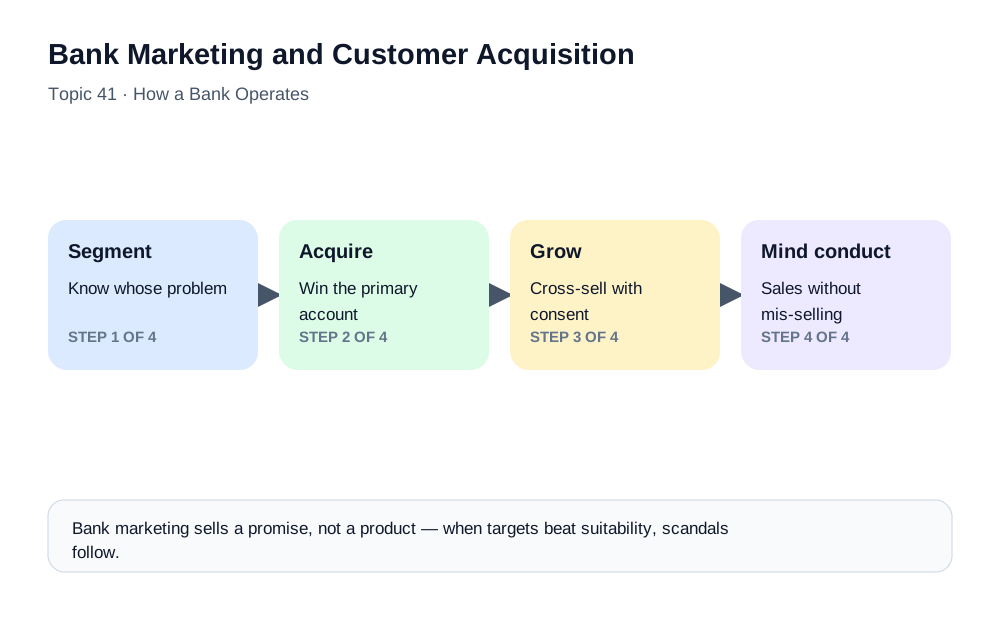
Bank Marketing and Customer Acquisition at a glance — Customer segmentation, digital marketing.
1. Marketing a Promise: Why Banking Is Different
The challenge of bank marketing begins with intangibility. Customers cannot see, touch, or try a savings account before opening it. The product is a promise, a commitment to safeguard funds and provide access when needed. This intangibility makes trust the central marketing proposition. Banks must convince prospects that they are reliable, secure, and committed to customer interests. Marketing investments build brand associations that signal these qualities, whether through sponsorships, advertising, branch presence, or community involvement.
Services marketing theory adds two further complications that bank marketers live with daily. First, inseparability: the service is produced and consumed simultaneously, at the branch counter, on the support call, inside the app, so the quality of the product is inseparable from the behavior of the people and systems delivering it. A bank's marketing promise is kept or broken by a teller having a bad day, a server outage, or a fraud team's false positive. Second, variability: no two service encounters are identical, so consistency itself must be engineered through process design, training, and increasingly through digital channels that deliver the same experience every time.
This is why bank marketing differs structurally from marketing soap or smartphones. A soap maker sells a thing; disappointment costs one purchase. A bank sells a relationship into which customers deposit their salaries, debts, and life savings; disappointment costs trust, and trust, once lost, is nearly unbuyable. Every serious bank marketing strategy therefore runs on two tracks simultaneously: acquiring new promises, and keeping existing ones. The industry measures the second track as carefully as the first, retention, dormancy, and complaint metrics appear alongside acquisition numbers in every management dashboard.
High switching costs intensify competition for initial acquisition. Customers rarely change banks once relationships are established; average tenure in many markets extends well beyond a decade, and a common industry saying holds that customers are more likely to change their spouse than their bank. This stickiness has a mechanical cause, moving salary credits, standing instructions, loan linkages, and saved payees is tedious and error-prone, and a psychological one: the perceived risk of something going wrong with your money outweighs the modest gains of switching. The consequence: the battle is largely won or lost at the point of first acquisition. Winning a customer's first account creates opportunities to cross-sell additional products that deepen the relationship and increase switching costs further. The lifetime value of a bank customer justifies substantial acquisition investment, but only if the bank can successfully expand the relationship beyond the initial product.
A corollary shapes every acquisition campaign: the moments that matter most are life transitions, when switching costs temporarily collapse. Starting a first job, entering university, moving city or country, getting married, starting a business: at each transition someone must open or change an account, and banks design entire product lines, student accounts, salary accounts, NRI account opening from abroad, to be present at exactly those moments. The salary-account corporate tie-up, discussed below, is simply the industrialization of this insight.
2. Customer Acquisition Strategies
Digital marketing now dominates customer acquisition for most banks and customer segments. Search engine marketing captures intent, placing the bank's offer before prospects actively researching financial products. Social media builds awareness and engagement, using targeted advertising and content to reach specific demographics. Content marketing provides educational material that draws prospects to the bank's website, establishing expertise and trust before any sales conversation occurs.
The economics of digital acquisition vary by channel and segment. Search advertising for high-intent keywords like best home loan may cost thirty to eighty dollars per acquired customer but converts prospects already considering the product. Social media acquisition costs fifteen to fifty dollars, building awareness among broader audiences. Content marketing costs five to twenty dollars per customer but requires sustained investment and patience as educational content builds organic search visibility over time. These costs, while substantial, compare favorably to traditional branch-based acquisition that could exceed one hundred dollars per new customer.
Traditional marketing channels retain roles in comprehensive strategies. Branch presence and location still matter for segments that value physical accessibility, as the branch chapter showed, the building itself is a trust signal and a deposit anchor. Television and print advertising build mass-market brand awareness. Referral programs leverage satisfied customers as advocates, offering incentives for successful introductions that carry credibility traditional advertising cannot match; a recommendation from a friend who banks somewhere answers the trust question instantly, which is why referral bonuses persist even in digital-first banks. Corporate tie-ups provide bulk acquisition through salary account relationships, gaining entire employee cohorts with efficiency impossible through individual marketing. When a bank wins the payroll relationship of a large employer, it acquires thousands of primary accounts, accounts that receive the salary every month and are therefore the most likely to become the customer's main financial home, in a single negotiation.
Product-led growth strategies use attractive product features to drive acquisition. Zero-balance accounts remove barriers that might prevent prospects from opening relationships. Sign-up bonuses, cashback offers, and introductory interest rates provide immediate value that overcomes inertia. Bundled products package multiple services at prices that appear advantageous compared to separate purchases. These tactics acquire customers at cost or even loss, betting on relationship expansion to generate profitability over time.
The bet deserves scrutiny, because it fails often enough to matter. Sign-up bonuses attract bonus hunters who open, collect, and go dormant; introductory rates attract rate-chasers who leave when the intro period ends. Disciplined banks therefore track quality of acquisition, activation rates, ninety-day balances, and cross-sell take-up by acquisition channel, not merely volume. A campaign that acquires ten thousand customers of whom sixty percent go dormant is more expensive than a campaign acquiring five thousand who stay, a truth visible only when acquisition cost is divided by active customers, not by opened accounts.
3. The Customer Lifecycle
Bank marketing operates across a customer lifecycle that extends from initial awareness through long-term retention and potential win-back of departed customers.
Awareness stage activities build brand recognition and association. Mass media advertising, sponsorships, and social media presence ensure the bank comes to mind when prospects consider financial needs. Financial literacy content serves dual purposes, educating consumers while positioning the bank as a helpful expert.
Consideration stage marketing provides the information prospects need to evaluate options. Rate comparisons, product features, and customer reviews help prospects assess fit. Tools like EMI calculators and eligibility checkers engage prospects actively, providing value while capturing data for follow-up marketing.
Acquisition focuses on converting interest into account opening. Smooth onboarding, digital account opening that completes in minutes, minimal documentation requirements, and video KYC, reduces friction that might cause abandonment. Every additional field, document, and day of delay measurably increases abandonment; onboarding design is where marketing investment lives or dies, because the most brilliant campaign is wasted if a third of applicants quit at the documentation step. Welcome offers and initial engagement programs begin the process of building habits and establishing the relationship.
Activation is critical: the first ninety days determine whether a new customer becomes active or dormant. Marketing encourages first transactions, first bill payments, first transfers, that establish the account as the customer's primary banking relationship. Guided tours of features and proactive support address confusion that might otherwise cause disengagement. The behavior banks chase hardest in this window is the salary credit or primary income deposit; an account receiving the customer's income behaves entirely differently from one receiving an occasional transfer, and everything from cross-sell to credit offers keys off that distinction.
Growth stage marketing deepens relationships through cross-selling. Data analytics identify which customers are likely to need which products, enabling targeted offers that feel relevant rather than intrusive. The progression from savings to credit card to personal loan to home loan to investments represents an ideal deepening that multiplies customer value. Leading banks achieve significantly more products per customer than average institutions, and each additional product both raises revenue and lowers attrition, which is why cross-sell ratio appears in every retail bank's strategic targets.
Retention marketing maintains active relationships against competitive poaching. Loyalty programs, premium services for long-standing customers, personalized offers based on transaction history, and proactive issue resolution all contribute to retention. Relationship managers serve high-value customers, providing single points of contact for complex needs. The economics are stark: retaining a customer costs a fraction of acquiring one, so a small improvement in retention is worth more than a large improvement in acquisition, and the mathematics of compounding tenure is why the stickiness discussed earlier is the industry's most valuable asset.
From the customer's side of the glass, a well-run lifecycle feels like a bank that notices: an onboarding flow that takes minutes, a first-month check-in that resolves confusion, offers that arrive attached to real life events rather than at random, and a human who picks up when something goes wrong. A badly run lifecycle feels like the opposite, a bank that vanishes after account opening except to sell. Customers rarely articulate this in marketing language, but their behavior, primacy, tenure, referrals, is precisely the scorecard this section describes.
Win-back marketing targets departed or dormant customers with offers addressing the reasons for their departure. Understanding why customers leave, through exit surveys and transaction analysis, enables targeted campaigns that may recover relationships worth preserving. Dormancy analysis often reveals fixable causes, a failed app update, an unresolved complaint, a better rate elsewhere on one product, that a timely, specific offer can reverse at far below new-acquisition cost.
4. Data-Driven Marketing
Banks possess some of the richest customer data available in any industry. Transaction records reveal where, when, and how much customers spend. Income patterns emerge from salary credits and business deposits. Life events signal through account openings, address changes, and transaction anomalies. Financial behavior, risk appetite, saving patterns, and payment discipline all become visible through banking data.
This data enables marketing capabilities impossible for less data-rich industries. Hyper-personalized offers reach the right customer with the right product at the right time: a travel loan offer following airline ticket purchases, education savings promotions following childbirth. Predictive analytics identify customers likely to need products before they actively search, enabling proactive outreach. Churn prediction flags customers showing signs of potential departure, falling balances, stopped salary credits, rising complaint contacts, triggering retention interventions before the decision is final. Lifetime value modeling focuses acquisition spending on segments with highest long-term profitability.
The engine behind modern personalization is the next-best-action discipline: rather than running campaigns, banks score every customer against every product continuously, and each contact, app banner, relationship manager call, email, presents whatever the model ranks highest for that customer that week, subject to contact-frequency rules and eligibility. Done well, this replaces the intrusive mass campaign with a quiet sequence of relevant suggestions. Done badly, it becomes the uncanny offer that arrives too soon after a life event, which is why the best-run programs include taste and timing rules alongside the models.
The responsible use of this data presents ethical and regulatory considerations. Privacy regulations constrain how data can be used and shared, and consent frameworks increasingly give customers enforceable rights over their own financial data. Fair lending laws require that marketing does not discriminate against protected classes, which reaches further than most marketers expect: targeting models that exclude neighborhoods or demographics, even through neutral-seeming proxies, can constitute illegal redlining, and regulators have penalized banks for marketing patterns, not just credit decisions. Responsible AI guidelines ensure algorithmic decisions are explainable and unbiased. Banks must navigate these constraints while still extracting marketing value from their data assets, and the banks that treat consent and transparency as features rather than obstacles increasingly find they are also good marketing.
5. Inside the Bank: How Marketing Actually Runs
Bank marketing looks different from inside the organization, and understanding the machinery explains both its strengths and its periodic scandals.
Structure. A large retail bank typically separates brand marketing (advertising, sponsorships, awareness) from lifecycle or customer-value management teams (activation, cross-sell, retention, win-back) and from product teams who own the economics of each product line. The lifecycle teams, often sitting closer to data than to advertising, control the largest measurable budgets because their results are directly attributable: an offer sent, an account opened, a balance retained.
The campaign workflow. A typical targeted campaign moves through six gates. The analytics team defines the target population, say, salary-account holders whose balances have grown for three consecutive months. The product team sets the offer and its economics. Compliance reviews the communication for fair presentation, mandatory disclosures, and fair-lending exposure, a gate that has grown steadily stricter as conduct regimes have matured. Channel teams execute across app, email, and relationship manager call lists, with contact-frequency rules preventing the customer from being bombarded by three departments at once. Response is measured against a holdout group, matched customers who received nothing, because only the gap between treated and untreated customers proves the campaign caused anything. And results feed back into the models. The holdout discipline is the tell of a mature marketing function: without it, banks routinely credit campaigns for customers who would have bought anyway.
The frontline is the channel that matters most. For all the sophistication of digital targeting, a large share of bank sales still closes through humans, branch staff, relationship managers, call centers, which is why incentive design, script compliance, and sales-quality monitoring carry so much weight, and why the conduct failures described next happen at the interface between head-office targets and frontline pressure.
A worked funnel shows where the leaks are. Of one hundred thousand prospects who click a savings-account advertisement, perhaps forty thousand start the application, fifteen thousand finish the form, nine thousand complete document upload and verification, and seven thousand open the account. Of those, perhaps four thousand five hundred transact in the first ninety days. The marketing team bought one hundred thousand clicks; the bank acquired four thousand five hundred relationships. Every gate in that funnel, form length, document demands, verification failures, is a measurable, fixable leak, and funnel conversion is usually the highest-return investment in the entire growth budget.
6. The Conduct Question: When Sales Culture Goes Wrong
No chapter on bank marketing is complete without its cautionary tale, because the industry's worst modern scandal was a marketing and sales failure, not a credit or trading failure.
In 2016, Wells Fargo, then one of the most admired retail banks in the world, admitted that employees had opened millions of unauthorized deposit and credit card accounts in customers' names, without their knowledge, to meet aggressive cross-selling targets. The bank had celebrated its products-per-customer ratio for years; investigators found that the metric had been pursued so hard, through daily sales quotas and intense management pressure, that staff manufactured the cross-sell rather than earning it. The consequences cascaded for years: immediate fines, then billions of dollars in settlements, executive resignations, criminal convictions of senior managers, an unprecedented regulatory cap on the bank's growth, and reputational damage that outlasted every penalty.
The lessons are now standard curriculum in bank governance. First, metrics become behavior: what you measure and reward is what your frontline produces, and a cross-sell target without a customer-benefit test is an invitation to fabrication. Second, incentives outrank culture: no amount of values messaging survives a quota system that punishes honesty. Third, the complaint data knew: customers reported unauthorized accounts for years before regulators acted, and the failure to aggregate and escalate those signals converted a conduct problem into an institutional crisis. Modern conduct regimes in many jurisdictions now require banks to demonstrate fair customer outcomes, not merely rule compliance, a direct descendant of these scandals.
For the marketing professional, the boundary line is simple to state and demanding to practice: marketing may persuade a customer to want a product; it may never manufacture a sale the customer did not choose. Suitability checks, needs-based selling frameworks, cooling-off periods, and sales-quality monitoring are the machinery that keeps the line bright.
7. The Digital Challenger Effect
The acquisition playbook this chapter describes was rewritten in the last decade by digital-only challengers, and incumbents have spent years adapting.
Challenger banks and fintechs entered with no branches, no legacy systems, and no legacy customers to protect, so they competed exactly where incumbents were weakest: onboarding friction. Opening an account in minutes from a phone, with transparent pricing and instant notifications, reset customer expectations industry-wide. Incumbent onboarding that once tolerated days of paperwork was forced to compress toward minutes. The challengers' acquisition economics were different too: referral loops, social virality, and product-led features, free foreign exchange, early salary access, spending analytics, substituted for advertising budgets, driving acquisition costs in some cases below ten dollars per customer.
The incumbents' counter-advantages remain real: trust accumulated over generations, deposit insurance familiarity, full product ranges, and regulatory track records. The market outcome has been convergence rather than conquest: challengers added products, licenses, and advertising; incumbents rebuilt onboarding, apps, and transparency. For the banking professional, the lasting lesson is that acquisition advantage in banking is temporary by nature, every successful innovation diffuses across the industry within a few years, so sustained advantage lives in the relationship economics of activation, cross-sell, and retention, not in any single acquisition trick.
8. Measuring What Matters
Success in bank marketing is measured through metrics that connect activities to outcomes. Customer acquisition cost tracks marketing efficiency in generating new relationships, but as Section 2 showed, only the cost per activated customer tells the truth. Customer lifetime value estimates total expected revenue, justifying acquisition investment levels; the ratio of lifetime value to acquisition cost is the discipline that keeps marketing honest, with healthy programs targeting several units of lifetime value per unit of acquisition cost. Net promoter score measures willingness to recommend, correlating with growth and retention. Cross-sell ratios indicate relationship depth. Digital adoption rates track migration to lower-cost channels. Dormancy rates flag inactive relationships requiring reactivation.
A worked example ties the key metrics together. A bank spends two million dollars on a digital campaign producing forty thousand new accounts, a headline acquisition cost of fifty dollars. Activation analysis shows only twenty-two thousand become transacting customers, so the true cost per active customer is about ninety-one dollars. Of those, modeled lifetime value averages three hundred and forty dollars, a healthy ratio of roughly 3.7 to 1. But channel drill-down reveals the search channel delivered active customers at sixty dollars with lifetime value of four hundred, while the incentive-driven social channel delivered them at one hundred thirty dollars with lifetime value of one hundred ninety, a marginal 1.5 to 1. The same campaign, the same average, two completely different verdicts. Marketing judgment in banking is largely the discipline of refusing to manage by averages.
Together these metrics enable continuous optimization of marketing strategies in a competitive environment where differentiation is subtle and customer relationships are enduring.
9. Common Misconceptions About Bank Marketing
"Bank marketing is advertising." Advertising is the visible tip. The mass of the discipline is lifecycle management: activation, cross-sell, retention, win-back, and the data infrastructure underneath them, most of which customers never consciously notice.
"The best product wins." Products converge to parity within years; distribution, trust, and onboarding friction decide outcomes. Banks routinely lose with better rates and win with smoother journeys.
"Acquired customers are profitable customers." Opened accounts are not relationships. Without activation, an acquisition is a cost, not an asset, which is why cost per active customer is the only honest acquisition metric.
"More cross-sell is always better." Only when the products fit the customer. Cross-sell pursued as a raw target produced the industry's worst modern scandal; cross-sell pursued as relevance produces its most valuable franchises.
"Customer data means marketing can say anything." Legally and ethically, the opposite: the richer the data, the tighter the constraints. Privacy law, fair lending rules, and conduct expectations all scale with capability, and the uncanny, too-personal offer destroys the trust the data was meant to serve.
"Digital challengers proved branches and brands don't matter." They proved onboarding friction matters enormously. Trust, deposit safety perceptions, and full-service capability still decide primary relationships, which is why challengers keep adding exactly the features of the incumbents they set out to replace.
10. Frequently Asked Questions
Why do banks pay sign-up bonuses when accounts are free? Because a primary account relationship is worth far more than the bonus. An account receiving a salary generates deposit value, interchange income, and cross-sell potential for years; a two-hundred-dollar bonus is cheap acquisition against that lifetime value, provided the bank converts the opener into an active customer.
What is a salary account and why do banks fight for corporate payroll tie-ups? A salary account is the account into which an employer pays wages, typically with preferential terms. Winning a company's payroll means acquiring its entire workforce's primary accounts in one negotiation, the single most efficient acquisition channel in retail banking.
Why is my bank always offering me credit cards and loans? Because cross-selling is the core of retail banking economics: each additional product raises revenue and makes the relationship stickier. The relevance of the offers comes from analysis of your transaction patterns; whether the product actually suits you is the question worth asking every time.
What does "products per customer" measure and why did it cause a scandal? It measures relationship depth, how many of the bank's products an average customer holds. At Wells Fargo it was pursued through quotas so aggressive that staff opened millions of unauthorized accounts, showing that a good metric becomes dangerous the moment it is rewarded without a customer-benefit test.
Is it safe how banks use my transaction data for marketing? Banks operate under privacy law, internal data governance, and fair lending rules that constrain use and sharing, and most offers are generated by models scoring patterns rather than humans reading statements. Customers typically have rights to access, correct, and limit use of their data, rights worth knowing and exercising.
How do digital banks acquire customers so cheaply? Referral loops, viral features, product-led growth, and zero branch overhead. Features like instant notifications and free foreign exchange generate word-of-mouth that substitutes for advertising, though costs rise as challengers scale into mass-market advertising themselves.
Why do bank offers always seem to arrive at oddly specific moments? Because they are triggered by your data: balance changes, transaction patterns, and life-event signals feed propensity models that time offers to predicted need. When the timing is helpful, that is personalization working; when it feels intrusive, that is the model outrunning the bank's judgment, and most banks let you limit marketing contact if you ask.
Do referral bonuses actually work for banks? Consistently yes, because a recommendation from a trusted friend answers banking's central marketing problem, trust, instantly and for free. Referred customers also tend to activate and stay at higher rates than advertising-acquired customers, which is why referral programs survive in every generation of bank, from branch-era introductions to app-based invite links.
What is churn and how do banks predict it? Churn is customer departure, explicit closure or silent dormancy. Banks predict it from behavioral signals: falling balances, stopped salary credits, declining logins, rising complaints. Early prediction enables retention offers before the decision hardens, at a fraction of replacement cost.
11. Key Terms in This Chapter
- Intangibility — banking products are promises, not objects; trust is the core marketing proposition.
- Inseparability / variability — services are produced and consumed simultaneously and never identically, making delivery the brand.
- Switching costs — the mechanical and psychological friction that makes bank relationships sticky.
- Primary account — the account receiving the customer's income; the strategic prize of acquisition.
- Customer acquisition cost (CAC) — marketing spend per acquired customer; honest versions count activated customers.
- Customer lifetime value (LTV) — modeled total relationship revenue; the LTV-to-CAC ratio disciplines marketing spend.
- Life transitions — first job, university, marriage, migration: moments when switching costs collapse and acquisition battles are decided.
- Salary account / payroll tie-up — bulk acquisition through an employer's payroll relationship.
- Onboarding friction — every field, document, and delay in account opening that causes abandonment.
- Activation — converting an opened account into a transacting relationship, decided in the first ninety days.
- Cross-sell ratio — products per customer; relationship depth and its most dangerous metric.
- Next-best-action — continuously scoring customers against products to make every contact relevant.
- Churn / dormancy — explicit and silent customer departure, predicted from behavioral signals.
- Win-back — targeted recovery of departed or dormant relationships.
- Net promoter score — willingness-to-recommend metric correlating with organic growth.
- Fair lending / redlining — prohibitions on discriminatory credit marketing, including proxy-based targeting.
- Conduct risk — the risk that sales culture manufactures outcomes customers did not choose; the Wells Fargo lesson.
- Product-led growth — acquisition driven by product features and referral loops rather than advertising.
- Holdout group — matched customers deliberately not contacted, proving whether a campaign caused its results.
- Funnel conversion — the staged measurement of prospects from click to active customer, exposing where acquisition leaks.
- Sales-quality monitoring — the control function that checks frontline sales were genuinely made and suitable.
- Primacy — the status of being a customer's main bank, holder of the salary credit and the daily payments, the foundation on which all cross-sell economics rest.
- Suitability — the requirement that a sold product fits the customer's needs and circumstances, the line between selling and mis-selling.
12. Interview Insights: How This Topic Appears in Banking Interviews
"Why is acquiring a bank customer so expensive, and is it worth it?" Answer with the economics: switching costs make first acquisition decisive; lifetime value of an activated primary customer, deposit margin, interchange, fees, cross-sell revenue over a decade-plus tenure, dwarfs acquisition cost. Then add the discipline: worth it only if activation and cross-sell convert the account into a relationship, so cost per active customer and LTV-to-CAC ratio are the metrics that matter.
"What did Wells Fargo teach the industry about sales culture?" Metrics become behavior; incentives outrank values; complaint data must be aggregated and escalated; and cross-sell without a customer-benefit test is fabrication waiting to happen. Strong candidates connect it to conduct regulation, outcome-testing, and why suitability frameworks exist.
"How would you market a savings account that pays the same rate as every competitor's?" Segment and target life transitions; win on onboarding friction and app experience; use content and tools to own the consideration stage; bundle salary, payments, and cards to build primacy; and measure success by activation and ninety-day balances, not openings. This tests whether you understand that parity products are sold through journeys, not features.
"How do banks use customer data in marketing, and where is the line?" Propensity models, next-best-action, churn prediction, life-event triggers, then immediately the constraints: privacy law and consent, fair lending and redlining prohibitions on proxy targeting, explainability expectations, and the uncanny-offer trust problem. The line is relevance with consent versus surveillance without it.
"What is the first thing you would fix to improve a bank's customer growth?" Onboarding abandonment, because it is usually the largest measurable leak: marketing spend pours prospects into a funnel whose documentation and delay steps discard a third of them. Compressing time-to-account and instrumenting every drop-off step typically outperforms any incremental campaign.
"How would you set a marketing budget for a new digital account product?" Work backward from unit economics: model lifetime value by segment, set a maximum acquisition cost at a defensible fraction of it, then allocate across channels by expected cost per activated customer, holding a reserve for testing new channels. Define the kill criteria upfront, activation rate and ninety-day balance thresholds below which a channel is cut, so the budget follows evidence rather than enthusiasm. The answer shows whether the candidate thinks in ratios and experiments or in slogans.
Summary and Key Takeaways
- Bank marketing sells promises, not products: intangibility, inseparability, and variability make trust the proposition and delivery the brand.
- Switching costs and decade-plus tenures make first acquisition decisive, and life transitions are where the battles are won.
- Acquisition channels blend digital intent capture, social awareness, content, referrals, and payroll tie-ups; judge each by cost per activated customer, not per opened account.
- The lifecycle, awareness, consideration, acquisition, activation, growth, retention, win-back, is the operating system of bank marketing, and the first ninety days decide whether an acquisition becomes an asset.
- Banking data powers personalization and next-best-action marketing, bounded by privacy law, fair lending rules, and the trust cost of the uncanny offer.
- Sales culture is conduct risk: Wells Fargo's unauthorized-accounts scandal showed that metrics without customer-benefit tests manufacture fraud, and modern conduct regimes now test outcomes, not just rules.
- Digital challengers rewrote onboarding expectations and acquisition economics; incumbents' durable advantages remain trust, primacy, and full-service relationships.
- Inside the bank, marketing runs as a gated machine: analytics defines targets, compliance gates communications, holdout groups prove causation, and funnel metrics expose where acquisition leaks.
- Manage by ratios, not averages: LTV-to-CAC, activation rates, cross-sell quality, and dormancy tell the truth that campaign volume conceals.
Next: Topic 42 — Cheques and Negotiable Instruments →
<!-- MBA-DEEP-DIVE-START -->Deep Dive: Bank Marketing as Customer Economics, Conduct, Data, and Trust
Bank marketing becomes much more useful when it is separated from advertising. Advertising creates attention. Bank marketing manages the economic and behavioural journey from prospect to active primary relationship, and then tries to keep that relationship valuable without abusing the information or trust the bank possesses. That definition pulls product, data, channels, pricing, conduct, complaints, fraud, onboarding, and service into the same story.
A bank can run a brilliant campaign and still fail at marketing if the customer cannot open the account, the app crashes, the debit card never arrives, the first salary credit is rejected, or the customer is sold a product they never needed. In financial services, the experience after the advertisement is part of the advertisement.
Acquisition should begin with a target customer, not a channel
A weak growth plan starts with a channel: ‘Run social media ads for this account.’ A strong plan starts with a customer and a need.
For a first-job customer, the need may be salary receipt, payments, budgeting, an emergency fund, and eventually credit history. For a small business, the need may be collections, supplier payments, payroll, working capital, and cash visibility. For an affluent family, it may be liquidity, investment, lending, and succession. The same bank can serve all three, but the acquisition proposition and economics are entirely different.
A target-market definition should describe eligibility, need, likely behaviour, service requirements, risks, and products that are genuinely suitable. It should also identify who the proposition is not designed for. That negative definition is a conduct control. A product whose value depends on keeping a high monthly balance should not be marketed as a universal account to customers whose normal cash flow makes the condition unrealistic.
Product economics set the ceiling for acquisition cost
Customer acquisition cost cannot be evaluated in isolation. The bank needs to know what economic value a relationship can reasonably generate.
Imagine a digital current account costs ₹1,200 to acquire after advertising, referral reward, identity checks, card issuance, and onboarding support. If the average acquired customer maintains little balance, performs only free transactions, never adopts another product, and requires frequent service, the account can remain loss-making for years.
Now consider a salary account acquired through an employer partnership at ₹500 of effective acquisition cost. The customer receives monthly income, uses the account for payments, keeps an average balance, takes a credit card after six months, and later a mortgage. The second customer can justify much higher service investment because the relationship lifetime value is structurally different.
The bank should therefore calculate acquisition cost by activated customer and cohort, not merely by application or account opened. An account that passes KYC but is never funded is not a successful acquisition.
Activation is the missing middle between acquisition and value
The first thirty to ninety days determine whether many retail banking relationships become primary or dormant. Activation should be treated as a designed journey.
Useful activation events include first funding, first salary credit, first card transaction, first digital login, first beneficiary setup, first bill payment, first recurring instruction, and customer completion of essential security settings. Different products have different activation signatures.
The bank should distinguish activity from meaningful engagement. A ₹1 test transfer proves that the account technically works but says little about relationship quality. A regular salary credit or business collection flow is more economically meaningful.
A mature activation dashboard tracks time-to-first-fund, time-to-first-transaction, failed onboarding steps, card activation, digital login, salary migration, recurring payments, and early complaints. If one acquisition channel creates unusually high dormancy, the channel may be attracting incentive-seekers rather than target customers.
Funnel management is operational process improvement
Marketing teams often describe a funnel: impression, click, application start, KYC completion, approval, account opened, funded, activated. Each fall-off point should have a reason.
Suppose 100,000 prospects begin an account-opening journey. Sixty thousand complete identity details. Thirty thousand reach document verification. Twenty thousand pass. Eighteen thousand open. Only twelve thousand fund the account, and eight thousand remain active after ninety days.
The real acquisition result is closer to eight thousand durable relationships than eighteen thousand account numbers.
Now examine the forty-thousand-customer drop between start and identity completion. Did the form ask for information the bank did not need at that stage? Was address lookup failing? Were customers unsure why tax information was requested? Did the mobile camera fail on common devices? Marketing cannot solve these problems with more advertising. Product, compliance, technology, and UX must repair the funnel.
This is one of the highest-value insights in bank growth: conversion defects are often banking-process defects.
Attribution should prove incremental behaviour
If a customer receives a credit-card offer and applies, the bank cannot automatically assume the campaign caused the application. The customer may already have intended to apply.
Mature marketing uses control or holdout populations where appropriate. A randomly selected comparable group receives no offer. The bank compares response, revenue, and later behaviour between exposed and unexposed groups. The difference estimates incremental impact.
Without this discipline, every team can claim the same customer. A branch says it sold the loan, the mobile banner says it sold the loan, the email campaign says it sold the loan, and the relationship manager says the customer called after their conversation. Attribution rules prevent one economic event from becoming four marketing successes.
Lifetime value should include risk and cost
A simple lifetime-value model adds expected revenue over time. A banking model should be stricter.
For a credit customer, value should include expected interest and fees minus funding cost, expected credit loss, fraud loss, rewards, servicing, complaints, collections, capital cost, and acquisition cost. For a deposit customer, the bank should value the funding benefit of balances rather than treat deposits as free profit. For an investment customer, value should be net of product and advisory costs and should never encourage unsuitable sales simply because fee margins are high.
This risk-adjusted view prevents a classic growth mistake: celebrating high-revenue customers whose losses arrive later. A credit-card cohort can appear exceptionally profitable in its first six months because accounts are spending and few have yet defaulted. Vintage analysis may reveal deterioration only after balances mature.
Segmentation should describe needs, not stereotypes
Customer segmentation can be behavioural, financial, life-stage, geographic, business-based, or needs-based. The danger begins when segmentation becomes a proxy for unfair exclusion.
A useful segment may be ‘customers receiving recurring salary credits and maintaining growing emergency savings’. A weak segment may rely on demographic assumptions that do not actually predict need. In credit-related marketing, apparently neutral variables can also reproduce historic discrimination if they correlate strongly with protected characteristics or underserved locations.
Banks should therefore govern both who is targeted and who is systematically left out. Fair-lending or fair-treatment review should examine marketing models as well as underwriting models because a customer who never receives an offer never reaches the credit decision stage.
Eligibility should be separated from propensity
A marketing model may predict that a customer is likely to buy a product. That does not mean the customer is eligible or that the product is suitable.
A robust next-best-action engine applies several gates:
First, legal and product eligibility: can this customer hold the product?
Second, risk eligibility where relevant: is the customer within credit or financial-crime policy?
Third, suitability or target-market fit: does the product make sense for the customer's documented needs and circumstances?
Only then should a propensity model rank the offer.
This ordering prevents a common failure in data-driven marketing: letting the model optimize conversion before the bank establishes whether the sale should happen at all.
Consent and lawful data use belong in the campaign design
Banks possess intimate transaction data, but possession does not automatically mean every use is appropriate. The legal basis for processing depends on jurisdiction and purpose, and sensitive financial information deserves careful governance even where a particular marketing use is technically lawful.
A campaign should identify which data fields it uses, why they are necessary, whether customer consent or another lawful basis applies, how long the campaign audience is retained, who can access it, and whether data is shared with a third party.
If a customer opts out of direct marketing, the preference should propagate across email, SMS, app, call centre, and branch campaign lists according to applicable law. A marketing preference stored only in one campaign platform is not a real preference.
Frequency management protects the relationship
A universal bank can have dozens of product teams targeting the same customer. Without central contact policy, a customer can receive a loan call, card email, insurance message, investment notification, and mortgage banner in one week.
Contact-frequency rules should combine channel, product priority, customer preference, recent service issues, and vulnerability or complaint status. A customer in the middle of a fraud dispute should not simultaneously receive an upbeat cross-sell campaign.
This sounds like common sense, but it requires shared data. Marketing technology needs to know what service and risk systems know about the customer's current relationship state.
Trigger-based marketing should be useful, not invasive
Transaction patterns can reveal likely needs: salary increase, recurring rent, travel booking, tuition payment, business inflows, or mortgage-related activity. Triggered marketing can be highly relevant, but timing determines whether it feels helpful or creepy.
A bank should avoid implying knowledge it should not expose unnecessarily. Instead of saying, ‘We noticed you paid a fertility clinic last week, so here is family insurance,’ a bank should use broad, respectful propositions and exclude sensitive categories from marketing triggers where appropriate.
The rule is not merely privacy. It is trust. Customers may accept that banks process transactions to execute and secure them while strongly objecting to intimate life events becoming sales prompts.
Salary accounts are a platform acquisition strategy
An employer payroll relationship can acquire hundreds or thousands of customers at once. But the relationship is only valuable if the employees adopt the bank voluntarily as a useful primary bank.
The bank should manage employer onboarding, employee consent and KYC, salary-file processing, account activation, card issuance, digital access, service support, and exit when employees leave the company. If an employee changes jobs, the account may lose its salary status and pricing benefits; communication should be clear rather than surprising the customer with fees months later.
Salary-account marketing also has a powerful data signal: verified regular income. That can support pre-qualified credit offers, but the bank should still perform the required affordability and underwriting checks. ‘Pre-approved’ should not become a marketing phrase that implies guaranteed credit when final eligibility can still fail.
Referral programmes need fraud controls
Referral incentives can produce efficient acquisition because trust transfers from an existing customer to a new one. They can also create synthetic accounts, self-referrals, device farms, duplicate identities, and organised bonus abuse.
Referral systems should therefore detect repeated devices, shared identifiers, rapid account opening and closure, circular funding, and networks of accounts generating incentives without genuine use.
The marketing metric should be cost per qualified activated referral, not cost per referral code entered.
Branch and relationship-manager selling needs evidence
Human sales remain important for mortgages, business banking, wealth, and protection products. Human relationships also create pressure and information asymmetry.
A good frontline sale leaves evidence of customer need, offer made, key disclosures, relevant alternatives, consent, and any suitability or affordability assessment required for the product. Call recording or digital confirmation can strengthen the trail where appropriate.
Management should monitor unusual sales patterns. One employee with a dramatically higher conversion rate may be exceptionally skilled—or may be bypassing controls. High cancellation, early closure, complaint, policy lapse, or delinquency rates linked to one seller are quality indicators that revenue dashboards can miss.
Incentives must reward customer outcomes as well as volume
The Wells Fargo scandal is famous because employees created unauthorised accounts to meet targets, but the broader lesson applies everywhere: an incentive system is a control design.
If staff are paid only for number of products sold, they will naturally seek the easiest path to product count. If bonuses include activation, retention, complaint quality, early cancellation, portfolio performance, and audit results, behaviour changes.
No metric is perfect. Too much complexity makes incentives incomprehensible. The objective is to ensure that a sale which harms the customer does not remain economically attractive to the employee or business unit.
Complaints are marketing data
Marketing teams often analyse clicks and conversions while complaints sit in a separate service function. That separation wastes one of the bank's richest datasets.
Complaints can reveal misleading advertising, hidden eligibility conditions, unclear fees, broken onboarding, aggressive sales calls, poor product fit, and inconsistent branch explanations. Complaint reasons should be linked back to campaign, product, channel, and seller where possible.
If one campaign converts extremely well but generates a surge of ‘I did not understand this fee’ complaints, the campaign is not a success.
Churn should be decomposed before win-back
A customer who stops using an account may have moved salary, found a better rate, suffered a service issue, emigrated, consolidated accounts, or simply no longer need the product. Sending the same incentive to every dormant customer wastes money and can revive the wrong relationships.
The bank should distinguish voluntary churn, silent dormancy, operationally forced exit, regulatory exit, product maturity, and relationship migration. Customers exited for financial-crime reasons should obviously not enter an automated win-back campaign.
For legitimate churn, the best retention action depends on cause. A rate-sensitive saver may need competitive pricing. A customer who lost trust after a complaint needs resolution, not cashback. A user who stopped logging in after a device change may need digital recovery support.
Cross-sell should follow relationship logic
Cross-selling works when the next product solves the next customer problem. A salary account can naturally lead to savings, card, personal credit, mortgage, investment, or insurance over years. The correct sequence depends on need.
A product-per-customer target alone is dangerous because it treats every additional product as equally valuable. A dormant zero-balance account opened only to meet a target adds complexity without value.
A healthier measure looks at primary relationship depth: active products, balance quality, recurring use, customer outcomes, retention, and risk-adjusted profitability.
Marketing technology is a controlled banking system
Customer data platforms, campaign engines, lead-management tools, CRM, analytics models, consent stores, and digital channels can all influence regulated outcomes. They deserve change management, testing, access control, audit logging, and data-quality monitoring.
A wrong mapping between ‘customer opted in’ and ‘customer opted out’ can create a mass privacy breach. A campaign rule using gross income instead of net disposable income can target unaffordable credit. A stale deceased-customer flag can send marketing to a bereaved family.
These are not cosmetic errors. Marketing systems should be governed with the same seriousness as other customer-facing bank technology.
A complete acquisition scenario
Imagine a bank launching a current account for small online sellers.
Research shows the target customer needs simple collections, scheduled supplier payments, tax visibility, and occasional working-capital finance. The product team defines eligibility and pricing. Compliance reviews disclosures and target market. Risk identifies financial-crime and fraud scenarios associated with rapid account opening and marketplace receipts.
Marketing runs search and marketplace-partner acquisition. Prospects land on a digital journey that explains fees before application. KYC, beneficial-owner checks, and business verification complete through the standard onboarding process. Customers who need document exceptions are routed to assisted service rather than abandoned.
Activation focuses on first collection, first supplier payment, and connection of accounting tools. After several months of stable verified cash flow, eligible businesses may receive a working-capital invitation. The credit engine still performs underwriting; marketing does not bypass it.
The bank tracks acquisition cost, ninety-day activation, average operating balance, payment activity, complaints, fraud, credit performance, and cohort lifetime value. Referral rewards are paid only after genuine activity. Campaign holdouts estimate incremental effect.
If complaints reveal that customers misunderstand one fee, the disclosure is changed. If one partner channel produces high mule-account rates, acquisition is slowed despite strong volume. Growth and control remain connected.
What excellence looks like
A world-class bank marketing function can explain who a product is for, why it is useful, what each acquired relationship costs, how activation is measured, and how lifetime value is adjusted for risk and service cost. It can prove that campaigns create incremental behaviour rather than claim correlation as causation. It governs consent, targeting, fairness, contact frequency, seller incentives, and complaints. It knows when not to market. Its technology can trace why a customer received an offer. And it treats trust as an economic asset that can be destroyed much faster than it can be purchased.
That is the real purpose of bank marketing: not to maximise the number of products sold, but to create durable, useful, profitable customer relationships whose value survives scrutiny from the customer, the risk function, and the regulator.
<!-- MBA-DEEP-DIVE-END -->