The physical spaces where banking occurs have undergone transformation as dramatic as any in the industry's history. From the imposing marble halls of nineteenth-century institutions designed to convey permanence and trust, through the automation and standardization of the late twentieth century, to today's digital kiosks and advisory centers, the bank branch continues evolving in response to technological possibility and changing customer expectations. Understanding this evolution illuminates how banks balance physical presence with digital efficiency, and why branches remain relevant even as mobile apps handle routine transactions.
By the end of this chapter, you will be able to:
- Explain why branches were built as temples of trust and what job that architecture did
- Trace the mechanization and automation waves that reshaped branch work
- Describe what happens operationally inside a working branch each day
- Analyze the channel economics that drive branch strategy
- Explain why branches survived the digital disruption that was supposed to kill them
- Compare branch strategy in developed and developing markets
- Identify the risks and controls specific to physical banking
- Assess the hybrid "phygital" models defining the branch of the future
Visual overview
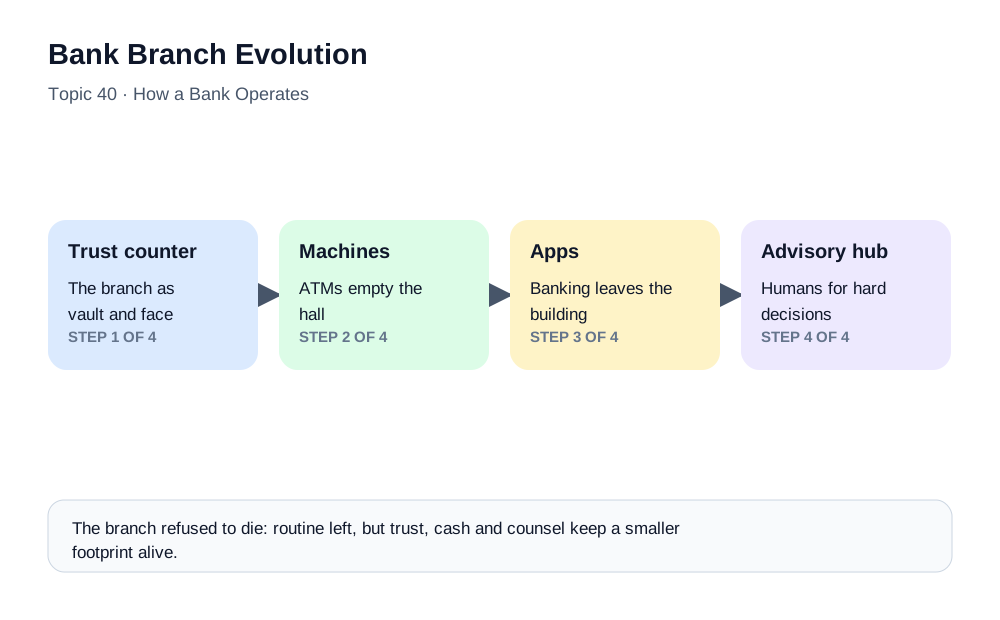
Bank Branch Evolution at a glance — Physical to digital, branchless banking.
1. The Branch as a Machine for Trust
Before the history, the first-principles question: why did banking need buildings at all?
A bank's product is a promise. A depositor hands over cash and receives a promise of repayment on demand; a borrower receives cash against a promise to repay over years. Promises are cheap to make and expensive to believe. The early bankers understood that the credibility of the promise had to be manufactured, and architecture was the manufacturing plant. A marble hall with a heavy vault said, more eloquently than any advertisement, that the institution was permanent, solvent, and serious. The building was not decoration; it was collateral.
Early bank branches served as visible symbols of institutional permanence. Constructed of stone and marble, often occupying prominent corners in commercial districts, these buildings communicated that deposited funds were safe. Heavy vaults, armed guards, and thick walls reinforced security. Inside, paper-based processes dominated: handwritten ledgers recorded transactions, manual calculations determined interest, and tellers served customers across high counters that emphasized the formality of the relationship. Banking hours were limited, the famous banker's hours reflecting both the physical demands of paper-based processing and the status consciousness of a profession that saw itself as distinct from mere commerce.
The paper-based branch was also a fundamentally local institution. Each branch kept its own ledgers; your account lived at your branch, physically, in bound books. Transacting at another branch was impossible or cumbersome because your balance existed nowhere else. The branch manager was consequently a figure of real local power: credit decisions for the town's businesses were made by someone who knew the applicants personally, walked their shops, and judged character as much as collateral. This relationship model had virtues that standardized scoring later traded away, and the trade was deliberate: personal judgment scales poorly and embeds bias, while rules scale indefinitely and treat strangers consistently. Much of branch evolution since has been an attempt to recover the virtues of both.
The ledger era also explains the rhythms that still echo in banking. The end-of-day balancing ritual, every ledger reconciled to the last entry before staff left, survives today as the branch's daily cash verification and system cut-off routines. Banker's hours shrank the working day because the books had to be closed, tallied, and proven by hand before tomorrow could begin.
2. Mechanization and Early Automation
The mid-twentieth century brought mechanization that improved efficiency without fundamentally changing the branch experience. Typewriters replaced handwritten ledgers, adding machines accelerated calculations, and telex machines enabled inter-branch communication. Computers arrived in the 1960s and 1970s, initially for back-office processing, eventually extending to customer-facing operations. These technologies increased speed and accuracy, but the branch remained a place for face-to-face transactions, with customers visiting to deposit checks, withdraw cash, and discuss their accounts.
Two innovations of this period deserve naming because they quietly built the modern system. Magnetic ink character recognition, the stylized numerals still printed at the bottom of cheques, allowed machines to read and sort payment instructions at industrial speed, making mass cheque clearing possible. And the first automated teller machine, installed by Barclays in north London in 1967, proved that a machine could authenticate a customer and dispense cash without any staff at all. Both were efficiency plays at the time; both were actually the first detachments of banking from the branch building.
The 1980s and 1990s brought transformative automation. Automated teller machines proliferated, allowing customers to withdraw cash and check balances without entering the branch. Core banking systems replaced branch-level ledgers with centralized databases, enabling customers to transact at any branch rather than just their home branch, a change so fundamental it redefined the customer relationship from a relationship with a branch to a relationship with the bank. Cheque processing machines with magnetic ink character recognition automated clearing. Branch design shifted toward openness, with lower counters and more welcoming spaces reflecting a customer-service orientation.
Notice what each wave did to staffing. Mechanization sped up the same jobs; core banking deleted entire categories of jobs, ledger-keepers, inter-branch reconcilers, local posting clerks, while creating demand for staff who could sell and advise. The branch's headcount began its long decline, and the skill mix inside it began its long rotation from processing toward selling. Every subsequent innovation has intensified this rotation.
3. The Digital Transformation and the Death That Didn't Happen
The twenty-first century accelerated change as internet and mobile banking moved routine transactions outside branches entirely. Customers could check balances, transfer funds, pay bills, and deposit checks by photographing them, all without visiting a bank. The purpose of the branch became unclear; many predicted their complete disappearance as digital natives came of age and older customers adapted.
Yet branches proved more resilient than predicted. The forecasters made a category error: they counted transactions and concluded the branch was a transaction machine. Transaction volume did indeed collapse, but transactions were never the whole job. While transaction volumes plummeted as customers self-served digitally, certain activities remained stubbornly physical.
Complex transactions like mortgage applications and business account openings required discussion, explanation, and document exchange that benefited from face-to-face interaction. Trust building, crucial for major financial decisions, happened more naturally in person. Problem resolution, disputes, fraud cases, and unusual requests required human judgment that automated systems could not provide. Financial education, important for first-time banking customers and those navigating complex decisions, worked better with personal guidance. And account opening for the digitally excluded, the elderly, recent migrants, the financially inexperienced, required a patient human across a desk.
The deeper explanation is that banking products divide into commodities and commitments. Checking a balance is a commodity: instant, identical everywhere, and perfect for self-service. A thirty-year mortgage, a business expansion loan, a bereavement-driven estate settlement, these are commitments, emotionally loaded and consequential, and humans still prefer to make commitments facing another human. Digital channels ate the commodities completely; the commitments remained physical. The branch's survival is not nostalgia; it is the residue of a correct product segmentation.
The modern branch has been reimagined around these persistent needs rather than routine transactions. Branch formats now vary widely depending on location, customer demographics, and service requirements. Full-service branches remain in major centers, offering complete banking services, safe deposit lockers, and specialist teams for business banking and wealth management. Express branches in high-traffic locations provide basic counter services supplemented by digital kiosks for self-service. Digital branches operate with minimal staff, relying on self-service machines for most transactions while providing video connections to remote specialists when needed. Mobile branches, banking services delivered from vehicles, serve rural and underserved areas where permanent locations are uneconomical. Banking correspondents, agents equipped with point-of-sale devices, extend basic services to the last mile beyond where branches can reach.
4. Inside a Working Branch: Operations Most Customers Never See
To understand what branches cost and what they are for, walk through one operating day.
Opening. Staff arrive before customers for the day's most controlled ritual: opening the vault under dual custody, two authorized officers, because no single person ever controls cash alone. Teller cash is issued from the vault against signed records. Systems are checked, the previous day's exceptions reviewed, and the cash-in-transit schedule confirmed.
The day itself now divides into three streams. The counter stream handles the transactions that remain physical: cash deposits and withdrawals, demand drafts, document submissions. The advisory stream, relationship managers in open desks rather than behind glass, handles mortgages, investments, business accounts, and complaints, increasingly by appointment booked through the app. And the invisible stream never touches customers at all: scanning and dispatching documents, verifying the day's transactions against system reports, reconciling the ATM, and managing the branch's cash position, ordering currency when drawers run low, returning surplus cash because idle currency in a vault is money earning nothing.
Controls thread through everything. Tellers balance their cash at intervals and at close; differences beyond tolerance trigger investigation the same day. Dual custody governs the vault, the ATM, and the locker room. Surprise cash verifications and periodic audits test the records against the physical reality. These rituals look bureaucratic until you price the alternative: a branch holds concentrated, anonymous, immediately spendable value, and history shows that internal fraud, not robbery, is the larger chronic risk. Robbery takes what's in the drawer; a compromised process can bleed for years.
Closing mirrors opening: cash counted and verified by two people, vault sealed under dual custody, day-end reports generated. The branch that closes clean is a branch whose every rupee of physical cash was accounted for that day, a discipline the ledger-era bankers would recognize instantly.
From the customer's side, the same branch presents three doors. Walk in with cash and a deposit slip and you meet the counter stream, or increasingly a cash recycler that credits your account instantly and frees the teller entirely. Arrive for your two o'clock mortgage appointment and you meet the advisory stream: a relationship manager who has already reviewed your application, checked your documents against the checklist, and prepared the questions the underwriter will ask. Call about a suspicious transaction and you meet the invisible stream's customer-facing edge: someone empowered to block the card, start the dispute, and reassure you, with judgment no chatbot yet replicates. Good branches are designed so these three doors never queue behind each other.
5. The Economics of Branch Transformation
The cost structure of banking channels drives branch transformation strategies. A transaction handled by a teller in a branch costs several dollars when fully loaded with premises, staff, and overhead. The same transaction at an ATM costs well under a dollar. Online banking reduces this to dimes. Mobile banking costs pennies per transaction, and automated service handles simple inquiries for less still. Precise figures vary by country and cost allocation, but the order-of-magnitude ladder, branch, ATM, online, mobile, is stable across markets and decades.
These economics create irresistible pressure to migrate routine transactions to cheaper channels. Banks have invested heavily in digital capabilities, improving app functionality, expanding self-service options, and encouraging customers to handle their own routine needs. Branch staff roles have shifted accordingly, from transaction processing to advisory services, from data entry to relationship management. The modern branch employee is less likely to count cash and more likely to discuss mortgage options, explain investment products, or help a small business owner apply for credit.
But the full economic picture is subtler than the transaction ladder suggests, and banks that read it naively have paid for the lesson.
Branches are deposit machines, not just cost centers. A well-sited branch anchors a local deposit franchise: customers who see the building, know the staff, and trust the institution keep balances there, and those balances are the raw material of lending. When banks have closed clusters of branches, they have repeatedly discovered that local deposit balances erode afterward, customers do not move their mortgage, but the new salary account and the small business's operating balances drift to whoever still has a building on the high street. The branch's true economics must therefore include the deposit franchise it defends, not merely the transactions it processes.
Advisory sales justify the residual network. A branch that sells mortgages, investments, and insurance generates fee and interest income that dwarfs its transaction costs. The strategic question for a branch network is not "how cheaply can we process" but "which locations generate franchise value above their cost," a portfolio question that produces different answers for a city-center flagship, a suburban express unit, and a village correspondent point.
This reframing explains the apparent paradox of banks simultaneously closing branches and renovating others: they are exiting locations whose only function was transaction processing, and investing in locations that function as trust anchors and advisory hubs.
6. Branch Strategy in Different Markets
Branch evolution follows different trajectories in developed and developing economies.
In developed markets, banks are reducing branch counts, consolidating networks as digital adoption reduces the need for physical presence. The United States and the major European markets have each shed thousands of branches over the past decade, a trend that quickened as the pandemic pushed even hesitant customers onto digital channels. The remaining branches focus on advisory services, complex transactions, and customer segments that prefer or require face-to-face interaction. Sweden represents the far frontier: cash usage there has fallen so far that many branches no longer handle cash at all, and the policy debate has turned to whether the state must guarantee cash access for those who still need it.
Consolidation carries a social cost that regulators now watch closely: the emergence of banking deserts, communities, usually rural or poor urban neighborhoods, left without any physical banking presence. Closures cluster where profitability is lowest, which correlates with where need is greatest, and the evidence that branch absence suppresses small-business credit and financial inclusion has pushed some regulators to require impact assessments or community consultation before closures.
In developing economies, branches and agents remain essential for financial inclusion. Hundreds of millions of people are accessing formal banking for the first time, requiring education, trust-building, and support that digital channels alone cannot provide. India's banking correspondents, numbering in the hundreds of thousands, extend basic services to villages without branches, turning a local shopkeeper with a biometric device into a one-person branch for deposits, withdrawals, and benefit transfers. Kenya's M-Pesa agents, numbering in the tens of thousands, enabled mobile money adoption by providing cash-in and cash-out services that connected digital balances to physical currency. The agent model is the branch concept stripped to its essentials: trust, cash handling, and a human face, delivered at a fraction of a branch's cost.
The contrast teaches the general rule: physical banking infrastructure matters most where trust is scarcest and digital capability is thinnest. As both improve, the network thins, but the direction and speed differ by market, and no serious bank strategy is global in its branch policy.
7. Case Studies: Three Strategies in Practice
The shared banking hub. In the United Kingdom, waves of branch closures left hundreds of towns with no bank at all, prompting an industry-coordinated response: shared banking hubs, single premises, run jointly under a cash-access initiative, where counter staff serve customers of every major bank for everyday transactions, with rotating days for each bank's own advisors. The hub model acknowledges an economic truth the closure wave revealed: a town may not support five branches, but it can support one shared front door. Community bankers in hubs report footfall dominated by exactly the segments this chapter predicted, elderly customers, small businesses banking daily takings, and people with problems no app could untangle.
The closure that cost the franchise. Large banks in several markets have learned the deposit-franchise lesson the hard way: close the only branch in a modest town and, within a year or two, the bank's share of local deposits measurably shrinks, not because customers rage-close accounts, most stay, but because new customers stop arriving. The salary accounts, the new businesses, the next generation all open with whoever kept a building. The transactions the branch processed were worth pennies; the franchise it defended was worth millions. Network strategy models that price only transactions systematically over-close.
The correspondent revolution. India's business correspondent model turned branch economics inside out. Instead of a building costing fixed crores, a village shopkeeper with a biometric device, a cash float, and a commission schedule delivers deposits, withdrawals, remittances, and government benefit transfers at purely variable cost. During the massive expansion of no-frills accounts under India's financial inclusion drive, correspondents made the accounts usable: an account is only real if you can get cash in and out, and in hundreds of thousands of villages the correspondent is the only way to do it. The model's limits are equally instructive, agents can transact but not advise, so as rural customers graduate to credit, insurance, and investment needs, banks layer in video advisory and periodic mobile branches above the agent base. The stack, agent for transactions, remote specialists for advice, occasional physical presence for complexity, is emerging as the default architecture for low-income markets everywhere.
8. Risk and Control in the Physical Channel
The branch is the bank's most attackable surface, and its risk profile is distinctive.
Cash risk is the obvious one: robbery, burglary, and cash-in-transit attacks, mitigated by time-delay safes, dual custody, dye packs, insurance, and the simplest control of all, keeping drawer and vault holdings low through aggressive cash logistics. Internal fraud is the chronic one: fictitious transactions, misappropriation of dormant accounts, unauthorized locker access, mitigated by mandatory job rotation, surprise audits, dual authorization, and compulsory leave policies that force continuity of records through another pair of hands. Identity fraud walks through the front door daily, forged documents, impersonated customers, coerced withdrawals, countered by verification procedures, transaction monitoring, and staff trained to notice the customer who is being directed by someone at their shoulder. Operational error rounds out the list, and the daily balancing ritual exists precisely to catch it within hours rather than months.
The modern twist is that branch risk and digital risk now interact. A fraudster who socially engineers a customer's credentials online may still need a branch to extract cash; a mule account opened with a fake identity at a branch enables digital fraud afterward. Controls therefore increasingly span channels: unusual branch withdrawals trigger the same analytics as unusual online transfers, and branch staff are briefed on digital fraud patterns because the counter is often where the scheme physically surfaces.
9. The Hybrid Future: Phygital Banking
The future branch likely combines physical presence with digital capabilities in hybrid models that the industry has taken to calling phygital. Customers may initiate transactions on their phones, visit branches for document verification or complex discussion, and complete processes through digital channels, with the journey flowing across channels without restarting. Staff equipped with tablets can serve customers anywhere in the branch rather than from fixed counters. Video connections provide specialist expertise without requiring every specialist to be physically present at every location, one mortgage expert can cover a region's branches from a central hub.
A typical phygital journey shows the architecture working. Priya starts a home loan application on her phone on Sunday night, uploads her income documents through the app, and the system flags one document it cannot verify digitally. She books a Tuesday slot at her branch, where the relationship manager, who can see the entire application exactly as she left it, verifies the document in five minutes and spends the remaining twenty-five minutes on the only part that needed a human: structuring the loan term against her plans. The approval arrives Thursday, in the app. Nothing was done twice, no form was re-filled, and the branch was used for precisely the two things it does better than software: verification and judgment.
Several design principles are emerging from the banks doing this well. Appointments replace queues, so advisory time is scheduled and prepared rather than walk-in and improvised. The branch surface is shared: the app knows what the branch did and vice versa, so no customer ever has to explain their situation twice. Cash is handled by machines, recyclers that accept deposits and dispense withdrawals against the same notes, freeing every human in the building for judgment work. And the branch becomes a studio for the digitally hesitant: staff whose job includes teaching customers to self-serve, deliberately training away the very transactions that once justified the branch, because a confident digital customer is cheaper to serve and, the data consistently shows, no less loyal.
The branch has survived technological disruption by evolving from a transaction center to an advisory hub. While the number of branches may continue declining in mature markets, their role in building trust, solving complex problems, and serving customers who need human connection ensures their continued relevance. The branch of the future will be smaller, more digital, and more advisory than its predecessors, but it will remain part of banking's omnichannel present. The marble hall is gone; the promise it was built to make credible still needs a face.
10. Common Misconceptions About Bank Branches
"Branches are dying." Branch transaction processing is dying; branches are not. Networks are consolidating in mature markets while formats multiply, express, digital, mobile, advisory, and agent models are expanding in developing ones. What is ending is the branch as a queue for routine transactions.
"Branches exist mainly for older customers." Older customers are one retained segment, but the branch's core retained function is complexity, mortgages, business banking, disputes, estate matters, which arrives in every generation. Young customers self-serve commodities and still appear in person for commitments.
"Closing branches saves their full cost." Closures save premises and staff costs but frequently sacrifice local deposit franchises and advisory sales that the branch was quietly anchoring. The true saving is net of lost franchise value, which is why disciplined banks model closures as portfolio decisions, not line-item cuts.
"ATMs and apps made branch staff unnecessary." They made transaction-processing staff unnecessary and advisory staff scarce. The binding constraint in modern branches is finding people who can sell, advise, and solve problems, not people who can count cash.
"Banking correspondents are second-class banking." The agent model delivers the branch's essentials, trust, cash, human assistance, at a fraction of the cost, and it has brought formal finance to hundreds of millions whom branches never reached. It is not a lesser branch; it is the branch idea adapted to different economics.
"Digital banks have no physical presence problem." Branchless banks face the same trust and complexity gaps; they answer them with video advice, couriered documents, partner agent networks, and premium telephone service. The functions the branch performs do not disappear; they are re-housed. Every bank has a physical strategy, even if the strategy is deliberate absence.
11. Frequently Asked Questions
Why are bank branches closing in my country? Because routine transactions have migrated to mobile and online channels, collapsing the footfall that justified large networks, and because the transaction-cost ladder makes branch processing the most expensive way to serve routine needs. Banks retain and remodel locations that anchor deposits and advisory sales.
What happens to my account if my branch closes? Your account belongs to the bank, not the branch, since core banking centralized records decades ago. It is typically transferred to the nearest surviving branch, and all digital access is unaffected. What you lose is local physical service, which is why regulators in some markets require consultation and alternative provision, such as shared banking hubs or post office partnerships, before closures.
Are bank branches profitable? Individually, some are and many are not on a narrow transaction view; collectively, networks are justified by the deposit franchises and advisory income they anchor. Banks increasingly evaluate branches on franchise contribution, deposits gathered, products sold, customers retained, rather than transaction profit.
What do people actually do in a branch today? A shrinking routine stream, cash and document transactions, plus the growing advisory stream: mortgages, investments, business accounts, complaints and fraud resolution, bereavement and estate services, and guidance for the digitally hesitant. Appointment-based advisory is displacing walk-in queues.
How do banking correspondents work? A bank appoints local agents, often shopkeepers, equipped with biometric point-of-sale devices linked to the core banking system. The agent authenticates customers by fingerprint, takes deposits and pays withdrawals from their own cash float, and settles with the bank electronically, earning commission per transaction. The customer gets a functioning mini-branch; the bank gets last-mile reach at variable cost.
Why does my bank want me to use the app for things I prefer doing at the branch? Because routine branch transactions are the most expensive service the bank provides, and every transaction migrated to self-service frees branch staff for the advisory work that genuinely needs them. Most banks still accommodate customers who need counter service; the nudge toward digital is about capacity, not refusal.
Will cash disappear, and branches with it? Cash usage is declining at very different speeds across countries, and even the most cashless economies retain meaningful minorities dependent on it. Branches long ago stopped being mainly about cash, so their future does not hinge on cash's survival; it hinges on the durable human preference for facing a person during complex, high-stakes financial decisions.
12. Key Terms in This Chapter
- Branch banking — delivering banking through physical locations, historically the industry's only channel.
- Banker's hours — the short working days of the ledger era, dictated by manual end-of-day balancing.
- Core banking system — the centralized platform that freed accounts from home branches and enabled anywhere banking.
- ATM — the 1967 innovation that first detached a banking service from the building entirely.
- MICR — magnetic ink character recognition, enabling machine-speed cheque clearing.
- Home branch — the ledger-era concept that your account physically lived at one branch.
- Dual custody — the control requiring two authorized people for vaults, ATMs, and lockers.
- Day-end balancing — the daily ritual proving every unit of cash and every transaction.
- Transaction-cost ladder — branch > ATM > online > mobile > automated service, the economics driving channel strategy.
- Deposit franchise — the local deposit balances a branch anchors, its hidden economic value.
- Banking desert — a community left without physical banking access after closures.
- Banking correspondent / agent banking — local agents delivering branch services via biometric devices.
- Full-service / express / digital / mobile branch — the modern format spectrum from flagship to van.
- Phygital banking — deliberately hybrid journeys flowing between physical and digital channels.
- Advisory hub — the branch's modern role: complex sales, problem resolution, education.
- Cash recycler — a machine accepting deposits and dispensing the same notes, mechanizing branch cash.
- Shared banking hub — jointly run premises serving customers of multiple banks in towns left without branches.
- Omnichannel — one continuous customer journey across app, branch, phone, and video, with no restarts between channels.
13. Interview Insights: How This Topic Appears in Banking Interviews
"Are bank branches obsolete? Defend your answer." The strongest answer segments products: commodities have gone fully digital, but commitments, complex, emotional, high-stakes decisions, still anchor to human contact. Then add the economics: branches are deposit-franchise anchors and advisory sales hubs, so network strategy is a portfolio question, not a transaction-cost calculation. Candidates who argue purely from transaction costs, or purely from nostalgia, both fail the nuance test.
"If you managed a region, how would you decide which branches to close?" Model each location on franchise contribution: deposits anchored, advisory income, customer retention effects, and closure spillovers onto nearby branches, weighed against premises and staff costs, plus regulatory and community-impact obligations. Mention banking deserts unprompted; it signals you understand branch policy is partly public policy.
"What controls protect a branch against fraud?" Dual custody on vaults, ATMs, and lockers; daily cash balancing and surprise verifications; job rotation and mandatory leave; dormant-account monitoring; identity verification discipline; and cross-channel analytics linking branch and digital activity. Bonus depth: distinguish chronic internal fraud from episodic robbery, internal fraud is the larger long-run risk.
"Why do banks invest in branches while simultaneously closing them?" Because they are exiting transaction-only locations and investing in trust anchors. The two policies are one strategy: reallocate physical presence from processing to advisory, and from low-franchise to high-franchise locations.
"How would you serve a rural district where a branch is uneconomical?" Agent banking through correspondents, mobile branch vans on scheduled routes, digital kiosks with video assistance, and partnerships with existing retail networks. The point to land: the question is how to deliver trust, cash handling, and human assistance at variable cost, not how to afford a building.
Summary and Key Takeaways
- The branch began as a machine for manufacturing trust, marble, vaults, and ledgers made the bank's promise credible, and the local branch held both the records and the credit judgment.
- Mechanization sped up branch work; core banking and the ATM abolished the home-branch model and began the rotation of branch roles from processing to advising.
- Digital channels consumed commodity transactions completely, but branches survived on commitments: complex sales, problem resolution, trust building, and financial education.
- Channel economics push routine transactions up the cost ladder to mobile, but branch strategy must price the deposit franchise and advisory income a location anchors, not just its processing cost.
- Developed markets consolidate networks and face banking deserts; developing markets expand through correspondents and agents, proving the branch idea adapts rather than disappears.
- Branch risk is distinctive: concentrated cash, internal fraud, and identity fraud, controlled by dual custody, daily balancing, rotation, and increasingly cross-channel analytics.
- The future is phygital: journeys that flow across app, branch, and video, with humans doing judgment work and machines handling cash and routine.
- The branch of the future is smaller, digital, and advisory, but as long as financial commitments feel human, physical banking has a job to do.
- Case studies converge on one lesson: shared hubs, closure backfires, and correspondent networks all show that physical banking is re-priced and re-housed, never simply removed.
Next: Topic 41 — Bank Marketing and Customer Acquisition →
<!-- MBA-DEEP-DIVE-START -->Deep Dive: The Modern Branch as Part of an Omnichannel Banking Operating Model
The most useful way to understand branch evolution is to stop asking whether branches are ‘dying’ and ask a better question: Which banking activities genuinely need a physical location, which need a trusted human, and which should disappear into digital self-service? The branch has survived because those three categories do not overlap perfectly.
A modern bank branch is no longer the place where the customer's account physically lives. The account lives in central systems. The branch is a controlled access point into those systems, a place for cash and documents, a relationship centre for complex decisions, an identity-verification location, and sometimes a last-mile inclusion channel. Its strategic value therefore depends on how well it integrates with mobile, internet, call-centre, ATM, correspondent, and back-office channels.
The branch should be designed around journeys, not counters
Legacy branches were organised around internal functions: teller counter, customer-service desk, manager's cabin, cash room, locker area. Modern design starts with customer journeys.
A customer arriving to withdraw cash needs a fast, controlled transaction. A first-time homebuyer needs time, explanation, document collection, and access to a mortgage specialist. A small-business owner depositing daily cash needs efficient cash acceptance and perhaps liquidity or credit advice. A fraud victim needs rapid restriction of compromised access and a human who can coordinate investigation.
If all four customers wait in the same queue, the branch design is wrong.
A strong branch separates high-volume routine activity from high-value or high-risk conversations. Cash recyclers, self-service kiosks, appointment systems, digital document upload, and remote specialist video links reduce transaction congestion so employees can focus on situations where human judgement adds value.
Omnichannel means one customer state, not many disconnected channels
Banks often call themselves omnichannel because they offer an app, website, branch, and call centre. True omnichannel banking means the customer can move between them without restarting the journey.
Suppose a customer begins a mortgage application on a mobile app, uploads salary documents, and books a branch appointment. The branch employee should see the same application, verified documents, consent, affordability results, outstanding questions, and prior communication. The customer should not be asked to print documents already received digitally.
After the meeting, the customer should be able to continue in the app, review conditions, provide missing information, and track status. If a call-centre agent later supports the customer, the agent should see the same controlled case record.
This requires a shared workflow and customer identity model. Channel integration is therefore primarily a data and process architecture problem, not a front-end design exercise.
Branch identity verification is valuable precisely because digital identity can fail
Digital onboarding is efficient, but some customers cannot complete it. Documents may not validate, biometric checks may fail, names may differ across records, the customer may lack a compatible device, or the risk profile may require enhanced verification.
The branch becomes the exception channel for identity. Staff can inspect original documents where permitted, perform face-to-face verification, resolve name discrepancies, collect signatures, and escalate unusual cases.
That role must be controlled carefully. A branch employee should not be able to override failed digital KYC simply because the customer is standing in front of them. The exception should have defined evidence requirements, authority limits, reason codes, and audit trail.
Human verification is valuable when it adds reliable evidence, not when it bypasses a control that technology found inconvenient.
Cash remains operationally expensive and strategically important
Cash handling creates security, logistics, insurance, reconciliation, counterfeit, and staffing costs. Yet for many households and small businesses, physical cash remains essential.
A branch must forecast cash demand by denomination and day. Too little cash creates customer-service failure. Too much cash increases idle balance and robbery exposure. Cash deliveries and collections from currency chests, cash centres, or service providers must be scheduled and reconciled.
Cash recyclers can improve efficiency by using deposited notes to satisfy later withdrawals after validation, reducing the amount of physical currency transported. But the machine becomes another controlled cash location requiring balancing, counterfeit detection, maintenance, access controls, and incident procedures.
A world-class bank therefore does not simply ‘go cashless’ because cash is expensive. It determines where cash access is a customer, inclusion, regulatory, or resilience requirement and designs the lowest-risk channel that can provide it.
Teller limits and dual control are financial controls
A teller should have transaction and cash limits appropriate to role and experience. Higher-value withdrawals or manual adjustments may require supervisor approval. Vault access should use dual control. Cash transfers between vault and teller drawers should generate system and physical records that reconcile.
The key idea is no unexplained movement of value. If ₹10 lakh moves from vault custody to teller custody, the records should identify amount, time, maker, receiver, and resulting balances. The same principle applies when ATM cassettes are loaded or removed.
Daily balancing is not enough if differences can be hidden. Cash differences should have defined tolerance, escalation, investigation, and loss-accounting processes. Repeated small shortages by the same employee can be a more important fraud signal than one large obvious break.
Manual transactions deserve stronger controls than straight-through digital ones
Branch staff may have the ability to perform manual corrections, override account restrictions, update customer data, process exceptional transfers, issue drafts, close accounts, or release documents. These actions are necessary, but they bypass some of the automation that normally protects the bank.
High-risk manual events should therefore carry reason codes, documentary evidence, maker-checker approval, entitlement limits, and post-event monitoring.
A useful operational principle is: the more a transaction departs from the standard customer journey, the more evidence and independent review it should require.
If branch employees repeatedly use the same override because the normal system cannot handle a legitimate scenario, the right solution is not to normalise the override. The bank should fix the product or workflow.
Branches are a major social-engineering control point
Many fraud attempts that begin digitally end physically. A victim may be instructed by a scammer to withdraw cash, buy gold, transfer savings to a ‘safe account’, or add a new beneficiary. The customer may pass every normal authentication check because the customer is genuinely initiating the transaction under manipulation.
Branch staff can detect behavioural clues that technology cannot always see: the customer appears frightened, is reading instructions from a phone, refuses to explain an unusual transfer, is accompanied by a controlling stranger, or suddenly wants to liquidate long-term savings.
The response should not depend only on individual intuition. Banks need scam-warning scripts, escalation paths, temporary hold procedures where legally permitted, fraud-team contact channels, and training on current scam patterns.
Human intervention should be respectful. An unusual transaction is not proof that the customer is incapable of making decisions. The goal is to create a short verification moment that can interrupt manipulation without unfairly blocking legitimate activity.
Customer data changes are often riskier than money movement
Fraudsters frequently change contact details before attempting a payment. A branch request to update mobile number, email, address, authorised signatory, or power of attorney may therefore be the first stage of an account takeover.
High-risk static-data changes should receive strong identity verification and sometimes a cooling period or independent notification to the old contact method where policy and law permit.
The bank should also consider sequencing. If a mobile number is changed and a large beneficiary is added five minutes later, the combined event may deserve stronger review than either action alone.
This is why channel systems need to share risk signals. A branch data change should be visible to the digital fraud engine.
Business banking gives branches a different economic role
Small and medium businesses often need services that remain partly physical: cash deposits, cheque or document handling in some markets, account mandates, lending discussions, trade documents, and relationship support.
A branch located in a commercial district may therefore be strategically valuable even if retail footfall is low. Its economics should include deposits, lending relationships, merchant acquiring, payroll accounts, cards, FX, and transaction-banking revenue connected to local businesses.
A pure cost-per-teller-transaction model can wrongly classify such a branch as inefficient because the branch's real value sits in relationships created or retained outside the counter.
Branch profitability needs full relationship attribution
Suppose a branch costs ₹3 crore per year and directly reports only ₹2 crore of fee and lending income. A narrow accounting view says close it.
But imagine the branch also originates ₹150 crore of low-cost deposits that treasury values highly, supports ₹100 crore of mortgage balances booked in a central product unit, acquires small-business customers whose payments revenue is reported elsewhere, and reduces service cost for complex local cases.
The branch may be economically profitable even though the branch P&L is not.
This is why internal transfer pricing and customer-level profitability matter. Network decisions should use the franchise value of a location, not only locally booked revenue.
Closure decisions create conduct and inclusion risk
Closing a branch can reduce cost, but it can also reduce access for customers who depend on cash, assisted service, disability accommodation, language support, or in-person advice.
A responsible closure analysis should consider alternative branches, public transport, ATM and cash access, business-correspondent coverage, customer demographics, complaint history, digital adoption, and whether critical services can migrate safely.
Communication matters. Customers need enough notice to move recurring activities, retrieve documents or locker contents where relevant, understand replacement channels, and receive help adopting digital services.
A closure should therefore be a controlled customer migration, not simply a premises decision.
Business correspondents extend reach but not accountability
India's business-correspondent model allows banks to serve customers through authorised agents rather than owned branches. This can reduce fixed cost dramatically and improve financial inclusion, but the bank remains responsible for the service model.
Agent onboarding should include identity, background, location, financial capacity, technology, training, and conflict assessment. Transactions need authentication, receipt generation, limits, device controls, and central logging.
Cash management is especially important. An agent who has electronic authority to process a withdrawal but insufficient physical cash creates failed service. An agent who accepts cash without correctly posting the account creates customer loss.
The bank should monitor cash position, reversals, failed transactions, complaint rates, unusual volumes, dormant-customer activity, and biometric or authentication exceptions by agent. Concentrated complaints around one correspondent are a risk signal, not a local customer-service issue.
Agent incentives can create conduct risk
Business correspondents and branch sales staff respond to incentives. If compensation rewards only account openings, the network may create dormant or duplicate accounts. If incentives reward insurance sales without suitability controls, customers can be mis-sold. If agents earn on transaction count, they may encourage unnecessary fragmentation of transactions.
Good incentive design balances growth with quality: active accounts, complaint rates, customer retention, correct documentation, fraud outcomes, and audit performance.
The principle is universal in banking: what the bank measures and pays for becomes part of the control environment.
Digital Banking Units and assisted digital models change the footprint
A physical location no longer needs to reproduce a traditional branch. Digital Banking Units, self-service centres, assisted digital kiosks, video banking, and remote advisory can provide parts of the branch experience with fewer full-time specialists on site.
The control challenge is identity and handoff. If a customer uses a kiosk to begin a loan and then speaks to a remote adviser, the system must know who the customer is, which session they are in, what documents were captured, what consent was given, and which employee completed each action.
Video banking should not become a weaker version of branch verification. Recording, customer consent, session security, employee authentication, document quality, and escalation all need defined controls.
Accessibility is part of channel design
A digital-first strategy can unintentionally exclude customers with visual, hearing, motor, cognitive, language, literacy, or technology barriers. Branches and assisted channels provide an important accessibility layer.
Accessibility should be designed rather than improvised. Signage, ramps, seating, accessible ATMs, screen-reader-compatible digital tools, sign-language or translation support where available, large-print materials, and staff training can determine whether the service is genuinely usable.
A bank that forces every customer into one digital path may reduce average cost while creating disproportionate harm for a minority of customers. Channel strategy should therefore optimise for service inclusion as well as efficiency.
Branches are also resilience infrastructure
When digital channels suffer a major outage, customers may turn to branches. But if branch systems use the same unavailable core service, the building alone provides little resilience.
Banks should define which critical services can continue during partial outages. Can customers obtain emergency cash under controlled limits? Can staff view enough verified balance information safely? Can important documents be accepted and timestamped for later processing? How are offline actions reconciled after systems recover?
Offline procedures must be tightly controlled because they operate with less real-time information. The bank should avoid creating duplicate withdrawals or accepting instructions that later conflict with account restrictions.
Resilience is therefore not ‘keep branches open’. It is design which controlled services remain possible when normal technology fails.
The branch generates valuable operational data
Footfall, appointment reasons, wait times, transaction type, cash demand, complaint category, product conversion, digital-assistance requests, and fraud interventions can help the bank understand what customers still need physically.
If a branch receives hundreds of visits each month solely because one digital journey is broken, the correct strategy may be to fix the app rather than add staff. If elderly customers repeatedly seek help with one authentication step, product design can be simplified while keeping fraud protection.
The branch can therefore act as a sensor for weaknesses elsewhere in the bank.
A complete omnichannel scenario
Consider a small-business owner opening a current account for a new company.
The customer begins online, enters company details, uploads registration documents, and identifies directors and beneficial owners. Automated checks complete what they can, but one director's identity requires enhanced verification and the company's mandate needs two authorised signers.
The customer books a branch appointment. The branch employee sees the existing case rather than opening a new one. Original evidence is inspected where required, the identity exception is resolved, and both signers complete the approved authority process. The employee does not manually invent entitlements; the system translates the mandate into maker-checker permissions for business banking.
The customer deposits initial cash. Cash controls and transaction monitoring apply. The business leaves with digital access active, a relationship manager assigned, and a record showing exactly which documents and checks completed the case.
Months later, one director leaves. The company submits a mandate change digitally and attends the branch only because the change is high risk. Old entitlements are removed from the effective date, the new director is verified, and all channels receive the new authority model.
That is a modern branch: not a separate world from digital banking, but a controlled physical step inside one continuous customer journey.
What excellence looks like
A world-class branch network knows why each location exists. Routine transactions migrate to efficient self-service without abandoning customers who need assistance. Complex journeys move between app, call centre, branch, and specialist without restarting. Cash is tightly controlled. Manual overrides are rare and evidenced. Static-data changes trigger appropriate fraud controls. Business correspondents are monitored like extensions of the bank. Branch economics include deposit and relationship value. Closure decisions consider inclusion and customer migration. Physical locations contribute to operational resilience rather than simply adding real-estate cost.
The branch of the future is therefore neither the marble hall of the past nor a kiosk with no humans. It is the physical component of an integrated banking operating model, used deliberately where presence, cash, identity, judgement, or trust still create value.
<!-- MBA-DEEP-DIVE-END -->