Markets left entirely to their own devices do not always allocate credit where it generates the broadest social benefit. Banks naturally gravitate toward large corporate borrowers with established credit histories, collateral assets, and low administrative costs per dollar lent. Small farmers, micro-entrepreneurs, and rural communities present higher costs, greater risks, and smaller transaction sizes that market forces alone may underserve. Priority sector lending requirements represent a policy intervention that redirects credit flows toward sectors deemed economically vital or socially important, using regulatory mandate to correct market outcomes that would otherwise exclude deserving borrowers.
By the end of this chapter, you will be able to:
- Explain the market-failure logic that justifies directed lending
- Describe the priority sector framework: targets, sub-targets, and eligible categories
- Understand how banks compute, monitor, and report priority sector compliance
- Compare the borrower journey in priority sector lending with conventional lending
- Explain the innovations that make small-ticket rural and MSME lending viable
- Describe the compliance machinery: shortfall deposits and Priority Sector Lending Certificates
- Assess the risks and criticisms of directed lending honestly
- Compare India's approach with directed-credit regimes in other countries
Visual overview
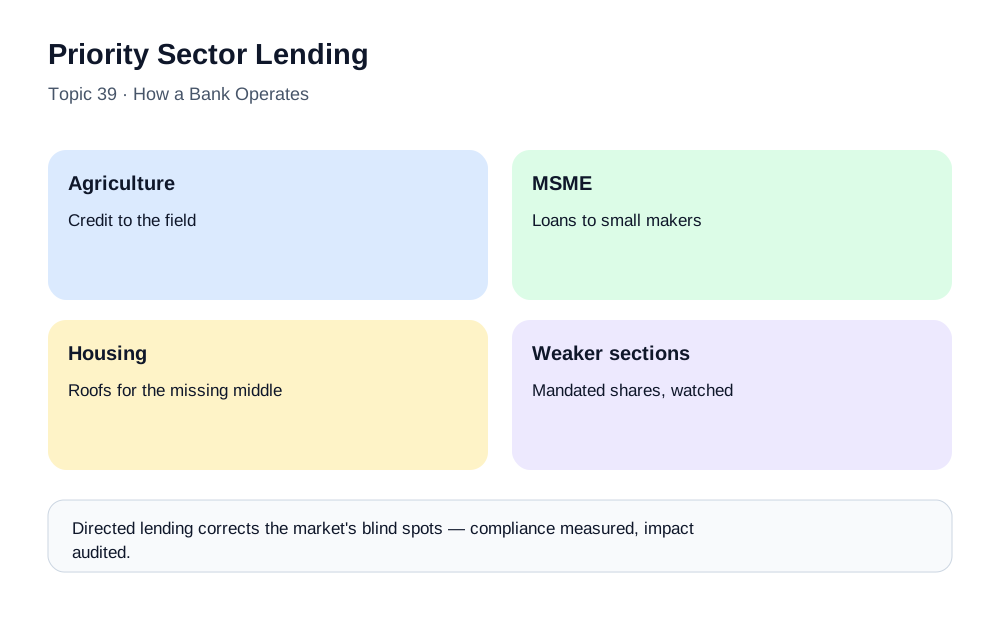
Priority Sector Lending at a glance — Agriculture, MSME, housing, directed credit.
1. Why Directed Lending Exists: The First Principles
The logic underlying priority sector lending recognizes that credit allocation has consequences beyond bank profitability. Agriculture feeds populations and provides livelihoods for billions. Micro and small enterprises generate employment and economic dynamism. Housing creates assets and stability for families. Education investments increase human capital and social mobility. When markets fail to provide adequate credit to these sectors, societies lose benefits that exceed the private returns banks might earn.
Economists call this a positive externality: when a farmer borrows to buy seeds and irrigation, the bank captures the interest, but society captures food security, rural employment, and price stability, none of which appear in the bank's pricing. Left alone, any profit-seeking institution prices only what it captures, so sectors with high social returns and modest private returns are systematically starved. Directed lending is the state's correction: mandate the allocation that the market under-provides.
There is a second, harder-edged rationale. Credit exclusion compounds across generations. A micro-entrepreneur without formal finance pays moneylender rates that consume the business's surplus; a farmer without crop credit sells standing crops to traders at distress prices. Exclusion is not a stable state but a downward spiral, and breaking it early is cheaper than repairing it later. Priority sector lending, whatever its design flaws, is best understood as development policy executed through the banking system rather than through the budget.
This also explains why the obligation sits on banks rather than on a state lender. Banks hold the deposit franchise, the branch network, and the credit skills; the state holds the policy goal. Directed lending welds the two together, and nearly every design feature in this chapter, targets, sub-targets, certificates, penalties, exists to make that welding work without breaking either partner.
2. The Framework of Priority Sector Requirements
India's approach illustrates how priority sector lending operates in practice. Under the Reserve Bank of India (Priority Sector Lending – Targets and Classification) Directions, 2025, effective from April 1, 2025 and amended from time to time, the target depends on the bank's legal and licence category. Domestic commercial banks excluding RRBs and SFBs, and foreign banks with twenty branches or more, have an overall target of 40% of ANBC or CEOBSE, whichever is higher; foreign banks with fewer than twenty branches, Regional Rural Banks, Small Finance Banks, and Urban Co-operative Banks have distinct target structures. The computation base itself follows a prescribed regulatory formula, so banks must apply the current RBI directions rather than treat 40% as a universal number for every institution.
Agriculture commands eighteen percent of adjusted net bank credit, reflecting the sector's importance for food security and rural employment. This includes crop loans for seasonal cultivation, term loans for equipment and irrigation investment, and financing for allied activities like dairy, poultry, and fishing. A sub-target within agriculture directs a substantial share specifically to small and marginal farmers, those cultivating the smallest holdings, to prevent the agricultural target being met by lending only to large farm businesses and agri-corporations. The agricultural target acknowledges that farming faces unique risks, weather dependence, commodity price volatility, and biological uncertainties, that make pure market lending insufficient.
Micro enterprises receive a seven and a half percent target, directing credit to the smallest businesses that face the greatest barriers to formal finance. Manufacturing enterprises with investment up to one crore rupees and service enterprises with investment up to forty lakh rupees qualify. These businesses often lack formal financial records, established credit histories, and collateral assets, making them unattractive to traditional credit assessment.
Weaker sections, a category including small and marginal farmers, self-help groups, scheduled caste and scheduled tribe borrowers, and women entrepreneurs, receive a twelve percent target. This provision ensures that priority sector lending reaches those facing social and economic disadvantages beyond mere business risk. The weaker sections target reflects recognition that credit access can help overcome structural inequalities.
Additional categories complete the priority sector framework. Education loans support studies in India and abroad up to prescribed limits, building human capital. Housing loans below defined value thresholds create assets for lower and middle-income families, with the thresholds periodically revised to track property prices. Renewable energy financing supports solar, wind, and biomass projects advancing environmental goals. Social infrastructure including healthcare, sanitation, and drinking water receives support. Export credit maintains international competitiveness. Each category carries eligibility conditions, loan-size caps, and definitions that the central bank revises periodically, the framework is a living document, and bankers track amendments because yesterday's compliant loan may not qualify tomorrow.
Two features of the design deserve attention. First, the targets are measured quarterly on average achievement, not on a single date, preventing cosmetic year-end lending. Second, the rules extend beyond direct lending: bank credit to specified non-banking finance companies and microfinance institutions for on-lending to priority sectors counts toward targets, and the co-lending model, where a bank and an NBFC share a loan, the bank contributing low-cost funds and the NBFC contributing last-mile origination, has become a significant channel for reaching borrowers banks cannot serve alone.
3. The Challenges of MSME Lending
Micro, small, and medium enterprises present particular challenges for bank lending that explain market failure in this segment. These businesses often operate informally, without audited financial statements, tax returns, or documented business plans that banks traditionally use for credit assessment. Their owners may lack formal education or experience with banking relationships. Collateral is frequently unavailable, with business assets insufficient and personal assets often unencumbered or informally held.
Information asymmetry compounds these challenges. Banks struggle to distinguish viable businesses from hopeless ventures, good operators from unreliable ones. The cost of evaluating small loans approaches that of evaluating large ones, making small loans proportionally more expensive to originate and monitor. Geographic dispersion increases travel costs for assessment and collection. These factors combine to leave many creditworthy small businesses without access to formal finance. The financing gap for micro and small enterprises in developing economies is measured in the trillions of dollars globally, a figure that represents not bad credit but unprocessed credit.
Banks have developed innovative approaches to serve this segment profitably. Cluster lending targets geographic or industry concentrations, a town of weavers, a district of auto-component makers, where banks can develop expertise and achieve scale. Lending to groups of enterprises in the same business cluster allows banks to leverage local knowledge and achieve efficiencies in assessment and monitoring. Credit guarantee schemes, where governments or development institutions guarantee portions of small business loans, reduce bank risk and encourage lending that might not otherwise occur; India's Credit Guarantee Fund Trust for Micro and Small Enterprises is among the world's largest such mechanisms.
Cash flow-based lending uses transaction data rather than financial statements to assess creditworthiness. Bank statements showing regular deposits and payments, goods and services tax data demonstrating business scale, and utility records confirming operational continuity can substitute for traditional documentation. Digital lending platforms automate assessment using this alternative data, reducing costs and enabling rapid decisions. The account aggregator framework, which lets businesses share their own financial data across institutions with consent, and invoice-discounting platforms where small suppliers sell receivables from large buyers, are pushing this further: the small business's data trail is becoming its collateral.
A worked example shows the economics changing. A tailor-turned-garment-unit owner seeks eight lakh rupees to buy machines. Under traditional underwriting, a field visit, document collection, and committee approval might cost the bank fifteen to twenty thousand rupees in staff time, against a year's interest margin of perhaps eighty thousand, before any provisioning. Under cash flow-based digital underwriting, the bank pulls twelve months of bank statements and sales tax filings with the owner's consent, scores the cash flows automatically, and sanctions in days at a fraction of the cost. The borrower's character did not change; the cost of seeing it did. That cost collapse, more than any subsidy, is what is finally closing the small-business credit gap.
4. The Borrower's Journey: How Priority Sector Credit Actually Works
Frameworks and targets look different from the borrower's side. Consider the journey of a small farmer seeking a crop loan, and notice how each stage is engineered around the barriers described above.
The farmer approaches a rural branch or a business correspondent, an agent extending banking services beyond branches, with land records and identity documents. There is no audited balance sheet to assess; instead the bank works from the scale of finance, locally fixed per-acre cultivation costs for each crop, which standardize loan sizing where financial statements cannot. The loan is structured around the crop calendar: disbursed at sowing, repaid at harvest, with the limit renewing seasonally. Interest subvention, a government subsidy delivered through the bank, brings the effective rate down sharply for farmers who repay on time, making the loan both cheap for the borrower and, through the subsidy, viable for the bank.
The micro-entrepreneur's journey parallels this. Without collateral, she may borrow through a self-help group or a joint liability group, where five to ten members guarantee each other, substituting social collateral for physical collateral, an innovation that development finance has refined over decades. Group dynamics supply what documentation cannot: members screen each other, monitor each other, and enforce repayment through social pressure and shared stakes in continued access.
The bank's perspective completes the picture. Priority sector lending is operationally expensive, many small loans, dispersed borrowers, seasonal risk, so banks manage it as a portfolio business: standardized products, statistical provisioning, group and cluster approaches, guarantee covers, and digital collection. The economics work when volume, standardization, and risk-transfer mechanisms are layered together; they fail when a bank treats a hundred-thousand-rupee crop loan like a hundred-crore corporate credit. This is why specialized institutions and NBFC partnerships exist, and why the compliance mechanisms of Section 6 matter: they let each institution play to its strength.
5. Agricultural Finance Innovations
Agricultural lending requires adaptation to farming's distinctive characteristics. Seasonal production cycles mean repayment capacity concentrates at harvest, requiring loan structures that accommodate uneven cash flows rather than assuming regular monthly income. Weather and price risks can devastate farmer finances through no fault of their own, requiring forbearance mechanisms and insurance linkages that pure commercial lending might not provide.
The Kisan Credit Card represents a significant innovation in Indian agricultural finance. This single instrument provides a comprehensive credit limit covering crop production expenses, consumption needs, and insurance premiums. Farmers can draw as needed within their limit, repaying when crops are sold. Tens of millions of cards have been issued, demonstrating the scalability of well-designed agricultural credit products. Government interest-subvention schemes can reduce the effective borrowing cost for eligible short-term agricultural credit when current scheme conditions, limits, and timely-repayment requirements are satisfied. Because those scheme parameters can change by financial year, banks should apply the rate and eligibility rules in force rather than treat one historical effective rate as permanent. The card's deeper innovation is structural: it converts a seasonal need into a revolving facility, eliminating the per-season application cycle that once made crop credit slow enough to miss the sowing window.
Warehouse receipt financing addresses post-harvest liquidity needs. Farmers storing produce in approved warehouses receive receipts representing their stored goods. Banks lend against these receipts, providing cash while farmers await favorable selling prices. The warehouse operator guarantees the quantity and quality of stored goods, providing collateral that substitutes for traditional security. This directly attacks one of rural finance's oldest traps, the distress sale at harvest when prices are seasonally lowest because every farmer sells at once, and converts stored grain into working capital.
Crop insurance linkages, weather-indexed products, and satellite-verified crop assessment are extending this toolkit, reducing both farmer risk and the bank's information costs. The direction of travel is the same as in MSME lending: replace unverifiable paperwork with verifiable data.
6. Compliance Mechanisms and Market Development
Banks that fail to meet priority sector targets face consequences designed to encourage compliance. Where banks report shortfalls, RBI can allocate amounts for contribution to the Rural Infrastructure Development Fund and other designated funds with institutions such as NABARD, NHB, SIDBI and MUDRA Ltd., as decided by RBI from time to time. These deposits earn below-market returns, creating financial incentives to meet targets through direct lending rather than penalty payments. The design is elegant: the penalty is not a fine that vanishes into government revenue but a forced allocation of the shortfall into specialized institutions that deploy it into the very sectors the bank failed to reach. The mandate is fulfilled either way; only the economics differ.
Priority Sector Lending Certificates provide a market mechanism for compliance flexibility. Banks that exceed targets in particular categories can sell certificates to banks that fall short. The buyer bank counts the certificate amount toward its priority sector requirement; the seller bank transfers the obligation. Trading takes place through the central bank's platform, and certificates expire at the end of the financial year, making this a genuine market with real price discovery rather than an accounting fiction.
A worked example shows the logic. A foreign bank with urban branches and no rural network finds that originating farm loans costs it far more than a rural-focused bank. Meanwhile, a regional rural bank overflows with agricultural lending beyond its targets. The rural bank sells PSLCs covering its surplus; the urban bank buys them, counts the underlying lending toward its obligation, and pays a price that, if the market works, reflects the difference in origination costs. Total priority sector lending is unchanged; what changed is that each bank specialized where it is efficient. Critics worry that certificates let banks buy their way out of the mandate's developmental intent, but the counter is equally real: the lending happened, the farmer was served, and forcing inefficient lenders to originate badly serves nobody.
7. Inside the Bank: Managing the Priority Sector Book
Priority sector compliance is not an annual scramble; it is a continuous management discipline, and watching it operate reveals how regulation translates into daily banking.
Planning begins with the base. The bank's finance function projects adjusted net bank credit for the year, because the forty percent obligation moves with total lending. A bank growing corporate credit rapidly must grow priority sector credit just as fast, which is why lending plans for the two books are drawn up together rather than independently.
Origination targets cascade down. The overall obligation decomposes into category targets, then into regional and branch-level goals. Rural and semi-urban branches carry the agricultural and weaker-sections targets; urban branches contribute through micro-enterprise, housing, and educational lending; specialized verticals handle on-lending partnerships with NBFCs and microfinance institutions. Relationship managers in rural branches are, in effect, delivery agents of national credit policy, a dimension of the job no job description captures.
Classification is the daily discipline. Every loan booked must be correctly tagged as priority or non-priority, with the right category and sub-category, because misclassification corrupts both compliance reporting and risk management. Eligibility conditions are checked at origination, does this housing loan fall within the value threshold, does this enterprise qualify as micro, and audit teams re-verify tags because regulators examine classifications during supervision. A misclassified portfolio can convert apparent compliance into an actual shortfall discovered at the worst possible time.
Monitoring runs on dashboards. Priority sector achievement is tracked monthly against targets, with gaps flagged early enough to act. When a shortfall looms late in the year, the levers are the ones this chapter has covered: accelerate eligible origination, purchase PSL certificates in the quarterly trading windows, increase on-lending to qualifying NBFCs, or accept shortfall deposits as the costliest fallback. Treasury teams watch certificate prices the way they watch money market rates, because a few basis points on a large certificate purchase is real money.
A worked example of the shortfall arithmetic shows why certificates exist. Suppose a bank faces a two-hundred-crore-rupee agricultural shortfall as the year closes. Depositing that amount with the development institutions at below-market rates might cost it several crore rupees of forgone interest annually, indefinitely visible to supervisors. Buying agricultural PSLCs for the same amount costs the certificate premium, historically a small percentage of face value, once. Originating two hundred crores of compliant farm loans in the final quarter is usually impossible at any responsible standard. The rational hierarchy, lend first, buy certificates second, deposit last, is the market mechanism working exactly as designed.
8. The Risk Side: When Directed Lending Goes Wrong
Honest treatment requires facing the failures, because they are instructive.
Credit discipline erosion is the deepest risk. When borrowers believe loans will be waived or restructured for political reasons, repayment culture decays. India's recurring cycles of farm loan waivers illustrate this: each waiver provides genuine relief to distressed farmers, but each also teaches borderline borrowers that waiting may be cheaper than repaying, and banks respond to the resulting uncertainty by raising prices or retreating from exactly the borrowers the waiver meant to help. The waiver helps today's defaulter and taxes tomorrow's honest borrower.
Target gaming takes quieter forms. Banks have periodically met targets through large loans to medium enterprises or agri-businesses that technically qualify while bypassing the small borrowers the framework intends, which is precisely why sub-targets for small and marginal farmers and micro enterprises were introduced. Every category boundary invites arbitrage, and the regulator's periodic revisions are largely an audit of where the previous boundaries were gamed.
Microfinance excesses show what happens when directed credit meets aggressive growth without underwriting discipline. The 2010 crisis in the Indian microfinance sector, concentrated in Andhra Pradesh, saw multiple lending to the same borrowers, coercive collection, borrower over-indebtedness, and ultimately a political backlash that froze collections across the industry. The episode's lesson shaped the regulatory architecture that followed: income-based lending limits, centralized credit bureau checks for micro-borrowers, and conduct codes, recognition that in small-ticket lending, borrower protection and portfolio quality are the same thing.
None of this invalidates directed lending; it specifies the engineering tolerances. Directed credit works when underwriting remains real, subsidies reward repayment rather than default, and category definitions are policed. It fails when targets substitute for judgment.
9. The Global Landscape and the Standing Debate
The global landscape of directed lending varies considerably. The United States uses the Community Reinvestment Act, which evaluates banks on service to low-income communities without mandating specific targets, relying on examination ratings and merger-approval leverage rather than quotas. Brazil requires a substantial share of demand deposits be directed to agriculture and housing at regulated rates, funding its rural credit system. China combines window guidance, informal pressure on banks to meet policy goals, with formal quotas. Development finance institutions worldwide use credit lines and guarantees to steer bank lending toward small business, housing, and green projects. Each approach reflects different institutional capacities and policy priorities, and each reveals the same trade-off between precision of direction and efficiency of execution.
Priority sector lending remains controversial among economists who prefer market-determined credit allocation. Critics argue that directed lending creates inefficiency, politicizes credit decisions, and may generate losses that weaken banks. Proponents respond that markets fail to account for social benefits, that directed lending has enabled broad-based development in countries that implemented it effectively, and that the alternatives, excluding millions from credit access, are worse. The reality is that well-designed priority sector programs, with appropriate pricing and risk management, can expand financial inclusion without compromising bank viability.
The synthesis most practitioners reach is that the debate has shifted from whether to how. Pure quota systems give way to hybrid designs: targets plus market mechanisms like certificates, mandates plus guarantee schemes that price risk honestly, obligations plus data infrastructure that lowers origination cost. The question is no longer whether credit should reach the farmer and the micro-entrepreneur, but how to deliver it at prices and loss rates that keep both banks and borrowers healthy.
10. Common Misconceptions About Priority Sector Lending
"Priority sector means subsidized, loss-making lending." Not necessarily. Subvention schemes and guarantee funds transfer part of the cost to the state or specialist institutions, and well-run priority portfolios earn acceptable risk-adjusted returns. The assumption that small borrowers are unprofitable usually reflects high origination costs, a solvable operational problem, not borrower quality.
"The forty percent target applies to everything a bank lends." It applies to adjusted net bank credit or the credit equivalent of off-balance-sheet exposure, a defined computation with specific deductions. The precise base matters enormously in compliance, and quoting the headline forty percent without the base is a mark of not having read the directions.
"Buying PSL certificates is cheating." Certificates are a regulator-designed market that keeps total priority sector lending constant while letting banks specialize. The lending occurred; only the obligation's accounting moved.
"Loan waivers help farmers." Waivers help yesterday's defaulters, once, while damaging repayment culture and future credit access for the honest majority. Most waiver money flows to larger farmers who had bank access in the first place.
"Small borrowers are risky borrowers." Default rates in well-underwritten micro and group lending have historically compared well with corporate lending, because the risks are different, not greater: small loans fail from information problems and collection failures, both of which good design addresses.
"Priority sector lending is charity imposed on banks." It is development policy routed through the banking system, but it is also a business: sticky rural customers, cross-sell potential, and government-supported margins have made priority sector franchises profitable for banks that build them properly.
11. Frequently Asked Questions
What exactly counts as priority sector? Agriculture and allied activities, micro and small enterprises within investment limits, education loans up to prescribed caps, housing loans below value thresholds, renewable energy, social infrastructure, export credit, and specified weaker-section lending, each with detailed eligibility conditions set by the central bank and revised periodically.
Do foreign banks operating in India have the same targets? Foreign banks operate under the priority sector framework with arrangements reflecting their limited branch networks, and PSL certificates exist partly to make compliance practical for them. The principle of contribution is the same; the mechanics accommodate different business models.
Why do banks lend to NBFCs and microfinance institutions if they must lend to farmers anyway? On-lending partnerships combine the bank's low-cost funds with the specialist's origination reach. The bank meets its obligation, the NBFC earns a spread for serving borrowers the bank cannot reach economically, and the borrower gets credit that neither party could have delivered alone.
What is a self-help group and why do banks lend to groups rather than individuals? A self-help group is a small collective, typically of women, that saves together and borrows jointly, with members guaranteeing each other. Group lending substitutes social collateral for physical collateral and dramatically lowers screening and monitoring costs, which is why group-based lending anchors the weaker-sections target.
How does interest subvention actually work? The government reimburses the bank a portion of the interest on qualifying loans, conditional on timely repayment by the borrower. The farmer pays the reduced effective rate, the bank receives the full rate, and the state pays the difference, a subsidy delivered through the credit channel rather than as a cash handout.
What happens if a bank misses its target? The shortfall is deposited with designated development institutions at below-market returns, and the bank's compliance standing with the regulator suffers. Persistent shortfalls attract supervisory attention beyond the financial penalty.
Can a bank exceed its targets? Yes, and many do, because well-run priority sector books are profitable and because surplus achievement in a category generates PSL certificates that can be sold to shortfall banks. Over-achievement is a revenue line, not a compliance accident.
What is the difference between priority sector lending and financial inclusion? Financial inclusion is the broader goal, access to accounts, payments, insurance, and credit for all. Priority sector lending is one specific instrument toward it: mandated credit allocation to designated sectors. A country can have high account penetration, inclusion progress, while still needing PSL mandates to move actual credit to small borrowers.
Does priority sector lending exist outside India? Yes, in many forms: Brazil's directed rural credit, China's policy-guided lending, the US Community Reinvestment Act, and development-bank credit lines and guarantees across Africa, Asia, and Latin America. India's framework is distinguished by its specificity and its market mechanisms, not by the underlying idea.
12. Key Terms in This Chapter
- Priority sector lending (PSL) — mandated allocation of a fixed share of bank credit to designated sectors of social and economic importance.
- Adjusted net bank credit (ANBC) — the computation base for PSL targets: total credit after permitted deductions.
- Sub-targets — category-level mandates (agriculture, micro enterprises, weaker sections) beneath the overall forty percent.
- Small and marginal farmers — cultivators of the smallest holdings, carrying a dedicated sub-target within agriculture.
- Weaker sections — the category covering self-help groups, scheduled caste and tribe borrowers, women entrepreneurs, and small farmers.
- Kisan Credit Card (KCC) — a revolving crop-credit facility combining production, consumption, and insurance needs.
- Scale of finance — locally standardized per-acre cultivation costs used to size crop loans.
- Interest subvention — government interest subsidy delivered through banks, rewarding timely repayment.
- Warehouse receipt financing — lending against receipts for goods in approved warehouses, curing distress sales.
- Self-help group / joint liability group — borrower collectives whose mutual guarantees substitute for collateral.
- Credit guarantee scheme — third-party guarantee cover that reduces bank risk on small-business lending.
- Co-lending — shared bank–NBFC loans combining cheap funds with last-mile origination.
- Cluster lending — concentrating credit in industry or geographic clusters to exploit local expertise and scale.
- Account aggregator — consent-based data-sharing infrastructure turning a small business's data trail into its collateral.
- Priority Sector Lending Certificates (PSLCs) — tradeable instruments transferring PSL compliance between banks.
- Shortfall deposits — mandatory below-market placements with NABARD, SIDBI, and NHB on missed targets.
- Loan waiver moral hazard — the decay of repayment culture when borrowers expect political debt relief.
- Community Reinvestment Act — the US evaluation-based counterpart to quota-style directed lending.
- On-lending — bank credit to NBFCs and microfinance institutions that is re-lent to priority borrowers, counting toward targets.
- Business correspondent — an agent model extending banking services beyond branches into villages and low-income areas.
13. Interview Insights: How This Topic Appears in Banking Interviews
"Why does priority sector lending exist? Shouldn't banks lend where returns are best?" Answer with the externality argument: banks price what they capture, so socially valuable sectors are under-served; directed lending corrects the allocation. Then show balance by naming the costs, politicization, waiver moral hazard, gaming, and what good design does about them. Interviewers want a candidate who can hold both sides.
"Walk me through the PSL framework." Forty percent of adjusted net bank credit overall; agriculture eighteen percent with a small-and-marginal-farmer sub-target; micro enterprises seven and a half percent; weaker sections twelve percent; measured quarterly on averages; shortfalls deposited with NABARD, SIDBI, and NHB at below-market rates; certificates available for market-based compliance. Precision here is what separates candidates who have read the directions from those who have read about them.
"How would you build a profitable micro-enterprise lending book?" Cluster selection, cash flow-based underwriting using bank statement and tax data, guarantee scheme cover, standardized small products, digital collections, and portfolio-level provisioning. The answer should demonstrate that profitability in this segment is an engineering problem, not a contradiction.
"Is buying PSLCs better than lending directly?" It depends on comparative advantage. If your origination cost in a category exceeds the certificate price plus lending margin, buying is rational; if you can originate efficiently, direct lending earns more and builds franchise. Strong answers note the system-level result: certificates reallocate obligation, not total lending, so specialization makes the whole system cheaper.
"What went wrong in the 2010 microfinance crisis?" Multiple lending to the same borrowers without bureau checks, growth targets overwhelming underwriting, coercive collection practices, and a political backlash that collapsed collections. The regulatory response, income-based limits, bureau reporting, conduct codes, is the real lesson: in small-ticket lending, borrower protection and portfolio protection converge.
Summary and Key Takeaways
- Priority sector lending exists because credit markets under-serve sectors whose social returns exceed the private returns banks can capture, and because credit exclusion compounds across generations.
- India's framework mandates forty percent of adjusted net bank credit to priority sectors, subdivided into agriculture (eighteen percent, with a small-farmer sub-target), micro enterprises (seven and a half percent), and weaker sections (twelve percent), plus defined categories in education, housing, renewable energy, social infrastructure, and exports.
- The framework is enforced through quarterly average measurement, below-market shortfall deposits with development institutions, and tradeable PSL certificates that let banks specialize.
- MSME and agricultural lending succeed through design: cluster lending, guarantee schemes, cash flow-based underwriting, self-help groups, Kisan Credit Cards, and warehouse receipt finance.
- Directed lending's failures are specific and instructive: waiver-driven moral hazard, target gaming, and underwriting collapse, each addressed by sub-targets, bureaus, and conduct rules rather than by abandoning the mandate.
- The global debate has moved from whether to how: hybrid designs combining targets, markets, guarantees, and data infrastructure now define best practice.
- Inside the bank, priority sector compliance is a year-round discipline: base projection, cascading targets, classification rigor, monthly dashboards, and a rational hierarchy of lend first, buy certificates second, deposit shortfalls last.
- For banks, priority sector lending is simultaneously a compliance obligation, a development instrument, and, when engineered properly, a profitable and defensible franchise.
Next: Topic 40 — Bank Branch Evolution →
<!-- MBA-DEEP-DIVE-START -->Deep Dive: Priority Sector Lending as a Regulatory Classification, Data, and Portfolio-Management Discipline
Priority Sector Lending is often taught as a list of percentages. That is necessary, but it is not enough for anyone working inside a bank. The real challenge is converting a regulatory framework into millions of correctly classified loans, maintaining evidence that each loan remains eligible, measuring achievement against the right denominator, applying the right sub-target, and correcting misclassification before it becomes a supervisory finding.
The current Indian framework is governed by the Reserve Bank of India (Priority Sector Lending – Targets and Classification) Directions, 2025, effective from 1 April 2025 and amended from time to time. The Directions apply across commercial banks, Regional Rural Banks, Small Finance Banks, Local Area Banks, and specified Urban Co-operative Banks, but the targets are not identical for every bank type. That distinction should sit at the centre of any system design.
The first question is: which target table applies to this bank?
For domestic commercial banks, excluding RRBs and SFBs, and for foreign banks with twenty branches or more, the overall priority-sector target is 40% of ANBC or the credit equivalent of off-balance-sheet exposures, whichever is higher. Foreign banks with fewer than twenty branches have a different composition within the overall target. RRBs and SFBs operate with higher overall targets, and UCBs have their own target framework.
This means a generic configuration field called PSL_TARGET = 40% is bad banking technology. The correct value depends on legal entity, licence type, reporting period, and current RBI directions.
The same logic applies to sub-targets. Agriculture, micro enterprises, weaker sections, and the small-and-marginal-farmer or non-corporate-farmer requirements vary by bank type. A compliance engine must therefore be able to answer not only ‘Is this loan PSL?’ but also ‘Which target and sub-target does it contribute to for this legal entity?’
ANBC is not simply total loans
The denominator is one of the most underestimated parts of PSL management. RBI defines Adjusted Net Bank Credit (ANBC) through a prescribed computation that starts from bank credit in India and then makes defined additions and deductions. In some circumstances the bank compares ANBC with the credit equivalent of off-balance-sheet exposures and uses whichever is higher.
Because the denominator itself can move, a bank can become less compliant even when its stock of priority-sector loans has not fallen. If corporate lending grows rapidly, ANBC can expand and raise the absolute PSL amount required.
A simple example shows the effect. Suppose a domestic commercial bank has an applicable denominator of ₹1,00,000 crore. A 40% overall target requires ₹40,000 crore of qualifying PSL. If the denominator grows to ₹1,20,000 crore while qualifying PSL remains ₹42,000 crore, the bank has increased priority lending in rupee terms but fallen from 42% achievement to 35%. Business growth outside the priority book can therefore create a compliance shortfall.
This is why finance, regulatory reporting, and business planning must model PSL together. It is not a rural-lending problem owned by one product team.
The 2025 framework introduced important current details
The 2025 Directions refreshed eligible limits and classification rules across agriculture, MSME, export credit, education, housing, social infrastructure, renewable energy, and other categories. They also preserve grandfathering for loans that qualified under the earlier framework until maturity where the Directions provide for it.
For 2026 practitioners, there is another reason to use effective-dated rules: RBI has continued to amend the framework. For example, the ANBC computation has been updated to reflect specified treatment of eligible fresh FCNR(B) and NRE deposits following 2026 CRR/SLR amendments. The details are highly specific and should be implemented from the current RBI text, not copied permanently from a training slide.
The lesson is broader: PSL eligibility is versioned regulatory logic. The system should know which rule applied on the relevant date.
Classification needs evidence, not a checkbox
A loan qualifies because its borrower, purpose, amount, activity, and other conditions satisfy the regulatory definition. The bank should therefore store the evidence that supports the classification.
For an agricultural loan, relevant data can include farmer type, landholding where applicable, activity, purpose, sanctioned amount, warehouse-receipt details, FPO/FPC status, or whether the activity is farm credit, agricultural infrastructure, or ancillary service.
For MSME lending, the bank needs reliable enterprise classification under the applicable MSME framework and should retain identifiers and evidence used at sanction or review. The current PSL Directions treat all bank loans to qualifying MSMEs as PSL, subject to the current definition and other applicable conditions; the bank should not hard-code obsolete investment thresholds from older MSME regimes.
For housing, education, social infrastructure, renewable energy, and start-up categories, the system needs the relevant sanctioned-limit, purpose, location, asset-cost, or eligibility fields required by the current Directions.
A single generic priority_sector = Y field is not enough to survive audit.
The classification hierarchy should be explicit
One exposure can sometimes appear to fit more than one description. A loan to an MSME operating a renewable-energy business, for example, could have attributes relevant to both MSME and renewable energy. RBI rules determine how it should be classified and prevent inappropriate double counting.
A robust engine should therefore use an ordered classification hierarchy or controlled decision table. It should record the final category and sub-category, the rule version, and the reason.
This is important for downstream reporting. If one system reports the loan as MSME and another reports it as renewable energy, both can be individually plausible while the bank's aggregate PSL return becomes wrong.
Agriculture is a portfolio of different risks
The current agriculture category includes farm credit, agriculture infrastructure, and ancillary activities. Treating all three as ‘farm loans’ hides major differences.
A seasonal crop loan to an individual farmer depends on crop cycle, weather, yield, input costs, and harvest proceeds. A loan for a cold-storage facility depends on project execution, utilisation, energy cost, and commercial cash flow. Finance to a food-processing business may look more like ordinary enterprise credit while still meeting an agriculture-related PSL definition.
The regulatory classification does not replace credit-risk analysis. Two loans can both qualify for agriculture PSL and have entirely different underwriting models, collateral, tenor, repayment profile, and expected loss.
Small and marginal farmer data must be reliable
The sub-target for small and marginal farmers exists to prevent the agriculture target from being satisfied mainly through larger borrowers. Current RBI directions define the relevant landholding and include specified categories such as certain landless labourers, tenant farmers, oral lessees, sharecroppers, and eligible groups.
For a bank, this creates a data-quality challenge. Landholding and borrower type may be captured through local records, self-declaration, agricultural databases, or verified documents depending on the product and jurisdiction. If the field is missing, the bank may lose valid sub-target credit. If the field is overstated, the bank can report false achievement.
Good data design stores both the classification result and the evidence source.
MSME classification should follow the current definition, not historic thresholds
MSME policy has changed over time. Older material often quotes obsolete investment-only thresholds or separate manufacturing and service definitions. Current banking systems should refer to the MSME definition incorporated by the latest RBI and Government framework and maintain update capability when the definition changes.
The PSL rule is conceptually straightforward: qualifying bank loans to MSMEs are eligible for classification under the MSME category, with additional provisions for specified start-ups, factoring, TReDS, and eligible on-lending structures.
The operational complexity is proving that the enterprise qualifies and mapping the loan correctly. Udyam or other recognised registration data, turnover and investment information where relevant, enterprise status, borrower identity, and loan purpose must reconcile across origination, credit, and regulatory-reporting systems.
On-lending creates a look-through requirement
Banks can obtain PSL classification for certain lending to eligible NBFCs, MFIs, HFCs, and other intermediaries where the current Directions permit it and the underlying loans satisfy the specified conditions.
This is not the same as saying ‘a loan to an NBFC is PSL’. The bank needs evidence that the intermediary deployed funds into qualifying underlying assets and stayed within borrower-level and portfolio caps where applicable.
The 2025 Directions, as amended, contain specific limits and a cap on eligible on-lending relative to the bank's prior-year PSL portfolio. Those values can change, so product documentation should reference the effective regulatory rule rather than embed an eternal percentage in narrative text.
Operationally, the bank needs periodic files from the intermediary showing underlying borrower, category, sanctioned or outstanding amount, eligibility, and other agreed data. The bank must validate duplicates and reconcile the reported underlying pool to the funded exposure.
Co-lending requires one borrower view
In a co-lending arrangement, a bank and NBFC may each hold a defined share of the same borrower exposure. The PSL benefit follows the bank's eligible share under the applicable framework, but the customer journey can involve two institutions and a shared servicing model.
The control problem is therefore wider than PSL classification. Who performs KYC? Who underwrites? Who communicates the rate and charges? Who disburses? Who collects? How are repayments allocated between lenders? Who reports delinquency? How are complaints resolved?
If the NBFC classifies the borrower as a micro enterprise but the bank's regulatory engine lacks the supporting enterprise data, the arrangement may be commercially correct but reporting-incomplete. Co-lending technology must carry the regulatory attributes with the cash flows.
Geographic weighting changes achievement without changing the loan balance
RBI introduced an incentive framework that assigns higher weight to incremental PSL credit in districts with comparatively low per-capita priority-sector credit and lower weight to incremental credit in districts with comparatively high credit flow. The current list is effective for the prescribed period through FY 2026-27 subject to review.
For the bank, this means two identical qualifying loans can contribute differently to achievement because of location and whether the credit is incremental under the RBI methodology.
The customer still owes the actual loan amount. The general ledger still records the actual loan amount. The regulatory achievement value can differ because of weighting.
Systems should therefore never overwrite the accounting balance with the weighted PSL amount. Keep actual exposure and regulatory-weighted contribution as separate measures.
Quarterly monitoring prevents year-end window dressing
RBI monitors PSL achievement on a quarterly basis and uses the quarter-wise positions in determining annual shortfall or excess. This means a bank cannot rely safely on originating a large volume in the final days of March simply to repair an earlier gap.
A strong bank runs an internal PSL dashboard at least monthly and often more frequently. It tracks actual eligible outstanding, target denominator, category achievement, sub-targets, expected maturities, pipeline, PSLC positions, on-lending caps, district weights, and potential reclassification issues.
The forward view is as important as the current view. If a large portfolio of qualifying housing loans will amortise or be sold next quarter, compliance can deteriorate even without new non-PSL growth.
Priority Sector Lending Certificates separate origination from compliance position
PSLCs allow banks with surplus eligible lending in defined categories to sell certificates to banks with shortfalls. The underlying loan does not move to the buyer. Credit risk remains with the originating bank. What moves is the ability to count a defined amount toward PSL achievement for the certificate period.
This is why PSLCs are closer to a regulatory-compliance instrument than a loan sale.
A bank buying a PSLC should account for the certificate correctly, monitor expiry, and ensure it is counted in the right category. A bank selling PSLCs must avoid double counting the same surplus beyond what the scheme permits.
For treasury, the PSLC price becomes part of the economics of meeting the target. For the business, however, persistent dependence on certificates may signal that the franchise is not originating enough of the intended credit directly.
Shortfall contributions are not just a fine
Where a bank fails to achieve prescribed targets or sub-targets, RBI can allocate amounts for contribution to RIDF and other designated funds. The deposit rate can be linked to the size of the shortfall under the current Directions, creating an economic penalty.
The accounting and management question is therefore: what did the shortfall cost? The answer includes forgone spread, contribution terms, PSLC alternatives, business opportunity lost, and supervisory consequences.
A mature bank uses this cost in planning. If buying a PSLC is cheaper than hurriedly originating weak loans merely to hit a number, buying the certificate may be safer. Regulatory compliance should never become an excuse for poor underwriting.
Misclassification can be more dangerous than an obvious shortfall
RBI can adjust misclassified PSL identified during supervision from the relevant year's achievement. A bank that believes it exceeded the target can therefore discover later that ineligible loans were counted and that a historical shortfall exists.
This is why audit sampling and automated rules matter. The bank should test eligibility before regulatory submission and retain enough historical data to reproduce the return after the fact.
Imagine a housing portfolio classified using an outdated property-cost limit. The error may affect thousands of loans. Correcting it after supervisory review can change not only the current quarter but earlier target calculations and shortfall contributions.
Data lineage is a regulatory control
A PSL return may contain aggregated numbers, but every number should be traceable back to individual exposures and source data.
A good lineage chain looks like this:
customer and facility data → product system → regulatory classification engine → adjustments and weights → legal-entity aggregation → quarterly return → submitted figure.
Each transformation should be controlled and reproducible. Manual spreadsheets can be useful for investigation, but they should not become the unexplained source of regulatory truth for a large bank.
Version control is essential. If a classification rule changes on 1 April, the bank should preserve the prior version for historical reporting and apply the new rule from the correct date.
A practical bank-wide scenario
Assume a domestic commercial bank enters January with overall PSL achievement slightly above target but an agricultural sub-target gap. Corporate lending is growing faster than expected, which will raise ANBC by March. At the same time, a block of crop loans will be repaid after harvest and a large eligible MSME portfolio may be securitised.
The PSL dashboard forecasts that the bank will fall below both the overall and agriculture requirements despite being compliant today.
The bank has several options. Rural business can accelerate already-approved quality farm lending. Partnership teams can add eligible on-lending within current caps. Treasury can evaluate agricultural PSLC prices. The securitisation team can consider the regulatory effect of transferring the MSME portfolio. Finance updates the denominator forecast. Compliance and regulatory reporting review whether any planned assets are being classified using stale rules.
The right response is a portfolio decision, not a frantic instruction to branches to ‘book PSL’.
After quarter-end, actual exposure is reconciled to the regulatory classification output. District weights are applied separately from accounting balances. PSLC purchases and sales are incorporated. The submission is independently reviewed, with material manual adjustments documented and approved.
That is how a percentage in an RBI direction becomes an operating discipline across the whole bank.
What excellence looks like
A world-class PSL framework can explain which target applies to each legal entity, how ANBC and CEOBSE are computed, why every loan is classified, which sub-target it supports, what regulatory version was used, and what evidence proves eligibility. It can distinguish actual outstanding from weighted achievement. It looks through eligible intermediary lending to underlying assets. It prevents double counting across categories. It reconciles PSLC positions. It forecasts shortfalls before quarter-end. It can reproduce a filed return from source-system records months or years later.
Priority Sector Lending is therefore not a social-policy appendix to banking. It is a live example of how public policy, credit underwriting, product design, data, finance, treasury, and regulatory reporting must operate as one controlled system.
<!-- MBA-DEEP-DIVE-END -->