The movement of people across borders creates a distinctive banking need. Millions live and work abroad while maintaining financial ties to their home countries, managing income earned overseas alongside obligations and investments back home. Non-resident banking services address these cross-border financial relationships, while remittances, the money migrants send home, constitute one of the largest financial flows in the global economy, exceeding foreign direct investment and development aid to many developing nations.
By the end of this chapter, you will be able to:
- Explain why non-resident banking exists as a separate category
- Distinguish residential status for exchange control from residency for tax
- Compare NRE, NRO, FCNR, and RFC accounts and know when each applies
- Trace how remittances move through banks, transfer operators, fintechs, and mobile money
- Calculate the true cost of a remittance, including hidden exchange rate markups
- Describe the regulatory framework governing cross-border personal flows
- Understand how banks view the non-resident segment as a business
- Explain where digital innovation is taking remittances next
While this chapter uses India, the world's largest remittance recipient, as its primary case, the underlying patterns apply wherever significant diasporas exist: non-resident account structures, regulated convertibility, and competitive remittance channels appear from the Philippines to Nigeria to Mexico, with local rules layered on top.
Visual overview
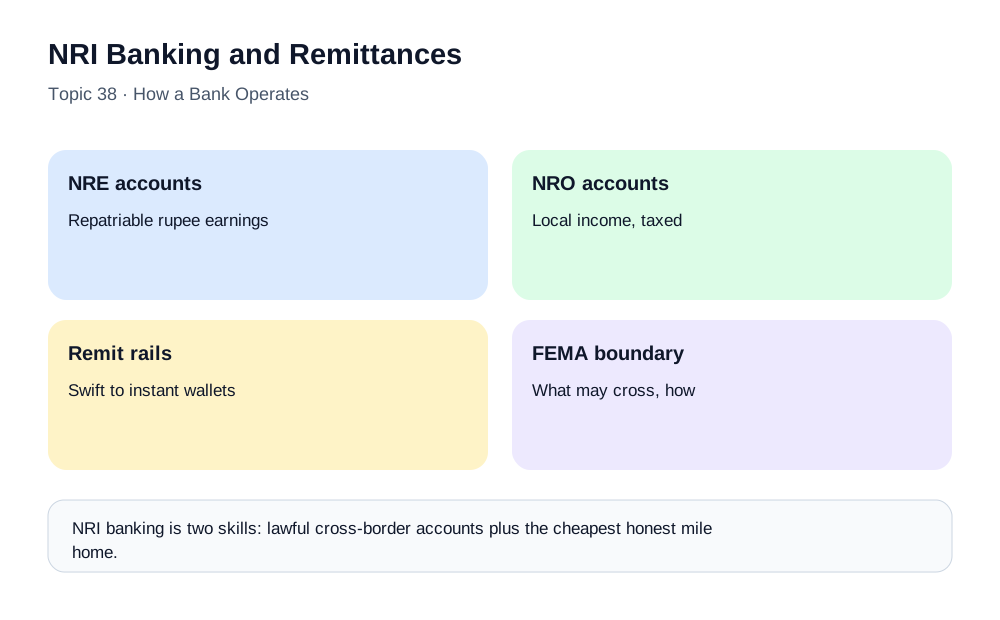
NRI Banking and Remittances at a glance — NRE/NRO accounts, FEMA, cross-border banking.
1. The Scale and Meaning of Remittances
The scale of remittance flows is staggering. Over eight hundred billion dollars moves annually from migrants to their home countries according to World Bank estimates, with India consistently ranking as the largest recipient, receiving over one hundred twenty billion dollars yearly. Mexico, China, the Philippines, and Egypt follow as major destinations. For many countries, remittances represent substantial shares of national income, exceeding twenty-five percent of GDP in some nations and providing the primary income source for millions of families.
These flows matter beyond their economic scale. Remittances fund education that enables social mobility, healthcare that improves life expectancy, housing that builds assets, and business investment that creates employment. They stabilize household consumption during economic shocks, providing a safety net that government programs cannot match for reach or flexibility. Remarkably, remittances have historically proved more stable than investment flows during crises: when foreign investors fled during the 2008 financial crisis and again during the 2020 pandemic, remittances dipped briefly and recovered, because migrants keep supporting families precisely when home economies suffer. This countercyclical character makes remittances a quiet pillar of financial stability in the developing world. Understanding how these flows move, what channels carry them, and how banking serves those who generate them illuminates an essential dimension of global finance.
The geography matters. Reserve Bank survey data on India's inward remittances shows the United States as the largest source, followed by the Gulf states, the United Kingdom, and Singapore, but the character of the flows differs sharply by corridor. Remittances from North America and Europe tend to be larger, less frequent, and investment-oriented, flowing into NRE deposits and property. Remittances from the Gulf, where millions of Indian workers in construction, services, and trades hold fixed-term contracts, tend to be smaller, monthly, and consumed by families, flowing through exchange houses and instant channels into NRO-linked family accounts or directly to beneficiaries. A bank serving these two corridors well looks almost like two different banks: investment advisory and wealth products on one, cheap instant transfers and doorstep cash access on the other.
2. Who Is a Non-Resident? Two Different Answers
Before any account can be opened, a deceptively simple question must be answered: who counts as a non-resident? In India there are two separate answers, and confusing them is one of the most common and costly errors in this field.
Exchange control residency. The Foreign Exchange Management Act (FEMA) determines who is a person resident in India versus a person resident outside India, based primarily on where you live and work and your intention: someone who has gone abroad for employment or business for an uncertain period is treated as non-resident under FEMA from the point of leaving. This status governs which bank accounts you may hold, whether you can repatriate funds, and what foreign exchange transactions are permitted to you.
Tax residency. The Income Tax Act applies its own day-count tests, broadly, the number of days spent in India during the financial year and preceding years, to determine whether you are resident, non-resident, or a transitional category for tax purposes. This status governs which of your income India taxes.
The two tests use different logic and frequently diverge. A person can be non-resident under FEMA and resident for tax in the same year, or the reverse. The practical consequences are concrete: FEMA status tells your bank what to do with your accounts the day you leave or return; tax status tells the government how to tax the interest. Banking professionals must keep them separate, because advising a customer using the wrong framework can create regulatory violations, not merely bad advice.
One obligation follows immediately and is routinely missed: when a resident becomes a non-resident under FEMA, their ordinary resident accounts must be redesignated, existing savings accounts converted to NRO status, fixed deposits redesignated, because continuing to operate a resident account while non-resident violates exchange control rules. The reverse applies on permanent return: NRE and FCNR accounts must be redesignated to resident accounts, or converted to the RFC account described below.
3. Account Types for Non-Residents
Different types of non-resident accounts serve distinct purposes depending on the source of funds and the account holder's intentions. India offers the most developed menu, which makes it the clearest teaching case.
3.1 NRE: The Non-Resident External Account
The Non-Resident External account serves Indians earning income abroad who wish to hold rupee deposits in India. These accounts offer full repatriability, both principal and interest can be freely transferred abroad, and interest is exempt from Indian tax. NRE accounts accept deposits in foreign currency, which the bank converts to rupees, exposing the account holder to exchange rate movements. These accounts suit those building savings in India while maintaining the flexibility to return funds overseas if needed.
The key word is "external": the account is maintained on a repatriable basis for credits permitted under the FEMA deposit framework. Eligible credits can include inward remittances and specified transfers, and current income such as rent, dividend, pension, or interest may also be credited where the applicable regulatory conditions are satisfied and the authorised dealer is satisfied about eligibility. The safe operational rule is therefore to validate the source against the current Foreign Exchange Management (Deposit) Regulations rather than assume that every Indian-source receipt is automatically prohibited. The currency risk deserves emphasis: an NRI who holds a rupee NRE balance bears rupee exchange-rate movements when measuring wealth in another currency.
3.2 NRO: The Non-Resident Ordinary Account
The Non-Resident Ordinary account manages income earned in India by non-residents, such as rent from property, pension payments, or dividend income. Unlike NRE accounts, NRO accounts do not offer free repatriation. Account holders may remit up to one million dollars per financial year abroad after paying applicable Indian taxes on the income, supported by documentation including a chartered accountant's certificate confirming taxes have been settled. Interest earned on NRO accounts is generally taxable in India and withholding applies according to the tax law in force, subject to the customer's facts and any valid treaty relief. Banks should not treat one historical withholding percentage as permanent because rates, surcharge or cess treatment, documentation, and treaty application can change. These accounts serve the practical need of managing Indian income streams while living abroad.
NRO accounts can also receive funds from abroad, and they permit joint holding with a resident relative, which NRE accounts generally do not, making NRO the operational hub for NRIs managing family finances and property in India.
3.3 FCNR: The Foreign Currency Non-Resident Deposit
Foreign Currency Non-Resident accounts allow non-residents to hold deposits in foreign currency within Indian banks. These term deposits, available for one to five year maturities, protect depositors from rupee exchange risk while offering returns comparable to international markets. Both principal and interest are fully repatriable and tax-exempt in India. FCNR accounts suit those who expect to need foreign currency in the future or who are concerned about rupee depreciation.
FCNR deposits are offered in major currencies, dollars, pounds, euros, yen, and a small set of others, and they shift the currency risk from the customer to the bank: the bank now holds a dollar liability while its assets are largely rupee loans. How banks manage that risk is covered in Section 7, and it produced one of the most instructive episodes in Indian banking.
3.4 RFC: The Returning NRI's Bridge
Less known but practically important, the Resident Foreign Currency account serves NRIs returning to India permanently. On return, FEMA residency flips back to resident, and foreign currency holdings must move out of NRE and FCNR wrappers. The RFC account lets returning NRIs hold their foreign funds in foreign currency inside India, preserving flexibility for those unsure whether their return is permanent or who anticipate future foreign expenses such as children's education abroad. Funds in NRE and FCNR accounts can be transferred to RFC on return, keeping the money's foreign character intact.
3.5 Choosing Among Them: A Comparison
| Feature | NRE | NRO | FCNR | RFC |
|---|---|---|---|---|
| Currency held | Rupees | Rupees | Foreign currency | Foreign currency |
| Source of funds | Foreign earnings only | Indian income + foreign | Foreign earnings | Foreign funds on return |
| Repatriability | Full | Up to USD 1m/year, post-tax | Full | Full |
| Indian tax on interest | Generally exempt subject to applicable law | Generally taxable; withholding per current law/DTAA | Generally exempt subject to applicable law | Depends on the holder's tax status and current law |
| Exchange rate risk | Holder bears | Holder bears | Bank bears | Holder bears |
| Typical use | Saving foreign income in India | Managing Indian income | Currency-safe term saving | Transition on return |
4. The Customer Journey: Operations Behind the Accounts
Opening an NRI account from abroad introduces operational steps that domestic banking never faces. Know-your-customer documents, passport, visa or work permit, overseas address proof, must be verified across jurisdictions, traditionally through attestation by Indian embassies or notaries, and increasingly through video KYC and digital document verification that leading banks now offer. Banks must also collect overseas tax identifiers, because international information-sharing agreements, the US FATCA and the OECD's Common Reporting Standard, require banks to report accounts held by tax residents of partner countries. An NRI customer is therefore documented twice over: once for India, once for the country of residence.
Day-to-day operation adds practical considerations. Many NRIs grant power of attorney to a trusted resident relative to operate accounts and manage property, a delegation banks accept with carefully scoped mandate letters. Nomination matters more than usual because cross-border estate settlement is slow. And every account carries an ongoing compliance duty: the customer must inform the bank of status changes, moving countries, returning permanently, because the account's legal basis depends on residency.
5. Remittance Channels: From Traditional to Digital
The channels through which remittances flow have evolved dramatically, with significant implications for cost, speed, and accessibility.
Traditional bank wire transfers through the SWIFT network remain reliable but expensive options. Fees typically range from fifteen to forty-five dollars per transfer, with additional exchange rate markups adding hidden costs. Settlement takes one to three business days as funds move through correspondent banking networks of the kind described in the foreign exchange chapter. These channels suit large transfers where security and traceability outweigh cost considerations.
Money transfer operators like Western Union and MoneyGram established global networks of agent locations that allow recipients without bank accounts to receive cash. These services cost more than bank transfers, typically two to seven percent of the amount sent, but provide accessibility that pure banking channels cannot match. The ability to send money to remote locations and have it available for cash pickup within minutes created a market that banks largely ignored. Operationally, these firms work through prefunded accounts and netting: agents worldwide draw on pooled liquidity while the operator nets thousands of small flows centrally, settling only the net differences across borders.
Digital fintech platforms have disrupted remittance markets by leveraging technology to reduce costs and improve convenience. Wise, Remitly, WorldRemit, and similar services offer fees of one to two percent, near real-time transfers, and mobile-first experiences that appeal to digitally connected migrants. These platforms optimize correspondent relationships, use local banking partnerships to reduce friction, and pass savings to customers. Some operate largely by matching flows within each country, collecting dollars in New York and paying out rupees from rupee liquidity in Mumbai, so that little money actually crosses borders on any given day. The result has been dramatic cost reductions, with some corridors now offering transfers at rates approaching wholesale foreign exchange costs.
Exchange houses and bank tie-ups dominate the Gulf corridors. Exchange houses, licensed remittance firms concentrated in the Gulf states, collect dirhams and riyals over the counter and pay out in India through direct arrangements with Indian banks, crediting beneficiary accounts within hours at low cost. Indian banks compete for these tie-ups aggressively because each exchange house relationship is a high-volume, low-margin flow machine.
Mobile money platforms have transformed remittances in regions with limited banking infrastructure. Kenya's M-Pesa, launched in 2007, demonstrated that mobile phone-based money transfer could bring financial services to populations previously excluded from formal banking. Similar platforms now operate across Africa, Asia, and Latin America, enabling remittances to reach recipients in rural areas where no bank branch exists, often into the same wallet the recipient uses for daily payments.
6. The True Cost: Reading a Remittance Quote
The cost of a remittance is almost never just the advertised fee. It has two components: the upfront charge and the exchange rate markup, the gap between the rate offered and the mid-market rate described in the foreign exchange chapter. Providers advertising "zero fees" routinely embed two or three percent in the rate.
A worked example makes the comparison concrete. A nurse in London sends GBP 500 monthly to family in India. The mid-market rate is 105.00 rupees per pound, so the benchmark value is INR 52,500.
- Bank wire: GBP 20 fee plus a 2.0 percent markup (rate 102.90). Delivered: 480 × 102.90 = INR 49,392. Total cost: INR 3,108, about 5.9 percent.
- Money transfer operator, cash pickup: GBP 5 fee plus a 1.8 percent markup. Delivered: roughly INR 51,150, cost about 2.6 percent, with cash available in minutes.
- Fintech app: GBP 2 fee plus a 0.6 percent markup. Delivered: roughly INR 51,975, cost about 1.0 percent, credited to the family's bank account the same day.
Over a year of monthly transfers, the gap between the most and least expensive channels can exceed a month's entire remittance. The professional habit mirrors the FX chapter's rule: ignore the fee, compare the rupees delivered, and always compute cost as a percentage of the amount sent. World Bank price monitoring has tracked these costs corridor by corridor for years precisely because transparency itself pressures providers to compete.
7. The Bank's Perspective: Why NRI Deposits Matter
Non-resident banking is not charity; it is one of retail banking's most valuable franchises, and the reasons reveal how deposit economics work.
NRI deposits are large, sticky, and concentrated. Outstanding NRI deposits in Indian banks total well over one hundred fifty billion dollars, providing stable, long-dated funding that behaves better under stress than flighty wholesale money. The customers are high-value: globally mobile professionals who need mortgages, investments, insurance, and eventually retirement planning in India, giving banks decades of cross-selling runway. And the remittance flows themselves generate foreign exchange income on every conversion.
The FCNR book shows the risk side vividly, and the 2013 episode is the classic case study. During the 2013 currency crisis, when the rupee was falling sharply and foreign investors were pulling out of India, the central bank offered banks a concessional swap window for new FCNR deposits: banks could swap the dollars they raised into rupees at a fixed, below-market forward rate, with the central bank taking the currency risk. The incentive worked dramatically. Banks raised roughly thirty-four billion dollars in a few months, the inflows stabilized the rupee, and the crisis passed. But the mechanism contained a delayed cost: when those three-year deposits matured in 2016, the central bank had to supply the dollars to unwind the swaps, a closely watched test of reserve adequacy that markets called the redemption cliff. The lesson generalizes: currency-protected deposits attract money precisely when the currency is under pressure, and someone, bank or central bank, always ends up holding the exchange risk. Pricing, hedging, and maturity-matching that risk is treasury work of the kind covered in the treasury chapter.
8. Regulatory Frameworks
Cross-border money movements operate within regulatory frameworks designed to prevent money laundering, terrorist financing, and capital flight while facilitating legitimate flows.
In India, the Foreign Exchange Management Act governs all foreign exchange transactions, having replaced the draconian Foreign Exchange Regulation Act with a liberalized regime in 1999. The philosophical shift matters: the old law treated foreign exchange transactions as suspect until permitted; FEMA treats current account transactions as free unless restricted, reserving controls for the capital account. The Reserve Bank of India oversees compliance, setting rules for account operations, repatriation limits, and permitted transactions. The liberalized approach recognizes that restricting legitimate flows merely drives activity underground, while proper oversight can distinguish legitimate remittances from illicit movements.
Anti-money laundering and know-your-customer requirements apply with special stringency to international transfers. Banks must verify sender and recipient identities, document sources of funds for large transfers, and report suspicious transactions to financial intelligence units. Every remittance also carries a purpose code, a classification telling the regulator why the money is moving, family maintenance, education, gift, investment, which feeds balance-of-payments statistics and pattern monitoring. These requirements add friction and cost to remittances but are essential for preventing abuse of the financial system, and they are the operational reason that small transfers sometimes trigger disproportionate questions.
India's Liberalized Remittance Scheme allows resident Indians to remit up to two hundred fifty thousand dollars per financial year for permitted purposes including education, travel, medical treatment, investments, and gifts. This provision enables families to support members abroad, fund international education, and diversify investments globally within controlled limits. Note the direction: LRS governs money leaving India by residents, the mirror image of the NRI accounts governing money belonging to non-residents, and the two frameworks meet when, for example, an NRI parent supports a resident child or vice versa.
9. The Cost Problem and the Policy Response
The cost of remittances has historically imposed a significant burden on migrant workers and their families. When average costs exceeded ten percent, substantial portions of hard-earned income disappeared into fees and exchange rate markups rather than reaching intended recipients.
The United Nations Sustainable Development Goals target reducing remittance costs to three percent globally by 2030, alongside eliminating corridors with costs above five percent. Progress has been substantial but uneven. Digital channels and fintech competition have driven costs down in major corridors, while smaller or more difficult destinations still face high charges. Global averages have settled in the region of six percent for a typical two-hundred-dollar transfer, meaning billions of dollars annually are lost to transfer costs that could otherwise support development in receiving countries. Costs also vary sharply by channel: cash-based services remain the most expensive, while account-to-account digital transfers on competitive corridors now routinely approach the three percent target.
A corridor case study shows the machinery working. The Gulf-to-Kerala flow, one of the world's oldest high-volume remittance routes, was once dominated by informal hawala networks that moved value through trusted brokers outside the banking system, cheap and fast but invisible to regulators and occasionally abused. Regulated exchange houses progressively pulled this traffic into the formal system by matching hawala's price and speed while adding receipts, recourse, and compliance. Formalization did not happen by prohibition alone; it happened because the regulated channel became genuinely better. The lesson generalizes across corridors worldwide: the sustainable way to shrink informal remittance markets is to outcompete them, with enforcement as the backstop rather than the strategy.
Policy initiatives aim to accelerate cost reductions. Regulatory clarity supports digital innovation. Payment system interoperability reduces friction, exemplified by linkages between national instant payment systems such as the connection between India's UPI and Singapore's PayNow, which enables near-instant, low-cost transfers between the two countries. Transparency requirements help migrants compare true costs across providers. Competition policy prevents monopolistic pricing in concentrated markets. These interventions recognize that reducing remittance costs is among the most effective development interventions available, putting money directly into the hands of families who need it, with no intermediation loss beyond the transfer itself.
10. Common Misconceptions About NRI Banking and Remittances
"Non-resident means the same thing for banking and tax." It does not. FEMA residency and income tax residency are separate tests with different logic; they diverge regularly, and applying one framework's answer to the other's question creates compliance violations.
"I can keep using my old savings account after moving abroad." No. FEMA requires resident accounts to be redesignated to NRO when you become non-resident. Operating a resident account while non-resident violates exchange control rules, regardless of how small the balances are.
"NRE money is tax-free everywhere." NRE interest is exempt from Indian tax, but the country where the NRI lives may tax worldwide income. Tax-free in India does not mean tax-free; it means taxed, if at all, elsewhere.
"A zero-fee transfer is free." The fee is only half the price. The exchange rate markup, invisible unless compared against mid-market, is where zero-fee providers earn their margin.
"FCNR deposits are safe from all risk because they are in dollars." They eliminate currency risk for the holder, but they remain deposits with a specific bank, carrying that bank's credit risk, and premature withdrawal terms can be unfavorable. Risk is reshaped, not abolished.
"Digital remittances are unregulated and therefore risky." Licensed fintechs and mobile money operators are regulated in every market they serve, often in two jurisdictions per transaction. The licenses, not the app design, are what to check.
11. Frequently Asked Questions
Can I hold an NRE account jointly with my spouse who lives in India? An NRE account can generally be held jointly with another non-resident; joint holding with a resident is restricted and, where permitted, operates under constrained mandates. NRO accounts, by contrast, can be held jointly with a resident relative, which is why family finance in India usually runs through NRO.
What happens to my NRE fixed deposit when I return to India permanently? You become resident under FEMA, and the deposit must be redesignated. You may continue it to maturity as a resident deposit or move the proceeds into an RFC account to preserve the foreign currency character. What you may not do is simply leave it untouched as an NRE deposit.
How much can I repatriate from my NRO account? Up to one million US dollars per financial year from NRO balances, after paying applicable Indian taxes and providing the prescribed documentation, including a chartered accountant's certificate. NRE and FCNR balances are fully repatriable without this ceiling.
Why did the bank ask for my US tax number when I opened an account in India? Because international information-sharing agreements, FATCA for the US and the OECD Common Reporting Standard for most other countries, require banks to identify and report accounts held by foreign tax residents. Your Indian bank reports your account to Indian authorities, who share it with your country of residence.
What is the cheapest way to send money to India? There is no universal answer; the cheapest channel varies by corridor, amount, and urgency. Compare on rupees delivered, not on fees, across at least one bank, one fintech, and one transfer operator each time rates matter. For regular monthly transfers, digital account-to-account services are usually cheapest; for cash delivery to remote recipients, transfer operators may be the only option.
Are remittances to India taxed? Remittances themselves are not taxed as income to the recipient; money sent to family is a transfer, not earnings. Interest earned on NRO deposits is taxed in India, and large gifts between non-relatives can have tax implications for the recipient under Indian law, which is why documentation of the remitter's identity and relationship matters.
Will I be taxed twice on my NRO interest? India deducts tax at source on NRO interest, but most countries tax their residents on worldwide income while giving credit for foreign tax paid, and India has Double Taxation Avoidance Agreements with most major diaspora countries. In practice you usually pay the difference between the Indian rate and your home country's rate, not the sum of both. The exact mechanics depend on the treaty and your circumstances, so cross-border tax advice is worth its cost.
What is a purpose code and why does it matter? Every cross-border remittance is classified with a purpose code, family maintenance, education, gift, investment, telling the regulator why money moved. Codes feed balance-of-payments statistics and compliance monitoring, and using the wrong code can delay or flag a transfer.
12. Key Terms in This Chapter
- Remittance — money sent by migrants to their home countries; one of the largest flow types in global finance.
- NRI (Non-Resident Indian) — an Indian citizen living abroad, defined separately under exchange control and tax law.
- FEMA — India's Foreign Exchange Management Act, the liberalized framework governing forex transactions since 1999.
- FEMA residency vs tax residency — two independent tests; the first governs accounts and repatriation, the second governs taxation.
- NRE account — rupee account for foreign earnings; fully repatriable, interest tax-exempt in India; holder bears currency risk.
- NRO account — rupee account for Indian-source income; repatriable up to USD 1m per year post-tax; interest taxable.
- FCNR deposit — foreign currency term deposit, one to five years; fully repatriable and tax-exempt; bank bears currency risk.
- RFC account — foreign currency account for returning NRIs, preserving funds' foreign character after return.
- Repatriability — the right to move funds abroad freely.
- Redesignation — mandatory conversion of accounts when residency status changes.
- Liberalized Remittance Scheme (LRS) — residents' annual USD 250,000 allowance for permitted outward remittances.
- Money transfer operator — cash-network remittance firms using agent locations and pooled liquidity.
- Exchange rate markup — the hidden cost between the offered rate and mid-market; half the true price of any transfer.
- Purpose code — the regulatory classification attached to every cross-border remittance.
- FATCA / CRS — international regimes requiring banks to report accounts of foreign tax residents.
- Instant payment linkage — direct connection of national fast-payment systems (e.g., UPI–PayNow) for near-instant cross-border transfers.
- Countercyclical flow — remittances' tendency to hold up or recover during crises, unlike investment flows.
- Exchange house — licensed Gulf-region remittance firms paying out in India through bank tie-ups; the dominant formal channel on Gulf corridors.
- Hawala — informal trust-based value transfer outside the banking system; cheap and fast but unregulated and invisible to authorities.
13. Interview Insights: How This Topic Appears in Banking Interviews
"A customer is moving to Dubai next month. What should happen to their banking?" Walk the compliance sequence: on becoming non-resident under FEMA, their savings account must be redesignated to NRO, fixed deposits redesignated, and they should open an NRE account for foreign earnings and consider FCNR if they want currency protection. Mention mutual fund and demat implications exist but stay in scope. Interviewers are testing whether you know the redesignation obligation, the single most-missed point in real banking.
"Explain the difference between NRE and NRO in one minute." Source of funds and repatriability: NRE holds foreign earnings, fully repatriable, tax-exempt in India, rupee-denominated; NRO holds Indian income, taxable, repatriable up to one million dollars a year with documentation. Add the currency-risk point for NRE to show depth.
"Why do banks compete so aggressively for NRI deposits?" Large, sticky, long-dated funding; high-value customers with decades of cross-sell potential; and foreign exchange income on flows. Strong candidates add the risk side: FCNR shifts currency risk to the bank, and the 2013 swap window shows how that risk is managed, and by whom, in a crisis.
"A client says a zero-fee transfer app is cheaper than our bank. How do you respond?" Compare total cost: fee plus exchange rate markup versus mid-market, measured in currency delivered. Sometimes the app wins, and honesty about that builds trust; sometimes the bank's traceability, limits, and service justify the gap. The professional habit is computing cost as a percentage of the amount sent, not comparing headline fees.
"How do regulators distinguish legitimate remittances from laundering?" KYC on sender and receiver, source-of-funds documentation, purpose codes, sanctions screening, transaction monitoring against the customer's expected pattern, and suspicious transaction reporting. The design goal is friction proportionate to risk, which is why small regular family transfers sail through while unusual patterns trigger questions.
Summary and Key Takeaways
- Remittances exceed eight hundred billion dollars annually, outweigh foreign investment and aid to many countries, and behave countercyclically, making them a pillar of household and national financial stability.
- Non-resident banking exists because exchange control and tax systems treat residents and non-residents differently; FEMA residency and tax residency are separate tests, and confusing them causes real violations.
- NRE accounts hold foreign earnings in rupees with full repatriability and Indian tax exemption; NRO accounts manage Indian income with taxed interest and capped repatriation; FCNR deposits hold foreign currency with the bank bearing exchange risk; RFC accounts bridge returning NRIs.
- Status changes trigger redesignation duties, the operational core of NRI banking that customers most often miss.
- Remittance channels trade cost against speed and access: bank wires, cash-agent operators, fintech apps, and mobile money each own a niche; the true cost is fee plus exchange rate markup, compared in currency delivered.
- For banks, NRI deposits are prized sticky funding and a high-value franchise, but FCNR-type products concentrate currency risk that must be swapped, priced, and maturity-matched, as the 2013 episode demonstrated.
- Regulation, FEMA, LRS, purpose codes, AML screening, FATCA and CRS reporting, shapes every transaction, proportionate to risk.
- Policy is pushing costs toward the three percent SDG target through digital competition, transparency, and instant payment linkages; the direction is cheaper, faster, and more transparent flows, with the compliance layer permanent.
Next: Topic 39 — Priority Sector Lending →
<!-- MBA-DEEP-DIVE-START -->Deep Dive: NRI Banking as a Residency, Account, Tax, FX, and Remittance Control Problem
Non-resident banking becomes much easier to understand when the bank stops thinking of the customer as simply ‘an Indian living abroad’ and instead asks five precise questions: Where is the person resident for exchange-control purposes? What is the source of the money? In which currency should it be held? Is the money repatriable? What tax and reporting treatment applies to the customer and the account? Most operational errors in NRI banking come from answering one of those questions with rules belonging to another.
For India, the governing exchange-control framework sits under FEMA and the Foreign Exchange Management (Deposit) Regulations, 2016 as amended from time to time, together with RBI directions and other applicable rules. Those regulations have continued to be amended, including in 2026. A world-class banking process therefore never hard-codes a regulation as if it will remain unchanged forever. Product rules should be parameterised, legally owned, effective-dated, and reviewed against the current RBI text.
Residency is an event that changes the permitted product
The most important operational event is change of residential status. A customer who leaves India for employment, business, or another purpose that makes them a person resident outside India under FEMA cannot simply keep every resident account operating unchanged indefinitely. Likewise, a customer who returns to India for a purpose indicating a settled return may no longer be eligible to continue non-resident accounts in the same form.
The bank therefore needs a residency-change process, not merely an onboarding process. The event should trigger review of savings and current accounts, deposits, loans, demat relationships, standing instructions, cards, lockers, nominees, powers of attorney, investments, tax declarations, and foreign-currency holdings. The customer record should preserve the effective date and evidence supporting the change.
This is a good example of why customer master data is a banking control. If one application updates residency while another still treats the person as resident, the bank can permit a transaction that is inconsistent with exchange-control rules even though every individual system appears technically healthy.
NRE, NRO, and FCNR(B) solve different balance-sheet problems
An NRE account is a rupee-denominated non-resident account designed for funds that are eligible to be maintained on a repatriable basis under the applicable regulations. The key idea is not ‘foreign salary only’. Permitted credits are defined by the FEMA deposit framework and can include eligible inward remittances and specified transfers or current income where the regulatory conditions are satisfied. The bank should therefore validate the source and permitted credit category rather than using an oversimplified rule that every Indian-source receipt is automatically forbidden.
An NRO account is the practical account for rupee transactions and Indian-source receipts of a person resident outside India. Repatriation is not treated in the same unrestricted way as NRE or FCNR(B) balances. Remittance of eligible balances is subject to the applicable FEMA conditions, documentary requirements, taxes, and the prescribed annual facility where relevant. Operations must know whether a requested outward remittance is current income, transfer of assets, sale proceeds, or another category because the documentary route can differ.
An FCNR(B) account is a term deposit denominated in a permitted foreign currency. From the customer's perspective it removes direct rupee exchange-rate risk on the deposit principal and interest because the liability is maintained in foreign currency. From the bank's perspective, however, the foreign-currency liability must be funded or hedged. If the bank raises dollars from customers and deploys the economic value mainly into rupee assets without proper hedging, the currency mismatch belongs to the bank.
These accounts are therefore not marketing labels. Each creates a different combination of currency risk, liquidity, tax treatment, repatriability, and permitted transaction types.
Do not mix FEMA residency with tax residency
A customer can be treated one way under FEMA and another way under the Income-tax Act because the tests are different. Exchange-control residency focuses on the person's status and purpose of stay in or outside India under FEMA. Tax residency uses statutory tax tests, including day-count and other conditions that can change with law.
The bank should not promise a tax outcome merely because the account is called NRE, NRO, FCNR(B), or RFC. Tax exemptions, withholding, treaty relief, and returning-resident treatment depend on the applicable tax law and the customer's facts. Product communication should distinguish banking eligibility from tax advice.
This matters especially for NRO interest, treaty claims, and returning residents. Instead of quoting a single permanent withholding percentage, a bank should apply the rate required by current law and validated customer documentation, including treaty documentation where accepted.
Source of funds and source of wealth still matter
Non-resident customers can have legitimate cross-border activity that looks unusual compared with a domestic retail account: overseas salary credits, transfers between own accounts, property sale proceeds, family remittances, investment redemptions, pension income, or business receipts. That does not remove financial-crime obligations.
A bank should understand source of funds for significant transactions and source of wealth for the relationship where appropriate. A customer whose profile shows employment income in the Gulf but suddenly receives a large transfer from an unrelated offshore company needs explanation even if the money arrives through a regulated bank.
The bank should also distinguish a legitimate third-party remittance from an unexplained pass-through pattern. Repeated receipt and immediate onward transfer of funds for unrelated persons can indicate money-service activity, mule behaviour, or misuse of a personal account.
Repatriation is a workflow, not a yes/no flag
Customers often ask, ‘Can I send this money abroad?’ The correct answer depends on the account, source, amount, purpose, tax status, documentation, and current FEMA route.
A robust outward-repatriation workflow captures the origin of funds, supporting documents, applicable declaration or certification, tax evidence where required, beneficiary, destination country, purpose code, sanctions screening, and any limit consumption. The system should prevent the same underlying proceeds from being presented repeatedly as if new eligible funds.
Where an annual remittance facility applies, the bank should track utilisation accurately and consider transactions processed through multiple branches or channels. A limit held only in the branch application can be bypassed by initiating another transaction through online banking or a second branch.
Inward remittance is not complete when the correspondent credits the bank
A remittance from overseas goes through several layers. The sending institution accepts the instruction and foreign currency. One or more correspondent or local settlement arrangements move value. The receiving bank obtains the funds or settlement confirmation. The bank identifies the beneficiary and purpose, performs required controls, converts currency if necessary, and credits the correct customer account.
Several exceptions can occur: beneficiary details may be incomplete, the customer account may be closed or restricted, the amount may not match expected settlement, compliance screening may require review, or the payment may arrive without enough information to classify the purpose.
The bank therefore needs suspense and repair processes. Money received externally but not yet credited to a customer must be visible, owned, aged, and resolved. It should not sit indefinitely in an unidentified account simply because the inbound message technically succeeded.
The exchange rate is part of the customer outcome
Two remittance providers can charge the same visible fee and deliver different rupee amounts because their FX spread differs. The bank should therefore disclose the applicable rate or rate methodology as required and be able to reconstruct which rate was applied to a completed transaction.
The operational system needs to know when the rate is fixed. Is it fixed when the sender initiates, when the funds reach the bank, when the beneficiary is credited, or when a manual repair completes? If the rate can expire, the workflow must define what happens after expiry.
For larger NRI transactions, treasury may provide a negotiated rate. The quote should carry a unique identifier, currency pair, amount, rate, validity period, and customer so that operations cannot accidentally apply an old quote to a new transaction.
Cross-border payments create correspondent and sanctions dependencies
A customer may experience an NRI remittance as a simple app transfer, but the bank may depend on correspondent banks, exchange houses, money-transfer operators, local clearing systems, or partner banks.
Third-party dependency changes the control model. The bank needs service-level monitoring, settlement reconciliation, fraud controls, sanctions obligations, complaint handling, dispute procedures, and contingency plans if a partner is unavailable.
A payment can also be delayed because an intermediary bank asks for more information. The customer-facing bank should not promise an exact cross-border completion time that ignores intermediaries and compliance review. Service communication should distinguish an estimated delivery window from guaranteed final credit.
Exchange houses need settlement and prefunding discipline
High-volume remittance corridors often use exchange houses or money-transfer partners. The commercial model can involve prefunded accounts, net settlement, intraday limits, or credit exposure depending on the arrangement.
The bank must know how much value the partner can send before settlement, when positions are reconciled, which account carries prefunding, how failed beneficiary credits are returned, and what happens if the exchange house becomes insolvent during the settlement cycle.
A strong partner onboarding process therefore includes more than AML due diligence. It also assesses licensing, ownership, operational capability, information security, settlement mechanics, financial strength, complaint handling, and business continuity.
Power of attorney does not transfer every right
NRIs frequently appoint a resident relative or another trusted person to operate accounts locally. The bank should capture the scope of the power precisely. A power of attorney may permit specified banking transactions while prohibiting gifts, account opening, change of beneficial ownership, repatriation, or other actions depending on the instrument and applicable rules.
The system should not simply label the person ‘joint holder’ if they are actually an attorney. Those are different legal capacities.
High-risk requests by an attorney should be checked against the mandate. The bank should also have a process for revocation, expiry, death, incapacity, and replacement of the attorney so that old access does not remain active.
Joint holding needs role clarity
Non-resident accounts can permit different joint-holding arrangements subject to regulation and product terms. The operational question is not merely whether a joint holder exists, but what rights that person has.
Can either holder withdraw independently? Is the resident joint holder permitted to operate only under a former-or-survivor arrangement? Who may create beneficiaries or close a deposit? What happens on death? The bank must translate the permitted legal arrangement into channel entitlements and payment controls.
A system that gives a joint holder unrestricted digital access because the customer master says ‘joint = yes’ can violate the intended mandate.
Returning to India is a second onboarding event
When a long-term NRI returns to India, the bank should treat the change as a structured conversion journey. Non-resident accounts may need redesignation or transfer into permitted resident structures. FCNR(B) deposits may receive specific treatment until maturity under applicable rules, and eligible foreign-currency balances can potentially move into resident foreign-currency arrangements such as RFC where conditions are met.
The bank should review tax declarations, overseas address, communication details, FATCA/CRS information, investment permissions, demat status, cards, loans, nominations, and foreign-currency needs. A return event handled only by changing the address misses most of the regulatory impact.
FATCA and CRS make tax residency a data-quality problem
Banks collect tax-residency information because international reporting frameworks can require account information to be reported to tax authorities. The critical fields include jurisdiction of tax residence, tax identification number where required, place and date of birth, entity classification where relevant, and controlling-person information for certain entities.
Self-certification cannot be treated as a form that disappears into an archive. If other account data conflicts with the declared tax residency—for example, a new permanent address in another country—the bank may need to obtain an updated certification under applicable procedures.
The control objective is consistency across customer, account, and reporting systems. A correct self-certification stored in one application is useless if the reporting engine receives stale residency data from another.
Fraud patterns are different in diaspora banking
Cross-border relationships create fraud opportunities. Criminals may impersonate the customer using compromised email or phone accounts, convince elderly parents in India to share credentials, redirect property-sale proceeds, or exploit the time-zone gap between customer and branch.
High-risk changes such as overseas mobile-number updates, email changes, beneficiary creation, power-of-attorney changes, and large repatriations deserve layered verification. The bank should not rely on a single email instruction merely because the customer historically communicates from abroad.
Callback controls, device intelligence, behavioural monitoring, transaction limits, cooling periods where appropriate, and independent verification can materially reduce loss.
A full NRI property-sale scenario
Consider an NRI who sells an apartment in India and wants to remit eligible sale proceeds abroad.
The bank first identifies the customer and confirms current non-resident status. The sale proceeds are received into the appropriate account and linked to evidence of the property transaction. The bank establishes the source and ownership of the funds, reviews tax documentation and any required certification, determines the applicable FEMA route, checks the customer's utilisation of any relevant annual remittance facility, and records the purpose code.
Before payment, beneficiary and destination-country screening is completed. Treasury provides or confirms the foreign-exchange rate. The outward payment is created under maker-checker control, sent through the appropriate cross-border route, and reconciled to the nostro or settlement account. The customer receives confirmation showing amount debited, currency converted, exchange rate or equivalent transaction information, charges, and amount remitted.
If the payment is later returned by an intermediary, the bank should not simply credit an arbitrary rupee amount. It must apply the defined return and FX treatment, account for charges, restore any relevant limit correctly where the rules permit, and maintain an audit trail linking the return to the original remittance.
That is why repatriation is not a branch form. It is a joined process across customer data, FEMA rules, tax evidence, compliance, FX, payments, accounting, and reconciliation.
What excellence looks like
A world-class NRI banking operation can identify the customer's exchange-control residency and tax residency without confusing them. It knows which account may receive each type of fund, what is repatriable, which documentation is required, how joint holders and attorneys may act, and what changes when the customer returns to India. Its remittance process can trace money from sender to correspondent settlement to beneficiary credit. FX rates are reconstructable. Suspense items are aged and resolved. Cross-border partners are reconciled. FATCA and CRS data remain consistent. High-risk profile changes receive stronger authentication.
The real skill in NRI banking is not memorising four account acronyms. It is keeping residency, currency, ownership, tax, repatriability, and payment execution aligned for the entire life of the customer relationship.
<!-- MBA-DEEP-DIVE-END -->