International trade presents a fundamental problem of trust. An exporter in Vietnam shipping goods to a buyer in Germany faces the risk that the buyer may not pay once goods arrive. The German buyer faces the risk that goods may not arrive as promised if payment is made in advance. Separated by distance, different legal systems, and limited knowledge of each other, buyer and seller need a mechanism that ensures both will honor their commitments. Trade finance, the specialized banking services that facilitate international commerce, solves this trust problem and has enabled the explosive growth of global trade over centuries.
By the end of this chapter, you will be able to:
- Explain the trust problem at the heart of international trade and why banks solve it
- Trace a letter of credit transaction end to end, party by party, document by document
- Distinguish the main LC types and know when each is used
- Compare letters of credit, bank guarantees, and documentary collections
- Describe how banks finance the trade cycle before and after shipment
- Understand supply chain finance and why it re-prices supplier risk
- Identify the risks banks manage in trade finance, including fraud and compliance
- Explain how digitalization is changing a paper-based industry
Visual overview
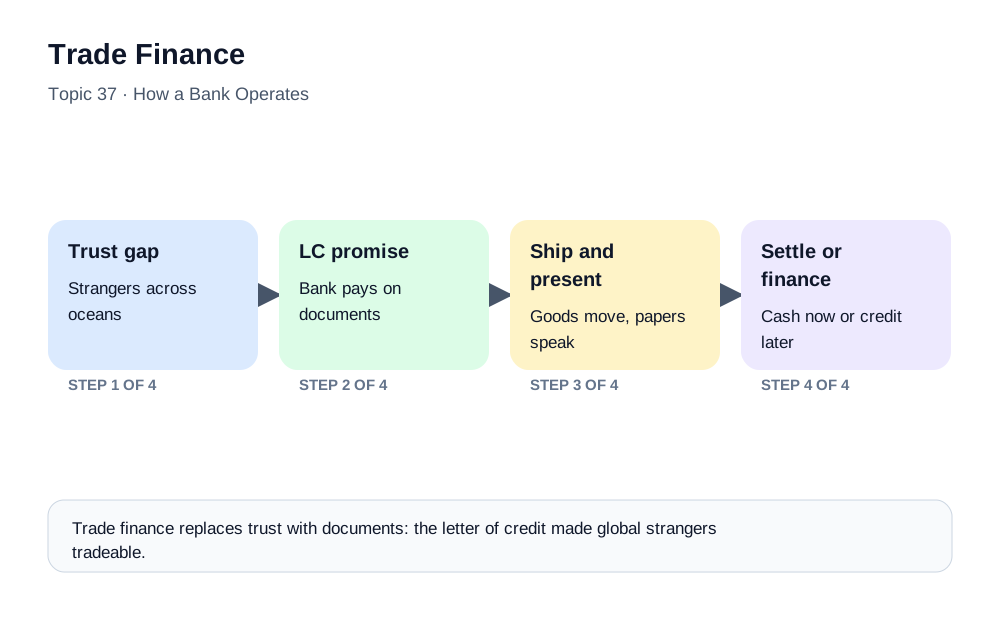
Trade Finance at a glance — Letters of credit, bank guarantees, supply chain finance.
1. The Trust Problem: Why Trade Finance Exists
The core challenge arises from the timing mismatch between shipment and payment. Exporters prefer payment before or upon shipment to fund production and eliminate non-payment risk. Importers prefer to pay after receiving and inspecting goods to ensure satisfaction and avoid paying for items never delivered. This conflict of preferences, multiplied across thousands of trade relationships daily, creates demand for financial intermediaries who can bridge the gap.
Notice what makes this problem special. In domestic trade, trust is supported by proximity, reputation, repeat business, and accessible courts. A supplier in one city can visit a customer in another, check references cheaply, and sue in a familiar legal system if unpaid. None of this works well across borders. The Vietnamese exporter cannot practically assess a German buyer's creditworthiness, does not know German commercial law, and would find foreign litigation slow and expensive. The buyer faces the mirror-image problem. Both parties are rational, and both would rather not trade than accept the other's terms, so valuable trade simply does not happen.
Trade finance solves this by inserting the one institution both parties can trust: a bank, or more precisely a chain of banks. The exporter trusts a bank's promise to pay because banks are regulated, capitalized, and rated. The importer trusts the bank's control over documents because payment flows only against proof of shipment. Neither party needs to trust the other directly; each trusts the structure. This substitution of institutional credit for personal trust is the single idea behind every instrument in this chapter.
There is also a second problem trade finance solves: time. Even when trust exists, trade ties up cash. The exporter spends money on materials and wages months before payment arrives; the importer pays out cash long before the goods can be sold. Bridging these gaps with working capital, the financing side of trade finance, is as important as the guarantees, and Sections 6 and 7 cover it in detail.
2. The Payment Spectrum: Four Ways to Settle a Trade
Before the instruments, it helps to see the whole menu. International trade is settled in four basic ways, arranged from safest-for-exporter to safest-for-importer.
Cash in advance. The buyer pays before shipment. Ideal for the exporter, terrible for the buyer, who now carries all the risk of non-delivery. Used for small orders, custom-made goods, or new relationships where the seller has all the bargaining power.
Letters of credit. Banks guarantee payment against documents, balancing risk between the parties. The subject of the next section, and the workhorse of traditional trade finance.
Documentary collections. Banks handle documents but guarantee nothing, cheaper than LCs, riskier for the exporter. Covered in Section 4.
Open account. The exporter ships and invoices; the buyer pays later, typically in thirty to ninety days. This is how the majority of modern trade between established partners actually settles, because it is cheapest and simplest. The exporter carries the full credit risk of the buyer, mitigated today by credit insurance, factoring, and supply chain finance rather than by bank guarantees.
A professional reads every trade finance proposal as a negotiation over this spectrum. Where the deal lands depends on bargaining power, relationship history, country risk, and the cost of each instrument. New relationships in higher-risk corridors start near the LC end; mature relationships between multinationals drift toward open account with financing layered on top.
3. Letters of Credit: The Cornerstone of Trade Finance
A documentary letter of credit is one of the classic instruments of international trade finance. The issuing bank gives an independent undertaking to honour a complying presentation under the credit, subject to the applicable terms and rules such as UCP 600 when incorporated. It is better described as a documentary bank undertaking than as a generic 'guarantee': the bank examines the stipulated documents, not the physical goods or the commercial performance of the sale contract. The structure can substitute issuing-bank risk for all or part of the seller's direct buyer-payment risk.
Two legal principles make the LC work, and every professional must internalize both.
Independence. The LC is separate from the underlying sales contract. The bank's obligation is to pay against conforming documents, not to ensure the goods themselves are correct. If the documents say "500 cartons of cotton shirts" and the cartons actually contain rags, the bank pays against conforming documents and the buyer's remedy is a lawsuit against the seller, not refusal of the bank's payment. This autonomy principle is what makes the bank's promise bankable: it cannot be entangled in commercial disputes.
Complying presentation. Banks examine the stipulated documents against the credit, UCP 600 when applicable, and recognised documentary examination practice; they do not inspect the goods themselves. A late shipment date or a document that fails a material credit requirement can create a discrepancy, but document examination should not be taught as a hunt for every harmless spelling variation. The professional question is whether the presentation complies with the credit and applicable rules on its face. Documentary precision matters because the bank's undertaking is triggered by the documents, not by an investigation of the underlying goods.
3.1 The Parties
A classic LC involves five parties. The applicant is the buyer who requests the LC. The issuing bank is the buyer's bank, which issues the LC and takes the primary payment obligation. The advising bank is the seller's bank, which authenticates the LC and advises it to the seller, usually without payment obligation of its own. The beneficiary is the seller. Where the beneficiary wants additional protection, a confirming bank, often the advising bank, adds its own payment undertaking, which we return to below.
3.2 The Workflow, Step by Step
The process begins when the buyer applies to their bank, the issuing bank, to open a letter of credit in favor of the seller. The bank evaluates the buyer's creditworthiness and may require cash collateral or credit lines to secure its obligation, because issuing an LC creates a contingent liability that converts into a real payment obligation the moment conforming documents appear. Once approved, the issuing bank transmits the LC to the seller's bank, the advising bank, traditionally by authenticated SWIFT message, which verifies authenticity and notifies the seller.
The seller now examines the LC carefully, a step too many exporters skip. Every term must be achievable: the shipment dates, the document list, the description of goods. If the LC calls for a document the seller cannot obtain, the time to fix it is before shipment, through an amendment, not after.
The seller ships goods and prepares documents specified in the LC, typically including the bill of lading proving shipment, commercial invoice describing the goods, packing list detailing contents, certificate of origin confirming manufacturing location, and insurance certificate covering transit risk. These documents are presented to the advising bank, which examines them for compliance with LC terms. Banks apply strict compliance standards; even minor discrepancies can justify rejection. Under the prevailing international rules, the ICC's Uniform Customs and Practice for Documentary Credits (UCP 600), banks have a maximum of five banking days following presentation to examine documents and decide. Industry experience consistently shows that a majority of first presentations contain discrepancies, which is why document preparation is a profession in itself.
If the presentation complies, the payment path depends on the credit's availability and the roles of the nominated, confirming, negotiating and issuing banks. A bank that merely advises a credit authenticates and transmits it but does not acquire a payment obligation simply because it is the advising bank. A nominated or confirming bank may honour or negotiate according to its role, and the issuing bank is bound to honour a complying presentation under the credit. Documents are then forwarded and handled according to the transaction. A negotiable bill of lading can perform a title/control function in the carriage of goods, but not every transport document is a document of title: sea waybills and other non-negotiable transport documents operate differently.
If documents do not comply, banks may seek buyer waiver of discrepancies or return documents to the seller for correction. In practice many discrepant presentations are eventually paid after the buyer waives, but the exporter has lost the LC's certainty: payment now depends on the buyer's goodwill, exactly what the LC was meant to remove.
3.3 A Worked Example with Numbers
Consider an Indian auto-components exporter selling USD 250,000 of parts to a buyer in a higher-risk market, under a confirmed usance LC payable ninety days from the bill of lading date. The issuing bank charges its applicant an issuance fee of, say, 0.15 percent of the amount (USD 375) plus SWIFT and handling charges. The confirming bank charges confirmation at perhaps 0.8 percent per annum on the covered risk (roughly USD 500 for a quarter), priced against the issuing bank and its country. The exporter ships, presents documents, and receives a compliant determination within the five banking days. Wanting cash now rather than in ninety days, the exporter discounts the confirmed usance draft at the prevailing short-term rate, receiving the USD 250,000 less the discount interest. The exporter has paid perhaps USD 1,500 to 2,500 in total bank costs, about one percent of the shipment value, and in exchange has converted a risky foreign receivable into near-immediate cash from a local bank. Whether that is expensive depends entirely on the alternative: an unsecured ninety-day exposure to an unknown overseas buyer.
3.4 Types of Letters of Credit
Different types of letters of credit address specific transaction needs.
Irrevocable LCs cannot be changed or cancelled without all parties' consent, providing sellers certainty that the commitment will not be withdrawn. Under UCP 600 every credit is irrevocable by default; the old "revocable LC," which offered the seller almost no protection, has disappeared from modern practice.
Confirmed LCs add the seller's bank guarantee to the issuing bank's obligation, providing double protection particularly valuable when dealing with banks in jurisdictions with political or economic risks. If the issuing bank or its country fails to pay, the confirming bank pays anyway. Confirmation costs extra, priced against the country and bank risk it absorbs.
Sight LCs provide immediate payment upon compliant document presentation, while usance LCs allow deferred payment after specified periods, typically thirty to one hundred and eighty days, providing credit terms to buyers while still letting sellers discount the bank's acceptance for early cash.
Standby LCs function as guarantees, invoked only if the applicant defaults, commonly used in domestic transactions and service contracts. Unlike a commercial LC, which is expected to be drawn on in the ordinary course, a standby is expected never to be drawn; it sits behind the transaction as protection.
Other structures appear in practice: transferable LCs, which let an intermediary pass part of the credit to actual suppliers; back-to-back LCs, where a trader's incoming LC supports a second LC to their supplier; and revolving LCs for repeated shipments under one framework. All are variations on the same independence-and-documents logic.
4. Bank Guarantees and Alternative Instruments
Bank guarantees provide assurance distinct from letters of credit. Where LCs facilitate payments, guarantees protect against non-performance. A performance guarantee promises payment if a contractor fails to complete a project as specified. A financial guarantee promises payment if a borrower defaults on an obligation. Bid bonds guarantee that contractors will honor their bids if selected. Advance payment guarantees secure the return of a buyer's upfront payment if the seller fails to deliver. These instruments give beneficiaries recourse to the bank if the guaranteed party fails to perform.
The legal character matters. Demand guarantees, governed internationally by the ICC's Uniform Rules for Demand Guarantees (URDG 758), are payable on first written demand accompanied by the statements the guarantee requires; the bank does not investigate whether default truly occurred. This makes them powerful instruments that applicants must issue carefully, because an unfair call is nearly impossible to stop at the bank counter, the remedy is afterward, in court.
Documentary collections offer a less expensive but less secure alternative to letters of credit. In a documentary collection, the seller's bank forwards documents to the buyer's bank with instructions to release them only against payment or acceptance of a bill of exchange, under the ICC's Uniform Rules for Collections (URC 522). Documents against payment requires immediate payment to receive documents, while documents against acceptance requires only commitment to pay later. Collections eliminate bank guarantees but still ensure that buyers cannot claim goods without accepting payment obligations. The crucial difference from an LC: if the buyer simply refuses to pay, the banks have no obligation to step in. The exporter's risk returns.
Bills of exchange, negotiable instruments ordering payment at future dates, have facilitated trade for centuries. An exporter might draw a bill on an importer, requiring payment sixty days after sight. The importer accepts by signing, creating an enforceable obligation. The exporter can hold the bill to maturity or discount it with a bank to receive immediate cash less discount interest. The accepted bill, especially when a bank adds its own acceptance, becomes a banker's acceptance, a tradeable money-market instrument in its own right.
5. What It Costs and Who Decides
Trade finance is a fee business, and understanding the pricing helps both sides negotiate. Issuing banks charge the applicant an issuance fee, typically a small percentage of the LC amount per period, scaled to the buyer's credit quality and collateral. Confirmation adds a second fee, priced against the issuing bank's and its country's risk, which is why confirmation into a stable banking system costs little while confirmation covering a stressed jurisdiction costs much more. Advising, amendment, negotiation, and document-checking each attract smaller fees, and discrepancies attract penalty fees that punish sloppy document preparation.
Who pays what is negotiable and specified in the LC itself. Exporters should price LC costs into their quotations, because a "cheap" sale absorbed by bank charges is not cheap at all. Importers should remember that their credit standing sets the price: a buyer with strong financials and clean collateral gets LCs issued cheaply and quickly, while a weak buyer may be asked for full cash cover, which defeats the instrument's working-capital purpose entirely.
6. Financing the Trade Cycle
Trade finance extends beyond payment guarantees to provide working capital throughout the trade cycle.
Pre-shipment finance, also called packing credit, advances funds to exporters before shipment to finance raw material purchase, manufacturing, and preparation for export. This bridges the gap between order receipt and shipment, when exporters face cash needs but have no receivables to pledge. Banks typically lend against a confirmed export order or LC, advancing a percentage of the order value and expecting repayment from the export proceeds. The risk is performance: if the exporter never ships, the bank holds a loan with no export receivable behind it, so banks monitor end-use and shipment evidence closely.
Post-shipment finance provides liquidity after goods have shipped but before payment is received. Bill discounting purchases the exporter's draft or bill of exchange at a discount, providing immediate cash while the bank collects the full amount from the importer later. Export factoring purchases export receivables outright, with the factor assuming credit risk as well as providing finance, and often handling collections and sales-ledger administration. Forfaiting provides medium-term finance for capital goods exports by purchasing receivables without recourse to the exporter, letting an exporter of machinery offer the buyer three-to-seven-year terms while receiving cash immediately. The distinction between with-recourse and without-recourse finance is fundamental: under recourse, the exporter must repay if the buyer defaults; without recourse, the financier has bought the risk along with the receivable, and prices accordingly.
Import finance assists buyers who need funding to complete purchases. Buyer's credit provides financing directly to importers, often at competitive rates reflecting bank relationships and collateral. LC-based finance structures deferred payment terms through usance letters of credit, allowing importers to pay after receiving and potentially selling the goods. For commodity importers, banks extend this into structured trade finance, lending against warehouse receipts and the goods themselves, with the cargo as collateral and its sale as the repayment source.
7. Modern Evolution: Supply Chain Finance
Supply chain finance represents a modern evolution that optimizes working capital across entire supply chains. Large buyers with strong credit ratings can leverage their borrowing capacity to provide favorable financing to smaller suppliers.
In a typical arrangement, a major retailer approves invoices from suppliers as valid and payable. Suppliers can then sell these approved receivables to a bank at low interest rates reflecting the retailer's credit rather than their own. Suppliers receive early payment, improving their cash flow. The retailer maintains their original payment terms, preserving their working capital. The bank earns spreads on low-risk financing backed by strong credits.
This win-win-win structure addresses a fundamental inefficiency in traditional trade finance. Small suppliers often face high borrowing costs and limited credit access despite selling to large, creditworthy buyers. Supply chain finance unlocks value by recognizing that the risk in these transactions depends on the buyer's credit, not the supplier's.
Two cautions belong in any professional treatment. First, buyers have sometimes used supply chain finance to extend their payment terms while presenting the program as supplier support, stretching suppliers who then pay to be paid; regulators and accounting standard-setters have moved to require clearer disclosure of these arrangements, since extended payables financed by banks can resemble hidden debt. Second, the model concentrates risk on the anchor buyer: if the anchor fails, every financed invoice loses its credit support at once. The collapse of the UK construction firm Carillion in 2018 left banks and suppliers exposed through exactly this channel. Supply chain finance is genuinely valuable, but it redistributes risk rather than eliminating it.
8. The Bank's Perspective: Risks Behind the Fees
Trade finance looks safe, short-dated, self-liquidating, collateralized by goods and documents, and historically its loss rates have been low relative to other lending. But the risks are specific and unforgiving.
Documentary fraud is the classic. Because banks deal in documents, not goods, forged or fraudulent documents are the attack surface: fake bills of lading, inflated invoices, phantom shipments. The great salad oil swindle of 1963 saw a trader borrow against warehouse receipts for vast tanks of vegetable oil that turned out to contain mostly water, with the "oil" layer floated on top to fool inspectors; banks lost heavily. Modern versions use duplicated electronic documents or round-tripped cargo. Defenses are operational: verify documents with carriers and counterparties, know your customer's business, and treat unusual terms as red flags.
Credit and country risk sit in every LC. The issuing bank takes the buyer's credit risk; the confirming bank takes the issuing bank's and its country's transfer risk, the danger that a government blocks foreign currency outflows even when the local bank is solvent.
Compliance risk has grown into the largest operational burden. Trade transactions are screened against sanctions lists, and banks must also watch for trade-based money laundering, where criminals move value through over- or under-invoicing, multiple invoicing of the same shipment, or misdescription of goods. Dual-use goods, items with civilian and military applications, require extra scrutiny. These obligations, detailed further in the financial crime chapter, mean every trade transaction passes through document checking and sanctions screening, adding cost and delay that honest traders feel as friction but that the system requires.
Operational risk concentrates in document checking. A bank that pays against discrepant documents without the applicant's waiver may lose its right to reimbursement; a bank that wrongly rejects complying documents faces liability to the beneficiary. The five-banking-day examination clock under UCP 600 turns this into a time-pressured, high-skill judgment repeated thousands of times daily across the industry.
9. Digitalization: Paper's Long Goodbye
Trade finance remains one of banking's most paper-intensive corners. A single shipment can generate dozens of original documents couriered between parties, and the bill of lading's status as a document of title has long required physical possession, making the trade wait on the courier.
Change is arriving on several tracks. The ICC has supplemented UCP 600 with electronic presentation rules (the eUCP, updated to version 2.0 in 2019) and published the Uniform Rules for Digital Trade Transactions (URDTT, 2021) for fully digital records. UNCITRAL's Model Law on Electronic Transferable Records (2017) provides a template for giving electronic bills of lading the same legal force as paper, and an increasing number of jurisdictions have adopted or are adopting legislation on these lines. Digital platforms now connect carriers, banks, and traders so that documents are created, checked, and transferred electronically, compressing document turnaround from weeks to days and reducing discrepancy-driven delays.
The direction is clear even if adoption is uneven: documents will become data, checking will become increasingly automated, and financing decisions will be made against real-time shipment information rather than couriered paper. What will not change is the underlying logic this chapter has emphasized throughout: someone must carry the trust, and someone must carry the time. Banks are paid for both.
10. Common Misconceptions About Trade Finance
"A letter of credit guarantees I will be paid." It guarantees payment only against strictly conforming documents. Exporters who treat the LC as a blank cheque and prepare sloppy documents discover that a discrepant presentation converts bank risk straight back into buyer risk.
"The bank checks the goods." Banks deal in documents and not in goods, a principle stated explicitly in UCP 600. The bank pays against documents describing conforming goods; whether the goods actually conform is a matter between buyer and seller.
"Confirmed means the goods are guaranteed." Confirmation guarantees payment, not performance. It adds a second bank's promise to pay against documents, protecting against issuing-bank and country risk, nothing more.
"Documentary collections are just cheaper LCs." In a collection, banks handle documents but promise nothing. If the buyer refuses to pay, no bank is obliged to step in. The cost saving is real; so is the risk you have re-assumed.
"Supply chain finance is free money for suppliers." Suppliers receive early payment at attractive rates, but the program's credit support is the anchor buyer. If the anchor fails or the program is withdrawn, financing disappears precisely when suppliers need it most.
"Digital documents will make trade finance risk-free." Digitalization removes courier delays and many discrepancies, but fraud, credit risk, country risk, and compliance obligations all remain. Technology changes the plumbing, not the trust problem.
11. Frequently Asked Questions
What is the difference between advising and confirming? An advising bank authenticates and delivers the LC but promises nothing. A confirming bank adds its own independent payment undertaking: if the issuing bank or its country cannot pay, the confirming bank must. Confirmation is insurance you pay for; advice is delivery you receive free of obligation.
Who pays the fees on a letter of credit? As agreed in the LC. Commonly the applicant pays issuance and the beneficiary pays advising and negotiation fees in their own country, but everything is negotiable. Exporters should price expected LC costs into their quotations.
What are the most common documentary discrepancies? Late shipment, late presentation, expired credit, invoice description not matching the LC word-for-word, missing or wrongly consigned bills of lading, and insurance dates later than shipment. Nearly all are avoidable by reading the LC on receipt and preparing documents against a checklist.
Is a letter of credit necessary for every export? No. Most trade between established partners settles on open account, with credit insurance or factoring covering the risk. LCs earn their cost in new relationships, higher-risk countries, large one-off transactions, and where the exporter's own bank requires one before lending.
What is the difference between a bank guarantee and a standby LC? Functionally both are payable on default rather than in the ordinary course. The differences are legal framework and market practice: demand guarantees follow URDG 758 and are common in Europe, the Middle East, and Asia; standbys follow LC practice and are common in the Americas. A banker chooses the form the beneficiary's jurisdiction prefers.
Can a small exporter get pre-shipment finance without an LC? Often yes, against a confirmed purchase order from a creditworthy buyer, though banks lend more readily and cheaply against LCs because the repayment source is a bank's promise. Order quality, exporter track record, and collateral all shape the decision.
What happens if goods arrive damaged under an LC? The bank still pays against conforming documents; that is the independence principle. The buyer's remedies are the insurance claim (if transit risk was insured, which the LC's insurance document requirement exists to ensure) and a claim against the seller under the sales contract.
12. Key Terms in This Chapter
- Trade finance — the banking services that bridge trust and timing gaps in international commerce.
- Letter of credit (LC) — a bank's conditional promise to pay a seller against conforming documents.
- UCP 600 — the ICC's Uniform Customs and Practice for Documentary Credits, the global rulebook for LCs.
- Independence (autonomy) principle — the LC is separate from the sales contract; banks deal in documents, not goods.
- Strict compliance — documents must match LC terms exactly; discrepancies entitle banks to refuse.
- Applicant / issuing bank / advising bank / beneficiary — the buyer, the buyer's bank, the seller's bank, and the seller in an LC.
- Confirming bank — a bank adding its own payment undertaking to the issuing bank's.
- Bill of lading — the transport document that is receipt, contract evidence, and document of title.
- Sight / usance LC — immediate versus deferred payment terms under a credit.
- Standby LC / demand guarantee — instruments payable on default rather than in the ordinary course, governed by LC practice or URDG 758.
- Documentary collection — banks forwarding documents against payment or acceptance, under URC 522, with no payment guarantee.
- Bill of exchange / banker's acceptance — a signed order to pay at a future date; bank-accepted versions trade as money-market instruments.
- Pre-shipment / post-shipment finance — working capital before shipment (packing credit) and after shipment (discounting, factoring, forfaiting).
- With / without recourse — whether the financier can claim back from the exporter if the buyer defaults.
- Forfaiting — without-recourse purchase of medium-term export receivables, typically for capital goods.
- Supply chain finance — buyer-approved invoice financing priced on the anchor buyer's credit.
- Trade-based money laundering — moving illicit value through mis-invoiced or mis-described trade.
- eUCP / URDTT / electronic transferable records — the rule frameworks and legal templates enabling digital trade documents.
13. Interview Insights: How This Topic Appears in Banking Interviews
"Explain a letter of credit as if the client has never used one." Strong candidates lead with the trust problem, not the jargon: two strangers across borders, each fearing the other will not perform; the buyer's bank promises to pay the seller once documents prove shipment. Then name the parties and walk the flow. Interviewers reward candidates who mention the two principles, independence and strict compliance, unprompted.
"Why do banks refuse payment for a spelling mistake?" This tests whether you understand the bank's position. Document examiners cannot inspect goods, so documents are the only protection; if banks exercised judgment about which discrepancies "matter," they would inherit commercial disputes the LC was designed to avoid. Add the practical nuance: many discrepancies are waived by applicants, but waiver converts the exporter's protection back into dependence on the buyer.
"When would you advise a client to use an LC versus open account?" Weigh relationship maturity, country risk, transaction size, and cost. LCs for new counterparties and higher-risk corridors; open account with credit insurance, factoring, or supply chain finance for mature relationships. Candidates who answer "always use an LC" reveal they have never priced one.
"What risks does a confirming bank take?" Issuing-bank credit risk and country transfer risk: the confirming bank pays the beneficiary against conforming documents and then looks to the issuing bank for reimbursement, which may fail through insolvency or through the issuing country's foreign exchange controls. This is why confirmation fees vary so widely by jurisdiction.
"How can trade finance be abused for money laundering?" Describe trade-based laundering: over- and under-invoicing to transfer value, multiple invoicing of one shipment, phantom shipments with collusive documents. Banks respond with price reasonableness checks, document verification, vessel and sanctions screening, and knowing the customer's normal business. This question separates candidates who know the compliance dimension from those who only know the product.
Summary and Key Takeaways
- International trade's core problem is trust plus timing: buyer and seller each rationally prefer terms the other cannot accept, and banks bridge the gap by substituting institutional credit for personal trust.
- The payment spectrum runs from cash in advance through LCs and collections to open account; where a deal lands reflects bargaining power, relationship, and country risk.
- A letter of credit is a bank's conditional promise to pay against conforming documents, resting on two pillars: independence from the sales contract and strict compliance of documents.
- LC variants, confirmed, usance, standby, transferable, exist to allocate specific risks; guarantees protect performance while LCs facilitate payment.
- Collections and bills of exchange are cheaper instruments that return more risk to the exporter.
- Banks finance the whole cycle: packing credit before shipment, discounting, factoring, and forfaiting after it, and structured finance against the goods themselves.
- Supply chain finance prices supplier risk on the anchor buyer's credit, creating real efficiencies and real concentration risk.
- The bank's own risks are documentary fraud, credit and country risk, compliance failures, and document-checking errors, managed through verification, screening, and disciplined examination.
- Digitalization is converting documents into data under eUCP, URDTT, and electronic transferable records laws, but the trust and timing problems that created trade finance remain, and banks remain paid to solve them.
Next: Topic 38 — NRI Banking and Remittances →
<!-- MBA-DEEP-DIVE-START -->Deep Dive: Trade Finance as a Controlled Chain of Documents, Credit, Goods, and Settlement
Trade finance is easiest to understand when it is treated as an operating system for commerce rather than a catalogue of products. The exporter wants certainty of payment. The importer wants certainty that shipment has occurred on agreed terms. Banks cannot inspect every container or arbitrate every commercial dispute, so they convert the trade into a controlled sequence of contractual undertakings, documents, credit decisions, ownership rights, and payment events. The discipline comes from knowing exactly what the bank is promising, what it is not promising, and which evidence triggers the next step.
The central boundary is that a documentary bank generally deals with documents rather than the underlying goods, services, or performance. Under a documentary credit, the bank examines the presented documents against the credit and the applicable rules. The bank is not certifying that the machinery works, that the rice inside a container is of the promised grade, or that a vessel will arrive without delay. That separation is what makes documentary instruments scalable across borders: a bank can evaluate documentary compliance consistently even when it has no practical ability to inspect the commercial subject matter.
The sales contract comes first
A letter of credit should never be treated as the first event. The transaction begins with a sales contract between buyer and seller. That contract should identify the goods or services, price, currency, delivery term, transport responsibilities, insurance responsibilities, required documents, and payment method. If those terms are vague or contradictory, the bank will inherit the ambiguity later.
The buyer then asks its bank to issue a documentary credit that reflects the agreed payment conditions. A good trade-finance team compares the requested credit with the commercial purpose and identifies terms that are impossible, unnecessary, or likely to create discrepancies. A credit requiring a certificate that no independent authority actually issues is operationally defective before it is transmitted.
This is why experienced banks discourage excessive documentary conditions. Every extra condition creates another point of failure. The strongest documentary credit is not the one with the largest document list; it is the one that asks for evidence genuinely necessary to protect the parties and can be objectively examined.
The issuing bank is taking credit risk before any goods move
When an issuing bank opens a letter of credit, it creates a contingent obligation. The bank may have paid nothing yet, but if a complying presentation is made, its undertaking can become a payment obligation. The credit decision therefore occurs before issuance.
The bank assesses the applicant's repayment capacity, account conduct, existing facilities, country exposure, industry, collateral, goods being financed, tenor, and the proposed transaction. The bank may issue under a sanctioned trade limit, obtain cash margin, take security over inventory or receivables, or require other risk mitigants.
This distinction matters for analysts: document checking and credit underwriting are separate controls. Perfectly compliant documents do not make a weak applicant financially strong. Equally, an excellent applicant does not allow the bank to ignore documentary conditions promised to the beneficiary.
Advice, confirmation, and nomination are different roles
The advising bank authenticates the documentary credit and communicates it to the beneficiary. Advice alone does not automatically create the advising bank's own obligation to pay. A confirming bank, by contrast, adds its own independent undertaking in addition to that of the issuing bank, subject to the terms of the credit and applicable rules.
Confirmation is therefore a transfer of risk. The exporter who is uncomfortable with the issuing bank or country can obtain the credit of a stronger confirming bank. The confirming bank must then price not only documentary risk but the issuing bank's credit quality, sovereign and transfer risk, tenor, currency, and its ability to obtain reimbursement.
A nominated bank may be authorised to pay, accept, incur a deferred payment undertaking, or negotiate under the credit, depending on its terms. These roles should not be collapsed into the generic phrase ‘beneficiary's bank’ because their rights and obligations differ materially.
Document examination is a controlled decision, not a visual check
A document examiner should be able to reconstruct the credit's documentary logic. What documents are required? Which data must be consistent? What shipment date applies? What presentation period applies? Is the transport document the correct type? Is it signed in an acceptable capacity? Does the invoice description correspond with the credit? Does the insurance document provide the required cover? Are originals required? Are there prohibited alterations or missing endorsements?
Under UCP 600, the relevant banks have a maximum of five banking days following the day of presentation to determine whether a presentation is complying. That is a maximum examination period, not a service target that every bank should consume in full. Well-run banks triage presentations, identify discrepancies quickly, and preserve the evidence supporting the decision.
The examiner must also distinguish data conflict from mere non-identical wording. Documentary practice does not require every word to be duplicated across every document. The test is whether the documents, read in context, comply with the credit and do not conflict in a way that makes the presentation non-compliant.
Discrepancies need precise reason codes
‘Documents discrepant’ is not a useful operational status. Each discrepancy should be specific enough for the beneficiary, issuing bank, applicant, operations team, and auditor to understand it.
Examples include late shipment, late presentation, expired credit, invoice amount exceeding the credit, missing required document, incorrect transport document, inconsistent ports, unsigned document, insurance dated too late, or a document issued by the wrong party.
This precision matters because the next action depends on the discrepancy. Some defects can be corrected before the presentation deadline. Others cannot. The issuing bank may seek a waiver from the applicant, but a waiver request does not erase the discrepancy. Until the bank decides to honour or negotiate in accordance with the applicable framework, the documentary position must remain clear.
A bank should also avoid ‘soft clauses’ that make payment depend on evidence controlled entirely by the applicant, such as a certificate that only the buyer can issue after shipment. Such conditions can turn an apparently secure credit into an instrument the beneficiary cannot independently satisfy.
Waiver is a commercial decision layered on top of documentary control
Suppose the bill of lading shows shipment two days after the latest permitted date. The presentation is discrepant. The issuing bank may contact the applicant and ask whether it wishes to waive the discrepancy. If the applicant agrees and the bank is willing to accept the waiver, payment may still occur.
But the bank should not confuse the applicant's waiver with a finding that the documents were originally compliant. The audit trail should show the discrepancy, the waiver request, the applicant's authority, the bank's approval, and the final disposition.
This distinction becomes critical when disputes arise later. A system that simply changes ‘discrepant’ to ‘compliant’ after waiver destroys useful legal and operational history.
Reimbursement is its own process
Trade-finance learners often stop at ‘the bank pays the exporter’. In reality, the paying or nominated bank must obtain reimbursement from the issuing bank or a designated reimbursing bank according to the credit arrangement.
The reimbursement instruction can create timing, currency, nostro, and counterparty exposures. Operations must know which account is to be debited, which value date applies, what authentication is required, whether charges are for applicant or beneficiary, and what happens if reimbursement is delayed.
A documentary credit can therefore have a clean presentation and still create an operational loss if reimbursement instructions are wrong. Trade finance is simultaneously documentary banking and payment operations.
Deferred-payment credits create financing opportunities and risks
A usance or deferred-payment credit separates document acceptance from final payment. The beneficiary may be entitled to payment thirty, sixty, ninety, or more days after a defined event. If the beneficiary wants cash earlier, a bank may discount or purchase the future receivable subject to the structure.
The financing decision should identify whether the bank has recourse to the beneficiary, whose credit risk it is ultimately taking, whether confirmation exists, which maturity date is correct, and whether the receivable is legally transferable or purchasable as structured.
Discounting should never be treated as merely subtracting interest. The bank is converting a future bank or corporate exposure into immediate cash and must price funding, tenor, credit risk, country risk, capital, and operational costs.
Guarantees require a different mental model
A documentary credit is normally expected to support payment in the ordinary course of trade. A demand guarantee is generally intended to be called only if the applicant fails to perform an obligation covered by the guarantee.
The bank should therefore analyse the trigger language carefully. What constitutes a compliant demand? Which statement must the beneficiary provide? What amount can be called? What expiry mechanism applies? Does the guarantee reduce automatically after milestones? Is a governing ruleset such as URDG 758 incorporated?
An unconditional-sounding guarantee can expose the bank to a valid documentary demand even when the applicant insists that it performed perfectly. As with documentary credits, independence from the underlying contract is the feature that gives the instrument value and also creates risk for the applicant.
Banks should manage guarantee limits, expiry diaries, claim events, reductions, collateral, and release evidence with the same discipline used for funded loans. A guarantee that has economically expired but remains legally open because no valid release or expiry event was recorded can continue consuming risk capacity.
Trade-based money laundering changes the control framework
Trade finance can be abused because international commerce naturally involves complex goods, multiple jurisdictions, intermediaries, invoices, transport documents, and pricing that can be difficult for outsiders to verify. Trade-based money laundering may involve over-invoicing, under-invoicing, multiple invoicing, phantom shipments, false description of goods, third-party payments, unusual routing, or circular trade.
No single red flag proves financial crime. A legitimate commodity price can move sharply. A parent company may pay for a subsidiary. A shipment may be routed through a transshipment hub for commercial reasons. The control objective is to identify patterns that are inconsistent with the customer's known business and obtain credible explanation and evidence.
A bank should understand the customer's expected goods, counterparties, countries, transaction sizes, shipping routes, and payment behaviour. A small textile importer suddenly financing high-value industrial chemicals to a new high-risk jurisdiction is a reason to investigate even if every individual document appears formally complete.
Sanctions controls need both parties and goods context
Trade sanctions screening can be more complex than screening an ordinary domestic payment. The bank may need to consider applicant, beneficiary, banks, vessel, carrier, ports, countries, goods, dual-use concerns, ownership or control of entities, and other parties appearing in documents.
A name-screening engine alone cannot decide every case. Vessel names can change. Ownership structures can be opaque. Goods descriptions can be broad. Compliance teams need escalation procedures and access to supporting documentation.
The bank must also prevent an operational shortcut in which documents are released or payment is made before a required sanctions review is complete. Workflow states should make compliance clearance explicit where required.
Physical control of documents still matters
Even in digital banking, certain trade documents can represent rights over goods or be needed by the importer to obtain delivery. Loss, duplicate release, incorrect endorsement, or delivery to an unauthorised party can therefore have economic consequences far beyond the cost of paper.
Document custody should include receipt logging, controlled storage, access restrictions, dispatch tracking, maker-checker release, and clear handling of originals versus copies. If documents are scanned for processing, the digital image should not create uncertainty about where the legal original resides.
Goods, collateral, and borrowing-base risk
When banks finance commodities or inventory, the goods themselves may support the credit. That introduces collateral controls: warehouse quality, inspection, insurance, title, location, price volatility, concentration, release conditions, and fraud risk.
A warehouse receipt is valuable only if the warehouse exists, the goods exist, the receipt is authentic, the bank's rights are enforceable, and the same goods have not been pledged repeatedly.
Commodity finance can appear highly secured while becoming dangerous during a price collapse. A bank lending 80% against copper inventory may suddenly find the collateral coverage inadequate if copper prices fall sharply. Borrowing bases therefore need haircuts, margining, concentration limits, and independent price sources.
Supply-chain finance starts after invoice approval
In reverse-factoring or approved-payables structures, the bank relies substantially on the anchor buyer's obligation to pay an approved invoice. Operational integrity therefore depends on the buyer's approval event.
The platform should know whether an invoice is created, validated, approved, disputed, financed, paid, cancelled, or credited. Financing an invoice before valid buyer approval can convert low-risk buyer exposure into supplier performance risk. Financing the same invoice twice creates obvious loss potential.
Duplicate-invoice detection, buyer-authority controls, invoice identifiers, credit-note handling, and settlement reconciliation are as important as the credit line itself.
Digital trade should reduce paper without weakening legal certainty
Electronic presentation, electronic bills of lading, trade platforms, digital signatures, and structured data can reduce delay and manual errors, but digitisation should not be confused with scanning paper into PDF files.
A genuinely digital trade process needs reliable identity, authenticity, control over transferable electronic records where law permits, version management, timestamping, data integrity, and interoperability between parties.
The control question remains the same as in paper trade: who issued this record, can it be altered, who currently controls it, and what legal right does it represent? Technology is valuable when it answers those questions more reliably than paper, not merely faster.
A complete import LC scenario
Consider an Indian manufacturer buying specialised equipment from a German exporter for EUR 2 million under an irrevocable documentary credit.
The manufacturer and exporter agree the sales contract, including shipment term, latest shipment date, required transport and insurance evidence, and ninety-day deferred payment. The importer applies to its bank. Credit approves the contingent exposure within the customer's trade limit and obtains the required margin and security. Operations creates the credit exactly as approved, and an authorised second officer checks the terms before release.
The issuing bank transmits the authenticated credit to the advising bank. The exporter reviews it, requests one amendment because a requested certificate is impossible to obtain, and ships only after the amendment is issued and accepted.
The exporter presents documents. The nominated bank checks them and identifies one apparent discrepancy in the insurance wording. The discrepancy is analysed against the credit and applicable practice; after review it is determined not to conflict with the credit, so the presentation is treated as complying. Documents are forwarded and the deferred-payment obligation is recorded.
The importer receives the documents needed to take delivery. The bank's system records the maturity date. Treasury forecasts the EUR outflow. Before maturity, the importer funds the required account. On value date, reimbursement and settlement occur, the contingent exposure converts and closes according to the accounting process, fees are recognised, and all document and payment records reconcile.
Now imagine the importer cannot fund on maturity. The documentary process may have been perfect, but the bank still has credit risk on its customer. Trade finance never eliminates credit risk; it structures, reallocates, documents, and controls it.
What excellence looks like
A world-class trade-finance operation can answer every important question for every transaction. What commercial purpose is being financed? Which bank has which undertaking? What documents trigger payment? Were they examined under the correct rules and within the required time? Which discrepancies were found, waived, or refused? Who carries applicant, issuing-bank, country, commodity, and settlement risk? Are goods and counterparties consistent with the customer's profile? Are sanctions and trade-based money-laundering risks cleared? Where are original documents? When does the exposure mature? How will reimbursement occur? Do customer, trade, accounting, and settlement records reconcile?
Trade finance becomes understandable when those questions remain connected. The products differ, but the discipline is the same: convert a cross-border commercial promise into a chain of independently controlled events that can survive distance, mistrust, legal complexity, and operational failure.
<!-- MBA-DEEP-DIVE-END -->