Every cross-border transaction that requires one currency to be exchanged for another — whether a tourist conversion, an importer paying overseas suppliers or a corporation hedging foreign revenues — connects to the foreign-exchange market directly or through intermediaries. The Bank for International Settlements' 2025 Triennial Central Bank Survey reported average OTC FX turnover of about US$9.6 trillion per day in April 2025 on its net-net basis, up from US$7.5 trillion in 2022. The figure measures trading turnover, not the value of underlying world trade, and includes spot and FX derivatives activity. The market operates across global time zones, with banks and other dealers providing liquidity, settlement access and risk-management services that support commerce and investment.
By the end of this chapter, you will be able to:
- Explain why foreign exchange markets exist and why banks sit at their center
- Read an exchange rate quote, including bid-ask spreads, pips, and currency pairs
- Distinguish the major exchange rate regimes, from free floats to hard pegs
- Describe the core FX products banks sell: spot, forwards, swaps, and options
- Trace how a cross-border payment actually moves through Nostro and Vostro accounts
- Understand settlement risk and the role of payment-versus-payment mechanisms
- Identify the three types of FX risk businesses face and how each is hedged
- Explain what has changed for retail customers in the digital era
Visual overview
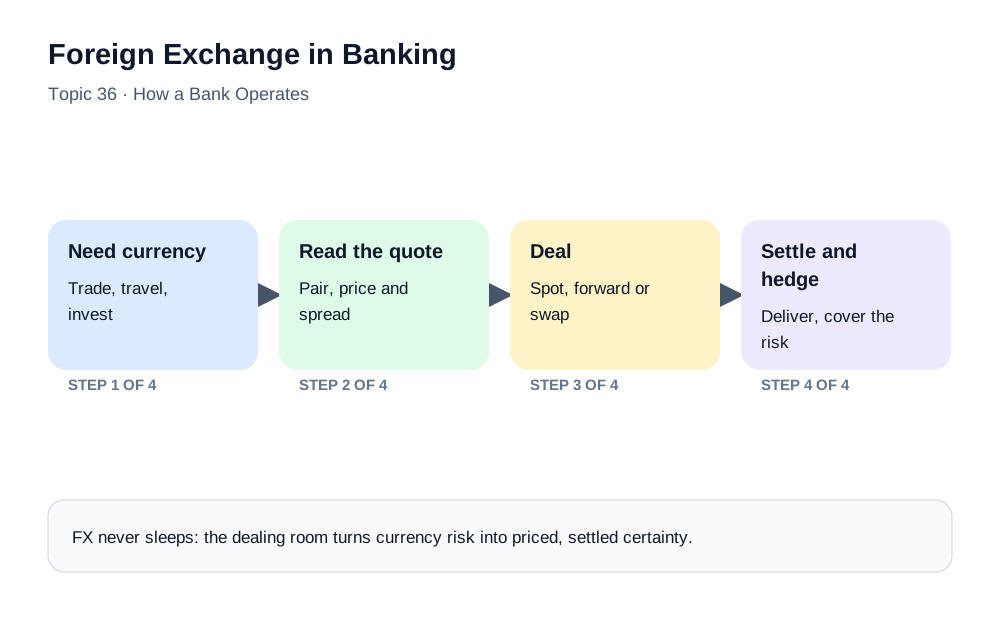
Foreign Exchange in Banking at a glance — FX desks, currency pairs, hedging.
1. Introduction: The Market That Never Sleeps
The foreign exchange market has no central exchange, no physical location where trading occurs. Instead, it functions as a decentralized network of banks, dealers, brokers, and electronic platforms connected by communication systems. Traders in one institution deal directly with traders in another, bilaterally or through electronic venues, and prices form from this continuous negotiation rather than from a single auction.
Trading follows the sun. The day begins in Sydney and Wellington, moves through Tokyo, Singapore, and Hong Kong, passes to the Middle East centers, peaks when London and New York overlap in the afternoon European time, and concludes with the US West Coast before Sydney opens again. Each center's business hours overlap with the next, creating seamless twenty-four-hour operation from Monday morning in Asia-Pacific to Friday evening in New York. This global continuity ensures that exchange rates adjust continuously to news and events, with no pause for market closing. An announcement in Washington at midnight London time moves prices instantly, because somewhere in the world a dealing desk is open.
Two features of this structure matter for everything that follows. First, with no central exchange there is no single official price: banks quote slightly different rates simultaneously, and a customer's rate depends on size and negotiating skill. Second, bilateral trading means every participant bears counterparty credit exposure, which is why the market developed the settlement infrastructure discussed later.
2. Why Foreign Exchange Exists: The First Principles
Currencies exist because economies issue their own money. As long as a buyer in one currency zone wants goods, services, or assets priced in another, someone must convert one money into the other. That conversion is foreign exchange, and the price at which it happens is the exchange rate.
Imagine an exporter in India selling textiles to a buyer in the United States. The buyer holds dollars; the exporter's workers, suppliers, and landlord all expect rupees. Whoever invoices, someone must convert: sell dollars for rupees. A currency transaction must occur, and both parties face the question of what rate they will get.
Scale that up to tens of trillions of dollars of annual merchandise trade, plus cross-border services, investment flows, tourism, remittances, and central bank reserve management. Each flow generates a demand to buy one currency and sell another, and the foreign exchange market is the aggregate of all these conversion needs plus the financial activity that intermediates them.
Banks became the market's natural home for three reasons: they hold accounts in many currencies through correspondent networks, so they can settle conversions; they assess counterparty credit, which bilateral dealing requires; and they run payment systems, so conversion can be bundled with the actual movement of money. A customer does not merely want a rate; the customer wants the dollars to arrive in the supplier's account in New York.
3. Reading an Exchange Rate: Quotes, Pairs, and Spreads
Before going further, it is essential to read an FX quote fluently, because confusion here causes expensive mistakes in practice.
Currency pairs and the base currency. Exchange rates are quoted as pairs, such as EUR/USD 1.0850. The first currency (EUR) is the base currency; the second (USD) is the quote or counter currency. The number tells you how many units of the quote currency buy one unit of the base currency. EUR/USD 1.0850 means one euro costs 1.0850 dollars. Most major pairs follow market convention for which currency is the base: the euro, pound, and Australian and New Zealand dollars are conventionally quoted against the dollar as the base (EUR/USD, GBP/USD), while the dollar is the base against the yen, Swiss franc, Canadian dollar, and most emerging market currencies (USD/JPY, USD/INR).
Direct and indirect quotations. In domestic retail contexts, a direct quotation expresses the price of foreign currency in home currency units. For an Indian customer, USD/INR 83.25 is a direct quote: one dollar costs 83.25 rupees. The same information expressed the other way, rupees per hundred or per unit, would be an indirect quotation. Knowing which convention is in use prevents a surprisingly common error: multiplying when you should divide.
Bid and ask. A bank's quote is two-sided. The bid is the rate at which the bank will buy the base currency from you; the ask (or offer) is the rate at which it will sell the base currency to you. If a bank quotes USD/INR at 83.20 / 83.30, it buys dollars at 83.20 and sells them at 83.30. The customer always gets the worse side of the quote: a customer selling dollars receives 83.20, while a customer buying dollars pays 83.30. The difference, 0.10 rupees here, is the spread, and it is the dealer's gross compensation for providing immediacy and bearing risk.
Pips. Price movements are measured in pips, the smallest conventional increment of a quote. For most pairs a pip is the fourth decimal place (0.0001); for yen pairs it is the second decimal place (0.01). If EUR/USD moves from 1.0850 to 1.0875, it has risen 25 pips. On a one-million-euro transaction, each pip is worth one hundred dollars, which gives a sense of how quickly small moves aggregate on large tickets.
Worked example. An Indian importer must pay USD 500,000. The bank quotes USD/INR 83.20 / 83.30. The importer buys at the ask: 500,000 × 83.30 = INR 41,650,000. Against a mid-rate of 83.25, the cost versus mid is 0.05 × 500,000 = INR 25,000, the price of immediacy, service, and risk. A month later an exporter sells USD 500,000 at the bid of 83.20, receiving INR 41,600,000. Spread discipline, comparing quotes across banks, is a real cash management skill.
Cross rates. Not every pair trades actively. Converting, say, Singapore dollars into Indian rupees is often constructed from two liquid legs, SGD to USD, then USD to INR. The implied rate is a cross rate, and the customer effectively pays two spreads, one reason quotes in less liquid combinations look noticeably worse than headline rates.
4. Exchange Rate Regimes and Determination
Currencies operate under different regimes that determine how their values are established.
Free floating currencies, including the dollar, euro, pound, and yen, derive their values from market supply and demand. Floats absorb shocks automatically: when an economy weakens, its currency tends to depreciate, cheapening exports and cushioning the downturn. The cost is volatility, which businesses manage with the hedging tools covered later.
Managed float currencies, including the Indian rupee and Brazilian real, generally follow market determination but allow central bank intervention to smooth excessive volatility or prevent destabilizing movements. The central bank sells foreign reserves to support its currency when depreciation becomes disorderly, or buys foreign currency to slow appreciation that threatens export competitiveness. Market participants in managed floats watch the central bank's behavior almost as closely as they watch economic data, because intervention can dominate short-term price action.
Pegged currencies maintain fixed rates against major currencies. Hong Kong has pegged to the US dollar within a tight band since 1983, and Saudi Arabia pegs the riyal to the dollar, reflecting the dollar pricing of oil. Pegs deliver stability for trade but import the anchor country's monetary policy and require large reserves to defend; when markets doubt sustainability, speculative attacks can force violent abandonment, as the UK learned when sterling was expelled from the European Exchange Rate Mechanism in 1992.
Currency boards represent the strictest pegs, requiring full foreign reserve backing of the monetary base: the authority cannot issue domestic money without acquiring equivalent foreign currency, surrendering monetary policy for maximum credibility.
The regime determines who bears exchange rate risk. Under a hard peg, the central bank absorbs volatility and businesses trade at known rates, until the peg breaks. Under a float, volatility passes through daily, and hedging becomes a core discipline rather than an optional extra.
5. What Moves Exchange Rates
Multiple factors drive exchange rate movements, and professional dealers hold all of them in mind simultaneously.
Interest rate differentials attract capital to higher-yielding currencies, strengthening them as investors seek returns. This relationship also anchors forward pricing, as we will see: forward rates are not forecasts but arithmetic consequences of interest differentials.
Inflation erodes purchasing power, with higher-inflation currencies tending to depreciate over long horizons. This is the intuition behind purchasing power parity: in the long run, exchange rates should adjust so identical goods cost the same everywhere. Deviations persist for years, but persistent inflation differentials eventually show up in the rate.
Trade balances affect currency demand, with surplus countries typically seeing appreciation as exporters sell foreign currency earnings for domestic currency. Chronic deficit countries face the reverse pressure, financed only as long as foreigners willingly hold their assets.
Capital flows, whether direct investment, portfolio flows, or speculation, can overwhelm trade effects. Daily FX turnover is many multiples of the trade it notionally serves, because investors moving portfolios generate far more conversion volume than importers and exporters do.
Central bank intervention, direct buying or selling of currency, can influence short-term movements even in floating regimes, working best when coordinated with interest rate policy and backed by credible reserves.
Political stability and economic prospects drive risk appetite, with uncertainty pushing investors toward safe-haven currencies like the dollar, Swiss franc, and yen. In crises, calm-time correlations break down and capital stampedes toward safety regardless of yield.
The practical lesson for banking professionals: exchange rates are not random, but they are not predictable either. Every factor above is known to every market participant simultaneously, and prices adjust to new information within seconds. This is why banks teach customers to manage currency risk rather than to bet on currency direction.
6. Inside the FX Dealing Room: The Bank's Perspective
To understand the products banks sell, it helps to see the machine behind them. A bank's FX operation is organized around three functions.
Sales desks face customers. When a treasurer calls to sell ten million euros, the salesperson quotes the trading desk's price plus a margin calibrated to the customer's size and sophistication. Large customers who check multiple banks get tight margins; small ones accepting the first quote get wider ones, the same pricing ladder seen in deposits and loans.
Trading desks manage the resulting risk. Having bought the customer's euros, the bank holds a position that fluctuates with the market. The trader can warehouse it within strict limits or offset it immediately in the interbank market, earning only the spread. Most flow is offset quickly: the modern FX dealer is a market maker earning spreads on volume, not a speculator. Open positions are governed by intraday and overnight limits, stop-losses, and value-at-risk measures, supervised within the treasury and ALCO framework of the previous chapter.
Operations and settlement complete the trade: confirming details with counterparties, generating settlement instructions, and reconciling money movements. A bank's FX franchise stands or falls on this unglamorous accuracy, a misrouted settlement can cost more than a day of trading profits.
The interbank market is where banks trade with each other to manage positions. Spreads are razor-thin, tickets are large, and the prices formed here ripple outward to customer pricing. Electronic platforms now intermediate most flow, with algorithms slicing large orders to minimize market impact; the human trader's role has shifted toward supervising algorithms, monitoring risk, and handling the unusual trades where judgment still matters.
7. FX Products: What Banks Sell and Why
Banks serve foreign exchange customers through a family of products designed for different purposes and risk appetites. Each solves a distinct problem, and choosing between them is a core corporate treasury skill.
Spot transactions involve immediate exchange of currencies at prevailing rates, with settlement typically two business days later, written T+2, a legacy of time zone and processing constraints, though some pairs now settle faster. Spot serves tourists, importers with immediate payments, and anyone needing prompt conversion. It is simple, but leaves the customer fully exposed to rate moves until settlement.
Forward contracts allow customers to lock in exchange rates for future dates. An importer expecting to pay a supplier in three months can enter a forward contract today, fixing the rate and eliminating uncertainty about future costs. The forward rate differs from the spot rate based on interest rate differentials between the two currencies, reflecting the cost of carrying positions over time.
The arithmetic deserves a worked example, because forward pricing is widely misunderstood. Suppose spot USD/INR is 83.25, US one-year rates are 5 percent, and Indian one-year rates are 7 percent. A bank quoting a one-year forward prices by covered interest parity: borrow dollars at 5 percent, convert at spot, invest rupees at 7 percent, and deliver the dollars forward. The one-year forward must be approximately 83.25 × (1.07 / 1.05) ≈ 84.83. The higher-yielding currency trades at a forward discount; any other price would create riskless arbitrage. This is why calling the forward rate the market's forecast is wrong: it is an interest-differential calculation, not a prediction.
Forward contracts are binding obligations. The customer must complete the transaction at the agreed rate regardless of subsequent market movements. If the rupee strengthens to 82, the importer who locked 84.83 must still pay it. Forwards eliminate uncertainty in both directions.
Currency swaps involve exchanging principal and interest payments in one currency for equivalent payments in another. These instruments serve long-term hedging needs, matching the duration of foreign currency debt or revenues. A corporation with dollar revenues but euro debt might enter a swap to align its obligations with its income, eliminating ongoing exchange risk. Banks also use FX swaps, short-dated combinations of a spot deal and an offsetting forward, as daily liquidity tools, borrowing one currency against another when their treasury needs to adjust currency funding. The FX swap market is, by volume, one of the largest and least visible parts of global finance.
Currency options provide the right but not the obligation to exchange currencies at predetermined rates. Unlike forwards, options let the holder participate in favorable movements while protected against adverse ones. The cost is the premium paid upfront. An exporter unsure whether a dollar contract will be won can buy a dollar put option: if the dollar weakens, the option pays; if it strengthens, the exporter lets the option lapse and converts at the better rate, having lost only the premium. Options suit uncertain exposures or where upside participation matters; the customer's decision logic is simply that the premium is the price of keeping the upside.
8. Nostro and Vostro: The Plumbing of International Payments
International payments rely on accounts banks maintain with each other across borders. A Nostro account, from the Latin for ours, represents a bank's account held at a foreign bank: our account with you. A Vostro account, yours, represents a foreign bank's account held at the domestic bank: your account with us. The same account is a Nostro to the account holder and a Vostro to the account provider, different perspectives on the same relationship.
When a customer sends money abroad, their bank debits their account and instructs its Nostro bank to pay the beneficiary. If the beneficiary banks with the same institution, payment is internal. If not, the Nostro bank transfers to the beneficiary's bank, perhaps through its own correspondent network. This chain of accounts and instructions enables money to move across borders without physical currency transportation.
A worked trace makes this concrete. Priya, a customer of a mid-sized Indian bank, must pay GBP 12,000 in tuition to a UK university. (1) Her rupee account is debited the equivalent plus fees; (2) her bank converts INR to GBP through its FX desk; (3) it sends a payment instruction over the SWIFT messaging network to its sterling correspondent in London, its Nostro bank; (4) the correspondent debits the Nostro balance and pays onward through the UK's domestic system to the university's bank; (5) the university is credited. Priya experienced one transfer; the money hopped across three institutions and two payment systems.
The efficiency of international payments depends on the density of correspondent relationships. Major banks maintain Nostro accounts in dozens of currencies across the globe, enabling payments to virtually any destination. Smaller banks rely on correspondents to access markets where they lack direct presence. The cost and speed of international payments reflect the number of intermediaries involved, with each bank in the chain potentially adding fees and processing time. This is why two banks that share a direct correspondent relationship can complete a transfer in hours, while an exotic routing through four intermediaries may take days. The message formats, validation rules, and acknowledgements that govern these instructions are covered in depth in the SWIFT series; here it is enough to know that messaging moves the instruction while correspondent balances move the value.
Managing Nostro balances is itself a treasury discipline: too little, and payments fail; too much, and idle balances drag on returns. Reconciliation teams match expected and actual movements daily, chasing entries that may signal fraud, error, or counterparty failure.
9. Settlement Risk and Payment-Versus-Payment
Every FX trade involves two payments in two currencies, often settled in two different countries hours apart. This creates a distinctive danger: settlement risk, the possibility that one party delivers its currency but never receives the other side.
The canonical disaster is the failure of Bankhaus Herstatt in 1974. German regulators closed the bank mid-afternoon German time, after it had received Deutsche Mark payments on its FX trades but before the corresponding US dollar payments were due in New York, which was still morning. Counterparties had paid one leg and never received the other. Settlement risk in FX is still called Herstatt risk in the industry, and it shaped half a century of market infrastructure.
The solution is payment-versus-payment, PvP: both legs settle simultaneously, so neither can complete without the other. Since 2002, CLS Bank, a specialist institution owned by the major FX banks, has settled the bulk of major-currency trades this way, netting each member's obligations in each currency and paying out only when all funding is in place. PvP does not eliminate all settlement risk, many emerging market currencies sit outside CLS, but it transformed the systemic risk profile of the world's largest market.
For practitioners, the operational lessons generalize. Know settlement cut-offs for each currency. Escalate failed trades immediately, a fail may be the first symptom of a counterparty in distress. And remember that FX settlement risk is credit risk measured at full principal, not at the price movement, which is why FX counterparty limits are large and carefully governed.
10. Managing Foreign Exchange Risk: The Business Perspective
Businesses with international operations face multiple forms of foreign exchange risk, and good practice begins by naming which one you are dealing with.
Transaction risk arises from specific payables or receivables denominated in foreign currencies. A company awaiting dollar payment in ninety days faces the risk that the dollar may weaken against their home currency, reducing the local currency value of expected revenue. Transaction risk is concrete, dated, and hedgeable: you know the amount, the currency, and the date, so a forward contract or option maps directly onto it.
Translation risk affects multinational corporations consolidating foreign subsidiary financial statements into their reporting currency. A European parent with a US subsidiary reports the subsidiary's earnings in euros; if the dollar weakens, reported euro earnings fall even though the subsidiary's dollar business is unchanged. Translation risk is an accounting exposure, not a cash one, but it moves reported profits and can breach loan covenants, so treasurers manage it with balance-sheet hedges such as borrowing in the subsidiary's currency.
Economic risk, the most diffuse, concerns long-term competitive impact as sustained currency movements affect relative costs and pricing power. A manufacturer whose home currency appreciates 20 percent over three years may find its products uncompetitive abroad even if every individual transaction was hedged. Economic risk cannot be hedged with short-dated instruments; the real defenses are operational, diversifying production locations, sourcing inputs in the currency of sale, and maintaining pricing flexibility.
Hedging strategies map onto these risks. Natural hedging matches foreign currency revenues with expenses, using dollar income to fund dollar costs, the cheapest hedge of all. Forward contracts lock rates for specific exposures, eliminating uncertainty at the cost of flexibility. Options provide asymmetric protection at the price of the premium. Cross-currency swaps transform debt from one currency to another, aligning obligations with revenue sources over years rather than months.
The decision to hedge involves balancing the cost of protection against the potential impact of adverse movements. Complete hedging eliminates risk but also eliminates the possibility of benefiting from favorable rate movements. Partial hedging reduces both risk and cost. Some companies choose to remain unhedged, accepting currency volatility as a cost of international business or believing they can predict rate movements better than the market.
Three disciplines separate professional hedging from expensive guesswork. First, hedge exposures, not opinions: the trigger is the existence of a foreign currency cash flow, not a view on rates. Second, set policy before the exposure: a board-approved framework prevents the whipsaw of hedging after losses and unhedging after gains. Third, measure effectiveness on the combined position: a hedge that loses money while the exposure profits is working as intended, and treating it as a trading loss is a category error that destroys good programs.
A case study illustrates the stakes. In 2015, the Swiss National Bank abruptly abandoned its ceiling on the franc, which appreciated against the euro by double-digit percentages within minutes. Unhedged businesses with franc exposures faced immediate, severe impacts, and several currency brokers failed outright. The lesson: the most dangerous moment to be unhedged is precisely when the official rate looks most stable. Businesses that had treated the ceiling as a guarantee discovered it was a policy, and policies change.
11. Retail Foreign Exchange: What Ordinary Customers Experience
Most people never see an interbank quote. Their foreign exchange happens through retail channels, each with its own pricing structure worth understanding.
Travel money from banks and exchange bureaus carries the widest spreads in the FX world, often several percentage points from mid-market rates, widest of all at airport counters where the customer's alternatives are nil.
International card spending converts at network rates set by the card schemes, plus a foreign transaction fee many banks levy, commonly one to three and a half percent. A subtler trap is dynamic currency conversion, where a foreign merchant or ATM offers to bill your card in your home currency. It feels reassuring but almost always embeds a poor rate, costing several percent more than letting your card scheme convert. The professional habit: always choose to be charged in the local currency abroad.
Remittances, money sent home by migrant workers, are among the most consequential retail flows in the world, running to hundreds of billions of dollars annually and exceeding foreign direct investment into many developing economies. Historically this market was expensive, with total costs frequently in the mid-to-high single digits of the amount sent, a burden falling on those least able to pay it. International policy efforts have pushed to lower these costs, and digital competition has driven real improvement, though prices still vary widely by corridor and channel.
Multi-currency accounts from banks and fintechs now let customers hold, convert, and spend in dozens of currencies at spreads far tighter than traditional channels, converting at or near mid-market rates for transparent flat fees. For frequent travelers, freelancers paid in foreign currency, and small exporters, these products have compressed retail FX costs to a fraction of their former level.
12. Regulation, Compliance, and Conduct
Foreign exchange operates within layers of regulation that every practitioner must respect.
Exchange control regimes. Not all currencies are freely convertible. Some countries restrict who may buy foreign currency, for what purposes, and in what amounts. India, for example, permits current account transactions like trade and travel broadly, subject to documentation and purpose rules, while many capital account transactions remain regulated. Bankers in such jurisdictions must verify purpose, collect documents, and refuse transactions outside permitted categories. Assuming FX is as free everywhere as between dollars and euros is a common and costly error.
Sanctions and AML. Because FX moves value across borders, it is a primary channel for sanctions evasion and money laundering. Correspondent banks screen payment messages against sanctions lists, apply know-your-customer standards to originators and beneficiaries, and file suspicious activity reports; several global banks have paid enormous penalties for stripping payment data to move money for sanctioned parties. Compliance is not an overlay on the FX business but a license condition for operating correspondent networks at all.
Benchmark integrity. Reference rates published at fixed times, used to value contracts, proved vulnerable to manipulation by traders coordinating orders around the fixing window. Enforcement actions in the mid-2010s brought multi-billion-dollar fines and reforms: wider fixing windows, regulated benchmark administration, and surveillance of trader communications.
13. Digital Disruption: Where FX Is Heading
The FX business banks have run for a century is being reshaped on several fronts simultaneously, and the trajectory matters for anyone building a banking career.
Fintech compression of retail spreads. Digital-first providers entered retail FX with mid-market pricing, transparent fees, and app-native experiences, forcing incumbents to cut margins. Banks increasingly compete on bundling, FX inside accounts, cards, and credit, rather than on standalone conversion spreads.
Instant cross-border payments. Domestic instant payment systems have set expectations international payments struggle to meet, because correspondent chains span systems, time zones, and compliance checks. Links between national instant systems and richer ISO 20022 messaging are compressing end-to-end times from days toward minutes on many corridors.
Algorithmic execution for customers. Corporate treasurers increasingly slice large conversions across the day using bank algorithms, and execution quality, once invisible, is now measured and negotiated.
Digital currencies and tokenized settlement. Central banks are piloting digital currencies, several experiments targeting cross-border settlement without correspondent chains. Their ultimate shape is uncertain and declaring the correspondent model obsolete would be premature; the prudent reading is that settlement will keep moving toward simultaneity, speed, and transparency, with bank value migrating from plumbing toward risk management, compliance, and credit.
14. Common Misconceptions About Foreign Exchange
"The forward rate is the market's forecast of the future spot rate." It is not. Forwards are priced from interest rate differentials by arbitrage, as the worked example in Section 7 showed. Empirically, forward rates are poor predictors of future spot rates; they are carry-adjusted prices, not predictions.
"A strong currency means a strong economy." Sometimes, often not. Currencies strengthen when capital flees risk elsewhere or when rates are high while the real economy stalls; the yen and franc have appreciated during domestic difficulty precisely because they are safe havens. Currency strength is a price, not a grade.
"Devaluation makes a country richer by boosting exports." Depreciation helps exporters at the margin but raises the cost of every import and inflates the real burden of foreign currency debt. Countries that relied on devaluation as a growth strategy generally imported inflation instead.
"Banks make FX profits by predicting currency direction." Flow-based FX dealing is primarily market making: earning spreads on customer volume while holding risk within tight limits. Directional positions exist but are small, limited, and supervised. A bank that ran its FX desk as a macro hedge fund would not remain a bank for long.
"The rate on Google is the rate I can get." The rate shown in search results is an indicative mid-market rate, the midpoint between bid and ask in the wholesale market. No customer, retail or corporate, transacts exactly at mid. The question that matters is how far from mid your quote is, which is the true, comparable measure of FX cost.
"Hedging is speculation." The opposite. The unhedged importer is speculating that rates will stay favorable; the hedged importer has removed the bet. Hedging feels like a cost only in the periods when the unhedged position would have won.
15. Frequently Asked Questions
Why does my bank's exchange rate differ from the rate on the news? The news shows a wholesale mid-market rate between large banks dealing in millions. Your rate includes a spread covering cost, risk, and service, from a few hundredths of a percent on large corporate deals to several percent at retail counters.
What is the difference between buying rate and selling rate? The buying (bid) rate is what the bank pays you for foreign currency; the selling (ask) rate is what it charges you. You always transact at the side less favorable to you. The difference is the bank's gross margin on the conversion.
If forwards lock in a rate, why would anyone stay unhedged? Cost and flexibility. Forwards are binding and remove favorable moves as well as adverse ones. Businesses with uncertain exposures or margins wide enough to absorb volatility may rationally hedge less than 100 percent, provided the decision is policy-driven rather than hopeful.
How long does an international transfer take, and why? Minutes on well-connected corridors to several business days through long correspondent chains. The drivers are intermediary count, time zone and cut-off gaps, compliance screening, and the destination's domestic system speed.
Can an individual hedge currency exposure like a company? Yes, through forwards offered by banks and fintechs, or by converting in advance within a multi-currency account. For most individuals the amounts rarely justify formal hedging, but the logic of matching the currency of assets to future obligations applies at any scale.
What happens if the counterparty bank fails mid-settlement? Under PvP through CLS, the two legs are simultaneous and neither completes alone. Outside PvP coverage you face Herstatt risk: potentially losing the full principal delivered. Settlement limits and counterparty selection matter even for trades with no market risk.
16. Key Terms in This Chapter
- Exchange rate — the price of one currency in units of another.
- Base / quote currency — the first and second currencies in a pair; the price expresses quote currency per unit of base.
- Bid and ask (offer) — the rates at which a dealer buys and sells the base currency; customers transact at the worse side.
- Spread — the gap between bid and ask; the dealer's gross compensation and the customer's true FX cost.
- Pip — the smallest conventional price increment, usually the fourth decimal place (second for yen pairs).
- Free float / managed float / peg / currency board — the spectrum of exchange rate regimes from pure market pricing to hard reserve-backed fixing.
- Spot (T+2) — immediate conversion settling conventionally two business days later.
- Forward contract — a binding agreement to exchange currencies at a fixed rate on a future date, priced from interest rate differentials.
- Forward premium / discount — the adjustment of the forward rate away from spot reflecting relative interest rates.
- Covered interest parity — the no-arbitrage relationship linking spot, forward, and interest rates in two currencies.
- Currency option — the right, not the obligation, to exchange at a set rate, purchased for an upfront premium.
- FX swap / cross-currency swap — exchanges of currencies and payment streams over time, for liquidity and long-term hedging.
- Nostro / Vostro — our account with you / your account with us; the same correspondent account from each side's perspective.
- Correspondent banking — banks holding accounts with each other to enable cross-border payments.
- Settlement (Herstatt) risk — the risk of delivering one currency and never receiving the other, named for the 1974 bank failure.
- Payment-versus-payment (PvP) — simultaneous settlement of both currency legs, operated for major currencies by CLS Bank.
- Transaction / translation / economic risk — the three forms of FX exposure: specific cash flows, accounting consolidation, and long-run competitiveness.
- Safe-haven currency — a currency that appreciates in crises, such as the dollar, Swiss franc, or yen.
17. Interview Insights: How This Topic Appears in Banking Interviews
"Explain why the forward rate differs from the spot rate." The answer interviewers want is arbitrage, not forecasting. Walk through the logic: a bank can synthesize a forward by borrowing one currency, converting at spot, and investing the other, so the forward must price off the interest differential or arbitrageurs would force it there. Quote the covered interest parity relationship and give a numeric example. Candidates who say the forward is the market's prediction of the future rate have failed the question.
"A client says hedging cost them money last year. How do you respond?" Explain that the hedge's loss is mirrored by the exposure's gain, that effectiveness is measured on the combined position, and that abandoning hedging after a favorable year converts treasury policy into a trading strategy. Strong candidates add that hedging costs should be budgeted like freight or insurance, a cost of doing international business.
"Walk me through what happens when a customer wires money abroad." Trace the full path: customer debit, FX conversion, payment instruction over the messaging network, correspondent (Nostro) debit and onward transfer, beneficiary credit. Mention screening, cut-offs, and why multi-hop routings are slower. Interviewers notice whether you distinguish the message from the movement of value.
"What is Herstatt risk and how is it controlled?" Name the 1974 failure, define settlement risk as principal risk on the delivered leg, and explain payment-versus-payment and CLS netting. Bonus depth: note that non-CLS currencies still carry the risk, managed through settlement limits and counterparty selection.
"Should our exporter client invoice in home currency or the customer's currency?" A genuinely two-sided question. Home currency invoicing transfers FX risk to the customer, simplifying the exporter's life but possibly weakening competitiveness or inviting price pressure. Foreign currency invoicing may win business and can be hedged with forwards. Strong answers weigh competitiveness, hedging cost, and the client's bargaining power rather than giving a universal rule.
Summary and Key Takeaways
- The FX market is the world's largest financial market, a decentralized twenty-four-hour network in which banks intermediate currency conversion for trade, investment, remittances, and reserves.
- Read quotes fluently: base and quote currency, bid and ask, pips, spreads. The spread from mid-market is the true, comparable cost of any conversion.
- Exchange rate regimes, float, managed float, peg, currency board, determine who absorbs volatility: markets continuously, or the central bank until its policy changes.
- Rates move on interest differentials, inflation, trade and capital flows, intervention, and risk sentiment. They are explainable but not reliably predictable, which is why risk management beats forecasting.
- Forwards, swaps, and options are distinct tools: binding certainty, long-term alignment, and asymmetric protection. Forward rates are arithmetic, not prophecy.
- International payments run on correspondent accounts, Nostro and Vostro, with cost and speed set by the length of the chain.
- Settlement risk is principal risk. Payment-versus-payment through CLS neutralized it for major currencies; elsewhere it is managed through limits and discipline.
- Businesses face transaction, translation, and economic risk. Hedge exposures by policy, not opinions; judge hedges on the combined position.
- Retail FX, travel money, cards, remittances, is being repriced by digital competition, with spreads compressing toward mid-market plus transparent fees.
- The infrastructure is evolving toward faster, more transparent, more simultaneous settlement, but the banker's fundamentals, pricing, risk, compliance, and liquidity, remain the profession's core.
Next: Topic 37 — Trade Finance →
<!-- MBA-DEEP-DIVE-START -->Deep Dive: FX as Pricing, Risk Transfer, Funding, and Settlement
Foreign exchange is not one business. Inside a bank, the same currency pair can appear in a customer conversion, a corporate hedge, a trader’s market-making position, a treasury funding swap, a cross-border payment, a collateral call, or the translation of a foreign subsidiary. These activities use similar market prices but solve different problems.
The most useful framework is to separate transaction exposure, market risk, funding risk and settlement risk. A bank can hedge the market price perfectly and still lose money if the counterparty fails at settlement. A corporate can fix its future exchange rate and still face liquidity pressure from margin. A treasury can obtain dollars through an FX swap without having a directional view on the dollar at all.
A currency trade creates two cash obligations
Every deliverable FX transaction contains two currency legs.
If a bank buys EUR 10 million against USD at EUR/USD 1.1000, it is entitled to receive EUR 10 million and owes USD 11 million on the agreed settlement date.
Until both legs settle, several risks exist:
- the exchange rate can move;
- the counterparty can default;
- one payment can be made before the other is received;
- settlement instructions can be wrong;
- a payment can be delayed by time zones or correspondent chains;
- intraday liquidity can be consumed.
This is why the trade date and the settlement date need different controls.
Market risk begins immediately after execution
Suppose a customer sells USD 5 million to the bank against INR. The bank has bought dollars. Unless the bank already has an offsetting customer flow, it now has an open USD/INR position.
The dealer can:
- keep the position within an approved market-risk limit;
- offset it immediately in the interbank market;
- combine it with other customer flows and hedge the net position.
Most customer FX franchises are not built around making uncontrolled directional bets. The bank earns spreads, service revenue and relationship value while traders manage residual positions within limits.
The distinction between customer flow and proprietary risk should remain visible in governance and management reporting.
Position is not the same as P&L
A dealer can have little net currency position and still report profit or loss because execution prices, spreads, options, funding costs and hedges matter.
If the bank buys USD from one customer at 83.20 and sells the same amount to another at 83.30, the gross spread is ₹0.10 per dollar before costs and other effects.
If it buys first and the market falls before the offsetting sale, part of the expected spread can disappear.
Dealer P&L therefore needs independent control. Trading systems record executions; market data revalue positions; finance or product control independently validates prices and explains daily P&L.
A trader should not be the sole authority for both the position and its official value.
Spot, forward and swap solve different timing problems
A spot transaction converts currency for near-term delivery according to the market convention for that currency pair.
An outright forward fixes an exchange rate for a future date. It is used when the future currency exposure is known.
An FX swap combines two opposite currency exchanges on different dates. It is widely used for funding and liquidity rather than simply for directional hedging.
Imagine a bank has excess euros for one month but needs dollars during that period. It can exchange EUR for USD today and agree to reverse the exchange in one month. Economically, it has borrowed dollars against euros for the term while controlling the future reversal rate.
This is why FX swaps are central to global bank funding markets.
Forward points come from relative funding economics
A forward rate is not simply a dealer’s forecast of where spot will be.
For freely tradable currencies with functioning markets, covered interest parity links spot, forward and relative interest rates, subject to funding and cross-currency basis conditions.
The practical principle is that a bank cannot quote forwards without considering the cost of carrying the two currencies over the period.
If one currency has a higher interest rate than another, the forward adjustment prevents a simple risk-free borrowing-and-investing arbitrage under idealised conditions.
Real markets can show cross-currency basis, reflecting demand and supply for funding, balance-sheet constraints, collateral and market frictions. Corporate treasurers therefore should not interpret every forward discount as a prediction that a currency will weaken.
Forward hedging removes price uncertainty, not economic uncertainty
Suppose an Indian importer knows it must pay USD 1 million in three months. A forward fixes the INR cost.
If the rupee weakens dramatically, the hedge protects the importer. If the rupee strengthens, the importer does not benefit because the forward is binding.
The hedge has therefore removed exchange-rate uncertainty.
But what if the supplier contract is cancelled?
The company still has the forward position. It may need to close or reverse it at the current market rate, creating a gain or loss.
This is over-hedging or exposure mismatch risk. Treasury should hedge the amount and timing of the underlying exposure with appropriate confidence rather than treating hedging as an isolated transaction.
Options are useful when the underlying exposure is uncertain
A currency option provides asymmetric protection.
An exporter bidding for a contract may receive USD only if the bid is won. A forward entered before the award creates a firm obligation even if no revenue arrives.
An option can protect the downside while allowing the company to walk away from the FX exchange if the business exposure never materialises, subject to the option terms.
The cost is the premium.
Option suitability should be understood through payoff, not jargon. A customer should know:
- maximum loss;
- maximum or conditional gain;
- strike;
- expiry;
- notional;
- exercise style;
- settlement method;
- premium;
- underlying exposure.
Complex option combinations can embed leverage or barriers that change risk sharply. Banks need product governance and suitability or appropriateness controls where applicable.
Translation, transaction and economic exposure are different
A corporate group can face at least three kinds of FX exposure.
Transaction exposure arises from contracted foreign-currency receivables, payables, debt or purchases.
Translation exposure arises when the financial statements of foreign operations are translated into the reporting currency.
Economic exposure reflects how exchange-rate changes affect the competitiveness and long-term cash flow of the business.
A European exporter competing with a Japanese manufacturer can suffer economic exposure to EUR/JPY even if every invoice is denominated in euros.
Hedging transaction exposure is relatively straightforward. Hedging long-term economic exposure is more strategic and may involve production location, sourcing, pricing, debt currency and natural offsets.
Natural hedging can be cheaper than derivatives
A company earning USD revenue and paying USD costs has a natural offset.
If it earns USD 10 million annually and has USD 8 million of operating costs, only the net USD 2 million may need financial hedging for that risk horizon, depending on timing and policy.
Borrowing in the same currency as foreign assets or revenue can also create a natural hedge.
Natural hedges reduce derivative volume but can introduce other risks. Foreign-currency debt should not be taken merely to create an accounting hedge if the borrower cannot service that debt through real foreign-currency cash flow.
Corporate hedge policy should define governance before markets move
A corporate treasury should decide in advance:
- which exposures are hedged;
- hedge horizon;
- target percentage;
- approved products;
- counterparty limits;
- authority levels;
- benchmark and performance measurement;
- documentation;
- accounting treatment;
- exception process.
Without policy, hedging can turn into market timing.
A treasurer who waits because ‘the rupee will probably strengthen next week’ has moved from risk management into speculation.
The objective of hedging is usually budget certainty and protection of business margins, not beating the market.
Counterparty credit exists even for a hedge
A forward with a bank has replacement value as rates move.
If the forward becomes worth ₹5 crore to the corporate and the bank defaults before settlement, the corporate may have to replace the hedge at the current market, potentially crystallising that loss.
Banks therefore establish counterparty limits, netting agreements and collateral arrangements for derivatives.
Corporate treasurers should diversify bank counterparties and understand documentation rather than assuming a hedge has no credit risk because it was entered with a financial institution.
ISDA and collateral reduce bilateral derivative risk
Large professional derivatives relationships often operate under master agreements that define netting, default, termination and collateral terms, such as industry-standard ISDA documentation where applicable.
A Credit Support Annex or equivalent arrangement can require collateral as mark-to-market exposure changes.
Netting is economically important.
If Bank A owes Bank B ₹100 crore on one derivative and Bank B owes Bank A ₹90 crore on another, enforceable close-out netting can reduce the net exposure substantially compared with treating every trade independently, subject to legal certainty.
Collateral then covers part of the residual exposure.
Legal enforceability by jurisdiction is therefore part of counterparty risk management.
Settlement risk can exceed the market risk
The classic FX settlement problem occurs when one currency leg has been paid but the other has not yet been received.
Suppose a bank pays USD 100 million in New York but expects to receive euros later in the European settlement cycle. If the counterparty fails after the dollar payment, the bank can lose the full principal amount — far larger than the normal daily market movement on the trade.
This is often called principal risk or Herstatt risk, after the 1974 failure that became the famous example.
Payment-versus-payment mechanisms reduce this risk by linking settlement so that one currency is paid if and only if the other is paid according to the system design.
Where PvP is unavailable, banks use limits, bilateral arrangements, settlement timing controls and correspondent management to reduce exposure.
CLS changed wholesale FX settlement risk
CLS provides PvP settlement for eligible currencies and participants, substantially reducing principal settlement risk for covered FX transactions.
But not every currency, counterparty or transaction is necessarily settled through CLS.
Banks therefore need to know the settlement method at transaction level.
An FX trade cannot be considered low settlement risk merely because the institution is a CLS participant if that particular flow settles outside the mechanism.
Operations and risk systems should distinguish PvP, on-us, bilateral correspondent and other settlement paths.
Cut-off times matter because currencies live in different clocks
A cross-border FX payment can involve:
- customer cut-off;
- FX execution time;
- correspondent cut-off;
- local clearing cut-off;
- funding cut-off;
- settlement-system opening hours;
- holidays in two or more countries.
A currency may be tradable electronically while the payment system required to deliver it is closed.
The FX desk can quote a rate, but operations may not be able to settle same day.
Holiday calendars are therefore critical static data. A USD/EUR value date must account for relevant business-day conventions in both currencies.
Wrong calendars can create failed settlement and unhedged positions.
Nostro liquidity connects FX to payments
If a bank must deliver USD, it needs usable USD settlement liquidity in the appropriate correspondent or settlement account.
Buying dollars in the market does not help operationally if the purchased funds arrive after the outgoing payment cut-off.
Treasury therefore forecasts currency-specific Nostro balances and FX settlements together.
Excess balances create opportunity cost and counterparty exposure to the correspondent. Insufficient balances create failed payments or expensive last-minute borrowing.
This is why FX operations, payments and treasury cannot be designed as separate silos.
FX payment and FX trade are related but distinct events
A customer sending GBP 100,000 from an INR account creates at least two business events:
- the bank converts INR into GBP at an agreed customer FX rate;
- the bank sends GBP to the beneficiary through the payment route.
The conversion can succeed while the payment fails because beneficiary data is invalid. The payment can be delayed even though the hedge was executed.
Systems should preserve separate identifiers and statuses for FX execution and payment execution while linking them for customer service and accounting.
If the payment is returned two days later, the bank must decide how to convert or hold the returned foreign currency and who bears FX movement according to terms and cause.
Customer pricing contains more than interbank spread
A retail or corporate FX rate can include:
- interbank market price;
- bid-ask spread;
- size and liquidity adjustment;
- credit or settlement cost;
- capital and balance-sheet cost;
- execution cost;
- customer margin;
- payment or service fees.
A customer comparing only the explicit transfer fee can miss the FX margin embedded in the rate.
Transparent pricing should allow the customer to understand the effective cost where required by applicable rules.
For large corporate customers, pricing is often negotiated based on total relationship and transaction size.
Mark-to-market creates collateral and accounting consequences
A forward that had zero or small fair value at inception can become a large asset or liability as spot and forward curves move.
The bank marks the derivative to market, records fair value under the applicable accounting framework, measures counterparty exposure and may exchange collateral.
A hedge that economically protects a customer can therefore consume bank credit limit even though no principal has settled yet.
Pre-deal credit checks should include potential future exposure, not only current mark-to-market.
Wrong-way risk combines counterparty and currency stress
Wrong-way risk occurs when counterparty credit quality worsens as the bank’s exposure to that counterparty increases.
Imagine a company in an emerging economy has large foreign-currency debt and enters derivatives with a bank. A sharp local-currency depreciation increases the value of the bank’s derivative claim at the same time the company’s debt burden becomes harder to service.
The hedge exposure and credit risk worsen together.
Counterparty models and limits should identify material wrong-way relationships rather than assuming market and credit risk are independent.
FX swaps can create hidden dollar funding dependence
A bank may appear to have little direct USD borrowing but obtain substantial dollar funding by swapping another currency into dollars.
Economically, the FX swap is part of the funding structure.
Treasury should therefore include off-balance-sheet or derivative-based funding in currency liquidity analysis rather than looking only at deposits and bonds.
During global dollar shortages, the cross-currency basis can widen sharply, making swap funding expensive.
A diversified funding strategy understands both cash borrowing and synthetic FX funding.
Central-bank swap lines matter at the systemic level
During severe global funding stress, central banks can use swap arrangements to provide foreign-currency liquidity through the central-banking system, subject to the participating authorities and facility terms.
These arrangements are systemic backstops, not normal substitutes for bank liquidity management.
The lesson for learners is that FX markets connect domestic banking systems so tightly that a shortage of one currency can require coordinated central-bank action even when banks are solvent in their home currency.
FX controls need independent limits
Bank FX risk governance can include:
- net open position limits;
- currency-specific limits;
- intraday limits;
- overnight limits;
- stop-loss limits;
- value-at-risk or expected-shortfall measures;
- stress tests;
- counterparty limits;
- settlement limits;
- country limits;
- product limits;
- option Greeks.
Each controls a different risk.
A dealer within market-risk limit can still breach settlement risk. A counterparty within credit limit can still create concentration to one currency. One headline VaR number is therefore never enough.
Options require Greek risk, not only notional
An option’s risk changes non-linearly with market movements.
Banks measure sensitivities such as:
- delta — sensitivity to spot;
- gamma — change in delta;
- vega — sensitivity to volatility;
- theta — time decay;
- rho — sensitivity to rates.
Two option portfolios with the same notional can have completely different risk.
This is why option limits and hedging cannot rely only on face value or strike.
The trading desk dynamically manages these sensitivities within the approved framework.
A complete importer hedge and payment example
An Indian manufacturer signs a contract to pay USD 2 million to a US supplier in ninety days.
The treasury policy requires 80% hedging of committed imports. The company enters a ninety-day USD/INR forward for USD 1.6 million, leaving USD 400,000 unhedged according to policy.
The bank executes the forward and books counterparty exposure. The trade is confirmed and its future value date enters treasury settlement forecasts.
Ninety days later, the company instructs the supplier payment. Its account is debited for the INR amount required by the forward on the hedged portion and the prevailing rate on the unhedged portion, subject to the agreed arrangement.
The bank delivers USD through its settlement or correspondent mechanism. The payment message and value movement are monitored separately. Nostro reconciliation confirms the USD debit. The derivative is settled and closed in the trading and accounting systems.
If the supplier payment is rejected, operations investigate the payment while treasury determines the resulting USD position. The FX trade does not disappear merely because the beneficiary account was wrong.
That one transaction joins corporate treasury, trading, credit, operations, payments, Nostro liquidity, accounting and reconciliation.
What excellence looks like
A world-class FX business can explain every exposure from customer need to hedge, market position, counterparty credit, settlement method, value date, Nostro cash flow, fair value and final reconciliation. Forward rates are explained as relative funding economics rather than forecasts. Corporate hedges match genuine underlying exposures. Options are governed by payoff and suitability. PvP is used where available and settlement method is visible. Holiday calendars and instructions are controlled. Dealer P&L and valuations are independently verified.
The deepest lesson is that foreign exchange is not simply a market for predicting currencies. Banking uses FX primarily to transfer risk, fund currencies and settle cross-border obligations. The price on the screen is only the first step; the bank still has to deliver the right currency, to the right place, on the right date, without losing principal or creating an unintended position.
<!-- MBA-DEEP-DIVE-END -->