Visual overview
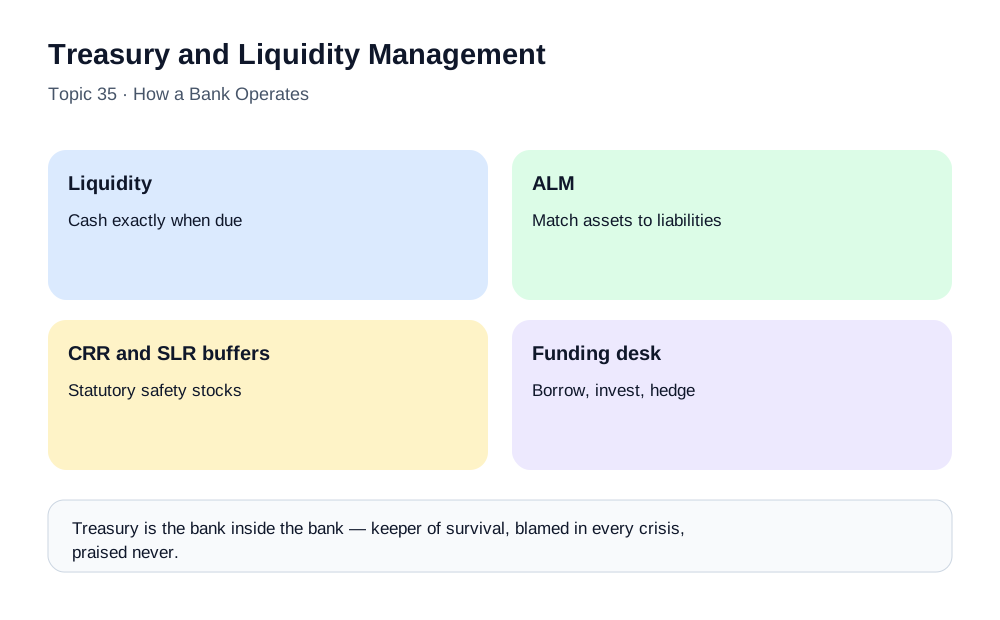
Treasury and Liquidity Management at a glance — ALM, CRR, SLR, liquidity ratios.
1. Introduction: The Bank Inside the Bank
The treasury function serves as the financial command center of every bank. While customers see branches, loans, and deposits, the treasury ensures the institution itself maintains sufficient resources to meet every obligation, every day, while generating returns on surplus funds. This internal management of the bank's own balance sheet is as critical to survival as any customer-facing activity. Treasury mistakes have destroyed banks more surely than any external competitor.
Learning objectives. By the end of this chapter you should be able to:
- Describe treasury's four core responsibilities and how they interconnect
- Explain maturity transformation and why it makes liquidity risk structural
- Interpret the LCR and NSFR and the stress logic behind them
- Explain CRR and SLR-style statutory requirements and their costs
- Read ALM gap analysis and understand how treasuries close the gaps
- Analyse the investment portfolio's three purposes and the duration trap that struck in 2023
- Explain funding operations, funds transfer pricing, and why treasury is the bank's internal central bank
The treasury department manages four interconnected responsibilities that together ensure the bank's financial stability and profitability. Liquidity management ensures cash is available when needed, whether for customer withdrawals, loan disbursements, or operational expenses. Investment portfolio management deploys surplus funds in securities that balance return with safety and regulatory requirements. Funding operations raise capital when deposits are insufficient, accessing interbank markets, issuing securities, or borrowing from the central bank. Interest rate risk management protects the bank's profitability from movements in market rates that could squeeze margins or create losses.
2. The Liquidity Challenge
Banks operate through maturity transformation, converting short-term liabilities like deposits into long-term assets like loans. This fundamental banking function creates inherent liquidity risk. Depositors can demand their money immediately, while borrowers repay over years or decades. If too many depositors withdraw simultaneously, the bank may be unable to meet obligations even though its assets ultimately exceed its liabilities.
The daily mechanics are more granular than outsiders expect. Each morning the treasury opens with a projected cash position: expected withdrawals and disbursements, maturing borrowings to roll, settlement obligations at the payment systems, and the buffer's current state. Intraday, the numbers move — a large corporate draws a credit line, a treasury counterparty delays a payment, a payroll wave goes out — and the desk borrows or places short money to end the day square. The week's rhythm adds maturities and auctions; the quarter's adds reporting and stress testing. It is a function of perpetual short horizons guarding an institution with very long ones.
Managing this liquidity conundrum requires continuous monitoring of cash flows and careful matching of inflows with outflows. The treasury tracks expected deposits and withdrawals, loan disbursements and repayments, investment maturities, and operating expenses. They maintain liquidity buffers, highly liquid assets that can be sold or pledged to raise cash quickly. They establish contingent funding sources, credit lines and borrowing facilities that can be drawn when needed.
A bank run, seen from the treasury desk, is a race between two clocks. Outflows accelerate as fear spreads — in the app era, measured in billions per hour (Topic 31's digital physics). Inflows depend on how fast liquid assets convert to cash: central bank reserves are instant; government bonds sell or pledge in hours; loans are effectively frozen. The bank dies when the second clock loses, even if every asset is ultimately sound. Liquidity management is therefore not about profitability at all — it is about making the second clock fast enough that the race is never close.
Regulatory requirements now mandate specific liquidity standards. The Liquidity Coverage Ratio (LCR) requires banks to hold enough high-quality liquid assets to survive a thirty-day stress scenario. This ensures that even under severe pressure, with deposit outflows, credit drawdowns, and market freezes, the bank can continue operating for a month without access to funding markets. The Net Stable Funding Ratio (NSFR) requires banks to maintain stable funding sources, equity and long-term debt, sufficient to support their assets over a one-year horizon. These requirements constrain bank behavior but provide crucial protection against liquidity crises.
A worked sketch makes the LCR tangible. Suppose a bank models $40 billion of stress outflows over thirty days — a run on its uninsured deposits, drawn credit lines, and lost wholesale funding — and expects $10 billion of inflows it can count on. It must therefore hold at least $30 billion of high-quality liquid assets: central bank reserves and government bonds that remain saleable in a panic. The ratio's genius is its pessimism — it assumes the stress happens to this bank now — and its cost: those $30 billion earn safe, low yields, which is why liquidity regulation permanently reduces industry returns and why banks lobby over every runoff assumption. Topic 27 introduced these ratios as guardrails; here they are daily treasury life. The Liquidity Coverage Ratio requires banks to hold enough high-quality liquid assets to survive a thirty-day stress scenario. This ensures that even under severe pressure, with deposit outflows, credit drawdowns, and market freezes, the bank can continue operating for a month without access to funding markets. The Net Stable Funding Ratio requires banks to maintain stable funding sources, equity and long-term debt, sufficient to support their assets over a one-year horizon. These requirements constrain bank behavior but provide crucial protection against liquidity crises.
3. Statutory Liquidity Requirements
Beyond international liquidity standards, national frameworks can impose reserve and statutory liquid-asset requirements. In India, the Cash Reserve Ratio (CRR) requires banks to maintain a prescribed average percentage of net demand and time liabilities with the Reserve Bank of India, while the Statutory Liquidity Ratio (SLR) requires prescribed holdings of eligible liquid assets under the Banking Regulation Act and RBI directions. The ratios are policy and regulatory parameters that can change. As of the RBI's July 2026 published current-rates information, CRR is 3.00% and SLR is 18.00%; learners should verify current RBI data before using these figures operationally. CRR is a monetary/liquidity instrument and prudential requirement — it should not be described as a mechanism that 'funds central bank operations'. SLR also should not be reduced to a guaranteed captive market for government debt: eligible-asset requirements, liquidity management and prudential policy are the more accurate functional explanation.
Reserve and statutory-liquidity requirements affect the composition and opportunity cost of a bank's balance sheet, but it is misleading to say that a combined CRR and SLR mechanically makes only a fixed fraction of each individual deposit 'lendable'. Modern banks create and fund assets through an integrated balance sheet containing deposits, capital, wholesale funding, reserves, securities and central-bank settlement balances. Changes in reserve ratios can alter system liquidity and bank funding conditions, while statutory liquid-asset requirements influence asset allocation and liquidity buffers. Their economic cost depends on the return on required assets, funding structure and prevailing market rates; the relationship to credit supply is real but not a simple deposit-minus-ratios arithmetic identity.
4. Asset-Liability Management
The ALM framework provides the analytical foundation for treasury operations. Banks organize assets and liabilities into time buckets based on when they mature or reprice. Short-term buckets cover the next month, while long-term buckets extend years into the future. By comparing assets and liabilities within each bucket, treasuries identify gaps that create risk.
A numerical sketch shows gap management at work. Suppose a bank's one-year bucket holds $30 billion of repricing assets (floating-rate loans, maturing securities) against $50 billion of repricing liabilities (deposits and short borrowings resetting upward). The negative gap is $20 billion: if rates rise one percentage point, annual interest expense rises about $500 million while asset income rises only $300 million — a $200 million annual margin hit, arriving whether or not a single loan defaults. The treasury's responses are the standard toolkit: lengthen asset duration (buy longer bonds or make fixed-rate loans), lengthen liabilities (issue term bonds, attract longer deposits), or pay fixed on an interest-rate swap that synthetically converts floating funding to fixed. Each response has a price; ALM is the discipline of knowing your gap before the rate cycle prices it for you.
A positive gap occurs when more assets than liabilities mature in a given period. The bank will have surplus funds requiring reinvestment, exposing it to the risk that interest rates may have fallen, reducing future returns. A negative gap occurs when more liabilities than assets mature, requiring the bank to raise new funding at potentially higher rates. The treasury manages these gaps through derivative instruments, swapping fixed for floating rates or adjusting portfolio durations to match liability profiles.
Gap analysis extends to currency exposures for banks operating in multiple markets. Mismatches between assets and liabilities in different currencies create foreign exchange risk that must be hedged through forward contracts, swaps, or natural offsets. The complexity of modern banking requires sophisticated systems that can aggregate positions across products, currencies, and entities in real time.
The 1990s taught the industry why this matters through several emerging-market bank collapses: institutions borrowed cheaply in dollars, lent expensively in local currency, and pocketed the spread — until devaluation doubled the local-currency burden of dollar liabilities while local-currency assets stood still. Currency gaps are rate gaps with a geopolitical amplifier, and they are hedged or limited with the same discipline: the spread between currencies is never free — it is the price of the mismatch risk, and someone always ends up paying it. Mismatches between assets and liabilities in different currencies create foreign exchange risk that must be hedged through forward contracts, swaps, or natural offsets. The complexity of modern banking requires sophisticated systems that can aggregate positions across products, currencies, and entities in real time.
5. The Investment Portfolio
Banks maintain investment portfolios for multiple purposes. Regulatory requirements mandate holdings of government securities. Liquidity management requires holdings of marketable instruments that can be sold or pledged. Income generation deploys surplus funds in higher-yielding assets within risk constraints.
Government bonds dominate bank investment portfolios, particularly in markets with statutory liquidity requirements. These securities offer safety of principal and active secondary markets, though yields are typically modest. Corporate bonds provide higher returns but introduce credit risk that must be managed within overall portfolio limits. Money market instruments, treasury bills, commercial paper, and certificates of deposit offer short-term parking for funds awaiting deployment or meeting seasonal liquidity needs. A common portfolio architecture is the barbell: very short instruments (instant liquidity, minimal yield) at one end and longer, higher-yielding bonds at the other, rather than a uniform middle. The barbell separates the portfolio's two jobs — the short end is pure liquidity, saleable without loss at a moment's notice; the long end is income, accepted as a duration position. Where banks get into trouble is blurring the jobs: letting the 'liquidity' end quietly extend in maturity to chase a few extra basis points, until the buffer is itself a rate bet — the exact confusion that 2023 punished.
Portfolio management involves balancing yield against risk and liquidity needs. The 2023 failure of Silicon Valley Bank stands as the modern textbook of getting all three wrong at once. SVB parked enormous deposit inflows into long-dated, fixed-rate government and agency bonds at near-zero yields — safe from default, lethal from duration. When rates rose sharply, the portfolio's market value collapsed; when uninsured depositors fled, forced sales crystallized the losses, wiping out capital in days. Every element appears in this chapter: maturity transformation, gap risk, liquidity buffers that were actually duration bets, and funding concentration. The lesson treasury professionals now repeat: liquidity assets that lose value when you need them are not liquidity. Safety in a bond portfolio is a joint property of credit quality AND duration — and SVB had only the first. Longer-duration bonds offer higher yields but greater price volatility if interest rates rise. Credit spreads on corporate bonds compensate for default risk but can widen dramatically during market stress. The treasury must construct portfolios that meet regulatory requirements, provide liquidity when needed, and generate returns that support overall bank profitability.
6. Funding Operations
When customer deposits prove insufficient to fund lending growth, treasuries must access wholesale funding markets. The funding ladder is climbed from cheapest to dearest, and the rungs matter: insured retail deposits sit at the bottom (cheapest, stickiest), then wholesale deposits and CDs, then secured funding through repo (cheap because collateralized, but only while the collateral is accepted), then unsecured interbank and bond markets, and finally — the rung you never want to need — the central bank's standing facilities at penalty rates. A bank's funding mix is therefore a public document of its franchise: institutions stuck on the upper rungs pay more for money and are watched accordingly, because markets read heavy wholesale dependence the way Topic 29's analysts do — as run-proneness with a price tag. The interbank market allows borrowing from other banks, typically overnight or for short terms. Repurchase agreements provide secured funding by selling securities with agreements to repurchase them later. Certificate of deposit issuance attracts institutional and retail investors seeking fixed-income products. Long-term bonds provide stable funding for assets with extended maturities.
The cost and availability of wholesale funding depend on the bank's credit rating, market conditions, and regulatory environment. Well-rated banks in stable markets can access funding readily at modest spreads over benchmark rates. Banks with weaker ratings or during market stress may find funding expensive or unavailable, forcing asset sales or contraction of lending. This dependency makes maintaining strong credit ratings and investor relationships a core treasury responsibility.
Treasury trading activities generate additional revenue beyond the basic spread between deposit and lending rates. Money market trading exploits small differences in short-term rates across instruments and maturities. Bond trading positions the portfolio based on interest rate expectations. Foreign exchange trading manages currency exposures and serves customer needs. These activities require specialized expertise and careful risk management, as trading losses can quickly erase earnings from traditional banking. This is why the governance boundary between the liquidity book and the trading book is drawn so sharply (Topic 27's segregation of duties): the liquidity portfolio exists to be sold in a storm and is managed for certainty, while the trading book exists to profit from movement and is managed under VaR limits and stop-losses. Mixing the mandates — letting traders manage the buffer, or treasury 'position' the liquidity book for gain — is among the oldest recipes for institutional embarrassment. The treasury that trades its safety net eventually finds itself performing without one.
The treasury function operates largely invisible to bank customers but determines whether the institution survives stress periods. Banks that maintain adequate liquidity, manage interest rate risk prudently, and diversify funding sources weather economic cycles. Those that pursue yield without regard to liquidity, mismatch maturities excessively, or depend on unstable funding face existential risk when conditions deteriorate. Treasury management is not merely a support function, it is the guardian of the bank's financial integrity.
7. Funds Transfer Pricing: Treasury as the Internal Bank
One treasury mechanism deserves its own section because it quietly governs every product price in the bank: funds transfer pricing (FTP).
FTP is the internal exchange rate at which treasury 'buys' deposits from the deposit-gathering units and 'sells' funds to the lending units. A branch that raises a one-year deposit at 4% might receive internal credit at a 6% transfer rate — a 2% internal margin rewarding the funding franchise. A lending unit borrowing internally at 6% and lending at 10% shows a 4% lending margin. Treasury keeps the residual — and with it, the interest-rate risk, which is the entire point: FTP strips rate risk out of the business units and concentrates it where the hedging tools live.
The mechanism disciplines everything. Loan pricing (Topic 33's stack) starts from the FTP curve, not the raw cost of funds, so every loan automatically carries its maturity-matched funding cost — a ten-year loan is charged ten-year money even if the bank is actually funded by overnight deposits, and the treasury then owns the mismatch it has thereby centralized. Deposit rates, product profitability, and branch scorecards all flow from the same curve. When people call treasury the bank's internal central bank, FTP is why: it sets the price of money inside the institution, and every margin in the bank is measured against it.
8. Common Misconceptions About Treasury and Liquidity
"A profitable bank can't have a liquidity problem." Profitability is about values over time; liquidity is about timing tomorrow. A bank can be solvent on every accounting measure and dead by Friday if outflows outpace its ability to convert assets to cash — the definition of a run, and the reason LCR exists independently of capital rules.
"Government bonds are always safe." No instrument should be treated as universally risk-free. High-quality sovereign securities can have very low credit risk in their own market and are often highly liquid, but sovereign credit quality differs across countries and all fixed-rate bonds can carry material interest-rate and market-value risk. Duration can produce large unrealised or realised losses when yields rise. Treasury therefore distinguishes credit quality, market liquidity, currency risk and duration rather than using the word 'government' as a substitute for risk analysis.
"Treasury is only a profit centre." Treasury can legitimately generate income through balance-sheet management, customer flows and permitted market activity, and organisational models differ across banks. The danger arises when revenue targets override the primary responsibilities for liquidity, funding, structural interest-rate risk, collateral and balance-sheet resilience. Strong governance separates or clearly limits risk-taking mandates so that the institution's liquidity buffer and structural hedges are not quietly converted into speculative positions.
"Liquidity buffers are wasted money." They look idle in calm times because their payoff is existence in bad times. The $30 billion of HQLA in Section 2's example earns little — and is the reason the bank is open to earn anything at all after the next panic.
"Central-bank facilities mean liquidity risk is solved." Central banks can provide important standing or emergency liquidity facilities, but access depends on the applicable framework, eligible counterparties, collateral, operational readiness and pricing. The classic Bagehot principle describes lender-of-last-resort support to solvent institutions against good collateral at a penalty rate, but not every modern central-bank facility is literally priced that way. A bank cannot substitute assumed future central-bank support for sound liquidity buffers, diversified funding, collateral preparation and contingency planning.
"Deposits are stable, so why hedge?" Deposits are stable on average, across cycles, for well-franchised banks — and utterly unstable at the tail, for specific banks, in specific hours. ALM exists for the tail: the gap you do not hedge is the gap that prices itself during your worst week.
9. Frequently Asked Questions
What is the difference between the liquidity book and the trading book? Purpose and measurement: the liquidity book holds assets to be available in stress — managed for certainty of value, usually at amortized cost or FVOCI (Topic 30) — while the trading book holds positions to profit from price movement, marked to market daily under strict limits. The boundary between them is a regulatory and governance wall, and the disasters begin when it is quietly crossed.
What does a bank treasurer actually do all day? Watch the clocks: today's settlement obligations, this week's expected flows, the buffer's composition, funding maturities to roll, gaps repricing with the rate outlook, and the market's pricing of the bank's own credit. Plus the standing governance — ALCO meetings, limit reports, contingency funding plan tests — that keeps the machinery honest before it is needed.
What does 'ending the day square' mean for a treasury? Closing with settlement accounts balanced: every obligation at the payment systems met, the reserve position within target, and overnight borrowing or placement used to neutralize the residual. Square days are the function's heartbeat — a treasury that cannot square today does not get the luxury of planning for next quarter.
What is ALCO? The Asset-Liability Committee: the senior committee (CFO, treasurer, CRO, business heads) that sets gap limits, approves hedging, steers the FTP curve, and owns the balance sheet's risk posture. If the Board sets risk appetite (Topic 27), ALCO is where that appetite becomes daily decisions.
Why do banks hold so many government bonds — is it just regulation? Partly mandate (SLR-type rules), but mostly function: sovereign bonds are the only deep, liquid, default-safe asset class that exists at the scale bank balance sheets need. They collateralize repo borrowing, satisfy the LCR, and anchor the risk-free yield curve against which everything else is priced. Even unregulated banks would hold them heavily; the mandate merely sets the floor.
How is the LCR different from reserve requirements? Different purposes: CRR/SLR-style requirements are monetary policy and fiscal tools baked into the balance sheet; the LCR is a survival test against a defined 30-day stress, measured in liquid assets rather than reserve balances. A bank meets the first by holding what the regulator mandates, the second by holding what a panic would demand.
Why do banks borrow in the interbank market at all if they have deposits? Timing and composition: deposits arrive unevenly and wholesale funding fills the gaps — overnight for settlement, term for matching long assets. Interbank borrowing is also a signal: the rates a bank pays in that market are the financial system's real-time verdict on its creditworthiness.
What happened in 2023 that changed treasury practice? The US regional bank failures proved that held-to-maturity accounting can hide economic insolvency, that uninsured deposits run at app speed, and that 'liquid' bond portfolios can be illiquid in value when needed. Practice shifted toward shorter duration in liquidity portfolios, more pre-positioned central bank collateral, intraday outflow monitoring, and stress scenarios measured in days, not weeks.
What is a contingency funding plan? The pre-written playbook for the bad week: ranked sources of emergency cash (asset sales, secured borrowing, central bank facilities), triggers that activate each, assigned responsibilities, and — critically — regular tests. A CFP written for the first time during a crisis is a biography, not a plan.
Why do central banks lend to banks, and on what terms? As lender of last resort: against good collateral, at penalty rates, to solvent-but-illiquid institutions — Bagehot's nineteenth-century doctrine, still the rule. The penalty rate and collateral haircuts exist to keep the facility a backstop, not a subsidy, and to protect the discipline of maintaining private buffers first.
Who watches the treasury — is it supervised like lending? Intensely: liquidity ratios are reported to regulators frequently (daily in stress, monthly or quarterly in calm), ALCO minutes and limit frameworks are examined, and intraday liquidity has become a supervisory focus since the app-speed runs. Treasury enjoys more operational glamour than audit trails suggest — but on paper it is among the most measured functions in the bank.
What is the difference between liquidity risk and interest rate risk? Liquidity risk is timing: can we pay when obligations fall due? Rate risk is value: do rate moves erode our margins and portfolio worth? They interlock — forced sales turn paper rate losses into realized liquidity crises (the 2023 mechanism) — which is why one committee (ALCO) owns both.
What is FTP in one sentence? The internal price at which treasury buys deposits and sells funds to business units — concentrating all rate risk in one place and making every product's margin honest about its maturity-matched funding cost.
How do stress tests relate to everyday treasury management? Regulatory stress tests are the LCR logic at portfolio scale: simulated combinations of deposit flight, market freezes, and credit losses against the bank's actual positions, forcing proof that buffers and plans survive severe scenarios. For treasury they are not exams but design tools — the scenarios reveal which funding lines vanish first, which assets are truly saleable, and whether the contingency plan's assumptions hold, before reality conducts the test for real.
Can a bank be too liquid? Yes: buffers beyond stress needs drag returns — HQLA yields are low, and every excess billion parked safely is a billion not lent. Liquidity management is an optimization, not a maximization; the art is holding enough for the storm that has not happened and no more than that number honestly requires.
10. Key Terms in This Chapter
- Treasury — the bank's financial command center: liquidity, investments, funding, and rate risk.
- Maturity transformation — borrowing short to lend long; banking's core function and structural risk.
- Liquidity buffer / HQLA — high-quality liquid assets held against stress outflows.
- LCR (Liquidity Coverage Ratio) — 30-day stress survival: HQLA ≥ net stressed outflows.
- NSFR (Net Stable Funding Ratio) — one-year structural funding adequacy.
- CRR (Cash Reserve Ratio) — mandated non-interest balances at the central bank.
- SLR (Statutory Liquidity Ratio) — mandated government-securities holdings.
- ALM (Asset-Liability Management) — bucketed gap analysis and its closure through duration, funding, and derivatives.
- Gap (positive / negative) — the mismatch between repricing assets and liabilities in a time bucket.
- Duration — a bond's rate sensitivity; the hidden risk in 'safe' portfolios.
- ALCO — the committee owning balance-sheet risk posture and the FTP curve.
- FTP (Funds Transfer Pricing) — the internal price of money between treasury and business units.
- Interbank market / repo — wholesale short-term funding, unsecured and collateralized.
- Contingency Funding Plan (CFP) — the pre-tested playbook for liquidity emergencies.
- Lender of last resort — central bank lending against collateral at penalty rates to the solvent-but-illiquid.
- Barbell portfolio — pairing very short liquid instruments with longer income bonds, keeping the portfolio's two jobs separate.
- Liquidity book / trading book — certainty-managed buffer assets versus profit-seeking, marked-to-market positions.
- Funding ladder — the cost-ranked sources of money from insured deposits to penalty-rate central bank facilities.
- Deposit beta — the fraction of a central bank rate change that banks pass through to depositors; historically low in early tightening cycles, which flatters net interest margins, until competition and one-tap digital switching push betas upward.
- Wholesale funding dependence — reliance on market-based borrowing rather than sticky retail deposits; efficient in calm markets but the first funding to evaporate under stress, which is why liquidity rules assign it the heaviest run-off assumptions.
11. Interview Insights: How This Topic Appears in Banking Interviews
"Walk me through what happens in a bank run." The treasury-eye view: rumor or disclosure triggers doubt; the most informed and least insured depositors move first, by app, in size; outflow monitoring flashes red within hours; the desk sells liquid assets and draws committed lines while ALCO convenes; if outflows persist, the CFP activates — asset sales, secured borrowing, central bank facilities — and communications fight the panic itself, since runs are self-fulfilling prophecies. Resolution comes from one of three things: the bank's buffers outlast the fear, the authorities backstop it, or the second clock loses. The entire architecture of this chapter exists to make the first outcome the ordinary one.
"Why can a solvent bank fail?" The timing answer: solvency compares values; liquidity compares clocks. Assets ultimately exceeding liabilities cannot pay this afternoon's withdrawals unless they convert to cash in time. Cite 2023 — solvent-on-paper, dead in days — and close with the regulatory response: LCR for the 30-day storm, NSFR for the structural year.
"What is the LCR and why was it designed that way?" HQLA against 30-day stressed net outflows, built from post-2008 autopsy: crises killed funding before capital. The design choices to name: stress assumptions (not averages), 30 days (long enough to resolve or rescue), and asset quality criteria (what actually sells in a panic). Its cost — permanently lower returns — is the premium on the insurance.
"Explain ALM gap analysis to a non-specialist." Bucket everything by when it reprices, compare each bucket's assets against liabilities, and the differences are your rate bets: negative gap loses when rates rise, positive when they fall. Management closes unwanted gaps with duration, funding tenor, or swaps. The punchline: every bank has rate bets; ALM is knowing yours are the ones you chose.
"What did SVB teach treasury professionals?" Four words — duration is not liquidity. Long fixed-rate bonds bought at zero rates were default-safe and value-fragile; uninsured deposit concentration made the funding fragile too; forced sale crystallized the hidden losses; and the run moved at app speed. Practice changed: shorter liquidity-portfolio duration, pre-positioned collateral, intraday monitoring.
"How does FTP shape what a bank offers customers?" Everything priced internally inherits the FTP curve: loan rates start from maturity-matched funding cost, deposit rates reflect what treasury credits for funds, and product scorecards measure margin after transfer pricing. The customer-facing implication: a bank's product competitiveness is downstream of its funding structure — cheap, sticky deposits become cheap, winning loans.
Summary and Key Takeaways
Treasury is the guardian of the bank's survival — the function that ensures the institution can pay, every day, whatever the cycle brings. The essential points:
- Four responsibilities, one mandate: liquidity, investments, funding, and rate risk — all serving the single goal of solvency-through-time.
- Maturity transformation is the structural wager: lending long against short funding earns the spread and creates the run risk; treasury exists to keep the wager survivable.
- A run is a race of clocks: outflow speed versus asset-to-cash conversion — and in the app era, outflows are measured in billions per hour.
- The LCR and NSFR encode pessimism into law: survive 30 days of stress alone, fund the year stably — permanents costs accepted as insurance premiums.
- CRR and SLR quietly shape economies: mandated reserves and securities pre-empt a fifth or more of deposits, blending safety, fiscal finance, and monetary policy in one mechanism.
- ALM makes rate bets visible and chosen: bucketed gaps, measured and closed deliberately — because unhedged gaps price themselves in your worst week.
- Duration is not liquidity: the 2023 lesson — default-safe bonds can be value-fragile exactly when liquidity is needed.
- FTP makes treasury the internal central bank: one curve prices all money inside the bank, concentrating rate risk where the hedging tools live.
- Boring treasury years are the successful ones: run as a profit center, the function destroys banks; run as a guardian, it is why the bank survives to have customers at all.
- The funding mix is the franchise's public verdict: dependence on the upper rungs of the funding ladder is both a cost and a signal — markets price run-proneness long before regulators act on it.
A fitting way to close: every earlier chapter of this series, whatever its subject, had treasury underneath it. The deposit franchise of Topic 31 is treasury's raw material; the loans of Topics 32–33 are its liquidity sink; the stressed assets of Topic 34 are how its buffers get tested. Treasury is where all of banking's promises come due daily — and the quiet proof that in this industry, survival is not the foundation for strategy. Survival is the strategy.
In the next topic, we follow the bank across borders — foreign exchange in banking: how currencies are traded, how exchange rates touch every international transaction, and how banks manage the risks of a multi-currency world.
Next: Topic 36 — Foreign Exchange in Banking →
<!-- MBA-DEEP-DIVE-START -->Deep Dive: Treasury as the Bank's Survival Engine
A bank treasury manages a problem that never disappears: assets and liabilities have different maturities, repricing dates, currencies and liquidity characteristics, while customers and payment systems expect obligations to be met exactly when due. Treasury therefore sits between the bank's long-term balance sheet and the short-term clock of settlement.
The primary question is not ‘How much cash does the bank have?’ It is whether the bank can generate enough usable liquidity, in the right currency and legal entity, at the right time, under both normal and stressed conditions.
A banking group can be liquid in aggregate and still have a problem if the cash is trapped in the wrong subsidiary, currency or jurisdiction. Treasury management is therefore about location and transferability as much as quantity.
Liquidity starts with today's settlement obligations
Every business day creates a moving schedule of cash flows:
- customer withdrawals;
- salary and corporate payment files;
- card and domestic payment settlement;
- securities purchases and sales;
- derivative margin;
- loan disbursements;
- loan repayments;
- maturing deposits;
- wholesale debt maturities;
- central-bank operations;
- tax and operating payments;
- intercompany transfers.
Treasury forecasts the opening position and updates it as actual flows differ from expectations.
A large corporate drawing ₹2,000 crore of a committed line can materially change the day. So can a delayed securities settlement or unexpected deposit outflow.
The desk needs enough reserves or settlement cash to avoid failing external obligations while also avoiding unnecessary idle balances.
Intraday liquidity is different from end-of-day liquidity
A bank can finish the day with enough cash and still experience an intraday liquidity problem.
Payment and securities systems often require value during the day before expected incoming payments arrive. If a bank delays outgoing payments until incoming funds appear, it can create gridlock for the market and breach service expectations.
Intraday liquidity management therefore monitors payment queues, collateral, central-bank credit where available, timing of large customer flows and system cut-offs.
The important metric is not only ‘end-of-day reserve balance’. It is maximum intraday funding need.
For a payments-heavy bank, intraday stress can be one of the largest liquidity requirements even though the position disappears by close of business.
Legal entity matters in a banking group
Suppose a banking group has ₹5,000 crore of surplus liquidity in one foreign subsidiary while its Indian bank urgently needs ₹1,000 crore.
The group cannot assume funds can be transferred instantly. Local liquidity requirements, capital rules, tax, currency controls, board approvals, ring-fencing, resolution requirements and market conditions may restrict movement.
Treasury therefore manages liquidity by legal entity and currency, then considers what can genuinely be transferred.
This becomes critical during stress because regulators may protect local depositors by limiting upstreaming of funds from subsidiaries.
Group-level dashboards should never hide local shortages.
Currency liquidity is not the same as FX market value
A bank may be solvent in rupees but owe dollars today. Holding equivalent rupee assets does not automatically meet the dollar obligation.
Treasury can obtain foreign currency through deposits, interbank borrowing, FX swaps, secured funding, correspondent balances or asset sales, subject to market access.
In calm markets, converting currencies can be easy. During stress, FX swap markets can become expensive or unavailable.
A bank should therefore stress currency-specific liquidity and maintain reliable sources for material currencies rather than assume conversion will always work at normal spreads.
The liquidity buffer should be usable, not merely eligible
Regulatory HQLA classification is important, but treasury also asks whether the bank can operationally monetise the assets.
A government security may be high quality but still fail as an immediate liquidity resource if it is:
- already pledged elsewhere;
- held in a legal entity that cannot transfer cash;
- subject to settlement delay;
- not pre-positioned at the central bank;
- denominated in the wrong currency;
- operationally inaccessible because of a system outage.
The difference between eligible liquidity and operationally available liquidity becomes visible only in stress.
Treasury therefore tracks encumbrance, custody location, settlement account, collateral eligibility and monetisation time.
Pre-positioning collateral buys time
Central-bank facilities and secured markets often require collateral to be delivered or pledged. Waiting until a run begins to identify, value and mobilise collateral can waste critical hours.
Banks therefore pre-position assets where appropriate, maintain completed documentation and test access operationally.
A contingency funding plan should answer:
- which facilities are available;
- which assets are eligible;
- how much can be borrowed;
- which haircuts apply;
- who can authorise use;
- how quickly cash arrives;
- what operational system is required;
- whether using the facility creates disclosure or market consequences.
A facility that exists only in a policy document is not reliable liquidity.
LCR is a minimum stress framework, not the bank's whole liquidity model
The Liquidity Coverage Ratio compares a stock of high-quality liquid assets with net cash outflows under a prescribed thirty-day stress framework, subject to the Basel and local implementation rules.
The LCR provides a common regulatory baseline. Banks should not assume that staying above 100% means every liquidity scenario is safe.
Real stress can differ from regulatory assumptions. Deposit outflows can be faster. Collateral calls can be larger. Foreign-currency needs can be concentrated. Operational incidents can block access to liquidity.
Internal liquidity stress testing therefore supplements the regulatory metric.
A bank should understand both regulatory survival and its own idiosyncratic survival horizon.
NSFR focuses on structural funding
The Net Stable Funding Ratio is designed to encourage a sustainable funding profile over a one-year horizon by comparing available stable funding with required stable funding under the regulatory framework.
Its economic logic is simple: illiquid or long-term assets should not be financed excessively with funding likely to disappear quickly.
A thirty-year mortgage book supported almost entirely by overnight wholesale borrowing could look liquid today but be structurally fragile.
NSFR pushes the institution toward deposits, capital and longer-term funding appropriate to the assets it holds.
Again, the regulatory ratio is a framework, not a substitute for understanding behavioural maturity and concentration.
Survival horizon makes stress tangible
A practical internal metric is survival horizon: how long the bank can continue meeting obligations under a defined stress scenario without access to specified new funding sources.
Consider a scenario with:
- rapid corporate deposit runoff;
- retail deposit outflow;
- committed credit-line drawdown;
- derivative margin calls;
- loss of unsecured wholesale funding;
- reduced secured-funding capacity;
- rating downgrade;
- collateral haircut increases.
Treasury projects cash day by day.
If cumulative outflows exceed available liquidity on day twelve, the survival horizon is twelve days under that scenario. Management can then ask what actions extend it: sell assets, obtain central-bank liquidity, slow new lending, raise term deposits, issue secured funding, or execute contingency measures.
The metric turns abstract stress into a management clock.
Deposit concentration should be part of treasury, not only retail banking
Treasury needs to know who can withdraw money, how much, and how fast.
The top twenty depositors may matter more than the average deposit balance. Corporate treasurers, financial institutions, fintechs, government entities and high-net-worth customers can behave differently from households.
Useful views include:
- insured versus uninsured or uncovered balances;
- operational versus non-operational balances;
- customer concentration;
- sector concentration;
- maturity concentration;
- digital transfer capability;
- relationship depth;
- historical stress behaviour.
A deposit base is diversified only when decision-makers are diversified, not merely account numbers.
Wholesale funding diversification requires more than multiple instruments
A bank can issue certificates of deposit, commercial paper, senior bonds, covered bonds, repo and interbank borrowing. That looks diversified, but if all instruments depend on the same group of investors or collateral, the funding sources may fail together.
Treasury should examine:
- investor type;
- market;
- maturity;
- currency;
- secured versus unsecured;
- collateral dependency;
- rating triggers;
- rollover concentration;
- geography.
A maturity wall where large bond issues fall due in one quarter can create refinancing risk years after the original funding was raised.
Terming out funding early can be expensive, but waiting until the maturity date is more dangerous.
Asset encumbrance creates hidden liquidity constraints
An asset is encumbered when it is pledged or otherwise unavailable for unrestricted use because it supports a funding or collateral obligation.
A bank may own ₹10,000 crore of securities but have ₹7,000 crore pledged to repo, derivatives or central-bank operations. Only the unencumbered portion remains freely available for another liquidity need, subject to eligibility.
Treasury should therefore report gross liquid assets, encumbered assets and freely available liquidity separately.
During stress, increasing secured borrowing generates cash but also increases encumbrance. The bank can become more dependent on the remaining unpledged collateral.
Haircut risk can shrink secured funding suddenly
Suppose a bank can normally borrow ₹95 against ₹100 of eligible securities — a 5% haircut.
If market stress causes the haircut to rise to 15%, the same ₹100 of collateral supports only ₹85 of funding.
The bank needs additional collateral or must repay part of the borrowing.
This is why liquidity stress tests should combine market-value shocks with haircut shocks. Collateral can lose value and become less financeable at the same time.
Interest-rate risk has two main lenses: earnings and economic value
Structural interest-rate risk in the banking book is commonly analysed through both net interest income sensitivity and economic value sensitivity.
NII analysis asks how interest income and expense change over a defined horizon when rates move.
Economic value analysis asks how the present value of assets, liabilities and off-balance-sheet positions changes when the yield curve moves.
A bank can look comfortable under one lens and exposed under the other.
For example, long fixed-rate mortgages funded by non-maturity deposits may produce strong current NII. A sharp rate increase can still reduce the economic value of the mortgages substantially.
Treasury therefore needs both short-term earnings and longer-term value perspectives.
Repricing gap is useful but incomplete
Basic gap analysis places assets and liabilities into time buckets based on maturity or repricing. It is a useful first view but can miss optionality and behavioural assumptions.
A mortgage customer may prepay. A savings depositor may not reprice immediately. A term depositor may break early. A loan commitment may be drawn. A bond can contain an embedded call option.
Modern ALM therefore uses cash-flow models, duration, scenario analysis and behavioural models in addition to static gaps.
The spreadsheet bucket is a starting point, not the final risk measure.
Deposit optionality belongs in IRRBB
Non-maturity deposits have customer options: withdrawal timing is not fixed, and the bank controls pricing subject to competition and contract.
Treasury models both balance behaviour and rate behaviour.
If the bank assumes deposits remain for five years but customers leave after six months, duration is overstated. If it assumes the deposit rate barely changes when market rates rise but customers demand repricing quickly, earnings sensitivity is understated.
These assumptions should be validated against historical behaviour and stressed for structural change, especially as digital competition makes deposits more mobile.
Mortgage prepayment changes asset duration
Borrowers tend to refinance or prepay mortgages when rates fall, subject to local product terms and refinancing economics. When rates rise, prepayment may slow.
This means the bank’s fixed-rate mortgage portfolio can shorten when reinvestment yields are low and lengthen when market yields are high — an unfavourable pattern known as negative convexity in many mortgage contexts.
Treasury can manage this risk with product pricing, hedges, securitisation or portfolio composition.
The customer’s right to prepay is therefore also an embedded option on the bank’s balance sheet.
Transfer pricing should include liquidity and optionality
Funds transfer pricing should not use one average ‘cost of funds’ for every product.
A one-month loan and a ten-year mortgage consume different funding and liquidity. A stable retail deposit and a rate-sensitive corporate deposit provide different value.
A sophisticated FTP curve can include:
- matched maturity funding rate;
- liquidity premium;
- behavioural maturity;
- optionality;
- reserve costs;
- basis risk;
- currency;
- other balance-sheet adjustments.
This makes product profitability more economically meaningful.
If every loan receives the overnight funding rate internally, long-term lending units will appear artificially profitable and create excessive duration risk.
Treasury should distinguish banking book from trading intent
Banks can hold securities for liquidity, investment, customer facilitation or trading. Governance should make the purpose clear.
A liquidity portfolio should not quietly become a speculative duration position because yields are attractive. A trading book should not be used to hide structural ALM exposure.
Accounting categories, regulatory trading-book rules, risk limits and management mandates interact but are not identical concepts.
The core control is that risk-taking intent is explicit, limited and independently monitored.
Investment portfolios have at least three jobs
A bank securities portfolio can serve:
- liquidity;
- regulatory or collateral needs;
- income and structural balance-sheet management.
One security can perform more than one role, but treasury should know which role is primary.
A thirty-year fixed-rate bond may offer attractive yield but be a poor first-line liquidity asset if its market value is highly sensitive to rates. A short government bill may be excellent liquidity but produce little income.
Portfolio construction is the deliberate compromise among return, duration, credit quality, market liquidity and collateral usability.
2023 showed why credit-safe is not liquidity-safe
The failure of Silicon Valley Bank highlighted the interaction of concentrated deposits and interest-rate risk. Long-duration high-quality securities can suffer large fair-value losses when rates rise. If depositors then withdraw rapidly, the bank may need to sell assets and realise losses.
The lesson is not ‘government bonds are unsafe’. It is that credit quality, duration, accounting classification and liquidity need must be managed together.
A security suitable to hold to maturity may be unsuitable as the asset the bank expects to sell during a run.
Treasury should stress the sale value of liquidity assets under the same scenarios that generate deposit outflows.
Central-bank reserves and securities serve different liquidity roles
Central-bank reserve balances, where applicable, are immediately usable settlement assets. Securities need to be sold or pledged before they become settlement cash.
Both can be high-quality liquidity, but their time to cash differs.
A bank with large securities holdings but low reserve balances may need robust repo, market-sale or central-bank collateral processes to meet intraday obligations.
Operational readiness therefore connects treasury with payments operations and settlement systems.
Margin and collateral liquidity can dominate during market stress
Banks using derivatives and secured funding exchange collateral as market values move.
A sharp interest-rate or FX movement can generate large variation-margin calls even if the bank’s overall economic hedge is working.
The institution may be economically protected but still need cash today to meet margin.
Treasury should therefore include collateral calls in liquidity stress tests and understand which assets counterparties accept.
This is one reason a ‘perfect hedge’ can still create liquidity stress.
Contingency funding plans need triggers and actions
A contingency funding plan should not be a list of possible funding sources. It should define when management changes behaviour.
Possible early triggers include:
- deposit outflow above threshold;
- widening wholesale funding spreads;
- reduced secured-funding tenor;
- collateral haircut increase;
- rating downgrade;
- falling LCR or internal buffer;
- unusual payment queue behaviour;
- large committed-line drawings;
- social-media or market concern;
- deterioration in stock or bond prices where relevant.
Actions can be staged: increase monitoring, stop non-essential asset growth, raise funding, monetise securities, increase collateral, communicate with supervisors, activate central-bank arrangements and invoke crisis governance.
The plan should specify decision rights so hours are not lost arguing about authority.
Liquidity stress communication must be controlled
Confidence is part of bank funding. Poor communication can accelerate a run.
Treasury, investor relations, communications, senior management, legal and regulators may need coordinated messaging during stress.
Statements should be factual and avoid creating commitments the bank cannot support. At the same time, silence can allow rumours to dominate.
The operational response matters more than public reassurance: if the bank claims strong liquidity while customers experience payment delays, credibility collapses.
A complete treasury day
Imagine a bank opens with ₹4,000 crore of usable settlement liquidity.
Expected outflows include ₹2,500 crore of customer payments, ₹1,000 crore of securities settlement and ₹500 crore of maturing wholesale debt. Expected inflows include ₹1,800 crore of customer receipts and ₹700 crore of loan repayments.
The forecast closing position appears positive.
At 10:30 AM, a large corporate unexpectedly draws ₹1,200 crore from a committed facility. At noon, a ₹600 crore securities receipt is delayed. Derivative markets move sharply and the bank receives a ₹400 crore margin call.
Treasury now has an unexpected ₹2,200 crore shortfall versus forecast.
It uses pre-positioned government securities to obtain secured intraday or short-term liquidity, adjusts money-market borrowing, and coordinates payment timing without breaching obligations. Risk and ALM update the stress view. Management is informed because the event crosses a liquidity threshold.
By end of day, the delayed security receipt arrives and some funding is repaid.
Nothing appeared in the news. No customer noticed. That is successful treasury.
What excellence looks like
A world-class treasury knows its cash position by legal entity, currency and time bucket. It models behavioural deposits and validates those assumptions. It manages intraday as well as thirty-day liquidity. Collateral is pre-positioned and encumbrance is visible. Funding is diversified by investor, instrument, maturity and currency. LCR and NSFR are treated as regulatory floors, not the whole risk framework. Interest-rate risk is measured through both earnings and economic value. FTP transfers structural risk to the function equipped to manage it. Contingency funding plans are operationally tested.
The deepest lesson is that treasury is the function that makes every other banking promise possible. A loan officer can create a profitable asset, a payment team can send a valid instruction, and a deposit product can attract customers — but treasury ensures the bank itself has the settlement assets, funding and resilience to honour all of those promises when they become due.
<!-- MBA-DEEP-DIVE-END -->